Author: Onnik Krikorian

  • Azerbaijan: Reflections on Novruz

    4425506810_2d27dc4455_novruz_flag

    If I keep a green bough in my heart, then the singing bird will come… by ♥ Lala ♥

    This weekend marked the official start of Novruz, the Zoroastrian holiday marking the beginning of spring. Celebrated in many countries where Iranian influence has been strong, preparations started long before the actual festival, as last year's post on Global Voices Online detailed. In Azerbaijan, as elsewhere, Novruz is eagerly awaited and popular among foreigners and locals alike.

    This year, for example, a number of Peace Corps Volunteers (PCVs) in the largest of the South Caucasus countries celebrated the event with Lost in Azerbaijan providing a thorough introduction to the holiday.

    Today marks every Azerbaijani’s favorite day of the year: Novruz.

    Novruz takes place on March 20-21st but the entire month prior to today people are preparing and anticipating the holiday.

    Novruz means “new day” and is the start of the New Year in the Iranian calendar, welcoming spring, new life and a fresh start. It’s technically an Iranian holiday but celebrated by many Islamic cultures. Throughout the past month Azerbaijani’s have been cleaning out and painting their houses, planting trees in their yards, cooking special dishes and visiting friends and relatives.

    During the Soviet Union Novruz was prohibited and people were persecuted for following the traditions. Now all Azerbaijani’s proudly celebrate and look forward to this time of the year.

    The four Tuesdays prior to the holiday each have a name: Water (to purify), Fire, Wind, and Earth (new life). On each of these evenings at dusk families make small bonfires in their yard and everyone takes a turn jumping over the fire seven times reciting “Give me your redness and take my yellowness” which means “Take my hardships, give me your lightness.” […]

    Perhaps the symbol most associated with Novrus is the sprouted wheat called “samani’. These grass seeds are grown on a plate prior to Novruz and can by close to half a foot tall on the holiday. Each family usually places the samani on the center of their table with a red ribbon tied around it.

    semeni011

    Happy Novruz! Happy Spring, everyone! Wishing you peace, health, prosperity and wonderful new beginnings! by AZ Cookbook

    Aaron in Azerbaijan tells his readers that they're “missing out on the knowledge of a tradition that stretches back a few thousand years, in dozens of countries throughout Asiaon the last Tuesday before Novruz.

    Last night was the last Tuesday (Çərşənbə) of Novruz. That means that Miri, my host mom, and a random friend, Orxan, set about jumping over fires (for Novruz, you celebrate each of the four Tuesdays leading up to March 20/21. […] Apparently, you’re supposed to jump over fire seven times, so we lined up seven piles of the straw-type stuff and lit ‘em up. We jumped over each one and I did a few extra rounds for folks who weren’t here to enjoy the fun of jumping flames. […]

    In last year's post about Novruz on Global Voices Online, one Armenian commented and noted the similarities between the holiday and her own Trendez, another Zoroastrian holiday absorbed and changed by the Church when Armenia adopted Christianity in 301AD.

    This year, the similarities prompted an interesting discussion on Twitter between an ethnic Armenian and Azerbaijani.

    novruz

    Indeed, in her own post, Ianyan comments on Novruz, detailing the shared cultural influences in the region as well as her own personal identity.

    I would be lying if I said that I solely identified myself as an Armenian. With my family from Tehran and a maternal grandmother from Tabriz who spoke Armenian, Farsi and Turkish, I have as much Iranian influence running through my veins as I do Armenian and American.

    My parents grew up during a time in Iran when life was good. […]

    As Armenian as they were, they were also Persian and everything – from the food, to the music, to the traditions have been passed down to my sister and I in the most charming way. Not because it was forced, or written into our daily lives, but because we were genuinely interested.

    […]

    To me, being Armenian doesn’t symbolize an all inclusive club where only one set of traditions are observed and one language spoken. We are an amazingly diverse group of ancient people, who have, through the years, influenced and been influenced by a set of beautifully rich and magnetizing cultures, and denying this would be doing a disservice.

    I guess what I’m trying to say is that simply speaking, diversity is good. Embrace it. […]

    Happy New Year!

    img_3579

    the haft sin table/ © ianyanmag

  • Armenia: Women

    Emily Haas' Armenian Experience, a blog by a Peace Corps Volunteer (PCV) in the former Soviet republic, post photographs and an insight into the lives of women in Armenia. The blog says that the project is to “show how hard the women in Armenia work and the important and overlooked role they hold in society.” Meanwhile, Ianyan has started to publish a series of posts on what it means to be a woman in general.

  • Azerbaijan: Appeal court upholds ruling against video blogging youth activists

    Rufatagayev tweets that an appeal court in Baku, Azerbaijan, today upheld a previous court ruling sentencing two video blogging youth activists to 2 and 2.5 years in prison. Most observers consider the case again Adnan Hajizade and Emin Milli to be politically motivated and Amnesty International have since declared the two men to be prisoners of conscience.

  • Azerbaijan: Confusion over Internet problems with Azadliq site

    rfe-rl_logoIn the past few days in Azerbaijan, some users have complained that many sites, including Yahoo Mail, Gmail and Facebook, were inaccessible. In a region such as the Caucasus where the Internet is less than reliable at the best of times, such things can happen.

    However, because the problems also included users having problems accessing the web site of Radio Free Europe's Azeri service, some automatically assumed it was a government block. Azadliq was prevented from broadcasting on radio frequencies at the beginning of last year after controversial legislation effectively banned foreign stations from doing so.

    Such fears were probably also well founded given Azadliq's publication of reports related to last week's exposé by the Washington Post concerning apparently suspect real estate deals in Dubai by the family of the president, Ilham Aliyev.

    azadliq_0001

    Word of the apparent problems also spread on Facebook, with some reporting that it only affected some secondary providers. Indeed, when Global Voices Online contacted several Internet users in Azerbaijan, they reported experiencing no problems at all.

    Some even chatted over Gmail chat and sent mails from Yahoo at the same time as others reported the sites were inaccessible or not working properly while one even updated his status advising on how they could access the site.

    facebook_0001

    When typing www.azadliq.org instead of Azadliq.Org it opens. Check it!

    Problems were occurring, however, pushing the Institute for Reporters Freedom and Safety (IRFS) to publish a news item.

    Restriction of access to Radio Liberty website from several internet providers operating in Azerbaijan including Bakinternet”, “Azeronline”, “Uninet”, “Ultel”, “Connect” and “Adanet” is continuing.

    The “Facebook” social network disseminated information regarding this. The Institute for Reporters` Freedom and Safety conducted an investigation into this issue. “Ultel” provider told IRFS that the problem is linked to the website itself.

    “Connect” provider’s operator Tofig Huseynov said that “Connect” did not impose any restriction on access to Radio Liberty website.

    “Azeronline” representative on customer services Tural Omarov said that it is possible to access website by writing www at the beginning of azadliq.org.

    Yesterday, IRFS published a statement based on some of the Facebook user reports.

    The Institute for Reporters` Freedom and Safety condemns the restriction of access to Radio Liberty’s website by internet providers operating in Azerbaijan and assesses this as censorship by Azerbaijan government on the internet indirectly.

    On 6 March, at 3:00 p.m., access to Radio Liberty’s website from several internet providers operating in Azerbaijan was restricted. Comprehensive information regarding this issue was disseminated on the “Facebook” social network. This restriction is still being continued.

    IRFS does not rule out the possibility that due to the fact that an Azeri version of the critical article regarding Azerbaijan leadership published in the Washington Post was put onto Radio Liberty’s website is the reason for this censorship.

    However, when Global Voices Online contacted two Internet specialists in Azerbaijan asking for their opinion, they ruled out the possibility of a government block, and not least because several other sites of a non-political nature were inaccessible and it anyway only affected a few ISPs.

    Another specialist even updated his Facebook status.
    azadliq_0002

    The problems encountered within a few days while entering Azadliq Radio and at the same time a number of other sites have nothing to do with providers – the problem was caused by a temporary technical glitch in the communication channel between Delta Telecom and Turk Telekom.

    osi

    You don't want to help anybody. The only thing you do in our country is money laundering and act as a political destabilizer. That's the end. Happy Women's Day dear ladies.

    Because of the confusion and differing opinions on why and to what extent Azadliq was inaccessible, Global Voices Online contacted one European visitor to Baku, the Azerbaijani capital, to ask for further assessment, especially as the web site of the Open Society Institute (OSI) had been hacked at roughly the same time.

    osi_fb

    At time of writing, while some allege a block and technical specialists and others who could access the sites in question dispute such speculation, the reality is that confusion prevails. However, similar problems were encountered in Turkey a week earlier with Facebook at least, perhaps backing up the opinion of the technical specialists that there was no block.

    Nevertheless, with two video blogging youth activists currently in prison and more activists going online, fears over the possibility of online censorship in the future are very real indeed. Meanwhile, there is no consensus of opinion as to the reason for some users experiencing difficulties in accessing Azadliq and other sites.

    Thanks to A. for translation from Azerbaijani into English.

  • Azerbaijan: Youth, human rights and the Blogosphere

    HumanRightsUN posts a video of part of the presentation made by Ruslan Asadov, co-founder of the OL! Azerbaijani Youth Movement [AZ/EN], at the Geneva Summit for Human Rights, Tolerance and Democracy. One of the other co-founders of OL!, video blogging youth activist Adnan Hajizade, is currently in prison on what most observers consider politically motivated charges. OL! has also uploaded an English version of its promotional video. The full segment on Young Rights Defenders and the Blogosphere from the conference (split into ten parts) can be found here.

  • Armenia: S.O.S. Save Cinema Moscow’s Open Hall

    Unzipped comments on plans to demolish Yerevan's only open air cinema hall to make room for the construction of a new church. Although the cinema itself was constructed after the demolition of a previous church standing in the same spot, the blog says that there are enough churches in the capital and all focus should be on saving what it considers to be one of the finest buildings in the city.

  • Armenia: International Women’s Day

    Ianyan marks International Women's Day with an extended post reflecting on gender in Armenia and its Diaspora. The blogger examines several issues related to Armenian women including marriage, education, work, and sex.

  • Armenia-Turkey: Response to U.S. Genocide Resolution

    armenia_genocide_memorial

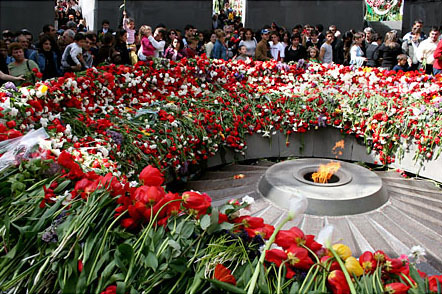
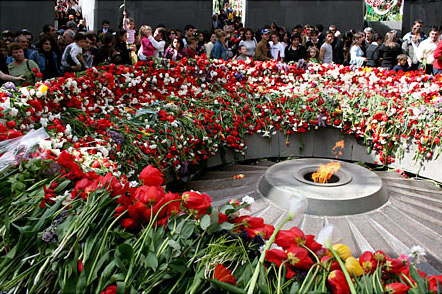
    Tsitsernakaberd Genocide Memorial, Yerevan, Republic of Armenia © Onnik Krikorian 2008

    Following last week's non-binding resolution narrowly passed by a congressional Foreign Affairs Committee urging the US government to recognize the 1915 massacre and deportation of Armenians in the Ottoman Empire as Genocide, reaction in the blogosphere appears to be muted, including from those Armenian sites which have covered the issue for years.

    Nevertheless, what does exist is mostly negative or neutral — although not necessarily reflective of comments or posts, and even no reaction at all, on closed networking sites such as Facebook. Typical of most comments made there, Life in the Armenian Diaspora sums up that reaction.

    Armenians around the world are celebrating again…. […]

    […]

    Again, the White House wasn't able to stop this. Turkey wasn't able to stop it with their threats about relations, borders, protocols etc. I said it two years ago and I'll say it again now. EMPTY THREATS – CALL THEIR BLUFF! Turkey can not afford to lose the U.S. as an ally. They recalled their ambassador then and they recalled him now. BIG DEAL!

    turkish flag

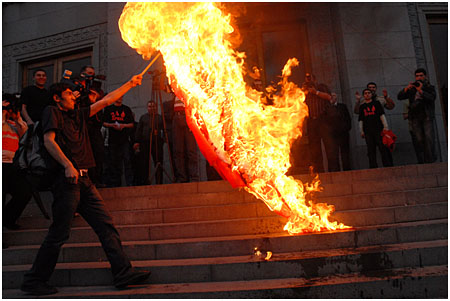
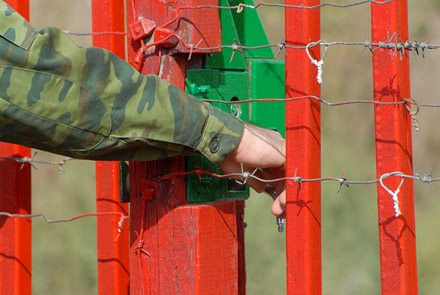
    Armenian Revolutionary Federation (ARF) activists burn the Turkish flag, Yerevan, Republic of Armenia © Onnik Krikorian 2008

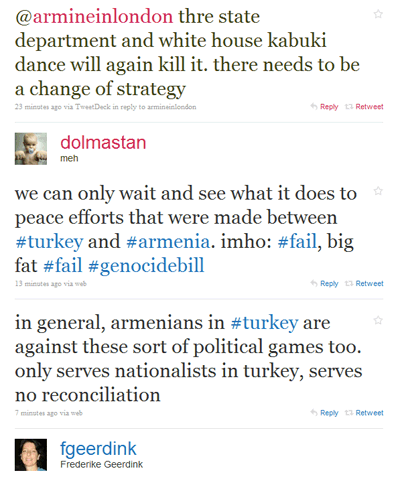
    However, and in sharp contrast with previous years when similar resolutions were passed, other alternative voices are making their voices heard. Ianyan, for example, is uncertain as to what next this all means for her as an ethnic Armenian living abroad.

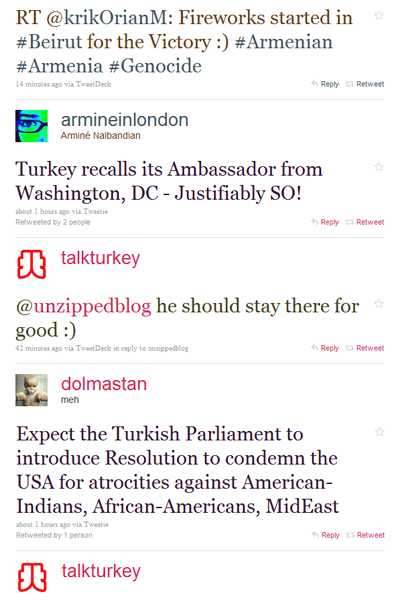
    Right after the vote, Turkey recalled its Ambassador, Namik Tan, back for consultations, Armenian publications swiftly posted the news, status updates and tweets exploded with joy and disappointment on both sides and the Obama administration, who had urged the committee to vote against the resolution, said it will seek to block the bill from coming into fruition.

    […]

    As for me, for a moment, I was shocked and surprised, although I probably shouldn’t have been. A similar resolution passed through the same committee in 2007 and was later successfully blocked from ever amounting to anything.

    […]

    While we sit in free countries, in our warm houses and flashy cars in our garages, many in Armenia are still suffering from economic turmoil and poverty . There is corruption and discrimination and much more that we, thousands of miles away, have the good fortune to not see. Most diaspora Armenians have never even met a Turk, nor do they want to. […]

    Do I need the U.S. government to recognize the genocide? Maybe, but I don’t feel any less Armenian, I don’t feel like something is missing if they don’t. My feelings could very well be the result of it not being recognized for so long, who knows.

    […]

    The answer still is, for me, “I don’t know.”

    armenian_turkey_border

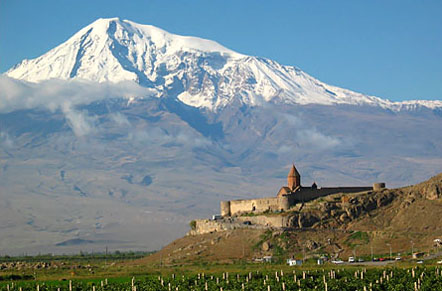
    Armenian-Turkish border, Khor Virap, Ararat Region, Republic of Armenia © Onnik Krikorian 2005

    Another Armenian blog, Global Chaos, however, is more critical, especially in light of a more pressing issue facing Armenia – the threat of renewed conflict with neighboring Azerbaijan over the disputed territory of Nagorno Karabakh.

    Yes, they made a full circle and we are seeing the whole Armenian Genocide Resolution circus played out all over again. No, I'm not happy with what happened yesterday. I'm very concerned, and I don't think it's going to have ANY positive outcome for Armenia. On the contrary, it might, and I'm afraid, it will only make things worse.

    […]

    American-Armenians are all upbeat about it. They learned well how to play this game called “American politics” and they want to stay politically relevant, especially this year, when the mid-term elections might turn out to be unusually interesting. […] But where's Armenia in this equation?

    […]

    There is evidently a disconnect between the Diaspora, which, quite understandably, clings to the Genocide problem as a basis for its identity, and the Armenian state, which is striving to survive, attain stability, and establish itself as a significant player on the international arena. […]

    […]

    Perhaps it's high time the Armenian government stops relying on the Armenian-American lobby to do both advocacy and public diplomacy in the US on its behalf? […] Yes, it is very commendable. But, it is also detrimental for Armenia, since the foreign policy of one of the most influential countries in the world toward it is being dominated by an issue the significance of which many, on both sides, don't even understand anymore.

    Again, I am not saying that the Genocide should be neglected or forgotten. What I'm saying is that the focus should switch, since with the resolution of the Karabakh problem might just open a leeway for more constructive and reconciliatory dialogue on the Genocide as well. If the Diaspora lets Armenia be, that is…

    The blog also raises concerns that such a resolution will increase the level of nationalism in Turkey, something that seems borne out by one Turkish blog, Talk Turkey.

    Do the Armenians really think that some soiling-their-pants Congressmen care about the Armenians' plight? Was this part of a ploy, a plan of pushing Turkey off-track and into radicalism, alienating the ‘model' integration of secularism and Muslim-ness, and thereby prove to the ‘world' that a moderate Islam doesn't exist?

    […] I am now definitely not in a reconciliatory mood any longer. In fact, I say ‘let the games begin!'

    memorial

    Tsitsernakaberd Genocide Memorial, Yerevan, Republic of Armenia © Onnik Krikorian 2008

  • Armenia-Turkey: US Congressional panel adopts Genocide resolution

    armenia_genocide_memorial

    Tsitsernakaberd Genocide Memorial, Yerevan, Republic of Armenia © Onnik Krikorian

    In what turned out to be a nail-biting vote, the US congressional House Foreign Affairs Committee today voted on a non-binding resolution recognizing the massacre and deportation of Armenians living in the Ottoman Empire as Genocide. Although accepted as such by many other countries, as well as by most historians, previous attempts to translate resolutions into actual bills have faltered after officials in Washington warn of the consequences of alienating Turkey, a key ally in the region.

    Last year, citing momentum in attempts to get Armenia and Turkey to resolve their own painful past, US President Barack Obama avoided terming the massacres as Genocide despite pre-election pledges to do so. Since then, however, many analysts consider that Turkey has not fulfilled its promise to ratify two protocols signed in October which would establish diplomatic relations between the two estranged neighbors and establish a historical commission to resolve the issue once and for all.

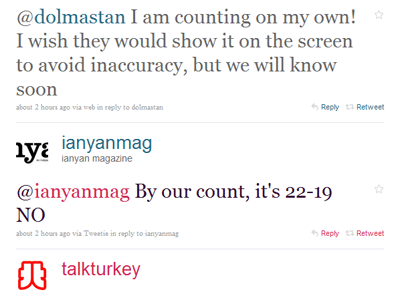
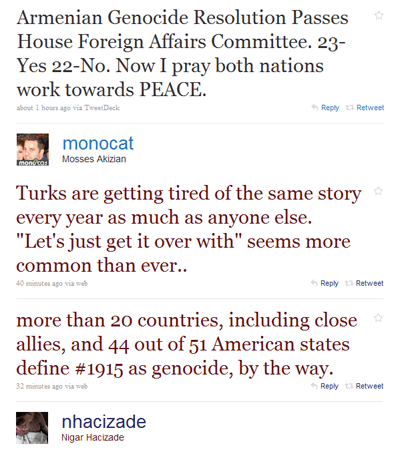
    Eventually, the resolution was passed by 23 votes to 22 and both Armenians and Turks live-tweeted the process, although both were unhappy with persistent delays, despite interpreting them in different ways. Many were also confused by the lack of an immediate vote tally.

    res_0001

    In such confusion, and especially as for most of the vote it was uncertain whether the resolution would pass at all, there was even some limited communication between the two.

    res_0002

    In the end, though, the resolution passed and many Armenians in Armenia as well as its large Diaspora celebrated while others warned of possible repercussions to come.

    res_0003

    One Dutch journalist based in Turkey blogged and tweeted her concerns while some Armenians resigned themselves to certain “realities” in American-Turkish relations.

    res_0005

    margara_0004

    Turkey border gates, Margara, Republic of Armenia © Onnik Krikorian

    Indeed, as this is not the first time such a resolution has been passed, it remains uncertain what will happen next given its non-binding nature, international pressure on Turkey to normalize relations and open its border with Armenia, and key US foreign policy objectives which require Turkish support.

    Even so, some on both sides of the ethnic divide hope that cool heads will prevail. For now, however, few others expect them to, but the situation will be clearer as 24 April, the date Armenians mark the anniversary of the massacres, approaches.

    res_0004

    survivor

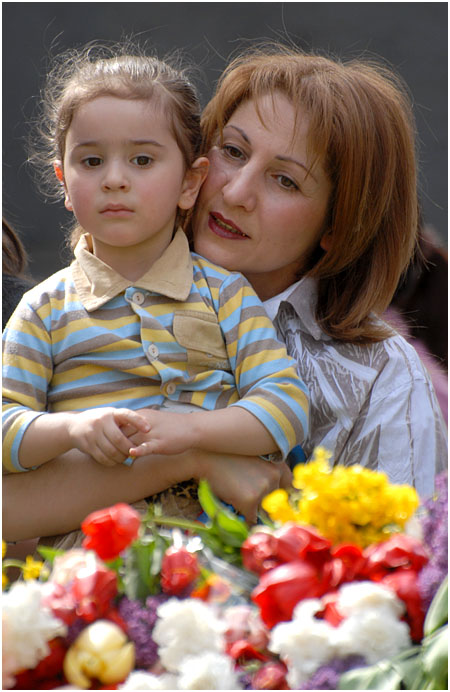
    Genocide survivor, Yerevan, Republic of Armenia © Onnik Krikorian

  • Caucasus: Women’s rights

    Security, in the Caucasus and beyond… prepares for International Women's Day by chronicling key developments in women's rights in the region. However, with many traditional practices slow to die out, the blog says that changes in societal values brought about during the Soviet years have been overturned since independence. In particular, it notes, this includes the custom of women retaining their virginity until marriage, domestic violence, and the resurgence of patriarchy.

  • Azerbaijan: Dusty City

    ANTV, an online citizen media site co-founded by imprisoned video blogging youth activist Emin Milli and recently awarded for its contribution to freedom of the press in the region, posts a video report on the chaotic urban development in Baku, capital of Azerbaijan.

  • Georgia: Social Innovation Camp in the Caucasus

    A web site for the first ever Social Innovation Camp in the South Caucasus has been set up at http://sic-caucasus.net. The event, aimed at promoting the use of social media to implement actual projects for civil society and activists in the region, will be held as part of the Social Media for Social Change conference held at the beginning of April in Tbilisi, Georgia.

  • Azerbaijan: Murdered journalist remembered

    Flying Carpets and Broken Pipelines remembers Elmar Huseynov, an outspoken journalist in Azerbaijan who was murdered in 2005. The blog says that five years later the case remains unsolved.

  • Armenia: Deadly clash anniversary

    Ianyan features a guest post by Fulbright Scholar and blogger Ashley Killough on the second anniversary of the deadly post-election clashes which left 10 dead in Yerevan, the Armenian capital. The post also includes an audio slideshow of the demonstration held to mark the occasion.

  • Azerbaijan: Prominent blogger on the BBC

    Flying Carpets and Broken Pipelines posts a video recorded for the BBC's Blogworld. The blogger, Arzu Geybullayeva, speaks about her own blog, the situation in Azerbaijan, and how blogging has changed her life. Global Voices Online's Caucasus editor also interviewed Geybullayeva here, here, and here.

  • Azerbaijan: Eastern Europe Free Press award

    Recently honored with the European Free Press prize, ANTV [AZ/EN/RU], an online citizen journalism site co-founded by now imprisoned video blogging youth activist Emin Milli, has published details of the award in English. The ZEIT-Stiftung Foundation is reported as saying ANTV “is the only independent Internet-TV channel in Azerbaijan show[ing] materials which have never been shown on state TV. This Internet-resource shows [the] real Azerbaijan.”

  • Armenia: Chance meeting

    Unzipped: Gay Armenia visits the Yuri Mechitov photo exhibit at the National Theatre in London as part of an festival of events honoring Armenian film director Sergei Parajanov and runs into the photographer. The blog posts photographs from the visit and encounter.

  • Georgia: Eurovision National Competition

    With Armenia having already chosen its entry for this year's Eurovision Song Contest in Oslo, Norway, now comes the turn of Georgia. The Oikotimes reviews the six songs presented to the Georgian public by Sopho Nizharadze. Crazyescfan's blog describes the winning entry, Shine, as a strong and emotional song by a talented and beautiful artist. Meanwhile, Azerbaijan will choose its entry early next week.