Frank Mugisha, head of Ugandan activist group Sexual Minorities Uganda, is speaking in New York City on March 22.
Author: Rebekah Heacock
-
Uganda: Students riot, Kampala burns
Two separate tragedies struck Kampala, the capital of Uganda, on Tuesday: students at Makerere University rioted after the shooting death of two of their peers. And the Kasubi Tombs, a UNESCO World Heritage Site and the burial location of the king of one of Uganda's largest ethnic groups, burned to the ground.
Riots at Makerere University
According to Ugandan newspapers, the riots at Makerere University, Uganda's largest university, began after two students were shot dead and another critically injured by a security guard Monday night during a meeting about the current Student Guild elections. The Daily Monitor reports two versions of the events:
Police say many students had gathered at the Hostel for the final leg of the Guild election campaigns when the watchman, suspecting one of the students could have intended to damage a vehicle in the parking lot, opened fire.
Earlier reports suggested supporters of Simon Kamau, one of the contestants in the guild presidential race, clashed with those of NRM's John Taylor, prompting the shooting of the Kenyan students.
The New Vision suggests the shootings were a result of a disagreement between one candidate and the supporter of another:
As the group prepared to leave, they were confronted in the compound by Nyongesa, who is believed to belong to the camp of John Kamau, one of the two Kenyans in the guild race.
He reportedly tried to hit [candidate John] Teira with a bench when the group rejected his calls to leave the hostel.
A brief commotion ensued, which, according to eyewitnesses, compelled the guard to fire the bullet that hit the three students.
Students responded on Tuesday by marching through Makerere University grounds, carrying signs and a coffin to protest the killings. Both newspapers report that the protests turned violent and that police used tear gas to disperse the crowds.
Ole Tangen Jr, a journalist living in Kampala, was one of the first to blog about the Makerere riots. He wondered why more students weren't using social media networks to spread the news:
Last night two Makerere students were shot by an armed security guard leading to widespread riots near the university today.
However no one thought to utilize Twitter to get the story out. Searches for #Makerere all day on Twitter Search resulted in nothing more than news reports. How is it that students — particularly politically-active students — are not making use of the social media tools available to them. Is it ignorance of Twitter? Is it the high cost of an internet connection? What has led to this?
A Twitter search for “makerere” largely supported his claim, with most tweets consisting of links to newspaper articles. Still, some Twitter users in Kampala were able to add some context:
@arthurnakkaka (18 hours ago): Gunshots being fired. Or its tear gas? #Makerere
@arthurnakkaka (18 hours ago): Students screaming and running. Situation getting bad #Makerere
@aspindler2 (18 hours ago): Demonstrations at Makerere Univ. Kampala uganda after shooting of 2 stdnts last night by security guard. Police firing teargas disperse crwd
@mirembe_maria (14 hours ago): The makerere University Strike has left two dead and one in critical condition, what is the way forward for the Government about all this??
Kasubi Tombs Burn
On Tuesday night, in an apparently unrelated incident, the Kasubi Tombs, the burial site of the kings of Uganda's Baganda ethnic group, burned to the ground. The current king of the Baganda people has been in the news recently for his clashes with Ugandan president Yoweri Museveni. In September 2009, the tension between the two led to deadly riots in Kampala, and citizens fear that the fire could lead to future unrest.
Ugandan blogger 27th Comrade writes:
Usually it is arson when a place like that burns down. They are made of grass thatch, the tombs, so the fire will be absolutely devastating.
Already, some f***wits around me are saying “Government!” I'd be more-likely to say “Opposition!” But I guess it is more-likely some staffer who was careless with fire. Let us wait for news.
Blogger and journalist Rosebell writes:
This relationship between President Museveni’s government and Buganda Kingdom is far from rosy and this has already given fertile ground for many to think there was some foulplay. Many people seem to expect riots to breakout at dawn. We only hope there will be a thorough investigation into the burning of the tombs and that no people will lose their lives and property. This is crucial time for Buganda leadership too. The Kasubi tombs are equally a heritage for the country so i hope both sides deal with this issue with maximum restraint.
Ugandans on Twitter are equally worried:
@daphnzempire (6 hours ago): kasubi tombs is on fire..oh my God where are we headed
@Kakazi (6 hours ago): Kasubi tombs burnt down about 2hours ago.. I honestly pray it wasn't arson!! A great loss to our heritage..:-(
@mugumya (6 hours ago): I fear there might be some kind of disturbance 2moro after Kasubi tombs are gutted in Kampala
Lauren, an American who formerly lived in Kampala, remembers taking friends to visit the tombs:
The Kasubi Tombs are more than important cultural and historic structures to me. When we lived in Uganda, they were my neighbors. Our apartment was at the bottom of Kasubi Hill, and we passed the Tombs every day to and from downtown Kampala. We took numerous visitors to see the tombs to learn more about the Buganda tribe, its history and culture. I always loved passing the guards of the Tombs; dressed in the traditional saffron-colored robe and leaning against the big tree out front, they waited patiently to greet the next set of visitors.

The Kasubi Tombs in October 2008. Photo courtesy of Lauren.
-
Sudan: Is ICT all it’s cracked up to be?
In a December 2009 Global Voices article titled “ICT4D: Past mistakes, future wisdom,” Aparna Ray points out that many technology for development projects have “started with a bang and later died with a whimper.” According to a recent article in the Financial Times, such is the fate of a multimillion dollar World Bank plan to supply Juba, the capital of Southern Sudan, with computers and Internet access.
According to Laurence Clarke, who heads the World Bank's program in the country and was interviewed for the article, the failure was not due to a lack of equipment or support. Instead, the problem is a lack of will:
Laurence Clarke, head of the bank's south Sudan programme, explains that fund money was used to buy computers, software and equipment for satellite links in Juba, the south's threadbare capital. But then “all kinds of problems came up,” he says….
“Some of the ministers apparently decided they were too old to learn to use a computer, and so they showed no enthusiasm.” In some cases even their younger assistants did not know how to log on. “So the system is lying there…moribund,” Mr Clarke says.
The recent surge in availability of mobile phones and Internet access in Africa has prompted considerable enthusiasm regarding the use of these technologies for everything from marketing and e-commerce to tracking crop diseases and reminding HIV/AIDS and tuberculosis patients to take their medicine. But the news from Southern Sudan forces the question: is the hype surrounding information and communication technology (ICT) justified? And how can those of us who work in this field make sure that our efforts don't result in moribundity?
As a researcher for the Technology for Transparency Network, I'm particularly interested in the way that ICT can help engage citizens in the governance of their country and encourage governments to be both transparent and accountable. Many projects are successfully using technology for transparency; David Sasaki's recent review of the network's first eight case studies shows as much. But, as the situation in Juba shows, technology does not magically lead toward better governance.
Sudanese blogger and Global Voices author Drima believes that Internet and mobile phones are not enough. “ICT is merely that, a technology. Its real usefulness is ultimately something that can only be realized if the users utilize such technology skillfully towards a good goal,” he writes in an e-mail.
If technology is to have an impact, Drima says, support must come not only from donors, but from within:
“When it comes to attitudes and goals, this is something the Southern Sudanese need to fix. And before we can even get into this whole idea of ICT as some kind of 'silver bullet' we really need to address many underlying concerns, beginning with corrupt leadership and destructive tribalism.”
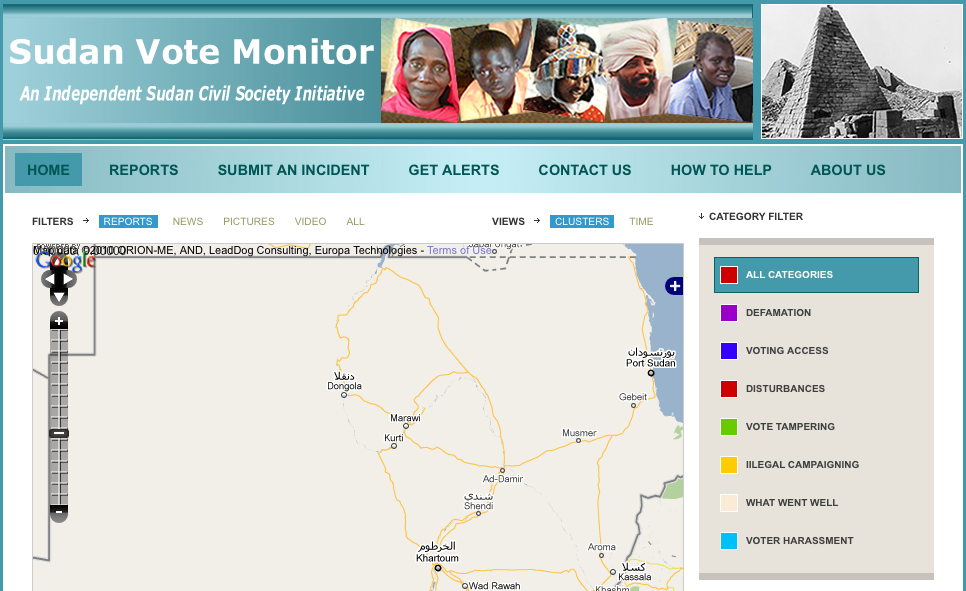
As Sudan moves towards elections in April, technology has the potential to play a major role in both engaging citizens and in monitoring the political process. Sudan Votes, a bilingual web site sponsored by German organization Media in Cooperation and Transition along with Sudanese organizations Teeba Press and the Association of Inter-Media, hopes to “enhance the quality of media coverage on the elections” and “promote a better understanding across language barriers.” The site features articles on topics ranging from politics to health and culture, as well as a Sudan Electionnaire to help citizens learn more about the country's political parties.

Sudan Votes
Sudan Vote Monitor, led by the Sudan Institute for Research and Policy, plans to use Ushahidi to enable citizens to monitor and report on the elections.
Sudan Vote Monitor
In an election where “many citizens are unfamiliar with basic election processes, are opposed to multi-party competition and have doubts about whether the vote will be fair,” these projects may play critical roles in educating people and documenting possible problems with the voting process. In order to be successful, however, they must first find a way to convince citizens of their usefulness.
Both Sudan Votes and Sudan Vote Monitor appear to have substantial Sudanese involvement at the ground level, which may help them succeed where the World Bank program has failed. As the elections loom nearer, I'll be watching closely to see how these organizations unfold. Will they fall flat, ignored and unused by Sudanese citizens? Or will they manage to translate technology into true civic engagement?
-
Uganda: Hundreds feared dead in landslide
A mudslide in eastern Uganda Monday evening left at least 80 people dead and over 300 missing. The mudslide, triggered by a day of heavy rain, has buried three villages in Bududa district and displaced more than 2000 people from their homes. As of Wednesday morning, the search continues for survivors.
Uganda's Daily Monitor reports that flooding has been reported throughout the eastern part of the country, forcing schools to close and making roads impassable. The rains are expected to continue, and Reuters reports that Ugandan officials fear flooding and mudslides may affect up to five more districts.
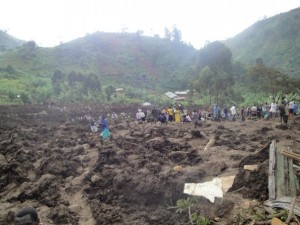
Landslides in eastern Uganda on Monday left three villages covered in mud. Photo courtesy of Apollo on Facebook.
Ugandan blogger Rosebell wonders why the government hasn't done more to move people out of the area:
There are estimated 50,000 people, some occupying the immediate precincts of the extinct volcano, who are regularly exposed to the threat from landslides. Every rainy season there are deaths in this part of Uganda but the only approach has been that of conservation of the national park to relocate people.
There has been no government effort to really try to find other ways to persuade these people and find them alternative livelihoods. In a place where many people depend on farming relocating from the fertile volcanic soils is difficult decision. So they live one day at a time and hope they survive the next rainy season.
In central Uganda, where the rain is less of a threat, Gay Uganda writes:
The rains which I was so guiltily taking joy in are taking a toll on my people. I can only pray. Uh, you know what I mean. I do love rain, but rain comes with its blessings and curses. A bumper harvest may be one thing to be happy about. Terrible loss of life– but, incredibly, life goes on.