Unless you’re reading this while using an inhaler, this fact may surprise you: According to the CDC, 26 million Americans currently have the chronic respiratory disease we know as asthma. Not only that, but the CDC tells us that the disease costs the U.S. $3,300 per person annually, and medical expenses associated with asthma have increased to about $56 billion (thanks to hospitalizations, emergency room visits and missed work), while over 10 percent of insured Americans are unable to afford their prescription medicines.
Asthmapolis launched in 2010 to help find a solution by leveraging the advances in sensor technology (and the reduced costs of producing said sensors) and mobile data monitoring to help people manage their asthma more effectively, in turn reducing the costs both for those suffering from asthma and for the U.S. healthcare system itself. And, today, the Wisconsin-based startup has announced that it has raised $5 million in Series A financing from The Social+Capital Partnership to build out a comprehensive solution and support system for those with the chronic respiratory disease.
Asthmapolis is one of a new generation of digital health startups attempting to hack the old software, devices and care systems that continue to prevail in today’s healthcare landscape. We recently wrote about Intersect ENT, for example, which is hacking stents (yes, stents) to help doctors more effectively treat the 31 million-plus people suffering from sinusitis.
Meanwhile, Glooko, Omada Health and a number of other startups are bringing mobile and digital technology to those with diabetes to help them manage the condition and, in Omada’s case, hopefully even prevent it.
Asthmapolis, on the other hand, is on a mission to hack your inhaler. The startup has designed snap-on, Bluetooth-enabled sensors that track how often people are using their inhalers (along with location and time-of-day), along with analytics and mobile apps for iOS and Android to help them visualize and understand their triggers and trends while receiving personalized feedback.
In turn, the data collected by the solution enables doctors to identify patients who are risk or need more help controlling its symptoms. This allows them to potentially prevent attacks before they happen, saving them the cost of hospitalization or a trip to the emergency room.
In fact, Asthmapolis’ early studies found that this access to realtime data was able to reduce the number of people with uncontrolled asthma (or those not regularly using inhalers) by 50 percent. Without realtime data and the ability to collect information on the context and situations in which people develop symptoms, doctors are groping around in the dark and waiting for attacks before they analyze context and begin treatment.
Many startups are beginning to recognize the opportunity both to create a sustainable businesses and affect real change by positioning themselves at the intersection of growing trends like mobile devices and mobile health initiatives, personalized medicine, big data and sensors. Asthmapolis co-founder and CEO David Van Sickle thinks that the startup can sit at that intersection, while differentiating from competitors by offering both a hardware and software solution.
Not only that, but Asthmapolis received approval from the FDA in July to market its asthma-tracking device and software solution to consumers, which puts it on a very short list. In turn, its software platform, which is available both in English and Spanish, allows users to keep a digital log on their use of medications, while receiving personalized feedback — both designed to improve their ability to successfully manage the disease.
In the big picture, the startup also wants to help public health institutions better evaluate the efficacy of their interventions and treatments and unlock insight into how asthma works and where it originates. And that’s where Asthmapolis is monetizing: By selling its hardware and software solution to payers and health plan providers. With more effective treatment solutions, insurance providers and health plans can save between $4,000 to $6,000 in annual healthcare costs — and, naturally, that’s money in the bank.
The company has formed a number of partnerships in the last year in this regard, which include programs with payers like Amerigroup Florida/WellPoint and providers like Wyckoff Heights Medical Center in New York and Dignity Health in California. Going forward, the startup will look to continue expanding its relationships with providers and payers, along with initiatives in retail pharmacy and the public sector.
“Asthmapolis is in a unique position in healthcare IT,” explains Social+Capital General Partner Ted Maidenberg, “where its technology can easily integrate with existing behaviors (like using your inhaler), while adding a huge amount of data (time, location, activity) that provides a much smarter package compared to your over-the-counter inhaler.”
Happy April First, errybody! Yes, that’s right, we’ve reached that special, inimitable time of year. April Fools Day 2013. At TechCrunch, we have a long history of taking April Fools seriously. Deadly, deadly seriously. So, we’ve taken it upon ourselves to create a master list (which will be updated throughout the day) with the best tomfoolery, pranks, WTFs and LOLs the Internet and the tech industry have to offer.
All night and all day, whatever it takes. If a company close to you happens to break out its clown shoes in what can only be an eye-rolling effort at being funny (really, the one time of year we indulge terrible nerd jokes publicly), please alert us in the comment section. And, again, thank you for your help in advance.
We’ve tried to separate the good from the bad and the ugly — and highlight the stuff that’s actually funny — sometimes with success, sometimes not.
So here they are.
(And, again, for our annual disclaimer: If you’re one of those folks who finds April Fools stressful because you’re constantly subject to punkings courtesy of your co-workers, rest assured that we at TechCrunch would never do that to you. Never. Never ever.)
The Great List Of April Foolings
Google Nose
You have to give Google props. They always take April Fools Day pretty seriously, and cats are usually involved. But this year Google is poking fun of its Glass Project with some olfactory goodness. Google Nose. Smells galore. You’ve probably been wondering what Google does with all that information that it tirelessly indexes for its search engine, combing the Web with Page Rank to serve you moderately usable results. Well, it’s also been collecting scents.
Now, as Greg reports, instead of paying hundreds or thousands for its newest piece of sexy hardware, Google is now letting you type your favorite scent into its search engine, tap the “smell button” and inhale to your hearts content. Just try not to sneeze on your monitor.
YouTube? More like NOTube, amirite?
That’s right. You heard it here first. Jordan brook the news Google has decided to shut down YouTube. After eight years, the company revealed that the whole thing has actually been an American Idol-like competition. Thank god, because for those of us that were taught that life is a competition — no enjoyment necessary — well, we’ve been a little suspicious of YouTube.
But the company has finally revealed that the competition that we know as YouTube is coming to a close, and that an expert panel of judges — YouTube celebrities themselves — will choose the winners. But don’t expect the winners to be announced any time soon. The judges will spend the next decade sifting through YouTube videos to choose said winners. Tomorrow, at midnight, the site will shut down and all content will be deleted. When it reopens in 2023, the only remaining video will be the winner. Frankly, it all makes perfect sense.
Gmail Blue
The hits just keep coming for The Googs. Next stop on the April Fools Google Train? “Gmail Blue.” That should explain itself, but just in case, it took Google “six years to develop the technology” to turn Gmail blue. Google turns nine tomorrow, and it might as well just go for it.
A poke at Facebook? Who’s to say?
You Got Vowels? Give Twitter Money.
Twitter has announced Twttr. Who needs vowels, am I right? Not you. Or Twitter. Twitter’s new “two-tiered” service includes a free portion called “Twttr” where each tweet (or “twt”) shall contain nary-a-vowel. But just in case that has you up in arms, you can have your stinkin’ vowels back, but it will cost you $5/month.
Pretty minimal price to pay for the fundamental building blocks of, you know, the English language and all. But because Twitter is ever-the-beneficent social network, it will offer the “sometimes Y” free of charge. Well, isn’t that precious? Oh, and thankfully URL vowels are free. Twitter’s not into the whole “hidden fees” thing, you understand. It’s almost like that April Fools joke where Facebook tried to make you pay $1 to message strangers. Oh wait, that actually happened.
It seems like an angry intern has wiggled his way into Netflix’s genre system, with all sorts of new genres popping up for the first time today.
Other family favorites include “Movies That Are In English But Still Require Subtitles”, “Movies With Epic Nicolas Cage Meltdowns”, and my favorite, “Surreal Ballets Based on a William Shatner Album” which just lists William Shatner’s Gonzo Ballet 50 times.
Virgin’s Glass-Bottomed Plane
Glass-bottomed boats are so last year. That’s why Virgin is stepping it up a notch with the world’s first-ever glass-bottomed plane. Richard Branson proves himself to be a peerless innovator yet again:
We hope to trial the glass bottom technology with other Virgin airlines in time and have asked other Virgin companies to support this innovative trial and launch our new domestic Scottish route. This really is a team effort from all corners of Virgin.
Speechless.
Sony For Pets
Sony is releasing a new “Animalia” line of products for your tech product-starved pets. And they’re really “stoked” about it. As are your pets, no doubt. Because your hamsters need to test out those Beats headphones you bought them for Christmas.
According to Sony:
The introductory line-up includes Sony-branded products targeted at owners with dogs, cats and hamsters, with additional devices and networked services slated for release later this year. Check out this video to learn all about our new K9 4K TV, M3-OW KittyCans, and In-Cage Speakers.
ThinkGeek
ThinkGeek has a whole new line of April Fools products that are fun for the whole family. Like this “Eye Of Sauron Desk Lamp.” My apologies if your order doesn’t go through. I’ve already bought 50 of them.
Archeological analysis has confirmed that our Google Maps Street View team has indeed found one of history’s long lost relics: a treasure map belonging to the infamous pirate, William “Captain” Kidd.
The map was found on a recent expedition in the Indian Ocean, as part of a deep-water dive to expand our underwater Street View collection. Captain Kidd was rumored to have buried his treasure around the world, and tales of a long-lost treasure map have lingered for generations.
Google+ Photos And +Emotion
Google+ now lets you add real emotions to your photos. This would be hilarious if 25 startups weren’t currently working on/pitching this idea — outside of Google+. Because the best Google+ April Fools joke is, really, well, Google+.
Google Analytics
Some users of Google Analytics may begin noticing that they have a few new international visitors checking out their sites. I’m just glad Google didn’t say that they were “totally out of this world.” Google is now including active visitors from the International Space Station, Control Room, who clearly have nothing better to do than to check out your WordPress blog. Here’s Carl to explain.
Is your house looking a bit tired and shabby? Want to make your narky step-aunt jealous? Trying to keep up with the Joneses but don’t have the money to complete an expensive reno?
Now you can give your house a lick of fresh paint for free on Street View with Google SCHMICK (Simple Complete House Makeover Internet Conversion Kit). Forgot to mow the nature strip? Deck it out with some fresh buffalo grass. Front steps falling down? Swap them out for doric columns and a pergola. Graffiti on the front fence? Cover it with so many palm trees people will think they’re on the Vegas strip.
Google’s Levity Algorithm
For your Google Apps pleasures:
Toshiba Gets A Console
That’s right. Today, Toshiba is announcing its first-ever gaming console: The Shibasphere. Look out, every gaming console ever made, past, present or future. The Shibasphere is here.
The Shibasphere features unprecedented computing power, a completely controller-free interface, and Logical Aggression Monitoring that deploys positive therapeutics to prevent emotionally devastating rage-quits. Available accessories include the Shibadome, Shibasuit and Shibatote that enhance the sound, motion detection and portability of the console, and also features:
12 core 3.5 Ghz Processors
8192 MB GDDR5 RAM Graphics Card
809.3b Infrared Motion Detection
1080p Full HD
7.1 Channel Surround Sound
5 Stereo Mini Jacks
8 HDMI Ports
AC Power
SoundCloud’s Dropometer
Sometimes you just don’t know when “the drop” is going to hit in a song. Not sure what I’m talking about? If you’ve ever seen a Harlem Shake video, it’s that very short, euphoric moment where the music drops out for a second and suddenly everyone is dancing/humping something. (See a notable example from my alma mater here.) Well, now, using its patent-pending algorithm, SoundCloud will tell you when that “unpredictable and surprising moment” is going to happen, via The Dropometer:
… The Dropometer is designed to help you prepare yourself for the big moment, whether that means getting in the mental space where you can really break it down, or fixing yourself a fortifying snack.
While we first innovated the Dropometer around dubstep, we’ve identified broad utility for this new functionality across all genres. Look to the Dropometer to find out when to expect a key crescendo in a 17th-century symphony or the emotional climax in an episode of This American Life.
Love with Food Gon’ Get You High
Love With Food is announcing a new product line called Love With WEED — a monthly subscription that delivers a new high every month. For every box sent, we’ll plant a cannabis shrub along CA Route 1. It’s like Tom’s, but greener. Here it is.
Sphero PeaceKeeper
Robotics takes a step forward today with “Sphero — Peacekeeper Edition.” The robotics maker is now offering a super-sized version of Sphero that you can control from your smartphone or tablet. And cats love it. It measures 3-feet in diameter, weighs over 150 pounds but is totally fun and lightweight and agile. The future is now, people. GoSphero.
StumbleUpon
StumbleUpon has put together a big list of things you can to do prank your colleagues, family members and loved ones. See it here.
RunKeeper
The next revolution in running is here. Now. And it’s really big.
Despite the best efforts of my administration, prolonged partisan debates in Congress are preventing us from a solution to our mounting national debt. Instead of bickering over taxes, we’re taking a new approach: asking everyday Americans to chip in so we can pay off our debt once and for all.
With your help, it’s time to act.
HELP PAY OFF our NATIONAL DEBT
Samsung’s Eco Trees
Really hilarious, Samsung: “Samsung Electronics announced Eco Trees, a smart, eco-friendly air purifier that runs on solar energy.” Get it? Chlorophyll? More like Bore-ophyll. Here are all of their fresh new Eco Tree products.
We are delighted to announce a significant new extension to Nokia’s product offering with the Nokia 5AM-TH1N6 Constellation, a touch-screen microwave oven. The Constellation sets itself apart with a superfast, water-cooled 8-core high-voltage transformer, which brings a combined performance of 5,000 watts to end-users, letting them heat up turnkey meal solutions within seconds.
‘Nokia has a proven track record and extensive IPR in working with microwave radios, so for us this was a logical next step. We can attack our competition in their core business,’ says Olavi Huhtikuu, Nokia’s director of household innovation.
‘That’s why we developed the highly innovative 5AM-TH1N6 Constellation, which will revolutionize everything from single households to canteen kitchens.’
The new Nokia 5AM-TH1N6 has even more innovative features. The device comes with the latest eye-tracking technology, which stops the food from rotating when you look at it, and it automatically adjusts the temperature depending on how hungry you look.
BMW Gets Into Strollers
With a royal baby due this summer, we are proud to announce the launch of our limited edition BMW P.R.A.M. (Postnatal Royal Auto Mobile). Available in Princess Pink or Royal Blue, this soft-top convertible has been designed using our EfficientDynamics technology. With two or four-wheel-drive, it rides as smoothly on a polo field as it does down The Mall and comes with air conditioning and built-in extendable flagpoles as standard. For those who are ‘too posh to push’ this masterpiece of motherhood even comes fitted with N.A.P.P.I.E. (Nanny-Assisting Petrol-Powered Injection Engine).
If you’ve ever been in a sports bar with your friends to watch a big game, you’ve likely run into the “muting” problem. While the bar may have two dozen TVs, each might be playing a different game, and there’s either too much sound or none at all. At most local restaurants, bars, airports and health clubs, you’ll find TVs muted for this very reason.
Some have opted to, say, put speakers on tables in their bars to project sound more directly, but the problem is that this puts a damper on any socializing you planned to do with your friends and fellow bar mates. Might just be me, but repeatedly yelling “WHAT DID YOU SAY?!” over the audio can detract from the viewing experience. After all, you’re really there to enjoy some quality time with friends — the thrilling play-by-play isn’t the only attraction.
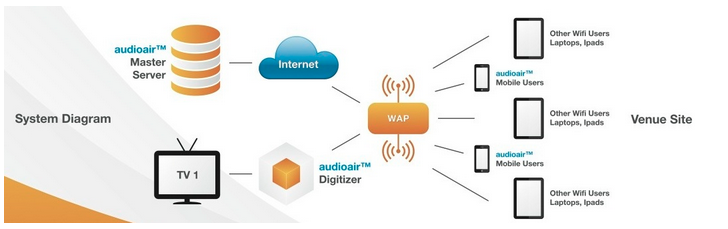
Durango, Colorado-based Airborne Media is hoping to offer another solution with a new product called Audioair, which aims to turn smartphones into your own personal listening device to help unlock sound from the tens of millions of muted TVs out there. Essentially, Airborne wants to put its audio solution anywhere an un-muted TV would add to the location’s overall noise pollution — every airport, hospital, sports bar, stadium or health club in the U.S.
But how does it work, you ask? Users download Audioair’s free mobile app, which taps into the sound system (via Wi-Fi) at any Audioair subscriber location, allowing you to determine which TV you want to listen to, projecting the audio through your smartphone so you can listen from your pocket or through headphones. Airborne is currently piloting its solution at 47 sites, including sports bars, restaurants, student health facilities and even a large resort casino, and plans to be in 800 locations by the end of the third quarter.
To help get Audioair off the ground, the startup has raised $3 million in seed funding, $1 million of which is convertible debt, from a handful of local investors. But, let’s be honest, creating a personal audio channel for muted TVs has some appeal, but it could be subject to a fairly limited use case. It’s not difficult to imagine significant others and friends the world over not being particularly pleased when, in the middle of a conversation, you throw in your headphones to hear the local play-by-play.
Plus, Airborne has to convince enough restaurants that it’s a good idea to invest in their on-premise hardware and buy another TV for their in-venue display. How does it hope to accomplish that tall order?
Airborne believes that its technology can help change the consumer experience within a multitude of these noisy environments and bridge the gap between mobile devices and customer engagement displays. So, not only does it want to provide a better audio experience for the end user, it wants to act as an interactive social networking experience and dedicated, location-based advertising network for bars, restaurants and any local venue.
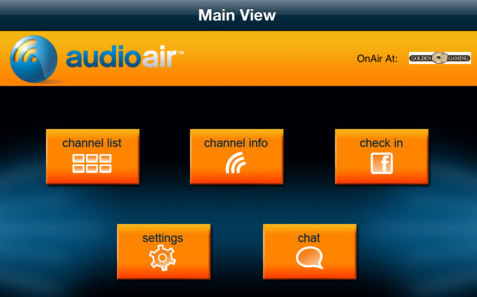
The service allows users to chat with other people in the venue directly through the Audioair app, along with checking-in and adding content from their phones to the sports bar’s local network. This adds a social networking element to the end-user experience; in the meantime, Audioair allows venues to display local advertising on the user’s phone or on a 42-inch digital display that they install in the bar.
At the outset, the startup has been offering discounts on the cost of the TV (and the installations themselves) to reduce friction for early customer acquisition, but the idea is that — once/if this catches on, bars will be paying for the cost out of their own pockets.
Audioair charges a monthly fee, which will be an add-on to the fees bars are already paying to DirectTV and so on for cable, but the idea is that the product can help venues reduce the perceived (and actual cost) by helping them attract more customers who stay on the premises longer — because they can actually hear the sound of the game.
On top of that, bars can distribute on-site promotions through Audioair’s digital display and mobile app, facilitating increased spend, while engaging customers in an in-bar, interactive social and ad network.
Venues can then share in the ad revenue gained from their displays, while receiving analytics on how customers are interacting, what they’re sharing and so on. They can also disseminate the needed info publicly or privately as needed (think personalized hospital, airport alerts).
The Airborne Media founders said that they see revenue coming from three buckets — advertising, installation and licensing — with revenue initially coming from subscription and installation and advertising revenue becoming the main stream over time. As to the licensing piece, the team says that they’ve filed for eight patents on their system (which are currently pending), which could help them manufacture some defensibility for a model that could become vulnerable to competition from big players as prices on hardware continue to drop.
Audioair also tries to sweeten the deal by providing an optional on-site server to manage the local, network and cloud-based content and, by splitting a portion of the advertising revenue with the owner, the startup wants to help them cover the cost of the subscription fee and grow their own revenues over time.
The Audioair creators also believe they have a leg up on the competition because it has inked a partnership deal with one of the original commercial DirecTV installers, which has exclusive territory rights to a big chunk of real estate — from Florida to Washington, D.C. It provides DirecTV service and support to over 5,000 restaurants and will be helping Airborne make installations throughout its territory, which the founders believe will be critical to helping it expand its footprint.
Again, it seems like a niche play, but if something like this is going to work, it could be a multi-pronged approach that’s not only an audio helper but a local information and advertising system, complete with hardware support and revenue sharing. There are 38,000 sports bars and restaurants in the U.S., 28,000 health clubs and plenty of airports, casinos and college campuses where Audioair could potentially have some appeal.
If the startup is able to keep its prices from stifling those venues that are willing to give it a try — and surmount the potential “this is too complicated” reaction from local venues — while offering real value-add on the advertising side (and some better design of its mobile interface), there’s a chance Audioair could have some real legs.
“I have a tip that can take five strokes off anyone’s golf game: It’s called an eraser,” Arnold Palmer once remarked. Yes, Even brave enough to wear ridiculous clothes and hack a small white ball around a manicured lawn, golf is a difficult and sometimes humiliating, sport.
Luckily for golfers, John McGuire feels your pain and is on a mission to make the game just a little less painful for anyone daring (and ignorant) enough to pick up a club. His new company, Active Mind Technology, wants to give the golfing masses access to the same tools traditionally reserved for the pros by leveraging the same wearable sensor-based technologies found in health-tracking devices like Fitbit, Basis and Jawbone’s Up.
And who better to assist in that endeavor than the mastermind behind the design of products like Jambox, Jawbone and Jawbone Up? Joining McGuire and his team of twenty is Yves Behar, the design and branding guru (and Chief Creative Officer of Jawbone) known for helping to design the products mentioned above as well as those for PUMA, General Electric, Samsung, Prada and more.
While Behar hasn’t assumed a title in the company, McGuire tells us that he has not only led the design of the UI, UX, branding and packaging of Active Mind’s newest product, he’s also and investor and “thankfully, even acts like a founder,” he says.
This week, McGuire, Behar and team officially unveiled Game Golf, a wearable product that employs a combination of sensors, GPS and NFC technologies to provide golfers with a stream of data and feedback to help them improve their scores.
Essentially, the device, which includes transmitter tags that are inserted into clubs and a receiver that can be attached to your belt, track every shot a user takes during a round, as well as distance, club selection and so on. And, a la health and fitness trackers, Game Golf compiles this data and syncs it with the cloud, allowing users to then access their performance data via its mobile app on their mobile devices and personal computers.
Golfers can then share highlights of their round and their overall progress with friends by way of their social network(s) of choice, and see the percentage of shots that they hit in the fairway, greens in regulation, and putting performance. Backing its software, the team has designed Game Golf’s battery to accomodate two full rounds of data tracking before requiring a charge.
Though that all equates to a good start, one feature that’s conspicuously absent is that the device is not able to measure the velocity of one’s swing (or its relative accuracy). his could deter some early adopters, it’s not a flat-out deal breaker; however, adding this capability down the road could become a significant selling point for those sitting on the fence.
And, unfortunately for those looking for instant gratification, Game Golf isn’t yet available in stores. Instead, the company has launched a crowdfunding campaign on Indiegogo through which it hopes to raise $125,000 in an effort to finance its product development and distribution. In spite of (or perhaps because of) the fact that it will cost a hefty $249 when it does become publicly available in stores, McGuire tells us that Game Golf has become the fastest money-raising campaign in Indiegogo’s history, raising $63K in 12 hours.
Now, two days removed from launch, the campaign has raised over $108,000. At this rate, it should meet its goal within a week, which the founder takes as a promising sign of the potential demand for its golf tracker.
Based on its initial concept and after recruiting well-known pro golfers like Lee Westwood and Graeme McDowell to help with early testing (and invest), Active Mind was able to raise seed financing from a bevy of reputable investors, including Chamath Palihapitiya, Jerry Yang (of AME Cloud Ventures), Morado Venture Partners, Crosslink Capital and Ed Colligan (the Former CEO of Palm) — to name a few.
“Game Golf gives everyone access to crucial data that can dramatically improve your golf game and handicap,” McDowell says of its appeal to golfers. “[It’s] intuitive, doesn’t disrupt your game and is essential for any golfer looking to understand their game better and knock down their handicap.”
With its Indiegogo campaign acting as a proof of concept, the startup is currently in the process of raising what McGuire tells us will be a $4 million series A round. If Game Golf is able to sustain this early demand, it will eventually look to expand into other sports, like board and motor sports and soccer, for example.
While the near-term plan involves serious iterating around Game Golf, McGuire said that the platform is being architected in such a way that it will be able to eventually help users measure activity — and provide a gamification and social layer — across multiple sports.
As to Game Golf, the founder said that users can expect to see its public launch sometime this summer.