Author: Silvia Viñas

  • Chile: Mapuche Communities Affected by Earthquake

    After the massive earthquake that hit Chile on February 27, the media and the government have faced strong criticism for their lack of coverage and support for the small communities closest to the epicenter. One of these communities is the Mapuche indigenous people, whose territory can found in central and southern Chile.
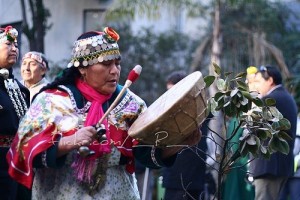
    Mapuche celebrating the Mapuche new year, We Tripantü. Photo uploaded by flickr user _p_ and used under a Creative Commons license

    Mapuche celebrating the Mapuche new year, We Tripantü. Photo uploaded by flickr user _p_ and used under a Creative Commons license

    The blog Kilapan [es] posted a statement from Miguel Cheuqueman which reports the aftermath of the earthquake:

    El terremoto que asoló el territorio chileno ha afectado más gravemente a los pueblos mapuches cuyos territorios se ubican en tres de las cuatro regiones del sur de este país. Cientos de muertos y desaparecidos, desabastecimiento total, caminos y comunicaciones cortados, son parte del drama que viven nuestros hermanos lafkenches.

    The earthquake that devastated the Chilean territory has affected the Mapuche people more severely, and whose territories are located in three of the four regions in the south of the country. Hundreds dead and disappeared, complete lack of supplies, roads and communication cut off, are all part of the drama that our lefkenches (a Mapuche community) brothers are going through.

    Pedro Vasquez produced the following video, which shows the destruction in the locality of Tirúa in the Arauco Province in the Bío Bío Region.

    In the blog Nativos del Sur [es] (Natives from the South), Reynaldo Mariqueo writes about the lack of media coverage the Mapuche communities are receiving, and he defends the right of the Mapuche to ask for international aid.

    Si observamos a la TV Chilena y los medios de comunicación en general, parecieran concertarse en dar cuenta de la situación que afecta a las regiones urbanas de Concepción al norte, pero se han olvidado de los pueblos ubicados al sur de Concepción, que como sabemos han sufrido un impacto similar de destrucción. Asimismo, la situación caótica que enfrentan las comunidades rurales mapuche, como siempre, parecieran haber sido totalmente olvidadas. En consecuencia, opino que es perfectamente razonable que las organizaciones y comunidades mapuches hagan un llamado conjunto y urgente solicitando ayuda humanitaria internacional y la presencia de organizaciones no-gubernamentales, que están abocadas a ayudar a las víctimas de catástrofe o desastres naturales.

    If we observe the Chilean TV and the media in general, it seems like they are concentrating their accounts of the situation of how it has been affecting the urban regions of Concepción and to the north, but they have forgotten the towns located south of Concepción, which we know have suffered an impact similar in destruction. Likewise, the chaotic situation that the rural Mapuche communities are facing, like always, seem to have been completely forgotten. As a consequence, I think it is perfectly reasonable that the organizations and Mapuche communities call out for urgent international humanitarian aid and for the presence of NGOs, that are meant to help the victims of catastrophes or natural disasters.

    Twitter users were quick to point out the lack of media attention given to the Mapuche. On February 28, the day after the earthquake, Twitter user Danny Micin Carvallo (@dmicin) wrote:

    hasta ahora no he visto ni una noticia acerca de comunidades mapuches y el terremoto

    up to now I haven’t seen one single piece of news about the Mapuche communities and the earthquake

    On March 8, more than a week after the earthquake, Nicolás Herrera (@nicolas91) referred to journalist Soledad Onetto on his Tweet and asked her:

    @SoledadOnetto porque no se a mostrado en la prensa como quedo el pueblo mapuche con el terremoto ?

    @SoledadOnetto why hasn’t the press shown how the Mapuche people are fairing after the earthquake?

    Other Twitter users showed their concern for the Mapuche, retwittering articles from Mapuche-focused blogs and websites asking other Twitter users about the Mapuche Community. On March 5 Conchu Arellano [es] (@conchu) asked if someone knew how the Mapuche were doing after the quake. In addition, Samuel Bascur Molina used his Twitter account (@sambascur [es]) to spread the word about the need for 180 beds, mattresses, and blankets for a Mapuche community in need.

    The media is not the only organization criticized for ignoring the Mapuche after the earthquake, the government has also been condemned for ignoring them by many bloggers and twitter users. A team of Mapuche communicators from the blog Comunidad Autónoma Temucuicui [es] -which focuses on the Mapuche community located in the Ercilla commune of the Araucanía region- denounced the government’s lack of action as a sign of racism and discrimination:

    Como una abierta y clara muestra de discriminación y racismo han reflejado las Autoridades del Estado Chileno, producto a la nula preocupación por las graves situaciones provocada por el Terremoto en comunidades Mapuche de Ercilla

    Al parecer para las diferentes Autoridades de Gobierno de este Estado Chileno, el fuerte Terremotos azotó y devasto solamente a las grandes ciudades de este país […]

    Después del fuerte sismo ocurrido en la madrugada del día, este dejo graves daños estructurales en las viviendas, poso de suministro de agua derrumbado, el río que atraviesa la comunidad completamente contaminado producto del movimiento de la tierra no pudiendo ser utilizado para el consumo humano.

    The Chilean government has openly and clearly shown a clear demonstration of discrimination and racism, because of the complete lack of concern for the serious situations produced by the earthquake to the Mapuche communities of Ercilla […]

    Apparently for the different government authorities of Chile, the strong earthquake hit and devastated only the big cities of the country […]

    The strong quake which occurred at early in the morning left severe structural damage to houses, the collapse of the well which supplies water, and contaminated the river that runs through the community because of the earth’s movement leaving it unusable for human consumption.

    In response to the devastation and the absence of media or government support, the Mapuche have called out for International aid. The news agency MapuExpress [es] put out a statement by a group of organizations under the name La Sociedad Civil (The Civil Society) specifying the measures they will be taking to ensure the Mapuche receive the much needed aid. The statement begins by introducing the aid group and assessing the situation:

    Ante la situación que vive nuestro país tras el terremoto, informamos que diversas redes de ONGs, organizaciones sociales, federaciones de estudiantes, medios de comunicación comunitarios y organizaciones internacionales se han articulado y se encuentran movilizadas para seguir trabajando en conjunto con las comunidades afectadas y recoger sus necesidades de urgencia inmediata así como las de reconstrucción de sus localidades.

    Las comunidades sufren en este desastre las consecuencias acumuladas de la desigualdad y la pobreza, de la privatización de los servicios básicos, de la desprotección social y los procesos de individualización y mercantilización, de la centralización política y administrativa, de la falta de probidad de un sector empresarial irresponsable y sin fiscalización suficiente por parte del Estado, de la falta de medios de comunicación comunitarios y alternativos y por lo tanto de la vulnerabilidad del actual modelo de desarrollo.

    In the face of the situation that our country is experiencing after the earthquake, we inform that various NGO groups, social organizations, student federations, community media outlets, and international organizations have come together and are mobilizing to continue working together with the affected communities to address their immediate urgent necessities and help with the reconstruction of their localities.

    The communities that suffer the consequences accumulated in this disaster due to inequality and poverty, the privatization of basic services, the lack of social protection, and the processes of individualization and mercantilism, of the policy of centralization and administrative, of the lack of honesty from the irresponsible business sector without enough fiscal review from the government, the lack of community, and alternative media outlets which result in the vulnerability of the current development model.

    The statement ends with optimism that new policies could help the Mapuche, but also with a warning that this catastrophe could make a severe inequality problem in Chile even worse:

    Este desastre natural puede permitir el comienzo de un proceso de reconstrucción participativo e incluyente, basado en nuevas políticas públicas, que garanticen estándares de de seguridad y derechos, incluso en casos catastróficos como los que enfrentamos en esta situación. Pero también puede ser un momento en que se agudice la profunda desigualdad e inequidad de Chile, que se ha mostrado con toda su brutalidad en esta coyuntura.
    This natural disaster may allow for the beginning of a process of participative and inclusive reconstruction, based on new public policy, that guarantees security standards and rights, even during catastrophic events like the one we are facing now. However, it can also be a moment that can deepen the profound inequality in Chile, which has brutally come to light during this moment.
  • Uruguay: José Mujica Sworn in as President

    On March 1, José Mujica -also referred to as “El Pepe” by many Uruguayans- was sworn in as the new president of Uruguay. He succeeds Tabaré Vázquez from the same left-leaning coalition party, Frente Amplio (Broad Front). During and after the inauguration ceremonies, Uruguayan bloggers and Twitter users reflected on this presidential transition and what it means for their country.

    Ana Rita Franco from the blog Nostalgia de Emigrante [es] writes about the public opinion surrounding Mujica and her own impressions of the new President:

    Mucho se ha dicho a favor y en contra de su persona. Desde mi punto de vista creo que ha sido el politico por estos tiempos, que ha generado con su sola presencia, sentimientos muy ambivalentes: se lo idolatra o se lo detesta. Por eso hay quienes se enorgullecen y otros se averguenzan. Desde mi posicion que no es ni una ni otra, se ha ganado mi respeto por haber llegado donde hoy se encuentra, dandonos la leccion de que todos los suenos pueden ser cumplidos.

    A lot has been said in favor and against him. From my point of view, I think he has been the politician in these times that has generated with his sole presence, ambivalent feelings: he is idolized or hated. That is why there are people that are proud and others ashamed. From my position which is neither one or the other, he has gained my respect for reaching the place where he is today, giving us a lesson that all dreams can come true.
    Mujica stands to the right of his wife Lucía Topolanski, head of the senate. Picture uploaded by flickr user Fernando Lugo APC and used under a Creative Commons license.

    Mujica stands to the right of his wife Lucía Topolanski, head of the senate. Picture uploaded by flickr user Fernando Lugo APC and used under a Creative Commons license.

    Mujica has captured the attention of the world because of his background as a former Tupamaro guerrilla fighter. Víctor Bagnuoli, director of the blog Visión Universitaria [es], explains that Mujica has left that past behind and taken a more realistic approach to achieving his political ideals.

    Luego de haberse jugado la vida en pos de ideales revolucionarios por medios ilegales, don Pepe Mujica hizo una profunda evolución que lo llevó, no a abandonar sus ideales pero sí, a comprender la realidad y a plantear metas factibles de corto y mediano plazo, ya que la coyuntura nacional e internacional obligan a buscar otras alternativas.

    After risking his life to defend revolutionary ideals through illegal means, Mr. Pepe Mujica has made a profound evolution that has made him, without abandoning his ideals, understand reality and put forth feasible short and long term goals, since the national and international situation forced him to find other alternatives.

    Constanza Moreira [es], a political scientists from the University of the Republic in Montevideo explains in the same blog that Mujica comes into power accompanied by an environment of very high expectations:

    Será asimismo el tercer presidente electo del siglo XXI. Y el electo con el mayor porcentaje de votos, con la excepción de Baldomir (61,3% en 1938), Amézaga (57,2% en 1942) y Jorge Batlle (54%).

    Muchas expectativas se ciernen sobre el nuevo presidente. Quizá más de las esperables, recordando que el gobierno de un país es algo más que un presidente, y recordando ­siempre es bueno­ las limitaciones de la humana condición.

    He will be the third elected president of the XXI century. And the one elected with the greatest percentage of votes, with the exception of Baldomir (61.3% in 1938), Amézaga (57.2% in 1942) y Jorge Batlle (54%).

    A lot of expectations are upon the new president. Maybe more than what can be expected, remembering that the government of a country is made up of more than one president, and remembering –it is always good to do so- the limitations of the human condition.

    Moreira also adds that the highest expectations for Mujica come from the poorest Uruguayans:

    En buena medida, Mujica es, con su propia vida, un representante “de los de abajo”. Y son estos miles de uruguayos, que lo han honrado con su voto una y otra vez, quienes más esperarán de un gobierno de Mujica.

    In great measure, Mujica is, with his own life experience, a representative of the lower class. And these thousands of Uruguayans, that have honored him with their vote again and again, will be the ones that expect more from Mujica’s government.
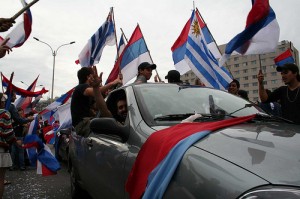
    Mujica and Frente Amplio supporters celebrating election on November 29, 2009. Photo uploaded by flickr user camerareporter and user under a Creative Commons license.

    Mujica and Frente Amplio supporters celebrating election on November 29, 2009. Photo uploaded by flickr user camerareporter and user under a Creative Commons license.

    As for the ceremony and inauguration speech itself, the writers at Uruguayan blog Opinemos Hoy [es] did not come away as politically energized as they had hoped to be:

    Ahora bien la primera imagen que me dejó toda la asunción (seguida por tv haciendo zapping entre el 4,10 y 12) es un Mujica cansado , cansado antes de arrancar , lo podemos acusar a su edad , pero no inyectó esa energía que necesita su gente , su pueblo sus seguidores , fueron discursos diferentes y me dió la impresión que opuestos , lo más importante lo dijo al principio en la asunción en la cámara de representantes mediante una carta leída la cual trataba varios temas yá conocidos por todos nosotros , como es la educación, seguridad , energía y el agrointeligente. […]

    En fin una jornada que deja mucho por ver y mucho visto, por el momento solo resta esperar a ver que pasa , mucha ilusión y fanatísmo en la gente frenteamplista , ahora politicos Uruguayos a no defraudar.

    Now the first image that the entire inauguration (followed on television surfing through channels 4, 10, and 12) left me is one of a tired Mujica, tired before taking off, we can attribute that to his age, but he didn’t inject that energy his people, his country and his followers need, they were different speeches and seemed opposites to me, the most important thing he said at the beginning in the chamber of representatives through a letter he read, which talked about various issues of which we are all already aware, like education, security, energy, and agro-intelligence.

    Anyway, it was an event that left a lot to be seen and a lot that was seen, for the moment we just have to wait and see what happens, a lot of hopes and fanaticism from the Frente Amplio supporters, now Uruguayan politicians, don’t let us down.

    Others thought Mujica’s speech was praiseworthy, like Mexican Twitter user @mostacho who wrote:

    Escuchando el discurso de Mujica, que envidia los uruguayos,cuando nos tocará tener esa calidad de dirigentes y esa sociedad en México..

    Listening to Mujica’s speech, I envy Uruguayans, when will we have that kind of leader in this society in Mexico?

    A Uruguayan user on Twitter, @gaaviota, showed her support for her new president:

    Estoy orgullosa de tener un lider como Pepe Mujica en mi pais. Vuelven los hijos de Artigas!!!

    I am proud to have a leader like Pepe Mujica in my country. The sons of (Uruguayan Liberator José Gervasio) Artigas have returned!!

    Mikaela Mia @mikiynick sent a message to Mujica through Twitter, reflecting what many Uruguayans feel -even those that did not vote for him:

    José Mujica : te dejo al mando de mi país querido Uruguay. Cuidalo y mejoralo.. con amor: una uruguaya más 😀

    José Muijca: I leave you in charge of my dear country Uruguay. Take care of it and make it better, with love: another Uruguayan 😀
  • Chile: Political Points Amidst the Earthquake

    On March 11, Sebastián Piñera will be sworn in as the new President of Chile, replacing the current president Michelle Bachelet. The presidential transition will take place despite the earthquake, and political observers—criticized by some who think this is not the time to analyze politics—have begun searching for political implications to the disastrous events of the weekend.

    Blogger and university professor Patricio Navia [es] begins his post by saying that Sebastián Piñera will come out of this catastrophe as the political winner:

    Ningún gobierno aspira a enfrentar un desastre natural mientras está en el poder. Pero si se pudiese escoger el momento para un devastador terremoto, el comienzo del periodo -o justo antes de asumir- es preferible a los últimos días de mandato. En ese sentido, Piñera tiene mucho más que ganar políticamente que Bachelet. Aunque los errores que cometa Piñera en estos días también le pesarán más que los traspiés en que incurra el saliente gobierno […]

    A su vez, como no ha asumido el poder, a Piñera nadie lo hará responsable de los desaciertos, atrasos y errores de la respuesta estatal inmediata. Ya que la reconstrucción comenzará durante su mandato, él hará los anuncios de nuevas obras y también las inauguraciones posteriores.

    No government aspires to face a natural disaster while in office. But if one could pick the moment for a devastating earthquake, the beginning of the presidential term –or just before being sworn in- is preferable to the last days of governing. In this sense, Piñera has a lot more to win politically than Bachelet. Even though the errors Piñera commits in these days will also weigh on him more than the slip-ups of the departing administration […]

    At the same time, since he hasn't been sworn in, no one will hold Piñera accountable for the mishaps, delays, and errors of the immediate response from the State. Since the reconstruction will begin during his term, he will announce the new projects and their inaugurations.

    He concludes that if the current president and the president-elect honestly collaborate in their efforts, then both can gain politically:

    Si colaboran, Bachelet cerrará su gobierno brillantemente y Piñera iniciará el suyo con el pie derecho. Si en cambio compiten por el liderazgo, ambos saldrán perjudicados.

    If they collaborate, Bachelet will close her term brilliantly and Piñera will begin his with the right foot forward. If they compete for leadership instead, both will come out at a disadvantage.
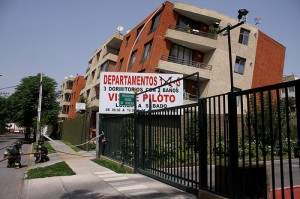
    Apartment Buildings in Maipu, Santiago. Picture uploaded by flickr user Raponchi and used under a Creative Commons license.

    Apartment Buildings in Maipu, Santiago. Picture uploaded by flickr user Raponchi and used under a Creative Commons license.

    This analysis didn’t sit well with many readers that considered Navia to be out of touch in presenting a political spin during such a tragic time for Chile. Carlos García commented on Navia’s blog post by saying:

    Creo que es un gran error sacar cuentas cortas del oportunismo político que puede generar una catástrofe de este tipo. Hoy hay Chilenos desaparecidos, gente sepultada aún con vida y más de un millon de Chilenos perdieron sus hogares y que en lo último que piensan es sobre que político podría beneficiarse.

    I think it is a big mistake to calculate the political opportunism that such a catastrophe can generate. Today there are Chileans that have disappeared, people buried alive, and more than a million Chileans that have lost their homes and the last thing they think about is which politician can benefit.

    A few users defended the blog post, like user Carlos who wrote:

    Creo que es una vision realista de lo que pasa. Lamentablemente asi es la politica y no me cabe duda que los comandos politicos han hecho estas evaluaciones. Los que estan rasgando vestiduras no conocen la naturaleza humana y menos a los politicos.

    I think it is a realistic vision of what is happening. Unfortunately that is what politics is like and I have no doubt that political parties have already made these calculations. Those that are tearing their clothes don't know human nature and even less what politicians are like.

    Juan Francisco Coloane wrote a blog post titled “The Politics of Nature” [es] where he says that in spite of what critics may say, this earthquake proves that nature affects politics:

    En la “hermandad política” de coadministradores del sistema, cualquier divergencia anterior pasaba a segundo plano.

    La naturaleza con su terremoto se convertía en el agente más político, sin diseño previo y como factor inesperado. Es la especial política de la naturaleza que no está en los manuales políticos. […]

    Entonces la premisa de que “la política de la naturaleza es apolítica” no es cierta.

    In the “political brotherhood” of co-administrations of the current system, any previous divergence falls to second place.

    Nature, with its earthquake has become the greatest political agent, without previous design and as an unexpected factor. It is the special politics of nature that are not found in political handbooks.

    So the premise that “the politics of nature is apolitical” is not true.

    This post received more assertive comments, like from Carlos Alberto who said:

    Excelente columna. El gobierno debe seguir trabajando y acelerar sus decisiones y acciones. El futuro gobierno coordinarse y apoyar en vísperas de heredar el problema

    Excellent column. The government needs to keep working and speed up its decisions and actions. The future government has to coordinate on the eve of inheriting the problem.
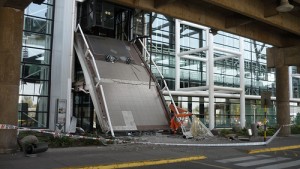
    Damage to Santiago's Airport. Photo uploaded by flickr user Jorge Barahona and used under a Creative Commons license.

    Damage at Santiago's Airport. Photo uploaded by flickr user Jorge Barahona and used under a Creative Commons license.

    Pedro Jesus Teruel [es] wrote on his blog that he is hopeful that the new administration will implement the necessary measures to help Chile:

    Tras las elecciones que han dado la victoria a Sebastián Piñera, en un contexto de alternancia caracterizado por una admirable normalidad democrática, la nueva orientación política aportará renovaciones estructurales ahora espoleadas por la urgencia. Será el 11 de marzo cuando se inicie la nueva legislatura, marcada ya por el azote inesperado del temblor.

    After the elections that have given the victory to Sebastián Piñera, in a context of alternating characterized by an admirable normality of democracy, the new political orientation will provide structural renovations that are now spurred because of urgency. It will be March 11 when the new legislature begins, marked by the results of the unexpected earthquake.

    Twitter users also commented on the politics related to the earthquake and the presidential transition. Some users like Elizabeth Tapia (@feelemotion) from Santiago, Chile echoed the comments on Navia’s blog post:

    No falta la gente que todo lo toma como campaña politica. En estos momentos Chile se debe unir, no pensar en partidos. Solo solidaridad.

    There are always people that take everything as a political campaigning. At this time, Chile needs to unite, not think about political parties. Only solidarity.

    Others where more analytical about the situation, like Fernando Galaz (@fernandogalaz) from Miami, Florida:

    La llegada de Piñera al gobierno será como un partido de futbol que comienza perdiendo 5-0, se viene mucho trabajo

    The arrival of Piñera to the government will be like a football team that begins the game losing 5-0, there is a lot of work ahead.

    Whether Bachelet or Piñera are to gain any political advantage from this devastating event is yet to be seen; meanwhile because of the quick messages that can be sent through social media, we can expect plenty of political comments despite critics disputing their place in the conversation about Chile’s recent tragedy.

  • Chile: Praise for Earthquake Preparedness

    The force exerted by the 8.8-magnitude earthquake that rattled Chile in the early morning hours of February 27 has shocked a country that is used to the earth shaking underneath their feet. Quakes are commonplace in Chile; since 1906 and counting this most recent earthquake, Chile has experienced 28 earthquakes [es]—without counting the smaller in magnitude but still frequent seismic activity that is often felt around the country. The three biggest earthquakes that many Chileans can still remember left 30,000 dead in 1939, 3,000 in 1960, and 177 in 1985.

    The international community together with Chileans living abroad have praised Chile’s preparedness in front of this devastating situation, which could have had an even higher casualty total.

    Cory Hunt in the blog Better Now than Never wrote a post on February 28 about the earthquake in Chile. The post begins by saying:

    I have been following the events that have taken place in Chile today, as well as the subsequent tsunami warnings that have spread across the Pacific. The Chilean government, society, and people should be praised for their readiness in dealing with such a catastrophic natural disaster…as of this writing, Chile has still not appealed for international help even though the death toll has topped 300.

    Destruction in Santiago, Chile after earthquake. Picture uploaded by flick user Ignacio Nuñez C. and used under a Creative Commons license.

    Destruction in Santiago, Chile after earthquake. Picture uploaded by flick user Ignacio Nuñez C. and used under a Creative Commons license.

    El Pollo from the blog De Cualquier Vaina [es] lived in Santiago for six months in 1998 and felt three earthquakes while he was there. He describes what he saw during one of them and the importance of the building structures for safety:

    En mi estadía sentí 3 y en uno de ellos vi, -mientras estaba despertándome en mi cama-, como por la ventana de mi apartamento en Apoquindo, se asomaban los edificios que tenía enfrente y el mío se mecía como un columpio. Estaba impresionado con las edificaciones ya que estaban en su mayoría construídos bajo estrictos códigos para mantenerse en pie ante los movimientos telúricos. Los chilenos dicen que en cada década había un terremoto fuerte que dejaba “la escoba”. Es decir, que volvía un desastre las ciudades.

    During my stay I felt 3 and during one of them I saw –while I was getting out of bed- how the buildings in front of me appeared through the window of my apartment in Apoquindo (street in Santiago) and how mine rocked like a swing. I was impressed with the buildings since most of them where built under strict codes to remain standing during seismic movements. Chileans say that every decade there was a strong earthquake that left the city “la escoba” (like a broom) . That means, the earthquakes turned cities into disaster zones.

    The Puerto Rican blog Puerto Space [es] compared Chile´s experience to that of Haiti during their recent earthquake, and wonders how such an event would affect Puerto Rico:

    Pero, por que al ser el terremoto de Chile mas grande que el de Haiti, hubieron menos muertes? Todo se trata de la preparación del país para manejar la situación. Chile es un país en la costa pacifica de América del Sur, con una economía solida en América del Sur y una gran historia con los sismos. No es la primera vez que un gran terremoto extremece a Chile, pues este es el tercer terremoto de sobre 8.7 en Chile. Haiti es un país mas pobre, y no estaba preparado para un gran sismo como Chile. Las autoridades de Haiti estiman los muertos en los 220,000 mientras que en Chile son en los cientos. Ahora la pregunta que nos preguntamos en Puerto Rico todos los días. Estaremos preparados para un gran terremoto?

    But why during the earthquake in Chile which was larger than the one in Haiti, there were less casualties? Everything is due to the country’s preparation to manage the situation. Chile is a country in the Pacific coast of South America, with a solid economy in South America and a large history of earthquakes. It is not the first time that an earthquake has hit Chile, this being the third earthquake over 8.7 magnitude in Chile. Haiti is a poorer country, and they were not prepared for a big earthquake like Chile. Haitian authorities estimate 220,000 casualties while in Chile casualties are still in the hundreds. Now the question that we ask every day in Puerto Rico. Are we ready for a big earthquake?
    Damage after earthquake. Picture uploaded by flickr user todosnuestrosmuertos and used under a Creative Commons license.

    Damage after earthquake. Picture uploaded by flickr user todosnuestrosmuertos and used under a Creative Commons license.

    In the midst of devastating news from around the world regarding other natural disasters, Chile’s preparedness stands as an example, showing that –despite the casualties and physical damage it has suffered—a much worse scenario was avoided thanks to infrastructure built to withstand earthquakes and a well-established government prepared to answer to disaster.

    Felipe Vallejos, a Chilean living in the Dominican Republic, pointed out on his blog El Rincón del Chileno [es] that even with Chile’s physical preparation, the emotional damage is something no one is ever prepared for. He finishes with high hopes that his country will rebuild itself like it has so many other times:

    Aunque siempre se destacó la preparación que Chile tiene para este tipo de fenómenos naturales, nadie puede ser preparado para perder la vida, nadie puede ser preparado para apurar la despedida, ni nadie será preparado para vivir la impotencia en los ojos de una señora que no pudo salvar a su hija, en la desesperación de saber que debajo de los escombros hay vidas que pueden ser salvadas, o en vivir en la incertidumbre más desoladora de la que se tenga memoria.

    Chile se ha recuperado antes, pero el dolor ha sido irreparable. La naturaleza se ha ensañado una vez más con uno de los países más sísmicos del mundo, pero la fuerza de su gente, la energía positiva y todo el cariño de la comunidad internacional, harán que el pueblo chileno pueda sanarse, aunque para ello, necesite tiempo, esfuerzo y amor propio por su tierra.

    Although Chile's preparation for this type of natural phenomenon has stood out, no one can be prepared to lose their life, no one can be prepared to hasten goodbyes, and no one will ever be prepared to experience the helplessness in the eyes of a woman who couldn't save her daughter, the desperation of knowing that under the rubble there are lives that can be saved, or living under the worst uncertainty anyone can remember.

    Chile has recuperated before, but the pain has been irreparable. The force of nature has shown itself one more time in one of the most seismic countries of the world, but the strength of its people, the positive energy, and the affection from the international community, will make the Chilean people heal, even though it will take time, effort, and love for their country.

  • Chile: Annual Viña del Mar Festival is Underway

    This year the annual Festival de Viña –short for Festival Internacional de la Canción de Viña del Mar (Viña del Mar International Song Festival)—opened at its traditional venue, La Quinta Vergara in Viña del Mar, Chile on February 22, with the performances of Chilean humorist Coco Legrand and Canadian singer Paul Anka. The festival continues for five more days with performances by artists like Ricardo Arjona, Raphael, Don Omar and Los Fabulosos Cadillacs among others. But despite the appearance of these well-known international performers, many Chileans expected more out of this year's festival that coincides with Chile’s bicentennial celebration.

    Felipe Camiroaga and Soledad Onetto as hosts of last years' festival; they are hosting this year as well. Picture taken by Flickr user alobos iphoto, and used under a Creative Commons license.

    Felipe Camiroaga and Soledad Onetto as hosts of last years' festival; they are this years hosts also. Picture taken by Flickr user alobos iphoto, and used under a Creative Commons license.

    Blogger Vito [es] from Valparaiso, wanted this year's festival to reflect the celebration of the bicentennial by including more renowned artists.

    Años anteriores se usaba el conocido dicho “¡que no se note pobreza!” y la Ciudad Jardín era invadida por un montóooon de artistas que, si bien no es Madonna ni Shakira, lograban llamar mucho la atención. Pero ¿qué pasó este año? ¿dónde están esos grandes artistas que celebrarían con nosotros el Bicentenario?

    Years back the well known saying “don't expose the poverty!” was used, and the Garden City (Viña del Mar) was invaded by a lot of artists, that even if they were not Madonna or Shakira, attracted a lot of attention. But what happened this year? Where are those great artists that would celebrate the bicentennial with us?

    Journalist, television host, and blogger Eduardo Fuentes [es] points out that bringing artists like Shakira is just too expensive; and that the criticism aimed at the artist pool is part of the festival’s culture.

    Como todos los años hay voces críticas respecto al festival. De seguro, muchos de ustedes quisieran artistas como Jonas Brothers, Tokio Hotel u otros que lamentablemente están fuera de presupuesto. Siempre ha sido igual. A mí me hubiera gustado ver alguna vez a Shakira, Michael Jackson (si sé, ya no se puede) o Pearl Jam, pero simplemente no se puede, entendámoslo de una vez, son muy caros. Pero como en la vida todo es opinable lo más seguro es que siempre escuchemos voces disidentes sobre la parrilla festivalera, eso es parte del encanto también de este certamen.

    Like every year there are critical voices regarding the festival. I'm sure a lot of you wanted artists like the Jonas Brothers, Tokio Hotel or others that unfortunately do not fit within the budget. It has always been like this. I would have liked seeing Shakira, Michael Jackson (I know, that is not possible anymore) or Pearl Jam, but it is simply not possible, let's understand that once and for all, they are too expensive. But as in life, everything causes opinions and we will probably always hear dissident voices about the artists at the festival, that is also part the festival's charm.

    The Chilean blog Chile Liberal [es] provides a perspective –albeit not a very positive one—of what really attracts Chilean viewers to the festival:

    El carácter del Homo chilensis está plasmado en el Festival de Viña. Éste es en esencia un programa de TV que nadie admite verlo, pero al final todos lo vemos, aunque sin prestar atención, menos aún disfrutándolo. Es como masoquismo. Está como ahí, pasando en la tele, pero nadie lo pesca. La única gracia es esperar los abucheos y pifias de los pelusones en la galería, que van ilusionados a presenciar un espectáculo de categoría mundial, pero al ver las proporciones liliputienses del escenario en la Quinta Vergara, se decepcionan. Y peor aún, muchos de los artistas no son sino relleno ante las falencias presupuestarias de la municipalidad de Viña del Mar. Todos lo vemos, sin verlo. Viña “es lo que hay”, y por eso es chileno hasta la médula. […] quizás lo seguimos viendo por atavismo, porque de chicos lo hemos visto, y no sabemos otra cosa. Pero al fin y al cabo, todos sabemos que lo mejor son las pifias

    The character of the Homo Chilensis is reflected in the Festival de Viña. This is in essence a TV show that no one admits to watching, but that in the end we all watch, even though we do it without paying much attention to it, and much less enjoying it. It is like masochism. It is there, on the TV, but no one pays attention to it. The only interesting thing is to wait for the booing from the misbehaved audience in the stands, that attends excited to witness a show of an international level, but at seeing the lilliputian-proportions of the stage at Quinta Vergara, are disappointed. And even worse, a lot of the artists are no more than a filler due to the lack of budget from the municipality of Viña del Mar. We all watch it, without watching it. Viña is “the only thing there is” and that is why it is Chilean to the bone […] maybe we keep watching it out of habit, because we watched it when we were young, and we do not know any better. But after all, we all know the best part is the booing.
    Audience at the 2008 Festival de Viña. Picture taken by Flickr user alobos iphotos and used under a Creative Commons license.

    Audience at the 2008 Festival de Viña. Picture taken by Flickr user alobos iphotos and used under a Creative Commons license.

    A post from the popular Chilean blog Zancada [es], where the blogger lists the reasons why she won’t be watching the festival, received many comments, mostly agreeing that the quality of the festival has declined. However, the decline in quality does not necessarily reflect its popularity. Marco Perez D (Twitter account @bichomaldito) says that if the festival was really not as popular as they advertise it to be, then it wouldn’t be broadcasted throughout Latin America.

    User LA Julieta responded to the post at Zancada with a positive spin:

    Trato de mirar el evento con un poco mas de cariño, si al final nos parece rasca pq tenemos la comparacion con eventos mega increibles gringos o europeos, pero hey, no nos parecemos en nada con ellos, en esto tampoco, y en vdd encuentro bkn que haya gente q le saque el jugo, y lo encuentre alucinante, importante y elegante.
Personalmente me resto, creo q nunca he visto un dia entero, pero reconozco que el dia que fui (hace mil años) lo pase increible y bailé y grité, aunque el invitado del dia fuera Cristian Castro, al que ni conocía ni he vuelto a escuchar hay q buscarle la buena onda al asunto, creo yo.

    I try to look at the event with a little more affection, in the end it seems low in quality because we compare it to mega incredible European or “gringo” (North American) events, but yet, we are nothing like them, and in this either, and in reality I find it cool that there are people that make the most out of the event, and find it awesome, important,and elegant. Personally I don't, I think I've never seen a whole day of it, but I admit that the day I went (a million years ago) I had a great time and I danced and screamed, even though the artist of the day was Cristian Castro, who I didn't even know and I've never listened to again. We have to find the good side of the event, I think.

    User Nachoop, the opposing view among festival-haters, simply said, “I love watching the festival. It it so, I don't know, like, etertaining!”

    Finally, Muricio Jürgensen, a blogger and journalist, says that despite the usual criticism, Chile’s attention inevitably turns to the festival during this week.

    Lo curioso es que esto que parece desagradar a tantos, que este evento al que le dan duro como a ningún otro en cualquier época del año, termine obsesionando de manera casi patológica a un país entero. Durante seis días y con lo que sea que hayan logrado contratar los organizadores, siempre pasa lo mismo: nadie logra abstraerse del todo. Para bien o para mal, Viña en verano siempre está en boca de todos. Atorado como si en esto se nos fuera la vida. 


    What is curious is that this thing (the festival) that seems to displease so many, this event that gets pounded on more than any other during the year, ends up being the obsession of the whole country in an almost pathological way. During six days and with whoever the organizers manage to bring, it is always the same: no one can keep themselves away completely. For better or for worse, Viña in the summer is always on everyone's minds. We stick with it as if our life depended on it.
  • Uruguay: Internet Spreads Carnival Around the World

    January 28 marked the opening of the 2010 Carnival in Uruguay with the traditional inaugural parade. Advertised as the longest Carnival in the world—starting late January and ending early March—the event encompasses 40 days of festivities each year. This year, the Internet and social media have allowed people from all over the world to read, hear, and see what the Uruguayan Carnival is all about.

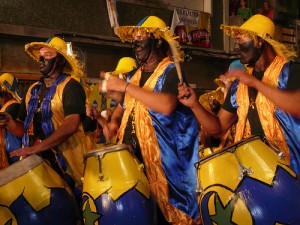
    Percussionists play candombe during parade Las Llamadas (The Callings). Picture taken by Flickr user ERBR and used under a Creative Commons license.

    Percussionists play candombe during parade Las Llamadas (The Callings). Picture taken by Flickr user ERBR and used under a Creative Commons license.

    Carnival in Uruguay includes parades similar to those seen in Carnivals around the world, with queens, percussionists and colorful costumes taking over the streets, dancing to the beat of national rhythms. One of the most important events of the Uruguayan Carnival is the contest [es], where performers compete in their chosen category representing Uruguay’s distinctive musical and artistic richness: murga, negros y lubolos (playing candombe), parodistas [es], humoristas [es], and revista [es].

    Carnival can be a melancholic and nostalgic time for Uruguayans living abroad, but thanks to the blog [es] and Twitter page [es] Todo el Carnaval, Uruguayans all over the world can download audio and videos of the day’s performances. Todo el Carnaval also provides Carnival music year round; its creator, Yuri, is backing up personal Carnival VHS videos and cassettes going back to the 1970s:

    Todo el carnaval, es algo asi como un lugar donde decidi compartir todo el material audio visual que dispongo sobre carnaval. La idea original fue la de hacer un respaldo sobre este material y se convirtió en este blog, para compartirlo con todo el mundo.

    Todo el carnaval, is something like a place where I decided to share all the audiovisual material that I have about carnival. The original idea was to make a backup of this material, and it turned into this blog, to share it with the whole world
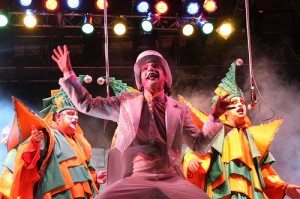
    Murga ensemble Los Curtidores de Hongos performing at 2009 carnival. Photo taken by Raúl Antoine, Flickr user rantoine2008, and used under a Creative Commons license.

    Murga ensemble Los Curtidores de Hongos performing at 2009 carnival. Photo taken by Raúl Antoine, Flickr user rantoine2008, and used under a Creative Commons license.

    Listening to the Carnival live is also an option. The popular site for Carnival information, Carnaval del Futuro [es], created a radio [es] which tunes listeners live into festivities, and promises 24 hours of streaming coverage.

    Video by Eduardo Gamero:

    Journalist and blogger Enrique Filguerias [es] explains that this radio will broadcast throughout the year:

    Los carnavaleros estarán de fiesta con esta novedad, impulsada por Carnaval del Futuro: Disponer de una emisora a través de la cual poder difundir el Carnaval, en forma continuada y sin interrupciones, durante los doce meses del año […] De abril a diciembre, en la grilla se encontrarán con espacios dedicados a difundir el Carnaval del Interior, con la totalidad del Regional de San José y ya se están gestionando otros certámenes representativos.
También se apostará a una producción de programas originales que combinarán lo periodístico y lo musical, transmisiones de eventos en directo, grabaciones de los espectáculos que se ofrecen en las salas montevideanas y se contará con enviados especiales en las giras que se realicen.

    Carnival enthusiasts will be happy about this news, promoted by Carnaval del Futuro: to have a radio through which Carnival can be broadcasted, in a continuous form and without interruptions during the twelve months of the year […] From April to December, the radio will provide a space dedicated to broadcasting Carnival from the within the country, with the totality of the regional Carnival of San José, and is already negotiating with other representative contests. The radio will also produce original programs that combine journalism with music, live transmissions, recordings of the shows that take place in Montevideo and reports from tours by special correspondents.

    Another online radio broadcasting live during the festivities is Radio Yorugua [es], from Los Yoruguas [es], a blog for and about Uruguayans living abroad. Los Yoruguas also offers a multimedia section dedicated to this year’s Carnival with information, videos, and pictures of the festivities.

    El Pedregullo [es], also part of Carnaval del Futuro, calls itself “the online community of the Uruguayan Carnival.” This small online community acts like a social network where users can discuss events, post pictures and videos, and create groups:

    El sitio está pensado para compartir todo lo referente a nuestro Carnaval. El Pedregullo, el lugar donde se cocina el Concurso. Ingresa y comparte tus fotos, videos, ideas.

    This site was made to share everything related to our Carnival. The Pedregullo, the place where the contest takes place. Sign in and share your pictures, videos, ideas.

    Uruguayans can confidently say they have the longest carnival in the world; not only because of its forty days of official festivities, but because the internet and social media are spreading its influence during the remaining 325 days.

  • Uruguay: President-Elect Mujica Tackles Botnia Issue Before Taking Office

    Uruguayan president-elect José “Pepe” Mujica is trying to intervene in a conflict that started more than seven years ago, and which still makes headlines in Uruguayan and Argentinean Media. Since the opening of Finnish pulp mill Botnia in Fray Bentos (Uruguay) along the Uruguay River—a natural border between Argentina and Uruguay—environmentalists and locals from the area and its neighboring Argentinean city Gualeguaychú have been protesting against alleged environmental and health hazards caused by the mill.

    Botnia Pulp Mill. Picture taken by Flickr user Gonzak and used under a Creative Commons license.

    Botnia Pulp Mill. Picture taken by Flickr user Gonzak and used under a Creative Commons license.

    Blogger and industrial designer Julián Ballesteros Riveros [es] spent recent Carnival celebrations in Gualeguaychú where he witnessed firsthand the activism against Botnia:

    Una bella ciudad con gente muy amable, vale la pena conocerla si se tiene la oportunidad; tiene termales, zonas para acampar y playas a lo largo de la costanera del río Gualeguaychú. Sin embargo, aunque lo más atractivo resulta ser los recursos naturales de la zona, es llamativa la constante exposición de avisos en las casas, en los establecimientos comerciales y hasta en los automóviles oponiéndose al unísono a la amenaza contra el medio ambiente que supone la instalación de “papeleras” y de Botnia en particular en límites con Uruguay

    A beautiful city with very nice people, it is worth seeing if one has the chance: it has hot springs, places to camp, and beaches along the Gualeguaychú river. However, even though the most attractive things are the natural resources of the zone, the constant exposure of signs on homes, commercial establishments and even on cars opposing the environmental threat which the installation of pulp mills and Botnia in particular within Uruguay, is striking.

    Skepticism about the plant posing an actual environmental or health hazard opposes the claims made by environmentalists, as various organizations have denied that the mill contaminates the air. According to local news organization from Entre Rios, Agencia de Noticias de Entre Rios APFD [es] , Marisa Arienza from Green Cross reported that the there have not been any changes in the levels of sulfur dioxide in the air since the plant began operations.

    Still, the strongest and most established protest came from the “piqueteros” who are discontent with the pulp mill and have used protest tactics like the takeover and blockade of bridges that act as important passage ways between the two countries for tourism and commercial purposes.

    Blockade from Fray Bentos, Uruguay and anti-Botnia slogans. Picture taken by Flickr user sebaperez and used under a Creative Commons license.

    ‘I Said No!' Blockade from Fray Bentos, Uruguay and anti-Botnia slogans. Picture taken by Flickr user sebaperez and used under a Creative Commons license.

    Mujica, who will not be sworn into office until March, has paid special attention to this conflict and wants the blockades lifted before he takes office. Mujica met with Cristina Kirchner, president of Argentina, and with the governor of the Argentinean region Entre Rios, Sergio Urribarri, where Gualeguaychú is located. However, environmentalist Lilian Melnik sees no progress in these meetings, as reported by local Uruguay River newspaper Rio Uruguay Digital [es]:

    [Mujica y Urribarri] son ‘traidores a una causa noble’ hacia quienes ‘defienden el levantamiento del corte sin argumentos y sin querer verdaderamente que se vaya Botnia’

    [Mujica and Urribarri] are ‘traitors in a noble cause' who ‘defend the lifting of the blockade without valid arguments and without really wanting Botnia to leave'

    Melnik also said that environmentalist will have to defend the blockade even harder, now that Mujica has tried to mediate.

    In an editorial, Ignacio de Posadas [es] criticizes these attempts made by the president-elect to reach out to the Argentinean side:

    El Presidente electo, por sus gestos (sobre todo la visita a los piqueteros) y por sus palabras (describiendo la violación de tratados y de normas y usos, como “un asunto interno” de la Argentina), dio razón al gobierno Kirchner y a los patoteros de Gualeguaychú, banalizando el asunto, debilitando la posición jurídica y de principios del Uruguay y enviando a La Haya el peor mensaje posible (¿qué juez se parará en los pedales si la parte agraviada dice que todo es negociable?).

    The president-elect, with his actions (especially the visit to the “piqueteros”) and with his words (describing the violation of treaties and of laws and uses as “internal affairs” of Argentina) agreed with the Kirchner government and the thugs of Gualeguaychú, decreasing the seriousness of the matter, weakening the judicial position of Uruguay and its principles, and sending The Hague the worst possible message (what judge would put his foot on the break if the aggravated side says that everything is negotiable?)

    Shortly after taking office, Mujica will have to face the verdict from the International Court of Justice at The Hague, where Argentina issued a formal case against Uruguay in 2006. Mujica’s close relationship with Kirchner and his recent attempt to reach out to governor Urrubarru will also be tested when he becomes the official president.

    Argentinean journalist and blogger Pepe Eliaschev [es] condemns the blockades as useless and contrasts Mujica’s close connection to the Kirchners with the current Uruguayan president Vázquez' tumultuous relationship with the neighboring government:

    En pocas palabras, el corte de la frontera con Uruguay no sirve para nada y es un pastiche siniestro que solo ha provocado daño. La planta de Botnia, inaugurada hace ya dos años, trabaja y produce con absoluta y total normalidad, y lo hace en toda su capacidad. El corte no solo no redujo el flujo de turistas, sino que lo incremento, demostrando la pasmosa estupidez de la medida. De la famosa “contaminación” nada significativo ha vuelto a aportarse, mientras que en el inicio del conflicto la llamada asamblea “ambientalista” de Gualeguaychú llegó a decir que la fabrica instalada en Uruguay era equivalente al Auschwitz, el campo de exterminio que los nazis instalaron en esa ciudad polaca durante la Segunda Guerra y donde fueron aniquilados centenares de miles de judíos. […] Operativo seducción: el viejo guerrillero quiere engullirse a la pareja presidencial argentina para que levanten el corte de la frontera. El septuagenario tupamaro imagina que podrá extraer de los post montoneros argentinos lo que le severidad del oncólogo socialista Vázquez no pudo.

    In a few words, the blockade of the border with Uruguay doesn’t serve any purpose and it is a sinister pastiche that has only caused damage. The Botnia plant, inaugurated two years ago, works and produces at absolute and total normality, and to its fullest capacity. The blockade has not only reduced the flow of tourists, it has also increased it, showing the stupidity of the measure. Of the famous “contamination” nothing significant has arisen recently, while at the beginning the so called “environmentalist” assembly of Gualeguaychú said that the installed mill in Uruguay was equivalent to Auschwitz, the concentration camp that the Nazis installed in that Polish city during the Second World War and where hundred millions of jews were annihilated […] Operation seduction: the old guerrilla man [Mujica] wants to swallow the Argentenian presidential couple [(the Kirchners)] so that they lift the blockade from the border. The seventy-year old Tupamaro imagines that he can get out of the Argentinians what the severity of the socialist oncologist Vázquez could not”

    Mujica has said he will not negotiate with “piqueteros,” and the “piqueteros” in turn, say they will not take action until the Hague pronounces its verdict.

  • Chile: Piñera’s Victory Raises Questions About Pinochet’s Influence

    On January 17, 2010 Sebastián Piñera was elected Chile's next president, following twenty years of a left-leaning government that symbolized the transition to democracy after Augusto Pinochet’s dictatorship. Spanish-speaking bloggers and online newspapers have commented on the relationship between the president-elect and the deceased dictator; many of these observations arose from the public support showed to Pinochet after Piñera’s victory.

    A Piñera voter shows his support for dictator Augusto Pinochet. Photo taken by Darcy Vergara, Flickr user darcy_vergara, and used under a Creative Commons license

    A Piñera voter shows his support for dictator Augusto Pinochet. Photo taken by Darcy Vergara, Flickr user darcy_vergara, and used under a Creative Commons license

    Commenting on the Pinochet followers the day of the final vote, Luis Ramirez [es] wrote on his blog:

    Sí, ya es un hecho: Los Piñeristas Pinochetistas están entre nosotros.

    Yes, it is a fact: The Piñeristas Pinochetistas (Pinochet supporters) are among us.

    Pictures like the one above and videos like the one below that show Chileans yelling “General Pinochet, this victory is for you” and “Chi Chi Chi le le le, long live Chile and Pinochet” have been passed around the internet to the bewilderment of some, and the indifference of others who say that this is nothing new in the country.

    Video by REMP81:

    Regarding these chants and signs, the online newspaper La Alternativa [es] explains that:

    El hecho causó estupor en varios adherentes del propio empresario, así como también en medios internacionales, incluso aquellos ligados a la derecha, quienes consideran al fallecido dictador en un nivel similar a Hitler Mussolini o Francisco Franco. La noche del domingo 17 de enero será recordada como el momento en que muchos aduladores del gobierno militar “salieron del closet” y expresaron públicamente que la retórica del emprendimiento, el futuro, la reconciliación y la esperanza, no eran más que vacías frases de campaña para “enchular” a una derecha.

    The event caused stupor in various people close to the businessman, and also in the international media, even those tied to the right, who consider the deceased dictator on a similar level to Hitler, Mussolini or Francisco Franco. The night of Sunday, January 17th will be remembered as the moment when many adulators of the military government “came out of the closet” and expressed publicly that the rhetoric of progress, of the future, and of reconciliation and hope, is nothing more than hollow campaign phrases to improve the right.

    In a blog called “Cuestiónatelo Todo [es] (“Question everything”) the author rejects what many have expressed about the positive state of Chilean democracy, and says that Piñera’s victory is actually a step backward for democracy in Chile:

    Su triunfo representa una resurrección del pinochetismo […] Pinochet nunca murio realmente, y el triunfo de Piñera solo significa la consecuencia natural de una transición que nunca fue tal cosa, sino simplemente la continuación de lo mismo con rostros aparentemente mas amables.

El triunfo del partido de Piñera es un paso atras en el avance hacia la democracia chilena,

    His triumph represents a resurrection of “pinochetismo,” […] Pinochet never really died, and Piñera’s victory is only the natural consequence of a transition that never happened and the simple continuation of the same thing with faces that appear friendlier. The triumph of Piñera’s party is a step backward for Chilean democracy.
    Man trying to take down Piñera electoral sign during Victor Jara's funeral, who was killed during the Pinochet dictatorship. Photo taken by Flickr user Amable Odiable and used under a Creative Commons license

    Man trying to take down Piñera electoral sign during Victor Jara's funeral, who was killed during the Pinochet dictatorship. Photo taken by Flickr user Amable Odiable and used under a Creative Commons license

    However, others see the outcome of this election as a sign that Chileans have put Pinochet and his dictatorship behind them, and that the left, who will become the opposition on March 11, will have to look for new ways to gain support from voters. Peruvian blogger Alejandro Lostaunau Neira [es] writes:

    Esta situación ha brindado la oportunidad para que los partidos que apoyaron la candidatura del exitoso empresario se desprendan de una vez por todas del fantasma de Augusto Pinochet. […] Sólo este triunfo sobre la Concertación de Partidos por la Democracia puede desligar el fantasma del amado y odiado militar, fallecido en diciembre de 2006.[…] La centro izquierda siempre tenía ventaja porque una manera de bajarse al contrincante era recordar los momentos de oscuridad de la dictadura. Ahora todo eso ya no será posible porque el pueblo chileno ha legitimado a los hasta ahora opositores.

    This situation has given an opportunity to the parties that supported the candidacy of the successful businessman to once and for all disconnect themselves from the ghost of Augusto Pinochet […] Only this victory over the Concertación de Partidos por la Democracia can disconnect the ghost of the beloved and hated military man, who died December of 2006. The center left always had an advantage because one way of putting the opposition down was to remember the dark times of the dictatorship. Now all that is not possible anymore because the Chilean people have legitimized the until-now opposition.

    Luis Mendez, a Chilean who runs the blog Adictos 2.0 [es] sees Piñera’s victory as an end to 37 years of division between the Chilean people on the issue of Pinochet. He ends his post with encouraging words for Piñera, and he calls for a future where Chileans will finally turn the page on the military coup and the Pinochet dictatorship:

    Ojala que por el bien de todos, a Sebastian Piñera le vaya bien, ya que de una vez queremos que los que paso el 11 de septiembre de 1973 quede en la historia de Chile y no siga siendo presente, ya que las nuevas generaciones queremos un viva Chile presente y futuro!!

    Hopefully for the good of everyone, Sebastián Piñera will do well, because we want what happened September 11, 1973 to stay behind in Chile's history and not remain the present, because new generations want a “long live Chile” in the present and future!!

    The fact that Piñera tried so hard to disassociate himself from Pinochet during the campaign speaks positively of the majority of Chileans who see the dictatorship as a grim part of their history. As reported from an interview in the Mexican newspaper Informador, when the then-candidate Piñera was asked about the influence of the dictator in the elections, he answered, “Pinochet is part of the past. We want to construct a future of national unity, of greater prosperity and greater justice for everyone.”