Author: Simon Maghakyan

  • USA: Native Cherokees Fight for Sacred Mound

    Cherokee Native Americans in North Carolina are currently fighting the construction of an electrical station they say would impede the spiritual experience at Kituwah, a sacred mound that is cherished as the place where God gave the Cherokee their laws and their first fire. It is believed to have survived nearly ten thousand years.

    The mound is 170 feet in diameter and five feet high.

    Although indigenous remains – both human and cultural – are protected in the United States by the 1990 Native American Graves Protection and Repatriation Act, sacred earthworks called mounds are still vandalized in the eyes of many Native Americans.

    The Cherokee fight to keep the mound untouched is on Facebook with more than 2,000 “SAVE KITUWAH” fans.
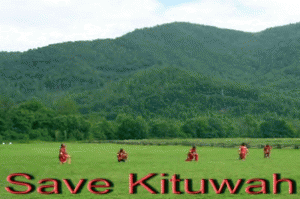
    Photo of Kituwah posted in Facebook group by Red Gryphon

    Photo of Kituwah posted in Facebook group by Red Gryphon

    Assistant attorney general of the Cherokee reservation, Hannah Smith, sent an email to Duke Energy. It is posted on Facing South, the website of the Institute for Southern Studies. She describes the effort to guard the area that the Eastern Band of the Cherokees repurchased in 1996:

    While I understand the need for power and know that change is by-product of progress, I explained my desire to have Duke Power mitigate as much as possible the visual impact this tower structure is going to have on the experience Cherokee people have when they visit Kituwah. I used a metaphor to describe the impact on this ancient view shed of Kituwah in hopes that it might convey a better understanding of how I (and most Cherokees) are going to be affected. I said that erecting this unattractive industrial looking “eye sore” so close in proximity to our ancient and sacred Mothertown was like putting up a power substation next door to a great Cathedral (like St. Peter's Basilica in Rome). The Cherokee culture values the Kituwah site and what is left of its unspoiled beauty like most of the world values St. Peter's for its iconic beauty and ancient place of worship.

    If the Cherokees persuade Duke Energy to halt construction, it would be their second victory this year. In January 2010, according to Save the Sacred Sites blog, the Department of Defense stopped construction of an airport on Iolta – an ancient Cherokee village and burial site in North Carolina – until further investigation. But other Native American sites, as summarized by Facing South, were not as lucky:

    Last year a mound near Oxford, Ala. was used as fill dirt for the construction of a Sam's Club, and another Indian mound in the Oxford area was recently found to have disappeared during construction of a municipal sports complex.

    In the late 1990s, an Indian burial site in Nashville, Tenn. was demolished to build a Wal-Mart Supercenter, while another Indian burial site along the Cumberland River in that city was disturbed during construction of a stadium for the Tennessee Titans National Football League team. And Georgia is building a four-lane highway near the Ocmulgee National Monument, a site of great significance to the Muscogee (Creek) people.

    More photos of Kituwah can be seen here and here.

  • India: Death of a Prehistoric Language

    The last speaker of the ancient Bo language, Boa Senior, has died in her native Andaman Islands (part of India) in February 2010. It's a vivid confirmation of last year's report from UNESCO, warning that 2,500 languages are at risk of disappearing.


    Video: Boa Senior singing in her native Bo, via Survival International

    In her Minnesota-based True to Words blog devoted “to the exploration of language and writing,” Sara Duane reports the news and adds that some formerly dead languages have recently revived:

    In 1992 a prominent US linguist predicted that by the year 2100, 90% of the world's languages would have ceased to exist. One of those languages died last month when 85-year-old Boa Sr. passed away. She was the last speaker of Bo, which at 70,000 years was one of the world's oldest.

    [..]

    Languages can be brough back from the brink, or even from total extinction, if the will is strong enough and most importantly, if enough of it has been written down. Hebrew was a dead language at the beginning of the 19th century. It existed as a scholarly written language, but there was no way to know how the words were pronounced. Persistence and will from Israeli Jews brought the language back into everyday use. There has also been a revival of Welsh in the UK and Maori in New Zealand.

    Transubstantiation, which described itself as trying to “make sense of the legacy of the Tower of Babel,” suggests documenting dying languages:

    If we are able to preserve language life then by all means let us preserve it. However, sometimes this is not possible and then perhaps our most important task as linguists is to analyse, describe and document; set the dying language down so that we can use knowledge about it to further research into the general understanding of the human condition.

    Andaman Islands from above by Venkatesh K on Flickr

    Andaman Islands from above by Venkatesh K on Flickr

    Madhu Baganiar, who belongs to the indigenous Oraon (Kurukh) community comments on the demise of Bo language with the death of Boa senior:

    Every language has its own unique history, culture style, story. When a language dies, a vast store house of knowledge associated with the language also dies. Today, a living tribal language “Bo” has died. Tomorrow more tribal languages of India are bound to die. There are hundred of reasons which will kill the living tribal language…

    Ireland-based blogger The Poor Mouth mourns the loss of Bo, and says:

    Languages come and languages go – we can see the traces of several lost languages in the British Isles (Yola, Norn, Cumbric etc) – but I can’t help feel that when they die something significant is lost from the rich, dark soup that makes up humanity. Boa’s passing diminishes us all.