Author: Sufiy

  • EVs mass market: Japan Plans $1.1 Billion Nuclear, Electric-Car Loans TNR.v, CZX.c, WLC.v, LI.v, RM.v, LMR.v, SQM, FMC, ROC, NSANY, TM, HEV, AONE, F

    Japan takes Electric Mobility very seriously and serious money are flowing into Green Mobility revolution now: Las Vegas Lithium Supply and Markets conference was marked by attendance of all Major Japanese trading houses – they are very actively sourcing supply of Lithium.

    America needs to catch up with the rest of the world in Electric Space. U.S. is years away from recent advance in lithium batteries and electric cars compare to Japan and China. Nissan spent 5.5 billion dollars and 16 years developing electric cars based on lithium ion technology. Competition is heating on and it is very positive to see DOE supporting at least production of Electric Cars in U.S. developed in another countries. Green Leaf growing in the Homeland is better than nothing even if it is from a foreign tree.”

    Bloomberg:

    By Shigeru Sato and Yuji Okada
    Feb. 12 (Bloomberg) — Japanese Prime Minister Yukio Hatoyama’s cabinet endorsed planned legislation to offer 100 billion ($1.1 billion) in low-interest loans to developers of electric cars and solar and nuclear power.
    The government will offer financing at rates about 0.2 to 0.3 percentage point lower than ordinary commercial loans to developers of photovoltaic cells, lithium-ion rechargeable batteries, and nuclear reactors, Tetsuya Hamabe, the director of the trade ministry’s industrial finance division, told reporters in Tokyo today.
    Japan wants to speed the development of next-generation clean energy technology amid an intensifying global race to capture the biggest share of the market for less-polluting power generators and vehicles. The move comes after U.S. President Barack Obama proposed tripling federal loan guarantees for new nuclear power plants to $54 billion.
    One hundred billion yen will be offered in the fiscal year starting April 1, and that figure should expand to several hundred billion in coming years, Hamabe said. The loans will help create jobs and achieve sustainable economic growth, he said.
    The bill will be submitted to the regular Diet session running through the middle of June. The ministries of trade, agriculture and transportation will decide who is eligible if the legislation is passed, Hamabe said.”
  • Lithium and REE: Mercedes Announces a For-Real Electric Van TNR.v, CZX.v, WLC.v, LI.v, RM.v, LMR.v, SQM, ROC, FMC, AVL.to, RES.v, BYDDY, HEV, DAI

    Here comes competition in Electric Vans space from Mercedes.

    Ford was late to the EV market place with GM Volt taking the headlines, but now they are moving into right direction: it is lithium and it is White . Important thing will be to move with electric version in Taxi urban market as well. Next step will be to target commecial fleets and Ford can even gain some market share here out of GM Volt and Nissan. It is a very encouraging news for Lithium and REE demand side.”


    EV World:

    Mercedes Announces a For-Real Electric Van

    Class: EVWORLDWIRE
    SYNOPSIS: Mercedes-Benz is manufacturing its own electric van.
    Written by: Martin Schwoerer Based on recent history, one might be forgiven for thinking that Mercedes is only interested in zero-emission technology when it involves collecting funds for Hydrogen boondoggles. But on Tuesday, Mercedes announced it has actually developed something that has the potential to greatly improve the quality of life of people who live in cities.
    Premiering to an audience of European economics ministers at the Basque city of San Sebastian, Daimler unveiled the prototype of a battery-powered van based on the Mercedes-Benz Vito. The van which might have been named after a minor figure in a Mafia movie is the world’s first with electric drive system ex factory. That means, it is not a vehicle that is converted to electric propulsion after leaving the factory in Vitoria, Spain; instead, Mercedes installs the Lithium-ion battery system on the assembly line.
    The battery-powered Vito will enter low-volume production in 2010. During 2010, around 100 Mercedes-Benz Vito vans will be delivered to 20 customers, primarily fleet operators and public institutions. The customers will be able to transport items in environmentally sensitive zones with zero emissions, including no CO2 emissions, and low noise. Deployment scenarios therefore typically involve short distances and making many stops in urban areas.
    With an operating voltage of 400 V, 16 A current and an available capacity of 32 kWh, the Vito’s range averages 130 km. The peak output of the electric motor is 90 kW; the topc speed is limited electronically to 80 km/h. Mercedes says there is no loss in terms of payload or load volume compared to a conventionally powered Vito as a load capacity in excess of 900 kg is possible.
    Mercedes plans to make 2,000 units of the electric Vito “in the near future”, which one would hope would be within the decade, since logistics, staff training and production technology are receiving financial support from the regional Basque government.”
  • Senior Chinese military officers have proposed that their country sell some U.S. bonds to punish Washington TNR.v, BVG.v, GRC.to, ASM.v, NGQ.to, HUI

    China’s response to stupidity (or calculated situation?) will be asymmetrical, unexpected and unusual: when you have more than a billion people and more than a pile of cash – you have brains and options to chose from. In U.S., on another hand, there are just a few options to go from here (war will be the calculated one) to avoid Depression and Burden of Debt: one will be to inflate it out and destroy the US Dollar, but start transition of economy into post oil dimension with Electric Cars and trans national train system. This approach will involve honesty, budget cuts and severe constrain on military complex. And you will have to keep your lenders happy: open the markets and not annoy them every minute. If military complex will get its upper hand over Obama we can expect another option: U.S. falling years behind China in Electric Space. War now is always economic. While U.S. spend billions to protect oil communication lines all over the world, China is moving fast into post oil environment dramatically cutting cost of it manufacturing base. China understands that low wage cost advantage will have to give up with time – they need to keep work force happy, but transition in Energy Space will bring China Energy Security, undermine U.S. military machine focused on Oil routes ocean domination and will bring another economic advantage in the form of much lower transportation cost. Nuclear Power developments in China support our point of view. What will be the response from Obama? We all have counted on the banks Too Big to Fail – they have failed and financial system is still in rubbles, now some are counting on “they will lose more if they sell” – is it another Big If in the making? Who can be sure?

    US Dollar now definitely looks tired and made a Sell Signal. Scare about sovereign debts and Greece particularly helped to sell few more billions of IOU, now reality will be settling in: Sovereign Debt Crisis is here on American soil – California is broken as U.S. itself with Budget Deficit over 10% now, compare it to Europe 6%. Greece will be baled out. Who will bail out USA?
    Chart at the top does not give a lot of room for error like Google freedom of search exercise in China or weapons delivery to Taiwan. Henry Paulson shared in his book that Russians were talking Chinese into selling Agencies’ Debt (FNM and FRE) just before the crisis hit the world. Chinese apparently did not use the moment and “even provided support” for FED and US Treasury actions in the market during unfolding of economic crisis in 2008. They still have those “weapons of mass distraction” – billions of US IOU. And if we can agree that nobody, including Chinese, needs US Dollar Collapse overnight, we can not believe that U.S has the luxury to drive them mad with Taiwan and recent announcements about Obama meeting with Dalai Lama. Short term signals are difficult to read, but US Dollar chart above does not suggest a run away drive at the moment – recent US Dollar rally looks tired. Please, do not forget Obama’s success or what has left out of his rock-n-roll appearance depends on Jobs, not US Dollar chart.”
    We have a small surprise from our lenders:

    Gold is building base for double bottom reversal.

    China builds stakes in Canadian mining
    Canada Zinc Metals CZX.v will be another example of Chinese expansion into Canada.
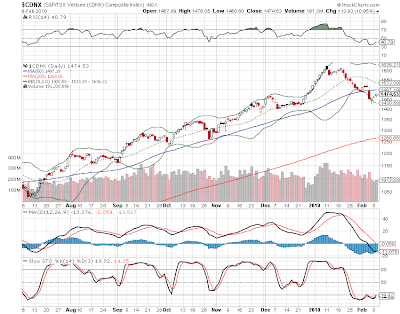
    Canadian Juniors will be the most exited public with all recent developments, interesting to note, that sector is building reversal which is more aggressive than USD and Gold pace of changing direction – we have a bullish candle and Free White Soldiers, bullish reversal will be confirmed with crossing MA50.

    Reuters:

    The calls for broad retaliation over the planned U.S. weapons sales to the disputed island came from officers at China’s National Defence University and Academy of Military Sciences, interviewed by Outlook Weekly, a Chinese-language magazine published by the official Xinhua news agency.
    The interviews with Major Generals Zhu Chenghu and Luo Yuan and Senior Colonel Ke Chunqiao appeared in the issue published on Monday.
    The People’s Liberation Army (PLA) plays no role in setting policy for China’s foreign exchange holdings. Officials in charge of that area have given no sign of any moves to sell U.S. Treasury bonds over the weapons sales, a move that could alarm markets and damage the value of China’s own holdings.
    While far from representing fixed government policy, the open demands for retaliation by the PLA officers underscored the domestic pressures on Beijing to deliver on its threats to punish the Obama administration over the arms sales.
    “Our retaliation should not be restricted to merely military matters, and we should adopt a strategic package of counter-punches covering politics, military affairs, diplomacy and economics to treat both the symptoms and root cause of this disease,” said Luo Yuan, a researcher at the Academy of Military Sciences.
    “Just like two people rowing a boat, if the United States first throws the strokes into chaos, then so must we.”
    Luo said Beijing could “attack by oblique means and stealthy feints” to make its point in Washington.
    “For example, we could sanction them using economic means, such as dumping some U.S. government bonds,” Luo said.
    The warnings from the PLA come after weeks of strains between Washington and Beijing, who have also been at odds over Internet controls and hacking, trade and currency quarrels, and President Barack Obama’s planned meeting with the Dalai Lama, the exiled Tibetan leader reviled by China as a “separatist.”
    MILITARY SPENDING BOOST
    Chinese has blasted the United States over the planned $6.4 billion arms package for Taiwan unveiled in late January, saying it will sanction U.S. firms that sell weapons to the self-ruled island that Beijing considers a breakaway province of China.
    China is likely to unveil its official military budget for 2010 next month, when the Communist Party-controlled national parliament meets for its annual session.
    The PLA officers suggested that budget should mirror China’s ire toward Washington.
    “Clearly propose that due to the threat in the Taiwan Sea, we are increasing military spending,” said Luo.
    Last year, the government set the official military budget at 480.7 billion yuan ($70.4 billion), a 14.9 percent rise on the one in 2008, continuing a nearly unbroken succession of double-digit increases over more than two decades.
    The fresh U.S. arms sales threatened Chinese military installations on the mainland coast facing Taiwan, and “this gives us no choice but to increase defense spending and adjust (military) deployments,” said Zhu Chenghu, a major general at China’s National Defence University in Beijing.
    In 2005, Zhu stirred controversy by suggesting China could use nuclear weapons if the United States intervened militarily in a conflict over Taiwan.
    The United States switched official recognition from Taiwan to China in 1979. But the Taiwan Relations Act, passed the same year, guarantees Taiwan a continued supply of defensive weapons.
    China has the world’s biggest pile of foreign currency reserves, much of it held in U.S. treasury debt. China held $798.9 billion in U.S. Treasuries at end-October.
    But any attempt to use that stake against Washington would probably maul the value of China’s own dollar-denominated assets.
    China has condemned previous arms sales, but has taken little action in response to them. But Luo said the country’s growing strength meant that time has passed.
    “China’s attitude and actions over U.S. weapons sales to Taiwan will be increasingly tough,” the magazine cited him as saying. “That is inevitable with rising national strength.”
    (Editing by Jeremy Laurence)”

  • Lithium and REE: Ford Unveils New Transit Connect Electric and Taxi Version TNR.v, CZX.v, WLC.v, LI.v, RM.v, LMR.v, SQM, FMC, ROC, AVL.to, HEV, F, TTM

    Now we need volume in the market for Electric cars, we need new models and new applications. Ford’s announcement is very important news for lithium batteries wide spread market penetration, it will compete directly with Renault Electric White Van unveiled in Frankfurt and will affect the timing of Lithium battery’s cost developments:

    Our main take from U.S. Energy Secretary Steven Chu Video :”Price of Lithium batteries is in access of 1000 USD/kWh at the moment, with mass production it will drop to 300-400 USD/kWh ( S. GM is aiming now for 450 USD/kWH in a near term) and with recent technological advance we can talk about 100 USD/kWh as possibility.” As we have wrote before, lithium battery price of USD 25o per kWh will make production of Electric Cars cheaper than a comparable CV – you do not need automatic transmission as part of your power drive.”

    Ford was late to the EV market place with GM Volt taking the headlines, but now they are moving into right direction: it is lithium and it is White. Important thing will be to move with electric version in Taxi urban market as well. Next step will be to target commecial fleets and Ford can even gain some market share here out of GM Volt and Nissan. It is a very encouraging news for Lithium and REE demand side.

    The New York Times:
    February 9, 2010, 1:17 pm — Updated: 1:17 pm –>
    By STEPHEN WILLIAMS
    2011 Ford Transit Connect Electric.
    Ford unveiled an electric version of its Transit Connect work van ahead of the Chicago Auto Show, which opens to the press on Wednesday.
    The 2011 Transit Connect Electric, which is expected to appear in fleets later this year, will offer a range of 80 miles per charge and a top speed of 75 miles per hour. The van is equipped with a 28 kilowatt-hour lithium-ion battery pack that recharges with a 240-volt outlet in six to eight hours. The Transit Connect Electric is also 120 volt compatible (though charge time is likely to be considerably longer). Ford says the battery pack should last the life of the vehicle.
    “Transit Connect Electric exemplifies how we are leveraging our relationships as well as our hybrid and advanced powertrain programs to bring energy-efficient technologies from the laboratory to the street,” Derrick Kuzak, Ford’s group vice president of global product development, said in a news release.
    The Transit Connect Electric was developed with Azure Dynamics, an electric-drive technology company in Oak Park, Mich., which will build the powertrain. Johnson Controls-Saft is supplying the lithium-ion battery cells and battery packs.
    2011 Ford Transit Connect Taxi.
    Another vehicle that Ford unveiled ahead of the Chicago show was its Transit Connect Taxi, which will also go on sale later this year.
    Ford says the taxi edition (and the base model Transit Connect) will come with a choice of three engines. In addition to a 2-liter 4-cylinder engine, there will be versions that run on compressed natural gas and propane.
    Indeed, the Transit Connect Taxi to be shown in Chicago has the words “Compressed Natural Gas” printed prominently on the door. The vehicle is painted yellow and even features a check pattern on the back half — perhaps portending a future in New York City?
    The Taxi might be a no-brainer to replace the aging Crown Victorias now carrying passengers in New York. While it’s not a stretched version, the Taxi does offer an additional three inches of rear legroom over the conventional truck and features an integrated fare-tracking system, an interactive eight-inch L.C.D. display in the back that can show routes and restaurant reviews.”
  • Electric Cars: Branson warns that oil crunch is coming within five years TNR.v, CZX.v, WLC.v, RM.v, Li.v, LMR.v, SQM, FMC, ROC, NSANY, BYDDY, TM, TTM,

    Sir Richard Branson, founder of the Virgin Group, will say the coming crisis could be even more serious than the credit crunch. Photograph: Peter Schneider/EPA

    It took a few months from that groundbreaking news in November: “Guardian Key oil figures were distorted by US pressure, says whistleblower“, but now Richard Branson will bring a vocal point to this issue – it is one of the catalyses for Electric cars to take off in a mass market fashion.
    To call it a bomb will be an understatement – couple of weeks ago UK papers run a story about behind the curtain negotiations to move out of US Dollar in pricing major commodities like Oil and Gas, story was denied by all parties involved…You need just to check Gold price and USD index where the truth is, if the same will happen to Oil reserves estimations and Peak Oil will be confirmed for majority of consumers panic will drive prices fast. Now all that effort of DOE to finance alternative energy and, particularly, transportation in the form of electric cars with lithium batteries gains a new meaning – Electric cars can be the only economic and fast deployable alternative to oil based fuels. Rising oil prices will make this transformation happening really fast and lithium and REE will be in a very high demand.”
    guardian.co.uk:

    • Virgin chief and fellow business leaders call for action

    • Energy crisis threatens to be more serious than credit crunch

    Sunday 7 February 2010 20.18 GMT

    Sir Richard Branson, founder of the Virgin Group, will say the coming crisis could be even more serious than the credit crunch. Photograph: Peter Schneider/EPA
    Sir Richard Branson and fellow leading businessmen will warn ministers this week that the world is running out of oil and faces an oil crunch within five years.
    The founder of the Virgin group, whose rail, airline and travel companies are sensitive to energy prices, will say that the ­coming crisis could be even more serious than the credit crunch.
    “The next five years will see us face another crunch – the oil crunch. This time, we do have the chance to prepare. The challenge is to use that time well,” Branson will say.
    “Our message to government and businesses is clear: act,” he says in a foreword to a new report on the crisis. “Don’t let the oil crunch catch us out in the way that the credit crunch did.”
    Other British executives who will support the warning include Ian Marchant, chief executive of Scottish and Southern Energy group, and Brian Souter, chief executive of transport operator Stagecoach.
    Their call for urgent government action comes amid a wider debate on the issue and follows allegations by insiders at the International Energy Agency that the organisation had deliberately underplayed the threat of so-called “peak oil” to avoid panic on the stock markets.
    Ministers have until now refused to take predictions of oil droughts seriously, preferring to side with oil companies such as BP and ExxonMobil and crude producers such as the Saudis, who insist there is nothing to worry about.
    But there are signs this is about to change, according to Jeremy Leggett, founder of the Solarcentury renewable power company and a member of a peak oil taskforce within the business community. “[We are] in regular contact with government; we have reason to believe their risk thinking on peak oil may be evolving away from BP et al’s and we await the results of further consultations with keen interest.”
    The issue came up at the recent World Economic Forum in Davos where Thierry Desmarest, chief executive of the Total oil company in France, also broke ranks. The world could struggle to produce more than 95m barrels of oil a day in future, he said – 10% above present levels. “The problem of peak oil remains.”
    Chris Skrebowski, an independent oil consultant who prepared parts of the peak oil report for Branson and others, said that only recession is holding back a crisis: “The next major supply constraint, along with spiking oil prices, will not occur until recession-hit demand grows to the point that it removes the current excess oil stocks and the large spare capacity held by Opec. However, once these are removed, possibly as early as 2012-13 and no later than 2014-15, oil prices are likely to spike, imperilling economic growth and causing economic dislocation.”
    Skrebowski believes that Britain is particularly vulnerable because it has gone from being a net exporter of oil, gas and coal to being an importer, and is becoming increasingly exposed to competition for supplies.
    “This is likely to put pressure on the UK balance of payments and in a world of floating exchange rates is also likely to put downward pressure on the valuation of sterling. In other words, the positive benefits to the valuation of the pound as a petrocurrency are now eroding,” he said.
    The question of peak oil came to centre stage last November when a whistleblower told the Guardian the figures provided by the IEA – and used by the UK and US governments for much of their planning scenarios – were inaccurate.
    “The IEA in 2005 was predicting that oil supplies could rise as high as 120m barrels a day by 2030, although it was forced to reduce this gradually to 116m and then 105m last year,” said the IEA source. “The 120m figure always was nonsense but even today’s number is much higher than can be justified and the IEA knows this.”
    But Saudi Arabia launched a counter-strike at Davos, insisting the issue was overblown. “The concern about peak oil is behind us,” said Khalid al-Falih, chief executive of Saudi Aramco.
    Tony Hayward, the BP chief executive, downplayed fears about dwindling supplies in an interview with the Guardian last week.”

  • Better Place’s electric vehicles land in Israel TNR.v, CZX.v, WLC.v, RM.v, LI.v, LMR.v, SQM, FMC, ROC, TM, TTM, HEV, AONE, BYDDY, DAI, BMW, NSANY, F

    We are always taking all advance with Better Place as a very positive sign on Electric Car promotion into the market place. We still have some reservations about commercial success of this project, but money are coming into this play and the more electric cars will they be able to put into market – the better it is for our Lithium and REE story. Better Place could happen to be not the best place for your money just because they would like to act as a mobile operator, selling you your miles to drive in Electric Cars. In the beginning some people will go for it, but all economics will be left for Better Place to profit (as they hope). With Lithium battery prices going down in the case of mass scale adoption of Electric Cars, Better Place will cut its own branch they are siting on – people will buy cars and charge them at home or in government sponsored outlets around major cities. They will not have to be constrained to Better Place Electric Cars model range and its “pay as you go plans”.

    JPOST.com:

    BY RON FRIEDMAN 08/02/2010 01:52
    Cars can be test-driven at Pi Glilot visitors’ center beginning next week.

    Better Place, the company that proposes to revolutionize the global auto market with its electrically powered car and grid system, opened a state-of-the-art visitor center near Tel Aviv on Sunday.In a press conference marking the occasion, the company’s founder and CEO, Shai Agassi, said that in the future the company’s logo will be as well known as the Macintosh apple or the Nike swish.Situated in a renovated oil tank at the Pi Glilot fuel depot north of Tel Aviv, the visitor center invites the public to hear about the Better Place vision, learn how the system will work, and test drive the electric cars.“With the Better Place project, for the first time, we in Israel are providing a solution for one of the biggest global problems,” said Agassi. “By a happy coincidence, the Israeli government announced today that it was calling for a national plan to reduce Israel’s dependence on fossil fuels. I promise you that we had nothing to do with it, but we are happy about it because it shows where we’re going.”Agassi said that Better Place would be the biggest international brand to come out of Israel since Jaffa oranges.Better Place Israel CEO Moshe Kaplinsky, a former deputy chief of the IDF General Staff, announced that the company had signed agreements with 92 Israeli companies that agreed to convert a portion of their fleets to electric vehicles once they become commercially available.Among the companies that signed with Better Place are Motorola, Strauss and Netvision.Also announced at the press conference was the signing of a strategic partnership agreement between Better Place and the Dor Alon gas station chain. Kaplinsky said Better Place’s battery replacement centers would be based at Dor Alon gas stations, which are spread out across the country. “This is a first-of-its-kind agreement, and we expect that Dor Alon will be followed by other companies,” he said.The center itself aims to enable prospective clients and members of the public to become acquainted with the company and its product. Its location in an old fuel tank is symbolic, said Dafna Agassi, the company’s sales and marketing manager. “It shows our attitude about recycling and symbolizes the transition from the fossil fuel-based transportation of the past to the electric trend of the future,” she said.While from the outside it looks like a big concrete drum, on the inside the visitor center is as futuristic as you can get. Dubbed by Agassi “the electric car Disneyland,” the center includes a specially designed auditorium, an interactive information center and a short driving course, where people can try out the vehicles.Upon entering the center, guests are shown into a 30-seat auditorium. Every visitor is seated in a comfortable, couch-like chair that, it turns out, is made of a refurbished car seat. Each seat comes with a private screen.After being seated, the light goes out and a promotional video is projected on a wall-sized screen opposite the seats. The film talks about the problems inherent in the existing automobile market based on fossil fuels and the solution that Better Place seeks to offer.During the film, a hologram of Agassi explains the fine points. The private screens represent the dashboard of the cars, which allow users to access information about the battery and engine, navigate to the closest switching station and control the multimedia features of the vehicle.Though not in use on the journalists’ preview tour, a revolving stage in the center of the auditorium hints that at a key moment of the film, an actual vehicle will be shown to the visitors.Following the screening, visitors are invited to test-drive a car. Guests are paired up with Better Place employees and given the key to the electric vehicle waiting outside.The cars themselves are modified Renault Lagunas and they were brought in from France, together with the French technicians, in time for the launch of the center. In the future the center will feature Renault’s Fluence ZE models, the first mass-produced electric cars.The cars look like ordinary sedans and it is only when the visitor is asked to start the engine that the novelty becomes apparent. “Insert the key, press on the brake pedal and push the button to start the car,” said the instructor. “There, the car is running.”The only sound is that of the air conditioning unit switching on. Otherwise the car is silent. With electric cars, drivers will have to learn to rely on other senses to determine when the vehicle is operating.The acceleration feels just like a regular car’s. On the 1.5-kilometer track, drivers can only accelerate to 80-90 kph. You can’t get the impression of what it’s like to drive at high speeds, but it definitely allows you to test the acceleration and deceleration of the car, and both are comfortable and smooth. On turns it also functions like a regular car and drivers can only just detect the vehicle’s low center of gravity.Following the test drive, visitors once again enter the center and are ushered into a room that looks like the set of The Weakest Link TV show. Every guest gets a private touch-screen and an operator runs a program that presents the company’s infrastructure. Visitors can input information on the screen and see where the closest charging point will be and where the battery-switching stations are located.So far Better Place has signed agreements with 17 local councils and municipalities to place charging posts. The company is assuming that there will always be an abundance of spots where car-owners can recharge their batteries.Agassi said that 2010 would be the year Better Place proves itself.“We are now putting together all the pieces of the puzzle,” he said. In 2010 the charging grid will be tried out in Denmark and Israel and a practical trial on taxicabs in Tokyo will get under way.Agassi said the company was waiting for other car manufacturers to join in its project. “We are in ongoing negotiations with other manufacturers, but it takes a long time. The talks with Renault took a year, too. We will announce additional agreements when they take place,” he said.The Israeli trial will begin in September with several hundred vehicles, he said. It will encompass five to 10 battery-switch stations and several thousand charging points across the country. After a six-month trial period the cars will be available to the public. By that time there should be around 100 switch stations and Agassi expects to deploy roughly 1,000 cars a month.
    Agassi said the company was committed to providing a vehicle that would be cheaper than the equivalent gasoline-powered car. “Keeping it running will cost the same or less than running a car on gasoline. I can’t tell exactly because it depends on the price of fuel, which as you know fluctuates widely,” he said. The company has yet to publish the proposed price of the electric vehicle.When asked whether there would be additional models of electric cars like minivans or sports cars, Agassi said that Renault was currently working on nine models of electric vehicles and that every market segment would be represented by an electric alternative. He also said that because of the international standards that Better Place follows, additional companies, assuming they choose to, would be able to use the Better Place grid for service and charging.The visitors’ center will be open to the public starting on February 14. Groups of up to 25 people can schedule a tour and individual visitors can call ahead to book a tour and test drive.”

  • International Lithium Corp. Presentation at Las Vegas Lithium Supply and Markets TNR.v, CZX.v, NG.to, ABX, NGQ.to, WLC.v, Li.v, ORO.ax, RM.v, LMR.v, F


    International Lithium Corp. Las Vegas Presentation

    VANCOUVER, BRITISH COLUMBIA–(Marketwire – Jan. 26, 2010) – International Lithium Corp. (“ILC” or the “Company”), a wholly-owned subsidiary of TNR Gold Corp. (TSX VENTURE:TNRNews; “TNR”), is pleased to announce that the annual Lithium Supply and Markets 2010 Conference has invited the Company to present on the first day of the conference.
    ILC’s Chief Operating Officer, Mike Sieb MBA, will be presenting “Global Opportunities in Lithium – Nevada & Beyond” at 2:30PM PST, Session II under Emerging North American Lithium Production section of the conference. ILC has received significant interest from the public and lithium-users recently and anticipates developing further strategic alliances during this conference.
    In 2009, the annual Lithium Supply and Markets Conference took place in Chile amidst the global downturn and set the stage regarding the status of the global supply of lithium given the pending boom of electric cars and hybrid vehicles. During the downturn of 2009 TNR and ILC recognized the demand of lithium and other rare metals early and sought out projects worldwide to capitalize on this inevitable boom.
    “This conference attracts the top industrial players from early explorers, resource developers, professional analysts, brokerage firms, fund managers, and key end-users spanning the globe,” states Mike Sieb, Chief Operating Officer of ILC and continues “In weeks prior to this conference, major automotive companies including Magna International and Toyota Tsusho made significant investments into junior lithium explorers operating in Argentina. This confirms the creditability of the need of additional supply of lithium and other rare metals and the role junior lithium explorers will play in sourcing that supply for the end users.”
    ABOUT INTERNATIONAL LITHIUM CORP. / TNR GOLD CORP.
    International Lithium Corp., currently a wholly-owed subsidiary of TNR, is a mineral exploration company diversified geographically and by resource type. With projects spanning the globe from Argentina, USA, Canada, and Ireland, ILC will offer investors the potential upside of speedy lithium brine resource development to production and the valuation of other rare metals credits from spodumene pegmatites. ILC is scheduled to go public early in the second quarter of 2010.
    TNR is a diversified metals exploration company focused on identifying and exploring its existing properties and identifying new prospective projects globally. TNR has a total portfolio of 18 properties, of which 9 will be included in the proposed spin-off of International Lithium Corp.
    It is anticipated that TNR shareholders of record will receive up to one share and one full tradable warrant of International Lithium Corp. for every 4 shares of TNR held as of the yet determined record date. This will result in TNR shareholders owning shares in both TNR and International Lithium. For further details of the spin-off please refer to TNR’s April 27, 2009 news release or visit http://us.lrd.yahoo.com/_ylt=AgFkq2uCGUk4_fCiNwuvgGKtcq9_;_ylu=X3oDMTE2NjRmOGl1BHBvcwMxBHNlYwNuZXdzYXJ0Ym9keQRzbGsDaHR0cHd3d2ludGVy/SIG=11907bp0b/**http%3A//www.internationallithium.com/.
    The recent acquisition of lithium, rare metals and rare-earth elements projects in Argentina, Canada, USA and Ireland confirms TNR and ILC’s commitments to generating projects, diversifying there markets, and building shareholder value.
    On behalf of the board,
    Gary Schellenberg, President”
  • Gold to hit $1,350 – $1,400 by late Spring – John Embry TNR.v, GRC.to, BVG.v, SGC.v, NGQ.to, KTN.v, EPZ.v, ASM.v, FVI.v, GBN.v, VTR.to, MUN.to, FST.v,

    After last week’s sovereign debt scare Gold still tries to build a potential Double Bottom reversal at 1065: buyers quickly snap all orders last Friday making a potential bullish candle. Next level of support will be 1025 with MA200 drifting in that area.
    We have mentioned before about Gold Sell signal and suggested that there will be a time to accumulate Juniors, which will provide more upside opportunities with another Leg Up in the gold market. As it was scary before with gold over 1200 USD/oz, when everybody was bullish – so it is now very comforting to hear that Soros is suggesting that gold is a Bubble, Prechter is waiting for 40% correction and everybody is bearish about the Gold.”
    Listen to John Embry Chief Investment Strategist Sprott Asset Management
    Topic: Ponzi Scheme & Gold Bull Markets on Financial Sense Hour 3
    MineWeb:

    Speaking on the Mineweb Gold Weekly Podcast, Sprott Asset Management’s chief investment strategist says while the yellow metal is likely to continue to consolidate over the next few weeks, the next major move will be up.

    Author: Geoff CandyPosted: Wednesday , 03 Feb 2010
    GRONINGEN
    Gold should continue to consolidate over the next few weeks but, the next big move is likely to be up.
    This is the view of Sprott Asset Management’s chief investment strategist John Embry, who says he is looking for the price of the yellow metal to hit around $1,350 to $1,400 by late spring.
    Speaking on the inaugural Mineweb Gold Weekly Podcast, Embry says the recent downward trend seen in the gold price is nothing more than a healthy correction.
    “Gold had a 300 dollar plus run in US dollars from July into the early part of December and it has come under heavy pressure subsequently. It certainly has engendered immense bearishness amongst the commentators which is actually good from my perspective. I think the fundamentals are undisturbed and as a result it is setting up for another strong buy.”
    Asked about the link between gold and the US dollar, especially the recent strengthening of the dollar against the euro, Embry, says, while there is often a very clear link, the problems in the US and, by extension, the US dollar, are everywhere – especially given the huge budget deficit it is sitting with – so “the idea that one should run away from gold and into the US dollar because it is strengthening against the euro and several other currencies to me is actually preposterous.
    “The idea that the US dollar is a safe haven today is flat out wrong,” he added, “and that is going to be one of the major factors that are going to change the perceptions in the gold market going forward.”
    Another reason for Embry’s conviction about bullion’s next move, is the increasing role gold will play as a protection against monetary debasement.
    “I think a lot of the world’s wealth is figuring out that we have little choice given the debt problems in the world and the resultant unlimited creation of money and so I think there is a solid investment bid in the market for gold.”
    He adds, that concerns that have been raised about the possible impact the jewellery market is likely to have on the long term rise of gold because, he says, “all great bull markets in precious metals come from their reestablishment as money.”
  • Lithium and REE demand: Tata to launch electric Indica Vista by 2011 TNR.v, CZX.v, LI.v, RM.v, WLC.v, LMR.v, SQM, FMC, ROC, TTM, TM< NSANY, BYDDY, SNE

    This price range with top at 15000 USD will make it the cheapest known Electric Car for us. This development will be very important for EV mass market adoption and mass scale Lithium batteries production rate, which will bring prices for the batteries down fast. Cost of the batteries will be the one of the dominant factors for mass market adoption of Electric Cars.

    CarDekho.com:

    Tata to launch electric Indica Vista by 2011

    Last updated on: February 5, 2010 11:11 IST

    “Fuel efficient engines, low emissions and alternate fuels have been some of the major concerns of the automotive industry across the globe.
    With the demand for electric cars on the rise Tata Motors have come up with Tata Indica Vista Electric.
    The car was showcased at the Delhi auto expo and is expected to be available to customers by 2011.
    Though the exact price is not yet known it is expected that Tata Indica Vista Electric would fall in the Rs 600,000-700,000 bracket.
    Powered by CarDekho.comCarDekho.com offers the best platform in India to research cars online. Make better car buying decisions using features like car research, reviews, car comparisons, discounts, on-road prices etc. on CarDekho.com.”
  • Google Might Be Investing in Electric Cars TNR.v, CZX.v, WLC.v, LI.v, RM.v, LMR.v, SQM, FMC, ROC, TT, TTM, BYDDY, NSANY, DAI, BMW, VLNC, PC, AONE, HEV

    Availability of serious capital for Better Place and Nissan is very encouraging. You have to make your homework right in order to find the right financing opportunities in Electric Cars value chain. Newcomers on Technology or Auto making side will be evaporated overnight by Toyota situation as it is today. It is time when very risky plays on Lithium and REE supply side could provide actually more security as a sector entry with at least technology risk minimised.”
    Tesla IPO will bring a lot of attention to the Electric Space. Google founders investing in it or even Google itself will bring the story out into the mass media headlines. Market has to climb the wall of worry and such high profile investors will bring necessary comfort for the investors to move into Electric Cars value chain – they will find out very soon that there is not enough pure plays for the magnitude of capital which could be involved. We will have situation in Gold, Majors and Juniors in 2003-2005: First capital moved into gold, than into Major producers and than Juniors took off with multiples to the market cap, when capital was chasing very small market with very hot stories.
    ValleyWag:
    Tesla wants to go public. But the electric car company, loved by California celebrities and nerds alike, had to first bare all to the SEC. So now we know Tesla is funded by a mysterious front company linked to Google.
    Tesla registered with the SEC on Friday. Buried in the copious paperwork is the name of a very interesting “Series C” and “Series E” stockholder: Amphitheatre LLC. We first flagged this entity as a possible Google front when it invested in a zeppelin company started by Google advisor Esther Dyson. The same zeppelin company was later hired by 23AndMe, the Google-funded and -housed genetic testing firm co-founded by the wife of Google co-founder Sergey Brin.
    Ampitheatre LLC may well have been acquired by Google along with the company INV Tax Group when Google bought its eight-building headquarters at 1600 Amphitheatre Parkway and 1200-1500 Crittenden Lane in Mountain View. Ampitheatre LLC and INV Tax Group, then believed affiliated with Goldman Sachs, had been the shell companies that held the buildings.
    It’s hard to imagine why a real estate holding vehicle is now investing in zeppelins and electric cars if it’s not controlled by Google. California records are little help; they show the LLC still registered to “INV Tax Group, 180 Maiden Lane, 40th floor,” an address once linked to Goldman Sachs in a building now used by a wide array of companies.
    Google’s a logical investor, anyway, since its founders are already Tesla customers (see picture of Brin in his Tesla, left, by Zach Graves) and investors. Co-founder Larry Page even reportedly “jet pools” with Tesla CEO Elon Musk, and Google has an “electric car” section reserved in its parking lot (see picture at top by Tristan Nitot). It wouldn’t be the first time Google co-invested with its founders; it followed Brin into his wife’s 23AndMe.
    Whether the Google honchos had their financial judgment clouded by the fact that they personally made it to the front of Tesla’s fiercely competitive waiting list is something for Google shareholders to decide.
    In so doing, they might consider another nugget buried in Tesla’s S-1: The company has not yet stabilized its notoriously volatile executive ranks. Among the recent departures is general counsel Jonathan Sobel, formerly of Yahoo. Sobel started in September; he was gone by December. One tipster claims friction with Musk was to blame. The bigger question is whether Musk can forge more stable relationships with his co-workers going forward. Only time will tell. We’ll be watching, and we bet Google will be, too.
    (Top pic: A Tesla parked at Google headquarters, by Tristan Nitot. Second pic: Sergey Brin driving in his Tesla, by Zach Graves.)”
  • Electric cars: A Netscape moment? Investors get out their chequebooks for electric-car start-ups TNR.v, CZX.v, WLC.v, LI.v, RM.v, LMR.v, SQM, FMC, ROC

    CS. Easy money are always dangerous. Cheap advise is even more so. It is time to separate business, stock price, analyst’s valuation and your money. To your surprise it could be Four different things in the end. It is time to write about the Power of Conservative view.
    New markets are new by definition – nobody knows what is coming. It is time when you should be extremely careful in gathering all available information: we still remember the power of analyst insight with Enron, Worldcom and Tyco – all at Strong Buy up to the last moment of Truth. That is why we always insisting that you, our devoted readers, must be making your own decisions – it is a proven trick: there is nobody to blame. Some could even suggest that Sell could represent more opportunities than Strong Buy – you can get and analyse information and should it be different to the one provided in a research low rating can get you a very nice entry point and if you are correct in your own observations the only way from it will be up in rating. As always ability to deliver will be crucial in the end of the day and will separate winners from research victims.
    Some analysts suggest after a few paid research reports, that to run a business is the same as to analyse history based on charts, they can always provide very helpful and clever “insights” what had to be done at the every turn…before. Some can even come up with valuations and ratings based on cut and paste old information from the websites, it is understandable – how can you contact all dozen companies you are writing about? Welcome to our second stage of Lithium and REE Bull market. Confusion, lack of information and creative writing provide opportunities as never before.
    We are not in a Bubble with Electric Cars, not even close according to the chart from Economist below. Idea slowly makes its way into the public rim. It has made already a few small bubbles along the way like in some Lithium juniors last year, but it is a very healthy transition period which will separate serious players from Hype and Dump stories.
    Availability of serious capital for Better Place and Nissan is very encouraging. You have to make your homework right in order to find the right financing opportunities in Electric Cars value chain. Newcomers on Technology or Auto making side will be evaporated overnight by Toyota situation as it is today. It is time when very risky plays on Lithium and REE supply side could provide actually more security as a sector entry with at least technology risk minimised.
    We are gathering information from Las Vegas Lithium market conference and will address challengers and opportunities for that sector later. Our first take from conference organisers is that if one year ago everybody was wondering whether it will be Electric Cars and whether it will be Lithium to power their drive – now both are almost certain and people start to worry about potential oversupply. Some of these people know something about electric cars, some don’t. Nobody knows about quantity. It is iPod before its launch. Will it be good, do we need it at all? Now you can tell, not before. Three presented Majors are spending time and money to prove that there is no market and place for anyone other then us. We have never come across such a generous helping from established players. Either they are moving into charity stage of the business cycle or, maybe, the problem is that they have as low as 8% in their revenue stream attributed to Lithium? Hardly an attractive entry point into the sector if you believe in iPod idea and ready to allocate risk capital. We would listen to them and park our money somewhere else, but when Toyota and Magna are buying into couple of Lithium plays sitting on the same Salar system and half of the Conference represent who is who in Japanese business we better wait – who knows, maybe after “boy band” warming up AC/DC will be on stage, it is Lithium after all and you better check the programme.
    Recent market correction and some research reports suggesting extreme overvaluation of some companies involved in the sector will provide a very good entry points into solid names with people, ideas and capital to support them. It is time when quantity and quality of projects will matter as never before: there is time to Buy and time to Sell. You can not build a business based on quarterly valuations, if it is a Next Big Thing you should come and Buy when nobody cares and then buy again when everybody get exhausted in anticipation of a quick buck. This is how the value build and portfolio diversity helps to mitigate early stage risks when nothing is certain.
    Last important observation from Conservative point of View on New Things, to cover all bets in case…if Warren Buffett will buy a stake or BYD, if he is busy, in any players involved in the sector, valuation could represent multiplies to any market cap and basically, please, disregard all hard wired research at that point. So now we all have at least a clue what to look for in this market.

    Electric cars
    A Netscape moment?

    Feb 4th 2010 From The Economist print edition


    THE idea of the “Netscape moment”, a fund-raising that signals the spawning of a whole new industry, is dear to Silicon Valley types who think back fondly to the browser firm’s spectacular initial public offering in 1995. So it was not surprising that in late January Shai Agassi, a former software entrepreneur, greeted a $350m investment in his company, Better Place, led by HSBC, in just those terms. Better Place, based in Palo Alto, which hopes to be the leading infrastructure provider for the world’s growing fleet of electric cars, has raised nearly $700m in two years, making it one of the biggest “clean-tech” start-ups. A few days later, lending some weight to Mr Agassi’s claim, Tesla Motors, a pioneering maker of battery-powered sports cars co-founded by Elon Musk, another technology entrepreneur, filed for an initial public offering aimed at raising $100m. There is certainly much discussion of electric cars all of a sudden, although not as much as the internet prompted in 1995 (see chart).
    Two questions arise. The first is whether Mr Agassi is right in believing that electric vehicles and the industry required to support them are about to enter the mainstream; the second is whether the charge will be led by disruptive innovators like himself and Mr Musk, or whether they will end up being trampled underfoot by the traditional automotive and energy-supply heavyweights.
    Investment in electric cars is being driven by tightening emissions regulations, worries about energy security and enthusiasm for the technology in China, already the world’s biggest car market. Industry forecasts suggest that by 2020 about 10% of new cars will be either entirely battery driven vehicles or plug-in hybrids, with accelerated growth thereafter.
    Mr Agassi’s achievement is to have shown how it can all be made to work. What impressed HSBC, apart from Better Place’s own technology, was the quality and seriousness of its partners, including Renault-Nissan, which has committed €4 billion ($5.6 billion) and 2,000 engineers to creating a range of vehicles designed to operate with Better Place’s infrastructure, A123 Systems, a respected battery-maker, the governments of Israel, Denmark, Canada, Japan and California, and big utilities in those places as well.
    In addition to installing thousands of charging points—up to 20,000 for both Israel and Denmark, the two countries where the project will first go live—Better Place is also building battery-switching stations. Renault says that its cars will do about 100 miles (160km) between charges, which is fine for most commutes but not for longer journeys. To overcome the range problem, Better Place has devised machinery that will swap one battery for another in about two minutes. Customers will buy their cars, but lease the batteries and only pay for the miles they drive.
    It all sounds promising, at least for now. But in the longer term, Better Place’s model may prove vulnerable. The utilities providing the electricity are quite capable of rolling out their own charging-point networks. There are also concerns about whether the switching stations will catch on. Oliver Hazimeh of PRTM, a consultancy, doubts whether other car manufacturers developing electric vehicles will be interested in standardising their batteries along lines determined by Renault-Nissan. And building different switching stations for different cars would either be impractical or very expensive.
    Tesla’s prospects are even more uncertain. The firm’s prospectus brags about the technological innovations that have made its Roadster sports car a showcase for the potential of battery-driven cars to match the performance and (eventually) the range of the best conventional cars. But its next vehicle, the Model S, a five-door luxury saloon priced to compete with BMW’s 5-series that is meant to go on sale in 2012, is a far more ambitious undertaking and one that is fraught with risk.
    Tesla has about $100m in cash and a $465m loan from America’s Department of Energy, but production of the Roadster will cease next year to allow retooling of the factory, and neither the design nor the production arrangements for the Model S have been finalised. Mr Musk’s plan to make 20,000 Model S saloons a year is a huge step up for Tesla (which has built about 1,000 Roadsters to date), but a tiny number for an industry that demands scale like no other.
    Mr Musk believes that Tesla’s focus and Silicon Valley agility give it an advantage over incumbent carmakers. But those incumbents are now taking electric cars very seriously indeed, and have huge engineering and financial resources, as Renault-Nissan is demonstrating. Tesla has a close relationship with Daimler, which took a 10% stake in the firm last year. It may end up a skunk works for the German manufacturer rather than a carmaker in its own right. After all, where is Netscape now?”
  • Markets Crashed after mere thought about cutting life support. TNR.v, CZX.v, WLC.v, RM.v, LI.v, VTR.v, ASM.v, KTN.v, EPZ.v, BVG.v, NGQ.to, RVM.to,

    A lot of things could be pointed out as a contribution to markets crash today. We will pick one, distant to Wall Street and not so apparent for the investors in North American markets. A lot of tools from today’s FED arsenal were tested out in UK first, be it bail out of banks or QE. King – BOE Governor, always speaks with more clarity in English than other gentlemen here across the pond:

    U.K. policy makers paused their 200 billion-pound ($317 billion) bond-buying program, matching the median forecast in a survey of economists by Bloomberg. The central bank may resume purchases “should the outlook warrant” it, the Bank of England said.”

    In plane English they have tested the patient ability to live without life support – test failed and we can expect QE continued in all of its forms further. We do not expect End of The History again and this reaction will provide a good entry points in a number of markets which will benefit with coming inevitable consequence of this medical shock – Inflation. Money supply will be extended further and when you hear cry about European monetary union collapse: euro, think again. Monetary authorities at home are walking the edge with Budget Deficit well above 10% of GDP now – Europe was shaking today with 6% threshold.

    After today’s shake up we would expect a lot of hysterical cry about coming collapse of economy and then even most prudent lawmakers will look like an Enemy of the Sate should they oppose another Thanks giving in a form of Jobs Program or what ever it will be called. And we are not even trying to be clever here – another option will be a total break of society as we know it. System is insolvent. The only way to run it is by multiplying liquidity to keep assets valuation afloat in terms of FIAT currencies.
  • Gold: Bravo Acquires Nevada Project in Cortez district from Agnico-Eagle BVG.v, AEM, GDL, GDX, HUI, XAU, ABX, GG, TLT, NEM, FCX, UXG

    Bravo Venture Group Inc. (BVG – TSX Venture) (the “Company” or “Bravo”) reports today that its wholly owned US subsidiary, Bravo Alaska, Inc., has signed an agreement with Agnico-Eagle (USA) Limited (“Agnico”), a subsidiary of Agnico-Eagle Mines Limited, to acquire their NSR property, located in the western portion of the Cortez Mining district. “The Cortez district hosts a major percentage of the gold discovered to date along the prolific Battle Mountain-Eureka Gold trend in central Nevada, and we are pleased to add such a significant property position within this important district to our existing portfolio of twelve properties along the trend. We plan to use this property position as a starting point to further expand our involvement in this exciting district,” commented President Joe Kizis. The property consists of 161 lode mining claims (approximately 1,300 hectares) as two irregular blocks, with adjacent ground generally being either private or claims held by others.Data provided by Agnico includes soil and rock geochemistry, geophysical surveys, historic drill data, and geology and geochemistry for five reverse-circulation holes drilled by Agnico. Limited surface rock-chip sampling by Bravo’s consultants confirms that anomalous gold exists up to +1g/t, with typical Carlin-style pathfinder geochemistry. Historic drilling indicates that several areas contain accumulations of strongly anomalous gold; however, historic drilling cannot be confirmed to have been conducted to NI-43-101 standards and cannot be relied upon to define any possible resource. Mineralization and alteration occur in Paleozoic-age ‘Upper Plate’ rocks and Eocene intrusions, but more-attractive ‘Lower Plate’ host-rocks have not been encountered yet at the property. In addition, most of the shallow, historic holes that were intended to test near-surface gold mineralization were drilled vertically, even though mineralization in ‘Upper Plate’ rocks is often predominately hosted by vertical structures, which may have been missed by those holes. Compilation of existing data, 3D geologic modeling, and additional geophysical surveys are expected to identify several attractive drill targets.Bravo can earn 100% interest by paying Agnico 300,000 common shares of the Company upon signing and exchange approval and by spending US$2.0 million over a maximum of six years. The agreement includes the immediate transfer of ownership of a logistical base in nearby Crescent valley, which includes a work-shop and a double-wide trailer for personnel. The base will be used for this and nearby Company properties. After Bravo completes earn-in, Agnico has 60 days to either accept a 2% NSR, of which 1% NSR can be purchased for $1.0 million, or elect to earn back 60% interest by spending $4.0 million over a four-year period, with a minimum expenditure of $1.0 million annually, and producing a bankable-quality feasibility document. Agnico can earn a further 10%, for a total of 70%, by loaning or arranging for financing of the Company’s share of capital required for mine development and construction cost, at Bravo’s option.Agnico-Eagle Mines Limited is a gold producer with mining operations located in Canada, Finland, and Mexico and exploration activities in Canada, Finland, Mexico and the United States.About Bravo Venture Group Inc. Bravo Venture Group Inc. is focused on exploring its precious and base metal-rich Homestake Ridge project in British Columbia, a gold-rich epithermal/VMS-related system within Eskay Creek/Silbak-Premier stratigraphy. Pursuant to the recently announced “Plan of Arrangement”, Bravada Gold Corp. will focus on exploring Bravo’s extensive Carlin-type gold holdings, strategically located within the Battle Mountain/Eureka “Cortez” gold trend in Nevada.
    Joseph Anthony Kizis, Jr. (P.Geo.) is the Qualified Person responsible for reviewing the technical results in this release.
    On behalf of the Board of Directors
    “Joseph A. Kizis, Jr.” Joseph A. Kizis Jr., Director, President, Bravo Venture Group Inc.

    Bravo Venture Group Inc. is committed to increasing shareholder value with an experienced management team that has successfully demonstrated the ability to identify, explore and develop gold/silver properties within North America that exhibit potential for discovery.
    Bravo Venture Group Inc. is committed to increasing shareholder value with an experienced management team that has successfully demonstrated the ability to identify, explore and develop precious metal properties within North America that exhibit the potential for discovery.
    Bravo’s exploration activities are focused in N.W. British Columbia and Nevada. The company’s 100% owned VMS/Epithermal Homestake Ridge gold/silver Project in British Columbia is rapidly advancing with excellent drill results. The company has completed an NI 43-101 compliant technical evaluation which reported an inferred resource of 903,231 ounces of gold and 5,745,746 ounces of silver contained within 11.9 tonnes with an average cut-off grade of 0.5 g/ton gold. (1)
    Bravo also has the 100% owned Silver Basin Project which is located 14km southeast of Bravo’s Homestake Ridge project. The Silver Basin project consists of a single amalgamated claim of 760 hectares, Hazelton volcanic and sedimentary rocks underlie the project, which is the same package of rocks that host the bonanza-grade Eskay Creek mine farther north.
    In addition, the company has acquired a substantial land package consisting of twelve properties located in the Battle Mountain/Eureka gold trend, Nevada that is being spun-out in a Plan of Arrangement to a newly formed company called “Bravada”.
  • Gold in Africa: Nevsun Resources Ltd.: $117 MILLION PRIVATE PLACEMENT BISHA FINANCE OVERHANG REMOVED NSU.to, SGC.v, NGQ.to, HUI, XAU, CDNX, GDL, GDX,

    We have mentioned before about Gold Sell signal and suggested that there will be a time to accumulate Juniors, which will provide more upside opportunities with another Leg Up in the gold market.”

    It is a very encouraging news for Eritrea – after UN sanctions all Juniors involved in the counter were under pressure. In a long perspective it will be very positive development for Sunridge Gold SGC.v and new parent company of former Sanu Resources SNU.v – Lukas Lunding global exploration play NGeX Resources NGQ.to which is now trading below recent financing, when Lukas Lundin has increased his holding in the company.

    February 04, 2010

    VANCOUVER, BRITISH COLUMBIA — Nevsun Resources Ltd. (TSX:NSU)(NYSE Amex:NSU) –
    Highlights
    $117 MILLION PRIVATE PLACEMENT (US$110 MILLION)
    BISHA FINANCE OVERHANG REMOVED
    Nevsun Resources Ltd. (“Nevsun”) is pleased to advise that it has arranged a non-brokered private placement financing of 52,000,000 common shares at Cdn $2.25 per share for Cdn$117 million (US$110 million). The private placement is scheduled to close on or before February 19, 2010 and is subject to certain conditions, including the receipt of all necessary regulatory approvals. The net proceeds from the offering will be used for Bisha mine development and general working capital purposes.
    The Company is confident the funds from this private placement, together with its existing cash and the ongoing one-third contribution by the State of Eritrea to Bisha will be sufficient to see the Bisha project through to cash positive operations. The funding arrangements are in excess of estimated costs to complete so as to provide a reasonable cushion in the event of unforeseen events.The Eritrean National Mining Corporation (ENAMCO) has reliably provided its one-third contributing share of financing to Bisha as the project has progressed. In addition the State continues to provide overall support for a responsible mining industry that is in the early stages of development within the country.
    The change in approach to the funding of the Bisha project is to ensure the project continues on schedule. While Bisha had already completed project debt agreements with European and South African lenders, these debt facilities have not yet been drawn because the European lenders required the German government’s support via its UFK scheme (effectively a partial guarantee to European lenders). The Company regrets that the European lenders and German government have been unable to follow through within our time requirements. The South African lender recently reconfirmed the availability of project debt (refer to Nevsun news release dated January 14, 2010) however it became apparent very recently that access to the debt in our time frame was uncertain. The Company and ENAMCO have concluded that the debt facilities are sufficiently unreliable and inconclusive for our project.
    The Company has taken a prudent business approach to secure funding needed to complete the Bisha project on schedule and has no practical alternative but to proceed without the debt providers. While the Company would have preferred to stay with a leveraged project, the higher priority is to get the project built and producing cash. Due to the very robust nature of the project and assuming recent metals prices, the payback to the Company is now expected to be under one year.
    As advised in news releases during January, the project is very well advanced (approaching 50% complete) and costs are re-estimated to be approximately $260 million, close to the original budget of approximately $250 million.
    The securities being offered in the non-brokered private placement have not been, nor will they be, registered under the United States Securities Act of 1933, as amended, (the “U.S. Securities Act”), and such securities may not be offered or sold within the United States or to, or for the account or benefit of, U.S. persons absent registration under the U.S. Securities Act or an exemption therefrom. This release does not constitute an offer to sell or a solicitation of an offer to buy the securities in the United States.
    Forward Looking Statements: Forward Looking Statements: The above contains forward looking statements that are subject to a number of known and unknown risks, uncertainties and other factors that may cause actual results to differ materially from those anticipated in our forward looking statements. Factors that could cause such differences include: the closing date of the announced private placement, the total value of the private placement, the adequacy of funding for development of the Bisha project and the continuing availability of funding from the State of Eritrea. Forward-looking statements in this release include statements regarding future dates, plans for proceeds, expected costs to complete, percentage of completion and pay-back period using recent metals prices. Although we believe the expectations reflected in our forward looking statements are reasonable, results may vary, and we cannot guarantee future results, levels of activity, performance or achievements.
    NEVSUN RESOURCES LTD.Cliff T. DavisPresident & Chief Executive Officer”
  • Gold and Silver: Fortuna Discovers High-Grade Ag-Au Mineralization at the Caylloma Mine, Peru FVI.to, GDX, HUI, XAU, ASM.v, SSRI, SLW, SLV, EPZ.v,

    Company has a great advance during the last year representing its improved fundamentals with production coming online. New discovery will provide new opportunities after price will settle from recent top in a consolidation stage. Bought financing will provide some floor for the stock at the 2.3CAD level. This story is another indication that strong players are able to finance their projects even in current market conditions.
    Wed Feb 3, 2010 6:20pm EST

    * Says to issue 13.1 mln shrs at C$2.30/shr
    * Offer at 11.5 pct discount to Tuesday’s close
    Feb 3 (Reuters) – Canada’s Fortuna Silver Mines Inc (FVI.TO) said it will raise C$30 million ($28.3 million) in a bought deal financing to partly fund the construction of its San Jose project in the state of Oaxaca, Mexico.
    The company said it will issue 13.1 million shares at C$2.30 apiece, a 12 percent discount to their closing price Tuesday, to a syndicate of underwriters, co-led by CIBC and Canaccord Financial Ltd.
    The underwriters will have an over-allotment option of 15 percent of the offering, Fortuna said in a statement.
    The offering is expected to close on or about March 2. Shares of the Vancouver, British Columbia-based company closed at C$2.49 Wednesday on the Toronto Stock Exchange. ($1=1.060 Canadian Dollar) (Reporting by Koustav Samanta in Bangalore; Editing by Gopakumar Warrier)”

    Press Release Source: Fortuna Silver Mines Inc. On Tuesday February 2, 2010, 12:25 pm EST
    VANCOUVER, Feb. 2 /CNW/ – Fortuna Silver Mines Inc. (TSX: FVI / Lima Exchange: FVI) is pleased to announce the discovery of high-grade silver-gold mineralization in the upper portion of the Animas Vein at the Caylloma Mine in southern Peru. A series of exploration raises and cross-cuts recently developed along the Animas structure cut Bonanza-style silver-gold mineralization above level 6 (production to date from the Animas Vein has all been derived from below the 6th level.)
    Mr. Jorge Ganoza, President and CEO, commented: “This is an exciting discovery of high grade silver-gold mineralization in the Animas vein, traditionally a polymetallic vein, that is the source of 85% per cent of production at our Caylloma mine. We’re currently investigating the full significance of the new discovery and our exploration and mine planning teams are working to define resources to be included in our mine plan”.
    Highlights of sampling on the new zone include: Raise CH 418N: 41 channel samples taken every two meters along 84m of vertical extent on the raise returned an average of 1,890 g/t Ag and 5.4 g/t Au over an average sample width of 1.35m. Cross-Cut 418N: Averaged 2110 g/t Ag and 13.27 g/t Au over a true width of 4.36m. Raise CH412N: 30 channel samples taken every two meters along 60m of vertical extent on the raise returned an average of 404 g/t Ag and 1.26 g/t Au over an average sample width of 1.55m. The high-grade silver-gold zone is open laterally over a strike distanceof 400m and vertically to the surface, a distance of 150 to 200m along theinclination of the vein. The significance of these results still needs to befully quantified and built into the current mine plan.
    Results of the systematic channel sampling every two meters of the raises are summarized in the following table. Silver and gold values range up to 13,202 g/t and 181.95 g/t, respectively.
    Table.
    To-date, only one drill hole has been completed above level 6 in theAnimas vein. Drill hole ANIS007506 intersected the Animas vein just abovelevel 6, approximately 200m north-northwest of raise CH418N, and assayed 116g/t Ag, 1.03 g/t Au, 3.74% Pb, 5.43% Zn and 0.29% Cu over an interval of 5.2m.The drill hole was oriented perpendicular to the mineralized structure. Thelocation of the underground workings and the single existing drill hole areillustrated in the attached longitudinal section of the Animas Vein. Pleaseclick on the following thumbnail to view the section:
    http://www.fortunasilver.com/i/maps/caylloma/FortunaSilver_AnimasVein_Lv6 _21jan2010.pdf
    A 1,300m, 15 hole diamond drill program has been developed to test the lateral and vertical continuity of this Bonanza-style mineralization. Drilling should start in mid-February.
    Other High-Grade Targets
    Initial exploration drilling will also be carried out at the Don Luis II and Vilafro prospects where surface sampling and mapping have identified mineralized structures with strong silver and gold mineralization. Surface channel samples collected over a strike length of 400m at the Don Luis II vein include 9.89 g/t Au and 347 g/t Ag (sample 251778), 10.0 g/t Au and 93.5 g/t Ag (sample 251740) and 1.16 g/t Au and 1250 g/t Ag (sample 251751). In the Vilafro area, high grade silver mineralization ranging to 3,132 g/t Ag in rock chip samples is associated with a northwest-trending fracture zone.
    QA/QC
    Sample results reported for the underground workings, including raises and cross-cuts, are based on channel samples systematically collected perpendicular to the orientation of the vein. Samples are dried, prepared and analyzed at company-owned sample preparation and laboratory facilities at the Caylloma property. Silver and base metals are assayed by atomic absorption methods utilizing an aqua regia digestion. Gold is assayed by standard fire assay methods with an atomic absorption finish. Certified reference standards are blindly inserted into the sample stream at a frequency of 1 per 20 normal samples. Assay blanks are blindly inserted at a frequency of 1 per 30 samples and field duplicates are collected and analyzed at a frequency of 1 per 80 normal samples. Check assay samples and preparation duplicate samples are routinely submitted to ALS Chemex facilities in Lima to verify sample preparation and assay quality.
    Qualified Person
    Mr. Miroslav Kalinaj, P. Geo., is the Company’s Qualified Person as defined by National Instrument 43-101 and is responsible for the accuracy of the technical information in this news release.
    Fortuna Silver Mines Inc.
    Fortuna is a growth oriented, silver and base metal producer focused on mining opportunities in Latin America. Our primary assets are the Caylloma Silver Mine in southern Peru and the San Jose Silver-Gold Project in Mexico. The Company is selectively pursuing additional acquisition opportunities. For more information, please visit our website at http://www.fortunasilver.com/.
    ON BEHALF OF THE BOARD Jorge Ganoza President, CEO and Director”
  • Budget Deficit, US Dollar Collapse and Gold – Charts and fundamentals TNR.v, GRC.to, BVG.v, FVI.to, SGC.v, NGQ.to, VTR.v, GBN.v, KTN.v, ASM.v, RVM.v

    CS. Above is what we are calling “Treasury Bubble”, it is weekly chart and it is still “safely” in a Bubble deflation mode. Everybody, who was “flying to safety” in the end of 2008 are sitting on huge by bond market definition losses. You can always hold it to maturity, but what will your money worth at that moment? We will make today just a few observations, regarding short term picture in USD, Gold and Juniors, highly leveraged to the first two factors.

    We have mentioned before about Gold Sell signal and suggested that there will be a time to accumulate Juniors, which will provide more upside opportunities with another Leg Up in the gold market. As it was scary before with gold over 1200 USD/oz, when everybody was bullish – so it is now very comforting to hear that Soros is suggesting that gold is a Bubble, Prechter is waiting for 40% correction and everybody is bearish about the Gold. Chart at the top does not give a lot of room for error like Google freedom of search exercise in China or weapons delivery to Taiwan. Henry Paulson shared in his book that Russians were talking Chinese into selling Agencies’ Debt (FNM and FRE) just before the crisis hit the world. Chinese apparently did not use the moment and “even provided support” for FED and US Treasury actions in the market during unfolding of economic crisis in 2008. They still have those “weapons of mass distraction” – billions of US IOU. And if we can agree that nobody, including Chinese, needs US Dollar Collapse overnight, we can not believe that U.S has the luxury to drive them mad with Taiwan and recent announcements about Obama meeting with Dalai Lama. Short term signals are difficult to read, but US Dollar chart above does not suggest a run away drive at the moment – recent US Dollar rally looks tired. Please, do not forget Obama’s success or what has left out of his rock-n-roll appearance depends on Jobs, not US Dollar chart. Recent budget suggested that even interest to pay on outstanding debt will be borrowed effectively, so it is basically a definition of insolvency. State can play the game longer then normal households, but now even Moody’s suggests that there are limits even to their AAA raiting to be stretched. Tim the Secretary was worried in front of Congress during the budget presentation about the same thing. His destiny was in the hands of Obama – literally: during his hug, before addressing the Nation. Question is: what can they really do with reappointed Mr Bernanke other than to print money to keep the Debt rolling?
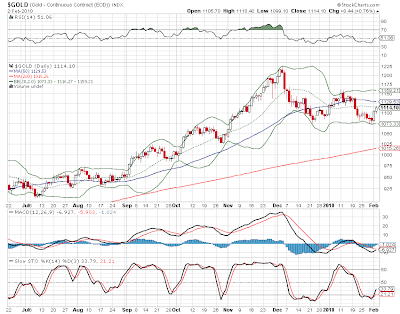
    Gold smells this uncertainty of proposed marriage of political will and fiscal discipline – when task is larger than life you can not just crunch the numbers, you have to be inventive and creative: TARP, Open window, Small business financing, Jobs Program – it is all about the money given to somebody. If you do not have them in the first instance you have to borrow or make more of it (before you borrow). Do you still follow us? We have lost it as well – we only know the big picture about which is the article below: the more creative fiscal and budget situation in the U.S. – the less confidence will be left in US Dollar. Gold is trying to make a double bottom reversal on a short term basis on the chart above. Coupled with US Dollar rally coming out of steam, political determination to bring jobs at any cost and coming elections after lost Kennedy seat – correction could be over even before reaching long term support around 1000 USD/oz.


    If all the above will prove to be correct in coming weeks, CDNX representing Canadian Juniors is making another high low at the MA50 support line and provides another buying opportunity into this Gold and Silver Bull. Do not discount our Lithium and REE plays as well along the road – inflation will bring excitement back with every dollar uptick in the Oil price above 75 USD/barrel. Once Sir Greenspan has suggested that Real Estate market is fragmented in nature and can not represent the Bubble (contrary to our modest observations and respectful disagreement at that time) – what if Tim and Ben will not be able to keep all those money on FED balance sheet and out of reach of their friends? After all, some of them were chosen and are still making the “God’s job”. Who can resist such a proposition? The Independent suggests that it will be very difficult:
    We are out of politics – our mind is too cynical in nature and instead baseless speculation we will provide more on gold fundamentals in the article below.
    GATA:
    Submitted by cpowell on Fri, 2010-01-29 20:46. Section:
    Remarks by John Embry
    Chief Investment Strategist
    Sprott Asset Management, Toronto
    Vancouver Resource Investment ConferenceHyatt Regency Hotel
    Vancouver, British Columbia, Canada
    Monday, January 18, 2010
    Good afternoon. It is once again a great pleasure for me to address a knowledgeable gathering at Joe Martin’s always excellent Cambridge Conference.
    When I was here last year gold was around $850 and there was the usual angst among mainstream commentators fearing a drop to $600 per ounce or worse. Today the price is roughly $300 higher and the same individuals continue to try to frighten the public with prophesies of vertiginous falls in the gold price. Despite this ongoing aggravation, I am even more bullish on the prospects for gold than I was a year ago.
    However, despite my consistent enthusiasm for the yellow metal once termed a “barbarous relic” by Lord Keynes, I still have the strong feeling that the vast majority of investors outside this room still haven’t got a clue about gold and they are certainly not aware that gold is experiencing a historic bull market with much, much further to go. What we have seen to date is merely a prelude, and the appreciation we are going to see in future years is going to greatly exceed what we have seen to date. This opinion is based on a number of factors I will expand on, but the predominant theme is that gold is re-establishing itself as money.
    It has been money for thousands of years, a reality that was succinctly summed up by J.P. Morgan in 1912 when he said, “Gold is money and nothing else.” But we go through periods when that reality is obscured, and the decades of the 80s and 90s represent living proof of that. Gold retreated to commodity status in that era, when disinflation was in vogue and the real returns on financial assets were truly remarkable in historic terms.
    Gold fell from a peak of $850 per ounce in January 1980 to a low of $252 in July 1999 in an extended bear market. To be fair to gold, it got a significant push to the downside in the latter part of that period from the central banks that were dumping enormous quantities of gold by leasing it through their bullion bank cronies. I would contend that the gold price overshot its economic value by perhaps $150 on the downside. Contributing to this fiasco was the ludicrous auction of half the British gold reserves within 10 percent of the bottom. Today this egregious error is referred to as “the Brown bottom” in recognition of the idiocy of the current British prime minister, who was then finance minister.
    However, this is all water under the bridge and I don’t particularly want to dwell on it other than to say that we are now in the phase of the gold market where we are about to benefit mightily from the central bankers’ awesome stupidity at that time.
    It is important, though, that everyone realize exactly what happened. The Western central banks supplied massive quantities of gold to the market for at least the past 15 years. Initially this facilitated excessive producer hedging. Then it helped to fund a huge carry trade that greatly enriched their bullion bank cronies. Now it occurs in large part to protect existing huge short positions held by those same banks.
    You might be inclined to ask why the central banks would do such a thing. The official explanation for the transparent portion of their activities (i.e., direct sales) was to diversify their reserves. Essentially, why hold gold when you can own an interest-bearing piece of paper in its stead?
    But that explanation is purely fatuous and a total smokescreen. The whole process, with the clandestine leasing and swapping of huge quantities of gold, was orchestrated by the United States. It was designed to reduce critical scrutiny of the central banks’ increasingly reckless monetary policy, to allow interest rates to remain at unrealistically low levels and to maintain the U.S. dollar’s supremacy. That this undertaking would inevitably spawn serial financial bubbles, the very same bubbles that brought the world financial system to its knees, was conveniently ignored.
    This was all foreshadowed by some remarkable comments by then-Federal Reserve Chairman Alan Greenspan at a Federal Open Market Committee meeting in the early 1990s, remarks that came to light only recently when a transcript of that meeting was scrutinized. Greenspan referred to gold as a “thermometer” and speculated that if the Treasury Department sold a little gold in the market and the price broke as a result, not only would the thermometer no longer be a measuring tool but the lower gold price could affect underlying psychology. Greenspan was unfortunately right in his perverse judgement and shortly thereafter the systematic dumping of gold by the Western central banks moved into high gear.
    It really makes you love free markets, doesn’t it?
    But what a sorry mess they have created. While in the ’90s, their gambit played out spectacularly with gold collapsing and financial assets flourishing, it sowed the seeds for what has happened subsequently: a robust bull market in gold since 2001 and increasing chaos in the stock, debt, and real estate markets worldwide. To this day the central bankers have remained undaunted and have increasingly intervened in all markets, but despite their annoying periodic raids, their influence is waning dramatically in the gold market.
    I would suggest that today central banks are discovering to their increasing discomfort what history has always demonstrated — and that is that manipulation of the free-market process ultimately fails. No amount of government interference and price manipulation can change the reality of the free market over the long term.
    In the whole sordid process of the gold suppression scheme for the past 15 years, what has been particularly intriguing to me is that an earlier generation of central bankers unsuccessfully tried to same ploy with gold in the 1960s. Using the considerably more transparent London Gold Pool, they succeeded in holding gold at the then-official price of $35 per ounce for a number of years before being overwhelmed by the reality of the situation. In the following decade of the 1970s, gold rose a mere 2,300 percent.
    Armed with the knowledge of that fiasco, one would have surmised that our current central bank geniuses might have considered that their new attempts at price control, albeit considerably more secretive, could meet a similar fate. Alas, the hubris of central bankers is well known, and this just represents another graphic example of their arrogance and awesome incompetence.
    However, what remains to play out is the denouement of their current folly. Markets that have been artificially capped tend to catapult upward when the suppression inevitably fails. In my opinion the last experience in the ’60s and ’70s was a mere bagatelle in comparison to what is unfolding today. It has always been accepted that “the greater and longer the manipulation, the greater the eventual price rise is going to be.”
    In the latest episode, there has been dramatically more central bank gold expended. Credible estimates suggest that more than 15,000 tonnes, or roughly half of the central banks’ supposed reserves, have already hit the market and are long gone, dangling from the wrists and necks of Indian women, filling vaults in the Middle East and Russia, and, in ever-greater quantity, migrating to China.
    In the era of the London Gold Pool, only around 3,000 tonnes were sold to maintain the $35 price. This time the exercise has been dramatically larger and has occurred over a much longer time frame against the backdrop of a considerably more fragile financial structure, particularly in the West. So all of you are free to use your imagination to estimate how high gold is going to go this time.
    It is critical to understand what the central banks have done because, in the absence of that knowledge, one cannot appreciate the whole gold story and will find it extremely difficult to recognise the investment opportunity being presented.
    However, that is only one critical factor, and, as I said at the outset of my remarks, it is gold’s return as money that is going to be really instrumental in driving gold to prices that would seem fanciful to most at the present time. In reality, it isn’t gold that is changing, because it has been a constant store of value for 6,000 years. It is the value of fiat paper money in which gold is priced that is on the slippery slope to oblivion.
    I could talk extensively about what is happening to the value of paper money, but to shorten things up, there is only one expression that you have to know: “quantitative easing.” What a joke that is!
    The authorities would have you believe it is some sort of magic elixir and a panacea, but all it represents is the monetization of various forms of debt by unfettered printing of money by central banks. Because the inflationary impact has yet to occur, the linear thinkers would assure you that it isn’t going to be a problem. However, because of ongoing deleveraging and falling velocity of money in the short term, it is only being delayed.
    As sure as death and taxes, continuing excessive money creation by the central banks will lead to accelerating inflation. When it begins to manifest itself, the velocity of money will pick up rapidly as people around the world rush to get rid of their increasingly worthless paper currency. In that event, we will rapidly progress from relatively benign inflation to truly frightening levels in a fairly short time.
    At this point, I would like to repeat a quotation I used in a recent Investor’s Digest article. It comes from Ludwig Von Mises, the brilliant originator of the Austrian school of economics, which is the only formal economics that makes much sense to me. Long before I was born, which was a long time ago, Von Mises observed:
    “There is no means of avoiding a final collapse of a boom brought about by credit expansion. The alternative is only whether the crisis should come sooner, as the result of a voluntary abandonment of further credit expansion, or later, as a final and total catastrophe of the currency system.”
    That comment is pretty germane to what is unfolding today. Following what was arguably the most abusive credit cycle in history, Fed Chairman Ben Bernanke and his central banking confreres have clearly chosen the latter option, and accordingly, in my opinion, all forms of fiat paper money are headed for a train wreck. Ironically, Bernanke tipped his hand seven years ago in the infamous speech he gave before becoming Fed chairman. He claimed that he could combat deflation by the use of a printing press or, if need be, by dropping money from helicopters to sustain demand. To me his theories were ludicrous at that point and remain so today. Yes, he may avert deflation for a considerable time but at the very probable cost of hyperinflation and the social chaos that inevitably results.
    Today the only question in my mind is whether investment demand for gold is going to go berserk as the result of a U.S. dollar collapse or because all the fiat currencies go down the drain together. The U.S. dollar is in its death throes, but will other countries print massive quantities of their own currencies to buy the dollar in an attempt to depress their currencies and keep their economies relatively competitive? To date, I would say that despite the considerable weakness in the dollar, there is abundant evidence that many other countries are printing aggressively to prevent their currencies from rising too much against the dollar.
    In any case, I believe we are fated to see a continuing policy of ridiculous monetary ease around the globe, despite rhetoric to the contrary. This will occur because the idea of a double-dip recession or depression, as the case may be, is anathema to the powers that be. Very simply, withdrawing any significant amount of stimulus, be it monetary or fiscal, in the foreseeable future would virtually guarantee another deflationary event, and this time it may be impossible to stop.
    Clearly, the United States is the lynchpin of the whole debacle, but most other countries are up their necks in the mess as well.
    To begin, let us consider the United States’ fiscal quandary, with a federal government deficit currently running above 10 percent of gross domestic product and representing roughly 40 percent of government expenditures. These numbers are horrific for a country that is providing the world’s reserve currency. A recent study looked at the 28 examples of hyperinflation in various countries since 1980 and included Argentina, Zimbabwe, and many other banana republics. It noted that one common trait was that when the national government deficit exceeded 40 percent of expenditures, the point of no return had been reached. The U.S. is there as we speak and the $389 billion deficit in the first quarter of the 2010 fiscal year was far from reassuring.
    While the preceding information is historical and thus factual, there is the matter of the Obama administration having recently admitted that its budget deficits would total $9 trillion (a number that I believe to be wildly optimistic) over the next 10 years. The question that obviously has to be asked is: What person, institution, or government, for that matter, in its right mind would lend money to the United States for the pathetically low interest rates currently on offer?
    In reality, who would really be comfortable lending the United States money at any interest rate in the current circumstances, considering that higher rates would just ensure even higher deficits?
    So it seems reasonable to assume that more of the deficits will have to be monetized, the dollar will inexorably decline as a result, and the question of confidence will become paramount. If confidence in the dollar is lost, chaos will ensue and those trapped in dollar-based fixed-income assets will see their wealth destroyed, the same fate that befell those who believed in the system in the Weimar inflation in Germany after World War I.
    But the United States is far from the only country that is in serious difficulty. Things are as bad, and in certain cases worse, in many other countries. For example, Great Britain is a basket case, which incidentally looks real good on that hypocritical jerk Gordon Brown, who has led his country to ruin. Britain’s central bank has been forced to intensify its quantitative easing program several times to keep the economy barely afloat and its financial system semi-intact.
    Japan, with its rapidly aging population, has seen its accumulated public debt reach 200 percent of GDP with no end of that trend in sight.
    Europe is no bed of roses either. Despite the soothing words of the head of the European Central Bank, Jean Trichet, and some very vocal comments about current monetary excess from Germany’s Angela Merkel, they appear to have little choice but to keep the money flowing to save Club Med, Ireland, and a whole swath of eastern Europe from oblivion.
    China, that paragon of all things economic and financial, had to resort to mandating a humongous increase in bank lending in the first half of last year to keep its economy moving. The ultimate outcome of this endeavor remains to be seen, although it certainly had a salutary impact on Chinese share prices and world commodity quotes. Unfortunately, the resulting massive over-capacity throughout the entire Chinese economy may become an issue.
    That brings us to the favorite country of everyone in this room, Canada. I suspect that the Canadian authorities will be forced to deal with reality soon. Despite the hedge funds’ love affair with the Canadian dollar, the economic and financial fundamentals in this country don’t support the current level of the loonie. We are attached at the hip economically to the United States and as our dollar rises, our manufacturing industries or what’s left of them are being destroyed. Budget deficits are exploding at all levels of government.
    One year ago the feds didn’t have one, but now the deficit is annualizing somewhere north of $60 billion. Ontario is homing in on $25 billion and even hydrocarbon power Alberta has ruefully admitted that its deficit forecast has risen to $6.9 billion, as very low natural gas prices, among other things, take their toll.
    Bank of Canada head Mark Carney and Finance Minister Jim Flaherty know these problems all too well, although much of the public seems blithely unaware, and I am eagerly awaiting Carney and Flaherty’s response. Rumors of aggressive quantitative easing are growing, adding yet another nation to the expanding list practicing this dark art.
    Why is all of this significant?
    Very simply, it ensures that the demand side of the gold-silver equation is baked in the cake. Investment demand is exploding on a worldwide basis as those with wealth to protect are beginning to comprehend the true extent of the monetary debasement under way. This is only going to intensify as inflation begins to rear its ugly head as the result of the money-printing orgy.
    As I mentioned earlier, the velocity of money is going to accelerate as people figure out what is occurring. Why would anyone want to hold a rapidly depreciating monetary asset when it yields next to nothing? At that juncture we will see if the powers that be have the courage to remove significant amounts of stimulus. Since I believe that our debt-logged economies will remain relatively weak and our financial structure exceedingly fragile, I don’t believe they will.
    So I find it laughable when people concern themselves with reduced jewellery demand as a factor in the pricing of gold in the current circumstances. Any decline is being dramatically exceeded by rising investment demand, and this phenomenon is only going to intensify. Besides, all great bull markets in precious metals are driven by investment demand as gold reasserts itself in its true role as money. They most certainly don’t occur as the result of gold’s attraction a bauble or as an adornment.
    However, as bullish as I am on the demand side of the equation, an equally compelling case can be made on the supply side, which consists of three primary elements — mine supply, scrap recovery, and central bank dispositions. The least important is scrap recovery, but it was briefly a negative in early 2009, when a lot of people around the world couldn’t wait to get rid of their jewelry and realize a little cash for the gold contained in it. However, that sharply abated in the second half of the year and the focus is now back where it should be, on mine supply and central bank dispositions.
    One of the key factors that is going to contribute to the ongoing bull market is mine supply, or more accurately stated, lack thereof. Mine supply has been in a steady decline since early in the new century despite the constant rosy predictions of greater supply from the alleged industry expert GFMS Ltd. I have long been of the mind that the decline will continue for some time irrespective of what the gold price does. I base my opinion on numerous factors, including a dearth of quality projects ready for mining, continuing geopolitical and environmental issues, less high-grading as the gold price rises, ongoing capital constraints, and a chronic shortage of skilled miners and mine builders.
    Thus I was fascinated when Aaron Regent, the new head of the world’s largest gold company, Barrick Gold, was quoted at RBC’s annual gold conference in London lamenting the state of the gold mining business. He went so far as to suggest that global gold production was in terminal decline despite record prices and Herculean efforts by mining companies to discover new orebodies in remote areas. He alluded to “peak gold,” implying that production has reached levels that can’t be exceeded, an expression that is commonplace in the oil industry, where the subject has been under discussion for some time.
    Following this pessimistic assessment, a more horrifying prediction was revealed in the South African Journal of Science. Chris Hartnady, the research and technical director of a Cape Town based consultancy, stated that South Africa’s famous and extremely prolific Witwatersrand gold fields are around 95 percent exhausted and predicted that production rates should fall permanently below 100 tonnes per year within the next 10 years.
    This is truly shocking in that gold production from the Witwatersrand, the largest gold field ever discovered, peaked at around 1,000 tonnes per annum in 1970 and, though falling steadily since, still contributes around 230 tonnes per year or roughly 10 percent of world production.
    In view of these two evaluations by knowledgeable industry players, my negative view on production has been reinforced. Gold mine production is in the neighborhood of 2,350 tonnes per year, and I continue to believe that odds strongly favor it continuing to fall rather than show any meaningful increase for the next several years.
    That brings me back to the central banks, and I apologize if I am belaboring the point, but I believe their role in the whole saga is neither widely appreciated nor well understood. Because of the remarkable obfuscation in the area, most observers do not realize how much central bank gold has entered the market in the past 15 years to fill the huge and growing gap between true demand and mine and scrap supply.
    This is the direct result of misleading accounting by the central banks — accounting, incidentally, that has been endorsed by the International Monetary Fund, the very same IMF that has been threatening the gold market with potential massive sales for a number of years. The central banks have been permitted to use a one-line entry on their balance sheets, which does not differentiate between gold in the vault and gold receivables.
    There is copious evidence, if you look for it, that supports the contention that gold receivables have grown dramatically as the result of central banks surreptitiously mobilizing their gold through leasing and swaps. This gold has been dumped in the market and has been essential in filling the natural demand- supply gap, which has probably exceeded 1,000 tonnes per year in most of the years since the mid- to late 1990s. That it also served to significantly depress the price wasn’t an accident.
    The significance of the 1,000-tonne-per-annum number is two-fold. First, it represents in the neighborhood of 25 percent of the physical gold supply during the period, showing how truly deficient real sustainable supply is. Second, it virtually guarantees that Western central banks are getting dangerously short of reserves to continue this activity. Just as importantly a number of Eastern central banks — including China and Russia, to name but two — have acknowledged their intentions and are accumulating and will continue to accumulate gold as one avenue to diversify their reserves away from the U.S. dollar.
    But India may have stolen a march on all of them when it announced recently that it had purchased 200 tonnes of the well-advertised and long-awaited IMF sale. This was the event that really kicked off the latest leg in the gold bull market, and unquestionably the Indian move drew widespread attention to a historic shift in the attitudes of central banks toward gold. It coincided with a complete cessation of selling by the European central banks, which under the terms of the recently renewed European Central Bank Gold Agreement could sell up to 400 tonnes per year.
    Thus just as the Western central banks are being forced to wind down their incessant selling and leasing, the Asians have stepped up as buyers. This is a truly dramatic development and is going to have extremely positive ramifications for the gold price.
    In view of the foregoing powerful positive fundamentals for the gold price, I find it almost nauseating that various pundits are referring to gold as overpriced and in a bubble phase. Nothing could be further from the truth, and, in reality, gold continues in its stealth bull market, which has now seen nine consecutive higher year-end closes. Despite this, as I mentioned earlier, it has attracted very little attention from the investing public in general.
    The dedicated goldphile has participated throughout, and a number of sophisticated financial players have come on board recently, the latest being the legendary trader Paul Tudor Jones. But the average investor remains uninterested. It is instructive to remember that at the end of the last bull market in 1980, people were lined up around the block outside the Bank of Nova Scotia in downtown Toronto to purchase physical gold. Today the only lines that have formed are outside emporiums set up so the unsuspecting public can unload their gold jewelry for cash. To have a bubble of any significance, there has to be wide public belief, and it certainly isn’t on display in the gold market.
    More importantly, if gold were overpriced, the gold producers would be experiencing an earnings bonanza. A close examination of the recent earnings statements of most major gold companies reveals that they are earning very little and are certainly not achieving the return on capital necessary to justify their involvement in a very risky and difficult business.
    I find sentiment in the sector to be remarkably subdued in the face of compelling fundamentals. Many attractive junior gold stocks are not even keeping up with the rise in the gold price. If history were any guide, these stocks would be rising at three to four times the rate of the gain in the gold price, but investor skepticism is holding them back.
    From a media perspective, if we were approaching the end of a bull market, the newspaper articles and television clips would be universally bullish touting the obvious merits of the yellow metal. There is indeed more coverage recently because of the relentless price rise, but it tends to be skeptical with the bearish commentators continuing to get the most exposure despite having been continuously wrong.
    There is no better example of this than an individual who my compliance department would prefer that I not identify. However, I’ll give you a broad hint — he writes virtually daily for a noted Canadian gold Internet site. Dubbed the Tokyo Rose of gold commentators, he is always quoted in articles with a negative slant despite having been consistently wrong since the inception of gold’s bull market. In my opinion, as long as he gets any press at all, we are a long way from the end of this bull market in gold.
    Finally, it is widely acknowledged that if the peak gold price in the last great bull market ($850 in January 1980) were to be adjusted to reflect the U.S. inflation rate in the intervening period, it would be equivalent to $2,300 today. That the current gold price is approximately half of that should put to rest any suggestion that this is a bubble.
    That’s not to say there aren’t several bubbles forming in other financial markets (most notably in government debt instruments) as a result of a new bout of central bank madness, but gold is not on the list. In fact, I believe that we are many years and several thousands of dollars in price away from the end of this powerful bull market.
    In conclusion, I now firmly believe that the chances of gold ever trading below $1,000 per ounce are remote. The only caveat I would offer is that if the world suffered a catastrophic deflationary collapse, an outcome long predicted by the noted Elliot Wave theorist Robert Prechter, gold could briefly be swept under but would then re-emerge with even greater relative strength as the only true safe haven. However, in a world of pure fiat currency, I think that a near-term deflationary outcome is highly unlikely. In fact, I strongly suspect that gold is going to stage a parabolic rise from current levels in the not-too-distant future, a development that will come as a shock to the many detractors of the world’s only real money.
    Gold is the only real money because it isn’t someone else’s liability.
    This remains one of the best supply-demand imbalance stories I have encountered in my long career and it will only be enhanced by the existence of massive short positions that will be impossible to cover amid myriad paper claims on gold that dwarf the physical supply, which, by the way, is a subject for another day.
    Thanks very much for listening. It has been an honor to speak to you.
  • Lithium Demand: EnerDel, ITOCHU Announce Second Smart Grid Battery Storage Project TNR.v, CZX.v, LI.v, RM.v, WLC.v, SQM, FMC, ROC, AONE, HEV, VLNC, PC


    It is very encouraging to see another confirmation of Lithium based batteries used for secondary market in Utility Storage area. Any volume in Grid batteries applications with Lithium based technology will help to bring total cost of lithium batteries per kWh down and open doors to the wide range of Lithium based batteries applications for Utility Scale and Smart Grid technology sectors.
    Our main take from U.S. Energy Secretary Steven Chu Video :
    “Price of Lithium batteries is in access of 1000 USD/kWh at the moment, with mass production it will drop to 300-400 USD/kWh ( S. GM is aiming now for 450 USD/kWH in a near term) and with recent technological advance we can talk about 100 USD/kWh as possibility.”
    As we have wrote before, lithium battery price of USD 25o per kWh will make production of Electric Cars cheaper than a comparable CV – you do not need automatic transmission as part of your power drive.”

    SmartGrid:
    EnerDel, an American lithium-ion battery producer, reportedly entered into a partnership with the real estate arm of Japan’s industrial trading giant, ITOCHU Corporation, to develop and produce the advanced battery systems for a residential smart grid energy storage project to be installed in a major apartment building near Tokyo.
    The system will provide a critical link between renewable energy, high-speed charging for electric cars and the local utility grid.

    According to EnerDel officials, this is the second such venture between the two companies, following the announcement last month that they are teaming up with Mazda Motor Corporation on a similar system using vehicles converted to electric drive using a platform designed and built by EnerDel and its partner THINK, which will be stationed at a Family Mart convenience store.

    “These are the first projects anywhere in the world to bring all the critical elements of a smart, sustainable network that connects renewable energy and transportation in the places where people live and work,” Naoki Ota, chief operating officer for EnerDel, said in a statement.

    Ota said that it will also demonstrate that EnerDel’s lithium-ion battery systems are equally capable, whether it is in a car or a stationary grid application. He said that the company’s longstanding partnership with ITOCHU has provided the means to set another exciting industry precedent.

    “We are delighted to be partnering again with ITOCHU to develop this industry leading project,” Charles Gassenheimer, chairman and CEO of EnerDel parent company, Ener1, said.

    Gassenheimer said that the company is pushing hard to drive pioneering initiatives like this to develop a secondary market for automotive grade lithium-ion batteries.

    “I believe this secondary market will be a key enabler to reducing battery costs for automotive buyers and accelerating the growth of the market for electric powered vehicles,” he said.”

  • Lithium and REE: 1.4 billion vote from DOE to bring Electric Cars to U.S. TNR.v, CZX.v, LI.v, RM.v, WLC.v, SQM, ROC, FMC, AVL.to, RES.v, CCE.v, QUC.v,

    C.S. Obama is calling for an action, financial situation of the State is close to desperate and middle class, the backbone of our society, is struggling to survive. It is a time of change and we have an opportunity to capitalise on this dramatic shift.
    Time is to write about Revolutions, transformation technology and disruption in the market place.
    Ideal market situation for the new disruptive technology to create a life time investing opportunity is when Demand for product or service is already there and you are able to deliver it in a new way, which will be more appealing to Existing consumers of this product or service. You have a dramatic shift in consumer preference and are gaining a market share in a tidal wave fashion by shifting consumers from existing providers to the new product or service place. You do not have to teach the market and prove that they need this product – you just need to prove that the new technology you are putting in place is viable to deliver the Better Experience.
    We have always loved our music. Sony made a Revolution in the way we consume the music with its Walkman – we were able to take our music with us as we go. CDs made the quality of music more appealing and record companies sold us our music one more time.
    Steeve Jobs made another Revolution by providing the means to consume what we exactly want with iTunes and means to Store and Retrieve All Our Music as we go in iPod. He sold us our own music one more time and we were happy to buy it. He has brought us a new Experience of how we consume the same music: it is convenient, easy, Searchable, high quality and with us – all of it. We have moved in droves to the new source of Joy.

    With Electric Cars all market estimations that we saw so far (apart from quote from Warren Buffett) looks like a drop in the bucket at a time. Will it be 2%, 5% or 10% claimed by Nissan in 2020? It is not a Revolution – it is like a tea party. We dare to differ and think that Electric Cars will provide to us a new Experience how we consume Mobility: energy efficient, environment friendly and cheaper with all cost accounted. And yes – they will sell us our cars one more time, this time in Electric version.
    Is it bad – not at all if you will be investing in Electric Cars value chain. Even if not, we will all gain from it more than from iPods – after all we have never heard about somebody being killed by CD, but those, who still do not believe that cars pollute and kill our environment including us, can try to breath from exhaust pipe for a while to be sure.
    We expect consumers to shift on a mass scale from CVs to EVs with prove that technology is viable and can provide the same utility with a Better Experience. Emotional Drive will be the driving force of this switch of consumer preferences.

    America needs to catch up with the rest of the world in Electric Space. U.S. is years away from recent advance in lithium batteries and electric cars compare to Japan and China. Nissan spent 5.5 billion dollars and 16 years developing electric cars based on lithium ion technology. Competition is heating on and it is very positive to see DOE supporting at least production of Electric Cars in U.S. developed in another countries. Green Leaf growing in the Homeland is better than nothing even if it is from a foreign tree.

    “Price of Lithium batteries is in access of 1000 USD/kWh at the moment, with mass production it will drop to 300-400 USD/kWh ( S. GM is aiming now for 450 USD/kWH in a near term) and with recent technological advance we can talk about 100 USD/kWh as possibility.”

    As we have wrote before, lithium battery price of USD 25o per kWh will make production of Electric Cars cheaper than a comparable CV – you do not need automatic transmission as part of your power drive.

    This is why we are calling it Green Mobility Revolution. Make a step back and look at the big picture. With electricity being the most convenient form of energy known to us, stable pricing and ready availability from existing source infrastructure – we have a transformation technology in place: you can store energy on board of your vehicle Produced Somewhere Else. It means that that energy could be produced thousand miles away using mass scale and most economical production method including Nuclear power, Hydro power generation, Geothermal, Wind, Solar and other renewable sources of energy available today.

    Our conventional vehicles did not move far away from steam powered trains. They still carry fuel and power plant on board with very inefficient conversion cycle technology from fuel to mechanical power. Power source is restricted to mobility application and it is very expensive, it can not use economy of scale or different sources including renewables (think about tidal wave generator on board) and you are caring exhaust pipe with you everywhere you drive.
    It is time to start thinking about Electric Cars as means to transform our Energy Diet nation wide – you do not need to have power generation plant on board (which will be always expensive and inefficient compare to Industrial Scale version even of the same technology) – you need just most effective storage system and power delivery system: Lithium ion batteries and Electric Powertrain.

    This is where you can start thinking with us: that all current estimations about Electric Cars adoption rate could be blown away once technology will be proven to be viable in a mass sale applications.
    This vote from DOE with 1.4 billion dollars is a very important step. Japanese companies are hunting all around the world for Lithium and REE resources today just to be ready for our Next Big Thing scenario.

    AUTOPIA:

    At today’s press conference at The Washington Auto Show, Department of Energy Secretary Steven Chu had something to say about electric vehicles, and how the U.S. government would approach aiding EV manufacturers. Although it was originally thought that announcement would concern the loans that Tesla, Fisker et al have received, the surprise announcement concerned Nissan’s Leaf all electric car.
    The Leaf, which Nissan says should get 100 miles to a charge, cost around $25,000 to $30,000 and should be in showrooms soon, will be receiving $1.4 billion from the American government to upgrade the company’s manufacturing plant located in Smyrna, Tennessee.
    At the D.C. Auto Show Secretary of Energy Steven Chu announced that the Department of Energy had closed a $1.4 billion loan agreement with Nissan to support the modification of the company’s Smyrna, Tennessee, manufacturing plant to produce both the Nissan LEAF as well as the lithium-ion battery packs that will power them.
    The $1.4 billion is part of the Advanced Technology Vehicles Manufacturing Loan Program, a $25 billion program that was authorized by Congress in 2007, according to Clean Skies. The Japanese automaker says the loan will allow them to generate up to 1,300 jobs when the Tennessee plants are working at full volume. The factory modifications will begin later in 2010 and include the new battery plant as well as changes to the existing structure for electric-vehicle assembly.
    Eventually the plants will construct up to 150,000 Nissan LEAF electric cars a year and as many as 200,000 batteries.
    AutoBlogGreen said that Secretary Chu’s announcement of the $1.4 billion Advanced Technology Vehicle Loan Program loan was down from the original $1.6 billion amount. ABG also reported that Chu dealt a blow to those wanting to get hydrogen up and running as soon as possible. The energy secretary stating that even though hydrogen is part of the DOE’s $13 billion advanced vehicle technology budget, it was “longer in the distance.”
    Chu has long been a vocal proponent of electric vehicles, stating back in October of 2009 that he would ” … put every cent into electric cars.”
    Photo: NissanRead”
  • Lithium Charge: 350 million vote of confidence for Better Place. TNR.v, CZX.v, LI.v, RM.v, WLC.v, SQM, FMC, ROC, BYDDY, NSASY, DAI, BMW, TM, TTM, F,

    CS. Obama has told you about our Investment Thesis in three short sentences. We are not so smart and we do not have such an authority – we need to bring reason to decompound his message. Time for us to drop couple of lines about Middle-class and our Christmas wish.

    One thing is when we are preaching about coming Green Mobility Revolution and another is when HSBC opens its cheque book. Serious money are committed to development of infrastructure for electric cars in this transaction, but the most important is the resonance in the investment market place: Electric Cars are becoming reality.