Author: The Oil Drum

  • Amazing Presentation On The End Of The Copper Era

    peak copper charts(This is a guest post from The Oil Drum by Jean Laherrère, a longtime head of exploration for TOTAL. As is his nature, Jean speaks more with graphs than words. This posts contains over 40 images amounting to 2 Mbytes of data; keep this in mind when proceeding.)

    Copper has been an important mineral in the world growth, in use for at least 10 000 years. The Bronze Age is well known for having replaced the Stone Age, and bronze is the alloy of copper and tin. Copper has the second highest electrical conductivity after silver. Its price went so high that copper cables are now often stolen, disturbing telephone and Internet communications. Copper is used in piping (water supply, refrigeration and air conditioning). Measured by weight, it is the third most important metal used by man after iron and aluminium (Radetzki 2009). Its use is challenged by new substitutes, but copper production will peak because it is a limited resource amounting to around 1400 Mt. Unlike oil, copper can be recycled, but developing countries’ needs are huge.

    What follows is an evaluation of world copper production, then an analysis country by country–there are many charts and graphs so that we may try to understand where we are with regard to future copper production.

    See The Coming Of Peak Copper >

    Soon we will use all of Earth’s copper

    Soon we will use all of Earth's copper

    I found it fairly easy to model gold production both for the world and the main producers in my 2009 post The gold peak, easier to model than the oil peak (part II). In this post, I have tried to do the same for copper production.

    The best source of data is the USGS which provides complete time-series since 1900 for the US and the world. For other countries unfortunately, I had to turn to individual annual reports (from 1932) where the scanned data is hard to read in old reports. The USGS should compile the country by country copper production data from the annual reports in one document like Porter and Edelstein did for the world and for the US: U.S. Geological Survey, in Kelly, T.D., and Matos, G.R. Historical statistics for mineral and material commodities in the United States: U.S. Geological Survey Data Series 140.

    Since 1995, the USGS reports its annual remaining reserve estimate as USGS reserves and USGS reserve base. The cumulative production from 6000 years ago to 1900 is estimated at 17 Mt. The world copper cumulative production can be easily modeled with a logistic curve for ultimates of 1200 Mt and 1600 Mt fitting the USGS estimates.

    Production will peak in a short time

    Production will peak in a short time

    For these two ultimates the annual production can also be easily model led and the peak seems to occur soon, despite (or because) the high price increase since 2000. Yet the copper price today is cheaper than in 1900 when reported in 1998 dollars per kg (USGS data). The secondary production is small and decreasing to almost nothing!

    These eight countries have 60% of the resources

    These eight countries have 60% of the resources

    The eight main copper producers (Chile, US, Peru, Indonesia, China, Australia, Canada and Russia) have been studied and the synthesis is plotted on a single graph. These eight producers have an ultimate of 820 Mt that is about 60% of the world’s ultimate.

    Chile emerged as the key producer

    Chile emerged as the key producer

    Gavin Mudd in Historical trends in base metal mining: back casting to understand the sustainability of mining[pdf!], a publication from 2009, shows annual copper production starting in 1840.

    International Copper Study Group (ICSG) appears to overstate the reserves

    International Copper Study Group (ICSG) appears to overstate the reserves

    The details for the eight main copper producers are presented in the following slides.

    World

    The world primary production is less than the secondary production and both added less than the refined reported by the ICSG.

    1600 metric tons (Mt) is the high estimate for cumulative reserves

    1600 metric tons (Mt) is the high estimate for cumulative reserves

    The Hubbert linearisation of production data – being the growth of production (or annual/cumulative in %) versus cumulative production – is extrapolated with a linear trend with the aim of estimating the ultimate, but it works only if the cumulative production fits a logistic curve, when in reality there are often several cycles. The present plot for the world shows only a recent trend from 2000 onwards, which can be extrapolated towards 1600 Mt (present cumulative production plus USGS reserve base) but the previous declining trend (1975-1995) was pointing towards 1000 Mt.

    But copper reporting is sloppy. Russia has “not declined” in 15 years.

    But copper reporting is sloppy. Russia has "not declined" in 15 years.

    The best approach is to rely on the geological inventory of the world potential estimated by the USGS, based on the study of known discoveries and possible yet to find. The USGS does not give a good and precise definition of its estimates reported as reserves and reserve base!

    Contrary to the obsolete SEC rules for oil, forbidding reporting of probable reserves (now changed in 2010) the SEC rules for minerals (industry guide 7) allow to report proved and probable. The USGS only changes its data on copper reserves from time to time, when it shows the remaining discovered reserves, but it should be decreased when production isn’t matched by new discovery. Only US and Canada reserves have decreased!

    The reserves reported by the USGS since 1995 show a poor evolution when plotted in a log scale.

    This poor evolution, such as for Russia with no change during 15 years, means that their estimate lacks good data!

    Geoscience Australia in their 2009 report [pdf!] use a more precise definition of resources and report Economic Demonstrated Resources (EDR) for Australia and the world at the end 2008 being 78 Mt and 603 Mt respectively. In its turn the USGS reserves stand at 24 Mt and 540 Mt and the USGS reserve base amounts to 43 Mt and 1000 Mt. USGS reserves look pessimistic compared to Geoscience Australia EDR. The reserve base looks similar, but there should be an upper limit.

    It is difficult to estimate the the point at which production ceases to be economic

    It is difficult to estimate the the point at which production ceases to be economic

    In mining, economics depends mainly on the grade of the ore and it is important to plot the evolution with time. But my data is not good enough. Gavin Mudd (2009) has a graph showing the decline of the ore grades for the world, US, Australia and Canada, all declining below 1% in 2008. It is difficult to estimate the the point at which production ceases to be economic.

    America estimates reserves at a high percentage of reserve base — that means we are very optimistic in the amount it is feasible to recover

    America estimates reserves at a high percentage of reserve base -- that means we are very optimistic in the amount it is feasible to recover

    United States

    The cumulative US copper discovery (starting in 1545) from USGS 98-206A is 350 Mt at the end of 1998 and seems very optimistic compared to the USGS reserve base (around 200 Mt with cumulative production).

    The cumulative production in 1900 is assumed to be around 6 Mt and it is at 129 Mt at end 2008. We have taken 200 Mt as the ultimate production.

    We can see that the U.S. has 200Mt

    We can see that the U.S. has 200Mt

    The Hubbert linearisation of production is more reliable, having passed peak, trending towards 200 Mt.

    The US annual production of copper is increasing chaotically from 1900 to a peak in 1998 at 2.1 Mt, and drops drastically to 1.2 Mt in 2005, despite a sharp increase in price!

    The US annual production of copper is increasing chaotically from 1900 to a peak in 1998 at 2.1 Mt, and drops drastically to 1.2 Mt in 2005, despite a sharp increase in price!

    The USGS has almost doubled Chile’s copper reserves from 1995 to 2009.

    The USGS has almost doubled Chile's copper reserves from 1995 to 2009.

    Chile


    Chile probably has 275Mt

    Chile probably has 275Mt

    We have model led for an ultimate of 250 Mt because the Hubbert linearisation since 1999 trends towards such value, but also 300 Mt, guessing that 275 Mt is not a bad value.

    Chile copper production has peaked in 2007.

    Chile copper production has peaked in 2007.

    Peru has 100 Mt

    Peru has 100 Mt

    Peru

    Like for Chile, the USGS has doubled its reserves estimate, but in 2008, from 30 to 60 Mt.
    We guess that the ultimate is around 100 Mt.

    But it is hard to estimate the peak for Peru

    But it is hard to estimate the peak for Peru

    The Hubbert linearisation is hopeless, being far from peak.

    Peru’s production will peak around 2025

    Peru's production will peak around 2025

    For an ultimate of 100 Mt, Peru’s copper production will peak around 2025 at 1.7 Mt.

    China is also hard to plot

    China is also hard to plot

    China

    Data for China is hard to check and the USGS has increased its reserves lately. We have taken an ultimate of 50 Mt.

    The Hubbert linearisation plot trends towards infinite!

    But China should peak in 2020

    But China should peak in 2020

    The annual production should peak around 2020 at 1.2 Mt.

    Indonesia has around 45 Mt

    Indonesia has around 45 Mt

    Indonesia

    The USGS has sharply increased Indonesia’s reserves around 2000, but reduced them last year. We have taken an ultimate of 45 Mt.

    Once again, it is hard to estimate the peak

    Once again, it is hard to estimate the peak

    Hubbert linearisation plot is impossible to extrapolate.

    But Indonesia has already peaked

    But Indonesia has already peaked

    Indonesia copper production has peaked in 2001 and will decline slowly until 2100.

    Australia has a better way of predicting reserves

    Australia has a better way of predicting reserves

    Australia

    In the US, Wall Street (SEC) dominates reserves definition and it is good to see a country with a better scientific approach. Australia is a good choice to compare the USGS estimate with Geosciences Australia’s estimate [pdf!]. Australia has a better reserve definition for minerals (EDR = Economic Demonstrated Resources).

    Check out the volatility

    Check out the volatility

    The sharp increase in Australia’s copper reserves comes mainly from the huge Olympic Dam field (copper and uranium) in South Australia. K.F.Bampton in Copper mining and treatment in South Australia [pdf!] displays (in a logarithmic scale) the up and down copper production in South Australia starting around 1840.

    We see that Australia has 100 Mt

    We see that Australia has 100 Mt

    Olympic Dam copper reserves are estimated at 32 Mt. Australia copper ultimate is estimated at 100 Mt.

    Volatility makes it hard to name the peak in Australia

    Volatility makes it hard to name the peak in Australia

    The Hubbert linearisation is hard to extrapolate!

    Australia may peak in 2030

    Australia may peak in 2030

    For an ultimate of 100 Mt Australia’s copper production will peak around 2030 at 1.5 Mt.
    But this optimistic future production increase is based only on geological constraints (reserves), yet above ground constraints (Economy) could dampen this forecast into a more chaotic behaviour!

    Canada has 50 Mt

    Canada has 50 Mt

    Canada

    Canada is another good place to compare USGS and Natural Resources Canada (NRCan) approaches. NRCan reserves are more complete and slightly lower than the USGS reserves. From NRCan we estimate Canada’s copper ultimate at 50 Mt.

    At least Canada has a clear sense of reserves

    At least Canada has a clear sense of reserves

    The Hubbert linearisation seems to be trending towards 50 Mt since 1970.

    Canada’s production will peak in five years.

    Canada's production will peak in five years.

    Canada’s copper production has peaked in 1974 and will be producing at half peak around 2015.

    Russia has 60 Mt

    Russia has 60 Mt

    Russia

    Russia is a difficult country to get reliable data from, because before the break up of the USSR the data was global and because the cold war data was very imprecise. We have assumed the copper production of Russia during the period of the FSU by taking a certain percentage of FSU data. The USGS reserves have not changed from 1995 to now, despite production, indicating the uncertainty of the estimate. The largest field is Udokan in Eastern Siberia, which displays some negative growth (from 20 to 14 Mt); it was sold in 2008 to be developed and is planned to be producing 0.5 Mt by 2016. We have assumed Russia’s copper ultimate to be 60 Mt.

    Their peak is hard to predict

    Their peak is hard to predict

    The Hubbert linearisation could be extrapolated towards 60 Mt but it is not reliable!

    Russia’s peak is now

    Russia's peak is now

    Russia’s copper production has dropped sharply with the break up of the FSU, and is likely peaking now.

    US consumption has likely peaked

    US consumption has likely peaked

    Copper consumption

    The US copper consumption displays a chaotic constant increase from 1900 to 2000, and then a decline. The US consumption peak follows the US production peak.

    Did world consumption peak in 2006? Or will it continue to rise?

    Did world consumption peak in 2006? Or will it continue to rise?

    The world copper consumption (N. Brewster, Rio Tinto, Outlooks for commodity markets [pdf!] displays a harmonious increase since 1850 but a possible peak in 2006, or just a bump! The real (in 2009 dollars) copper price displays an opposite trend!

    This is how we use copper

    This is how we use copper

    It is hard to find a good graph of the distribution of the world copper use.
    This Russian graph (from Copper industry: world production – Part I) shows the large range of use by industry.

    Another good graph on US copper use.

    Copper is roughly 20 years behind gold

    Copper is roughly 20 years behind gold

    Copper & gold & oil

    Gold production has peaked in 2000 and copper will likely peak in 2020. Their growth was roughly parallel (with a 20 years gap).

    Like gold, the price is chaotic

    Like gold, the price is chaotic

    Copper’s price in 1998 dollars has been chaotic with a sharp increase in 2006 (still, lower than in 1900!), but the gold price was also chaotic.

    Now copper pricing follows oil

    Now copper pricing follows oil

    Since 1980 the copper price has been following the oil price.

    The copper age is ending. The only question is when.

    The copper age is ending. The only question is when.

    Conclusions

    Copper has been an important mineral in the world growth, in use for at least 10 000 years. The Bronze Age is well known for having replaced the Stone Age, and bronze is the alloy of copper and tin.

    Copper has the second highest electrical conductivity after silver. Its price went so high that copper cables are now often stolen, disturbing telephone and Internet communications. Copper is used in piping (water supply, refrigeration and air conditioning). Measured by weight, it is the third most important metal used by man after iron and aluminium (Radetzki 2009). Its use is challenged by new substitutes, but copper production will peak because it is a limited resource amounting to around 1400 Mt. Unlike oil, copper can be recycled, but developing countries’ needs are huge.

    Chile and China dominate the world’s copper production. But Chile’s production peaked in 2007 and China will likely peak around 2020. The future of copper is uncertain!

    The Copper peak seems a real concern for many and there are several “Peak Copper” sites. The use of peak xxx has become a fashion following the introduction of the term Peak oil by Colin Campbell in 2001. Peak fat is described by Ugo Bardi.

    From Goggle (February 2010) peak oil finds 2 080 000 quotes but oil peak only 91 400 quotes; peak copper finds 53 100 quotes, but copper peak only 24 100 quotes.

    The Copper peak is not something new! The only question is when.

    Don’t miss…

    Don't miss...

    Image: MCA/Universal Pictures

    15 Depressing Facts About The Coming Water Crisis >>

    Join the conversation about this story »


  • The U.K. Is About To Run Out Of Natural Gas Storage

    (This post by Rune Likvern appeared on The Oil Drum. He is an independent energy adviser from Norway.)

    Compared to previous years, this heating season in the U.K. has called for record withdrawals of natural gas from U.K. storage to balance demand. This drawdown will result in increased demand for natural gas for refilling of the U.K. storage facilities this spring/summer.

    Apart from a colder than normal winter, a considerable contributor to the growing use of storage withdrawals to balance demand this winter has been an accelerated decline rate in indigenous U.K. marketable natural gas supplies–recently as high as 17% on an annual basis.

    The decline rate and colder weather have also contributed to a noticeable growth in U.K. LNG (Liquefied Natural Gas) imports and a decline in natural gas supplies sent from the U.K. to Continental Europe. This pattern of increasing LNG imports and declining exports to Continental Europe is expected to continue.

    See evidence of the UK gas storage shortage >

    See Also:

    Early withdrawals have eaten away at gas storage

    Early withdrawals have eaten away at gas storage

    U.K. STORAGE DEVELOPMENTS

    The availability of natural gas from storage facilities adds needed flexibility to the supply system, since pipeline and LNG sources do not match up well with daily demand.

    The U.K. storage system has 3 classes of storage facilities: LRS (Long Range Storage), MRS (Medium Range Storage) and SRS (Short Range Storage). Simultaneous operation of these facilities can add 120 + Mcm/d to the supply.

    For the contractual year 2009 (which started October 1st 2009 and ends October 1st 2010) increased use of storage withdrawals has been used to balance demand. At present, it looks like the minimum amount in storage will be 400 Mcm (or about 10 % of total working natural gas in storage, or about 1 day of present total U.K. consumption). This level may be tested, if there is another cold snap.

    April of 2008 (Contractual Year 2007) saw a cold snap that resulted in storage withdrawals of around 200 Mcm. The most recent weather forecasts indicate colder weather than seasonal averages for early April, so this could happen again. This could call for further storage withdrawals and thus delay the start of meaningful storage injections. Right now, as documented in the diagram above, U.K. working natural gas in storage is more than 800 Mcm lower than the same time last year.

    Withdrawals from storage increased each year

    Withdrawals from storage increased each year

    The diagram above illustrates that the trend over the recent years have been increased use of storage withdrawals to balance U.K. demand. It should come as no surprise if U.K. total natural gas storage capacity becomes subject to more demanding tests in the near future.

    Figure 02 also illustrates that between December 1st 2009 and now, net storage withdrawals have been around 1 300 Mcm higher than in the two previous years.

    Here’s this year’s gas withdrawals. Spring will give a brief respite.

    Here's this year's gas withdrawals. Spring will give a brief respite.

    The need for storage withdrawals seems very much to be weather driven and, as spring approaches, the need for natural gas fired heating can be expected to decline.

    But long range storage is at record lows

    But long range storage is at record lows

    Medium range supplies were lowest in 2009

    Medium range supplies were lowest in 2009

    Short term supplies are now routinely low

    Short term supplies are now routinely low

    The UK was withdrawing gas all summer long, when they were supposed to be refilling storage

    The UK was withdrawing gas all summer long, when they were supposed to be refilling storage

    STORAGE REFILLING

    Most of the injection/refilling seems to happen prior to August each season. The reason for lowered injections during August and September (apart from the fact that the storage tanks are by then mostly refilled) may be that the refilling program is coordinated with the annual maintenance programs for the offshore production installations.

    Earlier in the post, I mentioned that this spring/summer, U.K. storage refilling will require around 800 Mcm more natural gas relative to the two previous years and refilling will start later. This calls for higher daily injection volumes and/or an extended refilling period.

    The first slide illustrates that storage facilities have reached around 90 % filling by end of August in each of the years shown.

    During April and May 2009, injection averaged around 25 Mcm/d and declined to around 20 Mcm/d during June and July 2009.

    The diagram illustrates that during August and September, where the Interconnector (Bacton – Zeebrugge) normally is down for annual maintenance, natural gas injections for storage are low, and occasionally there are storage withdrawals.

    Declining indigenous supplies, the higher need for refilling, and scheduled maintenance of the production installations suggest that LNG imports may need to be 30 – 50 Mcm/d higher this coming August/September that they were in the same months of 2009.

    On an average winter day, imports are now greater than U.K. domestic supplies.

    On an average winter day, imports are now greater than U.K. domestic supplies.

    At the present time, it is expected that natural gas imports from the Netherlands and Norway will remain at approximately level for the next few years. How then should the decline in indigenous production be replaced? Continental European countries are also experiencing a general decline in natural gas production, so the only sources of meaningful additional supply seem (based on current knowledge) to be LNG and Russian gas coming by pipeline through the Interconnector.

    “The Elephant In The Room” is the YOY decline in supplies

    "The Elephant In The Room" is the YOY decline in supplies

    A major contributor to the steep increase in U.K. natural gas imports is the accelerating decline rates with respect to U.K. marketable natural gas supplies. Marketable natural gas supplies means natural gas that arrives at end users–that is, gross production adjusted for producers own use, operators own use and metering differences, etc.

    From January 2009 to January 2010, U.K. marketable natural gas supplies declined from 199 Mcm/d to 158 Mcm/d. The steep annual decline rate is the proverbial “elephant in the room”.

    Based upon data for U.K., proven natural gas reserves as of end 2008 the R/P (Reserves divided by Production) ratio has been estimated at 4,3 as of end 2008 and as of end 2009 preliminary estimates for R/P results in a similar ratio. This suggests that annual decline rates of 15 – 20 % for U.K marketable production should be expected for the near future.

    UK exports natural gas in the summer, but that is about to change.

    UK exports natural gas in the summer, but that is about to change.

    THE INTERCONNECTOR (Bacton – Zeebrugge)

    Continental Europe and U.K. have mutually benefited from the bidirectional Interconnector between Bacton and Zeebrugge. For the period 1998 to 2004, this allowed U.K. to be a net exporter of natural gas to Continental Europe. Recently the Interconnector has allowed for U.K. exports during the summer and imports during the winter as illustrated in the diagram below.

    One of the effects from the aggressive decline rates are that the flows between Continental Europe and U.K. are about to change. As the diagram above illustrates, natural gas has mainly flowed from Continental Europe to U.K. this winter. With continued decline in U.K. indigenous natural gas production, it may now be expected that the Interconnector in the near term will supply U.K. with natural gas most likely ultimately from Russia.

    UK natural gas exports are down 3 billion cm since October

    UK natural gas exports are down 3 billion cm since October

    So far this Contractual Year (as between October 1st 2009 and March 24th 2010), approximately 3 Gcm (Bcm) less natural gas has flowed from U.K. to Continental Europe.

    Inasmuch as Continental Europe’s natural gas production has been in general decline in recent years, one might expect this decline to give rise to a similar additional amount of natural gas imports, mainly from Norway and/or Russia into Continental Europe.

    Now don’t miss…

    Now don't miss...

    The 15 Oil & Gas Pipelines That Are Changing The World’s Strategic Map >>

    Join the conversation about this story »


  • How Real Are Fresh Claims That Oil Reserves Are Being Overstated By One Third?

    (This guest post previously appeared at The Oil Drum and is licensed under a Creative Commons Attribution-Share Alike 3.0 United States License)

    Earlier this week, the UK Telegraph reported:

    Oil reserves ‘exaggerated by one third’

    The world’s oil reserves have been exaggerated by up to a third, according to Sir David King, the Government’s former chief scientist, who has warned of shortages and price spikes within years.

    The article goes on to say,

    Sir David said he was “very concerned” that Western governments were not taking the concept of “peak oil” – where demand outstrips production – seriously enough, while China is throwing all its efforts into grabbing as many energy resources as possible.

    Overstated Reserves

    According to the article:

    The scientist and researchers from Oxford University argue that official figures are inflated because member countries of the oil cartel, OPEC, over-reported reserves in the 1980s when competing for global market share.

    Their new research argues that estimates of conventional reserves should be downgraded from 1,150bn to 1,350bn barrels to between 850bn and 900bn barrels and claims that demand may outstrip supply as early as 2014. The researchers claim it is an open secret that OPEC is likely to have inflated its reserves, but that the International Energy Agency (IEA), BP, the Energy Information Administration and World Oil do not take this into account in their statistics.

    The growth in OPEC reserves, without any corresponding discoveries, is an issue The Oil Drum has talked about various times. I know I talked about the issue about two years ago, in an article called The Disconnect Between Oil Reserves and Production. This was a graph I showed at that time, of published oil reserves.

    chart

    The FSU corresponds to the Former Soviet Union. The OPEC 11 is the 11 countries that were members of the Organization of Petroleum Exporting Countries at that time. (Membership changes over the years a bit.) As one can see, the vast majority of the reserves are those of OPEC–but these are not audited. The reserves the Telegraph article is talking about are “conventional reserves”–that is, reserves of liquid petroleum, not very heavy reserves that need to be melted, so would leave out the “Oil Sands” reserves in Figure 1.

    chart

    Based on the 2008 analysis, Figure 2 shows the distribution of oil production is quite different from that of the reserves. There is virtually no production from the oil sands, compared to their huge reserves. OPEC-11 also has much less production in comparison to its reported reserves.

    chart

    Figure 3 shows that when one calculates the ratio of oil production to oil reserves, one gets very different ratios for the four groups shown above. The oil sands, because they have to be melted, can only be produced very, very slowly. OPEC also seems to have low production compared to reported (unaudited) reserves.

    chart

    When one looks at the history of OPEC reserves shown in Figure 4, one can see they were raised very substantially in the 1980s, without any corresponding reported new fields being found, apparently because countries were at that time vying for production quotas, and higher reserves might have allowed greater production quotas. The reserves have not been reduced in recent years, even though oil has been extracted from these fields, tending to add further to questions about these reserves.

    Some might ask whether higher oil prices could lead to higher reserves. If we are talking only about conventional (that is liquid) oil, located in the Middle East–not under some deep sea somewhere–it seems unlikely that higher price would have much impact on reserves. Pumping these reserves wouldn’t seem all that expensive, so a higher price of oil shouldn’t have too much impact on the amount of reserves.

    Academic Paper Supporting Telegraph Article

    The UK Telegraph article is related to a peer reviewed article soon to be published in the journal Energy Policy. The article is titled The status of conventional world oil reserves—Hype or cause for concern? by Nick A. Owen, Oliver R. Inderwildi, David A. King.

    The abstract of this article reads:

    The status of world oil reserves is a contentious issue, polarised between advocates of peak oil who believe production will soon decline, and major oil companies that say there is enough oil to last for decades.

    In reality, much of the disagreement can be resolved through clear definition of the grade, type, and reporting framework used to estimate oil reserve volumes. While there is certainly vast amounts of fossil fuel resources left in the ground, the volume of oil that can be commercially exploited at prices the global economy has become accustomed to is limited and will soon decline. The result is that oil may soon shift from a demand-led market to a supply constrained market.

    The capacity to meet the services provided by future liquid fuel demand is contingent upon the rapid and immediate diversification of the liquid fuel mix, the transition to alternative energy carriers where appropriate, and demand side measures such as behavioural change and adaptation. The successful transition to a poly-fuel economy will also be judged on the adequate mitigation of environmental and social costs.

    The Key conclusions section of the paper reads:

    This paper supports the contention held by many independent institutions that conventional oil production may soon go into decline (Alekkett, 2007; Campbell and Laherrere, 1998; IEA, 2008; Laherrere, 2009a; Robelius, 2007; Sperling and Gordon, 2007; USGAO, 2007) and it is likely that the ‘era of plentiful, low cost petroleum is coming to an end’ (Hirsch, 2005). Significant supply challenges in the near future are compounded against a backdrop of rising demand and strengthening environmental policy. Key conclusions include:

    • The age of cheap liquid fuels is over. A condition of meeting additional demand is to develop unconventional resources, which translates to an increase in the price of petroleum products.

    • Oil reserve data that is available in the public domain is often contradictory in nature and should be interpreted with caution.

    • World oil reserve estimates are best described by 2P reporting. This means public reserve figures should be revised down-wards from 1150–1350 Gb to 850–900 Gb.

    • Supply and demand is likely to diverge between 2010 and 2015, unless demand falls in parallel with supply constrained induced recession.

    • Reserves that provide liquid fuels today will only have the capacity to service just over half of BAU demand by 2023.

    • The capacity to meet liquid fuel demand is contingent upon the rapid and immediate diversification of the liquid fuel mix, the transition to alternative energy carriers where appropriate, and demand side measures such as behavioural change and adaptation.

    • The negative effect of oil price on the macro-economy is significant, and should be used to build the business case to invest in alternative energy carriers. Many alternative fuel carriers also present the double dividend of improving energy security (i.e. utilize local resources) and reducing emissions (i.e. electricity, hydrogen).

    Join the conversation about this story »


  • Is Energy Efficiency Helpful, Or Does It Just Give Humans An Excuse To Consume More?

    This is a guest post by Marco Bertoli, originally published on The OIl Drum. Mr. Bertoli has an economics degree from Bocconi University in Milano and a master degree in renewable energy from the Milano Politechnical University.

    Energy efficiency is one of the themes most discussed by those who are interested in issues regarding energy and the environment. The key question is how effective these proposed solutions will be. Will these technological solutions labeled as ‘energy efficiency’ (i.e. an increase in power plants generation efficiency, cogeneration, home insulation, more efficient electric motors, cars, light bulbs, etc.) really lead to a decrease in the global demand for energy?

    First of all, we should distinguish between two different economic spheres: production and consumption.

    With respect to production, the proposed solutions (increases in power plants efficiency, changes to EFF1 electric motors, inverters applied to pumps and motors, improvements in the efficiency of compressed air systems, etc.) will inevitably get caught in the trap of Jevons paradox. We should also remember that industrial development comes from a long history of efficiency increases in the use of productive resources, those being either energy or labor or credit or raw materials. (‘More with less!’ is the claim.)

    Resource consumption has continued to increase in the long term, in spite of acknowledged gains in efficiency and productivity. Considering that, the myth of entrepreneurs reluctant to adopt available methods to increase efficiency should be abandoned: in fact, investment in energy efficiency should be considered business as usual.

    On the other side, we should also remember that Jevons paradox applies exclusively to the production sphere: the world of the so-called ‘consumer’ behaves very differently. In this regard, the economic literature is still pegged to the Consumer theory developed by economists such as Walras, Pareto and other Marginalists between the late 19th and the early 20th century. This is exactly the same theory studied in Basic Economics courses.

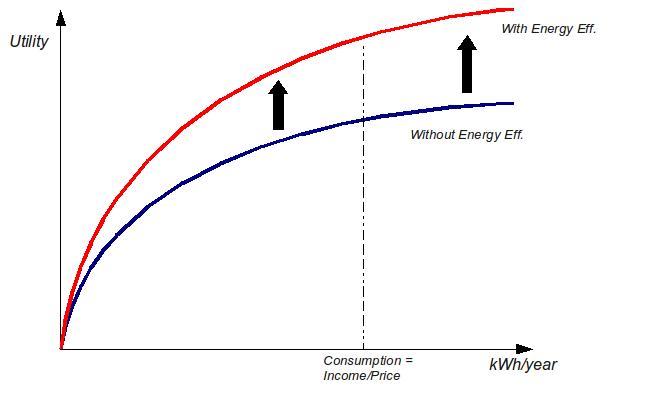
    According to Consumer theory, individuals choose the level of commodity consumption which, considering their own income and the price requested, maximizes their own Utility. The key point regarding this theory is that one of the theory’s unproven principles – the axioms – predicts that, for each individual, utility always increases as the consumption of any commodity increases. Ironically, economists call it the Piggy Principle.

    In an energy context, let’s consider what happens when an individual buys a more efficient car—the same can be said for light bulbs, home insulation, and so forth. What happens is that, in order to achieve the same level of utility, the individual can consume less energy. However, if the individual is a cute piggy, he/she will not be satisfied with the same utility he/she reached earlier if he/she is able to reach a higher utility for the same expense!

    In the figure below, this reasoning is made clear.

    For example, this effect is perfectly exemplified when we consider that with a more efficient car, with the same expense, you can take a job further away from home or, with more efficient bulbs, you can get a better illumination by installing multiple lighting spots (the so called ‘Ikea effect‘), or by insulating your house or installing a more efficient boiler, you can increase your indoor winter temperature, going for example from 18 ° C to 22 ° C. This kind of change has really occurred, if we consider that the winter set-point temperature in Italian schools was around 10 C ° in the early 20th century!

    To sum up, it is clear that, due to the Piggy Principle, energy consumption is not affected by efficiency improvements in products for families. Furthermore, as a consequence, if energy consumption does not change, neither does pollution from energy-related emissions.

    However, this lack of change does not mean that efficiency improvements in consumer products should not be pursued or encouraged. The opposite is to be said!

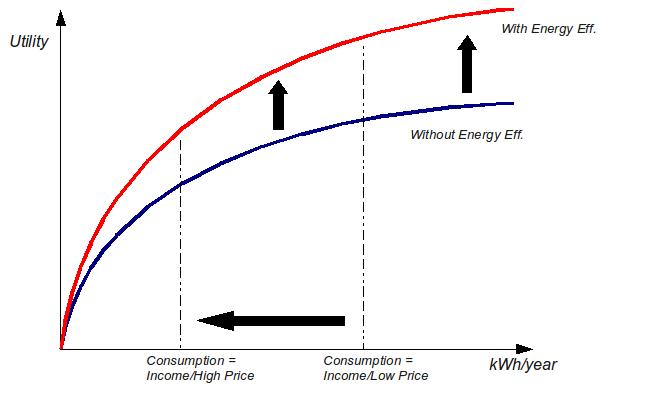
    Efficiency improvements in consumer products in fact have the great advantage of increasing the Resilience level of society. We are referring to Resilience in its engineering sense, i.e. in terms of resistance to rupture forces. Once again, the figure below clarifies this concept: in case of a substantial rise in energy prices, those who invested in efficiency measures are better off in comparison with those who did not. This can be helpful when facing the dilemma of taking part in riots or supporting the next war for resources.

    Now let’s focus on another question: are we really piggies? Is it really possible that, in a given period of time, the more we consume the better off we are? The answer is obviously NO! How can you accept as an axiom that individuals, if they could, would drive cars 24/7 the whole year round? Also, how could anyone assume that people, if they could, would be better off with 120 kg of meat per day than if they ate only 1 pound per day? It is pretty clear that the Piggy Principle is a long way from reality.

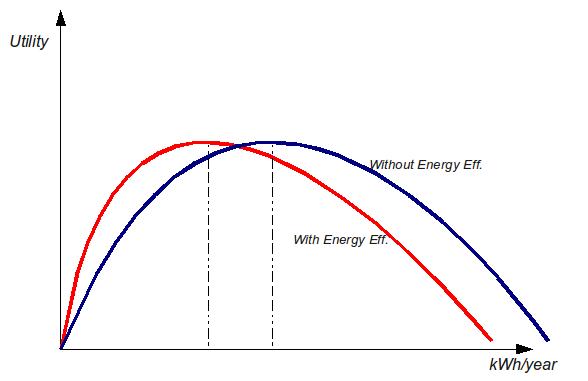
    What we need to admit is that beyond some level of consumption, Utility peaks and then begins to decrease.

    This concept is only sketched in some economic texts (Hoffman, Binger). The point beyond which utility decreases is called the ‘bliss point’.

    If a bliss point for each individual exists, why do figures show that this is never reached?

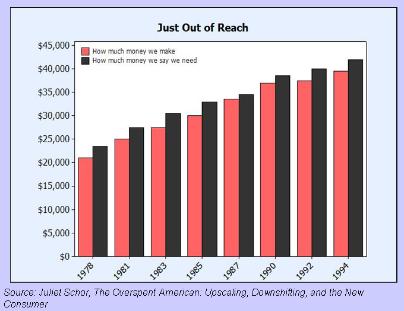
    As a matter of fact, the consumption rate per individual has kept increasing in Western countries since the beginning of the Industrial Revolution. Moreover, some studies show that the need for money by individuals is never fulfilled.

    Finally, if the bliss point exists, but figures show that individuals never achieve it, the correct question would be: how does it happen that the bliss point for individuals keeps moving further, becoming more and more unattainable? Why did we condemn ourselves to this constant Sisyphean challenge?

    Several studies have provided answers to this question—beginning with V. Packard and other critics of  E. Bernays (this is a nice video to start with). Bernays was Freud’s nephew and is considered the inventor of propaganda and advertising modern techniques. Other studies reveal that some products themselves are designed to be ‘addictive’. One example is this research on fast-food conducted by Yale University. Yet another area of study relates to the proliferation of the so-called positional goods; in simple terms, these good are intended to stimulate consumption by leveraging social envy. Nate Hagens has made other studies of interest on the subject.

    Going back to the problem of energy demand, we can now consider some of the policies that are proposed by different groups.

    Some environmental organizations and movements support ‘halting economic growth.’ These organizations act in a beneficial way by informing the public about the benefits of a more sober life-style and the devastating effects of excessive energy consumption. We could argue that these campaigns help to avoid the constant displacement of individuals’ bliss points.

    We know, however, that it is extremely difficult to persuade a critical mass of a population with messages related to sobriety. We also know that the most effective persuader in determining the consumption level of a commodity is the price. Just by relying on price, it is possible to prevent the Piggy Principle from undermining the benefits of efficiency investments.

    In regard to that, in recent days, the Dutch government has approved a very interesting proposal: it would replace the current ownership and sales taxes with a road tax by the kilometre (about 3€ cents/km, which, for a 15.000 km/year usage sums up to a total of 450 €!).

    This policy focuses on the bulk of the matter: the road tax offsets the kilometric price decline perceived by those buying a more efficient car. So the Piggy Principle can’t take effect and the final outcome is:

    • Same mileage covered, so same ‘Utility’ reached by drivers
    • Same total expenses for drivers
    • Less liters of fuel sold, so less polluting emissions

    But the more perverse side effects of this proposal need to be balanced in some way. Since mileage is a good on which the poor spend a higher percentage of their income than the rich, this is a regressive tax that might contribute to increase inequality. In addition, as with every carbon tax, it would be exposed to carbon leakage phenomena because of neighboring countries which do not apply it.

    Thus, the findings regarding the Piggy Principle and the Jevons paradox lead us to the  conclusion that energy efficiency issues are extremely sensitive. The simplistic solutions based on technology changes ALONE can prove to be a real boomerang.

    Join the conversation about this story »

    See Also:


  • Wanna Supply Energy For Those Electric Cars? We’ve Got A Huge Bolivia Problem

    (This is a guest post by David Summers, known as Heading Out on The Oil Drum.  He is a professor at Missouri University of Science and Technology. This post appears under a Creative Commons Attribution-Share Alike 3.0 United States License)

    Just over a year ago, and spurred by an article in Time, I wrote a post on the possible global supply of lithium, which is used in renewable batteries, and a major choice for use in the batteries of electric vehicles, such as the Chevy Volt. Since the story has acquired more recent interest this week, and with new information, it is worth re-visiting the topic.

    I began the original post by noting that our first introduction to these batteries was in our role as an Explosives Lab when we found out – in a series of experiments a long time ago – that they can blow up if handled wrongly. And it turns out that such a risk is still around, though not that common. But to put the event in context:

    Fifteen incidents in the last two decades were serious enough to warrant a decision to re-route a plane or perform an emergency landing, according to FAA data.

    For instance, in 2008, there were nine battery accidents resulting in two minor injuries. To put that figure in perspective, that year 3.3 billion lithium batteries were transported on 77 million flights, including 56 million passenger and combination passenger/cargo flights.

    Based on that data, one’s chances of being on the same flight with someone who suffers a minor injury because of a malfunctioning battery was about 1 in 28 million in 2008. In comparison, the one-year odds of dying from a car accident in the U.S. are 1 in 6,584, according to the National Safety Council.

    Since we also look at processing, I became curious about where and how the lithium is mined. Recently, however, h/t to JoulesBurn, there was an article by Jack Lifton explaining some additional production issues. So what I thought I’d do is to integrate some of this additional information into a more up-to-date post.

    It turns out that most lithium comes from salt lake deposits such as those in Chile and Bolivia.

    The biggest deposit in the world lies in the Salar de Uyini, Bolivia, which is also the world’s largest salt flat. A quick look through Google Earth gives the location, with the white in the picture being the salt flat, and not snow. La Paz, the capital of Bolivia is at the top.

    bolivia

    The world’s largest lithium deposit is at Salar di Uyuni (Google Earth)

    The lithium is found in the crystallized salt, and in the brine that underlies the crust. As the world gears up to demand more, Bolivia is determined to keep as much of the “value added” part of the processing to itself. Thus the intent has been that the state would initially act alone in industrializing their deposits, and not look for foreign partners until 2013. Unfortunately its attitude has not drawn a lot of excitement from the world press, since there appears to be more than enough for current demands available from elsewhere.

    Chile provides 61% of lithium exports to the US, with Argentina providing 36%, says the US Geological Survey (USGS), with Chile having estimated reserves of 3m tonnes, and Argentina about 400,000 tonnes. . . . . . Lithium production via the brine method is much less expensive than mining, says John McNulty, analyst at global bank Credit Suisse. Lithium from minerals or ores costs about $4,200-4,500/tonne (€2,800-3,000/tonne) to produce, while brine-based lithium costs around $1,500-2,300/tonne to produce.

    Melting snow from the Andes Mountains runs about 130 feet (39.6 meters) underground, into lithium deposits, then gathering into pools of salt water, or brine. The brine is pumped out from under salt flats such as Chile’s Salar de Atacama, and spread among networks of ponds where the desert sun and high altitude provide a beneficial environment for evaporation.

    It takes about a year for the brine to reach a lithium concentration of 6%, when it is shipped to a plant to be purified, dried and crystallized into lithium carbonate, which then is granulated into a fine powder for battery makers. Lithium stores a very large amount of energy for its volume, which makes it perfect for electronics.

    Unfortunately for those who are expecting electric cars to spring out of the woodwork in the next few years (remembering that the President’s plan calls for 1 million plug-in hybrids by 2015) Mitsubishi estimates that the world will need 500,000 tons per year at full ramp up. The Salar di Uyuni deposit in Bolivia holds at least 9 million tons, although the country has, in total, perhaps as much as 73 million tons. The only progress to date is a pilot plant that was intended to produce some 40 tons by the end of last year, as it geared up to full production, with the product coming from brine processing. The world supply of lithium itself is considered to be 28.4 million tons, equivalent to 150 million tons of lithium carbonate. The USGS has estimated that the deposit can produce about 5.4 million tons of lithium, relative to a total US reserve base of 410,000 tons. With the slump in the world economy last year demand dropped, and so lithium producer SQM SA has recently dropped the price 20% since there is more than enough to go around.

    lithium stats

    Source USGS

    Of course that all depends on how Chinese demand changes in the next short while.

    lithium demand

    Source Research in China

    In terms of how much lithium goes into a battery, it is about 20 lb for an EV, and about 0.1 oz for your cell phone. However there are other industrial uses for lithium, so that at present only about 25% of world production ends up in a battery.

    Part of the problem with the Bolivian deposit, as Jack Lifton noted is that the deposit is contaminated with magnesium, which is also true at the Atacama deposit in Chile, except that while the Mg/Li ratio there is 6.4 to 1, the deposit is 0.15% Lithium. At Hombre Muerto the Argentinean deposit, the Mg/Li ratio is down to 1.37 to 1, making it easier to produce, even though the grade is lower, at only 0.062% Li. Unfortunately the Bolivian deposit has only a 0.028% lithium, while an Mg/Li ratio of 19.9:1 so that it has both a poorer grade, and a higher Mg content. To add to these disadvantages, being high in the Andes means that evaporation is not as fast, and so processing costs go even further. This is especially true since the lake apparently floods every year, slowing evaporation even further.

    So put it all together, and, for the moment, the production of much lithium from Bolivia might be a bit further in the future than they currently expect. Which is perhaps why the plant gets being pushed further and further into the future. By November last it had been put back to 2014. (And the claim that the technology will all be homegrown is a little more suspect.)

    . . . companies like Japan’s Sumitomo and Mitsubishi, and South Korea’s state-run Kores — Korea Resources Corporation, are helping the government find the best way to extract lithium from Uyuni “free of charge,” but will be the preferential buyers of Bolivia’s lithium carbonate.

    Lithium is also produced from coarse grained igneous rocks called pegmatites, with spodumene being the most common. American mines were in the Carolinas, but closed since brine processing is cheaper than the mining and processing of the hard rock.

    Geothermal power plants draw hot brine from underground as a power source, and these brines can contain dissolved minerals. Thus, for example the seven Geothermal plants at the Salton Sea are reported to be able to produce up to 16,000 tons of lithium per year. The facilities are better known as a source of zinc (pdf). However the potential as a source of lithium is becoming increasingly recognized.

    Join the conversation about this story »

    See Also:


  • Here’s Why The Russia-Belarus Conflict Is A Real Threat To Western Oil Supplies

    (This guest post originally appeared at The Oil Drum and is licensed under a Creative Commons Attribution-Share Alike 3.0 United States License)

    I hadn’t actually been paying much attention to the Russian:Belarus dispute over oil supplies. After the annual debacles that we are used to over natural gas supplies that flow from Russia to Western Europe through Ukraine, and which seem somewhat quiescent at the moment, I had failed to grasp how much Western supplies of oil from Russia flow through Belarus. But as is pointed out in Foreign Policy, the flow is significant, and this is a more far-reaching conflict than I grasped.

    As a brief review:

    In 2001, Belarus unilaterally canceled a contract that mandated the sharing of these revenues, leading to substantial losses for Russian pipeline monopoly Transneft and the Russian state budget. Now, Transneft is demanding that Belarus pay full import duties for the portion of Russian oil that it resells on the European market, a demand that could cost Belarus as much as $5 billion per year. The Belarusian government argues that the Russia-Belarus customs union obviates the need for Minsk to pay duty on imports from Russia. Although deliveries through the Druzhba pipeline have not, as of mid-January, been cut off, the prospect that Transneft (whose chairman is Russian Deputy Prime Minister Igor Sechin, a close confidant of Prime Minister Vladimir Putin) will turn off the taps to force compliance from Minsk is clearly one that has European leaders worried because the European Union imports about a third of its oil from Russia, mostly via Belarus. Already, the prospect of supply disruptions has driven U.S. crude oil prices to a 15-month high, presumably to Moscow’s delight.

    Well, as my post on Wednesday showed, I am not convinced that this conflict had a lot to do with the rise in oil prices (which actually dropped a little today, on their overall march upwards). But that does not lessen the longer-term impact of what is going on. It is, as it was with the Ukraine dispute, to with control, with Russia seeking to control fuel distribution in these countries, and through supply controls also influence the directions in which the country moves.

    Russia is now warning that it will reduce oil flows to Belarus even further and wants the duty on the roughly 290,000 bd that is refined in Belarus and then exported to the West. At the moment the refineries in Belarus have a relatively short reserve (between a few days and a week, reportedly – depending on source) and the current contracts have expired.

    Germany and Poland are believed to be hit hardest once Russia halts shipments through the Druzhba pipeline. Germany depends on Russian crude for about 15 percent of its total consumption, and Poland buys from Russia to meet 75 percent of its market demands.

    Minsk has threatened to raise the transit fee for its European customers more than tenfold, from 3.9 dollars to 45 dollars per metric ton, should Moscow not agree to its conditions, RIA Novostinews agency quoted an unidentified expert close to the talks as saying.

    At the moment the talks appear to be stalled. However they are not limited to the transit of oil. There is also a dispute over the transmission of electric power. Belarus acts as a transit country for power both to Kalingrad and to the countries of the Baltic. It has assumed somewhat greater urgency with the closure of the Ignalina nuclear power plant in Lithuania. The plant closed on December 31, and there are fears of greater dependence on Russia for future power. Russian complacency about the situation is not, I suspect, exactly helpful.

    “It is inevitable that Russia is going to become a bigger supplier of energy to Europe and particularly to the Baltic countries. Ultimately there comes a point where you have to let the old days go,” Chris Weafer, chief strategist on Moscow’s Uralsib bank, told New Europe on 5 January, adding that the Baltics, which sorely need energy supplies, should adopt a pragmatic approach and rely on their eastern neighbor and forget the legacy of the Soviet Union. As long as Russia continues to try and build a modern and diversified economy with greater global integration, then it needs the goodwill of the West just as much as the West needs Russia’s energy.

    Bids for construction of a new plant are due to be submitted by the end of this month, with the hope of getting the new plant on line by 2018. (Kalingrad is hoping to have its own reactor in about the same time frame).

    In the interim the Baltic states are going to be dependent, not only on Russia for their electricity and oil, but also on satisfactory conditions to allow the transit of both through Belarus on their way.

    Meanwhile, over in Ukraine, there is an election underway, with initial voting to take place on Sunday. It is perhaps for that reason that there have been no major gas disruptions so far this year. Anger with the current administration is giving a bit of a boost to a third candidate, so perhaps it is in Russia’s best interests to retain a low profile at this point. In fact Russia is claiming credit for keeping the UK supplied with gas as supplies from Norway dropped due to bad weather at some of the production sites. However Russia is also being nice to Turkey as insurance just in case it will still need to do some bypassing around Ukraine to supply Western Europe after the election is over.

    Not that conditions in Ukraine itself have been unaffected. There are some 175 towns and villages that are reported to be still without power, due to the bad weather. This is a decided improvement from the 1,598 who lost power in the Dec 29th storm. At least they are more used to the cold.

    Those in Florida who aren’t, and plugged in too many heaters, are also causing power outages down there.

    Join the conversation about this story »

    See Also: