Author: Thu-Huong Ha

  • New playlist: TED for kids

    ted_for_kids

    TED playlists are collections of talks around a topic, built for you in a thoughtful sequence to illuminate ideas in context. This weekend, a new playlist is available: TED for kids.

    Not at all TED Talks are appropriate for elementary and middle schooers. But these 9 talks — filled with information presented in fun ways — is perfect for curious kids. David Gallo takes you into the world under water, Arthur Benjamin performs mathematical mental feats, LXD dancers bend in truly weird ways.

    Watch the “TED for kids” playlist »

  • New playlist: What does the future look like?

    what_does_the_future_look_like

    TED playlists are collections of talks around a topic, built for you in a thoughtful sequence to illuminate ideas in context. This weekend, a new playlist is available: What does the future look like?

    It’s the question none of us is sure how to answer: What will the world look like in 20 years? And in a hundred years, will our lives be recognizable? Is the future going to be so bright we gotta wear shades, or will we descend into dystopia? In this selection of talks, hear 11 visions for the future — on everything from cars to the Internet to the human species.

    Watch this playlist, which includes talks by Juan Enriquez, Nicholas Negroponte and Danny Hillis.»

  • Timelapse of a disappearance: Talking with Liu Bolin

    On Thursday at TED2013, Chinese artist Liu Bolin talked about his remarkable photographic installations, in which he paints himself (and sometimes other people) with perfect camouflage to disappear into a busy background. His talk closed with a photo of Liu in the theater at Long Beach, disappearing himself into the stage with paint and pattern over the course of an evening. Watch the timelapse above to understand his process, which involves a lot of people saying “A little to the left… a little to the left …” I caught up with him to discuss.

    Tell me about your process.

    For the talk, I stood up on stage with my outfit pre-painted, and then one of my assistants worked with the camera and stood back to instruct the other painter on what to do, where to paint, what colors to use, until from the camera I appear invisible.

    What inspires you to make a painting?

    That’s a perplexing question for me. When I was preparing for the talk initially I thought I would prepare a talk about art, but then I realized it’s really difficult to talk about pure art in China, because it’s always tied to survival. My life in China has always been adding a lot of things to my physical body and mental, emotional state. For example, in my piece “Supermarket,” it has an actual weight on my body.

    What makes an ideal shot?

    Two things: position of camera and focus. Focus is the most important. For the piece I did for TED, the stage is very colorful and red, so I needed reds and pinks.

    You mentioned in your talk that it’s not just an artist’s work but what they stand for. Can you talk more about that?

    There’s a difference between Chinese artwork and foreign artwork. As a Chinese artist, I ask a lot of questions about society in my work. When I am abroad, though — for example when I went to the Louvre — because I’m usually overwhelmed by my artwork, I have to make art as a souvenir. The TED piece is more of the latter, a form of memory or a souvenir. This year I have a new plan. I think the TED stage will be the highlight of my new series, Happy New City. In the future I will create new kinds of art. My talk was as a summary to conclude what I’ve done before.

    What kind of art do you enjoy?

    First of all, that art has to move me. The creator of that art doesn’t have to be a famous person. The artwork I’m most interested in right now are those that take the subject from real life, such as mobile phones, because most people won’t think of those things as art objects. But through the work of this artist, people realize those objects can be art. This kind of art moves me.

  • Effective altruism: Peter Singer at TED2013

    Photos: James Duncan Davidson

    Photos: James Duncan Davidson

    Moral philosopher Peter Singer starts the last session of TED2013, “A Ripple Effect?” with a shocking video of a 2-year-old girl in China who was hit by a van — and then a second van — and ignored by passers-by as she lay dying in an alley. He asks of the audience: Would you have stopped and helped this girl? Not surprisingly, the unanimous response was yes. Well, every day that we don’t help others, he says, it’s like leaving this girl crippled in the alley. In 2012, Singer says, UNICEF reported that 6.9 million children under 5 died from preventable poverty-relatable diseases like malaria. Does it really matter that we’re not walking past these children in the street, that they’re far away? According to Singer, there is no morally relevant difference.

    There’s a new movement of people who are realizing how necessary it is to help others. It’s called effective altruism. Using empathy and intellect, it appeals to both heart and head. Because reason is not a neutral tool to help you get whatever you want, says Singer, but to get perspective on the situation. Effective altruism has been led by figures in philosophy, math, economics — which may be surprising because people think philosophy has nothing to do with the real world, economics is for the selfish, math is just for nerds. Indeed, the most effective altruists in history — Bill and Melinda Gates and Warren Buffett — are “nerds” who realize that it’s necessary to give to charity and to make sure that charity is effective.

    Singer asks and answers questions about effective altruism:

    1. How much of a difference can I make?

    You don’t have to be a billionaire, says Singer. Meet Tony Ord, a philosophy researcher. He realized that with the money he was going to make over his lifetime, he could cure 80,000 people of blindness in developing countries and still have enough left to live a perfectly adequate life. He started Giving what we can, to ask people to give 10 percent of their income over their lifetime to fight against global poverty.

    TED2013_0072024_DSC_94512. Am I expected to abandon my career?

    Meet Will Crouch, a graduate student in philosophy who began 80,000 Hours (roughly the number of hours you spend in your career), which helps people find careers that make the biggest possible difference in the world. Surprisingly, one career he encourages people to go into is finance and banking, because the more you earn the more you can give. If you earn a big salary, rather than becoming an aid worker yourself, you could pay the salaries of five aid workers in developing countries.

    Singer and one of his students started an organization called The life you can save, which aims to encourage people to see that charity is part of living a normal life.

    3. Isn’t charity bureaucratic and ineffective anyway?

    One of the most important aspects of effective altruism is measuring your impact quantitatively. You can pay to provide and train a guard dog for a blind American, which costs about $40,000. But with that money you could cure 400 to 2,000 people in developing countries of blindness from glaucoma, which costs about $20 per person. Resources like Givewell and Effective Animal Activism help find those organizations that are truly effective.

    4. Isn’t it a burden to give up so much?

    No, says Singer. Giving helps lift the immense weight of living a Sisyphean life. The consumer lifestyle is: Work hard, make money, spend money on goods, run out of money, start again to maintain happiness. It’s a hedonic treadmill you can never get off. Effective altruism allows you to demonstrably contribute to the lives of others while also adding meaning and fulfillment to your life.

  • In search of the man who broke my neck: Joshua Prager at TED2013

    Photos: James Duncan Davidson

    Photos: James Duncan Davidson

    When Joshua Prager was young, he dreamt he would grow up to play baseball. Or be a doctor. He never imagined that at the age of 19 he would find himself paralyzed in the hospital, and that he’d have to reteach his body to move, to relearn to breathe and speak. In his new book Half-life, Prager returns to Jerusalem, where a truck hit the bus he was riding in and broke his neck.

    On stage today Prager tells the story of his return to Jerusalem and the challenge of facing the man who had so radically altered his fate: the driver of that truck. One year ago, he recalls, he set out to find this man. He didn’t have a phone number or address, but he knew his name — Abed — and the town outside Jerusalem where he lived. Twenty-one years before outside this city Prager broke his neck when he was hit by a speeding truck. Now he was off in a silver Chevy, “to find a man and some peace.”

    That night 21 years ago, Prager was 19 and reveling in his newfound strength. He had just grown 5 inches and was playing basketball with his friends. He was sitting in a mini-bus off to get pizza he had won on the court when from behind there was a great bang, as loud and violent as a bomb. Prager’s head snapped back, his shoes flew off, and he flew, too.

    When he landed he was a quadriplegic. Over the next few months he learned to breathe, sit and walk, and back home he was in a wheelchair for the next four years in college. After college he went back to Jerusalem. As he reflects, “I rose from my chair for good, leaned on my cane and looked back.” He contacted other victims and looked at old photographs, mourning all he had lost and not yet done and which was now impossible. On that trip Prager sought out Abed, not mentioning his condition or the fact that he knew Abed had had 27 driving violations by the age of 25. He said he wanted to meet with Abed, but later when he called back the number had been disconnected. Then, he said, “I let Abed and the crash go.”

    Prager returned to New York and began his life as a journalist, typing hundreds of thousands of words with just one finger. His friend pointed out that all his stories mirrored his own: an entire life changed in one instant. His book was almost complete when he realized he still wanted to meet Abed: “I wanted to hear this man say two words: I’m sorry. People apologize for less.”

    TED2013_0071593_D41_4589Prager went back to Jerusalem to search for Abed. He was carrying yellow flowers as a gift when he realized how ridiculous it seemed. “But what to get a man who broke your fucking neck?” (He settled on Turkish delight.) A torrent of questions filled Prager’s mind: What would Abed say and do? Who had he become since the accident? Who was he? Was he who he was before the crash? Are all of us the result of things done to us? And done for us? As Prager says, “It seemed we could be nothing more than gene and experience.” He looked back on the road and imagined that had the accident not happened he would have been a doctor, a husband, a father. And a little less mindful of time and death.

    With help from a man he met in the street, Prager arrived at Abed’s house. Abed’s wife said her husband in 4 hours. (Her Hebrew wasn’t very good and she later confessed she thought Prager was there to install the Internet.) Abed arrived home. The two men shook hands and smiled, and Prager gave Abed his gift.

    Inside Abed began his tale of woe: He had just had surgery on his eyes, he had lost his teeth in the crash. Prager knew the police report said that Abed had come away from the accident unharmed. He brought polaroids and his driver’s license to show Prager what he looked like before. But Prager didn’t want to relive the crash. As he said, “I wanted to exchange Turkish dessert for two words and be on my way. I was quiet because I had not come for truth. I had come for remorse.” He said to Abed, “I understand that the crash wasn’t your fault. But does it make you sad that others suffered?”

    “Yes,” said Abed. “I suffered.”

    He explained that before the crash he had lived an unholy life, and so God had ordained the crash. Now Abed was religious, and God was happy. Just then on television the news showed a crash in which three people were killed. “It is a pity the police in this country are not tough enough on bad drivers,” mused Abed. Prager was baffled. “Abed … I thought you had a few driving issues before the crash.” Abed responded, “I once went 60 in a 40.” Thus 27 violations became one. As Prager reflects, “No matter how stark the reality, a human being fits it into a narrative that is palatable.” It was that moment he realized that Abed would not apologize. He was not a particularly bad man, nor a particularly good man. He was a limited man.

    “This,” Prager quotes, “is the last of the human freedoms: to choose our attitude in any human circumstance.” The aging and the anxious, the divorced and balding and bankrupt … everyone can choose to rise above bad fortune, to enjoy community, study, work, adventure, friendship, love. The good. Prager quotes Melville: “Truly to enjoy bodily warmth some small part of you must be cold.” It’s in the contrats that we find the good. Prager ends his stunning story: “You know death so you may wake each morning pulsing with life.”

  • Are we getting more intelligent? Jim Flynn at TED2013


    Photo: James Duncan Davidson

    Photo: James Duncan Davidson

    Jim Flynn is an expert in intelligence famous for his research on the Flynn effect, the phenomenon that humanity’s IQ has been dramatically increasing since the 1930s. He opens Session 11 today on the last day of TED2013 to help answer the question, “Who are we?”

    During the 21st century, our minds have altered, he begins. At the beginning of the century, people were confronted with a concrete world, and their primary interest in dealing with it was to analyze how much it would benefit them. In today’s world we confront a complex world with new habits of mind: classification and abstraction. We clothe the concrete world, trying to make it logical and consistent. We ask not just about the concrete but the hypothetical: what might be, and not just what is.

    Today the line for giftedness is an IQ of 130. If you scored people a century ago against modern norms, they would have an IQ of 70. That is the line for mental retardation today. What can account for this?

    Imagine a Martian came down to Earth and found a ruined civilization. Imagine it found target scores from the past century: In the 1865 the target had one bullet in the bullseye; in 1898 it had five bullets in the bullseye; in 1918 100 bullets in the bullseye. The extraterrestrial archaeologist would be baffled. The tests were supposed to measure the keenness of eyesight and whether the shooter has control over their weapon, and so on; how could human skill have advanced so quickly in such a short amount of time? But of course we know the answer: We had muskets at the time of the Civil War, repeating rifles by the Spanish-American War and machine guns by World War I. It was the equipment in the hands of the average soldier that was responsible, not better eyes or steadiness of hand.

    So what mental artillery have we picked up over the last 100 years? Alexander Luria studied neuropsychology in the early half of the century, and he found that people were resistent to classification, to deducing the hypothetical. His subjects simply couldn’t think about anything abstract. Consider this exchange:

    Luria: What do crows and fish have in common?
    Subject: Absolutely nothing. A fish swims, and a crow flies.
    Luria: Are they not both animals?
    Subject: Of course not, a fish is a fish, and a crow is a bird.

    The man could only think of the objects as how he might use them, not as abstract objects part of a classification system.

    Luria told another subject: “There are no camels in Germany. Hamburg is in Germany. Are there camels in Hamburg?” The subject replied, “If it’s big enough, perhaps it has camels.” Luria prompted him again to listen to the conditions, and again he replied that perhaps Hamburg had camels. He was used to camels, and he was unable to imagine that there weren’t any in Hamburg.

    How have we come to solve things that aren’t real problems? For one thing, education has changed dramatically. These days the majority of Americans get a high school degree. We’ve gone from four to eight years of formal education to twelve. Fifty-two percent of Americans get some tertiary education. In 1910 a state examination in Ohio given to 14-year-olds asked socially-valued concrete questions, like “What are the capitals of the 45 American states?” In 1990 such a state examination was about abstractions, asking instead: “Why is the largest city of the state rarely a capital?” And the student is supposed to reason that the state legislature is rural controlled and they hated Big City, and so on. Today we educate people to use abstractions and link them logically.

    Another shift in the past century has been in employment. In the early 1900s, three percent of the population had cognitively demanding professions; today, it’s 35 percent. And not just professions like lawyer and doctor, sub-professions like technician and computer programmer are also cognitively demanding. Compare the banker in 1900, who really just needed a good accountant and to know who was trustworthy for paying back their mortgage. Today’s bankers, like the ones involved in the mortgage crisis, have jobs that demand much more from their cognitive faculties. It’s not just the spread of more cognitively demanding jobs but the upgrading of old professions.

    Moral intelligence has escalated in the past century because we now take the universal seriously and are able to look for logical connections. In the 1950s and ’60s, people were coming home and talking to their parents about Martin Luther King, Jr. When they asked the generation before them, “How would you feel if you woke up tomorrow and you were black?” their parents responded, “That is the dumbest thing I’ve ever heard. Who have you known who has ever woken up black?” They were fixed in the concrete mores they had inherited, and they were unable to take the hypothetical seriously. As Flynn says, “Without the hypothetical, it’s very difficult to get moral argument off the ground.”

    Looking at the evolution of IQ tests, it’s evident that gains have been greatest in certain areas, like classification and analogies. Consider the analogies in the Raven’s Progressive Matrices test:

    In 1900 people could do simple analogies: Cat is to wildcat as dog is to … ? People answered wolf.
    In 1960, two squares followed by a triangle is to two circles followed by a … ? People answered semi-circle.
    And in 2010, two circles followed by a semi-circle is to two 16s followed by … ? An eight. People were even able to see beyond the symbol to abstract the concept of halving.

    It’s not all good news, says Flynn. Our political intelligence is not improving. Studies show that American young people read less history and literature and less material about foreign places. It’s as if they are ahistoric, living in the present. How different might life be if Americans were more aware of their history, such as the fact that we have been lied to the past 4 out of 6 wars we’ve fought in? Lusitania was not an innocent ship with explosives on it, the North Vietnamese did not attack the Seventh Fleet, and Sadaam Husein hated Al Qaeda. Flynn remarks, “You can have humane moral principals, but if you’re ignorant of history and other cultures, you can’t do politics.”

    But the 21st century has undoubtedly shown there are enormous cognitive reserves in orginary people, and they’re finally being tapped into. The aristocracy once was convinced that the average person would never make it, that they wouldn’t develop their cognitive abilities. But we know today that the average human is capable of much, much more.

  • The invisible man: Liu Bolin at TED2013

    Photo: James Duncan Davidson

    Photo: James Duncan Davidson

    Can a person disappear in plain sight? That’s the question Liu Bolin‘s remarkable works all seem to ask. The Beijing-based artist is sometimes called “The Invisible Man” because in nearly all his art, Bolin is front and center — and completely unseen. Bolin aims to draw attention to social and political issues by dissolving into the background of his work.

    liu bolin 3

    When Bolin works, he stands as still as he can for as long as he can against the background he plans to disappeared into. He wears a suit, and his assistants paint over the suit and his face. When the camera is placed directly in front of him he appears indistinguishable from the scene behind him. A simple painting takes 3 to 4 hours. Something as complicated as “Supermarket,” below, takes 3 to 4 days. There is no Photoshop involved.

    liu bolin

    Between 1998 and 2000, 21 million people in China were laid off during China’s great economic transition to a market economy. In his piece “Laid Off,” Bolin poses six of those laid-off workers against a green-and-white wall, disappearing them into the factory where they worked for their entire lives. Above them a slogan from the Cultural Revolution reads: “The communist period is the thriving force behind our cause.”

    liu bolin 2

    As he says, “The attitude of the artist is more important than the content of the creation. It’s life’s struggles, not necessarily artistic skills, that touch people. The process of each life struggle is what we call art, regardless of its form.”

  • Remembering Jyoti Singh: Lakshmi Pratury at TED2013

    Photo: James Duncan Davidson

    Photo: James Duncan Davidson

    Lakshmi Pratury on letter-writingLakshmi Pratury on letter-writing

    Lakshmi Pratury joins us for a short talk on a large issue: the gang-rape of Jyoti Singh on a bus in New Delhi, and her eventual death in Singapore. The public was outraged, and it quickly turned into an international online movement to raise awareness for sexual violence. For the first time in India, people were using the Internet to galvanize a political response. Pratury launched a forum called Billionaires of Moments to help Singh’s memory live on, and to keep an archive of similar moments of tragedy that need to be remembered. Her wish is that someday, along with the Fortune 500, there will be a list of 100 Billionaires of moments. Once Pratury was deeply troubled by the public lives of young people on the Internet, but now she has hope — the same kids who post their party pics online are also posting their political outrage.

  • How I named, shamed and jailed: Anas Aremeyaw Anas at TED2013

    Photos: James Duncan Davidson

    Photos: James Duncan Davidson

    Anas Aremeyaw Anas can’t show you his face, but his name carries enough weight. Famous in Ghana for his investigative journalism, Anas’ stories like “Enemies of the nation,” about corruption at customs in the Port of Tema, have blown the cover on crime all over Africa.

    He started 14 years ago, when he had just come out of college. He received a tip that police were taking bribes from kids in the streets, so he decided to go undercover selling peanuts. Thus began his dedication to exposing corruption through immersive journalism, following 3 basic principles: naming, shaming and jailing.

    Anas has gone undercover as a Catholic priest in a Bangkok prison and as a bartender in a Chinese sex mafia ring in Ghana. Thanks to Anas the mafia men in the latter story will be in prison for the next 40 years for the abuse of the sex workers.

    Just last month Anas broke a story with the film Spirit Child, about the tragic practice in northern Ghana of killing deformed children believed to carry ill omens. Anas brought a prosthetic baby from London with a fake deformity and caught men in the act of preparing a concoction to have the baby killed. The police were standing by, and court proceedings are happening now. In “Spell of the albino” Anas follows the albino limb trade in Tanzania, where albinos are regularly killed because their body parts are believed to be lucky in witchcraft rituals. He went undercover as a businessman looking to get rich and caught the practice on film for the first time.

    TED2013_0063490_D41_2303And today at TED, Anas breaks his latest story. He’s been undercover for the past six months at Nsawam Prison in southern Ghana, where conditions are inhumane. He shows a shocking video of a room in the prison full of dead bodies piled atop one another. The sanitation conditions in the prison are unspeakably bad, and it’s easier to get heroin, cocaine and cannabis in the prison than out. He will be breaking the story in Ghana in a month.

    Not everyone has been a fan of Anas’ work. Some accuse him of a breach in ethics. But as he says, what’s the point of a journalist who doesn’t benefit society? He concludes: “What the evil man has destroyed, the good man has built.” So fight, and build again.

  • A dry yet astonishing demo: Mark Shaw at TED2013 (with animated gif)

    Photo: James Duncan Davidson

    Photo: James Duncan Davidson

    Imagine driving through a downpour and coming out with a dry car.

    Mark Shaw produces Ultra Ever-Dry, a liquid-repellent coating that may sound mundane but makes for one astonishing demo. The superhydrophobic coating acts as a shield against pretty much any liquids. When the coating is applied to a surface, it coats it with nanoparticles, which are, surprisingly, not super-smooth but rough and craggy. The spaces between the crags grab onto air particles so that a layer of air now covers the entire surface, and whatever hits the surface — dirt, oil, paint — just bounces right off. The applications are endless: anti-wetting, anti-icing, anti-corrosion, anti-bacterial, self-cleaning, the list goes on.

    GIF by Lil Chen Photos: James Duncan Davidson

    GIF by Lil Chen
    Photos: James Duncan Davidson

    Watch Ultra Ever-Dry in action »

  • The psychology of saving energy: Alex Laskey at TED2013

    Photo: James Duncan Davidson

    Photo: James Duncan Davidson

    Have you checked your email today? Your finances? What about your energy use? Alex Laskey thinks that with just a shift in attitude toward our energy use, we can all save a lot.

    Laskey introduces an experiment he ran with his team at Opower. People received one of three different messages on their doors about why they should try to save energy:

    – You can save $54 this month
    – You can save the planet
    or
    – You can be a good citizen

    Which one won? None. No one message showed a marked difference. So Opower added a fourth message: Your neighbors are doing better than you.

    That one worked. The locals who heard the message that 77% of their neighbors turned down their A/C, Also turned down their AC, creating a marked difference in energy consumption. As Laskey says, “If something is inconvenient, even if we believe it, persuasion won’t work. But social pressure? That’s powerful stuff.”

    Every year in the U.S. alone $40 billion of energy is wasted. Laskey projects that by thinking not just about material sciences but about behavioral sciences, we could save 2 terawatts a year — more than enough energy to power every home in St. Louis and Salt Lake City for more than a year.

    We can be doing so much better, says Laskey, starting by tapping into the power of social behavior.

  • Paper or plastic or what? Leyla Acaroglu at TED2013

    Photos: James Duncan Davidson

    Photos: James Duncan Davidson

    We all know sustainability is essential to our future, in vague terms. But what does that mean for the choices we make every day? In other words: paper or plastic? For one thing, design consultant Leyla Acaroglu wants you to think beyond choosing a material for your grocery tote. Instead, she encourages us to think about the entire life of a finished product, to think hard about the net impact a product has on the environment. This is life-cycle thinking, not just whether a product can be recycled, but all the parts of its existence: material extraction, manufacturing, packaging and transportation, product use, and end of life. Every step of the way, there’s a way to do something smart to make the most out of the product for net environmental gain.

    She introduces (and busts) some myths:

    1. “Biodegradability”

    This is a word used a lot in marketing, but it’s not what you think. Yes, when a natural material ends up in nature it biodegrades normally. But most of our discarded natural materials end up in landfills, anaerobic environments where the carbon molecules can’t break down and instead release methane, which is a 25 percent more potent greenhouse gas than carbon dioxide. Biodegradability, Acaroglu says, isn’t everything.

    2. Fridges

    Your fridge is great, but it’s killing the environment. And not just because it requires so much energy to run, but because it keeps things fresh — and keeps getting bigger, so it’s easier to fill with food … that you’re going to end up throwing out. According to Acaroglu, in the U.S. 40 percent of fresh food is wasted each year, amounting to $165 billion. Half of the world’s food is wasted, about 1.3 billion tons per annum. It comes down to the soggy lettuce, kept in a crisper that doesn’t keep things crisp. (In the UK the problem is so bad that there was a notorious Soggy Lettuce Report.) Acaroglu says: Design fridges that help prevent food waste from the start.

    TED2013_0051964_D41_9342

    3. Electric tea kettles
    In the UK, 97 percent of households have an electric tea kettle, and 65 percent of tea drinkers admit to overfilling their kettles, boiling way more water than they need for a cuppa. One day of extra energy use from these kettles is enough to light all the streetlights in London for a night. What we need, Acaroglu says, is not better materials for the tea kettle, but a behavior-changing kettle that helps you boil just what you need.

    4. Mobile phone subscriptions
    Last year there were 6 billion mobile phone subscriptions; yet only 11 percent of outdated or not-sexy-anymore mobile phones were recycled. In some regions, phones are burned for the gold inside: “it’s now cheaper,” she says, “to mine gold from a ton of phones than a ton of ore.” Acaroglu encourages designing phones for disassembly.

    So what’s the answer to paper or plastic? Well, paper pound for pound is more sustainable — but a paper bag weighs about 10 times what a plastic one does.

  • De-extinction to save a species: Stewart Brand at TED2013

    Photo: James Duncan Davidson

    Photo: James Duncan Davidson

    Last time we saw Steward Brand on the TED stage was in 2010, in his debate with Mark Z. Jacobson over whether the world needs nuclear energy. Brand, perhaps surprisingly, gave a passionate pro argument. But today he’s here for a very different — and potentially very controversial — purpose.

    Extinction is not just death, but death for everyone you ever knew or anything remotely like anyone you knew. It’s permanent. … Or is it? Brand takes the stage today at TED to present ground-breaking research on bringing back extinct species.

    In the past few centuries the Earth has lost dozens and dozens of species to extinction, including the Tasmanian tiger, the auroch and the passenger pigeon, which went from 5 billion to zero in just a few decades. But according to Brand, it’s possible to take tiny bits of old DNA from museum specimens and, using new technology, actually reassemble the entire genome — and maybe even reassemble the organism itself.

    A team of people, including legendary geneticist George Church and newcomer Ben Novak, are working on bringing back the passenger pigeon, which was a keystone species that helped save the buffalo. Beth Shapiro has already sequenced the passenger pigeon, and Church believes it can be brought back with synthetic biology technology, which is accelerating at four times the rate of Moore’s Law. Since it’s now possible to make adjustments in DNA down to a single base pair, scientists can replace missing genes with alleles from a close relative. In this case, genes from the band-tailed pigeon could be used to engineer a passenger pigeon, the last of which, Martha, died in 1914.

    The first de-extinction happened on the bucardo, a type of wild mountain goat. The last bucardo died out in 2000, but its ear was preserved, and in 2009 DNA from the ear was planted in a mother goat. The engineered bucardo died after 10 minutes due to a defect in its lungs.

    Incredible things are possible to save the Earth’s species. Captive breeding in zoos and ecotourism are already helping; in 1981 there were 254 Central African mountain gorillas left, and today there are 880. Currently there are four non-breeding northern white rhinoceros left, and with cloning, says Brand, we can get them back.

    But the critical question to ask is: Do we want extinct species back? Are we humans taking technology to its limits, and interfering unnecessarily in nature? Well, as Brand says, it’s our job to fix what we’ve already broken. In the past 10,000 years, we’ve made a huge hole in nature. It’s our fault that some of these crucial species have been completely wiped out, so we should dedicate our energy to bringing them back.

    While talking on stage to Chris, Brand ends by saying firmly, “It may take generations but we will get the wooly mammoth back.” An amazing dream? Stay tuned and see — and watch the free livestream of TEDxDeExtinction on March 15.

  • Electric, eclectic dance: Rich + Tone Talauega at TED2013

    Photos: James Duncan Davidson

    Photos: James Duncan Davidson

    Brothers Rich + Tone Talauega are choreographers whose energy is so powerful one performance makes the whole room seem to vibrate. This morning at TED, with the help of music producer Keith Harris, they unleash an eclectic menagerie of dance forms that meld martial arts, hip-hop and classical dance. The intensity is palpable across the theater as we watch dancers from across the world float, fight, shake, bend, fold, pirouette.

    TED2013_0043182_D31_1488

    TED2013_0043715_D31_2021

    TED2013_0043491_D31_1797

    TED2013_0043447_D31_1753

    TED2013_0043202_D31_1508

    sTED2013_0043625_D31_1931

  • New playlists: “Spoken-word fireworks” and “That’s absurd!”

    spoken_word_fireworksTED playlists are collections of talks around a topic, built for you in a thoughtful sequence to illuminate ideas in context. This weekend, two new playlists are available: Spoken-word fireworks and That’s absurd!

    That’s absurd!
    5 quirky talks remind us that life is funny, weird, sweet, absurd. Watch talks by Improv Everywhere’s Charlie Todd and Postsecret’s Frank Warren, and more.

    Spoken-word fireworks
    7 brave and beautiful expressions from some of the world’s most talented spoken-word performers — like Anna Deavere Smith, Sarah Kay and Rives — who weave stories in words and gestures.

  • Revolution in The Square: Q&A with Jehane Noujaim


    Egyptian filmmaker Jehane Noujaim won the TED Prize in 2006 with a wish to bring the world together for one day using the power of film. Her most recent work, The Square, saw her heading back to Cairo to track events in Tahrir Square as the Hosni Mubarak regime fell. While there, she filmed a group of local revolutionaries who had also been drawn to the tumultuous events, including the actor Khalid Abdalla and Aida El-Kashef, a cofounder of Mosireen, a media center dedicated to creating citizen journalism during the revolution. The documentary tracks the charismatic group of individuals through their time at the height of the revolution, and continues to tell their stories even after many of the other revolutionaries had moved on from Tahrir Square.

    The Square won the Sundance Audience Award in the World Cinema Documentary category earlier this year, and Noujaim and her team are currently running a Kickstarter campaign to fund the post-production of the film, including editing and further filming. After all, this is a story that is far from over.

    I caught up with Noujaim and the film’s producer, Karim Amer, to talk about the film, the achievements of the revolution, and what’s still to come in this newborn democracy.

    What are you hoping to achieve with the film?

    Jehane Noujaim: I hope people see this is not only a story about Egypt. This is a story about struggle and about fighting for your beliefs and putting everything on the line to fight for what you believe in. That story is interesting when the big news cameras cover it, when you have the entire country behind you — but when the cameras go away and most of the country and state television are calling you prostitutes and thugs and are not behind you, that can be some of the most interesting footage. It really shows what has to be sacrificed.

    Are you hopeful for the revolution?

    JN: Definitely. But this is a very difficult time right now, and it’s going to be a long process. I don’t think that we’re going to see some of the results for 5, 10, 15 years. This was a fairytale, to expect that in 18 days or two weeks, people in a square were going to be able to bring down a dictator and his entire regime. In a way, by bringing down Mubarak, a lot of the people that were fighting lost the symbol of what the revolution was fighting for. So it became even more difficult after Mubarak stepped down. But what they’re fighting against is the removal of a regime, and that means changing the system. That means dealing a major blow to the entrenched systems that are in place, and that includes the army, the police state, the  former regime, and the Muslim Brotherhood … not because of religious reasons, but because what the Brotherhood tried to do when they got into power was a massive power grab, and so it’s really been a fight against another dictatorship.

    You first started working on the film in 2011. In The Square it’s apparent that since then there’s been a change in morale among the revolutionaries. Can you talk a little about that?

    JN: The revolution goes in waves. There are times in the film when our characters are completely depressed. There are wins and then there are many times when they feel like the battle’s been lost, and they have to keep reminding themselves that it’s a long struggle. Look at the Civil Rights Movement. Look at any kind of fight for change. People had to keep fighting and taking their rights. Rights are never given to you. They have to be fought for and they have to be taken.

    Karim Amer: I think a lot of people we’ve spoken to from Western media outlets are kind of gloomy on the revolution’s outlook, but when we talked to our characters … it took over 30 years to make people realize what Mubarak’s regime was doing and to galvanize enough of a movement to get him out of power. It took over a year and a half to do that with the military. Now, the Muslim Brotherhood’s in power with the first freely elected president, and less than 6 months later, people are back in the streets. Our characters see it, and we see it, as progress. People are starting to react much more quickly to acts of injustice. That’s the new Egypt that many of the people in this movement and in our film are shaping and paving.

    So uprising and violence are actually signs that things are improving?

    KA: We’re not saying that violence is a sign that things are improving. What I’m saying is that reactions to injustice leading to massive action of people showing their power…

    JN: Ideally nonviolent.

    KA: …is an act of improvement. You’re going to try to jam the constitution through illegally? Well, we’re not going to stand for that. The action-to-reaction time is improving.

    JN: Before Mubarak stepped down, when a massive injustice took place, if you tried to have a conversation with somebody in the street, with a taxi driver, anybody, people would not even speak about it. People were afraid to give their opinions even though they knew that there were massive injustices happening. And even after he stepped down it took a year [for conversations to start happening.] You see in the film, the army was torturing people in the Egyptian museum, but it still took people about 8 months to stand in the street and to say to their army that they would not stand for this any more. And then when Morsi did his power grab, it took them, what, two weeks? Two weeks to go down into the streets. That is a massive change from the Egypt I grew up in.

    KA: It is a complete paradigm shift in terms of the mentality of the people. People are no longer living in a culture of fear.

    How have things in Egypt changed since you were young?

    JN: Probably the biggest change is really seeing people realize that the government is supposed to work for them, rather than them having to be victims of whatever the government decides to do.

    KA: Egypt is an epicenter of centralized states. Egypt is the land of the Pharaohs. We’ve been living under a Pharaonic-type of society for 5,000 years. What changed was a huge shift in people’s expectations of their leadership and their expectations of  the future they want to live. That’s why we know that regardless of the short term outcome, the revolution has been successful.

    Clearly not everyone from the revolution is pleased with Morsi. Do you think he’ll stay in power?

    JN: Right now there aren’t the checks and balances that are in place in the United States or other democracies, so the people gathering in protest around the palace are Morsi’s checks and balances. My hope is that people will continue to express themselves and educate the rest of the country on their rights. But I don’t think that Morsi is about to be ousted anytime soon.

    KA: The goal isn’t, like, the continual ousting of people. We’re trying to create a system. Right now a new social contract is being formed. The goal is that any attempts for Morsi to become a dictator are curbed, and that he recognizes the power of the people. If he fails to do that, then I think, yeah, he will not last. But I think that the outpouring of pressure against him is really making him check this again, especially because the Muslim Brotherhood is losing so much support from their own people, who are very disappointed.

    JN: In the film, one of our characters starts something called Mosireen, which means “adamant,” and basically it gets cameras out to people to film injustices. One very powerful piece that they filmed later was at a protest at the presidential palace when Morsi did his power grab. A number of Brotherhood supporters trashed the tents in front of the palace, took people, and tortured them. Somebody managed to videotape it. In these torture videos, the Brotherhood supporters were saying, “Who’s paid you to be here? You’re a thug.” That was Mubarak’s exact playbook.

    As we watch this happen again, the feeling you get is not that Morsi himself is going to be the savior and change things, but that people are going to keep fighting against the dictatorship and against this kind of rule.

    Jehane, I know you spent some time in jail during the filming. What were some other personal challenges that you both faced in making the film?

    KA: Of course, Jehane was arrested 3 times throughout the process.

    JN: Everybody on the team has been arrested, shot at, or chased by soldiers or police.

    KA: Cameras confiscated I don’t know how many times.

    JN: We’ve had many cameras confiscated, a lot of footage taken, so that’s probably the most obvious, but we still managed to get all of the footage out of the country and to put a film together.

    KA: When you’re documenting something that’s so close to home, what’s at stake for everyone in the film, the whole team, is your country. Your country is being reshaped and redefined, and you have the ability, hopefully, to make some kind of impression of that through the film. So there’s a lot at stake, and there’s a lot of emotion. One of the characters, Ahmed, told us that this film to him is the truth that must be preserved. He said, our generation and our parents’ generation grew up in a country where history was written by whomever was in power, and they could write and say whatever they wanted. This film is our ability to show an alternative version, to preserve the truth of what happened in this square, and he said, if this film succeeds, then our kids will live in a country that’s free.

    And I’m like … okay … that’s a lot to put on the film. [Laughs] I mean, we’re happy it means so much, but that’s a huge burden.

  • In short: A powerful spoken word reflection on bullying, the history of Bill Cosby’s sweaters

    Here, some staff picks of smart, funny, bizarre and cool stuff on the interwebs this week:

    In case you haven’t seen it yet, To This Day is a beautiful collaborative project that combines spoken word poetry and a flurry of eclectic animations to raise awareness about bullying.

    Lisa Harouni: A primer on 3D printingLisa Harouni: A primer on 3D printingSoon you, too, will turn out to be a replica of yourself made from a 3D printer. For now, a two-million-year-old whale fossil will suffice. [CENtral Science] Watch seven TED Talks on the wonder of 3D printing.

    The famous Bill Cosby sweater has a surprisingly interesting history. [Smithsonian.com]

    In the 1950s, nuclear bombs increased the amount of Carbon-14 in the air, allowing scientists today to carbon date human tissue. [Smithsonian.com]

    Jessica Green: Are we filtering the wrong microbes?Jessica Green: Are we filtering the wrong microbes?A new paper by TED Fellow Jessica Green on better ways to estimate diversity in the body. [Phys.org]
    Did you know: You only need 39 digits of pi to be able to measure the circumference of the observable universe? Now you do. [YouTube] Watch 9-year-old Chirag Singh confess his irrational love for Pi at TEDxYouth@BommerCanyon.

    The true story of a false story that just wouldn’t die. [Ars technica] Check out our playlist, Media with Meaning, for many talks on the future of journalism.

    Elizabeth Gilbert: Your elusive creative geniusElizabeth Gilbert: Your elusive creative geniusAre all writers miserable? Philip Roth says yes; Elizabeth Gilbert says no; writer Avi Steinberg weighs in. [The New Yorker Page-turner blog] Watch Gilbert’s classic TED Talk, “Your elusive creative genius.”

    A thoroughly fascinating look at the “extraordinary science of addictive junk food.” [NY Times] Reminds us of Jamie Oliver’s TED Prize wish.

  • The best tech demos at TED

    383975_Boaz_Almog_2012G_stageshotCalling all self-proclaimed tech nerds! TED2013, themed “The Young. The Wise. The Undiscovered.,” begins in six days. As we cover the conference live — blogging each and every of the 70 speakers, including those from the worldwide talent search — we will be anxiously awaiting a demo that sets everyone in the theatre a-buzz. In preparation, here’s a look back at 9 memorable tech demos from TED and TEDGlobals past.
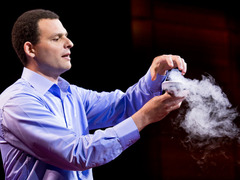
    Boaz Almog “levitates” a superconductorBoaz Almog “levitates” a superconductorBoaz Almog “levitates” a superconductor
    On stage at: TEDGlobal 2012
    Boaz Almog uses quantum locking to “levitate” a superconducting disk over a rail, without friction or energy loss. Start at 4:30 to watch a super-thin 3-inch disk levitate something 70,000 times its own weight.
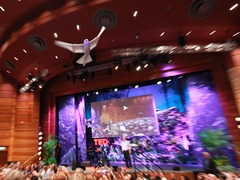
    A robot that flies like a birdA robot that flies like a birdA robot that flies like a bird
    On stage at: TEDGlobal 2011
    Markus Fischer and his team at Festo, a German tech company, developed a lightweight, incredibly lifelike robot that flies like a bird. Watch from 2:00 to 3:00 to see the SmartBird in action as it soars over the audience.
    Tan Le: A headset that reads your brainwavesTan Le: A headset that reads your brainwaves

    Tan Le: A headset that reads your brainwaves
    On stage at: TEDGlobal 2010
    A mind-boggling demo by Tan Le, in which a volunteer is able to “pull” a cube toward him on a screen, just by thinking it.
    Eric Giler demos wireless electricityEric Giler demos wireless electricity
    Eric Giler demos wireless electricity

    On stage at: TEDGlobal 2009
    Eric Giler presents wireless electricity, which uses magnetic resonators to transfer power over large distances via a magnetic field. Watch at 6:30 to see a standard TV and three different smart phones powered wirelessly.
    Michael Pritchard: How to make filthy water drinkableMichael Pritchard: How to make filthy water drinkable
    Michael Pritchard: How to make filthy water drinkable
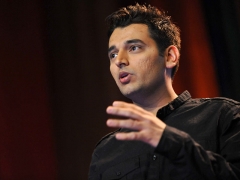
    On stage at: TEDGlobal 2009
    Michael Pritchard introduces his portable 15-nm filters, which can capture the tiniest viruses and make water drinkable. At 3:30 Pritchard takes visibly disgusting water from the Thames, Cherwell and his own pond, runoff from a sewage farm, rabbit droppings and other delights, and pours it through his filter, then drinks the water. TED Curator Chris Anderson takes a swig as well.
    Pranav Mistry: The thrilling potential of SixthSense technologyPranav Mistry: The thrilling potential of SixthSense technology
    Pranav Mistry: The thrilling potential of SixthSense technology
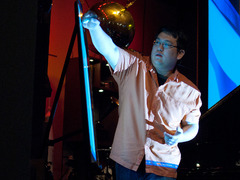
    On stage at: TEDIndia 2009
    Pranav Mistry of MIT Media Lab talks about developing SixthSense, a gesture-interface device that allows you to replicate what you do in the physical world in the digital world. Long before Microsoft Kinect, Mistry showed how he could treat any wall as a digital interface and take pictures just by gesturing with his fingers.
    Johnny Lee demos Wii Remote hacksJohnny Lee demos Wii Remote hacksJohnny Lee demos Wii Remote hacks
    On stage at: TED2008
    At 1:40 Johnny Lee shows how to turn a Wii Remote into a digital whiteboard, touchscreen and a head-mounted 3D viewer, all for $40.
    Blaise Aguera y Arcas demos PhotosynthBlaise Aguera y Arcas demos PhotosynthBlaise Aguera y Arcas demos Photosynth
    On stage at: TED2007
    Blaise Aguera y Arcas of Microsoft demoed Photosynth, a software which uses a giant database of static photos to allow you to navigate a space as if in 3D. It’s a fascinating demo — given pre-Google Street View.
    Jeff Han demos his breakthrough touchscreenJeff Han demos his breakthrough touchscreenJeff Han demos his breakthrough touchscreen
    On stage at: TED 2006
    Well before Apple popularized multitouch technology with the iPhone, Jeff Han had built his own high resolution, low cost and scalable multi-touch screen, shown here.

  • New playlists: “Ancient clues,” “Planes, trains and automobiles” and “Are we alone in the universe?”

    planes_trains_automobilesTED playlists are collections of talks around a topic, built for you in a thoughtful sequence to illuminate ideas in context. This weekend, three new playlists are available: “Ancient clues,” “Planes, trains and automobiles” and “Are we alone in the universe?”

    Ancient clues
    Five fascinating talks by archaeologists and evolutionary biologists about humanity’s beginnings and journey.

    Planes, trains and automobiles
    Drive a plane? Race a car with your eyes closed? Fly? 11 innovators in transportation show that getting from point A to point B doesn’t have to be boring.

    Are we alone in the universe?
    Can it really be possible that Earth is only life-sustaining planet in existence? These 5 speakers think there might just be something or someone else out there, and urge us not to stop the search.

  • In short: Looking for love during chemo, Kierkegaard’s love letter to a pen

    well-suleika-infertile-tmagArticle
    Here, some staff picks of smart, funny, bizarre and cool stuff on the interwebs this week, with a light Valentine’s Day theme:

    • Suleika Jaouad, who writes about being young with cancer, talks about the embarrassing but very real prospect of being a sexually active cancer patient. [The NYTimes Well Blog] For other unconventional responses to cancer, watch Ananda Shankar Jayant’s talk on fighting cancer with dance.
      .
    • Data visualizationist and programmer Olivier H. Beauchesne maps Wikipedia geotags to uncover some unexpected connections across the tome. [Collaborative Cybernetics]

    Leslie Morgan Steiner: Why domestic violence victims don't leaveLeslie Morgan Steiner: Why domestic violence victims don't leave

    • Read Leslie Morgan Steiner’s CNN article, “Why abused women stay in bad relationships,” in which she calls on lawyers to provide pro bono work to victims of domestic violence. [CNN] Make sure to watch her TED Talk on the same topic.
      .
    • An 18-minute documentary on the future of interactive design, along with eight insights. [Co.DESIGN]
      .
    • Soren Kierkegaard’s Valentine’s Day ode to his love — a pen. [The American Reader]
      .
    • On Tuesday night, TED Fellow Jon Lowenstein‘s documentary about gun violence in Chicago aired on Channel 4 News in the UK, before the U.S. State of the Union address. [Channel 4] See our annotation of Obama’s speech, in TED Talks and playlists.
      .
    • How moshing taught a physics grad student about the dynamic of human collective motion. [The Atlantic]
      .
    • Here, 34 tips from the Vimeo Video School on shooting a video promo for a nonprofit. The featured lesson was created by the film production crew, What Took You So Long?  [Vimeo] They also happen to be behind this video chat with Hans Rosling from the TEDxSummit in 2012.
      .
    • Simply sublime watercolors accompanying stories by beloved Italian author Italo Calvino. [Brain Pickings]
      .
    • Don’t feel bad if you’ve failed the famous invisible gorilla test. Eighty-four percent of radiologists, who seem to have superhuman attention spans, fail, too. [NPR]
      .
    • Is a wearable wrist computer on the horizon? Will we soon all be wearing iWatches? Perhaps so.  [NYTimes Bits blog]

    Photo: Anne Francey