Author: TobyWollin

  • Late Night: What Movies Can Tell Us About What Happened to the US Economy

    As some of you might know by now, business and community development is/are areas that Aunt Toby is very very interested in and passionate about. I grew up in a little industrial town in Upstate New York – a place that ended up in the 1970s with an advertising campaign whose tag line was “Will the last person leaving xxx, please turn out the lights.” I ‘did time’ in economic and workforce development for a gas and electric utility, but that is not what I’m all about tonight.

    I want to talk about the movies. My two favorite movies that deal with economic development and what I think they say to us today about the economy. And I’m hoping someone else out there has other movies that they think say something about the economy and why we are in the state we are in (and NO, you can’t use Wall Street, mention Gordon Gecco, or “Greed is Good.”).

    Movie Number One: “Gung Ho”, where unemployed auto worker Hunt Stevenson (played by Michael Keaton) goes to Japan to try to convince a Japanese car company to come back to their little town and re-open the plant. Hilarity and heartburn ensue when the Japanese arrive and try to establish their operating methods with the American workers. Everyone lives happily ever after when the Japanese supervisors and American workers team up to try to fool the Japanese president who comes for a visit. “I like you; you make me laugh.”

    The core of the issue in this movie is that the American workers are portrayed as not wanting to change. They want all the benefits of the operation; they also don’t want to have to do anything differently from what they have done in the past. There is no discussion about the former management of the factory. From this standpoint, the movie is a rather simplistic view of America’s industrial situation in the 1980s; however, as all generalizations, it does have a core of truth to it, which is that in order for American workers to stay employed and for American business to survive, we all have to be willing to look ahead, be flexible, be partners and change.

    Movie Number Two: “Other People’s Money”, where Larry ‘the Liquidator” Garfield puts an antiquated wire and cable company in play. The speech he makes at the annual stockholder’s meeting has been voted one of the top 100 movie speeches of all time. The factory is old, environmentally polluting, and not making money. Although the owner (played by Gregory Peck), appeals to the stockholders (many of whom are workers in the plant) to vote for the community and the jobs, they vote for the money.

    The core lesson of this film is – once you get past the little romantic interludes between Garfield and the lawyer for the wire and cable company – that the owners of the company basically did not do their job in terms of protecting the company and the employees by looking at what was happening in the wire and cable industry and coming up with new technologies to meet new demands. Again, the writers boiled down some issues but have found a kernel of truth of what happened in the 1970s and 80s to America’s industrial heart: you had companies which made the decision to invest…companies which made the decision to keep doing what they’d been doing for the past 50-100 years..and companies which made the decision that it was a better ‘deal’ for them to just allow the governments of other companies such as China or Mexico to make the investment in industrial training and development and move the operation overseas.

    When I was doing economic development, although there was a lot of drum-beating from the ED consulting companies about workforce quality and ‘clustering’ and issues such as this, in the end, no matter what companies would say, it all boiled down to one thing: The Wanna Factor.

    The Wanna Factor is what makes a company president move his company to Annapolis, Maryland so that he can be on his boat at 4:30 in the afternoon on Fridays. The Wanna Factor is what makes a company president NOT move his business out of the New York City Metro Area because his wife doesn’t want to move their kids out of their private schools and doesn’t want to give up the quality of the retail. The Wanna Factor is what makes a company president move the company because some state has made them an offer that they can’t refuse in terms of PILOT programs or free worker training or other incentives. The Wanna Factor is also the whole issue of Right to Work states. “I Wanna be THERE and I don’t Wanna be here.” It’s not rocket science or productivity or wanting to make jobs, or the workforce average educational attainment or the availability of an interstate exit in both directions.

    All it is, is Wanna.

    Any other movies?
    (photo courtesy of OldSkool)

  • Food News You Can Use

    And a very good evening to everyone; Joyous Easter to everyone who celebrates. It’s been an amazing weather week at Chez Siberia with several days in the 70s and 80s (soon to be followed by several days in the 50s, which is definitely more like it in terms of April weather for Upstate New York). (Cue the sound of teletype machines)

    To the news!!

    Certainly we all have sort of anecdotal feelings that there is a growing movement in terms of establishing farmers markets. The USDA actually has an update which shows that basically over the past 10 years, there has been an almost 300% increase in the number of operating farmers markets in the US.

    For more information about USDA programs targeted at growing farmers markets and local foods, see here at USDA’s website

    A Wellington, NZ-based design team has come up with a gardening solution for folks who live in high rise apartments, called The Plant Room. This structure ‘clips on’ to the outside walls of apartment buildings and provides basically an exposed greenhouse structure which can be used to provide growing space for apartment dwellers.

    British Charity, Growing Organic, has a new program which I think might be something we can push here, the One Pot Pledge, whereby folks who lack growing skills but who are enthusiastic about learning how (but also don’t want to get in over their heads) are matched up with experienced growers for guidance. All they have to do is grow one edible plant in one pot. There are, of course, a vast range of plants that require time to production ranges from 30 days (for something like lettuce) to several months (for things like peppers and tomatoes), but the point is that all they have to do is care for one plant. An easy start and something which I think we could use here as well.

    Venture capitalists in that West Coast den of financial iniquity, Silicon Valley, are smelling opportunities in…sustainable agriculture. There was a conference in Palo Alto, CA last week. Exciting stuff.

    For all of the flash and dash of the new US television reality show, “Jamie Oliver’s Food Revolution”, there is growing support for what he is attempting to do in putting real food in front of children at school lunch time. This week, the Royal Economics Society released a comprehensive study performed on 13,000 children, from 88 schools, comparing the results (academic test and otherwise) of children who had been on the new menu plans promoted by Oliver vs. children who had not. For children on the new menus: Academic performance went up; absences went down. Use of inhalers went down. Disruptive behaviors went down. They are still trying to figure out why the children at the very bottom did not improve as much as other students, but they did show some improvement as well.

    And from the “Sinclair Lewis Must be Gyrating in His Grave” news, an article from the Washington Post from earlier this week raised the red flag on an issue that we’ve discussed here at FDL several times: Fraudulent labeling of foods and the seeming incapacity of the FDA to do anything about it. “John Spink, an expert on food and packaging fraud at Michigan State University, estimates that 5 to 7 percent of the U.S. food supply is affected but acknowledges the number could be greater. “We know what we seized at the border, but we have no idea what we didn’t seize,” he said. The job of ensuring that food is accurately labeled largely rests with the Food and Drug Administration. But it has been overwhelmed in trying to prevent food contamination, and fraud has remained on a back burner.”

    And in microscopically local news, the photo shows the soil temperature in the bed of my garden that I’d put under old sheets of glass we had laying around from earlier this week. Needless to say, I sowed starter rows of broccoli, lettuce, kale, chard, beets, carrots, and peas to take advantage of the warmer soil and to get a jump start on my vegetable garden. To say this is early is to put it mildly – with climate change, we are now able to get things in (hardy things, but veggies nonetheless) a full 4-5 weeks earlier than we did when we first moved to Chez Siberia 25 years ago. Not a hoax, folks.

    (photo at the top, courtesy of Okinawa Soba)

  • Pull Up A Chair: Signs of Spring

    At Chez Siberia, it’s sort of difficult to put a line in the sand and say, “I know it’s spring now.” In Upstate New York, ‘Spring’ is sort of an amorphous concept: I remember in May, 1973, we had 6″ of very wet snow, which took down a lot of trees and bushes because they’d already leafed out. I also remember growing up and seeing all the kids go to church on Easter Sunday wearing their finery – and no matter how late the Easter was, they were also wearing their snow boots and winter coats (another sign of global climate change – kids get to wear their Easter outfits now with no coats up here unless it’s raining).

    However, last night, I got the message, big time. The DH and I went to visit some farmers from whom we buy meat (we usually see them at the farmer’s market but the last time we spoke with them, they mentioned that they have an appointment with the USDA processing plant and wanted to know if we wanted anything special. It’s another sign of the explosion in popularity of eating local and farmers markets that they have to make an appointment months in advance because there are not enough USDA inspectors and not enough USDA meat processing plants. When they first got started, they could call and get work done on a few days notice. No longer). This is a lovely couple who live on the top of a hill over the mountain from us and when we arrived last evening and stepped out of the car in the twilight, I turned to the DH and pronounced spring HAD arrived.

    The ’spring peepers’ were singing their hearts out. Oh, my they were just chorusing all over the place. Yes, there were lambs and piglets and new chicks all over the place, all usual signs of the beginning of things. But spring peepers are my measure. We never hear them if it is not warm enough – at this point, I have put my stick in the ground and said, “Yep, it’s spring.”

    What is the sign for you that spring has definitely arrived (and Joe Bastardi from Accuweather™ ) doesn’t count)?  Pull up a chair…

    apple blossom photo by the author

  • Late Night: Aunt Toby as Miss Marple

    For those folks so inclined, reality telly this month has had some pretty interesting offerings. Besides the usual, we had Jamie Oliver seemingly annoying the entire population of Huntington, West Virginia in “Jamie Oliver’s Food Revolution” and, (in order of appearance), Sarah Jessica Parker, Emmett Smith, Lisa Kudrow and Matthew Broderick (I wonder if he and Sarah Jessica gave Lisa a “twofer” in terms of a fee for this) wandering around the countryside, through libraries, battlefields, etc. searching for their roots (with the occasional mention of “go to Ancestry.com”), in “Who Do You Think You Are.”

    This American version of the UK show of the same title follows the format of “celebrity with no clue of family history getting whisked around and handed research materials already dug up by professional historians and genealogists in places as far afield as the Ukraine, Africa and Gold Rush era California. In 45 minutes plus commercial breaks, all the loose ends are tied up in neat little bows to the accompaniment of greatly raised eyebrows, expressions of amazement and a few tears.”

    Don’t let anyone think that I don’t appreciate the show. If nothing else, it will get thousands of people to sign onto Ancestry.com and get sucked into the world of family history courtesy of the freebie short-term membership and a couple of searches in various census records. For some folks, that will be enough. For others, however, it will hit them pretty quickly that if you had the sort of family that traveled around or came from someplace else, then this is going to cost you some money.

    So, from that aspect, the show is a little bit misleading because for most of us who are not professional historians or who are not familiar with certain types of records (who knew that the Connecticut State Archives had all the muster papers, in order, for people who had volunteered for the Civil War from that state?), doing this can take a lot of time, energy and expense money. But let me show you what I found out with my membership with the aforementioned arm of the LDS Church (sorry, but it’s true – the same can be said of FamilySearch.org as well but both are very useful).

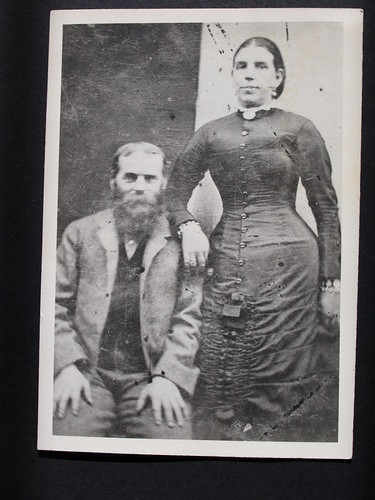
    The lady in the photograph at the top of this is my mother’s grandmother: Elizabeth Briggs Smith. All I knew about her was through my mother’s family stories and consisted of the following:
    1) She lived in Yorkshire – the whole family lived in Yorkshire;
    2) Supposedly, she was a pig farmer;
    3) She also put my mother’s mother “out to service” at the age of twelve;
    4) She supposedly buried three husbands before she died herself at the age of 55;
    5) My grandmother had a sister named Olive and supposedly a brother. Family mythology ran that this boy was really Olive’s son and because there was so much difference in age between Olive and my grandmother, she was brought up with the boy as her brother.

    Last year, the DH and I went over to England to visit relatives and take part in a little “family reunion.” Everyone was notified, invited and asked to bring whatever they had – photographs, papers, letters, etc. One of the older cousins had become the holder of “a” family Bible which he brought with him. The amount of information we were able to share around was amazing. The DH retired to a separate room and as we finished discussing particular collections, he took them, laid them out, took photos of them (which I uploaded to Flickr.com when we got back).

    What we came back with from THAT was the following for Mrs. Briggs Smith:
    1) That “family Bible” was a gift that she had bought for Olive and started to fill in. Somehow, it came back into the family. I still don’t know how that happened;
    2) The “brother” was named Byron Kingsmore in the Bible and he was born two years after my grandmother;
    3) The third husband was named “Hynchcliffe.”
    There was a lot of information about my mother’s sisters and brothers but not worth discussing for what I’m doing here.

    Since I’ve gotten home, I’ve been noodling around with Mrs. Briggs Smith Hynchcliffe (and goodness knows who else) and got back to her more recently because of several things.

    First, Ancestry.com is not a static site. You have to hand it to them; they are out there rustling up, transcribing and scanning records from all over the world. So, though there were some things on the site a year ago that were helpful, there are a lot more now from the UK. So, I see doing genealogy as being like a pot of stew on the back of the stove: Every once in a while, you pull it back up to the front, stir it around and see what comes out. Part of it is that you might have things that don’t make sense today, but six months from now with another little bit of information, all the dots get connected.

    One of the things that I wanted to find out was what was Elizabeth Briggs Smith’s maiden name, because she passed down to the rest of us some pretty nasty genetic issues, I’m always on the lookout for sickness and death information to see where that trail leads. But every census I could find (and the UK Census goes back to 1801, but they only started to collect useful information in 1841) just listed her as “Wife: Elizabeth.” Recently, I tried an end run and tried to find out what happened to ol’ Byron Kingsmore (who on the census is always referred to as Byron K. B. Smith – as you can see, poor old Mr. Briggs, long dead, was bring dragged along for posterity) and found him on a census where they asked for the maiden name of his mother, which he’d listed as “Elizabeth Earnshaw.”

    This is a name I had never heard before. Ever. So, I started working back with Elizabeth Earnshaw with a birthdate of about 1840. I found her on the 1841 Census listed this way:
    Elizabeth Earnshaw, aged 75, head of household
    Ann Earnshaw, aged 35
    John Earnshaw, aged 33 (Ag laborer)
    Henry Earnshaw, aged 30 (Coal miner)
    Elizabeth Earnshaw, aged 11 months
    Sarah Sanderson, aged 41
    John Sanderson, aged 9

    I followed all of these folks back and forth through the 1851 and 1861 Censuses. Elizabeth Earnshaw (the elder) and Ann Earnshaw disappear. I assume that the grandmother died. Ann might have married but I have not found anything yet there. In the 1861 census, I can’t find the younger Elizabeth Earnshaw. But I did find John Earnshaw and checked the Census page image, where right next door was – Elizabeth Briggs, her husband Thomas and her son Fred. Since I had already worked Elizabeth Briggs Smith back from my grandmother’s birth, I knew that in the original family, my great grandmother’s first child was named Fred.

    So what are the chances that John Earnshaw who had lived all of my great grandmother’s life in the same household with her, would live next door to her when she was a young married wife? Pretty good. At first, I made the guess that John Earnshaw was her father and that his wife had died. In a much later Census, he was listed as “unmarried.” If he’d had a wife, he would have been listed as a “widower” – so John was not her father?

    Where did Elizabeth Earnshaw come from?

    Today, by visiting FamilySearch.org (and a little bit of luck because they haven’t transcribed all the parish records), I found out. I searched for the birth/baptismal/christening record for Elizabeth Earnshaw, born 1840 in Wath Upon Dearne, Yorkshire and there she was. And there her mother was. And no father. Her mother was Ann Earnshaw.

    My great grandmother was born “out of wedlock” as they used to say. And she was brought up in this large extended household until she got married, but she did not move away. That entire family stayed right in that Wath/Rotherham/West Melton area. My grandmother was born there and started her early married life there. When my grandfather got a job down-country, they moved there, which is where two of their babies are buried, killed in the 1918 flu pandemic. That is also where my mother was born. But, after that, they moved again – and moved right back into the same district, where all the other children were born and where my mother grew up and went to school until she left to go to Scotland to go to nursing school.

    And that is a whole other story – but knowing that my great grandmother was illegitimate answers a question I always had, which was: Why was my grandfather’s family in Scotland so hot to snatch the kids away from the family and bring them up to Scotland for school? Now I understand: My grandfather’s family saw themselves as very upright, Presbyterian, educated people. And they considered the Briggs Smith etc. to be their version of trash. Their “good deed” would be to try and “save” as many as they could – and they did. They reached down and pulled up my mom’s eldest sister Jean (who ended up as the executive assistant to the president of the Scottish National Bus Company), my mother (who got placed in nursing school and became a nurse midwife before she met my father – and that’s another story), and her two sisters, who were sent to teacher’s college and made their careers that way. The war intervened for the rest.

    At the moment, I’m really sort of at a block – my great grandmother’s grandmother (the first Elizabeth Earnshaw) was, at least by the 1841 Census, born some time around 1766. If I want to get anything more there, I’m going to have to make arrangements to actually go to that area, visit, go to the records offices and the parish records. Oh, and another thing I found out: Earnshaw is to Yorkshire as the name Jones is to Wales.

    The plot thickens.

  • Late Night: Music Hath Charms

    One of the interesting things about becoming part of Greater West Blogistan, in the census district of Firedoglake, is that we get to know one another in a rather one-dimensional way. We all make assumptions about interests because after all, we’re all here.

    There are parts of our lives that we feel comfortable revealing and parts that remain undiscussed because..well, they just don’t come up. Although I think a lot of you have some basic ideas about who I am and what I do (at least in the persona of Aunt Toby at Chez Siberia), there are parts of me that I haven’t discussed a lot.

    Music is very important to me. I was one of those kids who was nailed to a piano bench at the age of five and worked my way through the exercise books until my parents allowed me to throw in the towel at the age of 13. I did the usual school choral music groups in school and college but always felt that I’d missed out because a) I really could not read music very well and b)playing piano is sort of a solitary deal. I always wanted to be in the high school band.

    In any case, for reasons I’m not going to get into here, I decided at the age of 49 to take up the fiddle (actually what I wanted to take up was Uillean bag pipes but could find neither pipes nor a teacher near us, so I did the next best thing, I took up the fiddle instead). Now anyone who has actually taken violin lessons will be looking at that photo at the top and will be saying to themselves, “She’s got tape on the neck – she’s a beginner….”

    Yep. I’m a beginner. I’ve been working at this on and off for 8 years and I’m still using the violin version of training wheels. It’s ok. I knew right from the get-go that with my hearing loss, hitting notes spot-on was going to be a challenge. I also knew that with the amount of arthritis I’ve got (which was not so bad when I started but is a whole lot worse now), the chances of my being able to play “Orange Blossom Special” at speed were non-existent. But both of those things have not stopped me from learning and playing, both with my teacher and with groups of other fiddlers.

    One of the reasons I got into this was to play with other people. I was absolutely astonished to see when my kids were in school and in the school band that none of them got together to just…play. If they didn’t have music and music stands and someone to give them the ‘and a one..” they had no clue what to do. One of my big reliefs in taking lessons is that my teacher teaches the traditional way, by playing a phrase and having the students play it back, which really played (ha) into my one talent: I actually have a pretty good musical ear. As long as my hearing aid is functioning well, then I can pick things up.

    Once I’ve played them a few times, I can remember them. I’m much faster at learning to play by ear than trying to read music. That helps me play with other people – as does having a basic group of tunes that every fiddler seems to know, no matter where they are from.

    A couple of years ago, I came across an interesting piece of research that had been done at the Eastman School of Music in Rochester, New York, using folks over the age of 60, in terms of playing music. As an experiment, they took a group of people (they had put a little story in the local paper looking for interest), some of whom had never played an instrument in their lives, tested them on the basis of many things: memory, physical flexibility, personality profiles, and so on. They then gave them the opportunity to join a group and learn to play an instrument of their choice.

    Some people came with whatever they could dig out of a family member’s closet; other people scrounged around or rented instruments. They met once a week and learned to play basic stuff (and we’re talking things at the level of “Twinkle, Twinkle, Little Star”).At the end of the year, the group was tested again and they found that on all measures, physical, medical, psychological, memory, almost every person, no matter what their age, had improved tremendously.

    In large part it was because it gave people something to do, a place to go and a feeling of accomplishment but the members of the group, which became known as New Horizons Band, started to make arrangements to go to one anothers’ homes and practice, meet up for lunches and so on. They gave a concert at the end of the season. It was a huge success. People arranged their vacations and trips to Florida around being in the Rochester area to play and practice with their friends. This group is now a huge, world-wide organization. New Horizons

    Music is great stuff. It’s uplifting, it’s fun, it gives you entre to many other activities which are fun and good for you, such as dancing. If you have ever thought, “Gee, I wish I could play xxx” or “Gee, I should take out my xxxx and dust it off” – do it. You’ll be amazed how much fun you can have.

    I’ll leave you with a couple of things – the first features my teacher, Laurie Hart, who is playing a Swedish keyed fiddle called a nykelharpa, and a Swedish folk group called Vasen. It’s a little bit different – but the world is filled with wonderful music.

    Tags: ,


  • Late Night: Send A Dog to Congress

    Last week, among the sturm und drang of the health insurance reform “thingy”, Aunt Toby had a couple of ‘light bulb moments’ with regard to the fight, Congress, and why things are so screwed up:

    First: no matter how much money we have or give to people who wrap themselves in the Progressive flag, as soon as someone (and I guess I have to call corporations ‘someone’ these days) comes along with a bigger checkbook, they’re doing something ELSE with that Progressive flag and we…are..toast. We just do not have enough money to keep these ‘streetwalkers’ loyal. They will not ‘stay’ bought.

    Second: As long as Democrats are not willing to stand their ground with regard to liars and Republicans (and y’all can figure out the permutations and combinations of those items), and perhaps even take a bite out of a few of them, we…are..toast.

    Third: It’s time to start putting some representatives into Congress who will stand their ground, chew on legislation, support the small, the weak, and the poor, raise a ruckus when necessary…and perhaps even sniff a few crotches.

    I give you, Buddy. Buddy is the injured guard dog in New Mexico who limped into a hospital ER and would not leave. I figure any creature who can figure out where to go when he’s hurt, figure out one of those auto-open doors, won’t leave until something gets done, convinces the staff to call someone who CAN help him and then gets ‘er done, deserves a shot at Congress.

    Think about it: Loyal. Knows where his next meal is coming from. Trainable. Would raise a howl when something’s wrong.

    And would ‘sit’, “speak” and “stay” (bought). I don’t know what party’s card he’s got, but he’s definitely registered and seems like someone we can work with. Anyone interested in starting a signature campaign?

    For more about Buddy:

  • U.S. High Speed Rail: Does China Get The Nod? Or U.S. Companies?

    China's high speed rail line (photo: henrie via Flickr)

    The Chinese are going to bid for the contract to build the U.S. high speed rail system. “China has built 4,000 miles (6,500 kilometers) of high-speed rail for its own train system and President Barack Obama issued a pledge in November with his Chinese counterpart, Hu Jintao, to cooperate in developing the technology.

    “We are organizing relevant companies to participate in bidding for U.S. high-speed railways,” Wang Zhiguo, a deputy railways minister, told a news conference.”

    China Wants U.S. Rail Project

    OK, we won’t discuss why the president made that statement to the Chinese (considering the amount of intellectual property that has probably been sucked up by the well-organized hacking operations in China over the past several years, I’m not sure we really have to “cooperate” in order to develop the technology since they’ve probably stolen it electronically already, but I digress), but I’d like to offer a suggestion to anyone looking for a reason to write their Congress critters…

    1) The Chinese have not awarded a non-Chinese company any contracts for any of their big infrastructure projects. Not wind energy, not high speed rail, not roads, nuthin. Remember – they have national industrial policy and it is NOT to give any other country’s companies any opportunities in China. As a matter of fact, U.S. wind energy companies who tried to participate in the bidding for that system complain that the Chinese gave contracts to companies that were created expressly for the purpose of bidding – that were brand new, had no experience or technology in wind energy to offer, but had the one thing that counted: they were Chinese.

    2) If we give the Chinese the contract for this – not only with U.S. taxpayer dollars leave the country, but we have no guarantee that anything will be built here. Shipped here, certainly but not built here.

    3) This will probably be the biggest (and perhaps the last) big rail project that the U.S. will ever see. We have companies in this country in that business, whether it’s for rail engines, rail cars, or steel.
    US Companies Want In On Rail

    Some of the companies are like GE, which builds locomotives and already is ramping up to build a new engine that can reach high rates of speed. We have rail car companies (some U.S.-owned; some like Alstom and Bombardier which are French-owned) which already are building and also ramping up. If the United States is ever going to save its industrial (and, shall we also point out, union-supported middle class jobs) infrastructure, this project is the cornerstone. The Chinese don’t need this project – they are already building rail systems in places such as Turkey. We actually do need this project and we need to support the advancement of U.S. industrial infrastructure to do it.

    So, I’m writing to Senators Schumer and Gillibrand, and my Congressman – how about you?

    Tags: , , , , , , , , , ,

  • Late Night: More FANAFI – Find a Need and Fill It

    Everyone has their favorite event or story from the recent Winter Olympics. Mine is the tale of the Norwegian Curling Team’s very colorful pants. Now, how they came to find the pants is not the topic here. The pants, however, attracted a huge amount of attention worldwide, not only for the Norwegian team (which finally lost in the end to the Canadians), but also for the sport itself. A fan from Rochester, New York started a Facebook page, The Norwegian Curling Team Pants which has 600,000 fans (including 200,000 from Norway itself).
    CNBC was running curling coverage after the close of business on Wall Street, so there the traders were, ogling the Norwegians’ red, white and blue diamond pants, while the teams were playing what has been heretofore considered a sport about as exciting as watching corn grow.

    But I digress. As many of Aunt Toby’s readers recall, I have a keen interest in small business, in entrepreneurship, in plain old ‘following your passion’. Although long after the 2010 Winter Olympics has faded from the collective memory, in the chronicles of international curling, I am sure that the growth of interest in the sport is going to be tagged to the pants worn by the Norwegian team this year. But my interest in this story actually is in the company which designed and makes these pants, which are technically golf clothing, Loudmouth Golf.

    Brown Alumni magazine

    Scott Woodworth, “a graphic designer who lives in Sonoma, California, with his wife, Cathy, and sons, Robert, 13, and Bailey, 14, turned his passion for audacious attire and brightly colored geometric designs into a men’s clothing business targeting a particular subspecies of golfer. “Loud mouth guys may be a little obnoxious,” he says, “but deep down they are good guys. You put those pants on, you are going out to tell jokes and have fun.”

    “..After he moved to California, he noticed that golfers there dressed in muted tones. That would have to change. So in 2000 he went to the fabric store, bought a bolt of powder-blue stuff that depicted Bugs Bunny and Daffy Duck riding in golf carts, and had a local seamstress make him a pair of pants to wear at a charity golf tourney. “They were horrible looking pants,” he says, “and I loved them. Guys kept asking me all day where I got them.”

    He found a clothing manufacturer and ordered seventy-two pairs for his newly formed company, Loudmouth Golf. Six weeks after placing a classified ad in Golf Digest, he’d sold half his inventory. He doubled the next order, and before long he’d drafted his children into helping him pack merchandise from his garage. It was good-bye graphic design and hello clothing business.”

    The international interest in the pants crashed Woodward’s server and he is scrambling to restock this particular model, with delivery scheduled for April.

    For people who dream of having their own business and who feel that all the ‘needs’ that need to be filled are gone, I’d like to mention that crazy pants for golfers are not necessarily something that screams ‘a need needing to be filled’. What Woodward did, by wearing crazy pants to the tournament and getting comments was actually an unconscious form of focus group testing – on the fly, certainly, but testing nonetheless. Woodward’s advantage was that he also realized that there was a market there (the need) that no one else was doing anything about and that he could fulfill (filling it).

    A lot of people would like to start a business, but many times they allow their fears of risk or lack of knowledge to stop them. Woodward was a graphic designer – it is not as if he grew up in the garment business (as Isaac Mizrahi did – Mizrahi’s father owned a dress design and manufacturing business). The difference is that Woodward got on the phone, called around, asked questions, found more people who could answer more questions, found more people who could help him, direct him, show him resources for fabric, sewing, manufacturing and so on. And that’s how he started and has grown his business.

    Now, you can be sure that there are people already out there, already in the sports clothing business, who are riffing changes on the Norwegian Curling Team’s pants. Maybe they called up some curlers and asked them if they liked the pants or perhaps what they wanted in pants to curl in? Maybe they are producing them in water repellant fabrics for skiers or snow boarders. Maybe they are producing them with bibs. Or matching jackets. Or matching shirts. Or with zippers down the legs. Or glow in the dark? Maybe someone has decided that the whole curling pants thing is a fluke – in Canada, the big deal in curling clothing from what I have heard is colorful sweaters. Maybe someone is going to try to reproduce the diamond motif in a heavyweight sweater. A heavyweight sweater with a zip in the front.

    Gad. The opportunities are endless.

    Tags: , , , ,

  • Late Night: If John Belushi Were Negotiating Health Care Reform

    There is that whole Zen thing about cutting through obstacles, right?

  • Pull Up a Chair: Good News All Around

    Once upon a time (because all good stories start that way), Aunt Toby “peddled flesh” for a regional staffing service (and no, we are NOT going to discuss the merits and ethics of this right now). This was during a period when the place where I lived (and still live) had gone through what anyone would consider a ‘rough patch’. The major (and highest paying) employer in the area had gone from 20,000 jobs to a couple of thousand. Other employers had downsized as well. The local newspaper was full of these stories day after day after day. There was (and still is, but that is another discussion for another time) a lot of desperation, people pulling up stakes and leaving, families breaking up, long-distance commuting and so on.

    But something that I learned while I was tramping through every office, small manufacturer, service business, and machine shop within my 3-county coverage area was this: While everything (at least if you read the papers) seemed to be falling apart around us, there were good news stories around. They were all much smaller businesses, but they wanted to grow and they needed people to take them there. But their stories never made it to the business page in our paper because the editors were too focused on what they considered our version of Towering Inferno. Some of those businesses I served back then are still in our area, in one case having spun off two other businesses. And now his businesses get a lot of copy. The other thing I learned back then is this: Whever you live right now is not the same place it was 50 years ago, or 20 years ago or 5 years ago and it will be completely different 5 years from now. It’s all a question of embracing the good news.

    In my area’s case, here are some good news stories that show how much this area has changed in the past 5 years, long after ‘the big money’ left the area and supposedly we were left on the ’scrap heap of history’:

    – First Friday. A small gift/picture/framing shop pulled together all the other little shop owners and services on her block and advertised that they would all stay open in the evening of the First Friday of every month. Rain or shine, snow, sleet, you name it. Then local artists got involved because the shop owners offered to let them put up their works on First Friday. Then an artist from New York City who wanted to find cheap studio space bought a small building nearby and put in a gallery, which attracted other artists. The City agreed during the summer months to shut off a six block area to traffic, allow live music, sales of food and beverages on the street, and encourage people to dance. In the street. Now, I admit that during December and January, the crowds are a little bit smaller, but the rest of the year, especially in the summer, this is huge. Everyone comes downtown on First Friday — and oh, yes, now there is First Saturday as well.

    – Farmers Market in the Park. There were other farmers markets in our area, but each one had issues with space, parking, etc. This market got started in a county park just off the interstate 3 years ago with 5 brave vendors. They now have 25, selling everything from fresh fish, meats, chicken/turkey and eggs, plants and flowers, baked goods, crafts, fruits and veggies. They hold demonstrations almost every week and events with local organizations. Some of these vendors do other farmers markets in the area during the week; all of them are new to farmers marketing through joining this market because they were closed out of the other ones due to space. In other words, there are 25 new entrepreneurs in the county because of this market.

    – Training courses for solar technicians and installers at the local community college. We have had for probably 15 years, a solar company locally, which basically limped along on a small crew of people who had to travel sometimes very far to do installs because they were primarily doing large jobs like schools and libraries which could get grants. They are so busy now that they have to run classes at the local community college to ‘grow their own’ in terms of trained crews so that they can keep up.

    – Sustainability Coalition. This group fights for: government energy saving, weatherization, job development, neighborhood development, beautification, and a healthy environment for everyone in the county. This group fights against: drilling in the Marcellus Shale. They have their own radio show sponsored at the local university radio station, a Facebook group, and lots and lots of meetings. Twenty years ago, this could not have gotten anywhere.

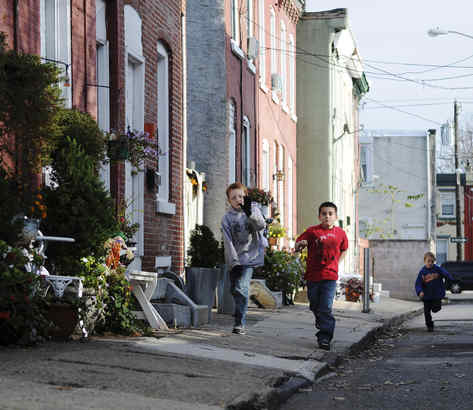
    So, what’s YOUR good news? I know it seems right now as if there is no good news, but I know if you think about what is happening at the local level, you will be able to think of good news stories to share. And oh, by the way, that photograph at the top? That’s a good news story too, about a neighborhood in Philadelphia which went from what would be considered a war zone to winning the prize for ‘most beautiful’, through the application of elbow grease, some left over paint, and plants. The most beautiful ‘lost block’ in Philly

    Like I said…good news stories all around.

  • Late Night: I Won’t Worry About That — Until the Next Time

    When I wrote and filmed about cooking on a grill under emergency conditions yesterday, one of the commenters chided me that everyone might not be in a position to do this. The grill might not be available, under mounds of snow. The family might have been caught short in terms of fuel or groceries and might not be able to get to stores, as was the case in the Mid-Atlantic last week under two back-to-back snow storms, one with blizzard conditions.

    OK – I admit that everyone does not think the way we do here at Chez Siberia. Part of what colors our environment is that I grew up in Upstate New York, with snow storms that dumped feet of snow at a time. My sister and I were also sent to walk to our little store through those conditions to try to get the standard ‘snow storm rations’ (milk, bread and eggs – why IS that?). It was only a three block walk, but my memory was that it was freezing cold and the wind was blowing and we could hardly see. So, at my house, always, there is a supply of stuff so that no matter what happens, we have food to eat and a way to keep warm. We tend to be very ‘belt and suspenders’ here and think about things pretty much all year round.

    The major ingredient of what you might consider emergency rations would be canned goods, with the emphasis on protein. Even if you don’t have power at all, as long as you have canned goods and a hand-operated can opener, you can eat. As long as the cans are not rusty or bulging (or the jars don’t have bulging lids), this food has been thoroughly cooked and is safe and nutritious to eat.

    Canned goods on this part of the list would be:
    Beans: Any canned beans will work, though the liquid in kidneys, garbanzos, and black beans would probably need to be rinsed off or at least drained out.
    Fish: Canned tuna, salmon, or sardines
    Soup, Stew and Chili
    I am not a big fan of canned meats such as Treat, Spam, or Hash, but those are edible as well.

    Other items on the list would be dried milk (take it out of the box and store in sealed glass jars – this will keep it dry), instant coffee, and cocoa (again, take these out of any box they come in and put the packets or powder into sealed glass jars. You can seal such items as nuts and seeds into glass jars as well – but those will not keep. We keep ours in the freezer. If we had an emergency and lost the power, I’d take out the containers and keep them in a cool place; they would stay good to eat for a long time and are high in protein and fat. If you want to set this sort of thing aside in a special pantry or box, that is fine but most of these are on the shelf staples and you can keep an eye on them all year round.

    One of the things that hit me in the coverage about the DC area was the Kidney Foundation sending up the red flag to find drivers with 4-wheel drive to take dialysis patients to their appointments. Medical emergencies and just day to day stuff should be part of your planning in terms of an ‘emergency box’. For example – what happened to people who needed medications during this period? No one and nothing was moving. It was not as if they could call up the local CVS and get deliveries. So, make sure that along with everything else you have in the house, that if the weather folks are warning about possible emergency weather conditions several days out, take a look at your meds. Also, look at basic first aid items such as disinfectants, antibiotic ointment, bandages, and adhesive tape. This is something you probably should be doing once or twice a year in any case, but when the weather folks predict emergency weather several days out, check on the rations box and the first aid kit and do refills.

    If you want to make an emergency rations box, find a good strong cardboard or wood box and put the food in it in a dry place off the floor. And put a hand-operated can opener in there, too. No use having the food and then getting into a situation where you have to open cans with your rusty old screwdriver. Check this box once or twice a year. Anything that looks off or has a bulge in the can or lid should be thrown away and replaced.

    If you are going to try to do the ‘cook on the grill’ emergency thing, make sure a) the grill is someplace where you can get to it and b) it is somewhat protected. If you keep yours on the deck with a cover, you will want to keep a path to it clean and keep the snow off it in the winter. If it’s gas, make sure of how much fuel you have. A full propane tank can cook many meals. If it’s charcoal, make sure that you have an extra bag or two in the garage in a dry place. Also, while you are at it, get a box of heavy duty aluminum foil; you can fashion all sorts of cooking pans out of that if you have to. You don’t want to use the fancy copper bottom pans for this.

    A small summary about cooking on the grill: Anything you can cook on a stove or in an oven, you can cook on a grill, particularly if it is the sort with a lid. If you don’t want to cook, open up the cans and eat those. A can of beans will feed two. A can of tuna will feed two.

    Light: another item for the emergency box would be candles, matches, something to put the candles IN (old glass tumblers, etc.) when they are lit, some sort of battery based or hand-cranked lanterns. A hand-crank radio. If you have a fireplace and intend to try to keep warm in that way, you will need to make sure you have dry fuel for it (don’t store this in the house – you don’t want to invite termites or carpenter ants – keep this outdoors, away from the house, under cover). You will also want to make sure once a year that the chimney is inspected and that the damper is operational (the last thing you want to find out when you start the fire is that the chimney has birds’ nests in it or that it’s full of creosote and that you start a chimney fire).

    Another thing to think about, no matter where you live, is that all of our climate assumptions have been thrown into a cocked hat. Alabama has had snow several times this winter, for example. Crazy stuff. I’m not saying that everyone everywhere needs a snow blower, but having a couple of good shovels in the garage would not be amiss. Another thing is that the days of people in certain parts of the country being able to ignore temperature issues is over as well – the heating bills coming due in many areas of the South are mind-blowing. Residents in these areas count on being able to balance off their summer AC bills with low or no heating bills in the winter. No more. So, items such as insulation, caulk, and plain old ‘shrink plastic over the windows’ are vital for them too. I predict that there will be people in areas where home canning has not been done for 40 years are going to be heading out to the stores looking for Ball jars this summer to start putting food away.

    Is Alabama going to be the next Watertown? Nope. But a bit of preparation will prevent a lot of discomfort and problems later on, the next time this happens. And oh, yeah..there’s more snow predicted tonight.

    What’s on your shelves?


  • Pull Up a Chair: Child’s Play

    2975966344_35610113bfPull Up a Chair

    I once did a stint as a substitute teacher for a second grade class. My career ended at 9:45 a.m. when a fight broke out in the back of the room when the kids lined up to visit the bathroom before recess. I ended up having to pass the class onto the teacher next door (who was also taking her kids out for recess) while I deposited the victim with the black eye with the school nurse and tried to deposit the perp with the principal. Long story. In any case, I am substituting today and with the weather what it has been all the damn winter long (I’m trademarking ‘The Winter That Never Ended” tm), I think it might be nice to talk about worst case scenarios (scenaria?) and being prepared.

    Imagine this: You either have smallish children of your own, are babysitting, have taken the grandkids for the weekend or whatever. Then really bad weather hits – too cold to go outside (like this weekend in the Northeast – we are facing single digit and minus numbers with wind chill factors), and we’ll add the fillip of perhaps a soupcon of the loss of cable tv and the internet. (but not the electric power – I’m not going to go that far today – there is still heat in the house)

    What to do? What to do?

    Kids today are accustomed to entertaining themselves through watching stuff: dvds, videos, things over the internet. If you are lucky, they are old enough to be readers, though they might not have brought books with them. Depending on age, their days of dress-up play are over.

    And they are bored. Now.

    Quick, list 5 things in your house that you can use to occupy, fascinate and keep any child (choose your age range) safe, reasonably contented, and dare we say it – happy for 24 hours. And no fair using the go to of ‘well, we still have power so they can watch dvds and videos.’

    On your mark…get set…….GO!

    My list, in no special order of preference:

    1) Large Cardboard boxes, big markers of various colors, other coloring items, old magazines, scraps of fabric, stapler, duct tape, scissors with round edges, craft cutters (but I would only operate it on their direction – no youngster’s hands), old egg cartons, leather scraps, various sorts of glue, glue sticks etc.
    2) Small bits of scrap lumber like wood trim
    3) Flour, salt, etc. to make kitchen clay
    4) Books of totally silly poetry to read out loud. Also lots of school filler paper, pens and pencils to write with.
    5) A large box containing really ancient clothing from my mom and dad, shoes, junk jewelry, purses, and hats.

    What’s yours?

    photo courtesy of Scariepants