Author: Trevor Seela

  • Oil Spill in Gulf Could Wash Ashore by Friday, Officials

    The oil spill resulting from an oil rig explosion last week could be leaking oil at five times the rate previously assumed.

    The leaking BP PLC-owned rig may be spilling into the Gulf of Mexico five times faster than previously thought, the BBC reports.

    On Wednesday crews working on cleanup and damage control conducted controlled burns of the spill, said a Coast Guard spokesman, according to the New York Times. The leaks were discovered late last week after an oil rig exploded days earlier about 50 miles southeast of Venice, Louisiana.

    While it was thought that the damaged rig was leaking about 42,000 gallons of oil per day, the National Oceanic and Atmospheric Administration weather predicts the oil is spreading faster and might reach the U.S. coast by Friday night. The spill is now leaking at a record rate of 210,000 gallons per day and might.

    “Probably the only thing comparable to this is the Kuwait,” Mike Miller, head of Canadian oil well fire-fighting company Safety Boss, told the BBC. “The Exxon Valdez is going to pale in comparison to this as it goes on.” In 1989, the Exxon Valdez oil spill released approximately 11 million gallons into Alaska’s Prince William Sound.

    “If some of the weather conditions continue, the Delta area is at risk,” said Charlie Henry, scientific support coordinator for the National Oceanic and Atmospheric Administration, according to the New York Times.

    And as experts speculate what will happen, the oil slick is moving towards three million acres of Louisiana wetlands and the Mississippi Delta. Louisiana is home to about 40 percent of the United States’ wetlands, and exposure to the contamination could devastate wildlife populations in the area.

    Because BP was leasing the rig when it exploded, the U.S. government has said the corporation is responsible for costs of cleaning up the spill. Currently the company, which is the third largest global energy business, is spending $6 million per day to control the spill and looking at ways to stop the leak, including eventually sealing off the well.

    Meanwhile BP has received permission to drill a relief well in which concrete and heavy fluids could be injected to seal off the leaking well, but this process may take up to 90 days to complete.

    Sources: The New York Times and BBC
  • UK Reliance on Imported Water Leaves Country Vulnerable, Study

    Britain’s large virtual water footprint–their reliance on imported water–could become problematic, and potentially cause many parts of the country to not meet domestic water demand, a study says.

    Water Virtual ImportsMuch of the imported water that contributes to Britain’s and other UK Countries’ large virtual water footprint comes from water-stressed countries, according to a report released Saturday by the Royal Academy of Engineering. The study shows that this dependency could compromise national security issues in the region.

    Only one-third of Britain’s water usage is domestic, while the other two-thirds comes from imported goods such as agriculture and energy.

    This reliance could result in a domino effect of problems for the country if a severe water shortage happens.

    “If the water crisis becomes critical it will pose a serious threat to the UK’s future development because of the impact it would have on our access to vital resources. Food prices would sky-rocket and economic growth would suffer,” said Peter Guthrie, a professor of engineering for sustainable development at Cambridge University and chairman of the study group told the Guardian.

    Guthrie argues that while importing so much virtual water into the country is problematic for issues of self-sustainability, and is also detrimental to the countries exporting the precious resource.

    “We should ask whether it is right to import green beans – or even roses – from a water-stressed region like Kenya, for example. The burgeoning demand from developed countries is putting severe pressure on areas that are already short of water. Our virtual water footprint is critical and we need to give it far more attention,” Guthrie said, according to The Royal Academy of Engineering’s press release.

    Last month, Britain’s chief scientific advisor, John Beddington, made similar predictions about the increasing need for food, energy and water. Beddington said that by 2030 the world will consume 30 percent more freshwater than current levels.

    “If we don’t address this, we can expect major destabilization, an increase in rioting and potentially significant problems with international migration, as people move out to avoid food and water shortages,” he said.

    However, there is no single way to secure freshwater reserves for the future because it’s a complex issue that crosses geographical boundaries and crosses other crucial areas, such as energy and food supplies, he added.

    “To avoid the perfect storm requires a global response, with global policies and governance—backed up by forward-thinking action at a national level to meet individual countries’ requirements.”

    Sources: The Royal Academy of Engineering, Guardian.

  • Watering a Lawn Could Lead to Water Pollution, EPA

    Storm runoff can result in a variety of problems, and its causes are just as numerous.

    Without first traveling through a natural filtration system, like a wetland, or artificial filtration system, pollutants end up in waterways and damage ecosystems and water quality, according to the EPA. Cars, lawns, pets and other parts of everyday life lead to a major source of pollution for waterways, while impermeable surfaces like streets, buildings and sidewalks lead to increased runoff into storm sewers.

    When it rains, or as snow melts the resulting water, known as storm runoff, carries excess litter, soil, fertilizer and other particulates to the nearest storm sewer, which then runs into nearby waterways.

    “How would you feel if you knew that you and your neighbors are the biggest source of water pollution in the U.S.?” Seattle Times columnist Terri Bennett writes in her article “You and storm water: A major source of pollution.”

    Inspired by Bennett’s article, here’s a look at how you may cause water pollution and how you can fix it:

    Effects of runoff pollution

    • Sediment can cloud water and slow or stop plant growth.

    • Excess nutrient runoff from fertilizers can cause algae blooms. When the algae die, they sink to the bottom and breakdown in a way that removes oxygen from the water, hampering other aquatic organisms’ abilities to survive in the water

    • Debris, such as plastic bags, bottles and cigarette butts can enter water bodies and can suffocate aquatic animals.

    • Chemicals and other hazardous wastes, like paint, pesticides and automotive fluids, end up in water and can damage water habitats.

    • Bacteria and other pathogens that wash into swimming areas can cause serious health hazards and may result in beach or swimming area closures

    • Both people and animals alike may become sick from consuming diseased fish.

    • Contaminated runoff also results in larger expenditures to clean the water for consumer use.

    Ways to help prevent hazardous runoff

    • Use a commercial car wash that treats or recycles its water. If you wash it in your yard, the water permeates into the ground.

    • Repair leaks in your car and dispose all auto fluids at designated drop-off or recycling locations.

    • Consider using a hose instead of a sprinkler to water your lawn as to not overwater it.

    • Use as little pesticide and fertilizer as possible. Use organic or safer pest control methods when possible.

    • Compost yard waste.

    • If building a house, consider permeable pavement. This type of pavement allows water to seep through it instead of running off.

    • Clean up after your pets. The most effective way is to pick up any droppings and flush them.

    • Plant filter strips of native plants around the edges of yards, streams and waterways. These plants can help filter out pollutants from runoff before they reach a water source.
  • International Cooperation Needed to Save Aral Sea, UN Secretary-General

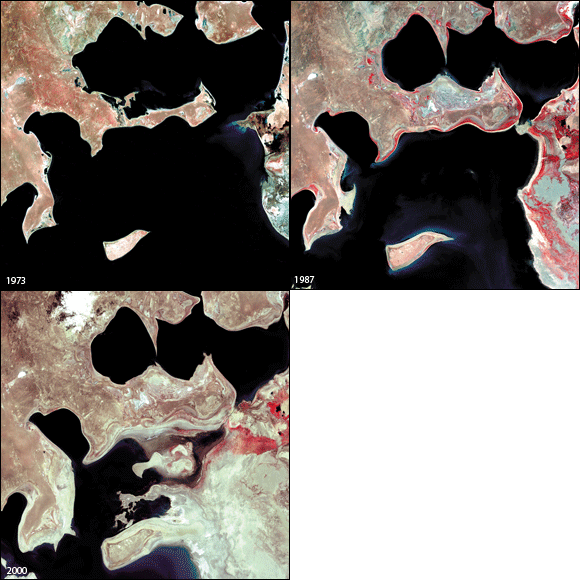
    U.N. Secretary-General Ban Ki-moon visits During a visit to five former Soviet republics, U.N. Secretary-General Ban Ki-Moon encouraged Central Asian leaders to work together to keep the Aral Sea from disappearing.

    Aral SeaU.N. Secretary-General Ban Ki-moon has called the diminishing Aral Sea “one of the worst environmental disasters in the world” and asked regional leaders to come together to solve the crisis during a visit to Central Asia, Reuters reports. Once the fourth largest lake in the world, the sea has been shrinking for the past 50 years.

    Ban flew over the basin in a helicopter to witness the arid salt flats left by the disappearing sea.

    The sea began decreasing in size since the 1960’s, when Soviet planners began siphoning off water to increase irrigation for cotton production in Uzbekistan. Since then, the sea has decreased in size by about 70 percent with the remaining water has become more saline, consequently damaging the area’s fishing industry.

    “It was a vivid testament to what happens when we waste our common natural resources, when we neglect our environment, when we mismanage our environment,” Ban said, according to United Press International.

    The evaporation process has left layers of salty sand in the area, which has plagued residents with health problems reports The Huffington Post. The salty dust can be carried as far away as Japan and Scandinavia by the wind.

    Ban was on a visit to the five former Soviet Republics that surround the Aral Sea, to discuss regional cooperation regarding climate change, development and nuclear non-proliferation. Many of these countries sit on some of the world’s largest untapped oil, gas, uranium and gold reserves.

    “I urge all the leaders [of Central Asia] including President Karimov of Uzbekistan to sit down together and try to find solutions,” Ban said.

    However, resource tension in the water-scarce region cooperation may stand in the way. Before Ban’s visit, Uzbekistan officials made a presentation to the Secretary-General regarding the negative effect dam projects in Tajikistan may have on their country.

    While in the Uzbek town of Moynak, a once coastal city of the Aral Sea now surrounded by sand, Ban was met by a group of about 20 townspeople who spoke about the problems the Rogun hydroelectric power plant project in Tajikistan could cause in the area, Reuters reports.

    “If Rogun is constructed, we will be in a much more difficult situation,” local teacher Zhanabay Zhusipov told Ban.

    Tajikistan wants to build the hydroelectric power plant to help solve the country’s chronic lack of power. The project could nearly double the electrical output in the impoverished country and could be a key source of revenue, reports The Huffington Post.

    Sources: Reuters, The Huffington Post, and United Press International .