Author: Victor Mair

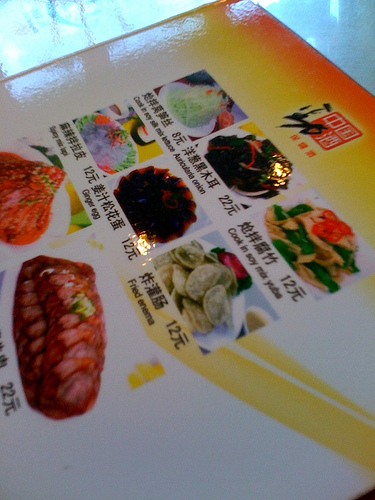
  • Fried enema

    Drew Mackie has posted an item about this not very appetizing-sounding Chinese dish on his personal blog.  He writes:  “A bit of searching has led me only to find out that this food is not, in fact, enema content that is fried, but I don’t know exactly what it is or how it might have gotten its name.”


    Here’s the unsavory-sounding dish in the context of the original menu:

    Drew asked for help from Language Log.   Luckily this puzzle is particularly easy to solve.

    The Chinese name of the dish in question is zhá guànchang 炸灌腸, which is a kind of sausage made of wheat flour stuffed into hog casings and fried.  The last two characters, pronounced guàncháng,  also have a completely different meaning, viz., “enema” or “give an enema” (literally, “to irrigate the intestine”).

    This is a good example of the spoken language being clearer than the written language — at least when one is relying on not-very-good machine translation.

    Google Translate renders 炸灌腸 correctly as “fried sausage”.  Unfortunately, restaurants in China can no longer use that method to improve the lexicographical appeal of their English-language menus.

  • Sinitic and Tibetic

    In a discussion we were having about the Tibetan evidential particle yin, Nathan Hill sent me an article by Nicholas Tournadre entitled “Arguments against the Concept of ‘Conjunct’ / ‘Disjunct’ in Tibetan” from Chomolangma, Demawend und Kasbek, Festschrift für Roland Bielmeier (2008), 281-308.  As I started reading through the article with the hope of finding how yin functions as a sort of equational verb or copula, I was caught up short by some preliminary remarks about the classification of Tibetan that Tournadre makes at the beginning of his paper.

    Based on his 20 years of field work throughout the Tibetan language area and on the existing literature, Tournadre estimates that there are 220 “Tibetan dialects” derived from Old Tibetan and currently distributed across five countries:  China, India, Bhutan, Nepal, and Pakistan.  In a forthcoming work, Tournadre states that these “dialects” may be classed within 25 “dialect groups,” i.e., groups that do not permit mutual intelligibility.  According to Tournadre, the notion of “dialect group” is equivalent to the notion of “language,” but does not entail standardization.  Consequently, says Tournadre, if the concept of standardization is set aside, it would be more appropriate to speak of 25 languages derived from Old Tibetan rather than 25 “dialect groups.”


    Tournadre maintains that this is “not only a terminological issue but it gives an entirely different perception of the range of variation.  When we refer to 25 languages, we make clear that we are dealing with a family comparable in size to the Romance family which has 19 groups of dialects.”  (These Romance “groups” are named in footnote 2:  Portuguese, Spanish, Asturian-Leonese, Aragonese, Catalan, Gascon, Provençal, Gallo-wallon, French, Nones-Cadorino, Friulian, Venetan, Lombardo, Corsican, Italian, Napolitan-Sicilian, Sardinian, Aromanian, and Daco-Romance.)  I would prefer to call Romance a “branch,” reserving “family” for Indo-European.  The main thing to keep in mind, though, is that, when we refer to 25 “languages,” we make clear that we are dealing with a collective entity (“branch” in my terminology) that is comparable in size to Romance which has 19 “groups.”

    To quote Tournadre directly, “This perspective is quite different from dealing with several dialects of a single language.  So I propose to adapt the terminology to reflect the linguistic diversity of the area and speak of Tibetic languages (or groups of dialects) derived from Old Tibetan.”

    Tournadre goes on to list the twelve major Tibetic languages and the thirteen minor Tibetic languages.  Some of the latter consist of only a single dialect and between a few hundred and a few thousand speakers.

    These views are by no means idiosyncratic with Tournadre, but reflect the thinking of a major research team headed by Roland Bielmeier at the University of Bern that works on Tibetan dialects.  The position of the dozen or so scholars who have been working at The Tibetan Dialects Project of the Institute of Linguistics at Bern is that “Tibetic is a very useful term to designate a very precise group of languages all directly derived from Old Tibetan.”

    I believe that it is time for Sinologists to take a cue from the Tibetologists.  Out of a total population of more than 1.3 billion in the People’s Republic of China, there are supposedly almost 1.2 billion speakers of “Chinese.”  This is held to be a single “language,” not a “family,” “branch,” or “group” of languages, but a monumental, monolithic LANGUAGE consisting of multitudinous “dialects.”  Since many of these so-called “dialects” are mutually unintelligible, language taxonomists fudge a bit by calling some of them “major dialects,” “sub-dialects,” and so forth.  However, several of the “major dialects” — all of which are mutually unintelligible — have upwards of 20 million speakers:  Mandarin (c. 850 million), Wu (nearly 100 million), Cantonese or Yue (around 90 million), Min (over 50 million), Xiang and Hakka (approximately 35 million each), Gan (roughly 20 million), and Jin ([a disputed subdivision of Mandarin] about 45 million).  Moreover, many of these huge “major dialects” comprise scores of “dialects” that have a very low degree of mutual intelligibility (or none at all) and a highly complex set of internal relationships.  For example, Min is divided into Eastern Min, Southern Min, Central Min, and so forth, and these branches are further subdivided into varieties that are quite different among themselves.  For instance, Southern Min is made up of Quanzhou, Zhangzhou, Amoy (Xiamen), Teochew (Chaozhou), Leizhou, and Hainanese, all of which are significantly dissimilar.

    Whether or not Sinitic and Tibetic are genetically related, how can it be that there is only a single Sinitic “language” with 1.2 billion speakers of innumerable “dialects,” while Tibetic — with somewhere around two million speakers worldwide — is divided into 25 “languages”?

    All the usual arguments in favor of Sinitic or “Chinese” being a single language (common culture, common script, common history, common ethnicity, common polity, and so forth) do not hold water.  For instance, Chinese characters have been used to write Japanese, Korean, and Vietnamese, but that certainly does not make Japanese, Korean, and Vietnamese Sinitic languages.  Conversely, there are Sinitic languages written in other scripts (e.g., Dungan, which is written in Cyrillic), yet they are Sinitic nonetheless.  Comparable arguments may be brought forward against all of the other “common” features that are frequently adduced in favor of there being only a single “Chinese” language consisting of a myriad “dialects.”  In any event, when making a case against the indivisibility of Sinitic, it is not necessary to rebut each of these “common” features individually, since they are largely or wholly extralinguistic.

    If we were to apply the same principles of classification to Sinitic that have been applied to Indo-European, Semitic, Austronesian, Austroasiatic, and so forth, we would soon enough find that — like them — Sinitic is a family of languages that may be organized into branches and groups.  Adopting such an approach to Sinitic would help not only to illuminate many problems in the historical development of Sinitic itself, but would contribute to enhanced comparison with other language families.

  • Suicided: the Adversative Passive as a Form of Active Resistance

    Language is changing at a torrid pace in China, and it’s not just a massive infusion of English words that is to blame.  Nor can we simply ascribe the dramatic changes in language usage to rampant, wild punning for the purpose of confusing the ubiquitous censors.

    Creative manipulation of lexical and grammatical constructions is another way to express ideas that are not permitted under the harsh social controls imposed by the government.  This is evident from the fact that the “character of the year” in China for 2009 is bèi 被.

    What is so great and powerful about this unprepossessing character bèi 被?  As a noun bèi can mean “quilt” or “cover.”  As a jiècí 介詞 (“preposition”), bèi is used in a passive sentence to introduce the doer of the action:  tā bèi quántǐ dǎngyuán píngxǔan wéi zhǔxí 他被全體黨員評選為主席 (“He was elected by all of the party members as chairman.”)  Before verbs, bèi is used to indicate passive voice:  bèi yāpò 被壓迫 (“be oppressed”).

    Lately, it has become fashionable to use the passive voice with verbs that don’t normally allow it and in situations that seem ludicrous.  One of the most celebrated examples is bèi zìshā 被自殺 (“be suicided”), with the implication that someone was beaten to death, but the authorities made it look as though he had committed suicide.  Once coined, bèi zìshā spread like wildfire, so that it wasn’t long before it merited its own entry in online dictionaries and encyclopedias.

    This novel application of the adversative passive is quite versatile.  Here are some other common, but telling, examples (English translations only):

    1. employmented:  turned into a false employment statistic

    2. represented:  misrepresented without consent

    3. invited to tea:  questioned by police, usually on political matters

    4. high-speed railroaded:  forced to buy expensive high-speed rail tickets because ordinary train tickets are not available

    5. harmonized:  censored (this must be particularly galling to the party elders, since héxié 和諧 [“harmoniousness”], with all of its clarion Confucian resonances, is President-Chairman-General Secretary Hu Jintao’s pet platitude)

    6. volunteered:  forced to volunteer

    Some specific examples of the application of these clever usages may be found here and here.

    The adversative passive is a prominent areal feature of Southeast Asian languages, but I wonder whether it has been used anywhere else in the world in such a systematic manner to express resistance against government policies as it has come to be in present-day China.

    In closing, it is worth noting that the English word of the year for 2009 is “unfriend.”  Like the ironic adversative passive in Chinese, it was generated by powerful Internet forces, just as were the other runners-up for English word of the year:  “netbook” and “sexting.”

    Unfortunately, Chinese netizens cannot experience the thrill of “unfriending” someone, since Facebook and other similar social networking services are blocked in the PRC.  Still, with Google moving to a freer Hong Kong, and with the abundant linguistic capabilities of Chinese netizens themselves, we can be sure that there will be new ways to circumvent the Great Chinese Firewall, which, after all, is only a paper tiger.

    A tip of the hat to Richard Cook.

  • Chinese Endangered by English?

    In an article by Malcolm Moore entitled “Chinese language ‘damaged by invasion of English words‘” published this morning in the Telegraph, a Chinese official expresses grave concern at the invasion of English words in his nation’s language.

    Huang Youyi, chairman of the International Federation of Translators, makes this alarming prediction: “If we do not pay attention and we do not take measures to stop Chinese mingling with English, Chinese will no longer be a pure language in a couple of years.” He goes on to state, “In the long run, Chinese will lose its role as an independent language for communicating information and expressing human feelings.”

    To ensure that such a horrible fate does not become a reality, Mr. Huang brought forward stern recommendations before the Chinese People’s Political Consultative Conference that was held recently in Beijing. Mr. Huang’s proposals would ban publications from using English names, places, people, and companies. Aside from the fact that this would put a large crimp in the global aspirations and operations of China Inc., embarking on the long, slippery slope of language purification — if carried out as energetically and thoroughly as the typical politco-cultural movements of the past 60 years — the Chinese language, quite the opposite of being purified, would end up being seriously impoverished. No longer would the Chinese be permitted to speak of “lion” dances, “honey” and “honeymoons,” “coral,” “magi / shamans,” “sachima,” “biology,” “religion,” “philosophy,” “economics,” and “republics” (such as their own people’s republic!), “military affairs,” “journalists,” “factories,” “workshops,” “science,” “physics,” “literature,” “utopias,” “centuries,” “X-rays,””laser,” “computers,” and countless other terms that form the backbone of everyday discourse.

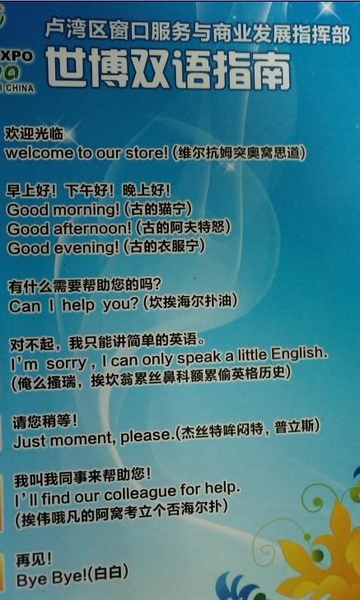
    Perhaps what really worries Mr. Huang is when foreign words are represented in a foreign script. But there’s an easy way around that: simply transcribe the offending terms in Chinese script. Here’s a good example of how that could be done:

    The first line reads:

    欢迎光临
    huānyīng guānglín

    维尔抗姆突奥窝思道
    wéiěrkàngmǔtūàowōsīdào

    “welcome to our store!”

    Incidentally, I know Mr. Huang personally. He prides himself on his English and was, in fact, an English major when he went to university. Mr. Huang was my brother Denis’ boss at Foreign Language Press back in the 80s. His entire professional career has been intimately involved with the study, teaching, and translation of English and other foreign languages.  Since Mr. Huang has been enormously effective in his chosen profession of Sino-English translation, he should not be surprised at the inroads of English in China and in Chinese.

    Thanks to Arthur Waldron for bringing Malcolm Moore’s article to my attention.

  • Whither the Velar?

    A few days ago, Cyndy Ning sent me this Website for learning pinyin pronunciation.  It has both female and male voices which you can activate by clicking on nánshēng 男声 and nüsheng 女声 just above the initials D, E, and F at the top of the table.  I also found similar tables here and here.

    This is a neat tool, BUT, in playing around with it, I discovered that nearly all of the 4th tone -ANG syllables in the system come out sounding like -AN.  A similar phenomenon holds true for all other 4th tone syllables ending in -NG; that includes -ENG, -IANG, -ING, -IONG, and -ONG, -UANG.  This is especially the case with the male voice, where I have to strain very hard to hear even a semblance of a [ŋ] at the end, and sometimes I can’t hear it at all.  Mind you, this is only on the 4th tone!  I can hear the final [ŋ] well enough on all of the other tones spoken by the male voice, and I can even hear it fairly well for 4th tone syllables when listening to the female voice.

    I asked many Chinese-speaking friends their opinion about the phantom velar at the end of 4th tone syllables spoken by the male voice.  About half of them said it didn’t bother them and they thought the male voice was adequate as a model.  Some colleagues, however, were more critical.  For example, here is what Liwei Jiao had to say:

    When I was in China, I was Guo2jia1ji2 Pu3tong1hua4 Shui3ping2 Ce4shi4yuan2 (Tester of Proficiency of Standard Chinese, National Level). According to my training and experience, “bang4, hang4, lang4, qiang4, tang4, wang4, xiang4″ in your link could be judged as “wrong”, while “ang4, jiang4, kang4, nang4, pang4, rang4, zang4″ could be judged as “defective”. Basically your judgement is correct.

    In truth, there seems to be a range of realizations of 4th tone final -NG according to idiolects, sociolects, and topolects.  For example, the final velar of 4th tone syllables ending in -NG is clearer on this site with a female voice.

    I wonder, though, whether there may not be some physiological-cum-phonological factors at work that lead to the vanishing velar at the end of 4th tone syllables.  In particular, the tonal contour is such that it finishes at the very bottom of the speaker’s vocal register, and this may make it difficult to clearly and fully enunciate the velar at the end.  Bear in mind also that the ending point of the female voice is at a much higher pitch than that of the male voice.  All of these factors may be significant in the phonological and acoustic realization of the spoken syllable.

    I should also note, along with several of my colleagues, that — particularly with the male voice — the vowel quality changes as the final [ŋ] is reduced.

    Moreover, it seems that velars have a tendency to disappear in many other environments beside Mandarin 4th tone final -NG.  Here at Language Log, we have recently been discussing G-dropping.  And last summer there was an intense debate over whether there really was a velar hidden in the middle of “Uyghur” (here and here).  And that segued into an analysis of the missing medial velar in some renderings of yoghurt.

    As a sort of addendum to the list of English “pronouncers” for Uyghur that were mentioned in those posts from last summer, I may add that, in the University of Washington announcement for an intensive Uyghur summer program, the suggested pronunciation is ooey-GHUR.

    Incidentally, some people seem to think that the medial consonant of “Uyghur” is a voiced uvular fricative [ʁ], while others consider it to be a voiced velar fricative [ɣ].  You can listen to the two sounds on this page (by clicking on the IPA symbol).

    You can hear the word “Uyghur” pronounced by a native speaker here.  Most educated Uyghurs I know say that their ethnonym should be pronounced with a voiced velar fricative in the middle, but some of my professional phonetician colleagues say that it sounds like a voiced uvular fricative to their ear.  And then there are those who swear that there is neither a velar nor an uvular to be heard.  How odd that a sound so muscular and substantial as a -GH- has a propensity to vanish into thin air!

    A tip of the hat to Jiahong Yuan and John Wells.

  • I Tiger You

    Last year the most popular new New Year’s greeting in China was “Happy NIU2 Year!” where NIU2 (“cow”) supposedly sounds like “new.”

    This year, the most popular new Valentine’s greeting in China is “I LAO3HU3 老虎 U,” where LAO3HU3 (which means “tiger”) allegedly sounds like “love” to Chinese speakers.

    Of course, this cute slogan, “I LAO3HU3 / Tiger U,” which was probably dreamed up by an advertising firm, reminds one of (and may well have been inspired by) the wildly famous “I Chocolate You” campaign for the LG Chocolate cellphone, in which one of the most memorable images was this voluptuous photograph of the Korean actress, Kim Tai-hee.

    “I LAO3HU3 老虎 U” is a current favorite for texting or e-mailing friends, but it’s also used in advertisements for bars:

    (After reading the comments here, I recommend that LAO3WAI4 [“foreigners”] stay away from this place.)

    Also singing contests:

    And computers, and so forth:

    But this “I LAO3HU3 / Tiger You” slogan / greeting is perhaps more clever than either “Happy NIU2 / Cow Year” or “I Chocolate You,” since it not only serves as a Valentine’s Day declaration of affection, but simultaneously works as a New Year’s greeting, February 14 also being the start of the lunar year in 2010. There’s another dimension to the “I LAO3HU3 / Tiger You” slogan / greeting, however, that even its creators were probably unaware of, namely, the association of the word “Tiger” with unrestrained love following the disclosures that were made following that car accident on November 27, 2009 in Windermere, Florida.

    Incidentally, the relationship between chocolate and Valentine’s Day is much more intense in Japan than it is in the West, since OLs (“office ladies”; Japanese: オーエル Ōeru) are obliged to give chocolate to the sararīman (サラリーマン “salaried man”) where they work, except when February 14 falls on a Sunday (such as this year). This custom, which was dreamed up by chocolate manufacturers — naturally! — is called giri-choko (義理チョコ), from giri (“obligation”) and choko (“chocolate”), i.e., “duty chocolate.” After awhile, and with slight advances in Japanese feminism, this got a bit tiresome, so that now the men are supposed to reciprocate on March 14.

  • The Growing Role of English in Chinese Education

    Under the title “English without Chinese at exams ‘traitorious,’” China Daily (“China’s Global [English] Newspaper”) presents an article by Wu Yiyao describing the uproar over the decision by four Shanghai universities to include an English test as part of their independent admission examinations, but not to include a corresponding examination for Chinese language. The controversy swiftly spilled over into other media reports, with strong opinions on both sides.

    While one can understand how patriots might be offended at the requirement for testing English and the absence of a requirement for testing Chinese, the examinees and their parents were strongly in favor of the new arrangement. First of all, one less exam to take means that much less stress in an already highly competitive atmosphere. Second, one must factor in the cost of preparation, since nearly all Chinese students attend cram schools for the exams that are required. Third, there is the sheer fact of economic value attributed to advanced English ability by students and their parents.

    Furthermore, many courses — especially in the sciences, medicine, and business — are actually taught in English, and even in the social sciences and in the humanities, courses are sometimes offered in English. In fact, it is not uncommon for Chinese universities to offer (or, perhaps more accurately, allege to offer) entire English curricula, especially to attract students from overseas. I have met students from Sri Lanka, India, African nations, and elsewhere who applied for graduate school in China in response to advertisements promising them instruction in English. Upon arrival (not knowing a word of Chinese), however, they all too often discover that the actual available offerings are rather meager, or that the English spoken by their instructors is barely intelligible to them.

    Incidentally, it is interesting that the People’s Daily Online, which reprints the China Daily article here, has an audio feature at the top of the page which seems to be able to convert the printed text into spoken English. In contrast, when I visited the Russian, Arabic, French, Spanish, Japanese, and Chinese versions of People’s Daily Online, I did not notice a similar feature for these languages (I wonder if they exist).  One thing that perplexes me in the spoken version of the article is how poorly the machine does with pinyin.  I listened to the recording many times, and it sounded to me as though it pronounced Qin more like a typical American than like a speaker of Mandarin.  She (it’s a female voice) almost chokes on the name “Hu Guang.”  It is also very bad about consistently providing appropriate pauses between sentences and paragraphs (it tends to be better with commas).

    However, it is curious that, even if the text-to-speech conversion software was acquired from abroad, it seems to have been at least partially adapted for home-grown purposes. In this recent article about President Obama’s energy initiatives, his name comes out sounding like “Aubama,” which resembles the pronunciation of his name in Mandarin (AO1BA1MA3 奧巴馬) more than it does the way it is pronounced in American English.  On the other hand, the machine voice here is not saying “Aulympics.”

    But then why did the synthesizer (if that’s what it is) do such a poor job with the pinyin in the article about English only testing (and not Chinese) on entrance exams?