Author: Wyndam Makowsky

  • M. Basketball: Ducks Down

    Landry Fields and Jeremy Green put on a scoring clinic, the Cardinal big men shut down one of the conference’s best post players and Stanford rolled to an 84-69 victory over Oregon (10-9, 2-5 Pacific-10 Conference) on Saturday to wrap up an impressive and dominant home stand.

    Sophomore Jeremy Green scored 25 of the Cardinal’s 84 in a win against Oregon on Saturday. The guard was one of three Stanford players in double digits, helping to improve the Card’s record to 9-2 at home. (GARNER KROPP/The Stanford Daily)

    Senior Landry Fields scored 32 of the Cardinal’s 84 in a win against Oregon on Saturday. The forward was one of three Stanford players in double digits, helping to improve the Card’s record to 9-2 at home. (GARNER KROPP/The Stanford Daily)

    Fields had a career-high 32 points and Jeremy Green tallied 25 of his own on eight for 12 shooting, including three of four from behind the arc. Fields also led the Cardinal (10-9, 4-3 Pac-10) in nearly every statistical category — he added eight rebounds, five assists, three blocks and two steals.

    “He’s just a great player,” said head coach Johnny Dawkins. “He’s broken some barriers and it’s only helping.”

    The Cardinal was in control for much of the game, as Stanford jumped out to a 10-point lead midway through the first half. A running jumper by Fields with three seconds to go before halftime gave the Cardinal a 39-30 advantage heading into the locker room.

    The early going was characterized by physical play from both teams. Each had success on the offensive boards and, subsequently, plenty of second-chance opportunities. Stanford, though, was able to capitalize on those chances, to the tune of 11 points, while Oregon was left wanting — they tallied just five points. This was in large part because Stanford was able to couple its aggressiveness with finesse, while the Ducks were unable to maintain much control. This was particularly evident in the play of their sophomore center, Michael Dunigan, generally considered one of the Pac-10’s budding stars. He was held to just two points — both came on free throws — and tallied no rebounds, as he flung his body around the post against smaller defenders, but could not register any results. His directionless play earned him frequent trips to the bench.

    The absence of one of their top producers put the Ducks at a serious disadvantage, particularly because Stanford’s stars were practically uncontainable. But that was not the sole reason for the Cardinal’s success — in its second game as a shorthanded team dealing with chronic injuries, Stanford was able to utilize the entirety of their rotation effectively.

    Sophomore Matei Daian, for instance, had six points, four of which came off of put-backs on missed shots. Classmate sophomore Jack Trotter, the Cardinal’s main post scoring threat, displayed other parts of his game, bringing down key rebounds and dishing out four assists with zero turnovers. Both Daian and Trotter were effective in eliminating Dunigan and Oregon’s frontcourt presence for much of the game.

    “Matei gave us a big lift off the bench again,” Dawkins said, “and Jack Trotter handled the ball well against their pressure.”

    But it wasn’t just the big men either. After sophomore point guard Jarrett Mann got into early foul trouble, Dawkins turned the offense over to redshirt junior Da’Veed Dildy, who kept the attack churning. Thrown in with extensive minutes from senior Drew Shiller, who added 10 points and effective defense against Oregon’s senior Tajuan Porter and the guards were able to demonstrate their depth.

    With the entire machine rolling, the Cardinal was able to expand on its lead in the second half. Stanford raced out to a 20-point advantage in just over six minutes and got its lead to as high as 23 points.

    “I thought we had a good start coming out of halftime and gained some momentum,” Dawkins said. “We were able to play consistently from then on.”

    “The second half is the time to close the game,” Green said.

    The contest appeared to be over, but Oregon had other plans. Porter, who had been shut down for about 36 minutes, exploded at the end, nailing three-pointer after three-pointer to bring the Ducks to within 13 points. He went from just four points with 3 minutes, 30 seconds remaining to 16 at the game’s conclusion.

    “Porter can score as fast as any young man I’ve ever seen,” Dawkins said. “With him as a weapon they are capable of beating anybody.”

    But Porter’s outburst was too little, too late. The Ducks fouled constantly in an effort to exploit an old Stanford weakness — free throws — but the Cardinal was consistent from the stripe. The team drained 76.3 percent of its shots from the line.

    Stanford now sits in second place in the topsy-turvy Pac-10, with six of its next eight games on the road. Although the Cardinal has been effective in defending its home court, it has yet to find much success outside of Maples. But in the previous two games, it has dominated two conference opponents, both of whom were picked to finish ahead of the Cardinal this year.

    It’s a hard team to project, but Stanford’s resiliency is, at this point, tangible.

  • M. Basketball: Dammed

    Cardinal stymies Beavers in rout

    Stanford picked a good time to turn in its best defensive performance of the season.

    Sophomore forward Jack Trotter shields the ball from an Oregon State defender during Stanford’s 59-35 victory over the Beavers last night at Maples Pavilion. Trotter had 10 points and six rebounds for the Cardinal. (DYLAN PLOFKER/The Stanford Daily)

    Sophomore forward Jack Trotter shields the ball from an Oregon State defender during Stanford’s 59-35 victory over the Beavers last night at Maples Pavilion. Trotter had 10 points and six rebounds for the Cardinal. (DYLAN PLOFKER/The Stanford Daily)

    With the salty taste of the Washington road trip still lingering and injuries piling up, the Cardinal (9-9, 3-3 Pac-10) beat Oregon State (8-10, 2-4 Pac-10) 59-35 at Maples Pavilion on Thursday.

    The Beavers’ point total was the lowest for a Stanford opponent since December 2005.

    “They’re a tremendous scoring team at times, but I think we played excellent defense,” said senior forward Landry Fields.

    “We were alert,” said head coach Johnny Dawkins. “It was good to see our guys grow in that area.”

    Oregon State’s own incompetence must be noted — the Beavers were never in sync in the second half and many of their mistakes could be attributed to self-inflicted errors. But it’s hard to take anything away from Stanford. The Beavers were held to 36.6 percent shooting and Roeland Schaftenaar, who pained Stanford last year, did not score.

    The Cardinal’s supremacy was widespread. Stanford out-rebounded the Beavers, 38-22 and pulled down 14 offensive boards. The Cardinal forced 19 turnovers and held Oregon State scoreless for nearly a nine-minute stretch in the second half.

    Although Stanford’s shutdown defensive performance will get the acclaim for this contest, the Cardinal was arguably even more impressive on offense.

    The Beavers hounded Stanford last year with its 1-3-1 set, which could easily morph into man-to-man or another zone. By attacking the ball handler, Oregon State forces errant passes and desperate shots — but not Thursday.

    “You always have to try and be coordinated and understand what they’re in first,” Dawkins said. “Our guys made very good reads. Our big guys were active, our perimeter guys were alert.”

    Sophomore guard Jarrett Mann, who has shown flashes of brilliance coupled with disappointing outings throughout the year, played like a conductor leading a finely tuned orchestra. He posted six assists to only two turnovers and fed his teammates with beautiful pass after beautiful pass. Sophomore forward Jack Trotter, a frequent recipient of Mann’s dimes, had three dunks in the game, none of which were heavily contested, in large part because Mann was able to find the right seam at the right time.

    “I talked to Jarrett about streamlining that consistency,” Dawkins said. “He was controlling our tempo. He set the table for the rest of our guys tonight.”

    The benefactors, besides Trotter (10 points), were Fields (17 points) and sophomore Jeremy Green (13 points in an off-night). But a total of 11 players got into the action, both because of Stanford’s expansive lead and injuries to sophomore forward Andrew Zimmermann, a starter and freshman guard Gabriel Harris. Sophomore forwards Matei Daian and Elliott Bullock played significant minutes because of the weakened frontcourt depth.

    “We don’t want to make excuses,” Fields said. “We’re going to need contributions from those guys whether we have injuries or not.”

    The game began reasonably enough. Stanford led 9-8 after seven minutes, but Green and Fields made consecutive three-pointers to push the Cardinal lead to seven. While the Beavers prevented Stanford from pulling away, they could never quite close the gap and the Cardinal went to the locker room with a 28-22 advantage.

    But while Oregon State was able to keep it close before halftime, it could do practically nothing after the break. The Cardinal outscored the Beavers 31-13 in the second half.

    The teams traded misses for the first few minutes and until the 12:40 mark, Stanford’s lead hovered near 10 points — sizeable, but still within range for an Oregon State comeback. But in fairly rapid succession, Mann connected with Trotter for a dunk, Daian put back a missed shot, Mann found Trotter again and Green hit a three-pointer from just in front of the Stanford bench. Within that two-minute span, the Cardinal lead jumped from 11 to 16 and overall, in just over five minutes, Stanford doubled its previous eight-point advantage.

    “It’s a mentality of attacking the rim hard and not letting anyone get in my way,” Trotter said about his low post performance.

    After the 10-minute mark, the Cardinal took over in one of its most impressive stretches of the season. Stanford dominated in every aspect of the game. From that point until the end of the contest, the Cardinal pulled down six offensive rebounds, out-hustled Oregon State for loose balls, stole seven passes, showed good movement and clock management and didn’t allow a basket until there were under three minutes left. The exclamation point came with 7:21 remaining in the game. Fields beat his man off the dribble, drove and threw down an emphatic dunk to bring the Stanford lead to 50-30.

    By the end of the game, walk-on and former practice player Peter Abraham was doing his best Fields impression, driving hard for two-points of his own. To say that the Cardinal was locked-in would be an understatement — the team was destructive and the Beavers could do nothing to stop it.

    Stanford, now 8-2 at Maples, will try and maintain its home court dominance when it hosts Oregon on Saturday. The Ducks (10-8, 2-4 Pac-10) were blown out by Cal, 89-57, on Thursday and have lost four straight since beginning conference play 2-0.

    Fields would like to see that slide continue.

    “It’s a mindset,” he said. “We want to come home and protect our home court.”

  • From the Farm to the NFL

    Evan Moore was at home, rehabbing a broken hand, when he got the call.

    Stanford Daily File Photo

    Stanford Daily File Photo

    The Cleveland Browns were interested in his services.

    It may have just been for their practice squad, but after sustaining two training camp injuries with the Green Bay Packers in consecutive years, the last one ending in a settlement that severed his tie to the team, the Browns presented a fresh start.

    And so, on Nov. 10, in a move relegated to the footnotes of NFL transactions, Moore was signed to Cleveland’s scout team to be one of eight players who practiced with the Browns without being on the 53-man roster.

    Moore was activated on Dec. 5; on Dec. 6, he led Cleveland in receiving –  catches for 80 yards – n a close loss to powerful San Diego. By the beginning of January, he was the Browns’ leading receiving tight end and a revelation for a franchise that badly needed one. In just five games – which coincided with a 4-1 record for Cleveland – he tallied 12 receptions for 158 yards.

    “It’s been a crazy road, but everything happens for a reason,” Moore said.

    Indeed.

    Moore was a member of the Stanford Cardinal from 2003-2007. A 6-foot-7 wide receiver from Brea, Calif., Moore finished his career with 103 receptions and 12 touchdowns despite missing over a year with various injuries. Briefly a two-sport athlete, he was a member of the Cardinal basketball team when it was ranked No. 1 in the nation. In football, he was a notable contributor during his senior season, when he was second on the team in catches and third in yards; his final game was a four reception, 36-yard performance in an upset win over Cal in the Big Game.

    But, like the rest of his eligible Cardinal teammates, Moore sat through the 2008 NFL Draft without hearing his name called.

    That’s when his journey began.

    He was signed as an undrafted free agent by the Packers and immediately switched positions from wide receiver to tight end.

    “I knew it was something that would happen,” he said about the change. “It was something I was looking forward to.”

    “My advantage at wide receiver was my size and ability to catch the ball,” he continued. The issue for Moore was that, when going against faster and nifty defense backs on the outside, those traits become harder to utilize. But at tight end, that skill set is optimal.

    “Those abilities can be taken advantage of with the hand on the ground going against linebackers,” he said. “It’s an immediate mismatch.”

    Moore entered training camp with the Packers and was off to a good start when he sustained a left MCL injury in the third week. He was immediately placed on injured reserve, which meant that he was ineligible to play for the rest of 2008, but that he would stay with Green Bay.

    “It was a blessing in disguise, since it was essentially a redshirt year,” he said. “I was able to put on the weight necessary to play tight end.”

    Moore went from 235 to 250 pounds and was optimistic about his chances in 2009. But once again, the injury bug struck<\p>–<\p>he broke his hand and, instead of going back on IR, he reached a settlement and was released from his contract. After rehab, he went to the Browns, where he immediately gelled with quarterback Brady Quinn.

    “I knew Brady in college and I got to know A.J. Hawk [Quinn’s brother-in-law and a linebacker for the Packers] in Green Bay,” Moore said. “Brady had success with tight ends at Notre Dame and he kept going to me in practice. The coaches noticed.”

    Still, Moore was only on the scout team and had been with Cleveland for a relatively short amount of time. But he took a different perspective.

    “I figured that I had nothing to lose after being picked up mid-season,” he said. “I used those few weeks to quickly learn the offense.”

    In the days before the San Diego contest, Moore started to get a feeling that he might be elevated to the active roster. The first official notice came from head coach Eric Mangini two days before the matchup.

    “Coach was showing some clips and mine came up. He said to me, ‘You’re going to be doing this in the game.’ It wasn’t overwhelming or anything, but it was a long time coming.”

    When game time came around, Moore’s nerves reached their peak, but, with specific plays drawn up for him, he was also confident.

    “I just wanted to get a catch and get hit and all of that would go away.”

    He didn’t have to wait long. Quinn hit Moore three times on the Browns’ opening drive. Quinn would find Moore another three times and Moore even showed off his blocking prowess on a fourth quarter touchdown, adding a key block to spring the runner.

    That’s an area of his game that he hopes to improve this offseason, when he has the opportunity to enter 2010 as the Browns’ starting tight end.

    “You have your receiving tight ends and tight ends that can block in the run game. I ended the season as the receiving tight end, but my goal is to become the complete tight end. You don’t want to be a situation guy,” he said.

    “In the NFL, you’re always competing,” Moore continued. “The guys that were here before me had no idea I was going to be there.”

    Despite his burgeoning career, Moore still chats with old Cardinal teammates like Trent Edwards, Greg Camarillo and Mark Bradford and, of course, finds time to root for his alma mater, be it in a bowl game (“I wish it was something I could have been a part of”) or against traditional rivals.

    “I was by myself in an Ohio sports bar watching the USC game,” he said,” and I don’t think I’ve ever left somewhere with that big of a smile on my face.”

  • Makowsky: Football’s options to replace Toby

    Toby Gerhart is on his way to NFL millions.

    Stanford is on its way to a conundrum that could define its 2010 season: how do the Cardinal replace the All-American’s production?

    Gerhart’s total yardage accounted for over a third of Stanford’s offense output in 2009; his 1,871 rushing yards shattered his own school record. But beyond statistics, he was a rock that powered Stanford to wins (see: Notre Dame) and kept the team competitive in close games when others faltered (see: Cal, Oklahoma).

    The Cardinal’s task — to account for both the tangible and intangible losses — is tall, and while there are certain elements of the offense that may look the same, there will have to be changes to the overall attack if Stanford wishes to retain its top 20 national yardage ranking.

    Stanford’s approach originated from Gerhart’s physical style of play. There is no back currently on the roster who can emulate that. But the other pieces are still there. The offensive line, for instance, loses only Chris Marinelli and Allen Smith, as both Matt Kopa and James McGillicuddy are expected to earn medical redshirts. Kopa, the expected starter at left tackle in 2009 before injuries, may be able to slide into Marinelli’s spot on the right side, which would give Stanford’s line a largely similar look. Tight end Jim Dray, who blocked like a tackle, is gone, but the two main reserve components of the powerful diesel package — McGillicuddy and Bert McBride — will return.

    But the men they will be blocking for are still largely undetermined, at least in terms of the hierarchy. Stepfan Taylor and Tyler Gaffney both saw time as true freshmen this season. Taylor served as Gerhart’s change-of-pace back while Gaffney, who was recruited as a fullback by some schools, displayed a nice combination of both power and speed. Both received opportunities because Jeremy Stewart went down with an injury early in the year; before then, the junior was effective when spelling Gerhart and, like Anthony Kimble a year before him, was having the most success of his career in that reserve role.

    All three will factor into the running game, but it’s essentially a free-for-all. And they’re not the only ones involved. There’s Usua Amanam and Andrew Stutz, both of whom redshirted this season. Amanam was a highly regarded recruit who dealt with a foot injury all season; Stutz was a walk-on who won the Cardinal’s award for best offensive scout team player.

    Then there are the current recruits. Namely, Brandon Bourbon, the nation’s leader in yards per carry, and four-star back Anthony Wilkerson. Both have committed to Stanford; they may ultimately be joined by another runner, Ricky Seale, who is still choosing his school.

    Of course, an eight running back rotation isn’t in the works. Some may be better suited for the other side of the ball — Bourbon at linebacker and Amanam in the defensive backfield, for instance. Or, there could be exogenous roles. Amanam, for instance, could be an X-back similar to Delano Howell in 2008. Though so much is uncertain, it is not likely that the Cardinal sticks with one feature back, at least at the beginning of the season, as they did throughout 2009 — multiple players will get opportunities.

    This has both positive and negative connotations. Stanford will be able to keep players fresh and throw out different combinations of runners with varying skill sets — a prime way to keep a defense guessing. On the other hand, the authoritative beating that Gerhart issued on a play-by-play basis, as well as his record-breaking production, will be hard to match.

    But the Cardinal can make up the loss through the air, too. Andrew Luck now becomes the focal point of the Stanford offense after a stellar debut season. For the Cardinal to have similar success in 2010, he will have to carry the team far more than he was asked to in 2009, when deference to Gerhart was often an optimal strategy.

    Fortunately, outside of Dray, he returns every single primary receiving threat. Ryan Whalen and Chris Owusu should hold down starting positions at wide receiver. Drew Terrell and Jamal-Rashad Patterson had seemingly minimal roles as true freshmen, but the game experience and subsequent orientation to the collegiate level is invaluable. And the tight end position — led by the dynamic Coby Fleener, along with Konrad Reuland and presumably at least one of the four freshmen who redshirted this season — will provide plenty of threats, too.

    The point being: Luck has the talent around him to be successful, most of it held over from this year, and the running game has enough talent to replicate a fair portion of Gerhart’s success. But whereas the Cardinal offense was oriented around a grind-it-out mentality in 2009, it will surely be more open in 2010.

    Replacing an All-American is a difficult job, but Stanford is not in a boat without a paddle. There are options; it’s simply a matter of optimizing them.
    It’s always football season in Wyndam Makowsky’s world. If you want to visit this magical land, send visa applications to makowsky “at” stanford.edu.

  • Republican wins Mass. Senate seat

    In a race that was thought to be non-competitive until just weeks ago, Republican Scott Brown secured a massive upset victory over Democrat Martha Coakley in Massachusetts, winning Tuesday’s special election for the U.S. Senate seat previously held by liberal lion Ted Kennedy.

    The outcome, which eliminates the Democratic caucus’ super-majority in the Senate, poses a significant risk to pending health care reform legislation.

    Brown won by about 120,000 votes, or a 52 to 47 percent margin. According to polls, Coakley led by 31 points in November and by 17 at the beginning of January. But in the past week, Brown led in nearly every survey taken, and his five-point margin of victory was actually on the lower end of recent numbers.

    His recent surge sparked national interest in the race, as President Barack Obama and former New York Mayor Rudy Giuliani went to Massachusetts to campaign for Coakley and Brown, respectively. On election day, despite inclement weather, Massachusetts Secretary of State William Galvin estimated that turnout may have been 50 percent.

    Brown, a state senator, takes over a seat that has been held by the Kennedy family, except for a two-year interruption, since 1953; Ted Kennedy died in August after holding the seat for 47 years. Brown is the first Republican elected to the Senate from Massachusetts since Edward Burke in 1972.

    “Tonight, the independent voice of Massachusetts has spoken,” Brown said after he was proclaimed the winner. “This Senate seat belongs to no one person, no one political party.”

    He did express his admiration for Kennedy, an iconic figure in Massachusetts polics.

    “Senator Ted Kennedy was a tireless and big-hearted public servant, and for most of my lifetime was a force like no other in this state,” Brown said. “There’s no replacing a man like that, but tonight I honor his memory, and I pledge my very best to be a worthy successor.”

    Coakley, the attorney state general, did not take the loss lightly. “I am heartbroken at the result,” she said, conceding Tuesday night. She lost despite Obama’s 26-point victory just over a year ago and a gigantic gulf in voter registration in the state — Republicans account for only 12 percent of voters.

    Coakley was labeled as an elitist and did little to dispel that notion. As the election wound down, she scoffed at the idea that she should shake hands with people, claiming that she was too busy and would instead rely on the support of local mayors and school boards.

    One of her most widely publicized comments — that Boston Red Sox legend Curt Schilling, a Republican advocate, was a fan of the archrival New York Yankees — further enforced the idea that she was out of touch with her constituents. And in perhaps her biggest gaffe, Coakley, running a campaign with a heavy focus on law enforcement and security, claimed that Afghanistan was free of terrorists.

    Brown, by contrast, played up an everyman image by driving his truck around the state, meeting with voters 66 times; Coakley made just 19 campaign stops. Coakley was not only unable to shake the superiority tag, but she was also unable to color Brown negatively. As a result, his working class persona prospered, and it was cemented by the time Coakley released a slew of desperate advertisements that tried, at the end, to craft the public’s view of Brown.

    “There will be plenty of Wednesday-morning quarterbacking about what happened, what went right, what went wrong,” Coakley said. “We will be honest about the assessment of this race, and although I was very disappointed, I always respect the voters’ choice.”

    The stunning outcome not only affects Massachusetts, but has significant national implications. Congress was expected to reconcile both the House and Senate versions of health care reform legislation early this year, with the Democrats’ 60-vote, filibuster-proof advantage acting as a restraint against any major changes from the bills passed in late 2009.

    Ted Kennedy, a champion of reform throughout his career, refused to retire in August, despite brain cancer, because it would end the Democratic supermajority.

    Brown, who is vocally opposed to the health care bill, will now break that stranglehold and put the entire process in doubt. Democratic leaders will now have to choose from a host of unpalatable options in proceeding: convincing their House majority to pass the Senate bill without changes, returning to deadlocked negotiations with Republican senators or bringing the bill to a vote it may not survive.

    “One thing is clear: voters do not want the trillion-dollar health care bill that is being forced on the American people,” Brown said. “I will work in the Senate with Democrats and Republicans to reform health care in an open and honest way.”

    Brown will take over for Paul Kirk, who holds the seat on an interim basis. Brown will have to run for reelection in 2012. He is expected to take his seat within the next couple of weeks.

  • Toby Gerhart enters NFL Draft

    Toby Gerhart will take his talents to the NFL in 2010, as he will forego his final season of eligibility to enter the draft

    Toby Gerhart will take his talents to the NFL in 2010, as he will forego his final season of eligibility to enter the draft

    In a long anticipated move, senior running back Toby Gerhart entered the NFL Draft on Friday. Gerhart, who missed all but one game in 2007, had the option of applying for a medical redshirt in order to gain an extra year of eligibility in 2010.

    Gerhart, the Doak Walker Award winner and runner up for the Heisman Trophy, will leave school immediately to train for the draft. A two-sport athlete, Gerhart will also not play baseball this season for the Cardinal.

    “After careful thought and deliberation, I have decided to withdraw from Stanford University for the winter quarter in order to fully devote my energies towards the pursuit of my dream of playing in the NFL,” he said. “I will forever cherish the camaraderie, friendships, and memories that I forged here at Stanford with all my friends, teammates, and coaches.”

    The NFL Combine, the main showcase for scouts before the draft, will begin on February 24th. There, Gerhart will have the opportunity to interview with teams, take an intelligence test, and display both his speed and strength. The draft will be held from April 22-24.

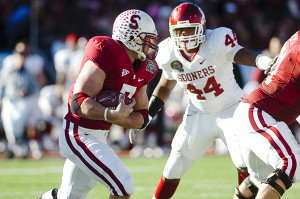
    Gerhart rushed for 1,871 yards and 27 touchdowns this year and was a consensus first-team All-American. He went over 100 yards in all but two games, and topped 200 yards in three contests. His final performance was a gutsy, 135-yard outing against Oklahoma in the Sun Bowl, when the Sooners were stacking the box nearly the entire game.

    “Toby will be a great pro, and we are all excited for his opportunity at the next level,” said coach Jim Harbaugh

    Gerhart had previously stated that he would enter the draft if he received a favorable grade on his NFL evaluation. Either way, there was believed to be only little chance that Gerhart would return for another season; over the past month, his public statements showed a lean toward foregoing his extra year.

    Gerhart finishes his Stanford career with his name littered throughout the Cardinal’s record books. He finishes second in school history in both yards on the ground (3,522) and total points (264).  His 44 touchdowns are a Stanford record. In 2009, he set the Cardinal single-season rushing record (breaking the one he set in 2008) and the Pac-10 conference’s touchdown mark.

    Stanford was 1-11 in Gerhart’s first year on the Farm, but he helped to engineer the turnaround that led the Cardinal, in his senior season, to an 8-5 record and the program’s first bowl appearance since 2001.

    “We’ve been through a lot of adversity during my time here,” he said, “but I’m extremely proud to have been part of the class that brought Stanford football back to national prominence.”

  • M. Basketball: Low power Pac

    Weak conference gives Card a shot

    Conference play in the Pac-10 is two weeks old and here’s what is certain: nothing.

    Jack Trotter, a sophomore forward, has been an important contributor for the men’s basketball team so far this season. (CHRIS SEEWALD/The Stanford Daily)

    Jack Trotter, a sophomore forward, has been an important contributor for the men’s basketball team so far this season. (CHRIS SEEWALD/The Stanford Daily)

    Rather, very little. It’s been long presumed and now established that the Pac-10 is nothing short of awful this season. There’s a legitimate possibility that just one team — the conference champion, which earns an automatic bid — will receive a spot in the NCAA Tournament. For the first time in history of the poll, no Pac-10 team was ranked in the coaches’ top 25 this week. There is no alpha dog. Cal and Washington were supposed to assume those roles, but the Bears lost at home to a poor UCLA squad and the Huskies are currently last in the conference with a 1-3 record. Unlike the Big East (or even the football side of the Pac-10), where good teams mercilessly beat up on each other, the Pac-10 features mediocre squads struggling to rise above. It’s a curious conference where, it appears, nearly everyone has a shot, because no one has distinguished themselves.

    Enter Stanford (8-7, 2-1 Pac-10), perhaps the hardest team to get a read on. Since the season began, the Cardinal has had its fair share of close losses that could easily have gone the other way. A last second running jumper led to a two-point loss to Oral Roberts. Stanford came within a made free throw of knocking off Kentucky, currently the No. 2 team in the country. The Cardinal then went on to lose by a single point to Oklahoma State and went to the wire with Northwestern. It wasn’t until Stanford squeezed out a win over USC that a close game went its way. But flip those losses and the country would be buzzing about one of the nation’s most surprising teams.

    Of course, that cannot happen and there are reasons why Stanford lost those games. First, the Cardinal has struggled with its free throw shooting all year, a problem that has directly contributed to many of its losses. Second, Stanford is a young team still trying to find its way — at the beginning of the season, only senior Landry Fields was a truly known quantity.

    Even now, the lineup includes Fields, a former walk-on, a transfer from Santa Clara by way of Foothill and two first-year starters who are both filling the shoes of long-time Stanford players. The reserves are career backups and current and former walk-ons.

    So why is Stanford, a team widely predicted to finish last in the Pac-10, currently tied for the conference lead and sitting with a winning record?

    First, Fields has fulfilled the potential inherent in him since he first stepped onto the Farm and in his final season, has become the quintessential veteran leader. He is second in the conference in scoring, rebounds and steals, but he’s also eleventh in assists.

    Second, sophomore Jeremy Green has become one of the best sharpshooters in the nation. He single handedly helped the Cardinal stay close against Northwestern — he’s taken over 100 three-point shots, but drains 43.4 percent of them. As a shooting guard, that rate would be good as an overall shooting percentage; to be that efficient from long distance alone is eye opening.

    And no one will fault the Cardinal’s effort — they’ve taken all the doubts and transformed them into a positive. It’s a high-energy squad that makes up for gaps in talent with its relentlessness. Sophomores Jack Trotter and Andrew Zimmermann, for example, hounded UCLA’s Reeves Nelson throughout last weekend’s contest and held the acclaimed freshman to just eight points.

    The issue for the Cardinal is that outside of Fields and Green, it’s never clear who will pick up the scoring slack. Trotter and Zimmermann have shown the ability to score in the low teens, but neither one does with much consistency and both have occasional issues with rebounding. Drew Shiller is draining over 47 percent of his takes from behind the arc, but he can also disappear for games at time. Point guard Jarrett Mann leads the conference in assists per game and backup Da’Veed Dildy is a lockdown defender and good ball handler, but neither has developed a good shot.

    It adds up to this: there are few constants with the Cardinal, but someone will generally step up and fill a void and not every contribution is necessarily through scoring. Coach Johnny Dawkins — who completely undressed John Calipari, one of the country’s preeminent coaches, in Cancun — has had success optimizing his talent and compensating for off-days.

    And yet with all the uncertainties, it remains hard to project how Stanford will do on a given night. But if the Cardinal can beat a good Washington State team and underperforming but talented Washington squad, both on the road, its frame should further come into focus.

  • Makowsky: Despite change, USC still a power

    After being turned down by Mike Riley, Jack Del Rio and (maybe) Jeff Fisher, and with their head coach search beginning to look fairly comical, Troy brought back a former golden boy: Tennessee’s Lane Kiffin, USC’s old offensive coordinator. That in turn prompted laughs from many. Kiffin’s well-publicized spats with Al Davis and the entire SEC, along with a dubious record as a head coach in both the NFL and college, have prompted a none-too-flattering image. Which is all good, except it means nothing. Kiffin’s hiring is a tactical move.
    Why? He’s bringing some serious backup. His father, Monte, his defensive coordinator at Tennessee, is assuming the same responsibilities at USC. Monte Kiffin is one of the preeminent defensive minds in the history of football. He literally created an entire scheme (the Tampa 2) and is compensated accordingly — he was the highest paid assistant at the college level last year. But that’s not all. Ed Orgeron, Kiffin’s associate head coach, will also be coming back to USC, where he previously served as the defensive line coach and recruiting coordinator. All three have head coaching experience at the collegiate level. And then there’s Norm Chow, one of the top offensive coaches in the country and a quarterback guru, who may leave UCLA to go back to USC — ESPN reported as much, but the Bruins have said that nothing is certain yet — where he will regain his old position of offensive coordinator.
    Chow and Monte Kiffin are longtime members of football’s elite. So why is Orgeron such a pain? Because back in the Trojan glory days of the early and mid-2000s, Kiffin and Orgeron formed one of the most potent recruiting duos in all of college football — they put together the No. 1 rated class in 2003 and 2004. In their only season at Tennessee and after getting a late jump on recruiting, they scored the No. 8 class. What does this mean? In the short term, that USC is likely to hold onto the recruits that they were in danger of losing after Pete Carroll left — Kyle Prater, the No. 2 wide receiver in the country, was planning on enrolling early, but opened up his commitment after Carroll’s departure. Now? He’s back on board and will soon be starting classes at USC. In the long term, it indicates that Troy’s ability to attract five-star talent won’t be going anywhere. In fact, recruiting may actually improve from its recent, still-excellent level. And that No. 7 ranked class Kiffin was putting together at Tennessee this year? Expect it to be gutted by the Trojans.
    The gamble is on Kiffin’s abilities as a coach, as he has not yet proven to be a great head man. But he was wildly successful as a coordinator and certainly has the potential to lead. Let’s also acknowledge that Oakland is where NFL futures go to die and Tennessee had a couple of stars but otherwise generally mediocre talent when Kiffin took over and he still got them to a bowl game and a winning record, despite playing in the ever-difficult SEC. That run included a near-victory over eventual champion Alabama in one of the Crimson Tide’s two toughest games of the season. Now, he is at home at USC with a plethora of talent to work with at a school that will do nearly anything to win. And it wasn’t too long ago that the Trojans brought in an NFL retread with a murky record to coach the program, who also happened to be their fourth choice.
    The most curious aspect of the move is that ostensibly, USC would want a clean leader in light of the Athletics Department’s continued investigation at the hands of the NCAA. Kiffin, who has had his own battle with ethics complaints, does not fit that mold. All bets are off if USC is sanctioned. But if they aren’t and the program proceeds as usual, it should be fine — even if it takes Kiffin a while to pan out and mature. Or if he doesn’t at all, he has still assembled a staff that will keep USC afloat and prospering both on and off the field.
    How does this hurt Stanford? On game day, they’re competing with Monte Kiffin, whose defenses could be flat-out scary with USC’s athletes. Chow, if he does go back to Troy, will have a nice little pet project in the uber-talented but underachieving Matt Barkley. Simply put, having Kiffin and Chow together as coordinators is just about as close to a dream team as possible.
    In terms of recruiting, the Cardinal may not be hit as hard as other Pac-10 schools. Their talent pool is different, if only because of academic restrictions — Stanford can’t go after a lot of the players that USC can, although there are the occasional crossovers, like Tyler Gaffney in 2009 and Jordan Zumwalt in 2010. The issue is mainly with USC’s continued ability to be the best recruiters in the conference.
    This all said, Stanford doesn’t inherently have anything to fear. Since Jim Harbaugh took over, they’re 2-1 against Pete Carroll coached Troy and no one would put Kiffin even close to his predecessor’s level, no matter his assistants. But for those who were hoping that USC’s coaching turmoil would prompt seasons of mediocrity from the program, let’s make it clear: that is not going to happen.

    Wyndam Makowsky is just keeping his friends close and his enemies closer. Ask him what he really feels about USC at makowsky “at” stanford.edu.

  • Between the Lines: Luck is just the next Card to be snubbed

    Stanford fans grumbled (read: yelled) about Mark Ingram beating out Toby Gerhart for the Heisman Trophy. But Thursday’s Freshman All-American team announcement should prompt even greater fury — the Football Writers Association of America chose Tom Savage of Rutgers over Andrew Luck for the lone quarterback spot.

    Now let me be clear: in the grand scheme of things, this doesn’t really matter. There are a number of Freshman All-American teams. Luck made the first team for the Sporting News, College Football News and Rivals. But the FWAA is a fairly prestigious organization — it gives out the Nagurski and Outland trophies — and holds an appropriate level of clout, which is what makes their (awful) selection so weird.

    It’s not just about Luck — although it helps to have a Stanford bent. Savage was no better than the fourth-best freshman quarterback in the country and was not even tops in his own conference.

    (It’s worth mentioning that I happen to like Tom Savage quite a bit. Rutgers is as close to a local team as New York gets and while I’m not a fan, they’re fun to watch. He has a wicked arm and is fairly mature for a true freshman. With due respect to Mike Teel, he’s the best Rutgers QB I’ve seen. But he still doesn’t deserve this honor. I’ve digressed.)

    Who was the best? It shakes out fairly well. Luck was the clear No. 1, with Oklahoma’s Landry Jones and South Florida’s B.J. Daniels below him. Savage enters the conversation here, along with Michigan’s Tate Forcier and USC’s Matt Barkley, although he tops both.

    Before getting to Savage, Jones, Luck and Daniels, let’s key in on one statistic: yards per attempt (YPA). It’s an efficiency rating that is perhaps the most important for quarterbacks. The name is self-explanatory — in order to maintain a high number, you have to a) complete a good percentage of passes for b) a nice amount of yards. One of the main qualms with Colt McCoy’s Heisman campaign, for example, was that while he hit on 70 percent of his passes, they did not go for a tremendous amount of yards — his 41st ranking in YPA indicates a tendency to dump the ball off more than other quarterbacks.

    As for our freshmen, Luck was sixth in the nation with 8.9 YPA; Daniels was eighth at 8.7. Sandwiched between them was Jimmy Clausen. Savage was 35th, just ahead of Aaron Opelt of Toledo. Jones, in the weakest part of his candidacy, was 63rd.

    But let’s not look at just one statistic. Savage threw for fewer yards with a worse completion percentage than both Luck and Jones. Luck threw for one less touchdown than Savage, but he also tossed just four interceptions, whereas Savage threw seven. Meanwhile, Jones had 26 scores through the air. Luck added 354 yards rushing; Savage and Jones both had worse than negative 100 yards on the ground. Daniels ran for 772 yards and compiled 23 total scores. Savage had the lowest passer rating of the four; Luck had the highest.

    Put it this way: of the major statistics, Savage topped Luck in exactly one: touchdowns. He had 14, Luck had 13. When rushing scores are factored in, they had the same amount. Otherwise, Luck tops him across the board. Nearly the same holds true for Luck and Daniels, except that Daniels has more total touchdowns.

    Speaking of USF’s dual threat, outside of yards per attempt, where Daniels is far and away better than Savage, the two have fairly similar passing statistics. But Daniels rushed for nearly 900 yards and eight touchdowns more than Savage — he was multidimensional, while Savage was most certainly not.

    As for Jones, he tops Savage in yards, touchdowns, completion percentage and passer rating. Savage betters him in interceptions and YPA. But Jones, unlike Savage, was not supposed to play this year and, due to injuries, had to adapt on the fly for a team that had national championship aspirations. Jones gets the nod.

    The only possible explanation is that Savage had a pretty good bowl performance while Luck sat out, so a “what have you done for me lately” factor set in. But that doesn’t fly for the other candidates: Jones was excellent against Stanford and Daniels had a very nice game in the International Bowl.

    While this may fall under the “pick your battles” category, I’ve long contended that for people who ostensibly watch a lot of games, sportswriters can make mind-numbingly bad decisions when it comes to awards seasons (see: American League MVP, 2006). Even the reporting on awards can be bad: the local New Jersey paper said that Savage was a surprise because Barkley was in the race; meanwhile, Barkley would have a tough time placing among the top five freshmen quarterbacks. These rampant displays of sheer ignorance only enhance my beliefs and subsequent disillusionment.

    Wyndam Makowsky has nothing better to do than explore freshman statistics now that the Giants missed the playoffs. Give him something better to do at makowsky “at” stanford.edu.

  • Football: 2010 outlook

    Stanford football released its 2010 schedule Monday, as the Cardinal looks to improve upon a successful 2009 season.

    Stanford will open on The Farm against Sacramento State – the Hornets are a Football Championship Subdivision team that replaces San Jose State on the Cardinal’s non-conference slate.

    But while Stanford may start off easy, their schedule will immediately step up in both toughness and importance – the Cardinal will travel south the next weekend to face UCLA to open Pac-10 play. The Bruins, an up-and-coming program in its own right, pose a difficult test, but a win would not simply have conference implications – the game will be nationally broadcast, giving the Cardinal an early opportunity to make a countrywide statement.

    Stanford will then wrap up its non-conference schedule at home against Wake Forest and then in South Bend against Notre Dame. In a reversal from this year, the Cardinal will face two of its toughest tests early in the year – it heads to Eugene to take on Oregon before returning to Stanford to host USC.

    The Cardinal will then have a bye before homecoming against Washington State. The next week prompts a trip to Seattle to take on Washington, before coming home again to face Arizona. Stanford has Arizona State on the road before another bye, after which it will face Oregon State on The Farm and Cal in Berkeley.

  • Makowsky: The plays that defined a season

    Football is a game of momentum. Even in a blowout, a few plays can dictate the outcome. It’s with that in mind that we look at the six turning points of Stanford’s season — that is, the plays or sequences that dictated the course of a single game or beyond and ultimately, the Cardinal’s final 8-5 standing.

    1. The Phantom Clip (at Wake Forest)
    Background: Despite an offensively anemic second half, Stanford was driving with the score tied at the midway point of the fourth quarter. It was third-and-2 from the Cardinal 45-yard line.

    The Play: Toby Gerhart, who was underutilized throughout the final 30 minutes, ran right and broke off a long, 39-yard run that would have given Stanford the ball at the Wake Forest 16-yard line with about four minutes to play. But a flag came out and Chris Marinelli was whistled for clipping, which brought the play back.

    Aftermath: The problem? There was no evidence of such a penalty. None. Stanford could not convert third-and-long and had to punt; Wake Forest subsequently drove the length of the field and scored with two seconds left. The Cardinal left North Carolina with a 24-17 loss and an awful taste in their mouths. Marinelli called the flag “horrendous” and it was — national analysts were still talking about it weeks later which, given the relatively low stature of the game, was both surprising and telling.

    2. The Drop (at Oregon State)
    Background: After the Wake Forest loss, Stanford tore off three wins against San Jose State, a ranked Washington squad and an upstart UCLA team. The Cardinal entered Corvallis as the top team in the conference and an emphatic road win over the always-difficult Beavers could have added further legitimacy to their season.

    The Play: Stanford started with the ball and on the initial play from scrimmage Andrew Luck ran a play-action pass and found a wide open, streaking Chris Owusu over the middle for what would have been a sure touchdown. Only Owusu dropped the pass.

    Aftermath: Stanford punted five plays later and Oregon State opened the floodgates. By halftime, the Beavers were leading 31-7 and were never seriously threatened. Owusu’s touchdown wouldn’t have cured Stanford’s porous defense, but it would have been a dramatic offensive statement out of the gate, which goes a long way toward establishing a presence, if not a swagger. Instead, the Cardinal attack didn’t really get going until the second half.

    3. Fourth Down (at Arizona)
    Background: In a wild match up, Stanford had the ball with under six minutes left in the fourth quarter, leading by two. It was fourth down and two from the Arizona 8 yard line.

    The Play: Instead of kicking a field goal to go up by a full score, coach Jim Harbaugh elected to go for it. Luck’s pass to Owusu fell incomplete and the Wildcats took over.

    Aftermath: Arizona scored on their next possession. Stanford still had one more chance to win, but instead of needing just a field goal, they had to score a touchdown. The Cardinal turned it over on downs in the red zone and the Wildacts prevailed, 43-38.

    4. The Sack (vs. No. 8 Oregon)
    Background: Stanford controlled much of the game through three quarters. A Nate Whitaker field goal extended the Cardinal lead to 17 with three minutes to play in the third, but Oregon’s quick strike offense, which propelled them to a win over USC the week before, was always a threat. Indeed, after the Ducks quickly marched into Stanford territory, it looked as if they were going to make it just a two possession game with a full quarter left to play. The Oregon drive stalled at the Cardinal 39-yard line, but the Ducks elected to go for it.

    The Play: Michael Thomas, blitzing from his nickel back spot, sacked Oregon quarterback Jeremiah Masoli as time expired in the period.

    Aftermath: Stanford took over on downs and promptly drove downfield for another Whitaker field goal to push the gap to 20 points. It proved necessary, as Oregon scored two quick touchdowns in the fourth quarter and cut the Cardinal lead to just six before Whitaker clinched it with another field goal.

    5. The Play Calls (vs. California)
    Background: After a Vince D’Amato field goal gave the Golden Bears a six point lead with under three minutes left, Stanford marched downfield in an effort to win the game. This was largely aided by a 29-yard pass reception by Gerhart, who carried defenders down to the Cal 13 yard line.

    The Play: Luck had been struggling all game; Stanford needed to burn time so as not to give Cal any ability to win on a last second score; and Gerhart was jacked up from the previous play and had scored four touchdowns already. But despite everything pointing to a run, Harbaugh elected to go with two straight pass plays. The first was an uncatchable toss to Coby Fleener in the end zone; the second was a badly underthrown pass right into the hands of Cal linebacker Mike Mohamed.

    Aftermath: Cal emerged with the Axe in one of the more painful finishes in recent memory. Harbaugh’s decision to pass is still questioned today and on an individual level, given the margin of the Heisman trophy voting, a fifth (and game winning) touchdown in a rivalry game would have added a little bit more spark to Gerhart’s campaign.

    6. The Toss (vs. Notre Dame)
    Background: Down eight points early in the fourth quarter, Stanford desperately needed a touchdown to keep pace with the Irish. The Cardinal made it down to the Notre Dame 18-yard line with just over nine minutes to play before the drive stalled.

    The Play: Instead of kicking a field goal, Harbaugh went for it on fourth and four. The play appeared at first to be a toss to Gerhart, which looked doomed — Notre Dame read it well. But then he stopped, planted and threw toward the end zone, where he found Ryan Whalen for a touchdown.

    Aftermath: Luck hit Jim Dray on the next play for the two-point conversion and Gerhart would eventually put the Cardinal ahead for good on a touchdown run with a minute left. The exhilarating victory was a fitting end to a thrilling, if not up-and-down regular season.

    Wyndam Makowsky refuses to admit that the football season is over. Shed some light at makowsky “at” stanford.edu.

  • Football: All-Around Changes

    UPDATE (1/5, 5:10 P.M.): While Andy Buh had originally intended to join the staff at Western Kentucky,  he has instead taken the defensive coordinator job at Nevada, his alma mater. Clayton White is still expected to go to WKU, but his specific position remains up in the air.

    With its year now completed, Stanford football begins the process of establishing its roster and coaching staff for the coming season. The off-season prompts significant turnover: Players will be lost to attrition, graduation and the NFL Draft; recruits will hit The Farm in the summer; and coaches will move on to other pastures and will be replaced in kind.

    (MASARU OKA/The Stanford Daily)

    (MASARU OKA/Staff Photographer)

    The question of the off season, until he says anything declarative, will focus on senior running back Toby Gerhart’s draft intentions. But actually, it is at the coaching level where most of the immediate changes have been made.

    Stanford may be less than a week removed from the Sun Bowl, but it has already seen movement in the ranks. Special teams and defensive ends coach DJ Durkin, one of the country’s top young assistant coaches, has left the Cardinal for Florida, where he will coach special teams and linebackers. Durkin was a graduate assistant at Bowling Green under current Florida head coach Urban Meyer.

    He will be replaced, at least on special teams, by Brian Polian, who previously coached in the same position at Notre Dame — he was not retained by new Fighting Irish head man Brian Kelly, but he is regarded as a fairly good coach and an excellent recruiter.

    Polian also has experience working with linebackers and may be able to work with the Cardinal there, as the current position coach, Andy Buh, is widely believed to be headed to Western Kentucky to serve as the Hilltoppers’ defensive coordinator. However, WKU Associate Athletic Director for Communications Todd Stewart emphasized, “nothing has been accepted at this point.” Western Kentucky’s new head coach is Willie Taggart, who served as Stanford’s running backs coach for three years and was named to his current job in November.

    The changes don’t stop there. Defensive backs coach Clayton White is also expected to leave Stanford for Western Kentucky, along with Buh and Taggart, to coach the Hilltoppers’ defensive backs. The Athletics Department would not confirm or deny the move. The Cardinal was able to hold onto offensive coordinator David Shaw, who was a finalist for the San Jose State head-coaching gig (the job eventually went to Duke defensive coordinator Mike MacIntyre).

    Coach Jim Harbaugh, always at the center of speculation himself, now has a number of vacancies to fill. His father, Jack, was the running backs coach during the Sun Bowl, and Harbaugh has expressed interest in keeping him on staff, if he is willing.

    But it’s not just the coaches who will experience change; the players will, too. Stanford has a number of key contributors who have now exhausted their eligibility. Chris Marinelli anchored the Cardinal’s superb offensive line from his right tackle spot, where he earned first-team conference honors. Jim Dray, perhaps the best blocking tight end in the country and a red zone threat, was a second-team All Pac-10 selection. Long time defensive starters Bo McNally, Ekom Udofia and Clint Snyder are also done, as well as impact players like Will Powers and Kris Evans and valuable reserves such as Tom McAndrew and Josh Catron. Tavita Pritchard, who manned the Cardinal offense in 20 starts, is gone, as is Allen Smith, the team’s most senior member.

    However, that’s not all of the Stanford seniors: Richard Sherman and Matt Kopa have both applied for medical redshirts due to injuries that sidelined them in 2008 and 2009, respectively. Jim Young, director of media relations, said that there’s “nothing definitive yet, although [he’s] optimistic on both.” Joining Sherman and Kopa as medical redshirts could be Brian Bulcke and James McGillicuddy, both of whom have expressed interest in playing another year; Erik Lorig may have missed enough time in 2009 to qualify, but he is not expected to apply.

    And then, of course, there’s Toby Gerhart. Although denoted as a senior, he would almost certainly gain an extra year of eligibility if he wanted it — he missed all but a few minutes of 2007. The will-he-or-won’t-he saga will not end until Gerhart makes a final statement either way, but the possibility that he will enter for the NFL Draft is considered very strong. He has requested an evaluation from the NFL, which will tell him a projected round — he has indicated that if he is graded out at a first round level, he will leave, but has not said that he would necessarily return if he’s seen as less than that. He has made no secret of his desire to play in the NFL, and though Gerhart could not be reached for comment, numerous quotes on the subject indicate a strong preference toward the professional ranks.

    Further attrition is also expected — in past years, early retirements for medical purposes or otherwise, along with transfers, have led to a handful of players leaving the team.

    Whatever the reasons, turnover is a perpetual part of football, particularly at the collegiate level. What it means, though, is that the off-season’s hunt for replacements leads to hardly any break at all.

  • M. Basketball: Card goes cold over break

    In what has become a recurring trend for Stanford men’s basketball, the winter break slate featured a number of near misses against prominent opponents, coupled with only a smattering of wins. Its conclusion – a 92-66 slaughtering at the hands of rival California – was the most disheartening loss to date.

    After a farily disappointing string of games over Winter Break, the Cardinal finds itself one game below .500.

    After a farily disappointing string of games over Winter Break, the Cardinal finds itself one game below .500.

    The Cardinal came out of finals week in impressive fashion. UC-Davis’ (5-8, 1-0 Big West) trip to the Farm was an unsuccessful one – Stanford (6-7, 0-1 Pacific-10 Conference) rolled, 85-69. All five starters finished in double figures and sophomore Jack Trotter notched the best performance of his young career, registering a double-double with 14 points and 11 rebounds.

    “I wanted to come out aggressive and get on them before they could get on us,” Trotter said.

    Senior Landry Fields, per the usual, tallied 21 points to lead the Cardinal. Through 13 games he is 10th in the country and second in the conference with a 23.2 points per game average. He did not drop below 20 points in any of the winter break games.

    That included a heartbreaking 71-70 defeat at the hands of a one-loss Oklahoma State team (11-2, 0-0 Big 12) at Maples in the Cardinal’s next contest. Stanford played one of its better games, particularly late in the second half, but could not overcome a 12-24 performance from the free throw line. Despite a double-digit deficit at the midway point of the half, the Cardinal closed the gap to one with seven seconds left. Fields, playing with four fouls and sophomore Andrew Zimmermann, whose 14 points were a career high, led the resurgence. With Fields feeding Zimmermann, the duo established a presence in the post that Oklahoma State had a hard time thwarting.

    It seemed natural that the game’s final play would be designed for Fields, with Zimmermann playing a role, but it did not seem to go as planned – Zimmermann wound up with the ball and looked for Fields, who was fairly well defended. He chose instead to drive, with his shot falling innocently off the backboard.

    “There was so much going in the last seconds,” Fields said. “It just shook out that I couldn’t get the ball.”

    Stanford’s next contest was nearly as close. The Cardinal traveled to Illinois to take on a surprising one-loss Northwestern squad. Senior Drew Shiller, who netted 12 points on 4-5 shooting from beyond the arc, led the Cardinal early. Though tied at the half, the Wildcats (10-3, 0-2 Big 10) created a 10-point lead with under six minutes to play, but nine straight points from Stanford sharpshooter sophomore Jeremy Green cut that gap to one with under two minutes left.

    But further success was fleeting – Northwestern hit their shots and Stanford did not. The Wildcats emerged victorious, 70-62. It was another attainable win that fell out of the Cardinal’s grasp – the team was not helped by its 28 team fouls, as opposed to Northwestern’s 13. Free throws continued to be an issue, as Stanford again shot just 50 percent from the charity stripe.

    Fields and Green continued to impress against Texas Tech (12-2, 0-0 Big 12), combining for 51 points and 19 rebounds, but the Cardinal, despite just a four point halftime deficit, fell behind early in the second period and could not recover – the Red Raiders maintained a steady lead throughout and won 100-87.

    There were silver linings in the three losses to teams with a combined three defeats at the time. Among them were Fields’s continued dominance and Green’s development into one of the nation’s best three-point threats.

    But the shortcomings were also evident. Sophomore Jarrett Mann took over point guard duties early in the year, but he turned the ball over a combined 16 times over the first two losses. Outside of Zimmermann against Oklahoma State, there was practically no post presence.

    The Cardinal did pick up a win against James Madison (6-6, 0-2 CAA) in a harder-than-expected game. The Dukes led early and prevented Stanford from pulling away, even at home. Still, the Cardinal was able to create a large enough gap later and led by nine with 14 seconds left; it took two desperation three pointers by James Madison to bring the final score to 80-76.

    But the victory was only a brief respite – Stanford’s foray into Pac-10 competition began with a drubbing in Berkeley. The Bears (9-4, 1-0 Pac-10) led by 20 at the half and had no answer for senior Jerome Randle, one of the main contenders (along with Fields) for conference Player of the Year.

    “Offensively, we wanted to run our offense. We thought that we’ve been doing that pretty efficiently all year long and we wanted to continue to try to come down and play with some poise, keep good spacing, move the basketball and share it,” said Head Coach Johnny Dawkins. “At times, we were able to do it well, but we weren’t able to consistently do it well enough.”

    The road does not get any easier, as Stanford will host USC, one of the best defensive teams in the country, on Wednesday, as the Cardinal delves deeper into Pac-10 play, with a 2-4 winter break record in hand.

  • Heisman Ruminations

    There are too many random tidbits from Saturday night’s Heisman presentation to coherently place in the event’s recap, so they will be presented here. Randomly.

    Camaraderie

    A trend emerged throughout the night: the five finalists had grown close during their time in New York. Tim Tebow and Mark Ingram prayed together; they all went to the Empire State Building; Tebow and Colt McCoy grabbed lunch at a deli; and not a negative word was offered throughout Saturday evening. Ndamukong Suh, essentially disregarding his own candidacy, even told reporters that he thought Ingram and Toby Gerhart were the two most deserving finalists.

    And so when each of the five took to the stand before the press gaggle after the presentation, mutual respect prevailed. The aura surrounding all of the proceedings was highly sentimental. It was a competition for arguably the top award in American sports, and you would not know it.

    The Winner

    I have spent much of the past week picking fights with people who put Ingram ahead of Gerhart. Mainly, it was due to ignorance, since many—including voters, by their own admission—did not watch much of Stanford. But along the way, you lose track of the individuals. And maybe it was because of, again, the atmosphere of the night, but after two hours, my respect for Ingram rose exponentially.

    He is a young man who embodies many of the traits Stanford fans like in Gerhart: intelligent, classy, devoted to his school and team. He’s gone through personal trials: his father is in jail, and he started at Alabama as the only northerner on the squad—a bigger deal than one may think.

    The impact of the night was evident. Tebow had to take him backstage before the ceremony because of his nerves, and when his name was called, the emotions came flowing out. He had to stop before he started because he kept getting choked up. He knew what the award meant to Alabama, which had not had a Heisman winner despite its rich football history. He knew what it meant to his family. And he knew what it meant for him, standing alongside Heisman winners dating back over 50 years as he gave his acceptance speech.

    Good on you, Mark Ingram.

    Academia’s Victory

    Too often, the college football world loses sight of the first part of the term “student-athlete.” Not tonight.

    Gerhart’s academic story is well known—he’s a management, science and engineering major taking an absurd 21-units this quarter. But all of the finalists had academic merit. Ingram made the Dean’s List, while Suh chose Nebraska because of its impressive engineering program. McCoy carries a 3.33 GPA and was an Academic Heisman finalist; Tebow won the award.

    Gerhart put it well.

    “In a time when education is falling by the way side, guys like McCoy, Suh, Tebow and Ingram, [who value academics], are the real heroes.”

    Regional Bias

    This needs to be talked about until it’s fixed, particularly in light of the closeness of this year’s balloting. Simply put: the Heisman system is undeniably biased against the West Coast. Dramatically so.

    The incomparable StiffArmTrophy.com has done an analysis. Here’s how it works. There are six voting regions that receive 1/6 (16.6 percent) of the votes each—Far West, Southwest, Mid-Atlantic, South, Midwest and Northeast. But there’s a big problem: the population of those regions is not equal, and thus the per capita votes allotted are skewed. The Far West region has 21.1 percent of the country’s population; the Northeast has just 11.9 percent.

    Statistically, that is, in a word or two, not fair. There are subjective arguments to be made about voter biases—the South thinking that the Pac-10 is a cupcake conference, for instance, even when it is tremendously strong—but those don’t even matter. The numbers, simple as they are, prove a “structural regional bias.”

    As StiffArmTrophy.com says, “Three regions (Far West, Midwest, and Mid-Atlantic) have more population than [16.6 percent]—and three have less (Northeast, South, and Southwest).”

    How does this relate to tonight? Gerhart’s win in the Far West was dramatically larger than any other candidate’s regional win. He beat McCoy by 105 points; next closest was Ingram in the South, where he beat McCoy by 78. Fix the proportions and project the vote totals and, well, you know what happens.

    Gerhart was asked point-blank about supposed bias.

    “Maybe there is, maybe there isn’t. It’s not something we concern ourselves about. We take pride in West Coast football. We take pride in the Pac-10 conference. We are as good as any. I think there’s enough exposure, though of course we’d like more, and as time goes on, people will respect West Coast football and the Pac-10 conference more.”

    I applaud his diplomacy, but hopefully, the closeness of this year’s race will help change the Heisman’s methodology.

    But I doubt it.

    What Could Have Been?

    In a race this close, it’s impossible not to look at the past season, and see where Gerhart may have been able to pick up those 28 points. Two immediate plays come to mind. First, the phantom clipping call against Wake Forest does not happen. That long run would have pushed him over 100 yards for the game and likely would have given Stanford another win on the season. Second, Jim Harbaugh gives Gerhart the ball on the final drive against Cal. Given his aggressive running right up until that point, I’d place a tremendously large bet that he was getting into the end zone. That would have given him five touchdowns and a win in a rivalry game.

    It would have been nice to play on the final weekend—given Gerhart’s consistency, it’s hard to imagine that he would have been anything short of impressive. Not playing didn’t hurt or help—the week-to-week voting breakdowns show practically no change between the week before the conference championship games and the week after the championship games. A good performance may have given him the extra edge.

    Oh, and it would be nice, in terms of the national exposure Gerhart mentioned, if the Pac-10 could work out a decent television deal. That would get the name out—the Notre Dame game, which was nationally broadcast, rose his stock since voters who could not see him before now had no excuse to miss him.

    But, as they say, c’est la vie.

    Stats of Note

    This year’s race was full of fun little nuggets.

    Suh had the highest point total of any fourth place finisher in history, while McCoy had the third highest points of any third place finisher. CJ Spiller of Clemson, who placed sixth, made an impact in the Mid-Atlantic, where he came in fifth—the only time a non-finalist placed in the top five in any region. He beat out Tebow by a considerable margin—79 to 57.

    Ingram and Gerhart appeared on practically the same number of ballots (67.9 percent for Ingram, 67.1 percent for Gerhart). Meanwhile, 15 different players received first place votes, including all of the top 10 finishers. Finally, 11 percent of voters cast their ballots before the pivotal championship game weekend, when the scene was dramatically different—McCoy was in first and Ingram was in fourth at the time.

    And then there was that part about it being the closest Heisman race ever…

  • Ingram edges Gerhart to win Heisman Trophy

    In the closest Heisman race ever, Toby Gerhart came up just 28 points short.

    Alabama’s Mark Ingram, a running back, won college football’s most prestigious award Saturday night—he grabbed 1,304 points, while Gerhart placed second with 1,276. The difference was a mere 1.2 percent.

    Texas’s Colt McCoy (1,276 points), Nebraska’s Ndamukong Suh (815) and Florida’s Tim Tebow (390) rounded out the finalists, the largest group since 2004. The Heisman chase was the closest by 17 points—Bo Jackson beat Chuck Long by 45 in 1985.

    Ingram ran for 1,542 yards and 15 touchdowns while leading Alabama to a No. 1 ranking and a BCS Championship Game appearance.

    “I’m so excited to bring Alabama their first Heisman winner,” said Ingram, who was emotional throughout his acceptance speech. The son of a former NFL wide receiver, Ingram is the third straight sophomore to win the trophy.

    If Gerhart, who ran for 1,736 yards and 26 scores, was disappointed, it showed only minimally.

    “It’s an honor to be here,” he said, unphased as Ingram posed with the trophy not 50 feet away. “It’s an honor to represent Stanford.”

    The announcement, made at the Nokia Theater in New York, capped off one of the wildest Heisman races in recent memory, one that changed dramatically after championship weekend. Before Texas and Nebraska faced off for the Big 12 title and Florida and Alabama met for the SEC crown, McCoy led Gerhart, Tebow, Ingram and Suh, in that order. But after those two match ups, the dynamics of the race changed: with Gerhart off, Ingram and Suh turned in notable performances while McCoy and Tebow floundered. About 90 percent of the 904 voters turned in their ballots after those games, and the change in perception was reflected in the final results.

    Ultimately, Ingram won four of the six regions—Northeast, Midwest, Mid-Atlantic and South—while Suh took the Southwest and Gerhart won the Far West. Ingram won five more first place votes and eleven more second place votes than Gerhart, while McCoy and Gerhart tied for the most third place votes, beating Ingram by nine.

    Gerhart, despite his razor-thin loss, was nothing but gracious in defeat.

    “Mark’s a great guy,” he said. “I appreciate the way he plays. I’m a physical guy, he’s a physical guy, we can relate to each other.”

    “He carried his team on his back,” he continued. “I’m extremely proud of him.”

  • Harbaugh signs extension through 2014

    Coach Jim Harbaugh has signed a contract extension to remain at Stanford through the 2014 season. Terms of the deal were not disclosed.

    Harbaugh and the University initially negotiated an extension last winter that would pay him $1.25 million a year, but due to the economic climate, decided to hold off on finalizing it. It appeared, from quotes from Harbaugh, that a contract would be signed last month, but no release was made at the time.

    Due to Harbaugh’s revitalization of the Cardinal football program, he has been a hot name for many collegiate vacancies. Indeed, the announcement, from Athletic Director Bob Bowlsby to the Associated Press, comes just a day after several news sources in Kansas reported that Harbaugh was leaving The Farm to take the head coaching job at the University of Kansas.

    But the new contract, and a statement from Harbaugh, puts those rumors to bed.

    “My resolve and future proudly remains as head coach of Stanford University,” he said Saturday.

  • Luck injured; Pritchard to start Sun Bowl

    Redshirt freshman quarterback Andrew Luck has had surgery on a hurt right finger and will not start in the Sun Bowl, The Daily learned Sunday. Luck will be replaced by senior Tavita Pritchard, who has made 19 starts in his Cardinal career but has attempted just three passes this season.

    The announcement was made at the team’s annual awards banquet, where Luck won sophomore of the year honors and Pritchard was acknowledged for his leadership. Indeed, Pritchard has taken on a mentorship role this year for the younger Luck, who has had a stellar start to his collegiate career. Luck has thrown for 2,575 yards on the season and 13 touchdowns against only four interceptions. Perhaps most impressively, he is fourth in the nation in yards per attempt, arguably the most important and telling passing statistic.

    But now, Pritchard will have a chance to ditch the headset and bookend his Stanford career another major win. His first start was against USC in 2007 in a game now known as the “Biggest Upset Ever.” In the Sun Bowl, his last game in a Stanford uniform, will try to lead the Cardinal to its first bowl victory since 1996.

    The Athletics Department could not be reached for comment.

    Check back at www.stanforddaily.com for more as this story continues to develop.

  • Pedersen named conference Player of the Week

    After a monstrous weekend on The Farm, junior forward Kayla Pedersen has been named the Pac-10 Player of the Week.

    Pedersen led Stanford in scoring in wins over both Utah and Gonzaga. She netted 18 points against the Utes on Friday before exploding for a career high 30 points against the Bulldogs on Sunday. Her 19 total rebounds left her one short of averaging a double double on the weekend. Pedersen, who takes a number of her shots around the perimeter, finished with an impressive 47.1 shooting percentage.

    Pedersen joins sophomore Nnemkadi Ogwumike on the year’s honoree list<\p>–<\p>they have each won once in the first three weeks of the season. This is the second time Pedersen has won the award in her career<\p>–<\p>her first came in March of 2009.

    The Cardinal women are back in action against DePaul on Dec. 13 at Maples Pavilion.

  • BRIEF: Whalen chosen as Academic All-American

    Stanford’s Ryan Whalen has been named an Academic All-American.

    Whalen, a junior wide receiver for the Cardinal, made the second team with a 3.43 grade point average. The honor was voted on by the College Sports Information Directors of America and presented by ESPN The Magazine.

    To be eligible, candidates must receive significant playing time — Whalen is a starter and Stanford’s leading receiver — and hold at least sophomore standing and a 3.30 GPA.

    Whalen, a Science, Technology and Society major, joins a long line of Cardinal Academic All-Americans, but is the first football player to receive the award since Troy Walters in 1999.

    Whalen was Stanford’s leading receiver against Notre Dame last week. He pulled in six passes for 75 yards and a score in the Cardinal’s 45-38 victory and has 54 receptions for 861 yards and four touchdowns on the year.

    Stanford will next be in action in its bowl game, which has yet to be determined.

  • BRIEF: Women’s volleyball claims seven Pac-10 awards

    Stanford’s women’s volleyball team garnered seven different honors when conference awards were announced on Monday.

    Junior outside hitter Alix Klineman, for the third time in three seasons, was selected to the All-Pac-10 team. She was sixth in the conference in both kills and points per set. Her teammates, junior outside hitter Cassidy Lichtman and middle blocker Janet Okogbaa, joined her, each for the first time in their careers, although Lichtman was an honorable mention last season.

    Libero Gabi Ailes picked up an honorable mention.

    The Cardinal freshmen were honored, too, as setter Karissa Cook and middle blocker Jessica Walker made the Pac-10 All-Freshman team and libero Hannah Benjamin was an honorable mention for the same squad.

    Stanford, the conference champion, will host the first two rounds of the NCAA Tournament at Maples Pavilion. The Cardinal will take on Long Island to open its run at the school’s seventh championship on Friday.