Category: Energy

  • South Korea Pledges to Cut Carbon Emissions by 30% by 2020

    Seohae1

    2009Nov18: South Korea pledges to cut carbon emissions by 30% from “business as usual” by 2020 (Korea Times).

    Reference: Korea Times http://www.koreatimes.co.kr/www/news/nation/2009/11/113_55654.html

    Image Description: Incheon Bridge, South Korea. Photo by Seunghwanshin, 2008Oct4. Image Location: Wikimedia Commons http://commons.wikimedia.org/wiki/File:Seohae1.jpg Image Permission: The copyright holder of this work, hereby releases it into the public domain. This applies worldwide.

  • Russia Pledges to Reduce its Carbon Emissions by 25% by 2020

    Kotelincheskaya_Naberezhnaja_Moscow.hires

    2009Nov18: Russia’s president, Dmitri A. Medvedev, pledges to reduce his country’s carbon emissions by 25% by 2020 (COP15 Copenhagen).

    Reference: COP15 Copenhagen http://en.cop15.dk/news/view+news?newsid=2633

    Image Description: Apartment building on Kotelnicheskaya Naberezhnaja, Moscow. This image is copyrighted by Dmitry Azovtsev. Image Location: Wikimedia Commons http://commons.wikimedia.org/wiki/File:Kotelincheskaya_Naberezhnaja_Moscow.hires.jpg Image Permission: This file is licensed under the Creative Commons Attribution 2.0 License.

  • The Fraction of CO2 Emissions that is Absorbed by Terrestrial and Marine Carbon Sinks Probably Decreased Between 1959 and 2008

    shutterstock_30072571_1mb

    2009Nov17: “On average only 45% of each year’s [carbon] emissions remain in the atmosphere. The remaining 55% is absorbed by land and ocean sinks. However, CO2 sinks have not kept pace with rapidly increasing emissions, as the fraction of emissions remaining in the atmosphere has increased over the past 50 years. This is of concern as it indicates the vulnerability of the sinks to increasing emissions and climate change, making natural sinks less efficient ‘cleaners’ of human carbon pollution,” said Global Carbon Project Executive Director and CSIRO’s Dr. Pep Canadell, who is co-author of “Permanent storage of carbon dioxide in geological reservoirs by mineral carbonation”, a paper that appears in Nature Geoscience.

    Reference: CSIRO media release. 2009Nov17. Available online at Global Carbon Project http://www.globalcarbonproject.org/carbonbudget/08/press-releases.htm

    Read the article abstract – Permanent storage of carbon dioxide in geological reservoirs by mineral carbonation http://www.nature.com/ngeo/journal/vaop/ncurrent/abs/ngeo683.html

    Image Description: Industrial pollution. Photo by Martin Muránsky. Image Location: Global Carbon Project http://www.globalcarbonproject.org/carbonbudget/08/images.htm Image Permission: Illustrative Photos (available free for Carbon Budget editorials if credited as specified).

  • CO2 Emissions Produced in the UK, Fell by 5% Between 1992 and 2004, while CO2 Emissions from Goods and Services Consumed in the UK Increased by 12%

    800px-Bath_45

    2009Nov17: CO2 emissions produced in the UK, fell by 5% between 1992 and 2004, while CO2 emissions from goods and services consumed in the UK increased by 12% between 1992 and 2004, according to the Global Carbon Project. “The developed world has exported to the developing world the emissions it would have produced had it met its growing appetite for consumer goods itself for the last two decades,” said CSIRO’s John Finnegan (BBC).

    Reference: BBC http://news.bbc.co.uk/2/hi/science/nature/8364926.stm

    Read the Global Carbon Project’s 2008 Carbon Budget report – released 2009Nov17 http://www.globalcarbonproject.org/carbonbudget/index.htm

    Image Description: Bath, England, United Kingdom. Photo by Christophe.Finot, 2005July. Image Location: Wikimedia Commons http://commons.wikimedia.org/wiki/File:Bath_45.JPG Image Permission: This file is licensed under the Creative Commons Attribution ShareAlike 2.5 License. In short: you are free to share and make derivative works of the file under the conditions that you appropriately attribute it, and that you distribute it only under a license identical to this one.

  • Each Human Consumes Goods and Services Worth 1.3 Tons of Carbon 2009

    800px-Tucson_shab1

    2009Nov17: Each human consumes goods and services worth 1.3 tons of carbon, according to the Global Carbon Project. Each human consumed goods and services worth 1.1 tons of carbon in 2000 (BBC).

    Reference: BBC http://news.bbc.co.uk/2/hi/science/nature/8364926.stm

    Read the Global Carbon Project’s 2008 Carbon Budget report – released 2009Nov17 http://www.globalcarbonproject.org/carbonbudget/index.htm

    Image Description: Tucson, Arizona. Photo by Zereshk. Image Location: Wikimedia Commons http://commons.wikimedia.org/wiki/File:Tucson_shab1.JPG Image Permission: This file is licensed under the Creative Commons Attribution 3.0 Unported License. In short: you are free to distribute and modify the file as long as you attribute its author(s) or licensor(s).

  • Global CO2 Emissions Rose by 29% Between 2000 and 2008

    800px-Factory_in_China

    2009Nov17: Global CO2 emissions rose by 29% between 2000 and 2008, according to the Global Carbon Project. The growth came from developing countries, but 25% of that growth came through production of goods for consumption in advanced economies (BBC).

    Reference: BBC http://news.bbc.co.uk/2/hi/science/nature/8364926.stm

    Read the Global Carbon Project’s 2008 Carbon Budget report – released 2009Nov17 http://www.globalcarbonproject.org/carbonbudget/index.htm

    Image Description: Factory in China on Yangtze River. Photo by High Contrast, 2008Sept. Image Location: Wikimedia Commons http://commons.wikimedia.org/wiki/File:Factory_in_China.jpg Image Permission: This file is licensed under the Creative Commons Attribution 2.0 Germany License.

  • France and Brazil Will Pursue Goal of Reducing Greenhouse Gas Emissions to 50% Below 1990 Levels by 2050

    800px-France-Nancy-Place_Stanislas_2_2007-03

    2009Nov14: French President Nicolas Sarkozy and Brazilian President Luiz Inacio Lula da Silva announce that France and Brazil will pursue the goal of reducing greenhouse gas emissions to 50% below 1990 levels by 2050 (BBC).

    Reference: BBC http://news.bbc.co.uk/2/hi/americas/8360738.stm

    Image Description: Place Stanislas à Nancy, France. Photo by Pinpin, 2007Mar19. Image Location: Wikimedia Commons http://commons.wikimedia.org/wiki/File:France-Nancy-Place_Stanislas_2_2007-03.jpg Image Permission: This file is licensed under the Creative Commons Attribution ShareAlike 3.0 License. In short: you are free to share and make derivative works of the file under the conditions that you appropriately attribute it, and that you distribute it only under a license identical to this one.

  • Energy vs. Financials, FINAL RESULTS

    Many of you may be familiar with this sectoral strategy that I have presented, which was due to the unusually wide extreme to which these two sectors had diverged from each other as of April 22, 2008. To review :


    On April 22, 2008, I decided to go short on Energy (XLE) and long on Financials (XLF).


    Then, on May 20, 2009, I decided to cover the Energy short, and use the proceeds to double down on Financials.  Up till that point, the trade had earned a loss of -5.36%, vs. a loss of -32.20% for the S&P500.


    Now, it is time to sell the Financials position, and assess the final performance over the entire 18-month period, against the S&P 500.


    Enerfin


    The purple line indicates the May 20, 2009 transition from being short XLE to covering that short and using the full proceeds to double down on XLF.  Note that the short of XLE was profitable, so that the amount that was redeployed to XLF was more than the existing value of the XLF position. 


    Therefore, the final results are (with all dividends reinvested) :


    Enerfin2 
    This strategy yielded a gain of 21.92% vs. a loss of -17.19% for the S&P500.  This is a huge gap of almost 40 points, and means that $10,000 deployed to this strategy would have yielded $12,192, vs. just $8,281 if placed in the S&P500 over this period.  Also note how the gap widened from what it was on May 20, 2009. 


    This continues our track record here at The Futurist of collectively beating the market by a wide margin, with portfolios that beat the market greatly exceeding the deficit of those that do not.  Of course, these trades are for entertainment purposes only, and should not be taken as professional advice. 


    Related :


    A History of Stock Market Bottoms   

  • Wind Turbines on the Isthmus of Tehuantepec in Mexico, Can Achieve About 50% of Installed Capacity

    800px-San_Jose_Chichihualtepec

    2009Nov11: Wind turbines on the Isthmus of Tehuantepec in Mexico, can achieve about 50% of installed capacity because of wind speeds of 10 meters per second, according to Dana R. Younger, senior renewable energy adviser to the IFC – the private arm of the World Bank (The Wall Street Journal).

    Reference: The Wall Street Journal http://online.wsj.com/article/BT-CO-20091111-715851.html

    Image Description: San Jose Chichihualtepec, Oaxaca, Mexico. Photo by Joseadrian0593, 2005. Wikimedia Commons http://commons.wikimedia.org/wiki/File:San_Jose_Chichihualtepec.jpg Image Permission: The copyright holder of this work, hereby releases it into the public domain. This applies worldwide.

  • Brazil Will Pledge to Reduce Greenhouse Gas Emissions by 38-42% by 2020 at Copenhagen Climate Summit

    800px-Ponte_estaiada_Octavio_Frias_-_Sao_Paulo

    2009Nov10: Brazil will pledge to reduce greenhouse gas emissions by 38-42% by 2020 at the Copenhagen climate change summit in December 2009, according to Brazil’s chief of staff, Dilma Rousseff (Guardian.co.uk).

    Reference: Guardian.co.uk http://www.guardian.co.uk/environment/2009/nov/10/brazil-emissions

    Image Description: The Octavio Frias de Oliveira bridge, São Paulo – Brazil. Photo by Marcosleal, 2008Aug14. Image Location: Wikimedia Commons http://commons.wikimedia.org/wiki/File:Ponte_estaiada_Octavio_Frias_-_Sao_Paulo.jpg Image Permission: This file is licensed under the Creative Commons Attribution ShareAlike 3.0 License. In short: you are free to share and make derivative works of the file under the conditions that you appropriately attribute it, and that you distribute it only under a license identical to this one.

  • Eleven Countries that Comprise The Climate Vulnerable Forum Announce they Will Voluntarily Commit to Achieving Carbon Neutrality 2009

    800px-Bandosisland

    2009Nov10: The 11 countries that comprise The Climate Vulnerable Forum announce that they will voluntarily commit to achieving carbon-neutrality. They also call on wealthy countries to give 1.5% of their GDP for climate action in the developing world. Bangladesh, Barbados, Costa Rica, East Timor, Ethiopia, Ghana, Grenada, Guyana, Kenya, Kiribati, Lesotho, Maldives, Nepal, Philippines, Rwanda, Vanuatu, and Vietnam comprised the group of 11 (ENS).

    Reference: Environment News Service http://www.ens-newswire.com/ens/nov2009/2009-11-10-01.asp

    Image Description: Illa de Bandos, North Male Atholl, Maldives; foto feta per J. Ollé el juiol del 2006. Image Location: Wikimedia Commons http://commons.wikimedia.org/wiki/File:Bandosisland.jpg Image Permission: This file is licensed under the Creative Commons Attribution ShareAlike 3.0 License. In short: you are free to share and make derivative works of the file under the conditions that you appropriately attribute it, and that you distribute it only under a license identical to this one.

  • Pastoral Reflection by Irish Bishops Calls for Public to Adopt a “simpler lifestyle” and the Government to Support a Treaty at Copenhagen 2009

    800px-Kylemore_Abbey_5

    2009Nov9: Irish bishops release “The Cry of the Earth”, a pastoral reflection on climate change that calls for the public to adopt a “simpler lifestyle” in order to help the planet and the Irish Government to support a new treaty at the Copenhagen meeting which sets greenhouse gas emissions targets (Irish Times).

    Reference: Irish Times http://www.irishtimes.com/newspaper/ireland/2009/1109/1224258393882.html

    Image Description: Kylemore Abbey in Connemara, County Galway, Republic of Ireland. Photo by hwrdh. Image Location: Wikimedia Commons http://commons.wikimedia.org/wiki/File:Kylemore_Abbey_5.jpg Image Permission: This file is licensed under the Creative Commons Attribution 2.0 License.

  • Wind Power Supplied 53% of Spain’s Energy Needs Over a Five-Hour Period on November 8, 2009

    799px-Campo_de_Criptana_Molinos_de_Viento_1

    2009Nov8: Because of high winds across Spain, wind power supplied 53% of the country’s energy needs over a five-hour period on November 8. The majority of the power generated from the high winds was used immediately, 6% was stored, and 7.7% was exported to France, Portugal, and Morocco (Times Online).

    Reference: Times Online http://business.timesonline.co.uk/tol/business/industry_sectors/natural_resources/article6910298.ece

    Image Description: Group of windmills at Campo de Criptana in La Mancha, Spain. Photo by Lourdes Cardenal, 2004. Image Location: Wikimedia Commons http://commons.wikimedia.org/wiki/File:Campo_de_Criptana_Molinos_de_Viento_1.jpg Image Permission: This file is licensed under the Creative Commons Attribution ShareAlike 3.0 License. In short: you are free to share and make derivative works of the file under the conditions that you appropriately attribute it, and that you distribute it only under a license identical to this one.

  • China: The Looming Giant

    While China’s Gross Domestic Product is currently less than half of the United States, China’s economy is expected to exceed the U.S.’s in just 15 years. Unlike the United States, China’s is working to dramatically increase its access to energy, both domestically and abroad. While the Obama Administration pulls back oil and gas leases,[1] halts a program to allow commercial oil shale leasing,[2] keeps new offshore energy exploration under lock and key,[3] and pushes for an energy tax under the name of cap-and-trade,[4] China is securing and expanding its energy resources around the world and at home.

    China’s Coal Consumption

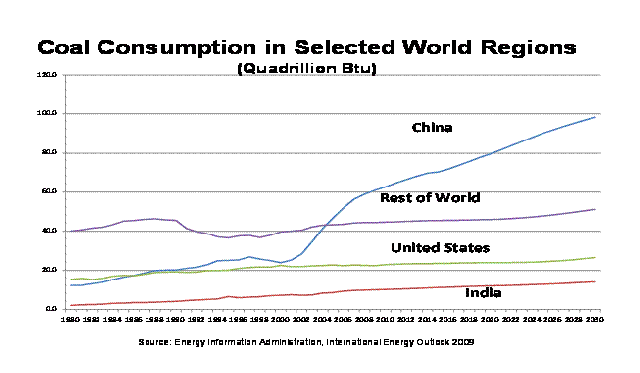
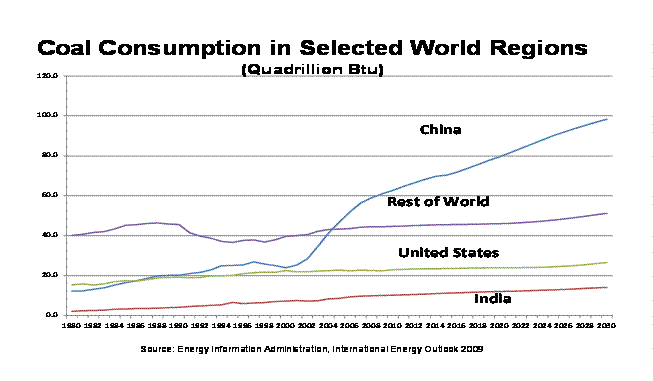
    China already consumes more than twice the amount of coal as the U.S., but by 2025, its coal consumption is expected to be 3.7 times larger than ours[I1] . Reports suggest that China is building two coal-fired electric generating plants a week,[5] while the U.S.’s coal-based generating construction program is stymied by EPA reviews, re-reviews and legal delays. Forecasters have shown that under the climate change legislation currently working its way through Congress, U.S. coal consumption will be severely reduced and replaced by nuclear and renewable generating technologies, which are more costly forms of energy. And while China has professed that it will meet renewable generation goals, it will not partake in meeting targets for greenhouse gas reductions that will hurt its projected economic growth and its future status as a major world power.[6] Instead, China is willing to make reductions in greenhouse gas intensity (greenhouse gas emissions per unit of GDP), a measure proposed by the U.S. almost a decade ago, that allows for both economic growth and lower emissions per unit of GDP from improved efficiency and technology.[7]
    clip_image002

    Let’s compare energy consumption in China and the U.S. today to each country’s projected consumption in 2025. Data for 2006 is taken from the Energy Information Administration’s (EIA) International Energy Annual (IEA)[8] and the forecasts are taken from EIA’s International Energy Outlook (IEO)[9] for 2009. [10]clip_image004
    China’s Renewable Energy Production

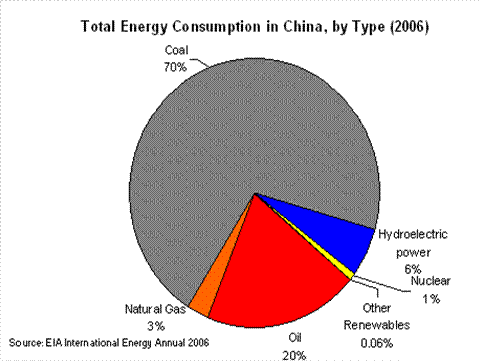
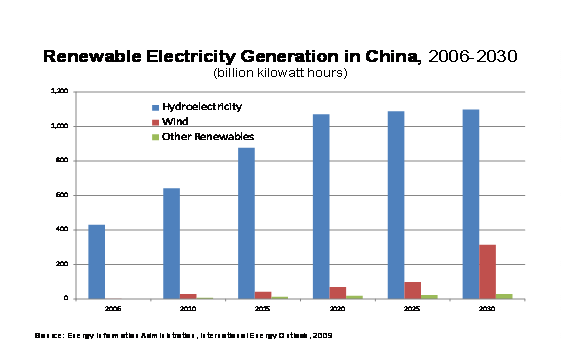
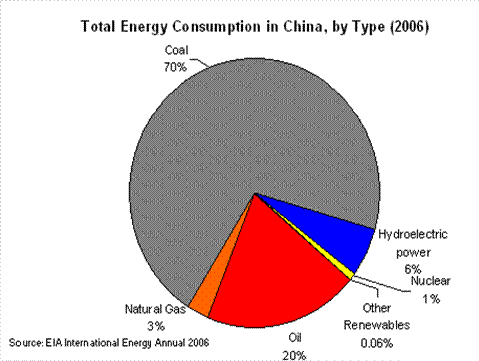
    China’s energy consumption today is dominated by coal, which supplies 70 percent of its demand, followed by oil, which supplies 20 percent. Renewable energy in China is largely hydroelectric power, particularly from the 18,200-megawatt Three Gorges Dam project, whose final generator went on line in October 2008. This project is the largest hydroelectric undertaking in the world. China has other hydroelectric projects planned, totaling an additional 57,720 megawatts of new capacity that will come on line in 2009. China has established a 30,000-megawatt target for installed wind capacity by 2020 (15 percent of its energy needs), and is currently installing wind power at a rate of at least 3,000 megawatts a year.

    However, wind growth in China isn’t without its problems. The Wall Street Journal reports that China’s transmission network currently can’t absorb such high rates of growth in renewable energy. Last year, as much as 30 percent of China’s wind power capacity wasn’t connected to the grid.[11] As a result, more coal is being burned in existing plants and new coal plants are being built as backup to wind energy. Wind resources do not conform to the normal hours of peak demand and require flexibility in the transmission and distribution system to take down other generators when the wind blows. Unfortunately, coal-fired capacity was not designed to be quickly taken on and offline as the electricity from wind fluctuates. clip_image006
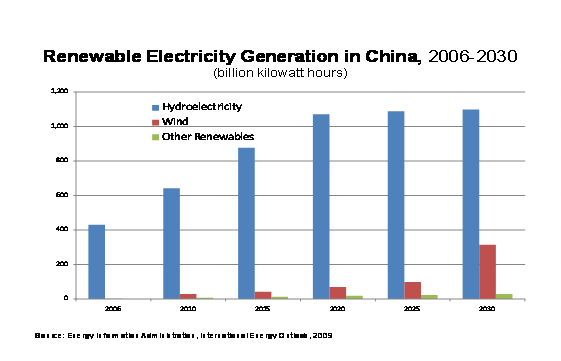
    China’s electric generating sector today relies on coal for 79 percent of its generation and EIA only expects that figure to drop to 75 percent by 2030. China’s generating sector is also investing in nuclear power. Generation from nuclear power is expected to increase by 570 percent by 2025, according to the EIA. That increase is equivalent to an additional 40 gigawatts of new nuclear generating capacity—a lower forecast than some, who are reporting 60 gigawatts of nuclear power in China by 2020.[12]

    China’s Liquid Fuels Consumption

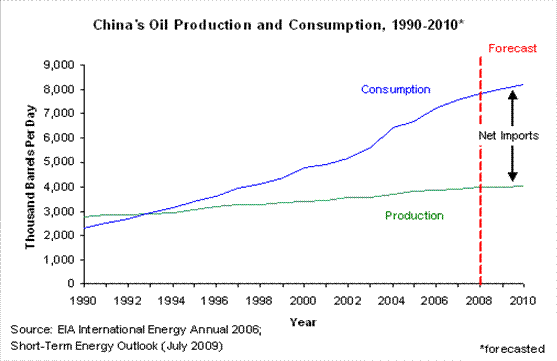
    China’s liquid fuel consumption is currently 7.2 million barrels per day, a rate of about a third of the United States. However, its projected growth far exceeds the U.S.; China is expected to increase its liquid consumption by 6.6 million barrels per day by 2025 (the largest growth of any country). At that time, China will consume about two-thirds of the U.S. level of liquids consumption. Unlike its vast coal reserves, China is not endowed with a lot of oil resources. Its oil reserves totaled 16 billion barrels in January 2009.[13] As a result, China has actively worked with other oil-producing countries (e.g. Venezuela, Angola). China has widely exchanged financial incentives for future access to oil supplies [14] including in U.S. waters in Gulf of Mexico.[15] China became the world’s second largest vehicle market in 2006, when sales exceeded those of Japan. In 2007, China produced nearly 8.9 million motor vehicles, an increase of 22 percent in production over 2006. China is the world’s third largest vehicle producer after the U.S. and Japan. The economic downturn reduced the growth in China’s vehicle sales to less than seven percent in 2008 and a lower rate is expected for 2009. Part of China’s economic stimulus package is expected to be used for infrastructure improvements in the transportation and electric power sectors.
    clip_image008

    China’s Natural Gas Consumption

    While China’s use of natural gas today is only at three percent, it is expected to triple its usage by 2025. Since China is not home to much of the World’s natural gas reserves (only 1.3 percent)[16], it will rely on imports to meet much of its natural gas demand. In 2030, EIA expects imports to make up more than one-third of China’s total natural gas consumption. To meet this growing need, China opened its first liquefied natural gas facility in 2006 and is expected to have a natural gas pipeline built by 2011 from Turkmenistan via Kazakhstan. Recently, Qatar has decided to divert around 10 percent of its liquefied natural gas exports to China from the United States because China is willing to pay more for the product.[17] It is a good thing that hydraulic fracturing has helped immensely to increase domestic U.S. supplies of natural gas, although the technology is currently being threatened by federal politicians, who are looking to restrict its use.[18]

    China’s Carbon Dioxide Emissions

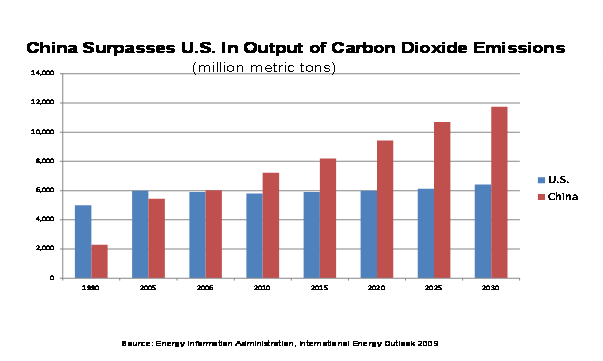
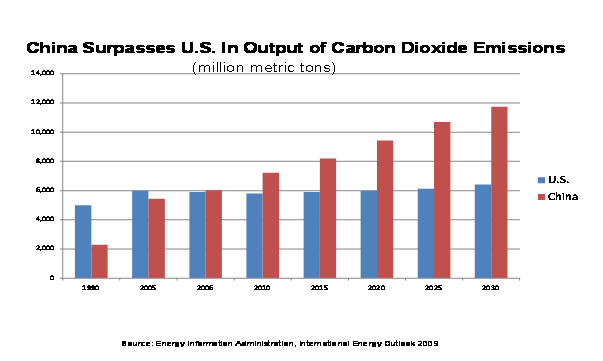
    As fossil fuels represent 93 percent of China’s current energy demand, it is not surprising that China ranks first in carbon dioxide emissions in the world, with 6,018 million metric tons released in 2006. By 2025, that number is expected to increase to 10, 707 metric tons, an increase of 78 percent from its 2006 value and 75 percent higher than expected carbon dioxide emissions in the U.S. in 2025.
    clip_image010

    Bottom Line

    China wants to become the world’s largest economic power, and China’s leaders understand the fundamental reality that abundant supplies of affordable, reliable energy are essential to economic growth. This is in stark contrast to the U.S. government’s actions to severely limit access to our domestic energy resources and the current proposals to tax carbon dioxide emissions from about 85 percent of our energy (oil, coal, and natural gas) through cap-and-trade. Unlike the United States, China is ambitiously pursuing energy policies to make sure its people have enough energy to grow their economy and make their lives better.


    [1] Paul Foy, Interior Secretary Sued for Revoking Utah Leases, ABC News, http://abcnews.go.com/Business/wireStory?id=7592093.

    [2] Daniel Whitten, Salazar to rewrite Bush oil-shale plan, Bloomberg News, http://www.chron.com/disp/story.mpl/headline/biz/6280852.html.

    [3] Jim Tankersley, Salazar puts expanded offshore drilling on hold, L.A. Times, http://articles.latimes.com/2009/feb/11/nation/na-offshore-drilling11.

    [4] Institute for Energy Research, President Obama’s Budget includes $1.6 trillion in new taxes—the largest tax increase in history, http://www.instituteforenergyresearch.org/2009/02/26/president-obama-budget-includes-16-trillion-in-new-taxesthe-largest-tax-increase-in-history/.

    [5] Roger Harrabin, China building more power plants, BBC News, http://news.bbc.co.uk/2/hi/6769743.stm.

    [6] Institute for Energy Research, Lost in Translation, http://www.instituteforenergyresearch.org/2009/07/28/lost-in-translation/.

    [7]http://online.wsj.com/article/SB125409730711245037.html

    [8] http://www.eia.doe.gov/iea/

    [9] http://www.eia.doe.gov/oiaf/ieo/index.html

    [10] EIA is an independent statistical agency within the U.S. Department of Energy that forecasts future energy outlooks for the U.S. and the world.

    [11]http://online.wsj.com/article/SB125409730711245037.html

    [12] http://www.eenews.net/Greenwire/2008/12/23/

    [13] “Worldwide Look at reserves and Production,” Oil and Gas Journal, Vol. 106, No. 48 (December 22, 2008), pp23-24.

    [14]Venezuela signed a $16 billion investment deal with China over three years. The deal could raise oil output by several hundred thousand barrels a day. http://www.eenews.net/Greenwire/2009/09/18/

    China National Petroleum Corp. received a $30 billion low-interest loan from a state-run bank to finance overseas acquisitions, Beijing’s latest bid to secure mineral resources to fuel the country’s burgeoning economy. http://www.eenews.net/Greenwire/2009/09/09/

    CNOOC and Sinopec have agreed to buy a 20 percent stake in an oil field off the coast of Angola for $1.3 billion, the latest in a series of Chinese acquisitions of overseas energy and mining assets. http://www.eenews.net/Greenwire/2009/07/20/

    [15] David Pierson, China’s push for oil in the Gulf of Mexico puts U.S. in awkward spot, L.A. Times, http://www.latimes.com/business/la-fi-china-oil22-2009oct22,0,2776603.story?track=rss.

    [16] “Worldwide look at Reserves and Production,” Oil and Gas Journal, Vol. 106, No. 48 (December 22, 2008), pp. 22-23.

    [17] Reuters, “Qatar diverts LNG to higher-paying China from U.S.”{, October 27, 2009, www.reuters.com/article/companyNews AndPR/idUSLR15622520091027

    [18] “States to U.S. Congress: Hands Off Hydraulic Fracturing”, May 19, 2009, www.energyindepth.org/2009/05/1005/