
Category: Internet
-
Netflix may change policies to prevent customers from sharing accounts
-
Google Now may be coming to Google’s homepage

-
Google chairman Eric Schmidt warns of ‘the dark side of the digital revolution’

-
Anonymous Organizes CISPA Blackout, Not Many Web Sites Show Up
The SOPA blackout protest was something else. Google, Wikipedia, Reddit and other major online players blacked out part or all of their Web sites in opposition to a proposed bill that would have given the U.S. government unchecked power to regulate the Internet as it saw fit.
Likewise, CISPA gives the government and corporations the ability to share your private information without a warrant and without much oversight. The bill has been met with some resistance, but not enough. The House passed it with relative ease, and now the fight will go to the Senate. Now everybody’s favorite (or most hated) hacktivist group wants to send the Senate a message with a blackout of its own.
Last week, Anonymous announced that it was organizing a CISPA blackout similar to the SOPA blackout of early 2012. Anonymous had hoped to coerce a number of Web sites into going dark today, but it only managed to get a little over 400 volunteers.
Getting over 400 Web sites to go dark for a day is no small feat, but it just doesn’t compare to the thousands that went dark in protest of SOPA.
Of course, a CISPA blackout could be effectual if Web sites frequently visited by millions of Internet users went dark. Unfortunately, the heavy hitters behind the SOPA blackout (i.e. Google, Reddit, Wikipedia) are refusing to go dark today in protest of CISPA. There are probably a number of reasons for this, but we can only guess at a few of them.
For starters, CISPA isn’t an immediate threat to companies. SOPA would burden Web sites with the responsibility of policing their own content. CISPA encourages companies to share private customer data with the government while granting them complete immunity from legal recourse. CISPA may not present any immediate threat to Internet companies, but Rep. Jared Polis argued last week that it would cause some pretty serious damage all the same:
“[CISPA] directly hurts the confidence of Internet users. Internet users – if this were to become law – would be much more hesitant to provide their personal information – even if assured under the terms of use that it will be kept personal because the company would be completely indemnified if they ‘voluntarily’ gave it to the United States government.”
The other thing standing in the way of an organized CISPA blackout is the organizers themselves. Even among anti-CISPA Web sites like Mozilla, Reddit and others, Anonymous isn’t exactly well-liked. The group’s intentions may be pure this time around, but there’s an argument to be made that CISPA was crafted in response to attacks from Anonymous and other hacking groups.
Anonymous’ planned blackout isn’t a failure, but it isn’t much of a success either. That being said, it at least shows that large groups of people are in opposition to CISPA. It might not be opposed by the teenagers who use Wikipedia to write term papers, but those in the tech community are rightly concerned about the overly broad legislation. It’s unfortunate then that Congress seems to think that only 14-year-olds living in their basements are the only ones opposed to CISPA.
[h/t: RT]
-
In Boston, a Week of Amateurs Ends in a Day to Thank Professionals
“They may be amateurs, but they’re lethal amateurs,” Tom Ridge, former secretary of Homeland Security, told Andrea Mitchell of the Boston Marathon bombers, hours after one suspect had been killed and hours before another would be captured.
In a way, this whole crazy episode was about amateurs. Amateur bombers, amateur sleuths, amateur reporters. But it was also a day for professionals: doctors, law enforcement, journalists. And despite making a few mistakes, there’s no doubt that in this case, the professionals came out looking much better.
In an apologia for Reddit on Techcrunch, Mike Masnick points out that both the amateur sleuths and the professional journalists made errors. And that’s true, especially on CNN (and others who claimed a suspect had been arrested on Thursday) and the New York Post (which published photos of innocent people Redditors had mistakenly identified as being suspects). But this is a false equivalency: media professionals also reported plenty of facts that were true. At places like the Boston Globe, NPR, NBC, and heck, even the Watertown Patch, professional journalists were getting it right. And as far as I can tell (and someone who followed the subchannel more closely can correct me if I am wrong) all Reddit really figured out was the logo on the black golf hat worn by one of the suspects. Hardly a coup. Worse, in some cases, crowdsourcing came dangerously close to — maybe even became — mobsourcing, accusing many innocent people of simply “being brown by a bomb,” as one critic succinctly put it.
It would be easy to make condescending remarks about the crowdsourced sleuthing in this case, and a lot of people have. To which I say: of course! They’re amateurs! Professionals, whether in law enforcement or in journalism, have training, experience, and expertise. Not that the public didn’t play a role; they played a very important one. Of course journalists rely on witnesses, and many witnesses relayed their first reports through social media, where anyone could read them. And law enforcement has relied on the public’s help since the days of the wanted poster.
Last night was no different: a huge break in the case came after a Watertown resident noticed something amiss in his boat. Seeing blood and that the shrinkwrap over the boat had been torn he did what was either the bravest or the stupidest — perhaps both — thing he’s ever done, and lifted the cover to discover the suspect. He promptly called in the professionals. They arrived with the sorts of tools only professionals have access to: helicopters, thermal imaging cameras, and robots.
Of course, the immediate aftermath of the bombing was an essential collaboration between the pros and the amateurs: citizens and trained first-responders alike rushed to help those wounded by the blasts. The difference there is that any of us may be able to stanch bleeding, at least a little, or keep someone conscious, or comfort someone wounded. But not any of us can amputate a leg, administer a blood transfusion, or surgically remove shrapnel. We don’t blame the amateur providing CPR for not being able to to perform surgery, and we should not blame the crowd for being unable to perform the job of the FBI. But we can blame them for spreading misinformation that causes innocent people to be hurt, spreads panic, or interferes with the ability of the professionals to do their jobs.Yesterday, for instance, many on twitter were listening to the police scanner and reporting what they heard as fact. As professional police-beat reporters know, there’s a lot of stuff on the scanner that turns out to be wrong. And while for a lot of truly sensitive information, the FBI uses an encrypted channel, there are risks to relaying the movements of police in real time. You could watch, in real-time, as one by one people on twitter listening to the scanner realized that they weren’t adding to the flow of information, they were actually muddying the waters with misinformation. They were learning, rapidly, a little of what it’s like to be a professional.
In a 2008 HBR article, Rakesh Khurana and Nitin Nohria define a profession thus:
True professions have codes of conduct, and the meaning and consequences of those codes are taught as part of the formal education of their members. A governing body, composed of respected members of the profession, oversees members’ compliance. Through these codes, professional institutions forge an implicit social contract with other members of society: Trust us to control and exercise jurisdiction over this important occupational category. In return, the profession promises, we will ensure that our members are worthy of your trust — that they will not only be competent to perform the tasks they have been entrusted with, but they will conduct themselves with high standards and integrity. On balance we believe that a profession, with well-functioning institutions of discipline, will curb misconduct because moral behavior is an integral part of the identity of professionals — a self-image most are motivated to maintain.
In an emergency, when so many of us are feeling like if we just had something to do, some role to play, some way to help, we’d feel so much better, it’s very tempting to jump into action. With so much information is freely available, it can even feel a little like we know what we’re doing. That can be dangerous.
Still, Masnick, in the TechCrunch piece, was right about one thing: the amateur-sleuthing, amateur-reporting genie is not going back in the bottle. But maybe next time we can be a little better at accepting that sometimes, the best way to help professionals is to simply get out of their way.
-
Anonymous calls for ‘Internet Blackout Day’ to protest CISPA [video]

-
Hulu reportedly hires firm to assist with sale

-
House Passes CISPA, Controversial Cybersecurity Bill Moves To Senate
During a vote in the House today, a majority of representatives voted in favor of passing CISPA for the second year in a row. Now the bill heads to the Senate where it will either live or die. Free Internet advocates and privacy proponents would much prefer the latter.
To recap, CISPA is a proposed bill that aims to boost the government’s ability to respond to cyber threats and cyber attacks by sharing private customer information between itself and companies. Its opponents claim the bill is a massive invasion of privacy that serves no use in combatting cyberattacks, but rather will be used to spy on American citizens by granting immunity to those companies that share information.
With CISPA’s passage in the House, the EFF vows to take its fight to the Senate:
“This bill undermines the privacy of millions of Internet users,” said Rainey Reitman, EFF Activism Director. “Hundreds of thousands of Internet users opposed this bill, joining the White House and Internet security experts in voicing concerns about the civil liberties ramifications of CISPA. We’re committed to taking this fight to the Senate and fighting to ensure no law which would be so detrimental to online privacy is passed on our watch.”
If history repeats itself, the EFF won’t have much of a fight in the Senate. CISPA died in the Senate last year as its members argued over its own law – the Cybersecurity Act of 2012. It was a marked improvement over CISPA, but it did have its own issues. The bill died after it failed a Senate floor vote and CISPA was never taken up.
For this year, the Senate will be debating the Cybersecurity and American Cyber Competitiveness Act of 2013. Like CSA, it’s a bit better than CISPA, but its lack of bipartisan sponsorship doesn’t bode well. It also doesn’t help that the bill still hasn’t even been picked up by its respective committee yet.
So, what happens if CISPA somehow makes its way through the Senate? It has to get signed into law by the president, and his administration just recently threatened to veto CISPA if it makes it to his desk. The administration suggested a number of common sense additions to CISPA that would make it far more pro-privacy, but the House ignored those suggestions. Now its up to the Senate to decide if it will actually listen to the thousands of people who are against CISPA.
-
Google Fiber: So fast that ‘the gap between you and Internet totally disappears’

-
CISPA Amendment Stripped Of Its Pro-Privacy Provision
We reported yesterday that CISPA was finally shaping up. Rep. Mike McCaul introduced an amendment late into the game that would have forced companies to share customers’ private information only with the Department of Homeland Security. It sounded too good to be true. Unfortunately, it was.ci
The Hill reports that the amendment we saw yesterday is entirely different from the amendment that actually wound up in the bill. The amendment has been stripped of its requirement that companies only share information with the DHS. With that requirement gone, the amendment is worthless. It’s only purpose now is to make it seem like CISPA actually respects your privacy.
Needless to say, pro-privacy groups are not happy. The EFF wrote a scathing review of the amendment last night:
The amendment in question does not strike or amend the part of CISPA that actually deals with data flowing from companies to other entities, including the federal government. The bill still says that: “Notwithstanding any other provision of law, a self-protected entity may, for cybersecurity purposes…share such cyber threat information with any other entity, including the Federal Government.” The liability immunity provisions also remain.
While this amendment does change a few things about how that information is treated within the government, it does not amend the primary sharing section of the bill and thus would not prevent companies from sharing data directly with military intelligence agencies like the National Security Agency if they so choose.
The amendment looks bad, and it will probably remain that way. That being said, there might be some changes made to it and the overall bill today before it heads to the floor for final vote. A House aide reportedly said that the sponsors of this latest amendment are in discussions to fix the language in it. If that was the case, why did they change the original text of the amendment that actually did some good? Are they just going to change the amendment back to what it was?
At this point, it’s hard to believe that we’ll actually see any positive changes in CISPA. After all, the bill’s sponsors believe that only 14-year-olds hate CISPA.
-
Google Fiber expands for second time this month, arrives in Provo, Utah

-
Google Fiber’s Next Stop May Be In Provo, Utah
Google Fiber is starting to pick up pace in Kansas City again, and Google is just starting to plan out its expansion into Austin, Texas. While all that’s happening, Google may be bringing its gigabit Internet service to another city.
Provo Buzz reports that the city of Provo, Utah may be next in line to receive Google Fiber. Their reasoning seems to stem from an official Provo city Web page that promises we’ll “be amazed.” City officials are reportedly saying it will an “epic announcement.”
So what makes Provo the more likely Google Fiber candidate over other past rumored locations like New York City? For one, Provo already has the Fiber infrastructure in place. The city has had a Fiber network for a few years now thanks to a project called iProvo. The project soon ran out of money, however, and transferred ownership to Veracity. After that, Veracity sold the network back to the city under a 14 month lease.
According to Provo Buzz, that lease is now just about up. This gives the city and Veracity the perfect opportunity to unload the costly fiber infrastructure onto Google who will then use it to offer Google Fiber to the citizens of Provo.
Of course, all of this is merely speculation for now. The city could be announcing something entirely different as there hasn’t been a single leak yet. There were numerous leaks before the announcements in Kansas City and Austin so it seems a little suspect that Provo could keep a Google Fiber announcement secret until today.
We’ll continue to watch the Provo Web site for any sign of Google Fiber. If the city announces an expansion today, we’ll be sure to let you know.
[h/t: DroidLife]
-
Patton Oswalt To Host 17th Annual Webby Awards
Comedian and social media superstar Patton Oswalt has been tapped to host the 17th annual Webby Awards. The Webby Awards, an award show presented by the International Academy of Digital Arts and Sciences, is one of the most prestigious internet-based award ceremonies. It’s often referred to as “the Oscars of the internet.”
The IADAS is made up of over a thousand member judging body that features high-profile public figures like Arianna Huffington, Vint Cerf, David Bowie, Biz Stone (Twitter), and Kevin Systrom (Instagram). Last year’s Webby Awards generated more than 1.2 billion media impressions.

There’s also a “People’s Voice” element to the voting, which you can check out here.
The ceremony will take place at Cipriani Wall Street on Tuesday, May 21st and will be available to watch on-demand the next day on the Webby Awards’ official site.
“Patton can out-nerd the nerdiest of nerdy nerds, and out-funny just about anyone,” said David-Michel Davies, Executive Director of The Webby Awards. “He’s the perfect Webby host.”
The Webby Award is handed out in various categories, including websites, advertising, online video, apps, and this year will introduce new categories based on “the social web.”
This year, Nike leads the pack with 17 nominations, followed by Google, The New York Times, and HBO with 12 each and NPR with 10. Music site Pitchfork and comedy site Funny or Die also lead the field with 8 and 7 nominations, respectively.
Patton Oswalt made headlines earlier this week when his Facebook and Twitter posts regarding the Boston Marathon attacks went viral.
-
Google Explores The Internet’s Impact On African Businesses
Google wants to see the power of the Internet better harnessed in Africa so that the economy across the continent improves.
The company discussed this in a post on its Europe Policy blog, and in this video uploaded to the Google Africa YouTube channel:
Google Africa sponsored a study from Dalberg Global Development Advisors exploring the Internet’s impact on Africa’s economy, which among other things, found that small and medium enterprises are “surprisingly optimistic” about the Internet’s potential. Over 80% of SME owners expect that it will help them grow their business, Google says.
“It reveals how Internet-enabled services are affecting the public and private sectors in agriculture, health, finance, education, governance, energy & transport, and SME growth,” writes Google Africa Policy and Government Relations Manager Ory Okolloh. “The report also analyses the pre-conditions for impact, looking at both business and ICT infrastructure as well as factors that influence how and why users get online. The findings are based on a survey of 1,300 organizations in Ghana, Kenya, Nigeria, and Senegal.”
“In addition, the report identifies big opportunities for cost savings as businesses shift to enterprise systems powered by the Internet,” Okolloh says. “For example, in Kenya the National Health Insurance Fund reduced its administrative costs from 60% to 32% by automating its claims processing, accessing real-time data and tracking payment processes. In agriculture, access to online information is creating price transparency, improving supply chain management and providing climate and growth data which ultimately reduces costs and increases farmer incomes.”
You can access the report here.
Google Executive Chairman Eric Schmidt recently predicted that the entire world will be on the Internet by 2020.
-
Rep. Mike Rogers Blocks Pro-Privacy Amendments From Being Added To CISPA
The House will vote on CISPA this week. This vote will decide whether or not the House majority thinks companies should be able to share your private online information with the government while enjoying total legal immunity. The second debate of the bill shows that the bill’s proponents don’t care about your privacy at all.
The EFF reports that CISPA went up for debate before the rules committee. During the hearing, congressmen were able to question the bill’s author, Rep. Mike Rogers, on the more troubling parts of the bill. The entire report is a little depressing as Rogers argued that CISPA has enough privacy protections already, and that the bill’s opponents are 14-year-olds living in their basement.
Those who questioned CISPA at the hearing had the same concerns that the White House expressed in its veto threat. The two main concerns were that not enough was being done to protect private information before it’s sent to the government, and that the bill doesn’t require the bill to go through a civilian agency first. Two valid concerns, and concerns that Rogers says are moot points.
In response to the first concern, Rogers says that identifiable information can’t be sent to the government because it’s all “zeroes and ones.” He seems to be under the impression that the government will be too busy scanning binary for cyberthreats that it will never collect any personally identifiable information from the content being shared with it either. Roger’s view displays a level of ignorance that shouldn’t be tolerated among Congress.
The second concern was framed in the context of how it would hurt the Web economy. Rep. Jared Polis said that allowing companies to share your private information with the government, including military agencies, would decrease the users’ trust in the Internet. He argues that online services would see a decrease in business thanks to decreased trust in their services:
This directly hurts the confidence of Internet users. Internet users – if this were to become law – would be much more hesitant to provide their personal information -even if assured under the terms of use that it will be kept personal because the company would be completely indemnified if they ‘voluntarily’ gave it to the United States government.
It appears that Rogers didn’t even provide a proper response to this concern. He just said that it wouldn’t be a problem and moved on.
Rogers’ response is why CISPA is so dangerous to begin with. Every concern that’s brought up is met with a simple response of “It won’t be a problem.” Such a response does nothing to dissuade fears. In fact, it makes us fear CISPA more if its author can’t even mount a proper response to its critics. In any other debate, arguing that a problem isn’t a problem without the proper evidence to back it up would be laughed off the stage. It’s apparently not only welcome, but encouraged, in the House though.
After providing non-responses to the concerns brought forward by other representatives, Rogers also blocked a number of pro-privacy amendments from making into the final CISPA that will go before the House for a floor vote. One such amendment came from Rep. Adam Schiff that would have automated the removal of identifiable information from data before it was shared with the government. In the current CISPA, the bill leaves it up to the government to remove any identifiable information after it’s already in their hands.
We’re likely to see a vote on CISPA today or tomorrow. The vote isn’t likely to last long, and Rogers will most likely attempt to just ram it through without any more debate. We’ll let you know how the vote went, but don’t expect good news.
-
Google chairman: Everyone on Earth will be connected to the Internet by 2020

-
Google’s Vint Cerf explains how to make SDN as successful as the internet
Vint Cerf, VP and chief internet evangelist at Google has a few regrets about the original design of the internet, but he’s hoping software defined networking may help right those wrongs. Cerf spoke at the Open Networking Summit Tuesday in Santa Clara, Calif., where he juxtaposed the creation of the internet and the evolution of the world wide web with the development of software defined networking.
He began with a rueful acknowledgment that back in the early 70s, when creating the addressing scheme for the internet, that 32-bits were enough. The point of the story — we ran out of 32-bit addresses two years ago — was to illustrate how the common knowledge at the time influenced the architectural decisions the creators of the internet made.
Yet, forty years later, the internet is still the valuable foundation of our communications infrastructure and Cerf hopes that in building out this next generation networks we learn a bit from the creation of the internet. For example he calls for the creation of open standards where differentiation doesn’t coming from companies patenting protocols, but rather from branding their services or branding their unique implementations of a standard protocol. That’s because interoperability is important for building networks that are stable and resilient. As Cerf said: “Stability is your friend in networking environments.”
“If you want things to interoperate standards are important,” Cerf said. “That’s not to say you can’t explore new ideas, but when you want something big to happen then you need to think about standards.”
In that same vein, Cerf also explained how as companies build out software defined networks they should consider the things that made the internet a success: the loose coupling of the gear that underlies the internet as opposed to heavily integrated and brittle solution; a modular approach allowing new companies to develop solutions that might work between layers in the stack; and open source solutions, which are recommended but not required.
SDN can build a web for the future.
Cerf then went into some of the opportunities that SDN can offer to improve some of the shortcomings of the internet. For example, the current way we route traffic relies on the network having a physical port to send a packet to, but the OpenFlow protocol changes the destination address from a physical port to a table entry, which enables a new type of networking. One that might be more suited to the collaborative web we’re building today.
Content based routing also could be an option — something we’ve covered at our Structure conference in 2011. In content based routing you take the content of a packet and use that to determine what to do with it. It turns routing into something that’s closer to the way Twitter works as opposed to how the U.S. Postal System does. For example you would look at the content of a packet and route it to people who said they want to receive that information. It becomes multi-cast instead of a one-to-one connection.
As for the core tenet of software defined networking, separating the control plane from the data plane, Cerf said. “I wish we had done that in the internet design, but we didn’t.”
But that also means people can build new networks that resemble older networks while sneaking in revolutionary new features. Cerf is excited about the ability of those building SDN products and networks to mimic the core functions of today’s networks in order to drive adoption but then introduce something new like content-centric routing. Or perhaps they can implement better security to protect people from identity theft, from inadvertently becoming zombies in a botnet attack or from any number of security threats that exists online.
Cerf is confident that SDN can help address those issues and more. He envisions using SDN to perhaps define areas where people can access intellectual property in a controlled manner that may prevent people from making illegal copies. SDN might also be a way to bridge the divides between different networks today.
He pointed out that when the internet was developed researchers built different networks depending on the medium, so a mobile network and a wireline network today don’t look the same to software running over those networks. You can’t run traffic seamlessly across both at the same time. With SDN you could.
He closed with a few examples of how SDN is helping Google, from its implementation of an intra-data center WAN to using software defined networks to boost the utilization of spectrum through tools like Google’s white space broadband database. This example, as well as the idea of creating a unified network using different medium, has me really excited to see what Google might do with its own fiber network and a corresponding Wi-Fi network.

Related research and analysis from GigaOM Pro:
Subscriber content. Sign up for a free trial.- The promise of SDNs in the enterprise
- Cloud and data third-quarter 2012
- Takeaways from the second quarter in cloud and data


-
Symantec highlights 58 percent increase in mobile attacks
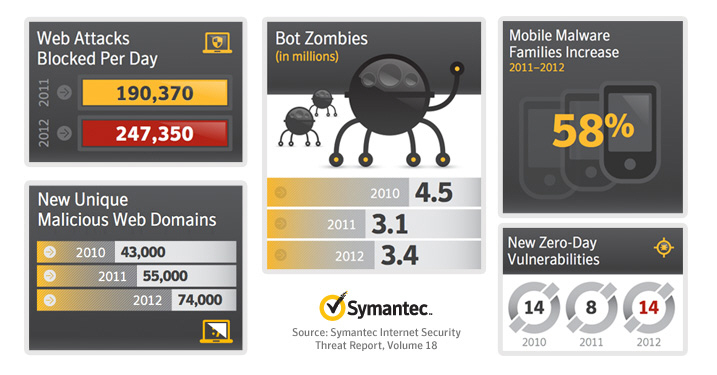
Security giant Symantec’s 18th annual Internet Security Threat Report is out today and reveals that cyber criminals are increasingly scouring the Web for personal details in order to target their attacks. Armed with your information they can exploit security gaps in social networks and other sites to infect your system or steal your details.

It’s not just your PC that’s at risk either; the report shows an alarming 58 percent increase in attacks on mobile devices with just under a third of these aimed at stealing data without the user’s knowledge. Android is the most targeted mobile platform as its open source nature makes it easier to hide malware in apps. The securer-than-thou smugness of Apple users receives a blow too as the report notes more than 600,000 Mac systems were infected by a single attack last April.
When it comes to types of threat, the growth of ransomware continues with infections becoming more aggressive and harder to undo. Another scary statistic is that 61 percent of malicious sites are actually legitimate websites that have been compromised so you may be at risk even if you think you’re practising safe surfing.
Symantec also highlights some common myths about security and you can read these as a handy infographic and access the full ISTR report here.
Norton’s security expert Richard Clooke said, “The report results have shown that it is still crucial for Norton to continue to educate consumers on how they can help protect themselves from acts of cybercrime. Ransomware, for example, a scam which disables victims’ computers until they pay a ransom, continues to be a key theme and is now becoming more sophisticated than ever…”
Of course all of this is aimed at boosting sales of Symantec’s security products, but it does underline that the threat landscape is an ever changing one and that we all need to be careful out there.
Photo Credits: Slavoljub Pantelic/Shutterstock
-
Anonymous hackers bring down North Korean websites for a second time

-
Sony-backed ISP shames Google Fiber, launches 2Gbps service in Japan
