Category: News

  • Zer01 Mobile ordered to pay $43 million to Global Verge

    Global Verge logo

    It appears that all of the cries of scam and vaporware about Zer01 Mobile have turned out to be true as the company has been ordered to pay $43 million to marketing firm Global Verge.  Zer01 must pay for breach of contract, tortious interference with contractual relations and long-term profit losses.

    Global Verge sued Zer01 and its CEO Ben Piilani late last year for breach of contract, claiming it had lent Zer01 over $170,000 to get the business going.  Piilani has 20 days to respond with an appeal, but that seems unlikely as he has all but disappeared.  Since Zer01 never really got off the ground, Global Verge doesn’t believe they’ll see much, if any, money from the judgment.  The company may be able to collect on some assets, such as a patent that Piilani and Zer01 allegedly applied for, but it’s unsure if the patent application was legitimate.

    Zer01 had planned to provide unlimited VOIP talk time and web use for $70 per month through AT&T’s network, similar to how an MVNO like Virgin Mobile operates.  The service also allowed users to sell products and services to others, and users were charged $40 per month for “back-office support” to help sell the service.  Many people claim that they signed up and paid for services and signed up others, but have yet to be compensated for their work.  Global Verge’s CEO Tim Robbins says that these claims are not true and that anyone who had signed up for Zer01 has already been given a refund.  Still, there have been 24 customer complaints, most about pyramid scheme activities, filed with the Missouri attorney general, where Global Verge is located.  Global Verge says its attorneys have responded to the claims, but the attorney general’s site says the opposite.

    As of now, Global Verge has moved on and has an agreement with Sprint to sell services under the brand GlobalMobile1.  The services will be sold exclusively by Global Verge members.  Also, it appears that someone has hacked the Zer01 website, so check it out here for a good laugh.

    Via PC World


  • Tesaro Nabs $20M Series A Financing for Cancer Drugs, $40M More in Reserve

    Tesaro logo
    Ryan McBride wrote:

    A team of cancer drug veterans has formed a new company in Boston. The company, Tesaro, says today that it has raised $20 million in a Series A round of funding from the investment firm New Enterprise Associates and its founders.

    Tesaro says it plans to acquire and develop cancer drugs and other oncology products. New Enterprise Associates, which has U.S. offices in Maryland and Silicon Valley, has led the company’s first-round financing and reserved an additional $40 million to support Tesaro as it progresses over time.

    The new company unites former top executives of the Minnesota-based drug company MGI Pharma, which had R&D operations in Lexington, MA. The Japanese pharmaceutical firm Eisai bought MGI in 2008 for $3.9 billion. Mary Lynne Hedley, the co-founder and chief scientist at Tesaro, previously led MGI’s and then Eisai’s research labs in Lexington. She also co-founded Zycos, a Massachusetts-based biotech startup, where she was CEO when MGI bought the firm in 2004 for $50 million.

    Hedley was not immediately available this morning for an interview. (Here’s a story I wrote about Hedley a few years ago when she won an award from Mass High Tech.)

    Tesaro’s founding team includes CEO Lonnie Moulder, who was chief executive at MGI before the Eisai buyout. Rick Rogers, another former MGI executive, is Tesaro’s financial chief. Before launching their newest cancer drug venture, Moulder, Rogers, and Hedley were executives for the Los Angeles-based cancer drug firm Abraxis Bioscience.

    It’s not clear from Tesaro’s website whether it has yet acquired any cancer compounds for clinical development. The firm was just formed in March, so it’s possible that the company hasn’t assembled a pipeline. Now, at least, we know that the firm has the money to go shopping for drug candidates it can develop.

    UNDERWRITERS AND PARTNERS


  • Fleet Week 2010 in New York City – Starts May 26

    May 26 marks the start of Fleet Week in New York City. It’s the time where we find many uniformed sailors wandering the the city’s streets. These sailors and their big ships visit Manhattan. Fleet Week only happens in New York City. Fleet Week is filled with activities – open houses on some of the ships, a variety of military demos and a very special tribute that will be held on Memorial Day – to respect these sailors. The New York City bars chime also offers an abundance of special drinks called “Fleet Week Drink Special” for our Navy or Marines. “Top Gun” starring Tom Cruise have a free screening on the flight deck of Intrepid.

    This celebration is made to give the armed forces in New York the chance to unwind and relax. USMC Sgt. David Donaldson said, “The beautiful things is people here love us so much, and they truly appreciate us.”The week’s celebration ends on June 2. So before the celebration ends make sure that when you see these men or women in uniform walking through the streets of New York, give thanks to their efforts, dedication and dangerous sacrifices – a simple  handshake or a pat on a shoulder  would mean so much to them.

    Related posts:

    1. May 26th is the Start of The 2010 Fleet Week
    2. Pirates Timeout: Maritime Coalition Forces Storm In To Save Russian Oil Tanker
    3. Sandra Bullock’s new life in New Orleans

  • Oklahoma voters to decide on health care opt-out amendment

    Photo source or description

    [JURIST] The Oklahoma House of Representatives [official website] on Tuesday voted 88-9 to put a constitutional amendment purporting to exempt state residents from the federal health care law [HR 3590; JURIST news archive] on the November ballot. The vote comes after the Oklahoma Senate [official website] voted 30-13 [roll call, PDF] in favor of the ballot initiative earlier this month. The legislation would ask voters whether they wanted to add an amendment to the Oklahoma Constitution [text] prohibiting “forced participation in the health care system.” If approved, the amendment would exempt state residents [press release] from any penalty for failing to purchase health insurance, according to the bill’s sponsors. Most Americans will be required to purchase health insurance by 2014 under the health care law. In a statement , state Representative Mike Thompson (R) [official website], a sponsor of the bill, described the effort as a “shield … from a federal takeover of our health care system,” and stated:

    SJR 59 is the answer to Oklahoma citizens about opting out of Obamacare. … What this legislation does is it empowers the voters to make the decision whether or not they want a single payer system implemented on them. … [T]his legislation builds upon the state constitution … [which is] the first line of defense for a state.

    The ballot initiative comes after the Oklahoma Senate failed to override a veto by Governor Brad Henry (D) [official website] of a bill that would have attempted to statutorily exempt state residents from the individual mandate provision of health care reform. Henry cited [veto message] the costs of litigation, could jeopardize health care funding from the federal government, and the inability of a state to “selectively ignore federal laws of its choosing,” as reasons for the veto. The bill would have also allowed state legislators to sue the federal government to overturn the health care reform law.

    Oklahoma joins Florida and Arizona in placing similar constitutional amendments on the November ballot. On Monday, the Obama administration filed a brief [JURIST report] urging the dismissal of a lawsuit brought by Virginia challenging the constitutionality of the individual mandate provision of the health care reform. Earlier this month, the National Federation of Independent Businesses (NFIB) [association website], a small business lobby group, joined a separate lawsuit [JURIST report] challenging the health care reform law. The NFIB joined 20 states in a suit that began in March when a complaint seeking injunction and declaratory relief was filed [JURIST reports] in the US District Court for the Northern District of Florida [official website]. Among the allegations in the suit are violations of Article I and the Tenth Amendment of the US Constitution [text], committed by levying a tax without regard to census data, property, or profession, and for invading the the sovereignty of the states.

  • Warren, Head of TARP Oversight Panel, Criticizes Bailout of ‘Frankenstein’ AIG

    Today, the Congressional Oversight Panel for the Treasury’s Troubled Asset Relief Program, headed by Elizabeth Warren, is holding a set of hearings on failed insurer AIG. Warren takes AIG to task for its blatant disregard for sound practices. “The company was a corporate Frankenstein, a conglomeration of banking and insurance and investment interests that defied regulatory oversight,” she says in her prepared remarks.

    But she hits even harder at AIG’s regulators and the government’s extraordinary intervention. “[AIG’s] complexity, its systemic significance, and the fragile state of the economy may all arguably have been reasons for unique treatment. But no matter the justification, the fact remains that AIG’s rescue broke all the rules, and each rule that was broken poses a question that must be answered,” she argues.

    AIG’s regulators and regulations failed the American taxpayer, Warren says. And thankfully, the House and Senate reform bills create a much better process for monitoring systemically important firms and winding them down if they falter — a process designed precisely as a response to the wildly expensive and unruly bailouts of companies like AIG.

    Now, firms like AIG need to author their own “funeral plans,” telling the government how to unwind them. Additionally, the reforms clarify the government’s process for deciding a firm needs to be shut down and then doing it, wiping out shareholders, firing management and giving counterparties haircuts. (There are differences between the House and Senate bills on the resolution authority front, differences that will be worked out in conference committee. The biggest difference is that the House bill has a $150 billion liquidation pool, funded by big financial firms. The Senate bill instructs the government to recoup its costs after the fact.)

    Here is a fuller clip of the remarks from Warren, a bankruptcy professor at Harvard Law School:

    When a company digs itself so deeply into debt that it cannot escape, our legal system provides a set of strict and simple rules to force the business to bear as much of the cost of its mistakes as possible and to minimize the impact on others. Of these rules, two are paramount. First, the business’s owners — its shareholders — lose everything. Second, the business’s creditors — including its bondholders and counterparties — lose money, and depending on how deep the hole, they could lose a great deal.

    The rules may seem harsh, but they are fundamental to the functioning of a free market. After all, the parties that gain the most when a business succeeds should also lose the most when a business fails.

    I open today’s hearing by listing the rules of bankruptcy because we are about to examine a bankruptcy that broke all the rules. In fact, the rescue of the American International Group was so extraordinary that it bypassed the entire legal process of bankruptcy. In saving AIG, the government invented a new process out of whole cloth, a parallel set of rules devised and executed for the benefit of only one company.

    By the time the federal government intervened in late 2008, AIG was a poster child for the need for a well-functioning bankruptcy system. Its stock price had plummeted 79 percent in only two weeks. The sharp decline in mortgage-linked asset prices and the failure of Lehman Brothers had led to staggering collateral calls from AIG’s counterparties, and AIG simply did not have enough cash on hand to keep its doors open.

    The next steps would ordinarily have been straightforward. Under the rules that applied to everyone else in America, AIG’s shareholders should have lost everything, and its creditors should have taken substantial losses. Yet even today AIG continues to trade on the New York Stock Exchange, and no creditor has lost a penny on its dealings with the company.

    Put another way, under the rules that applied to everyone else in America, the costs of AIG’s mistakes should have been borne by AIG and its partners. But under this new, ad hoc set of rules, the costs of AIG’s mistakes were borne by the rest of us – the American taxpayers.

  • Plummeting Marijuana Prices Create A Panic In California

    Via Prison Planet.com » Prison Planet

    Cryptogon
    Wednesday, May 26, 2010

    Understand the purpose of the drug war with just one story. Hint: Law enforcement is used to keep supplies down and prices high.

    So what changed?

    California is broke and the state government wants a cut of the action.

    Plummeting Marijuana Prices Create A Panic In California 130510banner3

    Via: NPR:

    For decades, illegal marijuana cultivation has been an economic lifeblood for three counties in northern California known as the Emerald Triangle.

    The war on drugs and frequent raids by federal drug agents have helped support the local economy — keeping prices for street sales of pot high and keeping profits rich.

    But high times are changing. Legal pot, under the guise of the California’s medical marijuana laws, has spurred a rush of new competition. As a result, the wholesale price of pot grown in these areas is plunging.

  • Growing Number Of Americans Dislike Elena Kagan

    Via Prison Planet.com » Prison Planet

    Rasmussen Reports
    Wednesday, May 26, 2010

    Voters have an increasingly unfavorable opinion of Supreme Court nominee Elena Kagan but are more convinced than ever that she will be confirmed by the U.S. Senate.

    A new Rasmussen Reports national telephone survey finds that 41% of U.S. voters now hold a favorable opinion of Kagan but 47% view her unfavorably, up from 43% a week ago and 39% just after President Obama announced her nomination.

    Growing Number Of Americans Dislike Elena Kagan 140410banner4

    These findings include 15% with a Very Favorable opinion and 23% who regard her Very Unfavorably. This, too, marks a shift from the first survey when Kagan’s Very Favorables were 18% and Very Unfavorables were 17%.

    By comparison, the president’s first Supreme Court nominee, Sonia Sotomayor, maintained favorables around 50% through the first three surveys following her selection, with unfavorables falling to 40%.

    Full story here.

  • The Next Two Years for the World Economy

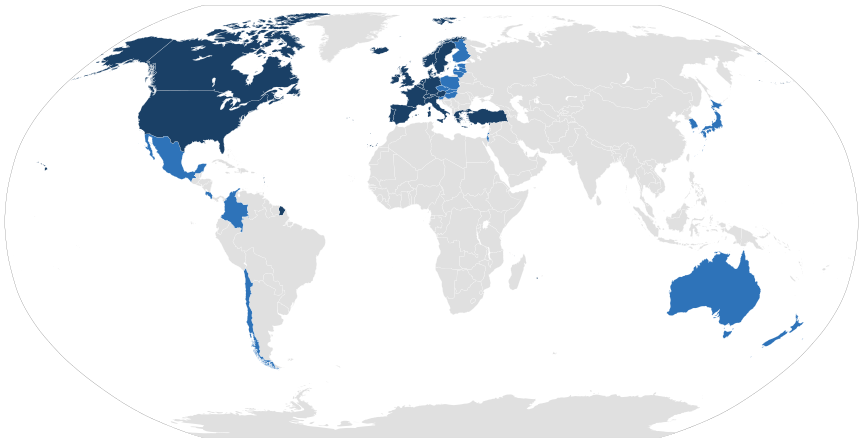
    The OECD has released its economic outlook (pdf) for the United States, Japan and the entire OECD member states (map here). The report projects GDP growth, inflation, unemployment and other stats out through 2011. One broad takeaway is that, in a reversal of fortune, strong recoveries in “emerging” nations like China and India will help fuel demand for goods in next few quarters. It should be noted, however, that as Europe’s debt crisis makes the dollar strong, it hurts the competitiveness of our goods abroad.

    GDP growth in the U.S. is projected to slow in each quarter of 2010, and unemployment is expected to average 9.6 percent in the last few three months of the year. That’s bad news. But it could be worse.

    The Eurozone is in for a horrible two years. It’s hard to create jobs with GDP below 2 percent, and that’s exactly what the OECD projects: Sub-two percent growth for a year between mid-2010 and mid-2011, during which time unemployment will climb above 10 percent. Without monetary stimulus from the European Central Bank, fiscal austerity plans throughout Europe will only cut more public jobs, take more private cash and reduce demand throughout the continent. It will be a rough retrenching.


    Email this Article
    Add to digg
    Add to Reddit
    Add to Twitter
    Add to del.icio.us
    Add to StumbleUpon
    Add to Facebook


    United StatesOrganisation for Economic Co-operation and DevelopmentEuropean Central BankGross domestic productEurozone

  • Motorola Shadow Spotted in the Wild…Again

    Engadget is reporting that the handset in the picture above is none other than the same Motorola Shadow we’ve been hearing about this week.  The image comes courtesy of the very same person who released the “Getting Started” manual for said handset.  User ‘wnrussel’ of Howard Forums allegedly has the Shadow in hand and is leaking some specs of the phone to the public.  Remember, these are unconfirmed but match some of the rumors about the handset:

    • 4.1 Inch Screen, no word on type from wnrussel
    • Ti Omap 3630 processor, in otherwords a 720 MHz Arm
    • 8 gig internal storage
    • 8 MP Camera

    We’re also pretty excited over the HDMI-out port found on the handset in the bottom side corner.

    BTW: This looks almost exactly like the renderings that first popped up backed in January, don’t they?

    Might We Suggest…


  • Bristol Palin Harper’s Bazaar June 2010 Pictures

    America’s Most Famous Teen Mom is featured on the pages of the June issue of Harper’s Bazaar Magazine. Bristol Palin, now 19, says despite her messy and public breakup with beefcake baby daddy Levi Johnston, she’s confident she’ll one day find a man who will love her and embrace her son Tripp, 1.

    Things are certainly looking up for the oldest daughter of GOP cheerleader Sarah Palin. Bristol recently inked a deal with Single Source Speakers and will command up to $30,000 for speaking engagements. In addition, Bristol also works as a medical assistant and serves as an ambassador for The Candie’s Foundation to fully support herself and her baby.

    Harper’s Bazaar captures an intimate family scene with Bristol and Tripp in a tea party-themed fashion spread, snapped by celebrity photog Danielle Levitt and featuring gowns by Carolina Herrera, Lanvin, Isaac Mizrahi, and Michael Kors.

    Take a look at Bristol’s life as a single mom in the latest edition of Harper’s Bazaar, on newsstands June 1.

    Bristol On Getting Pregnant At 17: “It’s not like we all sat down and were like, ‘Alright, here’s the birds and the bees.’ Truly, my parents just assumed that I wasn’t doing anything. And it was a shock for us all. It was kind of humiliating. . .Great, I’m 17 years old, I’m 40 pounds overweight with a big belly on me, all my friends are at school watching this on the news. This kind of sucks.”

    On Being A Working Single Mother: “I’m on my own. I’m really proud of it. I’m a hard worker.” “I don’t have time for friends or anything like that. It’s just like, Right, crap, there is a hockey game tonight that I want to go to but I can’t. Or, I do have to go to work today, because I’ve got bills to pay.”

    On Levi Johnston: “He is a stranger to me. It’s just dirty laundry.”

    On Dating: “I’m in no rush. One day I’ll find a nice guy.”

    On her son Tripp: “I thought I would be somewhere warm at college with my friends, but that was definitely not possible with having Tripp. I love my baby more than anything. He’s like a Gerber baby. He’s the cutest baby in the whole world…I just want Tripp to be happy and healthy.”


  • Iran and Russia clash in worst row for years

    Via Prison Planet.com » World News

    Reuters
    Wednesday, May 26, 2010

    TEHRAN/MOSCOW, May 26 (Reuters) – Iran and Russia clashed on Wednesday over Kremlin support for draft U.N. sanctions against the Islamic Republic, in one of the worst rows between the two powers since the Cold War.

    The public clash indicates growing concern in Tehran after the United States said Russia and China, the closest thing Iran has to big-power allies, had agreed to a draft sanctions resolution to punish Iran over its nuclear programme.

    In unusually strong criticism of Russia, President Mahmoud Ahmadinejad admonished the Kremlin for bowing to what he said was U.S. pressure to agree sanctions and bluntly warned President Dmitry Medvedev to be more cautious.

    Iran and Russia clash in worst row for years 150410banner1

    “If I were the Russian president, when making decisions about subjects related to a great nation (Iran) … I would act more cautiously, I would think more,” Ahmadinejad said in a televised outdoor speech.

    He said that Russian support for the United States was unacceptable and that Moscow should rethink its decision or face being viewed as an enemy by Tehran.

    Within hours, the Kremlin’s top foreign policy adviser dismissed Ahmadinejad’s criticism, telling the Iranian president to refrain from “political demagoguery”.

    Full story here.

  • Bentley-Built Shooting Brake is a Possibility—Maybe

    The latest company to tease wagon-lovers (that includes all members of the Car and Driver staff—it’s in our contracts) is, of all companies, Bentley. And no, we’re not talking about the Continental-based Flying Star wagonette (above) that debuted at this year’s Geneva show and was subsequently made available to interested parties by Italian coachbuilder Carrozzeria Touring Superleggera. While chatting with Stuart McCullough, VW Board Member in charge of Bentley, at the launch of the company’s new 2011 Mulsanne flagship, the subject of new models came up. We discussed the possibility of even more derivatives of the Continental such as the Flying Star, and he stated that the idea of a shooting brake (car-speak for two-door wagon) Bentley is not at all out of the question.

    “We have an idea in the back of our minds that we may yet bring to market,” McCullough said. Furthermore, he told us that the design that’s been kicking around for a little while goes “a lot further” than the Touring-built concept, and would be entirely Bentley from conception to assembly. Yeah, we like the idea too.

    Don’t get too excited, though. The Continental is nearing the end of its life span and it is unlikely that Bentley would be able to make a business case to develop, verify, and source materials for a ninth Continental model (yes, there are currently no fewer than eight Conti models on the market). It is far more likely that Bentley would use its resources to develop more derivatives of the aforementioned Mulsanne, such as a convertible and a coupe. And even if they were to build a wagon, it would be a shock to see it offered here. As C/D executive online editor Erik Johnson said to me upon hearing of Mercedes-Benz’s decision to build the Shooting Break concept just as BMW stated that it would not offer the gorgeous new 2011 5-Series wagon in America, “It seems that whenever a new wagon appears, another one goes away.” In other words, we’re used to being disappointed and we expect that McCullough’s little morsel will never see the light of day on our side of the pond. But we’d be happy to be proven wrong.

    No related posts.

  • Galaxy S available in Asia come June, Froyo comes later

    Do you like your screens crisp, but your phones a little less wavey? Do you like teh Gigahertzes, but are fearful of dragons?

    Well, I’m happy that you’re so sure of yourself, but I’m even happier that the Galaxy S ticks all of your boxes AND will be released sometime in June!

    But calm down a sec, mmmkay? There is something more I need to tell you. First of all, the June release is for Asia only at this point.

    Second of all, the price won’t be cheap: 1098 Singaporean dollars, to be exact (which is about 780 US dollars). Steep, considering a very similar HTC Desire runs for S$898, but reasonable, considering this is the only Android phone with a Super AMOLED screen.

    Also, while a date hasn’t yet been announced, Amazon.de do have the device up for pre-order for a very similar €649 (790 US dollars), so all you eager Europeans will be able to join the party soon, too.

    All this comes on top of the news from CNET that the device will receive that tastiest of Android desserts, Froyo, sometime in the near future.

    Great news all ’round, really.

    [via Engadget]


  • Rahm Emanuel invites Israeli Prime Minister Netanyahu to White House next week

    WASHINGTON–The White House on Wednesday confirmed that President Obama chief of staff Rahm Emanuel, in Jerusalem, invited Israeli Prime Minister Benjamin Netanyahu to the White House next week. Emanuel issued the invitation during a meeting with Netanyahu.

    The meeting will take place on Tuesday. Netanyahu will travel to Washington from Canada. U.S. Special envoy George Mitchell was in the region earlier this month shuttling between Israelis and Palestinians for “indirect” peace talks.

    Emanuel flew to Israel for the bar mitzvah of his son.

  • More on Why We Shouldn't Bail Out the Multi-Employer Plans

    Something I meant to write yesterday, but forgot, is that there’s considerable moral hazard if we allow multi-employer plans to segregate the employees of now-defunct companies.  As one of my commenters wrote:

    The multi-employer plans are treated differently from the single-company
    plans precisely because there is an expectation of the births and
    deaths of employers in the marketplace. They are common in industries
    like the garment industry, the construction industry and the trucking
    industry,where companies come and go frequently.

    There are a whole bunch of reasons for this birth and death cycle which aren’t particularly germane to our discussion.  But one thing that is worth noting is that it’s not uncommon for owners to serially start companies, or have three or four companies operating under the control of a single owner.  If you segregate the pensions of defunct firms, it seems to me that you may get a whole bunch of creative corporate bankruptcies so that the government can take over all the old pensions.

    It’s also important to note that this is not simply a disaster created by corporate bankruptcies or other market exit.  As the same commenter notes:

    The pension laws that govern the multi-employer plans already provide
    very specific guidance on how pension fund deficits are to be handled.
    In the non-construction multi-employer plans ( construction plans are
    treated somewhat differently),the unfunded liability actually belongs to
    the employer in proportion to his percentage of the fund’s hours over
    the last five years. That liability should actually be booked each year
    and becomes a clear balance sheet liability if there is ever a transfer
    of ownership. Since the companies have equal representation on the plan
    management boards, the rules were devised to give the companies a very
    direct stake in the state of the fund and to discourage excess pension
    awards.

    In the non-construction world,when a company withdraws
    from the marketplace or goes bankrupt,its share of the unfunded
    liability is immediately due and payable. And the fund trustees have a
    fiduciary responsibility to see that what is owed is paid.

    So
    what is the problem that Senator Casey is trying to solve? Did the
    trustees of the plans fail to collect what is owed or assert claims in
    bankruptcy? Did they allow the failing companies to avoid paying their
    routine contributions? Did the trustees fail to keep an eye on what
    companies are getting themselves in trouble? Did the company auditors
    ignore this liability? Did the company executives conceal it from their
    auditors and bankers? Were the executives negligent in even asking about
    it? Many people may be liable, but that is no excuse for a bail out.
    And if this is a bill just to solve the problems of one giant employer,
    why did they let things get so bad that the problem arose in the first
    place? Why wasn’t this problem sorted out in collective bargaining?

    There
    is no question that a lot of multi-employer plans have seen a growth in
    unfunded liabilities since the stock market crashed. But they have also
    seen substantial recovery since. And now they have to tell companies
    what each has as a share of unfunded liabilities,to further reinforce
    attention to the issue.

    Now it may be that companies have left
    the marketplace. If new union employers have come into the marketplace
    there is no problem,since the contribution base hasn’t changed. If the
    marketplace has gone open shop, then the plans have to either get more
    money in the door from each remaining company and employee or cut the
    pensions to fit the money available.

    The problem, in other words, is that the pension funds did not accrue adequate assets to cover their liabilities, a problem which in some cases seems to rise to gross negligence.  Now those long deficiencies have to be made up by the companies that are still in business, including those that weren’t around when the worst of the underfunding occurred.

    The problem that Casey is trying to solve is that the plans with the worst unfunded liabilities have trouble recruiting new members–both because companies fight hard to avoid “helping”, and because workers are now getting statements showing what terrible state the pension fund is in.  Naturally, the Teamsters would like the government to pick up the tab for their previous poor management, and Senator Casey is, as always, only too happy to help.  But whatever your view on unions, it cannot be true that every single thing the unions want is a good idea.  Just as support for some forms of deregulation does not imply that companies should also be able to dump toxic swill into public waterways, support for unionization should not imply that unions can screw up their pension fund management and get the government to make up the difference whenever the underfunding becomes too noticeable. 

    If a company had done this, it would have to declare bankruptcy, and make way for more competent businesses.  Maybe the Teamsters should do the same.

    Update:  a correspondent points out that it’s even worse than that.  UPS and the Teamster’s both had a big veto over companies that didn’t keep up their contribution, or the kinds of aggressive accounting tactics that result in underfunding.  Now the union is essentially selling out the workers of non-bankrupt employers (who, as I understand it, may get less than they were promised) in order to help out UPS.


    Email this Article
    Add to digg
    Add to Reddit
    Add to Twitter
    Add to del.icio.us
    Add to StumbleUpon
    Add to Facebook


    BusinessPensionStock marketSenator CaseyInvesting

  • OLEDs are the future: Canon buries development of SEDs

    Remember SEDs? Those surface-conduction electron-emitter displays were around for quite a while, competing with FEDs (field emission displays) until Sony decided to pull the plug on the latter back in March last year. That gave one company, Canon, enough of a push to continue to believe in SED. Canon even filed new patents on SED technology in the US in May 2009. But that’s over now (we kind of anticipated this as early as December 2008).

    Canon yesterday decided to freeze development of SED technologies, mainly because the company was unable to push down production costs to an acceptable level. The plan to establish SED as the next standard for flat TVs also proved to be more difficult than expected because Canon faced a lawsuit based on their work with SEDs in the US (the picture shows a Canon SED prototype from 2008).

    Toshiba left a joint venture with Canon that was aimed at developing SEDs in 2007 already. Now if only the hardware makers would focus on producing affordable OLEDs (Samsung Mobile Displays’ Sang-Soo Kim said this week he expects OLEDs to be the standard for flat TVs in about five years).


  • Review: Android 2.2 (Froyo)

    Froyo 1

    Who doesn’t love a little frozen yogurt? While our own Nate Allen may enjoy Costco’s froyo more, you and I are all much more interested in the less edible kind. Android 2.2, or Froyo, is a huge update for Google’s market-sweeping operating system. While it may not look very different to the untrained eye, it definitely has some underlying changes that really make a difference when you begin to use it.

    If you follow my Twitter feed (@BBCasper), you will know that I’ve been flaunting my Froyo for roughly three days. Google announced Froyo at their I/O conference last week on May 20th, and started rolling Froyo out to review devices on the 22nd. Since the Nexus One is now the “Google” phone and does not have any direct ties the supporting carrier, when Google releases Android 2.2 officially (to the public, not review devices), the OTA updates will go directly to the devices. Of course, until that time, the wonderful hackers of the Android world have graced us with a rooted version of Froyo to help calm the impatient masses.

    Froyo 2

    Home Screen

    The first thing you will notice when you upgrade to Android 2.2 is the modified home screen. Before there was solely a square icon at the bottom of the screen for the application drawer. Now on the left of the icon is a phone icon, to the right is a browser icon, and to the far left and far right of the screen you will see a marker that shows what screen you are currently on. Personally, I love this setup. Before, if you wanted quick access to the browser and/or phone on your home screen, you would have to setup some icons on your home screen. This modification more efficiently uses the home screen and makes some of the more commonly used features of the phone more quickly accessible.

    Froyo 3

    Task Switcher

    Another thing that you might notice that looks a little different is the most recent tasks page. Prior to the 2.2 update, when you long press on the home button of your Android device, the last six applications you have used will appear in the middle of the screen as shown below. With froyo, they have changed this page from six to eight of the most recently used applications. Honestly, between six and eight applications I don’t care, but it is a change nonetheless. These minor changes plus the addition of a Market widget are essentially all of the visual changes in Froyo, but the real changes lie underneath, hidden within the settings and within a few applications that need to be downloaded.

    Flash

    Possibly the most anticipated update brought in Froyo is (nearly) full flash support. In Android Market, you will see the newly available download for Flash Player 10.1 BETA. I must say, it works exactly like it should. Mind you, it is still in the BETA phase and does have some minor issues, most websites that run any standard flash will render quite well on my Nexus. Sites like Hulu are quirky, complicated, and different. They will not work yet, unfortunately. In all honesty, flash is very important to me; I don’t plan on watching any flash videos within my browser. It is very cool to have and a nice bell or whistle (whichever you consider it to be), but it is not a make-or-break factor to me. For many, it is, and I’m glad to see the Android development team working with Adobe to make it happen.

    Tethering

    The other long-awaited update found in Android 2.2 is the built-in wireless and wired tethering, a carrier’s nightmare. Being on an unsubsidized device, there isn’t a lot AT&T or T-Mobile can do to the Nexus One updates. When other phones such as the Motorola Droid or the HTC Desire get this update, the carrier will more than likely remove that feature and try to force you to pay their $30/month (it may vary) tethering fee. For those of you that load custom ROMs onto your device, you will likely see this in the various ROMs that will soon flood the Android forums. I’ve been using both wired and wireless tethering for some time now, and it is definitely a cool feature to have. It’s nice for those emergency situations that you may need internet on your computer, or when you’re in the middle of an online quiz for one of your classes and your home internet goes out; not that I would know anything about that.

    Install apps on SD card

    Undoubtedly, my favorite function of Android 2.2 is the ability to move your installed applications to your SD card. As of right now, there is no support for this within the applications. For the impatient (me), there is a workaround to enable this feature, which I took the liberty of doing to my phone. I will include some information about that if you are interested in it at the bottom of this review. The official version will require the developer to decide whether they want to allow the installation of their application on the SD card or not. In a way this is good and in another, just as bad. It can help the prevention of the piracy of paid applications (along with some encryption I read about), and some applications simply will not work from the SD card. What I have found from manually enabling the moving of applications to the SD card is that any application that has a widget will not work if installed to the SD card. Initially, the widget will work until you mount your phone to your computer, or unmount the SD from the phone. At that point, you will have to reinstall the application again before you will be able to add the widget back to your home screen. Hopefully this will not be the case when the developers enable the SD card support, but for now I can live with my widgets and applications containing widgets being saved to internal memory.

    Market

    Within the Market application, there have been some tiny improvements, but they go miles in my book. The first thing that you will notice upon viewing application details in Market is that the comments are no longer visible in the initial application about page. There are now two tabs at the top of the page, “About” and “Comments.” I love the separation as it is now much easier to view more comments on an application and everything is just ever-so-slightly more organized. The next major update to Market is the ability to update all applications at once. Rather than updating each individual app at a time, you can now press “Update all” at the bottom of the Downloads page to quickly update all applications that need updating. Before, you would have to click on each application, select “Update”, then select “Ok” just to update one app. That got to be very frustrating considering how often Android developers update their applications.

    Car Home

    From what I can tell, the changes to the Car Home app are nothing beyond aesthetics. Although, nothing major has changed, Car Home is now very slick looking, and much easier to use. Bigger buttons make for easier use while in the car, and the way it works flows more like Android than it did before. It used to be a curved line flowing across the screen in a fancy layout. Now, it’s much more simple, but looks heaps better, and you have two screens that you can slide between, but like your home screen. Also, if I do recall correctly, the old version of the Car Home acted more like an application. This new version is more like a temporary home replacement for in-car use. When you press the home key, it takes you back to Car Home. Before, (this is where I could be wrong because I rarely used it) I believe it took you back to your home screen.

    Call Logging

    Another intuitive change is the call log. Before, the call log would list every call you made or received, one after another. The change was rather smart in a “save screen space” kind of way. Now, the calls are grouped by contact and day. Although, it may be a tiny change, it was the little, insignificant details that turned me into a BlackBerry fiend. I’m glad to see that Android is now starting to focus on the little things and refine their gold mine of an OS.

    Miscellaneous

    Along with all of the major updates, there are some minor changes that have been made within the general settings in 2.2. One of these more minor changes is the ability to better customize when you want to enable/disable vibrate. You now have the options to enable it always, never, only in silent mode, and only when not in silent mode. Also, you have more options for passwords now as well. Rather than just pattern lock and you have the choice between a pin, a alpha-numerical password, and a pattern lock. There are also some other changes that have been made in the security department, but I’m not fully aware of their significance. Again, these are all part of the tiny details that refine an OS and make it more and more reliable for the end user.

    Verdict

    Rather than dragging this out any further and putting everyone to sleep, I will get straight to the point. Froyo is exactly what Android needed. They were already climbing the ladder to the top of the cell phone industry, and Froyo is just another rung in that ladder. It tells us that the Android development team is focused on what matters and is heading in the right direction. I’ve been using Sense UI on my Nexus and the stock ROM (rooted) for a while now. I loved them both, but after using Froyo, I will not be looking back anytime soon. It is lightning fast, more reliable, and overall more refined.

    Even the multi-touch is more reliable. I’ve been using the Swype alternative keyboard since I got my Nexus One. After updating to Froyo, I installed Swype again, but have ultimately been using the stock Android keyboard. It seems to be much more accurate and easier to type with that what I can remember.

    With huge upgrades like Flash support, built-in tethering options, and application storage on external memory, Android has swept the carpet out from under the competition. Mind you, the carriers are not going to be too accepting of the tethering options, it does show us that Google has a more consumer-friendly mindset than carrier-friendly, which is amazing.

    So far I have only encountered three tiny handicaps to Froyo. First and foremost, no application support for the application storage on the SD is a little disheartneing. I’m aware that it is coming, but like I said before, I am impatient. When it does finally make it to my Nexus, I hope the widget issue will be resolved. The second drawback is definitely the open availability of one of greatest features of 2.2 being restricted by carriers. Meaning, only people with an unsubsidized Android phone (Nexus One) will get to reap the full benefits of Froyo. For everyone else with a carrier branded device, those carriers will play their cards and bully the customers like they’re known for doing. Last, some applications seem to not want to work with 2.2. This is nothing more than a developer updating their application, but it was a tiny little hiccup that got on my nerves. At least when all the developers do update, I can update all of my applications at once. 😀

    One thing to expect is that if you do not have a Nexus One, your version of Android 2.2 will be slightly changed by each carrier. The Motorola Droid will probably (don’t hold me to this) keep its stock app drawer since it didn’t get the cubed one with its 2.1 update. Hopefully minor things like that won’t ruin your day when your 2.2 update does finally come. We all hope 2.2 comes sooner rather than later, and rolls out much more quickly than 2.1 did is.

    If you want a hands-on look at Froyo, you should head on over Andrew’s (from DroidDog) YouTube channel for his three part series on Froyo. Acsteffy87’s YouTube channel can be found here.

    If you were one of the ones interested in manually enabling application storage on your SD card here are the two ways to do it.

    (Note: PhoneDog is not responsible for any damages you may incur to your phone during this process. Only do this if you know what you are doing.)

    1. Using a computer:

    • Connect your Froyo’d phone to a computer and open command prompt. (I’m only fluent in the world of Windows. For Mac and Linux users, you will have dig deeper to figure out how to connect to ADB or try option 2.)
    • Go to the directory where you have the Android SDK installed on your computer. (IE mine is at C:\Casper\Documents\Android\android-sdk-windows\tools)
    • Type these commands: adb shell [Enter] pm setInstallLocation 2

    2. Using a Terminal Emulator on your phone: (Must be rooted)

    • Download the application Terminal Emulator from Market.
    • Open the application and type: su [Enter] pm setInstallLocation 2

    3. To disable the application installation to SD card repeat the process but exchange the 2 with a 1.


  • The Privacy Changes Facebook Needs to Make Today [Facebook]

    This afternoon, Facebook will announce the privacy changes they’ve been promising over the past several weeks. And while all we know so far is that the fix involves simplified settings, here are the adjustments they’d be crazy not to make. More »


    FacebookPrivacySocial networkSecurityOnline Communities

  • TaskFacade adopted by new developer, now optimized for HTC HD2

    Task Facade TaskFacade is absolutely the most attractive Windows Mobile task manager, and has been doing “cards” long before WebOS got the idea.

    The app has been in somewhat of a limbo, with the last developer no longer working on the project.

    Spacepants has decompiled the .Net code and have now released an optimised version of the app for the HTC HD2.

    See the changelog below:

    4.02 changelist:
    1. Fixed a memory leak that occurred when an app was started and closed outside of Task Facade.
    2. Cleaned up Layout config page.
    3. Cleaned up config file loading to minimize potential errors due to old and incompatible config files.

    4.01 changelist:
    1. Increased maximum number of frames for zoom-unzoom animation.
    2. Added an optional sleep between frames to smooth out animation and reduce amount of resources used by the app.
    3. Fixed a minor race condition which sometimes caused an updated icon to flash through just reactivated app.

    Download the cab and read more in this XDA-Developers thread here.

    Via XDA- Developers.com