Category: News

  • Scosche flipSync puts your iPhone charger on your keychain

    We’ve all been there. You’re out and about. You look down at your iPhone, and the battery indicator is screaming. No sweat; you’ll just pop into your favorite spot and charge up. But wait! You forgot your charger at home! How are the honeys gonna hit you up on the two-way if the two-way is dead?

    The Scosche flipSync, released today, solves all of our dead two-way (I’m seriously going to call it that from now on. Or at least the rest of this post.) problems, without bulking up your bag.

    As if the gents up above don’t do a fine enough job explaining it: the flipSync sits on your keychain, and takes up about the same amount of space as a car remote. Pop it apart, and you’ve got a full-fledged iPhone (or microUSB, if you go that route) charger. It goes on sale this afternoon at Best Buy for $20 a pop. Expensive? A bit — but remember: you’re doing it for the honeys.

    Two-way.


  • Kim Kardashian Hires Matchmaker

    The eternally-single Kim Kardashian is seeking professional help in her quest to find a new man to hitch her famous caboose to.

    At 29, pals squeal that the unlucky-in-love reality stunner has become “desperate” to get hitched again before she hits 30. In typical Kardashian form, Kim’s taken a huge step in obtaining that goal, , if a tabloid scoop featured in the May 31 issue of In Touch Weekly is to be believed.

    A celeb-gawker claims: “Kim has hired a professional matchmaker to help her find love. She wants to find a rich, successful businessman to date, but she doesn’t have much time to meet men, so she’s turning to a professional.”

    Kim is hoping a Los Angeles-based wingwoman will help her find a “committed-minded, respectful mate.” The star certainly hasn’t had been very successful on that front in recent years. Her first marriage to allegedly abusive music producer Damon Thomas ended in divorce. Then her relationship with R&B crooner Ray J was ripped about by the controversy surrounding their infamous sex tape. More recently, Kim split from Super Bowl champ Reggie Bush — a rumored womanizer.


  • Q&A: Chris Groves–Exploring Underground Water Systems in Mammoth Cave

    Chris Groves takes Circle of Blue’s creative director, J. Carl Ganter, on an exploration of one of the world’s most iconic karst regions.
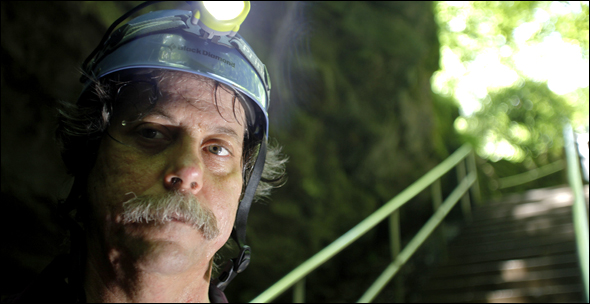
    Chris Groves a world renown cave and limestone karst expert

    Photo © J. Carl Ganter / Circle of Blue
    Chris Groves, director of the Hoffman Environmental Research Institute at Western Kentucky University, explores Mammoth Cave, the longest known cave system in the world, in early May as two-day floods damage nearby Nashville, Tennessee.

    Welcome to Circle of Blue Radio’s Series 5 in 15, where we’re asking global thought leaders five questions in 15 minutes, more or less. These are experts working in journalism, science, communication design, and water. I’m J. Carl Ganter. Today’s program is underwritten by Traverse Internet Law: tech savvy lawyers, representing internet and technology companies. In early May 2010, Nashville, Tennessee, was drowning. The Grand Ole Opry and the entire downtown was under water following torrential rains. But not far away–near Bowling Green, Kentucky–researchers were going underground into caverns carved through solid limestone by eons of water flow. They wanted to get a sense of how an ancient cave system was behaving as the rains fell above. So, deep down, in Mammoth Cave, I joined Dr. Chris Groves, a world renown cave and limestone karst expert who directs the Hoffman Institute at Western Kentucky University. I follow him on a tour of tunnels, water, and a bit of history.

    How far underground are we?
    Chris Groves: Right here, roughly probably 250 feet–something like a 20 or 25 story building of more or less solid rock above us.
    So, we’re underground in Mammoth Cave. While it’s raining up above in water events, we’re deep down in the karst system in Kentucky.
    Chris Groves: Actually, this is the only bathroom we’ll pass. Anybody need to use the restroom: either of you?
    No, I’m good.
    Chris Groves: We’re coming up here to a …. most of the cave’s been very dry, and one of the issues here that surprises people in Mammoth Cave is that you expect to see a lot of stalactites and stalagmites and such, and you just don’t see them here, for the most part. And that’s because the geology is such that there’s a waterproof sandstone layer over top that prevents water from coming down, but we’ll come up to a hole in that pretty soon. It’s more of waterfalls coming up. What’s a little different than normal is that we have gotten quite a bit of rain in the last few days here, and–I think somewhere exceeding ten inches, but I’m not really sure of the exact amount–but this is probably the most rain we’ve had here over a similar period of time since, probably for 25 years.

    Just as we’re coming down here in River Hall at Mammoth Cave is the lowest level that are on the public tours, and you can see how the floor’s kind of dark. There’s actually kind of a bathtub ring right here, so this is the highest that the water’s got just in the last couple days and now apparently is receding. This level here that you can see, this is about 45 feet higher than the normal “low” water condition. You see some of the water’s still pooled up. In fact, those benches are usually lined up along the side. They’ve apparently been floating in a lake, and that’s their position as the lake receded. You can see also these–what look like giant rulers, that are essentially giant rulers–those are kind of an old fashioned version of the methods that they used to look at the water levels during the floods. Now, actually, there’s computers that are measuring with probes back there, but just from looking at those, they saw that it was up to 45 feet.

    The last time it got up here was up to right about here. . . was in 1984, so we’re real close to it. I have some data from a study in a river in another part of the cave, where it flooded in 1997, where it rained a little bit less than this one, and we have data from there that the river rose about 94 feet in 12 hours–including rising about 24 feet per hour at one point. And 1997 was here. That tape up there was from 1984. Then on the point of that rock up, there there’s actually some tags up there from 1937. So it’s definitely a very dynamic system in here.

    So up above, we have a very dynamic water system and we forget about what’s happening down below, often times.
    Chris Groves: Well, water drains downhill, just like in a bathtub. And here, what’s a little different is that downhill is not necessarily down the side of a mountain or in a river, but here–because the ground is so dissolved out–it’s literally going straight down into the ground. So the nice thing here in Mammoth Cave, and other caves in south central Kentucky and other areas, is that we can actually go into the aquifer and just see for ourselves what it looks like and sample water and really kind of learn about it first-hand.
    What are some of the things you learn when you’re down here?
    Chris Groves: Well, the big issue here is that we’re in a National Park–which is pretty much the most highly protected land that the Government has in terms of land use–so you’d think that the water would be pristine, just because it’s mostly forest above the surface here. And the cave is, as we know now, so remarkably vast that the passages extend far beyond the boundaries of the National Park. In some cases, these are the upstream ends of some of the underground rivers that are drained in agricultural land. So there’s septic tanks, animal waste, fertilizers, and what have you.
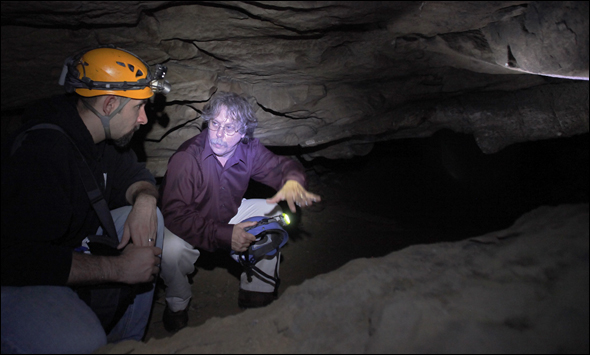
    Exploring Underground Water Systems in Mammoth Cave

    Photo © J. Carl Ganter / Circle of Blue
    Jason Polk, professor of karst, climate change and environmental policy at Western Kentucky University and Chris Groves discuss the quality of the water that flows inside the cave. A steady stream of scientists from around the world also come each year to visit the famous site, according to Groves.
    So tell me about the water quality: we’ve got a whole flow, we have a whole other world up above us–what’s flowing below us?
    Chris Groves: Well, we can see actually two different sources of water here. There’s the river below us–actually where it’s back flooded–and that’s actually from the Green River outside that’s back flooding into the Cave. Then this waterfall that’s in front of us is draining just the local area above us. And it’s very likely that the water that we’re seeing in this waterfall is probably, really, pretty good quality. That’s because it’s drained in a forested area in the National Park. There may be some impact from the visitors and the roads and such, but it’s pretty minimal here. Unfortunately, the water that we can see at the bottom of this shaft here–because that’s actually coming from a combination of water back flooding from the Green River and also the cave streams that are coming into it, and in some cases areas that are draining outside the National Park and agricultural land–that water at the bottom is probably pretty poor quality with various agricultural chemicals, primarily fecal bacteria from human and animal waste, and that water down there may exceed drinking water standards by tens of thousands of times for fecal bacteria. This time of year, we have an issue with an herbicide, Atrizine, which is widely used for corn production here. That has very, very, very low levels allowable in drinking water. There’s quite a bit of controversy regarding the use of Atrizine, these days. During the spring is when they apply it in the fields here, and so we typically get a pretty big slug of it coming through the ground water here, and in some cases, does exceed the drinking water standards.

    We’ll take a little side trip up here that’s pretty cool. So what happens here is that this is the place where the sandstone over top has been removed by erosion–so this waterproof cover has been removed so that you can hear all the water coming down through waterfalls, especially with the rainfall. Now if you look here, this is a bottomless pit–obviously not quite bottomless, since that’s about 90 feet–in fact, it doesn’t look as deep as it usually is because the water’s so high; it’s actually flooded back. I’m not sure, that water may be 20 feet deep? You can make the trip now; you can dive in there just like in Acapulco? I’ll hold your camera if you want, Carl–if you want to try it.

    Any of these side passages we’re seeing pretty frequently. . . some of these just extend for miles and miles and miles. One thing about this is that the Cave here is not a pretty dangerous or difficult cave to explore.–I mean, it is because it’s so vast; there’s definitely very remote sections of it–but of all the hazards, this idea of flooding is really the most potentially hazardous issue.

    One of the most famous cave explorers was a guy named Stephen Bishop in the 1830’s and 1840’s. He really got very interested in the Cave and made really very significant discoveries. Everything that we’ve just seen from the lower levels that we’ve just been in–Green River Hall and Mammoth Dome–he discovered. One of the stories is that right across here, what we’re seeing is a bottomless pit, he had come to this point from the main entrance up to here in the 1830’s sometime and had gone across the pit to the unexplored passage to our right and apparently had come with either a cedar pole or some kind of ladder, depending on which story you hear, and set it right across here where we are and made the first trip. During the subsequent trip, he discovered Mammoth Dome, where we came down the steps, and River Hall, the actual river that we didn’t get to see because it’s flooded. In fact, there, when he discovered the underground rivers down there, he was the first person to see the eyeless fish that are quite well known for Mammoth Cave. This was a place of great adventure, apparently.

    This waterfall runs continuously, but a lot of times–during drier conditions–it’s just a little drip, drip, drip. Here it’s flowing pretty well because of the rainfall we’ve had.

    So, Mammoth Cave holds a pretty important position in karst research–tell me a little bit about that.
    Chris Groves: Yeah, very much. One thing that’s distinctive is that, by far, it’s the longest known, most extensive known, cave in the world. The length of somewhere close to 370 miles, all of which has been measured foot by foot with measuring tapes and compasses. Here’s some more shafts, just like the big ones we saw. These are little ones that are bringing in water. Those, in fact, form independently of the main cave; this was actually an underground river, forming in these big passages that we’re in. Now that river is down by River Hall, where we were before; it’s down several hundred feet lower than where we are. These shafts are just formed from drips that are coming down through the rock from the surface where some little streams are sinking.
    So when we look at karst regions around the world, this is what they look like down deep.
    Chris Groves: Yeah, this is an example of one. There’s so many different kinds, it really depends on the details of the geology and climate and such. This is certainly one of the quintessential examples. In fact, because it’s the longest cave in the world, there’s a huge amount of interest in it among cave explorers and scientists. I think really since I’ve been working at the University, I’ve probably been in the Cave with people from at least 30 countries. The way I look at it, there’s a list of iconic karst areas–Slovenia, the home of the word “karst,” places in south China–there’s a certain set of really iconic karst places for people that are really into it, that are just on your checklist of must see places. Absolutely, this is one of them. And so we’re really lucky at the University that, because of that, there’s a relatively constant stream of major cave scientists from around the world that are just continually coming through here. It’s really a great resource for us and our students.
    The Center of the Earth?

    Photo © J. Carl Ganter / Circle of Blue
    Mammoth cave is sometimes referred to as a limestone labyrinth because of its numerous passageways and shafts, like this 90-feet-deep pit pictured above. It is a “quintessential” karst region that has helped inform people from similar regions, such as in China, according to Groves.
    So, globally, how does the research here affect how we manage freshwater resources in other parts of the world?
    Chris Groves: We’re obviously studying local phenomenon and collecting our data at this place or that place, but what we’re really trying to achieve is to learn about the way these landscapes and aquifers function in a way that transcends just the local details so that we can learn about things and ideas and ways of thinking that we can apply to karst landscapes more widely. Through the 20th century, and even continuing, there’s a good bit of work that’s been done here by various people that has really helped people understand how karst aquifers and landscapes function–not just here in Mammoth Cave, but how they function generally. There’s a lot of lessons that have been learned here that have really informed people around the world. We’ve done a lot of exchange, where my colleagues and I spend a good amount of China, and Chinese colleagues are coming over here. It’s not just a technology transfer through professional publications and such, but through a lot of just personal interactions. I think there’s a lot of information about methods and understanding about karst that really is informed by work that’s taken place here, relationships that have been established.
    Great. Well, Chris, thank you.
    Chris Groves: My pleasure, Carl.
    We’ve been speaking with Dr. Chris Groves, who is Director of the Hoffman Institute Research Center for Environmental Studies and karst around the world. He’s also Professor of Geography at Western Kentucky University. Thanks for joining us for another broadcast of 5 in 15 at Circle of Blue. I’m J. Carl Ganter.

    Our theme is composed by Nedev Kahn, and Circle of Blue Radio is underwritten by Traverse Legal, PLC, internet attorneys specializing in trademark, copyright, and patent infringement litigation.

  • Show Steve Jobs and Eric Schmidt Making Nice [PhotoshopContest]

    The battle between Apple and Google is heating up! It’s safe to say that the dueling CEOs of Jobs and Schmidt aren’t on the closest of terms right now. But why all the negative energy? Let’s show them making nice. More »


  • Arctic double stunner: Sea ice extent is now below 2007 levels, while volume hit record low for March – Summer poised to set new record

    NSIDC 5-20-10

    While the anti-science crowd scours the globe desperately looking for any indication of their imaginary cooling, reality has intruded again.

    Because they and the media — and even some scientists who don’t follow the subject closely — tend to take a two-dimensional view of the Arctic, they along with much of the public have been fooled into thinking the Arctic “recovered” in the past two years because sea ice extent appeared to recover.  Heck, some even claimed last month the Arctic ice was “recovering” to the 1979-2000 average.

    Climate Progress readers have long understood that trends in multi-year ice — ice volume — are what matter most in terms of the long-term survivability of the Arctic ice in the summer (see New study supports finding that “the amount of [multi-year] sea ice in the northern hemisphere was the lowest on record in 2009″).

    CP readers have also understood that Arctic volume did not recover in the last two years.  Quite the reverse — we appear to have been breaking volume records over the past several months according to the Polar Science Center:

    Total Arctic Ice Volume for March 2010 is 20,300 km^3, the lowest over the 1979-2009 period and 38% below the 1979 maximum. September Ice Volume was lowest in 2009 at 5,800 km^3 or 67% below its 1979 maximum.

    That is, in September, PSC says we saw the lowest volume ever, and in March, we saw the lowest volume for that month, according to their Pan-Arctic Ice Ocean Modeling and Assimilation System (PIOMAS).  Cryosphere scientists I have spoken to say PIOMAS is best for showing long-term trends, and they do recommend the caveat that it is a model, and so conclusions should be viewed accordingly.  That said, as the website shows, the analysis has been validated.

    I would also note that even the sea ice area measurements are based on remote data that must be interpreted using models.  A recent study, “Perennial pack ice in the southern Beaufort Sea was not as it appeared in the summer of 2009” by Barber et al. suggested that satellite (and other) measurements of Arctic sea ice extent were apparently deceived into OVERestimating summer sea ice extent in 2009:

    In September 2009 we observed a much different sea icescape in the Southern Beaufort Sea than anticipated, based on remotely sensed products. Radarsat derived ice charts predicted 7 to 9 tenths multi-year (MY) or thick first-year (FY) sea ice throughout most of the Southern Beaufort Sea in the deep water of the Canada Basin. In situ observations found heavily decayed, very small remnant MY and FY floes interspersed with new ice between floes, in melt ponds, thaw holes and growing over negative freeboard older ice. This icescape contained approximately 25% open water, predominantly distributed in between floes or in thaw holes connected to the ocean below. Although this rotten ice regime was quite different that the expected MY regime in terms of ice volume and strength, their near-surface physical properties were found to be sufficiently alike that their radiometric and scattering characteristics were almost identical.

    Last week, Arctic explorers again reported conditions they did not expect:

    A group of British explorers just back from a 60-day trip to the North Pole said on Monday they had encountered unusual conditions, including ice sheets that drifted far faster than they had expected.

    The three-member team walked across the frozen Arctic Ocean to study the impact of increased carbon dioxide absorption by the sea, which could make the water more acidic and put crucial food chains under pressure.

    Expedition leader Ann Daniels said the ice drifted so much that they eventually covered 500 nautical miles (576 miles) rather than the 268 nautical miles initially envisaged.

    One possible reason for the rapid drift was a lack of ice, she suggested. Satellite imagery reveals rapidly melting ice sheets in the Arctic, a region which is heating up three times more quickly than the rest of the Earth….

    “None of us had ever experienced that amount of southerly drift on our previous expeditions, and it continued for such a long period of time. We kept expecting it to stop, we began to pray it would stop,” Daniels said….

    Many scientists link the higher Arctic temperatures to the greenhouse gas emissions blamed for global warming….

    Ah, those blame-mongering “many scientists.”  Seriously, Reuters, can’t we get something just a little better than three hedges — “many” and “link” and “blamed”?  Can’t we get by with, say, just one friggin’ hedge?  (Plus that sentence as written makes no sense — The higher temperatures are the same as global warming)

    How about “Many scientists say the higher Arctic temperatures are from global warming caused by greenhouse gas emissions”?  How about no hedges:  “Climate scientists say the higher Arctic temperatures are from global warming caused by greenhouse gas emissions.”

    The story continues

    “We spent a couple of days walking on ice that was three or four inches thick with no other thicker ice around, which was a big surprise to us,” he told the news conference….

    Last month explorers at the team’s ice base some 680 miles (1,100 km) further south reported a three-minute rain shower, which they described as a freak event.

    It’s time to stop being surprised by the fact that the ice is so damn thin — see my May 2009 post, North Pole poised to be largely ice-free by 2020: “It’s like the Arctic is covered with an egg shell and the egg shell is now just cracking completely.”

    And it’s time to stop calling extreme weather “freak events.”  But I digress.

    The PIOMAS analysis appears to be the best volume model around, and here is their latest anomaly graph:

    PIOMAS 5-10

    Note:  “Anomalies for each day are calculated relative to the average over the 1979 -2009 period for that day to remove the annual cycle.” The sharp drop at the end is not to a record low absolute level of ice volume, but to apparent record low for the month.

    So, will we see a record low area and record low area this year?

    One cryosphere scientist I e-mailed who doesn’t want to make predictions on the record thinks we’re on track to beat last year’s area and hit the 2008 level — unless we get the same kind of weather pattern that we had back in 2007, in which case we would set the record and perhaps by a very large margin.  Note that although we are apparently below 2007 sea-ice area now, we aren’t at the record low area for this month (click here).

    The volume record seems more probable given where the sea ice extent is now compared to 2007 and how much less volume we appear to be starting with right now.  Of course, the sea ice extent is more visible and anything less than the record of 2007 will no doubt be dismissed by some.  But at least with the the Polar Science Center work, we will have a nearly contemporaneous, well-validated model to track the volume.

    I still like my odds on a 90% ice free Arctic by 2020 (see “Another big climate bet — Of Ice and Men“).

    [Note:  Any reader who is good at data graphing, please email me here.]

  • MPEG-LA Gearing Up To Go Patent Nuclear On Google’s Decision To Release Open Video Standard

    It’s no secret that MPEG-LA, the private company that handles patent pools for a variety of digital video standards, including the widely used H.264 — and recently began dabbling in patent trolling, has suggested that there can be no digital video without licensing patents from its patent pools. And, of course, there were just rumors (kicked off by a Steve Jobs email), that MPEG-LA was gearing up to sue any “open” video standard out of existence. Well, that whole story got a bit more complex this week when Google announced its plans to open up its VP8 video codec, and make it royalty free, under the WebM name.

    Of course, you didn’t think that MPEG-LA would take that calmly, did you? MPEG-LA’s boss claims he’s working to create a patent pool around VP8… meaning that what Google insists is now royalty free, might not end up being royalty free if MPEG-LA has its way. Of course, the good news here is that you now have Google’s cash around to back up any potential patent fight, but it may take years (and years and years) before any resolution comes of it. And, in the end, for MPEG-LA, that might be the real goal. If it can just create enough uncertainty around VP8 through patent threats and lawsuits (even if it loses), it might hope that it can retain its hold on the market with H.264.

    Permalink | Comments | Email This Story


  • Way too Early Look at the Basketball Bucks, Part 3

    This is how Matta has been feeling since the November signing date.

    Now that we’ve discussed all of next year’s players including what positions they could theoretically play, let’s try to paste together an idea of what the starting lineup might look like next season.

    Before we begin I want to point out that there is a long time before any of this actually gets set in stone.  We have no idea how certain people will play compared to how they performed last season (especially the new guys), and so the vast majority of this is guesswork.  Part of this, also, is to give an early sense of excitement for the upcoming season because there is so much talent on this team that it’s nigh disgusting.  It was rough having to choose who to play and who to sit in each lineup – Matta has to be smiling a little bit at having to deal with this particular “problem”.

    “Small” Lineup

    “Small” Starters Backups
    1 Craft Smith
    2 Diebler Sibert
    3 Buford Thomas
    4 Lighty Weatherspoon
    5 Lauderdale/Sullinger Kecman

    Here’s the fun with the “Small” Lineup.  You could plug any of Thomas, Weatherspoon, Sullinger or Lauderdale in at the 5 spot and probably do pretty well for yourself considering you go small in order to push the pace and deal with a faster smaller lineup.  The advantage of Lauderdale is that he gives you experience plus good size without actually being comparatively “big”.  The biggest downfall with both Sullinger and Lauderdale is that they don’t have the speed to play the 5 spot in a small lineup.  Thomas or Weatherspoon, or even Kecman would be a better fit for the 5 spot there, but I think you don’t want to give up on the talent/experience and shot changing ability of Lauderdale and Sullinger.

    “Big” Lineup

    Bigs
    1 Smith Craft
    2 Diebler/Buford Buford/Diebler
    3 Thomas/Weatherspoon Lighty
    4 Lauderdale Weatherspoon/Thomas
    5 Sullinger Sarikopoulos

    Take a look at the “Bigs” for a minute and tell me what you see.  First, Thomas and Weatherspoon are interchangeable at the 3 and 4 spots and I have them shift to the 4 in the backups so that Lighty can make an appearance somewhere.  Second, Big Z Sarikopoulos plays a heavier role here than anywhere else for obvious reasons.  Lastly, Buford as a backup?  This is one place that there could be a lot of play.  I place Buford as the backup primarily because Diebler’s ability’s from outside the arc would be more handy in a court of big guys than Buford’s all around ability – though Matta’s comments about working on his 3 point shot may change that come time for the season.  Also, Diebler has an inch on Buford, giving him a slight advantage for the Big spot (though an inch difference almost might as well be nonexistent).  Lighty also get’s relegated to the backups due to his lack of size and minor inconsistency from the outside.

    “Traditional” Lineup

    Traditional
    1 Craft Smith
    2 Diebler Sibert
    3 Buford Lighty
    4 Weatherspoon Thomas
    5 Sullinger Lauderdale

    The Traditional offense is predicated on the idea of getting a balance of Big guys down low and faster, smaller, guys outside.  Given Weatherspoon’s propensity for the dunk and his ability to play down low, I give him the nod over Thomas in the traditional style offense.  Lighty would be downgraded to the “6-man” coming off the bench as a primary defensive specialist.  The hope is that Craft would provide enough defensive ability that having Lighty on the bench to start the game wouldn’t be a liability.  Lauderdale takes a seat to Sullinger based on sheer talent, though I wouldn’t be surprised if Dallas starts due to his more extensive experience.

    Max Talent

    Skill
    1 Buford Craft
    2 Diebler Smith
    3 Lighty Sibert
    4 Thomas Weatherspoon
    5 Sullinger Lauderdale

    The last lineup I want to examine is the “Best Skill” lineup.  Obviously this lineup is based on having the best 5 players on the court to start the game.  Weatherspoon is replaced with Thomas, compared to the Traditional offense, due to Thomas’ increased versatility compared to Weatherspoon who seems to operate better in the paint.  Also, Lighty makes an appearance in the starting lineup as Buford moves up to the Point Guard position.  Smith takes a shot at the 2 spot while Sibert moves down to 3, taking advantage of some of their other skill sets.

    It’s pretty obvious from inspection that the job of delegating who gets playing time at this point would not be a fun one.  If I had to wager a guess as to what lineup we might see in November for the first game might be the last one given the overall experience and talent of the lineup.  However, it might as well be a coinflip depending upon how people look in fall practice and during the exhibition games before hand.  All I know for certain is that the Buckeyes are absolutely swimming in talent right now and it’s going to be exciting to see how things turn out in the end.

  • Another Century’s Episode: R ravaging Japan this August

    This year, PS3s in Japan will get caught up in a terrifying struggle between giant robots. No, it’s not another Gundam game, although it does have a few Gundams in it. It’s Namco Bandai and From Software’s

  • Jessie James: How He Views Himself After The Split

    Jessie James, former husband of Oscar winner actress Sandra Bullock, admits that he “threw away” a wonderful marriage and life by cheating on his wife. James calls himself the world’s most hated man. He tells ABC News that he “took a pretty amazing life and amazing success and marriage… and threw it away by my own hands. The first interview at ABC News’ Nightline will be scheduled to air on Tuesday. The motorcycle builder who turned reality into a reality TV star is asked if he’s the most hated man in the country after he cheated on his wife replied, “I think the most hated man in the world now”.  James had a moment in the interview where he started to cry and asks for a break. His marriage with Sandra Bullock lasted for six years and seemed happy to some people.

    The stripper Michelle “Bombshell” McGee was the first to come out and say that she had an extended relationship with James followed by a few other women who later stepped forward. After the couple – Bullock and James – separated, Bullock showed her baby boy whom she adopted. James and Bullock had planned the adoption together before the incident. After the split, James spent time in sex rehab and in seen in Los Angeles where he’s often seen to drive his kids to school. Bullock had already filed for divorce and had moved to New Orleans with her baby boy, Louis.

    James said, “Sandy is the love of my life. But considering the pain and devastation I have caused her, it would be selfish not to let her go. Right now, it is time for me to beat this addiction.”

    Related posts:

    1. Sandra Bullock is pregnant
    2. Sandra Bullock Baby Revealed: Sandra Bullock Files for Divorce
    3. Breaking News: Sandra Bullock In-Talks With Lawyer, Filing Divorce

  • How DNA Will Be Used to Create Mugshots [Crime]

    What if forensics experts could use a microscopic sample of DNA to figure out what a criminal suspect looks like? No, it’s not science fiction. In just a few years, investigators may be reconstructing suspects’ faces from DNA. [io9] More »


    DNAScience in SocietyForensic ScienceTesting ServicesUnited States

  • On To Life 2.0


    Rafat Departure Photo

    In the end, all things do come to an end. The good and bad part is, it is never a definite marker, but all part of a process. And so it has been for me. After pouring exactly eight years of my life and a lifetime into this, I am leaving ContentNext and paidContent in early July. I will continue to advise the company for the rest of the year.

    For most of you who know me, this isn’t coming as a huge surprise. I have been wrestling with this for months now, and the two-year mark under the Guardian and the eight-year mark since I launched the first site, seems appropriate enough as a closure point.

    The last two years under Guardian have been illuminating, to say the least. Being part of a big company brings its own level of complexities; during a huge financial crisis, it makes for a roller-coaster ride. The high of the sale dissipated quickly, and pulling back and hunkering down isn’t fun, much less entrepreneurial. To Guardian’s credit, amidst the mothership’s own perfect storm, they stood by us, and we have survived, though much smaller.

    I am leaving the company while the editorial is still at the peak of its reputation, even though we are half the team we used to be. It really is a miracle. And the edit leadership under our ME Ernie Sander and my longtime partner-in-crime and co-editor Staci D Kramer gets the full credit for it, as do our scrappy group of talented journalists. The business side is a rebuild-in-process that I hope Guardian continues to support in kind and spirit.

    paidContent and the company has given me a lot: it saved my life, literally (subject of a book someday); it gave me an existence, purpose and sustenance, in that order. It gave me way more chances in life than I probably deserved. I burned the candle on both ends, and then in the middle. And to think that I entered this country little over a decade ago, and in that time, got a degree, worked at two dotcoms, started one, sold it, lived in Bloomington, Ind., NYC, London, Los Angeles and back in NYC, and am now moving on to the next phase of my career. Next phase of my life. 

    As for my future, the honest answer is, I am in the middle of figuring it out. The good part is I have lots of choices; the bad part is that I have lots of choices. Very likely it will be another startup, in a larger media and marketing space. But in the immediate future, you will see my head pop up in places like Iceland, Mongolia, Tajikistan, Uzbekistan, Socotra Island (Google it!) and other parts of Central Asia. That’s the head-clearing trip of a lifetime, for the summer months after I finish here.

    At the end, I really have to thank my family, friends, colleagues and readers, who cared enough to care. You all gave me and a bunch of us outliers a chance to do something magical for a long time. Please continue reading and supporting paidContent and ContentNext; I merely started the story.


  • The Greecing Of America, Simplified

    The United States is destined to become the next Greece, unless we act fast to cut government spending, according to a video released by Bankruptingamerica.org.

    It is a little limited in its criticism, refusing to acknowledge the realities of what superior growth potential can mean for paying down government debt, but is still a catchy explanation of how serious the U.S. debt problem is, and what it has in common with Greece’s.

    Now Check Out Niall Ferguson’s Complete Explanation Of Our Sovereign Debt Crisis >

    Join the conversation about this story »

  • Inappropriate Golden Books: Movies R’ Fun by Josh Cooley

    Explaining adult themed movies to kids is a difficult task. Sometimes the most pivotal moments in the film are the ones you’d probably don’t want to explain to a child. Illustrator Josh Cooley takes these moments and gives them the kids story book treatment by drawing popular movie scenes with quotes as if they were from a page of a children’s book. Films such as Aliens, The Godfather, The Professional, and Terminator all get their place in Cooley’s book and are a lot of fun to look at. As Cooley states on his blog, the book will be available soon at Comic-Con and on his site. For more info visit his blog at www.cooleycooley.blogspot.com

    Continue reading for more images.


  • On FinReg, Five Lobbyists for Every Legislator

    Today, the Center for Public Integrity has a good survey of how the financial regulatory reform bill got lobbied. More than 850 banks, financial firms, hedge funds and others deployed more than 3,000 lobbyists to the Hill to argue against strong consumer financial protections and other provisions blunting risk-taking and profit-making at financial firms. The total amount spent on lobbying against Sen. Chris Dodd’s (D-Conn.) bill is not clear, but it might reach into the hundreds of millions, the Center said.

    In the financial services industry, some 175 companies and groups — ranging from Goldman Sachs Group Inc. to CME Group Inc. to the Private Equity Council — hired lobbyists to try to weaken or eliminate reform proposals aimed at banks and the capital markets. A distant second was the energy and utilities sector, with 91 companies and organizations, followed by manufacturing with 66 firms.

    The companies and groups that lobbied on financial reform spent a total of $1.3 billion in 2009 and the first quarter of 2010 on their overall lobbying efforts, the data showed. The exact dollar amount they devoted to financial regulation reform remains unclear because lobbyists are not required to itemize how much money in a given contract is spent on a specific issue. But if only 10 percent of that spending was targeted at financial regulation bills, lobbyists would have received $133 million.

    The American Bankers Association lobbyist quoted in the story notes that banks succeeded in influencing a few provisions — keeping the Federal Reserve as the regulator of state banks and killing a $50 billion resolution authority fund in the Senate bill, for instance. But those are relatively minor measures, underscoring just how strong the bill could be.

  • Are You Ready for Structure 2010?

    How quickly time flies — just like that, a whole year has gone by and we’re once again in the homestretch of preparations for our web infrastructure and cloud computing conference, Structure. In this third year of the event, we have expanded it to two days in order to accommodate an even more diverse range of topics. What he have not changed is the location — the UCSF Mission Bay Conference Center in San Francisco is where we’ll meet on June 23rd and 24th. (To buy tickets, click here.)

    We’re going to be hosting an all star line-up to talk about, among other things, the future of cloud computing, the changing role of virutalization, the new new networks, the growing importance of big data and most importantly, how it all impacts business. As always, we strive to curate an editorial event that’s focused on some of the issues we believe will become industry talking points over the next few years. In order to do that, we invite the best and the brightest to share their insights.

    This year will see keynotes delivered by Paul Maritz, CEO of VMware; Werner Vogels, CTO of Amazon; and Erich Clementi, head of IBM’s cloud efforts. Dr. Donald Ferguson, CTO of CA Techologies, is going to discuss its transformation into a cloud company and where it’s headed next. And Harel Kodesh, president of EMC’s cloud infrastructure business, will talk about the impact that company’s moves will have on cloud storage.

    And then there is the indomitable Marc Benioff, founder and CEO of Salesforce, who returns this year to talk about how he believes the software market will evolve in this new cloud-centric world. And last but not the least, we will be joined by Paul Sagan, CEO of Akamai, who will discuss the future of application delivery in the cloud.

    But that’s not all — we continue to add more speakers each week. Check out the complete list of speakers and the conference schedule, and go here to get your tickets before they sell out.

    Hope to see you all in June!


    Alcatel-Lucent NextGen Communications Spotlight — Learn More »

  • ZabaSearch the biggest people finder service

    ZabaSearch the biggest people finder serviceZabaSearch is a people finder service offering public domain telephone number and postal address information. Like Google, Zaba Search is a search engine, not a database and does not house, create or manage the information in the search results.

    The web page contains two search categories, you can eighter look for someone by his name, or telephone number from 50 U.S. states. Telephone numbers and addresses are revealed for free, no registration is required, and you get instant results.

    ZabaSearch have three times more residential listings than the White Pages Phone directory.

    If you want to look for a common name, you can do an advanced search, by first name, middle name, last name, birth date, City/Town or state.

    Related posts:

    1. Peachtree Road Race 2010 Registration
    2. Investigation in Time Square: Search warrants executed
    3. The Music city marathon

  • How To Trade Stock From Your iPhone

    iSwim iphone chart pic

    thinkorswim has been consistently rated as a top trading platform for a few years now and with good reason.

    It’s incredibly robust and offers both amateur and professional traders comprehensive details on every type of security out there, along with some excellent tools.

    But did you know they offer an iPhone app called iSwim that emulates most of the features of its desktop counterpart?

    They do, and it means that this summer, you can trade from the beach.

    Trade stocks, options, and futures from the palm of your hand

    Trade stocks, options, and futures from the palm of your hand

    Image: iSwim

    Complementing its sophisticated desktop client, the iSwim iPhone app allows you to easily trade equities, options, and futures from your phone. Just tap “Orders” and enter the ticker. Thinkorswim will bring up the current prices, displayed live. Enter your order and the exchange you want to buy/sell on and hit “Send Order” – you’re good to go.

    Now let’s get trading!

    Now let's get trading!

    Image: iSwim

    Alright, so you want to buy some shares of GameStop (GME). Login and tape the quick quote bar at the top.

    Type in your ticker and hit “Go”

    Type in your ticker and hit "Go"

    Image: iSwim

    In this case, we’ll use GameStop’s ticker – GME.

    It’s all in the details

    It's all in the details

    Image: iSwim

    You’ll be presented with a screen showing every last detail of the security you picked. Look it all over and make your decision to go long or short.

    Editing your order

    Editing your order

    Image: iSwim

    Now, look at the bid and ask and last price. What do you want to do? Buy or sell? Whats the quantity you want? Is it a limit order or a market order? If it is a limit, when do you want it to trigger? Lots of options are available here. Choose your exchange and after everything is set, hit “Send Order.”

    Confirm your order

    Confirm your order

    Image: iSwim

    Or edit it if you messed up.

    Boom! It’s sent!

    Boom! It's sent!

    Image: iSwim

    A pop up bubble confirms the order was sent along with your account number and details of the trade.

    You’ll now be on your order list

    You'll now be on your order list

    Image: iSwim

    Here you can view your trades. Let’s check out our GameStop trade by touching it.

    Your positions come in loud and clear

    Your positions come in loud and clear

    Image: iSwim

    After you hit the “Positions” button, you’ll now have this screen. As you can see, the positions screen is quite robust and gives you a comprehensive breakdown of your book in an organized, clean fashion. We see our P&L, BP effect, and ticker symbols, along with the amount of cash we’ve invested at the bottom.

    Everything we need to know is here

    Everything we need to know is here

    Image: iSwim

    The date and time of the trade, whether it was filled or not, order number, price, quantity and company are all here. Now tap “Positions” on the bottom menu to see your open positions.

    Now let’s tap GME

    Now let's tap GME

    Image: iSwim

    And we’ll close out our position.

    Select the positions to close

    Select the positions to close

    Image: iSwim

    In this case, our 100 shares of GME. Tap it and hit “Close Selected” in the top right corner.

    Back to the order editor

    Back to the order editor

    Image: iSwim

    Confirm and hit send. You’ve been through this before. Now you’re just closing out your position.

    Voila! You’re done

    Voila! You're done

    Image: iSwim

    Another pop up bubble will confirm your trade went through.

    Tap the small yellow, moving piece of paper in the middle of the screen

    Tap the small yellow, moving piece of paper in the middle of the screen

    Image: iSwim

    This will bring up the message center. It shows a history of all your orders and confirmations.

    Customize your own alerts if you’re on the go by hitting the “Alerts” key

    Customize your own alerts if you're on the go by hitting the "Alerts" key

    Image: iSwim

    Need to go to a meeting but want to be alerted if, say, a stock reaches a particular price point so you can make a move? No problem. Hit “Alerts,” tap “Alert Editor,” and enter your ticker symbol. Here you can fully customize the alert, changing settings on everything from the exchange to the trigger to the threshold. Buttons at the button quickly let you access your positions in that particular security.

    A crystal clear account overview

    A crystal clear account overview

    Image: iSwim

    It may sound like a basic feature but it’s a really important one. By tapping “Positions,” you can quickly access your account statement, which includes:

    • Your account number
    • Net liquidating value
    • Stock buying power
    • YTD commissions
    • Option buying power

    This is key for when you’ve got an idea and need to quickly check your account to see if you’ve got the scratch to make it happen. You can also see your current profits and losses, ordered by security.

    Plenty of options

    Plenty of options

    Image: iSwim

    Derivatives traders will find all the information they get on the desktop version of Thinkorswim right on their iPhone with the iSwim app. To get every gritty detail on, in this example, and equity option for Goldman Sachs (GS), you simply hit “Quotes” and type in the ticker. Then hit the “Options” button next to the “Chart” and “News” buttons for a full array of information. All contracts will be shown, including expiration, strike, live bid and ask, and a ton of other useful data.

    Radio, radio

    Radio, radio

    Image: iSwim

    Who ever said trading had to involve quickly punching keys and watching numbers fly by? Thinkorswim provides a group of audio channels for listening, including two NPR stations (Boston and NYC), a classical music station, and the ShadowTrader Live feed. Great for your morning commute.

    Can’t afford a Bloomberg Terminal? Build your own!

    Can't afford a Bloomberg Terminal? Build your own!

    How To Create Your Own Bloomberg-Killer For Under $1,000 ->

    Join the conversation about this story »

  • Hands-on with the Bump contact-sharing app for Android [#io2010]

    Bump contact-sharing app for Android

    See here! There’s the Bump contact-sharing Android application. And it’s just like it sounds: Bump your phone against another with the app, and it shares the info. Oh, and see that iPhone cowering in the corner? It’s there for a reason. You can now Bump from one platform to another, which has to be some crime against nature, right? Check it out after the break.

    read more

  • DC Circuit dismisses Bagram detainee habeas petitions

    Photo source or description

    [JURIST] The US Court of Appeals for the District of Columbia Circuit [official website] ruled [opinion, PDF] Friday in Al Maqaleh v. Gates that detainees held at Bagram Air Force Base [official website; JURIST news archive] in Afghanistan cannot bring habeas corpus challenges in US courts. The circuit court reversed the district court’s ruling, which allowed habeas corpus challenges [JURIST report] by three Bagram detainees pursuant to the Supreme Court’s test in Boumediene v. Bush [opinion, PDF; JURIST report]. Chief Judge Sentelle, delivering the opinion of the three-judge panel, stated that the district court underestimated the significance of Bagram being located in an area of armed conflict, which differentiates the defendants’ jurisdictional status from those detained at Guantanamo Bay [JURIST news archive]. The court held that the current case was more comparable to Johnson v. Eisentrager [opinion text], where the Supreme Court held that US courts had no jurisdiction over war criminals held in a US-administered German prison. Irrespective of where the petitioner was captured, jurisdiction is decided by the level of control the US maintains over the detention facility:

    While it is true that the United States holds a leasehold interest in Bagram, and held a leasehold interest in Guantanamo, the surrounding circumstances are hardly the same. The United States has maintained its total control of Guantanamo Bay for over a century, even in the face of a hostile government maintaining de jure sovereignty over the property. In Bagram, while the United States has options as to duration of the lease agreement, there is no indication of any intent to occupy the base with permanence, nor is there hostility on the part of the country. Therefore, the notion that de facto sovereignty extends to Bagram is no more real than would have been the same claim with respect to Landsberg in the Eisentrager case. While it is certainly realistic to assert that the United States has de facto sovereignty over Guantanamo, the same simply is not true with respect to Bagram. Though the site of detention analysis weighs in favor of the United States and against the petitioners, it is not determinative.

    The circuit court acknowledged that prohibiting jurisdiction on these grounds may lead to military officials manipulating the system by transferring detainees to Bagram who would otherwise be placed in alternative facilities, but stated that there was no evidence of purposeful manipulation in the cases of the three defendants. This statement would seemingly allow additional suits to be filed if evidence of jurisdictional tampering is apparent.

    Last June, Judge John Bates of the US District Court for the District of Columbia [official website] granted a government motion [JURIST reports] to certify and suspend his earlier ruling, which allowed the challenges to proceed in the Maqaleh case. The certification allowed the US Department of Justice (DOJ) to seek interlocutory appeal from the DC Circuit. The DC district court has been the venue for many habeas challenges, especially for Guantanamo detainees suspected of involvement with terrorism. In April, Judge Thomas Hogan dismissed as moot [JURIST report] 105 habeas corpus petitions of non-citizen former Guantanamo Bay detainees no longer in US custody. Hogan wrote that in deciding the case, the court was answering one of the questions left open by Boumediene: “what happens to a Guantanamo detainee’s habeas claim once he is transferred or released.” In March, a judge ordered the release [JURIST report] of a Guantanamo detainee who had been accused of planning the 9/11 [JURIST news archive] terrorist attacks. Mohamedou Ould Slahi [NYT materials], a Mauritanian who has been in US custody for over seven years, brought a habeas corpus petition, claiming that he had been tortured in prison and had made confessions under duress.

  • Reading Guide for iPhone App Development

    For those of you wanting to learn iPhone development, there are a number of resources available. Besides blogs (like ours) there are a number of books that can help pull things together for new and budding developers.

    New Stuff to Learn

    There’s been a lot of press lately about Apple development tools and the programming language, which is Objective-C. While folks that come from a C and C++ background feel quite at home with Objective-C, there are various developer groups feeling left out of the iPhone app gold rush. Specifically, I am speaking to the legions of .NET and Flash developers who have spent many years mastering their craft and are now being asked to learn a new set of tools, programming language and SDK.

    As someone who went through that transition I thought I would document the books that helped along the way. While I did learn Mac development in a classroom setting, the books I’ll recommend were instrumental to it all making sense. My recommendations are listed in suggested reading order.

    The Basics

    The first book that can help orient new Mac developers is Learn Objective-C on the Mac by Apress. While the book doesn’t specifically focus on the iPhone SDK it does provide fundamental answers to beginner programming questions. This includes how to program Objective-C properties, methods, classes, variables and OO design. It also introduces important concepts such as NSDictionary and NSPredicate which become useful when learning database development using Core Data.

    Build On What You’ve Learned

    Once you get your bearings you can build on the fundamentals by reading Beginning iPhone Development by Apress. This book introduces the basic aspects of the iPhone SDK. As you may know, learning Objective-C doesn’t necessarily make you an iPhone expert. You will also need to learn how to apply the iPhone SDK using Objective-C which is the focus of this book.

    Create User Interfaces

    I’ve heard a lot of people comment about their experience with Interface Builder (IB). Granted, IB may not be what most existing developers are used to, I do find working with it to be fun and different. There’s a lot you can do with IB, but working with XIB files (pronounced “nib”) IBOulets and IBActions can be complex. In the book Cocoa Programming for Mac OS X by Aaron Hillegass, he provides almost all of his code examples in an illustrated step-by-step approach. Readers also get exposed to additional concepts such as Key-Value-Coding, which is used in Mac desktop development.

    Fill In the Gaps

    At this stage you’ll certainly understand most, if not all of the language syntax and SDK fundamentals. However, you may not understand why some things work they way they do. This may include items such as memory management, synthesizing properties, calling delegates and handling notifications. One of the best books to help fill in the gaps is Head First – iPhone Development by O’Reilly. It provides one of the best introductions to Core Data that I’ve seen. One cruise through this book and you’ll be a happy camper.

    Build Something Cool

    By now you should have the knowledge to put your development ideas into action. Add to your new found expertise by reading More iPhone Development by Apress. This book skips the preliminaries and gets right into the good stuff such as Core Location, GameKit and the MediaPlayer Framework. I’ve been surprised by how many times I go back to this book as a reference for new and existing projects.

    Have a Reference

    Finally, the last resource that I recommend is the online reference material provided by Apple. This is not to say that its documentation is not good. On the contrary, it’s a great resource, but almost to a fault. Due to the complexity of its documentation I find it most useful as a reference and not for learning new concepts. I feel many new developers rush to the iPhone Developers Reference documentation as their first information source only to be discouraged when none of it makes sense.

    Conclusion

    Learning iPhone Development is indeed challenging but is not impossible with the right resources. As you continue to build your skills in app development we’ll be here to help take your ideas from concept to the App Store. In meantime these books should ease the learning curve.


    Alcatel-Lucent NextGen Communications Spotlight — Learn More »