Secretary of the Interior Ken Salazar discusses reorganizing government agency:
Secretary of the Interior Ken Salazar discusses reorganizing government agency:
Plans are underway to replace imported water with recycled wastewater and desalinated water in Singapore.
 Singapore is building water supply infrastructure to become self-sufficient and end a water import agreement with Malaysia when it expires in 2011, the country’s water minister said last month according to the Straits Times.
Singapore, a small island off the southern tip of the Malay peninsula, currently imports nearly 40 percent of its 300-million-gallon daily demand from its neighbor. In addition to the agreement expiring next year, the two countries have another supply contract that expires in 2061. According these agreements, Singapore pays three Malaysian sen (US$.01) per 1,000 gallons of raw water, as well as rent for the land. Singapore also pays to maintain the waterworks in Johor State, where the water is withdrawn, and provides Johor with subsidized, treated water.
However, with the construction of new domestic supply systems, Singapore–home to nearly five million people–plans to meet its own demands.
In 2003 the country opened its first wastewater recycling plant–a supply source that has been rebranded as NEWater–and now four plants provide 15 percent of the island’s water demand. A fifth plant opening this month will increase NEWater’s supply share to 30 percent, adding a treatment capacity of 50 million gallons per day. The reclaimed water will be blended with water in reservoirs before entering the public system.
The country’s second strategy for weaning off water imports is to invest in desalination plants. The first such plant opened in 2005 and supplies 10 percent of Singapore’s demand. A larger, second plant is under construction and expected to be completed in 20 months.
“With these new sources, we have diversified our water supply and built up a robust system,” said Environment and Water Minister Yaacob Ibrahim said to the Straits Times.
New reservoirs are also being built to collect rainwater. In order to maximize the catchment area of the island, a series of pipes and canals divert precipitation to 17 reservoirs.
Malaysia has long used Singapore’s water dependency as a political tool, and Singapore’s move to self-sufficiency, though potentially more expensive than imports, is an attempt to counterbalance the situation.
Erin Kutz wrote:
Open Angel Forum, a series of events for connecting entrepreneurs with investors, announced it will be hitting Boston for the first time, with an event on June 18. The program started as a way to counter startup pitching events where entrepreneurs are required to pay to get in front of angel investors. Open Angel, which was founded by Jason Calacanis, CEO of California-based search engine site Mahalo, will select five startups and a group of angels for its Boston installment.
Will NBC’s fall programming lineup really be "more colorful"? Maybe, if the Mr. & Mrs. Smith-inspired Undercovers from J.J. Abrams turns out to be a keeper, or Law & Order: Los Angeles rips some celebrity shenanigans from the headlines. (Hello, LiLo?) Meantime, the network’s marketing sure is Skittles-like. Here’s a shot of taxis in New York plastered with the every-color-in-a-Crayola-box campaign, from Pitch in Culver City, Calif. The cabs got their makeover this week to coincide with NBC’s new-season announcements to advertisers. The Hilton Hotel, where the dog and pony show took place, also got wrapped with the net’s multi-hued peacock mascot. Expect more rainbow ads as the fall season approaches. And even if you don’t care about Love Bites (it has that funny fashionista chick from Ugly Betty!) enjoy the landscape beautification.
—Posted by T.L. Stanley
Howard Lovy wrote:
Dow Venture Capital, the VC arm of Dow Chemical, headquartered in Midland, MI, has contributed $3 million to a $3.5 million Series B Round for Clean Filtration Technologies, based in Redwood City, CA, Dow announced Wednesday. Dow announced its “first closing” of $1.5 million for the company in February, with another $1.5 million anticipated. Wednesday’s announcement closes the round. Clean Filtration Technologies is developing a device that reduces particulate matter in difficult-to-filter water, such as waste water.
In Britain its illegal for an English fish and chip shop to sell fish and chips on a Sunday. But the Chinese takeaway next door can sell English fish and chips as part of their European menu on a Sunday. This law was to be changed but i don’t think it has yet, at least not in northern Ireland. 🙂
 General Motors’ announcement this week that it plans to link up with Google to provide a set of location-based services to owners of the upcoming electric vehicle the Chevy Volt comes hot on the heels of Ford laying out plans to work with Microsoft to manage electric vehicle charging. Google and Microsoft have been competing on the desktop and web browser for years — is their rivalry spilling over into the new landscape of the connected and electric car?
It remains unclear how battles may unfold and alliances will take shape in the nascent market for electric vehicles, which many automakers are positioning as evidence of their capacity for innovation and technology leadership. GM’s initial move to use Google services like voice search, maps and navigation in an app designed to link the Chevy Volt with Android-based smartphones (check out our hands-on video demo here) marks only a very early step toward the kind of alliance that Ford has built with Microsoft. So don’t consider GM and Google BFFs just yet. Microsoft, on the other hand, was the developer of the Ford Sync system and the Hohm energy management tool that Ford plans to pair with upcoming electric vehicles. So these collaborations exist at very different stages of development, and we’ll have to hang on awhile to see a full-on face-off.
Here’s some key similarities and differences between the deals struck so far among the two Internet giants and two massive automakers as they join up at the intersection of vehicles, communication and the grid.
| GM-Google | Ford-Microsoft | |
|---|---|---|
| Timeline |
|
|
| Vehicles involved | Chevy Volt, slated to hit production volumes of 8K-10K units in first year. OnStar has 5.5 million paying subscribers ($200/year). | Hohm set to deploy in upcoming Ford electric vehicles, starting with Ford Focus. Sync installed in more than 2 million vehicles, including more than 1 million in past year alone. |
| What consumers will get | Ability to use Google’s voice search, locate their vehicle, access to Google Maps, and send destination info from Android phone to Volt’s OnStar navigation system for turn-by-turn directions. | Ability to manage battery charging based on factors including energy pricing and personal schedule, potentially lowering charging costs. |
| Additional partners | PowerMeter utility partners include San Diego Gas & Electric, TXU Energy, JEA, Glasgow EPB, Reliance Energy, Toronto Hydro-Electric System, Yello Strom (Germany), others. | Microsoft has partnered with smart meter makers Itron and Landis +Gyr. Hohm utility partners include Xcel Energy, SMUD, Seattle City Light, Puget Sound Energy, others. |
| Tech partner’s larger smart charging/EV ambitions | Google’s home energy management device, PowerMeter, is free to use and has “no business model.” Google has said it’s looking at ways to use energy data without smart meters, as well as working with third-party device and application makers. | Energy industry and home energy management is a strategic business area for Microsoft. Hohm tool is free to consumers, but Microsoft plans to charge utilities for services eventually. EV infrastructure startup Better Place plans to use Microsoft’s Windows Embedded. |
| Open architecture? | Android itself is an open platform. GM is reportedly in talks with multiple companies to develop a new Human Machine Interface for its vehicles that is “truly open,” and is considering opening up the OnStar API. | Ford has opened up its Sync platform to let “trusted partners” hook up smartphone apps with vehicle controls. Microsoft Auto supports an API set and provides a development framework meant to be familiar to developers who aren’t necessarily familiar with automotive software. |
| Future plans | Asked if Google had plans to connect PowerMeter with electric vehicle charging, Google’s Ed Lu has told us the company has a lot of plans in a lot of areas that he couldn’t yet talk about. GM is moving to take OnStar beyond safety and security, and integrate its vehicles more closely with smartphones. GM is also considering offering OnStar for use in other automakers’ vehicles. | Potential integration of home energy use with vehicles’ on-board communication system, e.g. sending alerts to drivers on the road that electricity prices have spiked and letting them shut down large appliances until energy prices drop. |
Images courtesy of General Motors and saebaryo’s photostream.
Related research on GigaOM Pro (subscription required):
Why Microsoft’s Electric Vehicle Deal With Ford Matters
Report: IT Opportunities in Electric Vehicle Management


Via Prison Planet.com » Commentary
Russia Today
Thursday, May 20, 2010
Germany’s Chancellor Angela Merkel says the Euro currency is at risk and that Europe faces its greatest challenge since the EU was formed. It comes as stock markets in Europe and Asia tumbled on the surprise news that Berlin was banning types of ’short selling’ where investors profit by betting that shares will drop in value.


Today my kind of phone (www.mykindofphone.com) is launching ‘my kind of competition’ – a 3-part competition with a new element being announced each week starting today. My kind of phone is all about showcasing the ways people are personalizing their phones to make them uniquely theirs, in the areas of photography, music and gaming.
The first part of my kind of competition is called ‘groove’ – a competition to find the ultimate mobile playlist. To enter, readers need to tell us through the my kind of phone site which 7 songs they would put on their ultimate mobile playlist. The winner will get 2 tickets for the Glastonbury 2010 festival with special interstage access, staying in a luxury yurt tent (with its own restaurant and facilities) on the edge of the festival.
The competition begins today (20th May) and runs until midnight on Wednesday 26th May 2010. Ten entries will then be shortlisted and via the ‘my kind of phone’ Facebook page, people can vote for their favourite playlists from Friday 28th May until 9am on Tuesday 1st June 2010. The entry with the most votes will be heading for a once in a lifetime Glasto experience.
For full entry details, go to www.mykindofphone.com or follow us on twitter at http://twitter.com/mykindofphone.
This post was submitted by benrmatthews.
Point Man’s got a loaded plate in F.E.A.R. 3. Apart from having to deal with his bloodlusty mom, he’ll also have to work with his brother who might turn on him at any second. Sucks to be

Has comedian George Lopez joined Tiger, Jesse, and David as the newest cad in The Brigade of Hollywood Dirtbags?
When George’s kidneys failed in 2004, his wife Ana Serrano was first in line to offer up one of hers. Ironically, a pair of Tampa Bay Ladies of the Night claim Lopez repaid his wife’s gift of life with wild weekend of tawdry sex in April 2009, The National Enquirer has learned.
Say it ain’t so, G-Lo!

“I had sex with George Lopez for money, and so did a friend of mine,” a professional escort named “Tiffany” blabbed on the pages of The Enquirer’s May 31 issue.
The busty blonde hooker claims that she and another pro named Samantha arranged a $500 date for sex (You’re fucking a millionaire and you asked for $500?!) with the self-professed “Latin King of Comedy” — host of TBS’ Lopez Tonight – during the annual Outback Steakhouse Pro-Am Charity Golf Tournament, held April 13-16, 2009.
The trio met up at the Grand Hyatt Hotel in Tampa after George saw Samantha’s ad on an adult escort website.
“He wanted an outcall. That means the girl comes to him — he doesn’t go to the girl’s place. The fact that he used the term ‘outcall’ tells me he’d done this before,” Tiffany explained.
“Samantha went with George, and I went with his associate. We didn’t have sex, but he paid me anyway. Samantha told me afterward that she had sex with George, and described their sexual encounter in great detail,” she continued. “She told me he was ‘very blessed down there’ and that his taste in sex was pretty basic with nothing kinky….He paid her in cash.”

Tiffany got to see just what the funnyman was working with when she hooked up with George “for about 30 minutes” the following night.
“It was safe sex. Samantha and I insist our clients wear condoms. George did, without complaining….While we were talking, he told me he ’saw other girls in other cities and liked to have regular girls when he travels….After we were finished, he gave me a hug and said he’d be coming back in a year or so and would like to see me again.”
Despite playing the role of a devoted family man and comforting pal Sandra Bullock through the breakup of her marriage –after husband Jesse James cheated on her with a string of women — Tiffany insists George has been texting her on and off all year and even tried to set up a threesome when he hit Tampa for the same golfing tournament last month.
“It’s very strange that George is consoling Sandra Bullock because her husband cheated on her when he’s doing the very same thing,” Tiffany told The Enquirer. “George told me that he was married, but I seriously doubt that his wife has any idea that he hooks up with prostitutes listed on online hooker websites while he’s on the road.”
The Committee for a Responsible Federal Budget designed a budget simulator that challenges users to limit the US public debt burden to 60% of GDP by 2018. I took the challenge yesterday, and faced some blowback over my tax-heavy plan to remake the budget.
The criticisms of my plan in the comment section were provocative and smart. So rather than bury my responses in an old article, I wanted to address them in a fresh post. Here we go:
1) Marketkarma: “You are really nailing wage based coastal high-earners.”
That’s basically right. I’m eliminating a lot of deductions that benefit blue state rich folks: the mortgage interest deduction, which is valuable for people with high mortgage interest payments as a percent of their total tax burden; and the state and local tax deduction, which hits states with a disproportionate share of high-income households and relatively high state/local taxes (see this Tax Policy Center article by Kim Rueben). I also elected to add another tax bracket for millionaires and let the Bush tax cuts expire for families over $250K.
MK estimates that my reforms might take these folks effective local/state/federal tax burden to more than 60%. I don’t know if that’s accurate. I certainly give some coastal high-earners a proper bludgeoning, but the richest families are already losing the value of some of these deductions because of the Alternative Minimum Tax, which uses a different set of taxable income and deduction rules to determine wealthier families’ tax burden.
Federal tax burdens on the rich have fallen dramatically in the last 30 years. In 1988, President Reagan’s last year in office, the top 10 percent, 5
percent and 1 percent of income-earners paid total effective tax rates
of 27%, 28% and 30%, respectively. Under 2009 law, these groups will
pay the feds closer to 22%, 23% and 26% of their income — across the
board, an approximate difference of five percentage points. We can afford to raise these rates to pay down the debt over the next 20 years.
2) Kill the Bush tax cut?
Two commenters — Steveinch and RustyJohn — suggested that we let the entire Bush tax expire at the end of 2010. Arithmetically, this is an attractive option. Compared to President Obama’s plan to renew the tax cut for families making less than $250K, letting the whole thing go would shave an additional $2.1 trillion off the debt. Repealing health care reform, by comparison, saves about 12% of that: $260 billion. But letting the whole Bush tax cut go — including the tax credits and marginal rates for lower-income folks — would kick the economy in the stomach just as it’s starting to breathe normally again.
Ultimately, the most important takeaway from the budget simulator is that a 100% spending-side solution to our debt is pretty much impossible. You can freeze discretionary spending, slash subsidies and enact major entitlement reform by means-testing benefits and raising the full retirement age. But very few itmes come close to the impact from letting the Bush tax cuts expire and taking the axe to tax expenditures like the deductions on state and local taxes and mortgage interest. This isn’t the opinion of your tax-loving author. It’s just math.


Since NBC Universal (NYSE: GE) acquired iVillage for $600 million four years ago, the women’s content network has tried a variety of ways to make good on that deal. After several brand restarts, NBCU brought in Readers Digest Association’s global digital head Jodi Kahn 18 months ago to finally put the network on better course. To do that, Kahn has been been on a hiring and site-launch spree the past few months. On the hiring end, she has tapped publishing vets like Glam Media’s Joe Lagani to run ad sales, while she has reformed iVillage’s verticals, like entertainment, into fuller sites.
Today, iVillage is launching its two newest sites, Pregnancy & Parenting and Beauty & Style, and Kahn is following the same pattern that has guided her through the other vertical rollouts.
Like the other four that have appeared after iVillage’s Entertainment site launch in September, both the Pregnancy and Beauty channels offer the promise of personalization tools, along with a mix of straightforward editorial and community features draped with e-commerce functions. While she declined to discuss how the pending Comcast (NSDQ: CMCSA) acquisition of a 51 percent stake in NBC would affect her moves going forward, in a phone interview with paidContent, Kahn said she’s sticking to the basic playbook she outlined when she started the job: Do as much research as possible, followed by a lot of testing and then see what works. The following is an edited version of our conversation.
paidContent: There are a lot of sites for new moms and makeover how-to’s. What’s different about these two new sites?
Jodi Kahn: As was the case for the other sites we launched over the past several months—Entertainment, Food, Astrology, Health—we did a variety of research that told us what women really wanted from the web. They wanted a mix of expert opinion and community and they wanted to find it all quickly and easily. That’s not something that most sites offer.
Specifically, the Pregnancy site is focusing on topics that range from getting pregnant to having a family, all the issues of dealing with children through the tween and teen years. We’re positioning this site as “We’re not your doctor, we’re not your mother, we’re a friend helping you through your pregnancy.” That said, the site will feature information that’s weighted equally from moms and doctors as well.
The Beauty site is just that—tips on makeovers and style, without surrounding it all with the latest news on celebrity looks and glamour trends. Speaking of what women want online, we’ve brought in YouTube star Lauren Luke as the site’s digital expert makeup contributor. Her online how-to beauty videos have been seen over 77 million times, which shows how highly regarded she is.
What are the next sites on iVillage’s rollout list?
We have a Home site coming in August. After that, we’ll be releasing a new community platform that will underlie all the site channels this summer as well. Alongside those plans, we’re going to concentrate more on mobile.
What are the mobile plans?
We’re going to do a reverse of what’s usually done. We’re going to create some original mobile content, and then rework it for the web. We’ve already done that in one instance. Our Astrology Horoscope page originated as an iPhone app. Of course, we’ll also take some stuff from the regular websites and apply it to mobile as well.
Any plans to charge for any of that content?
We probably aren’t going to charge for the mobile content, at least not right away. We already do have a tiered paid content system in place for tarot card readings on the Astrology site. The prices range from $9.95 for a month’s subscription to $14.95 for three months and $29.95 for a whole year. We’re taking what we’re learning there and will apply it to other areas of the network. We don’t have any specific plans at the moment, but it could possibly center around a particular service offering. Like everything else, we’ll pilot something, study and plot the direction.
You talked about the mix of community voices and professional editorial and experts across the sites. How do you view Yahoo’s acquisition this week of freelance aggregator Associated Content? Is that the kind of model you might explore?
I’m interested to see what Yahoo (NSDQ: YHOO) does with Associated Content. I think it was a great purchase, and we’re going to explore ways of bringing more writers and voices into the site. But even thinking about that sort of thing is down the road; we’re going to stick to our knitting first before trying anything like that.
Related
“DWP says it will fire workers,” shouts the Daily News across the top of the front page.
“DWP to fire two caught in sting,” whispers the Times over a two-paragraph story at the bottom of page B-5 with a somewhat longer story online.
Both newspapers sent reporters to Interim DWP General Mayor and First Chief Deputy Mayor Austin Beutner’s morning press conference Wednesday so did local TV stations, most especially CBS2 which broke the story of workers drinking and driving and going to a strip club while being salaries up to $144,000 a year.
It’s easy to see this is a story of great public interest and significance, unlike the ridiculously hyped LA boycott-Arizona power shutoff story.
The boycott is phony and has no substance. Arizona’s power official only said he might recommend looking at retaliation if it had any real effect. And the problem with Arizona’s illegal immigrant law is in its symbolism and implementation which could lead to abuses and enormous liability claims, not in its substance which is basically the same as federal law and LA’s Special Order 40, both of which are enforced.
So why would the Times lead page B-5 with a catchup story on unplugging LA while caring so little about the DWP story, the editors not only buried and briefed it but called it a “sting” when it was an undercover hidden camera investigation? No one was lured to the strip club or liquor stores.
First and foremost, the Times institutionally doesn’t give a damn about LA or its people and never has, unless they are rich or famous or Hollywood celebrities — like Times staffers like to see themselves despite their company being in bankruptcy and their numbers down by more than half.
So the fact the DWP is the focus of the public’s growing discontent and the cash cow holding together a city government teetering on the brink of bankruptcy itself is of no importance.
Then, there’s the Times’ pride: It has a long history of ignoring stories broken up other media and the arbiter of the importance of all things Los Angeles even, as in this case, when the video of DWP workers aroused the sleeping population far more than rate hikes and the 100 years of DWP scandals.
Having said all that, the Times editorial decision does have a logic whether the editors actually thought about it or not.
Beutner is carefully managing the worker drinking-strip club scandal on the advice of PR people and political strategists.
It has to go away before the DWP can go after the long series of rate hikes it wants to pay its bloated payroll, appease IBEW Local 18 boss Brian D’Arcy with a couple of thousand more jobs and buy cleaner energy no matter how many billions is squeezes out of the public’s pockets and the local economy — money that will mostly go to giant Chinese and other corporations.
So he holds a quickie news conference to announce termination proceedings have started against two of the workers and others might face the same consequences while a broader investigation is under way to get closure on suspicion such conduct is widespread at the utility with at least the passive consent of managers who also are IBEW members.
You can bet little will come of the broader investigation. Beutner already has assured us he doesn’t care about the past so the probe won’t go very deep into the DWP culture, certainly won’t look at the people who have no work to do except unlocking and locking a warehouse door or the scams involving the theft of “surplus” DWP property..
Diminishing the significance of his statements further is there is a better than even money chance nobody will ever be fired unless D’Arcy gives the green light which he might do if he fix the culprits up with cushy jobs with his brethren in the private sector, IBEW Local 11.
That still leaves the problem of appeals to the Civil Service Commission and the rules put in place by our elected leaders to make sure that there is no workplace discipline anywhere at City Hall and workers never lose their jobs no matter what they do.
You might remember the two garbage men who a few years back rang up thousands of dollars in bills for personal calls on their city cell phones. They not only weren’t fired but they were given most of the rest of their lives to repay the city, supposedly because they didn’t understand the phones weren’t for personal use.
In days gone by, Beutner’s strategy would work. The Times would eventually declare case closed and come back in a year or two with an expose of its own of past DWP abuses.
But the journalistic world has changed.
The breakdown of the rule of law and of public service at City Hall is all over talk radio and getting extensive TV coverage. The internet is filled with bloggers’ reports on the DWP and City Hall’s endless list of failures. Viral email extends their reach to thousands of others. Citizen watchdogs are penetrating the walls of secrecy.
This scandal and all the other crimes against the city being committed by our elected officials won’t go away as easily as they did in the past. That is the light at the end of the dark tunnel that our city government has become — something that the political machine has yet to come to terms with.


Sliding its way into my heart!
T-Mobile just released this press release regarding the MyTouch Slide:
The T-Mobile® myTouch 3G Slide™ will be available on June 2 at T-Mobile retail stores, select authorized dealers and partner locations, and online at http://www.T-Mobile.com , with additional availability and an expanded marketing campaign beginning on June 16th.
Available in three colors – black, white or red – the myTouch 3G Slide will be available from T-Mobile USA for $179.99 (after $50.00 mail-in rebate) with a two year service agreement and qualifying voice and data plan.
For more information on the myTouch 3G Slide, customers can visit http://mytouch.t-mobile.com.
So, anyone really interested in running out and picking one up?
Se acaba de hacer oficial la llamada a revisión del Fiat Ulysse y Scudo. Supuestamente y según afirma una gran cantidad de clientes de estos modelos es que ambos tienen un consumo de combustible demasiado alto.

Tras las imnumerables quejas, Fiat ha comenzado a investigar para encontrar la causa del problema y parecer ser un manguito que, al hacer contacto con el aislante acústico del motor se deteriora pudiendo ocasionar una fuga de combustible.
Por otra parte, también se ha detectado otro fallo en el software del vehículo en el que se pueden apagar las luces delanteras sin intervención del conductor, lo cual puede ser muy peligroso si estamos conduciendo de noche o por una carretera con escasa visibilidad.
Como es normal, estas reparaciones no serán totalmente gratuitas.
Related posts:
Posted by Hal Dardick and John Byrne at 10:05 a.m.; last updated at 1:55 p.m.
Mayor Richard Daley today rejected the idea that the Supreme Court is likely to overturn the city’s gun ban, but said that he will be ready to act quickly to put in place restrictions on gun ownership if it does.
It’s defeatist to prepare new gun laws ahead of the court’s ruling, which should come before the body recesses at the end of June, Daley said.
"You have to have confidence in the Supreme Court, Maybe they’ll see the light of day," Daley said at a City Hall news conference. "Maybe one of them will have an incident and they’ll change their mind overnight, going to and from work."
The mayor said if the court overturns the Chicago ban, as expected, he’ll quickly present new legislation to the City Council.
"Whatever the details of the court’s ruling will be, we will always find new ways to keep guns off our streets," he said.
Daley offered no specifics on what he will propose. But he talked about the possibility of ballistics tests for registered guns, so police can track them if they’re used in crimes.
He also said that if guns are allowed in Chicago, something has to be done to allow police, firefighters and other first responders know how many weapons are in a home as they respond to a call.
"If you get a call for domestic violence, or you get a call for a burglary, or you get a call that a man with a gun is outside someone’s home, and the police officer goes to the scene, goes to the door and sees a person with a gun, what decision does he have to make with regards to his safety and the safety in that home?" Daley said.
"When you think about that, you’re really placing the first responders in a much more difficult — with all the restrictions on police officers, what they can do and what they can’t do — we’ll have to give them a worksheet for them, where they’ll have to read it to you, take your FOI card out?"
During the news conference, Daley reacted with the help of a prop when a reporter suggested the city’s handgun ban has been ineffective, given the number of shootings that still occur in Chicago.
"It’s been very effective," Daley said, picking up a gun from the dozens displayed on a nearby table. "If I put this up your butt, you’ll find out how effective it is. Let me put a round up your, you know."
"But that’s why you want to get them out," he continued. "You want to get these out. This gun saved many lives. It could save your life."
The mayor mentioned the possibility of some kind of registry to let police know how many guns and what types are in each house, but said nothing has been finalized.
In 1982, the city barred the registration of additional handguns, but allowed those residents who already had handguns to keep them. That ordinance became known as the city’s handgun ban.
In June 2008, the nation’s high court overturned a similar ban in
Washington, D.C.. and justices are now weighing a Chicago case
that will determine whether that ruling should be extended beyond
federal enclaves.
Supreme Court justices are expected to rule next month on McDonald vs. City of Chicago. The court heard arguments March 2 on the case. At the time, Tribune Supreme Court reporter David G. Savage reported that most of the justices who two years ago said the 2nd Amendment protects individual gun rights signaled they are ready to extend this right nationwide and to use it to strike down some state and local gun regulations. You can read the rest of that story by clicking here.
In the D.C. case, justices did not close the door on all gun
regulation, and D.C. later enacted a law requiring gun owners to go
through five hours of safety training, register their firearms every
three years and undergo criminal background checks every six years.
More extensive training requirements for gun owners — such as that enacted in Washington D.C. — also is a possibility, Daley said.
"We’ll work harder to make sure only responsible adults can have access to guns across the nation," Daley said. "When you think about that, you have to go through driver’s ed and you have to get a license, you have to pass a test for drivers, but you don’t have to really do anything to own a gun," he said.
Preserving the handgun ban has been high on Daley’s agenda during
his two decades as mayor. For years, Daley also has pressed state
lawmakers for tighter gun control laws, including an assault weapons
ban,but has found only limited success in a state where gun owner rights are closely guarded downstate.
 |
 |
[JURIST] UN Secretary-General Ban Ki-moon [official website] on Wednesday banned all UN employees [UN News Centre report] from using cellular devices while driving in an effort to take the prohibition against cell phone use global. Ban is teaming up with US Secretary of Transportation Ray LaHood, US Ambassador Susan Rice [official profiles], and Jennifer Smith, president and co-founder of a national advocacy group, FocusDriven [advocacy website], to launch a global campaign to improve road safety by ending habits that distract the attention of drivers. Ban addressed reporters in New York, highlighting the danger [remarks] associated with the practice.
Every year, more than 1.2 million people die on the roads around the world, and as many as 50 million others are injured. … Studies indicate that using a mobile phone increases the risk of a crash by about 4 times. And yet in some countries up to 90 percent of people use mobile phones while driving. We must instil [sic] a culture of road safety. A culture in which driving while distracted – on the phone, or text messaging – is unacceptable. … I want every driver in the world to get the message: Texting while driving kills. No SMS is worth SOS. The United Nations is leading by example. That is why I am issuing an administrative instruction aimed at promoting road safety, saving lives and prohibiting all drivers of UN vehicles from texting while driving. I thank the leaders here for being a driving force for road safety. Together, we have a message to all drivers of the world: Don’t let using a mobile for a few seconds make you or others immobile for life.
In March, the UN General Assembly [official website] proclaimed the period from 2011 to 2020 as the Decade of Action for Road Safety [press release] to encourage global efforts to halt or reverse the increasing trend in road traffic deaths and injuries around the world.
Several countries have been enacting cell phone use bans while operating motor vehicles in response to the increase in cell phone related accidents. In October, Ontario enacted a law banning the use of handheld devices [JURIST report] while driving, outlawing text messaging and talking on a cell phone while behind the wheel. Ontario joins other jurisdictions in Canada and the US to pass similar bans including Quebec, Nova Scotia, Newfoundland, Labrador, California, and New York. Earlier this October, US President Barack Obama signed [JURIST report] an executive order [text] making it illegal for federal employees or government contractors to use text messaging while driving. Despite numerous studies showing that drivers using handheld phones are more likely to get into a crash or near crash, some have criticized bans on using technology while driving. Dave McCurdy, CEO of the Auto Alliance [advocacy website], an automobile industry advocacy group, cautioned [Huffington Post op-ed] that increasing restrictions on technology use in automobiles may cross a threshold and hinder more than help. But the Auto Alliance’s official position [press release] supports legislation that bans text messaging while driving.
DURBIN WELCOMES TWO CHICAGO AREA LEADERS AS SPECIAL GUESTS TO THE JOINT SESSION OF CONGRESS
[WASHINGTON, D.C.] – U.S. Senator Dick Durbin (D-IL) today welcomed Sylvia Puente and Artemio Arreola as his guests to an address by the President of Mexico Felipe Calderon Hinojosa to a joint session of Congress. Durbin, a member of the Senate Escort Committee, will meet with his guests prior to the joint session.
“At today’s Joint Session of Congress, I look forward to hearing President Calderon’s views on strengthening the partnership between our two nations,” said Durbin. “I am pleased to welcome both Sylvia Puente and Artemio Arreola as my guests to the Joint Session. They have both been tirelessly working to improve the lives of our Hispanic population in Illinois and around the country.”
Sylvia Puente’s twenty-five year career serving the Latino community spans a wide range of experience at local, state and national levels. She has been recognized as one of the “100 Most Influential Hispanics in the U.S.” by Hispanic Business magazine. She is currently the Executive Director of the Latino Policy Forum, a public policy and advocacy organization in the Chicago metropolitan area working to improve educational outcomes for children, make housing accessible and affordable, and build the influence and leadership of the Latino community.
Artemio Arreola has been a union labor activist for the Service Employees International Union for 15 years. He is a co-founder of the March 10th Movement which organized the first large scale immigrant rights march in Chicago on March 10th, 2006. He is currently the Political Director for the Illinois Coalition for Immigrant and Refugee Rights an organization that is dedicated to promoting the rights of immigrants and refugees to full and equal participation in the civic, cultural, social, and political life.
By Scott M. Fulton, III, Betanews
 On the surface, it might sound like one of those amateurish conclusions a blogger might reach after having just read the press release: Symantec, a software company now mainly known for security products, acquires some assets from a non-competitor in order to get that company’s logo. But in the deal between Symantec and VeriSign announced yesterday, there is no mistaking the fact that the antivirus products maker acquired, among other things, the single asset that just last week VeriSign argued was the ticket to its own future stability: quite literally, its own logo.
Up until yesterday, its name was the VeriSign Trust Seal. A big part of VeriSign’s business had been the licensing of that logo to “trusted” Web sites whose security services pass VeriSign’s test. So when online shoppers see that pixelated checkmark inside the circle, they conclude the site they’re shopping on is safe…and they’ll buy more.
A marketing brochure published by VeriSign in March (PDF available here) tells the story of how the licensing of the Trust Seal logo to the online mall TheFind, which represents a multitude of smaller retailers, discovered that for those retailers it serviced that did display the Trust Seal, click-throughs increased by 18.5% over rates for retailers without the seal (Symantec estimates the “sales uplift” for retailers bearing the logo as high as 36%).
“One of the most important issues to users about an online retailer is its procedure for safeguarding personal data such as credit card numbers that travel over the Internet when customers make purchases,” the brochure reads. “With the rampant growth of phishing and identity theft, consumers are increasingly wary about providing this information, especially to companies they do not know. Therefore one of the pieces of information TheFind publishes about retailers is the protection they employ for transmitting private data. In many cases a generic ‘SSL Encryption’ logo appears. When the retailer uses VeriSign SSL Certificates, however, users see the VeriSign seal.”
The business that got VeriSign as far as it’s come thus far has been the sale of SSL certificates to Web sites, and the subsequent licensing of its Trust Seal to those sites that meet VeriSign’s conditions. The brochure implied that the checkmark was an indicator of trustworthiness that goes over and above the little padlock symbol that browsers use to indicate the presence of SSL or TLS encryption.
Late last month, VeriSign published its financial results for Q1 2010, and they’re not all bad. But they were a continued indication that the SSL certificates business was flagging, as executives credited themselves with bumping up the company’s Naming Services division — where it competes with the likes of GoDaddy and Register.com — and picking up the slack.
VeriSign began its expansion of its Trust Seal Services business last February. Two weeks ago, during its quarterly conference call with analysts, CEO Mark McLaughlin made a bold pronouncement in a response to a Baird & Co. analyst (Seeking Alpha transcript available here): His company would begin marketing the Trust Seal to Web sites that don’t use SSL certificates, in a move that would risk diluting the meaning of the seal in exchange for addressing a much broader potential market.
“The plan is to at least two groups of folks. The first one we are after is a broad-broad market that we’ve never addressed before, which would be sites that do not require SSL certificates. So they are non-transactional sites in nature,” said McLaughlin. “There are ten times more sites in that category than folks who would be in the e-commerce SSL total addressable market.”
Just seven days ago, VeriSign announced the expansion of its Trust Seal Partner Program, in what was then considered an effort to get the checkmark pasted onto just about any site in the world that someone, somewhere might consider “good.”
As VeriSign VP for marketing Armando Dacal stated at the time, “With the VeriSign Trust Seal, our partners now can bring the trusted VeriSign brand to a much broader marketplace, including content publishers, ad-supported Web sites, small online businesses, and e-commerce sites whose shopping carts are managed by a third-party service. Now every Web site whose success relies on a trusted relationship with consumers can display an extension of the most recognized trust mark on the Web.”
However, as analysts from the online financial service Trefis predicted following that announcement, that dilution strategy would not be as effective as VeriSign had hoped. The fact that the checkmark had come to stand for quality SSL certification, it concluded, would reduce its attractiveness for anyone else who thought it could stick the checkmark on its site at random, and call itself a VeriSign partner.
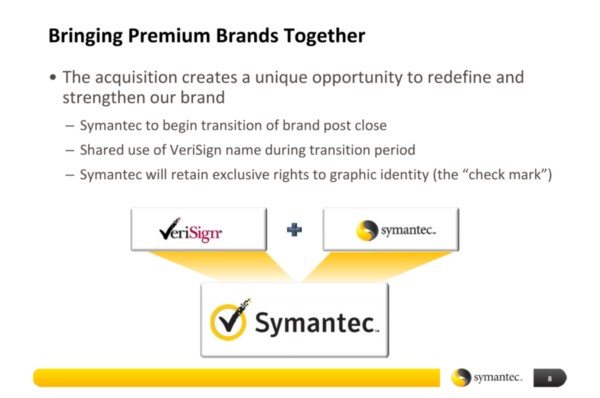
As Symantec made clear during its acquisition announcement yesterday, although it’s acquiring VeriSign’s SSL certification and Trust Services business, along with its logo, it’s not acquiring that company’s strategy. SSL certification could become an influential selling point for Symantec’s existing enterprise security products, such as Symantec Protection Suite. Rather than broaden the Trust Seal’s addressable market, Symantec now plans to tighten its focus, making it more of an incentive for online retailers to purchase not only SSL certificates but other Symantec products and services as well.
So while a billion and a quarter in cash is a lot to pay for a logo, Symantec seized an opportunity to save an influential business from drowning itself in its own market strategy. In yesterday’s announcement, Symantec said it would try to keep VeriSign employees who were critical to the business, though it acknowledged that some would be let go. That might not be a bad idea either.


