Category: News

  • Dodge Caliber, Dodge Nitro dropped from Chrysler’s UK lineup

    Dodge Caliber

    The Dodge Caliber and the Dodge Nitro don’t bring much in for Chrysler LLC on a monthly basis but things seem even worse in the United Kingdom – so much so that Chrysler has pulled both models off the UK market.

    The move to quietly drop both models from the lineup comes due to modest sales for both vehicles in the UK. As of now, the Dodge Journey is the only model for sale in the region.

    The Dodge Journey was upgraded for the UK in early 2010 with a revised lineup and more standard equipment.

    – By: Kap Shah

    Source: AutoCar


  • Staying Active This Summer

    basketballMay is the perfect month to hold National Physical Fitness and Sports Month. The weather is getting warmer, the days are nice and long and kids are antsy to be done with school. What time could be better to promote physical activity and encourage kids to step away from their video games and computers.

    There’s nothing wrong with playing those games from time to time, but with summer practically here, we should be encouraging kids to run around outside, stretch out their legs and get some fresh air.

    So what can you do to encourage your kids to be more active this month?

    Fitness.gov has some great tips and ideas for getting started.

    Take the reins and organize an event that promotes physical activity. Set up a walk or a bike ride. You can work with your community if you want to host a large event and invite your neighbors to attend, or you can host family events. Maybe every Saturday morning you will go for a family bike ride.

    You can also make family time more active in other ways. Go outside and play tag or capture the flag. Collect lightening bugs. Go hiking in a state park.

    There are lots of things you can do if you’re a little bit creative.

    What will you and your family do this summer to stay active?

  • Spectrum’s Digitizer running under Windows 7

    The current version of the universal Spectrum driver comes with full Windows 7 support for the complete product range of the fast digitizers and generators with sampling rates between 100 kS/s and 1 GS/s. This driver of cause also supports earlier Windows versions like Vista, XP or 2000.
    After Windows Vista, being not the most successful start of a new operating system, Windows 7 seems to be the next generation stable Windows platform for industry, research and development. As Windows 7 already has more than 10% market coverage the support of Window 7 is an essential feature for measurement cards. At Spectrum the support of the latest operating system has highest priority: Even Spectrum products that left the market 10 years ago can be used under Windows 7 after doing a driver update.
    PC systems are getting more and more powerful and use more and more memory this making 64 bit operating systems necessary to have access to full PC memory. Since the release of Windows Vista the 64 bit market is only accessible for hardware manufacturers being capable of digitally signing their software. Just a short time after Windows Vista has gone into market Spectrum drivers have been added a digital signature allowing to use the current hardware with no limits under Windows 7 64 bit as well as Windows Vista 64 bit. Drivers that are not signed cannot be loaded any more when using these operating systems!
    Besides the hardware drivers the complete software suite of Spectrum is also running without any limits under Windows 7. The Spectrum software suite contains the Control Center being able to test. Update and calibrate the hardware as well as the sophisticated measurement software SBench. Using the integrated demo mode the current driver version can be tested at any time, even if no hardware is installed. This feature is very helpful for customers who wants to start software development in the few days they have to wait until the ordered hardware arrives.

  • filtoo, the new mobile suction and filter unit

    Mobile suction and filter unit appropriate for one workplace
    The new filtoo:
    The recently developed filter unit „filtoo“ is a mobile filter unit that can be used for many applications requiring the filtration of fumes, dusts and even gases.
    Functioning of filtoo:
    The polluted air is extracted and led into the filter unit either by the suction arm or by other capturing elements. The particles or gases are extracted from the airflow during a filtering procedure consisting of several stages and the cleaned air returns to the working space.
    Application:
    For welding places, in workshops, for soldering applications, for restorers and in locksmith’s shops
    Benefits:
    You receive a complete „Plug and Play System“ that is ready for operation. It is only necessary to connect the intake elements before commissioning the unit.
    Construction of filtoo:
    The advantages of the compact unit are the robust and solid construction. The housing is made of a stable steel sheet construction and coated with powder from inside and outside. The filter elements are accessible via a maintenance flap. Therefore, they can be easily and rapidly withdrawn. The unit is equipped with suitable control elements.

  • Faster and More Precise Automotive Glass Preprocessing

    With its champ’speed line, Bystronic glass is launching onto the market a brand-new generation of machines for preprocessing automotive glass. The line enables cutting, breaking, grinding and drilling of automotive glass with the utmost precision and flexibility. “The champ’speed line is currently the fastest machine of its quality on the market”, says Jean-Philippe Chételat, Sales Manager for the Automotive Glass Sector at the Technology Center Bystronic Maschinen AG in Switzerland.

    “We have listened to our customers’ demands and now – with the champ’speed line – we have adapted our system solution for preprocessing automotive glass for the latest market requirements”, explaines Jean-Philippe Chételat. All the modules in the machine are individually matched to each other, the movements can be separately configured and, for example, optimized with regard to cycle time. The extremely stable, vibration-free process means that customers can work for many years with a consistently high quality level. “With a repeat accuracy of up to 99 percent, the champ’speed line outshines every other machine available on the market”, the Sales Manager is pleased to report. As all the machine parts are within easy reach, working with the new system is an extremely ergonomic process.

    Customized, Intelligent State-of-the-art Technology
    The heart of the system is the cutting and breaking unit. The cutting module contains a maintenance-free AC servo direct drive. Thanks to faster acceleration, it operates extremely dynamically with simultaneous maximum cutting accuracy. While doing so the machine automatically optimizes its speed to match the shape to be cut. Precutting of the glass lite along with shape cutting and breaking is conducted in two process steps and therefore enables parallel processing. This in turn results in a definitive cycle time advantage along with high productivity. In addition to this, the use of a special, maintenance-free breaking tool guarantees perfect quality of the edge breaks.

    Maximum Grinding Standard
    The grinding module can simultaneously use two grinding wheels enabling a fast bit change. “This means that, for example, automotive glass can be ground in different edge radii, without any need to change the tool in between”, explains Jean-Philippe Chételat. […]

    -> read more at www.bystronic-glass.com

  • MANUAL BRAKE ENHANCES LINEAR OPTIONS

    Sometimes the introduction of a simple device can make a significant difference to the application scope of a product. The LBG brake option from HepcoMotion® is a good example. It provides a compact and easy method of locking a bearing block in position on its LBG Linear Ball Guide.

    Stainless steel bodied for non-corrosion, the brake is intended for manual locking of a stationary block and can be supplied with a range of brake plates to suit most of the LBG bearing block options.

    The break assembly has two jaws which, when tightened via the ratchet locking lever, apply equal pressure to the LBG rail to ensure even clamping. When the brake is applied, the resulting clamping force does not impose any load on the bearing block.

    Although designed principally to extend the capability of HepcoMotion® LBG linear ball guides, the brake is compatible with all other ball guide systems with which the LBG system is interchangeable. Brakes in sizes 15 through 30 are available ex-stock via the HepcoMotion® e-shop in combination with the most popular guide sizes to suit most automation requirements.

  • Ultrasonic fork sensors for web guide and edge control

    The new edge sensors type UBA with ultrasonic through beam sensors. New software algorhythms and a unique ultrasonic transducer material allow an accuracy and temperature stability so far only realized with optical systems. But the ultrasonic fork barrier is much less sensitive to dirt and dust compared to optical sensors. Further more transparent materials such as foils can be perfectly handled. The so called plane change error has been minimized to almost zero. Together with the high sampling speed of the sensor this means that fast moving and thus fluttering webs are well aligned.

    The sensor can ideally be adjusted to the actual air conditions by the help of the teach-in function. Furthermore acoustically transparent materials such as textiles can be measured. With teach-in the signal output can be defined at fully closed as well as at fully open fork. In addition, the output signal can also be inverted via teach-in. The new sensors can be teached by push buttons or through the connector. 3 LED indicate the actual position in 5 steps.

  • MWS 906 | Multi-Channel Gas Warning System

    Application:

    The multi-channel gas warning unit MWS 906
    continuously monitors the ambient air and issues an
    early warning of gases and vapours that are dangerous
    to health, or when there is a danger of explosion, for
    non-combustible gases and vapours.

    Fields of Application

    Monitoring of:

    – Heating systems
    – Garages and tunnels
    – Liquid gas storage plants
    – Laboratories
    – Cold-storage depots
    – Plastic processing workshops
    – Chemical industries
    – Paint varnish manufacturers
    – Concentration measurement of O2
    – and many more

    Features

    6-section keyboard and backlit 4-line LC-display for displaying actual values, half-hourly average values and fault messages in cleartext

    Ready for operation, fault and gas warning indicators

    Menu-assisted adjustment of equipment parameters via 6-section keyboard

    Three alarm thresholds for each sensor, indepen-
    dently adjustable from 5-100% of the measurement range, also possible to from half-hourly average values

    A maximum of 48 floating outputs for driving additional warning and control devices

    Floating change-over contact for faults, sirens and warning banners

    Serial output RS 232, for connecting a printer or PC

    4-20 mA current interface as output signal

    Plastic, wall-mounting housing (IP 54)

    High degree of service reliability

    Low power consumption

    Easy installation

    Un-interruptible power supply (UPS) can be used

    Accessories

    Signal horn, warning lights, warning banner, plotter,
    stand-by power supply unit UPS 2000 24 V.
    Further accessories will be available, according to the
    proposed measurement tasks.

    About us:

    For more than 100 years our medium-sized company stands for innovation in gas analysis, gas warning and environmental protection.

    We produce for nearly all the fields of application, transportable gas-measuring items and stationary gas-measuring systems, which can measure and detect by use of high-sensitive detectors a multitude of hazardous substances in smallest concentrations and therewith warn the people in time.

    Our specialists offer all over the world expert advice, first-class installation as well as a reliable service on site.

  • Laser coding for premium German beers

    At the Ernst Barre GmbH private brewery based in Lübbecke, Germany, a sense of tradition and a deep attachment to the region and its people go to hand in hand with innovation and strict quality standards. The brewery has been investing heavily in environmental protection measures for over 10 years. The beers and the beer-based mixed drinks – only traditional glass bottles are used – are filled in state-of-the-art bottling plants, running at a rate of up to 50,000 bottles per hour. A label with proof of origin and expiration date is attached to the back of the bottle, so that the consumer can see immediately that the drinks are in top condition. For reasons of traceability, an encrypted code is also applied, so that details of the filling can be pinpointed at any time.

    The Barre brewery has already gained experience with laser-marking. However, as the mask laser in operation there was past its best, the firm was on the lookout for a flexible, economical and yet rugged laser marking system, which did not require any consumable resources. Thanks to tips from fellow brewers, who have had positive experiences with the K 1000 CO2 laser.

    “During testing by KBA-Metronic’s competent staff, we discovered very quickly that this marking laser could be the answer. The design is much more compact than that of the masking laser, and no additional gas mixture is needed,” said Dirk Stapper, the Technical Director. “It was much easier to integrate into our bottling line than we had expected.”

    The K-1000 CO2 laser system used, with a power of 60 W, marks the filled and labelled bottles inline, in other words, as part of the production process. The two-line code, consisting of the filling code and ‘best before’ date is applied, contactless, during product transport, on the paper rear label. The marking system receives the signal to activate the laser beam from sensors that announce when the bottle arrives to be marked.

    “KBA-Metronic’s marking laser operates with full availability even at high speeds, and produces a clear, legible typeface without the need for any pre-treatment of the labels” confirmed Michael Boschan, Head of Production. “It was a good choice from our point of view”, he added.

  • Courtney Love Kate Moss Lesbian Fling


    If you’re interested in sleeping with the loose-lipped Courtney Love, you may want to slap her with a gag order…

    Courtney Love once bedded catwalk maven Kate Moss — if the ravings of a methfaced former druggie are to be believed.

    Love has ’stunned” fans with claims that she enjoyed a lesbian fling with Kate back in the ’90s. Although you’ll have a better chance stunning us if you find someone Courtney hasn’t had sex with. Earlier this year, the Hole frontwoman hinted that she had a secret romp with a female beauty during a bender in Italy. After some prodding, Courtney’s finally confirmed that the tryst was with the waify supermodel.

    “It was Kate Moss. She doesn’t care. It’s a great story for the grandchildren, so yeah. Kate wasn’t doing a lot of drugs it was just a thing that happened in Milan in the 90,” Courtney revealed matter-of-factly in a chat with Irish music mag Hot Press. “It happened and it was fun and whatever. And she talks about it and so I hope she doesn’t get mad that I outed her about it. I feel like such a kiss and tell. Kate’s great, though! Kate’s a good friend of mine. I almost bought her house in St John’s Wood, London.”

    Both women have also shared their beds with a bevy of famous men. Kate famously dated Johnny Depp and Pete Doherty, while the former Mrs. Kurt Cobain enjoyed flings with rockers Billy Corgan and Gavin Rossdale.


  • Congressman Poe Speaks Out As Another Mexican Helicopter Invades U.S.

    Via Prison Planet.com » Prison Planet

    poe.house.gov
    Thursday, May 20th, 2010

    Flashback: While Government Treats Citizens As Terrorists, Mexican Military Invades U.S.

    Mr. Speaker, U.S. Border Patrol agents have spotted yet another Mexican military helicopter incursion into Texas. That makes three times these helicopters have crossed the border into America this year, that we know of.

    On Saturday, another Mexican military helicopter was in Texas, hovering near the Roma-Miguel Aleman International Bridge. Two other times this year, Mexican helicopters were photographed in Starr and Zapata Counties in Texas.

    These military incursions are becoming routine. What are they doing here? We don’t know. Has our government protested this violation of international law? No one is talking. Our own government seems to be blissfully silent about these incursions. That’s why I’m asking Homeland Security Secretary Napolitano for some answers.

    The Federal Government is MIA on our borders. Our government ought to spend less time protesting States like Arizona, trying to protect their citizens from border violence, and start getting some answers from Mexico about their military helicopters flying into the United States.

    And that’s just the way it is.

    Congressman Poe Speaks Out As Another Mexican Helicopter Invades U.S.  140410banner4

  • War Between The States: Utility Commissioner Threatens To Cut Off LA Power If They Boycott Arizona

    Via Prison Planet.com » Sci Tech

    Vince Veneziani
    Business Insider
    May 20, 2010

    According to NBC LA (via Drudge Report), an Arizona utility commissioner is going to shut off power to Los Angeles if LA decides to boycott Arizona.

    NBC LA: In a letter to the city of LA, a member of Arizona’s power commission said he would ask Arizona utility companies to cut off the power supply to Los Angeles. LA gets about 25 percent of its power from Arizona.

    Mayor Antonio Villaraigosa is in Washington D.C., meeting with Mexican President Felipe Calderon, but his deputy chief of staff issued the following statement: “The mayor stands strongly behind the city council and he will not respond to threats from the state that has isolated itself from an America that values freedom, liberty and basic civil rights.”

    Continue reading ->

    War Between The States: Utility Commissioner Threatens To Cut Off LA Power If They Boycott Arizona 140410banner4

  • Prosperity cannot be paid forever by maxing out our green credit

    Ross Gittins has an article in the SMH on ecological debt – Prosperity cannot be paid forever by maxing out our green credit.

    The most thought-provoking comment I’ve seen on the budget came from Senator Christine Milne of the Greens. ”Every Australian knows,” she said, ”that if you have two credit cards, it is very bad management to pay off your debt on one of them by racking it up on the other.” The budget ”pulled down the national economic debt, but it continued the process of racking up our ecological debt”. …

    When we run down our non-renewable resources (as we’re hoping to do at a much faster rate with the return of the resources boom), nowhere does this show up as a cost or reduction of our assets. When we continue to deplete renewable resources at a rate much faster than they can renew themselves, nowhere does this show up as any kind of negative.

    When we continue pumping our waste back into the environment – including greenhouse gases, but also other air and water pollution, garbage and human waste – at a faster rate than it can absorb, nowhere is this recorded as a cost.

    GDP, our great de facto measure of progress, counts the short-term benefits from all this exploitation, but ignores its long-term costs. So Milne is right: we have been paying off our economic credit card by racking up debt on our environmental credit card.

    But as the still-unfolding global financial crisis reminds us, you can get away with racking up debt only for so long. And with the environment the day of reckoning has already started to dawn. Lift your head from the economic statistics and you see rising average temperatures, the clearing of native forests, the destruction of habitat, the decline in fish stocks, the damage we’ve done to the Murray-Darling and other river systems and the degrading of our soil.

    So far we’ve managed to keep the economy separate from the environment, but we won’t get away with that much longer. Why not? Because, in the words of a former US senator, ”the economy is a wholly owned subsidiary of the environment”.

    The economy exists within the natural environment and is dependent on it. Logically, you could have the natural world without an economy – that is, without human activity – but you couldn’t have an economy without a natural world.

    We can go for a period running our economy at the expense of the environment – plundering its natural resources on one hand, pumping out our waste on the other – but eventually we start to get feedback. The despoiled and depleted ecosystem begins to malfunction, with serious consequences for the continued functioning of our economy.

    We get a lot more extreme (and thus expensive) weather events, a rising sea level forces us to move back from the coast, we start running out of native forests and some mineral resources and fossil fuels (making energy and fertiliser a lot dearer), we see the destruction of international tourist attractions such as the Great Barrier Reef,

    we have to move agriculture north to where the rain is, but the elimination of fish stocks and degradation of soil makes food production a lot harder and more expensive the world over.

    How did we get into the mindset that allowed us to take the environment for granted? Well, mainly it’s because economic activity is simply more visible than the environment. And because, until relatively recently, we could plunder the natural world with impunity.

    But also because we’re wedded to a way of thinking about (and measuring) the economy that, because it has changed little in the past 150 years, simply ignores the environment. Because at the time global economic activity was so small relative to the huge natural world, it made sense for the early economists to treat the environment as a ”free good” – something so plentiful it comes without cost.

    But with the human population having more than trebled since 1927 and the global standard of living also having risen considerably, it’s no longer sensible to treat the environment as an ”externality”.

    We need a new economic model – and a new way of measuring progress – that recognises the centrality of the environment to our wellbeing and keeps recording and reminding us when we charge things up on our environmental credit card, as Rudd has just done.


  • Professor of Mechanical Engineering Estimates that 4 Million Gallons of Oil are Leaking Every Day

    Via Prison Planet.com » Prison Planet

    Washington’s Blog
    May 20, 2010

    As I wrote on May 2nd:

    The Gulf oil spill is much worse than originally believed.

    As the Christian Science Monitor writes:

    It’s now likely that the actual amount of the oil spill dwarfs the Coast Guard’s figure of 5,000 barrels, or 210,000 gallons, a day.

    Independent scientists estimate that the renegade wellhead at the bottom of the Gulf could be spewing up to 25,000 barrels a day. If chokeholds on the riser pipe break down further, up to 50,000 barrels a day could be released, according to a National Oceanic and Atmospheric Administration memo obtained by the Mobile, Ala., Press-Register.

    CNN quotes the lead government official responding to the spill – the commandant of the Coast Guard, Admiral Thad Allen – as stating:

    If we lost a total well head, it could be 100,000 barrels or more a day.

    Indeed, an environmental document filed by the company running the oil drilling rig – BP – estimates the maximum as 162,000 barrels a day:

    In an exploration plan and environmental impact analysis filed with the federal government in February 2009, BP said it had the capability to handle a “worst-case scenario” at the Deepwater Horizon site, which the document described as a leak of 162,000 barrels per day from an uncontrolled blowout — 6.8 million gallons each day.

    Today, a Purdue University mechanical engineering professor – Steven Wereley – testified to the House Committee on Commerce and Energy that 95,000 barrels a day are currently leaking into the Gulf. That’s 3,990,000 gallons – just shy of 4 million gallons – per day.

    Professor of Mechanical Engineering Estimates that 4 Million Gallons of Oil are Leaking Every Day 140410banner4

  • Pyongyang denies sinking Cheonan, threatens war

    Via Prison Planet.com » World News

    Kim Young-jin
    Korea Times
    Thursday, May 20th, 2010

    North Korea Thursday dismissed the allegation it attacked a South Korean Navy vessel in March as “sheer fabrication,” warning that punitive measures over the incident would be met with “tough measures including an all-out war.”

    The statement issued by Pyongyang¡’s National Defense Commission (NDC) came in response to the findings of a multinational investigation team that probed the March 26 sinking of the frigate Cheonan.

    “They are pointing a dirty accusing finger at us like a thief,” an unidentified spokesman for the NDC said in the statement. The commission is headed by North Korean leader Kim Jong-il.

    Calling President Lee Myung-bak a “traitor,” the statement also offered to dispatch a delegation of North Korean investigators to Seoul to check the veracity of the international findings.

    “We remind the group of traitors in advance that there should be not a shred of doubt about the material evidence to be produced before the inspection group,” the statement said.

    It promised a “merciless strong physical blow,” if South Korea responds with even a minor act of aggression on its territory.

    The attack on the Cheonan is speculated to be retaliation for a naval skirmish that occurred in November last year, when a North Korean boat crossed the maritime border and exchanged fire with a South Korean vessel before retreating in flames.

    Pyongyang denies sinking Cheonan, threatens war  140410banner4
  • National Broadcaster Openly Rejects Question On Trilateral Meeting

    Via Prison Planet.com » World News

    Neil Foster
    sovereignindependent.ie
    Thursday, May 20th, 2010

    Here’s a short clip showing the national broadcaster, the equivalent in Ireland of the BBC outright refusing to discuss anything to do with the Trilateral Commission meeting recently held in Dublin.

    In a blatant example of mainstream media censorship, by the national broadcaster in Ireland RTE, who have an obligation to inform the public and to give a fair and balanced viewpoint, Monday nights airing of The Frontline on RTE 1, hosted by Pat Kenny, we witnessed the type of censorship one would expect from a Third World dictatorship. Up to the point where the lady in the audience mentions the Bilderberg Group and Trilateral Commission meeting in Dublin last week, Kenny remains silent but immediately steps in to talk over the questioner.

    Kenny can be heard giving the tired excuses that there is a complaints department at RTE which he tells the questioner to contact about her issues with the station.

    He then scurries away, it appears in panic. He can clearly be heard saying:

    ‘I’m not going to go there, I’m not going to go there’ in reply to persistent attempts by the questioner for an answer.

    National Broadcaster Openly Rejects Question On Trilateral Meeting  150410banner1

    Indeed, when combined with the miniscule coverage of the Trilateral Commission meeting in Dublin by the mainstream press, this disgraceful sidestepping of a pertinent question from a member of the audience as to why RTE had not covered such an important meeting.

    This shows the scant regard and outright contempt that the national broadcaster has for its audience who fund the station through their taxes.

    Welcome to the Soviet Republic of Ireland.

    Thank you Mr. Kenny for you pathetic allegiance to your banker masters!

    If you fast forward to the 59 th minute in the video below you can see the brief exchange.

    http://www.rte.ie/news/2010/0517/thefrontline_av.html

  • Largest 3D Monitor From ASUS Measures In At 27-Inches [Computers]

    ASUS’ PG276 has the glory of being the largest 3D monitor so far to have been announced—measuring 27-inches, it’s also joined by a 23-inch version, the VG236H. Both require NVIDIA’s active glasses, due to the 3D being stereoscopic. More »


    AsusNVIDIAShoppingNetbookAndroid

  • Remedies for Nitrate-Contaminated Water in California are Anything but Quick, Cheap

    Wells that serve more than two million Californians are contaminated with nitrates at levels that surpass public health standards, California Watch reports. In small towns and rural settings, schools and families often don’t have access to groundwater filtration systems. Tap water spiked with high nitrate levels can lead to illness in infants and some studies have found connections to certain cancers in lab animals.

    John Mataka and his wife Rosenda

    Photo by Roberto Guerra
    John Mataka of Grayson, Calif., and his wife Rosenda drink bottled water although Modesto has invested in a treatment plant.

    By Julia Scott
    California Watch, Special to Circle of Blue

    John and Rosenda Mataka never gave a thought to their tap water until 1995, when the city of Modesto took over the town of Grayson’s water supply wells and informed everyone that they had been drinking nitrate-contaminated water for over a decade.

    Modesto officials began conducting regular tests of Grayson’s two production wells. The state Department of Public Health reacted to the results by requiring the city to install a treatment plant to rid the water of dangerous nitrate levels.

    “I was angry. We just weren’t told. Every year they said the water was fine,” said Rosenda Mataka, who raised her son Emiliano on compromised tap water.

    ABOUT THE PROJECT:
    The California Watch nitrates project was a yearlong reporting effort that found a long legacy of groundwater polluted by nitrates from agricultural runoff and septic tanks..

    Although Emiliano and his parents show no indication that their health has been harmed by the water they drank for years, the Matakas worry about the long-term health impacts of exposure to tainted drinking water. Tap water spiked with high nitrate levels can lead to “blue baby syndrome,” which cuts off an infant’s oxygen supply. Some studies have found connections to certain cancers in lab animals.

    Grayson’s water treatment system provides an oddly incongruous sight: an assortment of gleaming pipes and tanks that tower above apricot orchards and alfalfa fields, with a tall fence wrapped around them and a big warning sign that says “Caution: Chlorine.”

    It’s Grayson’s accidental landmark, a symbol of the hidden legacy that has prevented this rural outpost of 1,200 from becoming the prosperous Modesto suburb it could have been.

    In a way, Grayson is lucky. Most small communities of its size with serious nitrate problems can’t afford expensive water treatment plants. That means these communities, made up largely of low-income families who work the fields, end up drinking whatever comes out of the tap, even if the water violates public health standards for nitrates.

    At least one million Californians rely on private wells that have no public health oversight. These residents are at high risk for nitrate contamination because their wells are shallower than municipal wells. Nitrates are colorless and odorless, making them hard to detect without lab testing.
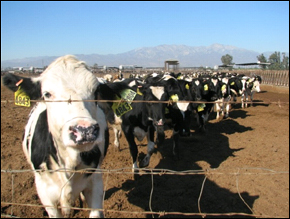
    Cows, of course

    Photo by Sasha Khokha
    Many dairies moved north, to the Central Valley, after Chino water regulators passed strict rules limiting the number of cows.

    At the other end of the spectrum, cities in Southern California have spent millions of dollars on nitrate treatment plants because they have no other choice – dirty or not, the groundwater is crucial to meet population growth while access to imported water shrinks. The Irvine Ranch Water District, for instance, built a $33 million system to remove nitrates in 2007. It costs an additional $2.3 million a year just to operate and maintain. The plant itself serves 50,000 water customers in Orange County.

    Other California communities will be facing the same tough choices in the coming years. California’s population is projected to increase 53 percent by 2050. Of the 50 million people who will one day call this state home, many will settle in the greater Los Angeles area, Inland Empire, and parts of the Central Valley – areas that overlie some of the most nitrate-contaminated groundwater in the state.

    City planners are looking to groundwater to supply one-third of the water needed to accommodate California’s coming population boom, or 1.1 trillion gallons per year – more than any other source, according to the Public Policy Institute of California.

    Looking around Grayson today, it’s hard to believe the town was once in the running to become a major suburb of Modesto. Twenty years ago, a developer was planning to build a 633-unit subdivision at the site of a peach orchard in Grayson.

    Those dreams were dashed shortly after Modesto installed a de-nitrification plant. Although it can barely afford it, the city spends $800 per acre-foot of water to make water drinkable for Grayson’s 1,200 residents – up to $19,440 a month, four times the cost of the treated Tuolomne River water Modesto pipes to half its 210,000 residents.

    Another problem is the leftovers: Grayson’s ion exchange process leaves behind hundreds of tons of saline brine that can’t be recycled or reused, so Modesto pays extra to export four truckloads of it each week to a Bay Area wastewater plant. At those prices, the city quickly concluded it couldn’t afford any new water connections in Grayson and banned them outright. The ban is still in place today, minimizing the area’s population growth.

    “If water wasn’t a problem here, the whole area would be developed in a heartbeat,” said John Mataka, who works for Stanislaus County as a behavioral health specialist. He and Rosenda both advocate for environmental justice issues with a variety of local and state organizations.

    Experts say the slow spread of nitrates underground has already affected millions of Californians, mostly due to a legacy of leaky septic tanks and intensive nitrogen fertilizer-based farming over the last 60 years. Nitrates are the leading cause of well closures in California. Scientists say that if nitrate concentrations don’t taper off, the pollution will eventually sink deep enough to affect the well water that millions of Californians depend upon.

    Studies have shown that although only 3.5 percent of public water supply wells in the Central Valley exceed the public health limit for nitrates today, an additional 13 percent of wells are at substantial risk of contamination.

    That message is somehow getting lost on people, says Karen Burow, a Sacramento-based scientist with the U.S. Geological Survey. Past farming practices have already contributed to tomorrow’s nitrate problems, and today’s contributions are making the problem worse.

    “I think that’s the most important point we can get across – that there is a lot of nitrate in shallow groundwater and it’s moving, and we don’t see it going away very fast. There is some urgency for the policy people to figure out what to do,” Burow said.

    Solving the groundwater problem will take imagination – and a lot more money than the state is spending. California voters have passed two water bonds since 2002, worth more than $8 billion. Roughly $2 billion was allocated for clean, safe drinking water.

    No estimate exists for what it would cost to clean up the nitrates in our groundwater basins, in part because the state has limited knowledge about where the pollutants are and where they go when they reach the water table.

    The Environmental Protection Agency has estimated that the cost of treating all the polluted groundwater in California over the next 20 years, including nitrates, would amount to $7.5 billion.

    Tackling the source

    “The solution isn’t usually to just shut down a dairy. The ones that we found having problems, we’ve worked with them to get more land, improve their cropping practices, in some cases line manure basins.”
    -Ken Landau

    Activists and regulators agree that the best way to solve the nitrate problem is to prevent it. But that is easier said than done. State regulators have started requiring certain operations to limit the nitrogen they apply to land. Records show, however, that in many cases, officials have been aware of ongoing nitrate pollution for years – and took little action to address it.

    One of the best examples of this is the state’s dairies, which grow crops with manure. Many dairies lack enough cropland to absorb all the nitrogen they produce. As a result, they over-apply liquid manure, causing nitrate problems.

    Most dairies began testing their domestic wells for nitrates in 2007 and 65 percent of the dairy wells exceeded the public health limit for nitrates. Forty-two percent of wells had nitrate levels that were twice the drinking water standard.

    Many dairies moved north, to the Central Valley, after Chino water regulators passed strict rules limiting the number of cows.

    Since 2000, the state has mandated that 48 dairies submit groundwater test results – in response to numerous other findings of nitrate contamination on their land. Yet none of the dairies were fined, required to cease operations or asked to clean up a nitrate problem identified by the state.

    Dairies receive violation letters for not monitoring properly, but exceeding the nitrate limits rarely has serious consequences.

    Records show some dairies were even suspected of spreading contamination to adjacent lands, potentially affecting the drinking water of neighbors and farmhands living onsite. But only one dairy, The Bosma Milk Co. in Tipton, received a violation letter specifically for high nitrates in groundwater beneath the property, according to an online database of state enforcement actions.

    The Bosma Milk Co. has reported nitrate concentrations above the public health limit since 2003. Like many other Central Valley dairies with nitrate problems, nitrate concentrations in some of Bosma’s wells spiked as high as five times the pollution limit between 2000 and 2007.

    The dairy received a violation letter in 2008, but no fine. The Central Valley Regional Water Board has asked the dairy to collect more information before it takes action.

    Gary Bosma, co-owner of Bosma Milk Co., said he and his brother Jake have gone out of their way to comply with water quality requirements imposed by the state. He suggested that regulators would have a hard time proving that nitrates were coming from Bosma given that there are other dairies in the area.

    “We have neighbors and the water moves around in the aquifer. Just because one well pops up positive doesn’t mean it’s coming from that dairy,” Bosma said.

    Officials say they have been aware of nitrate issues at dairies for a long time.
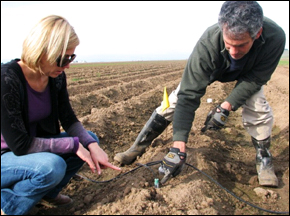
    Lettuce growers in Monterey County

    Photo by Sasha Khokha
    Some lettuce growers in Monterey County are participating in a farm program to help them gauge how much nitrogen to apply.

    “The solution isn’t usually to just shut down a dairy. The ones that we found having problems, we’ve worked with them to get more land, improve their cropping practices, in some cases line manure basins,” said Ken Landau, assistant executive officer of the Central Valley Regional Water Quality Control Board.

    In 2007, Central Valley regulators started requiring most dairies to develop plans to manage their manure to reduce water contamination. Another rule, the first of its kind in the country, required dairies to sample their domestic wells for nitrates. If the levels are too high, the dairy needs to pay to install additional monitoring wells to gauge the extent of the contamination.

    The program was welcomed by environmentalists, but Dairy CARES, a statewide dairy-industry coalition, feels the requirements are too burdensome. The group is working on an alternative that calls for installing wells in select regional locations to monitor contamination, an approach that would avoid pointing fingers at individual dairy operators.

    “It’s a much broader scale than holding an individual responsible for their exact actions,” said Darrin Polhemus, deputy director of the State Water Resources Control Board’s division of water quality. “Obviously that’s what we’ll want to get to eventually, but that’s not the focus. It’s not designed to find that one guy out there.”

    An expensive problem

    It’s too late to prevent nitrate contamination in many Southern California groundwater basins, especially in heavily urbanized portions of Los Angeles, Orange, Riverside and San Bernardino counties.

    It’s a problem that harkens back to the region’s agricultural legacy. Land now covered with suburban neighborhoods once sprouted with citrus trees and vegetable fields where farmers used nitrogen fertilizer. Until recently, the Chino Basin was home to more dairies than anywhere in the world.

    Nitrate problems were detected as early as the 1970s in the Chino Basin, one of the largest groundwater basins in the state. The area is at the heart of California’s Inland Empire and home to more than a million people. Nitrate concentrations in the worst-hit parts of the basin were double the EPA threshold in the 1980s and quadruple the limit by 2000, according to records.

    Regulators with the Santa Ana Regional Water Quality Control Board tried with limited success to contain the problem by banning dairies from applying manure to land in the Chino Basin in 1999.

    Today, residents pay high water bills to bankroll multimillion-dollar nitrate treatment plants in places like Pomona and Riverside. The Inland Empire Utilities Agency in western San Bernardino County is in the midst of a $300 million project to expand its nitrate removal plant as part of an aggressive strategy to cope with drought-related limits on imported water.

    “We recognized that imported water was vulnerable and less reliable,” agency General Manager Rich Atwater said. “We’ve literally hit the wall with the Delta. We’re in a huge economic recession and everybody recognizes that we’re going to go from 38 million to 50 million people in the next 25 years, and Southern California is a big part of the demand.”

    Times have changed since the 1970s, when water managers could just shut down a well and dig a new one if nitrates became a serious problem. Atwater says the causes of nitrate contamination were ignored for too long, creating a problem for everyone in the region.

    “All that nitrate contamination that we’re addressing today is literally a legacy of 50 to 100 years ago,” Atwater said. “Prevention is so much more cost effective – 10, 20 times as much. It’s so much more expensive to remove the contaminant from the groundwater basin than to keep it from getting there in the first place.”

    In Modesto, the city has had to shut down 10 of its 140 municipal wells because of nitrate contamination in the past 15 years, and there will likely be more, said Allen Lagarbo, deputy public works director.

    “All cities on wells in this area start developing contamination problems eventually,” he said.

    “We do this crazy thing now and take pristine, beautiful water and put it on our farms, and the minute it soaks into the ground it’s filled with nitrate, and then we ask cities to clean up marginal water and use it as drinking water.”
    -Jean Moran

    The combined population of cities in the Sacramento Metro region and the San Joaquin Valley is projected to top 9 million by 2030. The population in the Central Valley has doubled every 30 years since 1900 as residents move onto former farmlands.

    Meeting those future water demands is not as simple as building a new generation of nitrate treatment plants, as Modesto has discovered. The most common technologies to remove nitrates, ionic exchange and reverse osmosis, can be expensive and cumbersome.

    “We do this crazy thing now and take pristine, beautiful water and put it on our farms, and the minute it soaks into the ground it’s filled with nitrate, and then we ask cities to clean up marginal water and use it as drinking water,” said Jean Moran, professor of earth and environmental science at CSU East Bay and a former groundwater research scientist at Lawrence Livermore National Laboratory.

    A Sacramento solution?

    In the Central Valley, farmers may soon face regulations on their use offertilizer similar to an order imposed on dairies in 2007. The agricultural industry wants those rules to remain voluntary and says it would be unfair for regulators to require farmers to comply with strict statewide water quality standards.

    Nitrogen fertilizer use in California has stabilized at an average 700,000 tons each year, but it’s unclear whether voluntary strategies have made a difference for nitrate levels so far. It took 50 years to detect nitrate problems in many areas and it will take decades to see changes, experts say.

    One option would be to require farmers to limit the amount of fertilizer they apply to their fields. That would require new legislation. The State Water Resources Control Board does not have the authority to impose those limits.

    Lawmakers have directed hundreds of thousands of dollars of aid to small communities struggling with nitrates, and established demonstration projects for good farming practices through the University of California. But when it comes to tackling fertilizer itself, results have been mixed.

    Former Bay Area state Assemblyman Johan Klehs tried to pass a bill in 2006 that would have raised the mill tax on fertilizer. The money would have been used to provide grants to communities affected by nitrate contamination. (In California, fertilizer is exempt from local and state sales taxes). The bill died in the Assembly’s Agriculture Committee.

    “All efforts along those lines automatically go to the ag committee and they die there. Legislators are not friendly to anything that could negatively impact agriculture,” said Debbie Davis, legislative analyst with the Oakland-based Environmental Justice Coalition for Water.

    State Senate Majority Leader Dean Florez, D-Shafter, calls nitrates “a backwater issue in Sacramento.”

    “These are the kinds of things public policy makers need to hear,” he said. “It’s always difficult to get any of these things on the radar screen. … We’ve got to get our farmers to recognize the long-term impact of these materials on water systems. People say it’s the end of a major, multi-billion dollar industry without these fertilizers.”

    Scientists with the U.S. Geological Survey have calculated that even if fertilizer inputs ceased immediately and forever, nitrate levels would continue to climb for many more decades before starting to decline because of the lag time in deeper aquifers.

    All the more reason to take preventative action, says Eli Moore, a research associate with the Oakland-based Pacific Institute.

    “We can deal with nitrate contamination once it’s already reached the tap water, or we can try to prevent nitrate contamination before it becomes a problem,” Moore said. “It’s really a question of whether we as Californians are going to ensure that all Californians have access to clean drinking water.”

    Grayson’s moratorium on new water connections hasn’t kept people from building new homes and simply digging their own backyard wells at the risk of exposing themselves to dangerous levels of nitrates.

    Nitrate concentrations in Grayson’s raw water have tested as high as 65 milligrams per liter over the past 15 years. The public health limit is 45 milligrams per liter. One milligram is equivalent to half a teaspoon in a swimming pool. It may not seem like much, but for vulnerable populations, like infants, the effects can be acute, experts say.

    “If this is an issue now, can you imagine a town three times the size?” asked John Mataka. “It would have been a calamity.”

    This story was produced in collaboration with KQED Central Valley Bureau Chief Sasha Khokha and Christopher Beaver of CB Films. It was edited by Mark Katches. It was copy edited by William Cooley. For the whole story, plus interactive tools, film clips, a photo slideshow and links to a three-part series on nitrates produced by KQED Radio, visit California Watch. Read more of California Watch’s work on Circle of Blue here.

  • Oops! MSNBC graphic suggests Taliban set fire to Bangkok

    Via Prison Planet.com » World News

    David Edwards
    Raw Story
    May 20, 2010

    People watching MSNBC Wednesday morning could be forgiven for believing that the Taliban had invaded Bangkok. As NBC’s Ian Williams reported on violent protests in the capital city of Thailand, a graphic on the lower third of MSNBC’s screen read: “NEW TALIBAN ATTACKS, BANGKOK BURNS.”

    In truth, fires in the Thai capitol were not caused by the Taliban. Bangkok “burned” Wednesday because of rioting by anti-government protesters, according to The Associated Press.

    Downtown Bangkok became a flaming battleground Wednesday as an army assault forced anti-government protest leaders to surrender, enraging followers who shot grenades and set fire to landmark buildings, cloaking the skyline in black smoke.

    Using live ammunition, troops dispersed thousands of Red Shirt protesters who had been camped in the capital’s premier shopping and residential district for weeks. Five protesters and an Italian news photographer were killed in the ensuing gunbattles and about 60 wounded.

    After Red Shirt leaders gave themselves up to police, rioters set fires at the Stock Exchange, several banks, the headquarters of the Metropolitan Electricity Authority, the Central World, one of Asia’s biggest shopping malls, and cinema that burned to ground. There were reports of looting.

    Firefighters retreated after protesters shot guns at them, and thick smoke drifted across the sky of this city of 10 million people.

    Following MSNBC’s report on Bangkok, the NBC’s Tom Aspell began a separate report on a Taliban attack in Afghanistan. The confusing chyron was replaced with “INSURGENTS ATTACK BAGRAM AIR BASE.”

    Taliban had attacked the second biggest US base in Afghanistan Tuesday, The Los Angeles Times reported.

    Insurgents early Wednesday launched a bold attack on the largest U.S. installation in Afghanistan, leaving at least seven of the attackers dead.

    The fighting at the sprawling, heavily fortified Bagram air base, about 30 miles north of Kabul, began at dawn when Taliban fighters attacked with rockets, guns and grenades, the military said.

    NATO’s International Security Assistance Force said in a statement that five Western service members had been wounded, but did not characterize the seriousness of their injuries. Most of the troops at Bagram are Americans.

    Oops! MSNBC graphic suggests Taliban set fire to Bangkok 150410banner1

    Of course, all news organizations make mistakes. RAW STORY had to apologize Monday after a headline had incorrectly labeled a Democrat under fire as a Republican.

    Fox News has often been called out for doing the exact opposite on a number of occasions, and for other mistakes which often seem to benefit the GOP.

    This time, however, only the Taliban could potentially benefit from such an error.

    This video is from MSNBC’s News Live, broadcast May 19, 2010.

  • Paul Krugman’s Welfare-State Fallacies

    Via Prison Planet.com » Commentary

    Jacob Hornberger
    Campaign For Liberty
    Thursday, May 20th, 2010

    A recent op-ed entitled “We’re Not Greece” by Paul Krugman in the New York Times encapsulates everything that is wrong with liberals when it comes to economics.

    The good liberal that he is, Krugman suggests that the welfare state is about “taking care of those in need.”

    What he misses, however, is the issue of means, which, not surprisingly, he totally fails to address in his op-ed.

    Suppose I accost you with a loaded gun and force you to take me to an ATM. I tell you to withdraw $5,000 or I’ll shoot you. You withdraw the money and give it to me. I go and give all the money to people in need. I don’t keep one dime for myself.

    Haven’t I taken care of people in need? Isn’t what I did moral? Isn’t it consistent with God’s will? Aren’t I a good person?

    No. I’m nothing more than a common thief. The fact that I’ve used the money to help the needy is irrelevant. The end doesn’t justify the means. I should be prosecuted and convicted.

    Presumably Krugman would agree. But his moral blind spot — indeed, the moral blind spot that afflicts all liberals — is his inability to see that the same principle applies to the coercive apparatus of the welfare state. Who are the compassionate, caring people in a welfare state? All the citizens of the nation? Only the taxpayers? How about the IRS officials, especially those who harass and persecute people into paying their taxes? What about the welfare bureaucrats who distribute the dole to people? What about the congressmen, who claim credit for the federal money they bring back to their district? What about tax protestors, who don’t pay any income taxes? How about illegal immigrants who have taxes withheld from their pay?

    The real answer is: None of the above. Why? Because the entire welfare-state system is founded on force, which is antithetical to moral values, compassion, and free will. The only help for the needy that matters is that which comes from the willing heart of an individual, not at the point of some bureaucrat’s gun.

    Krugman laments the fact that the Greek government doesn’t have control over its own money supply, like the United States does through the Federal Reserve. If it did have that control, Krugman says, it could begin stimulating the economy with inflation — that is, by printing the money to pay off that ever-increasing mountain of debt.

    What he misses, however, is not only the moral implications involved with inflationary liquidation of debt but also the fact that inflation never accomplishes anything constructive in the long term. Let’s not forget, after all, that the principal reason the Framers established a gold standard was to prevent the federal government from inflating the money supply. By manipulating money and prices, inflation produces distortions and perversions by sending bad signals to the private sector. Ultimately, those distortions and perversions become manifest, which causes things to go into a tailspin. Thus, while inflation can delay the day of reckoning, that’s all it can do.

    The day of reckoning has obviously come for Greece and other European welfare states. For decades, such regimes been spending money on the dole that they didn’t have. To keep the dole payments going to Greek citizens, officials went out and borrowed money to their heart’s content and then lied about it to the other Euro countries. Ultimately, people figured out what was going on, and the jig was up.

    Not surprisingly, despite facing national bankruptcy the Greek people refuse to let go of their dole system. That’s what the dole does to people — it creates a sense of hopeless dependency and also a sense of entitlement. Young Greeks are also protesting, because they feel their future life on the dole is now threatened.

    Rather than dismantling their dole system, which is what they should do, the Greeks have induced foreign taxpayers to underwrite their dole, including German and American taxpayers. That’s what the U.S. Federal Reserve has committed Americans to do, without even the semblance of congressional approval.

    But despite a massive Greek bailout, speculators aren’t buying it. They’re continuing to send the value of the Euro into the tank. They’re not buying it because they know that the Greeks have no intention of doing what is necessary to save themselves — dismantle their dole system. At most, they’ll reform it by reducing welfare spending a bit … and by raising taxes — the very things that Krugman recommends that U.S. officials do to address the worsening welfare-warfare spending and debt problems facing our country.

    Krugman and the Greek statists recommend raising taxes as part of a welfare-state reform plan. But the problem is that the more they raise taxes, the more they send marginal firms — that is, firms that are barely making it — into closing down operations, which in turn increases unemployment, which then sends more people into the dole system.

    Moreover, as people learn about the benefits of going on the dole, more and more of them look for ways to do it themselves. Why work when the government will pay you for not working? The number of people on the dole — and the amount of the dole — skyrockets while the number of people producing wealth — and the amount of such wealth — diminish.

    Krugman acknowledges that Americans do have a “serious long-run budget problem,” but he says that America’s “fiscal outlook over the next few years isn’t bad” and certainly not as bad as Greece’s. He’s hoping that inflation will nurse the economy back to health so that there will be more private-sector producers paying the taxes to fund the parasitic welfare-warfare-state sector.

    Meanwhile, the U.S. government continues to spend and borrow as if there were no tomorrow, both on its welfare state (including the recent bailout of Greece) and its warfare state (e.g., Iraq and Afghanistan). For decades, Krugman and others of his liberal ilk, together with conservatives, have taken our nation down the road to Greece and the Roman Empire, with their out of control federal spending, taxes, inflation, moral debauchery, socialism, interventionism, and imperialism. Today, the welfare-warfare-state chickens are coming home to roost.

    There is only one solution to what they have wrought — a total dismantling of all their statism, both foreign and domestic. Tinkering will only delay the inevitable. It’s time for economic liberty, free markets, and a constitutional republic for our land.