
To knit and spin was not much fun
When ’twas my sole
employment
But now I smoke these Chesterfields
And find it real
enjoyment
Mild… and yet.. They Satisfy
To knit and spin was not much fun
When ’twas my sole
employment
But now I smoke these Chesterfields
And find it real
enjoyment
Mild… and yet.. They Satisfy

Safety Tail Light Shows Direction Motorist Intends to Turn
THE frequency of motor accidents may be lessened considerably when a new automatic tail light exhibited recently at the International Patent exhibition comes into widespread use. The turning of the steering wheel of the device, shown at the right, flashes on a light in the rear that indicates to following motorists which way the driver will turn, thus preventing confusion and delay.

Magic
Learn at Home—by Mail Easily! Quickly!
New! Different! Dr. Harlan Tarbell, Famous Magic Wizard, teaches you Big Tricks, Illusions, Stage Stunts, ‘Tatter” and the Principles of Magic. You learn easily and quickly at home by mail. Earn $250 to $1,000 a month. Write today for free literature and details.
Astonish Your Friends Gain that magnetic popularity that makes you the center of any crowd. Why envy others’ skill? You can learn Magic yourself, quickly, easily—at home—by mail—during your spare time!
WRITE!
Mail coupon now for free Magic literature telling all about the great Tarbell Course in Magic. Get Our Low Prices and Easy Payment Plan.
TARBELL SYSTEM, Inc., Studio C-235 1926 Sunnyside Avenue, Chicago, III.
Moving OCEANS INLAND
by JAMES N. MILLER
Washington CorrespondentThe new Nicaragua Canal is to be 134 miles longer than the Panama Canal, now working to capacity. Route will cost a billion dollars and will utilize huge Lake Nicaragua. See the map below.
Details showing how the ocean is to be moved to 400 Great Lakes seaports through the building of the St. Lawrence Deep Seaway! This article summarizes progress on three big seaway projects.A STAGGERING appropriation of almost two billion dollars may be made soon by our Uncle Samuel for the building of two urgently needed, gigantic canal projects. They are to connect the most strategic commercial waterways in the world. Both plans have immense international interest.
Number one, known as the Nicaraguan canal project, proposes to construct a canal that will make a seaway clear across the little republic of Nicaragua.
Plan number two, possibly the most vitally needed and nationally interesting, would extend the sea base of the mid continent of North America so that the 400 harbors of the Great Lakes, world famous for the enormous tonnage they handle so efficiently, would actually become seaports, available to all ocean carriers. This is the building of the St. Lawrence-Great Lakes Deep Seaway, which would make the ports of the Great Lakes doubly valuable as carriers of America’s vast inland commerce and simultaneously as world channels of trade.
A third project, receiving favorable national approbation, is known as the Riker Spillway, of which more later.
The United States’ present keen interest ill the proposed Nicaraguan Canal arises from the surprising fact that the far-famed Panama Canal has not lived up to its much advertised expectations. During the last six years its commerce has doubled, and is now close to its capacity tonnage of 50,- 000,000 tons per year, so that there is every indication that the canal will shortly be unable to take care of its traffic requirements, All of which means, of course, that our government must act immediately to remedy the alarming situation.
We are accustomed to think of the Panama Canal in terms of great size. But its distance from coast to coast is 134 miles shy of that which would prevail in the case of the Nicaraguan Canal. Moreover, the estimated cost (not yet accepted as official) for the new canal, is close to a billion dollars, as compared with $386,000,000 for the Panama Canal.
This great expenditure, however, would be well worth while, advocates of the Nicaraguan project believe. They say it would save a day’s sailing time from New York to San Francisco and about two days from New Orleans to the Golden Gate— in other words, that the canal would afford great economic advantages as a shorter route between the Atlantic and Pacific coasts of the United States, and also between the Gulf and Pacific ports. Furthermore, it would offer splendid prospects for development of a more profitable trade with Central America. The canal, in fact, would permit a shortened schedule for nearly 80 per cent of the shipping which now goes through the Panama Canal.
From the strictly military point of view it has been pointed out by both Army and Navy experts that such a new waterway (see map) could be effectively defended and would give our naval and merchant fleets the insurance of two means of passage from ocean to ocean.
Curiously enough, the idea for the Nicaraguan Canal turns back the pages of American history 40 years, long before the Panama Canal came into being. It was in 1889 that Congress granted a charter to the Maritime Canal Company for the furtherance of such a project, though it fell through at that time due to pressure on the part of certain South American interests. The first really practical step for the canal’s realization was paved back in 1914 during President Wilson’s regime when there was signed at Washington a special treaty between Nicaragua and the United States. This country paid $3,000,000 for “the exclusive proprietary rights for the construction and operation of an interoceanic canal by a Nicaraguan route . . . whenever the construction of such canal shall be deemed by the United States as conducive to the interests of the two governments.” The World War cut short American development plans.
Concerning today’s situation—it is true that thus far Congress hasn’t appropriated much money for a thorough investigation of the proposal. The sum of $150,000, granted for the purpose of a survey last March under ex-President Coolidge, is a mere drop in the bucket. Nevertheless many government engineering experts confidently expect that President Hoover with his broad knowledge of national needs will soon see to it that the canal gets a start on a worth-while scale.
National interest in a shipway of sufficient depth to permit ocean shipping from the Great Lakes to the Atlantic Ocean has been widespread for 9 years. Midwestern industrialists and the 40,000,000 inhabitants of the world’s bread basket are clamoring for its completion.
In 1920 an international board of engineers was appointed by Canada and the United States to make a survey of the St. Lawrence from Montreal to Lake Ontario in order to discover how best to make the waterway navigable for ocean and lake vessels. In 1921 the experts made a favorable report and in 1924 the two governments appointed another board of engineers to review the earlier board’s report. In 1926 the new board’s report showed the engineering factors to be very acceptable to both governments.
Also in 1924 the two governments appointed advisory committees to further investigate the economic phases. President Coolidge’s committee was the St. Lawrence Commission of the United States with the then Secretary of Commerce, Herbert Hoover, as chairman and Charles P. Craig as executive secretary.
Since then there has been a wide interchange of letters between this country and Canada. The next step, which seems to loom in the near future, is the appointment of an international commissioner or commissioners to phrase a treaty between the two nations.
The five Great Lakes are international waters which form the boundary between the United States and Canada from Minnesota to New York. Considered from the standpoints of their area and commerce they constitute the most important fresh water group in the world. They are directly concerned with the prosperity of over 40,000,000 Americans and afford access to regions notable for the magnitude of their natural and industrial resources.
THEY permit the grain of the western prairies and the Canadian provinces to reach eastern mills and ports of export at substantial savings compared with all-rail routes. They have brought into economic juxtaposition the ores of Minnesota and Wisconsin, and the steel mills of the Lake Michigan, Lake Erie and Pittsburgh districts. And they have enabled the Northwest to secure, at very great savings, the fuel required for the maintenance of its commerce, industry and domestic life.
To further develop these great waterways on a large scale would be a masterly stroke of modern-day engineering genius. Moreover, the deepening of the St. Lawrence would also involve the development of the huge hydro-electric power from the great rapids which now obstruct navigation on the river. This is the largest profitable hydro-electric power development on the North American continent and the dams necessary for further increase of power would create a series of pools in place of the present rapids, which, with the supplement of locks and short canals, would constitute the shipway.
That the interior states, as well as the others, believe they would be affected by the project, is shown by the fact that 23 states have associated together by acts of heir legislatures under the name of the Great Lakes Tidewater Association. Representing close to two fifths of the nation’s entire population, the organization is working heroically to accomplish its purpose.
Actual construction will be apportioned between the two countries as follows: as tentatively proposed by Canada and assented to in principle by the United States, the proposed works lying within international waters shall be constructed by the United States, whether lying on the American or Canadian side of the line, and all works within Canadian waters shall be built by Canada. In other words, the United States will bear the expense of deepening the connecting channels between Lake Superior and Lake Erie and construct the proposed works in that portion of the St. Lawrence River from Lake Ontario to the point where it ceases to form the international boundary. Whereas Canada, at its own expense, will complete the new Welland Ship Canal (probably by 1930) and will build the proposed works in that section of the St. Lawrence lying between the international boundary line and the sea.
As to cost, the United States will have to pay in the neighborhood of $123,000,000 while Canada will spend about $200,000,-000. It is expected that the seaway would be open to navigation in seven to eight years from the time that active work had been started.
NOW as to the third project, the Riker Spillway.
Down in the lowest depths of the historic Senate Office Building in Washington, D. C, a gigantic engineering model of the Riker Mississippi Spillway stretching some 75 feet long and about 12 feet wide, serves as a working plan of a waterway expert, Carroll L. Riker, whose age has passed the 80 year milestone.
His model represents a plan designed, after almost a quarter of a century of intensive study, to make a docile infant of the turbulent Mississippi, controlling its treacherous floods, making its vast power far more available to the nation, affording well nigh perfect drainage, irrigation and better climatic and health conditions throughout the valley.
Riker, a kindly, patriarchal man who has spent the best years of his life studying dam construction, explains that as far back as the years immediately preceding the World War, he had succeeded in interesting certain of Uncle Sam’s waterway experts in plans for the curbing of the Mississippi and its tributaries. But the war upset these plans to such an extent that not until recent years did government authorities again lend an ear of uninterrupted interest.
Back in 1928, Congress, forced to action by the disastrous floods that had been exacting such a terrific toll of life and property, appropriated $325,000,000 for control of the Mississippi’s flood waters. But the scheme thus far hasn’t shaped up as hoped for by Congress, particularly since a recent break in the work resulted in virtually desperate efforts to prevent breaks in levees at other points. So Riker, backed up by Senator Lynn J. Frazier of North Dakota, among other prominent persons, is agitating the building of the huge spillway.
Now the term, spillway, as the name implies, means a scientific “spilling”, or taking care of flood waters, so that they can do no damage. And in a word, the Riker plan proposes to accomplish this by virtue of the engineering process of quickly disposing of excess waters by deftly sluicing them to one side, though in as straight a line as possible, and then to the point of delivery.
Under the Riker plan, a strip of land from Cairo, 111., to a point 150 miles west of the mouth of the Mississippi, three miles wide, would be confined on each side by an embankment, or levee of great size and width, divided laterally into two halves by a third levee. By such division, one levee could be used for navigation while another could be employed for agricultural purposes. Or it even could be kept dry for years, if emergency occasion so demanded. The land on which the strip is located could be purchased readily by the Federal government from the states which it traversed at a reasonable price.
This wide spillway, running almost in a straight line to the Gulf, proponents of the plan say, would forever do away with the menace of floods. For it would tap the Mississippi near Red River Landing and receive all its excess waters there, and act similarly where it crosses the river above Vicksburg, recrosses it below Memphis, and at a point just below Cairo.
Now comes what certainly are the most unique phases of the Riker project: the inventor claims that his spillway, or Overland Seaway, as some choose to call it, might within a comparatively few years be the greatest man-made navigable deep-waterway in the world, reducing by 50 per cent the water-route distance between the Gulf and Cairo, 111., as compared with the present distance by river alone, and largely supplant the latter for navigation use. The point that almost staggers the imagination in this connection is that not only will there be locks for small vessels, but that the Riker plan also calls for locks more than twice the length of those of the Panama Canal. In other words, the space between the levees would be dredged to a depth sufficient to permit the largest steamships in the world to regularly navigate the river’s entire length from Cairo down to the Gulf.
Thus the city of Cairo would be brought to within 48 hours of the Gulf. In fact, Mr. Riker says: “My plan would practically make Cairo a seaport. It provides slack water for navigation, having a minimum depth of over 40 feet over the locks, an entirely ample width clear to the Gulf of Mexico, where there is the finest harbor entrance in the world both as to depth and approach. There is even a rattling good probability that if my scheme were carried out, the commerce of Cairo should, within 50 years’ time, become greater than that of any other port in the world.
“The Mississippi Valley, being the geographical center of the United States, is destined to become its primary center of agriculture, industry and commerce. All this should be largely accomplished by my Hood control plan As demands have compelled many of our great industries to undertake their production near areas of consumption, such production designed for export will eventually cause their centralization where the best facilities exist for exportation and for obtaining raw material and labor.
“The point is that the area between the confluence of the Missouri and Ohio Rivers with the Mississippi is the center towards which the natural products of the Mississippi Valley gravitate and from which its manufactured products must largely radi ate. Some of its bulky agricultural and other basic products now seek to find water-borne transportation to foreign markets by the Great Lakes and the St. Lawrence, unnavigable during the winter months; by rail to the harbors of our eastern seaports, whose congested facilities preclude the economical terminal handling of such products; or by the long rail and water route through the Gulf of Mexico.”
Still another unique, and even revolutionary phase of the Riker plan is its proposal to construct a series of gigantic monster dams. Explains Mr. Riker: “There would be about 10 reinforced concrete dams crossing the spillway; each would be provided with a continuous series of gates extending full length, and superimposed upon each dam would be a roadbed forming a bridge for railroad and vehicular travel across the spillway. Wherever required for travel there would be built additional bridge crossings made of reinforced concrete and so made as to be uninjured by floods and able to function as eveners of the depth of flood waters passing through the spillway.”
THE inventor points out that once the Riker Spillway were completed (granted that Congress eventually gives approval to its construction), work upon the Mississippi, looking to its complete canalization, should begin; first, by the construction of the master dams across the river; one just below the spillway’s mouth near Cairo; one just below where the river is crossed near Memphis; one below the recrossing near Vicksburg; and also one below where the river is connected with the spillway near Red River Landing. These master dams, Mr. Riker further explains, should be provided with gated control of the waters passing down the river, with locks for navigation and with plants for the generation of electric power.
As for the cost of this great project, the inventor says: “The canalization of the Mississippi would limit the greatest possible flood height in the river to an average of more than 25 feet below the tops of its present levees, for about a thousand miles of its length. There then would be recovered from overflow along the river, a very large area of most valuable land. All told it should amount to about 4,000,000 acres, soon becoming the most valuable land in the entire valley, as its increased acreage value would be at least $400. Such valuation, amounting to about $1,600,000,000 would be greater than the cost of the spillway and the estimated cost of the river’s canalization, including the purchase cost of the land bought from the various states.”

Holden, a longtime Comcast customer, recently replaced his decade-old cable box with two shiny new ones. Comcast, unable to let a happy customer be, sent equipment that won’t allow his household to watch high-definition channels without paying for an extra cable package. Customer service’s most helpful response: Hook up an antenna, and switch inputs whenever they want to watch something on broadcast TV! Not helping, Comcast. Not helping.
I’m a Comcast cable, phone, and internet customer in Jacksonville, FL. My family has been with Comcast since they acquired AT&T’s cable operations in the area back in 2002, and we’re still using the digital cable box that AT&T installed. Recently, it started acting up and dropping the picture every few minutes, so we called Comcast to ask for a new box. They said they’d send us two boxes at no cost, more than we expected.
What we received were two of the “DTA” boxes, the ones that convert a digital signal to an analog one for older televisions. We called back at they said we need one of those on every television in our house, even digital televisions, because they’re switching over to an encrypted signal in our area in June. That didn’t fix the original problem – they need to send someone out to “fix” the 12 year old digital box, but we installed them anyways. It made our picture quality worse and we lost all our QAM channels, meaning we couldn’t get any of our local stations in HD anymore.
I called Comcast today and was told that if I wanted to keep receiving local channels in HD, I would need to upgrade to a basic HD package and pay for HD receivers for each digital TV in the house. I told the rep that I was satisfied with that because without upgrading, we’ll be getting less channels for the same amount of money. I asked if there was any way we could still receive our local channels in HD without paying them more money, and I was told to “pick up an antenna and an AV switch.”
I never thought I’d hear a cable company advising me to buy an antenna! Comcast offered to waive the cost of the HD receivers for a year, but we don’t want free HD cable channels. We just want the local stations we’ve been getting in HD since we bought our HDTVs without having to unplug the cable and hook up the antenna every time we want to watch them.
Comcast is effectively taking away some of our channels and expecting us to pay the same amount of money. We wouldn’t have known about this if we didn’t call because they haven’t notified us of the switch, so I imagine this is going to happen to other Comcast customers too.
Mitsubishi seeks to integrate solar, wind, and other renewable power sources into its production facilities through smart grid technology that will manage the reliability and stability of the energy supply. Some of the production facilities will deploy solar photovoltaic systems in conjunction with rechargeable batteries to enable power usage when the sun is down. …
… “project to build facilities within the company’s production sites in Japan for experiments designed to establish advanced smart grid technologies. The project will contribute to the company’s efforts to support the adoption of sustainable power supplies worldwide.
Mitsubishi Electric will build experimental facilities at the company’s three Japanese domestic production sites located in Amagasaki, Wakayama and Ofuna. ” …
Via Mitsubishi Electric: Smart Grid Technology Investments (PDF).


Antes de contar a notícia, já adianto que vai ter um pouco de spoiler do filme Homem de Ferro 2. Se não assistiu o filme ainda, considerem-se avisados.
Quem chegou a assistir o filme do Homem de Ferro 2, viu que tem uma história engraçada e tudo mais, é um filme que recomendo a todos a assistirem. Tem uma parte interessante do filme onde o vilão destrói dois Rolls Royce Phantom pretos dentro de um autódromo.
O filme é cheio de efeitos especiais, então não seria surpresa imaginar que a chicotada elétrica que o cara dá no automóvel o parta em dois facilmente. O que é realmente “chocante” é que isso não foi um efeito especial. Para piorar, foram usados dois carros desses nas filmagens, que foram destruídos. Cada um vale US$438.000 + dano emocional, fora o fato que o carro é construído a mão, sem intervenção de máquinas.
Imagino o que um cara, que passou noites em claro trabalhando nesses carros, pensaria ao ver suas obras primas serem destruídas como folhas de papel rabiscadas, sendo vistas por milhões de pessoas? Será que algumas das frases que passam em sua cabeça começariam com a palavra “Filho…”?
Via | Top Speed
Facebook and Zynga, two of the largest social web companies, have been at odds recently. Zynga is one of the biggest buyers of advertising on Facebook, and without Facebook, Zynga would struggle to grow.
In other words, the two can’t live without each other. But cooler heads have prevailed and they’ve now settled their differences and inked a 5-year truce. We’ve put together a graphic that lays out the details of their codependency.

Update: Please note that this corrects an earlier version in which the use of Facebook Credits for games was described as “exclusive;” it was not.
Related content from GigaOM Pro (sub req’d):
Will Zynga’s Growth Make It a Facebook Frienemy?
Infographic by Column Five Media


‘Lost’ audio: Garnett explains the island to ‘Big Baby’ from The Basketball Jones on Vimeo.
Okay, so this video can basically bring anyone up to speed on Lost and so it probably deserves a *Spoiler Alert* tag, but there’s going to be no avoiding Lost news after the finale on Sunday so you might as well get used to it. Your screwed if you’re just now getting into the show. The Internet isn’t going to stop just because you’re only on Season 3. Sorry.
While parents, teachers, administrators, and politicians in Texas clash over the content of students’ textbooks in the Lone Star state, the Obama administration is quietly expanding the reach of the federal government into local education — with results to be cheered or feared, depending on your political philosophy.
The agenda set by the president and Education Secretary Arne Duncan, a friend of Mr. Obama and former chief of the Chicago public school system, is undeniably bold. It encompasses not only the $4.3 billion “Race to the Top” fund, which encourages competition for federal funds, but also an effort called the Common Core State Standards Initiative.
Here, the Obama administration is working with governors from forty-eight states and other leaders to develop standards in English — or “language arts,” as you may recall it from your own school days — and mathematics, for students from kindergarten through twelfth grade.
“These draft standards,” notes the initiative’s website, “define the knowledge and skills students should have within their K-12 education careers so that they will graduate high school able to succeed in entry-level, credit-bearing academic college courses and in workforce training programs.”
The website continues: “States will be asked to adopt the Common Core State Standards in their entirety and the core must represent at least 85% of the state’s standards in English language arts and mathematics.”
One governor — a Republican — told Fox News the core standards will not be “all-inclusive,” just a, quote, “basic threshold” for an educated citizenry. “While I strongly believe in states’ rights in education to create their systems, I think it’s entirely appropriate, if the federal government is giving money to incentivize, to make sure that we have strong accountable standards in education,” said Gov. Sonny Perdue of Georgia. “I think it’s too important for a nation not to do that.”
The amount of money that Uncle Sam spends on education is growing. Analysts project that the federal government’s share of total education spending will rise, during President Obama’s first term, from about 9 percent to 15 percent.
Duncan has said he wants to be “a partner, not a boss,” of local educators — but that he will not remain a “silent partner.” Conservatives, who have never been ardent champions of the Education Department, warn that greater federal involvement will lead inexorably to greater federal control — and not just from bureaucrats, but from the very groups conservatives blame for the great decline in American postwar education: teachers’ unions and administrators’ associations.
“As the federal government puts more money into education, there’s no question but that they’re going to demand accountability and oversight for the funds that they’re spending,” said Terry Hartle of the non-partisan American Council on Education. “We want them to do that; we want, as taxpayers, to make sure our money’s being well spent. How many strings come with that oversight and that accountability becomes a very critical question as time goes by.”
Some libertarian groups say the evidence is lacking for those policymakers who would propose a “federalized” curriculum — which the Obama administration has not done. Neal McCluskey of the CATO Institute, for example, wrote recently that there is “very little good, comparative research on national standards,” and thus little reason for local educators to embrace them.
And thus little reason for local educators to embrace the core standards program.
Filed under: Government/Legal, Toyota

The Federal Bureau of Investigation is looking into four packages that were recently sent to four different Toyota manufacturing facilities over the past week. Investigators eventually determined that there was nothing harmful or threatening in the packages, but not before Toyota evacuated its North American headquarters in Kentucky on Friday. According to Reuters, the packages were described as suspicious, but neither the FBI nor Toyota seem to think the incident was any kind of threat.
Only one of the boxes caused a full-scale evacuation. Two others were uncovered in the mail rooms of Toyota plants in Texas and West Virginia without incident, while a third was stopped in a post office in Indiana. At this point, it’s not clear exactly what made the packages suspicious in the first place. Whatever it was, though, it was enough to cause the post office workers in Indiana to call the state police. Law enforcement has yet to reveal the name of the sender.
[Source: Reuters | Image: AP Photo/David Zalubowski]
Reuters: FBI investigating four packages after Toyota’s Kentucky HQ evacuated originally appeared on Autoblog on Wed, 19 May 2010 11:00:00 EST. Please see our terms for use of feeds.
There’s a lot of under-the-hood changes to Wave to make it faster, more stable and more extendable with new APIs, among other improvements, but the big news for most people is that now anybody can use it with their standard Google (or Google Apps) account—it’s just going to live in Google Labs for the time being. [Wave] More »
By Scott M. Fulton, III, Betanews

Customer relationship management (CRM) software has typically fallen outside the realm that Betanews has covered, at least in recent years. It falls outside the realm a lot of publications cover, not because it’s the least bit obscure or unimportant or even a segment of the information industry around which billions of dollars in invested capital revolve, but because it isn’t usually the stuff around which soap operas are based. If someone left a spare, unauthorized beta copy of Dynamics CRM at a bar, it’s not something Gizmodo would be snapping photos of and TMZ would be scooping interviews about.
Nevertheless, CRM is a huge industry; and while Microsoft has been a big player in that market since its acquisition of Great Plains Software in 2001 and Navision the following year, it has never been the #1 player. PeopleSoft had a very competitive CRM offering for small businesses in the early part of the last decade, then Oracle acquired that company in 2004. Later, Siebel had the lead, and Oracle acquired that company in 2006. (You can see a pattern here.)
Then, as though Calvin “Freakin’” Borel were jockeying it, Salesforce.com has surged forward with a spectacularly successful alternative that is now a prime example of the success of cloud-based Web apps. Microsoft could very well be left behind in this market unless it makes some deals.
Evidently, that’s what it was trying to do: Jigsaw is a CRM software producer’s Holy Grail. Think of one colossal database of cloud-based, crowd-sourced contacts, assembled through the sheer momentum of tens of thousands of willing contributors. Connect Jigsaw to your CRM product and you have a high-bandwidth gold mine.
Just last month, CRM Magazine‘s Lauren McKay learned, Jigsaw was preparing to announce a deal with a handful of companies, including Microsoft and Oracle, to extend its cloud-based connectivity to Microsoft Dynamics CRM and Siebel. The result would probably have been a set of branded add-ons that resemble this currently available third-party utility that connects Dynamics with Jigsaw.
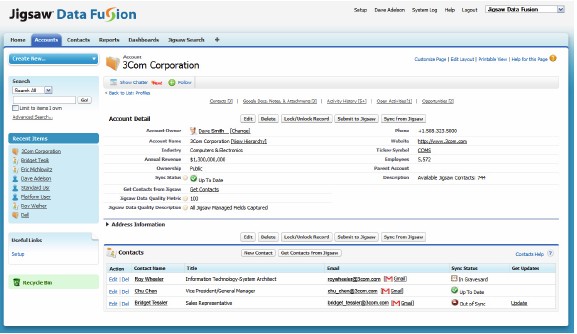
Then Salesforce.com purchased Jigsaw outright. Almost immediately, Salesforce began marketing Jigsaw Data Management as its own product — the biggest link to the broadest cloud database of sales contacts in the world.
The problem with cloud-based products is that they’re practically monopolistic by design. Just as there’s no sensible business reason for anyone to build “another Wikipedia,” it would be considered foolish for anyone to try a “competitive cloud” for even a barely-established product, including Jigsaw.
The objective now for any competitor, including Microsoft, is to try to keep enough of a foot in the door to remain a competitor, before it gets boxed in with the slow horses in the middle. Apparently Microsoft chose to fire a broadside with the weapons at its disposal at the time, which yesterday were comprised of some very old patents on “technologies” such as stacking toolbars together — methods for which you’d think the rest of the world had already been granted perpetual license by default.
But regardless of whether you buy into the theory that Microsoft has any rights to claim, for instance, the ability to embed a menu in a Web page (patent #5,742,768), it’s now an established fact that somebody in Tyler, Texas would buy into it, and it’s an academic matter to seat such a person on a jury. So even if Microsoft’s artillery rounds are made of paper, they can inflict damage.
This lawsuit isn’t really about toolbar stacking. It’s about making certain a competitor with momentum and motive doesn’t lock down the cloud.

Utilizing the nextgenserver SIM unlock method that came about last month, enterprising users have been able to unlock the newly released AT&T Palm Pre Plus and get it up and running on other North American GSM carriers, including T-Mobile and Telus. Folks interested in getting the the device up and running on T-Mobile will only be able to utilize EDGE, of course, but those using Telus and the like will experience full 3G.
While this method is effective, it isn’t exactly cheap – the phone without contract will set you back about $400, and the unlock service another $37 – but it’s really the best way that those of you who swear by T-Mobile State-side or want to enjoy HSPA up in Canada.
Thanks to Karl for the tip!
The Google I/O developers conference kicks off at 12EST/9PT—as in, like, now. We’re on the ground at the conference and we’ll be posting all the best nuggets we can find, but in the meantime you can watch a stream of the keynote over on YouTube. More »
It seems as though some Droid Incredibles are providing a less than incredible experience as Chris Tabor shown that he has had touchscreen issues with three different Droid Incredible devices. The problem seems to arise from an electrical grounding problem with the phone that prevents the touchscreen from working unless the body of the device is touched with your hand. Tabor originally discovered the bug while attempting to use his Incredible in a car dock and has apparently had the same issue with the two replacements that were sent by Verizon. Chris put up a video demonstrating the problem, showing that while a Motorola Droid and HTC Droid Eris work fine on a styrofoam surface, his three Incredibles do not.
This doesn’t seem to be a widespread problem, but we’re curious if any of you are experiencing any issues with your Droid Incredibles. Check out the video, and let us know in the comments!
{Widget type=”youtube” id=”PQRgT3gtmsI” }
Via Phandroid

Where were we when Chris O’Donnell was having FIVE children?!
A teen heartthrob no more, these days the Hollywood hunk stars opposite LL Cool J on CBS’ breakout hit NCIS: Los Angeles. And did we mention that he’s also been knighted Redbook Magazine’s “Hottest Celebrity Dad 2010?”
Eh — David Beckham still gets our vote, but congrats to Chris all the same.
Accepting his title with pride, Chris appears with his brood on a Matt Jones-snapped flip cover of Redbook’s June issue, on newsstands May 25.
“He’s the fun one in the family. He’s also a lot less strict than I am: he’ll bring home a package of Ho-Hos and try to show me the ‘vitamin category’ on the back. I’ll say, ‘There are no vitamins in that.’ And he’ll say, ‘Yes, there are—look!’” says Chris’ wife, Caroline.
Chris On Family Life: “I knew when I got into this business I couldn’t have it both ways: I could live the playboy lifestyle, which is not a bad thing to do, or have a traditional family life, which is how I grew up. That was more important to me…When I’m sitting in the backyard at the end of the day with a glass of wine, watching the kids having fun and clowning around, for me, that’s what it’s all about.”
Chris On Fame: “The only time it got really crazy was during Batman. Anywhere I went in the world, people knew who I was. I was being offered these huge films that would have taken my career to a different level, and I decided to put on the brakes. I knew if I continued on that track, I probably wouldn’t have gotten married.”
On The Secret To A Successful Marriage: “Our families have the same values and traditions, and I think that goes a long way, because when the excitement and heat of romance wears off, those are the things you fall back on.”
When you work for an international development agency you’re always looking for engaging ways to tell the development story.
In a bid to try something different – not just writing policy papers and thousands of words blog type features – we came up with the idea of using animations. We wanted to give people who support Oxfam the tools to challenge aid sceptics. We also hope to reach new people who might not come across our policy positions any other way.
I wrote the script for the animation below and then worked with an animation team from State of Play Games. There was a lot of back and forth as we refined the messages, adapted the animations and then went through the rigours of getting it signed off. Colours have to be right, you have to say things like this or like that – it’s complicated working at a large NGO.
This animation outlines the case for where aid has made a difference to millions of lives and shows that the idea that aid simply doesn’t work, doesn’t fit the reality in many of the poorest parts of the world.
I’d be really interested to hear what people think.

The singer Lee DeWyze is the favorite to win the title of American Idol. The aspiring artist, 24-year-old from Illinois, was the favorite of the judges last night, during the most recent edition of the singing contest.
Lee DeWyze, 24-year-old from Illinois, was the favorite of the judges last night, after singing two songs: one chosen by judge Simon Cowell and the other chosen by him.
DeWyze chose to sing the song by Lynyrd Skynryd’s “Simple Man “listed by the jury of the show as” brilliant. ”
Later, Cowell made DeWyze sing the theme of Leonard Cohen “Hallelujah.”
This was the interpretation which made the American Idol audience literally exploded in the amphitheater, along with the good reviews of the four judges.
“Just unbelievable,” said Randy Jackson.
Along with Lee, Casey James, and Crystal Bowersox are looking for the next Wednesday 26 to crown the new American Idol.
The final competition will be broadcast live and live in Peru, through the sign of Sony.
Lee DeWyze “Hallelujah”, American Idol 2010:
Related posts:
Remember back when Bill Gates said:
“If people had understood how patents would be granted when most of today’s ideas were invented and had taken out patents, the industry would be at a complete standstill today… A future start-up with no patents of its own will be forced to pay whatever price the giants choose to impose.”
Those days are long gone, apparently. In its latest patent litigation action, Microsoft has decided to sue Salesforce.com for infringing on a bunch of patents. Basically, it looks like Microsoft went through its collection of patents to find whatever they could that Salesforce might possibly infringe on. Take a look at the list:
Amusingly, Microsoft and its super expensive lawyers were apparently in such a rush to file the lawsuit that they put the wrong patent number in on that second to last patent in the filing. Oops. Either way, look over that list of patents and try not to repeatedly shake your head in disbelief at the ridiculously broad nature of each and every one of those patents. And, then, since patent system defenders always remind us that it’s the claims that matter, go take a look at the claims and wonder how these patents ever got approved in the first place. Going through that list of patents, you could use them to sue an awful lot of web-based service providers.
Hopefully (though, unlikely), the Supreme Court gets around to issuing its Bilski ruling and puts software patents like these out of their misery. Here’s the full filing for anyone interested:
Permalink | Comments | Email This Story


