Category: News

  • Report: Top Offshore Drilling Official to Step Down

    The Washington Post’s Juliet Elperin has the scoop that the federal official in charge of offshore drilling will soon be resigning:

    Chris Oynes, the top Interior Department official who oversees offshore oil and gas drilling for the Minerals Management Service, announced Monday that he will retire on May 31.

    Oynes has been in charge of Gulf drilling since 1998, the Post reports.

    No surprises here. The MMS has long had a reputation for being too chubby with the industry it’s supposed to be supervising. But the scrutiny has reached new heights in the wake of last month’s Gulf oil spill, and someone’s head had to roll.

    The question now is: Will Oynes be the only one?

    h/t: POGO.

  • Noah’s Kin Two review

    Overview

    What’s Good: Multitouch-aware capacitive display; Good QWERTY board; Zune Pass compatibility; Kin Studio provides automated Web-based backup

    What’s Bad: Featurephone features at smartphone price; No calendar, games or downloadable apps; Limited syncing options; Poor ergonomics for camera use

    Introduction

    Note: Kin One and Kin Two are basically identical in terms of software and general performance, including the 600MHz NVIDIA Tegra processor that they both employ. As such, appropriate portions of this review are shared with my Kin One review.

    A few years ago Microsoft bought Danger, inventors of the Sidekick family of messaging devices. Time passed and little was known about what, if anything, the Danger group was working on inside of Microsoft HQ, save a few leaks about “Project Pink.” Pink was rumored to be Microsoft’s self-branded foray into the messaging phone category, and said to consist of two launch phones codenamed “Pure” and “Turtle.”

    Then Microsoft killed off Windows Mobile and announced Windows Phone 7 (Series) and everyone kind of forgot about Project Pink. For a few weeks, anyway.

    Fast forward to a rainy Monday morning in April, and “Pure, Pink and Turtle” became “Kin One and Two,” as Microsoft officially launched their new devices for “Generation Upload” at a nightclub in San Francisco. Complete with a new mobile OS and heavily visual user interface, an online component called “Kin Studio,” and Verizon as launch partner, Kin showed the world that the Danger group had in fact been hard at work since being folded into the MSFT’s world.

    Question is, are Kin One and Two actually any good? Sorta, but they’re so overpriced (think monthly plan costs, not up-front sticker shock) that it’s impossible to see them only for what they are. Instead I keep comparing them next to the Android and webOS phones in Verizon’s lineup and seeing the Kins for all the things they’re not.

    Design & Features

    Kin Two is the higher end of the two Kin phones. A horizontal slider with a touchscreen and full QWERTY thumbboard, Kin Two measures up at 4.25 x 2.5 x 0.75″ and weighs 4.7 ounces. The phone is done up in what its maker calls “Carbon”: a textured gray/black soft-grip finish on the bottom half of the phone is complimented by a glossy, semi-translucent plastic bezel around the display portion of the device. Kin Two is pretty nice looking, with its grey-on-grey color scheme and rounded corners that bring Palm’s Pre and Pixi phones to mind.

    The display is a 3.4″, capacitive touch affair with 320 x 480 pixels worth of resolution. Text, graphics, images – it all looks pretty good on Kin Two, even if the display is on the low end of current size and resolution specs for smartphones. Kin Two supports multitouch input including single and two-finger taps, double taps, swipes, and pinch-to-zoom. There’s one hardware button on the front of the phone, mounted dead center directly below the display. A single press of the button takes you back one screen in the user interface, while a press-and-hold will bring you back to The Loop (home screen).

    Take a look around Kin Two and you’ll find 3.5mm audio and microUSB ports, and hardware buttons for the Camera, Volume Up/Down (rocker switch), and Power/Screen Lock. There’s an 8MP camera on the back of the phone that’s flanked by an LED flash, features auto-focus and anti-shake technology, and shoots 720p HD video. Photos, video, and music is stored on 8 GB of internal, non-removable flash memory; there is no microSD expansion slot.

    One big design flaw has to do with the placement and operation of the camera button. Mounted on a curved surface near the upper right of the device (as you hold it in landscape orientation), the camera button is easily accessible via your right index finger. That’s a good thing. Problem is, between the weird angle that the button is mounted on and the heavy action involved in pressing the thing, the camera button is both uncomfortable to use and winds up leading to hand shake during image capture … which leads to blurry photos. Or at least it did for me. Repeatedly.

    The QWERTY board, on the other hand, is pretty good. With a fairly standard four-row design marked by extra short, but usable, keys on the bottom row (Space, function, etc), the keyboard is bolstered by an offset layout and nice chiclet action on the circular buttons. I am annoyed that typing a comma is a two-button affair – Function + Period – but for all I know periods aren’t cool on Facebook and mySpace, so I might be the only Kin user to ever complain about using the thing to punctuate sentences.

    Usability & Performance

    Before you read on, bear in mind that I’m a 30-something year old guy who’s tied to computers and smartphones all day for work, tweets his head off but rarely uses Facebook for personal reasons. So I’m not Microsoft’s target audience for Kin. That doesn’t mean I don’t have worthy opinions about Kin One, but it does mean that a 22 year old single woman with a super active nightlife and close ties to her social networking friends may feel a bit differently about the Kin experience than I did. That said …

     What’s Confusing: The Loop and The Spot

    Kin is crazy. There’s support for four different social networks but no Calendar app or games. Contacts are automatically synced with your various social networking accounts, but there’s no way to auto-sync to address books, either on your local machine or on the servers of popular services like, y’know, GMail. Every photo you take, every video you shoot, every message and call you send or receive are automatically backed up to servers fronted by a timeline-based Web browser called Kin Studio.

    And then there’s The Loop and The Spot. The Loop is your home screen. Your home screen is a giant mosaic of photos and text headlines that represent updates from your social networks and news feeds. Concepts like wallpapers, app icons and widgets don’t apply here: Kin is The Loop is the loop is your social network and you change the look and functionality of it by adding/removing feeds and friends. From The Loop you swipe one way to get to your apps menu and swipe the other way to dive into your contacts.

    The Spot is this little dot at the bottom of most screens throughout Kin’s UI. When you want to share something with your peeps, you drag it to The Spot. The idea is that you can share most anything – photos, URLs, snippets of text, things posted to your Loop – with as many of your contacts as you like via The Spot. All you do is drag, in any order, some stuff and some peeps into The Spot, then open The Spot up and choose your method of sharing (SMS/MMS, Email, Post to Social Network) and that’s it. Easy. In theory.

    In practice The Loop and The Spot are equal parts cool and frustrating. What’s cool is the unique, highly visual approach Microsoft took to Lifecasting and giving those always-connected Gen Upload kids a way to stay in touch. What’s frustrating are the limitations of the systems in place. To wit:

    – Loop updates aren’t pushed to you in real time, they’re pulled on roughly 15-minute intervals. There’s no changing that schedule.

    – There’s no Twitter client on Kin. The Loop is your Twitter client. That’s too bad because The Loop doesn’t support DMs, viewing @ replies or even just looking at your personal stream in one fell swoop. For any of that, you’ll have to visit twitter.com.

    – The Loop is fun to look at first. And if you only have a dozen or two contacts it’s pretty fun to use. But if you’ve got upwards of forty or fifty friends across Facebook, mySpace and Twitter – let alone if you, like most members of Gen Upload have a network numbering in the hundreds – The Loop quickly becomes frustrating to use as a tool of any practical sort. At least it did for me. Scrolling through dozens upon dozens of differently-sized tiles chock full of photos and status updates and tweets and RSS headlines got to be laborious after a short time. Maybe I’m old and crusty, but I wanted some separation and I wanted a boring old list UI that was easy to scan for important information.

    Microsoft programmed the loop to push updates from your favorites to the top of your list at any given time. They, like HTC and others before them, conducted some research that shows that people tend to communicate with a small percentage of their contacts a large percentage of the time. So The Loop has that going for it. But it’s still not customizable enough for my tastes. Motorola’s MotoBLUR may also be a somewhat overwhelming way of viewing social networks and feeds, but at least it lets me separate updates from other updates from RSS headlines to a greater extent.
     
    What’s Great: Kin Studio and Zune Pass

     Kin Studio is great. Except that it only runs on Silverlight-enabled Web browsers. In a nutshell, Kin Studio is an automated backup of every photo, video, message and phone log entry that’s wirelessly beamed from your Kin to Microsoft’s servers without your needing to do anything to enable it. When you visit your password-protected Kin Studio page, you can view your Kin life by way of a nifty timeline. Photos, videos, etc etc – it’s all there in chronological order for your perusal. Your contacts and feeds are also accessible via Kin Studio. You can also share things via The Spot from Kin Studio, including full-resolution copies of photos and HD videos shot with Kin Two.

    Zune on Kin is also great. Kin One and Two are basically the mythological “Zune Phones” finally made real. Kin Two features 8GB of onboard memory for storage of photos, music, videos and everything else. While that doesn’t sound like much memory for a multimedia phone, remember two things: First, full-resolution photos are automatically backed up to Kin Studio and replaced with much smaller versions optimized for viewing on Kin Two’s 320 x 480 display, a clever trick that should preserve plenty of room in K2’s flash memory. Second, Zune Pass.

    If you’re going to get a Kin Two and you listen to a lot of music, you really should consider a Zune Pass. I have a pretty sizable music collection and generally get my music on a purchase-to-own basis, but whenever I listen to satellite radio (usually in a rental car) or get a chance to demo something like Zune Pass or Rhapsody, I’m inevitably tempted to change my ways. Kin Two comes with a 14-day free trial of Zune Pass, and after that it’s $14.99/month for unlimited streaming to your phone (and Zune HD and Web browser) and 10 songs you can download and keep. Yeah, it’s renting music and not owning it, but it’s a pretty good deal. Especially considering the size of the Zune catalog. The only issue with Zune Pass on Kin Two comes when you’re out of cellular and WiFi coverage – no data means no music, except for what you’ve downloaded or sideloaded into memory.

    Kin Two supports audio-out via an integrated 3.5mm headphone jack and stereo Bluetooth. Plugged into good earphones or powered speakers, high-quality audio tracks coming forth from K2 sounded quite good.

    And Oh Yeah

    I could go on and on here, but real quick:

    The phone functionality on Kin Two is fine but not great. Call quality ranged from decent to pretty good, but you’re not going to mistake voice calling on Kin for voice calling on a Nexus One or Motorola phone with high-end noise reduction technology. I had issues getting an automated conference call system to recognize touch tone input from the phone, though apparently it’s a known issue having to do with calling into such systems while in speakerphone mode.

    Kin Two’s 8MP camera disappointed me a little bit, mainly because of those ergonomic issues related to the button placement that I mentioned earlier. When I was able to take shake-free photos, they came out okay but a little bit blown-out, color and saturation-wise. To be fair, however, you can bypass the hard button and use the onscreen shutter control, instead. 720p Hi-Def video came out a bit better, but not on par with a standalone camcorder.

    Web browsing on Kin Two is okay. The browser supports pinch-to-zoom, which is great, but it’s built on Internet Explorer, which isn’t great. You’ll have a better time on the Web via Kin Two than most dumbphones, but Android or iPhone it’s not.

    Email isn’t great. Kin Two struggled with HTML formatted Emails. But, hey, Gen Upload posts and tweets, they don’t Email.

    There’s no IM client. None. *Scratches head*

    Conclusion

    Microsoft and Verizon are taking something of a chance with their new Kin duo of phones, what with their arrestingly different user interfaces, curious omission of features like calendars and IM clients, and smartphone-level monthly data pricing. Me? If I had to choose one Kin or the other I’d take Kin Two – I prefer its horizontal slider layout and two-thumb friendly keyboard, not to mention the extra memory and HD video capture not found on its little sister, Kin One.

    But if I had the choice between a Kin Two and an Android or webOS smartphone also on Verizon? I’d take the smartphone, no question. Kin Two is neat – it has a neat-looking UI and neat features like Kin Studio and Zune Pass. Problem is, the neatness wore off for me as soon as I found out I couldn’t easily sync contacts from Google or read HTML emails on the thing. And the lack of a decent Twitter option just made things worse. Then again, I’m not quite as interested in lifecasting as some other potential Kin buyers might be. So take my review with a grain of salt, Generation Upload. Kin Two’s okay at what it does, but maybe you’re better suited to judge the value of what it does than I am.


  • iGO My way™ released for Windows Mobile

    iGO My way™  is a new GPS Navigation application for Windows Mobile™.

    The software claims:

    Stunning 3D visualization
    iGO My way™ offers stunning 3D visualization. Complex junctions are displayed in 3D to provide a rapid understanding of your next maneuver while true-to-life 3D models of famous landmarks and display of the terrain around you – such as valleys, hills and mountains.

    Lane assistance and realistic signposts
    iGO My way™ makes navigation easy even in complex situations. Lane guidance and realistic signposts assist in choosing the right lane well before the upcoming maneuvres.

    Sophisticated route calculation
    iGO My way™ calculates not only fast, short, and economical route variants, but also easy-to-follow routes, which include fewer and simpler maneuvers, using main roads where possible.

    Precise voice guidance in numerous language
    iGO My way™ supports numerous languages. Please check out the description of the individual packages for the list of the languages included.

    Optimized in-car use
    Extra large buttons, simple icons, and a truly intuitive interface with streamlined workflow ensure optimized in-car use and maximum attention to the road.

    Current version supports 800×480 resolution phones with touch screen and GPS capability and is compatible devices are Samsung Omnia II, HTC HD2 and other WVGA devices.

    New devices and resolutions will be added continuously, please check back later.

    Read more here.

    This post was submitted by expsvetly.


  • Paddy Hirsch Explains How Devastating European Counterparty Risk Could Spread To Japan And Then To The US

    Marketplace Senior Editor Paddy Hirsch is back at the Whiteboard with a brilliant new video that explains counterparty risk with regard to the ongoing European problems.

    It’s an excellent example of what could happen should European banks start backing away from each other to reduce risks.


    Counterparty risk from Marketplace on Vimeo.

    Join the conversation about this story »

  • Big-Screen Bonde

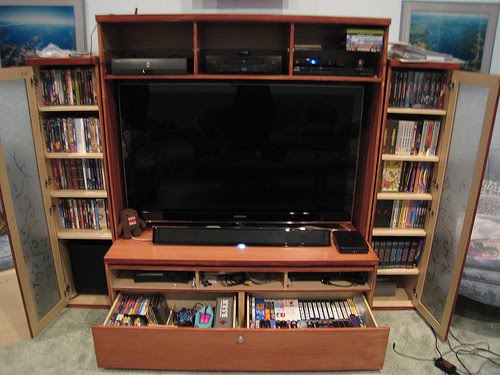
    Materials: Bonde TV Bench with hutch and 3 bookshelves with 2 doors, saw, drill, palm sander, stain, polyurethane, fabric from Jo-Ann, double-stick crafing tape, window film from Home Depot

    Description: I recently upgraded from an old small television to a new huge one, and I needed a new entertainment center to put it in. I finally settled on a Bonde system on IKEA, in large part because it was inexpensive on clearance. The base system was the birch color, which I wasn’t thrilled with for my decor, and the hutch was wide enough but not quite tall enough for the new TV, so I thought I could hack it to make it taller. I bought the TV bench, hutch, and two side bookshelves with doors to store my DVD collection. On the way out I found another bookshelf without doors in the as-is section and nabbed it (at half off the clearance price!) to provide extra pieces for the hutch extension.

    First, I dismantled the sacrificial as-is bookshelf. The top became a stain-test piece, the shelves were set aside to use in the final bookshelves, eight-inch pieces were cut off the sides to extend the height of the sides of the TV hutch, and an eight-inch strip of the backerboard was also cut off for the hutch. The holes in the hutch sides were moved up to accommodate the new mounting location of the shelves at the top of the hutch, and extra holes were drilled in the new extensions to match the hole spacing for the glass shelves in the hutch.

    Next, I spread all the pieces out on cardboard on my garage floor. Cam pegs, dowel pegs, and random plasticware from my cupboard helped hold pieces off the ground as necessary for edge and double-side staining. A light sanding of all the surfaces with 220 grit helped prepare the very thin birch veneer for stain, but it was easy to oversand. After wiping down all the dust, I applied two coats of Minwax stain in Red Chestnut color, though getting the color smooth was finicky work due to that thin thin veneer. I followed that up with two coats of satin polyurethane to protect the stain. It turned out that the recommendation to sand between coats was a bad one for this project due to the thin layer of stain, but luckily most of the parts I discovered that on aren’t very visible. I left all the surfaces that would be inside closed spaces the original birch color to save work and make the inside surfaces brighter. The doors ended up taking the stain differently than the rest of the pieces, but I did my best to even them out.

    After everything had dried really well, I assembled everything. The hutch side extensions were fastened to the top of the hutch sides with glue and dowel pegs. In retrospect, I should have done that before staining to ensure even colors, but live and learn. The fact that the extension joint lines up with the top of the bookshelves helps camouflage it. The backerboard extension was nailed onto the back of the hutch above the thick TV-mount backerboards and below the shelves, wehre it’s pretty well hidden by the TV.

    Finally, I applied a translucent window film with a vine pattern (available at Home Depot and other vendors) to the bookshelf door windows, and on the backside of the doors I used double-stick crafting tape to attach pieces of midnight blue organza fabric with little gold nubbins scattered across it like stars in the night sky (found at Jo-Ann Fabric and Craft around Christmas).

    DVDs and the subwoofer are stored discreetly in the bookshelves; the TiVo, VCR, and DVD player are mounted in the TV hutch for easy remote control; the big drawer in the TV unit has videotapes on one side and video games and oversize DVD sets on the other; and the door area of the TV hutch hides video game consoles, a UPS, and video and network switching equipment.

    See more here.

    ~ Amy, Houston, Texas, US


  • AT&T Getting the Hero? Ummm… What?

    We know that AT&T is planning to release a plethora of Android devices this year. What we don’t know is which ones they are. Rumors have it that a Touch Pro 2 like device will be on the menu. But what’s AT&T got planned for the touch-screen-only crowd?

    AndroidGuys has been sent a chat transcript from our buddy Jim C. In it, an AT&T customer support representative has claimed that AT&T will begin carrying the HTC Hero this summer, along with another device, which is still under wraps.

    Ingrid: Welcome to AT&T online Sales support.  How may I assist you with placing your order today?
    Jim: Do you carry the HTC Pure new anymore? All I see is refurbished, there isn’t even a page for the new device.
    Ingrid: I will be happy to assist.
    Ingrid: HTC is coming out with new phones pretty soon.
    Jim: Will they be similar to the Pure?
    Ingrid: Better since they will have Android technology.
    Jim: Wow, that sounds great. Do you know if they will be touchscreen like the Pure, or have a keyboard?
    Ingrid: Touch screen.
    Jim: When might I expect to be able to get one? I’m looking to buy soon, but I could wait a few weeks
    Ingrid: Anytime now or summer.
    Jim: Sounds great. Thanks for the heads up. I just did a quick web search, would this happen to be one of the devices? http://pocketnow.com/tech-news/att-htc-pc70110-is-the-android-touch-pro2
    Ingrid: The Hero is one of them the second one we do not have official word yet.
    Jim: Would it possibly be the Legend or the Desire? I’m a little confused about the Hero, since that’s an older device, the Legend is basically the successor to it. So might they be the Legend and Desire?
    Ingrid: Maybe if you type upcoming phones to AT&T you may get additional information.
    Jim: So you cannot confirm if either the Legend or Desire are one of these devices?
    Ingrid: Not yet since we do not have official Information, we are getting a new iPhone by June.
    Jim: Just wondering do you know the date on that?
    Ingrid: By the end of June.
    Jim: Thanks
    Jim: Have a great day

    While it seems highly unlikely that AT&T would adopt a year old phone, stranger things have happened. There’s always the possibility that the representative was, in fact, referring to the HTC Legend, but was just misinformed. At least now we know to expect two devices in the coming months. That’s good news for AT&T subscribers… Or is it? Should these new devices be locked down and Yahoo-ified like the Backflip, you can bet your bottom that Android fans aren’t gonna be happy.

    Might We Suggest…

    • HTC Legend is AT&T bound, so says the FCC
      Engadget has just posted a picture of FCC origin (see below) showing the HTC Legend sporting AT&T’s 850 and 1900MHz WCDMA bands. The label is the same as the one found inside the unibody case of t…


  • EDFix Call #9 Afterthoughts: Reconnecting with The Commons

    EDFix Call #9 – Summary (10 min.)

    Download MP3Subscribe in iTunes

    EDFix Call #9 – Full (54 min.)

    Download MP3Subscribe in iTunes

    Get Call Updates by Email

    An archaic German word — allmände — refers to goods used jointly by members of a community. This call was an exploration of such goods with German Commons activist Silke Helfrich.

    Five years ago, Helfrich helped organize a conference in Mexico that brought together experts in agriculture, biodiversity, genetics and more. An Argentine participant asked about folding in the concepts of open source software, precipitating a useful discussion about Common Pool Resources and their governance (you may remember CPRs from EDFix #5, with Charlotte Hess).

    Three notions bubbled out of those conversations, relative to these shared resources: access, usage rights and control. The culture of open source software gives everyone the right to read, write and use the code. Why was that kind of governance not happening with land, water, seeds and other resources needed for biodiversity? Duke professor James Boyle and others have described what's happened to The Commons as a second enclosure movement.

    During the first Enclosure movement, many physical Commons were replaced with private landholdings, but often with some loopholes to soften the blow. For example, the Magna Carta has a little-known companion document, the Charter of the Forest, which gave commoners access to enclosed lands for firewood, grazing their pigs and a little more. Historian Peter Linebaugh has a marvelous, slow-burning talk about this forgotten charter.

    This quick historical background is a platform for Helfrich's thesis: that we have become accustomed to delegating responsibility for these Commons to the State or the Market, and we need to regain the capacity to talk about The Commons and re-engage in its governance.

    Our earlier call with Charlotte Hess taught us that the people closest to a Commons are most likely to understand how to govern it. Helfrich believes we need to share our knowledge better, so people are better equipped to make wise governance choices. We also need to make some important vocabulary distinctions. One she finds critical is between property, which is permanent (until sold or transferred), and possession, which is temporary.

    What Governments and the Market will do depends largely on what society honors and rewards. Is the best company the one with the most patents, or the one that creates the most good with its innovations? (Think GreenXchange, from EDFix Call #6.) How, asks Helfrich, do we change the reward system?

    Commoning is not easy. It takes time and patience. There's no panacea. Each solution will be different, but the core notions are the same. Commoning is a social process that can reconnect the relevant stakeholders in ways that are beneficial in the long term.

    Many foundations, institutions and research centers are changing how they handle intellectual property, but Commoning doesn't fit comfortably into most of their charters. One useful step forward would be to reexamine their charters and missions to incorporate these ways of seeing and acting.

  • GM (Finally) Makes a Profit, But Some Worries Remain

    A year after the bailouts that I, among others, opposed, General Motors has announced its first real profit–$1 billion in positive cash flow, and $865 million in net income.  At this pace, GM may emerge from bankruptcy and go public by the end of the year, which will allow the government to recoup some of its investment.

    This is great news for taxpayers, and for GM employees.  The company didn’t just achieve the profit by cutting costs, but also by improving the revenue side.  However, there are still some dark spots on the record:

    1. GM achieved its profits at a time when the number one Japanese carmaker was taking a giant hit to its reputation for quality.  Yet The Truth About Cars points out that it still slightly lost market share compared to Q12009–which, you will recall, was not exactly a stellar moment for the firm.
    2. The Truth About Cars also points out that percentage of fleet sales actually rose, to 31% of all vehicles, and 40% of cars.  Fleet sales are often less profitable than retail sales, particularly to car rental firms, and they also depress the secondary market for your product–which in turn makes retail sales less profitable.
    3. GM is looking to move back into the auto financing business.  It was a truism for years that automakers were actually financial firms with an auto business on the side, and this was one of the reasons that they were hit so hard by the financial crisis.  I’d like to see GM develop its core competency as an auto manufacturer again before it dips its toes back into the banking industry.
    4. Europe is still struggling, while trucks are performing slightly better than the rest of the company.  That means that GM is still having trouble in small cars, doing better on big ones . . . at a time when gas prices are probably headed upwards.

    But still, it’s good news!  Everyone should want to see GM do well.

    The obvious question for folks like me is:  does this vindicate the bailout?  I don’t think so, for a bunch of reasons:

    • Bailouts are, on principle, a bad idea–they murder economic dynamism, and breed really unhealthy relations between corporations, labor unions, and the state. (Yes, unhealthier than what we have now, on the relevant dimensions)  Doing this one will make it harder to avoid bailing out other struggling firms.  Even if this one had been individually worthwhile, it would still be dangerous because of the precedent.
    • That said, the cost-cutting that made this turnaround possible is an effect of bankruptcy, not of government bailouts.  Arguably, the government interest in maximizing the number of UAW jobs has made things worse (though arguably, the financing terms have made things better).
    • The taxpayer is still going to end up losing a giant amount of money on this thing.
    • The notion that America could not have survived the collapse of GM is seriously overwrought.  They basically relied on the assumption that if GM was liquidated, all of GM’s manufacturing capacity would have disappeared, along with all of the buyers who bought GM cars.  But of course, profitable lines would have been sold to other manufacturers, and those other manufacturers would have produced more cars to satisfy market demand, for which they would have purchased more stuff from suppliers.  The dislocation would not have been zero, but it would not have rivaled, say, the construction industry.
    • The civic cost of this was large.  Rightly or wrongly, this was seen as a payoff to powerful Democratic interest groups in a large state.  Not that this is exactly unheard of, but this was very public, and the price tag was very large.  Though I think that government should do less stuff, I do not actually think it is a good thing when public trust in institutions erodes further; I want a government that is highly trusted to do the relatively few jobs for which it is uniquely suited.


    Email this Article
    Add to digg
    Add to Reddit
    Add to Twitter
    Add to del.icio.us
    Add to StumbleUpon
    Add to Facebook


  • It’s True: Mousetrap Never Works [Toys]

    Set to the tune of OK Go‘s This Too Shall Pass, this fantastic song/video parodies OK Go’s famed Rube Goldberg video—it’s called Mousetrap Never Works. And it’ll have you fist-pumping in vindication of your misspent childhood. More »


  • Google Doesn’t Like Mature Women Looking for Toy Boys [Censorship]

    I don’t know if Google’s motives are pure or not, but this is wrong: They are refusing to advertise CougarLife, a dating site for mature women looking for younger men. However, they accept sites for mature men seeking young women. More »


  • Shinobi Ninja video game iPhone app

    As more and more musicians and entertainers discover ways to use iPhone apps to reach their fans, we see an increasing amount of gadgets and games. Some of them are good, some of them are ehh.

    Earlier this year, the Brooklyn-based rock-rap group Shinobi Ninja launched a fun and amusing game called “Brooklyn to Babylon: Shinobi Ninja Attacks!” The game takes music and video and presents it in an eight-bit videogame world. As you play the game, you can earn rewards of more music, more videos, and more goodies. Plus, you get to take on Jersey Shore douchebags in the game, providing hours of family fun.

    The app also features GPS tracking capability at concerts so the band can located and reward fans who rock the game.

    There is a lite version of the game available from the iTunes App Store and a more loaded version for $1.99.


  • Toyoda says Toyota’s problems go years back, wants revive ‘neglected’ Scion

    Toyota's President and CEO – Akio Toyoda

    Toyota’s President and CEO, Akio Toyoda, said that he traces the automaker’s quality and financial woes to 2003, when the company began its ambitious global expansion. He said that winning over new customers in the wake of the company’s recall crisis will be a huge challenge.

    Speaking to Automotive News over the weekend, the publicity-shy Toyoda said he wants to scale back on the incentives that have led to record U.S. sales this year and revive what he calls a “neglected” Scion brand (which we’re guessing is due to the fact that Scion hasn’t come in under any negative headlines).

    “In 2003, we surpassed the 6 million sales mark, and after that the rate of increase kept growing,” Toyoda said. “We look at that as the turning point. When we hit the 6 million mark, we maybe couldn’t apply the Toyota Way as thoroughly as we should have”

    Toyoda also said that its best-selling models like the Camry sedan are also facing pressure from Ford, GM and Hyundai, which now rival his company in performance.

    – By: Omar Rana

    Source: Automotive News (Subscription Required)


  • Texas congressman uses porn to kill science funding | Bad Astronomy

    I know that there are rules to the way laws are made by our government here in the U.S., and that sometimes these rules seem weird and arcane. In general, these rules have evolved to make sure that the majority doesn’t stomp on the minority, and the minority still has a voice.

    TXRepRalphHallBut it’s also clear that those rules can be abused. In the case of U.S. Congressman Ralph Hall (R-TX), “abuse” isn’t nearly a big enough word. “Cynically manipulated” might be a bit better. He killed a bill that would fund science innovation and education by tying it to punishing people who look at porn at work.

    Seriously. This is truly disgusting, and has to be seen to be believed. Please read that link above.

    Basically, the America COMPETES act, instituted under the Bush Administration in 2007, funds a lot of technology and other endeavors to keep the US competitive in the world market. Of course, in the current economic market, we don’t have a lot of money to go around. But this bill would have re-authorized that earlier act, funding what is essentially seed corn, making sure that in the years to come we have a robust investment in our own economy. I wasn’t that familiar with it, but after reading about it I’ll say it’s one of the few things done by the previous President I think is a good idea. So did a lot of others: this reauthorization bill had over 100 co-sponsors in the House.

    I say “had”, because after the shameful and politically transparent move by Rep. Hall, the bill is basically dead.

    This bill would have extended funding for several more years in key places, including science education. Hall is the ranking Republican on the House Science and Technology Committee that prepped the bill. There had been objections by Republicans on the committee to the amount of spending of the bill. The Democrat-controlled committee made some concessions in that area (shaving 10% of the spending off), but still passed the bill out of committee. The next step would be a vote on the floor of the House.

    However, right before it was to go to the floor, Rep. Hall called a Motion to Recommit. Because of those weird rules I mentioned above, this meant that Congress would either have to agree to the Motion and have the bill sent back to committee — where it would die — or overrule the Motion. Now follow this carefully: part of the Motion Rep. Hall submitted was language added to the bill that said that it would prevent the government from paying salaries to employees who looked at porn on government computers.

    By doing this, Hall basically bet all his chips. Hall’s move left Congress, notably Democrats, with two options: kill this much-needed bill that invests in America’s future in science and technology, or overrule a motion punishing people for downloading pornography. If they did the latter, the far right noise machine, always eager for red meat in the political arena, could then say Democrats voted to continue paying employees who looked at porn.

    Facing this sort of choice, a large number of Democrats backed off. Hall’s Motion passed, and the bill went back to committee where it’s now essentially dead.

    Of course, watching porn on the government’s dime has nothing to do with this bill. The only reason I can think of that this language was added is that it was a gambit where Hall wins either way: the bill dies, or Democrats put their head in the right-wing media guillotine. Representative Bart Gordon (D-TN), who is the Chairman of the committee, agrees:

    We’re all opposed to federal employees watching pornography. That is not a question; but that’s not what this was about… The Motion to Recommit was about gutting funding for our science agencies.

    And while Representative Hall pulls this deplorable stunt, our nation is suffering mightily in scientific education. In this heart-rending post by my friend, astronomer and educator Pamela Gay, she laments how we’re letting our teachers and our children down by not funding science, technology, engineering, and mathematics. Read her post, then read again what Hall did.

    Our future is more important than being a chip in a political game of poker. Unfortunately, in this case, Congress folded.


  • Report: De Tomaso planning Mini rival?

    Filed under: , , ,

    Between the Fiat 500 and the Alfa MiTo (to say nothing of the Lancia Ypsilon), Italy’s got plenty of Mini rivals on the road. But it could gain another, if emerging reports prove accurate in the long run.

    The rumors center around the revived De Tomaso. The dormant sportscar marque was recently acquired by one Gianmario Rossignolo, a former chief executive of Lancia who was previously linked to a take-over of Bertone. Rossignolo has some ambitious plans in place for his new company, acquiring a former Pininfarina factory in the Piedmont region of Italy, where he reportedly plans on building a line of sportscars, luxury sedans and sport-utes. Now reports suggest a premium hatchback to rival the Mini could be in the cards as well.

    Any truth to it? Too soon to tell, but Rossignolo’s De Tomaso is expected to debut something new in Geneva next year, so if we sit tight, we just might find out.

    [Source: OmniAuto.it]

    Report: De Tomaso planning Mini rival? originally appeared on Autoblog on Mon, 17 May 2010 13:33:00 EST. Please see our terms for use of feeds.

    Read | Permalink | Email this | Comments

  • Jell-O to get its wiggly and jiggly groove back in new campaign

    Any ad campaign that conjures a Fat Albert memory is starting out on the right foot. And there’s even more nostalgia in the new full-court press for Kraft’s iconic wiggly dessert, Jell-O. Legendary pitchman Bill Cosby is back, as are his interviews with children, à la Kids Say the Darndest Things. This time they’re on the Web in 10-minute Jell-O-sponsored vignettes called "OBKB," which takes its name from the way Mush Mouth said "OK" on Fat Albert and the Cosby Kids. There’s a lot going on with this effort, including a Facebook page, a new logo and jingle, FSIs and TV, print, outdoor and in-store ads. A highlight has to be a national contest to find the best giggle (to be judged, ultimately, by Cosby and included in a national TV spot). There’s a cross-country tour via a tricked-out mobile recording studio, where folks in 22 cities will be able to compete for the best giggle (entries accepted online, too). Is snorting allowed? Kraft certainly isn’t the first marketer to go the happiness route to sell its products in these recession-racked, frowny times. But even cynics might have to admit this is just plain fun.

    —Posted by T.L. Stanley

  • Disembodied voice asks: Who will be the ultimate gamer (on season 2 of ‘WCG Ultimate Gamer’)?

    The most shocking thing about the news that there will be a second season of “WCG Ultimate Gamer” on SyFy is that there was ever a first season. Could have fooled me. But alas, it has been picked up for another year. This calls for a celebration of some sort. Wee!

    Yes, the network now best known for carrying WWE SmackDown (well, starting this fall) will air eight episodes of “WCG Ultimate Gamer” beginning this August. It sounds like the typical reality show: there’s a house, there’s people in the house who may or may not get on with each other, and they solve their differences by [filling in the blank]. The blank being filled in here is that they’re all gamers. Presumably they’ll solve conflicts by playing best of 10 in Super Street Fighter IV. I mean, that’s how I’d run the show; I don’t know if that’s actually what happens.

    Says the fancy press release:

    The challenges in “WCG Ultimate Gamer” include dramatic video game battles using Samsung’s leading edge technology and real-life scenarios inspired by best-selling games. Over eight weeks, the next Ultimate Gamer will need to demonstrate top-notch skills while excelling under the pressure of head-to-head elimination rounds and successfully navigating the drama and twists of this unique reality TV show.

    During the first season, contestants faced large-scale real-life challenges that took them beyond the game. For example, in the episode featuring the game Rock Band, the gamers had to form a band, create a look, learn to play a song by The Donnas, and then perform it using real instruments in front of a live audience as the band judged their performance.

    We all know that the best reality show in history was “Bug Juice” on the Disney Channel. Every other show feels so empty compared to the drama of the one team against the other team. (I actually did like that show, so if that came off negatively, well, it wasn’t supposed to.)

    The winner of the show gets $100,000. That’s probably pre-tax, though, so…

    Oh, and starting today you can visit the show’s Web site and vote for who you want to be the twelfth contestant. They have 11 set in stone, and it’s your job to pick number 12. That’s the young lady up there who’s in the lead as of 1:30pm ET.

    Is there an age limit to this show? I don’t know if I’m as good at Rock Band as those whiz kids, but Man Alive would I be annoying. I’m cackling at the idea as I type these words. MWAHHHHAAHHH~!


  • “Celebrity Rehab” Having Tough Time Casting Drug-Addicted Celebs

    VH1 has pumped the brakes on its hit reality soap Celebrity Rehab with Dr. Drew because the show is lacking the one essential thing it needs to ensure that it continues to be the gut-wrenching trainwreck reality fans love to loathe: drug-addicted celebs!

    For the first time in recent memory, Dr. Drew and the crew can’t find a single drug-addled notable doped-up and depressed enough to bare their souls for VH1’s cameras. Of course, trouble-prone rapper DMX seemed like a viable option — until an Arizona judge threw him back in the slammer on a probation violation. Last month. Heather Locklear, Brooke Mueller, and Lindsay Lohan all snubbed massive paydays that would have required them to spend a few months detoxing at Drew’s Pasadena Recovery Center.

    Here’s the Word on the Curb: “Sources close to the production tell TMZ they have struck out left and right trying to find A, B, or even C-list celebs for the show….The show was able to get a tentative commitment from a few D and F-listers, but our sources say the network rejected them..We’re told there was a deadline last Friday to lock down the cast, but since they don’t have ANYONE signed on…the deadline was extended to Wednesday.”

    Have they tried Gary Coleman?

    Jerry Conway, Jessica Sierra, and Mackenzie Phillips are among the stars who have been featured on Celebrity Rehab since the show’s debut in 2007.


  • Sony Ericsson Xperia X10 gets rooted.. sort of.

    Alright, everyone — it’s that time again! It’s time for yet another weekly installment of “Good news, bad news”! Hurraaaay!

    The Good News: The Sony Ericsson Xperia X10 has been rooted, granting hackers full access to the file system and the ability to install custom ROMs.

    The Bad News: In its current state, this root is by no means user-friendly. Unlike many a root, this one isn’t a matter of plopping a few files on an SD card and pushing in the right key strokes; these guys had to dig some serious trenches to get this root in place, requiring dedicated a hardware flashing tool (called the SETool) and a big ol’ bucket of elbow grease.

    On the upside, there’s a chance that this all could lead to a less-ridiculously-intense process, given that the folks responsible for this one are hard at work on taking what they’ve learned and building up an all-software solution.

    If this were an 80’s movie, there would be a totally killer montage of sweaty dudes sitting over smoking soldering irons, phones exploding, and frustrated faces all leading up to a shot of an anxious group of geeks huddled around a phone as they wait for it to boot. Also, the music would be something by Survivor.


  • Science fiction and ocean acidification

    Zimmer tells us we’ll be able to recognize the human era by the sedimentary evidence of ocean acidification and mass extinction.

    Sounds plausible. So what should we think of why we find a similar catastrophe 55 million years ago?

    An Ominous Warning on the Effects of Ocean Acidification by Carl Zimmer: Yale Environment 360

    … Scientists have been scouring the fossil record for periods of history that might offer clues to how the planet will respond to the current carbon jolt. They’ve found that 55 million years ago, the Earth went through a similar change. Lee Kump of Penn State and his colleagues have estimated that roughly 6.8 trillion tons of carbon entered the Earth’s atmosphere over about 10,000 years.

    Nobody can say for sure what unleashed all that carbon, but it appeared to have had a drastic effect on the climate. Temperatures rose between 5 and 9 degrees Celsius (9 to 16 Fahrenheit). Many deep-water species became extinct, possibly as the pH of the deep ocean became too low for them to survive…

    I’m sure I read this in a science fiction story once. Something to do with smart dinosaurs.

    I’m just joking of course. We’d easily recognize the evidence of long extinct prior technological civilization from 55 million years ago. After all, we won’t be just a peculiar layer of pollution in 55 million years, will we?

    (I really am joking. Though if had been over 200 years rather than “10,000 years” with no volcanic explanation one would have to wonder.)