Category: News

  • Obama week ahead: State dinner for Mexico President Felipe Calderon and Margarita Zavala

    Schedule for Week of May 17, 2010

    On Monday, the President will sign the Freedom of Press Act Bill. In the afternoon, the President will welcome the NCAA champion University of Connecticut women’s basketball team to the White House.

    On Tuesday, the President will travel to Youngstown, Ohio, and tour the facilities of V & M Star Ohio before delivering remarks on jobs and the economy to workers.

    On Wednesday, the President will hold a bilateral meeting and press conference with President Calderón of Mexico. In the evening, the President and Mrs. Obama will host a State Dinner in honor of President Calderón and Mrs. Zavala.

    On Thursday and Friday, the President will attend meetings at the White House.

    ###

  • Ask NerdGirl: Google I/O Is This Week! Why Do Apps Require Unnecessary Permissions? Streaming Video!

    Google I/O is just a few days away! Of course it starts the same day I’ll be taking a train from Cleveland to New York so I’ll be having some fun testing tethering apps along the way. Seems fitting that the first question of the week has to do with Google!

    Google Voice 0.3.3: Do you know when Google is gunna release this version and what it will add?  I Use this app all the time! I Love it!

    The last update was March 23rd. It finally pushed the notifications almost instantly. I was excited to see that. Judging by how Google I/O is next week and they’ve recently updated Maps, Goggles, the mobile sites, image search, and place pages, and now they’re about to officially release Android 2.2 (Froyo), I can’t imagine it’s too long before we see another update to Voice. It seems that they’re really working hard on the mobile end of things and I love it!

    DanO says:

    Why do so many apps that seem really useful require access to areas of the phone that they really shouldn’t need.

    Zxing’s Bar Code scanner wants to access the browser history, bookmarks read/write contact data-why? Where are all the tech privacy advocates on this-not a single article that I’ve seen.

    Why do I only see QR bar code links [on all the Android app sites] that only point to Google’s Android Market, when they could simply provide a link to the apk?

    Think about it, if you don’t want to give access to your history and contacts, you wouldn’t have the means to scan the QR code right?

    I know this was answered by AndroidTapp Admin Man himself, but I wanted to put my two cents into this as well.

    When I first started downloading apps I noticed these permissions too. Why does my camera app want to know my phonebook? Why does Key Ring need to know my GPS location? And of course why would my barcode scanner need my browser history? You need to consider what the app is really doing.

    Let’s go through the Barcode Scanner as an example:

    Modify/delete SD card contents – You can save scanned barcodes and retrieve them later. These are saved to the SD card. You can also delete the barcodes when you no longer need them so that is why it can delete.

    Read Browser’s history and bookmarks – You can actually send a QR code of a bookmark or a recently visited page to someone. Therefore, the app needs to access this information.

    Read contact data – You can send a code using the built in share feature. This enables the program to get your contacts so you can share it.

    Write contact data – When you send something, if you send it to someone that isn’t in your phonebook, it will save the data for you to insert later.

    Full Internet access – When you scan a barcode, not only does it go to the market, but it could go to a page to compare prices or a website for a company.

    Take pictures – The app uses the camera built into the phone to take a picture of the barcode.

    Control flashlight – If you have a flash built in you can turn it on so you can scan a barcode easier in low light.

    Control vibrator – When a barcode is scanned you can have it vibrate when it is found.

    So, just because an app looks like it does one thing, it may have the option to do even more. Yes, be wary of what you download and it is always a good idea to check what it has access to, but 99% of the time, it’s there for a reason.

    Is there a site that is capable of streaming movies to my Droid? Without adobe flash it seems impossible.

    Todd

    There are apps for that, Todd!

    Skyfire Mobile Browser – allows you to view some Flash videos directly from the browser.

    Androrb – This is not exactly what you’re looking for, but I like it. With an Orb account and Orb running on your computer you can stream the videos you have on your computer onto your phone. They don’t need to be on the same network, which is really nice, and the quality isn’t the worst. Best part, it’s free!

    SPB TV – With this app you can watch live streaming broadcasts from around the world. The free version only allows you to watch 6 channels, but the full version gives you over a hundred. The paid version is $9.95.

    Stream Media Player – This app allows you to watch Internet video, listen to Internet radio, and watch web cameras. It also is a media player for your local media files.

    I haven’t used SPB TV and Stream Media player extensively, but it can’t hurt to try them out. Now Hulu just needs to make an app…

    Even while I’m on vacation this coming week I’m going to be answering your questions to make sure to keep sending them to [email protected]!

    ~n3rdg1rl

    Algadon Free Online RPG. Fully Mobile Friendly.

  • DuPont’s Prints 50-Inch OLED Panel In Under 2 Minutes [Oled]

    DuPont has excelled where no man has before—demonstrating the first OLED panels to be printed, and in under two minutes no less. Using a Dainippon Screen multi-nozzle printer, they successfully created a 50-inch display. More »


    Organic LEDBusinessConstruction and MaintenanceMaterials and SuppliesElectronics and Electrical

  • T-Mobile myTouch 3G Slide gets priced at $150

    Looks like everybody’s favorite T-Mobile myTouch 3G Slide just got a price. According to a leaked slide from Tmonews, the myTouch 3G Slide will be available for $149.99 with new 2-year contract and $399.99 off contract (that’s Even More and Even More Plus for those counting). Given the decent specs of the myTouch 3G Slide and the fact that it’ll be running Android 2.1 with Sense, that $150 price looks like a steal. If you’re in the market for a solid Android phone with a physical keyboard, the myTouch 3G is a really great option. We won’t be surprised if the myTouch 3G Slide becomes the phone that’ll replace many people’s G1.

  • Keep track of your fuel economy with TREC

    Back in the day, when I used to drive a car, I used to be obsessed with fuel economy. When I started driving gas was 99 cents a gallon. Not long after it was up around $2, and now it can get over $3 per gallon. There’s nothing I can do to lower fuel prices, but I can do everything in my power to make sure my car uses fuel efficiently. This usually means entering data into a spreadsheet, but by the time I get to my computer I often forget to do it. In this case, a BlackBerry app makes sense. Thankfully, developer LSphone has created a low-cost application that lets you track many aspects of your fuel consumption.

    (more…)

  • The Samsung TL500 / EX1 gets a South Korean release


    Samsung’s upcoming flagship shoot brook a few months back. The TL500 / EX1 woo’d us with its rugged good looks along with a host of top-tier specs. Well, you don’t have to wait any longer. The camera is now available — in South Korea.


    It doesn’t seem anything has changed since the last time we spied this guy. A F1.8 24mm ultra0wide lens still supplies a 1/1.7-inch CCD backed by Samsung’s DRIMeIII image processor. Dual image stabilization along with a max ISO of 3200 should produce some good shots while a 3-inch AMOLED screen takes care of the viewfinding. The camera’s only real downside is the video mode that’s only capable of 640×480 at 30fps. (what is this, 2006?)


    The TL500 / EX1 is still bound for the states, but if you just can’t wait that long, why not fly over to Korea and pick one up for 599,000KRW. ($400 USD) [Samsung]


  • Iran Uranium ‘Breakthrough,’ Just in Time for a Sanctions Debate

    It’s difficult not to be skeptical here, but the Iranian regime is announcing that it’s reached a deal, brokered by Brazil, to send the majority of its uranium to Turkey to be enriched into a state unsuitable for nuclear weapons. On the face of it, that would revive a deal President Obama proposed last year to have a third country do Iran’s enrichment for it, thereby putting time back on the clock before Iran went nuclear to assemble an international strategy to change Iran’s decision-making on developing nuclear weapons. Iran rejected that offer.

    But that’s the face of it. The United States is in its strongest position ever at the United Nations Security Council to place economic sanctions on Iran, thanks in large part to consistent Iranian rebuffs of U.S. outreach. That means the smart strategy for Iran is a late-breaking show of superficial reasonableness. “This is a potentially important breakthrough and could signal a return to engagement, which everyone wants to see,” proliferation expert Jacqueline Shire tells Politico’s Laura Rozen. But it remains to be seen if what everyone wants to see gets in the way of what they should see.

    The Obama administration has yet to comment on the prospective Turkey enrichment move.

  • Elon Musk’s estranged wife wants $6 million, 10% of his stock, a Tesla Roadster and more

    Tesla Motors Co-founder, Chairman, CEO – Elon Musk

    The revolutionary world of electric-vehicles is generating a lot of buzz in the technology world and now, in a sort of a TMZ way, is generating a lot of buzz in celebrity divorce cases. Co-founder Elon Musk and his wife Justine Musk have filed for divorce, a move that could complicate plans by Elon to take the company public and retain $465 million in U.S. government funding to launch a mass-market Model S sedan.

    Musk is the largest shareholder in Tesla, which has over 81 million shares. Nonetheless it is unclear how much of the company Elon owns since Tesla does not disclose current shares on issue. According to Tesla’s regulatory filing, the government loan could be in default if Elon does not hold enough of the company stock.

    As for Justine, here is what she wrote in a recent post on her blog outlining exactly what she wants from Elon (hit the jump to see the list):

    For those who want to know the extent of my golddigging, this is what I asked for, from my ex-husband and the father of my five children Elon Musk, who is a billionaire and likely to become one of the wealthiest men on the planet.

    • The house
    • alimony and child support
    • 6 million cash
    • 10 percent of his stock in Tesla
    • 5 percent of his stock in SpaceX
    • (and he retains all voting rights)
    • and a Tesla Roadster (I really, really want one…)

    Note: Check out Justine’s blog here.

    Photo Copyright © 2009 Kap Shah – egmCarTech.

    – By: Omar Rana

    Source: Automotive News (Subscription Required)


  • Rachel Uchitel Naked For Playboy Magazine

    Manhattan nightclub hostess Rachel Uchitel — the 9/11 fiancee romantically-linked to golfer Tiger Woods and Bones actor David Boreanaz — has inked a deal to strip down to nothing but a smile for an upcoming issue of Playboy Magazine.

    TMZ.com writes: “A source close to the mag tells us Rachel has the right to pull out any time before the shoot goes down — which is in three weeks. We’re also told Rachel won’t be baring it all — just the backside … and the topside.”

    Uchitel, who is now a correspondent for Extra TV, has been negoitiating the reportedly lucrative deal with Playboy chiefs since being approached by the men’s mag at the height of the Woods sex scandal last December.


  • WP7 ROM outs 1.3GHz Snapdragon wielding HTC Mondrian

    This weekend the folks over at XDA-Developers managed to get their hands on what appears to be the first device-ready Windows Phone 7 ROM.  As you can imagine, they got to work trying to crack the ROM right away, and this morning Engadget is reporting that some interesting details have been revealed.  It’s hard to say for sure, but the image above could very well be the HTC Mondrian, a device we don’t know much about but whose name is referenced by the WP7 ROM.  Let’s not get too excited yet, as I’m sure you realize the above picture is rather generic looking, and could be a placeholder for the actual device.

    From what has been discovered so far, the Mondrian will be sporting a 4.3-inch WVGA touchscreen display with 400×800 resolution by Optrex, and a 1.3GHz (nice!) Qualcomm QSD8650A/B Snapdragon processor, which interestingly has the capacity to support both GSM and CDMA networks.  Also, you’ll notice that the above devices seems to be fully touchscreen, so we’re probably looking at what you may remember to be called Chassis 1.

    We all know that nothing’s final until it’s official, so remember to keep your tub o’ salt nearby.  And don’t forget that we’re not expecting to see the first Windows Phone 7 device until September at the earliest, which doesn’t take into account any delays that could easily come with a brand new OS and Microsoft’s strict guidelines for how WP7 is expected to look and behave.  All that aside, I’d love to give just about any device sporting an 1.3GHz processor a spin, wouldn’t you?  Sound off below!

    Via Engadget


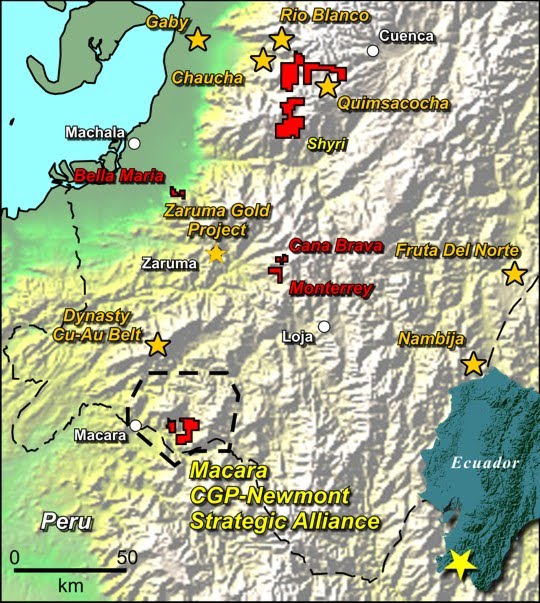
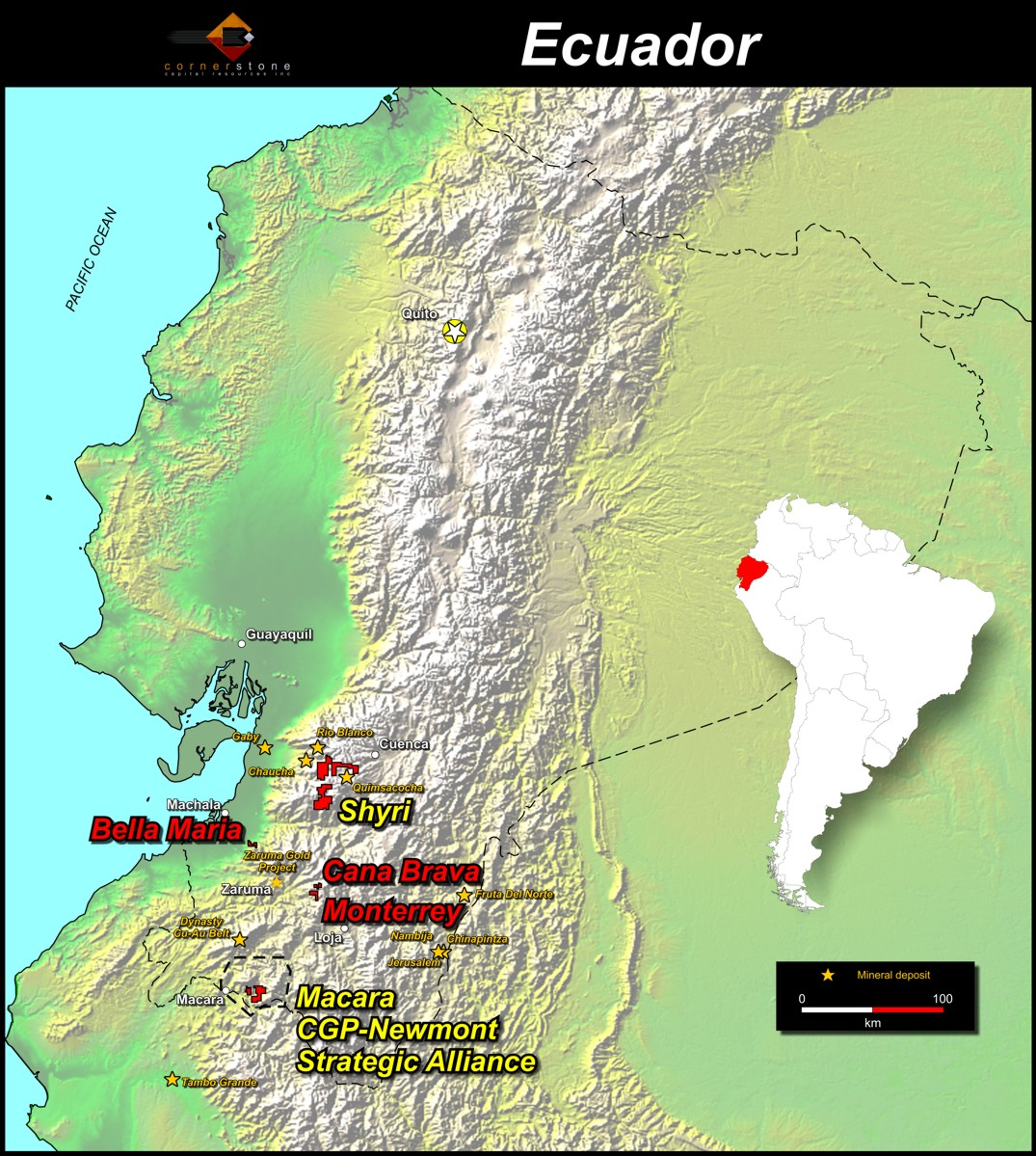
  • Gold in South America: Cornerstone Reports Significant Progress on Ecuador Permits CGP.v, AUY, NEM, ABX, TNR.v, BVN, HUI, XAU, GDX, FCX, GG, MAI.to,

    Related News
    Cornerstone and Newmont Propose to Form a Strategic Exploration Alliance in Southern Ecuador
    Primary TargetGoldLocationThe Macara concessions is approximately 75 km2 located near the Ecuador-Peru border. The Strategic Alliance area of influence encompasses approximately 2000 km2.Property InformationThe property hosts gold bearing quartz-tourmaline veins and breccias associated with an intrusive body. Recent work by Sierramin has returned assay values from channel samples up to 23.8 g/t Au over 1.0 m and 7.3 g/t Au over 1.8 m. Chip samples collected during reconnaissance prospecting returned assays of 13.0 g/t Au over 2.0 m (incl. 44.2 g/t Au over 0.5 m) and 8.3 g/t Au over 0.65 m from sulphide bearing quartz veins within shear zones cutting granites.

    Press Release Source: Cornerstone Capital Resources Inc. On Monday May 17, 2010, 8:00 am
    MOUNT PEARL, NEWFOUNDLAND–(Marketwire – May 17, 2010) – Cornerstone Capital Resources Inc. (TSX VENTURE:CGPNews; FRANKFURT:GWNNews; BERLIN:GWNNews; PINK SHEETS:CTNXFNews) reports that it has been issued a number of key permits needed to re-start exploration activities in Ecuador. During the first two weeks of May, Cornerstone received new titles under the January 2009 mining law to 13 of its mineral concessions including the 10 Shyri properties under option to Intrepid Mines Ltd. (see news release October 29, 2009).
    Also issued by the Ecuador Ministry of Environment during this period were the approval of the Environmental Management Plan for the Gama property, part of the Shyri project, and a water permit for drilling at Gama. Cornerstone representatives are meeting with the regulators this week to determine any final steps required to initiate exploration work and will provide updates of further developments. While the permitting process has been a lengthy one under an array of new laws and regulations in Ecuador, the company is encouraged that it is progressing within the current legal framework and expects to have its final permissions in the near future.
    About Cornerstone
    Cornerstone Capital Resources Inc. is a mineral exploration company based in Mount Pearl, Newfoundland and Labrador, Canada, with a diversified portfolio of projects in Canada and Ecuador and a strong technical team that has proven its ability to identify, acquire and advance properties of merit. The company’s business model is based on generating exploration projects whose subsequent development is funded primarily through joint venture partnerships.
    Further information is available on Cornerstone’s website: www.cornerstoneresources.com or for investor, corporate or media inquiries, please see contact information.
    Cautionary Notice:
    Certain statements contained in this press release may be considered as forward-looking. Such forward-looking statements are subject to risks and uncertainties that could cause actual results to differ materially from estimated or implied results. While Cornerstone anticipates that subsequent events may cause its views to change, it expressly disclaims any obligation to update the Forward-Looking Statements contained herein except where outcomes have varied materially from the original statements.
    On Behalf of the Board,
    Colin B. McKenzie, President & CEO
    Neither TSX Venture Exchange nor its Regulation Services Provider (as that term is defined in the policies of the TSX Venture Exchange) accepts responsibility for the adequacy or accuracy of this release.”
  • Honda adia lançamento da nova versão do Civic


    As rápidas mudanças tecnológicas que estão acontecendo na indústria automotiva obrigaram a Honda a quebrar o seu rigoroso ciclo de 5 anos para a renovação de seus modelos, e a próxima geração do Civic que estava planejada para lançar em 2010, vai ter que esperar um pouco mais e ser anunciada em 2011.

    Segundo a montadora, o atraso é para que o modelo se adapte às mudanças atuais, principalmente no que diz respeito a economia de combustível. A Honda admitiu que os padrões do mercado externo estão evoluindo a passos largos, e que o mercado se tornará muito mais competitivo. O vice presidente da Honda norte-americana, John Mandel diz o seguinte:

    “Nós mudamos veículos quando precisam mudar. A habilidade de fazer alguma coisa baseada em informação mais atualizada é melhor do que esperar um ciclo completo de modelos se passar. Alguns desses (modelos) são capazes de ter a chance de mudar, baseado no que você vê no mercado”.

    Via | Left Lane


  • Lady Gaga: Hat-Making Intern

    She writes a pretty mean pop song, but how are her hat-making skills?! Multiplatinum-selling recording artist Lady Gaga has applied for an internship with legendary milliner Phillip Treacy.

    The eccentric hitmaker — as known for her love of headscrathing ensembles as she is for her signature dance anthems — is a huge fan of Treacy’s outrageous toppers, including a telephone-shaped piece and a lobster hat previously worn by Gaga. Now the singer wants to learn how to design the kooky headpieces herself, and has applied for an internship at the company.

    “Gaga’s crazy about the idea. Philip agreed to give her an internship when they met at the Brits. She hopes to take him up on the offer this summer,” a fashion industry tattle told Britain’s Mail on Sunday this week.

    A representative for Treacy confirmed the news, saying: “Lady Gaga has requested an internship, but Philip will have to check her sewing skills first.”


  • Sunday Column: A question of umami

    photo 5If you’ve read all you care to about Swedish food on this blog, please move on. But I thought I would share this column, which appeared in yesterday’s print edition of the Atlanta Journal-Constitution. I took my travelogue from a couple of weeks ago and used it as a starting point for a geeky meditation on the presence — and absense — of umami in food. I’d love to hear from you if you have any thoughts on the subject.

    Swedish food adventure

    By the third day in our hotel room I felt like I could use the shower without getting scalded, or frozen, or shooting water out of the weird little side nozzle past my head and into the toilet. The bank of gleaming steel controls on this shower were both beautiful to behold and wholly unmarked. This was, I was beginning to understand, another example of Swedish design.

    A couple of weeks ago my wife and I went to Stockholm for vacation and spent a lot of time admiring the way everyday objects were designed. We also admired the food: Amazing …

  • How green are the ‘childless by choice’?

    by Lisa Hymas

    Laura S. Scott has surveyed and interviewed more than 170
    people for her Childless by
    Choice Project
    .  “I’m
    keenly interested in the process of decision-making,” she says. “How
    do we get from assuming parenthood for ourselves to the point where we’re
    saying, ‘No kids, thank you!’?” 
    She shares what she’s learned in a new book, Two
    Is Enough: A Couple’s Guide to Living Childless by Choice
    , and in a forthcoming
    documentary
    .

    I called Scott to find out whether environmental concerns
    were a factor for many of the people she spoke with—and we also got to
    talking about whether the feminist movement is supportive of childfree women,
    how a nurturing instinct is different from a maternal instinct, and why we
    shouldn’t try to save Social Security as we know it.

    ——-

    Q. How many of the people you talked to mentioned
    environmental issues as a reason not to have kids?

    A. I was trying to find the top six most compelling motives to
    remain childless. The environmental motive was not among that top six, but it
    showed up fairly regularly in the mix of motives.  In a questionnaire, I asked people an open-ended question:
    “I remained childless by choice because I believe ___.” The motive that was
    most frequent was, “I don’t feel the desire. I believe you shouldn’t have a
    child unless you feel a desire to have a child.” Then other frequently cited
    belief systems included, “The world is already overpopulated. I believe that
    the world does not need another child.”

    Even though [the environment] didn’t come out as the most
    compelling motive for the group, it was the most compelling motive for a number
    of people.  I interviewed people
    who felt very strongly that if they were going to be responsible global
    citizens, they needed not to have children. I talked to a couple in Canada and
    [the woman] said to me, “As much as I love the potentiality of a newborn,
    I don’t think the planet needs another garbage-producing human.” Her partner
    actually wrote himself a letter the week he was going to get a vasectomy,
    making a list of reasons why he got snipped. The No. 1 reason was that the
    world is overpopulated and Mother Earth’s problems are a result of too many
    humans.

    Q. When a person is thinking about whether or not to have a
    child, environmental concerns might break down in two ways: There’s concern
    about overpopulation and that a child will cause environmental damage and use
    resources and worsen climate change. And then you might be concerned about
    bringing a child into a polluted and crowded world that’s going to be a less
    pleasant place to live. Did you hear from people on that latter point?

    A. There is that too. There was worry that we’ve messed up this
    planet so badly, is it really fair to bring this little person into it? And I
    think “environmental,” more broadly, is not just a distressed planet, but also
    the social ills that might threaten the environment [in which you raise] a
    child, whether it be crime or drugs or sexual promiscuity.

    But it was more of the former that I heard about. There was
    a guilt aspect. Some people said, “You know, we really messed up this planet
    and I feel guilty bringing a child into this place.”

    People who I interviewed thought long and hard about what
    it would be like to be a parent in this day and age, and it didn’t look like a
    pretty picture to them. They didn’t have a lot of faith that they would be the
    parent they really wanted to be based on the stressors that were out there for
    parents.

    Q. Were people who cited the environment as a reason younger
    or older?

    If you like this article, you’ll love my piece on being a GINK: green inclinations, no kids

    A. I got it across the board. I saw slightly more of the 20- to
    29-year-olds expressing concerns about the environment, but only slightly. I
    anticipated that I would see more people concerned about the environment who
    were children of the ‘70s, when we had that zero-population-growth movement.
    There was a time, in the ‘70s and even in the early ‘80s, when it was totally
    cool to be childfree, particularly if you were in environmental-activist
    circles. But I think this next generation, anyone born after 1980, is
    going to be much more aware of environmental concerns because we’re doing a
    better job of educating children about global sustainability.

    I was influenced after the fact. I made the decision not to
    have children in my late teens, early 20s, and environmental motives were not
    among my primary motives. However, as I grew to be an adult, I became much more
    conscious about environmental concerns. I read Bill McKibben’s book Maybe
    One
    and was incredibly influenced by
    it, to the point where I felt myself nodding on every page, saying, “This guy
    is so right!” and thinking, “Wouldn’t it be great if everyone had a chance to
    read this book and really think long and hard about how many children they
    bring into the world?”

    Q. In your book, you mention meeting an older woman who asks
    you whether you have kids, and you tell her you’ve chosen not to, and she
    responds, “Back in my day we didn’t have a choice.”

    A. The choice to remain childless didn’t really exist even 50
    or 60 years ago. Birth control methods were really dodgy and not particularly
    safe or accessible or widely available to most people. And there were laws on
    the books against using contraceptives if you were married, even until the
    1960s in the United States and Canada. The fact that you can as a couple choose
    to remain childless and you can take the steps to ensure that you do not have
    children and you can do it safely and you can do it legally—this is new!

    Q. Maybe the culture hasn’t caught up with this dramatic
    shift?

    A. That’s very true. The assumption that everyone will have a
    child at some point in their life and it will all be good and happy—that still
    has a lot of power. People who make the alternate choice are really swimming
    against the tide, and their decision-making is not endorsed or understood or
    accepted in a lot of communities. 

    It used to be
    that you went from high school to marriage to children and the question was,
    “How many children are we going to have?” And that question has
    morphed into, “Should we have children?” As you delay marriage and
    child-rearing into your 30s and perhaps even your 40s, you come to appreciate a
    childfree life. Then that fertility deadline hits, particularly for women, and
    you go, “OK, gosh, if I’m going to have kids, I really need to think about it.
    Do I need to look at my partner as a possible father for my children? Am I going
    to find a new house that I can raise a family in? Or am I going to refill that
    birth-control prescription?” And then you are a decision-maker—you’re no
    longer assuming kids for yourself.

    Q. Do you think there’s more pressure on women than on men
    to become parents? Or do women feel it more acutely?

    A. I think females do feel it more acutely, and the reason is
    that having children, being a mother, is so tied to the female identity, more
    so than to the male identity. People I interview will say, “People don’t think
    you’re a real woman unless you have a child.” There’s that sense that others
    are thinking, “Well, she’s not really going to be fulfilled as a woman, or
    empowered as a woman, or empathetic as a woman if she doesn’t experience
    parenthood.”

    Studies have clearly shown that voluntarily childless women
    do experience incredibly good well-being and do have a great quality of life
    and are experiencing the full range of Maslow’s
    hierarchy of needs
    —that self-actualization that we all hope and pray for.
    But then there’s that niggling suspicion, especially from women who have
    children, that this can’t be legit, that childfree women are in denial and are
    going to regret it and are going to feel lonely and isolated and have a very
    poor quality of life. I think there’s a sense that a man in the world will do
    fine without children, but a woman in the world without children is going to
    face some tragic end.

    Q. Do you feel like the feminist movement—not that
    there’s some monolithic movement that you can pin down—but do you feel like
    it’s supportive of the choice not to have children? Or is it really focused on
    helping women balance work and children?

    A. Women who choose to remain childless really haven’t been
    embraced in that umbrella of modern feminism. Maybe earlier, in the ‘70s, when
    we did have a very strong environmentalist movement, the childfree choice would
    have been embraced within the feminist movement. But I don’t see that in this
    sort of neo-feminist movement that we have now. The focus really is on working
    moms. I think that will change as the numbers of women who remain childless
    increase.  Now, in 2010, close to 20
    percent of women don’t have children and will never have children.

    Q. A number of the people you interviewed in your book work
    with or volunteer with kids. Do you think it’s a disproportionately high number
    compared with the rest of the population?

    A. Maybe, because we have time. Frankly, I don’t think I would
    have mentored had I been a parent—I just wouldn’t have had the time nor the
    interest. When you parent, your focus is justifiably on your own children;
    they tend to consume a large portion of your disposable income and
    discretionary time. The reason why I think so many of the childfree are engaged
    in volunteerism, and especially volunteering with youth, is because they can.
    Many of the people I’ve interviewed emphasize that just because we’re childless
    by choice doesn’t mean that we’re without children in our lives. Our choice is
    to have nieces and nephews in our lives, to be able to mentor and to be able to
    volunteer in the community with children.

    I was quite surprised when I was doing the research for the
    book how many people I came across who were teachers. These were people who had
    chosen careers that would put them in daily contact with children, and they
    loved their jobs. But on the other side, they’re saying, “I’m so glad I’m
    childless by choice, because I don’t know how, after spending eight hours with
    30 kids, I could come home to a houseful of children. I would be overwhelmed.”

    I think there’s an understanding among the childfree that
    if you choose, you can have children in your life, and if you don’t choose, you
    don’t have to. There’s that incredible freedom to create a family of affinity
    versus a family of blood—what we call the tribe. The childfree are very adept
    at creating tribes because they know that if they want to have a good quality
    of life surrounded with people who love them and who they love, they need to
    seek out people who can function as a de facto family, and some of those people
    might be little people.

    Just because you’re childless by choice doesn’t mean you
    don’t have a sense of nurturing. I’ve had a lot of people tell me, “I don’t think
    I have a maternal instinct, but I have a nurturing instinct.” That nurturing
    instinct could be expressed by nurturing my community or nurturing my pets or
    nurturing my spouse.  I think
    there’s an assumption that if you don’t have children, you must be this
    cold-hearted, isolated, curmudgeonly person. I don’t see evidence of that with
    the people that I’ve interviewed.

    Q. How do you respond when someone says it’s selfish not to
    have kids?

    A. I question how they define selfishness, because to me,
    selfishness implies a victim. So who am I victimizing if I don’t have a child?
    Unless my parents anticipated a grandchild and didn’t get one, I don’t see that
    my choice not to have a child negatively impacts anyone else.

    I think people see a lifestyle that maybe involves travel or
    time alone and hobbies, and parents might look upon that and go, “Well, you’re
    self-indulgent or you’re selfish because your activities are more
    self-oriented.” And that might be true. Some people think it’s a bad thing to
    take that time for yourself in isolation or go on a hike.

    But I don’t see selfishness played out in the sense of, “I’m
    childless by choice because I want to go out to clubs until 3:00 in the
    morning,” or “I want to save every penny I make and not have to spend it on anyone
    else.” In fact, I see a lot of volunteerism, I see a lot of people donating
    time and money to charitable organizations, and I see a lot of people chipping
    in to help their nephew go to college. That selfish label just really doesn’t
    stick.

    Q. There’s an argument that we need to have kids in order to
    keep Social Security going, that we need more young people to support all the
    older people. There’s all this worry about demographic shifts in Europe, that
    they don’t have enough children being born.

    A. It’s like breeding workers. That kind of thing [is] a very
    scary assumption, that we can breed our way into well-being as a nation. I
    don’t think the evidence supports that. To save Social Security, we would have
    to have, according
    to Bill McKibben
    , at least three kids on average, which would, in a few
    generations, produce a population approaching China’s. From all I’ve read, it
    just doesn’t make any sense.

    It’s ridiculous that we’ve been able to double the [world]
    population in such a short span of time. But certainly we can’t afford to
    double the population again. I don’t think the earth will support that. I think
    it’s in everyone’s best interest if we find a way to plateau our population so
    that we do have a good quality of life. It may not include Social Security
    benefits. But it will be a world in which we might be able to feed ourselves
    and might have enough fresh water on the planet for everyone. That would be a nice
    world to live in.

    Related Links:

    Birth-control opponents greenwash their message

    Al Gore, Bill McKibben and the urgency of now

    50 years after the Pill and this is the best we can do?


  • Report: Infiniti considering coupe and convertible M variants

    2011 Infiniti M37

    The Infiniti M is becoming a strong competitor in the mid-size luxury sedan segment, giving Mercedes-Benz’s E-Class and BMW’s 5-Series a little something to worry about. However, Infiniti has yet to offer a competitor to the E-Class coupe and convertible and the 6-Series coupe and convertible.

    Click here to get prices on the 2011 Infiniti M37.

    With that in mind, Nissan executives are now discussing the possibility of expanding the 2011 Infiniti M lineup with a sedan and convertible offering of the model. According to Inside Line, Infiniti believes this to be a necessary move to compete seriously in the segment.

    The Infiniti Essence concept car is expected to heavily influence the design of the M coupe, including its unusual B-pillar and front fender side vents.

    Expect both engines from the M37 and the M56 to be offered in the coupe and convertible.

    Click here to read our first driving impressions on the 2011 Infiniti M.

    First Drive: 2011 Infiniti M37 / 2011 Infiniti M56:

    All Photos Copyright © 2010 Omar Rana – egmCarTech.

    – By: Kap Shah

    Source: Inside Line


  • Healthy breakfasts buy lunch in Berkeley schools

    by Ed Bruske

    .series-head{background:url(http://www.grist.org/i/assets/2/cafeteria_confidential_header.gif) no-repeat; height:68px; text-indent:-9999px;} h3.subscribe-head{padding-left:5px;background-color:black;color:#ff8400;} dl.series-nav{margin-top:-15px;}

    Part 4 of Cafeteria Confidential: Berkeley, in which Ed Bruske reports on his recent week-long, firsthand look at how Berkeley, Calif., schools part ways from the typical school diet of frozen, industrially processed convenience foods. Cross-posted from The Slow Cook. And check out the rest of the Cafeteria Confidential series.

    Breakfasts for Berkeley schoolkids are simple, healthy—and cheap.(Ed Bruske photos)Around 8:30 each morning, students at the Martin Luther King, Jr. Middle School in Berkeley, Calif., cross an asphalt playground behind the main school building and begin drifting into a cafeteria and kitchen complex known as the Dining Commons to pick up breakfast for themselves and their classmates. They head for a set of rolling metal shelves holding gray, plastic bins, and carry one back to their classroom, where they dole out the food and fill out a roster indicating which students took the meal.

    One morning during my recent “internship” with the school’s central kitchen, I was assigned to load the bins. That day, the bins’ contents were a sliced loaf of homemade banana bread, kid-size Fuji and Golden Delicious apples (that I sealed in plastic bags), and cartons of plain organic milk.

    I couldn’t believe how simple it was. Here in the District of Columbia, where my daughter attends fourth grade at a public elementary school, kids eat in cafeterias and get to choose hot items like breakfast pizza, eggs, or egg-and-cheese patties with bagels, in addition to brand-name cereals and a choice of four different milk varieties, including chocolate and strawberry.

    The Berkeley breakfast seemed downright spartan by comparison. Yet those gray bins hold the key to the success of Berkeley’s cook-from-scratch program.

    Mealing and dealing

    When chef Ann Cooper was hired five years ago to help transform the Berkeley meal program from industrially processed convenience foods to meals cooked fresh from raw ingredients, one of the first things she did was examine the program’s finances. And there in the school system’s general budget she found certain “Meals for Needy” funds provided by the State of California. The state allocates $1.24 for each breakfast the school district serves to students who qualify for free or reduced-price meals, and that’s on top of the $1.46 the federal government pays for students who meet the subsidized breakfast criteria. But California does not require that “Meals for Needy” money actually be used for food. It can be directed anywhere in a school district’s budget. Cooper insisted that it be dedicated to her food operation.

    “The ‘Meals for Needy’ money wasn’t going into meals, it was going into the general fund for other programs. Food services was running a negative balance,” Cooper recalls. “Ethically, I thought the money should go into school food. I said, ‘If you want us to grow the program and make it sustainable, you’re actually penalizing us if we don’t get this money.’”

    In Cooper’s second year, the ‘Meals for Needy’ funds were reassigned to food services. It was a virtual bonanza of extra cash—$879,000 this year alone, out of a $3.7 million food budget.

    But to really turbo-charge the deal, Berkeley schools decided to start serving breakfast in the classroom only for all its students except those in high school, who take breakfast in the cafeteria. To top it off, breakfast is universally free. There’s no reason for any student not to take it. Consequently, participation in the breakfast program exploded, from less than 9 percent of the district’s 9,100 students in 2005 to 61 percent this year. The figure might be much higher if high-schoolers participated, but shifting class schedules and the absence of home rooms in high school pose barriers, says Cooper. Only 4 percent of high school students take breakfast, compared to 96 percent of elementary- and middle-schoolers.

    By comparison, barely 30 percent of students in the District of Columbia take advantage of the free breakfast the public school system offers, although a recently passed “Healthy Schools” bill would require the city’s schools to offer breakfast in classrooms where there is a high percentage of needy students.

    “With current federal funding for the School Breakfast Program ranging from $1.16 to $1.74 for every breakfast served to students eligible for free and reduced meals, a Breakfast in the Classroom program—in which every child is served breakfast every day—can be a financial goldmine for severe-need school districts,” says school-food consultant Kate Adamick, citing the relatively low food and labor costs associated with producing that meal. “The net revenue generated by the breakfast program can then be used to help supplement the cost of providing a healthier school lunch.”

    Since the average cost of making a school breakfast like the one I packed is only around $1.31 in Berkeley, the multiplier effect of receiving both state and federal funds, coupled with a captive audience created by serving breakfasts only in classrooms—and having students and teachers reduce labor costs by distributing the morning meal—makes breakfast a cash cow that is the envy of every administrator in Berkeley schools.

    “There are lots of people who would love to get their hands on that ‘Meals for Needy’ money,” said Bonnie Christensen, the school district’s executive chef. “I tell them, take away our ‘Meals for Needy’ money and you won’t have a meals program any more.”

    The extra funds go a long way toward compensating for what may have been over-exuberant expectations for the lunch program. Eric Weaver, one of the original parent activists behind the switch from processed to fresh food in Berkeley (see my last post, about the history of Berkeley’s school food revolution), said organizers knew that cooking from scratch would be more expensive, but they believed better food would induce more kids to participate. “The food cost is high. But if you’re selling twice as many lunches, the marginal cost is lower,” Weaver said.

    In fact, student participation in the revamped lunch program has changed little since it started five years ago. The latest data show that 25.6 percent of Berkeley students took the federally subsidized lunch this year, compared to 24.5 percent in 2005, an increase of a little more than 1 percent. Participation among the 3,355 students at Berkeley High School has actually declined by nearly 16 percent, from a rate of 8.3 percent to 6.4 percent. Most high school students leave campus for lunch.

    The extra revenue from breakfast helps pay for better food at lunch, as well as the additional labor it takes to prepare it. The average food cost for lunch meals in Berkeley schools is around $1.40, compared to $1 or less at most other schools around the country. Berkeley will feel a bit of a pinch in the fall, however. Because of California’s ongoing budget meltdown, the per-student grant of $1.24 for each breakfast under the “Meals for Needy” program is scheduled to drop to $1.17.

    If Berkeley’s financial approach to breakfast sounds devilishly clever, it gets even better where student well-being is concerned. One of the reasons for moving breakfast to the classrooms was to remove the stigma students might feel standing in line for free meals. Even the truly needy will sometimes skip meals if it means revealing themselves as falling into the free or reduced-price category. About 41 percent of the Berkeley’s children qualify for either free or reduced-price meals based on family income.

    “We want all of the kids to sit down and eat breakfast together,” says Christensen. “We don’t want the stigma. The way to make that happen is to have kids take breakfast as a whole.”


    So much goodness in a small serving

    Making breakfast simple also helps hold down costs and satisfies the environmental concerns of Berkeley parents by minimizing waste. I just wasn’t quite prepared for how pared down these breakfasts would be. In D.C., kids routinely load their trays with cereal, graham crackers, cookies or muffins, juice of one kind or another, and milk. The cereal comes in plastic tubs, into which kids can pour a carton of milk. When they’re through eating, the milk carton, the juice carton, plastic wrappers, the plastic tub, and the Styrofoam serving tray all are thrown in the trash, creating a mountain of waste for the landfill every day.

    In Berkeley, the 1-ounce servings of cereal come in little plastic packets. It’s plastic, for sure, but nowhere near as much as a tub. I asked Christensen how the students were supposed to eat the cereal if they didn’t have anything in which to mix it with the milk. She motioned with her hands to indicate eating the cereal hand-to-mouth, then drinking the milk out of the carton. Or, the kids can pour the cereal directly into the mik carton. It sounded a little like camping to me—but it seems to work.

    Something that also struck me immediately about the contents of the breakfast bins was the lower sugar content. One of the original goals of parents who led the fight to reform Berkeley school meals was to eliminate the use of high-fructose corn syrup in school food. Corn-derived HFCS has become a lightening rod for those who oppose industrial agriculture and the culture of subsidizing with tax dollars a style of farming that rewards the heavy use of artificial fertilizers and pesticides to raise commodity crops on a grand scale and penalizes small family farmers who struggle to provide local communities with sustainably grown produce—and there are plenty of those people in Berkeley.

    Aside from its environmental impact, HFCS has also come under increasing scrutiny as an agent in the current epidemic of obesity. And fructose has been linked to an alarming rise in the incidence of non-alcoholic fatty liver disease. High-fructose corn syrup is the sweetener of choice in the chocolate- and strawberry-flavored milk that’s offered to District of Columbia schoolchildren at breakfast and lunch. Berkeley schools, by contrast, have eliminated flavored milk entirely, opting for plain milk instead—organic, to boot.

    A breakfast recently served to DC public schoolchildren, including my daughterKids in the District of Columbia sometimes consume 50 or 60 grams of sugar at breakfast alone, almost 15 teaspoons of sugar. From what I saw in the breakfast bins in Berkeley, I calculated that students there weren’t getting half that much. For instance, a 1.25-ounce tub of Raisin Bran cereal recently being served for breakfast at my daughter’s elementary school in D.C. contains 11 grams of sugar. That compares to 5 grams of sugar in the 1-ounce packet of Nature’s Path Organic Oaty Bites served in Berkeley. An 8-ounce carton of plain low-fat milk in Berkeley had 15 grams of sugar in the form of naturally occurring lactose, compared to 28 grams of sugar in the strawberry-flavored milk so many of the kids pour on their cereal in D.C.

    In fact, milk consumption is optional under the “offered versus served” scheme that both Berkeley and D.C. use in their food service. “There is no documented case of any kid dying for lack of chocolate milk,” says Cooper.

    “Sugar is an addictive substance. We don’t want to add calories with sugar,” explains Christensen. “Calories from sugar are not healthy. They provide no nutrition and the kids are just wired.” Fruit juice, because of its sugar content, is served only occasionally in Berkeley schools and as a substitute for milk, Christensen said. In D.C., juice is offered almost every day along with chocolate- and strawberry-flavored milk.

    I also noticed there were no big-brand cereals in the Berkeley breakfasts. Most of the cereal served in D.C.—Apple Jacks, Cinnamon Toast Crunch, chocolate-flavored Little Bites Mini-Wheats—are made by General Mills or Kellogg’s.

    “Kellogg’s is a big no, no for the parents around here,” says Christensen. “Marketing to kids is a big no-no.”

    Big food companies give hefty “discounts” (some prefer to call them “kickbacks”) in order to have their products placed in school meal programs. It is widely assumed that for a huge school-food service company such as Chartwells, which contracts with more than 500 school districts around the country, including D.C. Public Schools, those discounts can add up to millions of dollars every year and grease the wheels for imprinting popular, sugary brands in the minds of schoolchildren nationwide.

    It’s a murky area of the school food service business. A March 2009 article in In These Times magazine calculated that the big food service companies—Chartwells, Sodexo, Aramark—were taking in hundreds of millions of dollars in discounts annually in ways that ended up costing customers money by focusing food purchases on the large, national brands that can afford to give hefty discounts, rather than smaller, local companies that sell their goods more cheaply.

    A 2002 audit by the U.S. Department of Agriculture found that in a sample of Midwestern school districts, food-service companies routinely were ignoring a rule that requires them to pass on any discounts they receive to the schools. They were just pocketing the money. In 2003, Robert Pritsker, a former New York City restaurateur living in Connecticut, independently filed suit against Chartwells, Aramark, and Sodexo in federal court in Philadelphia, claiming they had withheld from schools $1 billion going back to the 1990s, causing the schools to falsely claim they were complying with the federal rules. Pritsker’s suit recently was dismissed by a federal appellate court after a seven-year battle.

    In 2008, the USDA beefed up its rule on discounts, requiring that school contracts with food service companies clearly state that any discounts received by the companies will be passed on to the schools. Still, the discounts act as a juicy incentive to choose mass-marketed products over healthier alternatives from smaller companies that can’t play the discount game. Pritsker believes the school food service giants operate on such a huge scale, they have ways to work around the USDA rules. Apparently, discount practices have caught the attention of some attorneys general in individual states.

    “This is a huge, huge issue because it’s one of the reasons we’ll never make any progress in these districts that have food service contracts,” argues nutritionist and school food activist Susan Rubin. “These volume discounts are another insidious way that our kids get marketed to. Basically, we’re now saying that money is more important than our kids’ health.”

    Coming next: Hold the beans, please! What kids want to eat

    Related Links:

    Two Berkeley chefs make healthy food that kids will eat

    New report from Childhood Obesity Task Force has something for everyone

    Berkeley school food revolution’s secret ingredient: parents


  • Helping Businesses Join the YouTube Era: How Pixability Found Its Groove

    Pixability Logo
    Wade Roush wrote:

    If you’re a disciple of the “lean startup” philosophy now in vogue among tech entrepreneurs, you know you’re supposed to “fail fast, fail cheap,” then “pivot to a new vision” before you’re “out of runway.” In ordinary English, the idea is to quickly scrap your product if it’s not flying with customers, and find one that does appeal while you still have some cash.

    One lean local startup that has done exactly this, with apparent success, is Pixability. The Cambridge, MA-based company takes advantage of the latest entry-level videocam technology to help businesses make compelling videos for their websites at bargain prices. But that’s not at all the idea that founder and CEO Bettina Hein had in mind when she started out in the fall of 2008. And the story of how Hein “pivoted” to Pixability’s current business model offers some useful lessons to entrepreneurs on how to stay flexible and open-minded. You might even find, as Hein has, that you like your new idea better than the old one.

    While millions of consumers own digital or tape-based video cameras and dutifully haul them out for every holiday, birthday party, or beach trip, nobody really wants to suffer through the unedited footage later. Hein’s original idea was to help people pare down these home videos to something more watchable, while adding titles, transitions, music, and other bits of Hollywood sparkle. “Pixability started out taking all that amateur video footage and really polishing it up with editing,” Hein explains.

    Bettina HeinWhat made that idea plausible was the plummeting cost of video production and editing. “When Bill Warner started Avid Technology [in 1987], you had to pay $1 million for an editing suite, and he brought it down to maybe $100,000,” says Hein. “Now, for $1,000, you can get a PC and a camera and some decent editing software, so there has been another two-orders-of-magnitude drop.”

    Unfortunately, late 2008 wasn’t a great time to be launching a new consumer-oriented service. Amidst the worst economic decline since the Great Depression, “discretionary income fell to almost zero for most consumers,” Hein notes. At the same time, she says, the startup was having trouble getting its message to click with potential customers: “Lots of people don’t understand the value of editing down your memories to something that somebody will actually watch.”

    But Hein, a serial entrepreneur who had founded a Zurich-based speech software company called SVOX and then spent a couple of years doing a fellowship at MIT’s Sloan School of Management before deciding to start Pixability, was getting interesting feedback from …Next Page »


  • Top 25 Buckeyes of the Decade: #24 Terrelle Pryor

    Terrelle Pryor (2008-2009)

    Pryor has already established himself as one of the best in 2008 and 2009, and the sky is the limit in 2010.

    Terrelle Pryor hasn’t concluded his career at Ohio State yet, and the expectations for him are unbelievably high for the coming season. If things go as planned, he can cement himself much, much higher on any all-time greatest list.

    As it is, his on the field exploits in 2008 and 2009 alone are enough to get him on this list, and if the criteria for selection were based purely on athletic ability, he would be ranked significantly higher.

    Pryor has logged playing time in every game since the start of the 2008 season, including 23 starts. He has a record of 19-4 in those starts.

    He was the Big Ten Freshman of the Year in 2008, and has been named Big Ten honorable mention in 2008 and 2009.

    Pryor already has the 10th most passing yards in Ohio State history with 3,405. In 2009, he had the 13th most passing yards (2,094) and the 8th most passing attempts (295) and completions (167) in a season at Ohio State.

    The best running QB at Ohio State since Cornelius Greene in the 70's, and very likely will be the best ever.

    Pryor saved his best for last in 2009 and his 266 passing yards against Oregon were the most of his career, and good for the 50th best passing game ever at Ohio State.

    Pryor was named the Rose Bowl MVP for his exploits against Oregon, that alone is enough to at least earn a mention in this countdown.

    On top of all of that, Pryor also led the Buckeyes in rushing in 2009 with 779 yards, and he has 3 career 100 yard rushing games, the second most for a quarterback at Ohio State behind Cornelius Greene who has 4.

    Pryor has been able to accomplish some pretty amazing things so far in his young career, and we can only hope that he continues to achieve greatness. The best may be yet to come, but for 2008 and 2009 alone, Pryor has earned a spot at #24 on our countdown.

  • Brain scan lie detection knocks on the court doors

    Wired Science interviews a professional observer in the most important legal hearing for the use fMRI brain scan ‘lie detection’ technology yet to come to court.

    The observer was Owen Jones, a professor of law and biological sciences at Vanderbilt University, and the hearing was over the scientific status of ‘lie detection’ scans done by commercial company Cephos and are been touted by the defence in a case of someone accused of defrauding medical insurance in the US.

    The debate is over whether the technology reaches the Daubert standard, criteria for whether scientific testimony or a specific technology is considered reliable enough to be admissible as evidence.

    The case is interesting in light of the discussion we covered about the variety of possible legal uses of fMRI, as the lawyers wanting the evidence admitted are not wanting to use it as a straight-forward truth test about something that did or did not happen in the external world.

    But rather, whether the accused is telling the truth about their earlier intentions. In other words, it’s a question of their honesty about an earlier mental state.

    Wired.com: Is there anything special about the way the defense is trying to use fMRI in this case?

    Jones: One of the things about this case that has gone undernoticed is that even though fMRI lie detection has not yet been admitted, the purposes for which people are seeking to admit it are already rapidly evolving. In this case, the defense is not attempting to introduce fMRI lie detection for purposes of verifying what was at some past time an external state of the world as, for example, when a hypothetical defendant says he was in his house at the time of the alleged murder. That would be a natural context to use lie detection. You’d ask, “Were you home? Are you lying?”

    In this case, the defense is taking it to the meta-level. They are using a scan as evidence of a person’s prior state of mind. What’s at issue is whether the defendant knowingly and willfully did what he did. The defense is therefore attempting to offer fMRI to demonstrate his past state of mind. The report actually says, “Doctor Semrau’s brain indicates he is telling the truth in regards to not cheating or defrauding the government.” It means that we’re introducing evidence of the brain’s current assessment of the brain’s former mental state. That’s one of the things that makes it tricky. He’s trying to have his brain testify as to the prior state of his brain.

    For fMRI to have already reached that level of complexity in the first case in which there has been a Daubert hearing gives some indication of how much more future litigation there is likely to be in this arena.

    Although it seems a great deal of scientific evidence was presented by both sides, as far as I can make out, the type of ‘lie detection’ scanning done in this case deviates so far from the standard (and still not very reliable) lab procedure that the main thrust of the argument to have the scans admitted seems to be ‘oh, go on!’

    Link to Wired Science on ‘Watershed’ Legal Hearing (via @edyong209)