Category: News

  • Lance Armstrong Baby No. 5 News

    Lance Armstrong and girlfriend Anna Hansen are expecting their second child together — and the tot’s already got his/her own Twitter page!

    What a sign of the times, huh?

    The cyclist revealed the baby news on the celeb-driven microblogging site on Friday, with a post under the username @Cincoarmstrong. “I got 2 arms, 2 legs, a nickname, and [I’m] 2 inches long. See y’all in October,” the inaugural Tweet read.

    “Getting’s today about someone I’m following, a certain @Cincoarmstrong. What to say? Yet another blessing in our lives. I cannot wait!” the 38-year-old Tour de France champ and testicular cancer survivor wrote on his own Twitter page.

    The baby will join older brother Maxwell Edward, 11 months, and Armstrong’s three children with ex-wife wife Kristen – twins Isabelle and Grace, 8, and Luke, 11.


  • Opera Browser Buying Webmailer FastMail.fm For Cross-Platform Email


    FastMail.fm

    Fresh from making a short-lived surge to the top of iTunes Store’s app chart, browser maker Opera is now buying Australian webmail service FastMail.fm to bolster its own email effort across multiple devices.

    The Opera desktop web browser, which claims 50 million users, has offered a built-in email client for 10 years now. But mobile has fast become Opera’s bigger business, with 55 million users.

    FastMail.fm offers its service to desktop web users but also to mobile users via WAP. It ranges from free up to $39.95 a year.

    Oslo-based Opera says the acquisition will “deliver cross-platform messaging to a wide range of devices, including computers, mobile phones, TVs and gaming consoles”.

    Chief strategy officer Rolf Assev: “This will enhance the value Opera provides to consumers, while assisting our operator partners in reducing customer churn.” Opera Mini, the mobile client, compresses web pages for phones by routing them through Opera’s own web servers and striping out certain elements.

    No acquisition terms were revealed.


  • Obama puts offshore drilling on hold as Gulf of Mexico oil slick reaches U.S. coast

    by Agence France-Presse

    The White House said new domestic offshore oil drilling was on hold until the disaster had been fully investigated.

    VENICE, Louisiana—Oil from a giant Gulf of Mexico slick
    washed onto Louisiana shores Friday, threatening an environmental calamity as
    President Barack Obama called for a “thorough review” of the
    disaster.

    With up to
    200,000 gallons of oil a day spewing into the Gulf of Mexico from a ruptured
    well, the accident stemming from a sunken offshore rig may soon rival the Exxon
    Valdez disaster as the worst oil spill in U.S. history.

    Strong southeast
    winds blew the first oily strands of the slick directly onto the coastal
    wetlands of South Pass near the mouth of the Mississippi river late Thursday,
    Billy Nungesser, president of Plaquemines Parish, where oil washed ashore, told
    AFP.

    Hundreds of
    miles of coastline were under imminent threat in Louisiana, Mississippi,
    Alabama, and Florida, a region that amounts to more than 40 percent of
    America’s ecologically fragile wetlands.

    A massive
    deployment of Coast Guard and private crews scrambled to contain the oil,
    fighting choppy seas that made the task more difficult.

    Obama said some
    1,900 federal response personnel are in the area with 300 boats and aircraft to
    combat a slick measuring at least 600 square miles. “We’ve laid 217,000
    feet of protected boom and there are more on the way,”

    Obama said in Washington.

    The president
    said he asked Interior Secretary Ken Salazar “to conduct a thorough review
    of this incident and report back to me on 30 days” on precautions required
    to prevent a recurrence of such a disaster.

    Obama said the
    government had dispatched teams to the Gulf Coast “to inspect all
    deep-water rigs and platforms to address safety concerns.”

    British energy
    giant BP meanwhile said it is “taking full responsibility” for the Gulf of Mexico oil spill and will pay for
    “legitimate claims” stemming from the disaster.

    Company
    spokeswoman Sheila William told AFP the energy firm was ready to assume costs
    related to the cleanup and to reimburse damages suffered from what could become
    one of the worst oil spills in history. BP is “taking full responsibility
    for the spill and we will clean it up and where people can present legitimate
    claims for damages we will honor them,” she said.

    BP, which leased
    the wrecked rig, no closer to capping the ruptured well.

    The region is a prime spawning ground for fish, shrimp, and crab,
    home to oyster beds and a major stop for migratory birds.

    “For birds,
    the timing could not be worse; they are breeding, nesting, and especially
    vulnerable in many of the places where the oil could come ashore,” said Melanie Driscoll of the Audubon Society.

    The Coast Guard
    was coordinating vessels including skimmers, tug boats, and robotic submarines,
    which are investigating the underwater damage.

    The White House
    has gone into emergency response mode to better coordinate resources and try to
    avoid the kind of disaster that Hurricane Katrina brought to the region in
    2005.

    U.S. officials called the event a disaster of
    “national significance,” as Louisiana Gov. Bobby Jindal (R) meanwhile declared a
    state of emergency and called for urgent help to prevent “catastrophic
    loss” of vital spawning grounds and fishing communities from pollution on
    a massive scale. Jindal also sought the mobilization of 6,000 National Guard
    troops to respond to the crisis. Florida Gov.
    Charlie Crist (R) also declared a state of emergency on Friday.

    Defense Secretary Robert Gates ordered two Air Force C-130 aircraft to the area to start dropping chemicals in a bid to contain the spill, the Pentagon said.  The U.S. Navy meanwhile sent in 66,000 feet of inflatable oil boom, seven skimming systems, and about 50 contractors to Gulfport, Miss., said spokesperson Lieutenant Myers Vasquez.

    Top commanders and Gates were continue to confer with the White House and the Department of Homeland Security on how the military can assist the effort to contain the spill.

    Despite frantic
    efforts to stave off an environmental calamity, many of those dependent on the
    region’s vital fisheries and nature reserves had already given up hope due to
    strong onshore squalls forecast for several days to come.

    Brent Roy, who
    charters fishing boats off the coast, said rough seas through Saturday would
    make it nigh on impossible for rescue teams to contain the spill offshore.

    “As it gets
    into the wildlife management area it is going to kill us,” he told AFP
    after returning to the small coastal hub of Venice from the Pass a Loutre
    nature reserve.

    At least two
    lawsuits were filed on behalf of fishers and shrimpers, in what is expected to
    be a flood of litigation from the disaster.

    Oil continues to
    gush unabated from near the Deepwater Horizon platform, which sank on April 22,
    two days after a huge explosion that killed 11 workers. Officials revealed late
    Wednesday that 200,000 gallons per day—about five times as much oil as previously
    estimated—was now pouring from the leaks.

    Crews conducted
    a controlled “trial” burn Wednesday of one of the thickest parts of
    the slick, but such operations were suspended indefinitely as the heavier winds
    blew in.

    BP, which leased
    the rig from Houston-based contractor Transocean, has been operating 10 robotic
    submarines in a so-far-unsuccessful bid to cap the ruptured well on the seabed
    some 5,000 feet below the surface.

    At the
    Gulf well’s current estimated rate of leakage, it would take 54 days for the
    amount of spilled toxic crude to surpass the 11 million gallons of oil that
    poured from the grounded Exxon Valdez tanker in Alaska in 1989.


    Related Links:

    Wake up, Obama. The Gulf spill is our big chance

    Oil rig disaster could soon be worse than Exxon Valdez

    Big Oil continues to see big profits, pollution while Americans get robbed at the pump


  • Sponsor post: Sponsor post: The Mobile Meets Entertainment Summit — Get $100 Off Your Ticket

    The Mobile Meets Entertainment Summit is a one-day conference focused on the emerging market opportunities for mobile content producers, aggregators and application developers. Mobile entertainment content is beginning to influence the development of social networks and media sites, as well how content is consumed and shared. The conference will bring together leaders from the entertainment, media and mobile spaces to share insights into the convergence and growth opportunities of this dynamic industry.

    The MME Summit will feature a combination of power panels featuring executives from top entertainment companies, service providers, mobile device manufacturers and developers in the market today. We hope you can join us for the day and contribute to the conversation.

    Register here and get $100 off by simply entering the following discount code: MME2010GIG

    • MME 2010
    • May 12, 2010
    • St. Regis Hotel, San Francisco

  • ‘Free’ and ‘open’ Web video may be impossible after Microsoft backs H.264 only

    By Scott M. Fulton, III, Betanews

    The good news should be, everyone with a major stake in the outcome of the Web video standards debate has now publicly expressed support for something called “open” or “openness.” But that’s where the similarities, and even the niceness, end. Yesterday, Apple CEO Steve Jobs personally weighed in on the subject by making it an “us against them” battle, with Adobe and Flash the villains.

    Late yesterday, the head of Microsoft’s Internet Explorer 9 project, Dean Hachamovitch, followed suit, representing the company whose decisions about what standards to support — or not support — have historically steered the course of Web development, for better or worse. Assuming a far more civil tone than Jobs, but with a message no less significant, Hachamovitch solidified Microsoft’s stance on high-definition Web video standards by announcing that IE9 would support H.264 for HTML 5 built-in video…and only H.264.

    “H.264 is an industry standard, with broad and strong hardware support,” Hachamovitch wrote. “Because of this standardization, you can easily take what you record on a typical consumer video camera, put it on the Web, and have it play in a Web browser on any operating system or device with H.264 support (e.g., a PC with Windows 7). Recently, we publicly showed IE9 playing H.264-encoded video from YouTube…For all these reasons, we’re focusing our HTML 5 video support on H.264.”

    The original reason for the creation of the <VIDEO> tag in HTML 5 was to enable browsers to implement built-in codecs that would play back “free video.” Soon, stakeholders in HTML 5 realized there may not be such a thing: While patent holders such as MPEG LA do extend royalty-free licenses to folks who view Web video, that’s because those royalties are considered paid by those who produce the video using encoder tools and codecs. And while open source developers have been actively creating encoding tools such as x264 that don’t incur royalties, the question of whether their underlying technologies may still be claimed by patent holders somewhere in the world, is thought to be a brutal battle just waiting to play itself out.

    Hachamovitch referred to this very point yesterday, in praising MPEG LA for its management of a licensing program that does not charge developers “additional royalty” for the use of the technology in H.264. Skillfully avoiding the use of the term “open,” he acknowledged that a critical difference exists between availability and ownership, and advised that perhaps the best course to follow is one where the owners are most reasonable and the availability is highest.

    But then he could not help but crash head-first into the issue of Adobe Flash. In his message yesterday morning, Steve Jobs thrashed Flash (which he also has a grudge against for also being a middleware platform) for being proprietary, insecure, and dictatorial — all of which he then went on to characterize Apple as not being. The fervor over Jobs’ message, coupled with the fact that Flash is the most prominent video format on today’s Web, made the issue unavoidable for Hachamovitch.

    “Today, video on the Web is predominantly Flash-based,” the IE9 team leader wrote. “While video may be available in other formats, the ease of accessing video using just a browser on a particular Web site without using Flash is a challenge for typical consumers. Flash does have some issues, particularly around reliability, security, and performance. We work closely with engineers at Adobe, sharing information about the issues we know of in ongoing technical discussions. Despite these issues, Flash remains an important part of delivering a good consumer experience on today’s Web.”

    And that’s where the message ended, leaving it for readers to infer from it that IE9 will continue to make it easy for Adobe to plug itself directly into the browser. Supporters of the original principles of HTML 5 had come out against the use of video plug-ins — the problem that the <VIDEO> tag was created to solve — but have recently acknowledged that if browsers seek to remain “open,” then they must remain accepting of the Web’s most prevalent video format — and the plug-in vehicle that comes with it, security risks and all.

    Yesterday afternoon, in a video interview with The Wall Street Journal, Adobe CEO Shantanu Narayen answered Steve Jobs’ attack by saying that it is iPhone that is the proprietary platform, and Flash that is the open one, as evidenced by the huge wealth of quality Flash video on the Web. Narayen’s implication was that, simply because Adobe owns the methodologies behind Flash, doesn’t make Flash any less open or more proprietary than H.264 — the format which Jobs says Apple supports.

    Though it was Apple that stirred the pot yesterday, in recent months, it has been Google that turned up the heat from “simmer” to “boiling.” Its role in the Web video issue has been to catalyze debate and keep everyone else guessing, as its own stance on the subject has been all over the map.

    The one thing we do know for certain is that Google supports the <VIDEO> tag in HTML 5. But last year, Google threw a monkey wrench into the adoption process by setting itself squarely against the use of Theora, the open source video codec that was Mozilla’s preference, as the one HTML 5 codec. Google engineers literally predicted that if Theora were adopted, the resulting traffic from the sheer bulk of poorly encoded video would stall the entire Web.

    Within weeks of breaking that iceberg and setting it adrift, Google purchased On2 Technologies, the company actually responsible for creating the underlying principles of VP3, on which Theora was based. That led to speculation that Google would produce VP8, the current version of that codec, under an open source license — something that Betanews was told Google may not have the authority to do even though it now owns the company behind VP8.

    Google could, however, issue a royalty-free license for VP8, perhaps with little or no dispute. That would make VP8 appear to be the HTML 5 codec of choice for its Chrome Web browser, which is growing in popularity.

    But then, having yet to exhaust its supply of monkey wrenches, Google began testing building Flash directly into Chrome, helping to cement the position of its YouTube division as the world’s principal supplier of Flash video for the foreseeable future. Just yesterday, Adobe followed up by announcing direct support for Flash Player 10.1 in smartphones with Android, Google’s open-source small device operating system, starting in June. Which makes things murky enough had Google, not three weeks earlier, announced it was openly funding the continued development of a version of Theora — the very codec its engineers threatened would cripple the Web, and which now stands in opposition to VP8 — as an ARM component that could be built into the firmware of smartphones everywhere, including both Android and iPhone, bypassing whatever it is that their browsers may choose to build in or plug in.

    The headline for that April 9 announcement was, “Interesting times for Video on the Web.” You think?

    Copyright Betanews, Inc. 2010


    Add to digg
    Add to Google
    Add to Slashdot
    Add to Twitter
    Add to del.icio.us
    Add to Facebook
    Add to Technorati


  • Apple Shutting Lala: Subscription iTunes Soon?


    iTunes icon

    Five months after buying the web-based music service, Apple (NSDQ: AAPL) is now shutting Lala, in what is likely preparation for a web- or subscription-centric upgrade to its own iTunes Store.

    The site has stopped accepting new sign-ups and will shut to existing users on May 31, says a message on Lala.

    Since launching in 2003, iTunes Store, to the labels, has been a welcome bulwark against what would have otherwise been even more chronic decline. It now contributes over a quarter of U.S. music sales. But, in a North American music market that’s now shrinking faster than anywhere in the world, digital income has now basically flatlined, growing just 1.1 percent in 2009, says the industry’s IFPI.

    Web-based streamers and new subscription models, offering unlimited music access, offer the industry promise of another shot in the arm. Spun-off Rhapsody now looks in shape to arrest the decline that’s brought it to 675,000 subscribers, Spotify’s excellent client has 320,000 premium subscribers out of seven million users but still has not launched in the U.S.

    Against both the web and subscription rise, iTunes’ a la carte reliance looks archaic and one-dimensional, tooled for a market that’s plateaued.

    But Apple has already moved closer to a web-based iTunes by displaying iTunes Store listings on a series of iTunes Preview pages. Reports, at the time of the acquisition, that Apple fancied Lala’s “payment and fulfillment systems”, suggest it’s also interested in subscriptions. It’s not clear whether it will launch a web-based service, a subscription offering or a combination of both, though a few industry sources I’ve spoken with speculate it will launch an underwhelming “locker”-type service, to house already-bought tracks in the cloud, before going all-out on subscriptions proper.

    iTunes’ flatlining has created an opportunity for new services to race to a legal music gold rush, in a space partly created by a growing number of anti-piracy moves by international governments. The labels can’t wait. “The subscription models that we are promoting will create much more value over time than the per-play or per-purchase models,” Warner Music Group (NYSE: WMG) CEO Edgar Bronfman Jr said in February. “The number of potential subscribers dwarves the number of people purchasing music on iTunes.”

    Maybe so. But, depending on what Apple does with Lala, rivals should be very concerned. Rhapsody and Spotify may be looming, Mog.com may have an attractively-priced service and Rdio.com is on the horizon. But none has iTunes Store’s existing heft and leverage…

    The store has over 125 million user accounts with credit card numbers – convincing just some of its music lovers to subscription will be very easy, and flipping them from occasional, one-off payments to recurring debits of, say, $9.99 a month, could create yet another massive new income stream for Apple, which has already introduced recurring subscriptions to its mobile apps. Whatever it does will likely have more impact than Lala, which has never launched outside the U.S..

    “There is a short window of opportunity for Rhapsody and others to lock in some of that growth for themselves before Spotify launches Stateside or Apple launches its own version, thus changing the competitive environment,” wrote Forrester analyst Sonal Ghandi this week.


  • Why Some Media Companies Are Quietly Cheering The Apple-Adobe Tiff


    Apple CEO Steve Jobs discusses iPhone 4.0 in Cupertino

    The Apple-Adobe (NSDQ: ADBE) tussle is heating up to bizarre proportions, with Steve Jobs yesterday issuing a public defense for Apple’s anti-Flash stance. Call it a blog-heard-round-the-world, due to how quickly Jobs’ comments spread. Appropriately, much of the focus has been placed on Jobs’ technical arguments.

    But there’s another big story behind this Flash fiasco that has successfully remained off the radar. It’s the answer to this question: How do the media companies—you know, those people who use Flash to put their premium content online everywhere from Wired.com to hulu.com—feel about having their primary delivery tool cut off at the knees?

    Answer: Media companies hope to complain all the way to the bank.

    First, a bit of disclosure. I’m the one who went on record explaining that the lack of Flash is one of the reasons I am not buying an iPad. So I’m clearly not a fan of the anti-Flash rhetoric for selfish reasons: I want my Flash content wherever I am. But I’ve spent the last few weeks discussing the Apple-Adobe problem with major magazine publishers, newspaper publishers and TV networks. Their responses are at first obvious, and then surprisingly shrewd.

    • They’re miffed that Apple is dictating their development decisions. After some very tough years dealing with decreasing ad revenues and a painfully fragmented audience, media companies don’t really have the money to suddenly become HTML5 developers. Even if HTML5 were ready for primetime—and they all agree it’s not—they have spent the last three years standardizing on Flash because it works. There is an ample supply of Flash developers, and Flash, like Visa, is everywhere they want to be.

    • But they’re going to do it anyway. As one major magazine publisher who has spent the last month realigning development priorities told me with a shrug, “we have no choice.” Contained in that response is the insidious genius of Apple (NSDQ: AAPL). By creating its own proprietary world, it can get away with unfairly calling Adobe a purveyor or proprietary solutions. Because Apple has a very attractive customer that no media company wants to live without.

    • And once they get over the anger, they see a silver lining. Yes, it’s a pain, yes it will cost some money and cause some headaches because it won’t work very well for a while, but the consolation prize they all come around to is this: Apple is handing them a way to justify charging for content. And they like this very, very much. In fact, one publisher came dangerously close to scrapping Flash development altogether (before his internal tech experts talked him out of it) because he realized that in the end, Apple is handing them something the Web never has: a controlled, curated content environment where people pay for content, albeit in the form of software calls apps.

    Ever since the Web—now personified in the minds of media companies as Google (NSDQ: GOOG)—reduced all content to a free search result, newspaper publishers, magazine publishers and TV programmers have watched consumer willingness to pay shrink and have stood by as advertisers who used to pay top dollar for handsome placement shrink back from the gritty, isolated online context that Web properties provide. Even when the controlled environment of the Kindle debuted, its lack of color and interactivity meant that there was no hope of wooing many paid customers or interested advertisers. But the iPhone app environment—and certainly its sexier younger sibling the iPad—promises to give publishers and programmers a way to both charge for content and satisfy advertisers.

    But not if consumers can get the same content for free on the same device. In other words, if we can all watch hulu.com or read an exciting version of Wired.com on our iPad browser using Flash, then we won’t buy the apps and advertisers won’t fall in love with reaching us again.
    So despite their grumbles and temporary hysteria, media companies are criticizing Jobs and Apple less and less these days, hoping that this will buy them time to woo customers with splashy paid experiences that will then reset the expectation that good content is worth paying for. Even on an Android device.

    James McQuivey is an analyst at Forrester Research, where he serves Consumer Product Strategy professionals. James blogs here.

    Related


  • Ouch: Spain Has 20% Unemployment

    The overall unemployment rate in the EU is about 10%, but Spain is being especially hard hit by the economy and has reached 20%. Ouch.

    The BBC says:

    Spain’s unemployment rate has hit 20% for the first time in nearly 13 years, official figures have shown.

    There were 4,612,700 people unemployed in the country at the end of March, the national statistics agency INE said.

    Spain’s jobless rate has risen sharply during the economic downturn and is the highest in the eurozone.

    S&P has downgraded Spain’s government debt based on its bleak economic outlook.

    According to WIkipedia other countries with around 20% unemployment include Bosnia and Herzegovinia, Gabon, and East Timor.

    Spain unemployment rate hits 20% [BBC]

  • MANY nurses say “yes definitely” to douching with ZONITE (Jun, 1954)

    SURVEY SHOWS MANY nurses say “yes definitely” to douching with ZONITE for feminine hygiene

    The practice of using a cleansing, deodorizing douche for feminine cleanliness, health and married happiness is prevalent among modern women. Another survey showed that of the married women asked:

    83.3% douche after monthly periods,
    86.5% at other times.

    Zonite is a perfect solution for your douche! It is recommended among nurses who know of zonite’s many advantages. In fact, no other type liquid product for the douche of all those tested is SO POWERFULLY EFFECTIVE yet so absolutely safe to body tissues as ZONITE.

    ZONITE Offers Great Hygienic Protection Zonite is a powerful antiseptic-germicide. An advantage of douching with Zonite is that it promptly washes away germs and odor-causing waste accumulations. Zonite leaves a woman with a sense of well-being and confidence— so refreshed and dainty. Zonite completely deodorizes.

    Enjoy the many benefits of Zonite. Inexpensive — only a few pennies per douche.

    ZONITE has ‘101′ uses in the home


  • Four Rotating Magnets Run Clock. (May, 1932)

    Four Rotating Magnets Run Clock.

    NO MATTER how closely you listen, you can’t hear this clock tick because four rotating magnets have replaced the old gears, making the clock “tickless.” The mechanism of this new timepiece, shown below, is made up of four magnetic fields. One rotates every second; one each minute; the third each hour; and the fourth operates the hour hand at the rate of one revolution every twelve hours.

    The new clock must be set face up on a table or support because the mechanism doesn’t function properly when hung on a wall or placed on the mantel.


  • HOW AN OFFICE BUILDING OPERATES (Jan, 1950)

    HOW AN OFFICE BUILDING OPERATES

    Prepared by the Armstrong Cork Company, makers of Industrial Insulations, in cooperation with the National Association of Building Owners and Managers

    Below ground, a modern office building is a beehive of activity. There you’ll find electrical, plumbing, and carpenter shops, employees’ locker rooms, control centers, and even a garage. Down deep in the basement, too, are the boilers and compressors that supply heat and refrigeration for the entire building.

    Delivering that heat and cold to every floor is a complex and expensive job. To cut the cost of these services and make them work more efficiently, modern office buildings depend on insulations. Many of the insulating materials they use are made and installed by the Armstrong Cork Company.

    Elevators, telephone lines, electric wiring, along with pipes carrying steam, hot and cold water, and refrigeration travel from basement to top floors through an opening called the “service core.” This core is really a vertical highway through which move all the services that make a building livable.

    Steam and hot water come from the boiler room (1), and are kept hot by 85% Magnesia insulation on the pipes that carry them. Right beside them are lines filled with a liquid refrigerant and insulated with Armstrong’s Cork Covering to keep it cold.

    This refrigerant is used for air conditioning. It is pumped from compressors 2 to machine rooms 3 spaced at intervals all the way up the building. Here the refrigerant runs through bare coils or pipes, and the air is cooled by being blown over them. Then the cooled air is carried to each office through ducts 4 covered with Armstrong’s Corkboard to hold it at the right temperature.

    Insulation works at other places, too. The boilers can generate steam with less fuel because Armstrong’s Insulating Fire Brick in their walls hold in the heat. Top floor offices are more comfortable because a layer of Armstrong’s Corkboard Roof Insulation helps keep temperatures steady.

    All through a modern office building, as in hundreds of other industries and businesses, Armstrong’s Industrial Insulations keep the cost of controlling heat and cold within practical limits. If insulation can solve a temperature problem for you, there is a trained engineer in a near-by Armstrong office who will be glad to help you.

    ARMSTRONG’S INDUSTRIAL INSULATIONS


  • The Secret Keepers (Aug, 1962)

    The Secret Keepers

    The latest methods of radio communications defy detection by any listener —friend or foe

    By KEN GILMORE

    MOST radio communications systems are like “party lines”—anyone can listen in. But electronics scientists have been working overtime to come up with the equivalents, radio-wise, for the more desirable (and costly) “private lines.” Their objective: to allow our military and government officials to transmit secret information on the air with the full assurance that it can be “received” only by those listeners it is intended for.

    Perhaps the best known gadget of this kind is President Kennedy’s “scrambler.” Thanks to this device, the transmitters in his private automobiles and airplanes take his words and turn them into a kind of electronic “hash.” Then a special receiver which is set for the right “code” unscrambles the hash and turns it into intelligent speech again. The result is that no unauthorized listener can eavesdrop on the President’s conversations.

    Electronics engineers are coming up with a number of devices to allow “private” radio communications. And some of them—already being tested by the armed services—do the job by performing a series of ingenious electronic tricks.

    RACEP. The Orlando Division of the Martin Company has come up with a system called RACEP (short for Random Access and Correlation for Extended Performance). One of the more promising schemes to insure secrecy on the airwaves, RACEP is based on a principle that is really quite simple—electronic circuits are capable of switching millions of times a second, but our ears, by comparison, are very slow.

    Therefore, suppose an electronic circuit were designed to snip tiny samples out of words being spoken. Let’s say this circuit takes 8000 such samples every second, and that each sample is one microsecond long.

    Now suppose you’re talking by radio and speak a 1-syllable word which has a fundamental frequency of 200 cycles— about average for a man’s voice. During one cycle of your voice signal, the sampling circuit will take 40 1-microsecond samples.

    The pulses generated by this sampling technique will trace out the shape of your voice waveform quite accurately. Using just these pulses, decoding equipment at the receiving end can reconstruct the original 200-cycle voice signal so well that the human ear can’t tell it from the original “unsliced” signal. Your voice, in other words, has been transmitted faithfully by a series of pulses.

    Now, to take it one step further, suppose the transmitter keeps shifting its frequency, so that each pulse is sent out on a different wavelength. A receiver, in order to pick up this tricky signal, must be set to synchronize with the pulses at the proper repetition rate. And, at the same time, the receiver must keep changing frequency exactly in step with the transmitter, so that it’s tuned in to each pulse at the right time and at the right frequency.

    Your words will be heard clearly on this special receiver, of course, but they’d be lost on any radio not set up to receive them properly. Military planners are excited about RACEP because it would be almost impossible for enemy electronics experts—even if they knew the principles involved—to analyze the waveforms and build equipment capable of intercepting and untangling the scrambled RACEP signals.

    Another big advantage: a RACEP user can call any receiver whose code he knows, simply by setting up his transmitter to broadcast its pulses in that code. Battle-field units could call each other as easily as dialing a telephone.

    Let’s say you want to call receiver 35. Just as you can call a friend on the telephone if you know his number, you could call receiver 35 by dialing its number on your transmitter. The code you dial sets up your transmitter to broadcast a series of coded pulses at a specific repetition rate. Furthermore, each of the pulses is sent out on a slightly different frequency. Each receiver, on the other hand, is set up to receive signals which are broadcast at a predetermined pulse rate and which change frequency in a predetermined pattern.

    If you transmit the pulse pattern which receiver 35 is set up to receive, its operator will hear your words as clearly as though you were speaking over a regular radio. Other receivers, not set to detect this particular combination of pulse rate and frequency changes, very likely won’t hear a thing.

    RACEP brings with it another advantage, too. Your voice is sampled only one microsecond out of every 125. The system, then, is working for one microsecond, and idle for 124. Your transmitter is on the air only 1/125 of the time you are speaking, so many other transmitters can be operating in the same frequency band at the same time without interfering with you or with each other. Even if an occasional pulse does happen to synchronize with another in both time and frequency, this slight interference would be so brief as to be unnoticeable.

    Development engineers at the Martin Company have found that scores of conversations can be going on simultaneously in a band about 4 mc. wide without seriously interfering with each other. Even in such busy systems as air-to-ground radio, each individual is using his radio only a small percentage of the time. Therefore, systems planners estimate that up to 700 receivers could be operating in one area with the RACEP system.

    Phantom. RACEP isn’t the only new communications system. General Electric researchers have come up with an entirely different approach which they call “Phantom.”

    The principle, again, is rather simple. A radio transmitter—one used by a regular commercial radio station, for example —may broadcast on a carrier frequency of 1000 kc. If it broadcasts a 5000-cycle note—about the highest frequency transmitted by most AM stations—this signal modulates the carrier so that the final output signal contains frequencies between 995 and 1005 kc. Engineers call this a bandwidth of 10 kc. (1005 – 995 = 10kc).

    Your receiver has a bandpass of about 10 kc, too. As you tune across the dial, you shift the position of this bandpass. When you tune to 1000 kc, the bandpass is centered around this frequency so that you receive all frequencies between 995 and 1005 kc and thus hear the program the station is transmitting.

    The Phantom system, however, would stretch the audio signal over an extremely wide band of frequencies—perhaps 200 kc or more. The transmitted signal, then, would cover a band of frequencies from 900 to 1100 kc. Since it is spread over such a wide area, only a tiny fraction of the signal would fall within the bandpass of an ordinary receiver.

    It wouldn’t be possible to tune in on the wide-band Phantom signal simply by having an extra-wide-band receiver, either. If you had this kind of setup, a jumble of stations broadcasting on frequencies within the band you were covering would come tumbling in. To get around this problem, Phantom designers “tag” the transmitted signal with a special waveform. The Phantom receiver lets in only signals which are identified by this waveform and rejects all others.

    You may have heard Phantom broadcasts without knowing it. General Electric has transmitted Phantom signals more than 2000 miles across the country to test the system. Because this special waveform is spread over such a wide frequency band, its amplitude in the bandpass of any normal receiver is very low—so low that you wouldn’t notice it even if you happened to be tuned in somewhere on the broad band of frequencies across which the Phantom signals go skittering. And if your receiver were sensitive enough to hear the Phantom signal, you would probably think it was just ordinary static!

    Incidentally, GE engineers who didn’t know the exact waveform tried to intercept the messages during the test transmissions, just to see whether an enemy could break the “code.” The results: they couldn’t. Said one, “It’s like a combination lock. Even if you know the principle on which it works, that doesn’t mean you can open it without knowing the combination of the particular lock you want to open.”

    Phantom systems can use literally thousands of “combinations” or special identifying waveforms, and they can also change from one to another rapidly. Thus, even if someone happened to stumble on the code accidentally—about as likely as opening a combination lock by chance—it wouldn’t do him much good. Next time he tried, the combination would have been changed.

    Vocoder. Engineers at Hughes Aircraft have come up with still another way to transmit messages secretly, although the gadget they use to do it wasn’t originally developed for that purpose. Their basic approach, as a matter of fact, isn’t even new.

    Back during the 1930’s, Bell Laboratories scientists built a gadget they called a “vocoder.” It consisted of a cabinet full of sound generators, niters, and other circuitry, and it was designed to create a reasonable facsimile of the human voice. If you turned on the right combination of circuits and did it fast enough, the vocoder produced a series of speechlike sounds.

    These electronically generated words were quite intelligible. In fact, Bell’s vocoder created a sensation at the New York World’s Fair in 1939, where an operator played it from a keyboard much like that on a piano. By pressing the right combination of keys in the right sequence, he could make the vocoder “speak” whole sentences.

    Hughes’ entry in the secrecy sweepstakes makes use of the old vocoder principle. Essentially, the spoken words to be transmitted are fed into an analyzing circuit which determines several important characteristics of the various sounds which go to make up each word—pitch, intensity, and so on. This information, electrically coded, is sent on to a receiver, which, much like the earlier Bell Labs unit, turns these signals into intelligible speech.

    The basic diagram is on page 43. The voice signal to be transmitted is applied to the inputs of a series of 12 bandpass niters. The output of each filter is determined by how much sound energy the word or syllable being spoken contains in that particular frequency region.

    Since the outputs from these circuits are rectified, the sound energy going through a particular filter shows up as a d.c. voltage. The louder the sound applied to the input of any specific filter falling within that filter’s frequency range, the higher the voltage at the output of that filter.

    A final circuit—called the pitch extractor—finds out two things. First, it determines the presence or absence of pitch. And second, if sounds with a definite pitch are present, it determines their frequency.

    By way of explanation, a vowel—an “a,” for example—is produced when our vocal cords generate a sound of a certain frequency. A consonant, on the other hand—such as an “s”—is a less specific sound (a hiss, in this case), requires no movement of the vocal cords, and is at no particular frequency.

    The pitch extractor transmits an encoded electrical signal which determines whether pitch is present, and, if so, what its frequency is. The signals from the pitch extractor and the 12 filters go to a time multiplexer which forms them into a single composite signal for transmission by radio.

    At the receiving end, a time de-multiplexer splits up all of the signals again and sends each one to its proper circuit. The signal from the pitch extractor is applied to a relay, which turns on one of two circuits. If there is no pitch pres- ent at the transmitter, the relay turns on a “hiss generator” which produces white noise. If pitch is present, the relay activates a “buzz generator” which puts out a sound rich in harmonics and similar to that produced by the human larynx. The buzz generator operates at the same fundamental frequency that the pitch extractor detected in the speech at the transmitting end.

    Now, either the hiss or the buzz (depending on which one happens to be present at any given moment) is applied to the inputs of all the bandpass filters in the receiver. Suppose, at one particular moment, that the person back at the transmitter is saying “a.” The fundamental frequency of his “a” might be 300 cycles.

    His particular voice quality—the characteristics of his voice which allow his friends to distinguish his speech from someone else’s—is determined, among other things, by the relative strengths of the various harmonics of this basic 300-cycle tone. Let’s say, for example, that the second harmonic—600 cycles— is twice as strong as the fundamental, and that the third harmonic—900 cycles —is half as strong as the fundamental.

    Again, for the sake of illustration, let’s say that bandpass filter No. 1 at the transmitter has put out a signal of 4 volts, corresponding to the intensity of the 300-cycle fundamental. Bandpass filter No. 3, carrying the second harmonic, would have put out a signal twice as large—8 volts. Filter No. 5, transmitting the third harmonic, would have produced only 2 volts.

    At the receiving end, these signals of varying strengths are applied to corresponding filters. Number 3, then, amplifies the output of the buzz filter—which, you’ll remember, is operating at the same 300-cycle fundamental—twice as much as number 1 and four times as much as number 5. The result is a sound very close to the original “a” spoken into the transmitter.

    The vocoder was originally designed to squeeze voice signals into a narrower bandwidth and make space for more messages in the crowded radio spectrum. And it does this very efficiently. The encoding vocoder generates 13 signals: one from each of the 12 filters and one from the pitch extractor. Each of these 13 signals can be squeezed into a channel just 25 cycles wide, and all 13 taken together require a total bandwidth of only 325 cycles.

    Normally, communications channels such as those used by the military, commercial airlines, and so on, are some 3000 cycles wide—about the same as a telephone channel. With the vocoder, about nine conversations can be squeezed into the band space usually taken up by only one.

    A vocoder operating as described above is said to be an analog device, that is, the voltage output of the separate circuits varies continuously as the input signals change, and these constantly changing values are transmitted continuously. But the vocoder can also be operated as a digital encoder and decoder.

    When operated digitally, a sampling circuit checks each of the individual circuit outputs some 50 times a second. The series of pulses obtained by this method is transmitted to a receiver where an unscrambler separates the various pulses. Then, it sends each to the circuit in the receiver corresponding to its counterpart in the transmitter.

    As you may have guessed, digital operation gives the vocoder several outstanding advantages. First, it can operate reliably in the presence of tremendous amounts of interference—amounts which would paralyze an analog system; consequently, a digital system is far harder to jam. Second, signals from a digital vocoder can easily be encoded— by turning them into a kind of electronic “hash” something like that used with President Kennedy’s scrambler. Then, a special unscrambler at the receiving end turns the scrambled signals back into words. To anyone listening without an unscrambler set specifically for the message being transmitted, the signal sounds like pure gibberish.

    Thus, with such tricky electronic devices as these, our military forces and government officials can have all the advantages of radio’s instant communications. And they can also have another advantage that radio has seldom offered —the assurance that their messages have traveled through the ether in such a manner that only the persons they are intended for will ever know what they were all about.


  • Elegant Engan catbox

    Materials: Engan 2 drawer 2 door, catbox, motion sensitive light

    Description: I followed the basic instructions but skipped the part about the drawers instead opting to use one of the side panels from a drawer to join the two drawer fronts together. Once attached using the 2 provided L bracket that were supplied + 1 other larger one I had bought at Ikea as well I mounted the drawer fronts to the unit.

    With all parts together I put the back on but only nailed the top part down to the middle then used a jig saw to trim off the bottom half, then jigged out the cat door oh so very carefully.

    The entry hole is protected around the edges with Ikea cable tube held on with the remaining nails from the backing. The bottom where the box is sitting on is one of the drawer bottoms.

    Last steps were to add in a motion sensitive light and I added 2 more L brackets with another drawer side to act as a brace so the box won’t shift when in use. The concern was the cat could potentially trap himself in side.

    ~ mcquarris


  • New beta unshackles Mac users from iTunes’ sync shortcomings

    By Tim Conneally, Betanews

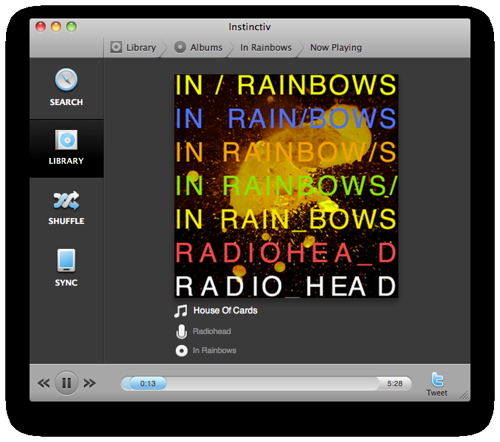
    Now Playing view on Instinctiv beta for Mac OS 10.5

    Windows users have a lot of alternatives to the “mainstream” media players (Windows Media Player and iTunes). However, Mac OS users are not so fortunate. Aside from a couple of minor exceptions, Mac OS is an iTunes-dominated platform.

    And as such, it means support for portable media players that don’t have an “i” at the beginning of their name is scarce.

    Mac users who carry a smartphone other than an iPhone or a media player other than an iPod don’t exactly have the easiest time organizing and shifting their content from their computer to their mobile device.

    It’s part of the problem I talked about last December, when I wrote about the three main issues that have prevented smartphones from completely replacing dedicated personal media players like the iPod.

    Among the three issues of limited battery life, limited storage capacity, and limited sync options, I consider sync to be the most important; and for Mac users, syncing a device other than an iPod or iPhone is really not an option.

    Today, Instinctiv launched the beta of a new media player for Mac OS which takes a serious stab at remedying this problem.

    The Instinctiv personalized media player supports portable devices that iTunes doesn’t –such as those running Android, BlackBerry, Windows Mobile, and Symbian– while supporting more than 50 file formats, including Windows Media files and those protected by Apple’s FairPlay DRM.

    This software is specifically geared toward Mac users who want to sync a device other than an iPod or iPhone.

    Actual Beta News feature banner“This market isn’t just underserved, it’s completely ignored!” Instinctiv CEO Aniq Rahman told us yesterday. “Apple has always given exclusive priority to their own products, but 85% of the international smartphone share is non-Apple devices. We’re trying to cater to everybody, so they can sync all their devices with their Macs.”
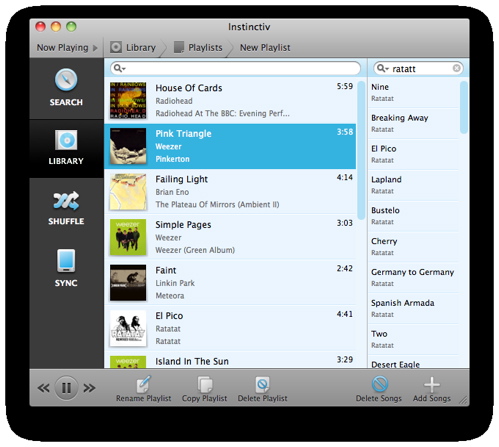
    But the software isn’t just meant to be a sync solution, it’s also a standalone player that automatically fetches missing cover art, renames misspelled or untagged songs, lets users create playlists, and analyzes the user’s listening behavior in shuffle mode with the company’s smart shuffle technology which it first debuted as an iPhone app last year.

    Create Playlist function on Instinctiv beta for Mac OS 10.5

    “Smart shuffle really eliminates the need to create playlists,” Rahman said. “With the standard, random shuffle feature of media players, users skip every 1.5 songs. With iTunes Genius-enabled shuffle, users skip once every four songs. With Instinctiv shuffle, users skip once every 31 songs.”

    Instinctiv’s smart shuffle can do a seeded shuffle which generates songs in a fashion similar to Pandora, or it can hone results as you go, based upon what you skip. For example, if you’re not in the mood to listen to the fast and loud song that comes up in shuffle, you’ll skip it and be given a song of a different mood.

    Furthermore, Instinctiv is clean, small and purpose-oriented. As iTunes continues to grow into a solution for organizing all media — music, HD video, apps, and now books — it is turning into a pretty big piece of software. If you only want to organize and consume music, Instinctiv is a streamlined solution to do so. It can act as a standalone player and manager for all of your music files or as a companion to iTunes, with automatic support for playlists created in iTunes.

    To download the beta of Instinctiv for Mac OS X 10.5+, visit Instinctiv’s download site.

    Copyright Betanews, Inc. 2010


    Add to digg
    Add to Google
    Add to Slashdot
    Add to Twitter
    Add to del.icio.us
    Add to Facebook
    Add to Technorati


  • 2010 Tesla Roadster Sport

    To the Batcave!
    Brian Armstead, Canadian Auto Press

    During a recent visit to New York to attend the 2010 New York Auto Show I was called by Michael Sexton, the sales manager for Tesla Motors’ new retail operation in Manhattan, who invited me to drive the all-electric Tesla Roadster. Now, I had previously driven the concept Model S on a special indoor course at the National Building Museum in Washington, D.C. Yes, I said indoor course, as all Tesla vehicles roll under electric only power, and thus, are emissions free. The Model S, designed by Franz von Holzhausen, the former Mazda design whiz kid, made me feel like an executive, as it was decked out in luxury, with tons of bells and whistles. Since the course was of limited length, I was not able to fully experience the car, but was impressed with the power off the line.

    2010 Tesla Roadster Sport

    2010 Tesla Roadster Sport

    My experience driving the Roadster was 180 degrees different, as this car is all about wall-to-wall performance, along with a surprising amount of comfort thrown in for good measure. When I drove the Roadster, I felt like Bruce Wayne, Batman’s alter ego. You see, the Tesla showroom is located in the arts district of Chelsea, full of lofts and galleries dedicated to painting, photography and the like. Their showroom is very hip, with Tesla cars on display, and the Tesla website is made visible on cool wide-screen Apple monitors. The floors are concrete, rock-like, just like the Bat Cave.

    So I wrench all six feet nine inches of my body into the car, riding shotgun as the six foot four Sexton made entry into the driver’s seat look pretty easy. We donned our secret identity masks (the latest designer sunglasses!) and shot out of the “Bat Cave” courtesy of 215 kW (288 horsepower) of pure electric thrust.

    “Holy Torque,” I exclaimed, having become sidekick Robin as Sexton temporarily assumed the role of Batman. I’ve driven Porsches, Ferraris, AMG Benzes and the like, but never have I felt this type of thrust experience in such a small car. This car’s acceleration is nothing short of amazing.

    As the Sun started to set, I became Batman, and my Tesla “Batmobile” headed towards Times Square. Even the Tesla logo, which somewhat resembles the Batman logo that would shine above Gotham City signaling Wayne to the Bat Cave, was displayed in the night sky over Times Square, competing with projected images from P.Diddy and Donald Trump. Of course the previous sentence and this whole scenario is fiction, but one would have thought there was a Tesla logo beaming as passersby parted the waters to let our gorgeous blue supercar go by with stares of admiration. And just for the record, one of New York City’s many nicknames is Gotham!

    Okay, back to the real world, where perhaps the most amazing thing about the Tesla Roadster is the simplicity of its operation. The motor is just that, a motor. It’s not particularly large or impressive looking like a big V12 with four cams hanging on top of the engine block. In fact, you can’t see it at all as it resides amidships under a cover. There are no dual exhaust tips at the rear, because they’re not needed. The chassis is made of bonded aluminum, and is very rigid. The motor connects to the simple single speed gearbox, which then turns two high torque capacity halfshafts to drive the rear wheels. Styling is based on the Lotus Elise. Interior accoutrements are purposeful, like heated bucket seats, great for the top off jaunts on a cool April night in Manhattan. A JVC aftermarket headunit provides a dedicated iPod connection, as well as hard drive based navigation and music storage. The only interior bow to serious high technology is the Vehicle Display System (VDS). The touch screen VDS allows you to view charge/battery status, adjust the performance parameters and access various system tools. It’s also the spot where Tesla technicians can input firmware updates to the computer control system that allow them to pinpoint any faults with your car, and also update performance software to keep your Roadster operating at its peak.

    The Roadster features a rudimentary top that requires a bit of patience to first learn to remove and install correctly. The cloth top slides across the targa like opening on suspended rods, and I’m sure this will be an area where you will see continuing upgrades to improve this operation. A slick, lightweight, one piece hardtop is optional and really changes the overall look and stance of the car in a positive way. But there is nowhere onboard to store the top, which is a drawback versus the canvas top that you can roll up and store in the Roadster’s tiny trunk. I can live with that, for obvious reasons.

    The Tesla Roadster delivers full availability of performance every moment you are in the car, even while at a stoplight. Its peak torque begins at 0 rpm and stays powerful at 14,000 rpm. This is the precise opposite of what you experience with a gasoline engine, which has very little torque at low rpm and only reaches peak torque in a narrow rev range. This forces frequent gear changes to maintain optimal torque. With the Tesla Roadster, you get great acceleration and the highest energy efficiency at the same time, all while requiring no special driving skills to enjoy it. There is no clutch pedal, because as I mentioned earlier the Roadster has a single speed gearbox. Want to go fast? Floor the go pedal! Want to reverse? Press the “R” button, and the current is reversed, making the car go backward (limited to 15 mph!). Want to brake? Take your foot of the throttle, and engine braking is immediate and slows the car rapidly (and generates power to recharge the battery cells). Of course, traditional performance brakes by Brembo will also accomplish this duty in very rapid fashion.

    2010 Tesla Roadster Sport

    2010 Tesla Roadster Sport

    The motor redline is insane, a motorcycle-like 14,000 rpm. The 288 horsepower motor also features 276 pound-feet of torque. The “base” Roadster accelerates to 60 mph in a scant 3.9 seconds, while my test car, the Roadster Sport, does the trick in just 3.7 seconds. Look up the numbers folks, these acceleration figures are in the supercar category. Top speed as you might imagine is limited, with 125 mph on tap. You can take a good guess on how quickly you would deplete the batteries if the top speed were much higher. Both models feature a four-hour charge-duration (with an optional 240 volt hookup), and a range of about 236 miles.

    The Tesla Roadster battery pack in comprised of 6,831 lithium-ion cells. The so-called Energy Storage System (ESS) has a 53 kilowatt per hour output, and weighs in at 992 pounds (450 kgs). As you probably know by experience with battery powered consumer electronics (a camcorder is a good example), batteries do not have an infinite lifespan. The charge, usage and recharge cycles eventually render the battery useless. Tesla offsets the inevitable through purposeful engineering. Tesla limits the maximum charge for each of the 6,831 cells, thereby extending the life of each. A sophisticated battery cooling system is standard, and cycles on and off even when the car is not being used to keep the ESS at its optimal operating temperature. Tesla expects full battery capacity for five years or 100,000 miles, and up to seventy percent of battery capacity after that time/mileage frame. Tesla offers a battery replacement package – more on that later.

    Driving along a parkway that abuts the Hudson River, I was very impressed with the ride quality of the car. Once you get to the speed you want (very quickly!), the Roadster is a paragon of relative comfort. The chassis is made of bonded and extruded aluminum, and is very rigid, with no flex or cowl shake evident. The Roadster body is made of lightweight, strong carbon fibre, and features replaceable panels and bumper covers.

    Standard interior accoutrements include the aforementioned JVC sound system and heated sport seats (with inflatable lumbar support), MOMO sport steering wheel, leather seats and trim, cruise control, power windows and locks, plus air conditioning. On the safety front, dual front airbags, seatbelt pretensioners and traction control are standard.

    My Roadster tester came in at a base price of $109,000 USD; with options that pushed the base price all the way up t0 $154,196. The “Sport” option alone costs $19,500 and includes the high-torque motor, adjustable suspension, and special wheels and tires. You can go bananas with various option packages that add the hardtop, more leather and carbon fibre, and multiple colour and body accessory options. Destination and delivery charges add another $1,950 USD to the price, bringing the total tester amount to $156,145 USD.

    Finally, you can purchase extended service and battery replacement plans. For $5,000, you can extend warranty coverage (three years/36,000 miles) for an additional 3/36. The battery replacement warranty costs $12,000 and provides a new ESS seven years from the agreement date. If you need the ESS earlier, you will pay a $2,000 premium for each year you exercise the agreement early. You’ll earn a $1,000 discount for each year you defer to exercise the agreement after seven years.

    Is any electric car worth $156,000? You will be the judge of that. I do urge you to stop laughing and visit your local Tesla dealer to arrange a test launch, err, make that drive. Now if you come out of the dealership wearing a flying mammal suit, you too will be sold on the supercar that is the Tesla Roadster.

    2010 Tesla Roadster Sport
    2010 Tesla Roadster Sport
    2010 Tesla Roadster Sport
    2010 Tesla Roadster Sport
    2010 Tesla Roadster Sport
    2010 Tesla Roadster Sport
    2010 Tesla Roadster Sport
    2010 Tesla Roadster Sport
    2010 Tesla Roadster Sport
    2010 Tesla Roadster Sport
    2010 Tesla Roadster Sport
    2010 Tesla Roadster Sport
    2010 Tesla Roadster Sport
    2010 Tesla Roadster Sport
    2010 Tesla Roadster Sport
    2010 Tesla Roadster Sport
    2010 Tesla Roadster Sport
    2010 Tesla Roadster Sport
    2010 Tesla Roadster Sport
    2010 Tesla Roadster Sport

  • The Future of the Internal-Combustion Engine – Feature

    Despite the green hype, internal-combustion engines will keep powering vehicles for the foreseeable future.

    Carlos Ghosn, the CEO of Nissan and Renault, has proclaimed that battery-powered vehicles will account for 10 percent of global new-car sales by 2020. Mr. Ghosn, of course, is planning to introduce at least four electric cars in the next three years. Independent analysts, however, such as Tim Urquhart of IHS Global Insight, believe that battery-powered vehicles will remain at less than one percent of the new-car mix in 2020.

    Keep Reading: The Future of the Internal-Combustion Engine – Feature

    Related posts:

    1. Engine Displacement Downsizing – Feature
    2. Mercedes Engine Transplant: Modern Diesel in a 1992 190E 2.6 – Feature
    3. The Future of In-Car Technology – Feature
  • HTC releases GPS fix for Telstra Desire

    HTC Desire

    For you folks in Australia using the HTC Desire on Telstra, know that there’s a software update available that should en your GPS woes. You can download it over the air (either WiFi or network), or directly from HTC, though doing it from the desktop will wipe the device. [HTC]

  • Boston becomes first city to approve Ford Transit Connect Taxi [w/video]

    Filed under: , , ,

    Ford Transit Connect Taxi – Click above for high-res image gallery

    The Ford Transit Connect could soon start plying the streets of America’s cities in taxi garb following the decision by Boston to approve the compact van for the new application. Ford announced the taxi package for the Transit Connect at the Chicago Auto Show in February.

    The Transit Connect is expected to start replacing traditional Crown Victoria sedans and will be a more practical alternative to the smaller Escape Hybrid. While the Escape is fuel efficient, it’s rather small for cab duty. The Transit Connect can more easily carry three passengers and plenty of luggage or other cargo. Ford has also moved the rear seat back three inches in the taxi version for extra leg room.

    The Transit Connect taxi can also be ordered with a package that preps it for conversion to either propane or natural gas fuel systems. Check out video of the Transit Connect taxi after the jump.

    [Source: Ford]

    Continue reading Boston becomes first city to approve Ford Transit Connect Taxi [w/video]

    Boston becomes first city to approve Ford Transit Connect Taxi [w/video] originally appeared on Autoblog on Fri, 30 Apr 2010 11:29:00 EST. Please see our terms for use of feeds.

    Permalink | Email this | Comments

  • One Fifth Of Goldman’s Market Cap, Gone Just Like That (GS)

    85 Broad Street Goldman Sachs

    A little more perspective on Goldman Sachs’ (GS) big fall today.

    It’s currently at 147, down from a pre-charges high of 186. That’s a fall of 21%, and also about $21 billion dollars.

    That’s a pretty serious haircut.

    Don’t miss: The full story of Goldman, Paulson, and ACA >

    Join the conversation about this story »

  • Fed to Quietly Begin Soaking Up Money Supply

    The Federal Reserve Board announced today that it approved a new Term Deposit Facility program, which would allow member banks to receive interest on certain deposits held at the central bank. Think of the program as Certificates of Deposits (CDs) for banks. Term Deposits (TDs) would act as a way for the Fed to begin draining some reserves from the banking system and reining in money supply, without much disruption to the broader economy.

    The program will start small, but could ramp up as the Fed tries to slowly remove excess credit from the financial system. This is one of the tools that it will use as a part of its exit strategy. It’s a clever program, because it will result in temporary reductions in monetary supply — so they should provide the Fed with flexibility if the recovery stutters. They would discourage banks from letting another credit bubble form between now and when the economy is healthy enough to begin more permanent monetary tightening.

    Funds held as TDs will not be a part of the required reserves that members are already obligated to hold at the Fed. They would act as another way for a bank to invest some of its capital. They would curb credit, because banks would be putting cash into TDs instead of funding more loans. Like CDs, TDs will pay interest for a certain time period while the deposits will remain at the Fed. TD maturities will likely be six months or less.

    While the Fed had announced its intention to create these TDs several months ago, it’s interesting that the FOMC failed to mention the new program in the statement from its meeting earlier this week. It almost begs the question of whether the Fed avoided saying anything about its exit strategy due to fear of spooking the market. It’s pretty hard to believe TDs wouldn’t have come up in the committee’s discussion, considering their formal approval would be announced later in the week.


    Email this Article
    Add to digg
    Add to Reddit
    Add to Twitter
    Add to del.icio.us
    Add to StumbleUpon
    Add to Facebook