Category: News

  • AutoblogGreen for 04.30.10

    Sunk Gulf oil rig spilling up to 5,000 barrels of crude every day
    Going from “not bad” to worse.
    James Cameron attempts to terminate the oil and coal lobbies (on CNN)
    First Pandora, now Earth.
    China controls key ingredient for NiMH batteries, supply may run short as hybrids gain popularity
    They’re called lanthanides, and they’re kind of important.
    Other news:

    AutoblogGreen for 04.30.10 originally appeared on Autoblog on Fri, 30 Apr 2010 06:00:00 EST. Please see our terms for use of feeds.

    Read | Permalink | Email this | Comments

  • A chance to earn an income in Myanmar

    Aye Lei Tun learns how Oxfam’s training is helping people affected by Cyclone Nargis in Myanmar to develop new skills and improve their income.

    Min Zaw, a mechanic in Nyaung Lan Village. Photo: Aye Lei Tun/Oxfam

    Min Zaw, a mechanic in Nyaung Lan Village. Photo: Aye Lei Tun/Oxfam

    “Incredible” was the word that 40-year-old Min Zaw uttered when asked about his current life after joining Oxfam’s occupational skill training in January last year.

    “It is quite incredible – the two-month program has really guaranteed a steady income for the rest of my life,” Min Zaw said, referring to the Machine Repair and Maintenance Training provided by Oxfam as part of its programmes for those whose livelihoods were destroyed or affected by Cyclone Nargis in 2008.

    Min Zaw was one of ten participants in a training programme which he confirmed has changed his life. Before Cyclone Nargis, Min Zaw sold maize, but when the cyclone devastated the agricultural sector, small traders such as Min Zaw were particularly hard hit. By increasing his skills, more work opportunities have opened up, allowing him to continue to earn an income, and to work from home so that he can now take care of his disabled daughter – a very important step for him.

    In the past, Min Zaw would go to his client’s house and check and repair only small machines. Now he can work at home because he has more customers and they are confident in his competence, so they approach him to repair larger machines as well. “This way, I can look after our daughter. Otherwise, my wife will be occupied with her while also taking care of our grocery shop, cooking, and other household works. Our life is getting better now.”

    Min Zaw already had basic knowledge about mechanical devices and repairs, but he believes the training has improved his skills and built up his confidence, which in turn has gained him trust from his customers.

    “I think the rate of work has increased after that. My customers are not only from our village, but also from other villages nearby. We earn at least 2,000 kyat (approx $2 US dollars) a day and at most 10,000 kyat ($10 US dollars).” Together with his wife’s income from the shop, they are doing quite well and can also afford medicines for his daughter, who has been mute since birth.

    Thuya, a mechanic in Kyone Dar Chuang Village. Photo: Aye Lei Tun/Oxfam

    Thuya, a mechanic in Kyone Dar Chuang Village. Photo: Aye Lei Tun/Oxfam

    Another participant, Thuya, 19, from Kyone Dar Chaung Village, also said he is more confident about his job since the training.

    “Before the training, I sold maize. I learned how to repair machines by watching other mechanics do their work, and became their assistant for minor repairs,” Thuya told Oxfam. “Now I have confidence to be a professional mechanic. Because of the training, I was able to really understand about machine repairs and how they work.”

    Nine months after the training, Thuya has found that the number of people asking him to work has significantly improved. He has started dreaming about the future: having his own business.

    For big repairs, Thuya makes at least 10,000 kyat (approx $10 US dollars), and 3,000 or 4,000 kyat ($3 or $4 US dollars) for smaller pieces. He usually repairs agricultural and fishery machinery. Thuya used to earn about 500 kyat ($5 US dollars) from selling maize.

    “I’ve earned about 150,000 kyat ($150 US dollars) already. I want to set up a welding business. For that, I think I need to invest about four or five lakhs (approx $400-$500 US dollars). I expect my dream will come true in two or three years,” he said with a smile.

    In pictures: rebuilding lives and livelihoods in Myanmar

    Emergencies: Myanmar cyclone

  • James Patrick Tressel vs. Wayne Woodrow Hayes

    It’s the off season and that means it’s the perfect time to ponder some ponderables. For instance, who’s regime at Ohio State was (is) better, Jim Tressel’s or Woody Hayes’?

    Ohio State football personified.

    Before we start, I want to make it clear that Woody Hayes is Ohio State football and he always will be. I am not challenging that. What I would like to compare is which period of Ohio State football was “better”, the Jim Tressel era or the Woody Hayes era.

    Another thing to get out of the way right now is that obviously the Jim Tressel era isn’t over yet. That only makes the issue more interesting as far as I’m concerned because it opens up the additional question: what does Jim Tressel need to do over his final seasons to surpass Woody Hayes?

    And there is little question that Tressel is entering his final seasons.

    The contender.

    Tressel recently signed a contract extension through the 2014 season. There is much speculation that it could be the last contract extension he signs (there was speculation that he would retire when his initial contract expired in 2012 too, so take it for what it’s worth).

    Even if Tressel does extend again, he has said he doesn’t see himself coaching as long as a Paterno or a Bowden, so I will say very roughly that he retires within the next ten years.

    That leaves us with two questions: how do the two coaches compare now? and what does Tressel need to do over the final years of his regime to clearly separate himself from the Godfather of Ohio State football.

    Let’s break it down. Ding! Ding! Ding!

    Overall Record

    Woody Hayes: 205-61-10 (.76087)

    Jim Tressel: 94-21 (.81739)

    Overall record is an obvious place to start.

    Right off the bat it is clear that Tressel just can’t compete with Hayes in terms of years coached or number of victories.

    The Shoe has been good to both coaches… or have the coaches been good to The Shoe?

    Woody’s 28 years at the helm and 205 victories are both the most in Ohio State history, and it isn’t even close.

    Tressel isn’t going to touch either one of those numbers.

    On the other hand, Tressel’s winning percentage is higher.

    In fact, Tressel’s winning percentage is the best of any coach in Ohio State history that lasted more than two seasons (Carroll C. Widdoes went 16-2 from 1944-1945).

    Two more years of 10 (or more) win seasons and Tressel’s moves into 2nd place for total number of victories (passing up Cooper at 111).

    Where does that leave us?

    The winning percentage angle is an advantage for Tressel, and it doesn’t look like the 10 win seasons are going to be ending anytime soon.

    Tressel will have the second most wins and the second longest tenure in the history of Ohio State football whenever he decides to hang up the whistle.

    That by itself doesn’t mean much since he will be second behind Woody. But combined with the higher winning percentage and I think it creates a compelling argument. Is that enough to put Tressel over the top? We will see.

    For now, 28 years, 205 victories. It is hard to see those number ever being broken or even approached.

    Woody Hayes is the king of tenure and victories at Ohio State, and he always will be.

    Tressel will most likely be the king of winning percentage and second in tenure and victories.

    Which one is more impressive?

    I will wait until the Tressel era is over before I come down with a final judgment on that one.

    Big Ten Record

    Woody Hayes: 152-37-7 (.80423)

    Jim Tressel: 59-13 (.81944)

    Once again this turns into a story of quality versus quantity, but in this case the quality is about the same.

    Owned.

    Tressel and Hayes both share about the same winning percentage, but Woody did it for a lot longer than Tressel has, so you gotta give the edge to Woody here, right?

    Then again, they didn’t call it the Big 2 when Woody coached for nothing. Similarly, Tressel takes some heat for dominating a “down” conference.

    Regardless, both coaches owned the Big Ten.

    Record Vs. Michigan

    Woody Hayes: 16-11-1

    Jim Tressel: 8-1

    Clearly Tressel has the edge here.

    While no one could match Woody’s hatred of that school up north or the intensity of the rivalry during the Ten Year War, Tressel has done a better job racking up rivalry wins.

    Chalk one up for the vest.

    Big Ten Championships

    Woody Hayes: 13

    Jim Tressel: 6

    At face value it looks like Woody has this one locked up with over twice as many Big Ten Championships as Tressel.

    Upon closer examination, however, you will see that Tressel’s 6 titles in 9 seasons is a bit more impressive than Woody’s 13 titles in 28 season… at least from a purely statistical perspective.

    It would be shocking if Tressel didn’t earn a few more of these before his time is over in Columbus, so I am going to give Tressel the slight edge here.

    Bowl Record

    Woody Hayes: 5-6

    Jim Tressel: 5-4

    You can’t really compare the two coaches in this area because of the restrictions on bowl game attendance that Woody faced which aren’t there today.

    At the same time, it is clear that Woody struggled a bit in bowl games.

    The last few years haven’t been so kind to Tressel either, but he still has a shot to turn that around (2010 Rose Bowl was a nice start).

    I will call this one a wash for now, with the distinct possibility that Tressel can separate himself in the coming years.

    National Championships

    Woody Hayes: 3 (5)

    Jim Tressel: 1

    With a few more of these Tressel's resume would be tough to beat.

    This is the major area that Woody is clearly better than Tressel as far as I’m concerned.

    At the same time, it is also the area that Tressel can make up the most ground over the next few seasons.

    Woody had championship seasons in 1954, 1957 and 1968 with two more kinda championship seasons that the school claims in 1961 and 1970.

    To this point, Tressel has 2002 and several misses in 2006 and 2007.

    While another national championship (or three) before Tressel retires will make this discussion worth having again, for now you have to conclude that with an untouchable number of wins, years coached, and an impressive 5 national championships, Woody Hayes is still the best coach in Ohio State football history.

    If the last years of the Tressel era go as well as I am hoping they will, the story may change.

    With a superb record against Michigan and an unbelievable run of Big Ten championships, another national title or two may make up for the fact that Woody coached for nearly twice as long as Tressel and racked up a lot more wins in the process.

    It should be fun to watch.

  • Iowa Wind Turbines


    This is a great story and it had little if anything to do with Washington.  If ever we need an example of the importance of locally supported leadership, this is it.  In a country with over fifty state governments it is possible to find real performers and innovators.
    I have recently argued that healthcare needs to be pushed down to the state level in order to introduce both competition and a counterweight to insurance company power. This demonstrates why.
    Every success breeds imitation.  That is why a seventy year old banking success in North Dakota is now in the process of been imitated in several other states.
    Iowa has made itself a leader in wind manufacturing and this industry has plenty of growth left in it in the midwest.
    Iowa: Land of Corn and Wind Turbines
    HERMAN K. TRABISH: APRIL 28, 2010
    How do you keep them on the farm? Give them jobs in turbine factories.
    Iowa ranks 30th among the 50 states in population and 23rd in square miles, but it is number two in wind — and it wants more.
    Iowa now has over 25,000 wind turbines and doubled its proportion of wind-generated electricity from 7% to 14% in 2009, the biggest jump in the U.S. Estimates put the current 2010 percentage of Iowa‘s electricity coming from wind above 17%.
    Because Iowa added 879 megawatts of new capacity last year (enough to power more than 200,000 homes), the state’s installed capacity is now second only to Texas. It has 3,670 megawatts of total installed capacity, enough electricity for 880,000 homes — in a state with only 3 million people. And it has over 14,000 megawatts of wind power awaiting approval.
    The state, known for its dairy farms and bucolic rolling cornfields, also became the leading provider of wind energy manufacturing jobs in 2009.
    The numbers reflect the payoff for Iowa‘s transformation from farm country to wind country: 2,300 direct manufacturing jobs, an estimated 5,000-to-10,000 direct and indirect jobs associated with wind, $175 million in major manufacturing facilities’ investments, 2009 annual property tax payments by wind project owners of $16.5 million, and 2009 annual lease payments to Iowa landowners of $11 million.
    Iowa has the seventh best wind energy potential in the U.S. going for it, but a lot of states that have even better wind potential are not yet reaping the bounty that Iowa is. So what’s driving the state’s success? A long history.
    In 1983, Iowa enacted its Alternate Energy Production law, essentially the first U.S. Renewable Electricity Standard (RES). The law required the state’s two regulated utilities to obtain 105 megawatts of renewable energy. The legislation lacked enforcement provisions, however, as did the 2001 voluntary mandate requiring the state to build 1,000 megawatts of wind capacity by 2010. But both were ahead of their time and pointed the way to today’s achievements.
    Earlier in this decade, the state’s agricultural sector was suffering when, according to Mike Kelley, the Corporate Environmental Health and Safety Manager for Upwind Solutions and a member of the Iowa Wind Energy Association Board, current Democratic Governor Chet Culver and his team saw the new opportunity in wind.
    “They saw the wind business beginning to grow, they saw the impact and the Governor and his team became very, very proactive in looking for manufacturers, even out of the country, ” Kelley said. “They really flew the flag of Iowa and what good Midwest values had to offer…and I attribute the growth from the manufacturing standpoint to some visionaries there in the state offices.”
    With many of its farms failing, Iowa had been losing jobs — and the people who needed them. The 200 Iowa companies servicing those manufacturers’ supply chains have added more than $50 million in new revenue every year. Five community colleges and other training institutions now offer wind-related training.
    Governor Culver now says Iowa is ready to become an energy exporter. The next questions are whether the production expansion can be sustained and how big Iowa‘s wind manufacturing industry can get.
    To sustain wind energy production growth, Iowa needs more and better transmission so it can export electricity. Kelley said he expects regulatory hurdles to be cleared and lines to be built in the near future.
    Greg Watkins, the Renewable Energy Planner in the Iowa Office of Energy Independence, says they also expect continued manufacturing growth.
    “This may not ramp up more towers in Iowa, but will stimulate the manufacturers here producing and exporting turbine components to other surrounding states and into Canada,” Watkins said.
    Added Joe Jongewaard, Project Manager with the Iowa Department of Economic Development: “We believe that there is a huge expansion in manufacturing capacity of wind generation equipment and that it’s going to happen somewhere in the world over the next 3 to 4 years…Iowa is positioned to get more than its share of that expansion. We believe that it’s reasonable to expect that 10,000 manufacturing jobs could be created in Iowa by the end of 2014.”
    Jongewaard says the state expects to attract more companies to create those jobs and that those companies will create more opportunity for existing and new supply chain manufacturers. The Governor’s office, Jongewaard said, has two project managers on staff who do nothing but work to attract wind manufacturers.
  • Cattail Update


    This is a quick catch up on Peggy’s efforts in the cattail development business.  Much has been learned and a good body of practice has arisen.
    It appears that the use of drained land is presently the most adaptable to husbandry needs for the ease of operation with equipment that exists.
    I would like to see a fodder field test.  The productivity is huge and it should give us excellent product for cattle.  If not, then we need to figure out why.
    It is noteworthy that the plants will drown if cropped long enough.  This makes paddy control effective and easy.
    Cattail Histhings
    April 2010
    Water Assurance Technology Energy Resources
    40 Sun Valley Dr., Spring Branch TX 78070
    FAX (830) 885-4827; Cell: (512) 757-4499
    Welcome Aboard Investigative Team: Thank you to the sincere and qualified respondents to the request for participants for our rhizome starch study.  Our team members have varied interests, backgrounds, locations and talents—extremely diverse and this is a GOOD thing!  We have closed our admittance because the cost of supplies, postage and time necessary to consolidate reports has limits.  Everyone will benefit from the trials.  Our collaborations are confidential at this time so that we can establish a working protocol among ourselves.  Various supplies are shared and everyone uses his own equipment.  We look forward to a shared educational experience supporting each other along the way.  Over the next several months we may post ideas from certain team members that may be willing to offer services or products to other cattail enthusiasts. 
    Discharge Permit NOT Required: A certified letter addressed to Peggy Korth as the Principle Investigator states that a discharge permit is NOT required to grow cattails as an agricultural field crop using community wastewater/ effluent as per our experimental outline in Otero County New Mexico.  Through the efforts of Sustainable Technology Systems, Inc. the Groundwater Bureau for the state of New Mexico has determined that a discharge permit is not necessary in Tularosa New Mexico on land designated to receive agricultural use of wastewater.  Special permitting often requires expensive protocols.  This letter is worth thousands of dollars and hundreds of hours of time and sets a precedent for projects elsewhere.
    The community project ‘Cattails to Ethanol” is supported by Sustainable Technology Systems, Inc (STS) and funded by the Otero County Commissioners.  The preliminary cattail evaluation study under the control and direction of STS includes professional consultation services from a number of expert specialists in related fields.  We expect to clone projects following proper due diligence.  WATER’s non-profit education and research objectives compliment the efforts by sending highlights to you, the several hundred cattail enthusiasts that subscribe to Cattail Histhings.   
    Congratulations Peggy. Great news!  MH reports…I’m working with a village in Ohio who would like to have their own sewer plant. The EPA says we can do this with little effort if we have a zero discharge plant. Since I want to grow cattails, sell ethanol and develop property in the village, it would be very synergistic to combine all. Do you have any data on water use, in addition to normal evaporation, cattails use to grow on a per acre? I can get the normal rainfall and evaporation data from the government, which is about equal for the area I’m working. So, the additional water usage is what I need to complete the rough estimate.  I plan to grow a 18 x 18 plot of cattails this summer to develop this data in Michigan , where I live. I’ll send you a copy of my results.  In this case zero discharge is zero effluent discharge into any local streams
    YES!  This is what WE NEED!  Thank you so very much for the email and finding out about your plans.  When you mention EPA does that mean your state agency?  Did they send you a written notice?  Do you already release effluent into agricultural land?  I look forward to learning about your results.  Thanks again for the email.

    Dialog Continues… I’m working through the local village and their contacts with the Ohio EPA and the OKI ( Ohio / Kentucky / Indiana) commission that controls the sewers systems in our area. A developer in the next township was able to get approval for a private system, bypassing the county controls, by installing a zero discharge / zero effluent to the local streams system. I’m hoping to do the same, by using cattails to use the effluent. Wastewater sludge, for use as fertilizer, is also available from local treatment plants and is being used by local farmers. I was looking for a cheap source of water and if it has any NPK included so much the better.

    No effluent discharge yet.  Correspondent question…Are there any papers available that indicated the amount of water used to grow cattails? A government sight, I found, indicates pond evaporate about the same as annual rainfall in the area of our Ohio farm, so I am trying to determine the additional amount used by growing cattails.  I’ll send data as I develop the information.
    PK on EPA—An Opinion: Every state’s EPA has different ideas.  Some are more liberal than others.  I was told that definitely I could NOT use sludge (even if approved for release) in a wet environment.  Well, our growing beds do NOT stay wet.  We do NOT keep a crown of water.  We periodically flood the land as is standard in agricultural release of effluent into the countryside where permitted.
    I do not quite understand the containment ideas that are proposed.  The location of our first trials, the land is naturally dry.  There is no regular run-off into streams.  Water does not percolate into the ground water which is 100 feet below.  The effluent is absorbed into the land and the plants take up the nitrogen as natural fertilizer.  The soil microbes are NOT regularly tested, yet dissipate nitrogen as a natural phenomenon.  Yet, we feel that the cattails will substantially lower the pathogenic microbial count even as they do in their natural habitat.  Remember we plant cattails as a field crop and not in a pond.
    Ponds Can Be Microbial Incubators: We found that if a pond is stagnant, no flowing water, then there is an increase in microbial content (pathogens included).  When the sun shines on still water, there is a tremendous incubation effect UNLESS that water is flowing.  The flow does not need to be extreme as in a river.  The flow can be gentle and still have significant microbial reduction in the presence of cattails and other combined botanicals.  It is assumed that a new thin growth will have more filtering effect than a dense mature stand.  The web of rhizome in hardened patches can restrict water flow.
    However, Ponds can CONQUER weeds in Cattail Field Crops.  Words of wisdom from our propagation specialist…  It takes effort to develop a field system that works. A rice paddy system, dry then wet then dry is a better fit for raising cattails as a starch field crop.  Weeds are the enemy with a dry production system cycle. Immersion (temporary POND or temporary standing water) can control weeds until a closed canopy is achieved (growth of stalks and leaves).  Once established cattails are mesic and not aquatic.  Then periodic flood irrigation after an established growth can maintain growth until harvest. 
    Native Plant Specialist: If your community project seeks expert consulting advice on planting your field, obtaining cattails, or any specialized propagation information, please phone.  The STS Ph.D. commercial growing associate specialist can give you a bid for services.
    Harvesting Equipment Scope and Scale: Size of the filed makes a great deal of difference in selecting harvesting equipment.  The harvest system used for cattails grown to be replanted or used in wetland development may be vastly different than harvesting equipment used to collect starch-rich rhizomes.  A proposed field production and harvest system for ethanol production is in a state of evolution.  .Relative small volume and high total plant value as a resale botanical is not the same as gathering rhizomes for starch conversion.  When you develop YOUR ideas, please let us know.  Perhaps we can help with a market for your products.  Let’s talk.
    The SECRET of a Sterilized Field:  Controlling weeds can be achieved through chemical fumigation.  Unknown factors support the commercial field crop growth of cattails.  Cattails grow well on methyl bromide sterilized ground. Past commercial crop failures have been when fumigation was NOT employed/ skipped. (Read the section on conquering weeds above to grow cattails without this sterilization step.)  This is a report.  Please add your comments so we can understand your successes as well.
    KB Asks: Can we plant from seed?
    Absolutely Yes! Those of you that have read the Cattails to Ethanol Vol. 1 know that there is only a two week difference in seed  from root growth in a pond environment.  I have observed that seeds planted too close together have a smaller production rate than seeds planted with space in-between.  A clump of seeds just doesn’t produce anything.  A single seed sprouts better.  This self-thinning is also witnessed in dense field crop growth.  This plant is SO smart that it does not crowd its neighbor.  We could learn something from this.  There is a lot to learn….
    All it takes is time and money to run lab tests.  Report on local findings as actual collected data during consulting trials validate progress.  Reaching into one’s back pocket to pay for confirmation of improvements provides due diligence information.   Collaborating improvement from our cattail enthusiasts provides a basis for universal understand of potential.  Peer-reviewed journals expect qualified scientific reporting.  Adequate compilation of data is necessary to publish new articles that can impact EPA and permitting authorities.  At this time only a scattering of reports fit our particular use.  Therefore, if anyone is gathering lab reports, we would be grateful to compare results.  Thank you for sharing!
    Project Protocols: Start with understanding your compliance needs.  EPA officers may assist in writing protocol or directing you to a group that has implemented successful botanical remediation.  Yet… you may not want to tip them off as to your concerns… because that could trigger their concerns.  Standard agricultural use effluent protocols, should be SAFE within standard operating procedures for community effluent.  Rains and increased population have triggered new problems.  Solutions are sometimes beyond the budgets of the residents or farms.  When our readers find acceptable standards, please document the authority and get back with us.  We need to support each other.
    Books Sold as Donations keep our non-profit organization active.  With steady work the non-profit remains minimally funded.  Two thirds of the annual budget come from my personal funds.  Significant grants require collaboration with large educational facilities.  Most universities demand 40 to 45% indirect costs to host a project and then the professor that serves as the principle investigator and his department get the lion’s share of the grant with minimal consideration to the origin of the initial idea even if I WRITE THE GRANT!  A better tact can be to target funds available to assist local governments make improvements.  Consider addendums to proposals such as microbial reports from local effluent test regimes.  Obtaining reasonable remediation charge for report numbers supports due diligence.
    Excellent Documentation is Stellar:  Rewrite field notes on a regular basis to form a legible and comprehensive review of what is being accomplished.  A weekly summary is often adequate if a daily rewrite is impractical.  Another documentation strategy is to outline highlights and ideas in your computer as soon as you can and then expand the explanation as time allows.
    Community Starts: This work flows through Sustainable Technology Systems, Inc., the group that recently completed the Otero County Cattail Evaluation Study.  We produced a 150 page book which is full of color photo pages of most of what we observed plus many pages of lab reports.  At this time I am working with New Mexico State University to garner funds to develop an educational program for farmers and communities through the non-profit channels.  The university people thought the recent study must have cost about $100,000 dollars.  Our actual cost was about $11,500 with the remaining $8,500 available for further study in that same arena assuming that I don’t ever get paid anything for my work.  And I do hope to get paid some day soon….
    Proposals Proofs: The importance of a well-written proposal cannot be over stressed.  That proposal should outline your steps.  It is wise to include charts of goals, timelines, and costs with good budget justification.  Your periodic reports should validate your accomplishments.  And I believe in an excellent summary ‘book’ to give to the officials as a reference will prove that they got more than their money’s worth.  Combined projects often offer a more well-rounded solution to the communities goals. Please let us know what you are doing.  It is always inspirational to hear about your progress.
    Information Powers Progress: BB Likes Links—The  link to our non-profit organization is www.waterC3.com.  However, if you have questions, please send them.  The web page, like the book was written several years ago.  Most new news and correspondence from the cattail people is sent via the newsletters, Cattail Histhings.  The newsletter gives me a way to highlight what is important and not repeat too many questions as a forum might do.  In this nascent development we need people willing to experiment and share their results.  Contributing information helps everyone and especially the person doing the trials.  Everyone appreciates the giving of information and sharing of experiences.   .
    CM Caring: I’m curious about the cattails being used to make ethanol, is it the root that has the starch?  How do they harvest them? 
    PK: A number of people on the newsletter list use a variety of harvesting methods.  I personally prefer the field-crop planting using a lifter shaker (potato harvester).
    DB: Anything new on the cattail front?  I see the name Peggy Korth in many searches for information on cattail ethanol, but instead of trying to read the reams of info you’ve put out there, I figure I can take a shortcut and ask you directly.  Are you still on the cattail bandwagon and how does it look going forward?
    PK: I did not see your name on my newsletter list.  How did you hear about me?  We seem to always have something new to report.  The reams of information continue with lots of publications… some more applicable to ‘your’ projects than others may be.  I wear many different hats and encourage people to take self-sufficiency steps both solo and as communities.  Farmers should most definitely be self-sufficient
    Scientific American Headlines: Breaking the Growth Habit Society can safeguard its future only by switching from reckless economic growth to smart maintenance of wealth and resources. 
    Checklist for Registration for Conventional Ethanol Production
    We, the small and mid-sized biofuels producers, are NOT conventional.  We do not produce the quantities the require RIN’s.  However, if you would like to have access to this very long and detailed explanation of the RFS2 compiled by the RFA team, please let me know.  (Those of you that assume that you will be in the million gallon-a-year production arena but have not taken the steps to hire and pay your environmental attorney need good compliance planning.  Small and mid-sized production just took another step in practical production reasonability.  EXEMPT!
    Keep Records anyway…  Now as a reasonable and prudent small and mid-sized producer, please keep accurate records of all phases of your project and processes.  These records become more valuable as biofuels become more available.  If a regulatory agency becomes obsessed with controlling the small and mid–sized producer, then we need to support each other with real information that goes beyond theory.  Too often regulatory and compliance people are not thorough in their research and evaluation of potential problems.  If there is a case report that is detrimental, we need to quickly support the other side of the equation so that there is no BAD REP being falsely being built.  Also, it should be made clear to the industry producers that we are not their competition.  Our work can actually build a better overall image as well as supporting the peripheral/ adjunctive uses and processes.
    CM Sharing a Joke: Thought I would share the link to this crazy machine with you http://dkenvironmental.com/aquamog-ccx-in-action-ripping-up-cattails.htm
    PK Gasps: Thanks for the entertainment, my friend.  The machine is not harvesting anything, but certainly disturbing the plants.  Any rhizome/ root fragment, or seed can re-grow the plant to maturity in one inch to two meters of water within two years.  One seed head has 300,000 seeds.  So this is an example of big boys with big toys that are not actually doing a whole lot of good.  If destruction is the goal, it would be better to cut the re-emerging plants six inches below the surface of water about three times in the following season.  Drowning is the best way to actually eliminate the cattails without the use of chemicals.  But it takes repeated cutting and not allowing the plants to emerge from the water.  After about three cuttings several inches below the water line, they usually die.
    What is happening in the video is a real waste of good biomass.  The green leaves make excellent animal fodder.  The stalks are superior in pulp and fiber than trees or most other plants.  The rhizomes (the white stuff floating in the water after being macerated) are reported to have 40% starch content.  Concerning the environment, a habitat works best with channels going through a dense growth to allow better flow patterns for animals, fish, and water remediation.
    What a trip!  Perhaps, some of our heavy duty equipment operators can use such a machine and the ideas to modify the equipment into a harvesting design.  Whoever thought up the equipment didn’t do his homework.  Mostly, when the machine is used as demonstrated, he has a perpetual job—sort of like mowing grass.
    Another Bad Idea for Culling Plants: There is a program in the Texas Rio Grande Valley to remove hydrilla from the resacas.  The work crew dredges the biomass and stacks it on the side of the drainage ditches.  Then the first rain washes the seeds replanting the seed berries that are be lying on the side of the ditch.  Within two years, the plants have repopulated to the same extent )depending on the weather).  We should use this biomass and the ditches as a crop and cropland.  During our cellulosic trials the hydrilla was the easiest to break down into glucose.  But… I do not have the time or the location to prove this in trials at this time.  Let me know if anyone wants to address this biomass.  It continually clogs the waterways in South Texas and other parts of the world.
    Investigate Sterilization and Sanitation Methods and Products:  On a small scale, it should be easier to clean our equipment than at the industrial sites.  Access and ease-of cleaning will help to control contaminants.  Abundant culprits await their chance to grow and thrive.  When meeting with Lynn Margalis—the famous microbiologist and author of 5 Kingdoms (among other publications), she stresses how colonies change to optimize their environment.  Providing basic nutrients should attract all kinds of multiplying organisms—including humans.
    Avoid Dings, Chips, and Scratches: Excellent cleaning of all vessels, utensils, and counter tops, are a must.  When possible sterilize everything you can reach.  Any ‘tool’ that has a nick in it can harbor bacteria/ spores.   Unless a plastic (Teflon) product is new, then it can be contaminated in small scratches or manufacturing flaws even if you think you scrubbed it.  Do NOT tap your utensil on your vessel to remove water.  The tap can ding the rim offering another place for microbes to hide.  .  Ultrasound is amazing at loosening microscopic particles in pores and dents and a requirement in medical sterilization processing.  Discount stores have inexpensive stainless steel implements that can serve your needs.  Dilute sodium hypochlorite (Clorox) is pretty good to sanitize surfaces, but cannot be introduced into the mash.  A long treatise on sanitization is under development.  Do not tap the top of your containers.  Any dip or nick will make a place for bacteria to hide.  Keep everything clean and SMOOTH.
    Quick, Easy and Effective Sanitizing: Most brew shops sell a rather benign oxygenating rinse/ dip.  As kind as the product is to your environment, it is a powerful antimicrobial.  The one that I use is Carlson’s Easy Clean.
    Stay in Touch: This has been a busy month organizing our summer trials, writing a grant proposal and planning our next steps.  Please email us and let us hear about your plans.
    Best wishes,
    Peggy
    Thank you for your support of our non-profit organization.  Water Assurance Technology Energy Resources forwards research and development of technologies to solve environmental problems in clean air, clean water, and clean energy.  WATER’s focus on education and outreach continues to bring public awareness to a better understanding of how each individual and community can work in concert to address positive impact for a better world.
    Books of Interest by Peggy G. Korth
    Bioenergy Terms Glossary—An in-depth compilation of industry terms for biofuels, biomass energy, and electrical generation.
    Small Scale Biofuels Production: Vol. 1, Cattails to EthanolA comprehensive selection of scientific papers, related narratives, pilot project study, and documents to address cattail fuel ethanol production and small flow remediation.
    Small Scale Biofuels Production: Vol. 2, Bioenergy BusinessThe only Education, Outreach, and Training guidebook for small scale bioenergy business visits performance standards, protocol, learning objectives, and other educationally related information that can be an integral part of building your company specific Standard Operating Procedure or grant funding submission.  The sections that address building your business plan and writing grants offer a comprehensive overview of common criteria.
    2008 and 2009 Cattail Histhings Newsletters—A compilation of reports from cattail enthusiasts, scientific and farm related advice, and cattail project related news.  Packed with useful information and growing like a weed, the latest issues include interchange of ideas and projects with cattail growers plus comments on current research and development.  Issues also highlight outreach and education with comments on government regulations, trials and successes.
    Cattails: A Contender if the Age of Biofuels Coming Soon through Sustainable Technology Systems, Inc.: Off-site project development consultation and strategic planning.
    Excellent References:
    Alcohol Fuel References:
    Biofuels Wiki http://www.biofuelswiki.org  (Search Cattail)
    http://gillesenergies.webs.com/ Simplicity in Applied Technology
    Dave Blume’s Site  http://www.alcoholcanbeagas.com/
    Basic distilling not related to alcohol fuel. (Distilling is distilling is distilling.)
    The Complete Distiller” sold by Amphora Society http://www.amphora-society.com/
    Water Assurance Technology Energy Resources
    40 Sun Valley Dr., Spring Branch TX 78070
    FAX (830) 885-4827; Cell: (512) 757-4499
    Book Order Form
                                                                    Price                        Quantity                       Total
    Bioenergy Terms Glossary                                       $50.00        X  _______          =        _____
    Small Scale Energy and Fuel Production Vol. 1
    Cattails to Ethanol                                          $50.00       X  _______          =        ______
    Small Scale Energy and Fuel Production Vol. 2
    BioEnergy Business                                      $50.00        X  _______          =        ______
    Shipping and Handling Book Rate                     $ 5.00
    Priority Shipping                                               $10.00                                                ______
    Donation to Education and Outreach                                                                                   ______
    Newsletter booklets for 2008 and 2009                    $25.00                                                 ______
    Sum Total Enclosed                                                                                                               ______
    Business Development Guide Perks—Free to patrons of WATER
    Send check to: Water Assurance Technology Energy Resources OR WATER as the abbreviated name for our non-profit, 501C3 organization.  A PayPal invoice is also available.  Please phone to confirm the current mailing address as this is our transition month. 512 757-4499
    WATER                                   WATER
    40 Sun Valley Dr,                     P O Box 572
    Spring Branch TX 78070           Cloudcroft NM 88317
    Your purchase and support are greatly appreciated.  Please state if you would like to receive a statement of donation for tax deduction purposes and include the name and address of the party to receive the tax donation letter.
    Best wishes for a future of self-sufficiency
    Peggy G. Korth, President
    Name: _________________________________ Company: _____________________________
    Address: __________________________City ________________ State : ____ ZIP: _________
    Contact Phone: _____________________________ Email: _____________________________
  • Fiat’s new chairman says company doesn’t need other partners beyond Chrysler

    John Elkann – Fiat Chairman

    Fiat’s new chairman John Elkann said that the company ‘doesn’t need other partners’ beyond Chrysler Group, and that it is focused on turning Chrysler around. “We have a strong relationship with Chrysler and that is what we are actively working on,” said Elkann, 34, the grandson of former Fiat Chairman Giovanni Agnelli.

    The company said April 21 that it plans to separate its agricultural and truck-making units into a new body called Fiat industrial, and that it aims to double sales at Fiat Auto by 2014.

    Currently, Exor is the largest shareholder in both units, and intends to remain so, unless the dilution of their stakes meant growth. Elkann said that the company would rather be a smaller shareholder in a bigger Fiat than stifle growth by remaining the largest stakeholders.

    – By: Stephen Calogera

    Source: Automotive News (Subscription Required)


  • Prize-Winning Enertia Team Begins Long Climb To Commercialize Clean, Portable Energy

    Matterhorn
    Howard Lovy wrote:

    University of Michigan business student Adam Carver says he is a “mountain climber at heart.”

    Maybe that’s why he’s going for two degrees at once. Last summer, he conquered the Matterhorn. Yes, the actual Matterhorn in Switzerland.

    This year, he set out for the foothills of a longer, perhaps even more ambitious journey-to bring to market what he considers breakthrough technology that could completely replace today’s electrochemical batteries in portable devices.

    And he is not a lone explorer. Together with colleagues Tzeno Galchev and Ethem Erkan Aktakka, both Ph.D. Fellows at U-M’s Center for Wireless Integrated Microsystems, the three recently picked up the top prize of $50,000 in the 2009-2010 DTE Clean Energy Prize business plan competition.

    Their project goes by the name of Enertia, and this prize could be the beginning of a long climb toward commercialization of a clean, renewable source of power. The invention is a device that can harvest energy from arbitrary vibrations in the environment, then run them through a little converter to general electric power.

    Carver, who is simultaneously working toward his MBA at Michigan’s Ross School of Business and a master’s degree from U-M’s Erb Institute for Global Sustainable Enterprise, set out specifically to look for a business project over at the engineering department. So, he went to an on-campus event that was open to entrepreneurs from the local community.

    “I really wanted to get involved in cleantech. And I had this feeling that the real breakthrough technology was coming out of the school of engineering,” Carver says.

    He immediately saw a great deal of possibility in Galchev’s and Aktakka’s project.

    “What really attracted me to the project was the compelling technology, itself-the idea that we can utilize this ambient energy around us in the form of tiny vibrations and make renewable power,” Carver says.

    “I felt that there was a very good environmental reason for this, there’s a very good economic reason, and it’s a scalable solution-that we will be able to reproduce, at high volume with quality assurance,” he says.

    Carver, 28, is talking like a true entrepreneur, anyway. He even has a target year of …Next Page »

    UNDERWRITERS AND PARTNERS


  • US dollar decoupling from gold

    Those that follow the gold and currency markets know that the price of bullion and the U.S. dollar typically move in opposite directions. However, this negative correlation can turn positive from time to time and is happening now. 

    The correlation between weekly changes in the U.S. dollar and bullion has turned from -0.7 at the start of 2010 to +0.41. This is the biggest positive since 2007.

    During gold's biggest rally ever between 1978 and 1980, the U.S. dollar traded sideways. Back then, demand for bullion was being driven by fears of a collapsing global monetary system, and investors fled all paper currencies. These days, the situation isn't very different except that U.S. dollar reserves are being accumulated in large numbers.

    Sovereign debt concerns in Greece, Portugal and elsewhere in Europe continue to put pressure on the Euro currency as investments in gold and the U.S. dollar are in high demand from investors seeking safe havens.

    Historically, episodes of U.S. dollar appreciation coupled with rising gold prices tend to be fleeting, according to Stéfane Marion, chief economist and strategist at National Bank Financial.

    In a note to clients he wrote, "…we still think that the historical negative correlation between gold and the greenback will resume once the uncertainty is lifted about the introduction of credible loan programmes between eurozone partners to help certain members reduce their fiscal deficits."

    As Adam Kritzer of forexblog notes, at the moment the correct interpretation is that anything is preferable
    to the Euro since its sovereign debt problems are the most pressing.

    He also points out that many are betting that gold will eventually distance itself from the U.S. dollar if and when America's fiscal problems escalate to the level of a
    Greek-style crisis. "At this point, gold will start to trade as an
    alternative to the entire forex market!"

    According to Deutsche Bank, gold has decoupled from the dollar since at least
    the end of March. "If the correlation re-establishes itself before
    July, either the dollar must continue to decline or investment into
    bullion-backed funds must pick up in order to avoid erosion in gold
    prices," analysts at the investment bank said recently.

    Jonathan Ratner


  • Black HTC Desire due by end of next week say Orange

    Holding out for the black version of the HTC Desire?  Initially promised for the end of April by Orange UK, a combination of volcanic ash and firmware issues have seen the Android 2.1 smartphone delayed.  Now, Android Community tipster Chris has let us know that the black Desire is expected to arrive early next week.

    That’s come straight from Orange UK customer services, who told Chris that the limited edition Desire was expected to arrive in their warehouses sometime in the first week of May.  Actual shipments out to customers should take place from “middle to late next week”.

    Orange’s product page is here – it still says simply “coming soon – and the specifications for the handset are the same as the regular model we reviewed back in March.  The phone will be priced from free on new contracts.

    [Thanks Chris!]

  • Massive South Atlantic Current Discovered


    Again we are learning just how badly that the three dimensional ocean current structure needs to be both mapped in decent detail and also continuously monitored.  Variation must occur and we have no idea.


    I have already argued that a minor adjustment in the flow of warm surface water into the Arctic over the past fifty years is sufficient to account for everything we know about the past couple of decades of hemispheric warming, presently confused with global warming.


    We presently are unable to identify the mechanism behind this change.  It appears likely to be a simple yet subtle alteration in the subsea current geometry.  I am encouraged in this line by the reality of the Gulf Stream having been two degrees warmer during the Bronze Age.


    I notice that folks are now making the same linkage and recognizing that we possibly have it all backwards.  It is Arctic warming rather than global warming.


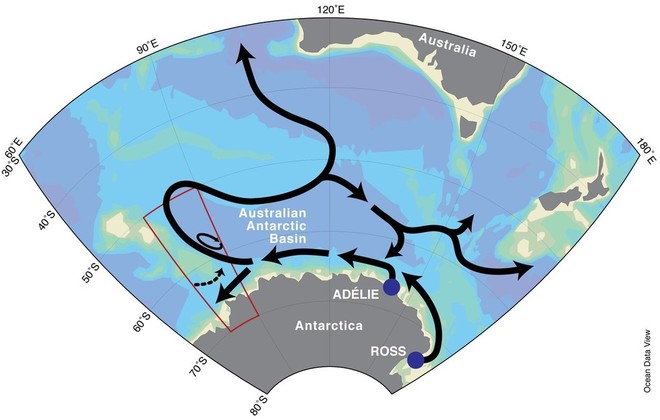
    Massive Southern Ocean current discovered

    Apr 27, 2010
    In a paper published today in Nature Geoscience, the researchers described the current – more than three kilometres below the Ocean’s surface – as an important pathway in a global network of ocean currents that influence climate patterns.
    “The current carries dense, oxygen-rich water that sinks near Antarctica to the deep ocean basins further north,” says co-author Dr Steve Rintoul from the Antarctic Climate and Ecosystems CRC and CSIRO’s Wealth from Oceans Flagship.
    “Without this supply of Antarctic water, the deepest levels of the ocean would have little oxygen.
    “The ocean influences climate by storing and transporting heat and carbon dioxide – the more the ocean stores, the slower the rate of climate change. The deep current along the Kerguelen Plateau is part of a global system of ocean currents called the overturning circulation, which determines how much heat and carbon the ocean can soak up.”
    While earlier expeditions had detected evidence of the current system, they were not able to determine how much water the current carried. The joint Japanese–Australian experiment deployed current-meter moorings anchored to the sea floor at depths of up to 4500 m. Each mooring reached from the sea floor to a depth of 1000 m and measured current speed, temperature and salinity for a two-year period.
    “The continuous measurements provided by the moorings allow us, for the first time, to determine how much water the deep current carries to the north,” Dr Rintoul said. The current was found to carry more than 12 million cubic metres per second of Antarctic water colder than 0 °C (because of the salt dissolved in sea water, the ocean does not freeze until the temperature gets close to –2 °C).
    “It was a real surprise to see how strong the flow was at this location. With two-year average speeds of more than 20 cm per second, these are the strongest mean currents ever measured at depths three kilometres below the sea surface.
    “Mapping the deep current systems is an important step in understanding the global network of ocean currents that influence climate, now and in the future. Our results show that the deep currents near the Kerguelen Plateau make a large contribution to this global ocean circulation,” Dr Rintoul said.
    Antarctic waters carried northward by the deep currents eventually fill the deep layers of eastern Indian and Pacific Oceans.

    A deep ocean current with a volume equivalent to 40 Amazon Rivers has been discovered by Japanese and Australian scientists near the Kerguelen plateau, in the Indian Ocean sector of the Southern Ocean, 4,200 kilometres south-west of Perth. 
    In a paper published today in Nature Geoscience, the researchers described the current –more than three kilometres below the Ocean’s surface – as an important pathway in a global network of ocean currents that influence climate patterns.

    ‘The current carries dense, oxygen-rich water that sinks near Antarctica to the deep ocean basins further north,’ says co-author Dr Steve Rintoul from the Antarctic Climate and Ecosystems CRC and CSIRO’s Wealth from Oceans Flagship.

    ‘Without this supply of Antarctic water, the deepest levels of the ocean would have little oxygen.’

    ‘The ocean influences climate by storing and transporting heat and carbon dioxide – the more the ocean stores, the slower the rate of climate change. The deep current along the Kerguelen Plateau is part of a global system of ocean currents called the overturning circulation, which determines how much heat and carbon the ocean can soak up.’

    While earlier expeditions had detected evidence of the current system, they were not able to determine how much water the current carried. The joint Japanese-Australian experiment deployed current-meter moorings anchored to the sea floor at depths of up to 4500m. Each mooring reached from the sea floor to a depth of 1000m and measured current speed, temperature and salinity for a two-year period.

    ‘The continuous measurements provided by the moorings allow us, for the first time, to determine how much water the deep current carries to the north,’ Dr Rintoul said. The current was found to carry more than 12 million cubic metres per second of Antarctic water colder than 0 °C (because of the salt dissolved in sea water, the ocean does not freeze until the temperature gets close to -2 °C).

    ‘It was a real surprise to see how strong the flow was at this location. With two-year average speeds of more than 20cm per second, these are the strongest mean currents ever measured at depths three kilometres below the sea surface.’

    ‘Mapping the deep current systems is an important step in understanding the global network of ocean currents that influence climate, now and in the future. Our results show that the deep currents near the Kerguelen Plateau make a large contribution to this global ocean circulation,’ Dr Rintoul said.

    Antarctic waters carried northward by the deep currents eventually fill the deep layers of eastern Indian and Pacific Oceans.

    The research team included scientists from the Institute of Low Temperature Science (ILTS) at Hokkaido University in Japan, the Centre for Australian Weather and Climate Research, the Antarctic Climate and Ecosystems Cooperative Research Centre and the Wealth from Oceans National Research Flagship. Funding support was provided by the Australian Climate Change Science Program, the Cooperative Research Centre Program and logistics support from the Australian Antarctic Division. The lead author of the paper is Dr Yasushi Fukamachi, from the ILTS.


  • Axelrod denies Cornyn claim–with no evidence–of White House pressure on Giannoulias

    WASHINGTON — Admitting he had no evidence, Sen. John Cornyn, who runs the Senate GOP political operation, suggested Thursday that the White House may try to force Democratic U.S. Senate nominee Alexi Giannoulias out of the race — speculation that was flatly denied by White House Senior Advisor David Axelrod.

    When I asked Cornyn, a Texas Republican, why he thought the White House would do that, he said: “I don’t know. Giannoulias is a flawed candidate and they are realizing it and I think they are worried. . . . I hope they respect the choices of Democratic primary voters and don’t engage in some sort of back-room shenanigans.”

    A Giannoulias campaign spokeswoman said Cornyn’s comments were “ridiculous.”

    Cornyn’s comment came a day after President Obama, in Downstate Quincy, gave a shout-out to Giannoulias, calling him the “soon-to-be senator” in a remark I think was calculated to quiet talk about distancing himself from Giannoulias.

    “No one here is trying to ‘muscle’ him from the race. That should have been clear from the president’s comment yesterday,” White House senior adviser David Axelrod said Thursday. “Kind of ironic that on the day that Gov. [Charlie] Crist was forced out of the Florida Republican primary that Sen. Cornyn would be suggesting we would muscle someone out of a Senate race.”

    Crist, who is running for the U.S. Senate, announced Thursday he would drop out of the GOP primary and run as an independent.

    At a reporters breakfast sponsored by the Christian Science Monitor, Cornyn tried to inject an element of uncertainly about Giannoulias, who faces a tough race against GOP Senate nominee Rep. Mark Kirk for the seat Obama once held. Cornyn called the contest “one of our trophy races.”

    Giannoulias, the state treasurer, is in a rough patch because his family-owned Broadway Bank was seized last week. Giannoulias is a former bank officer.

    I asked Cornyn, chairman of the National Republican Senatorial Committee, to assess Kirk and about what kind of resources the NRSC was going to pour into Illinois. Cornyn was in Chicago on April 6 for a fund-raiser to benefit the NRSC and Kirk.

    “We will do whatever it takes to help Cong. Kirk win that Senate seat. I am not prepared to quantify that yet,” Cornyn said. “The choice could not be more stark; Mark Kirk the reformer and Alexi Giannoulias… with all of his manifold problems that he has.”

    What Cornyn said next was surprising:

    “I just hope that the Democrats in Illinois respect the rights of Democrat primary voters to select their nominee and we don’t see some backroom shenanigans that this White House has been very active in, in trying to force him out of the race and disrespect the vote of the Democratic primary voters there,” Cornyn said.

    Alexi campaign spokesman Kathleen Strand said Cornyn’s comments were “Ridiculous. With all evidence to the contrary including the President’s supportive words just yesterday, it sounds like Senator Cornyn is as out of touch with what’s happening in Illinois as Congressman Mark Kirk is. Next thing you know, he will be agreeing with Mark Kirk that unemployment isn’t a big issue.”

    Hari Sevugan, Democratic National Committee National Press Secretary said, “Rather than spending his time on something he has no evidence of, we think Senator Cornyn should be more focused on the hard reality of his hand-picked Republican Senate candidates being chased out his party – from Florida to Kentucky to Utah – just because they are willing to work in a bipartisan manner or won’t sign on to the far right’s purity test.”

    Maybe Cornyn was just stirring the pot. Said Cornyn, “I feel very confident that Mark Kirk will be the next United States senator from Illinois.”

  • Mozilla Labs Releases the Jetpack SDK 0.3

    Mozilla has announced the release of the third iteration of its nascent Jetpack Software Development Kit. With Jetpack SDK 0.3, the project gets a couple of new APIs that should prove pretty important if not crucial for add-on developers, the “context menu” and the “self” APIs. The platform is still in the early stages, but thing… (read more)

  • How Often Should A Stock Pay And Raise Dividends?

    In the U.S. and Canada, most companies pay dividends quarterly. In other parts of the world, it is not uncommon for companies to pay an annual or a semi-annual dividend. That is not to say that North American companies sometimes choose not to pay quarterly dividends. For many years McDonald’s (MCD) paid an annual dividend. Since 2000, Walt Disney Co. (DIS) has paid an annual dividend and Ruby Tuesday, Inc. (RT) pays a semi-annual dividend. Going in the other direction, Realty Income Corp. (O) and Alpine Total Dynamic Dividend Fund (AOD) pay monthly dividends.

    Though I prefer quarterly dividends, there is something more important than frequency — dividend increases. Below are several companies satisfying their shareholders desire for more cash by increasing their dividends:

    Travelers (TRV) is a leading provider of commercial property-liability and homeowners and auto insurance. April 23rd the company increased its quarterly dividend to $0.36/share. The dividend is payable June 30, 2010, to shareholders of record as of the close of business June 10, 2010. The ex-dividend date is June 8, 2010. The yield based on the new payout is 2.85%.

    Costco Wholesale (COST) operates about 565 membership warehouses in the U.S., Puerto Rico, Canada, the U.K., Taiwan, Japan, Korea, and Mexico. April 23rd the company raised its quarterly dividend 14% to $0.205/share. The dividend of $.205 per share is payable May 21, 2010, to shareholders of record at the close of business on May 7, 2010. The ex-dividend date is May 5, 2010. The yield based on the new payout is 1.39%.

    Holly Energy Partners (HEP) operates refined product pipeline and terminal facilities. April 23rd the partnership raised its quarterly distribution to $0.815/unit. The distribution will be paid May 14, 2010, to unitholders of record May 4, 2010. The ex-distribution date is April 30, 2010. The yield based on the new payout is 6.98%.

    International Paper (IP) is a leading worldwide producer and distributor of printing papers and packaging products. On April 26th the company increased its quarterly dividend to $0.125/share. The dividend is payable June 15, 2010 to shareholders of record on May 17, 2010. The ex-dividend date is May 13, 2010. The yield based on the new payout is 1.85%.

    Alliance Holdings GP, L.P. (AHGP) produces and markets coal primarily to utilities and industrial users in the U.S. It offers a range of steam coal with varying sulfur and heat contents. April 26th the partnership increased its quarterly distribution 2.8% to $0.465/unit. The distribution is payable on May 20, 2010, to AHGP’s unitholders of record as of the close of trading on May 13, 2010. The ex-dividend date is May 13, 2010. The yield based on the new payout is 5.49%.

    Community Bank System (CBU) provides financial services in upstate New York, and in northeastern Pennsylvania as First Liberty Bank & Trust. April 26th the company raised its quarterly dividend 9.1% to $0.24/share. The dividend is payable on July 9, 2010, to shareholders of record as of June 15, 2010. The ex-dividend date is June 11, 2010. CBU is a Dividend Achiever and has paid a higher dividend for 17 consecutive years. The yield based on the new payout is 3.89%.

    Inergy Holdings (NRGP) operates a retail and wholesale propane supply, marketing and distribution business. April 26th the company increases its quarterly distribution 3.7% to $0.975/unit. The distribution will be paid on May 14, 2010, to unitholders of record as of May 7, 2010. The ex distribution date is May 5, 2010. The yield based on the new payout is 5.31%.

    EarthLink (ELNK) is one of the largest U.S. Internet service providers, based on paying subscribers. April 27th the company increases it quarterly dividend to $0.16/share. This increase will be reflected in the next quarterly dividend to be paid on June 28, 2010 to shareholders of record on June 14, 2010. The ex-dividend date is June 12, 2010. The yield based on the new payout is 6.88%.

    Williams Partners (WPZ) engages in gathering, transporting, processing, and treating natural gas, as well as fractionating and storing natural gas liquids. April 27th the company increases its quarterly distribution 3.5% to $0.66/unit. The distribution is payable on May 14, 2010, to unitholders of record at the close of business on May 7, 2010. The yield based on the new payout is 6.31%.

    IBM (IBM) products and services include information technology services, software, computer hardware equipment, fundamental research, and related financing. April 27th the company raised its quarterly dividend 18% to $0.65/share. The dividend is payable June 10, 2010 to stockholders of record May 10, 2010. The ex-dividend date is May 6, 2010. This is the 15th year in a row that IBM has increased its quarterly cash dividend, and 7th year in a row of double-digit percent increases. With the payment of the June 10th dividend, this Dividend Achiever will have paid consecutive quarterly dividends every year since 1916. The yield based on the new payout is 2.02%.

    Sunoco Logistics Partners LP (SXL) owns and operates a group of refined product and crude oil pipelines and terminal facilities. April 27th the company increases its quarterly distribution 2.3% to $1.11/unit. The yield based on the new payout is 6.54%.

    WW Grainger (GWW) is the largest global distributor of industrial and commercial supplies such as hand tools, electric motors, light bulbs and janitorial items. April 28th the company raised its quarterly dividend 17% to $0.54/share. April 28th the company raised its quarterly dividend 17% to $0.54/share. The dividend is payable on June 1 to shareholders of record on May 10. The ex-dividend date is May 6. GWW is a Dividend Aristocrat and has paid a higher dividend for 39 consecutive years. The yield based on the new payout is 1.99%. See recent analysis.

    Exxon (XOM) is the world’s largest publicly owned integrated oil company. April 28th the company raised its quarterly dividend 4.8% to $0.44/share. The dividend is payable on June 10, 2010 to shareholders of record of Common Stock at the close of business on May 13, 2010. XOM is a Dividend Aristocrat and has paid a higher dividend for 28 consecutive years. The yield based on the new payout is 2.54%.

    Chevron (CVX) is a global integrated oil company that has interests in exploration, production, refining and marketing, and petrochemicals. April 28th the company increased its quarterly dividend 5.9% to $0.72/share. The dividend is payable June 10, 2010, to holders of common stock as shown on the transfer records of the Corporation at the close of business on May 19, 2010. The ex-dividend date is May 17. The amount represents a 5.9 percent increase in the company’s quarterly dividend. CVX is a Dividend Achiever and has paid a higher dividend for 23 consecutive years. The yield based on the new payout is 3.37%.

    Sturm, Ruger & Co. (RGR) designs, manufactures, and sells firearms to domestic customers; it offers products in four industry product categories: rifles, shotguns, pistols, and revolvers. April 28th the company raised its quarterly dividend 55% to $0.093/share. The dividend will be paid on May 28, 2010 to stockholders of record as of May 14, 2010. The ex-dividend date is May 12, 2010. The yield based on the new payout is 2.16%.

    TransAlta Corp. (TAC) is an independent power producer and wholesale marketing company owns a portfolio of generation assets in Canada, the United States, Mexico, and Australia. April 29th the company increased its quarterly dividend to $0.29/share. The dividend is payable July 1, 2010 to shareholders of record at the close of business June 1, 2010. The ex-dividend date is May 28, 2010. The yield based on the new payout is 5.59%.

    Cullen/Frost Bankers (CFR) is the largest multi-bank holding company headquartered in Texas, has more than 80 offices in various cities in the state. April 29th the company increases its quarterly dividend 4.7% to $0.45/share. The dividend is payable June 15, 2010 to shareholders of record on June 1, 2010. The ex-dividend date is May 28, 2010. CFR is a Dividend Achiever and has paid a higher dividend for 16 consecutive years. The yield based on the new payout is 3.02%.

    Duff & Phelps (DUF) is an independent financial advisory company operates worldwide in two segments, Financial Advisory and Investment Banking. April 29th the company raised its quarterly dividend by 20% to $0.06/share. The yield based on the new payout is 1.50%.

    Frequency of dividends increases is one of the most important things to consider when adopting a dividend growth investment strategy. For a list of stocks with a long string of consecutive cash dividend increases, see this list.

    Full Disclosure: Long MCD, AOD, CVX, O, PG, JNJ. See a list of all my income holdings here.

    (Photo Credit)

    Related Posts:

    Have future posts delivered to you for free! If you enjoyed this post, please bookmark or share it here:

    Print
    email
    Yahoo! Buzz
    Tipd
    Propeller
    StumbleUpon
    del.icio.us
    Digg
    Technorati
    Facebook
    Twitter
    LinkedIn
    NewsVine
    Google Bookmarks
    Reddit
    Live
    Yahoo! Bookmarks

  • Legal Analysis Of Italian Criminal Conviction Of Google Execs Says Judge Made A Big Legal Error

    We were among those amazed back in February, when an Italian court ruled that three Google execs were criminally liable for a video posted on Google Video, and were sentenced to six months suspended sentences. The video in question involved some kids taunting a mentally challenged boy and throwing a tissue box at him. Within hours of Google being alerted to the video, it was taken down. Part of the debate focused on whether or not Google should have known about problems with the video or whether or not Google had actually been informed earlier — but the only evidence that seemed to have been presented was that the comments on the video complained about the content. But it wasn’t clear that anyone at Google had read the comments. Still, when the decision came out, it was just the decision — not the full ruling by the judge, leading to some detailed legal guesses for the judge’s reasoning.

    However, it looks like the ruling has finally come out, and one Italian legal expert, after reading through it in detail, suggests the ruling was based on a pretty big legal interpretation error by the judge. The details are a bit complex, but basically, it seems the judge may have combined two separate parts of a law that were disconnected (and, the key part of the law wasn’t even brought up in the case itself) to suggest that Google’s big mistake was in not prominently telling users that they should not upload videos without the permission of everyone in the video. That information was in the Google Video’s terms of service, but the judge felt that wasn’t enough.

    The problem is that the law doesn’t actually say that Google had to make that information clear to users — and, even if Google didn’t satisfy that part of the law, not only was it not mentioned during the trial at all, it’s also not connected to the part of the law Google was actually charged under:


    The trouble with the ruling, said [Elvira] Berlingieri, is that Section 13 of the law was not mentioned in the case against the Google trio at all. One charge laid against them by prosecutors was to do with defamation, and that failed. The other was to do with privacy but that was based on a supposed data-processing violation of Section 167 of the law.

    Section 167 of the Act says that anyone who breaches particular Sections of the Act with a view to gain or with intent to cause harm shall be punished by imprisonment of between six and 24 months. The Sections to which it refers, though, do not include Section 13.

    “If you put together Section 13 and Section 167, that is how you get a sentence of six months,” she said. “The problem is that Section 167 does not talk about Section 13. In the charge written by the prosecutors, Article 13 is never mentioned.”

    This definitely seems like good news for Google in its planned appeal.

    Of course, even outside of the legal nuances of this, just from a common sense standpoint, this ruling is incredibly troubling. It’s difficult to see how anyone (outside of those with logic deficiencies) could defend the ruling. The video itself was actually helpful in punishing the kids responsible. If Google had actually stopped the video from being uploaded, they would have gotten away with the bullying. On top of that, making the sanctions criminal against individuals seems way over the top, especially for individuals who had absolutely no knowledge of the video in question whatsoever. The whole thing seems ridiculous on any level.

    Permalink | Comments | Email This Story


  • TIME Magazine 100 Least Influential People Of 2010

    On Thursday, TIME Magazine honored a number of Hollywood’s leading men and women have made their way onto The TIME 100, the magazine’s annual list of the year’s most influential people.

    Among them Lady Gaga, Robert Pattinson, and Conan O’Brien.

    In addition, TIME also released their list of the 100 people who least affect our world, otherwise known as “The Time Bum Hundred.” From Heidi Montag and Spencer Pratt to Jon Gosselin and Levi Johnston, CLICK HERE to explore the entire list of Tinseltown’s Biggest Bottom Feeders…..

    TIME Magazine rips Heidi Montag: “You used to be famous for being famous. Then you were famous for getting lots of plastic surgery and selling only 658 copies of your album in its first week. Now you’re not famous. That was fast.”


  • Palit mejora la GeForce GTX 470

    La empresa Palit anunció oficialmente la GeForce GTX 470 con un sistema de refrigeración alternativo.

    La placa cuenta con dos nuevos fans que hacen su tarea de una manera sorprendente al bajar 12 grados centígrados menos y a demás es alrededor de 4 dB más silencioso que el modelo referencia de NVIDIA, sin embargo, la tarjeta sigue funcionando con las frecuencias de referencia, 607 MHz núcleo, shader 1215 MHz y 3348 MHz para la memoria.

    La GTX 470 tiene 448 Stream Processors y 1280 MB de memoria GDDR5 con interfaz de 320 bits. Y en este caso Palit decidió ir tras las huellas de AMD al agregar un puerto DisplayPort mas 2 DVI y 1 HDMI.

    Vía benchmark.kz

  • Greece Sized Mat of Microbes


    ]Just is case biologists were ever in fear of running out of thesis material, we have this.  A billion different genera certainly taxes the imagination.
    Rather annoyingly we still get the almost obligatory pass on how little we know about the impact of global warming.  It would be more appropriate to simply state that we are now getting so much data it is physically impossible to classify and organize it.
    We already suspected this depth of speciation and sub ocean penetration.  It is now confirmed and surely provides all the feedstock needed to support oil manufacture.
    It is interesting that they are oxygenating the subsea environment.  The energy path will need to be clarified.

    Mat of microbes the size of Greece discovered on seafloor
    Apr 18, 2010
    Gargantuan whales and hefty cephalopods are typically thought of as the classic marine mammoths, but they might have to make way for the mighty microbes, which constitute 50 to 90 percent of the oceans’ total biomass, according to newly released data. 

    These tiny creatures can join together to create some of the largest masses of life on the planet, and researchers working on the decade-long Census of Marine Life project found one such seafloor mat off the Pacific coast of South America that is roughly the size of Greece.

    A single liter of seawater, once thought to contain about 100,000 microbes, can actually hold more than one billion microorganisms, the census scientists reported. But these small creatures don’t just live in the water column or on the seafloor. Large communities of microscopic animals have even been discovered more than one thousand meters beneath the seafloor. Some of these deep burrowers, such as loriciferans, are only a quarter of a millimeter long. 


    “Far from being a lifeless desert, the deep sea rivals such highly diverse ecosystems as tropical rainforests and coral reefs,” Pedro Martinez Arbizu, of the German Center for Marine Biodiversity Research and leader of the Census of the Diversity of Abyssal Marine Life, said in a prepared statement. 

    Thanks to high-throughput DNA sequencing, researchers have been able to vastly expand their catalogue of marine microbes. “Scientists are discovering and describing an astonishing new world of marine microbial diversity and abundance,” Mitch Sogin, of the Marine Biological Laboratory in Woods Hole and leader of the International Census of Marine Microbes, said in a prepared statement.

    This genetic data has revealed that there might be as many as 100 times more microbe genera than researchers had assumed. One study conducted in the English Channel landed 7,000 new genera alone. Current estimates place the number of marine microbial species at about a billion, according to a prepared statement by John Baross of the University of Washington and chair of the International Census of Marine Microbes’s scientific advisory council. 

    And research has yet to plumb the guts and surfaces of more macro ocean life, which, like humans, can play host to billions of microbial cells. The species living on and in “marine animals alone may account for hundreds of millions of microbial species,” Baross said. “This is a huge frontier for the next decade.”

    Despite their small individual size, microbes play a big role in the oceans—and the planet overall. Microbes help to turn atmospheric carbon dioxide into usable carbon, completing about 95 percent of all respiration in the Earth’s oceans. Even those deep in the seafloor, such as the deep-sea burrowers, “help oxygenate sediments and interact with microbes to cycle nutrients and carbon on the ocean floor,” Arbizu said. But little is known about these creatures’ susceptibility to the changes in ocean temperatures, dissolved gasses and acid levels that are predicted to occur with climate change. 


    “Tracking and visualizing such complex populations was impossible 10 years ago,” Baross said. “Sequencing allows us to give the equivalent of an Internet URL to millions of microbes, to which we can attach all kinds of other information, like their favorite temperature and amount of salt and light.” 

    The full findings of the census will be presented in October in London. For the coming decade Baross suggests a survey of marine viruses.

    Image of loricciferan Culexiregiloricus tricchisccalida, which was discovered off the coast of Africa some 4,100 meters below the surface last year through the census, courtesy of Gunnar Gad/Marco Buntzow/German Center for Marine Biodiversity Research/Census of Marine Life
  • Gutierrez White House immigration protest; expects arrest

    WASHINGTON — In the wake of a new Arizona law aimed at illegal immigrants, Rep. Luis Gutierrez (D-Ill.) on Saturday is going to join demonstrators at the White House who will likely be arrested for their protests.

    He expects to be booked and released. Gutierrez will be a guest on “Face The Nation” on CBS this Sunday morning

    Gutierrez — arrested twice in 2001 protesting the Navy’s use of the Puerton Rican island of Vieques for bombing practice — will take part in civil disobedience “to keep the pressure up on President Obama and the leaders of the Democratic party,” said Gutierrez spokesman Doug Rivlin.

    Gutierrez has been outspoken in his criticism of the White House for not moving faster on a comprehensive immigration bill. “When you don’t keep the pressure on and you sort of lose hope that we are going to have a bill this year, things like Arizona happen, and you are reminded why we need to keep moving forward,” Rivlin said.

    Last Sunday, Gutierrez was in Phoenix at a rally objecting to the new law that would allow police, in certain circumstances, to ask people for papers showing they are in the U.S. legally.

  • Conan O’Brien Lights Into Leno On “60 Minutes”

    In an interview on 60 Minutes airing this Sunday, late-night comic Conan O’Brien tells 60 Minutes if he was in Jay Leno’s position –ousted from primetime and looking at a return to late-night — he would have “Done something else, go someplace else. I mean, that’s just me.”

    O’Brien left NBC — with a $33 million settlement — after a bitter divorce from the network, which decided to reinstall Leno in its marquee late-night show after his primetime program, The Jay Leno Show, bombed. In the interview with Steve Kroft, Conan – whose new TBS late night series will debut in November – said had the roles been reversed, he would’ve handled things differently.

    “He went and took that show back and I think in a similar situation, if roles had been reversed, I know … I know me, I wouldn’t have done that,” O’Brien said. “If I had surrendered ‘The Tonight Show’ and handed it over to somebody publicly and wished them well and then … six months later, but that’s me, you know. Everyone’s got their own, you know, way of doing things.”


  • Opera Software Buys FastMail.FM

    Opera Software is one of the oldest browser manufacturers in the world, but, despite its best efforts and continually improving software, Opera on the desktop hasn’t managed to pick up any steam. Opera, the company, on the other hand, is doing pretty well, thanks in large part to its mobile browser. So well in fact that it’s made its second acquisitio… (read more)