Category: News

  • Microsoft Courier – we barely knew ya

    Microsoft has been unusually forthright with Gizmodo when they enquired about Microsoft’s elusive dual tablet.

    According to Frank Shaw, Microsoft’s VP of corporate communications:

    At any given time, across any of our business groups, there are new ideas being investigated, tested, and incubated. It’s in Microsoft’s DNA to continually develop and incubate new technologies to foster productivity and creativity. The "Courier" project is an example of this type of effort and its technologies will be evaluated for use in future Microsoft offerings, but we have no plans to build such a device at this time.

    Engadget speculates that the idea was at one time in development, but never really panned out internally and was eventually abandoned.  We have however seen some of the ideas implemented in other products, such as the sharing feature in the KIN so in the end all is not lost, and who knows, maybe many of the features will make a re-appearance when cut and paste come to Windows Phone 7.

    Read the full story at Gizmodo here.


  • As If On Cue, Sony Sued For Making PS3 Less Useful

    We recently noted how Sony decided to make their Playstation 3 game console less useful by removing the ability to run alternative operating systems. Sony wanted to retain stricter control of the hardware to battle piracy, but it’s something that annoyed some hobbyists — who’d found a number of creative uses for the feature. The decision made it clear that in the broadband age, the product you thought you purchased isn’t always the product you now own — and it raised the question whether products made less useful post purchase demand a refund. One UK customer thought so, using a UK consumer protection law to force Amazon to give him a 20% rebate. At the time, we noted how a class action lawsuit seemed likely in the U.S., and right on cue — Sony’s now facing a lawsuit:

    "The suit claims that the "Install Other OS" function was "extremely valuable." According to the suit, the plaintiff he has not yet installed the latest firmware update so that he can continue to use the Other OS feature. The suit also notes that PS3 owners who choose not to update their firmware cannot access the PlayStation Network, play PS3 games online, nor can they play new games or Blu-ray videos that require firmware 3.21."

    So with the recent Avatar DRM flap in mind, users not only lose useful functionality, but if they refuse to update their system with the latest firmware — they also lose the ability to go online, or watch/play the latest Blu-Ray titles or games. In other words, if you refuse a hardware downgrade designed to battle piracy (which punishes paying customers), your PS3 console becomes progressively less useful. So what exactly is a Playstation 3 worth if it can’t be used to do anything?

    Permalink | Comments | Email This Story


  • Climate Change Legislation Is Just A Deal Away

    First, the good news,  Senator Lindsey Graham (R-S.C.) is not completely turning his back on the energy and climate change bill he co-authored and then walked away from just hours before it was set to be officially rolled out.

    Now for the bad news,  Democrats were set to release  later today, a very preliminary draft of an immigration reform bill,  says this tweet from Mother Jones’s Kate Sheppard. That’s not good for the climate change bill, which if left aside in favor of immigration reform, would likely not be debated until closer to the mid-term elections, when support for the bill would be all but dead.

    The energy and climate change bill crafted by Senator John Kerry (D-Mass.),  Joe Lieberman (I-Conn.) and Graham, would cut greenhouse gas emissions by 17 percent by 2020 and 80 percent by 2050. It includes a cap and trade system for utilities. It also includes funding for nuclear power, offshore oil and gas drilling, and carbon capture and sequestration. The is widely supported by environmental groups and industry groups. Despite all that good will, earlier today Graham told Ezra Klein of the Washington Post that he was ready to vote against his bill if immigration was scheduled ahead of it. “I care equally about immigration and climate change,” Graham tells Klein. “But if you stack them together this year you’ll compromise climate and energy. You’ll compromise my ability to get votes on climate change,” he warns.

    Until Friday its seemed like an “all systems go” for the climate change and energy bill, which has been almost a year in the making. Signals from the White House were that after Wall Street reform, energy and climate change bill was next up. That’s why in the months leading to what would have been its official roll out, Graham, Kerry and Lieberman were actively negotiating with environmentalists, other Senators and industry groups in an effort to build a coalition that could get the legislation passed.

    Now it’s true that the legislation never had the 60 votes to get passed, however it was closer to getting these votes (from both side of the isle) than a hurried immigration reform law.

    However, given what happened last week in Arizona, immigration reform has become a top priority for Democrats. Graham says he’s not opposed to immigration reform — he recently op-ed with Senator Chuck Schumer (D-N.Y.) calling for such reform — but he argues that now is not the time to do it.

    He tells Klein:

    My advice is that securing the border now gives a guy like me who wants to get to comprehensive [immigration] reform the credibility to get there. But if you bring up immigration in this climate, you’ll divide the country further. You’ll get a huge vote for border security and interior enforcement, but when it comes to pathway to citizenship, you’ll break down big-time.

    Without Graham Kerry and Lieberman can’t get Republicans to vote for their bill. Besides Kerry and Lieberman (since Monday the three senators have not met) the other person that could bring Graham back into the fold is President Obama, writes Jim Tankersley, in the Los Angeles Times.

    Graham is probably ready to do a deal. He has said that he would  support the legislation again if immigration reform is delayed until 2012 and if the White House comes out and support a controversial provision in the transportation section of the bill, which the White House has dubbed a “gas tax” and opposed but which Graham argues is not a straight gasoline tax.

  • MobileTechRoundup 207 – Podcasting LIVE!


    An MP3 file of the show will soon be available for download.

    HOSTS: James Kendrick (Houston), Matthew Miller (Seattle) and Kevin C. Tofel (Philadelphia)

    TOPICS:

    • HP buys Palm
    • webOS 1.4.1.1 update comes to Verizon Pre Plus, solves GPS and keyboard issues
    • Nokia N8 revealed, world’s first 5 band 3G device (hd video sample impresses, Symbian just opened up development for HTML, CSS, JavaScript – how will that work out?)
    • T-Mobile to allow you to go over 5GB, just throttles speed a bit
    • B&N Nook updated to version 1.3 with web browser and games
    • Skyfire for Android hands on – Flash if you want it, although it’s really transcoding on the fly.
    • Note to self: Courier isn’t happening

    CONTACT US: Email us or leave us a voicemail on our SkypeLine!

    SUBSCRIBE: Use this RSS feed with your favorite podcatcher or click this link to add us to iTunes

  • Japanese Scientists Invent ‘Elastic Water’ [Science]

    This is “elastic water,” a substance researchers have created in Japan that’s 95% water yet retains a jelly-like texture that’s perfect for sticking tissues together. More »


  • Dendreon CEO Mitch Gold: Seattle Biotech Has An Anchor Tenant Again

    pic_gold
    Luke Timmerman wrote:

    The impact of today’s FDA approval of Dendreon’s prostate cancer drug is being covered exhaustively from every angle on the Web. There’s the company saga, the benefit for prostate cancer patients, the boost to the field of cancer immunotherapy research, and the stock market surge.

    But one thing that’s not lost on Dendreon CEO Mitch Gold is what this means to Seattle, the community where he lives, where the company is based, and which has lacked a powerhouse independent biotech company since Immunex got acquired by Amgen in 2002. Gold, 43, has made it plain since the day he took the Dendreon leadership job in 2002 that his aspiration is to make Dendreon the next great biotech company from Seattle.

    When he took the job, I quoted him in The Seattle Times saying: “We’re not talking about building a $500 million or a $1 billion company. That’s too low,” Gold said. “We’re building something here much more durable, and much bigger.”

    Eight years later, the company is now worth $6.7 billion, and Provenge is finally approved. “This is great for Seattle biotech,” Gold said this afternoon. “Now we have an anchor tenant again.”

    Dendreon currently has about 650 employees, Gold says, and it is continuing to grow fast to keep up with the demand for sipuleucel-T (Provenge). The company still has more than 150 job openings on its website, with more than 60 of them at the Seattle headquarters, and most of the rest at factories in New Jersey, Georgia, and southern California.

    It’s a dramatically different group of people than were at Dendreon just 12 months ago, when the company had only 200 employees, and wasn’t even sure if its drug would pass its pivotal clinical trial. But Dendreon has been transformed in this past year, raising more than $630 million from investors for the Provenge commercial push. Its stock has rocketed to more than $50 at today’s close, giving the company a market valuation of more than $6.7 billion. “Dendreon is probably now one of the top five biotech companies in the world,” Gold says, based on market value.

    That sounded pretty shocking to me for a company that still hasn’t booked its first sale. By my count, Dendreon isn’t in the top 5, but it is in the top 10 now. Here’s a list of the top biopharmaceutical companies by market cap that I follow (please let me know if I’m forgetting anybody, and I’ll update below).

    Company Market cap, Apr. 29
    Amgen $56.6 billion
    Gilead Sciences $36.4 billion
    Celgene $28.3 billion
    Genzyme $14.3 billion
    Biogen Idec $14.2 billion
    Vertex Pharmaceuticals $7.9 billion
    Dendreon $6.7 billion

    So how did Gold first hear the news today? Turns out he was on his way to the office in Seattle when he got a phone call from his vice president of regulatory affairs, Liz Smith, one of the mainstays at the company for years. “It was one happy moment,” Gold said.

    By the time Gold had parked and made his way into the office, employees were already buzzing around the hallways and congratulating each other. The company issued its press release at 11 am, held a conference call with analysts at 11:30 am local time, and had a quick all-employee meeting in its auditorium. Gold specifically singled out Smith, and chief scientist David Urdal, for their dedication through the years of some serious ups and downs before today’s approval.

    “I knew it was going to be great when this came, but I didn’t really know how great it would feel,” Gold says.

    By the time I filed the first two stories today and made it to the company’s offices at 2 pm, it was quiet, except for one lonely security guard, and a single TV crew on the sidewalk. Clearly, the party had moved somewhere else. Rick Hamm, the company’s senior vice president of corporate development, told me that the sales and marketing guys were into the champagne before noon and weren’t around the office much longer.

    They are certainly entitled to enjoy the moment, but everybody there knows there will be tons of work piling up on the Dendreon team almost immediately. There’s handling patients who might be unhappy they won’t be able to get Provenge. There’s the effort to keep manufacturing on track, and build out its extra capacity as fast as possible. There will be delicate negotiations with insurers to get them to pay for a $93,000 drug. Almost immediately, Wall Street will start wondering what’s next, and Dendreon will have to show investors that it’s not a one-hit wonder, and that it can plug and play other cancer drugs into its proprietary immune-boosting platform.

    How long will Gold and the team actually get to celebrate? He laughed at that question, but said he’ll savor the moment tonight for sure with friends and colleagues. Then next week, he said he’ll be flying to New Jersey to see the first patient’s white blood cells roll off the factory floor in a commercial setting.

    “The best moment will be when I get to see that happen,” Gold says.

    UNDERWRITERS AND PARTNERS


  • Yelp: Businesses, restaurants, reviews.

    As a college student, I frequently find myself scrambling for the nearest food option, bank, or gas station. When the frenzy that is my life slows down and I have a spare moment, I enjoy exploring the city and finding new restaurants.

    Yelp, an application based on the popular website, allows me to accomplish these goals with its easy to navigate menus and great search functionality. I have the option of choosing to browse through a variety of categories (ex: Restaurants, Coffee, Banks, Gas, etc), to search for a specific type of item (ex: tacos, Mexican food, etc), or simply to search for a certain restaurant (ex: McDonald’s … although I wouldn’t recommend it). Yelp offers the ability to search locations close to you using the phone’s GPS, or to input an address or city, in case you want to search for places elsewhere. Furthermore, once in the list of items, Yelp allows you to filter by price, or if it’s late at night, to display only those locations that are currently open.

    But the best part is Yelp’s extensive library of reviews. Nearly every restaurant I browse through has tons of reviews as well as user-submitted pictures, allowing me to discover new food that I know I will like. Once I have found what I am looking for, Yelp smoothly integrates with Google Maps and Navigation with a “Directions to Here” option below the address. If you’re not running Android 2.0+ yet, it gives you the option to view the directions through the browser. The hours and phone number (you can call right from the app!) of the business are also listed, along with the website and much more. Even if you’re not interested in finding new restaurants, Yelp is a great tool for finding those you already frequent when you are in an unfamiliar area, or for finding bars, banks, and gas stations. Yelp also offers many exclusive sales and specials through the application (for example, one of my favorite local restaurants offers a discount if I simply mention the word “Yelp”).

    Finally, Yelp offers the ability to login to your already existing Yelp account (or create one) in order to save history, submit reviews, and add photos straight from the app. You can also add bookmarks for quick access to your favorite locations.

    Pros:

    • Simple, easy to navigate menus and search
    • Integration with Google Maps and Navigation
    • Sync with your Yelp Account
    • Ability to submit photos from app

    Cons:

    • There is no way to sort by distance
    • As of now, you can only save a draft of a review from the app, and then must submit it through the website
    • no check-in feature like the iPhone version

    Final Verdict:
    Whether you’re looking to find new food options, or simply looking for the closest Starbucks, Yelp is the app for you. With the ability to both browse and search for nearly any business, find phone numbers, and navigate through Google Maps, Yelp is your one stop app to access your community.

    Note: This review was submitted by Michael Ewart as part of our app review contest.


    Related Posts

  • Microsoft aims to embed Media Center directly into HDTVs

    By Scott M. Fulton, III, Betanews

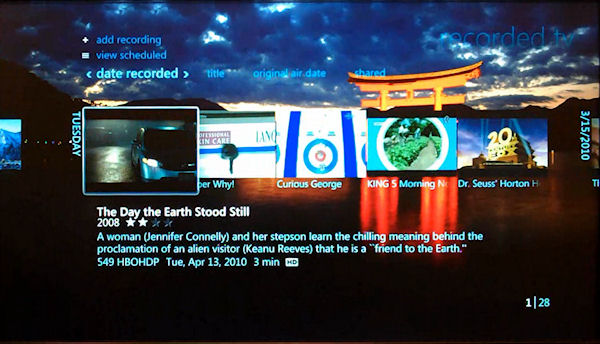
    Customizable screen from Windows Media Center in Windows Embedded Standard 7.

    “More and more people are getting excited about the opportunity of what PCs can do for them in their living rooms to improve their entertainment experience.” That was the message I was getting as far back as 2005, as companies including AMD, Intel, Microsoft, and yes, even Sun were exploring form factors for “entertainment PCs.” Soon, we’d be seeing brands like Intel Viiv, AMD Live, and Microsoft TV at a store near you.

    It’s five years later, and reality has officially set in. “Most people, from a consumer perspective, would not like to have a PC in their living room,” said Irena Andonova, the director of product management for Windows Embedded 7 at Microsoft — the company where entertainment PCs were once all the rage. Today, with HDTV manufacturers embedding Internet connectivity and versatile functionality directly into their sets, the PC is just one more box. Microsoft realizes that now, so with Windows Embedded 7 — which released to manufacturing Tuesday — it’s aiming to put the operating system and the media player in the TV where it now says they belong.

    “Making Windows Media Center available in specialized devices like set-top boxes and connected media devices, we now have devices that can live in the living room, and customers will be accustomed to having them there. It brings the same functionality and features from Windows PCs to the world of specialized devices.”

    Historically, the market for Windows Embedded has been industrial system makers, who build high-quantity or ultra-small form factor devices that need full-featured applications. And in recent years, the company has marketed Mediaroom, rather than Windows per se, to video service providers as an adaptable software platform for delivering cross-platform digital media. At CES 2010, Mediaroom actually stole the show from Windows 7 among device manufacturers.

    Customizable screen from Windows Media Center in Windows Embedded Standard 7.

    The new play for Windows Embedded Standard 7 will be to effectively wedge all of Windows into some of Mediaroom’s market space. With it would then come Internet Explorer, custom applications, and yes, Silverlight.

    As Andonova told Betanews, OEMs and platform customers looking to embed the new operating system can use Silverlight as their development platform for customized apps that can appear as part of the Media Center environment. It’s a somewhat familiar looking place, especially for users familiar with Windows Media Center today, as well as the company’s overall look-and-feel for media-driven platforms such as Zune and Windows Phone 7.

    But as a Microsoft demo indicates, some components of that look and feel may be customized by platform customers, so that it’s not Microsoft’s branding that comes through — a lesson learned from Mediaroom.

    “Windows Media Center is a customizable and extensible platform, so [OEMs] can actually customize the Media Center UI to provide the branding that they would like. They cannot change the horizontal and vertical menus — they can’t change that paradigm — but they can change the font, the background, and the branding,” she told us.

    A forthcoming Windows Embedded Standard 7-based home media device being announced by Swiss manufacturer Reycom.

    One early adopter of Windows Embedded 7 for digital home media libraries, Microsoft tells us, is Swiss media device manufacturer Reycom. It’s expected to produce its first Win7-based device (pictured above) in a few months. Andonova said Reycom’s take on the Media Center UI is “very modern, very sleek, very nice looking, something that you would expect to find sitting in a modern living room.”

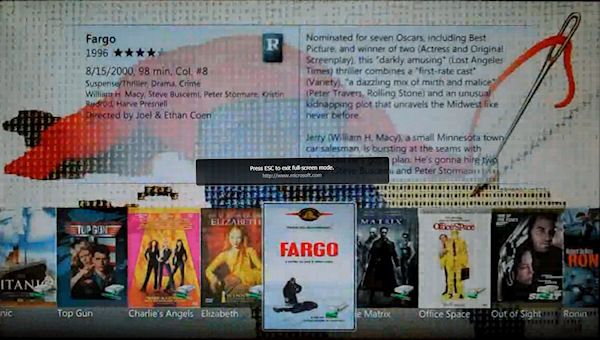
    Customizable screen from Windows Media Center in Windows Embedded Standard 7.

    One of those customizable areas will be the movie library (shown above), which could theoretically become customized by potential customers whose names Microsoft couldn’t help but share…including Netflix.

    “Service providers like telecommunications companies, satellite and cable providers, what Windows Media Center and Windows Embedded Standard 7 offers is the opportunity to provide incremental, over-the-top content. We have demonstrated different services, like Netflix and combining videos from local sources and the Internet, bridging the experience between the Internet and broadcast, or viewing your pictures and photos on Standard 7 and merging Flickr, for example, with personal photo libraries…There can be different, additional revenue potential for service providers, by providing these incremental, over-the-top services.”

    Or to break that down another way: Cable and satellite companies could find additional revenue streams by funneling customers to Internet-based services. But to do that in such a way that viewers aren’t being transported to the Web browser/PC operating system world they might rather leave at work, Web apps need to become channels — things that viewers can tune in on their dials. Nevertheless, because Web apps come and go, and change, more rapidly than the firmware in most set-top boxes can keep up with, the operating system needs to be able to install these apps and uninstall them just like on a PC.

    Thus the creation of an extensible Windows Media Center on a real Windows operating system, but without the PC, embedded in the back of the latest HDTVs as well as the newest DVRs and home media devices like the one European customers should see from Reycom in the coming weeks.

    Copyright Betanews, Inc. 2010


    Add to digg
    Add to Google
    Add to Slashdot
    Add to Twitter
    Add to del.icio.us
    Add to Facebook
    Add to Technorati


  • Looks like BP stands for Burning Petroleum; worst spill since ExxonValdez heads for LA coast – I’ll be on MSNBC’s Countdown at 8:35 edt

    Offshore Oil Safety Awards Luncheon Postponed

    And it gets more ironic:  CBS reports that last year BP won an award for “promoting improved medical care and evacuation capabilities for offshore facilities.”

    The photo “provided by the U.S. Coast Guard shows fire boat response crews battling the blazing remnants of the off shore oil rig Deepwater Horizon, April 21, 2010.”

    I wish I had more time to write a longer post, but I’m doing a couple of interviews on this tonight, including Countdown.

    By the way, Halliburton appears to have been involved in the spill.  They have been named in two lawsuits by Louisiana fishermen and shrimpers, Climate Wire (subs. req’d) reports:

    The oil spill is floating miles from Louisiana’s coastline, home to a huge commercial and recreational fishing industry. It comes as a particularly fragile time for fisheries, since Gulf shrimp are in their spawning season.

    Louisiana claims a $2.6-billion-a-year commercial fishing industry, which provides a quarter of the U.S. seafood supply, exclusive of Alaska and Hawaii.

    The two lawsuits target BP, which holds the lease to the offshore well; Swiss-based Transocean Ltd., owner of the Deepwater Horizon drilling platform that exploded last week; and Halliburton Energy Services Inc., which the lawsuit says was responsible for capping the well.

    I know you are shocked that Halliburton is involved.

    Now what is really rich is that FoxNews and the GOP are working to spin this as Obama’s Katrina, somehow suggesting that the administration’s response was delayed.

    Except, of course, in the case of Katrina, the Bush administration ignored its own administration’s weather forecasts — and ignored the videos of brutal devastation and suffering people — for days.

    In the case of the spill, the reverse is true.  BP basically misled everybody about the size of the spill — by a factor of 5 — and hence their ability to control it.  It was NOAA — which is to say the Obama administration — that realized BP was lowballing the leak, that the problem was beyond the company’s resources, and that much broader action was needed.

    The leak rate is now estimated at more than 200,000 gallons a day — which means it will exceed the Exxon Valdez disaster within 2 months.  I just heard on ABC news that 400 species are threatened and that Louisiana coastline contains 40% of the US wetlands.

    And, of course, the BP and the entire industry has been pushing for weaker safety regulations for a long time — HuffPost piece is here:

    Click here for the proposed rule from the Interior Department’s MMS

    Click here for the letter from BP objecting to the proposed rule

    Finally, the BP well “lacked a remote-control shutoff switch that two other major oil producers, Norway and Brazil, require,” the WSJ reported.

    The only thing this has in common with Katrina is that it is going to devastate the exact same area.

  • Nissan LEAF expected to be in short supply within the first 3 months of sales

    2011 Nissan LEAF

    Nissan predicts that its new 2011 Nissan LEAF will be in short supply within the first three months of sales. The Japanese automaker says that demand will outstrip supply.

    Nissan said that sales may be strong due to the company’s claim that the LEAF will be cheaper to buy and operate than its main competitor – the Toyota Prius.

    It was recently reported that more than 6,600 people in the U.S. have reserved the LEAF, just a few days after Nissan started taking reservations on April 20. Prices for the start at $32,780 or $25,280 with a federal tax-credit. That works out to a lease payment of $349 a month.

    Click here to read news on the Nissan Leaf.

    Refresher: Power for the Nissan Leaf comes from a 107-hp electric-motor that runs on power supplied by lithium-ion cells. On a full-charge, the Nissan Leaf allows for a driving range of 100 miles with a top speed of 87 mph. A full charge takes up to 8 hours on a standard 200V outlet. Buyers can opt for the DC 50kW quick-charger, which recharges the battery up to 80 percent in under 30 minutes.

    2011 Nissan Leaf:

    2010 Nissan LEAF EV 2010 Nissan LEAF EV 2010 Nissan LEAF EV 2010 Nissan LEAF EV

    – By: Omar Rana

    Source: WhatCar


  • Pushing Back: GM expanding Chevrolet into Korea, Daewoo out

    Filed under: , , , ,

    Chevrolet Camaro goes to South Korea – Click above for high-res image

    General Motors decided several years ago to begin heavily promoting Chevrolet as its global mainstream brand even in markets where its existing brands like Opel and Daewoo were a dominant force. Today, at the Busan Motor Show in South Korea, GM Daewoo president Mike Arcamone announced that the Camaro would lead the way in GM’s efforts to market Chevrolet in South Korea.

    For now at least Chevrolet and Daewoo-branded vehicles will coexist in the Korean market. However, while we were in China last week GM officials told us that the Daewoo brand, which has been somewhat tainted by past quality issues, would eventually be phased out in favor of Chevrolet. When the new Aveo launches next year it will likely be badged as a Chevrolet even though GM Daewoo is in charge of engineering the car.

    [Source: General Motors]

    Continue reading Pushing Back: GM expanding Chevrolet into Korea, Daewoo out

    Pushing Back: GM expanding Chevrolet into Korea, Daewoo out originally appeared on Autoblog on Thu, 29 Apr 2010 17:32:00 EST. Please see our terms for use of feeds.

    Permalink | Email this | Comments

  • Tri news.

    No backing out now!!
    I just filled out the registration and PAID for my first sprint triathlon!


    I will also be doing one in September, but I am waiting to register for that one until my next paycheck because it is significantly more! It also sounds more much exciting since it is all women, at Disney, etc.

    In other related news, I am more than likely going to be joining this Triathlete training program for SWIMMING. The coach and I spoke on the phone and I have two options, so I am ruminating through those. He also does about 6-8 open water swims each month, so it is perfect. Details to follow when I come to a final decision.

    I purchased a swim suit today, too! Actually, I bought one last night, but I hate it. I am not comfortable in it at all. I’m debating whether or not to post a picture of me in my ONE PIECE suit. How do they size these things?? It makes no sense! I found a nice, solid black one today. It is classic and basic, I like it!


  • Round Table: HP buying Palm, and what that means

    Round Table 

    Going to the chapel, and we’re gonna get pur-ur-ur-chased…

    Welcome to Round Table, which is in fact not a table at all. Round Table is a continuing series on PreCentral where we pose a question to the staff and they provide their thoughts and insights. The question could be something simple like “what’s your favorite webOS app?” or something a bit more complicated, like “why did Palm choose the creepy lady?” Or maybe we’ll just end up chatting about our favorite episode of Alf, you never know. Today, however, we’re going to take a crack at the big news of the week: HP is buying Palm, and what does that mean?

    read more

  • Video: BMW M3 GT3 hits up Nurburgring… makes a lot of noise

    2011 BMW M3 GTS

    Here is a short clip of the new 2011 BMW M3 GTS hitting up the Nurburgring, Nordschleife. We’re loving the sound.

    Oh, and while we’re at it, may we remind you that we’ll never see the M3 GTS on the stateside – so don’t keep your hopes up.

    Click here to get prices on the 2010 BMW M3.

    Hit the jump for the short clip.

    Refresher: Weighing in at 3,285 pounds (the standard BMW M3 coupe weighs 3,704 pounds), the 2011 BMW M3 GTS is powered by a 4.4L V8 making 450-hp. Power is transmitted to the wheels through a 7-speed M DKG Drivelogic gearbox.

    2011 BMW M3 GTS:

    2011 BMW M3 GTS 2011 BMW M3 GTS 2011 BMW M3 GTS 2011 BMW M3 GTS

    2011 BMW M3 GTS:

    – By: Kap Shah

    Source: BMWBlog


  • The Climate Post: Mighty winds a-blowin’

    by Eric Roston

    .series-head{background:url(http://www.grist.org/i/assets/climate_desk/header.gif) no-repeat; height:68px; text-indent:-9999px;} h3.subscribe-head{padding-left:5px;background-color:black;color:#ff8400;} dl.series-nav{margin-top:-15px;}

    First things first: A high-stakes political drama unfolded after the Senate Majority Leader announced the body would consider immigration reform ahead of anticipated climate legislation. The surprise political move caused a key Republican to bolt the tri-partisan effort to craft a federal climate program. The episode has greatly intensified doubts that the U.S. will pass a climate bill this year.

    Two developments in offshore energy this week competed for both attention and nothing less than–cue Carmina Burana–the future itself.

    Tough climate in ‘battle born state’: Nevada state politics sometimes have an outsized influence on federal energy debates. That’s been true since at least 1987, when Congress designated Nevada’s Yucca Mountain as the geological storage site for America’s nuclear reactor waste.

    With Nevada Sen. Harry Reid in charge of the U.S. Senate, and now embroiled in a competitive re-election campaign, Nevada’s voice is speaking louder than ever. Last year, the White House eliminated funding to develop the Yucca Mountain facility. And state political pressures led to Reid’s announcement last week that the Senate will undertake an immigration overhaul before parsing climate legislation.

    In response, Sen. Lindsey Graham (R-S.C.) threatened to pull out of intense, months-long work on climate policy with colleagues Sen. John Kerry (D-Mass.) and Sen. Joe Lieberman (I-Conn.). Reports up to last weekend had cast the trio as upbeat, with momentum, as they negotiated with business and advocacy groups to support their effort.

    Things fell apart Saturday when Graham released a blistering public letter on the matter, charging that the Democratic leadership put the immigration issue forward in “a hurried, panicked manner”:

    This has destroyed my confidence that there will be a serious commitment and focus to move energy legislation this year. All of the key players, particularly leadership, have to want this debate as much as we do. This is clearly not the case. I am very disappointed with this turn of events and believe their decision flies in the face of commitments made weeks ago to Senators Kerry, Lieberman and me. I deeply regret that election year politics will impede, if not derail, our efforts to make our nation energy independent.

    Graham pulled out of a Monday press conference when he would have released the bill he co-wrote with Sens. John Kerry (D-Mass.) and Joe Lieberman (I-Conn.).

    Strike that. Reverse it: Reid reversed himself on Wednesday, pointing out that it makes sense to pursue climate legislation first since there’s already a bill. That’s not the case for immigration, which exploded onto the scene after a new Arizona law empowered police to ask anyone for U.S. residency documents.

    Despite the potentially mortal political damage inflicted on their effort, the three senators have released a description of their bill to the Environmental Protection Agency, where researchers will perform economic analysis on it in the next several weeks. The Los Angeles Times’ Jim Tankersley sees two implications for this move: It will provide useful input for senators, who need such an assessment before considering the bill; and it suggests that, in the absence of any other signals, it’s theoretically possible for the legislators to resolve their differences and get back to work. An energy-industry funded think tank, the Institute for Energy Research, has filed a Freedom of Information Act request to obtain the bill from EPA, since it has not been released publicly.

    Getting down to business (or at least trying): The legislative stasis frustrates new markets and companies deciding whether they should or must participate in said markets. Some investors have been hoping a federal bill will define a voluntary market for carbon credits. It works like this: There would be many opportunities for emission reductions beyond mandatory efforts. Voluntary actions would generate carbon credits that large industrial companies can buy to offset their emissions (hence the name “offsets”).

    With the climate bill comatose, high-profile news media are beginning to, uh, focus in depth on what the policy actually is and how long it has been around (NYT, NPR).

    A world of indecision: Clearly, the U.S. Senate is currently having trouble introducing legislation, to say nothing of passing it. And enacting legislation may not be the only hurdle, if California is an example. A ballot initiative would, if passed, suspend the bill until unemployment, currently 12 percent, falls below 5.5 percent and stays there for a year. The leading gubernatorial candidate, Republican Meg Whitman, has said she would put central elements of the state’s 2006 climate law on hold for a year. (Democrat Jerry Brown would let it be.)

    International negotiations look no more productive. Officials from the BASIC countries–Brazil, South Africa, India, China–met in Cape Town this week. They called for the completion of a legally binding global climate treaty by this year’s 16th Conference of Parties (COP) meeting in Cancun, Mexico, or at the latest COP-17 in Cape Town. The German news magazine Der Spiegel reported this week that “Chancellor Angela Merkel is quietly moving away from her goal of a binding agreement on limiting climate change to 2 degrees Celsius.” Climate Post doesn’t like to make predictions, but will offer the observation that the COP-16 website is still under construction.

    Anyone looking for a sign of tranquility this week in the energy and climate space might have to look up the U.S. Commodity Futures Trading Commission. The oversight agency identified more than half a dozen kinds of contracts that deserve additional regulatory scrutiny–but the Chicago Climate Exchange’s contract for carbon credits wasn’t one of them.

    American companies offshoring jobs: Nine years after it was first proposed, Cape Wind Associates has won federal approval to build 130 wind turbines about five miles off the coast of Cape Cod. The fight pitted seaside private landowners and Indian tribes against developers and environmental activists. Interior Secretary Ken Salazar said the project will usher in wind power development all along the East Coast.

    The specter of windmills rising in Nantucket Sound offers an alternative image to those of an oil rig collapsing into the Gulf of Mexico. Federal and BP company officials upped their estimate of the oil leaking from the wreck, from 1,000 barrels a day to as much as 5,000 barrels. Satellites have captured dramatic images of the spill heading toward the ecologically delicate Mississippi Delta.

    Dept. of Bad Timing: The Minerals Management Service, an office in the Interior Department, postponed its 2010 Offshore Industry Safety Awards event, planned for next week.

    Breakthrough in commuter transportation policy?: Big legislative initiatives mean one thing to Hill staffers and the armies of lobbyists, journalists, and other observers peeking over their shoulders: Togetherness. No one wants to miss anything important. Reporters can be particularly conscientious, like Darren Samelsohn of Greenwire, who is as close as any journalist to ticking climate-related events in the Capitol.  Wednesday John Kerry posted to his Twitter stream: “Maybe Darren Samuelsohn and I should start carpooling, he’s my shadow in capitol [sic].”

    Climate Post readers, meet Climate Desk readers…: Several weeks ago, a consortium of publications launched The Climate Desk, a collaborative exploration of “the impact–human, environmental, economic, and political–of a changing climate.” The project brings together journalists from the Atlantic, Wired, Slate, Grist, Mother Jones, the Center for Investigative Reporting, and PBS’s Need to Know. The Climate Desk will now also pick up Climate Post when it publishes “Thursdays at three.”

    Climate Post (about), just shy of its first birthday, began as an attempt to reconcile two realities: People like to be informed but have very little time, and climate change is a monstrously vast sea of complexity involving many overlapping, interlocking scientific disciplines, technologies, economics, human behaviors and social systems, diplomacy, and heaven knows, politics. We try to be one-stop shopping for all you interested-but-busy people.

    We’re a project of the Nicholas Institute for Environmental Policy Solutions at Duke University. Click for more on Climate Post, the Nicholas Institute, and Duke University.

    Eric Roston is Senior Associate at the Nicholas Institute and author of The Carbon Age:  How Life’s Core Element Has Become Civilization’s Greatest Threat.  Prologue available at Grist. Chapter about Ginkgo biloba and climate   change available at Conservation.

    Related Links:

    Gulf of Mexico: from magnificent resource to industrial sacrifice zone

    Something’s wrong when our best option is burning an oil slick

    Tragic oil spill = smarter climate bill?


  • Textie for iPhone: Stop Texting Until You’ve Tried It [IPhone Apps]

    The guy behind recent Twitter purchase Tweetie, along with the dude behind Borange, have put together a characteristically pretty SMS replacement app called Textie. There are two things you should know about it: It’s free, and it works. More »


  • Gulf of Mexico: from magnificent resource to industrial sacrifice zone

    by Tom Philpott

    Fire and a vast oil spill, on top of one of the globe’s most productive fisheries. Photo: U.S. Coast Guard

    The Gulf of Mexico is a magnificent resource: a kind of natural engine for the production of wild, highly nutritious foodstuff. Here’s how the EPA describes it:

    Gulf fisheries are some of the most productive in the world. In 2008 according to the National Marine Fisheries Service, the commercial fish and shellfish harvest from the five U.S. Gulf states was estimated to be 1.3 billion pounds valued at $661 million. The Gulf also contains four of the top seven fishing ports in the nation by weight. The Gulf of Mexico has eight of the top twenty fishing ports in the nation by dollar value.

    According to the EPA, the Gulf is the home of 59 percent of U.S. oyster production. Nearly three-quarters of wild shrimp harvested in the United States call it home. It is a major breeding ground for some of the globe’s most prized and endangered fish, including bluefin tuna, snapper, and grouper.

    It would be a wise policy to protect the Gulf, to nurture the health of its ecosytems, to leave it at least as productive as we found it for the next generations. As climate change proceeds apace and population grows, sources of cheap, low-input, top-quality food will be increasingly precious.

    So, how are we doing? As I write this, oil is gushing into the Gulf at the rate of 5,000 barrels per day, 5,000 feet below the water’s surface, The New York Times reports.  Above the surface, an oil slick with a circumference of 600 miles is lurching along, lashed by wind toward the coasts.

    By Friday, it will have reached Louisiana’s wildlife-rich coast. And according to MarketWatch, “Beaches in Alabama and Mississippi are also threatened, and, if the spill spreads into the Gulf’s ‘Loop Current,’ it could devastate coastlines as far away as southeastern Florida.”

    For fisheries, the situation is atrocious. Direct contact with high oil concentrations kill fish quickly. But low-concentration contact can have horrible impacts, too. According to Greenpeace:

    Even when the oil does not kill, it can have more subtle and long-lasting negative effects.  For example, it can damage fish eggs, larva and young—wiping out generations.  It also can bio-accumulate up through the food chain as predators (including humans) eat numbers of fish (or other wildlife) that have sub-lethal amounts of oil stored in their bodies.

    Tragically, now seems to be a particularly awful time for a massive spill. On the Oceana blog, Matt Niemerski writes:

    [S]cientists say this is a critical time for bird life in the region because it is peak nesting and migration time for hundreds of species. Endangered sea turtles are beginning to lay their eggs along beaches in the area and bluefin tuna are spawning right now. Whales, dolphins and sea turtles are also at risk because they could inhale oil when they come to the surface to breathe.

    What started with a human tragedy and suspected tragic loss of 11 lives on April 21, now appears to be unfolding into one of the worst environmental disasters in U.S. history.

    And that’s not all

    A satellite view of the Gulf. In the red areas, a vast, nitrogen-fed algae bloom has risen, blotting out most sea life underneath.Photo: NASA

    It should be remembered that oil drilling is not the only human activity that imperils this vital ecosystem. Every year, millions of tons of synthetic nitrogen and mined phosphorous leach from Midwestern farm fields and into streams that drain into the Mississippi. The great river deposits those agrichemicals right into the Gulf, where they feed a 7,000-square-mile algae bloom that sucks up oxygen and snuffs out sea life underneath.

    The bulk of this vast Dead Zone’s rogue nutrients come from the growing of corn, our nation’s largest farm crop. Half of the corn crop ends up in feedlots, feeding cows, chicken, and pigs stuffed together in pollution-spewing, factory-style feedlots.

    The federal government has mounted an effort to stem the flow of fertilizer from farms to the Gulf. But policies that encourage maximum production of corn—including mandates and tax breaks for corn ethanol—overwhelm those gestures. Thus the Dead Zone has become a routine fact of life in the Gulf, the cost of doing business for a food system that prizes cheapness and industry profit above all else. As the writer Richard Manning puts it in the winter 2004 American Scholar (unavailable online):

    Already, the Dead Zone has seriously damaged what was once a productive fishery, meaning that a high-quality source of low-cost protein is being sacrificed so that a source of low-quality, high-input subsidized protein can blanket the Upper Midwest.

    The government-generated boom in corn-based ethanol plays its role, too. Five years ago, just 13 percent of the corn crop went into ethanol factories. Today, a third does; by 2015, if government mandates hold, fully one-half will. Already, increased demand from ethanol is taking its toll on the Gulf.

    Back in 2008, after ethanol production had soared, the Louisiana Universities Marine Consortium reported, “The nitrogen loading to the Gulf of Mexico in May of this year was 37 percent higher than 2007 and the highest since measurements began in 1970.” The group added: “The intensive farming of more land, including crops used for biofuels, has definitely contributed to this high nitrogen loading rate.”

    Thus like the oil spill, the Dead Zone owes some of its existence to our reliance on auto transportation.

    At this time of year, fertilizer runoff is streaming into the Gulf, and the algae bloom is just beginning to do its dirty work. Now, adding to the routine depredations of the agricultural runoff, we have what’s looking likely to emerge as the nation’s largest oil spill ever.

    Rather than protect the Gulf, we seem determined to destroy it in pursuit of cheap car fuel and cheap meat. Is it too late to reverse course?

    Related Links:

    The Climate Post: Mighty winds a-blowin’

    Take note, companies: Young workers want urban jobs

    Something’s wrong when our best option is burning an oil slick


  • Fishermen and Hunters Could Receive Credits Because Of The Change In License, Permit And Tag Fees

    State senators have decided to reimburse those who purchased a fishing or hunting license, permit or tag between Oct. 1, 2009 and April 14, 2010 in the form of a credit to be applied to the fee for a license, permit or tag purchased after Oct. 1.

    The credit would be equal to the difference between the amount originally paid and the amount the fees were reduced to in April. Fishing fees dropped from $40 to $28, and hunting fees decreased from $28 to $19.

    Lawmakers say last year’s decision to increase fishing and hunting license, permit fees was a mistake, and last month, they scrambled to decrease those fees before the start of fishing season. Now, they are taking another step to make amends.

    About 180,000 people pay the hunting and fishing fees each year.

    The Senate passed the bill 25-9 today. It still has to go to the House.

  • GTMO Doctors Are Examining Omar Khadr Now

    GUANTANAMO BAY — Navy Commander Brad Fagan, a spokesman for the military command running the detention facility here, told reporters that Omar Khadr “is being looked at right now by a doctor.” Khadr is experiencing an “urgent” medical condition, according to Dr. Stephen Xenakis, who briefly checked him out earlier this afternoon, owing from a combination of residual shrapnel in his eyes, conjunctivitis and elevated blood pressure.

    Fagan explained that Khadr has an appointment to see an optometrist tomorrow. There’s a full-time optometrist at Guantanamo’s Naval Hospital, but there isn’t a proper ophthalmologist, an actual eye doctor. The optometrist’s examination of Khadr will be transferred to an ophthalmologist off-base. It’s doubtful that Khadr actually saw a doctor this morning, although a Marine captain testified this morning that he visited an infirmary in Camp Delta and received some pain-relieving eyedrops.

    Asked if the command would entertain the idea of permitting Khadr not to wear the blacked-out goggles that Xenakis said “aggravate” Khadr’s condition during transport from his cell to court, Fagan replied, “That’s hard to say. We’d have to see what the Joint Medical Group doctor has to say and what the optometrist has to say.” The goggles are a security measure to protect guards from the prospect of a detainee assault during transport. They do not touch the detainees’ eyes, ski-goggle style, Fagan clarified.

    Fagan additionally challenged the defense’s claim — which clearly comes from Khadr himself — that Khadr had not previously been forced to wear the goggles and accompanying noise-dampening earmuffs while in a vehicle. It’s “standard operating procedure for the transport of detainees,” he said, adding that “there hasn’t been any deviation from the procedure,” in Khadr’s case or others. As far as Fagan is aware, this is the first time Khadr objected to wearing the goggles.

    “At any time, if the detainees have discomfort in this area, all they have to do is say something to a guard,” Fagan said, “and they’ll be looked at.”

  • Eslogan publicitario: Sixt nos invita a hacer como la Bruni “coger un pequeño frances”

    bruni_sixt

    La empresa alemana de alquiler de vehículos Sixt, ha vuelto a hacer de las suyas con un anuncio. Esta compañía tiene un equipo publicitario con ideas muy curiosas y que siempre llaman la atención, muchos aún recordaran cuando sacaron una foto de la canciller alemana Ángela Merkel con un peinado estilo punk, y ahora para promocionar el alquiler del C3 Picasso se han inspirado en la pareja Sarkozy-Bruni.

    El anuncio, tal y como podemos ver en alemán, nos dice: “Haga como la señora Bruni. Tome un pequeño modelo francés “. Desde la empresa han asegurado que no es más que otro de sus típicos anuncios (no es el primero que crean polémico) y que “es en clave de humor en la que debemos entender el anuncio”, pero de todas maneras no creo que le haga mucha gracia a la pareja Sarkozy-Bruni. (Después del salto el anuncio de la canciller alemana)

    merkel_sixt

    En este de la canciller alemana, dice: “deseas un nuevo peinado, alquila un cabrio”.

    Vía | RTVE