Category: News

  • HP: A Transformational Deal for the Mobile Market

    New HP Logo
    HP held an conference call with investors and analysts on the Palm acquisition. In the call Todd Bradley, executive vice president, Personal Systems Group, HP laid out the motivations behind the transaction. Mr. Bradley remarked that it represents a “transformational deal for the connected mobile device market” and he gave a few details and hints about HP’s plans for the future of webOS.

    Mr. Bradley made a point to highlight that webOS lends itself to additional mobile form factors and he stressed the benefits of owning the entire mobile experience. He said that HP sees opportunities in other mobile form factors and market segments for the platform. In specific, larger slate style devices were mentioned a number of times as well as “potential netbooks.” He remarked that HP had gone through the due diligence to confirm that webOS would be able to support such future products. When pressed in the Q&A he declined to give any sort of timeframe or potential product roadmap.


  • Podesta: Energy First for Congress, Then Immigration

    The great debate over the scheduling of comprehensive immigration reform versus clean energy and climate legislation has engulfed Washington. Lost in that frenzy is the need for Congress to do both.  John D. Podesta, CAPAF President and CEO explains why in this repost.

    The Senate now has a clear schedule for consideration: the energy and climate bill followed by immigration reform. The consternation and anxiety—and even the threats—surrounding the schedule must now come to an end so we can solve these critical problems.

    It is obvious that energy and climate legislation is further along in the legislative process than immigration reform. The Environmental Protection Agency is doing its assessment of the bill and it should be ready for Senate consideration within weeks. This gives leadership, sponsors, and supporters time to secure 60 votes.

    Comprehensive immigration reform is no less worthy of consideration but needs more time to develop legislatively. The passage of draconian legislation in Arizona amplifies the demand for a prompt federal solution. Constructing immigration reform that can garner bipartisan support can’t be done in a matter of days but it’s critical that the process be accelerated and we move to it this year.

    Given this path forward it is time for senators and interest groups alike to put an end to the histrionics and get to work.

    – John Podesta


  • How do you argue against the growth juggernaut?

    by Lisa Hymas

    I’ll be talking tomorrow to filmmaker Dave Gardner, who’s making a documentary called Hooked on Growth: Our Misguided Quest for Prosperity.  He wants to hear about my choice to be a GINK—green inclinations, no kids.  And I’ll be offering thoughts about growth in general.  Any suggestions about points to make or ideas to share?  How can we best fight the assumption that what society needs is growth, growth, and more growth?  As Edward Abbey so memorably put it, “Growth for the sake of growth is the ideology of the cancer cell.”

    Here’s a trailer for the film, with commentary from Bill McKibben, Paul Ehrlich, and Dick Lamm, among others. 

    Related Links:

    14 buildings compete to be the Biggest Loser (of energy waste)

    Sit, stay, recycle [VIDEO]

    Ask Umbra on fertility awareness, grilling, and Earth Day pledges


  • Protect Your Kids from Porny Folder Art [Ads]

    This ad for Latinworks’ Parental Control Bar urges parents to protect their kids from the seedier sides of the internet. But if you’re going to organize your folders like that, what the hell do you expect? [ScaryIdeas via Copyranter] More »


  • GTMO Video: Daphne Eviatar Discusses Day 1 of Khadr Hearing

    GUANTANAMO BAY — Seated near me in the courtroom today during Omar Khadr’s pre-trial hearing was a sight for sun-beaten eyes: Daphne Eviatar, the former TWI legal affairs correspondent who’s now working for Human Rights First. Shortly after Army Col. Pat Parrish, the judge hearing the case, gaveled this afternoon’s proceedings into recess, I caught up with Daphne so she could walk everyone through the highlights of the defense’s attempt to suppress Khadr’s statements to interrogators from being used against him in his scheduled July military commission.

    Video after the jump:

  • Nike NBA Post Season Twitter Playoff Treemap

    nike_twitter_basketball.jpg
    The Nike Post Season Twitter Playoff [nikebasketball.com] reveals the relative popularity of NBA teams within the Twitosphere in real-time. The interface is the newest creation of Stamen Design, who have created several other real-time Twitter visualizations for several fancy clients, including MTV (Video Music Awards), the NBC (Winter Olympics) and Twitter themselves.

    In the Matchup interface, the rectangles captured in the treemap-like interface represent a different NBA team each, and dynamically scale according to the number of tweets per minute for that particular team. The Bracket interface orders all the teams in a visual ranking that mimics a play-off style competition. The teams with the most tweets can win “matchups” while miving to subsequent rounds.

  • Student Turing Point Society Inducts New Members

    stps.jpg

    Student Turning Point Society

    The Student Turning Point Society, a select group of undergraduate leaders committed to promoting the spirit of Case Western Reserve University, welcomed more than 20 new members during the 2009-2010 academic year.

    As several members plan to graduate next month, the spirit and enthusiasm demonstrated by the newly-elected members, along with returning ones, are indications that the progress made by the organization will continue.

    “We had an outstanding year and it’s reflected by the large class we’re inducting this year,” said Liz Smith, executive director. “I’m confident in the hands we’re leaving the organization in,” she said of the new and returning members.

    Twenty-two members were introduced at an induction program held this month.

    Named after the campus sculpture of the same name, members of the Student Turning Point Society promote the university’s mission by developing and maintaining relationships with the university’s administration, alumni and friends. Members participate in social functions and alumni events, serve on committees, conduct personal tours for VIPs and other high-profile campus visitors and more. They also work to enhance campus life for future students. They were involved with several events per month during the 2009-2010 academic year.

    Student Turning Point Society members work closely with the university’s alumni relations, development and donor relations offices. “These are some of the most recognizable student leaders on campus. Their ability to connect with external constituents provides a lot of value,” said Michael Wolford, assistant director of donor relations and events and the group’s adviser.

    David Holcomb, a second-year student majoring in economics, is one of the new members. He wanted to join the group “to get involved with an organization focused on directly giving back to the school.”

    Lea Cross, a third-year chemical engineering major, also is a newly-elected member. “The administration has a lot of information to share with students and I feel like we have a lot to share as far as the student experience,” she said about wanting to join the organization.

    In addition to Holcomb and Cross, who were part of the spring 2010 class, the following students were inducted:

    Fall Class of 2009:
    • Brendan Goodwine
    • Colin Downey
    • Brian Nelson
    • Meredith Collier
    • Emily Friedlander
    • Tristan Chen
    Spring Class of 2010:
    • Lillian Zamecnik
    • Anthony Opperman
    • Robert Armstrong
    • Mara Gallagher
    • Ali Briggs
    • Benjamin Pinkie
    • Chen Yan
    • Matthew Richter
    • George Linderman
    • Bharath Velagapudi
    • Anna Handorf
    • Christian Wargo
    • Rebecca Simmons
    • Matthew Root

    Learn more about the Student Turning Point Society.

    For more information contact Kimyette Finley, 216.368.0521.

  • Rally legend Per Eklund to enter Nürburgring 24 in classic Saab 900 Turbo

    Filed under: , ,

    Hold on to your Dubbelmossas, rally fans. Legendary Swedish rally and rallycross driver Per “Pekka” Eklund is coming back, and he’s coming back hard. How hard? A Saab 900 Turbo 16S built to Group A specs.. Sure, it’s not diamond tough hard – like this – but we’re still impressed. Not only that, but he’ll be campaigning the 26-year old front-driver in the ADAC 24 Hours of Nürburgring. Also of note, it’s been thirty years since Eklund competed in a 24 hour race.

    Fear not though, as this particular Saab 900 Turbo sounds totally up to the task as it’s capable of producing 310 hp and a punishing 384 pound-feet of torque steer. Says Eklund, “When I got offer to be able to compete with a classic Saab 900 Turbo on the Nordschleife, I immediately loved the idea.” Who wouldn’t?

    Will the 64-year old Eklund be up to the task of racing around one of the world’s most difficult tracks in the middle of the night in car built (probably) the same night Mondale was defeated? We’ll go ahead and guess yes, he’ll be just fine. As for a Saab holding together for 24 grueling hours, hey, anything’s possible. The fun starts on May 13th.

    [Source: Per Eklund via Saabs United]

    Rally legend Per Eklund to enter Nürburgring 24 in classic Saab 900 Turbo originally appeared on Autoblog on Wed, 28 Apr 2010 17:32:00 EST. Please see our terms for use of feeds.

    Permalink | Email this | Comments

  • HP buying Palm is like Ke$ha marrying John McCain

    By Joe Wilcox, Betanews

    Exactly, what do they have in common? HP-Palm is a merger of necessity. HP needs to jumpstart (for the umpteenth time) its mobile strategy and Palm needs to be bought by anybody or perhaps die. Hey, there is anybody and then there’s anybody else would be better. In a parallel universe the situation is different. HP is doing what I said Microsoft should: Buy Palm, and what a steal HP is getting for $1.2 billion.

    Perhaps I’m missing something about things in common. While I was writing this post, Walter Lounsbery tweeted to me: “HP and Palm both share that has-been entrepreneurial spirit.” Ouch! Get the Neosporin! And a Band-Aid! Alex Scoble poured salt on the wound. In a response to me at FriendFeed: “They both sell mobile devices…just no one knows that HP sells mobile devices.” Whoa, put away that baseball bat, Alex!

    Adam Hall sees the glass as being half full (as opposed to my half-empty — OK, nearly empty — perspective). He tweeted: “Isn’t it what Palm and HP don’t have in common that makes this interesting? I see potential, but can they realize it?” HP must realize something to plunk down $1.2 billion. Hey, there is one more thing in common. Mark Kéy-Balchin tweeted: “Interestingly enough, the other thing they share in common is Tom Bradley, former CEO of Palm and current VP of HP’s PC group.”

    When I think HP, enterprise comes to mind. When I think Palm — at least its latest post-PDA life — I think consumer. HP: Stodgy handheld/phone design reminiscent of my college roommate’s first calculator. Can you say black and grey? Palm: Curvy, round smartphone that reminds of a Sephora make-up compact. HP: Builds the hardware, licenses the software from Microsoft. Palm: Delightfully designs hardware and software. Ultimately, I worry that craggy old business-oriented HP will suck all the vitality out of the fresh, new Palm — at least as run (or run into the ground) — by Jon Rubinstein. Think: lifeforce-sucking Wraiths from cancelled TV series Stargate Atlantis.”

    Yes, HP sells to consumers, and, I must admit, does a good job marketing to them. The Palm PDA once was an enterprise mainstay of 1990s business users. Maybe Hall is right and these differences mean something. Certainly they mean the end of Palm as everyone knows it. Look what happened when HP gobbled up Compaq, which was a huge brand at the time. Now Compaq is the name HP sticks on its cheapest-selling notebooks and keeps around because in some dark corner of the IT world there are people desperately clinging to the Compaq name. Say, it’s the 21st Century, dude. You can let go and move on now.

    It’s not rocket science to see why HP would want a Palm merger. The smartphone market is so smoking everyone wants a whiff. Late last year, IDC rightly predicted that major PC manufacturers would move aggressively into the smartphone market this year. Well, Dell has cued up Flash, Smoke and Thunder — names evocative of the smoking smartphone market and the PC manufacturer’s determination to scorch it. HP has chosen to buy rather than build. The smartphone and other mobiles are destined to replace the PC as the dominate Web-connected device, by 2015, according to Morgan Stanley. I believe. Do you?

    Anyone thinking HP can do much right by Palm should look no further than the waylaid Compaq brand, current HP PDA/phone lineup or disastrous iPod distribution deal. What? You don’t remember that HP once sold iPod, right alongside Apple? Your memory answers just how badly it went (You can be sure Apple CEO Steve Jobs wishes everyone would forget that deal). I’ve read absolutely nothing about the HP-Palm shotgun merger other than the press release, so I wouldn’t be influenced by anybody else’s thinking. But I expect to read lots of punditry about how much Palm handsets and software will benefit from HP’s huge retail channel. Oh, yeah? It did diddly squat for iPod. Apple had to build out its own channel.

    HP is a great technology company, as is Palm. HP needs to jumpstart its handset strategy, and Palm needs a white knight. In fairytales, the princess must kiss a frog for him to become her prince, her white knight. In fairytale mergers, the princess’ kiss turns one — or both — into a frog.

    [Editor’s Note: For closeted, out-of-touch geeks, here is the relief from your confusion. Ke$ha is a hugely successful, 23-year-old party-girl rock star. John McCain is a 73-year-old, war hero and US Senator who ran for president in 2008.]

    Copyright Betanews, Inc. 2010


    Add to digg
    Add to Google
    Add to Slashdot
    Add to Twitter
    Add to del.icio.us
    Add to Facebook
    Add to Technorati


  • Beef, Spinach and Mushroom Lasagna

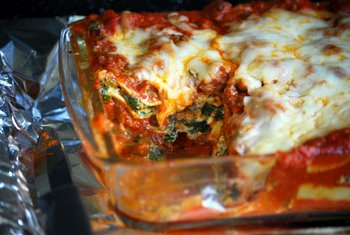
    Beef, Spinach and Mushroom Lasagna, sliced

    Lasagna is one of those dishes that seems like it is going to be tricky and time consuming to make, but is actually quite easy to prepare. It makes a big batch, so it is a great dish to make to feed a crowd, but it is also a good option for a smaller group, since you can slice it up and freeze portions, ready to reheat a few days or weeks down the line for a quick (yet still homemade) dinner!

    I’m not a big fan of lasagnas that go overboard with cheese. Instead, I prefer lasagnas that have a good balance of meat, veggies and spices in them to keep them interesting. This lasagna is a good example, as it incorporates ground beef, spinach, mushrooms, onions and garlic into it. It isn’t heavy on cheese, although it does use ricotta, mozzarella and parmesan cheeses, which I think keeps it a little lighter and a little healthier than some other recipes. I cheated a little bit and used good quality jarred marinara sauce as a base, as well as no-boil lasagna noodles, which saved on prep time.

    About 1 hour after you start cooking, you’ll be ready to sit down to eat. The sauce for this lasagna is meaty and flavorful, with lots of nice garlic flavor and a hint of spice from the red pepper flakes. Add in more pepper when you’re preparing the sauce if you like things spicier. You can actually taste the spinach in the spinach filling because the ricotta and parmesan cheese that it is mixed in with don’t overwhelm it. Mozzarella on top, of course, adds a classic lasagna look to everything.

    Beef, Spinach and Mushroom Lasagna

    (more…)

  • Senate Agrees to Move FinReg to the Floor by Unanimous Consent

    Rather than taking a fourth cloture vote, the Senate just agreed to start formal debate on Sen. Chris Dodd’s (D-Conn.) financial regulatory reform bill by unanimous consent.

    Earlier this afternoon, Senate Minority Leader Mitch McConnell (R-Ky.) said Republicans would no longer stand in opposition to the bill reaching the floor. Republicans Olympia Snowe (Maine), Susan Collins (Maine) and Lamar Alexander (Tenn.) indicated they would vote for the cloture motion. But Senate Majority Leader Harry Reid (D-Nev.) just asked for unanimous consent — a parliamentary procedure that does not require a vote, as long as no senator objects.

    Senators are currently speaking and anyone interested can watch all of the hot Hill action here.

  • The new Dirty Dozen: 12 foods to eat organic and avoid pesticide residue

    blueberries

    (Photo: Getty Images)

    Fruits and veggies are an essential part of a healthy diet, but many
    conventional varieties contain pesticide residues. 

    And not all the pesticides used to kill bugs, grubs, or fungus on the farm
    washes off under the tap at home. Government tests show which fruits and
    vegetables, prepared typically at home, still have a pesticide residue.

    You can reduce your exposure to pesticides by as much as 80% if you avoiding the most contaminated foods in the grocery store.

    To do so, you need the latest info from the why the Environmental Working Group’s “Dirty Dozen” list of foods most likely to have high pesticide residues. Since 1995, the organization has taken the government data and identified which type of produce has the most chemicals.

    This year, celery takes the number one spot and both blueberries and spinach make an appearance (displacing lettuce and pears).

    The best way to avoid pesticide residue on foods is to buy organic produce — USDA rules prohibit the use of pesticides on any crop with the certified organic label.

    Here’s a closer look at the 2010 Dirty Dozen:

    1. Celery
    Celery has no protective skin, which makes it almost impossible to wash off the chemicals (64 of them!) that are used on crops. Buy organic celery, or choose alternatives like broccoli, radishes, and onions.

    2. Peaches
    Multiple pesticides (as many as 62 of them) are regularly applied to these delicately skinned fruits in conventional orchards. Can’t find organic? Safer alternatives include watermelon, tangerines, oranges, and grapefruit.

    3. Strawberries
    If you buy strawberries, especially out of season, they’re most likely imported from countries that have less-stringent regulations for pesticide use. 59 pesticides have been detected in residue on strawberries. Can’t find organic? Safer alternatives include kiwi and pineapples.

    4. Apples
    Like peaches, apples are typically grown with poisons to kill a variety of pests, from fungi to insects. Tests have found 42 different pesticides as residue on apples. Scrubbing and peeling doesn’t eliminate chemical residue completely, so it’s best to buy organic when it comes to apples. Peeling a fruit or vegetable also strips away many of their beneficial nutrients. Can’t find organic? Safer alternatives include watermelon, bananas, and tangerines.

    5. Blueberries
    New on the Dirty Dozen list in 2010, blueberries are treated with as many as 52 pesticides, making them one of the dirtiest berries on the market.

    6. Nectarines
    With 33 different types of pesticides found on nectarines, they rank up there with apples and peaches among the dirtiest tree fruit. Can’t find organic? Safer alternatives include, watermelon, papaya, and mango.

    7. Bell peppers
    Peppers have thin skins that don’t offer much of a barrier to pesticides. They’re often heavily sprayed with insecticides. (Tests have found 49 different pesticides on sweet bell peppers.) Can’t find organic? Safer alternatives include green peas, broccoli, and cabbage.

    8. Spinach
    New on the list for 2010, spinach can be laced with as many as 48 different pesticides, making it one of the most contaminated green leafy vegetable.

    9. Kale
    Traditionally, kale is known as a hardier vegetable that rarely suffers from pests and disease, but it was found to have high amounts of pesticide residue when tested this year. Can’t find organic? Safer alternatives include cabbage, asparagus, and broccoli.

    10. Cherries
    Even locally grown cherries are not necessarily safe. In fact, in one survey in recent years, cherries grown in the U.S. were found to have three times more pesticide residue then imported cherries. Government testing has found 42 different pesticides on cherries. Can’t find organic? Safer alternatives include raspberries and cranberries.

    11. Potatoes
    America’s popular spud reappears on the 2010 Dirty Dozen list, after a year hiatus. America’s favorite vegetable can be laced with as many as 37 different pesticides. Can’t find organic? Safer alternatives include eggplant, cabbage, and earthy mushrooms.

    12. Grapes
    Imported grapes run a much greater risk of contamination than those grown domestically. Only imported grapes make the 2010 Dirty Dozen list. Vineyards can be sprayed with different pesticides during different growth periods of the grape, and no amount of washing or peeling will eliminate contamination because of the grape’s thin skin. Remember, wine is made from grapes, which testing shows can harbor as many as 34 different pesticides. Can’t find organic? Safer alternatives include kiwi and raspberries.

    More Healthy Eating Tips From The Daily Green

    Reprinted with permission of Hearst Communications, Inc.

    Check out Yahoo! Green on Twitter and Facebook.

  • Hp Buys Palm: Weigh in, PreCentral Nation

    Look, we’re going to keep this simple: HP is buying Palm. We’re feeling fairly pleased overall so far, but we’ll see as time goes on. In the meantime, simple: what do you think?


  • Aviation Official Laments Focus on Aviation


    Janet Napolitano


    An official with the nation’s aviation system lamented on Wednesday that U.S. counterterrorism efforts are too focused on — of all things — the aviation system.

    The Federal Aviation Administration official called the issue “troubling,” insisting that more attention should be paid to the nation’s rail system.

    In Washington, where federal agencies often tangle over turf and tactics, it’s rare to see an official from one agency worrying about the resources and attention being afforded to another agency or institution.

    The sentiment came after Homeland Security Secretary Janet Napolitano, speaking in Washington at the U.S. Chamber of Commerce, outlined her department’s efforts to boost aviation security around the world.

    During a question-and-answer session, a man identified himself as an FAA employee and a “strong” supporter of the Obama administration’s efforts to stop terrorism.

    But, he told Napolitano, he finds it “troubling” that “so much progress has been made with aviation security” while rail security remains “largely” ignored.

    After all, Russia and Spain have both “suffered transit attacks,” said the FAA employee, a policy analyst in his 30s.

    He asked Fox News not to identify him by name, insisting he did not speak for the FAA.

    Napolitano herself has expressed similar views, even before she became head of Homeland Security.

    During her confirmation hearing on Jan. 15, 2009, she told lawmakers that the department’s counterterrorism efforts “ought” to focus on “not just aviation but surface transportation as well.”

    “That is a work in progress,” she said. “We haven’t done as much there as we have done on aviation.”

    On Wednesday, Napolitano told the FAA official he is “right to say” that terrorists want to target rail systems, which she said is something reflected by current U.S. intelligence.

    As an example, she cited the case of Najibullah Zazi, the Colorado airport shuttle bus driver who was arrested last year for plotting an attack on the New York City subway system.

    But, she said, her department and the Obama administration are taking steps to boost security on rail systems across the country.

    She said the White House’s latest budget proposal includes requests to increase deployment of Visible Intermodal Protection and Response (VIPER) teams, particularly where intelligence suggests threats are greatest.

    VIPER teams are the rail equivalent of federal air marshals, patrolling Amtrak and other mass transit systems for suspicious behavior and responding to potential incidents.

    In addition, Napolitano said her department is trying to boost rail security through risk-based grant programs to cities and towns across the country.

    Napolitano was the keynote speaker at the National Chamber Foundation’s Annual Aviation Summit, a forum sponsored by the Chamber of Commerce.

    “Secretary Napolitano underscored the Obama administration’s unprecedented efforts to strengthen the international aviation system by enhancing information sharing with international partners about terrorists and other dangerous individuals; increasing cooperation on the development and deployment of new technology, such as Advanced Imaging Technology and Explosive Trace Detection units; and modernizing aviation security standards around the world,” according to a statement from the Department of Homeland Security.

    In March, two female suicide bombers attacked the Moscow Metro, killing dozens and injuring scores more. Six years earlier, in 2004, several bombs ripped through four trains in Madrid, killing nearly 200 and injuring hundreds more.

    In each case, a group affiliated with al Qaeda claimed responsibility for the attack.

  • Cell Phone Chip King Confirms Its Server Ambitions

    ARM plc has confirmed that within the next 12 months its architecture, which is currently used primarily in cell phones and consumer electronics, will also be used in servers — pitting it against the lifeblood of Intel’s chip business. Speaking with EETimes, Warren East, the CEO of ARM, said servers using ARM-based chips should appear within the year.

    The news shouldn’t come as a surprise to our readers, since I profiled Smooth-Stone, one company trying to build low-power servers earlier this month, and in that same post pointed to ARM’s server ambitions. And it’s not just startups that are interested in using the low-power ARM architecture inside data centers, either. Google recently acquired a secretive startup called Agnilux that was rumored to be making a server with the ARM architecture. We also reported on a Microsoft job listing that sought a software development engineer with experience running ARM in the data center for the company’s eXtreme Computing group.

    For the last couple of decades, Intel’s x86 chips have gained dominance in the data center, but as power considerations begin to outweigh the benefits of a cheap, general purpose processor, other chip makers have started to smell blood. Nvidia is pushing its graphics processors for some types of applications, while Texas Instruments is researching the use of DSPs inside servers. So ARM’s server ambitions aren’t so far-fetched, and because of its ubiquity it may have the best chance at success, especially as more and more software is written for mobiles where ARM dominates. East told EETimes:

    The architecture can support server application as it is. The implementations [of ARM] have traditionally been aimed at relatively low performance optimized for minimum power consumption. But we are seeing higher speed, multicore implementations now pushing up to 2-GHz. The main difference for a server processor is the addition of high-speed communications interfaces.

    Smooth-Stone, for example, says it has developed intellectual property at the silicon level to handle the communications between the myriad ARM-based processors that would be needed inside a server. However, ARM isn’t the only low-power solution in the server world. Intel’s best hope may lie in companies using its low-power Atom chips to build greener boxes. I’m hoping we’ll hear more about ARM’s server ambitions when Ian Feurgeson, the director of enterprise and embedded solutions at ARM and the guy in charge of the company’s server ambitions, speaks at our Structure 10 conference in June.

    Related content from GigaOM Pro (sub req’d):


    Hot Topic: Green Data Centers

  • HP implying WebOS tablets on tap? (Already?)

    That didn’t take long for brand new speculation to surface.

    Brian Humphries, HP’s vice president of strategy and corporate development, set some tongues wagging during the conference call about the HP acquisition of Palm. Hold on, back up: If you don’t already know the big news, HP has agreed to purchase Palm. That alone is a whopper of headline news. (For more on that, click here.)

    Then Humphries kinda sorta alluded to something heretofore never actually uttered in public: a WebOS tablet. In truth, it still wasn’t uttered here, even in this conference call. But here’s what has the webs buzzing about the possibility:

    Slide 5 from the presentation (below) features the Pre Plus, Pixi Plus and HP’s Slate tablet. The next slide spotlights the major strengths of each company. For Palm, it’s the WebOS platform and industry experience, whereas HP offers cashflow and “scale.” That last word is what analysts are zeroing in on. It could be taken to mean that deploying the OS across different hardware platforms, both small and large. Now let’s take another look at the previous slide…


    That’s it. One word, one slide, a load of cash, and now people are wondering whether HP might eventually unveil a WebOS tablet.

    For the record, my initial thoughts are that it would truly be awesome. WebOS, despite being an elegant and user-friendly operating system, has taken a lot of flack over its hardware. Now imagine all those cards swiping by on a big glorious screen set in a beautifully built device.

    It’s way, way too early to know if this will be in the works, but I hope HP is licking its lips, thinking about it. What about you? If a “Pablet” ever sees the light of day, would you go for it?

    Via: PreCentral


  • Republican Filibuster About to Collapse

    By Tim Shoemaker

    FOXNews.com reports some Republicans are considering surrendering their successful filibuster of the financial “deform” bill (the third round of which was successful today, 56-42).

    Senate Republicans…will attempt to change the bill on the Senate floor, Republican officials said.

    Sen. Richard Shelby, the top Republican on the Senate Banking committee, said he has assurances that Democrats will adjust his banking regulation bill to address concerns that it perpetuates bailouts.

    The concession sets the stage for Republicans to withdraw objections that have stalled the bill in the Senate.

    The agreement does not bridge other significant differences between the parties on the bill.
    Democrats tried three times to begin debate on the bill only to be thwarted by Republican opposition.

    Contact your Senators now and urge them to continue the filibuster!  Make sure they know a vote for cloture will be seen as a vote for empowering the Federal Reserve!

    Sen. Shelby’s trust in the ‘assurances’ of the Democrats to change the bill after the filibuster is over is misguided and extremely naive. 

  • Shock: People “Addicted” To Communication, Information, Other Humans, Oxygen

    Adam Singer writes in to direct our attention to yet another silly study claiming to highlight the evils of technology and Internet addiction. According to this latest study, Researchers at the University of Maryland asked 200 students to give up all media of any kind for one full day — and found that after 24 hours "many showed signs of withdrawal, craving and anxiety along with an inability to function well without their media and social links." Researchers say the disconnected test subjects strangely equated being without these connections to "going without friends and family" — which of course is exactly what they were doing. However, if you look at the press release, researchers appear to base their conclusion that students were "addicted" to media by the very scientific fact that students simply said they were:

    "A new study out today from the International Center for Media & the Public Agenda (ICMPA) at the University of Maryland, concludes that most college students are not just unwilling, but functionally unable to be without their media links to the world. "I clearly am addicted and the dependency is sickening," said one person in the study. "I feel like most people these days are in a similar situation, for between having a Blackberry, a laptop, a television, and an iPod, people have become unable to shed their media skin."

    Just taking common modern media consumption and communications tools away from users for 24 hours doesn’t seem to prove much of anything — aside from the fact that people have grown used to modern media consumption and consumption tools — which they’d adapt to living without in time. The American Psychiatric Association does not recognize so-called Internet addiction as a disorder (despite efforts to change this to help sell more "cures"), and real addiction generally involves people with real problems who usually aren’t quick to admit they even have an addiction. As we’ve discussed countless times — the real problem is that we’re annoyingly in love with (but not addicted to) calling everything an addiction. At least when we’re not busy getting high off of everything.


    Permalink | Comments | Email This Story


  • Jon Rubinstein’s company email about acquisition

    As a part of Palm’s just-mentioned SEC filing, there’s a copy of the email Palm CEO Jon Rubinstein sent out to all employees. Looks like they are going to have an all-hands-on meeting with employees to discuss the acquisition.

    The letter goes over the basics: HP’s resources, Palm’s innovation, and a focus on keeping the pace up now and in the future – in other words, Palm’s not going to go on autopilot while they wait for the acquisition to shake out. Good to see Rubinstein praising the work that Palm has already done "In short, we have delivered on our original plan," and also good to see that there’s not much in the way of dark clouds in Rubinstein’s message to the team:

    I am very excited about the potential of this merger (and not only because I started my career there). HP recognizes the value in our platform, our IP and our people, and that is all a result of your hard work

    The filing also includes ‘talking points’ detailing that there was "a high level of interest […] from other serious buyers" and that "it should be business as usual at Palm" during the integration process.

    Full letter after the break

    read more

  • Now Obama Is Making Emergency Calls To Merkel Over Greek Aid

    Barack Obama

    The Greek crisis is obviously freaking out The White House.

    According to MSNBC’s Chuck Todd, Obama has made a personal call to the recalcitrent Angela Merkel over moving forward on the bailout.

    Germany is getting pressure from all sides. The IMF wants it to act, Obama wants it to act, and you know the leaders of Spain and Portugal want it to act.

    The problem is that nobody in Germany wants it to happen, and Merkel is showing no signs of bowing to this pressure.

    How long can she hold out?

    There’s a HUGE list of potential victims if Greece collapses >

    Join the conversation about this story »