Category: News

  • Did FCC Just Out the HTC Wildfire?

    It’s not very often that we get to see pictures of handsets to go with FCC approvals. Such is the case with this new HTC phone, the PC70110. Based on the looks, we can safely assume this will be an Android-based unit. Look to the front keys for a row of buttons that mimic the Droid Incredible.

    Nothing concrete is known about this handset aside from the AT&T 3G bands it was approved with. Some are beginning to believe this might be the HTC Wildfire as its design could fit the “playful and full of youth” description. The handset maker recently conducted a poll on their Facebook page asking fans to help pick the name of their next release. Other choices included HTC Jovi, HTC Zeal, and HTC Festi.

    We’ll be sure to bring you more on this handset as we can gather it.

    Source: PhoneDog

    Might We Suggest…

    • U.S. Cellular to Launch the HTC Desire in July

      Praise the Android Gods, we now have a date for when the HTC Desire will launch on U.S. Cellular!   According to the U.S. Cellular Facebook page, the HTC Desire will be launching sometime in Jul…


  • The Iron Hoe


    This item informs us that Cuba has gone further down the road of integrating the separate rural and urban life ways than I had any reason to anticipate.
    I want you to read the underlined component, before we do the kneejerk thing about Cuba.
    It has been my argument that introducing an urban element into our agriculture is necessary in order to achieve the best utilization of human resources for our own modern civilization.  Formal employment has always been only part of our lives.  The remaining part can well be engaged in agricultural pursuits for which we are well adapted.
    In Cuba, it has become a source of private enterprise and local economic health.  Not quite a joint stock company, but beats driving cab.
    As I posted earlier, we can integrate a condominium complex with a large operational farm with sufficient land to provide individual enterprise and multiple part time employment opportunities.  The financing package can easily support acquisition and operating working capital to support all aspects of production.  But key is manpower availability.  It becomes possible to operate labor intensive high yield protocols.
    This can all be done with something as simple as a proper zoning law that does not allow separation of title to permit abandonment.  A farm can then achieve a density equal to single family housing while having negligible impact of cropping space.  This provides the necessary tax base and services.
    THE IRON HOE OF THE STATE
    Cuba’s urban-ag revival offers limited lessons 2
    26 APR 2010 6:15 AM
    Cuba\’s flourishing urban agriculture comes with a strong dose of government control.
    This post originally appeared on Civil Eats.
    Many of us in the U.S. sustainable-food movement idolize Cuba‘s experience in building a vibrant urban-farming sector. This idealization is due to the lack of information available on the Cuban system, as caused by the travel embargo and media blackout there. Compounding this situation is the vast difference between the Cuban and American political and economic systems.
    Cuba’s accomplishments are undeniably astounding, inspiring and a testament to the country’s flexibility and pragmatism: 350,000 new well paying jobs (out of a total workforce of 5 million) created in urban agriculture nationally; 4 million tons of fruits and vegetables produced annually in Havana, up ten-fold in a decade; and a city of 2.2 million people regionally self-sufficient in produce. These accomplishments have been supported by an extensive network of input suppliers, technical assistance providers, researchers, teachers and government agencies.
    Yet, Cuban urban agriculture, no matter how inspiring, is largely irrelevant to Americans. The state is pervasive throughout Cuba and controls virtually all aspects of the official economy. The government can mobilize quickly and massively around its priorities through an array of powerful policy tools at its disposal. After 50 years of socialist rule, Cuban institutions, as well as the mentality and expectations of the Cuban public, differ vastly from those in the U.S. By way of example, the ruling motto of Cuban urban agriculture states, “We must decentralize only up to a point where control is not lost, and centralize only up to a point where initiative is not killed” embodies the vast differences between their planned economy and our free market system.
    The fundamental differences between the Cuban and American systems as they relate to the success of urban agriculture are vast and, for the most part, are insurmountable.
    Land ownership key
    Case in point, the success of urban agriculture in Cuba has been grounded in the distribution of public land for food production. For example, a law passed in 2008 allowed any citizen or entity to request idle lands up to 33 acres to be passed out in usufruct for 20-40 years. This law resulted in 16,000 persons requesting land in the past two years. Since all land in Cuba – with the exception of private homes – is the property of the State, the government has resources at its disposal to support its policies far beyond that of any American jurisdiction.
    On the other hand, in the U.S., land use laws and private property land tenure represent a very real challenge to the expansion of urban farming. While some cities have made their minimal idle lands available for urban farming, when they do so, garden land tenure is not assured. For example, in New York City, hundreds of community gardens were threatened with destruction and dozens were ultimately plowed under when city government prioritized housing developments.
    Land use planners here typically view urban agriculture as an interim land use at best, until a development opportunity with higher economic utility, such as housing, retail or manufacturing, becomes feasible. Few communities have protected urban agriculture as a permanent use in their planning documents, although this phenomenon is beginning to change. Neighbor complaints about noises, smells, visual clutter and dust created by urban farming are made frequently and deter farm permanence.
    Salary controls nurture Cuban farming
    In Cuba, virtually everyone works for the State. The State sets salaries; economic incentives are controlled by the government. To incent fruit and vegetable production, the government has allowed urban agricultural enterprises to distribute part of their profits back to the workers. These quasi-free enterprise farming operations have led to some unique salary structures wherein farm workers can earn two or three times the salary of the local physicians. These incentives have thus allowed urban farms to retain high quality human resources and maximize production.
    U.S. policymakers have few tools at their disposal to shape the earnings of urban agricultural producers, beyond the nigh-impossible extension of commodity subsidies. Urban farms have to compete with the rest of the labor market for qualified workers, with immigration policy also playing a large factor in agricultural labor supply.
    Profit, capital and the marketplace
    The economic conditions under which Cuban urban farms operate are extraordinarily different than the conditions of similar enterprises in the U.S. For example, since they do not purchase or rent the land, they have no mortgage or rental costs to pay. Inputs and technical assistance are subsidized by the government. (A visit from a technician to assess a pest problem costs one cooperative member the equivalent of two bits.) They enjoy little competition from other sources for their fruits and vegetables, which they may sell at farmers’ markets or at on-site farm stands. While capital may be difficult to access from the government, there is no private banking sector and no interest charges to bear. As a result, the urban farms in Havana are profitable enough to redistribute a significant portion of their earnings (85 percent in one case) back to the workers. In a country where the basic wage is $10 per month and a monthly incentive of $50 per month is quite substantial, these farms clearly do not need to be making enormous profits to make a difference in the lives of their workers.
    Running a profitable urban farming business in the U.S. entails a much more complex set of calculations than in Cuba. In the U.S., small farms struggle to break even, under the weight of high monthly payments for land, inputs and machinery. On the wholesale level, they face difficult access to markets for selling their products and typically receive prices near or below their cost of production. Small farms selling directly to consumers frequently face stiff competition from other farmers or other retail outlets, which are typically better capitalized. The more socially-minded farming enterprises subsidize their operations with grants for educational programs or through agri-tourism schemes. To be profitable, urban farmers must find a market niche at which they excel, such as providing ultra-fresh micro-greens to high-end restaurants or through cause-related marketing.
    Necessity, the mother of invention
    Cuba‘s shift to urban and organic agriculture was driven by necessity. As the Soviet bloc fell in the late 1980s and early 1990s, Cuba lost the primary market for its products and its source of subsidized agricultural inputs and petroleum. The crisis that ensued was referred to by the Orwellian term, “the special period,” and they were hungry and dark times for Cuba. To its credit, the Cuban government found partial solutions to this emergency by pushing the country toward organic and urban agriculture. As one highly placed Cuban official said about the decision to support urban farming and farmers’ markets, “We moved food production and the markets as close to the people as possible because there was no oil for transportation to get the people out to the food.” This policy decision came at an ideological cost. It entailed a partial opening of urban food production to the free market, which resulted in increased social inequality through income distortions. It also was a 180-degree turn from the capital and input-intensive, Soviet-influenced production methods valued in Cuba at the time.
    American interest in urban agriculture has been influenced by the state of the economy. Backyard vegetable production and seed sales for 2009 spiked significantly over 2008 levels, and urban farming in Detroit has grown rapidly as a means to deal with acres of vacant land. But, by and large, increased policymaker and public interest in urban agriculture is traced to concerns about food literacy, urban sustainability, community building, obesity prevention and – to a lesser degree – economic development and job training. These goals are important, but they are not driven by a state of emergency as Cuba suffered.
    The success of Cuba‘s urban agriculture program is a true inspiration to the people working to green cities here in the U.S. Yet, what is best learned from Cuba’s experience is not the specifics of how to produce more food in urban communities, but the value of alternative economic, political and social structures that can help us accomplish our goals.
  • Marc Jacobs Sketchy Miss Marc Laptop Case

    laptopcase2 Marc Jacobs Sketchy Miss Marc Laptop CaseThis latest designer laptop case oddly looks like me on a bad day back in the 90’s. Created by Marc Jacobs, Sketchy Miss Marc Laptop Case fits a 17″ laptop ( which is great since there aren’t enough cases for them) and consists of a denim material, gold hardware, and a Miss Marc print canvas design. Sketchy Miss Marc Laptop Case comes in two designs – one featuring a brunette and another a blond and retails for $78.

    laptopcase1 Marc Jacobs Sketchy Miss Marc Laptop Case


  • Giveaway: 100 Unlock Codes for BlackBerry from CellUnlock!

    The Birthday Giveaways aren’t done yet, we’ve just been really busy with all the news from WES 2010. The awesome folks at CellUnlock wanted to share a Happy Birthday with BBSync, and they’ve offered up 100 BlackBerry Unlock Codes for any BlackBerry locked to networks in Canada or United States! So the first 100 people to leave a comment below will receive a free unlock code.

    All you have to do is: Tell us what network your BlackBerry is locked to and what model you have (for example: Bell/Storm 9530) and leave us a quick happy birthday note below it. Simply as that.

    We’ve got some more great giveaways coming up later this week! Stay tuned.

    Rules: This contest is ONLY available to residents of Canada and the United States (sorry!) and will be offered to the first 100 unique people who comment. This is limited to ONE entry per person and email address. Anyone who posts double comments will not receive an unlock code.

    You’re reading a story which originated at BlackBerrySync.com, Where you find BlackBerry News You Can Sync With…

    This story is sponsored by the new BlackBerry Sync Mobile App Store. Grab your free copy today at www.GetAppStore.com from your BlackBerry.

    Giveaway: 100 Unlock Codes for BlackBerry from CellUnlock!

    Related posts:

    1. Giveaway: First 25 People to Comment Win an Unlock Code from CellUnlock.net Who doesn’t love free stuff?! Our friends at CellUnlock.net…
    2. Looking to Unlock your BlackBerry? Get 50% off any BlackBerry Unlock Codes Do you currently have a locked BlackBerry that you…
    3. Win 1 of 7 OtterBox Commuter Cases for BlackBerry! (BBSync Birthday Bash) We’re not stopping yet, the BBSync Birthday Bash continues…

  • Accelerating Solar: A Look at the Next Decade

    REW has an article by Charlie Gay of Applied Materials on the future of solar pv power – Accelerating Solar: A Look at the Next Decade. I like the note about Chinese utilities producing aluminium as a way of leveling load – remember that next time some nuclear power zealot starts raving away about the need for “baseload power”…

    There is a lot of price pressure and cost pressure in the photovoltaics industry. Much of that is coming from the scale that’s happened and the capacity that’s been installed. We’ve seen costs come down fairly rapidly in addition to those prices coming down and that’s helping make this technology evolve and grow even faster. (Many) of the markets are geographically significant — Germany and Europe more broadly — but what we’re seeing is also a lot of change and growth happening in China, in India, in the U.S. and other parts of the world.

    Many parts of the world already have electricity rates that are over $0.40/kWhr. Solar today averages $0.25/kWhr. In almost all of Africa, Pakistan, Hawaii, Italy and large portions of Japan, the price of electricity is already in excess of what the cost of electricity is coming from solar. Solar can make a difference and what’s exciting is that the markets can grow as the industry grows. We’ve had a lot of different opportunities to be able to scale this industry in an organic and continuous fashion.

    Of the changes that are happening, we see a lot coming from China. We see utilities in China where there are basically less than 10 major utilities already getting actively engaged in solar and becoming vertically integrated. A utility in China is very different than a utility in the U.S. so those utilities are able to bring the market along with the manufacturing. Many of them today make their own aluminum, for example, as part of how they do load leveling. Rather than worrying about pumping water uphill for storage, they use that nighttime power to create other products. Several utilities have already taken large steps toward getting to large-scale manufacturing. Many of them are becoming significant players, able to bring down the total costs across the value chain.


  • Rubio’s Independence on Arizona Law

    WEST MIAMI-After officially filing as a Republican candidate for U.S. Senate in the Florida race on Tuesday ,Marco Rubio became the most notable member of the GOP to distance himself from the controversial Arizona immigration law that is quickly becoming a hot-button issue in the 2010 political cycle. Rubio, the Cuban-American son of Cuban exiles, said that while he sympathized with the border state for trying to remedy a “broken border”  infused with drug violence spill-over from Mexico , the new law could have ”  unintentional  and unintended consequences” and would require a “police state” to enforce it.

    “I think everyone is concerned with the reasonable  suspicion provisions where people could be pulled over because someone suspects they may not be legally in this country, ” Rubio said to reporters. ” I think people will grow uncomfortable with that,  and that’s why I think the sense of urgency here needs to be a legal immigration system that works for America and that begins with border security, and tightening up the visa process.”

    Rubio fully blamed the federal government for failing to secure the border, but  hoped that the Obama administration would not use the controversy to push amnesty for the mill

  • Visa Snuffs Out Credit Card Scam

    In an attempt to stop a scam in which third parties make unauthorized charges to credit cards thinking they were signing up for a loyalty rewards program, Visa is putting up a roadblock meant to keep information safer, CNet reports:

    Retailers will no longer be able to allow third parties to charge a customer’s card without the card owner re-entering credit card information, Visa said Tuesday. This is Visa’s response to one of the biggest scandals to rock online retailing in years.

    Last year, the U.S. Senate Committee on Commerce, Science, and Transportation launched an investigation after learning that thousands of consumers had complained about receiving mysterious credit card charges.

    It’s never a good idea to give your credit card number out for anything other than a purchase from a business you trust.

    Visa targets online marketing ‘scam’ [CNet]
    (Thanks, tz!)

  • Peter Boockvar: Greece Crisis Marks The Unwind Of The Largest Monetary Easing In History

    cash dollars money

    Even if the Greece crisis doesn’t turn into a major crisis for all of Europe and its banks, the economic implications are still signifianct, as Miller Tabak’s Peter Boockvar nicely spells out in a morning note:

    Most European bond markets remain under pressure again. Whatever happens with
    Greece now, the cost of capital is going up for most of the Euro region and that
    has implications for companies and consumers that borrow in these markets.

    Death, taxes and easy money, the only certainties in life. Actually the last one
    is not always the case but REAL interest rates have been negative for 5 of the
    last 8 years and the FOMC will tell us today that they will remain that way for
    an ‘extended period.’ They will tell us that inflation is benign, even as the
    Journal of Commerce index is up 9% from the last meeting at the highest level
    since Aug ’08 and just 7% from a record high. There will be some coffee talk on
    selling their large pile of MBS at some point. Unwinding the largest monetary
    easing in the history of the world will not be easy and the longer the Fed
    waits, the more rough it will be due to the misallocation of capital they have
    created, again
    . II: Bulls 54 v 53.3, highest since Dec ’07, Bears 18 v 17.4

    Join the conversation about this story »

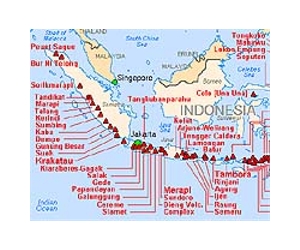
  • Indonesian Taps Volcano Power


    Sometimes one needs to be reminded of the obvious.  Indonesia not only has a massive geothermal energy resource it is also within easy reach of over half the world’s population by the new super conducting power lines we are soon to build.
    One internal line simply following the islands of Sumatra and Java taps the resource and a single short sub sea link to Thailand connects it to a future land line system.  That could be built through Burma to access India and China both.  It does not have to follow valleys.
    While building a system in the USA is necessary to develop a future electric car economy it is hugely more important in this region of the world were power access is far from been universal     They have ten times the population not nearly the opportunities in hydro and are forced to otherwise rely on coal and nuclear.
    Present plans are ambitious not need to be even more ambitious.  Coal plants are cheap and easy if you are in a hurry, but geothermal is a permanent solution that is good forever.
    Also it would provide Indonesia an additional source of foreign exchange beside its depleting oil.
    Indonesia aims to tap volcano power
    by Staff Writers

    Kamojang, Indonesia (AFP) April 24, 2010

    Indonesia has launched an ambitious plan to tap the vast power of its volcanoes and become a world leader in geothermal energy, while trimming greenhouse gas emissions.

    The sprawling archipelago of 17,000 islands stretching from the Indian to the Pacific Oceans contains hundreds of volcanoes, estimated to hold around 40 percent of the world’s geothermal energy potential.

    But so far only a tiny fraction of that potential has been unlocked, so the government is seeking help from private investors, the World Bank and partners like Japan and the United States to exploit the power hidden deep underground.

    “The government’s aim to add 4,000 megawatts of geothermal capacity from the existing 1,189 megawatts by 2014 is truly challenging,” Indonesian Geothermal Association chief Surya Darma said.

    One of the biggest obstacles is the cost. Indonesia currently relies on dirty coal-fired power plants using locally produced coal. A geothermal plant costs about twice as much, and can take many more years in research and development to get online.

    But once established, geothermal plants like the one built in Kamojang, Java, in 1982 can convert the endless free supplies of volcanic heat into electricity with much lower overheads — and less pollution — than coal.
    This is the pay-off the government is hoping to sell at the fourth World Geothermal Congress opening Sunday on the Indonesian resort island of Bali. The six-day event will attract some 2,000 people from more than 80 countries.

    “An investment of 12 billion dollars is needed to add 4,000 MW capacity,” energy analyst Herman Darnel Ibrahim said, putting into context the recent announcement of 400 million dollars in financing from lenders including the World Bank and the Asian Development Bank (ADB).

    “Field exploration can take from three to five years, suitability studies for funding takes a year, while building the plant itself takes three years,” he added.

    If there is any country in the world where geothermal makes sense it is Indonesia. Yet despite its natural advantages, it lags behind the United States and the Philippines in geothermal energy production.

    Southeast Asia‘s largest economy and the world’s third biggest greenhouse gas emitter exploits only seven geothermal fields out of more than 250 it could be developing.

    The case for geothermal has become stronger with the rapid growth of Indonesia‘s economy and the corresponding strain on its creaking power infrastructure.

    The archipelago of 234 million people is one of the fastest growing economies in the Group of 20 but currently only 65 percent of Indonesians have access to electricity.

    The goal is to reach 90 percent of the population by the end of the decade, through a two-stage plan to “fast-track” the provision of an extra 10,000 MW by 2012, mostly through coal, and another 10,000 MW from clean sources like volcanoes by 2014.

    President Susilo Bambang Yudhoyono’s pledge to slash greenhouse gas emissions by 26 percent against 2005 levels by 2020 has also spurred the push to geothermal.

    Many of the best geothermal sources lie in protected forests, so the government aims to allow the drilling of wells inside conservation areas while insisting that the power plants themselves be outside.
    Geothermal fans welcomed the recent completion of negotiations between a consortium of US, Japanese and Indonesian companies and the state electricity company, Perusahaan Listrik Negara, over a 340 MW project on Sumatra island.

    The Sarulla project will be Indonesia‘s second biggest geothermal plant, after the Wayang Windu facility in West Java.

    “The Sarulla project is a perfect example of how Indonesia can realise its clean energy and energy security goals by partnering with international firms,” US Ambassador Cameron Hume wrote in a local newspaper.

    Several firms such as Tata and Chevron have submitted bids to build another geothermal plant in North Sumatra, with potential for 200 MW.
  • Canada parliament can demand uncensored detainee documents from government

    [JURIST] Canadian House of Commons Speaker Peter Milliken ruled Tuesday that members of Parliament have the right to seek uncensored Afghan detainee documents from the government of Prime Minister Stephen Harper. The historic ruling is a significant victory for opposition parties over Harper’s minority Conservative government. In his ruling, Milliken said:
    The Chair must conclude that it is within the powers of the House of Commons to ask for the documents sought in the December 10 order it adopted. Now, it seems to me, that the issue before us is this: is it possible to put into place a mechanism by which these documents could be made available to the House without compromising the security and confidentiality of the information they contain? In other words, is it possible for the two sides, working together in the best interest of the Canadians they serve, to devise a means where both their concerns are met? Surely that is not too much to hope for.Milliken gave both sides two weeks to reach a compromise. If no agreement can be reached, members of Harper’s cabinet, including the ministers of defense, foreign affairs, and justice, could be held in contempt of Parliament. Although the Harper government has indicated its general willingness to comply with the Speaker’s ruling, it might yet pass the general issue of executive versus legislative authority on to the Supreme Court of Canada as a constitutional reference question for its formal determination. The release of the detainee documents has been highly controversial. Last month, Canadian Justice Minister Rob Nicholson announced that former Supreme Court justice Frank Iacobucci would review documents detailing Canadian forces’ handing of Afghan detainees and the terms of their transfer to Afghan authorities before the documents would be released to Parliament. Nicholson indicated that Iacobucci would report back to Nicholson, who would determine the conditions of disclosure. In December, Parliament passed an order to compel Harper to release the unredacted documents after the Canadian government released more than 40 redacted e-mails sent by Canadian diplomat Richard Colvin to then-foreign minister Peter MacKay raising concerns about the torture of transferred detainees. The release of the e-mails came after Colvin testified before a Commons committee in November that all enemy combatants captured in 2006 and 2007 by Canadian forces were likely tortured upon their transfer to Afghan authorities.

  • A focus on Houston as GE’s annual meeting kicks off

    GE’s 2010 annual shareholders meeting is getting underway this morning at 11 a.m. ET in Houston, Texas, which is home to an array of GE’s energy businesses. The theme of the meeting is “Renewal,” and it’s an opportunity for Chairman and CEO Jeff Immelt to underscore that the business environment for GE continues to improve and that the 2010 framework outlined for the company remains achievable with upside potential. It’s also a chance for GE’s leadership and board members to hear directly from shareowners and get direct feedback about the company’s direction, business performance, and opportunities for growth. Click here to see a live webcast of the remarks made by Jeff and Keith Sherin, Vice Chairman and CFO. A rebroadcast will also be available later in the day.


    Feeling energized: GE has nearly doubled its size in Houston in recent years through the acquisitions of PII Pipeline Solutions in 2002 (which moved to Houston); VetcoGray in 2007, and Hydril Pressure Control in 2008 (both based in Houston originally). More than one-third of the world’s electricity is generated by GE technology. The photo above shows a large generator stator, which is the stationary part of a rotor, being checked. A turbine supplies the mechanical energy that feeds the generator.

    With Houston in the spotlight this week, GE’s presence in the region’s energy sector is on display for the 700 shareholders expected to attend the meeting. GE currently employs more than 4,100 in the greater Houston area in eight businesses: Aeroderivative Gas Turbines, Jenbacher Gas Engines, Gasification, Oil & Gas, Water, Optimization and Control, Power Services, and Consumer and Industrial. As Jeff wrote in this year’s annual report, the continuous research underway in new technologies in these businesses is one of the key drivers of GE’s current, and future, success. “In 2010, we will spend about 5 percent of our industrial revenue on R&D,” he wrote. “We have filed 20,000 patents this decade. We have nearly 40,000 engineers and scientists around the world.” That R&D focus can be seen in areas such as wind power, where a $1 billion investment has led to $29 billion in orders.


    Healthy Houston: The grant will “allow us to increase access and improve our services for the more than 33,000 patients and almost 130,000 visits we have annually,” said Legacy Community Health Services executive Katy Caldwell, pictured above with Jeff Immelt at the press conference.

    Building on GE’s long presence in the city, the GE Foundation — which is the philanthropic organization of GE — and the GE Corporate Diversity Council yesterday announced the award of $1.25 million in total to five Houston community health centers toward the goal of increasing access to primary care for uninsured and underserved populations across the city.

    The grants are part of the GE Developing Health Program’s nationwide, 10-city healthcare effort that will provide $25 million in grants over three years. The grant announced yesterday in Houston is the largest grant to date for the Developing Health Program and follows similar ones made in New York City and Milwaukee.

    Each of the five health centers will receive $250,000 — and GE employees from the area will also volunteer their time. The unique approach ensures that the health centers also benefit from GE’s expertise in areas such as process improvement and business management. “This program and the volunteers supporting it are a living example of GE’s healthymagination strategy to help change the world’s approach to healthcare by touching more lives and improving quality of care,” said Mike Barber, VP, GE healthymagination.

    In the video below, we’ve combined eight clips featuring the GE team and leaders of the clinics receiving the grants:


    * Read “Twenty thousand patents this decade, and counting… “ on GE Reports
    * Read the Developing Health grant announcement
    * Learn more about Developing Health
    * Learn more about the sister program, Developing Health Globally
    * Visit GE’s Annual Report website
    * Read Energy stories on GE Reports
    * Read “Milwaukee clinics upping access with new grants” on GE Reports
    * Watch a video: “Developing Health: A clinic grows in Brooklyn” on GE Reports

  • Apple Worldwide Developers Conference 2010 Starts On June 7 [Apple]

    The Apple Worldwide Developers Conference 2010 will start on June 7 in San Francisco. Five days of endless code orgies and hands-on sessions for iPhone OS 4 and Mac OS X. No word on any possible Steve Jobs’ keynote yet. More »


  • A Week Ahead Of Election, UK PM Gordon Brown Makes Horrible Gaffe Caught On Camera

    Gordon Brown Head In Hands

    A week before the election, UK PM Gordon Brown has made a horrible, career-ruining gaffe caught on camera.

    Basically, after doing a little street-level chit-chat with an old lady, he gets into his limo and calls the woman bigoted, not realizing his mic was still on. Here’s the video. The bigoted line comes at the very end.

    Photo from Tim Montgomerie, editor ConservativeHome.com

    Join the conversation about this story »

  • First Solar Buys Solar Developer NextLight Renewable Power

    Thin-film PV maker First Solar has acquired NextLight Renewable Power, a developer of utility-scale power project for $285 million.  This latest acquisition  significantly bolsters First Solar’s project pipeline, adding some 1,100 megawatts of  solar projects that are at various stages of development.

    NextLight is backed by Energy Capital Partners, a clean energy-focused private equity fund based in Short Hills, N.J., founded by former Goldman Sachs energy banker Doug Kimmelman.

    The Acquisition grows First Solar U.S. exposure at a time when European markets, in particular Germany and Spain, which account for a majority of First Solar’s revenues, are tightening key subsidies. Germany is set to cut its solar power feed-in tariffs by some 10 percent and the Spanish government is considering scaling back its own subsidy program by as much as 40 percent.

    NextLight, based in San Francisco, has about 570 megawatts of solar power under development that are backed by singed, long-term power purchase agreements (PPA). Including Agua Caliente, a 290 megawatts facility located in Arizona’s Yuma County, which signed a PPA with Pacific Gas and Electric (PG&E) last fall.  More recently NextLight’s Silver State solar project, located on Bureau of Land Management land in Nevada, signed a 25-year PPA with NV Energy. The Silver State project is slated to begin operating in May of 2011.

    NextLight also has 530 megawatts of additional PV  power projects in various stages of development, according to the press release announcing the deal.

    In January  First Solar acquired a project pipeline comprised of utility-scale  solar power projects to be developed in California and across the U.S. Southwest from the Edison Mission Group (EMG), a unit of Edison International.  And a little more than a year ago it bought project developer OptiSolar in an all stock transaction worth $400 million.

    The acquisition will allow First Solar to monetize its PV panel production by securing sales contracts with  NextLight Projects.  First Solar, which has repeatedly shown that it does not want to be a plant operator, will likely flip the Nextlight plants when they near completion.

    Over the past year First Solar sold a 21-megawatt solar project — backed by a long-term PPA with Southern California Edison in Blythe, Calif., to NRG Energy. It also sold a 20-megawatt solar farm in Ontario to natural gas pipeline operator Enbridge for about C$100 million ($93.14 million). The project is backed by a 20-year PPA with the Ontario Power Authority.

    For this year Tempe, Ariz. First Solar says it expects to generate revenues ranging between $2.7 billion – $2.9 billion in 2010, which is ahead of analysts’ estimate of $2.4 billion.

  • GPS to Revolutionize Aviation…Finally

    “Internet to show me where. GPS to get me there.

    Everywhere there’s satellites. Oh, I live the simple life.”

    — lyrics from A Simple Life

    When a song by country/bluegrass singer, Ricky Skaggs includes a reference to GPS, it seems pretty clear that this amazing satellite technology, developed initially for the military, has become a part of our every day lives.

    GPS technology has been in cars for years — now most advanced cell phones are GPS capable, but you might be surprised to know that the nation’s air traffic control system is only now starting to use GPS in a sophisticated way.

    Later today, I will board a plane at the FAA’s William J. Hughes Technical Center near Atlantic City, New Jersey to witness first hand new technology that will revolutionize aviation — making the skies safer — while making travel more efficient and less time consuming. It should save airlines fuel over time, thereby reducing the carbon footprint of large commercial jets.

    The FAA calls this ADS-B (that stands for Automatic Dependent Surveillance Broadcast). It’s the underlying core technology of the FAA’s Next Generation Air Transportation System. Once tested, the air traffic controller will be able to reduce aircraft separation from five miles to three. Planes equipped with ADS-B technology will be able to know their location within three meters — and, perhaps more importantly, see exactly where other planes are. I wonder if the ADS-B systems has one of those pleasant female voices like the GPS system in my car? I call her Maggie.

    Ground systems should be installed around the country by 2013 and the FAA is proposing that all airplanes be equipped with ADS-B avionics by 2020. Some airlines have already started installing the gear. According to FAA administrator, Randy Babbitt, this new technology “is a tremendous leap forward in transforming the current air traffic control system.”

    It’s already up and running in Philadelphia, which sits smack dab in the middle of some of the most congested airspace in the country.

    This plane I’ll be flying on is the FAA’s ADS-B testbed . I’m told it is equipped with a mock cockpit and video screens. Being the techno-geek I am, I’m certain I’ll be all agog by the time I land. It doesn’t take much to make me all agog, however.

    Be sure to watch for my reports Wednesday afternoon on Fox News Channel.  Also check back to this blog for updates!

  • Poynt turns your BlackBerry into a social tool

    When we released our top BlackBerry apps list a few weeks ago, we named a number of applications that we haven’t gotten to featuring on the site. That’s going to happen with a list that prolific. One of those applications, Poynt, just got an upgrade, so it seems like as good a time as any to feature it. Poynt is an excellent tool for any BlackBerry user. It taps the power of location, using GPS or cell tower data to search local businesses, restaurants, and more. It takes this a few steps further, too.

    (more…)

  • Emoticon Stamp Handles 99.9% of Interpersonal Communication Just Fine [Culture]

    Staring ruefully at the stamp, Joe realized, even the 2,000 emoticons couldn’t ask her the simplest question, “Will you marry me?” Instead, she took his ink-stained hand into hers, like coffee into a porcelain cup. She knew. [JapanTrendShop /OhGizmo!] More »


  • SportyPal Indoor Now on the Web

    SportyPal Android App now has SportyPal Indoor available on the Web, allowing you to track your sport life in one place.

    SportyPal Indoor is a new web application that allows you to track all your indoor sports activities like gym workouts, basketball, football etc. with the possibility to add your own type of exercises. Now you can combine our SportyPal outdoor and SportyPal indoor web applications to track all of your sport activities at one place.

    Key Features include:

    • Privacy control. Share your workouts with everyone, only your friends or keep them for yourself.
    • Flexible Auto Calories Suggestion. SportyPal indoor calculates and suggests the burned calories for you (For SportyPal defined exercises).
    • Easy and fast setup of your custom exercises. Easy to create and define your own exercises.

    For those who like to stay fit going to the gym, you can track workouts via the Android App. Then view results at home via SportyPal Indoor!

    Algadon Free Online RPG. Fully Mobile Friendly.

  • Vw in talks with several battery manufacturers for its upcoming electric car

    Vw Up ConceptAs Volkswagen AG searches for companies to supply it with electric-car batteries, it is reportedly in talks with a Robert Bosch GmbH and Samsung SDI Co. joint venture and LG Chem Ltd.

    In an interview, Ulrich Hackenberg, head of Volkswagen brand development, said that the company is keeping its options open and is expected to study the development of various battery systems. However, Hackenberg didn’t say when the deal with SB LiMotive Co. and LG Chem, the largest South Korean chemical maker, will be signed. Hackenberg added that mass-produced battery cells aren’t likely to start delivery until one or two years from now. The list of companies that VW is said to have been cooperating with include makers of rechargeable batteries: BYD Co., the Chinese carmaker supported by billionaire Warren Buffett; Sanyo Electric Co.; and Toshiba Corp. Hackenberg admitted though that Japanese suppliers “are still a step ahead” of BYD. VW intends to begin manufacturing battery-powered cars in China as early as 2013. VW also said that it wants to add 1.6 billion euros ($2.1 billion) to its investment to create more models and two new facilities in China, raising total investments in China to 6 billion euros.

    [via autonews – sub. required]

    Source: Car news, Car reviews, Spy shots

  • US Cellular Tease HTC Desire Details And Release Window

    DesirableOn their Facebook page today, US Cellular today teased an “around July” release for the HTC Desire (previously known as the Bravo).

    The device, in case you didn’t know, is basically a Nexus One in Sheep’s (or HTC’s) Clothing (which includes Sense UI), but with a few differences.

    There is a little more RAM on the Desire (presumably to fit in the extra bits of Sense UI), and no docking ports, or second-mic-noise-cancelling-tech.

    The buttons on the desire are also “physical” (as opposed to capacitive), and there is an optical trackpad, rather than a trackball (which is good, because, like old mice balls of yore, the trackball on my Hero is already wearing out. Or getting gunked up. I don’t really know. But it’s not working so great anymore… aaaanywhooooo).

    The original announcement is included below:

    Hungry for more Android info? How about a peek at some specs for the gorgeous HTC Desire including a 3.7″ AMOLED touchscreen display, 5 MP camera with LED flash, Wi-Fi, GPS, Android Market and an 8 GB microSD card. How about news of a launch date around July? We’ll need to make sure our rigorous testing is complete before you can get your hands on this sweet phone. Stay tuned here for more exclusive Android updates!

    [via Phone News]