Category: News

  • Want to let users test-drive your server apps? Devops outfit ComodIT has a button for you.

    ComodIT, the Belgian cloud management startup that’s targeting enterprise devops with its automated virtual machine provisioning and configuration product, just released a rather handy tool for developers and users of server-based applications. It’s a “direct install” button that  developers can put on their website, allowing the user to either easily install the app on their existing on-premise or cloud server, or to test-drive it for free in a cloud-based ComodIT VM.

    The feature can already be seen in ComodIT’s own application store and on the website of lifestreaming platform Storytlr, but is now available for anyone to use. In effect, it makes the installation of server-based apps a lot more like that of mobile apps – an almost one-click experience that even allows users to “share” the apps in question on Facebook and Twitter.

    comodit_team_september2012“You can embed the application – just copy and paste [a few lines of Javascript] and put it on your website. You add the direct install blue button and you allow anyone to install that application directly from your website,” ComodIT CEO Daniel Bartz told me.

    Bartz suggested this approach would overcome the traditional open-source server software installation experience, which sometimes involves multi-page tutorials. The test-drive aspect is pretty neat too: when that option is chosen, ComodIT basically installs and runs the app for a free 100 minutes in an Amazon EC2 micro instance.

    It makes marketing a bit easier for developers and of course it steers people towards ComodIT’s own distribution platform and wider services. As Bartz explained:

    “When you click ‘direct install’, in fact you connect to ComodIT and you create a server on which you will install an OS and all the things that have to be done for installing applications. We’re automating the manual procedure – we do this like we do for any other pieces of ComodIT following the devops approach.

    “Behind the scenes, we’re activating recipes for deployments. Within your ComodIT account you have access to all the recipes and descriptions that you usually have. The next step is deploying the application not only for testing but also for production, with all the ComodIT features like autoscaling and autobackup.

    “We bring the user onto the platform and, as we have a business model based on the number of servers you’re managing with ComodIT, if you have more users installing the application through the direct install button, we’re a happy provider.”

    It’s a smart idea and one that could give ComodIT a boost as it competes with the likes of Opscode and Puppet Labs (see disclosure) for devops’ attention.

    ComodIT was a finalist in our Structure:Europe LaunchPad competition last year. This year’s Structure:Europe will take place in London from 18-19 September and, if you can’t wait until then for a high-level get-together around cloud automation and other such topics, don’t forget that our San Francisco Structure event is coming up on 19-20 June, too.

    Here’s a video explaining how ComodIT’s direct install button works:

    Disclosure:Puppet Labs is backed by True Ventures, a venture capital firm that is an investor in the parent company of this blog, Giga Omni Media. Om Malik, founder of Giga Omni Media, is also a venture partner at True.

    Related research and analysis from GigaOM Pro:
    Subscriber content. Sign up for a free trial.


  • Why Health Care Should Bring Back the House Call

    Years ago, as a family physician in Louisiana, I made house calls. Certain patients were too sick or too hurt to get to my office. Sometimes a condition or injury had worsened, requiring my evaluation bedside. I would visit patients at home for the simplest of reasons: home was where they needed care.

    By the mid-1980s, the pressures of time and money prevented most physicians from making house calls anymore. But I kept seeing patients at home until I retired from my practice after 29 years. Home visits enabled me to better detect, diagnose and treat most health conditions. Many of the patients I saw might otherwise have wound up in an emergency room and eventually been admitted to a hospital.

    If we hope to rein in health care costs and improve quality, we need, in effect, to bring back the house call. Americans are living longer than ever before and a higher percentage of the population is elderly, with both trends sure to accelerate drastically in the decades ahead. Baby Boomers are now turning age 65 at the rate of roughly 10,000 per day.

    As the older demographic expands, so, too, does the number of people who live with chronic diseases, chiefly diabetes, high blood pressure and heart failure. About three in four of Americans age 65-plus suffer from more than one such chronic condition. The single biggest and fastest-growing contributor to healthcare costs is chronic disease. That’s why an estimated, 49% of our health care costs go toward 5% of Medicare beneficiaries.

    Yet the U.S. health care system is still based on a massive misconception: that health care for the sickest of the sick, typically the elderly and the chronically ill, should be carried out almost exclusively in institutions, primarily hospitals, but also nursing homes and assisted living facilities. And that health care delivery should consist largely of, say, a trip to the emergency room or a four-day hospital visit for pneumonia. That kind of episodic engagement represents short-term thinking. When it comes to health care, hospitals are essential, but are only a part of the answer.

    Rather, health care should be practiced year-round, and even minute-by-minute. Managing chronic disease should involve post-acute care, complete with daily monitoring of vital criteria, including blood pressure, diet and physical activity. Only under such regular oversight can chronically ill patients expect to function well, much less fully. No single approach can do this better than home care. It can shorten hospital length of stay and lower readmissions. And there is mounting evidence that health care delivered at home enables patients to live longer lives and, equally important, better ones.

    In the process, home care is doing exactly what’s most needed — increasing quality and driving down costs. An Avalere Health study found in 2011 that health care at home improved outcomes and saved $2.8 billion among patients with diabetes, congestive heart failure and COPD. A 2009 study revealed that home health care reduced hospitalizations and short-term nursing stays, saving Medicare dollars. Indeed, expanding access to home health care for chronic-disease patients could save a projected $30 billion, that same study concluded.

    Yet the value of home care remains under recognized. As a result, vast needs are still going unmet. Here’s what has to be done:

    Define the discipline better. The medical community, including physicians, medical schools, and hospital administrators must better describe what home care does and why it matters in order to bring it to life for policymakers and family caregivers.

    Get in sync. Primary care physicians particularly, but also nurses, therapists, social workers and others, must align better with home-care clinicians to coordinate care, especially during and immediately after the transition from hospital to home.

    Physician, educate thyself. Physicians should learn about home-care options and discuss them with patients who could benefit.

    Adopt new technologies. More companies in the home-care business should use innovative technology to coordinate care in real time, including point-of-care laptops, telemonitoring devices, and Internet portals for physicians that allow all providers to share a patients’ information.

    Remove policy obstacles. Reimbursements from Medicare and private insurers should reflect the true value of home care. But the payment system now in place sees home care, quite mistakenly, as merely an add-on with little clinical benefit. Policymakers should create a payment model that aligns providers’ clinical and economic interests, assigning proper value to good outcomes and recognizing that home care is pivotal to success.

    Health care at home is patient-centered, outcomes-driven and truly collaborative, making it a microcosm of how the health care system should function across the board. Only by embracing home care can we truly reform the health care system.

  • Study suggests Google Glass could be a smash hit

    Google Glass Study
    Google Glass is expected to be a pretty big focus at Google I/O this year, but it’s still unclear how the public at large will receive Google’s connected eyewear when it launches next year. In an effort to assess its odds in the U.S. market, BiTE Interactive commissioned YouGov to conduct a study on the matter. According to a poll of 1,000 American smartphone owners aged 18 and above, “only” one in 10 respondents said they would be willing to wear Google Glass regularly, regardless of the device’s price. The study also found that 45% of those polled said they believe Google Glass is “too socially awkward” or “too irritating” to wear, and 44% said they simply don’t find any of Glass’ known features to be desirable.

    Continue reading…

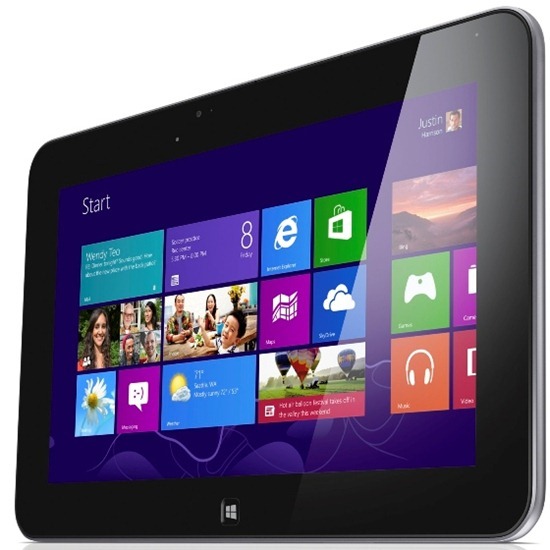
  • Dell now selling the XPS 10 Windows RT tablet for $299.99

    Yes, that’s right, there is no typo. The Dell XPS 10, which runs Windows RT and came to market sporting a $499 price-tag, is now available for purchase at a very affordable $299.99. Clearly, the US computer manufacturer no longer has its eyes set on Apple’s fourth-generation iPad, one of the most popular fondleslabs available today.

    So what do you get for $299.99? For the money, the XPS 10 packs a 10.1-inch multitouch display with a resolution of 1366 by 768, a 1.5 GHz dual-core Qualcomm Snapdragon S4 processor and 32 GB of internal storage. And, for just $50 more you can up the internal storage capacity to 64 GB.

    The 4G LTE upgrade, which works with the AT&T cellular network and comes with 64 GB of storage straight off the bat, runs for $449.99 which is $150 more atop the base model’s price. Dell lowered the cost for this model as well, as the XPS 10 with 4G LTE was first available starting at $599.99.

    The base XPS 10 now undercuts Apple’s 16GB iPad 2 by $99, while the 4G LTE model runs for $79 less than the equivalent iPad 2 with cellular connectivity. The fruit logo company’s second-generation tablets have the advantage of being able to run on Verizon’s 4G LTE network, as opposed to the XPS 10 which only supports AT&T’s network.

    Dell’s price cuts for the XPS 10 make room for yet another wave of complaints addressed to Microsoft’s Windows RT. Most critics blame a lack of apps in the Store, inadequate performance and, now, low consumer demand is sure to join them.

  • Singer Attacked In Houston, Injured In Bar Brawl

    The singer of a hugely popular Tejano group was attacked outside a Houston bar on Monday night and suffered severe injuries to the face.

    Oscar De La Rosa of La Mafia was reportedly standing outside a gay bar when he and his driver were attacked by an unidentified man who has so far eluded police. Witnesses say De La Rosa didn’t have a chance to defend himself in the attack, and as a result he suffered several lacerations to the face, damage to his eye, and lost two teeth. The band released a statement about his condition on their Facebook page:

    “Oscar De La Rosa was assaulted around 1:30 AM this morning leaving a local bar in Houston. He is still in trauma care at Memorial Herman Hospital (sic). He has suffered severe face lacerations and possible damage to his right eye. A police report has been filed and the identity of the assailant has been confirmed, assault charges will be filed as soon he is located.”

    Several reports say that the attack was unprovoked, but band member Armando Lichtenberger said it started with an altercation inside the club which led to the man being kicked out.

    “He sucker-punched the driver, knocked him half unconscious and then he went at Oscar and started pounding on his face,” Lichtenberger said. “A sucker punch is the worst thing. He didn’t get to defend himself at all. It happened so fast.”

    The band hasn’t decided yet whether they will need to cancel or postpone any performances.

    Image: Wikimedia Commons

  • Sponsored post: Navigating the Apache Hadoop Ecosystem

    Open is the flavor du jour in enterprise software for big data. But it’s just the beginning.

    The challenge of analyzing massive data sets has spurred a hotbed of creativity in open-source communities. While some of these are more novel than innovative, hindsight has taught us that open source succeeds in the enterprise when it meets relatively mundane challenges like security, reliability, manageability and cost-efficiency.

    Enterprises need a platform to ingest, store and process data that is open and extensible but also robust and high-performing. Committed to developing Apache Hadoop as that platform for the long-term, Intel is adding value to these essentials.

    • First, we focused on bolstering security with hardware capabilities available today. In the Intel Distribution for Apache Hadoop, we built in file-based encryption in HDFS, accelerated up to 20 times with Intel AES-NI. We also launched Project Rhino to offer a common framework for authentication, authorization and auditing across key Hadoop projects.

    • Optimizing performance was another focus, and we achieved up to 8.5 times faster Hive queries, adaptive data replication and optimization for SSD.

    • We’re also making secure, high-performing Hadoop clusters easier to manage. By simplifying deployment and monitoring, automating configuration with Intel® Manager, and enabling Hadoop across multiple data centers, we’re taking the complexity out of Hadoop deployments.

    While foresight is rarer than hindsight, we predict that this is the right approach for enterprises which are harnessing big data for the long haul.


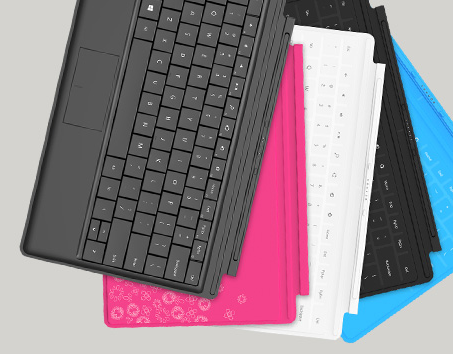
  • Microsoft UK offering a free cover with all Surface RT purchases

    If you live in the UK and are thinking of purchasing Microsoft’s Surface RT tablet, now is the time. Pick up one through the Microsoft Store or a participating retailer (which in terms of brick and mortar sellers means John Lewis) and you’ll get a Touch or Type Cover thrown in for free.

    It’s a very good deal, as you’d be looking to pay around £100 if you were to buy a cover separately. You can pick up the 32GB tablet-only version of Surface for £399 at the moment.

    The offer, which is only available for residents of the United Kingdom, is valid on all Surface RT purchases made between now and 30 June.

    John Lewis offers the Type Cover in black, and the Touch covers in white or blue. Buy from Microsoft however, and you get a much wider selection, including limited edition covers (Skulls, Flowers, and Year of the Snake).

    Of course before you rush off and place your order, it’s worth remembering that the more powerful Surface Pro will be arriving in the UK sometime at the end of this month.

  • Amputee Killed By Dogs In His Wheelchair

    An 80-year old double amputee was killed after being mauled by four dogs as he sat in his wheelchair, authorities in South Carolina say.

    Carlton Freeman was in his motorized wheelchair on May 8 when the dogs, who belonged to a neighbor woman, attacked. Three of the animals have been captured, but one remains on the loose.

    Freeman suffered several lacerations all over his body and was unable to properly fight the dogs off due to his condition. Both legs were amputated several years ago below the knee as the result of diabetic complications.

    “Upon my examination of Mr. Freeman, it is a wonder that this gentleman was able to hang on as long as he did,” coroner Chris Nesbit said in a statement. “He had bites and lacerations from his legs to the top of his head. This is very sad story, but even worse that Mr. Freeman was basically helpless to the attack, due to being a bi-lateral amputee.”

    The woman who owned the dogs, Barbara Goodwin, is also related to Freeman. She admitted to authorities that she owned the dogs, which were reportedly a mother and her pups.

    WCIV-TV | ABC News 4 – Charleston News, Sports, Weather

    Image: UPI

  • iPhone 5S fingerprint sensor seemingly confirmed

    iPhone 5S Fingerprint Scanner
    Apple is getting closer to launching the next version of the iPhone later this year. If the Cupertino, Calif.-based company wants to keep up with Samsung, Google and others, it needs to innovate. And fast. That’s where the tip of your finger comes in to play.

    Continue reading…

  • Raspberry Pi Camera Module Now On Sale, $25 To Add An Eye To Pi Hardware Hack Projects

    Raspberry Pi plus camera model

    Calling all hardware hackers: the Raspberry Pi camera module has gone on sale online via Pi suppliers including RS Components and Premier Farnell/Element14, providing the eye required for all those computer vision projects you had in mind for the Pi microcomputer.

    The camera module actually went on sale yesterday and is currently temporarily out of stock on RS’ website (but Element 14 appears to have stock). The plug-in module costs around £17, or about $25.

    The camera module can be used with either the Model A or Model B Pi, and has a five megapixel sensor — the same size as you’d find in many a mid-range Android smartphone — and a fixed focus lens. The module supports 1080p/720p/640x480p video. Dimensions are 25 x 20 x 9mm. Weight is just 3g.

    The latest version of the Raspbian firmware supports the module so Pi owners may need to upgrade to enable camera support.

    The Pi Foundation has made a short video showing basic hardware set up for the camera module. Embedded below.


  • 6 Key Trends in the Data Center Following AFCOM Data Center World

    Mark Harris is the vice president of marketing and data center strategy at Nlyte Software with more than 30 years experience in product and channel marketing, sales, and corporate strategy. Nlyte Software is the independent provider of data center infrastructure Management (DCIM) solutions.

    mharrisMARK HARRIS
    Nylte Software

    I attended this year’s AFCOM Data Center World held at the Mandalay Bay convention center in Las Vegas, and felt compelled to write about my experience given the excitement and exchange of ideas at the event. The emphasis of this event was on real solutions for today’s data center and facility managers. Some of the industry’s largest end-users and vendors in attendance were engaged in very real conversations surrounding today’s modern IT infrastructure and how to preserve existing data center assets confirming what we are hearing with our own customers.

    The event covered a range of topics including: new ways of supporting high density computing, vendors providing some form of DCIM, convergence on standard IP-based connections for monitoring and control, questions surrounding costs for services and resources, and even an new intelligent rack system was shown. I should also mention that I was intrigued by the in-person conversations surrounding the emerging hybrid model of computing to include in-house, colocation, cloud and modular and the economics driving this mix.

    Cost Discussions

    What is this new model? It is about delivering IT services at a specific cost. In the past, we all operated under the umbrella of delivering IT servers at ANY cost. Today, it’s really about specific costs, and each type of service or application has different cost models. Back-office email, for instance, may have a costing model that is vastly different than e-commerce revenue transaction processing systems. The AFCOM show attendees are beginning to talk about this. The vendors are also beginning to talk about the economics, but surprisingly, most of these discussions between end-user and vendors are not aligned. The show vendors were talking about discrete product cost, while the end-users wanted to talk about service delivery costs – a clear disconnect.

    It turns out that trying to quantify the total cost associated with work executed is hard to do as a vendor. The end-user sees all the pieces working together and can do some simple math to figure out their costs per unit of work. Vendors at the show seemed to struggle with that idea. They wanted to provide product costs, but had a hard time participating in bigger and more strategic discussions, which involved many components working together.

    Some key observations emerged at AFCOM:

    1. High-Density Data Centers – Doing More with Less
    Many of the show floor vendors were demonstrating new solutions created for the world of high-density computing. Squeezing more computing into less space, powering it, and keeping it cool, with much more intelligent cooling, much higher capacity power distribution, more efficient fans and everything else needed to create the data center filled with 20kW racks. It was good to see the forward-looking solutions, in a world that currently runs 4-5kW racks on average. This density theme also manifested itself in discussions about Direct Current and Over Current Protection considerations. Unicom, ServerTech, Cooper and StarLine took the lead on these topics.

    2. Vendors Jump Onto the DCIM Bandwagon
    DCIM was one of the most prevalent themes throughout the show and its educational sessions. Many vendors – hardware and software vendors alike – wanted to associate with the DCIM movement. And why not? Accordingly to Gartner, Forrester and The 451 Group, adoption of DCIM is one of the biggest cost-containment opportunities for the the data center. That said, most DCIM software vendors at the show were talking about building islands. Tactical islands of must-have features offered by their products, but the discussions got very thin when looking for an off-the-shelf, strategically integrated story. (However every vendor happily volunteered to ENGINEER a custom integration on a T&M basis). This is partly due to the use of the term “DCIM” to describe anything new in the data center monitoring and management space. Many of the booth graphics stated “DCIM” in their first bullet of value, but what they actually delivered ranged all over the place. There were the big element management solution providers, the environmental and power distribution vendors, the cooling vendors and even the remote access solutions which were popular 5 years ago. End-users were just as confused with how to apply what they were seeing on the show floor to their strategic charter to get their data center economics under control.

    3. The Cloud and Colocation Realities
    Cloud topics proliferated across the educational sessions. Using the cloud, planning the cloud, when a cloud is required, how the cloud will fit with other styles of computing, etc. In spite of the “cloud everything” message so common recently, the mixed hybrid model of computing is clearly here to stay. While colocation vendors were limited in number at the show, it was clear that our next 10 to 15 years of computing will include some individually unique mix of in-house data centers, colocation space, cloud services and modular approaches. While most of the show was full of vendors that catered to traditional in-house data centers, a fair amount of the products shown could easily be applied to colocation space as well.

  • BlackBerry Continues Trying To Be Everything To Everyone

    If your target market is everyone, then you’ll target no one. I’m not sure who said that originally, but it might be the simplest, most helpful advice for any marketer. Apparently BlackBerry continues to feel it is the exception to the rule, despite past failures trying to be everything to everyone.

    Let’s run down what BlackBerry announced yesterday at BlackBerry Live:

    • The BlackBerry Q5, a QWERTY BlackBerry 10 handset that is slated for emerging markets.
    • The BlackBerry 10.1 upgrade that will allow, among other things, BlackBerry Z10 users to run Skype.
    • BBM Channels, which amounts to a BBM social network.
    • Availability of BBM on iOS and Android, coming this summer.

    The BlackBerry 10.1 upgrade is obviously all positive, if a little late. We’ve heard about this for a month or so now, so it’s good to hear BlackBerry finally planning to roll it out.

    BlackBerryTeam

    The Q5 continues BlackBerry’s strategy of creating mid- and low-tier devices for international markets. It’s not an awful one, to be sure. There are plenty of people around the globe who can’t afford top-tier smartphones, even including the best BlackBerry models (zing). At the same time, creating products for these markets takes away focus from the high-end US and EMEA markets.

    Then we get to the BBM announcement. The new BBM Channels feature essentially turns BBM into a social network. You can now create, follow, and subscribe to channels, taking actions such as commenting and liking posts. The first examples BlackBerry touted were Merceds AMG Petronas Formula One Team. It’s pretty clear that they’re trying to work with brands here. As if we don’t get enough of that from Facebook, Twitter, Pinterest, and basically every other social network.

    We’ve been hearing about the possibility of BBM on iOS and Android for a while now, maybe two years. They could have attempted this in the past, when BBM was still popular despite BlackBerry’s decline. But they held off on that until they had the Channels tie-in. At this point, though, iOS and Android users have fewer reasons than ever to use BBM. With so many high-quality instant messaging products on the market, BBM has become just another.

    I feel that Nathaniel Mott of PandoDaily best sums up BlackBerry’s position:

    BlackBerry is playing catch-up with Apple, Samsung, and Google, and seems to be struggling to reconcile that fact with its former glory. The company’s products no longer have a monopoly on the business elite’s pockets, are no longer representative of true innovations, and are, for all their advances, rooted in the smartphone market of the past.

    The company needs to get better at communicating — or even figuring out — what its products are and who they are for before it can cast the perception that it’s left its prime aside.

    In other words, they’re trying to be everything to everyone. In the process they’re doing little but standing still. Loyal BlackBerry users will always stand by the brand and even defend them — you learn this after writing about BlackBerry, for BlackBerry fans, for five years. If BlackBerry had decided, six years ago, to continue focusing on that core of users, we might not be having this discussion now. But starting in 2008 they tried to become everything to everyone.

    It didn’t work then. Chances are it won’t work now.

    The post BlackBerry Continues Trying To Be Everything To Everyone appeared first on MobileMoo.

  • BlackBerry Live 2013 Wednesday Morning Brief: Following Up a Big Day [VIDEO]

    If you missed our Tuesday morning brief, be sure to check it out to get the scoop on how we kicked off this year’s BlackBerry Live conference. Today we’re excited to check out the hands-on labs and breakout sessions, as well as the partner showcase. Be sure to visit us at the Social Media desk! Check out the video below for the details on what BlackBerry Live has in store for you today:

    [ YouTube link for mobile viewing ]

    To view a recording of yesterday’s general session keynotes, head over to the BlackBerry Live and BlackBerry Jam Americas web sites.

    What are you most looking forward to today? Share in the comments below.

  • For Entrepreneurs, Failure Isn’t Always a Good Teacher

    Much has been said about the virtues of failure — it’s a learning opportunity, it happens to everyone, it’s character-building. Failure is becoming some romanticized rite of passage, invoking images of young entrepreneurs burning the midnight oil and yelling “Eureka!” I can say from experience that any entrepreneur who fails repeatedly before finding the golden ticket had better be ready to coat themselves in protective armor, because your stakeholders may not be as understanding of your failures.

    I’ve often said that failure is a great teacher, but its lessons are too harsh. Entrepreneurs will fail all the time, yes, and there’s no alternative to failure. You can’t avoid it altogether. What you must avoid, however, is letting it consume you and destroy your self-confidence. If you let yourself become afraid to innovate — to go for it — you haven’t just failed. You’ve become a failure.

    Failure makes many of us less confident and less aggressive. We become gun shy. That’s not surprising. Unfortunately, the cold reality is that once you’ve failed as an entrepreneur, you need to have blind confidence and a healthy sense of aggression to prove to people that you actually can succeed. You need to try again, and brace yourself to be criticized, lectured, doubted, and flat-out ignored by investors and sometimes even your own team. If at first you don’t succeed, you’re in for the fight of your life.

    When I first started Bullhorn in 1999, our original concept was the product of some brainstorming between me and my co-founder. His idea was, “Why don’t we build a platform for people to display their creative work on the internet?” Then I added, “We could make it a marketplace for those people to get jobs.” Nobody had ever told us that this was a problem that needed solving, yet we thought it was a great idea. So did our original investors. In fact, when we took the idea to creative professionals, they really liked it as well. Unfortunately, when we took it to the businesses that were making hiring decisions, it was a total flop.

    So our first business model failed. After a few months, as our cash dwindled, we thought up yet another problem that we could solve. Our investors loved that idea too. But, much like our previous efforts, we discovered that no one actually suffered from the problem we were out to solve. Our second business model failed, as well. Then the dot-com bubble collapsed. Our early investors quickly turned from loving their investment in Bullhorn to hating it and they shut us off from any additional capital. We decided to forgo salaries to stretch our cash. I was paying my rent by maxing out my credit cards. Then a business dropped in our laps. We met someone with a problem that needed solving and we were uniquely poised to solve it. We realized we had a game-changing idea on our hands: creating the first software-as-a-service applicant tracking system for recruiters. When our new product started to take off, we needed more money to get to the next level. Unfortunately, our investors looked at me like I was the boy who cried wolf and rejected the idea out of hand. The sales traction and momentum was not compelling to them in any way. They told us it would never be a big business. Fortunately, they were dead wrong, but we didn’t feel so confident at the time.

    I had identified our winning product, but I was late to the game. So what did I do? Did I pick myself up off the floor, dust myself off, and power ahead? Not really. My team and I still had total faith in our concept, but the reality of having failed before made me nervous to take risks. I didn’t have the confidence to push my investors to support the idea and decided to essentially bootstrap the business, which worked, but cost us precious time. The business succeeded and the rest is history 13 years later, but we would be three times the size we are now had I been stronger.

    We entrepreneurs are often good at one of two things — identifying when something isn’t working, or ignoring the risks and suspending disbelief. When you’ve failed before but now know you have the right idea to succeed, you need to silence your inner skeptic and then work to silence your outer skeptics. You’ve learned to identify failure. You know what it looks like. Now, you need to focus on identifying success. Once you’ve done that, you can move on to suspending your critics’ disbelief.

    Just because you pursued the wrong idea once (or twice, or even many times) doesn’t make you incapable of recognizing the right idea. A calming dose of skepticism can be great, but as an entrepreneur, sometimes you just need to charge ahead, no matter how many times failure knocks you down.

  • CA Integrates Eaton Power Management Into DCIM Suite

    Two players in the data center management space just got closer. Eaton’s power management technologies, which help increase power reliability and control cost by reducing energy consumption, have been integrated into DCIM software from CA Technologies in a turnkey solution that helps bridge the gap between IT and facilities.

    Eaton’s power management technologies are designed to help customers increase the reliability of their power infrastructure and control cost by reducing energy consumption. CA DCIM software provides a web-based, centralized solution for monitoring power, cooling and environmental conditions across facilities and IT systems in the data center. Their functions complement one another, forming a turnkey solution.

    “CA Technologies and Eaton are two of the leading companies in data center technology, each providing critical products in very different areas,” said Andy Lawrence, vice president of Data Center Technologies and Eco-Efficient IT, 451 Research. “Both companies understand that the most effective and competitive data centers in the future will make full use of embedded intelligence and intelligent management systems. Their formation of a complementary hardware and software partnership is a notable and very logical step forward for data center systems and DCIM.”

    IT Software Talks to UPSes, PDUs

    The Eaton and CA Technologies collaboration provides integration between CA DCIM technology and select Eaton power management hardware, including uninterruptible power systems (UPSes) and power distribution units (PDUs). As a result, CA DCIM can collect, analyze and report on metrics such as temperature, humidity, power by phase, current by phase and power factor.

    Customers can use CA DCIM to create intelligent alerts to identify environmental and power issues before they have an opportunity to threaten IT infrastructures. Customers can also accurately calculate total PDU power usage for Eaton equipment or other device groups. These Eaton data points are automatically added to CA Technologies unified management portal views.

    “Eaton’s alignment with CA Technologies represents an evolution in infrastructure management and will provide integrated, pre-engineered solutions for efficient and effective business performance optimization,” said Hervé Tardy, vice president and general manager of Eaton’s Distributed Power Quality Division. “This collaboration is designed to provide a level of power hardware integration and data center control that isn’t currently available.”

    Bridging Facilities and IT

    DCIM provides organizations with greater insight into critical data center infrastructure, across both facilities and IT systems.  Both companies come to the table with complimentary functionality to this end, aiding data center managers increase operation efficiency, mitigate risk, and enhance performance.

    The combined solution will also enable managed service providers to grow their businesses by providing high-value DCIM-as-a-service offerings that include monitoring and maintenance of customers’ critical infrastructure and business systems.

    “Our agreement with Eaton will enable customers to increase efficiency while safeguarding IT service delivery,” said Terrence Clark, general manager, DCIM, Energy & Sustainability Solutions, CA Technologies. “These benefits are critical as demands on IT and data center managers continue to escalate at a pace that exceeds the ability of MSPs and enterprise customers to fund, power and flexibly operate their data centers.”

  • The TechStars startup empire expands to Austin with new program

    TechStars must have a hankering for live music, barbecue, Google Fiber and some awesome enterprise-focused startups, because the Boulder, Colo.-based accelerator program is opening an Austin class. This won’t be TechStars’s first rodeo in the state — its TechStars Cloud program is hosted out of San Antonio in part because it has ties to Rackspace, which is headquartered there.

    “There’s so much happening in Austin, it was place we had been wanting to expand to, and especially with the cloud program in San Antonio we had a lot of visibility because of proximity,” said Jason Seats, the managing director of TechStars Austin. “It was always a matter of when and not if.”

    Seats, who was the former managing director of TechStars cloud, is moving about 90 miles up I-35 to take over the Austin class of startups. He told me that TechStars will, “keep the cloud program basically as it is. I’ll be involved with it but we are working on filling the director role.”

    The Austin program won’t have an explicit theme and joins programs in Boston, Boulder, Chicago, New York City, Seattle, Wash. and London. TechStars Austin will provide $18,000 in financing and the option of a $100,000 convertible debt, but the most valuable aspect for most will be mentoring from establish entrepreneurs and other program participants.

    In an interview with me, Seats said he is looking for about 10 companies for the first class that will run from August 5 to Nov. 1. TechStars looks for founding teams with an idea who want to take that idea to the next level. Generally that means companies seeking outside financing, but as the head of a former boot-strapped startup (SliceHost, which sold to Rackspace) Seats is happy to bring those in as well.

    As for connecting with the Austin entrepreneurial community, including the existing Capital Factory incubator, Seats has laid the groundwork. He notes the Capital Factory founders Joshua Baer and Bill Boebel are already TechStars Austin investors and mentors, and both Seats and Baer are planning to work together, despite both running accelerator programs. “The last thing we want to do is cleave the ecosystem,” Seats said.

    Seats has also reached out to support from the venture community in Austin, notably Austin Ventures, but also to Silverton Partners and local angels. He expects to see a lot of enterprise software deals given that Austin has a track record of building and then selling or taking such companies public. That’s a plus from his perspective since he views enterprise software as “the first cousin of the cloud,”

    “I’ve spent the last two weeks canvassing the city and meeting the CEOs and founders and operators and investors, and the depth of talent and expertise is excellent,” Seats told me. “I have one data point of experience building and running a company, but I’ve met with so many people in Austin who have run and sold their companies and are on their third or fourth of fifth thing.”

    That experience, plus more visibility provided by TechStars, should only help Austin and its entrepreneurs get even more experience.

    Related research and analysis from GigaOM Pro:
    Subscriber content. Sign up for a free trial.


  • Completely redesigned Google Maps leaks ahead of I/O

    Google Maps Redesign
    The days leading up to a big industry event like Google I/O are always packed with leaks and this week has been no different. Among the details trickling out ahead of Google’s big day is confirmation that a complete overhaul of Google Maps will debut during the keynote on Wednesday. Or, it would have debuted had Google not leaked it ahead of time. Droid Life managed to grab screenshots of the new Google Maps’ sign-up page when it accidentally went live briefly on Tuesday night, and they reveal what appears to be a terrific reimagining of Google’s popular mapping service. Changes include a brand new layout, new search features and new ways to highlight the “things that matter most.” Additional images showcasing Google Maps’ new design follow below and the rest of the screenshots can be viewed by following the source link beneath them.

    Continue reading…

  • Add a Modern UI-style Start menu to Windows 7 or 8

    Microsoft’s decision to drop the Start menu in Windows 8 has caused plenty of controversy, but fortunately it’s made little difference to the end user. Developers quickly realized that many people really don’t like the new interface at all, and they’ve produced a host of free tools to help make Windows 8 look and feel as much like Windows 7 as possible.

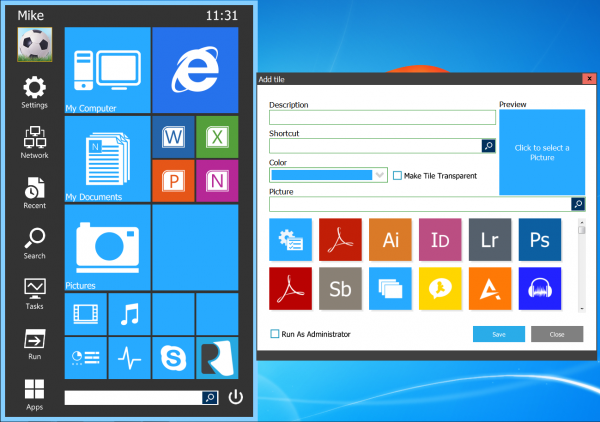
    Start Menu Reviver, though, has a different aim. Instead of ignoring Microsoft’s Modern UI, it adapts it, with configurable tiles rather than text links. There’s good integration with Windows 8, including the ability to launch Start Screen apps from your desktop. But at the same time, it’s not tied to Windows 8 systems: if you like the look, you can install and run the program on Windows 7, too.

    After a straightforward setup, Start Menu Reviver displays a link to a demo video where you can learn more about how this works. But although this is useful, you’ll figure out most of the details for yourself, so it’s safe to dismiss that for now and jump right in.

    Just as you’d expect, Start Menu Reviver pops up whenever you click the Start orb or press the Windows key. (It’s not made any drastic low-level changes to achieve this, though, so if you have any problems with the program then it can easily be dismissed: just right-click the Start orb and select Exit.)

    The opening menu looks good, and works well. Left-hand buttons give you one-click access to common destinations: the Search window, Run box, Recent Documents list, Network and Sharing Centre and more.

    Right-hand tiles initially give you access to various folders (My Computer, Documents, Pictures, Music, Videos), applications and system areas (Control Panel, Task Manager), as well as switching you to the Start Screen in Windows 8 (you can launch Windows 8 apps from the menu, too).

    Elsewhere, a Search box helps you find what you need, and a Power button displays all the usual options: Log Off, Switch User, Lock, Sleep, Hibernate, Restart, Shutdown.

    You’ll also want to customize these tiles, of course, and there are multiple ways to do this. Move the mouse cursor to the right of the menu, for instance, and a view of your Program Files folder appears; find an executable, drag and drop it onto a tile and it’ll be added immediately.

    Alternatively, right-clicking any of the right-hand tiles provides an option to customize it with a shortcut of your own. This can point to a program, document or website, and can optionally be set to run as an Administrator, if necessary. And if there’s not enough space, the larger tiles can optionally be used to hold four individual shortcuts, giving you up to 32 in total.

    There are some annoyances here. If you type the name of a program in the regular Start Menu search, for instance, you can immediately use the up and down cursor keys and press Enter to select and launch whatever you need. With Start Menu Reviver, though, the keyboard focus remains on the Search box, so you can’t do any of this. To select and launch a program you must double-click it with the mouse (or tap it on a touch screen).

    Start Menu Reviver also isn’t quite as configurable as we’d like (the left-hand buttons appear to be fixed). It uses a notable amount of RAM (50MB or so on our test PC), and requires a “helper” service to be installed.

    The program looks great, is free (for personal use) and has plenty of features, though, so if you need a Start Menu alternative then it’s well worth considering.

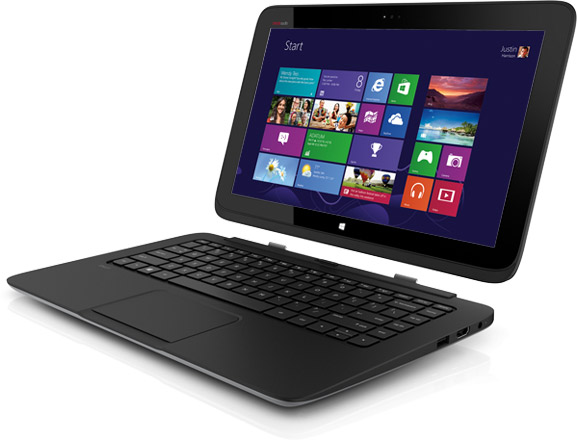
  • HP announces the Split x2 Windows 8 hybrid

    On Wednesday, US manufacturer HP unveiled a new Windows 8-based hybrid dubbed the Split x2. The company touts the device as being able to deliver the best of both worlds — works as a tablet and doubles as an ultraportable with the keyboard dock.

    The Split x2 packs a 13.3-inch HD display and is powered by a third generation Intel Core processor (known under the “Ivy Bridge” codename). The device comes with 128 GB of internal storage. Users can also choose to add a 500 GB HDD inside the keyboard dock, which brings the tally up to 628 GB.

    This allows the Split x2 to cater to more demanding users which wish to store large files on the device and to also better compete with established ultrabook solutions, which can pack similar if not more storage capacity out-of-the-box.

    With the keyboard dock attached, the Split x2 weighs 4.85 lbs (2.2 KG). When used as a tablet (with no keyboard) the device comes in at 2.3 lbs (1.04 KG). However, if you’re looking for a similarly-sized light ultrabook you might want to look elsewhere. The 13.3-inch ASUS Zenbook, for instance, weighs just 1.45 KG.

    The Split x2 also features HP’s Connected Music and Beats Audio, which are designed to improve the audio experience, a 2 MP Full HD webcam (with a resolution of 1920 by 1080) and a touchpad (which HP calls a ClickPad) on the keyboard dock.

    HP says that the Split x2 should be available from August in the US. The hybrid will run for $799.99.

  • GigaOM Chrome Show 5: Google I/O preview and Joe Marini from Google talks apps

    On the all-Chrome podcast this week, we remind folks that Google Keep is replacing Scratchpad in Chrome OS: Don’t forget to sync your notes! Also, Google has added push notification support in Chrome. Speaking of Google, Joe Marini, a Google Developer Advocate talks about Packaged Apps, Native Client and more.

    Our extension of the week will help you better manage your tasks while a quick tip helps unhide your “missing” extensions. Oh… and isn’t there a big event this week? Hear our preview thoughts of Google I/O!

    Show notes

    Hosts: Chris Albrecht and Kevin C. Tofel

    Got questions, tips or tricks for an upcoming GigaOM Chrome Show? Find Kevin on Google+, Twitter (@kevinctofel) or via e-mail ([email protected])

    (download this episode)

    Subscribe to RSS

    iTunes

    Stitcher Radio

    Related research and analysis from GigaOM Pro:
    Subscriber content. Sign up for a free trial.