Category: News

  • The Week Ahead

    The key economic stories this week will be house prices, the FOMC meeting and the “advance estimate” for Q1 GDP to be released on Friday.

    On Monday the LoanPerformance house price index (for February) will probably be released. Also on Monday, the Census Bureau report on Housing Vacancies and Homeownership for Q1 will be released at 10 AM. Although noisy quarter-to-quarter, this report has been showing a declining homeownership rate. The vacancy rates for homeowners and renters have probably peaked, but both will still be near record levels.

    On Tuesday the February Case-Shiller Home Price Index will be released at 9 AM by S&P. This will be confused by the recent S&P release cautioning about the seasonal adjustment. Also on Tuesday the Conference Board will release consumer confidence at 10 AM, and Fed Chairman Bernanke, budget director Peter Orszag, and others will speak at President Obama’s debt-reduction commission.

    The Federal Open Market Committee (FOMC) is meeting on Tuesday and Wednesday, and the FOMC statement will be released on Wednesday at around 2:15 PM . Although there will be no change to the Fed Funds rate, or to the “extended period” language, there might be a few minor changes to the statement – perhaps a little more upbeat on the economy, maybe some discussion of eventual asset sales to appease a few hawkish members (not going to happen any time soon), and perhaps a comment on disinflation or the weak housing market.

    On Thursday the closely watched initial weekly unemployment claims will be released. The consensus is for a decline to 446K this week from 456K last week. Also on Thursday (or earlier in the week) the ATA Truck Tonnage Index for March will be released.

    And on Friday, the Advance Q1 GDP report will be released by the BEA at 8:30 AM. The consensus is for an annualized increase of 3.4%. Also on Friday, the Chicago Purchasing Managers Index for April, and the March Restaurant Performance index will be released. And of course the FDIC will probably be busy Friday afternoon …

    And a summary of last week:

  • New Home Sales increase in March

    The Census Bureau reported New Home Sales in March were at a seasonally adjusted annual rate (SAAR) of 411 thousand. This was an increase from the revised rate of 324 thousand in February (revised from 308 thousand).

    New Home Sales Monthly Not Seasonally Adjusted Click on graphs for larger image in new window.

    The first graph shows monthly new home sales (NSA – Not Seasonally Adjusted).

    Note the Red columns for 2010. In March 2010, 38 thousand new homes were sold (NSA).

    The record low for March was 31 thousand in 2009.
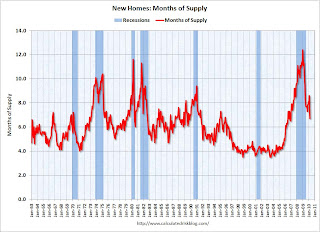
    New Home Months of Supply and RecessionsMonths of supply declined to 6.7 in March from 8.6 in February. This is significantly below the all time record of 12.4 months of supply set in January 2009, but still higher than normal.

    New home sales are counted when the contract is signed, so this pickup in activity is probably related to the tax credit. Note that that a few thousand extra sales NSA in March can make a huge difference in the SAAR.

  • Existing Home Sales increase in March

    The NAR reported: Existing-Home Sales Rise

    Existing-home sales … rose 6.8 percent to a seasonally adjusted annual rate of 5.35 million units in March.
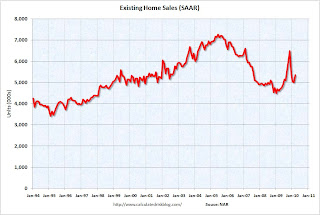
    Existing Home SalesThis graph shows existing home sales, on a Seasonally Adjusted Annual Rate (SAAR) basis since 1993.

    Sales in March 2010 (5.35 million SAAR) were 6.8% higher than last month, and were 16.1% higher than March 2009 (4.61 million SAAR).

    Note: existing home sales are counted at closing, so even though contracts must be signed in April to qualify for the tax credit, buyers have until June 30th to close.
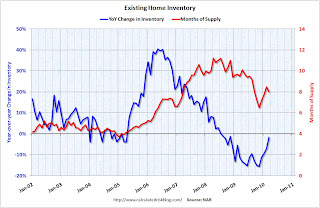
    Year-over-year Inventory This graph shows the year-over-year change in reported existing home inventory and months-of-supply.

    The YoY inventory has been decreasing for the last 20 months. However the YoY decline is getting smaller – only 1.8% in March.

    This slow decline in the inventory is especially concerning with the large reported inventory and 8.0 months of supply in March – well above normal.
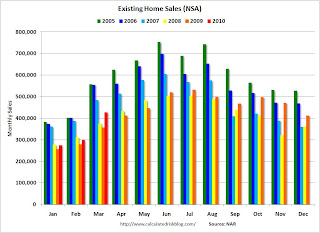
    Existing Home Sales NSA This graph shows NSA monthly existing home sales for 2005 through 2010 (see Red columns for 2010).

    Sales (NSA) in March 2010 were 19.6% higher than in March 2009, and also higher than in March 2008.

    We will probably see an increase in sales in May and June – perhaps to the levels of 2006 or 2007 – because of the tax credit, however I expect to see existing home sales below last year in the 2nd half of this year.
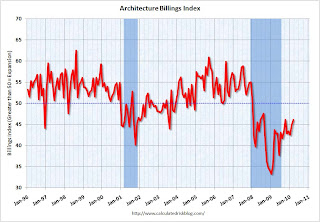
  • Architecture Billings Index shows contraction in March

    AIA Architecture Billing Index From the AIA: Billings Index Inches Up in March

    Note: This index is a leading indicator for Commercial Real Estate (CRE) investment.

    This graph shows the Architecture Billings Index since 1996. The index has remained below 50, indicating falling demand, since January 2008.

  • DOT: Vehicle Miles Driven Decline in February

    Vehicle Miles YoYThe Department of Transportation (DOT) reported that vehicle miles driven declined year-over-year in February.

    This graph shows the percent change from the same month of the previous year as reported by the DOT.

    Miles driven in February 2010 were down -2.9% compared to February 2009.

  • Commercial Real Estate Prices Decline 2.6% in February

    The Moody’s/REAL All Property Type Aggregate Index declined 2.6% in February. This is a repeat sales measure of commercial real estate prices.

    CRE and Residential Price indexes CRE prices only go back to December 2000.

    The Case-Shiller Composite 20 residential index is in blue (with Dec 2000 set to 1.0 to line up the indexes).

    Commercial real estate values are now down 25.8% over the last year, and down 41.8% from the peak in August 2007.

  • Other Economic Stories …
  • From Kevin G. Hall and Chris Adams at McClatchy Newspapers:
    Senate panel: Ratings agencies rolled over for Wall Street
  • From Kevin Hall at McClatchy Newspapers: Executives testify: Bond-rating agencies corrupted themselves
  • From DataQuick: Foreclosure activity declines, moving to mid-to-high end
  • From Tamar Lewin and Sam Dillon at the NY Times: School Districts Warn of Even Deeper Teacher Cuts
  • Jennifer Schonberger at Motley Fool interviews Professor Robert Shiller: Shiller: The Housing Recovery Could Be on Shaky Ground
  • From S&P: S&P Issues Statement, Publishes Research on Seasonally-Adjusted Home Price Index Data
  • Unofficial Problem Bank List April 23

    Best wishes to all.

This post is reprinted from Calculated Risk.

Join the conversation about this story »

  • Condemning Hamas’ Gilad Shalit Video

    Today marks the 1,400th day that Israeli soldier Gilad Shalit has spent in Hamas captivity. Today is also the day Hamas released an animated video depicting Gilad in a coffin, his father Noam looking on. Our Associate Director, Mark Pelavin,…

  • Three Hardware Standards Android Handset Manufacturers Need to Implement

    Since the debut of the T-Mobile G1 in October 2008, Android has grown exponentially.  The platform has progressed from 1.0 to 2.1, with high-end Android handsets being all the rage in recent months.

    With the rapid growth of the platform we have seen many different pieces of hardware that  show off the range that Android operating system provides.  From the T-Mobile Huawei Pulse to the Sprint HTC EVO 4G, handsets have had screen sizes ranging from 2.8″ to 4.3″, different processors, and varying internal storage capacity.  Honestly, this is one of the great things about Android! Despite these differences, there have been some similarities, such as the  volume rocker, home button, back button, and search button (some of you may be asking why I did not include dialer button, but the Motorola Cliq XT and several other HTC handsets do not feature this.)

    Before we get carried away with ourselves, the point of this post is not to discuss the similarities and differences in Android handsets, but to detail hardware standards, especially when it comes to buttons and switches.  Take a look to see what I think about this below.

    1. Mute/Silent Switch

    One of the major gripes I have about the hardware on Android handsets is that there is not a quick way to silence the phone.  Sure, if someone calls me while I am in a meeting I can just hit the volume rocker or I can even get an app that silences the phone if it is face down.  This works.  With all this, I still wish there was a hardware switch to flip to make the phone silent. The only Android phone I know that has this to date is the Motorola Cliq.  Whenever my wife silences here phone it is very easy, switch it and boom.  All I am saying is it would be much easier if all Android handsets had this.  It is much more convenient and faster than unlocking the phone and turning the volume all the way down or pressing a widget.  I think this is needed.

    2. GPS /Maps Switch

    The lack of a GPS/Maps switch on any Android handsets is something that needs to be changed.  In fact, I am unsure if any major handset(even the iPhone) has a button that turns on the GPS and opens up the Google Maps application.  Sure, you can unlock the phone and turn on Google Maps then place it in the car mount and go, that works great.  However, when driving or needing to get somewhere quickly, there should be a better, faster option.  If possible, it would be great to just flip a switch or push a button on a handset while it is in the car mount and Google Maps would open right up, GPS turn on, and you can speak your directions easily without fiddling with the screen.  Handset makers have camera buttons to open the camera application all the time, I can’t see it being to difficult to add a switch or button a GPS/Maps application.

    3. Camera Button

    Speaking of the camera button.  It really is something nice to have isn’t it?  A colleague of mine who owns the Motorola Droid, simply loves the hardware button.  Honestly, I never really thought much about it, but when I used his Droid to take some photos, using the camera button was absolutely fantastic! One push and boom the camera is on.  Just like that.  I can’t tell you how many times my wife told me to take a picture and by the time I unlocked my phone and found the camera app, the moment was over.  I think Android handset manufactures should think long and hard about adding a standard camera button, it makes it much easier.

    So that’s it from me.  Now the question is what standards, if any, would you like to see?  Let us know in the comments!

    Might We Suggest…

    • Did Google Shoot itself in the Foot with Nexus One?
      Microsoft sure thinks so.  In a quote from Microsoft’s Robbie Bach taken from Bloomberg, it seems the software giant thinks that Google may have bitten off more than it can chew.

      The Bach Quote fr…


  • 28th Annual Dana Point Concours d’Elegance adds motorbikes

    Filed under: , , ,

    If it’s good enough for Pebble Beach… For the first time in its history, the 28th Annual Dana Point (née Newport Beach) Concours d’Elegance will host an exhibit of antique and vintage motorcycles alongside the usual assortment of incredible automobiles from every era. The event has been moved up to the summer this year, but will once again be held at the St. Regis Resort in Dana Point, California.

    Those who show up on that Sunday (June 27, 2010) will find that Alfa Romeo is the featured marque, celebrating 100 years of great racing and road cars in 2010. The 80-year-old Pininfarina design house will also be feted, but the big news for bike lovers will be the exhibition-only classes featuring 65 significant motorcycles from throughout history. The preliminary groupings divide European, American and Japanese motorcycles, as well as production and competition models.

    Entry forms and additional information can be found online at: www.DanaPointConcours.org.

    Photos by Frank Filipponio/Copyright (C)2009-2010 Weblogs, Inc.

    28th Annual Dana Point Concours d’Elegance adds motorbikes originally appeared on Autoblog on Sun, 25 Apr 2010 17:04:00 EST. Please see our terms for use of feeds.

    Permalink | Email this | Comments

  • What Should You Have Bought? AAPL Stock or Apple Products? [Stock]


    Click here to read What Should You Have Bought? AAPL Stock or Apple Products?

    That Apple PowerBook G3 250 you bought back in 1997 may have some nostalgic value, sure, but if you had simply bought up some Apple stock instead you’d be sitting on real value, to the tune of about $330,563. More »


  • IPCC in trouble again, Bishop Hill

    Article Tags: ClimateGate

    article image

    Click source to read FULL report

    Source: bishophill.squarespace.com

    Read in full with comments »   


  • HTC HD Mini OpenGLES 2.0

    As requested, here’s a quick video of the HD Mini and the HD2 running some OpenGLES demos. The HD2 seemed a lot more temperamental, not running some of the demos.

    The two devices both features an AMD z430 GPU, and even with the much lower resolution on the HD Mini, the rendering is a similar speed on both.


  • AC Asks: Motorola Droid owners – what are your must-have apps?

    Must-have Motorola Droid apps

    Let’s just go wide-open this week. We’ve got 10 Otterbox Commuter Series cases for the Motorola Droid to give away. And so, Droid owners, we ask you: What are your must-have apps for one of the most popular Android devices around?

    Reply in this forum thread and you’ll be automatically entered to win one of the 10 cases. We’ll take entries through Thursday, April 29. Good luck, everyone!

    What’s your favorite app on the Motorola Droid?

  • Teaching First Grade Math: Money

    Teachers can use the following resources for students that are in the first grade who are learning about money with a total value up to 100 cents or less (Virginia Standards of Learning for 1.7 a & b).

    Text Annotations:

    coin-counting-book.jpg

     The Coin Counting Book written by Rozanne Lanczak Williams is a fun rhyming book for students to learn about counting money and it’s value.  The book introduces pennies, nickels, dimes, quarters as a way for students to do simple math with rhyme:

    “Let’s count our five pennies just one more time. If we add five more pennies we’ll have…one dime.”

    Actual size coins are spread out over the pages showing both front and back for student learning.  If the book says to count five pennies as an example, there are five pennies laid out on the page with a addition sign in between each coin to help with student visualization.  The book ends by showing a hand placing coins in a piggy bank making the statement: “If we save some of it- the rest we can spend!” 


    pigs-will-be-pigs-1.jpg

    Pigs will be Pigs, Fun with Math and Money written by Amy Axelrod and illustrated by Sharon McGinley-Nally is about a family of hungry pigs looking for money in their house so they can go to their favorite place to eat a snack.  This is a great book for introducing students in the first grade to money.  The pig family is hungry and realize they do not have enough money to go out to eat; so Mrs. Pig decides that everyone will “Hunt for Money!”.  The book describes where in the house and how much money everyone in the family finds while on the money hunt.  In the end, the Pigs have enough money to eat out and when they arrive home they find their house in a mess from their hunt.  Pigs will always be pigs.   


     26-letters-and-99-cents.jpg

    The book, 26 Letters and 99 Cents written by Tana Hoban provides photos of numbers from 1-30, counting by 5’s from 30-90 and 99.  Beside of each number there is a photo of coins that shows the value of the number when added.  The book can be shown to the whole class while identifying each coin and the value.  This would also be a great book for students to look at during the day as a center activity, etc.  The book shows students both the front and back of real American coins: pennies, nickels, dimes and quarters in their actual size.  This helps students to visualize the size and identification of each coin.


     if-you-made-a-million.jpg

    The book If You Made A Million written by David M. Schwartz and illustrated by Steven Kellogg is a book where students can really use their imagination.  Readers are given different scenarios with spending anything from one penny to purchase a peeble all the way up to one million dollars with the option of saving the money at the bank.  This would be a great way to ask students for ideas about what they would purchase with different amounts of money.  Schwartz gives differnet forms of measurement for various amounts of money.  For example, one hundred dollars in pennies stacked up would be equal to fifty feet or a million dollars in quarters would equal a whale’s weight.  This is a great book to help students realize that a paper bill is sometimes easier (and lighter) to carry around instead of coins.


    money-madness.jpg

    The last text would be a great resource for students who are in need of a more challenging way to think about money and its uses.  Money Madness written by David A. Adler and illustrated by Edward Miller explains how money first originated and how money is now used to purchase different items from around the world.  The book starts off by asking:

    “What’s all this money madness? People talk about money and work for it. They seem to always want more of it…”

    The book gives examples of why people now use money to purchase a variety of items.  If people did not have money then they would have to make their own bread.  Adler explains at a child’s level how people first started to trade by introducing the word, barter.  An example that Adler used was when a person would trade an animal in exchange for berries. Even though the person receiving the berries might not want them he knew that someone else would want to trade the berries for something that he wanted or needed in return. The book explains how rocks were used as an early form of money and then replaced by metals (silver and gold).  The silver and gold pieces were made into coins but were at times difficult to carry if someone had a lot.  Paper money was then invented.  Adler explains how each country has it’s own form of money and that the value of the money can vary from place to place.  ”You know with money you can buy things you want. With money you can buy things you need.”

    Web Annotations:

    Students can play the game Change It  for additional practice on adding up different coin values.  Teachers can create each game to specifically fit each students instructional level. 

    GPB Kids has created a web-site for students to play a game where they are given nine different items that they need to buy.  Players are instructed to buy one of the nine items by dragging the correct coin(s) to the matching picture in the chart.  If the player is right then they can move on to the next problem; if not, they have the chance to try again.

    Teachers can create different tutorials for students by selecting any combination of pennies, nickels, dimes and quarters for practice.  For each category chosen, students are provided a picture of real money on the left side of the screen and need to select the correct value of the money from the right side of the screen.  If the student selects the correct amount of money they can move on to the next problem.  If an incorrect answer is chosen, then the student can try again.

    HMH School Publishers created a great money practice tool for students.  For the activity, coins are lined up in decreasing value from largest to smallest.  Students need to count the value of the coins and type the correct amount of money in the blank provided.  Students then need to click on “check” to see if they have typed in the correct amount.  If so, the student will hear chimes, if an incorrect amount is typed in then the student will see a screen flash up that explains the amount is either greater or less than the answer that was entered.

    Kid 20/20 has an activity, Coin Sort that students can play on-line.  Students are given 280 seconds to properly place different coins in the corresponding piggy bank.  Each piggy bank is labeled with either pennies, nickels or dimes on the side.  Students must click on each coin and drag it to the proper piggy bank.  If the coin is taken to the correct piggy bank then the coin will disappear and the value of the coin will be added to the amount already in the piggy bank.  Students can visually watch as the amount increases by either one, five or ten cents.

    Additional Resources:

    The United States Mint has a great web-site that teachers can use for various reasons.  The site contains ideas for lesson plans, coin programs which give detailed information about each coin and coin curricula.  Teachers can also use the site for class activities: game centers, web gadgets (worksheets), learning centers (ways to bring in different areas of the curriculum and financial literacy). 

    Scholastic has a great web-site for teachers.  Teachers can download different activities from worksheets, foldables, mini-books, and even lesson plans.  Click on “Teachers Resources” and select lesson plans, printables or mini-books. Narrow each search by selecting 1st grade, math and then money from each category on the left hand side of the screen.  *This web-site requires a yearly paid subscription.*

    Teaching Money Skills by Grade Level: First Grade is an article that teachers can read prior to teaching first grade students about money.  The article provides a review and instructional method for teaching a lesson or unit on money.  The article recommends that teachers use play/fake money with their students for a hands-on learning experience.  After the unit lesson on money, students should be prepared for second grade math: addition and subtraction of money. 

  • Barry Zito, back in the circle of trust

    I understand why there’s so much roto-hate out there for Barry Zito(notes). He crushed you in 2007, he let you down in 2008, and that picture to the right should make all of us a little bit angry. But his comeback story has been out there for nine months now, and it’s time to accept the reality of the situation, the lefty is mixed-league worthy in any format.

    Zito’s first three starts this year were excellent if not dominant; he had a tidy 1.86 ERA working but just nine whiffs over 19.1 innings. But the eccentric lefty brought out his best stuff in his fourth turn, an eight-inning gem against the Cardinals Saturday (3 H, 0 R, 3 BB, 10 K). When you shut down Albert Pujols(notes) & Company, you’ve done something impressive. Here’s your video scouting report.

    When you add up all of Zito’s 2010 work, we’re looking at a 1.32 ERA and 0.84 WHIP, numbers that are clearly unsustainable for any pitcher (this isn’t 1968, after all). It’s easy for the lazy internet scribe to play the "regression coming!" card with Zito – everyone knows he won’t maintain a .205 BABIP and an 82.6 percent strand rate all season. But can Zito keep his ERA below 4 and maintain mixed-league worthiness all season? Parked in that roomy San Francisco park, I’m betting that he can.

    The comeback story hasn’t come completely out of nowhere – Zito was very useful in his final 15 starts of 2009 (2.83 ERA, 1.29 WHIP, 74 K in 86 IP). He got the feel of his curveball back last summer and so far this year he’s been outstanding with the curve and change, while putting his fastball where he wants. Mix that together and you’ve got a trustable arm for the middle of your make-believe staff.

    There’s one other thing we need to mention in a Zito piece: his contract. Yes, Brian Sabean made a gigantic mistake when he handed a seven-year, $126 million deal to Zito after the 2006 season. But why should we sweat the package? We don’t have to pay him every two weeks, the Giants do. (And while we’re on the subject, cut Vernon Wells(notes) and Alex Rios(notes) a break, too.)

    The whopping contract probably had a role in Zito’s 2007 and 2008 collapse. It’s a massive burden to walk to the mound every fifth day trying to justify that you’re worth an $126 million paycheck. But Zito’s finally gotten over that mental hurdle, and it’s time for fantasy owners to get on board, too.

    I’m calling Zito a $13 arm from here on out – ranking him over guys like Rick Porcello(notes), Rich Harden(notes), Edwin Jackson(notes) and anyone on the Reds. Coming along for the ride, or is Zito still fool’s gold in your estimation? Let’s discuss in the comments.

  • Experts: Kindle Helps You Sleep, iPad Causes Insomnia [Sleep]


    Click here to read Experts: Kindle Helps You Sleep, iPad Causes Insomnia

    According to sleep experts, the iPad’s bright LCD display could be hampering your body’s ability to create melatonin. Translation: Insomnia. The Kindle and other e-ink devices, on the other hand, won’t disrupt your sleep cycle. More »


  • MUST READ: The Greenhouse Effect: Origins, Falsification, & Replacement by Timothy Casey B.Sc. (Hons.)

    Article Tags: Timothy Casey

    This is a MAJOR paper that Hans Schreuder informed Alan Siddons about today

    A few choice plums:

    #Everyone knows what the greenhouse effect is. Well … do they? Ask someone to explain how the greenhouse effect works. There is an extremely high probability that they have no idea.

    #Beware of wheels within energy diagrams as these usually constitute the energy creation mechanism of perpetual motion machines. One such gem of clarity, used uncited by Plimer (2009, p. 370), was offered by Kiehl and Trenberth…

    #The mechanism by which the addition of carbon dioxide warms the atmosphere has no empirical basis. Therefore the assertion that global warming is anthropogenic, may well be philosophical and perhaps political, but it is most certainly not scientific.

    #Increasing visible radiation, even by quite a large amount, results in no measurable rise in temperature because no appreciable amount of visible radiation is converted into infrared when absorbed and re-emitted – contrary to Arrhenius’ hypothesis.

    Read in full with comments »   


  • “Word Doctor” Luntz: I Don’t Set GOP Agenda

    Pollster Frank Luntz says charges from Democrats that his talking points memo sets the GOP agenda are dead wrong. Luntz told Fox News this Sunday, “I dont even live in Washington anymore. My business is all corporate. I write one memo, which I thought was pretty good. I took the language that was being used at the time, and the language worked. And because I used the language, I verified it because I have a reputation of being right”

    The memo being referred to was a 17-page memo Luntz wrote in January entitled “The Language of Financial Reform.” The premise of it basically boils down to this: “The single best way to kill any legislation is to link it to the Big Bank bailout.” 

    In recent weeks, several leading Republicans have referred to bank reform bill as just that — another government bailout. But Luntz says he was late to the game in terms of financial reform legislation language. He says, “Congressmen [Scott] Garrett (R-NJ) and Mike Pence (R-IN) were first. I just happened to get more of the attention.”

    Luntz went on to say that what he does for a living is nothing new. “We know the Democrats and the White House did it last year with health care reform and I remember a top pollster for the White House going out and finding people don’t like insurance companies and that is the way the debate was framed, calling them villains and putting it on their doorstep, the problem … Don’t the parties look to pollsters for help on the issue?”

    Luntz is the president of The Word Doctors communications consulting firm. He’s an expert at figuring out key words and phrases that will resonate with the American public. And Luntz insists he does it for both parties, “It is funny. I have presented to democrats on several occasions, the very people making criticisms who have listened to my work in the past. My work is nonpartisan and nonpolitical. It talks about what American people think and feel and what we all know.”

    So what is it that he says all Americans think and feel? Luntz says it’s simple, “Number one: America hates these buyouts.  Number two: they don’t believe a bigger Washington puts Wall Street under control. And number three, they don’t want legislation, healthcare legislation and financial services legislation.”

    Luntz doesn’t want credit for the bank bailout language, but he does want some credit for past successes. “I am behind the phrase ‘death tax’ when talking about the Estate Tax. And when talking about health care, I was the one who called it the ‘Washington takeover’ of health care.  So I write a memo two months ago using language that was already out there, and because of my reputation I verified that language. “

    Luntz regularly appears on the Fox News Channel. Time magazine recently named Luntz one of the 50 most promising leaders aged 40 and under in America.

    You can check out Luntz’ Talking Points Memo

  • EV mass market: 60 percent of Chinese consumers would consider buying electric vehicles TNR.v, CZX.v. LMR.v, RM.v, SQM, FMC, ROC, LI.v, CLQ.v, AONE, F

    Price competition will drive Electric Cars mass market. Chinese companies will have yet to prove that they can claim auto brand properties, but costwise they are out of competition. Once thousands of engineers working in China on lithium batteries, safety and design of Electric Cars convert quantity into quality this market will take off in Ipod fasion.”

    Alibaba.com:

    Green cars a draw for ChinesePublished: 21 Apr 2010 08:02:01 PST
    By Wang Xinyuan
    About 60 percent of Chinese consumers would consider buying plug-in hybrids or pure electric vehicles in China, according to an Ernst & Young report released Wednesday, a percentage higher than in any other country surveyed.
    The finding suggests huge market potential in China for green car manufacturers.
    The company conducted a survey of 1,000 Chinese respondents who currently own a vehicle or plan to purchase one within three years.
    Chinese consumer’s interest in electric cars was the highest, followed by buyers in Italy, France, Germany, the UK, the US, and Japan.
    Fuel savings, environmental impact, government incentives and safety favorably influenced Chinese consumers’ willingness to buy a plug-in hybrid or pure electric car, according to the report.
    The environmental benefit of green cars was cited as the top reason to purchase them by 82 percent of the Chinese respondents, the highest percentage among all countries surveyed.
    Government incentives were the top motivator for 66 percent of German and 61 percent of Italian respondents, compared with 60 percent of the Chinese survey takers.
    Battery driving range, access to charging stations, reliability and safety were cited as obstacles keeping Chinese consumers from buying green cars.
    Roughly 82 percent of Chinese respondents considered a range per charge of less than 200 kilometers acceptable, and 79 percent believed electric cars will outnumber gasoline-powered cars within 20 years.
    “We saw a real appetite in the market for plug-in hybrid and electric vehicles as a new means of transport in China and globally,” said Mike Hanley, Ernst & Young’s global automotive leader.
    “The popularity of new powertrain technology will only increase and the market leaders will be those companies that have their fingers on the pulse of the consumer trends and behavior,” he said.
    Many car producers are already eyeing the alternative fuel vehicle market, including Chinese brands such as BYD, Geely, and Chery. Chery has launched an electric car already and Geely will launch one as well, the Beijing Times reported April 7 citing Li Shufu, the chairman of Geely.

    Nissan Motor, Daimler and local brand BYD are expected to show electric cars at the upcoming 2010 Beijing International Automotive Exhibition, which opens tomorrow, Century Weekly reported Sunday.
    Peugeot and Audi will also show hybrid and electric cars at the exhibition, according to the China Auto Show website.
    Last January, the Ministry of Finance announced tentative measures to subsidize energy-efficient and alternative energy cars used in applications such as public transportation and taxi service.
    Subsidies on individual purchases of hybrid and electric cars are expected to come out later in pilot cities.
    State Grid Corporation, the country’s largest operator of power grids, also announced early this year that it plans to build 75 charging stations for electric vehicles nationwide in 2010.

  • Mobiola Web Camera 3 Turns Your Symbian Smartphone into a Handy Webcam

    Found under: Symbian, Smartphone, Apps, Mobiola, ,

    In case you didnt know your Symbian smartphone can be turned into a very handy webcam which can be connected to your computer and used for some fast video conferencing. Sure you could say that your Symbian smartphone already does video calls but that will cost you extra whereas Internet video conferences are almost free.In order to turn your Symbian smartphone into a webcam youll need to install Mobiola Web Camera 3 on your handset. The program available in the store for just 7.42

    Read More

    Read more in mobile format

  • GeigerCars blows the Corvette Grand Sport into ZR1 territory

    Filed under: , , , ,

    GeigerCars Chevrolet Corvette Grand Sport – Click above for high-res image gallery

    European buyers looking to get their hands on a Corvette ZR1 may find them in short supply. Fortunately, GeigerCars is there to save the day with the next best thing. The German tuner of American iron has taken a crack at the Corvette Grand Sport and boosted it to near-ZR1 levels of power and performance.

    Starting with the Grand Sport’s 6.2-liter LS3 V8, Geiger bolts on a supercharger to increase output from the stock 430 horsepower to a prodigious 588, helping the Geiger GS hit 60 un under four seconds. That may not be quite as powerful or quick as the ZR1’s supercar numbers, with its 638 horsepower and 3.3-second sprint, but it’s nothing to scoff at, either.

    [Source: GeigerCars.de]

    Continue reading GeigerCars blows the Corvette Grand Sport into ZR1 territory

    GeigerCars blows the Corvette Grand Sport into ZR1 territory originally appeared on Autoblog on Sun, 25 Apr 2010 15:33:00 EST. Please see our terms for use of feeds.

    Permalink | Email this | Comments

  • Don’t Extend China’s Recent Growth As Your Forecast, China Already Peaked And Will Now Collapse

    china storm

    If you’re ready to dissect a full take-down of the Chinese economic and political model, well here it is, from the author Gordon G. Chang. (Who will have an upcoming book, The Coming Collapse of China).

    The main thrust of his argument is that China has already peaked.

    Thus those who predict China’s ascendancy as a global superpower are predicting far too much based on the country’s recent performance.

    They also fail to realize that China got a bit lucky:

    World Affairs:

    So will ours be the Chinese century? Probably not. China has just about reached high tide, and will soon begin a long painful process of falling back. The most recent period of China’s fast growth began with Deng’s Southern Tour in early 1992, the event that signaled the restarting of reforms after the 1989 Tiananmen Square massacre. Fortunately for the Communist Party of China, this event coincided with the beginning of an era wherein political barriers to trade were falling and globalization was kicking into high gear, which set the table for a period of tremendous wealth generation.

    It worked before, but now times are changing:

    China’s economic model, which allowed the Chinese to take maximum advantage of boom times, is particularly ill suited to current global conditions. About 38 percent of the country’s economy is attributable to exports—some say the figure is higher—but global demand at this moment is slumping. (Last March, the normally optimistic World Bank said the global economy would contract in 2009 for the first time since World War II and that global trade would decline the most it had in eighty years.) Globalization, which looked like an inevitable trend in early 2008, is now obviously going into reverse as economies are delinking from each other. So China is now held hostage to events far beyond the country’s borders.

    While we take issue with the idea that globalization is heading in reverse, at the very least the point about China facing some serious economic adjustment challenges holds. Globalization will continue and world trade will grow at a multiple of global GDP growth, as it has for decades. Yet it’ll be far less driven by U.S. consumption than before.

    Anyhow, Mr. Chang predicts a Chinese recession followed by stagnation. I think few would argue against the notion of a recession happening at some point. What makes Mr. Chang’s assertion unique is that he predicts economic stagnation afterward, rather than continued robust growth.

    But the economy could fail before stagnation eventually sets in. Prime Minister Wen Jiabao, to fund his stimulus plan, has forced state banks to create the greatest surge of lending in history. One state manager, Lin Zuoming of Aviation Industry Corporation of China, publicly complained last April that central government officials forced him to borrow the equivalent of $49.2 billion from twelve Chinese banks, saying he did not know what to do with all the cash.

    Moreover, after listing China’s many economic challenges, many of which readers of this site are now well aware of (Asset bubble risks, bad loans in the banking system, overcapacity in many industries, employment challenges, etc), he describes the unsustainable nature of China’s political system with razor sharp succinctness.

    Worse yet, even if the Communist Party could solve each of these specific problems in short order, it would still face one insurmountable challenge. The economic growth and progress of the last three decades, which makes so many observers believe in the inevitability of China’s rise, is actually a dagger pointed at the heart of the country’s one-party state.

    Change, in general, is tough for reforming regimes. As Tocqueville noted, it was rising prosperity that created dissatisfaction in eighteenth-century France and paved the way for revolution. These same trends played out more recently in Thailand, South Korea, and Chinese-dominated Taiwan. And they are at work right now in China itself.

    Senior Beijing officials now face the dilemma of all reform-minded authoritarians: the economic progress that legitimates their leadership endangers their continued control.

    He ends with this anecdote, hinting that a political revolution might be sooner than many expect.

    I was in a dingy walk-up in my dad’s hometown, Rugao. It’s a backwater town in Jiangsu Province. I was trying to talk to a group of residents, some young and a few elderly, about the Olympics. Nobody wanted to discuss the Games, which were dismissed as just another government-staged event. All they wanted to hear was news from the American campaign trail. They wanted to hear about John McCain and Barack Obama. They wanted to hear about the workings of democracy.

    We have a feeling that Mr. Chang’s long-term forecast is overly bearish. China will become an enormous superpower (While the U.S. will remain one as well, and could easily remain economically larger through 2050 thanks to excellent demographic trends)

    We’re more of the view right now that China could have an extremely tough adjustment period within the coming five years, perhaps involving a GDP recession and political turmoil, before then growing further. Yet at the same time, we find Mr. Chang’s essay compelling. If you have some time, read the entire thing here.

    (Via Abnormal Returns)

    Join the conversation about this story »

  • SIRIUS XM Radio Coming to Android Smartphones This May

    Found under: SIRIUS XM, Radio, Satellite, Android,

    In case youd love to listen to some SIRIUS XM satellite radio station on your Android smartphone then youll be happy to hear the company has officially announced that Android handsets will get a new SIRIUS XM app in May. The SIRIUS XM Android app will come free of charge and will bring you over 120 satellite radio channels which will offer you fast access to commercial-free music sports comedy and talk radio. While the app will be available for free users will also be able t

    Read More

    Read more in mobile format

  • Foreign aid: highest levels ever but still way below promised amounts

    The OECD (Organisation for Economic Co-operation and Development) recently published new preliminary figures for aid in 2009.

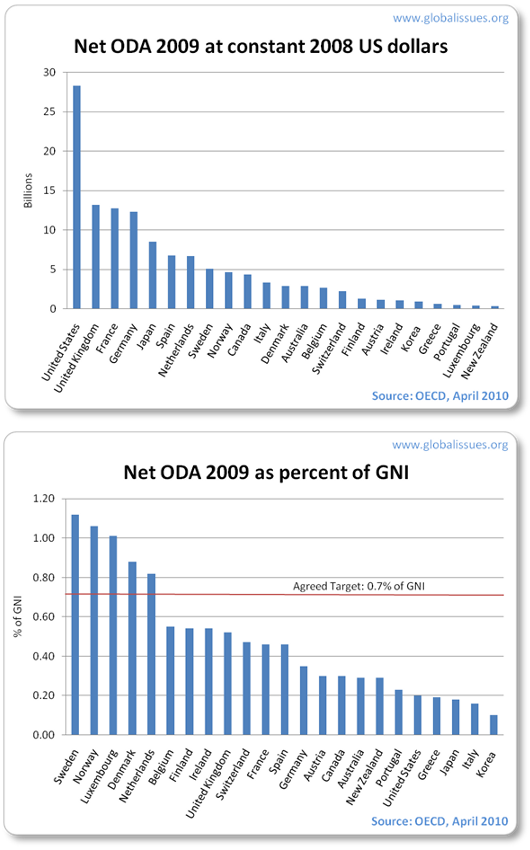
    It showed official development assistance (ODA) aid from wealthy governments had increased to just over $123 billion in 2009 (at constant 2008 prices). This is roughly 0.31% of GNI (Gross National Income) of the donor nations.

    Net ODA in dollars: the US provided the most in dollar terms. As a percent of their GNI, Sweden provided the most

    Yet, almost 40 years ago nations promised to reach 0.7% of their GNI. While each year the amount of aid falls quite short of that 0.7% target, the quality and effectiveness of that aid is often questionable, sometimes benefiting the donor more than the recipient due to the types of conditions attached to this aid.

    This update includes a number of new and updated charts and graphs.

    Read full article: Foreign Aid for Development Assistance

  • Foreign aid: shortfall reaches $3.6 trillion; greater than aid given

    Almost 40 years ago, rich country governments agreed to give 0.7% of their GNI (Gross National Income) as official aid to poor countries for development assistance.

    The average aid delivered each year has actually been between 0.2 to 0.4%. The shortfall has therefore accumulated to over $4 trillion dollars at 2008 prices, while total aid delivered in that same time frame has reached just under $3 trillion.

    Of the total aid that has been promised in those 40 years, only 43% has actually ever been delivered

    This update includes updated charts and graphs that look into this further.

    Read full article: Official global foreign aid shortfall: $4 trillion