Category: News

  • Lack cross-shelf

    Materials: Lack shelves, Dioder multicolor LED light strips, angle brackets, circular saw, drill, screwdriver, paint, caulk

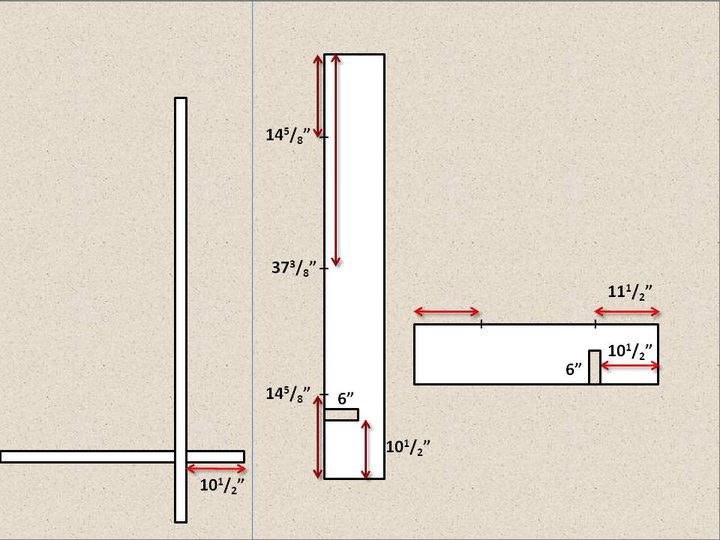
    Description: We wanted a shelf or table unit to fill a narrow vertical space adjacent to the bed. My wife conceived the fusion of two Lack shelves in an uneven cross, mounted off the wall to make the shelf appear to float. We used two Lack shelves, a 43″ and a 78″, made two hemi-lateral cuts in order to fit the pieces together, and mounted the horizontal shelf using the standard IKEA Lack bracket, though keeping it off the wall by 2″.

    The vertical shelf wasn’t going to support any significant weight, so we ditched the standard bracket and used a simple angle bracket at either end to hold it in place. The shelf brackets were primed and painted to match the wall color to give the effect of the floating shelf. The seam where the two shelves meet was finished with painter’s caulk. Finally, two sets of Dioder LED lights were mounted on the back, giving the floating shelf a cool glow. A few lazy nights to plan and two half-days on the weekend to put together, one of our favorite new additions.

    ~ Matt Tremblay, San Diego


  • A Novel Geoengineering Idea: Increase the Ocean’s Quotient of Whale Poop | Discoblog

    The fight against global warming has a brand new weapon: whale poop. Scientists from the Australian Antarctic Division have found that whale poop contains huge amounts of iron and when it is released into the waters, the iron-rich feces become food for phytoplankton. Phytoplankton absorbs carbon dioxide from the air, the algae is in turn eaten by Antarctic krill, and baleen whales eat the krill. Through this neat cycle, globe-warming CO2 is kept sequestered in the ocean. Scientists have long known that iron is necessary to sustain phytoplankton growth in the oceans, which is why one geoengineering scheme calls for adding soluble iron to ocean waters to encourage the growth of carbon-trapping algae blooms. While environmentalists have fretted over the possible consequences of meddling with ocean chemistry that way, this new study on whale poop suggests an all-natural way to get the same carbon-trapping effect: Increase the number of whales in the ocean. When Stephen Nicol of the Australian Antarctic Division analyzed the feces of baleen whales, he found an astounding amount of iron in it. New Scientist reports:
    Nicol’s team analyzed 27 samples of faeces from four species of baleen whales. He found that on average whale faeces had 10 million times as much …


  • Flash and Air Developers Finding it Easy to Port to Android.

    Androidpolice.com is reporting that with the recent huge push from Adobe, application and game developers are having a breeze of a time porting over their Air and Flash apps to Android.  Most of the feedback of the process has been positive from devs, some even saying that their apps are porting over in 10 minutes!

    This comes, of course, after the whole drama surrounding the fact that Apple has shut Adobe and Flash out of the iPhone for the time being.  Adobe has decided to push its platform to Android in a big way and we’re about to see the fruits of this effort.

    This is good news for Android as a whole being there are tons of AIR apps out there that could be ported over to our mobile devices running later versions of Android.

    Might We Suggest…

    • Adobe AIR on the Android Platform
      By Andy Rubin, Google VP of Engineering, Android

      Partnerships have been at the very heart of Android, the first truly open and comprehensive mobile platform, since we first introduced it with the O…


  • TED talk on building a greener house

    by Jonathan Hiskes

    Robotics engineer Catherine Mohr is
    tired of enviros “long on moral authority and short on data.” She’s got a smart
    TED talk
    clip
    about the greenest options for (a) wiping up a yogurt spill and (b) building
    a house. The point in each case is that the best option is often not what you’d
    expect.

    She sorta takes the
    annoying and all too common tone of “everything you’ve been trying to do out of
    good faith is wrong and stupid,” which isn’t motivating. But she brings the
    data and presents it clearly, and that’s worth a shout-out:

    Related Links:

    Astute climate bill analysis from DJ Biz Markie

    Save Bette Midler, er, Mother Nature! [VIDEO]

    How Dirty Are We Willing to Get?


  • German Fembot AILA Has No Mouth to Feed Bratwurst To [Robots]

    As the glamor shots illustrate, fembot AILA is pretty tasty. Curvy in all the right places, big eyes not seen since Zooey Deschanel, and a modern haircut that shows she’s got an awesome music collection. Shame she has no legs. More »


  • Is The Vegan Double Down Worse For You Than The Real Thing?

    A few weeks back, before KFC had even unleashed their bacon, fried chicken and salt concoction known as the Double Down, vegan website Vegansaurus had already come up with their own animal-friendly version. But while it might not harm any of your furry, feathered, scaly or insecty friends, the vegan Double Down certainly isn’t a diet item.

    According to Vegansaurus’ own numbers, here’s how the concoction breaks down, in terms of calories and fat:

    * 2 Gardein Chick’n Scallopini patties: 180 calories, 4g fat
    * 2 Tbsp Vegenaise: 180 calories, 18g fat
    * 25 percent of the batter recipe (plenty for one sandwich): 225 calories, 25g fat
    * 2 oz Follow Your Heart Monterey Jack: 140 calories, 14g fat
    * 3 strips Smart Bacon with cooking oil: 60 calories, 8g fat
    Grand total: 785 calories, 69g fat

    So how does that stand up against the real thing? Well, that depends on who you ask.

    If you go by KFC’s numbers — 540 calories, 32g fat — then the vegan version should make the list of foods worse for you than the Double Down.

    But then there are the folks who claim that the number should be closer to 1190 calories. If that’s the case, then the vegan version is a little friendlier to your waistline, though still on the same level as a McDonald’s Double Quarter-Pounder with Cheese.

    We still haven’t found anyone who has done a side-by-side taste test of the two versions. Any volunteers?

    Calorie count cage match: KFC Double Down vs. Vegan Double Down [Vegansaurus.com]

  • Watch out, Kerry—Big Ag’s not done with your climate bill

    by Tom Philpott

    The agribiz lobby: plenty of horsepower. With the support of three big oil companies in hand, Sen. John Kerry (D-Mass.) is now tailoring his climate bill to please the folks over at the Chamber of Commerce, Mother Jones’ Kate Sheppard reports.

    What about agribiz? The good senator seems intent on bringing that greenhouse-gas-spewing industry into the fold, too. “Agriculture would be entirely exempt from the cap on carbon emissions,” Sheppard reports.

    But as we learned last summer in the fight over the House climate bill, just exempting ag from the carbon cap isn’t enough. As I put it then, Big Ag’s message can be boiled down to: “screw the cap—just give us the trade!!!” In other words, agribiz interests are demanding that a generous stream of carbon-offset cash flow into what they call “production” (and I call “industrial”) agriculture.

    In short, they demand that farmers be rewarded richly for doing exactly what they’re already doing: spewing greenhouse gas while consuming plenty of agrichemicals.

    We don’t know yet how the Kerry bill will treat the question of agricultural offsets. For hints as to how it will play out, we can look again at what happened to the House’s climate legislation, named for its sponsors, Reps. Waxman and Markey.

    Like the original Mayor Daley running his Chicago “machine,” House Ag committee chair Collin Peterson (D-Minn.) wrangled and threatened and fulminated before turning Waxman-Markey into another potential cash cow for Big Ag.

    Before the bill had even made it out of committee, agriculture—a massive emitter of greenhouse gases—had been exempted from any carbon cap. By the time Peterson got done with it, it was full of goodies for agribusiness. His biggest coup was probably engineering things such that the USDA, not the EPA, runs the ag-offsets program. The EPA’s role in life—true, often honored in the breach—is to protect the environment. The USDA’s is to promote U.S. agriculture—and most of U.S. agriculture is environmentally devastating.

    And Waxman-Markey enshrined an expansive definition of offsets for agricultural practices. The practice of “chemical no-till”—essentially, replacing tillage with heavy applications of broad-spectrum herbicides and herbicide-tolerant GMO seeds—is already widely practiced in the Corn Belt, to the delight GMO seed/agrichemical giant Monsanto.

    As I wrote last summer, there’s no evidence that chemical no-till increases soil carbon content—indeed, there’s evidence that it does the opposite. Yet under Waxman-Markey, farmers stand to reap extra rewards from this dubious practice—without having to change a thing about how they farm.

    There’s no telling now whether the Kerry bill will play out in similar fashion. But with the sponsor in deal-making mode and the industrial-ag stalwart Blanche Lincoln in charge of the Senate ag committee, I fear that the Senate version will be at least as bad as the House version viz. agriculture—and possibly even worse.

    Related Links:

    EPA intern offends sensitive meat-industry souls

    Foreign Policy mag spotlights ‘peak phosphorous’

    Perpetuating the myth that climate policy is all cost


  • A 200-foot-long ‘Tron: Legacy’ monorail ad upset Disney purists

    Tron

    Ah, Disney theme-park purists. They’re the folks who get their mouse ears in a twist whenever anything changes or updates. Imagine what they’ve had to say about a 200-foot-long ad for Tron: Legacy wrapped on the monorail at Disney World. "What’s next, billboards on Cinderella’s Castle?" asks a blogger. The offending monorail, with a painted-on motorcycle and a yellow trail of light extending the length of the train, is part of the marketing for the Disney holiday sci-fi action remake and has reminded some park visitors of a bus wrap. Just one question: Does nobody recall that Walt Disney developed theme parks for the primary purpose of promoting his movies? Such short memories. Meanwhile, Six Flags parks are putting their digital out-of-home ads on steroids, adding TV screens at rides and other spots and digital menu boards at the busiest restaurants. Along with the recently opened Jumbotron Network, that makes for 100 million annual impressions, says the company. That’s a lot of Coke ads. So, don’t go If you’re expecting a getting-away-from-it-all experience. Apparently there’s only so much fantasy you’re allowed.

    —Posted by T.L. Stanley

  • 6,635 Nissan LEAF Reservations in Just Over Two Days

    And just like that, we have proof that the upcoming Nissan LEAF will be a big seller. Today I got a quick note from Nissan spokesperson, Katherine Zachary, who wrote to tell me that as of this morning 6,635 people have plunked down the $99 refundable deposit to get in line for the first truly affordable, mass market electric car ever available… myself included.

    (more…)

  • Beijing 2010: 89 World Debuts Provide Proof That the Chinese Auto Market is Exploding

    With a claimed 990(!) vehicles on display and 89 world debuts, the 2010 Beijing auto show was a lot to take in, especially for this jet-lagged Western journalist. I’ve spent the past couple of days in and around Beijing observing China’s blooming and booming car culture—it’s nothing short of astounding.

    The show’s 89-debut tally includes both passenger and commercial vehicles, with a large portion of them—75, to be precise—coming from Chinese manufacturers. I would have attempted to count them all, but it’s difficult to discern a new model from something that’s not so fresh, what with my near-total unfamiliarity with the Chinese market and the fact that half of the new Chinese cars resemble old, recycled designs from Europe, Japan, and the U.S.

    Proof that the Chinese car market is growing too quickly to keep up with: While walking the show floor with one of our colleagues from Car and Driver China, I asked about a small stand of cars from GONOW, and he told me that he wasn’t familiar with the brand at all. I suppose similar problems plagued the coonskin-cap-wearing American auto journos of the early twentieth century when there were scores of automakers sprouting up across the country. “I say, Jackson, I’ve not caught previous word of Ticonderoga Trundlebus, but their horseless carriages look splendid! Huzzah!”

    The impact of the increasing number of cars on the market and increasing rate of consumption becomes all the more real when you’re sitting in Beijing gridlock. Rush hour (the high-traffic period, not the Chan/Tucker flick) lasts about five hours on a good day in Beijing, longer on Fridays, and my guide estimated doubling that figure today as a result of the bumper-to-bumper and mirror-to-mirror traffic caused by the auto show. China was the number-two national car market in 2009 and it’s already on pace to handily beat the U.S. at its own game this year. It’s a brave new automotive world here in the People’s Republic.

    Related posts:

    1. Beer Goggles at the 2008 Beijing Auto Show: 5 Chinese Cars Ready for America
    2. Beijing 2010: Saab and Spyker Stand Together
    3. Beijing 2010: The Next Hyundai Accent Hides in Plain Sight
  • Android-powered Barnes & Noble Nook gets browser, games, ‘Read in Store’

    Barnes & Noble Nook

    Barnes & Noble’s Nook Android-powered e-reader just got itself another update. Here’s what’s new in version 1.3:

    • Read in Store: Just like it sounds, it gives you access to entire books while you’re at a Barnes & Noble store.
    • Sudoku and chess.
    • The Daily: Kind of a daily BN news hub, letting you know about new content.
    • Browser: Still in beta, but it gives you basic web access (sans Flash and Java).
    • Better WiFi hotspot access.

    A decent update, indeed. Check out more at Barnes & Noble, as well as manual download instructions. [Barnes & Noble]

  • “Green Hornet” 3D Delayed Until Jan. 2011

    Drats! The Green Hornet won’t be buzzing into theaters this holiday season.

    The film, based on the crime-fighting hero of the 1930s and ‘40s, has been moved from its planned December 22, 2010, release date to January 14, 2011, Deadline Hollywood has learned.

    Sony Pictures has delayed the release of the forthcoming superhero blockbuster — which stars Seth Rogen (AKA Hollywood’s newest “Hardest-Working Man”) — to give the feature the 3D treatment.

    “We’re investing more in the film to have it 3D,” Sony Vice-Chair Jeff Blake told the site on Friday. “We love it. We believe in it. We’re going to finish ‘Green Hornet’ in 3-D and take nine months to do it right.”


  • A Ballerina, Inside Out

    Toni Bentley, age 16, in Paquita

    Doctor, I want my hip bone.”

    Doctor Padgett did a double take.

    I want my bone, you know, what you’ll be taking out.”

    Well, I don’t know about that,” he said, “you’ll have to talk to pathology about that.”

    Down the hall, the pathologist said sure. A couple of weeks after surgery you can have it. (First they would have to conduct the routine tests on any newly removed body part.)

    They both asked me the same question: “Why?” I wasn’t sure, I just knew I wanted it. Perhaps I didn’t want to part with the part of me that had caused me the most pain without having a final word.

    So I got the OK. That and the promise of a small—well, smallish—incision, and I agreed after more than two decades of delay to go under the knife with the hope of trading more pain for less. Though being a ballet dancer, it really wasn’t to lessen the physical pain that I finally decided to have my hip replaced. It was because of the increasing loss of mobility. Life was getting smaller, and my hip was starting to rule.

    At the age of twenty-three when I was dancing for Balanchine in the New York City Ballet, I was diagnosed with osteoarthritis in my right hip while on tour in Europe. It all began when I couldn’t swoop my right leg up to the side during the opening minutes of Serenade one night at Tivoli. After many exams and X-rays I got one of those “Honey, sit down, it’s all over, your career is finished” talks from the company orthopedist. Needless to say I did not obey, though I did have to go to bed for three months to allow the inflammation to subside. A year later, with the help of Indocin and daily physical therapy, I got back on stage and danced for another eighteen months. But then other injuries, the body’s compensation, started adding up and I knew the time had come.

    I stopped dancing, but refused to give up my hip. It was my battle wound, proof of having attained victory over that great defiant physical act upon which all classical ballet is delicately perched: turn-out. (Contrary to common belief, true turn-out—the outward rotation of the legs so that the knees and are pointing in 180 degree opposition—is a pivoting in the hip socket, not in the knees or feet.) One of the many ironies is that I lost the ability to turn-in: I was trapped turned-out. Ha! I suppose I thought that in keeping the bone after it was removed I was losing less somehow.

    Not a very appropriate fear for a ballerina, for whom dancing is, by definition, a conscious act of loss. A ballet dancer goes onstage on a given night, in a specific theater, in a specific ballet and executes, in a specific fraction of musical time a movement that is already past just as it appears. And it takes far more than 10,000 hours of practice and repetition to make this movement exquisite, worthy. A dancer’s entire career consists of these moments of non-existence; they are not even fleeting, they are, somehow, never there at all, a shadow in someone else’s mind at best.

    I first realized this at age seventeen, having already focused thirteen years on the pursuit of this particular kind of beauty. I had just been chosen by Balanchine to join his company, and when finally dancing his ballets on his stage, the real task at hand became apparent. I feared not having the courage to endure this kind of transience—this was spiritual work of a very high order; the physical work paled beside it. Terror sent me into a kind of scribbling frenzy in an attempt to salvage myself from what felt like complete extinction. (Surely dancing is the saddest of the arts in its fragility—for architects, sculptures, painters, writers, composers, musicians, actors, their work resides legitimately outside themselves. Not so dancers. And don’t talk to me about the two-dimensional horrors of video and DVDs!)

    So now, decades later, I envisioned a parched white Georgia O’Keefe bone, my eroded femur head, on a shelf in my house, a fossil, evidence of those millions of lost moments dancing, now solid, externalized. Proof. (Of what? God knows.)

    Two weeks after surgery, as promised, Mrs. Wong, my doctor’s office manager, called to say my bone was back from pathology and ready for pick up. Well, the Georgia O’Keefe fantasy quickly vanished. Sitting on Mrs. Wong’s desk in an opaque quart-sized Tupperware container with a crooked orange hand-written label were pieces of something floating in formaldehyde. She handed it to me, and suggested that if I was taking it on the airplane to California I should put it in my checked luggage so as to not concern security with the “What is THAT?” question, not to mention the liquid it was in.

    Once back from the hospital I gingerly opened the container: nothing in there looked remotely like anything from an anatomy book. Now, Mrs. Wong had also told me that if I wanted to preserve my “souvenir” on dry land I needed to have a taxidermist extract the fatty tissues from the bone so it wouldn’t go rancid. One hundred thousand dollars of medical bills and I still needed a taxidermist.

    Back in Los Angeles I let the Tupperware sit in its cocoon of bubblewrap in the corner of my dining room bureau for several weeks. Finally I Googled “taxidermists Los Angeles” and came up with several places. Game Master Taxidermy was the one closest to me. It was already 10 p.m. but I thought I’d call and see what information the recording would give me about hours and parking.

    Hello,” a man’s voice said.

    Oh, er, ah, sorry, ah—is this the taxidermist? I thought you’d be closed…”

    Yeah, this is the taxidermist and yeah we’re closed.” Images of him in some dark workshop drying out the dead late into the night came to mind. I explained that I needed my recently removed hip bone “treated” in some fashion. He warmed up a little. It was illegal, he explained, for him to have human bones on his premises—at least the kind that are free-floating. “But I can tell you what to do. It’s very easy,” he said cheerfully.

    Here’s the recipe he gave me:

    1. Boil bones on the stove in plenty of water for one hour.
    2. Drain and soak in cold water for 30 minutes.
    3. Soak in a solution of 50 percent bleach, 50 percent water for twenty minutes.
    4. Let dry outside in the sun

    Well, I’d come this far and I wasn’t going to stop now. But, what if, as they came to a boil, there was a smell? By now I had realized that step one was the same as making chicken broth and I wondered if I should have added a carrot and celery stick, a bay leaf and some whole peppercorns like my mother did. Human broth. What if my cats started yowling like they do when they smell chicken broth? But, I reasoned, I am not a chicken—and I wasn’t going to avoid smelling it. It was a rare opportunity. I stuck my nose into the pot like Julia Child and inhaled deeply. The aroma was mild and, well, not so bad.

    As directed, I drained the pot into a colander observing, I’m proud to report, very little fat on the surface of the liquid. Less than with a chicken. And no, I didn’t save the broth. I’m not crazy.

    There on the bottom of my red plastic colander that had held so many strands of pasta was my hip. Sort of. This was the first time I had really seen the pieces not submerged in liquid. I had to look in brief flashes to get used to it. There was me, the inside on the outside, and it sure didn’t look pretty. I had hoped to see the arthritis that had caused the end of my dance career at an age young even for a dancer. I wanted to confront the enemy and see that it was real. Even now, all these years later, I still think I should have been able to cure my injury, alleviate the pain and increase my motion with enough sleep, steak, cod liver oil, time, acupuncture, physical therapy, and Pilates. Like a child, I thought my bad hip was my fault. I wanted to face it now, to confirm somehow that I could not, with all the will in the world, have overcome it and danced again.

    So there it was, the femur head in two halves (pathology had cut it in half). But there were numerous other pieces, bits, God knows what. Yuck. Maybe the bleach would, at least, turn everything white, purify it. It didn’t. And neither did the sun.

    I have since brought my bones inside. I’m no longer scared of them, just curious. They simply don’t make any sense. I can look at my X-ray and see what got taken out but there are many rough, asymmetrical, curved, chunky, twisted, strange pieces that don’t fit. When I showed them to Dr. Padgett during a check-up back in New York (yes, I packed them up and took them on the plane back East again) he wrinkled his nose and drew back—not exactly how you want your surgeon to react to your insides, especially the parts he removed himself. He shrugged and said he had no idea what they were. Jeez. Then he explained that the smooth, mottled, marble-colored side of the femur head, the only part of the bone that was beautiful to me, was the “arthritis,” meaning the place where the cartilage was gone entirely: arthritis is an absence—pure, smoothed-down bone surface. Inside the sliced bone it looked like honeycomb.

    Maybe I’ll glue the femur head back together so at least it looks more like a femur head. For now an elastic band holds the two sides as one. But the truth is that all the pieces do not fit together and they never will. I guess they didn’t inside me either. That was the trouble. They sit now in a wooden box that belonged to Balanchine, that he painted himself, that I was given by Father Adrian who buried him. Next to the box, I keep the last pair of pointe shoes I ever wore on stage. The coffin of my career.

  • Mid-Day Update: Here’s What You Need To Know (GS, XHB, XRX)

    new homes ArizonaIndices:

        * DJIA: Flat at 11,134.
        * NASDAQ: Down 5 points to 2513.
        * S&P 500: Down 1 point to 1207.

    Today’s biggest gainers on the S&P 500:

        * Western Digital Corp (WDC): $44.19 / +8.63%
        * Xerox Corp (XRX): $11.30 / +8.13%
        * Dover Corp (DOV): $55.97 / +7.40%

    Today’s biggest losers on the S&P 500:

        * Devry Inc (DV): $68.56 / -7.66%
        * King Pharmaceuticals Inc (KG): $10.55 / -4.95%
        * Rockwell Collins Inc (COL): $65.11 / -4.02%

    Commodities:

        * Oil: Up 0.97% or $0.81 to $84.51 a barrel.
        * Gold: Up 1.11% or $12.70 to $1155.60 an ounce.
        * Silver: Up 1% or $0.18 to $18.22 an ounce.

    Futures:

        * Mixed, with grains taking a hit along with orange juice, lumber, and sugar.
        * Energy up; natural gas up 1.1% to 4.1730.
        * Corn down 2% and wheat falling 1.3%.

    Now here are the stories you need to know:

    • Greece has turned to the IMF and EU, activating their support mechanism for the debt troubled state. The action is reassuring markets that Greece has a backstop, and may not default on its debt.
    • Attacks in Baghdad today have killed at least 58 people with over twice as many injured. The attacks are likely a retaliation against the Iraqi government killing several Al-Qaeda chiefs.
    • The SEC’s case against Goldman Sachs was further diminished today, as it was revealed that the marketing documents from the German bank involved in the deal suggest the firm had a complete grasp if the deal they were investing in.
    • New home sales skyrocketed in March, reaching five year highs. Homebuilders are having a good day as a result, with the industry ETF (XHB) up nearly 1.5%. 

    All prices as of 12:00 PM EST

    Join the conversation about this story »

  • Dept. of Bad News

    Citigroup is selling new mortgage-backed securities for the first time in two years.

    The company expects the mortgages to be rated AAA. But, BusinessWeek notes, “$67.3 million of the loans were to self-employed borrowers and $66.3 million didn’t require borrowers to document two years of their incomes and assets.”

  • Redefining Humanity | The Intersection

    ‘What is it, exactly, that distinguishes us from other species?’ So begins a recent article by UT professor Michael Webber, who offers an interesting take on a subject that’s long been debated. He suggests that what makes us human is the way we manipulate energy:
    I contend that what really separates humans from all the other species is that we are the only ones to manipulate energy. The First Law of Thermodynamics tells us that energy has many forms (for example, chemical, thermal, kinetic, electrical, atomic, radiant) and that we can convert from one form to another. And though all species benefit from the natural conversion of radiant energy (for example, sunlight) into chemical energy (derived from, for example, photosynthesis), humans are the only species that will specifically manipulate energy from one form to another — for example converting chemical energy (fuels) to thermal energy (heat) or mechanical energy (motion).
    And, thus, a new definition of humanity is born: Humans intentionally manipulate energy.
    With this in mind, Webber argues that we ought to accept responsibility for its negative effects. In other words, his definition implores us to be better stewards of this pale blue dot. It’s a perspective I like very much. Go read …


  • Tell your legislators to VOTE NO on SB 2494, the Chicago voucher bill

    All IEA members are urged to contact their state legislators immediately and tell the lawmakers to oppose SB 2494, legislation that would divert $100 million from the state budget and give those dollars to private schools in Chicago.  See a brief video on the bill.

    All IEA members are urged to do two things immediately:

    1. Send an email to your state representative and senator telling them to VOTE NO on SB 2494.  Tell them you oppose the Chicago voucher bill and they must oppose it as well.
    2. Tell at least three colleagues to go to the IEA Website and contact their legislators and urge them to VOTE NO on SB 2494, the Chicago voucher bill.

    Check back the Website for updates later today.

  • Lamborghini Murciélago LP 670-4 SuperVeloce Chinese Edition

    Lamborghini acaba de presentar una nueva edición especial de su superdeportivo más famoso. Esta versión recibe el nombre de Lamborghini Murciélago LP 670-4 SuperVeloce Chinese Edition y como su propio nombre indica estará destinada al mercado chino.

    Por otra parte y para recalcar la exclusividad de esta edición especial, sólo se pondrán a la venta 10 unidades numeradas de este increible modelo. Pasando a comentar el diseño del vehículo, la carrocería destaca por el tono gris y una franja de color naranja, color que también ha sido utilizado en los detalles del emblema SV, las pinzas de los frenos y las costuras de la piel y las levas del volante en el habitáculo.

    También debemos destacar que los únicos cambios de esta versión son puramente estéticos ya que el motor continuará siendo el mismo, un V12 6.5 de 670 CV con el que puede acelerar de 0 a 100 km/h en 3.2 segundos y conseguir una velocidad máxima de 342 km/h. El precio no ha sido confirmado.

    Related posts:

    1. El sucesor del Lamborghini Murciélago verá la luz en 2012
    2. Vídeo del Lamborghini Murciélago LP 670-4 SV
    3. Lamborghini Gallardo LP 560-4 Enco Exclusive
  • Beijing 2010: The Next Hyundai Accent Hides in Plain Sight

    Hiding in plain sight at the Beijing auto show was this world-premiere Hyundai Verna. Who’s Verna, you ask? We know her better as the Accent, a car that just so happens to be due for an update.

    I wasn’t able to get any solid stats—press kits and my grasp of Chinese were both depleted by the time I made it to Hyundai’s stand—but I did manage to snap a few pictures of this baby-Sonata-style compact. Aesthetically it’s certainly an improvement on the current car’s long-in-the-tooth design, and the interior has a piano-black center stack similar to that found in the new Sonata.

    Other details of note: The red car was badged as a Blue model, denoting it gets fuel-efficiency tweaks similar if not downright identical to those found on Hyundai’s current Blue models, i.e. low-rolling-resistance tires, aero add-ons, a smart alternator, and higher-cog-count automatic transmission. The engines in these cars feature variable valve timing, so its safe to say that the U.S.-market Accent will add the tech to its small-displacement four-cylinder. Direct injection is likely, too.

    This revitalized Accent should make it to the States in 2011. Some Chinese colleagues are working to provide more concrete info on this one, which I’ll be sure to pass along.

    Related posts:

    1. Changes Improve Fuel Economy for 2010 Hyundai Accent
    2. Hyundai, Kia Plan Fuel-sipping Variants of Accent, Elantra, and Forte – Car News
    3. Beijing 2010: Saab and Spyker Stand Together
  • Salão de Pequim 2010: Lamborghini Murciélago LP 670-4 Especial

    Imagens da Edição especial do LP 670-4

    Uma das outras novidades do Salão de Pequim desse ano vem dos europeus. A Lamborghini apresentará no evento desse ano uma versão especial do seu Murciélago LP 670-4 SuperVeloce, especialmente para o público chinês. Serão 10 unidades numeradas e pintadas em cinza, com um belo contraste em faixas de laranja e preto.

    Essa nova versão SuperVeloce possui 100 Kg a menos que o Murciélago normal, porque possui uma carroceria de fibra de carbono e alguns de seus componentes internos. Por falar componentes internos, a versão limitada chinesa do SuperVeloce traz revestimentos em Alcântara e mais detalhes em laranja.

    Com um motor V12 de 670 cv, possui um torque máximo de 67,3 kgfm. Sua aceleração de 0 a 100 Km/h é feita em 3,2 segundos e chega ao limite de 342 Km/h. Mais novidades do evento virão a seguir. Enquanto isso, fique com as fotos da edição especial do LP 670-4.

    Imagens da Edição especial do LP 670-4
    Imagens da Edição especial do LP 670-4Imagens da Edição especial do LP 670-4Imagens da Edição especial do LP 670-4

    Via | Interpress Motor