Category: News

  • 16 Dividend Stocks Providing An Inflation Hedge

    With all the other investment strategies out there, why should investors consider dividend or income investing? There are a multitude of reasons to follow a dividend growth strategy. These include: investment stability, security of cash, continuous feedback, potential higher returns, low maintenance, et. al. But for me the most important reason is the inflation hedge that a growing dividend will provide in my retirement years.

    Below are several companies building an inflation hedge for their shareholders by increasing their cash dividends:

    TransMontaigne Partners (TLP) provides terminaling, storage and related services to petroleum related companies. April 16th the company increased its quarterly distribution 2% to $0.60/share. The distribution is payable on May 11, 2010 to unitholders of record on April 30, 2010. The ex-distribution date is April 28, 2010. The yield based on the new payout is 8.21%.

    Citizens & Northern Corp. (CZNC) provides banking and mortgage services to individuals and corporate customers in Pennsylvania and New York. April 19th raised its quarterly dividend 12.5% to $0.09/share. The dividend is payable May 14, 2010 to shareholders of record as of May 3, 2010. The ex-dividend date is May 29. The yield based on the new payout is 2.94%.

    Procter & Gamble (PG) is a leading consumer products company markets household and personal care products in more than 180 countries. April 19th the company increases its quarterly dividend 9.5% to $0.4818/share. The dividend is payable on or after May 17, 2010 to shareholders of record at the close of business on April 30, 2010. The ex-dividend date is April 28, 2010. PG is a Dividend Aristocrat and has raised its dividend for 54 consecutive years. The yield based on the new payout is 3.05%.

    Magellan Midstream Partners (MMP) is engaged in the transportation, storage and distribution of refined petroleum products primarily through its 9,500-mile pipeline system. April 21st the partnership increases its quarterly distribution 1% to $0.72/share. The distribution is payable May 14 to unitholders of record at the close of business on May 7. The ex-dividend date is May 5, 2010. The yield based on the new payout is 6.00%.

    Sonoco (SON) is a manufacturer of paper and plastic packaging products serves various industries. April 21st the company
    raised its quarterly dividend 3.7% to $0.28/share. The dividend is payable June 10, 2010, to shareholders of record as of May 14, 2010. The ex-dividend date is May 12. The dividend yield moves from 3.26% to 3.38%. SON is a Dividend Achiever and has paid a higher dividend for 27 consecutive years. The yield based on the new payout is 3.42%.

    Renaissance Learning (RLRN) company provides computer-based assessment and periodic progress monitoring technology for pre-kindergarten through senior high schools and districts in North America. April 21st the company raised its quarterly dividend 14% to $0.08/share. The dividend is payable June 1, 2010 to shareholders of record as of May 7, 2010. The ex-dividend date is May 5. The yield based on the new payout is 2.05%.

    LSB Corp. (LSBX) provides various financial products and services to the general public primarily in Merrimack Valley in Massachusetts and New Hampshire. April 21st the company increased its quarterly dividend to $0.09/share. The yield based on the new payout is 2.73%.

    Fidelity National (FNF) is a provider of title insurance, specialty insurance, claims management services and information services. April 21st the company increased its quarterly dividend to $0.18/share. The yield based on the new payout is 4.76%.

    Kinder Morgan (KMP) is one of the largest pipeline master limited partnerships (MLPs) in the U.S. April 21st the partnership raised its quarterly distribution to$1.07/unit. KMP is a Dividend Achiever and has paid a higher dividend for 13 consecutive years. The yield based on the new payout is 6.29%.

    Ensco (ESV) provides offshore contract drilling services to the oil and gas industry worldwide. April 22nd the company increased its dividend to $0.35/share. The dividend is payable on 18 June 2010 to holders of Ensco’s American depositary shares (ADSs) as of the 7 June 2010 record date. The ex-dividend date is June 3, 2010. The yield based on the new payout is 2.78%.

    Johnson & Johnson (JNJ) is a leader in the pharmaceutical, medical device and consumer products industries. April 22nd the company increases its quarterly dividend 10.2% to $0.54/share. The dividend is payable on June 15, 2010 to shareholders of record as of June 1, 2010. The ex-dividend date is May 28, 2010. JNJ is a Dividend Aristocrat and has raised its dividend for 48 consecutive years. The yield based on the new payout is 3.33%. See detailed Analysis here.

    Sensient Tech. (SXT) produces flavors, colors and fragrances for businesses operating in various industries, including food, pharmaceutical and personal care. April 22nd the company increased its quarterly dividend 5.3% to $0.20/share. The dividend is payable on June 1, 2010, to shareholders of record on May 6, 2010. The ex-dividend date is May 3. The yield based on the new payout is 2.53%.

    Arch Coal (ACI) the second largest U.S. coal producer. April 22nd the company raised it quarterly dividend 11% to $0.10/share. The dividend is payable June 15 to shareholders of record on June 1. The ex-dividend date is May 28. The yield based on the new payout is 1.45%.

    Artesian Resources Corp. (ARTNA) distributes and sells water to residential, commercial, industrial, governmental, municipal, and utility customers in the state of Delaware. April 22nd the company increases its quarterly dividend to $0.19/share. The dividend is payable on May 21, 2010 to shareholders of record at the close of business on May 7, 2010. The ex-dividend date is May 5, 2010. The yield based on the new payout is 4.19%.

    J. M. Smucker (SJM) products include coffee, fruit spreads, peanut butter, shortening and oils, ice cream toppings, health and natural foods, and beverages. April 22nd the company increases its quarterly dividend 14% to $0.40/share. The dividend is payable on Tuesday, June 1, 2010, to shareholders of record at the close of business on Friday, May 14, 2010. The ex-dividend date is May 12, 2010. SMJ is a Dividend Achiever. The yield based on the new payout is 2.54%.

    STMicroelectronics (STM) is a global semiconductor company makes various semiconductor integrated circuits and discrete devices. April 22nd the company increased its annual dividend to $0.28/share. The yield based on the new payout is 2.68%.

    For a stock to be an effective inflation hedge it must raise its dividend each year in excess of the inflation rate. For a list of stocks with a long string of consecutive cash dividend increases, see this list.

    Full Disclosure: Long PG, JNJ. See a list of all my income holdings here.

    (Photo Credit)

    Related Posts:

    Have future posts delivered to you for free! If you enjoyed this post, please bookmark or share it here:

    Print
    email
    Yahoo! Buzz
    Tipd
    Propeller
    StumbleUpon
    del.icio.us
    Digg
    Technorati
    Facebook
    Twitter
    LinkedIn
    NewsVine
    Google Bookmarks
    Reddit
    Live
    Yahoo! Bookmarks

  • Round Two UK PM Face-off

    LONDON  The second round of the US-style TV debates between contenders for the UK Prime Minister job is over.

    Friday morning British newspaper headlines and instant polls gave the edge to Conservative party challenger David Cameron. “Cameron Wins with Passion,” The Daily Express declared.

    Third party Liberal Democrat challenger Nick Clegg, who did so well in the first debate last week, fended off some tougher-sounding  opponents. “Clegg Weathers the Storm,” announced the Guardian.

    As for incumbent Labour Prime Minister Gordon Brown, the best he could hope for is that the “…Election becomes a Three Horse Race” as The Financial Times noted.

    The debate ran on Fox News sister network Sky News which led the fight for the first-ever party leader face-offs.  They’ve become a big hit here and have made a difference in the campaign.

    Last night’s theme was foreign policy. For folks here, how close the UK should be to the troubled European Union was a major point.

    The argument over how to handle immigration became as heated as in the States.   A proposal from Nick Clegg for an amnesty for illegal immigrants was batted down by his rivals. 

    The US was only a blip in the foreign policy discussion.  Clegg got a bit of heat for his suggestion that the UK’s relationship with America is too close.       

    But mostly, US viewers would have been at home with the good old-fashioned politicking on display.

    Poll leader Cameron played to the camera like any American debate participant, and acted, if not Presidential, than Prime Ministerial, which is what he wanted. 

    Nick Clegg continued to use the equal time debate format to grow his stature like third-party candidate Ross Perot did in the 1992 US Presidential debates.

    The un-telegenic Prime Minister Brown, who continues to look a bit like Richard Nixon in the famous 1960 TV duel with John Kennedy, literally tried to put a “brave face” on it all and upped his game a bit.

    What was the main catch phrase of the night coming from all three?  You guessed it, “Change”    Maybe even change Brits can believe in… 

    …In between the soccer match, the prime time soap opera, and the rare mild UK spring evening, which competed with the debate for attention.

    The last debate of the campaign is next week. Election day is May 6th.

  • Europe In The Green, U.S. Futures Following On

    European markets are up as Greece has confirmed that it will formally ask the IMF for help. U.S. futures are up as well so far. Gold and oil are down very slightly, at $1140 and $83.60 respectively. Chart

    Chart

    Join the conversation about this story »

  • Obama Preps VAT

    Strangely enough, I consider this to be excellent macro economic news.  I am not too exercised about the revenue potential as that it will level the import export playing field for the USA and the rest of the world who all use VAT systems.
    So I am not going to oppose it when it is exactly the first thing that I would have done a year ago.  Our trading partners have gamed the VAT system to their interests for half a century.  This ends it.
    The best system would be a ten percent or something close that is split between state and federal.  That way the state has revenue and can take on many programs now been handled at federal level.
    However, it will not start up been right and will take a generation to get sort of right as will health care.
    I have posted here on the topic of VAT and the present dispensation is the worst possible deal for the USA.  The bad news is that it will not be popular and is likely to be a disaster for Obama.  In the event it cannot be launched until after November.
    We had this drill in Canada about twenty years ago and it proved to be one of the wisest things ever done.  That was seen by few at the time.  You will find that any numbers of hidden taxes are getting money while actually damaging competition.  VAT ends all that.
    Obama Calculates VAT Tax
    Monday, 19 Apr 2010 07:56 AM
    By: Grover Norquist
    President Barack Obama’s economic team is already calculating government revenues from a possible value added tax (VAT), according toThe New York Times on April 18.

    Article excerpt:

    But since any Social Security plan would probably preserve benefits for those nearing retirement, it would not help the administration achieve its goal of reducing the deficit to 3 percent of gross domestic product, from 10 percent, within a decade.
    One way to reach that 3 percent goal, by the calculations of Mr. Obama’s economic team: a 5 percent value-added tax, which would generate enough revenue to simultaneously permit the reduction in corporate tax rates Republicans favor.
    The reported VAT calculations may explain President Obama’s recent attempts to alter the terms of his central campaign promise — a promise that no family making less than $250,000 per year would see “any form of tax increase.”

    Twice in the past 10 days, Obama has claimed his pledge applied only to income taxes. In his April 10 Weekly Radio Address, Obama said: “And one thing we have not done is raise income taxes on families making less than $250,000. That’s another promise we’ve kept.”

    In a speech on the evening of April 15, Obama repeated the truncated promise: “And one thing we haven’t done is raise income taxes on families making less than $250,000 a year — another promise that we kept.”


    In the interest of transparency, Americans for Tax Reform respectfully asks President Obama to immediately release the reported VAT calculations or deny such calculations exist.

    © Newsmax. All rights reserved.

  • Podcast: Oxfam raises awareness about the dangers of portable generators in Gaza

    Karl Schembri looks at the dangers of using portable generators during the electricity crisis in Gaza.

    A shop selling portable generators in Gaza City. Photo: Karl Schembri/Oxfam

    A shop selling portable generators in Gaza City. Photo: Karl Schembri/Oxfam

    Oxfam has just launched an awareness-raising campaign for Palestinians in Gaza about the dangers of using portable generators. They have become widely used because of the electricity crisis caused by the Israeli blockade, and by a funding gap for the purchase of the industrial fuel needed to operate Gaza’s sole power plant. As a consequence, Palestinians are increasingly using generators to power their homes and work places to continue to live as normally as possible. However, the misuse of some generators resulted in 75 deaths last year according to the Gazan authorities, and 15 fatalities were reported in the first two months of this year alone – mainly from fires and carbon monoxide poisoning.

    One portable generator produces as much carbon monoxide as several hundred cars. It is an odourless and invisible gas that kills within minutes. Approaching working generators with a flame or while smoking has already provoked deadly fires in many households. This has prompted Oxfam, together with local partners, to launch an information campaign across the Gaza Strip, distributing brochures and posters to shops, public places, hospitals and schools, and directly to many families.

    The main slogan adopted for the campaign is: “Its place is outside. Generators in closed areas kill people. Don’t be the next victim.” The brochures outline step-by-step instructions on how to operate the generator safely before, during and after switching it on.

    Impact of the financial crisis podcast

    You will need the latest version of Flash to use the audio player.

    Oxfam in action: Gaza Humanitarian crisis

    Where we work: The occupied Palestinian territories and Israel

    Podcast transcript

    This is the sound of blackouts in Gaza. Shops – offices and houses – equipped with mobile generators as daily power cuts disrupt life in the Gaza Strip.

    Smuggled from Egypt through the tunnels, generators have become a part of daily life here.

    Since the European Union stopped funding Gaza’s energy last December, the fuel needed to operate Gaza’s power plant remains in short supply, forcing people to find their own energy sources.

    But besides the headache that comes with the pervasive noise of generators, the rise in their use is also creating new victims.

    Last year, a total of 75 Palestinians died from carbon monoxide gas poisoning or fires from generators, and 15 died and 27 people were injured in the first two months of this year.

    Enaam Abu Nida, an Oxfam worker in Gaza, nearly died together with her 20-year-old daughter, from the lethal gas coming out of their generator at home.

    “When the electricity turned off I had necessary work because I work as a volunteer. In that time I asked my husband to run the generator and to close the door because I was afraid it would be noisy for my neighbours, and worked for about two and a half hours without feeling any dangerous things for me or for my daughter. But suddenly my daughter said to me that she felt tired and had a headache. When I stood up to help her she fell down. I couldn’t stand up to help her because I felt very tired. I’m lucky because my son walked in at that time. I said to him “hurry to your sister”. He called his father to turn off the generator. The problem was from the generator. They took us to hospital and we spent from 3am till 2.30pm, and they gave us oxygen and treatment.”

    To prevent more accidents, Oxfam has just launched an awareness campaign informing Palestinians on how to use their generators safely – with messages urging users to keep the machines outside and away from flames.

    Oxfam’s food security assistant Basil Kanoa:

    “Now Oxfam is working on a community awareness campaign regarding the best use of generators and how to decrease the accidents among the population. We observed some problems brought about by the misuse of generators that lead to death cases because of carbon monoxide poisoning. We will use our community awareness campaign, distributing our brochures and posters among targeted beneficiaries.”

    Brochures and posters giving step-by-step instructions on how to use generators are being distributed in shops, clinics, schools and mosques. Oxfam is also distributing the material to thousands of families through its main partners in Gaza.

    Enaam says she now wants to use her experience to warn others about generator safety.

    “I have learnt and I want to teach many people: take care about generators, don’t put it inside, don’t let children near, or smoke or light fire next to the generators, and it must be outside the room.”

    Karl Schembri in Gaza for Oxfam

  • Greek Bonds Rallying Hard After Papandreou Confirms IMF Request

    Don’t listen to people saying the market isn’t reacting to news that Greece will formally ask the IMF for help. The Euro may not look like it has done much over the last 24 hours…

    Chart

    But… Greek 10-year bonds are rallying hard. They had hit 8.80% last night, they were 8.15% just 30 minutes ago, and now they have broken down below 8% according to Bloomberg. Greek bond traders are clearly loving even the latest confirmation. Yields have now gone from 8.80% yesterday now below 8%:

    Chart

    Join the conversation about this story »

  • Graphene Underwrites Moore’s Law


    Yes Moore’s law will not be retired soon. Unbelievably I have lived my entire adult life (say 1967) under the sway of this particular law.  With it in 1970, I understood that the desk top would arrive in the decade of the eighties and that the general access to information would arrive over the next decade.  Mass communication became possible this past decade and we will flow seamlessly into the holodeck inside the next decade.  After that, who really cares?
    The technology itself will soon be applied to the manufacture of magnetic exclusion craft to allow ready access to the solar system.  See my postings on reverse engineering the UFO.  This will likely take about twenty years to produce.
    One neat item here is that lapping two layers of graphene produces what behaves like a wire.  Thus we can fabricate just about any electrical function into graphene structures.
    Big News from the Nano-World of Graphene Means New Life for Moore‘s Law
    April 2, 2010
    Almost 50 years ago, Intel co-founder Gordon E. Moore came up with a little idea called Moore’s Law , which basically says that computer processors roughly double in efficiency every two years due to advances in technology along with affordability.  So how much smaller, faster and cheaper can computers go?  Lots, if graphene , the nanomaterial of the new millennium, has anything to say about that.
     By: Tina Casey
    Almost 50 years ago, Intel co-founder Gordon E. Moore came up with a little idea called Moore’s Law, which basically says that computer processors roughly double in efficiency every two years due to advances in technology along with affordability.  So how much smaller, faster and cheaper can computers go?  Lots, if graphene, the nanomaterial of the new millennium, has anything to say about that.
    Discovered just a few years ago, graphene is only the thickness of one atom but it scores on strength and it can function as a conductor.  One difficulty to overcome, though, is manipulating “raw” graphene on an atomic level to create a useful material.   With support from the National Science Foundation, researchers at the University of South Florida have accomplished a breakthrough of sorts by developing a way to form precise graphene “nanowires” that are just a few atoms across.
    Graphene Nanowires And Sustainable Computers
    The ability to construct nanoscale components for electronic devices can’t come a moment too soon.  The world is already awash in e-waste, and energy use by computers and data centers is surging.  That trend will continue as computers become integrated into more aspects of life in the developed world, and as more people in the developing world enter the consumer marketplace — unless electronic devices become significantly smaller, lighter and more energy efficient.
    Graphene – What’s The Catch?
    Yes, there is always a catch.   Although some researchers have developed methods for producing graphene in bulk, the material is difficult to manipulate with precision.  One possible solution has been devised at the University of Illinois at Chicago, where researchers have used nano-sized water droplets as chaperones to coax graphene into complex shapes.  At the University of South Florida, researchers were able to construct nanowires by bonding two half-sheets of graphene edge to edge.  Instead of forming a seamless whole, the two halves are separated by a defect that emerges in the atomic structure of the graphene sheet, forming a continuous line just a few atoms across.  The researchers were able to confirm that this line functions as a nanowire, with its own periodic atomic structure and metallic properties.
    Don’t Forget About Carbon Nanotubes
    With all the excitement over graphene it’s easy to forget that other new-millenium nanomaterial, carbon nanotubes.   Though the two materials handle quite differently, there are some parallels in the emerging developments.  Researchers are finding ways to produce carbon nanotubes of different types in bulk, which could significantly lower the cost of production, and at the University of San Diego researchers have found that defective carbon nanotubes can be more efficient at storing energy than their flawless counterparts.
  • Graphene Hydrogen Storage


    I remember seeing the first items on metal organics when I was a teenager.  It has always been promising but has never come close.  Yet it looks like the advent of graphene may change all that.
    Early work presented here gives us proof of concept.  Ongoing work will focus on hydrogen storage.
    I think that this may actually work out in time.  It is capable of elegantly solving the problem of hydrogen storage once and for all.  Then hydrogen systems can become something other than an engineer’s fantasy.
    It is worth been optimistic about.
    Graphene-oxide framework packs in hydrogen
    Mar 29, 2010
    Stacked layers of oxidized graphene could be used to store hydrogen fuel for cars and other applications. So say researchers in the US who have made graphene-oxide frameworks (GOFs) that can hold roughly 1% of their weight in hydrogen. This value is 100 times better than graphene oxide itself and compares well with MOF-5 (the most studied metal-organic framework to date for hydrogen storage), which absorbs about 1.3 wt%.
    Vehicles and other systems powered by hydrogen have the advantage of emitting only water as a waste product. An important challenge, however, is storing enough hydrogen on board a car to give it a range comparable to a vehicle powered by fossil-fuels. If hydrogen is stored as a compressed gas, it takes up far too much space – and liquefying hydrogen is expensive in terms of both cost and energy.
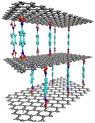
    One promising solution to this problem is to exploit the fact that many solid materials will absorb large amounts of hydrogen. Graphene oxide is a sheet of carbon and oxygen just one atom thick, and hydrogen can be stored between the layers in stacks of this lightweight material. The challenge is to get the spacing between layers just right to reach maximum storage capacity.
    Connector molecules
    Now, Taner Yildirim and colleagues at NIST and the University of Pennsylvania have boosted the storage capacity of graphene oxide by using organic “connector molecules” to separate individual layers by 1.1 nm. This is three times more than the inter-plane distance in bare graphite – which comprises stacked layers of graphene.
    “Being able to control this width is important for a number of applications, including hydrogen storage,” explains team member Jacob Burress. He says that the interlayer spacing can be controlled to optimize hydrogen adsorption. The idea is to have pores that are small enough to maximize the interaction between hydrogen and the surface of the frameworks, but at the same time large enough to hold two layers of adsorbed hydrogen.
    The team took its inspiration from work already done on metal-organic frameworks (MOFs), widely studied materials for hydrogen storage. Here, inorganic nodes are connected by organic struts using well established chemistry techniques. In the new work, the metal oxides are replaced with graphene oxide and the struts with diboronic acid “pillars”.
    Future optimization
    The GOFs can store roughly 1 wt% of hydrogen at 77 K and 1 bar. “This is less than one fifth that the ‘ideal’ GOF structure can hold, according to state-of-the-art computer simulations,” says team member Wei Zhou. “Based on our adsorption simulations, the ideal GOF structure can adsorb hydrogen up to 6 wt% at 77 K and atmospheric pressure, suggesting that our GOF materials could be significantly optimized in the future.”
    As important as its hydrogen-storage properties are, the fact that graphene-oxide production can easily be scaled-up to industrial quantities is a big advantage too. What’s more, it is inexpensive and thought to be safe for people and the environment.
    The team also discovered that the hydrogen-adsorption kinetics of GOFs are different compared with other materials. At lower temperatures, there is little adsorption and hardly any hydrogen gas is released either. This means that the material can be loaded with gas at higher temperatures and then cooled below this blocking temperature to hold the hydrogen in place. Gas will not be released until the sample is allowed to warm up. Ideally, this blocking temperature needs to be as close to room temperature as possible for practical applications.
    Drug delievery
    “We expect to see more work on graphene oxide where it is linked by many different connectors for a variety of chemistry and physics applications,” Burress tells physicsworld.com. “We anticipate these materials to be very useful not only for hydrogen storage but for other gases such as ammonia and carbon dioxide as well.” He also hinted at medical applications: “Once the graphene-oxide layers are separated by sufficiently large distances, one could also imagine adding some biomolecules for drug delivery”.
    The researchers now hope to look into possible electronic applications for the GOFs because they may be useful as conducting materials for fuel cells or batteries. Another possibility is to use the GOFs as sensors, where gas adsorption leads to a measurable change in the material’s electronic properties.
    The next immediate step is to optimize hydrogen-storage capacity, says the team. This could be achieved in a number of ways: including removing unreacted hydroxyl groups to increase the useable surface area; and optimizing the linkers in terms of concentrations and chemistry.
    “We also want to understand the nature of hydrogen-adsorption kinetics and how we can use it to our advantage!” says Burress. “This is just the beginning of new research and there are many new experimental avenues to follow.”
    The research was presented last week at the March Meeting of the American Physical Society.
    About the author
    Belle Dumé is a contributing editor to nanotechweb. This article first appeared at physicsworld.com.
  • One Man’s Obssession with Beer Mats

    Sven Goebel from Germany has a lot of time on his hands. I mean, a lot. Sven recently won a place in the Guinness Book of World Records for building the world’s largest house built from beer mats.

    Goebel took three months to build the house, painstakingly stacking over 250,000 beer mats against each other to create a house with tables and chairs inside also constructed from beer mats. You can watch it all fall apart here…


    Related posts:

    1. Beer Bottle Chandeliers Will Dress Up Any Frat House
    2. Finally – Space Beer is Here
    3. Brewery Creates ‘World’s Strongest Beer’

  • Thermo Ionic Desalination


    You need to jump to the sub title Salt works and try to figure out what they are saying.  It is a bit of a slog.
    Yet the important claims been made is that they are able to operate with 80% less energy which is no small claim.  My guess though is that the hardware will be much more complex.  The way more compelling claim is that they can produce solid salts.
    Desalination is already a huge capital intensive industry. Operating efficiency matters.  Reducing the energy cost is a huge improvement.  Yet as costly has been the constraints created by the removal of saline water.  It has been in the form of brine and is typically simply released back into the ocean were it has long since been bothersome.
    This approach reduces the removed salt to the form of cake.  That means it can simply be stored on land were its effect can be minimized.
    So though this is another industrial solution and obviously capital heavy, the combination of energy saving and salt saving could make it far more competitive than any present competitor.
    O Canada! Land of Water Innovation!
    Can thermo-ionic desalination reduce the high cost of making seawater drinkable?
    YONI COHEN 04 06 10
    Recognizing that water is a rapidly expanding $400 billion global market, many investors pledge a theoretical interest in water innovations. But in practice, window shopping is the norm.  Concerned about the capital intensity of many water projects and the length of water startups’ time to market and sales cycles, numerous American venture firms have made only a single water investment. As a result, many firms are not well prepared to evaluate and embrace the next great water startup. 
    “If you have done just one, you don’t know the 100 different pieces of the value chain and the market segment,” says CMEA Capital’s Rachel Sheinbein, who used to help Intel address wastewater challenges. “Something else comes in and it is totally different. It is like saying ‘energy.’ There are so many pieces of [the water market].” 
    North of the border, in Canada, there is a lot less hesitation.   
    In March, the Government of Ontario announced it would later this year introduce aggressive legislation to promote Ontario as an international leader in clean water entrepreneurship and investment. Last week, the Ontario Centre for Environmental Technology Advancement (OCETA) and XPV Capital followed up on the government’s announcement with a new report. “The Water Opportunity for Ontario” draws attention to Ontario‘s research institutions, water regulations and standards, and water industry, including the region’s “track record in creating world-class water technologies.” Some examples are Zenon Environmental, a wastewater treatment firm purchased by GE, and Trojan Technologies, a leader in ultraviolet water purification purchased by DanaherCorporation.  
    In 2010, Toronto-based XPV Capital will soon close a $150 million fund dedicated exclusively to stage-agnostic investments in emerging water companies. To put the fund in perspective, consider that in 2009 venture capitalists invested about $150 million in water innovation — total.  (Ontario is also making a big push in solar and has attracted big-name partner Samsung.)
    “The rate of adoption is accelerating in water. The primary [reason] is that the value proposition of water technology has shifted from a regulatory value proposition,” said XPV Capital’s David Henderson. “A lot of the technology in the 1980s and 1990s were about bad bugs in drinking water. What is happening now is more economic drivers — the fact that a third of a municipality’s energy bill is moving and treating water. That’s a big bill that you can attack with technology.” 
    XPV Capital is particularly bullish on investment opportunities in four broad water areas: demand destruction, wastewater to product, water reuse, and infrastructure renewal.  Said Henderson:
    ·                        “Demand structuring is all about how we reduce the demand for energy, water, chemicals, [and] other inputs in mission critical water processes without changing the output of the processes.”  
    ·                        “Wastewater to product is taking the valuable resources that are found in wastewater streams and translating them into value-added products.”
    ·                        Water reuse is taking [wastewater from] industrial, municipal, [and] commercial, buildings, uses and instead of treating it to be discharged back into the environment, treat[ing] it to be discharged for other applications.”
    ·                        “Infrastructure renewal technology can extend the life, expand the capacity, or increase the productivity of [water] infrastructure – a big area for North America.”
    But even water enthusiasts such as Henderson and Sheinbein recognize the sector’s challenges.  
    “There are definitely elements in the [water] industry where venture capital doesn’t make sense, but there are segments in the industry where it does make sense. A technology that can drop the energy equation in a desalination process by fifty to seventy percent is very financeable under any venture capital model,” said Henderson
    Trouble is, most of the recent advances, at least in desalination, have been incremental in nature.  
    “I’ve seen membranes [and] I’ve seen changes in distillation.  But they are not really breakthroughs,” said Sheinbein. “They use too much energy or, from a venture capital perspective, they need to build $100 million plants because they only make sense on that scale. I’m looking for things that are not iterative on what I learned in my chemical engineering classes.” 
    Saltworks: Thermo-Ionic Desalination
    In Vancouver, startup Saltworks Technologies claims exactly such a disruptive innovation and value proposition. 
    “Saltworks has developed an energy-efficient desalination technology that reduces electricity costs by up to 80 percent,” said Malcolm Man, Saltworks’ Vice President of Business Development.   
    To appreciate Saltworks’ approach, begin with a refresher course in chemical engineering. Today, desalination takes place primarily through distillation or reverse osmosis.  During distillation, water is heated and vaporized to remove salt, then condensed to produce fresh water. During reverse osmosis, pressure gradients drive water through a semi-permeable membrane through which salt cannot pass.  Both approaches are energy-intensive and thus expensive. 
    To reduce energy costs, NanoH20 is developing a more efficient membrane for reverse osmosis and Oasys Water is using ammonia salts to encourage forward osmosis, i.e. the water is drawn through the membrane due not by pressure but due to its natural attraction to an extremely salty solution on the other side.
    Saltworks is promoting a different approach, using ion bridges to create an electrical circuit that manipulates salt. Similarly, researchers at MIT and in Korea recently announced their successful small-scale testing of desalination based on passage of water through ion-selective materials.  
    To understand Saltworks’ thermo-ionic desalination method, recall that salt is composed of negatively charged chlorine ions and positively charged sodium ions. Saltworks’ process begins with four separate streams of seawater or brackish groundwater. Using either a solar thermal pond or industrial waste heat, the first stream of seawater, for example, is evaporated until its salt concentration rises from its natural 3.5 percent to more than 18 percent. This first high-salinity stream is then pumped at low pressure into Saltworks’ desalting device. 
    Inside the device, the first high-salinity stream is connected using ion bridges to the second and third natural seawater streams, whose salt concentrations are only 3.5 percent.  Made of polystyrene, the ion bridges have been treated so that one allows only negatively charged chlorine ions to pass (from the first stream to the second stream) and the other allows only positively charged sodium ions to pass (from the first stream to the third stream).   
    The second and third streams are also connected to the fourth seawater stream. To maintain its electrical balance, the second stream pulls positively charged sodium ions from the fourth natural stream. Similarly, the third stream pulls negatively charged chlorine ions from the fourth stream.  In the process, the fourth stream is stripped of its ions and desalinated. 
    “Our technology can hybridize with existing [desalination] plants,” said Saltworks’ Man. “For example, a reverse osmosis plant produces a high-brine concentration discharge. We use that as our fuel.  What we can do is take that fuel, recover more water from it and produce a solid salt with zero liquid discharge.” 
    To date, Saltworks has raised about $1.3 million and received about $2 million in government grants.  The company has a one cubic meter per day demonstration plant operating, where it extracts seawater from Vancouver harbor and produces fresh water. Skeptics wonder whether the process will work over time, can clean water to a degree necessary, and address other issues, but it’s definitely an intriguing concept.
    “We’re looking [for] up to $10 million for our Series A financing…to continue operations [and] IP protection, deploy four mobile demonstration plants to key industrial and municipal customers, and start our manufacturing capabilities to reduce costs,” said Man.  
    Yoni Cohen is a JD-MBA student at the Yale Law School and the Wharton School of the University of Pennsylvania.  He previously worked as a reporter for Fox Sports, among other jobs.
  • Twenty Six Point Two

    Go
    Creative Commons License photo credit: kaneda99

    “It is not the mountain we conquer but ourselves.” ~ Sir Edmund Hillary, New Zealand mountaineer and explorer

    We head out into this life we're living, a journey in some direction.  For each of us.  And along that journey, we encounter crossroads, new paths, paths less traveled, paths traversed quite well.  These paths – and there are millions of them out there in this world we call "life" – are all directions we can choose to go in.

    Choice.

    "You have brains in your head. You have feet in your shoes. You can steer yourself, any direction you choose." ~ Dr. Seuss

    Today, I am putting the feet that I have into a good pair of running shoes.  I am choosing to compete in my first marathon.  The Milwaukee Lakefront Marathon.  October 3rd, 2010.

    26.2 miles.  That is the mountain.  And yet, it will become not this mountain that I conquer, but myself. 

    This conquering of myself will be no easy task.  There will be moments of doubt.  In fact, I know this – as there have already been moments of doubt.  There will be aches and pains that I haven't felt before (and there already have been).  There may be moments where I question what I was thinking in signing up.  There will surely be moments where I won't want to put in another long run. 

    That's why I've brought on the best coach – Coach Lori.  She's been there.  She knows what it's like – the training, the time, the aches, the challenges…and the conquering of ourselves. 

    And that's it.  As amazing as I anticipate it will be to cross that finish line, the bigger thing for me here, is the going deeper within myself.  This WILL be a challenge for me.  A challenge both physically and mentally.  It's in this challenge, that – in the words of Sir Edmund Hillary – I will conquer myself.  And perhaps I have already.  At some level, I have.  With the challenges, the mountains, that I have faced already in life.  This becomes a new layer, as I go deeper within.  A new conquering of myself. 

    Perhaps that is really it.  On this life journey we are each on, there will continue to be new challenges for us to face.  Some of these challenges will be ones we bring on, and other will happen by chance.  I believe very much that the challenges we choose to conquer for ourselves will better prepare us for all that lies ahead. 

    Today I choose the Milwaukee Lakefront Marathon as that next challenge, and the next conquering of myself.

    The journey continues…

    As it does for all of us.

  • Dodd Bill Update: Listening to the Market

    James Geshwiler wrote:

    Like an entrepreneur listening to market feedback while designing a product, Senator Christopher Dodd (D-Conn) has made some improvements to features of his pending legislation that we described last month. Originally designed to fight the “too big to fail” problem in the financial markets, many constituents—including the Angel Capital Association and the National Venture Capital Association—have highlighted that it could inadvertently render startups “too small to succeed.” These new enhancements are steps in the right direction. The legislation is still pending, however, and other voices—particularly state regulators seeking more power—could oppose the amendments and hinder entrepreneurs.

    Senator Dodd has proposed two amendments to his own legislation based on feedback from the entrepreneurial community. One would leave the current standard for accredited investor at a net worth of $1 million (as previously proposed, the bill would have more than doubled this figure) but would add a new provision that the calculation would exclude the value of the investor’s primary residence. It also would allow the Securities and Exchange Commission to revisit the definition periodically. The other amendment would maintain regulatory consistency across states for entrepreneurs raising money while disqualifying parties who have been identified as “bad actors” by state or federal regulators.

    While no change to the accreditation standard would have been preferable, Dodd’s new approach is a reasonable compromise. The change to the regulatory environment provides uniformity for entrepreneurs while increasing investor protections for all types of private fund raising.

    Many state regulators reportedly are still continuing to seek to expand their control over private fund raising and might oppose these positive steps for entrepreneurs. We hope Senator Dodd and his colleagues continue their support of entrepreneurship, job creation, and economic growth and pass the legislation and these amendments.


  • HTC recoils from Palm after seeing its numbers

    donotwant Reuters report that HTC, which was initially enamoured with Palm and considered a union, recoiled in horror after seeing the veteran company without make-up.

    After HTC did their due diligence and examined the companies internal books, Reuters’s sources report HTC is no longer interested in hooking up.

    "There just weren’t enough synergies to take the deal forward," said the source with direct knowledge of the matter, who declined to be named because the deal had not yet been made public.

    HTC Chief Financial Officer Cheng Hui-ming and Lenovo spokeswoman Angela Lee both declined comment. Palm has said they still believe they can go it alone, and has expressed further interest in licensing their OS.

    "It’s a good thing that HTC is dropping it because Palm has been losing money for a while now, and when you look at the two companies, they share such a similar profile," said Lu Chialin, an analyst at Macquarie Securities.

    "A more suitable candidate will be mainland China companies, because they’ve got a lot more free cash and don’t have the brand presence in the U.S. yet."

    However both Huawei and ZTE, which have been rumoured to be interest, are out of the deal, leaving Lenovo the last one standing. Whether that interest can withstand the scrutiny that due diligence required of Palm, who has not made money in 13 quarters, remains to be seen.

    We know we would certainly have preferred an HTC end to Palm’s story.  What do our readers think? let us know below.

    Via Engadget.com


  • BREAKING: Greece Prime Minister Says He’ll Ask The IMF For Help

    papandreou

    According to Bloomberg Radio, Greece Prime Minister George Papandreou has confirmed that he’ll formally ask for the latest $45 billion aid package from the IMF and Europe later today.

    ATHENS, Greece (AP) — Greek Prime Minister George Papandreou has called for the activation of a joint eurozone-International Monetary Fund financial rescue to pull his country out of a major debt crisis.

    Papandreou, speaking from the remote Aegean island of Kastelorizo, said he had asked Finance Minister George Papaconstantinou to make a formal request for the plan’s activation.

    The prime minsiter says the markets have not responded positively to Greece’s austerity measures, and that it is now a “national and pressing necessity” to call for the aid.

    The rescue package will provide Greece with loans from other eurozone countries to the tune of euro30 billion ($40 billion) at interest rates of about 5 percent, and about euro10 billion from the IMF.

    Join the conversation about this story »

  • Gorenje’s Carbon Fiber Fridge: Last Seen In Batman’s Kitchen [Kitchen Appliances]

    Gorenje, the company that brought us the iPod-docking fridge, has created the next fridge of our dreams—carbon fiber, baby. The induction hob shown below is also the stove of our (concentric) dreams: More »


  • German Officials ‘Horrified’ by Google Street View WiFi Snooping

    German privacy regulators love to get everyone worked up about various, horrible privacy violations companies engage in. But it is their job after all, so maybe there’s nothing to read into it. Their favorite target of late is Google and especially its Street View product, which isn’t even available in Germany yet. The s… (read more)

  • Asking the climate question in the North West

    There’s more to this election than TV debates. Tristan finds out more about the election meetings Oxfam have been organising around the country to “ask the climate question”.

    In an election in which a series of historic leadership debates takes place on TV, it could be easy to think they were the only events that mattered. That’s not the case. On the 21st April Oxfam hosted the hustings (political meetings between candidates and voters) in the South Ribble Banqueting Hall in Lancashire.

    Following its success, next week on the 28th we’re hosting another one, this time in Bury North, at the Fusilier Museum in Bury itself. These debates challenge parliamentary candidates in two of the country’s most closely fought constituencies to explain where they stand on the issue of Climate Change and could potentially prove crucial come May 6th.

    These are just two of a series of events taking place across the country as part of the national ‘Ask the Climate Question’ Campaign. Supported by ten different environmental and development Non Government Organisations (NGOs) and charities, it aims to make climate change an election issue and ensure our next government, whichever party gets into power, is fully committed to UK emissions reductions and a ‘fair’ and ‘adequate’ international agreement on climate change.

    As you might have guessed from the campaign’s name, it asks voters to join in by simply ‘Asking the Climate Question’ to their local candidates, be it on the doorstep, at a local hustings or even in writing. Its both an easy and effective way to raise a crucially important issue and draw attention to what is arguably the greatest threat to the world’s poor.

    As a self-confessed politics geek with a passion for tackling climate change it’s been a joy to be charged with helping organise the debates in the North West and come Wednesday 28th I’ll be there in Bury climate change question to hand and listening carefully.

    Find out more about Oxfam’s work on climate change

  • iPad Is First Computer 100-Year-Old Woman Bought [Ipad]

    The iPad is so easy to use, a cat can play with it. So can a dog! But what about a centenarian? Virginia of Oregon bought her first computer—an iPad—and as the video shows, she’s a whizz. More »