
Category: News

  • Sprint is giving away 10 HTC Evo 4Gs to Sprint Premier customers

    I have no idea what being a Sprint Premier customer does for you on most days, but today it is offering you a kick ass contest from Sprint that could potentially net you an HTC Evo 4G, a trip to Maui, Chicago, Las Vegas, or Houston, and $4,000.

    So the first step is to figure out if you are a Sprint customer; look down at your phone and if it says “Sprint” on it somewhere then chances are good that you can check this one off the list.

    Now you need to verify whether or not you are a Sprint Premier customer. If you have an individual account with a base rate plan of at least $69.99, or a family plan with a base rate plan of at least $99.99, or if you have been a Sprint customer for at least 10 years you qualify. If you meet the requirements but have never bother to sign up you can do so right here.

    Alright, now you can finally hit the contest page to enter. It’s a little more involved than just hitting an enter button, but not too bad. The only thing that will require any thought is the “fast fact” essay (150 words or less) that tells them what you can do really fast. This can be basically anything, but you are being judged on creativity and “entertainment value” so I would steer away from the first five things that pop into your head.

    You’ve probably already made your way to the contest page by now, but just in case you are sticking with me for some reason here is a more complete description of the prizes. There are 10 HTC Evo 4Gs that will come with a free year of service. These 10 are the Semi-Finalists and they will have to blog about their experiences with their Evo 4G. The top 4 bloggers as selected by Sprint (the Finalists) will then be given a long weekend trip to one of the four aforementioned cities. Finally the public at large will get to vote on their favorite among the four bloggers and the winner will receive $4,000.

    What? What are you still doing here? Get out there and enter!

    Related Posts

  • Fast food salads worse for you than KFC’s meaty Double Down

    by Tyler Falk

    So you’re boycotting KFC because you think its extra-meaty
    Double Down sandwich (two chicken breasts, hold the buns) is nasty. But you’re running late and need
    food now. You opt for a healthy option at Burger King—a salad (the Tendercrisp
    Garden Salad, to be exact). Not so fast, McFoodie. The
    Consumerist has a list of 10 fast food items that are worse for you than the Double
    Down, and three of them happen to be faux-healthy salads.  

    The Double Down’s nutrition line is surprisingly low: 540
    calories, 32 grams of fat, and 1,380 milligrams of sodium. Not surprisingly,
    the numbers are being disputed, but if you believe KFC, the Double Down is
    healthier than:

    Burger King’s Tendercrisp Garden Salad (670 calories, 45 grams fat, 1,740 milligrams sodium)
    Wendy’s Chicken BLT Salad with Honey Dijon Dressing (720 calories,
    51 grams fat, 1,540 milligrams sodium)
    Wendy’s Southwest Taco Salad with ranch dressing and tortilla strips (640 calories, 36 grams fat, 1,590 milligrams sodium)

    But let’s not be fooled, the Double Down is still a gross
    symbol of our meat-addicted culture and a blatant play on the notion that
    meat-eating is masculine.

    ——————————————————————————————————————————————————————————————————————————-

    Like what you see? Sign up to receive The Grist List, our email roundup of pun-usual green news just like this, sent out every Friday.

    Related Links:

    Coked-out Coca-Colla [sic]

    Power your house with poop

    Prez steals, owes fines


  • Obama To Bankers: Remember When Creating The FDIC Was Going To Ruin The Economy?

    During the President’s address to Wall Street bankers today in New York City, he reminded them that their predecessors had completely flipped out about a bill that passed through Congress way back in 1933. It was, in their view, sure to “not only rob them of their pride of profession but would reduce all U.S. banking to its lowest level.” What was this reform bill?

    From the White House:

    So, yes, this debate can be contentious. It can be heated. But in the end it serves only to make our country stronger. It has allowed us to adapt and to thrive.

    And I read a report recently that I think fairly illustrates this point. It’s from Time Magazine. I’m going to quote: “Through the great banking houses of Manhattan last week ran wild-eyed alarm. Big bankers stared at one another in anger and astonishment. A bill just passed… would rivet upon their institutions what they considered a monstrous system… such a system, they felt, would not only rob them of their pride of profession but would reduce all U.S. banking to its lowest level.” That appeared in Time Magazine in June of 1933.

    The system that caused so much consternation, so much concern was the Federal Deposit Insurance Corporation, also known as the FDIC, an institution that has successfully secured the deposits of generations of Americans.

    What do you think? Does he make a valid point? Or is it apples and oranges?

    Remarks by the President on Wall Street Reform [White House]

  • AT&T Dell Aero, now with slower CPU and DRM

    I’m sorry AT&T. The more we learn about the upcoming Dell Aero, the less excited we are about the device. The last time we posted impressions of the Aero, it was running without any of Google’s applications or the Android Market. AT&T claims the final device will include the Android Market, but nothing would shock us at this point after they removed Google search from their first Android phone.

    New leaked product slides claim the Aero will come “equipped with one of the best in class processors”. This CPU is actually the low-end 624MHz Marvell (believed to be the PXA310).

    For those keeping score at home, that is the same CPU featured in the General Mobile DSTL1. That device was never certified by Google so it lacked their native apps and the official Android Market.

    Other notable details leaked about the Aero include a music store protected by Windows Media DRM, a 5 megapixel camera with flash, and the inclusion of a capacitive stylus with the device.

    Current speculation says the Aero will launch on AT&T this June. Look for a refreshed version late in the year that should add support for Android 2.1.

    Related Posts

  • Lane Bryant Commercial Ad Banned By ABC & FOX

    The Big Girls aren’t welcome on The Alphabet: Plus-size label Lane Bryant says that a commercial advertising their new line of lingerie has been rejected by ABC and FOX.

    Lane Bryant — which caters to the pleasantly-plum bodies of the world — was set to launch its campaign for Cacique, a new line of intimates, during this week’s Dancing With The Stars, but controversy erupted after ABC abruptly yanked the ad spot, insisting the models in the ad bared too much cleavage for the commercial to be aired in primetime.

    Lane Bryant thinks the Disney-owned network is “prejudiced against boobs” and has rallied cries of discrimination against the full-figured, an insider told The New York Post on Thursday.

    “The cleavage of the plus-size models, they said, was excessive, and we don’t think that’s the case. It certainly appears to be discrimination against full-sized women.”

    The brand also complains that FOX initially resisted the idea airing the ad during Wednesday’s episode American Idol. That network only relented after it was pointed out to executives that a commercial featuring the petite bodies of Victoria’s Secret models frequently airs between Idol segments.

    Thoughts on this? Is the new Lane Bryant commercial too hot for TV?


  • Is Apple Acquiring ARM? ARM Clarifies With a Big ‘No’

    Despite of all the speculation on Apple buying ARM, which took the internet by swarms, we were waiting for the inside scoop and it has appeared on eWeek finally. It is confirmed that Apple is not buying ARM and there are a good number of reasons for that.

    This news has been confirmed by ARM itself and the ARM CEO Warren East says,

    How this affected Apple?

    This news has not affected Apple at all. Apple, which clearly had no intentions to buy the book techarraz.com and firm enjoyed the movie. There were many speculations on why Apple should buy and why it should not buy ARM. The best one was that ARM is an investment of $8 billion to acquire a technology which is pretty much open and needs sharing to thrive. Apple could either attempt to stop this sharing which would send down ARM revenue or it could just buy and keep ARM as a souvenir, sit on it and keep losing money on it.

    How this affected ARM?

    ARM is the only one with a benefit from this deal which was not made. ARMs low stock prices rose up so high, it recorded an eight years high. ARM’s business design is such that it will thrive only if it runs on the current model.

    How this affected Intel?

    Intel, which could not make its ARM killer into a success now seems like the most suitable one to buy ARM. Now, Intel has an advantage of already being in thread same field.

    TAGS: ,
    Is Apple Acquiring ARM? ARM Clarifies With a Big ‘No’ originally appeared on Techie Buzz written by Chinmoy Kanjilal on Thursday 22nd April 2010 04:37:35 PM. Please read the Terms of Use for fair usage guidance.

    Don’t miss these Related Posts:

    Join Techie Buzz on Your Favorite Social Networking Sites


  • Be part of the solution: Do your share to preserve Earth’s ecosystems

    By Melissa Segrest
    Green Right Now

    Lemurs, a threatened species (Photo: Osoman/Dreamstime)

    Lemurs, a threatened species (Photo: Orsoman/Dreamstime)

    They are slipping through our fingers. Our tenuous hold on the Earth’s threatened animals, plants and fish, rivers and oceans, forests and ice caps is not strong enough. It’s not for lack of trying – environmental and eco-conscious groups are in a constant scramble to slow the lengthening list of losses.

    But the numbers tell the tale:

    Every year, more than 2 million acres of Amazon rainforest – called “the lungs of our planet” for its massive daily recycling of carbon dioxide into oxygen –  is lost to logging, agriculture, roads and more.

    At last count, out of 44,837 known species of living creatures on Earth, nearly 40 percent are threatened and 804 are extinct.

    Climate change could destroy one-quarter of all land animals and plants in 40 years, the Wildlife Conservation Society says.

    Amazon (Photo: House Select Committee on Energy Independence and Global Warming)

    Amazon rainforest, losses to logging and agriculture continue (Photo: House Select Committee on Energy Independence and Global Warming)

    Agriculture and overpopulation are draining some of the world’s biggest rivers that once flowed powerfully into the sea.

    There are many other threats – invasive species, water overuse, polluted runoff, overfishing, mining and poaching –  problems begun at the hands of men.

    The delicate web of the world’s eco-systems is fraying. Species survive because of other species, and those survive because of others: Pull a single strand from that web and the unraveling begins. The process can lead to destruction of all that exists within that finely balanced environment.

    An example:  Louisiana’s Lake Pontchartrain took a big hit from Hurricane Katrina in 2005, and the water that flooded into the lake was thick with agricultural runoff and sewage. That spawned algae growth, which clouded the water, which killed aquatic plants, which killed small fish that needed the plants to sustain them. Larger fish began to die, according to the U.S. Geological Survey.

    Another: The isolated island of Madagascar has an estimated 150,000 species unique to that place. But many are nearly gone, as 80 percent of the lush forests that sheltered them have given way to logging and agriculture. The people who live there are poor, and have survived by using the land. Conservation efforts have grown stronger, though, making eco-tourism and habitat restoration a new source of income.

    It’s fitting, then, that the United Nations has designated 2010 the International Year of Biodiversity. Humanity is part of that delicate biological balance – we depend on plants, animals, marine life and more for everything from medicine to supper.

    There is some good news.

    China's Pandas benefit from land being put into reserve and national parks (Photo: Wei Liang/Dreamstime)

    China's pandas benefit from land being put into reserves and national parks (Photo: Wei Liang/Dreamstime)

    China recently opened its country’s first national park, according to the Nature Conservancy. It is the beginning of building a national park system for China. The country has more than 2,000 nature reserves, but they are said to be poorly managed and none house as many endangered species as this single park.

    Halfway around the world, $26 million owed to the U.S. by Costa Rica was recently forgiven. In exchange, the small nation will maintain long-term conservation for its lush tropical forests and massive areas of biodiversity. The Tropical Forest Conservation Act will protect Costa Rica’s species from manmade threats.

    Here’s is even better news. You can help.

    Here are 8 ways you can help conserve the earth’s ecosystems:

    1. Rid your yard of invasive species. There are innumerable non-native species of animals, invertebrates, fish, bugs and plants plaguing the U.S. Most of them arrived as unseen stowaways at American ports. Others

    A field of juniper infested with Japanese climbing fern (Photo: University of Florida extension service.)

    A field of juniper infested with Japanese climbing fern (Photo: University of Florida extension service.)

    were brought in with good intentions: as a means of controlling other invasive or destructive species. Some were just pretty plants destined for the landscape, or exotic pets that were set free.

    Instead of solving a problem, or just sitting pretty, they took over, eating or smothering native vegetation, fish, insects or animals.

    Take, for example, the Japanese climbing fern, which arrived in America in the 1930s. It was brought here as a lovely tropical plant for the landscape. Unfortunately, the fern quickly spread out of control, overwhelming native plants in forests. Researchers are still looking for an insect or microbe that could take on the Japanese fern.

    You may have some invasive plants in your back yard, or in the neighborhood park. The USDA has a map that will tell you which invasives are hanging around your town.  Don’t start ripping out plants or grabbing bugs without talking to an area expert. There are many listed on the USDA site.

    2. Create a backyard wildlife habitat. While you’re in the mood to help the good members of the plant or animal world, you can set up you your own ecosystem – a backyard built to nurture your area’s wildlife.

    humingbd

    Keep a wildlife friendly backyard, with native plants to support birds and other animals (Photo: Natural Resources Conservation Service, USDA)

    There are plenty of Earth-friendly non-profit groups that will walk you through the process of creating a new home for your area’s natives, be it for a balcony garden to a farm. The right kind of food, a water supply, places for wildlife to hide and nest, all grown organically, can net you a certified wildlife habitat designation and other goodies from the National Wildlife Federation. The NWF offers guidance in their Garden for Wildlife online manual. The NWF has a drive on to certify 150,000 new wildlife habitats.

    State extension offices can advise you on this, too, and many states will give you an official designation if you follow guidelines and devote a certain amount of space to the project.

    3. Try to lure some bees for pollinating with native plants and flowers of different colors and shapes, planted in groups. Or set up for butterflies with a variety of plants (they like milkweed and thistles, but most people call those weeds), places for them to hibernate, lay eggs and for the caterpillars to eat. Butterflies like to hang around puddles of water when they make their warm-weather appearance. See the Pollinator Partnership for more information.

    4. Grow and buy organic food. If you don’t grow your own, try to buy from local organic farmers. Plants grown organically don’t use chemical herbicides or synthetic fertilizers, which leach contaminants into the water supply and ground, contaminating the natural environment. If your organic food is grown close to home, you have shrunk your carbon footprint to boot.

    Farmed oysters (Photo: Monterrey Bay Aquarium)

    Farmed grilled oysters with Miso and Wasabi (Photo: Monterey Bay Aquarium)

    5. Eat sustainable seafood, caught legally and in plentiful supply. For example, Mahi Mahi from the U.S. Atlantic that is caught by trolling with a pole and line is a good choice. Not sea bass: It is overfished, caught using illegal methods and may contain mercury. See the Monterey Bay Aquarium’s Seafood Watch for more information on how which fish to eat, and which to avoid. In honor of Earth Day, the aquarium has put out a list of Super Green seafood and recipes that rely on sustainably sourced seafood.

    6. Buy fair-trade and sustainable goods. Fair-trade goods are made in poor countries by workers who receive equitable pay for their labor. The eco-friendly jobs provide an alternative to more destructive means of subsistence that could wipe out ecosystems. Sustainable goods are those made from easily renewable natural resources that will not be depleted for future generations.  An eye toward items with a small carbon footprint (close to home, minimal transportation required) is a good idea. See the Fair Trade Federation website for details about how businesses are certified and how to find products from Fair Trade sources.

    7. Take an eco-tour. Your next vacation could be to a destination that takes steps to care for its environment and its people. Fair wages and jobs that sustain a nation’s rich eco-culture are the result.

    For example, a trip to Peru’s lowland Amazon rainforests offers access to the amazing, colorful birds of Tambopata, one of that nation’s most accessible forest birding areas. The International Ecotourism Society has details on that and many more eco-destinations.

    8. Plant a tree. It’s easy. Do a little research to find what trees are native and most beneficial to your area, then contact a nearby nursery that sells native plants. Plant your tree in the right place, at the right time of year. Arbor Day sounds good – the date can vary from state to state. Find your area’s Arbor Day here, and get your conservation efforts going.

    Copyright © 2009 Green Right Now | Distributed by GRN Network

  • Sprint is giving 10 lucky winners a free EVO 4G

    Don’t break your neck heading over there just yet. We all would love to get our hands on this phone, and the price can’t be beat. It’s free and this offer comes with a few other perks.

    You have to sign up as a Sprint Premier customer to win. The winners will not only get the phone for free but they will have it before it hit shelves. Sprint will also give away a job as a Sprint blogger, a “4G trip” or just cold hard cash. The winners will also receive a free year of service. To be a Sprint Premier Customer click this link, register and explain why you should be the winner in a 150 words. Good luck.

  • European Hero Eclair update scheduled for … June?

    HTC Hero update in June

    Don’t kill the messenger.  The Unwired reports that during a Google event in Europe today, HTC announced that the Android 2.1/Eclair update for European Hero will be released "later this summer".  Supposedly starting sometime in June, Hero owners will receive a preparatory update, followed shortly by the full on 2.1 update.  Details are a bit sketchy, but one thing is certain — the long awaited Eclair update is still scheduled to be released.  But is it too late?

    I’ll agree the shift from 1.5 to 2.1 is a big one indeed, and it’s possible that the speed at which Android is evolving might have left the Hero and other G2 class devices in the dust.  Let’s just hope that when it finally comes, it was worth waiting for.  No word from Sprint or any of
    the other CDMA carriers if this will affect their proposed update window, but I’m guessing the news won’t be good.  [via The Unwired]

  • Report: Audi RS5 to arrive Stateside by Sept 2011, again

    Filed under: , ,

    2011 Audi RS5 – Click above for high-res image gallery

    With European deliveries set to begin in just a couple of months, reports indicate that the Audi RS5 will, in the end, make it to the North American market, 444-horsepower V8 and all. But it could take a little while.

    The first RS5s will begin arriving in customers’ hands in Germany this coming June with a sticker price pegged at €65,300, representing a 32.4 percent price hike over the existing S5 coupe. Inside Line calculates that translates to about $88k by straight conversion, but applied to the U.S. market price for the S5, the 32.4% increase comes out closer to $69,500. Audi, however, doesn’t anticipate selling many of the super-coupes Stateside, and is therefore planning on bringing every RS5 over fully equipped, with the sport differential, Dynamic Ride Control system and Boysen sport exhaust.

    So equipped, sources peg the American price for a loaded RS5 at around $75,000. But Audi reportedly warns not to start counting the days just yet, as first North American deliveries likely won’t begin before August or September 2011.

    Gallery: 2011 Audi RS5

    [Source: Inside Line]

    Report: Audi RS5 to arrive Stateside by Sept 2011, again originally appeared on Autoblog on Thu, 22 Apr 2010 15:31:00 EST. Please see our terms for use of feeds.

    Read | Permalink | Email this | Comments

  • Massey denies time off for workers to attend funerals of mine victims

    by Jonathan Hiskes

    The coal and oil
    industries are really trying to outdo each other these days. Massey Energy, the
    criminally unsafe coal mining and intimidation company, refuses
    to give workers time off
    to attend the funerals of friends who died in
    Massey’s Upper Big Branch Mine, the Washington Independent reports:

    Massey Energy, the Virginia-based coal giant that runs the
    Upper Big Branch Mine, has denied time off for miners to attend their friends’
    funerals; has rejected makeshift memorials outside the mine site; and, in at
    least one case, required a worker to go
    on shift even though the fate of a relative—one of the victims of the April 5
    disaster—remained unknown at the time
    , according to some family members
    and other sources familiar with those episodes. In short, the company might be
    taking heat for putting profits and efficiency above its workers, but it
    doesn’t appear to have changed its tune in the wake of the worst mining tragedy
    in 40 years.

    “They told my
    husband, ‘You’ve got a job to do and you’re gonna do it,’”
    said the wife of
    one Massey miner, referring to the funerals he’s missed this month for friends
    who died in the blast. “What else are we
    gonna do?”

    Such anecdotes aren’t easy to come by. Massey—the top coal producer in Appalachia—has built a reputation
    of intimidating its workers into a type of lock-step compliance that most often
    takes the form of silence
    , particularly when the subject revolves around
    safety in the company’s mines. The reason is clear: Massey is the economic engine in parts of West Virginia, and there’s a lingering fear among
    many workers that any grumbling could leave them unemployed. Some former
    employees said this week that the reluctance of Upper Big Branch miners to
    discuss the conditions inside those tunnels prior to the blast is no accident. [Emphasis mine.]

    Bet the offshore
    drilling folks are hoping this takes some attention away from the rig that
    collapsed into the Gulf of Mexico today.

    Our running tally of fossil-fuel
    industry disasters of late:

    The oil rig explosion,
    which injured 17 workers, left 11 missing, and is spilling crude oil and
    possibly diesel into the Gulf.
    The awful coal-mine
    explosion
    that killed 29 men under the criminal safety record of
    Massey
    Energy CEO Don
    Blankenship
    .
    The crash
    of
    a coal freighter
    into the fragile Great Barrier Reef as it tried to
    take
    a shortcut from Australian mines to Chinese furnaces.
    The Tesoro oil
    refinery explosion
    that killed five workers in Washington state.

    The spillage
    of
    18,000 gallons of crude oil
    from a Chevron into a canal in the
    Delta
    National Wildlife Refuge in Louisiana.

    Remember, the people
    making money off these businesses are the ones fighting hardest against a
    clean-energy bill. They say this is the best we can do.

    Related Links:

    Hey, look: Denver has a bike-sharing program

    Burning oil rig sinks into Gulf of Mexico

    Earth Day: Profiling Coal’s Eco Heroes


  • Small scale farming & micro farming: Free resource for your customers

    Education for small scale farming customersMARKETING: Here’s a link to receive a free brochure on the problems of GMOs, courtesy of the Organic Trade Association, for small scale farmers and micro farmers who would like to hand them out to their customers.

    The brochure can be put in with CSA shares, given out at roadside stands and farmers’ markets, and even linked to online from your farm’s website. — www.MicroEcoFarming.com

  • Earth Day 1970: That was then, this is now – A photo montage and notes of hope and despair

    Anneat11yrsold-fIt was spring, 1970.  Apollo 13 had just barely made it back safely.  We were about to invade Cambodia. The Beatles had just disbanded. Men wore ties so wide you could use them for napkins, mini-skirt lengths were finally coming down. I was 11, a 6th grader, tall, lanky, nerdy, awkward, and really worried about our planet — already.  Fresh memories of the tumultuous sixties lingered in the air, as did the pollution.  It hung over DC like stale cigarette smoke.

    Our assignment was to clip relevant news articles, and be ready to talk about the significance of the first Earth Day in class.  I recently unearthed my class project in storage and decided to show-and-tell, 40 years later.

    Guest blogger Anne Polansky has a blast-from-the-past repost — her version of “The Wonder Years.”

    Anne is a long-time friend and colleague who applies her training in the Earth sciences and public policy to effect positive change in government and the marketplace, with a strong focus on global climate disruption and sustainable energy policy and practices.  The photo is a school pic of Anne at ~11 yrs old.

    Gone are Gaylord Nelson and Ed Muskie, but founding organizer Denis Hayes, bless his soul, is still with us!  After an entire career devoted to environmental protection, it’s hard not to assess progress, admit defeat.  We did manage to get some strong laws on the books (e.g. Clean Air Act, Clean Water Act), raise awareness, but it hasn’t been enough.  Mother Earth is still choking, dying, it seems.  Meanwhile, enviros still hold rallies, polluters still pollute, blatant green-washing still abounds, and we continue to log in more devastation, destruction, degradation.  Where is the hope?

    Welcome to my personal scrap book, a photo montage of my 6th grade Earth Day One homework assignment.  A pretty cover page was always the key for a good grade – looks like I threw in some extra credit too.  Strangely, I recall the feelings I had back then, as a pre-teen, clipping these articles, absorbing all the Earth Day hype, feeling hopeful and excited but also concerned.
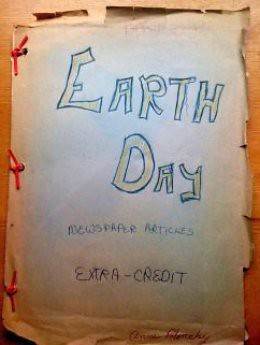
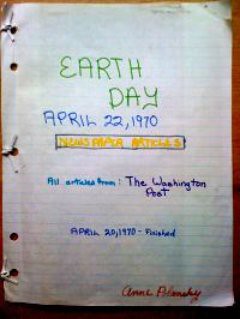
    Earth Day  1970 - 1f Earth Day 1970 - 3f

    ~ ~ ~ ~ ~ ~

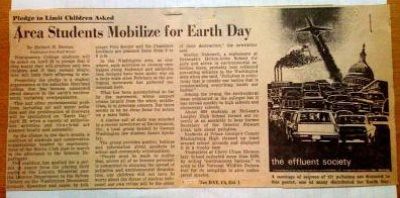
    This clip is about students engaging in grassroots Earth Day stuff.
    Earth Day  1970 - 5f

    If you can’t make out the tag line for the cartoon, it says “the effluent society” and it shows a snarly traffic jam near the US Capitol (leaning as if about to topple), smoke stacks, and a jet with a nasty black contrail, totally exaggerated and unrealistic but it gets the message across.

    The opening paragraph would incite the anti-Earth-anti-liberal-anti-science-anti-IPCC crowd, providing rich material for another big attack-dog-style media go-round.  Recall the recent spate of attacks on presidential science adviser John Holdren for even mentioning the need to start thinking about limiting population growth in a 1970s book co-authored with Paul Ehrlich?

    Montgomery College Students will be asked on April 22 to pledge that if they marry they will produce only two children and if they remain single, they will limit their offspring to one.  Promoting the pledge is a student organization at the suburban Maryland college that has become concerned about dangers to the earth’s environment, including overpopulation.

    Another quote from this article is a real jaw-dropper:

    What has been accomplished so far by the movement, whose support comes largely from the white, middle class, is to generate concern.  But there seems to be no clear focus for action on a mass basis.

    Wow. Racial and socioeconomic profiling, plus a wildly inaccurate prediction, wrapped neatly in one paragraph!  Wash Post staff writer Herbert H. Denton really ought to write a retraction of that one!   (by the way, I looked him up to see if this is actually possible, but, RIP, he passed away in 1989.  His obituary says he was “one of the first blacks to reach a position of authority in the newsroom of the Post,” he died at the early age of 45 from AIDS. This discovery is a story all by itself…)

    Let’s move on to the next one.

    ~ ~ ~ ~ ~ ~

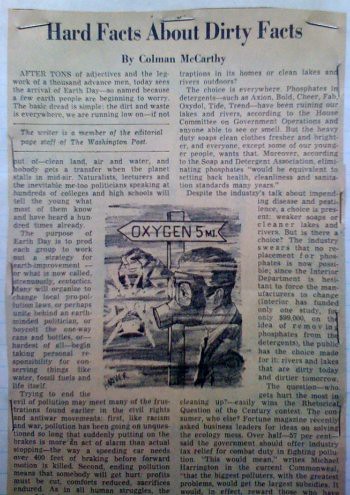
    Washington Post icon Colman McCarthy posts “Hard Facts About Dirty Facts” on the editorial page.  The cartoon is of a business man wearing a gas mask, the arrow on the sign says “Oxygen 5 miles.”
    Earth  Day 1970 - 14f

    Here are a few juicy excerpts:

    The lede:

    AFTER TONS of adjectives and the leg-work of a thousand advance men, today sees the arrival of Earth Day — so named because a few earth people are beginning to worry.  The basic dread is simple:  the dirt and waste is everywhere, we are running low on — if not out of — clean land, air and water, and nobody gets a transfer when the planet stalls in mid-air.  [Blogger’s comment:  Does anyone else recall farmer-types legitimately objecting to the word “dirt” to describe pollution, since it’s synonymous with “soil”?]

    Third paragraph:

    Trying to end the evil of pollution may meet many of the frustrations found earlier in the civil rights and antiwar movements: first, like racism and war, pollution has been going on unquestioned so long that suddenly putting on the brakes is more an act of alarm than actual stopping — the way a speeding car needs over 400 feet of braking before forward motion is killed. Second, ending pollution means that somebody will get hurt:  profits must be cut, comforts reduced, sacrifices endured.  As in all human struggles, the powerful and monied will fight the hardest to be hurt the least.

    Blogger’s comment:  So, McCarthy just puts it out there, plain and simple. In 1970 he nails the two most inconvenient truths of the environmental movement:  power and money.  And he essentially tipped off the US Chamber of Commerce who had their marching orders for the next several decades (and is still running strong).  Colman McCarthy knows of these things:  he has spent his entire life fighting the rich and powerful in a life-long struggle against violence and war, and has built a rich peace activist legacy.

    His concluding remarks:

    The question raised by an earth suddenly turned cesspool, after millions of years of grace and purity, is forcing a definitions of man:  is he a co-creator or a violent destroyer?  The hope of Earth Day is that we are the former, that survival, even self-improvement, is still possible.  But even here the evidence is mixed.  The very signs, posters, buttons and pictures used to dramatize April 22 will become tomorrow just more piles of junk and garbage to be hauled off to the burning ground — as much a pollutant to the air and earth as any Detroit smokewagon guaranteed to be damned more than once today.

    Blogger’s comment: He has a point.  It’s the same thinking that causes some to accuse IPCC scientists of polluting the air in the dozens of commercial flights they take while doing their research and attending meetings and others to accuse Al Gore of living in a gluttonous mansion just outside Nashville.  At the big rally this Sunday the 25th, how many will travel via SUV to get there?  How much litter will be left behind?  In the scheme of things these offenses amount to tiny misdemeanors, but, walking our talk is part of the deal.   How many of us do it?

    OK, onward.

    ~ ~ ~ ~ ~ ~

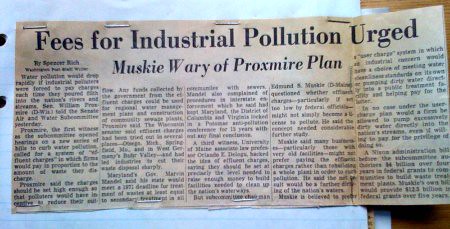
    Here, Washington Post staff writer Spencer Rich reports on a US Senate hearing held on April 21, 1970, to address solutions for cleaning up our nation’s surface waters.
    Earth  Day 1970 - 11f

    The hearing was a key part of the national dialogue that would culminate in passage of a seminal environmental law then known as the Federal Water Pollution Control Amendments of 1972, later to be known simply as the Clean Water Act.  Just the summer before, the Cuyahoga River in Ohio had caught on fire, again.  It was notable not because it was the first time oil slicks had burned on flowing river water, but because the public paid attention this time, and a growing number of us decided we wanted our lakes and rivers and streams to flow clear and clean again, as they once did.

    The discussions in the hearing are eerily similar to the intense battle we’re now witnessing between those who would cap CO2 emissions (but allow for trading of emissions rights) and those who would simply slap a rising price on carbon to discourage escalating greenhouse gas emissions.

    On this spring day in 1970 Democratic Senator William Proxmire from Wisconsin is testifying before the Senate Subcommittee on Air and Water, chaired by Sen. Edmund Muskie of Maine.  Alongside Proxmire as a hearing witness was Maryland Governor Marvin Mandel. Proxmire is championing a bill that would charge a fee for water effluent discharges and thus raise revenue for waste water treatment facilities and regional water plans.  Chairman Muskie is skeptical of the idea, not because he’s against regulating water pollution emitters, rather, he’s concerned that such a scheme would result in industry viewing the law as a “license to pollute” especially if the fees were set too low.  Sound familiar guys?  Muskie went on record as preferring “water cleanliness standards” for effluents (essentially, a cap on pollution), with a back-up alternative to send polluted water straight to the treatment plant and to pay for the service.  How amazing is that?  The very same dynamic is in play at this moment, as the US Senate works through its schizophrenic stance on climate and energy policy leading up to major legislation addressing climate change.  So back in 1970 we were seeing an earlier and wetter version of Cap-and-Trade vs. Price on Carbon.

    ~ ~ ~ ~ ~ ~

    Moving on…

    Hey, is this a great photo, or what?

    Earth Day  1970 - 7f

    Taken in a US Senate hearing room on April 21, 1970, the photo shows (left to right), Senator Edmund Muskie (D-ME) and Senator William Proxmire (D-WI) talking with Maryland Governor Marvin Mandel, during the hearing mentioned above about how best to regulate water pollution. (Marylanders especially will recall that Mandel was found guilty in 1977 of mail fraud and racketeering and served jail time; President Reagan commuted his sentence.)  Muskie and Proxmire each earned notable legacies as pioneers of pollution regulation and the environmental movement.

    Sen. Gaylord Nelson, not shown here but chairing the hearing that day, was a primary force behind envisioning and implementing the very first Earth Day.  Years later he was asked about the its enormous success as a grassroots movement:

    We had neither the time nor resources to organize 20 million demonstrators and the thousands of schools and local communities that participated. That was the remarkable thing about Earth Day. It organized itself.

    ~ ~ ~ ~ ~ ~

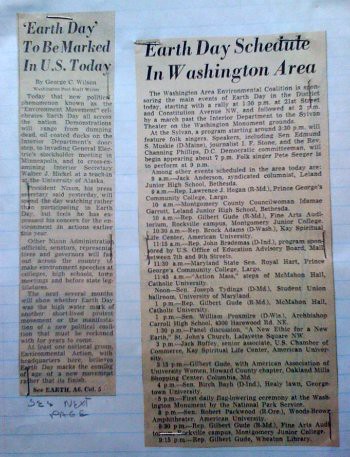
    On April 22, 1970, Earth Day was breaking out all over the place.
    Earth Day 1970 - 8f

    In high schools, colleges, churches, community centers all over the DC area – and in towns and cities nationwide — speakers were invited to talk about the nascent environmental movement and the many environmental challenges ahead.  Locally, Senators Bill Proxmire (D-WI), Bob Packwood (R-OR) and Birch Bayh (D-IN) — notably, father of Indiana’s current Senator Evan Bayh — made appearances, along with Reps. Gilbert Gude (R-MD) and Brock Adams (D-WA).  And on the national mall near the Washington Monument, there was song and dance:  among others, legendary folk singer Pete Seeger performed. I’m sure my parents didn’t know who he was, and if they did, they deemed me too young to go.  If I could live my life all over again, I’d make sure my folks took me to see Seeger.

    Here’s Pete on Earth Day, in an archived photo from the Smithsonian archives:

    PeteSeeger1970

    ~ ~ ~ ~ ~ ~

    Somehow the montage wouldn’t be complete without the voice of industry, the ones being asked to clean up their acts while maintaining our quality of life, our GDP, our right to a certain lifestyle….

    Earth Day 1970 -  13f

    This is Alcoa, taking out a full page ad on Earth Day 1970, to brag that it has already taken serious action to cut pollution.

    This is what the ad says, verbatim:

    Our Environmental Controls Division has developed a new air pollution control system for aluminum smelting plants.  It’s the most advanced system of its kind.  It removes nearly 100% of the pollutants collected.  And it has the added advantage that it doesn’t trade air pollution for water pollution, as all the older systems have had to do.

    Alcoa’s process removes fumes and particles from the gases gathered during production of the primary aluminum so that virtually none escape into the atmosphere.

    If you make aluminum, we’ll be very happy to license the system to you.  To help you lower your costs and brighten your skies.

    This is an example of early greenwashing.  In 1967 the Air Quality Act was passed and Alcoa knew that passage of major amendments in the form of the 1970 Clean Air Act was all but a done deal; the law passed a few short months after Earth Day.  So the company decided to create a new business opportunity.  Of course, Alcoa is a lot more sophisticated today about communicating their pro-environment (read: greenwashing) operations, with an online sustainability report.

    But the facts tell a different story.  For example, in 2008 Alcoa was listed as one of the ten most polluting companies in the United States, as one of the “Toxic Ten.”  Its aluminum smelters release over 6 million pounds of air pollution each year, and its power plants (though few) are among the dirtiest in the nation, on a pollution-per-megawatt-produced basis. In 2003, George Bush’s Department of Justice ordered Alcoa to shut down three out of four Texas power plants, noted by the US EPA to be the dirtiest in the nation.

    We really need a truth-in-labeling law when it comes to communicating environmental performance of both private and publicly owned corporations and businesses.   I hear the SEC is pursuing this, good for them!

    ~ ~ ~ ~ ~ ~

    So… is there more hope then despair?  Power and money and a few bad actors (can anyone say “Tea Party”?) are attempting to throw us back to the good old days before Earth Day, before all these pesky environmental regulations, before true accountability to and responsibility for stewardship of Earth’s natural systems, the ones that sustain life for conservatives and progressives alike.

    Fourty years and a few wrinkles and battle scars later, we’re all trying to keep hope alive.  I’ll be on the national mall on Sunday with thousands of other folks.  But I plan to ride my electric motorbike and haul out my own trash.

    – Anne Polanksy

  • DOE Releases $200M For Cleantech Manufacturing

    The Obama administration is leaving no stone unturned in its quest to build the country into a greentech power. Today Energy Secretary Steven Chu announced (Happy Earth Day!) a five year, $200 million financing to support “manufacturing-focused research projects that will have near and mid-term impact on the U.S. solar industry.”

    After supporting manufacturers of thin-film photovoltaics or CSP parabolic through as well as power project developers that buy them, the DOE is  now looking to finance cleantech’s less glamorous, but nonetheless crucial,  back office. It’s making money available to developers of  manufacturing processes that actually make these panels and CSP parabolic through also get a cut of the government monies — see full press release.

    The announcement comes comes at a time of growing concern that China and its cheap manufacturing costs is edging ahead in the greentech race,  at it attracts a growing of investments by clean energy companies eager to cut their production costs and grow their margins.

    To be able to manufacturer in the U.S. clean energy companies says they need long-term government backing and as such they  have been pressing the Obama administration and Congress to extend the manufacturing cleantech tax credits implemented as part of the stimulus program.

    Of the $200 million announced today the DOE plans to spend $125 million over the next five years  to support projects that develop manufacturing processes that cut the production cost involved in making  PV panels.  The DOE has also earmarked about $40 million for companies that can develop new photovoltaic supply chain solutions processes, for example developing  equipment that improves the  manufacturing of PV panels.

    Included in today’s annoucment is $40 million to back marine power technology.

  • The people speak at the world people’s climate summit

    by Ashley Braun

    Cochabamba, Bolivia—The voice of
    Evo Morales cut through the autumn heat, no problem: “The principle causes of
    climate change are from capitalism,” the Bolivian president told attendees at
    his country’s alternative climate summit, the first World People’s Conference
    on Climate Change and the Rights of Mother Earth
    . It was time, said Morales,
    for the people’s voices to be heard.

    The people attending the inaugural
    ceremonies on Tuesday were mostly listening—and sweating. Like many developing
    nations, Bolivia is already
    feeling the ill effects of a changing climate, including the dramatically
    retreating glaciers across the Andes. So I tracked down some of the Bolivian people to hear
    what they really thought about their country’s alt climate summit, the
    significance of Earth Day, and the need for international action on climate
    change.

    Photo: Ashley BraunJ.C. Ernesto Miranda Uribe,
    27

    Environmental engineer and educator
    Cochabamba, Bolivia

    “The ‘environmental movement’
    is very new here; it’s no more than 10 years old. But now everyone knows about Bolivia and its
    environmental initiatives. For Bolivia,
    this [conference] is a great opportunity that I believe the government is doing
    that not even other COPs [U.N. climate meetings] have tried to do. It’s trying
    to put everyone’s words in the proposals.

    “To me, as a Bolivian, this
    is something that you see once in your lifetime. I think Evo Morales is
    connecting something that was always a belief of indigenous people with what
    Western people believe about the environment. I hope these ideas and proposals
    are going to be taken into consideration on a higher level.”

    ———————————————————————

    Photo: Ashley BraunMarcelina Chavez, 52
    Miner,
    farmer, and senator of Cochabamba
    Cochabamba, Bolivia
    (originally from Icoya, Bolivia)

    “For me, Earth Day is about
    respecting the environment. On Earth Day, we are going to plant 2,000 trees—by
    the president of Bolivia
    and by presidents of other countries and organizations, and we hope that this
    will be a seed for change because all days should be treated like Earth Day.

    “Considering that I’m older
    and an indigenous person, my main goal [for the summit] is to make this process
    of minimizing our effects on the environment happen for real.”

    ———————————————————————

    Kelly Blynn, 25
    350.org Latin America coordinator
    Mexico
    City, Mexico (originally from Pennsylvania)

    “This conference has real
    potential for civil society and governments to work together in a very concrete
    way. There was so much tension at Copenhagen.
    Everyone here is so positive and wants to find solutions, as opposed to some
    parties at Copenhagen
    who wanted things to fail. I see a lot of diverse perspectives here and lots of
    young people who are psyched to see their government taking the lead.”

    ———————————————————————

    Photo: Ashley BraunGuedoi Palma, 59
    Engineer
    Cuzco, Peru

    “Everyone here has the same
    weight and the same chance to participate in the solutions. I think this day,
    Earth Day, is important because the population needs to recognize the
    importance of Mother Earth. We have to have pride in the Earth.

    “Every participant should
    have a voice, but we have to keep working. Not only talking but also taking
    care of the trees.”

    ———————————————————————

    Alejandra Kolbe Arce, left, and Helga Gruberg, rightPhoto: Ashley BraunHelga Gruberg, 27, and
    Alejandra Kolbe Arce, 27

    Gaia Pacha Foundation
    Cochabamba, Bolivia

    Gruberg:

    “I really hope we stop
    talking so much. There’s no time to wait for COP16 or COP17 because so many
    people [and their livelihoods] are hurt from climate change, for example, with
    their harvests. People are starving. It’s no joke.

    “We had a pre-conference in
    Bolivia a week or two before, and indigenous Bolivian groups helped make a
    proposal for this country [to be brought to this international summit].”

    Kolbe Arce:

    “Earth Day, for us, is really
    big because we move in environmental circles, but a lot of people don’t know
    about it.

    “I think this conference is
    really important because the people can really talk, not just the government or
    high-level officials, and because it’s an alternative to the COP process. The
    important thing is not only the scientific facts but also people telling their
    stories. The Working Groups here [composed of various international
    representatives] give people the opportunity to talk more openly.

    “Right now, we should hope
    that people not in Annex I [developed nations] can get together and work with
    one idea, instead of fighting all the time.”

    ———————————————————————

    Photo: Ashley BraunFernando Slogo, 53
    Ongamira
    Despierta! (Wake up Ongamira!)
    Valle de Ongamira, Argentina

    “It’s important that the
    conference is in Bolivia
    because Evo Morales and Bolivia
    can be a model. This is a start that can become bigger and can create
    connections.

    “I spent some time in Europe, and we have to analyze their science and their
    techniques and use our heads, but change is what comes from the heart … with
    changing the way you and I think.”

    Related Links:

    Coked-out Coca-Colla [sic]

    Bolivia’s Morales slams capitalists for causing global warming

    U.S. lowers expectations for climate treaty this year


  • Stocks Falling After Hours After Traders Dump Microsoft And Amazon On Earnings (MST, AMZN)

    Their numbers looked fine, but traders are dumping Microsoft (analysis here) and Amazon (analysis here) after the two tech giants reported earnings.

    And as such, futures are selling off after hours, giving a little taste of what we may see tomorrow morning.

    From FinViz:

    chart

    Join the conversation about this story »

  • Nylon Magazine Young Hollywood Issue 2010, Featuring Vanessa Hudgens, Portia Doubleday, Ashley Greene

    It’s that time of year again, Nylon is rolling out the red carpet for Tinseltown’s most elite as part of its annual Young Hollywood Edition. This year, the mag gives kudos to starlets Portia Doubleday (Youth in Revolt), Ashley Greene (Twilight), and Vanessa Hudgens (Bandslam, High School Musical).

    Does anyone else find it a bit ironic that two of the young women selected Nylon’s honorary May issue (Vanessa and Ashley) have been the subjects of nude photo scandals? Just a thought.

    Vanessa Hudgens On Shopping With Mary Kate Olsen: “I love her! I used to be in her fan club!… When we were in Montreal, we’d go shopping and she’d take me to vintage stores and I would literally just follow her around being like, ‘Help me! What do you look for? Please tell me. Give me your shirts. What’s your shirt secret?’”

    Portia Doubleday On Life After Youth in Revolt: “I would still rather do well in class than book a job. That’s the honest truth.”

    Ashley Greene Sounds Off On The Paparazzi: “I know their cars. Bit there’s always people sitting outside my house. I put my own security system in my apartment because you have to worry about people getting a little too obsessed.”


  • How Apple Conceals Prototype iPhones [Apple Iphone 4]

    There’s a reason why more people haven’t seen the next iPhones before Steve Jobs makes an announcement: They’re in disguise. More »


  • Coming soon to a cul-de-sac near you: farming!

    by Tom Philpott


    A new way forward for suburbia?Suburban sprawl was a dreadful mistake—and not one brought on by “consumer choice,” but rather by a specific set of government policies.

    Let’s hope sprawl’s forward march can now be stopped—the bursting of the housing bubble no do doubt helped with that. But existing sprawl isn’t going away. It’s our built environment—a brute fact that won’t be wished away by my desire to see walkable, bikeable, flourishing neighborhoods everywhere.

    The question becomes, what to do with this existing, admittedly awful infrastructure?  Here’s one answer, from Good Magazine:

    In cities, agriculture might be able to take the place of vacant lots. And in suburbia? Well, in 2008, the New Urbanism evangelist Andrés Duany, of Duany Plater-Zyberk & Company (DPZ), architects and town planners, proclaimed that “agriculture is the new golf,” a prescient and deliberately provocative claim that is helping frame the conversation about suburbia’s future. “Only 17 percent of people living in golf-course communities play golf more than once a year. Why not grow food?”

    Admittedly, the article deals mainly with new development: planning housing communities around farms. Here’s an example:

    [In Solano, Calif. , architect Brendan] Kelly and his colleague Amie MacPhee created a plan for a clustered rural community that marries innovation with deeply rooted farming patterns. The big idea here is that they’ve retrofitted not buildings but the typical pattern of development: The existing agricultural land is clustered into a 1,400-acre plot, while the rest of the community is preserved open lands, habitat preservation, and a village of 400 homes at the center. A land conservancy, partially funded by a percentage of home sales, would provide a mechanism with which to manage and monitor the land. As MacPhee explains, “Agriculture is an amenity. You can’t just wish for it, you have to support it.”

    The article is actually pessimistic about retrofitting existing suburbs. I’m more sanguine. Projects like Durham’s Bountiful Backyards are expert at turning home lawns into dramatically productive gardens. And that is one possible vision for the future of suburbia.


    Related Links:

    New homes are cropping up in cities, not suburbs

    Nothing will drive the suburbs away

    Asphalt becomes a developer’s best friend


  • Final Fantasy XIII items hitting PlayStation Home

    Just because L’Cie are unwelcome in Cocoon, doesn’t mean that the feeling is shared in PlayStation Home. In fact, walking around the virtual world dressed like Snow or Lightning might even fetch you a few comments