Category: News

  • Used Toyota Tundra Price Increases – Holds Value Better Than Others

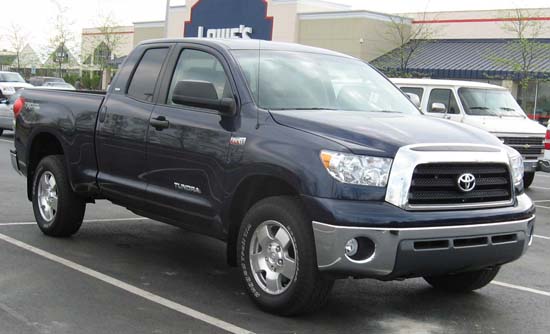
    The used truck market is HOT right now! How hot? The Toyota Tundra and other pickups have seen their used truck prices rise. Which one is holding its value the best? You guessed it, it’s the Tundra.
    Used Toyota Tundra Price Increases - Holds Value Better Than Others

    The used truck market is hot right now and so is the Tundra. Surprised? We didn’t think so.

    A story on Autonews.com proclaims that the demand for used trucks is so high that prices will stay higher than before the recession after stablizing. In fact, the prices of used pickups less than 9 years old have increased by 7 percent through April according to Larry Dixon, an analyst at NADA guides.

    Dixon told Automotive News:

    “We expect large pickups to be one of the better-performing segments for the year,” Dixon says. “They’ve got a couple of things going for them. Used supply is still fairly low relative to where we were just a few years ago [as a result] of reductions in production and retail sales going back to high gasoline prices in 2008.

    “You also have the growth and improvement in the housing market.”

    Most analysts agree that used-vehicle prices peaked in March and the market will start to stablizie soon. However, the car market is expected to recede much faster than the truck market. This is due to seasonal deprecation patterns and rising/falling of gasoline prices.

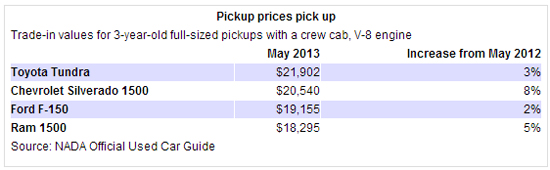
    Further demonstrating their point, Automotive News created the chart below using NADA numbers.
    Used Toyota Tundra Price Increases

    This chart shows how much better the Tundra holds its resale value. Chart courtesy of Automotive News.

    Tundra owners have known for years that the truck has a high resale value and charts and stories like these reinforce that fact. The truth is that while the Tundra doesn’t have the bells and whistles of the competitors (active grille shutters, lighter weight frames, etc…) it is simply one durable and dependable truck. This is great for owners who are looking to have a vehicle that runs for a long time.

    Most analysts and industry experts continue to believe that used truck residual values will remain high. With the new cars exceedingly full of plastic and less durable than past versions, trucks keep on running for years.

    What do you think? Are you surprised by these numbers?

    Related Posts:

    The post Used Toyota Tundra Price Increases – Holds Value Better Than Others appeared first on Tundra Headquarters Blog.

  • The Domestic Energy Bonanza and the Economy

    A recent commentary on the Washington Post’s “Wonkblog” illustrates the ability of professional economics to collide with common sense. The article seeks to pooh-pooh the idea that America’s oil and natural gas expansion have contributed much to the (anemic) economic …

  • LogMeIn and ARM want to help you build the internet of things

    Just a few weeks ago, my colleague Stacey Higginbotham covered an interesting Spanish outfit called Carriots that’s building a platform-as-a-service (Paas) geared specifically towards the internet of things (IoT). As with other startups such as Electric Imp, the aim here is to make it super-simple for developers of connected devices and the services around them to, well, connect those devices. It’s a lot easier to innovate on top of an established platform than to rebuild the fundamentals each and every time.

    Well, those startups now have seriously heavyweight competition in the form of LogMeIn, the remote connectivity specialist, and ARM, the British firm whose low-power chip designs underpin the vast majority of mobile devices, and which is now competing with Intel to own the IoT space.

    LogMeIn has just launched its own PaaS for the internet of things, calling it Xively (the beta version was known as Cosm). And developers wanting to start creating connected devices on this platform are being offered the Xively Jumpstart Kit, which combines Xively with ARM’s mbed platform, for building devices using ARM’s microcontrollers. With this kit, the companies promise, developers can “rapidly progress from prototyping to volume deployment”.

    Xively is based on LogMeIn’s Gravity infrastructure – the same one used to support the company’s cloud storage offering, Cubby — and it comes with development tools for writing and prototyping services, a provisioning engine for deployment and a scalable management console. It supports real-time messaging and directory and data services, as well as analytics, and it uses a “pay-as-you-grow” pricing model that should make the platform attractive to startups.

    The directory services extend to a “commons” named the Xively Connected Object Cloud, through which different companies’ devices can interconnect. According to LogMeIn, a “fundamental philosophy” baked into the Xively terms of service states that “customers own their data and can choose whether or not to share all, part, or none [of] it.”

    A showcase page for the platform shows early projects built on Xively that include the Visualight smart lightbulb and even some of the post-Fukushima crowdsourced radiation-monitoring efforts (which used an earlier iteration of the platform, called Pachube at the time).

    While the Xively Jumpstart Kit should help inventors and developers gravitate in ARM’s direction, it’s not like Intel is sleeping. Intel said in February that its own Intelligent Systems Framework – a set of specifications for connecting, managing and securing IoT devices – had been used to support more than 50 products. The company also released new software tools for, you guessed it, reducing time to market.

    Although ARM does benefit from a much broader ecosystem than Intel, it’s too early to call that race. However, those startups trying to build their own PaaSes for the internet of things had better get a move on. LogMeIn’s offering is already pretty mature for this space and, given the momentum rapidly building behind the IoT movement, its timing is exquisite.

    Related research and analysis from GigaOM Pro:
    Subscriber content. Sign up for a free trial.


  • The Azure Cloud, Exposed to the Azure Sky

    Microsoft-quincy-outdoor

    Data center modules packed with servers sit outside at the newest phase of the Microsoft data center in Quincy, Washington. In the background is the vast concrete shell of the company’s initial Quincy data center. (Photo: Microsoft)

    QUINCY, Washington – As the Windows Azure cloud expands across central Washington, the physical building has all but disappeared. Lightweight enclosures filled with servers, known as ITPACs, sit under the barest of skeleton of a facility. They are self-contained data centers, assembled in days, housed on a concrete slabs and attached to a power “spine” supplying connections to the grid and the Internet. It’s completely open to the air, and in production.

    With the latest phase of its data center in Quincy, Microsoft is getting out of the air conditioning business and deploying thousands of servers inside factory-built modules, which can be installed in days and allow the company to reach new heights of energy efficiency. The ITPACs take advantage of the natural environment in Quincy, allowing cool air to flow through the modules and cool the servers powering the Azure cloud.

    One Campus, Three Experiences

    Walking through the Quincy campus provides three very different experiences. After passing through security, you encounter Microsoft’s first facility on the six-year old campus, a typical data center in an immense concrete shell. The next phase is a lightweight building housing ITPACs. The end of the trip takes you to open air – yet even here, the Microsoft cloud continues to grow.

    After passing through a gate that could stop a truck, you arrive at the 470,000 foot concrete building, constructed by Microsoft in 2007. The Columbia campus feels like a fortress, with a gauntlet of security that includes a staffed access gate, biometrics and a mantrap corridor (which earns its name from the doors at both ends, which cannot open at the same time, limiting access to ) . After you’re cleared, as a guest you receive a badge that expires after a set time, with the word “VOID” appearing out of nowhere. This is your traditional enterprise data center with all the trimmings, and then some. It features all the physical redundancy, the giant generators, and the massive UPS rooms you would expect to be hidden beyond such security.

    Once you walk outside, you begin to see the evolution of Microsoft’s data center design. The next building you enter isn’t really a building at all, but a steel and aluminum framework. Inside the shell are pre-manufactured ITPAC modules. Microsoft has sought to standardize the design for its ITPAC – short for Information Technology Pre-Assembled Component – but also allows vendors to work with the specifications and play with the design. These ITPACs use air side economization, and there are a few variations.

    Essentially, they are data centers in a box. Cooling is supplied by fresh air and the equivalent of a garden hose. Fresh air is drawn into the enclosure through louvers lining the side of the module, which functions as a huge air handler with racks of servers inside. Each IT module is also equipped with an evaporative cooling system in which air passes through a moist media filter. The system uses just 1 percent of what the traditional data center uses.

    Inside A ‘Secret Garden’ of Servers

    These ITPACs are highly efficient, and quick to deploy. The shell around these first ITPACs is wall-screened.

    However, by the end of the trip, you’re back in open air, in a “Secret Garden” of servers. The building has disappeared, but each ITPAC unit acts as its own steel perimeter. You’re still on camera, you’re still in a highly secure area, but it feels wide open.

    Just as the security evolves, so does the power infrastructure.  Cloud servers drive a whole different design, down to the components.

  • Nokia unveils Lumia 925 with aluminum body, PureView camera; headed to T-Mobile

    Nokia Lumia 925 Launch
    Nokia on Tuesday unveiled its new Lumia 925 smartphone during a press conference in London. The struggling vendor’s new Windows Phone beats the same drum yet again in a number of ways, though there are a few notable changes this time around. For one, the Lumia 925 features an aluminum body instead of the polycarbonate case used on the Lumia 900 and Lumia 920. The phone also includes Nokia’s enhanced PureView with improved low-light shooting, and while Instagram still isn’t available for Windows Phone 8, the Lumia 925 includes a new “Smart Camera” function and it comes preloaded along with the popular photo filter app Hipstagram.

    Continue reading…

  • Firefox 21 improves performance and privacy

    Mozilla has released Firefox 21.0 FINAL, a major new version of its cross-platform, open-source web browser for Windows, Mac and Linux. Version 21 gives users more control over their tracking cookie preferences, extends the social API to support four new providers and implements support for tools to help with troubleshooting and performance issues.

    Although Firefox 21 doesn’t have quite the impact version 20 did with its new panel-based downloader, per-window private browsing and ability to close hanging plugins without crashing the entire browser, it still throws in some useful features, all of which have smoothly migrated from the Beta version.

    Version 21 builds on Firefox’s Do Not Track feature to provide users with three options via the Privacy tab of Firefox’s Options dialog. The existing “user says nothing” and “user says don’t track” have now been joined by a “Tell sites that I want to be tracked” option for those who actively wish to be tracked in order to see more personally relevant advertising.

    Firefox 21 also sees the Social API extended to support new providers. Users can now add Asian social providers Mixi and Weibo, plus news aggregators msnNOW and Cliqz. Once installed, users switch between providers by clicking the main button and selecting the chosen provider from the list.

    Also implemented in the latest version is the Firefox Health Report, a tool that provides information designed to improve browser performance while also sharing data with Mozilla regarding the stability and health of the browser installation. The feature is switched on by default, but can be disabled via Firefox’s Options dialog — select Advanced > Data Choices tab to do so.

    At the present time, only preliminary support has been implemented — users can see information about their own browser stats by selecting Firefox Help Report from the Help menu, but in future this should also allow them to compare their configuration with other Firefox users.

    Users also gain an option for restoring removed thumbnails from the New Tab page — one deleting a thumbnail, a small message briefly appears at the top of the screen allowing the user to undo the action or restore all thumbnails removed previously.

    Another improvement sees Firefox monitoring browser start-up times and alerting the user via a Notification bar at the bottom of the screen if startup seems particularly slow — users can then click a button to visit a web page offering advice for reducing start-up times.

    The update also comes with the promise of improved graphics performance, the implementation of Remote Profiling for developers and the removal of support for certain depreciated History APIs as part of Firefox’s drive towards asynchronous History and Bookmarks.

    Firefox 21.0 FINAL is available now as a free, open-source download for Windows, Mac and Linux. Beta, Aurora and Nightly channels should be updated later this week.

  • CVC Ends Pursuit of Betfair After Bids Rejected

    Betfair and CVC Capital Partners have ended takeover discussions after the private equity firm said it would not make a third revised offer for the online gambling company, Reuters reports.

    (Reuters) – Betfair and CVC Capital Partners have ended takeover discussions after the private equity firm said it would not make a third revised offer for the online gambling company.

    CVC and its consortium partners Richard Koch and Antony Ball had raised their offer twice from the 880 pence per share it proposed on April 22.

    Betfair said it received a revised offer of 920 pence on May 10 which it rejected. Then on May 12, CVC again increased its offer to 950 pence per share, valuing the company at 988 million pounds ($1.52 billion).

    Betfair’s board rejected the revised proposal that evening, but indicated it would consider an improved proposal.

    “The Board has spent considerable time assessing the various proposals, including detailed discussions with the Co-offerors,” Gerald Corbett, Chairman of Betfair said in a statement.

    “The Board concluded that none of the proposals represented adequate value or acceptable execution risk.”
    CVC had been given an extra 24 hours to commit a firm bid after a 1600 GMT Monday deadline lapsed, but said on Tuesday morning that it would not be making a revised offer.

    “The Consortium confirms it has been unable to agree financial terms with the board of Betfair and as a result has no intention of making an offer for Betfair,” it said in a statement.

    Betfair’s technology allows gamblers to bet online against one another at their own prices. It is also offering more conventional sports betting with odds set centrally to compete with rivals in an expanding yet highly competitive sector.

    Since Betfair listed in 2010, the stock has tumbled from its debut price of 13 pounds. Analysts said the company had failed to clearly identify whether it was a technology or gambling business.

    Under Chief Executive Breon Corcoran, who joined from Irish bookmaker Paddy Power last year, Betfair has withdrawn from markets such as Greece and Germany, where regulations are not clear cut or tax rates are punitive, and has cut 500 jobs to help save 30 million pounds in costs.

    Betfair stock, which was trading at 700 pence before CVC said on April 15 it was considering a bid, closed on Monday at 895 pence.

    The post CVC Ends Pursuit of Betfair After Bids Rejected appeared first on peHUB.

  • Cloudant Raises $12 Million for Database-as-a-Service

    Mobile and web applications are growing at an astounding clip, bringing the market for hosted databases in tow. That’s behind the investment in Database-as-a-Service company Cloudant, which has raised an additional $12 million in Series B Funding from Devonshire Investors, Rackspace, and Toba Capital. Current investors Avalon Ventures, In-Q-Tel, and Samsung Venture Investment Corporation also purchased additional shares. The funding will support global expansion, as well as go towards growing the company’s support, service, and go-to-market strategies.

    “The market opportunity for managed, hosted databases is large, and the NoSQL model is where major mobile and Web applications are moving,” said David Jegen, managing director at Devonshire Investors. “We’re seeing that shift accelerate across the industry with Cloudant in the sweet spot of this market, adding big customer names with a highly scalable and durable DBaaS.”

    Cloudant provides a scalable, managed NoSQL DBaaS based on a globally distributed network of data centers. Application developers build their back ends on the Cloudant Data Layer cloud database, freeing developers from the mechanics of data management so they can focus exclusively on their applications. It allows customers to offload the administrative burden of operating and scaling distributed databases.

    Samsung announced a strategic investment in the company last February, given its interests in the mobile space.

    Support from Rackspace

    Rackspace’s investment is also of note, given the service provider is at the heart of the “Internet of things” movement. The company is careful and calculated in terms of what it invests and acquires, usually focusing on what is sees working and grabbing the most attention first hand.

    “We hear all the time from customers that dealing with the complexities of large-scale systems infrastructure just slows them down,” said Pat Matthews, senior vice president of corporate development at Rackspace. “Developers want control of their infrastructure, but they don’t want to have to manage it 24×7. Cloudant is the natural extension of this idea at the database layer. We’re partners that share a commitment to delivering the highest level of customer support, which is why investing in Cloudant works so well from a Rackspace perspective.”

    Momentum in the enterprise market has also helped the company court new investors like Vinny Smith at Toba Capital, the former CEO of Quest Software, which he led to IPO and a $2.4-billion acquisition by Dell.

    “Enterprises are quickly realizing that they want a cloud that isn’t one size fits all. They want to scale their app without having to customize it to fit within a third-party cloud,” said  Smith. “Spending on cloud infrastructure is no longer an IT line-item; it’s now a major line-of-business concern. With strategic support from Rackspace, Cloudant is providing a clearer path for businesses to run large production workloads in the hybrid cloud.”

    Cloudant also announced the opening of a new office in San Francisco. Market demand recently drove the company’s expansion into the U.K. with an office in Bristol. The company’s headquarters are in Boston, and it has an office in Seattle as well. Cloudant will use its new presence to strengthen its relationships with the Web and mobile application development communities and to build its brand in the enterprise software market.

  • Doye Named CEO of CompuCom

    CompuCom has promoted Anthony Doye to the role of CEO. Doye joined CompuCom as Divisional CEO in November. CompuCom, an IT outsourcing specialist, also said that Thomas H. Lee Partners has completed its acquisition of the company.

    PRESS RELEASE

    DALLAS–(BUSINESS WIRE)–CompuCom Systems, Inc. (“CompuCom”), the leading IT outsourcing specialist, today announced the promotion of Anthony (Tony) Doye (“age: 56”) to the role of Chief Executive Officer (CEO). Doye joined CompuCom as Divisional CEO in November, responsible for the executive leadership of all sales and support functions including Services, Hardware and Software. The Company previously announced he would succeed Jim Dixon, who will transition to his role as Executive Chairman of CompuCom after more than 20 years of dedicated service to CompuCom, its clients and associates.

    Dixon led the transformation of the company from a national reseller of hardware to an IT services leader. Doye will continue to solidify CompuCom as the leading provider of IT outsourcing services and products to North American enterprise organizations, while driving the Company’s expansion into emerging areas which require platform expertise and management, including mobile device management and cloud services.
    “I am delighted to announce Tony’s promotion to CEO,” said Jim Dixon. “This is the culmination of the succession plan we laid out in January. Tony’s drive and track record of success are vital to CompuCom’s continued growth. Since joining CompuCom, he has shown a commitment to creating value for our clients and helped to reshape the strategic direction of the company.”
    Prior to joining CompuCom, Doye served as President and CEO at Fujitsu North America where he was responsible for the North American Outsourcing portfolio generating well over a billion dollars in revenue that spanned all Fujitsu International Business activities in the United States, Canada and Caribbean regions. Doye also successfully integrated diverse business units and led the launch of a full range of cloud solutions and outsourcing services growth programs.
    “Jim has done a phenomenal job in growing the CompuCom business as CEO,” said Doye. “I am honored to have been given this opportunity and I’m excited to lead the organization into its next chapter of growth, as we work closely with our clients to develop and roll out the technology-enabled solutions that will truly enhance their businesses.”
    Doye has extensive experience in creating and delivering solutions that improve client service levels and nurture innovation. His professional background includes more than 30 years of IT industry experience in positions of increasing responsibility with companies including Computer Sciences Corporation (CSC), Unisys and IBM.
    This management change coincides with the completion of the acquisition of CompuCom by a leading private equity firm, Thomas H. Lee Partners L.P. (THL). THL’s investment in CompuCom is consistent with its long history of investing in businesses with compelling value propositions that help their customers save money, improve their businesses and provide essential services.
    About CompuCom Systems, Inc.
    CompuCom, the leading IT outsourcing specialist, delivers IT your way. Our clients like working with us because they know that, with CompuCom, it’s all about them. Our unique ITSM strategy blends your data center, cloud, and end-user computing environments in an innovative fashion. This radically simplifies your IT, allowing you to focus on growing your business and serving your customers. We are highly regarded around the world for our balance of industry-leading tools, a pragmatic approach to best practices, and our highly skilled workforce. We are the perfect alternative to address the revolutionary IT transformations facing you today and in the future. More than a trusted advisor, CompuCom is your trusted doer. To learn more, visit www.CompuCom.com.
    About Thomas H. Lee Partners
    Thomas H. Lee Partners, L.P. (“THL”) is one of the world’s oldest and most experienced private equity firms. The firm invests in growth-oriented global businesses, headquartered principally in North America, across three broad sectors: Consumer & Healthcare, Media & Information Services and Business & Financial Services. THL’s team of investment and operating professionals partner with portfolio company management teams to identify and implement business process improvements that accelerate sustainable revenue and profit growth. Since its founding in 1974, THL has raised approximately $20 billion of equity capital and invested in more than 100 businesses with an aggregate purchase price of more than $150 billion. THL strives to build great companies of lasting value and generate superior investment returns. For more information, please visit www.thl.com.

    The post Doye Named CEO of CompuCom appeared first on peHUB.

  • Rightware Raises $5.2 Mln Series B

    Rightware closed a $5.2 million series B round with participation by Inventure, Nexit Ventures and Finnish Industry Investment. Rightware, of Espoo, Finland, provides user interface technology for the mobile, automotive and other embedded industries.

    PRESS RELEASE

    ESPOO, Finland–(BUSINESS WIRE)–Rightware, the leader in embedded user interface (UI) software and performance benchmarking tools, announced today that is has closed a $5.2M Series B round with Inventure, Nexit Ventures, and new investor Finnish Industry Investment. The investment will be used to further expand global sales and continue the development of the Kanzi UI Solution, which continues to gain traction within the automotive sector and consumer electronics companies in Europe, USA and Asia.

    The Kanzi UI Solution is already widely adopted by premium car manufacturers such as Audi AG, tier-1 suppliers such as Visteon (NASDAQ: VC) and is supported by leading semiconductor companies such as Freescale® Semiconductor, Inc (NYSE: FSL). During the few last months, Rightware has achieved several yet-to-be-announced major design wins with companies from consumer electronics and automotive industries. In Q1 2013, User Interface business revenues were more than double compared to Q1 2012 and the company forecasts the growth to further accelerate towards the end of the year.
    “Rightware leads the embedded UI industry with its innovative technology and market penetration. The company promotes next-generation applications where integrated 2D & 3D graphics deliver better and faster user experiences,” said Jussi Hattula, Team leader of Growth Capital at Finnish Industry Investment Ltd. “We are excited to be part of this round and to work with the company to fulfill its vision.”
    Rightware recently extended its market reach and momentum announcing a partnership RKS design, and a significant update to the Kanzi UI Solution. The recent equity investment will enable Rightware to further expand aggressively into automotive and consumer electronics and start addressing new and emerging markets including, entertainment, mobile, tablet, smart TVs and other embedded verticals.
    “Rightware is at a fast-growth stage as companies and designers begin to use photorealistic and immersive graphical user interfaces in their products,” said Jonas Geust CEO of Rightware. “Our commitment is to continue providing UI designers and programmers leading solutions that can be leveraged across industries. As the embedded market continues to grow, we will be working closely with our customers as they push the boundaries and provide ever better user experiences.”
    About Rightware
    Rightware® is the market leader in User Interface technology, serving mobile, automotive and other embedded industries with its patent pending Kanzi® solution for rapid 3D and 2D user interface design and deployment. Rightware also develops industry leading system performance analysis tools and its renowned product portfolio includes the Basemark® product family for various benchmarking purposes, including industry standard benchmarks for OpenGL ES, OpenVG, OpenCL, Android, Linux, and Windows Mobile performance measurement. Rightware is headquartered in Espoo, Finland and has offices in Saratoga, CA, Shanghai, Taipei and Munich. More information:
    www.rightware.com
www.facebook.com/Rightware
www.linkedin.com/company/rightware
    About Finnish Industry Investment
    Finnish Industry Investment Ltd is a government-owned investment company. It invests in venture capital and private equity funds and directly in growth companies, always together with private investors. With investments and commitments amounting to € 720 million, Finnish Industry Investment is an investor – directly or through funds – in altogether 510 companies. For further information, please visit www.industryinvestment.com.
    About Inventure
    Inventure is a technology investor in early stage companies, actively supporting growth oriented entrepreneurs to internationalize Nordic success stories. Inventure’s entrepreneur driven team works actively with the portfolio companies and brings their knowledge and network’s support. Founded in 2005, Inventure manages funds with over EUR 53 million in total capital base. Examples of Inventure’s portfolio companies are e.g. Canatu, Thinglink, Conmio, Freespee, Beneq and Silex Microsystems. For further information, please visit www.inventure.fi.
    About Nexit Ventures
    Nexit Ventures is a venture capital firm focused on mobile and wireless innovation. Leveraging its extensive network in the global marketplace, Nexit invests primarily in Nordic and US-based early stage companies with products and services for global market. Nexit has offices in Helsinki, Stockholm and Silicon Valley and has realized several successful exits of its portfolio companies in the United States, the world’s leading M&A market for technology ventures. For further information, please visit www.nexitventures.com.
    Rightware and Kanzi are trademarks or registered trademarks solely owned and controlled by Rightware Oy and are protected by applicable trademark law, and may not be used to any extent without the express prior written consent of Rightware Oy in each instance. Freescale and the Freescale logo are trademarks of Freescale Semiconductor, Inc., Reg. U.S. Pat. & Tm. Off. Other product and company names mentioned herein may be the trademarks of their respective owners.

    The post Rightware Raises $5.2 Mln Series B appeared first on peHUB.

  • GraphLab Raises $6.75 Mln

    GraphLab said Tuesday it raised $6.75 million Series A funding led by Madrona Venture Group and NEA. Seattle-based GraphLab provides a machine learning analytics engine for graph datasets.

    PRESS RELEASE

    SEATTLE, May 14, 2013 /PRNewswire/ – GraphLab Inc.(graphlab.com) today announced a $6.75 million Series A funding led by Madrona Venture Group and NEA. GraphLab Inc. is innovating on the popular open source distributed graph computation framework (graphlab.org) that is used millions of times per day to deliver recommendations through popular consumer services.
    Founded by leading data scientist and entrepreneur, Carlos Guestrin, who began the GraphLab open-source project five years ago, GraphLab Inc. is building a commercial product for applying advanced machine learning to massive graph datasets.  The company is based in Seattle and will continue to actively support the open source GraphLab project.
    “Data has the ability to make our lives better – whether applied to public health, economics, or suggesting the perfect song.  But, as the complexity of data sets grows, the need for entirely new ways of thinking about them has grown as well,” said Carlos Guestrin, CEO.  ”The industry’s response to the GraphLab project has been clear, this is the solution that drives millions of transactions daily and we are excited to build on this success with commercial products that make a difference.” Dr. Guestrin is the Amazon Professor of Machine Learning at the University of Washington.
    “Graph data is fundamentally different than other datasets and the analytics solutions that companies are using are time intensive to create and to maintain. There is a significant need for graph-specific solutions to answer some of the bigger questions of our time,” said Matt McIlwain , Managing Director, Madrona Venture Group.  ”Carlos Guestrin is an exceptional talent who brings both business and engineering experience to the table and we are excited to help build this important company with him and his exceptional team.”
    Many well-known companies and services rely on GraphLab software to get more out of their data.  ”The software being written by the GraphLab team is second to none. They consistently raise the bar for graph-based machine learning.” – Eric Bieschke , Chief Scientist, Pandora Internet Radio.
    “We at WalmartLabs have been following the GraphLab project closely since its inception. GraphLab is amazingly fast compared with other options and is especially well-suited for systems involving large-scale iterative machine learning methods.  An extension of GraphLab makes big data analytics come true even over a laptop.  We are impressed and eager to see what’s next.” – Lei Tang, Data Scientist at Walmart Labs.
    Complex data sets such as those describing social media networks are commonly described as graph datasets.  These graphs describe relationships between people, the products they buy, the pages they like, etc.  Graph datasets require novel computational methods, machine learning algorithms, and specialized systems in order to effectively and efficiently analyze outcomes.  GraphLab Inc. will introduce version 2.2 to the GraphLab open source project at the annual GraphLab workshop in San Francisco on July 1st.
    As part of the funding, Matt McIlwain of Madrona Venture Group and Greg Papadopoulos of NEA will be joining the board, with Forest Baskett from NEA as an observer.
    GraphLab Inc has established an industry Technical Advisory Board which includes:
    • Joe Hellerstein – Co-Founder and CEO of Trifacta Inc., and a Chancellor’s Professor of Computer Science at University of California, Berkeley.
    • Michael I. Jordan – Michael I. Jordan , a leading researcher in machine learning, is the Pehong Chen Distinguished Professor in the Department of Electrical Engineering and Computer Science and the Department of Statistics at  the University of California, Berkeley.
    • Hank Levy  – Chairman and Wissner-Slivka Chair in the Department of Computer Science & Engineering at University of Washington, co-founder of Skytap and Performant (acquired by Mercury Interactive in 2003).
    • Kai Li – Co-founder of Data Domain (acquired by EMC for $2.1 billion in 2009), a Paul M. Wythes ’55, P’86, and Marcia R. Wythes P’86 Professor In the Computer Science Department of Princeton University.
    • Sujal Patel – Founder and former CEO of Isilon Systems (acquired by EMC for $2.5 billion in 2010).
    • Chris Stolte – Co-founder and Chief Development Officer, Tableau Software.
    About GraphLab Inc.
    GraphLab Inc. is building the fastest machine learning analytics engine for graph datasets. Started in 2009 as an open source project by Carlos Guestrin, the software is used daily for millions of recommendations in popular consumer services.  GraphLab is based in Seattle.
    About Madrona Venture Group
    Madrona (www.madrona.com) has been investing in early-stage technology companies in the Pacific Northwest since 1995 and has been privileged to play a role in some of the region’s most successful technology ventures. The firm invests predominately in seed and Series A rounds across the information technology spectrum including consumer Internet, commercial software and services, digital media and advertising, networking and cloud computing, and mobile. Madrona manages nearly $1 billion and was an early investor in companies such as Amazon.com, Apptio, Isilon Systems, Sharebuilder, and World Wide Packets.
    About NEA
    New Enterprise Associates, Inc. (NEA) is a leading venture capital firm focused on helping entrepreneurs build transformational businesses across multiple stages, sectors and geographies. With more than $13 billion in committed capital, NEA invests in information technology, healthcare and energy technology companies at all stages in a company’s lifecycle, from seed stage through IPO. The firm’s long track record includes more than 175 portfolio company IPOs and more than 290 acquisitions. In the U.S., NEA has offices in the Washington, D.C. metropolitan area; Menlo Park, California; and New York City. In addition, New Enterprise Associates (India) Pvt. Ltd. has offices in Bangalore and Mumbai, India and New Enterprise Associates (Beijing), Ltd. has offices in Beijing and Shanghai, China. For additional information, visit www.nea.com.

    The post GraphLab Raises $6.75 Mln appeared first on peHUB.

  • Sandvine report confirms: video makes bandwidth hogs of us all

    Despite the love people have for email, Twitter and even Facebook, the real star of the web in terms of sheer traffic is video. And not only is all this real-time video streaming possibly rotting our brains, congesting our broadband networks and threatening our pay TV businesses, it’s driving wholesale changes in how we pay for broadband and the future of television.

    A great illustration of these changes comes from Sandvine’s Global Internet Phenomena Report: 1H 2013. Sandvine provides deep packet inspection and networking management tools to wireless and wireline ISPs, which is how it gets some of its data. While, many people already knew that Netflix traffic comprises about a third of the web traffic in the U.S., they might not know that YouTube is gaining rapidly with 17.11 percent of web traffic downloaded on wireline networks, up from 13.8 percent a year ago.

    videotraffic

    Video makes bandwidth hogs of us all

    Few people are immune to the siren song of cat videos or Arrested Development. In fact, it’s changing the profile of what broadband usage looks like to the point where it’s normal to be a bandwidth hog. According to the Sandvine report in North America, the top 1 percent of subscribers who make the heaviest use of the network’s downstream resources account for 10.1 percent of downstream traffic.

    However, those top 1 percent of users don’t look too much different from the top 30 percent. At the bottom, the network’s lightest 50 percent of users account for only 6.4 percent of total monthly traffic. In fact it’s those laggards at the bottom we should be worried about. Did they somehow miss Gangnam Style?

    The average and median usage on both wireline and wireless networks in North America is on the rise. On wireline networks mean usage was 44.7 GB, a 39 percent year-over-year increase from 32.1 GB. Over the same period, median monthly usage increased at an even by 56.5 percent, jumping from 10.3 GB to 18.2 GB. On mobile networks mean monthly usage increased by 25 percent from 312.8 MB to 390.1 MB. Yet, median usage more than doubled from 25.5MB to 58.7 MB over the past year, driven in part by more people buying smartphones.

    And mobile is even bigger than these numbers make it look like (or something like that). One out of every five bits — or 20 percent of the traffic on wireline network is generated by a smartphone or a tablet. And as Wi-Fi expands and is easier to connect too, that number should continue to increase.

    Yes, video traffic will always be big, because videos are big

    Before people accuse me of being unfair, let me note that sending video is one of the most data heavy options around. A two-hour HD movie file can contain 4GB of data or more, while a book that might also take two hours to read would top out at several megabytes.

    The sheer volume of data is one reason video strikes fear into the hearts of both wireless and wireline network operators, while the loss of revenue from pay TV subscriptions keeps wireline providers up at night. Unfortunately for those implementing usage-based billing plans perhaps in hopes of influencing subscribers to keep their pay TV subscriptions, Sandvine shows that real-time entertainment usage goes up on networks with usage-based billing. In fact, the only thing reduced appears to be file-sharing traffic.

    ubbchart

    The rest of the report is chock full of great data such as this tidbit that confirms North America’s love of Apple products:

    So what single home roaming device consumes the most Real-Time Entertainment traffic at over 10percent? It’s the iPad. In fact, Apple devices as a whole play a large role in the consumption of Real-Time Entertainment. If you add up all Apple manufactured devices (which includes iPads, iPhones, iPods, AppleTVs, and Mac computers), they consume over 45% of all streaming audio and video on North America fixed access networks.

    There’s also some good data from Europe that shows that the lowered availability of over the top options like Netflix or the BBC’s video player cause the amount of real-time streaming traffic to drop. Additionally the report shows that in Europe file sharing is higher than in North America, something the report’s authors attribute to a lack of access to certain popular content because of geo-blocking.

    But taken in its 40-page entirety, the data and case studies show how our love of video is causing both wireline and wireless ISPs to get creative to boost revenue and meet the challenges posed by the demand for video. Just like we said it would.

    Related research and analysis from GigaOM Pro:
    Subscriber content. Sign up for a free trial.


  • Google Glass crowdsources its internet connection thanks to Open Garden hack

    As Google I/O gets ready to kick off Wednesday, there’s a lot of buzz about what’s in store for Glass, in particular which new apps Google will let onto the so far bare-bones platform. At least one developer, however, is vying for a spot on glass, but not to offer up any kind of new game or service. Instead Open Garden wants to change how Glass – and eventually any wearable — connects to the Internet.

    Open Garden is trying to build a mesh network for mobile devices that does away with the notion that a single device must connect to the internet through a pre-defined path. Instead it’s created tablet, smartphone and PC software that will allow their host devices to crowdsource their connections by forming ad hoc mesh networks with other Open Garden devices. Collectively those clients determine which device or devices have the best connections to the internet – whether its 3G, 4G, Wi-Fi or Ethernet – and route traffic through those links.

    Open Garden Google GlassIt’s a hard notion for many people to grasp since we tend think of our connections as individual property, but Open Garden is trying to change that mindset. If everyone shares their connection, then everyone’s link to the network is optimized. Open Garden co-founder and CEO Micha Benoliel believes that Google Glass is an ideal candidate to demonstrate that principle.

    Open Garden has succeeded in installing its networking software for Glass, which means the wearable can now act as a node in a larger mesh. The setup has an immediate advantage for Glass owners: they don’t need to pair Glass to their Android devices through Bluetooth or subscribe to a tethering plan from their operators. The Open Garden client makes the connection automatically over Wi-Fi.

    But the bigger implication is that Glass could eventually become part of a larger networked community ranging far beyond its owner’s personal constellation of devices. A Glass user, for instance, might be able to leave his smartphone at home or in his office. Instead of losing connectivity, the Google headgear would search out other Open Garden devices – even other Glass units — hopping from node to node until it wended its way onto a mobile or broadband network.

    To make its software work on Glass, Open Garden had to do more than just tap into the Mirror API. Benoliel said Open Garden’s developers had to delve deeper into the Android kernel to gain access to its networking functions, which will make distributing its software all but impossible when Glass becomes generally available to the public. But Benoliel is hoping Google will see the advantage of making Glass part of the larger mesh and is lobbying the search giant to clear the way for its app.

    Related research and analysis from GigaOM Pro:
    Subscriber content. Sign up for a free trial.


  • That’s a lot of videos: YouTube now responsible for 17% of home Internet traffic

    YouTube is now responsible for 17.1 percent of all residential fixed-line downstream traffic in North America, according to Sandvine’s latest global internet phenomena report.

    The traffic management specialist’s report for the first half of 2013 still lists Netflix as the most popular bandwidth consumption pastime — 32.3 percent of all residential downstream traffic was caused by Netflix viewing. But YouTube’s share has been growing, and is up from 13.8 percent a year ago.

    That in itself is notable, because most other services, including Netflix, HBO Go (0.34 percent) and Amazon Instant video (1.31 percent) have seen their share of traffic decline over the same period. Of course, that doesn’t necessarily mean that people watch less Amazon Instant than a year ago; the company’s total share of a growing bandwidth pie is just smaller. But YouTube seems to be growing faster than any of these other services, at least on wired networks.

    One reason for this kind of momentum could be the company’s emphasis of premium content as well as channel subscriptions. YouTube relaunched its site in late 2011, and gave sizeable advances to a number of content producers in 2012 to encourage more quality serialized content on the site. However, Sandvine seems to think that there’s another reason for the uptick. From the study:

    “We believe the increase is attributed to the continued growth of smartphone and tablet use within the home (i.e. “Home Roaming”); as observed in this study, such devices consume over a quarter of all streaming audio and video on fixed access networks.”

    YouTube did release its iPhone app in September, and followed up with an Pad app in December.

    For more on Sandvine’s report, check out Stacey Higginbotham’s story Sandvine report confirms: video makes bandwidth hogs of us all

    Related research and analysis from GigaOM Pro:
    Subscriber content. Sign up for a free trial.


  • Dead For 40 Minutes: New CPR Machine Brings Man Back From The Brink

    It’s the sort of thing you usually only see in the movies or on medical shows on TV: a patient is clinically dead and all hope seems lost, when suddenly he (or she) is miraculously revived after an impossibly long time. Well, that scenario played itself out in Melbourne, Australia several months ago when Colin Fielder, 39, of Dandenong, Victoria was revived after being clinically dead for 40 minutes.

    The reason for Fielder’s amazing recovery is an experimental combination of new techniques: the use of a new automated CPR machine, called the AutoPulse, and the use of a blood-oxygen machine. As the name implies, the AutoPulse automatically performs regular chest compressions on patients in cardiac arrest. Meanwhile, the blood-oxygen machine – a device usually reserved for the operating room – maintains the blood’s oxygen levels, ensuring that the brain and other vital organs continue to receive oxygen while the patient is “dead.”

    When Fielder suffered a heart attack in June of last year, paramedics in his ambulance gave him a choice of two Melbourne-area hospitals. As luck would have it, he chose the Alfred Hospital, which is the only hospital in Victoria currently using this new technique. After coming back from his 40 minute rendezvous with death, Fielder made a full recovery and has suffered no ill-effects.

    Since his recovery he has stopped smoking and takes a much more relaxed approach to life, Fielder told the Herald Sun.

    Fielder is one of three patients to have been brought revived after a long time clinically dead. One patient was brought back after 60 minutes. While the system is still in clinical trials, physicians hope to bring it to more hospitals eventually. Meanwhile, the AutoPulse machine is currently deployed in three Melbourne ambulances, though the company that produces it is working to deploy it more broadly.

  • Nokia’s real innovation is happening on Asha, not Windows Phone

    Nokia’s new flagship has been revealed. Not the Lumia 928 – that was announced late last week as a “hero” device for Verizon — but the GSM-friendly Lumia 925. As predicted, Nokia is highlighting the photographic capabilities of the device and its camera is slightly enhanced over that on the 928, but the real difference here is the 925′s aluminium frame.

    Here in Europe, people don’t like their phones too thick and plasticky, and that’s been a consistent criticism levelled at the Lumia 920, Nokia’s previous flagship, and for that matter the very similar-looking 928. The 925 makes things sleek and metallic (I like metal; I used to be a proud owner of the Nokia E71) and is, at 139g, significantly lighter than the 920 (185g) and 928 (163g).

    The 8.7-megapixel camera has 6 elements, rather than the 5 found in the 920 and 928, and wireless charging comes courtesy of a snap-on cover rather than being built in, but otherwise it’s really, really similar to the 928: 1GB RAM; 1,280 x 768-pixel, 4.5-inch screen; dual-core 1.5GHz Qualcomm processor; and so on.

    Here’s how IHS Screen Digest mobile chief Ian Fogg reacted as the unveiling happened:

    And there’s the thing. You can tell Nokia didn’t have that much to shout about in hardware terms, because its main message around the 925 is the around the photo-centric apps it’s preinstalling, namely Hipstamatic’s Oggl and Nokia’s own Smart Camera software, which clearly seeks to rival Samsung’s recent efforts in the Galaxy S4. This is all good and fine, but exciting? Not so much.

    Look lower

    But even if the limitations of the Windows Phone platform don’t allow Nokia to truly exercise its innovation muscles, that doesn’t mean the Finnish handset maker is taking it easy. Just look at what it’s doing at the low end of its range, once we’re out of Microsoft territory.

    As I pointed out a few weeks ago, the QWERTY-enabled Asha 210 offers an incredible amount of social functionality for its $72 price tag (the Lumia 925 costs just north of $600). And just last Thursday, Nokia revealed the Asha 501, a touchscreen device that runs the new version of Nokia’s S40-derived operating system and also comes in at under $100.

    Nokia Asha 501The new version of Asha comes with features such as Fastlane, a second homescreen option that provides direct access to recently-accessed contacts and apps, rather than showing a convention grid of apps. This is all a result of Nokia’s purchase in early 2012 of Smarterphone, a Norwegian company that tries to make so-called featurephones seem, well, smarter.

    Nokia has come in for a lot of flak for calling its all-touch Ashas smartphones, with many seeing this as a trick to inflate its real smartphone shipment figures. That may be one motivation, but I honestly think Nokia has every right to call these devices smart. When the 501 came out, Nokia also made a major push for developers to address the revamped Asha platform, releasing a new SDK and new in-app payment tools. Apps that are already on or in development for the platform include Facebook, Foursquare, LinkedIn and Twitter, and also games from the likes of EA and Gameloft.

    Sure, heavier apps are lacking, but frankly the kinds of apps we’re talking about there might be better executed on a tablet than a smartphone anyway – particularly given the excellent battery life promised by Asha phones, Asha-plus-tablet is starting to look like a pretty tempting combo.

    Who’s smart now?

    Of course, the big promise with Windows Phone these days is that it will hit lower and lower price points, perhaps becoming a viable rival to low-mid-range Android devices at some stage (right now Nokia has only managed to cross the $200 threshold with Windows Phone products, namely the Lumia 520). These Ashas are already targeting the same rivals, though, and they are more optimized for the price point than efforts based on Google’s OS.

    Nokia is clearly putting a large amount of effort into industrial design and user experience for both the Windows Phone and Asha ranges. However, it has way more freedom to tinker with its own platform. There’s also the small matter of price — the Lumia 925 costs 6 times as much as the Asha 501 so, if customers respond well to the new version of the Asha platform, the potential impact of the 501 will be greater than that of the Lumia 925. (That is admittedly a big “if”, though, as last quarter’s results showed roughly even sales for Lumia and full-touch Asha phones, with Lumia heading up and Asha down.)

    The Lumia 925 sure does look fine, and if I was in the market for a high-end smartphone I’d give it strong consideration. However, in terms of making a real splash, the innovations Nokia is making at the low end come through more starkly than the tweaks made to its Lumia range.

    Related research and analysis from GigaOM Pro:
    Subscriber content. Sign up for a free trial.


  • Is it time to give Linux another look?

    With recent stories highlighting Windows 8’s comparative lack of sales success  it’s understandable that people start to think about other operating systems. Assuming you don’t want to throw away your old hardware and sell your soul to Apple then the obvious alternative has always been Linux.

    The International Space Station likes it, yet Linux still has only a tiny share of the desktop market — 1.2 percent as at April 2013 according to analytics company Net Applications.

    Like most people who’ve spent their working lives around computers I’ve flirted with various flavors of Linux from time to time. Suse, Debian, Linspire, Ubuntu, Mint, Puppy, been there, tried those, resisted buying the T-shirts. Each time I’ve experienced the minor problems that take hours of trawling obscure, geeky forums to solve the odd little quirks that eventually drive me back to the comfort of Windows.

    But Linux continues to make steady improvements. The latest Ubuntu for example has a sleek interface with hints of Android. And most distros now have an installation process that doesn’t require you to have an in-depth knowledge of command line switches and another system on standby to look up problems.

    The underlying code behind the various distros is still evolving too. Linus Torvalds’  announcement at the weekend of the rc-1 version of the Linux 3.10 kernel promises some major improvements. Better support for 64-bit ARM chips, SSDs and AMD power management along with improved sound drivers being just some of the highlights. A final version of 3.10 is expected in around June or July.

    All of which might have you thinking about giving Linux another go. In the past the major reasons for not doing so have been down to software. That’s no longer an excuse for plain vanilla tasks. The open source office suites like LibreOffice are now just as good as their Microsoft counterpart. If you run some specialist software that’s only available for Windows you still have more of a problem. You could use Wine but emulators are never quite the same, are they?

    The other thing that puts many people off is the sheer number of different Linux flavors. What works in Windows’ favor is its ubiquity. There are minor variations between Home and Professional versions but mostly Windows is Windows, it’s familiar and even with the love it or hate it Windows 8 the furniture hasn’t moved around too much between versions. More importantly it just installs and works nearly all the time. Until you’ve tried out some alternatives you don’t realize what an impressive feat this is.

    So, back to the original question, is it time to give Linux another look? The answer is really down to how you use it. For day-to-day web surfing, creating documents and so on there’s no reason why you should find Linux any harder to use than Windows. The problem comes if you want to run some slightly obscure hardware or software or if you need to look for support. That’s when the average user is still likely to get out of their depth. That’s the difference that a massive corporation and a huge user base makes. The day when we all run Linux desktops might be coming, but it’s a long way off yet.

  • Raspberry Pi’s camera board now available

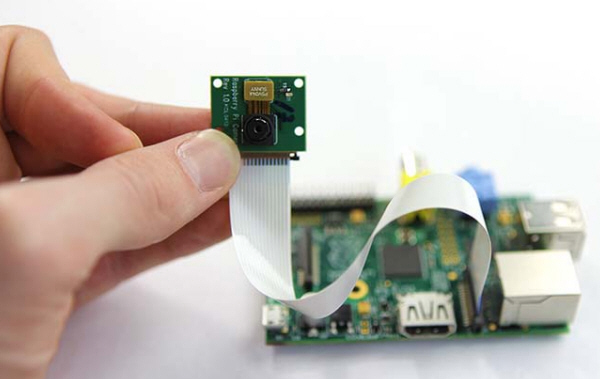
    Raspberry Pi, the popular credit card-sized ARM GNU/Linux computer, now has a camera add-on. A year in the making, the camera board consists of a small lens on a chip around the size of a postage stamp, attached to a flex cable.

    Connecting the module is just a matter of opening the camera port on the Raspberry Pi (it’s situated between the Ethernet and HDMI ports) and inserting the flex. The process is a little fiddly, but easy enough.

    The camera module is very sensitive to static electricity so you’ll need to be careful when getting it out of the box and handling it in general.

    Once connected, fire up the Pi, make sure you’re running the latest firmware, and access the configuration settings by entering: “sudo raspi-config”.

    Navigate to “Camera” in the menu and enable the board.

    Naturally, taking shots with the camera isn’t as easy as simply pressing a button. There are three applications provided: raspistill, raspivid and raspistillyuv and to use them you have to enter some commands. For example, “raspistill -o image.jpg” will capture an image, while “raspivid -o video.h264 -t 10000” will record a ten second video (without sound).

    The camera can stream video over a network on Linux, Windows and OS X.

    Although the module is a 5-megapixel camera capable of capturing 1080p video, the quality of the shots generally aren’t amazing, but you can improve the results by tweaking elements like sharpness, contrast, brightness, saturation, and ISO, all using commands. You can also turn off the Automatic White Balance and choose a mode like Sun (for shooting on sunny days), Cloud, Shade, and Fluorescent.

    There are various effects available too, such as Posterize, Watercolor, Oilpaint and Sketch.

    To encourage creativity, and show other users what’s possible, there’s a Photography Competition available to enter now.

    You can order the board from RS Components or Premier Farnell/Element14 in the UK, and it’s priced at £16.56 plus postage. At the moment it’s showing as out of stock, but more should be arriving soon. US customers should keep an eye on the Allied Electronics site.

    If you own a Raspberry Pi do you plan on getting the new camera module?

  • Nokia Confirms The Flagship Lumia 925 For T-Mobile U.S: 4.5″ AMOLED Screen, Metal Edges, Extra Lens & New Camera Software

    Lumia 925

    Fresh from last week’s Verizon Lumia device launch, Nokia has taken the wraps off a new smartphone in its Windows Phone-based Lumia range at an event in London today. The Lumia 925 is its first flagship for T-Mobile in the U.S. This means that following the Lumia 928 launch on Verizon, and factoring in Nokia’s initial launch of the Lumia 920 on AT&T last year, Nokia now has a flagship Windows Phone ranged on all three major U.S. carriers. Globally the Lumia 925 will be ranged with Vodafone in Europe, coming to markets including Germany, Italy, Spain and the U.K. (priced at €469), and in China with China Mobile and China Unicom. The device will ship in June in Europe, with a U.S. launch slated for soon after.

    The Windows Phone 8-based 4G Lumia 925 continues Nokia’s strategy of emphasising the camera smarts of its flagships Windows Phones, including PureView branding, Carl Zeiss optics and an 8.7MP lens with image stabilisation tech inside. But the camera hardware in the 925 is a little different to the 928 and 920, with one extra lens. This sixth lens improves photo performance in bright sunlight, according to Nokia, as well as sharing the low light performance abilities of its fellow flagships. In addition to that new camera hardware, the phone includes new software, called Smart Camera, that’s aimed at extending the photography experience by giving users new ways to capture and share photographs.

    The camera software on the device includes a burst mode which allows up to 10 shots to be captured at a time. The software also has three new capture modes that take advantage of this burst feature, namely: Best Shot, for composing a composite shot from the best elements of several images; Action Shot for snapping a series of stills of action shots, such as sports, that can then be edited and shared as a sequence; and Motion Focus, a Lytro-style mode that allows the snapper to pick different elements to be in or out of focus after the shot has been taken. Nokia confirmed to TechCrunch that the latter featured is the first bit of software to make use of technology Nokia acquired when it bought imaging company Scalado last July.

    “Whatever you do you can go back and edit again and again,” said Jo Harlow, head of Nokia’s smart devices unit — pictured above left, with SVP of product design chief Stefan Pannenbecker at the London launch. “The Nokia smart camera is our latest uniqie experience for our Nokia Lumia portfolio.”

    The Smart Camera software is exclusive to the Lumia 925 initially but will be pushed out as an over-the-air update called Amber to Windows Phone 8-based Lumias in Q3, the company said. Nokia looks to be trying to bolster its efforts against Samsung here, which included a raft of new camera features on its flagship Galaxy S4 device, such as Dual-Shot and Drama Shot. The lack of Instagram for Windows Phone continues to hamper Nokia’s photo-focused efforts however, but also today it announced a partnership with Oggl, Hipstamatic’s new photo community app — noting that since Oggl has a relationship with Instagram, users will be able to access the latter service via that app.

    Design wise, the Lumia 925 is the first Lumia device to include metallic trim. A silver aluminium band runs around its four edges, and doubles as the phone’s antenna — taking its cues from the iPhone’s design (but with “rigorous testing” to ensure no repeat of antennagate, according to Nokia). The mobile maker’s trademark polycarbonate clads the back of the device, so there’s a two-tone look and feel.

    Nokia says the plastic back is designed to make it feel nicer and grippier in the hand. It may also be about keeping the weight down (to 139g), since heavy handsets is something Nokia has been criticised for. It certainly felt lightweight and slender during a brief hands on. Handset colour options are muted rather than the usual bold Lumia offerings, with black, white and grey options for the plastic back. Wireless charging shells, sold separately, can reintroduce the usual Lumia splashes of yellow, cyan and red.

    Under the hood there’s a 1.5GHz Dual-Core Snapdragon chip, and 1GB of RAM. On board memory is 16GB (Vodafone will also get a 32GB variant) plus 7MB free cloud storage on Microsoft’s SkyDrive. The 4.5 inch AMOLED display has a resolution of 1280 x 768. Dimensions are 129 x 70.6 x 8.5mm. The 2000mAh battery is good for up to 12.8 hours of talk time on 3G, or up to 6.6 hours video playback, according to Nokia.

    A ‘true PureView’ Windows Phone device — codenamed EOS — has been rumoured for several months, and the Lumia 925 looks to be that device. However it certainly does not include the 41MP sensor and pixel oversampling techniques featured in the Symbian-based 808 PureView. It seems unlikely that bona fide PureView technology will ever make it to Windows Phone, not least because it’s something of a camera pro curiosity, rather than a consumer-friendly mainstream feature. Rather Nokia is extending the PureView branding — to associate it with a range of camera-centric features, not just that original huge sensor.

    Harlow closed the presentation by hinting at further new device launches from Nokia “later this summer”. “I can’t wait to see you later this summer when we will continue to bring new innovation and new experiences to our Lumia portfolio,” she said.

  • Polaris acquires HTC Sweden

    Polaris Private Equity has acquired HTC Sweden, a global developer and manufacturer of professional floor grinding systems and floor solutions. Polaris has acquired the company from Håkan and Gunn Thysell. 3i Group and former management, who held 40%, have also sold their interest in the company to Polaris.

    PRESS RELEASE

    Polaris Private Equity (“Polaris”), a leading Danish/Swedish mid-market private equity investor, has successfully acquired HTC Sweden AB (“HTC” or “the Company”), the leading global developer and manufacturer of professional floor grinding systems and floor solutions.
    Polaris has acquired the Company from Håkan and Gunn Thysell, who founded HTC in 1987 and have remained majority owners with a 60% stake. 3i Group and former management, who held 40%, have also sold their interest in the company to Polaris, in what is the firm’s sixth platform investment since the start of 2012.
    Headquartered in Söderköping, Sweden, HTC has been growing rapidly in recent years, driven by expansion into new geographic markets and the launch of new products. The company has 165 employees, and subsidiaries in the US, Germany, the UK and France, with coverage of an additional 60 countries through distribution partners. In 2012, the Company generated revenues of SEK 370m and EBITDA of SEK 58.5m.
    HTC creates value for its customers through new methods for floor preparation and floor solutions which are cheaper, sturdier, more environmentally friendly and longer-lasting compared to other options available on the market today. HTC’s strong focus on innovation has resulted in global market leadership within floor grinding machines, polished concrete (HTC SuperfloorTM) and diamond cleaning systems (TwisterTM).
    Polaris will now focus on supporting HTC in an ambitious growth strategy, based on organic and acquisitive expansion. The company will seek to consolidate its position in key geographies such as Europe and the US, as well as to extend its offering into emerging markets such as China and Brazil. Polaris will also continue the focus on innovation that has created strong customer loyalty and provided the Company with a competitive advantage.
    Peter Ankerst, Partner at Polaris, commented:
    “We are delighted to have completed the buyout of HTC Sweden. This is a highly scalable business led by an impressive, visionary management team, which has shown its credentials in recent years, growing both revenues and margins despite tough economic conditions. There are now exciting opportunities to transform HTC into a truly global leader in its field, and we look forward to helping the company deliver on these growth plans.”

    Lars Landin, CEO of HTC, added:
    “HTC has seen a strong expansion in recent years, with both the Twister and Hardware divisions contributing positively to top-line growth and earnings. Having Polaris as a new owner will give us wider access to the skills and capital resources required for the company to reap the benefits from the next stage of development which includes increased penetration and several near term growth venues.”
    Lars Landin and the rest of the management team will also invest in HTC. -ENDS-
    For further information please contact: Polaris
    Peter Ankerst, Partner
    HTC Sweden
    Lars Landin, CEO
    NOTES TO EDITORS
    +46 701 302830 [email protected]
    +46 765 266484 [email protected]
    About Polaris Private Equity (www.polarisequity.dk)
    Polaris Private Equity is a Danish private equity fund, based in Copenhagen, focusing on buy-out investments in well-established small and midcap companies in Denmark and Sweden. Polaris has €635 million under management in two funds. Polaris focuses on investments in companies with development potential and a typical turnover of €25-200 million. To date, Polaris has invested in 28 companies and exited 14. In addition, around 50 successful investments have been made within the portfolio companies.
    About HTC Sweden (www.htc-floorsystems.com)
    HTC Sweden AB (“HTC”) is the leading global developer and manufacturer of professional floor grinding systems and floor solutions, and is the number one player globally in terms of installed machines and technology. HTC is headquartered in Söderköping, Sweden with subsidiaries in the US, Germany, UK and France and covers an additional 60 countries through distribution partners. In 2012, the Company generated revenues of SEK370m and EBITDA of SEK 58.5m.
    HTC operates two divisions: Hardware – encompassing grinding machines and tools; and Twister – a diamond-based pad used in the cleaning industry. The Hardware division has been the market leader for over 20 years, while the diamond-based cleaning system, TwisterTM, launched in 2006 represents another successful invention which is rapidly gaining ground and taking market share.

    The post Polaris acquires HTC Sweden appeared first on peHUB.