As has always been obvious about Islam as a so called religion, which it purports to be, is that its principle method of recruitment is intimidation. No other religion does this.
This interview develops the idea and explains its success. We know it is wrong, but we are invited through outright intimidation to acquiesce to outrageous crimes against our own interests. What is missing is a counter strategy.
Yet the Rest of the World has one. Not war but confrontation. And let us take this game to the self proclaimed enemies. Call our armies Crusader armies and let them froth about it all.
War today is fought with well trained soldiers and special equipment. We have the capacity to stand off and merely glower. Of course we interdict money and supplies to force respect.
Make absolutely sure every horny young man knows he is a loser and his death is of no consequence and that unlimited power faces him.
Record the exhortations of every living Imam and confront him with his own words. Insist that he meets a higher level of educational attainment should he not meet the standards of civilized discourse.
Demand the application of full human rights and twelve years of a modern education for entry into civilized society.
Their rhetoric incites violence from not just their people but from us also. If our response is simply violence then they have reduced civilization to their level of barbarism to our loss.
We can do better today.
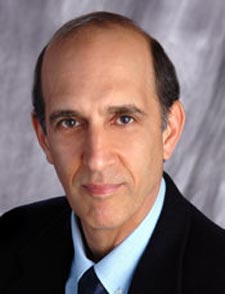
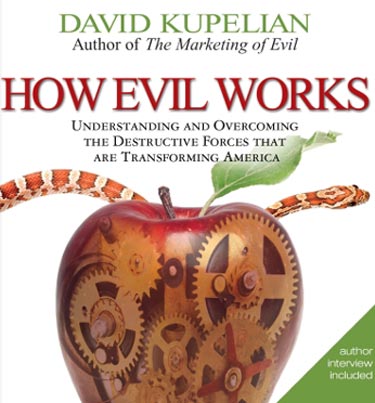
Frontpage Interview’s guest today is David Kupelian, award-winning journalist and managing editor of online news giant WorldNetDaily.com as well as its popular monthly newsmagazine, Whistleblower. A widely read online columnist, he is also the author of the bestselling culture-war classic, The Marketing of Evil: How Radicals, Elitists, and Pseudo-Experts Sell Us Corruption Disguised As Freedom, now in its eleventh printing. His new book, released in February by Simon & Schuster, is How Evil Works: Understanding and Overcoming the Destructive Forces That Are Transforming America.
FP: David Kupelian, welcome to Frontpage Interview.
Let’s start by talking about the Stockholm syndrome that, as you discuss in your book, is affecting the West right now in its confrontation with Islamic Jihad. Give us your perspective.
Kupelian: Jamie, thanks very much for giving me the opportunity to talk about “How Evil Works.” In Chapter 3, “How Terrorism Really Works,” I use the Stockholm syndrome to explain the inexplicable level of weakness and appeasement we continually see in the West toward Islam – for instance, in our disastrous failure to stop Nidal Malik Hasan before he shot dozens of people at Fort Hood, killing 13, even though we knew full well he was a jihadist time bomb waiting to explode.
Everyone’s heard of the Stockholm syndrome, named after the Swedish bank robbery when two escaped convicts terrorized four hostages in a bank vault for five and a half days, during which time the hostages grew increasingly sympathetic toward their captors and antagonistic toward the police who were risking their lives to rescue them. The hostages, who had been tied to chairs, had nooses around their necks and guns trained on them day after day, ended up siding with their captors wholeheartedly, later raising money for their defense and refusing to testify against them at trial.
The syndrome, which law enforcement psychologists recognized long before it had a name, is pretty simple: When we’re seriously intimidated, in a life-threatening way, some of us start to side with whomever or whatever is intimidating us. I don’t mean just cooperating and “agreeing” with a captor as a survival strategy, which makes perfect sense. Extreme intimidation has a way of sometimes flipping our sympathy and loyalty in favor of the people doing the intimidating. In the news business, we see this in high-profile cases like Patricia Hearst, Elizabeth Smart and Jaycee Dugard.
Radical Islam is extremely intimidating – by design. The more crazy it acts, the more powerful it becomes. Just a few weeks ago, in Nigeria, Muslim gangs slaughtered 500 Christians, including many children and pregnant women and old people – hacked them to death with machetes. Islam has spread in this way – “at the point of a sword” – for centuries. As I write in “How Evil Works,” I personally lost many family members, perhaps over 100, in the genocide of the Christian Armenians at the hands of Muslim Turks. I tell one story in which my great grandfather, a Protestant minister, was martyred, along with 60 or 70 other clergymen and their wives, in Adana, Turkey, because they refused to convert on the spot to Islam. This is how it spreads, by traumatizing people. Many, just to survive, join the religion.
So the murderous Islamic tantrums we keep hearing about have a certain dark logic to them, in terms of enabling the spread of Islam. Remember the Danish Muhammad cartoons, which resulted in over 50 deaths? Or when Newsweek reported (incorrectly) that someone at Gitmo flushed a Quran down the toilet, which led to at least 15 deaths? Or the Miss World contest in Nigeria, when a single comment by a newspaper columnist about the beauty of contestants led to insane Muslim rioting in which rioters massacred over 200 people with machetes, or beat them to death or burned them alive – all because of a single sentence a newspaper columnist wrote, which wasn’t even offensive?
How do we respond to these outrageously demented and murderous tantrums? We refer to terrorist acts as “man-caused disasters.” We proclaim Islam as a “religion of peace.” Burger King recalls thousands of its ice cream cones because someone thought the ice cream swirl logo looked too much like the way the word “Allah” is written in Arabic and was therefore sacrilegious. “The 3 Little Pigs” is repeatedly censored in Britain so as not to offend Muslims, who don’t like pigs. In the U.S. we have a middle school curriculum that requires our children to dress up in Islamic garb, take on a Muslim name, memorize verses of the Quran and play so-called “jihad games.” Imagine trying that in today’s public schools with the Christian religion!
America, Europe and Britain today, in the way they deal with radical Islam and the terror threat, reveal something very akin to a low-grade, widespread Stockholm syndrome.
Bottom line, we don’t want to offend Muslims. Why? Because we’re afraid of them. We’re not afraid of Christians or Jews, because Christians and Jews don’t have tantrums and burn down other religions’ houses of worship and cut of people’s heads and commit terrorist acts. Radical Muslims do. We’re so afraid that, even after the Fort Hood attack, the Pentagon, in its 86-page postmortem report analyzing the event, did not see fit to mention the word “Muslim,” “Islam” or “jihad.” This is reminiscent of the “Harry Potter” stories, where everyone is so spooked by the villain Voldemort that they are afraid even to utter his name.
Ironically, people in the grip of jihadist fervor have nothing but contempt for our weakness and appeasement, which actually encourages more violence. Their madness is neutralized only by strength. Ronald Reagan knew this, which is why his watchword was “Peace through strength.”
FP: David, you mention how just recently, in Nigeria, Muslim gangs slaughtered 500 Christians, including many children and pregnant women and old people. Everyone has heard about the “Christian militia” that was just arrested in Michigan (casualties, which seem to be at the number of zero, are still to be numbered or named). How come the slaughter in Nigeria, which took 500 lives, is not in the news and no one has heard about it?
Kupelian: The Obama propaganda ministry – aka the “mainstream press” – is always looking to reinforce the largely phony narrative that “homegrown terrorism” on the right is a major danger to American civilization. Hence the saturation coverage of the “Christian militia” group. The “rightwing terrorism” narrative is necessary for justifying the left’s attacks on normal, hard-working, tea-partying Americans – evident in the growing allegations that speaking honestly about the leftist coup in Washington is “hate speech,” that those opposing Obama are racists, and that tea partiers are one step away from violence.
On the other hand, dwelling on Muslims’ blood-lust and widespread massacring of Christians in foreign lands supports the “wrong” narrative (from the media’s point of view) – namely, that Islam is not a religion of peace after all, hasn’t been one for the last 14 centuries and shows no signs of starting. Thus, the murders of 500 innocent people are reported perfunctorily, if at all, and then dropped. The mainstream media are just not interested.
FP: You say that, “Bottom line, we don’t want to offend Muslims. Why? Because we’re afraid of them.” Absolutely, we have a pathetic talk show host on the CBC up here in Canada, George Stroumboulopoulos, who makes constant jokes about Jesus, yet you will never hear him make one joke about the “Prophet” Mohammed.
Fear, as you state, is definitely a factor. But let’s move a bit further and deeper. I’ve made a life-time study of these people and we know that in the world of the Left, it is unimaginable to criticize an adversary culture or religion, and that it is very chic to slander anything connected to the Judeo-Christian tradition. To poke fun at Islam would threaten these peoples’ whole identity, world vision and social life. Can you comment on this a bit?
Kupelian: For one thing, the Left’s very identity and sense of righteousness are tied up in hating America for all its supposed wrongs, arrogance, injustices, exploitations and wars of oppression. And since, as we all know, “the enemy of your enemy is your friend,” cultures that hate and revile America are therefore respected and even admired by the Left, which also hates America. This is one reason Attorney General Eric Holder has pushed to try Khalid Sheikh Mohammed in civilian court; he secretly – maybe unconsciously – has a certain amount of sympathy for the 9/11 mastermind. The logic of this is straightforward and incontrovertible: KSM hates and blames America, and because leftists like Holder also hate and blame America, leftists “understand” and even sympathize on some level with terrorists, no matter how despicable their crimes.
FP: Tell us a bit about how people who want to manipulate us often use crises to do so. Explain how this is connected to what Obama and his administration are up to.
Kupelian: As all skilled manipulators know, the easiest and surest way to exert control over people is to get them to react emotionally to you. One way to get people to do what they wouldn’t ordinarily do is to create a phony crisis for them to overreact to.
For instance, in “How Evil Works” I cite a child-abduction case in which a little girl was approached after school by a man she didn’t know. He claimed her house was burning down, that her parents were busy putting out the fire, and that he was a friend of the parents who had asked him to pick up their daughter and take her to them. The crisis – and the emotional upset the girl experienced over the thought of her house being on fire and her parents in danger – drowned out her normal caution about getting into a car with a stranger. Result: The stranger, a predator who had concocted the lie for the sole purpose of upsetting and tricking the girl into going with him, murdered the little girl. This same routine was portrayed in the film “Changeling” starring Angelina Jolie, a true story that involved a serial child murderer who enticed youngsters into his car using this exact “your-house-is-on-fire” ruse.
As I explain in Chapter 1, “Why We Elect Liars as Leaders,” manufactured crisis is the primary modus operandi of the Obama administration. After all, how else could a far-left administration lead a center-right country in such a terrible direction without big-time deception and subterfuge – which is accomplished handily by constantly creating bogeyman crises? For instance:
* We heard for 14 months that our healthcare system is desperately broken. In reality, it’s the finest healthcare system in world history. If you’re an illegal alien child molester and you get sick or injured and go to a public hospital, you will, by law, be taken care of whether or not you can pay. That’s not a broken system. And as for the relatively small number of Americans who truly can’t afford health insurance, our government has always been good at creating safety nets. But that was not the intent of Obamacare, which conspicuously bypassed all sensible, market-based reforms – like litigation reform and allowing intrastate purchase of insurance – that would lower costs without degrading quality of care.
* Until wave after wave of scandalous fraud revelations proved the global warming “consensus” was a giant hoax, America was poised to pass “cap-and-trade” legislation which would institute massive and ruinous levels of wealth redistribution – which was the object all along. The administration is now regrouping and re-strategizing how best to force this abomination down Americans’ throats, as they did with Obamacare.
* We’ve been told throughout the age of Obama that America will plunge into hopeless depression if government doesn’t spend trillions and take over entire sectors of the economy. In reality, massive government and Federal Reserve intervention has always worsened and prolonged economic downturns, not solved them.
· Here’s one most people don’t know about: Last May, just a few days before the World Health Organization classified swine flu as a phase 6 pandemic – the highest, scariest category – the WHO quietly redefined pandemic to eliminate the phrase “enormous numbers of deaths and illness” and substituted wording that said pandemics “can be either mild or severe in the illness and death they cause.” You see, the WHO grows in power and lots of money starts to flow when a phase 6 pandemic is declared. The White House, never one to let a good crisis go to waste, issued a press release saying up to 90,000 Americans would likely die from swine flu. The next day, the head of the CDC, Dr. Thomas Frieden, told Americans to ignore the White House’s wild fear-mongering, saying “Everything we’ve seen in the U.S. and everything we’ve seen around the world suggests we won’t see that kind of number if the virus doesn’t change.”
Fundamentally, the whole leftist obsession with power – which promotes ever-increasing dependency of people on government – is, in and of itself, a huge crisis machine. Normal competent adults are able to take care of themselves and their families through their own efforts and through voluntary cooperation with other free individuals. That’s America. If you’re an adult who can’t take care of your own life, that’s a crisis – and this is the state leftists want us to be in, to be dependent on them since that’s the basis for their growth in power. So socialism not only requires crisis to become established, its very existence is a state of perpetual crisis for free people.
FP: You refer to the “whole leftist obsession with power” in passing. Not everyone might know what you mean. In my own research and study, I know this reality in terms of how the Left lives vicariously through supporting communist dictators like Fidel Castro through what is called “negative affirmation.” But that is another matter (a bit). I know our themes are connected, so can you expand a bit on what you mean?
Kupelian: Whole people – that is, people who are internally connected to conscience, to common sense, to God, however you want to put it, and who therefore possess a certain natural reverence for other souls and their autonomy – are not attracted to obtaining power over other people.
But people who have become twisted in certain ways – maybe they had a crummy childhood, or were brainwashed in college into embracing some toxic ideology, or simply are really resentful or envious or insecure – sometimes develop a compulsion to control others.
Imagine that you just met someone for the first time, and discovered that this person considered himself or herself far superior to others, above the need to be truthful, above the law, willing to break the law, and was arrogant and defiant at every turn. And that furthermore, this person harbored an overwhelming urge to control you, take what’s yours, and exercise power over you. You might understandably conclude this person is not only dangerous, but likely a criminal and/or mentally ill. That’s who we have running the country right now – the inmates are truly running the asylum.
These are very sick people we’re talking about: They thrive on crippling others, because the more dysfunctional people there are in the general population, the greater their power. More competent, mature, self-sufficient grownups translate into less power for them, which is why they disdain and malign the tea partiers and other normal, hard-working, tax-paying, independent Americans.
For the very egotistical, deluded person, power is like alcoholism. People like Nancy Pelosi and Barack Obama are drunk – on power. They don’t think, feel, reason or act in a normal way; they’re in an altered state of consciousness. As we say, “power corrupts,” and the more power we give them, the more absolute that corruption becomes.
Also, we need to remember that leftist politicians by definition believe the purpose of government is to ensure, by force, that wealth is evenly distributed. Thus, they look at us like we’re farm animals and they’re the farmers. When some of us have “too much food” and others “don’t have enough,” they come in and take it from us, and scold us for “hording” all that food we don’t need, and give it to the poor, righteous animals with not enough food. The problem is, we’re not animals and we don’t belong to them.
FP: How come the West has such a difficult time understanding the conflict we are in? This has much to do with, as is the subject of your work, the difficulty we have in understanding evil. Illuminate this phenomenon for us.
Kupelian: In the past 60 years, America as a whole has been conned into abandoning the core Judeo-Christian values that have provided the moral foundation of Western civilization for millennia, and of American civilization for centuries. The fundamental principles of life that previously gave our existence meaning and kept our society unified, safe and strong – belief in God, belief that the Ten Commandments and the Sermon on the Mount were the basis for a good life and a great society, recognition of the sanctity of life (which means you don’t kill babies before they’re born or old people when their care gets too expensive), belief that sex is sacred and reserved for marriage, and so on – have been discarded like yesterday’s newspaper.
If we don’t understand that we are created by God and that we live in a moral dimension in which we constantly can choose between good or evil, and that things go really badly when we choose the wrong way – if we don’t recognize this basic reality level of our lives, then it’s very difficult to understand evil, or to understand ourselves for that matter.
FP: You refer to the Sermon on the Mount as being the basis for a good life. I always found that one of the most moving parts of the New Testament, but I always saw it mostly as a promise for the next life (i.e. your reward will be great in heaven). Can you expand a bit on what you mean in terms of it being a basis for a good life on earth?
Kupelian: The beatitudes (“Blessed are the …”) describe the kind of attitude toward life that leads to genuine happiness or “blessedness” – including the admonition to “let your light shine before men” (which includes speaking the truth even if it’s unpopular) but also to forgive people who attack you for speaking the truth (“Blessed are ye, when men shall revile you, and persecute you, and shall say all manner of evil against you falsely”). That’s very reassuring and strengthening.
A lot of what Jesus said in the Sermon on the Mount is practical, for the here and now: He talks about hate and lust and divorce, and how we need to rise above these things. Some of the most transcendent truths that have infused traditional Judeo-Christian culture derive from the Sermon on the Mount, including The Lord’s Prayer; the admonition to “Seek first the kingdom of God” (and all else will be added); the warning to “Beware of false prophets, which come to you in sheep’s clothing, but inwardly they are ravening wolves”; the truth that “a good tree cannot bring forth evil fruit,” and so on. Wisdom for living.
FP: Your book deals with the war that is being waged on men and on masculinity in our society. Why is this happening and what are its consequences?
Kupelian: In schools today, boys are doing worse than girls by every measure. The vast majority of children with discipline problems, learning disabilities, behavioral disorders, who are put on Ritalin or who drop out of school – 70 to 80 percent – are boys. Three out of five college students today are young women.
As boys grow up and get married, two thirds of divorces are initiated by the wives – and it is the wives that almost always get the children during custody proceedings, since the entire family court system is notoriously biased against men.
In popular culture, virtually every TV commercial portrays men as idiotic and women as smarter and hipper. Same with sitcoms, and with animated comedies like “The Simpsons” and “Family Guy.” The dad is always the doofus. What happened to “Father Knows Best”?
In Chapter 8 of “How Evil Works,” titled “The War on Fathers,” I document how, as an outgrowth of the radical feminist movement of the sixties, today men, boys and masculinity itself are under attack. Our leftist academia harbors a major movement that is so offended by masculinity that it holds workshops on how to “transform” boys, eliminating their aggressiveness, competitiveness and maleness!
Remember the radical feminists of the sixties, with their angry denunciations of marriage as “legalized rape” and “slavery for women”? Just as the sixties political radicals are today running the American government, culturally the sixties’ radical feminist hatred of Christianity and the traditional patriarchy that goes with it has infected today’s culture. It manifests as a compulsion to ridicule, diminish and have contempt for men. You can see it everywhere.
There is, of course, also a “practical” governmental motivation for breaking up marriages: Tyranny always works better when families are in crisis. Intact, functional families constitute their own universe, one with powerful internal loyalties and transcendent values that compete and sometimes clash with those of despotic government, which therefore strives to separate fathers from their families. In 1918, right after the Russian revolution, Vladimir Lenin passed a radical no-fault divorce law. Realizing that to maintain control of the people the Russian family had to be destroyed, Lenin passed a law whereby you could divorce your spouse simply by mailing or delivering a postcard to the local register without even notifying the spouse being divorced!
FP: Final thoughts?
Kupelian: Alexander Solzhenitsyn, the great Soviet dissident who exposed the evils of the gulag system to the world, once wrote: “More than half a century ago, while I was still a child, I recall hearing a number of older people offer the following explanation for the great disasters that had befallen Russia: ‘Men have forgotten God; that is why all this has happened.’”
Decades later, Solzhenitsyn said that in trying to explain the totalitarian horrors that permeated the 20th century – which he himself endured – he could not improve on the explanation he had heard as a child: “Men have forgotten God.”
FP: David Kupelian, thank you for joining Frontpage Interview.
I have to tell our readers that How Evil Works is a brilliant book. Buy it!!!!



 Google has been getting a lot of flack for its supposed disregard of user privacy. The Google Buzz fiasco is still fresh in everyone’s mind and privacy regulators, especially in Europe, are increasingly critical of Google. But it goes both ways, when it suits them, governments will forget all about user privacy. Google, jus… (


 (USDA, April 16, 2010) – Agriculture Secretary Tom Vilsack today invited public comment on several proposed rules designed to increase the production of advanced biofuels and the development of biorefineries. The programs are authorized under the Food, Conservation and Energy Act of 2008 (The Farm Bill). “We view these proposed rules as part of the strategy to help meet President Obama’s goal to accelerate the commercial production of advanced biofuels and create a viable alternative fuels industry,” Vilsack said. The proposed rules affect the following three renewable energy programs administered by USDA Rural Development: Biorefinery Assistance Program – The proposed rule will establish guaranteed loan regulations to develop and construct commercial-scale biorefineries and to retrofit existing facilities using an eligible technology to develop advanced biofuels. Under the proposed rule, USDA Rural Development proposes a rolling application process for the consideration of loan guarantee requests. The Agency will consider a technology that is being adopted in a viable commercial-scale operation that produces advanced biofuels.
  Kentucky Enterprise Fund
  Marine and Hydrokinetic Technology Readiness Advancement Initiative – DOE is investing in marine and hydrokinetic (MHK) technologies. The opportunity to harness energy from waves, tides, currents, and ocean thermal gradients represents a promising, largely untapped resource that can produce predictable baseload renewable energy that is within close proximity to loads. The mission of DOE’s Water Power Program is to perform and sponsor the necessary research, development, test, evaluation, and demonstration of innovative water power technologies, in order to effectively generate renewable, environmentally responsible, and cost-effective electricity from MHK resources. It is the intent of this FOA to advance the technical and operational readiness of marine and hydrokinetic systems and components across a range of TRLs, with the unified goal of accelerating the development and deployment of these technologies to provide a domestic source of clean, affordable energy that is both economical and ecologically responsible. This FOA seeks applications in the following Topic Areas: Topic Area 1: MHK Technologies Concept Development; and Topic Area 2: MHK Technology Readiness Level Advancement. Funding will be made available in each Topic Area for the advancement of both MHK “systems” and “components” as defined below. MHK Systems: For the purposes of this announcement, a system is defined as a complete device that is capable of capturing and converting hydrokinetic energy (wave, current, or tidal) with the purpose of generating electricity for the grid, either via a single unit or configured in an array. Integrated ocean thermal systems will not be funded under this announcement. All necessary components should be conceptualized, designed, and integrated. These components may include, but not limited, to: nacelle, hydrodynamic, buoys, power-train, power take-off, mooring, and foundation. MHK Component: For the purposes of this announcement, a component is defined as a sub-system of an MHK system that is optimized for an existing MHK system, or has the potential for cross-cutting multiple MHK systems. DOE is also interested in components that maximize commonality across existing and/or future MHK systems. Components may address marine and hydrokinetic energy (wave, current, tidal, and ocean thermal). Examples include optimized rotors, generators, drive-trains, power take-off devices. Total Funding: $15.36M. Eligibility: Industry. Application Due Date: June 7, 2010.



 Computational Toxicology: Biologically-Based Multi-Scale Modeling – The EPA, as part of its Science to Achieve Results (STAR) program, is seeking applications for research in developing quantitative, dose-response models to elucidate the associations between environmental agents and toxicity pathways across multiple scales of biological organization. Additionally, this solicitation calls for research into ways in which the data underlying these models can be managed and shared for easier access, interpretation and use by the broader community of researchers and risk assessors. There are two distinct Research Areas covered by this solicitation: (1) Model Development and Model Evaluation; and (2) Data Management. Applications must propose research in one of these research areas to be eligible for funding. These two areas of research shall be conducted concurrently in the following way: the research team funded under the second research area shall collaborate with the research teams funded under the first research area to ensure that the latter conform their modeling data to a shared ontology. Total Funding: $3M. Eligibility: Public and Private Nonprofit Institutions/Organizations (including institutions of higher education and hospitals). Closing Date: July 15, 2010.