Category: News

  • The Treasury Acts to Stop Private Counterfeiting–But What About the Fed?

    By Doug Bandow

    The U.S. government is worried.  Counterfeiters around the world are at work.  Printing fake greenbacks has become big business.

    So the Treasury has unveiled a new banknote.  Reports the Wall Street Journal:

    Treasury Secretary Timothy Geithner and Federal Reserve Chairman Ben Bernanke unveiled a new $100 bill equipped with two new security features.

    The bill will go into circulation Feb. 10, 2011.

    Treasury Secretary Timothy Geithner and Federal Reserve Chairman Ben Bernanke unveil a new $100 bill equipped with two new security features. The News Hub takes a look at the new bill, which goes into circulation Feb. 10, 2011.

    The Fed, along with the Treasury Department, the Bureau of Engraving and Printing and the U.S. Secret Service, “continuously monitor the counterfeiting threats” for each denomination and redesign decisions are made based on those threats, Mr. Bernanke said.

    “This job has become more complex in recent years as technology advances and U.S. dollar flows expand and increase,” he added.

    The bill-the highest denomination of all U.S. notes-circulates widely around the world, with circulation in the past 25 years growing to $890 billion from $180 billion.

    About two-thirds of all $100 notes circulate outside the U.S.; Mr. Bernanke said the agencies must ensure people around the world are aware of the design change. Over the next several months, officials at the agencies will work to educate cash handlers, consumers and others about the design and explain how to use its security features.

    Benjamin Franklin is still on the latest makeover of the $100 bill, unveiled Wednesday, but he has been joined by a number of security features as part of an effort to stay ahead of counterfeiters.

    The 6.5 billion or so $100 notes in circulation now will remain legal tender, Mr. Bernanke said.

    Okay, so now the counterfeiters will have a harder time.  (Though as long as older notes are legal tender, nothing prevents counterfeiters from faking the old currency.)

    But who’s going to stop the Fed from running the printing presses?  Just like killing is illegal murder when conducted by individuals but legal war when conducted by government, counterfeiting is illegal when private individuals pass the notes onto unsuspecting people but legal when the government forces private individuals to accept its currency as “legal tender.”

    Who’s going to put a stop to legal counterfeiting?

  • “Designing with Forces” – How to apply Christopher Alexander in everyday work

    A couple weeks ago I gave a talk at the MFA in Interaction Design program at the School of Visual Arts in NYC. The video for the talk and Q&A session is online now. When Liz Danzico invited me to speak at the SVA, I thought it would fit the university setting to share some theory behind our design process at 37signals.

    One book that heavily influenced my approach to design is Christopher Alexander’s Notes on the Synthesis of Form. Many designers cite the book as an influence, but few really explain what it’s about or teach how to apply the ideas in everyday work. So I took the opportunity to explain the key points of the book and show how we use Alexander’s model to do design at 37signals.

    Here’s the video of the talk:

    Some of the screenshots are hard to see around 38:30. Check the images below if you’d like to see those screens more clearly.

    Highrise history Options behind a link A new link to notify Embedded notification form

    The talk was followed by a Q&A session. The Q&A touches on customer feedback, design vs. evolutionary selection and trusting your intuition.

    Here are some things to check out if you liked the talk.

    I’d love to know if people are interested in this material. Post a comment here or write me at ryan at 37signals dot com with your thoughts.

  • Insane: Carlos Zambrano headed to Cubs bullpen

    http://a323.yahoofs.com/ymg/ept_sports_fantasy_experts__26/ept_sports_fantasy_experts-620177271-1271883104.jpg?ymglPBDDaC_HcQDR

    Ted Lilly(notes) returns from the disabled list this weekend, so the Cubs have decided to send Carlos Zambrano(notes) to the bullpen — not Tom Gorzelanny(notes) or Carlos Silva(notes), but Zambrano.

    Big Z struggled on opening day, per his usual. But in his three most recent starts he’s pitched 18 innings, struck out 25 batters, and allowed eight earned runs. He is inarguably one of his team’s most talented starting pitchers. April has been Zambrano’s worst month historically, yet he’s never posted an ERA above 3.95 in any full season. In case you’re wondering, he’ll earn $17.9 million this year, $17.9 million in 2011, $18 million in
    2012, and he has a vesting option for 2013.

    According to MLB.com’s Carrie Muskat, "The Cubs didn’t want to move Carlos Silva into the bullpen because he’s been on a hot streak, and southpaw Tom Gorzelanny wouldn’t fit as well in relief."

    For the record, Silva’s hot streak is exactly two games old. Opposing batters have hit .303 against him over the course of his nine-year career. Silva’s lifetime ERA is 4.67. Gorzelanny’s is 4.80.

    Zambrano is not an immediate threat to take over Carlos Marmol’s(notes) closing role, of course. He’s just another guy in the ‘pen for now. Instead of giving him his typical 200 innings, the Cubs have apparently chosen to give him 80 this year. Here’s manager Lou Piniella:

    "This makes all the sense in the world and I appreciate Carlos doing this," said Piniella of the decision. "It gives us some power at the end of the ballgame. With Zambrano and [Carlos] Marmol, it gives us some firepower."

    You didn’t ask for my opinion, but here it is: This decision isn’t merely stupid, it’s weapons-grade stupid. Total organizational failure. Even if Zambrano is successful in the setup role, this is an atrocious use of resources. This move is neither bold nor innovative. It’s just insane.

    I can’t possibly talk you off the ledge, Cubs fans. Perhaps our commenters can help…

    Photo via US Presswire 

  • Open vs. Closed: Ubuntu Walks the Line

    Any debate over open vs. closed systems has to touch on open-source software and the ways in which companies are attempting to build code as a community effort, while still profiting from it in some way. So I chatted with Mark Shuttleworth, CEO of Canonical, the company that supports Ubuntu, about how his company walks the line between spending to support open-source software and finding a business model that works.

    Canonical’s 330 employees are responsible for maintaining, supporting and selling service for Ubuntu, an open-source version of the Linux operating system for servers, desktops and computer manufacturers. About 120 to 150 of the Canonical employees contribute directly to the new releases of the software that come out every six months, and most of the company’s revenue comes from supporting enterprise server customers and maker’s of computers who want to put Ubuntu on desktops. Consumers also download the software, but few pay Canonical for support. The company is not yet profitable.

    Shuttleworth believes that in order to develop a strong business model around an open approach, one has to create an open option early, ideally through a strong standardization process and one also needs to have a lot of different open source projects fighting it out.  For example, in the operating system world there wasn’t a strong history of open alternatives, which meant that Ubuntu had to out-open its proprietary competition, which has high costs.

    In that way it has pushed Canonical perhaps further out toward open on the spectrum. Shuttleworth calculates the direct costs of being so open as bringing people together in way that empowers them and makes them feel like members of a community, and reaching out and putting in place the infrastructure to create a company. However, there are indirect costs as well.

    “There is a myth that being open is necessarily more efficient and cheaper, but there are no hordes of people showing up to do the hard stuff,” Shuttleworth says. “Occasionally wonderful, magical things happen — really incredible things do happen, like people show up unexpectedly with brilliant ideas — but it’s still hard and expensive and you still have to be willing to do all the hard and expensive things and do it in an open fashion. And you’re still likely to be accused of being open only when it’s convenient.”

    He points to the cloud-computing market as one that tends to give a lot of lip service toward openness but where a lack of a big standardization effort and robust open source competition could lead to a relatively closed ecosystem.

    “The basic story there is pretty bad at the moment,” Shuttleworth says. He notes that proprietary infrastructure, hypervisors and even the APIs and ways data is stored can lock folks into one cloud for life. “We need real open alternatives early in the process, making it possible for people to build own cloud infrastrucutre that responds to the same APIs that Amazon’s do,” Shuttleworth says.

    He’s accepted that Amazon Web Services’ APIs for its web services, while not created through an open standards group, have become a de facto standard and said that it’s more efficient to build open source code around Amazon APIs rather than try to develop new ones for accessing the cloud. Canonical has a partnership agreement with Eucalyptus, which offers open-source software to create an AWS-compatible cloud, where people can use Ubuntu  and Eucalyptus to create their own cloud computing platform. But Shuttleworth would like to see more open-source options other than Eucalyptus  for building out a cloud computing service of your own.

    At the platform-as-a-service level, the issue around openness will be around moving data from cloud to cloud easily. There’s room there for an open standard or open databases, he said. But at every level, when considering building a business around open source software, he he believes that “you want a common and clear standard with competing open source versions using that standard.”

    That keeps proprietary vendors at bay, and gives the companies building a business around the open source software a chance to decide where they want to be on the open-to-closed spectrum. But it also introduces the prospect of fragmentation, which we’ll leave for a later post.

  • Fiat Uno supermini leaks out

    Filed under: , , , , ,

    2011 Fiat Uno – Click above for high-res image gallery

    The crew at Carscoop have managed to get their hands on a bevy of images of the new Fiat Uno. Judging from the photos, it looks like the company will be offering its tiny hatchback in two varieties – the standard base model and the Uno Way. Expect the Way to boast a slightly taller ride height and off-road inspired looks once the cars hit markets in Brazil, Europe and Russia.

    There’s no word on whether or not the Brazilian-built machines will find their way to the U.S. via Fiat’s new partnership with Chrysler, but judging from what’s rumored to be under the hood, we doubt it. Odds are both the standard Uno and the Way will get their grunt from tiny 1.0- or 1.4-liter engines – not exactly American fare.

    The new Uno resurrects a name that had been abandoned by Fiat since the early 2000’s, and the company says we can expect the model to slot between the Panda and the Grand Punto when it hits the scene.

    Gallery: 2011 Fiat Uno

    [Source: Carscoop]

    Fiat Uno supermini leaks out originally appeared on Autoblog on Wed, 21 Apr 2010 17:20:00 EST. Please see our terms for use of feeds.

    Permalink | Email this | Comments

  • Users Appetite For Social Networking Much Broader Than Facebook When On The Phone


    Facebook Mobile on iPhone

    Mobile-phone subscribers in the U.S. spent nearly 60 percent of their time on the phone accessing a social networking site, making the category the most visited by far when on the phone. In fact, time spent on social networks easily exceeds other high-profile sites such as online portals and typically well-integrated carrier sites.

    According to Ground Truth, a measurement firm that receives data directly from the carriers and other sources, the average subscriber initiated 68.1 sessions, consisting of 310 pages viewed for a total time of 52 minutes and 12 seconds on social networks from the phone’s browser. The data does not include usage from mobile applications. During the first full week in April, top social networking brands, like MySpace (NYSE: NWS) and Facebook, did fairly well, but the true highlights were mobile-specific brands like MocoSpace, AirG and MBuzzy. In terms of the amount of time spent with an individual site, MySpace averaged 40 minutes; Facebook, 30 minutes, MocoSpace and AirG an hour and a half each, and MBuzzy for one hour and nine minutes.

    Other categories didn’t even come close. After social networking, portals (presumably sites like Yahoo (NSDQ: YHOO) and Google), were only used 13.65 percent of the time; operator portals were even visited less frequently at 9 percent.

    Ground Truth’s VP of Marketing Evan Neufeld said in a release: “Facebook and MySpace may be the most addictive pastimes on the PC, but sites like Mocospace and AirG command more attention on mobile phones…This data points to the fact that there is a whole universe of media properties advertisers need to consider that have to date been largely ignored. It also demonstrates that traditional media companies that are not focused on the Mobile Internet—both browser- and application-based usage—risk losing market share to leaner, more mobile focused companies.”


  • Air Force to Launch Secret Space Plane Tomorrow–But Don’t Ask What It’s For | 80beats

    0420-air-force-X37BWhen it comes to keeping secrets, the U.S. Air Force knows how to stay mum. On Thursday, the Air Force will launch its secret space plane, the unmanned X-37B aircraft, from Cape Canaveral. The project has been a decade in the works and cost millions of dollars to develop–but we civilians have little idea what it’s for.

    Once launched via an Atlas V rocket, the plane is expected to spend days or weeks orbiting Earth and performing classified experiments before landing back in California. If successful, the launch will fulfill the Defense Department’s long-time dream: the orbital flight of a military vehicle that combines an airplane’s agility with a spacecraft’s capacity to travel in orbit at 5 miles per second [Popular Mechanics].

    The project itself has had an interesting past. It was begun by NASA in 1999 but was later adopted by the Defense Department, and was first placed under the auspices of DARPA before finally finding a home with the Air Force. The Air Force immediately threw the X-37B behind a veil of secrecy, leading some experts to speculate that this could be the military’s attempt to weaponize the final frontier. There are also concerns that the mysterious project could set off an orbital arms race with countries like China.

    The 29-foot-long delta-wing spacecraft looks like a miniature version of a space shuttle. The unmanned X-37B is capable of cruising around the globe for more than nine months at a stretch, experts say, keeping close tabs on targets below and monitoring the space above. Its small size and simplicity are great assets to the military, because they’ll allow for the aircraft’s quick deployment in emergencies. Theresa Hitchens, a space policy expert and director of the United Nations Institute for Disarmament Research says the X-37B might be intended to be an orbital first responder. “The first thing that comes to mind is a pop-up reconnaissance vehicle for a place where you don’t have satellite reconnaissance or can’t move a satellite fast enough” [Popular Mechanics], she says.

    Though the air force has been mum about the space plane’s potential uses, experts speculate it could conceivably be used as a bomber. The craft could fly over targets within an hour of launch to release cone-shaped re-entry vehicles that would both protect and guide weapons through the atmosphere. A craft the size of the X-37B could carry 1000- or 2000-pound re-entry vehicles armed with precision munitions like bunker-busting penetrators or small-diameter bombs, or simply use the explosive impact of kinetic rods cratering at hypersonic speeds to destroy targets. [Popular Mechanics].

    When the first X-37B returns to Earth, scientists will determine how many of its components survived the flight and how long it will take to get the craft back into the air. The shorter the turnaround time, the better, since that would mean fewer X-37s would have to be built, regardless of its ultimate mission [The Christian Science Monitor]. For now, the Air Force is simply preparing for tomorrow’s launch and refusing to spill the beans on the space plane’s potential uses. But the military seems optimistic about this long-delayed program; Air Force officials have admitted that they have a second X-37B in the works, which they hope to take out for a test flight by 2011.

    Related Content:
    80beats: Highway to the Green Zone? Navy to Test a Supersonic Biofuel Jet
    80beats: Will the Pentagon Build the Jetsons’ Flying Car?
    80beats: Meet the “Puffin,” NASA’s One-Man Electric Plane
    80beats: DARPA Wants a Biofuel Jet, While Germany Works on a Hydrogen Plane

    Image: U.S. Air Force


  • Citroën C5 3.0 HDi V6 240 CV aut., prueba (Parte I)

    Citroën_C5

    Cuando hace unos meses probamos una versión del Citroën C5, me quedaba con la pena de probarlo con cambio automático y una motorización a punto de desaparecer por la llegada de los nuevos motores HDi, pero nos quedaba pendiente una prueba que no podíamos dejar pasar (y no será el único motor V6 que pase a corto plazo por nuestras manos), con este motor se situa al máximo nivel esta berlina francesa y hace que cobre más sentido al spot de “carácter alemán, espíritu francés”.

    Como ingredientes tenemos un motor de última generación V6 HDi de tres litros y una potencia de 240 CV, un aspecto exterior con más cromados con unas llamativas llantas de 19 pulgadas, y un interior de gran calidad donde abunda el tapizado en cuero mezclado con un equipamiento muy completo, todo ello por un precio que ronda los 40.000 euros, un precio imbatible si lo comparamos con cualquier berlina premium y más si tenemos en cuenta la cantidad de caballos bajo el capó.

    Con esto como base, el Citroën C5 equipado con este nuevo propulsor diesel era un modelo muy interesante para probar, y más partiendo como base que ya habíamos visto otro C5, con otro nivel de equipamiento, para poder ver mejor hasta donde llega la berlina media de Citroën.

    Motor y prestaciones

    Citroën_c5

    La joya de este Citroën C5 es su motor de tres litros V6 HDi y 240 CV unido a un cambio automático de seis relaciones, este motor es el más potente montando por un modelo Citroën en su historia, y llega en sustitución del anterior bloque 2.7 HDi de 204 CV. Este nuevo motor ha sido desarrollado entre el Grupo PSA y Jaguar-Land Rover, por eso lo comparte con modelos como el Jaguar XF Diesel o dentro de la propia casa el Citroën C6 y el Peugeot 407 Coupé.

    Si el anterior motor V6 ya era gozada, este nuevo motor no se queda atrás, con un par motor de 450 Nm desde las 1.600 r.p.m. hasta las 3.600, este impresionante par unido a sus dos turbos hace que la respuesta sea óptima a cualquier régimen. Puesto que a bajas vueltas sopla un primer turbo y si pasamos las 2.800 r.p.m. empieza a funcionar un segundo turbo para mantener la potencia y la aceleración.

    Esto se traduce en una aceleración según el fabricante de 0 a 100 km/h en 7,9 segundos y alcanza los 243 km/h, unas prestaciones más que decentes para una berlina. Este nuevo motor cumple además con la nueva normativa Euro V al mantener las emisiones en un nivel bastante bajo, 195 g/km, además del alternador que recupera energía en las deceleraciones y frenadas optimizando de esta manera el consumo de energía.

    Citroën_c5

    Ahora que ya conocemos un poco más el motor del C5, nos toca meternos en comportamiento, este modelo pese a lo que pueda parecer no busca sensaciones deportivas, es una berlina y no cuenta con la suspensión ni con una respuesta con un carácter deportivo, desde que nos pusimos al volante es más bien un vehículo burgués con mucho carácter, pero lo blanda que llega a resultar su suspensión (incluso en modo Sport) no da confianza como para ofrecernos un carácter deportivo, tampoco es lo que se busca.

    El funcionamiento del motor es en todo momento muy suave, y se nota que está bajo el motor un V6. Los caballos hacen que tenga una muy buena aceleración y no le tenga miedo a los adelantamientos y recuperaciones. Esto unido al tarado de su suspensión Hidractiva III hace que sea un vehículo ideal para viajar y con unas prestaciones a la altura del 3.0 TDI alemán o los equivalentes.

    Como comentaba al principio, la suspensión es la tradicional Hidractiva III de Citroën, que cuenta con regulación en altura, que entre otras ventajas, nos permite pasar por zonas complicadas con algo más de seguridad y son tocar en los bajos.

    Citroën_c5

    La suavidad de marcha de esta suspensión está fuera de duda, haciendo que el coche se deslice de una manera muy suave sobre el asfalto. Pero si queremos ir algo más rápidos y no queremos que la suspensión sea tan blanda, disponemos del modo sport que limita el deslizamiento de la suspensión mejorando notablemente el aplomo del vehículo en curvas seguidas, o en autopista incluso si hay baches o irregularidades.

    Tampoco podemos olvidarnos del cambio, que obligatoriamente va asociado con este motor un cambio automático de seis relaciones (sin levas) y con un modo sport y nieve. El modo sport alarga más las marchas y consigue una respuesta más rápida del cambio y el modo nieve nos ayuda en situaciones de baja adherencia a arrancar sin dificultades. Con el cambio en modo sport y la suspensión igual practicando una conducción deportiva, el C5 mantiene el tipo, si bien se nota que no es su cometido.

    La dirección con un tacto demasiado asistido, nos vuelve a dejar claro que no está diseñado para sensaciones deportivas, y para poder parar el este coche de casi cinco metros con un potente motor lleva cuatros frenos de disco, los delanteros de 340 mm lo que se traduce en un control total sobre la frenada del C5, que se detiene sin problemas.

    Citroën_c5

    Para finalizar nos queda el apartado de consumos, que si tenemos en cuenta la potencia del motor no son especialmente bajos, pero hay que destacar que en relación al anterior bloque V6 han conseguido reducir en un 15% la media de consumo. En autopista a velocidad legal tuvimos un consumo medio de 7 litros a los 100km, y durante la prueba en recorrido por ciudad y carretera rondó los 8,3 litros de media. El consumo no está nada mal si tenemos en cuenta la potencia, medidas, y sus llantas de 19 ” que tampoco ayudaban especialmente a reducir los consumos.

    Por tanto en el apartado dinámico es un vehículo muy bueno, un producto al que no nos tiene acostumbrado Citroën y que le planta cara en prestaciones a la competencia alemana, con unas buenas prestaciones, y para aquella gente que viaja mucho y quiere llevar un vehículo potente y a su vez muy cómodo este C5 HDi V6 de 240 CV es un buen candidato.

    En la segunda parte nos toca hablar del diseño del Citroën C5, muchas de las cosas ya las comentamos en la anterior prueba del C5, pero esta unidad de 240 CV contaba con elementos propios y acabados interiores diferentes que comentaremos, así como la buena calidad de realización y su habitabilidad.

    Citroën_C5

    Fotos | David Taboada


  • Soccer Multiplayer: The paperless paper soccer

    Wandering through the market looking for something new and interesting one day, I was immediately captivated by a game called ‘Soccer Multiplayer.’ The developers took a real gamble not actually naming the game and won. Soccer. Multiplayer. It’s a game. Jackpot! I like all three of those things, and with it being free and only 513kb I couldn’t pass it up.

    The actual game is easy to learn, but hard to master. It has a local mode for taking turns on your phone playing against friends, and also an online multiplayer option. The game play is just like paper soccer only digital, and it’s a ten minute battle to the first score. The outcome of the game immediately reflects in your record and ranking, helping keep the competitive drive alive.

    Another plus for the game is the chat and friend features. While playing you can open chats and befriend those you’ve competed against. The game developer has also mentioned that the ability to search for friends is an update being worked on.

    For all the positive that can be said for this game’s simple, direct execution, it also can leave you wanting more. Soccer Multiplayer is sorely missing any sounds or music and is truly underwhelming graphically. While it was kind of the developers to give you the option of customizing your colors and field, it just isn’t enough to convince me that the developers were concerned with anything besides the game being compact and functional.

    The Goods

    • Chat option is always great to have
    • Being able to save friends is awesome
    • Small file size and quick game play

    Needs Improvement

    • Group chat outside of games would be greatest
    • Single player mode so you can practice on your owners
    • Music or sounds listening to the vibrations gets annoying

    Final Verdict:
    This game is addictive and doesn’t tax your phone’s memory. It brings back fond memories of paper football, paper soccer, dots, and tic-tac-toe. Soccer Multiplayer is definitely worth a download.

    Note: This review was submitted by Darius Bazemore as part of our app review contest.


    Related Posts

  • Lithium Investors to Receive Good Karma: Fisker Karma will begin a two-month marketing tour TNR.v, CZX.v, LMR.v, RM.v, LI.v, WLC.v, SQM, FMC, ROC, HEV

    CS. Obama has told you about our Investment Thesis in three short sentences. We are not so smart and we do not have such an authority – we need to bring reason to decompound his message. Time for us to drop couple of lines about Middle-class and our Christmas wish.”

    Fisker Karma is an ultimate EV marketing machine – it is just beautiful. We have seen it, touched and sit inside. This is the Electric Car. Aluminium body and bold design lines from Fisker makes you feel safe and with limitless power on the road – it is a status symbol, but with a Green twist. This car will not bring us reaches in Lithium market, but it will bring people close to EV mass market. Range Extender technology cuts Range Anxiety and celebrity look will make heads turn on the roads, Nissan Leafs and GM Volts will take the lead on the mass market side of things, but this one is for ultimate pleasure of being Green.

    Resource Investing News:

    Lithium Investors to Receive Good Karma

    By Dave Brown – Exclusive to Lithium Investing News

    On Tuesday, April 27, the world’s first premium plug-in hybrid electric vehicle (PHEV), the Fisker Karma will begin a two-month marketing tour that will stop in three Canadian provinces and 26 US states targeting 42 cities. The Karma has a total range of 300 miles, 50 of which are electric-only and powered by a lithium-ion battery that can be fully recharged in as little as eight hours. The battery was designed by A123 Systems (NAS:AAONE).
    According to California-based Fisker, the four-seat sedan combines sports car-like performance with world-class luxury and industry-leading economy as well as zero tailpipe emissions. Utilizing a 403hp engine, it can reach 60mph in six seconds with a top speed of 125mph, yet the manufacturer claims it can achieve more than 100mpg. Initial customer deliveries are expected to begin first quarter 2011 with a base price of $87,000. The company anticipates a more affordable model using the same basic technology arriving in 2013.
    The most common view about electric car markets in the past has skewed to the coasts with observers pointing to hybrid ownership as the best proxy for electric vehicle adoption. An emerging regional pattern of hybrid ownership in the past 10 years has tilted strongly towards major coastal cities such as Los Angeles, Seattle, New York, San Francisco and Washington, DC. Fisker is attempting to gain market penetration in many areas that have been traditionally underrepresented in hybrid sales. Most analysts forecast stronger electric vehicle demand in dense urban centers, rather than in ‘rambling truck country’ or suburban developments.
    Lithium on the Leading Edge
    Tom Baloga, Vice-President of Engineering for BMW North America (ETR:BMW), is demonstrating his confidence in lithium-ion battery technology used in his company’s ActiveHybrid 7 sedan. Mr. Baloga feels the superior performance of lithium-ion batteries is compelling evidence: “We have seen them in consumer electronics, and lithium-ion is taking over from other types of batteries for power tools. Even though they are expensive, lithium-ion is the choice for battery electric vehicles.” More economical nickel metal hydride (NiMH) batteries are used currently in hybrid vehicles, including BMW’s ActiveHybrid X6, but lithium-ion is expected to replace these bulkier, less-effective batteries. The company reports that the ActiveHybrid X6, having arrived late last year to North America, is presently the fastest four-wheel-drive hybrid in the world and is powered by a V8 twin turbo engine combined with two electric motors.
    Hybrid Minivans to Hit the Streets
    On April 16, Toyota Motor Corp (NYSE:TM) announced plans to launch competitively priced Prius hybrid minivans using lithium-ion batteries early next year. The company will initially manufacture lithium-ion batteries at its Teiho factory in Aichi Prefecture, and later plans to produce them at a battery joint venture operation with Panasonic Corp (NYSE:PC). Toyota plans to keep the price point of the new Prius model relatively close to those of current models as it aims to strengthen its current market dominance in the hybrid market.
    Mining News
    On Tuesday, Rodinia Minerals Inc. (TSX-V: RM) reported that it received positive second phase sample results from the auger drill exploration program on its Salar de Diablillos lithium-brine project in Salta, Argentina. The Canadian mineral exploration company believes the results may be indicative of high concentrations of lithium and potash. Rodinia Minerals is encouraged to observe results at a further depth of the brine indicating favorable magnesium to lithium ratios. The samples are from an aquifer that will be the focus of subsequent exploration programs and will be used to assess the feasibility of production in the future. The results represent the first batch of deep auger drilling samples currently being performed on a 300 metre by 300 metre grid over the Diablillos project. The market showed strong support for this news, as the stock appreciated from its closing price on Monday at CAD $.465 to a high of CAD $.53 on relatively higher volumes during early morning trading on Tuesday. After experiencing some profit taking and reversion to its mean, the stock closed at CAD $.49 for a 5.4 percent gain on the day.Permalink: “Lithium Investors to Receive Good Karma”

  • Kindle Coming to Target: Are Consumers Ready?

    Amazon lacks the one thing that most retail companies have, and that is a brick and mortar outlet. Some would say that having only an online store is an advantage, but that’s not necessarily the case when a company starts selling its own products, like the Kindle. Barnes & Noble stumbled out of the gate getting its own e-book reader, the Nook, into its retail stores, but it can be found there now by consumers who might want to touch one before buying it. There’s also a distribution deal with Best Buy to sell the Nook. Consumers like to try e-book readers prior to purchase, and that may be the driver behind the Amazon deal with Target, to sell the Kindle in select Target stores.

    According to Target, the Kindle will initially be available in Minneapolis and stores in Florida, to be followed with more Target outlets selling the Kindle later.  The restricted roll-out may be a test by Target to gauge sales potential prior to the full launch, but Target has not stated that is the case.

    It will be interesting to see how the general public reacts to the e-book reader. Amazon has likely sold quite a few Kindles online, but there are no hard numbers to indicate if the non-techie community is buying them. Having the Kindle in a mass market retailer like Target should give mainstream consumers good exposure to the technology, perhaps for the first time for many of them. It will be telling to see how the general public reacts to such hands-on exposure.

    Related research on GigaOM Pro (sub req’d):

    Irrational Exuberance Over E-Books?

  • Your favorite racing games [AC Asks]


    We asked you to tell us about your favorite racing games for Android. And while the results weren’t as numerous as other categories, there were two clear winners. We’ll take a look at them after the break.

    read more

  • Grassley’s Support of Derivatives Bill Doesn’t Extend to Broader Reform

    Earlier today, Senate Agriculture Committee Chair Blanche Lincoln’s (D-AR) derivatives bill passed through committee. The vote was on mostly partisan lines, as Senator Chuck Grassley (R-IA) was the lone Republican vote in favor. Does this indicate that he might also be willing to cross the aisle and vote for the Banking Committee’s broader financial reform package that Democrats support? Not just yet.

    In a memo addressing this question, Grassley says that he supported the derivatives bill because, while not perfect, he thinks it is on the right track. Yet, regarding the broader reform legislation, he says:

    My vote for this important reform of the derivatives market doesn’t mean I’ll be able to support the larger financial reform bill on the Senate floor. The derivatives piece is significant, but that larger bill has a number of flaws that need to be resolved before I’d support it. Again, I hope the majority leadership of the Senate allows the kind of debate, negotiation and amendment process needed to make those kinds of changes so that representative government can work as it should.

    Earlier today, new reports indicated that a bipartisan bill may be close. It still looks like such an effort will be necessary, because no Republican has offered to support the bill and end the threat of filibuster. The statement above makes clear that Grassley’s vote today doesn’t indicate that he intends to be that rebel swing vote.

    This strategy makes sense in a political context. Grassley is from Iowa and the agricultural industry strongly supports reducing Wall Street’s influence on derivatives. Yet, Grassley clearly has no intention of going against the rest of his party and supporting the broader bill in its current form.


    Email this Article
    Add to digg
    Add to Reddit
    Add to Twitter
    Add to del.icio.us
    Add to StumbleUpon
    Add to Facebook


  • IEA Rally Day

    Illinois Education Association and the Responsible Budget Coalition held a massive rally at the state Capitol building with 15,000 people in attendance in an effort to tell legislators that they need to come up with a responsible budget and to fund education.
  • An Original Game Boy Gussied Up With a GBA Screen [Hacks]

    The terrible screen on the original Game Boy keeps it from being a retro device I want to use. But this mod, which crams a GBA screen inside, made me fall in love all over again. [Flickr via Oh Gizmo!] More »


  • Spy Shots: Facelifted 2011 Aston Martin V8 Vantage Roadster

    Filed under: , , , ,

    Or is that a V12 Vantage? Looking at the pics of this Aston Martin test car snapped by our crack team of spies, it’s tough to say if we’re looking at a refreshed V8-powered Vantage Roadster, or what might in fact be a V12 Vantage Roadster. Either way, we dig the new wheels.

    If you tiptoe through the gallery, you’re sure to notice what’s new. Namely, and aside from the gray carbon-look wheels, a carbon fiber front splitter and a rear carbon fiber diffuser. Whatever the engine, the Aston Martin Vantage has been one of the flat out sexiest cars available since it debuted in 2005 – but that doesn’t mean it’s not getting long in the tooth. So Aston very well might be performing a mild mid-cycle refresh of their baby coupe and convertible by grafting on the ground effects from the 510 horsepower V12 Vantage.

    Or, alternatively, and hey-why-not, this could in fact be an all new V12 Vantage Roadster. All that’s missing from the V12 coupe is the wildly louvered/scalloped hood. We already know how good the 4.7-liter V8 sounds when the Vantage’s top is dropped. We can hardly imagine how breathtaking the big 6.0-liter V12 would sound crammed into the Vantage’s teeny engine bay while the wind whistles through our hair. Whatever this test mule turns out to be, we’ll keep you posted.

    Spy Shots: Facelifted 2011 Aston Martin V8 Vantage Roadster originally appeared on Autoblog on Wed, 21 Apr 2010 16:57:00 EST. Please see our terms for use of feeds.

    Permalink | Email this | Comments

  • Straight Up: What to look for in the bipartisan climate and clean energy jobs bill.

    On Monday, Senators Graham (R-SC), Kerry (D-MA), and Lieberman (I-CT) will launch the bipartisan climate and clean energy jobs bill.  I’m quite certain there will be something in it to dissatisfy everyone.

    On the other hand, has Congress ever passed a significant bill that didn’t dissatisfy everyone, particularly on the environment?  We haven’t had a major piece of clean air legislation for almost exactly two decades now.  The Clean Air Act Amendments of 1990 (EPA history here), which ultimately passed by large margins, put in place a cap-and-trade system for acid rain pollution, but didn’t end the grandfathering of old coal plants.  And so they burn on.

    No bill that could pass Congress right now or in the immediate future would be sufficient to put us on the path to stabilizing the world at 2°C. We simply aren’t sufficiently desperate to do what is needed, which is nonstop deployment of a staggering amount of low-carbon energy, including efficiency, for the rest of the century.

    And so my criteria for judging the bill focuses on whether it will create the conditions that will allow more desperate policy makers in the not-too-distant future to have a realistic chance of getting on the necessary path.  My new book Straight Up includes one essay on the House’s astonishing yet dissatisfying achievement in passing the Waxman-Markey bill.  It explains that when we are that desperate, probably in the 2020s, we’ll want to already have:

    • substantially dropped below the business-as-usual emissions path
    • started every major business planning for much deeper reductions
    • goosed the cleantech venture and financing community
    • put in place the entire framework for U.S. climate regulations
    • accelerated many tens of gigawatts of different types of low-carbon energy into the marketplace
    • put billions into developing advanced low-carbon technology
    • started building out the smart, green grid of the 21st century
    • trained and created millions of clean energy jobs
    • negotiated a working international climate regime
    • brought China into the process

    Waxman-Markey, had it become the law of the land, would have achieved all of those vital goals.  And that’s why I strongly supported it, even though its 2020 target and use of offsets meant that it was, from a purely scientific perspective, unsatisfactory.

    The Senate bill will no doubt be weaker than the House bill, but my criteria remain the same.  There is one other criterion that many people, including me, feel is important:  Does the bill finally start shutting down the grandfathered coal plants — the dirtiest of the dirty? The answer to that question for the House bill was “Hell yes.”  But what about the Senate bill?  The answer to that question will be the focus of Part 2.

    history on the bipartisan CAA amendments for all you enviro-Jane’s out there, courtesy of EPA
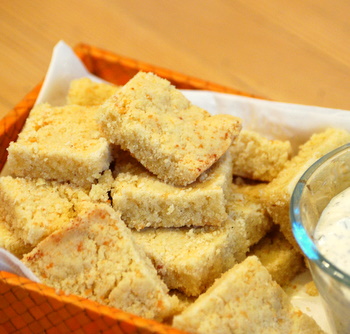
  • Parmesan Shortbread Squares

    Parmesan Shortbread Squares

    Shortbread is marked by its fine, crumbly and sometimes delicate texture, as well as its buttery flavor. They’re primarily made with butter and flour, and although they’re often served as dessert with coffee or tea, most shortbreads don’t have a lot of sugar in them. This means that they’re easily adapted into more savory applications, like this parmesan cheese-infused variation.

    This shortbread comes together very quickly and makes a really nice homemade appetizer to put out with some wine. You can make it by hand, but it is easiest to put it together in the food processor. Simply add your flour, parmesan, spices and butter, then pulse everything together before pressing the mixture into a pan and baking it until golden. The spices I added in are the same ones that I might add to a batch of homemade macaroni and cheese – garlic, chipotle pepper (cayenne will work well, too) and mustard – since they go so well with cheese. They’re subtle and just give these shortbreads a little bit of dimension.

    When baked, these are tender and slightly crumbly, and they’re much less crisp than a cracker because they are quick a bit thicker than your average cracker would be. They have a great flavor and are quite addictive, so it’s a good thing that this recipe makes quite a big batch. These are best when they’re fresh and eaten the day they’re made, but you can store them in an airtight container. If you need to crisp them up after a day or two, simply put them on a baking sheet and pop them into a 350F oven for 5-8 minutes and you’ll be all set.

    (more…)

  • Report: Scion planning convertible version of 2011 tC

    2011 Scion tC

    After waiting forever to get new products, Scion finally received some attention at the 2010 New York Auto Show. The 2011 Scion tC will go on sale in dealerships later this fall while the Scion iQ will go on sale in early 2011.

    “The all-new tC features styling that is both refined and aggressive, appealing to a sports coupe owner who wants to make a bold statement,” Hollis said. “The tC has had the youngest median age buyer in the industry, and with more power, superior driving dynamics, and increased fuel efficiency, that should remain the case with the new tC as well.”

    According to a report by Inside Line Scion is also working on a convertible version of the Scion tC for 2012. If the car makes it into production, it would not only be the first Scion convertible, but will also be the only convertible sold at Toyota/Scion dealers.

    The Scion tC convertible is expected to share the coupe’s 2.5L 4-cylinder engine making 180-hp mated to a 6-speed manual or a 6-speed automatic.

    2011 Scion tC:

    – By: Omar Rana

    Source: Inside Line


  • Obama taps Edmond Chang for Chicago based federal judgeship

    WASHINGTON—President Obama on Wednesday tapped a Chicago federal prosecutor, Edmond E. Chang, for a seat on the U.S. District Court for the Northern District of Illinois.

    “Edmond Chang is an excellent candidate,” said Sen. Dick Durbin (D-Ill.), who as senior senator from the state established a bipartisan screening judicial panel to evaluate potential judges.

    “Throughout his career, Chang has demonstrated an exceptional commitment to public service, and if confirmed will become the first Asian-American federal judge in Illinois. I was honored to recommend his name to President Obama. His extensive experience and distinguished record will be an asset to the Northern District of Illinois’ bench,” Durbin said.

    Chang is now Chief of Appeals for the the U.S. Attorney’s Criminal Division. The Northwestern Law School graduate earlier was an associate in the Chicago office of Sidley Austin.


    from the White House…


    Edmond E. Chang: Nominee for the United States District Court for the Northern District of Illinois

    Edmond E. Chang is an Assistant United States Attorney for the Northern District of Illinois, Chicago office, where he has represented the government in criminal cases at the trial and appellate levels since 1999. Since 2005, he has served as Chief of Appeals for the Criminal Division, and he previously served as Deputy Chief of the General Crimes section. From 1997 to 1999, he was an associate in the Chicago office of Sidley Austin LLP, where he practiced in labor and employment litigation. After law school, Chang was a law clerk to the Honorable James L. Ryan of the U.S. Court of Appeals for the Sixth Circuit and then for the Honorable Marvin E. Aspen of the U.S. District Court for the Northern District of Illinois. Since 1996, he has served as an adjunct professor of law at Northwestern University School of Law teaching civil rights litigation. Chang received his B.S.E. in Aerospace Engineering (cum laude) in 1991 from the University of Michigan, and his J.D. (cum laude) in 1994 from Northwestern University School of Law.

    ##

    from Sen. Dick Durbin……

    April 21, 2010

    DURBIN: WHITE HOUSE NOMINATES CHANG TO FILL FEDERAL JUDGESHIP IN NORTHERN DISTRICT

    [WASHINGTON, D.C.] – U.S. Senator Dick Durbin (D-IL) today announced that President Obama has nominated Edmond Chang for a federal judgeship on the U.S. District Court in the Northern District of Illinois. Chang is the third individual to be nominated to fill one of five pending vacancies in the Northern District. Last week, the Senate Judiciary Committee unanimously approved the President’s first two nominations: Sharon Coleman and Gary Feinerman. Those nominations will now proceed to a vote by the full Senate.

    “Edmond Chang is an excellent candidate,” said Durbin. “Throughout his career, Chang has demonstrated an exceptional commitment to public service, and if confirmed will become the first Asian-American federal judge in Illinois. I was honored to recommend his name to President Obama. His extensive experience and distinguished record will be an asset to the Northern District of Illinois’ bench.”

    Chang has served as an Assistant U.S. Attorney in the Northern District of Illinois since 1999, and he is currently the chief of appeals. He previously worked as an associate at Sidley Austin in Chicago, and as a judicial law clerk to Judge Marvin Aspen in the Northern District of Illinois and Judge James Ryan on the U.S. Court of Appeals for the 6th Circuit. He received a Star of Distinction award from the Chicago Crime Commission. He has served as an adjunct professor at Northwestern University law school, where he graduated with honors and served on the law review.

    In April of last year, Durbin established three bipartisan screening committees to assist in selecting Federal District Court Judges, U.S. Attorneys, and U.S. Marshals for Illinois. The screening committees were comprised of 22 distinguished Illinoisans drawn from various aspects of the legal profession and include former judges, prominent litigators, law professors, bar association leaders, former prosecutors and defenders. Former federal judge and Illinois Congressman Abner Mikva chaired the Northern District Screening Panel.

    Members of the screening committees met throughout the spring and early summer, reviewing applications and references, and conducting interviews. The screening committees recommended the names of several individuals for each vacancy. Durbin reviewed the screening committees’ recommendations, conducted interviews of finalists, and last fall, in consultation with members of the Illinois Congressional delegation, submitted the names of seven individuals to the President, who made the final decision on today’s nominee.

    Once the President submits a nomination to the U.S. Senate, it will be reviewed by the Senate Judiciary Committee, of which Senator Durbin is a member and the nominee will ultimately receive a vote in the committee. If approved by the Judiciary Committee, the nominee will then receive a vote by the full Senate.

    -30-