Category: News

  • Facebook Acquires Cloud Platform Parse

    Facebook announced that it has entered into an agreement to acquire Parse, a cloud-based platform for cross-platform apps. It lets developers create create rich social apps integrated with Facebook across platforms like iOS, Android, HTML5 , etc.

    The two companies have already been working closely together. Parse is one of Facebook’s technology partners. Parse Social enables developers to allow users to use Login with Facebook and save and associate their information, without having to set up their own backend.

    Parse Social uses Facebook’s native SDKs for iOS, Android, Windows 8 and JavaScript, so developers can add Facebook functionality a few lines of code.

    “By making Parse a part of Facebook Platform, we want to enable developers to rapidly build apps that span mobile platforms and devices,” says Facebook’s Douglas Purdy. “Parse makes this possible by allowing developers to work with native objects that provide backend services for data storage, notifications, user management, and more. This removes the need to manage servers and a complex infrastructure, so you can simply focus on building great user experiences.”

    “[We] have seen first-hand how important their products and community are to developers,” says Purdy. “We don’t intend to change this. We will continue offering their products and services, and we’re excited to expand what Facebook and Parse can provide together.”

    In a blog post, Parse CEO Ilya Sukhar said he expects the transaction to close soon. Terms were not disclosed. TechCrunch says it’s “heard” the deal is worth $85 million.

  • NJ Train Explosive: “Terrorist” Just Had Fireworks

    A New Jersey man was arrested a week before the Boston bombings for carrying homemade explosive devices onto a New York-bound train, and rumor quickly spread that he was a terrorist. However, 27-year old Mykyta Panasenko said they were simply fireworks and that he was taking them to the wooded area near Suffern to detonate for fun.

    His roommate apparently wasn’t in on the good times, because he quickly called police after seeing the explosives and “freaking out”. Investigators arrested Panasenko on April 15th on charges of possession of destructive devices and creating a risk of widespread damage, and he was subsequently interviewed by the FBI. The police force later addressed the incident in a statement, saying, “There is no indication at this point of the investigation that he intended to detonate a device in his building or on the transit system.”

    Panasenko says he wasn’t aware that the items were illegal and has been highly disturbed by the rumors floating around online that he is a terrorist and was involved in the bombings, though he admits understanding now that it was a bad idea to take explosives onto a train.

    “I’m not feeling well,” he said. “After all the stuff I just read about myself online, I almost passed out.”

    Now that the story of his arrest has been released, many are wondering why it took so long for the media to grab onto it, or why it was kept so quiet considering the FBI were involved.

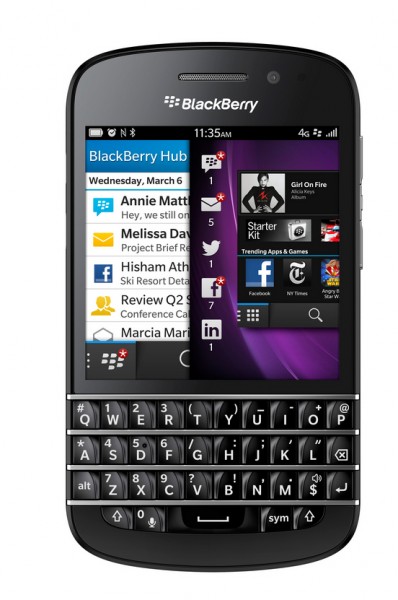
  • BlackBerry Q10 now available, gets Skype preview

    Even though BlackBerry unveiled the BlackBerry Q10 smartphone in late-January, prospective customers around the world are still waiting to get their hands on the device. But if you live in the UK the handset is available today from Selfridges. The BlackBerry Q10 will also arrive next week, starting May 1, in Canada.

    At Selfridges, the BlackBerry Q10 is available to purchase outright for GBP579.99 which is quite expensive for any smartphone, let alone one with a QWERTY keyboard. For the money you get a 3.1-inch display with a resolution of 720 by 720 and a 330 ppi (pixels per inch) density, 8 MP back-facing camera with 1080p video recording, 16 GB of internal storage and 4G LTE cellular connectivity as the main features.

    For the BlackBerry Q10 the Canadian manufacturer quotes 14.4 hours of standby time and up to 13.5 hours of talk time, both using 3G connectivity. The endurance is decent by today’s standards but not impressive considering the small screen.

    If you do decide to get a BlackBerry Q10 you should be pleased to know that Skype is also available, in preview trim, at launch. The app features the usual suspects like voice and video calling, instant and text messaging support as well as calls to mobile phones and landlines around the globe.

    The app, according to the announcement, is designed with the BlackBerry Q10’s display in mind. That means the interface is optimized for the square look of the panel. Also, Skype contacts are automatically imported to the smartphone’s contact list, which should make it easier to call people, and notifications are displayed under the BlackBerry Hub.

    BlackBerry also has a blog post on Skype’s arrival which reveals an interesting tidbit related to BlackBerry 10.1. “Skype runs on the 10.1 Operating System on the BlackBerry Q10. As this new version of the BlackBerry 10 operating system launches on the BlackBerry Z10 in the coming weeks, BlackBerry Z10 owners will have the ability to download Skype for BlackBerry from BlackBerry World”, says the manufacturer.

    Skype for the Q10 is available to download from BlackBerry World now.

  • Twinkies Return, Along With HoHos and Ding Dongs

    Last year Hostess Brands, Inc. went bankrupt, shutting down all of its factories. Fans of snack treats such as Twinkies and HoHos were dismayed as the cakes left store shelves. Now it appears that collectors who hoarded boxes of Twinkies in the hope that the treats would become rare could be out of luck.

    Hostess Twinkies, Ding Dongs, and Cup Cakes will be returning to stores this summer. Hostess Brands, LLC, a newly formed company, has announced that it will begin hiring to relaunch two of its bakeries, including a Hostess bakeries in Emporia, Kansas and Columbus, Georgis. The new Hostess was formed by investors who bought the old Hostess’ assets during its bankruptcy.

    The bakery in Kansas will be hiring 250 employees initially, with 50 more to be added over “the next several years.” The Georgia bakery will initially hire 200 employees. Unfortunately for workers, it does not appear that those jobs will be union. A labor dispute was one of the many factors that led to Hostess’ bankruptcy last year.

    “The city is delighted that the new owners of Hostess Brands are resuming production at the Emporia plant,” said Bobbi Mlynar, the mayor of Emporia. “Making the best snack cakes in the world is something that Emporia-area workers know how to do well and are eager to resume doing. The plant has been a major employer here for almost 50 years, providing significant support to our economy, as well as being a good corporate citizen in our community. We look forward to the same type of relationship with the new owners.”

  • Akamai broadband reports – MN doesn’t rank!

    The latest Akamai report has been released, tracking worldwide broadband growth from Q4 2012. The US does not rank highly by international standards; Minnesota does even worse when compared to other states. We don’t do well with speed or adoption. We saw the same results last August.

    Average Measured Connection Speed by Country/Region – US is #8

    akamai - avg measured connection speed

    Average peak connection speed, we’re worse with US at #13.

    In terms of adoption US is #8 – the report measures broadband and “high broadband” defined as 10 Mbps and up. (US ranks #13 for plain old broadband – defined as 4 Mbps.)

    akamai - high bb connectivity

    Akamai only reports on the Top Ten of each listing – except as you can see above including info on the US when it doesn’t make the Top Tem list. So while I don’t know where Minnesota ranks in terms of speeds and adoption, I can tell you we aren’t in the Top Ten of any metric. You can see on the maps below that the ranking lean heavily to the East Coast.

    It’s discouraging. We hear in rural areas of Minnesota about how good broadband can help reach and retain business and residents. And I’ve heard people talk about lack of broadband has the opposite effect. I don’t think it’s a far stretch to point out that the same effect may be seen at the state and international level. Minnesota and the US may be overlooked by businesses.

    akamai - avg measured connection speed MN
    akamai - avg peak connection speed MN
    akamai - bb adoption MN
    akamai - high bb adoption MN

    I’m most interested in the Akamai rankings – but their highlights from the last 5 years were interesting too…

    This issue of the State of the Internet Report marks the end of five years of publication — the near equivalent
    of an eternity in Internet time. Over this half-decade period, we have seen:

    • The rapid rise of mobile phones and tablets using Apple’s iOS and Google’s Android operating systems as the  primary devices for accessing Web content

    • The exhaustion of IANA’s central pool of IPv4 address space, and the ongoing depletion of available IPv4 address space across the Regional Internet Registries

    • Growth in IPv6 adoption across major backbone networks, end-user networks, major Web sites, and leading content delivery networks, including Akamai

    • The development of “national broadband plans” in countries around the world, laying out target connection speeds and adoption/availability targets for the next several years

    • “Internet disruptions” used as a means of control in some countries during periods of political unrest, where  international Internet connectivity is severely limited, or severed entirely

    • Growth in Denial-of-Service (DoS) attacks as a means of protest, targeting government, financial services,  commerce, and other enterprise Web sites and applications

  • Stop Telling Your Employees What to Do

    I will never forget the experiences of getting my first suit. I was 12 years old and my father took me to a department store on 18th street in New York City. I was very excited; this was the transition to feeling grown up. A real milestone. I would have a suit like all the grown men I knew.

    At the store, we headed straight downstairs to the boys department and I tried on several cream-colored suits (very mid-1970s Saturday Night Fever). Once we found the right one, the tailor had me stand on a box in front of a mirror. He then went to work pinning and marking for the alteration. When he finished he stepped back, and he and my father looked at the suit pinned on me. In the mirror, I saw my father point to the back and shoulder of the jacket and sleeve and then shake his head no. The tailor went back to work, re-pinning and re-marking. Once again, my father shook his head no. So the tailor added padding under my shoulder. Still, my father shook his head. After about 30 minutes of back-and-forth, finally my father nodded and my cream colored, three-piece suit with bell bottom pants went off for alteration.

    For me, the experience was long and boring and not as exciting as I anticipated. On the car ride home I asked my father why he didn’t just tell the tailor what to do (my father was a clothing manufacturer). He explained, “if I told the tailor what to do, he would have done exactly what I had requested — but then if the jacket didn’t fit properly, he would have said, ‘I did what you told me to do’. On the other hand, if I told him what we are trying to achieve (for the jacket to lay flat with no pulling in the back, shoulder, or sleeve) he could be responsible for the outcome I described.”

    This lesson of trusting the skill and experience of the professional has stayed with me. In my experience, this idea of describing the outcome and letting a skilled professional determine how best to get there often results in a more committed worker, higher quality work, and a proud employee. This is also a very effective approach in getting the most out of knowledge workers. Describe the outcome you are trying to achieve, be clear on the requirements, and preserve the worker’s autonomy. If the worker needs help, she will ask for it.

    It turns out there is a scientific reason why employees are less effective when tasks are dictated. Amy Arnsten, a neuroscience professor at Yale University, studies the importance of feeling in control. Her studies can be applied to employee autonomy in managing a team. In an interview at her Yale Laboratory, Arnsten explained that when people lose their sense of control, such as when tasks are dictated to them, the brain’s emotional response center can actually cause a decrease in cognitive functioning. This perception of not being in control, whether real or imagined, would presumably lead to a drop in productivity. If a manager describes the long-term outcome he wants, rather than dictating specific actions, the employee can decide how to arrive there and preserve his perceived sense of control, cognitive function, and ultimately improve his productivity.

    This neuroscience behind leadership came to a head when I was working with an aggressive start-up operation. Like many start-ups, the founder was hard charging, charismatic, and had big aspirations and a compelling offering, which afforded him early success and an expansion in operations. In preparation for the expansion, the founder told his team that they needed to win more business. In turn, the team started accepting all types of requests from new and existing customers and ultimately overburdened the operation with a volume and types of requests they could not fulfill. Some team members were starting to get frustrated if a customer they had personally said “yes” to didn’t get their request fulfilled. When this happened, other team members did not understand the issue — they had been told to win more business and they were delivering on what was asked of them.

    What the leader failed to realize is that he was working with skilled and experienced professionals. The team did not need to be told what to do, but merely shown the organization’s direction. To resolve this issue, the team jointly developed a mission and vision statement that identified what requests were in scope and which were not. By showing the team the purpose of the organization they were able to effectively execute the expansion of the operation resulting in increased volumes, satisfied customers and stronger financial performance.

    The knee-jerk reaction of many managers to a performance challenge is to “tighten the screws” and get involved in how and when a task is done. Both practical experience and now scientific evidence tell us often a better approach is to protect the autonomy of the worker and provide high level direction.

  • Microsoft, Windows Phone 8 hardware must keep up with the times

    This is a question that I never thought I’d ask — Is the hardware leaving Windows Phone 8 behind its fierce competition? In September last year, I asserted that “Windows Phone 8 is the best idea Microsoft has had in phone tech” after analyzing the new hardware requirements imposed by the software giant for its smartphone operating system. But as we all know eight months is a long time in the tech world.

    This is a tough question to answer. After all, in January, BlackBerry unveiled the BlackBerry Z10 with pretty much the same hardware that was available for Windows Phone 8 at launch. Apple’s iPhone 5 is also not far away in terms of specifications. So should Microsoft rest on its laurels and send the engineers on vacation? Well, no. As a smart man once said, “You can never have enough power”. And even Windows Phone needs better hardware, although some die-hard fanboys would beg to differ.

    The Hardware Is Good…

    I’ll concede that Windows Phone 8 performs very well on compatible hardware. The dual-core Qualcomm Snapdragon processors are decently powerful even by today’s standards, but a good processor alone does not make for a great nor popular smartphone today, as we all know.

    My Lumia 920, bar the occasional hiccups likely associated with the branded firmware that I used to have (I now run a developer firmware on it), performs very well when navigating the interface or the installed apps. I have no major complaints concerning lag when scrolling, zooming, installing software or other such activities, but it’s not perfect either.

    … But Good Is Not Good Enough

    I’m quite sure I’ve read that Windows Phone 8 is very fluid with no lag or stutter in a bunch of reviews. That’s not entirely true. I sometimes encounter a slight stutter when navigating the interface or lag when resuming an app, both of which should be entirely eliminated by using beefier hardware.

    When Windows Phone 8 can’t handle the number of suspended apps — because there’s no true multitasking like on Windows — it starts closing the most problematic or first-used ones. Likely due to the same reasons even Internet Explorer comes with a tab number limitation — one can only have a maximum of six opened at the same time.

    If the lag or stutter can be attributed to the processing power, the multitasking issue can be pinned on the amount of RAM. How can Microsoft take care of these problems? It’s simple, just add support for the quad-core Qualcomm Snapdragon processors. Manufacturers could then use a mindbogglingly fast Snapdragon 600 or Snapdragon 800 inside their next Windows Phone handsets.

    Look at Me!

    Yes, I’ve got a gripe with the display as well. Windows Phone 8 devices are limited to having a panel with a maximum resolution of 768 by 1280 — as the Lumia 920 has. But why is that? Well, you can also blame Microsoft’s design principle here. Because when Windows Phone 8 came to market the software giant didn’t give quad-core processors the stamp of approval so it would have been a mistake to allow manufacturers to use 1080p displays, for instance.

    With a higher pixel count the smartphone would need more processing power at its disposal in order to deliver a similar user experience as it does now, otherwise it just bogs down. Basically one limitation creates another. It’s obvious, but that proves Microsoft doesn’t want to look beyond the near future. Shouldn’t now be the time to learn from past mistakes?

    And there’s the other side of the coin — manufacturers can’t innovate or even follow market leaders. The perfect example for this is the phablet market. There, today’s smartphones need 1080p displays in order to deliver the highest visual quality on a large screen. The higher the ppi (pixels per inch) density on a 5.5-inch panel (for example) the better. Windows Phone 8 can’t compete for the phablet crown without a loss in clarity and customer satisfaction.

    Constantly Behind the Curve

    Windows Phone 7, Windows Phone 7.5 and Windows Phone 8 were all designed for the hardware available during the development process, which is a problem if Microsoft wants to release a major software iteration each year.

    Windows Phone 7.5 devices ran on a single-core processor, 512 MB of RAM and a 480 by 800 display resolution at best. Not long afterwards beefier quad-core processors with 1 GB of RAM as well as 720p displays were available.

    Guess what? Microsoft’s operating system didn’t support any of those specs. A similar story can be said about Windows Phone 8. It came with last year’s hardware requirements when we now have quad-core processors with 2GB of RAM and 1080p displays. Of course, it doesn’t support such hardware. So what should be done?

    Microsoft should protect Microsoft from Microsoft. The company’s thinking of limiting Windows Phone 8 to only support the hardware of its time is rendered obsolete by the fast-paced tech world. Develop today, but think of tomorrow as well.

    The best scenario is to bear current hardware in mind but leave room for what’s coming next. Or, if that leaves too much room for error, Microsoft could simply update its operating system more frequently to bump up the maximum supported hardware. It should have done so at launch, actually.

    The Spec War

    Microsoft shouldn’t play the specifications war that is constantly underway in the Android world. But Microsoft can’t ignore better hardware either. With better hardware the company can give Windows Phone manufacturers the opportunity to more clearly differentiate their products or give them a better fighting chance against the competition.

    The company doesn’t need to enforce a ton of stickers on the box touting the hardware that’s inside, but when customers want to buy a smartphone they shouldn’t be able to dismiss Windows Phone handsets based on inferior hardware specifications. Don’t hate the player, hate the game.

    By today’s standards Windows Phone 8 devices are mid-range compared to their Android counterparts. People notice that. Why shoot yourself in the foot if you have the option not to do so? If Microsoft keeps up with similar limitations its smartphone operating system will always be one hardware generation behind. Has it helped so far? I’d say not.

    The Options Matter

    Truth be told, I find it silly that Microsoft can’t provide users with the option to choose what they want. It is the same thinking that got the company into trouble with Windows 8, which even today gets a bad rep for not allowing users to use a simple Start menu on traditional computers. Why not show a sign of change, Microsoft?

    As a Windows Phone 8 user I have to commit to using yesterday’s hardware when I should be able get the best available today. Does it do the operating system any good? No. Does it do consumers any good? No. I just don’t see the point, only excuses.

    Photo Credit:  AlexRoz/Shutterstock

  • Eric Schmidt says Google Glass is inappropriae for some places and talking to it is ‘the weirdest thing’

    google-glass_598

    Google Executive Chairman Eric Schmidt recently said some interesting things regarding Google Glass. He said using the voice recognition capabilities and talking to Glass is “the weirdest thing” while he was at Harvard University’s Kennedy School of Government yesterday. He thinks that we have to develop a new etiquette to deal with products such as Glass because they can record video and bring up information that only the wearer can see. He also admitted, “There are obviously places where Google Glasses are inappropriate.” We already saw one bar ban Google Glass, and that was before the Explorer Editions were even sent out.

    There’s no question that people will need to get used to Glass, but I think it goes for both the people without Glass as well as the people with Glass. How comfortable are owners of Glass going to be using it everywhere? At the same time how comfortable will be those that don’t own Glass going to be around those that do?

    source: Reuters

    Come comment on this article: Eric Schmidt says Google Glass is inappropriae for some places and talking to it is ‘the weirdest thing’

  • Zuckerberg’s FWD.us Immigration Reform Group Snags Bill Gates, Sean Parker, and More

    Mark Zuckerberg’s immigration-focused political advocacy group is getting the help of a few more tech heavyweights.

    Today, FWD.us announced a couple of new members: Microsoft founder BIll Gates, current Microsoft CEO Steve Ballmer, INtuit CEO Brad Smith and Sean Parker, of Napster and later, Facebook fame.

    “We’re thrilled that Bill Gates, Brad Smith, Steve Ballmer, and Sean Parker – longtime advocates for vital policies like comprehensive immigration reform that will grow our economy – are joining FWD.us’ efforts to organize and engage the tech community,” said FWD.us President Joe Green. “We’ve been excited by the momentum we continue to see as more members of the tech community contribute to the national debate to improve our economic future, and support the bipartisan policies that will boost economic growth and continue to grow the knowledge economy.”

    FWD.us officially launched on April 11th when group founder Mark Zuckerberg penned an op-ed in the Washington Post, giving a basic outline of what the group hopes to accomplish through immigration reform.

    Officially, FWD.us is “a new organization founded by leaders of our nation’s technology community to focus on these issues and advocate a bipartisan policy agenda to build the knowledge economy the United States needs to ensure more jobs, innovation and investment.”

    The group already had some major tech clout – Netflix CEO Reed Hastings, former Groupon CEO Andrew Mason, Yahoo CEO Marissa Mayer, SpaceX’s Elon Musk, Google Chairman Eric Schmidt, and Instagram’s Kevin Systrom. But adding Gates, Ballmer, and Parker is a significant boost for the group.

    Zuckerberg has called for comprehensive immigration reform that starts with effective border security and also allows a “path to citizenship.” He also calls for higher standards in schools and “investment in breakthrough discoveries in scientific research and assurance that the benefits of the inventions belong to the public and not just to the few.”

    FWD.us currently has two U.S. offices, one in Silicon Valley and one in Washington D.C. The goal, obviously, is to affect legislation. Having the names that it has attached to it – well, it’s a good start.

    [via All Things D]

  • Wired for Business: Digital Realty Boosts Connectivity at its Data Center Hubs

    Digital Realty's building at 350 East Cermak in Chicago, a key hub in the region's digital economy, and one of the most connected buildings in the country. (Photo: Rich Miller)

    Digital Realty’s building at 350 East Cermak in Chicago, a key hub in the region’s digital economy, and one of the most conencted buildings in the country. (Photo: Rich Miller)

    The digital world is tied together by fiber. It runs under streets and sidewalks, through conduit underground and risers inside skyscrapers. Fiber connects the world’s data centers, but sometimes a customer will need just the right cable transmitting bits to a specific provider or partner. And it doesn’t always exist.

    Digital Realty wants to fix that problem. The company will build dark fiber infrastructure to connect its key Internet gateways and data center buildings, making it easier and cheaper for customers to connect with the carriers and clouds of their choice.

    Digital Realty will run high count dark fiber between buildings, allowing it offer a “plug and play” Gigabit Ethernet product as well as straight dark fiber cross-connects to customers, carriers and service providers campus-wide. Dark fiber is cabling that is in place but not yet carrying customer traffic. Having dark fiber already in place between physical locations allows customers to “light” unused cabling, enabling traffic to flow without having to dig up streets and sidewalks to lay new fiber.

    For Digital Realty’s enterprise-heavy customer base, the initiative will simplify the deployment of hybrid environments, enabling private clouds within data centers to easily connect with public cloud providers. It will also ensure that customers have easy access to their choice of carriers and can easily create direct connections with high-traffic Internet destinations like social networks and video hubs.

    The launch of this important strategy takes our global portfolio to the next level in terms of network connectivity, which is a key factor for customers when selecting a data center provider,” said Michael Foust, chief executive officer of Digital Realty. “When combined with our scale, expertise and global footprint, this initiative will give customers a one-stop shop for all of their data center needs.”

    Foust made it clear that by making dark fiber available, Digital Realty won’t be competing with its customers.

    “The important distinction here is that we are not building a network, nor are we becoming a reseller,” said Foust. “The goal of this initiative is to ensure a robust offering of network and carrier products and services in every Digital Realty location, making our portfolio the easiest place for both wholesale and retail colocation customers to locate their data centers.”

    By offering friction-less fiber, Digital Realty removes the connectivity complexity from the decision-making process of choosing a data center provider. If a carrier isn’t already “in the building,” there’s a cost involved in establishing that physical connection, which can change the economics of the deal. By building its own dark fiber infrastructure, Digital Realty is leveraging its financial strength to simplify this part of the site selection process, and gain an advantage over its growing field of rivals in the wholesale data center business.

    The “Digital Realty Ecosystem” program will launch later this year in the company’s major campus locations in the New York, London, Chicago, Boston, Ashburn, Va. and Santa Clara, Calif. It will then be expanded across the company’s portfolio, which spans 22 million square feet of technology properties across three continents and 32 geographic markets.

    The additional dark fiber capacity may prompt new business relationships between Digital Realty’s customers, according to John Sarkis, vice president carrier and connectivity operations for Digital Realty and the architect of the plan.

    “The Digital Realty Ecosystem is designed to give customers a neutral, efficient, and connectivity rich environment for our customers to connect, not only to any carrier of choice, but directly to one another,” said Sarkis. “In addition, this ecosystem will provide an underlying infrastructure for carriers and service providers to deliver their entire portfolio of products and services to our customers, without the major capital intensive deployment costs hindering their business models.”

  • Pinterest Adds New Features And Brings Back A Few Old Ones

    In early January, Pinterest began testing its new look, which started rolling out to everyone in mid-March. Reactions have been mixed. Now, they’ve made some additional updates.

    “As we’ve rolled out our new look, we’ve heard from our community about things they love, things they miss, and things that could make Pinterest even better,” a spokesperson for the company tells WebProNews. “Thanks to the feedback, we’ve made some changes. The most significant changes are a new notifications system that keeps you up on all of the activity around your account, as well a typeahead to offer suggestions while you search.”

    After you pin something, you can check out related boards or go straight to your pin by clicking “See it Now”.

    See it Now

    For those who missed the “via” feature, Pinterest has added a way to see who things were pinned from when you click on a pin.

    Repinned from

    You can also now mention friends in pin descriptions and comments using an “@” before their name.

    The “Find Friends” feature lets you see which of your Facebook and Twitter friends are on Pinterest.

    Find Friends

    Pinterest has added more notifications, with “Recent Activity” located in the upper right hand corner, and notifications for when someone follows you or your boards; repins, likes or comments on pins, and mentions. Old notifications will also be there for future reference.

    There’s also an improved search functionality, with search suggestions as you type.

    Soon, Pinterest says it will start letting you know when new pins have been added to your home feed. They’re also thinking about adding the ability to rearrange your pins, search for your pins, and to create a board within a board. These would likely be welcome features.

    Also in the cards is the ability to know when you’ve already pinned something to prevent duplicates.

    They’re still rolling out the new design.

  • Katt Williams Sentenced For Evading Police

    Katt Williams was sentenced on Thursday for his charge of evading police back in November, when he led them on a “low-speed chase” in California on his three-wheel motorcycle.

    Williams pleaded no-contest and was sentenced to 180 days in jail; however, half of that time was stayed and half was turned into community service hours, so he won’t do time behind bars.

    “We are pleased that he will not be incarcerated and Mr. Williams looks forward to working with the community,” his attorney, Richard Schonfeld, said.

    Williams had a very strange year in 2012, including having a lawsuit slapped on him for performing a bad show after he showed up for a comedy show at a club and ended up harassing the audience and trying to fight at least one of the members before storming offstage. He was also arrested several times for varying degrees of assault.

  • A smartphone shipments surpass feature phones, Samsung rules the galaxy

    For the first time ever, more smartphones than feature phones shipped globally. Research firm IDC shared its data in a report on Friday, noting the historical highlight: Of the 418.6 million handsets shipped during the first quarter of 2013, 216.2 million where smartphones. And in the battle for smartphone supremacy  Samsung stole the show, shipping 70.7 million smartphones to Apple’s 37.4 million.

    As these company’s battle for the top spot, it’s interesting to note which competitors aren’t on the top 5 smartphone shipments list. Namely: HTC, BlackBerry and Nokia, all of which were on the list together as recently as the last quarter of 2011. Now it’s LG, Huawei and ZTE that round out the top 5 after Samsung and Apple.

    It should be noted that Apple is the only vendor that reports sales and not shipments, but even that fact doesn’t support the idea that Apple outsold Samsung. It’s simply not a reasonable expectation that Samsung has 33.3 million smartphones sitting around in inventory worldwide.

    Unless Samsung stumbles in a big way, it’s not likely another Android handset maker will outsell Apple’s iPhone any time soon. For all intents and purposes, Samsung is the de-facto Android standard, having built a huge audience with its line of Galaxy smartphones. This strategy started in 2010 and as we pointed out in mid-2011, Samsung was poised to become the smartphone king. Let’s see how long it keeps the crown.

    Related research and analysis from GigaOM Pro:
    Subscriber content. Sign up for a free trial.


  • iOS reading platform Readmill partners with digital marketplace Gumroad

    Readmill, a Berlin-based startup that offers e-reading apps for iOS, has partnered with digital marketplace Gumroad to let authors sell ebooks directly through the site. The company also announced partnerships with Faber Factory and Firsty Group, which provide services for independent publishers.

    Gumroad was founded by former Pinterest designer Sahil Lavingia in 2012 and aims to let anybody sell anything — whether it’s a song, a PDF, a video or a T-shirt — without having to set up their own store. The company has raised $8.1 million from Kleiner Perkins and Crunchfund, among others.

    Readmill offers a clean, easy-to-use e-reading interface through its iPhone and iPad apps. Gumroad will let users selling ebooks on its platform add a “Send to Readmill” button that lets buyers send the ebook directly to their iOS device. (32 independent digital bookstores have also enabled “Send to Readmill.”)

    “Reading should be an open and shared experience, for both authors and readers,” Gumroad’s Lavingia said in a statement. “Readmill and Gumroad will help authors make money doing what they love — writing — selling directly to their readership — so they can continue doing what they love: writing more.”

    Separately, Readmill has partnered with Faber Factory, a U.K. based platform for independent publishers that is a joint venture between U.K. publisher Faber and Faber and U.S. publisher Perseus Books Group; and Firsty Group, a U.K. company that helps publishers and authors sell ebooks directly. Readmill said these partnerships are part of its effort to “help independent publishers and retailers gain further traction and sell more books,” and says it is hoping to offer authors and publishers statistics on users’ reading data later this year.

    Related research and analysis from GigaOM Pro:
    Subscriber content. Sign up for a free trial.


  • MacBook shipments seen growing 10% in Q2 despite declining PC market

    MacBook Shipments Q2 2013
    Shipments of Apple’s various MacBook laptop computers are expected to grow 10% sequentially in the second quarter this year. Digitimes on Thursday reported that unnamed sources in Apple’s supply chain anticipate new orders from Apple beginning in mid-May as the company finishes “digesting its excess inventory.” Apple reported earlier this week that it sold 3.95 million Mac computers during the first calendar quarter of 2013.

    Continue reading…

  • 38 Die In Mental Hospital; Fire Investigation Underway

    38 people died in a horrific fire at a mental hospital just outside Moscow on Thursday night, officials say. The cause is believed to be a short circuit in the wiring.

    Of the victims, 36 were patients and two were doctors. It’s been reported that only three people managed to escape the one-story building; fire officials are investigating the cause, but say it appears to have originated in a wooden annex of the hospital before spreading to the patient area. Because most of them were under heavy sedation, the victims were tragically burned alive in their beds.

    In an unfortunate turn of events, not only did the fire spread quickly because of the wooden structure of the building, but firefighters were delayed arriving on the scene by more than an hour because they were forced to make a detour.

    The Emergency Ministry is looking into fire safety protocol as Russia has a notoriously tragic past; about 12,000 deaths were reported in 2012 alone.

    Image: Ministry for Emergency Situations

  • Explainer: How Corruption Is Strangling U.S. Innovation

    Tesla. Uber. Netflix. Most economies would kill to have a set of innovators such as these. And yet at every turn, these companies are running headlong into regulation (or lack thereof) that seems designed to benefit incumbents. The reason? The devastating impact of money in politics and how it discourages disruptive innovation among new businesses. Click through this explainer to learn more about legal bribery and U.S. competitiveness:

    Let us know your thoughts about this content as an explainer; it was originally published as an article on Dec. 7, 2012.

  • Bennett Tool and Die Sold to Investor Group

    Bennett Tool and Die Co. Inc. was sold to Kansas Venture Capital, Capital for Business, Jefferson Capital Partners and InvestAmerica. Financial terms were not announced. Nashville-based Bennett is a contract tooling and metal stamping supplier serving the locomotive, electrical, appliance, watercraft, and ATV industries. The Lenox Group advised Bennett Tool in the sale.

    PRESS RELEASE

    The Lenox Group advised Bennett Tool and Die Co., Inc.
    (“Bennett”) on its sale to a consortium of private equity funds including Kansas Venture
    Capital, Capital for Business, Jefferson Capital Partners and InvestAmerica (“Investors”).
    Bennett, headquartered in Nashville, TN, is a contract tooling and metal stamping
    supplier serving the locomotive, electrical, appliance, watercraft, and ATV industries.
    Since 1951 Bennett has been providing its customers with part design consultation,
    prototyping, design and build of metal stamping dies, production stamping, welding,
    assembly, testing, and machining.
    Bennett, founded in 1951, was run for over 50 years by Eli Bennett who took over from
    his Father at the age of 24. Recently, the third generation, lead by Yvonne Leggett has
    been leading the Company and will continue in their current roles post closing to assist
    the Investors in continuing to grow the Company.
    The Lenox Group is an investment bank based in Atlanta that focuses on middle market
    transactions primarily for private, family-owned businesses. Our services include raising
    capital (debt and equity), M&A advisory and traditional corporate finance advisory, i.e.
    valuations and fairness opinions. Lenox is proud to have completed engagements
    representing over $1.5 Billion in transaction value.

    The post Bennett Tool and Die Sold to Investor Group appeared first on peHUB.

  • A familiar story: Samsung rakes in record Q1 profit, but growth slows

    Samsung Q1 2013 Earnings
    Apple shares skyrocketed between 2009 and the end of 2012 as the company repeatedly posted record quarterly earnings. Of course, gravity eventually wins — breakneck growth simply can’t be maintained forever. Samsung, too, has seen unbelievable growth over the past couple of years and its quarterly results have reflected its incredible success. But how long will the party last?

    Continue reading…

  • As Smartphones Reach A Global Tipping Point, Leader Samsung Shipped 71M Devices In Q1, Nearly 2X As Many As Apple

    tipping point

    IDC is the first of the big analyst companies to come out with quarterly mobile device shipment numbers that indicate Q1 as the first quarter where smartphones have outnumbered more basic feature phones in worldwide shipments: in a total market of 418.6 million devices, 216.2 (51.6%) were smartphones. But it is was a kind of tipping point of another sort, too: it is a sign of how Apple is not the juggernaut that it once was.

    (BTW… for those of you keeping track, this is not the first quarter where Android has all but dominated the top-five rankings, save Apple’s presence. That happened in Q4 2012, according to IDC’s figures.)

    Samsung shipped nearly 71 million smartphones in the quarter, giving it a market share of almost one-third of the whole of the smartphone sector (32.7%). Apple, meanwhile, shipped 37 million devices — just over half as many as Samsung, for a market share of 17.3%. With all others in the top-five — LG, Huawei and ZTE — still with less than 5% market share apiece, Samsung and Apple remain a strong top-two.

    But looking at the pattern of growth something else comes out: Apple only grew its volumes by 6.6% over the same quarter a year ago. In fact, in that regard, that growth puts it far behind not only Samsung (at 60.7% volume growth), but also behind LG (110.2% growth); Huawei (94.1%); and ZTE (49.2%). As a point of comparison, Samsung and Apple were more nearly level a year ago, in Q1 2012, (44 million versus 35.1 million in Q1 2012), and respectively saw growth of 267% and 89% in shipment volumes — the only two that increased:

    Today:

    A year ago:

    As we’ve pointed out before, shipments to those who sell devices are not the same thing as sales to users, but it is an important barometer for where the wider market is going. (The most recent figures from Kantar Worldpanel, which track sales, spell out how the difference between Android-based and Apple sales is not as wide as 2:1 in every market, but is in fact significantly wider in some.)

    It’s notable that Nokia, BlackBerry, and HTC whose shipments were on the decline last year but still enough to keep them in the top-five, are now out of the picture altogether. It also shows that Nokia’s sub-10 million sales of smartphones, with 5.6 million Lumias, are not big enough figures to break out of the sizeable ‘others’ category.

    With Apple still shipping more than three times as many devices as its next-closest competitor, LG, even if things continue as they are today, it will likely still be some time before it gets overtaken by the others in the list. Its performance also was enough to keep it in place as the world’s third-largest mobile handset maker overall, in a list otherwise dominated by companies that make both smartphones and feature phones:

    IDC notes that LG, which shipped 10.3 million smartphones in the quarter, a rise of over 110% over the year before, was helped by three factors in the last quarter. The first of these was the popularity of the Nexus 4 device it created with Google; the second was the success of its lower-priced L Series (15 million sold in this category alone since launched); and the third was its LTE line. These three point to how those Android handset makers that can create strong enough and distinctive handsets that are set apart from the rest of the Android crowd can continue to pull away from the crowd.

    Apple’s iPhone brand has never been seen as anything other than premium, and true to type, it is still not playing at the same level as others smartphone industry in creating new models that aim at the “cheap smartphone” market.

    CEO Tim Cook did not discuss the prospect of a new, low-cost device, on Apple’s earnings call this week — the focus remains on selling older models, namely the iPhone 4, in markets like China as a route to bringing new smartphone users on to the platform. Other handset makers like Samsung, Nokia and many “others” are building out portfolios that hit not only at high-end users but those looking for entry devices priced at closer to $100 or even less. Some handset makers, specifically in emerging markets, are targeting only this market.

    On the other hand Cook also left open the possibility that whatever comes next may be something different altogether: the “really great stuff” coming out in the autumn and in 2014 could be another iPhone. Equally, it could be something else altogether, and not a handset at all.

    Image: Flickr