Category: News

  • SOLOMO Tech Raises $1.7 Mln

    SOLOMO Technology said Wednesday it completed a Series A first close worth $1.7 million. The round was co-led by Venture Management, and Don Layden, and included participation by Wisconsin Investment Partners. SOLOMO said the equity investment leveraged additional funding from the Wisconsin Economic Development Corp.

    PRESS RELEASE

    Madison, Wisconsin, May 29, 2013 – SOLOMO Technology, Inc., is releasing its patent-pending SOLOMO Exchange™ web services platform globally following its latest financing round. The company has completed a Series A first close worth $1.7M. The financing will be used to accelerate its product development and increase its sales and marketing activities. The round was co-led by Venture Management, LLC and Don Layden, and included participation by Wisconsin Investment Partners. The equity investment leveraged additional funding from the Wisconsin Economic Development Corporation.
    The company’s unique SOLOMO Exchange™ platform is the only solution on the market today that enables retailers to conduct personalized and localized omni-channel marketing while strengthening customer trust. The platform connects to retailers’ branded mobile applications to support the seamless, trusted exchange of individual customer data in return for value. Retailers can offer products, services, special offers, or leverage their existing loyalty program to trade virtual currency, in exchange for customer data. Customers own the data they store on the platform and can update or revoke it, putting them in control of their personal information.
    SOLOMO Geo™, one of the SOLOMO Exchange™ services, provides retailers with WiFi-based anonymous indoor location analytics and an array of opt-in localized customer engagement capabilities. This allows retailers to engage customers in their stores and better understand customer behavior. Critical to customer trust, SOLOMO treats consumer location information as securely and privately as any other personal information. SOLOMO is currently working with companies across many categories, including specialty retail, convenience, malls and airlines.

    The company is led by CEO Liz Eversoll, a veteran of CDW and other leading IT companies. Armed with her in-depth IT knowledge and vision for permissioned data exchange, she launched SOLOMO in 2011. The management team is rounded out with members who have deep executive experience from Microsoft, CDW, Lands’ End and Weather Central.
    “Trust is the foundation of the relationship between retailers and their customers. Due to the general erosion of consumer trust, the World Economic Forum has noted1 that nearly $1 trillion is at stake in the digital retail economy by 2016,” says Liz Eversoll, CEO. “Trusted retailers will win that business.”
    This financing round comes on the heels of a number of accolades announced by SOLOMO in recent weeks, including its announcement of its designation by Gartner Research as a 2013 Cool Vendor in Retail2, Microsoft BizSpark’s recognition of SOLOMO as a “Featured Startup”, and recognition for SOLOMO’s “rock star team” in a recent NBC Chicago blog post.

    About Venture Management LLC
    Venture Management LLC (http://www.vmllc.com) is a private investment office based in Madison, Wisconsin. VMLLC currently has 20 active investments including positions in ecommerce & internet services, medical devices, biotechnology, pharmaceuticals, and clean & renewable energy technologies. Over the past few years VMLLC has had several successful exits.
    About Don Layden
    Don Layden is Operating Partner at Baird Venture Partners and a Partner with Quarles & Brady. He is also an active investor in, and director of, several technology enabled business service companies. Layden held executive management roles with Metavante, Fiserv, NuEdge Systems and Marshall & Ilsley during his career.

    The post SOLOMO Tech Raises $1.7 Mln appeared first on peHUB.

  • Report: Apple picks Pegatron to build low-cost iPhone, not longtime partner Foxconn

    The Wall Street Journal is reporting that Taiwanese manufacturer Foxconn, which has been Apple’s biggest and most important manufacturing partner, will see some of its orders from Apple transfered to a competitor in the future. The word is that Apple will be working more closely with Pegatron on the production of future iPhones and iPads.

    Pegatron is already an Apple partner — it made some iPhones and the iPad mini — but is set to take on a larger role, according to the report: Apple will be “dividing its weight more equally” among it and Foxconn. And one of the products Pegatron will be making? It ”will be the primary assembler of a low-cost iPhone expected to be offered later this year,” says the report.

    There has been a steady stream of reports since early this year that Apple is working on a version of the iPhone whose price would make it more accessible to a larger percentage of users who have yet to join the smartphone revolution, mostly in emerging markets.

    The reasons for the transition of more iOS device manufacturing to Pegatron, according to the Journal‘s unnamed sources:

    • Reaction to Foxconn’s production troubles with the intricately designed iPhone 5.
    • Apple’s need to expand beyond Foxconn’s current capacity.
    • And perhaps most importantly: Pegatron’s willingness to take lower profits in favor of more business from Apple.

    This report jibes with earlier news that Foxconn has been looking for ways to diversify its manufacturing abilities beyond the iPhone and iPad, including televisions.

    Pegatron will  be staffing up as a result: it has 100,000 employees now in its home bases of Taiwan and China, but will be increasing its employee headcount in China by 40 percent in the second half of this year. That would coincide with when Apple is expected to release an updated version of the iPhone.

    Related research and analysis from GigaOM Pro:
    Subscriber content. Sign up for a free trial.

  • Tweet a photo, pray you don’t get hacked!

    Last week it was pointed out that in the latest Twitter update, the implementation of two-factor verification that we mentioned here, was less than solid. Now, as opposed to working to solve these issues, the company instead concentrates on its latest mobile apps updates.

    Today Misha Lushin of Twitter announces that the social network has “just released updates to our iPhone and Android apps. Tweeting is now even easier and more seamless”.

    Now when customers add a photo to the Tweet, they will see a full preview of that photo, not just the cropped version.  Customers can also add photos more easily from the camera roll by simply clicking the photo icon on the bottom right corner of the Tweet box.

    The company also adds that, when a customer composes a Tweet, he or she will see their avatar and username to give a better sense of how the Tweet will actually appear. In addition, it is now easier to select an account by tapping an avatar, as well as promising richer notifications and the removal of the borders around timelines.

    The updates are very nice, but not a single one will prevent a customer from being hacked. Let us hope these are better vetted than last week’s update. Perhaps next Twitter may focus its energy on that little problem.

  • Microsoft doubles Surface Pro storage to 256GB following user backlash

    Microsoft Surface Pro Storage
    Microsoft has been accused of being misleading regarding the way it has advertised the internal storage in its Surface tablets. The 64GB Surface Pro model ships with only 23GB of useable space, while the 128GB model has just 83GB of available storage. Microsoft’s bloated operating system contains a number of preloaded applications and programs that take up more than 40GB of space, and consumers are filling up their devices quicker than anticipated. It would appear the company is ready to address its critics, however.

    Continue reading…

  • Courteney Cox: Divorce Final, One Year Later

    Courteney Cox and David Arquette are finally legally divorced.

    The couple filed last June but had been separated since 2010, citing “irreconcilable differences”. Their marriage was officially over as of yesterday, which would have been their 14th wedding anniversary.

    “I don’t recommend divorce in general,” she said, “but he is my best friend and we’ve both grown and changed, and I think we both appreciate each other more.”

    The parents of 9-year old Coco say they will remain friends and plan on raising her together.

  • Twitter updates to 4.1, gets richer notifications, new compose mode

    screenshots_new_twitter

    Until version 4.0, Twitter’s Android app seemed like an afterthought to the iOS version. 4.0′s overall was a welcome change, and 4.1 adds even more features, including rich notifications and simplified image sharing.

    The folks at Twitter have taken advantage of Jelly Bean’s rich notification capabilities, and now notifications show profile pictures of those who have interacted with you, as well as a list of interactions if you have multiple. In addition, the compose window, which used to be a pop up, has been transformed into a real window. Image sharing is now incredibly easy through the new compose window, as you can now choose the photo you want to share straight from the app, without opening your phone’s gallery. Also the full preview is visible, instead of the cropped version that used to be shown. Twitter brags that you can now tweet a photo in under six seconds, and I just attempted and confirmed their claim.

    Other tweaks in 4.1 include easier account-switching, removed borders for more reading space, and the ability to remove your location from individual tweets. You can read the full change log and download the updated app after the break.

    What’s new in Twitter 4.1.0 

    The new Tweet composer makes it easier to share with quick access to your camera roll and clear previews of how your Tweets will appear. Also:
    • Richer notifications now include details like avatars and indicate how people are interacting with you (reply, retweet, etc.) for devices running Android 4.0 and higher,
    • Enjoy wider and taller timelines in all parts of the app including profiles, search, and Discover.
    • Receive a notification when a friend has joined Twitter.

    Play Store Download Link

    QR Code generator


    Come comment on this article: Twitter updates to 4.1, gets richer notifications, new compose mode

  • Arrest Made For Disneyland Dry Ice Bomb

    Yesterday afternoon, a loud bang in Disneyland L.A.’s Toontown section caused an evacuation and investigation by Ahaheim police. A bomb squad later determined that the blast was caused by a dry ice bomb made out of a plastic bottle that went off in a garbage can. No injuries or damage to park property were reported.

    Today, the Anaheim police have announced that a Disneyland “cast member” (employee) has been arrested in connection with the incident. 22-year-old Christian Barnes of Long Beach, who was working at the park as an outdoor vendor, was identified as a suspect using surveillance footage. He has now been arrested on suspicion of possession of a destructive device and his bail has been set at $1 million.

    Barnes, who sold soda and water at the park, has not provided a motive for the incident. Anaheim police have stated that Barnes is cooperating with the investigation, and that he told them the bomb was an “isolated incident with unanticipated impacts.”

  • Fun to watch: Paper gets wings

    In this super cool talk from TEDxTokyo, magician Kohtaro Fujiyama morphs ripped pieces of paper into butterflies, and then lets them take flight, controlling their motion by waving fans. (Fast forward to 1:43 to watch.) This fascinating display is an adaptation of tezuma, a classic form of Edo magic that fuses illusion, story and music. It’s an art form Fujiyama knows well, as he is the second generation in his family to practice it — his father is tezuma legend Shintaro Fujiyama.

    So what’s the story in this performance? The ongoing cycle of life and death, illustrated by the butterflies.

  • ITC to review rulings in Apple-Samsung patent spat

    Apple Samsung Patent Dispute ITC
    The U.S. International Trade Commission announced on Tuesday that it will take a second look at two recent rulings between Samsung and Apple, Reuters reported. The full panel will review an earlier decision that found Samsung had infringed upon Apple’s technology relating to selecting text, and a second ruling that found the company did not infringe on Apple’s patent for detecting microphones. The ITC has the power to ban imported goods from entering the United States. Apple’s complaint concerns older Galaxy devices such as the Galaxy Nexus. The panel is expected to make a final ruling on August 1st.

  • Aisha Tyler Will Host Ubisoft’s E3 Press Conference Again

    Ubisoft always has the best E3 press conference. This is an unmistakable fact. While she wasn’t quite as insane as 2011′s Mr. Caffeine, Aisha Tyler did a bang up job hosting last year. Ubisoft seemed to like her enough that they’re bringing her back as the host of this year’s press conference as well.

    Alongside confirming that Tyler is back, Ubisoft released a teaser today that hints at what it will be showing at its E3 press conference this year. It’s obvious that we’ll see more Assassin’s Creed, Splinter Cell and Watch Dogs, but there’s a few other hints for some not so obvious games as well.

    The Cartman figurine on the desk pretty much confirms that Ubisoft will be showing off South Park: The Stick of Truth at E3 after buying the rights from THQ earlier this year. The Vaas bobblehead may indicated that we’ll be getting some more Far Cry 3 content.

    I may be reading too much into this, but does the brief cameo of Professor Farnsworth on the monitor indicate that we’ll be getting a new Futurama game in the future? Probably not, but it’s nice to dream.

    Ubisoft’s E3 press conference is set for June 10 at 3 p.m. PST/6 p.m. EST. There will, of course, be plenty of live streams for those watching at home.

  • Zigbee and Z-wave are out. Broadcom’s new chips bet on Bluetooth and Wi-Fi for IoT

    There is nothing that hardware nerds love than a good old-fashioned standards battle. LTE versus WiMAX, VHS versus Betamax, Ethernet versus InfiniBand … the list goes on. The internet of things is another battleground with different factions fighting over protocols for sending wireless signals, sending data between points, security and a variety of other standards. But when it comes to the wireless technology of choice for connecting consumer gadgets, Broadcom has chosen its winners: Bluetooth and Wi-Fi.

    Brian Bedrosian, Broadcom’s Senior Director, Embedded Wireless and Jeff Baer, Broadcom’s Business Development Director, Embedded Wireless — both in Broadcom’s Wireless Connectivity Combo Group — explained their thinking to me on a call related to the launch of a new all-in-one Wi-Fi module that contains a Wi-Fi radio and a microcontroller that will handle all the on-boarding of the device and communication to the network.

    From Broadcom’s perspective, other protocols are either closed or the standard is so open to interpretation (Zigbee) that it might as well be closed. For example, there’s no guarantee that Zigbee devices will work with other Zigbee devices, and for Z-Wave, the chips are more expensive. Plus, neither Zigbee or Z-Wave are regulars in the smartphone radio stack. I’ve discussed this with the CEO of Securifi, the maker of the Almond + router, on one of my podcasts, if you want to learn more.

    Thus, Broadcom has made its bets on Wi-Fi and Bluetooth (and Bluetooth Low Energy). That means we can expect more modules from Broadcom that make it easier to build connected devices, something the Bluetooth Special Interest Group is also pushing hard. For example, the latest chip, the BCM4390, is designed with a Wi-Fi radio and a communications processor so the whole package can go into existing devices like washing machines or dishwashers without requiring a separate microcontrollers to handle the additional burden of networking. That means devices can be retro-fitted for connectivity without swapping out other parts.

    Broadcom was coy on the subject, but I imagine a Bluetooth and a Bluetooth Low Energy module that can handle the networking on-boarding isn’t too far behind. It did launch a Bluetooth system on a chip today as well, that offers much lower power consumption so people can go a year without needing to replace the battery in connected device like a pedometer or door lock. And by the way, this isn’t all just to boost the consumer experience. As more and more businesses are realizing, adding connectivity can help them, even if that connectivity isn’t exposed to consumers through fancy apps or whiz-bang refrigerators that tell you when the milk is expired.

    Baer explained that businesses want connectivity so they can track data on how products are used, or update features over the air. So even if the microwave doesn’t need an app, it may need Wi-Fi. And Broadcom really wants to sell that Wi-Fi chip.

    Related research and analysis from GigaOM Pro:
    Subscriber content. Sign up for a free trial.

  • Why a sale to Yahoo may just be the best bet for Hulu

    Maybe it’s fate: Just two months ago, Hulu moved all of its 500 or so Los Angeles-based employees into swanky new offices in the heart of Santa Monica’s tech hive. The complex now housing Hulu is called the Colorado Center, and is also home to HBO and a few other companies at the intersection of media and technology.

    But anyone who recalls the Los Angeles tech scene from back in the days of the Web 2.0 boom will still remember the building as part of the former Yahoo campus. And even if you’re a little rusty on local tech history, you don’t have to go far to find your way to the purple Y. The internet giant still has an outpost next door to Hulu, and another building just around the corner.

    Yahoo threw its hat in the ring to buy the video service last week, bidding a reported $600 to $800 million. Yahoo is competing with six other entities that also want to buy Hulu — but I’d argue that Yahoo may just be the best bet for Hulu to survive and thrive (and not just because the two are already neighbors).

    A renewed focus on Hulu’s ad business

    Hulu’s problem has long been that its corporate owners haven’t been able to agree on its future. News Corp. wants the company to focus on its subscription business, while Disney tends to favor ad-supported videos. Comcast has been a kind of third wheel and can’t exert any influence on Hulu due to merger conditions imposed when the company bought NBC Universal.

    Of the companies bidding for Hulu, at least two would clearly follow News Corp’s lead: DirecTV and Time Warner Cable are both more interested in subscription revenue than in free videos that would compete with their pay TV offerings. Both companies might even turn Hulu into a kind of TV Everywhere portal and tie all access to a pay TV subscription, which would more or less spell the end of Hulu as we know it.

    Yahoo, on the other hand, wants Hulu for its advertising business. CEO Marissa Mayer made as much clear when she tried to buy French video startup Dailymotion earlier this year with the goal of adding more opportunities to sell high-CPM video ads. Hulu and its content (even if some of that were no longer available through the service after an acquisition) would be a better match for brand advertisers trying to reach their target audience than Dailymotion’s mish-mash of user-generated content and semi-adult fare.

    And what’s in it for Hulu? An owner that doubles down on ads could help the company refocus and regain some of the viewers it lost, as well as more aggressively roll out free offerings on platforms that have largely been for-pay only. Why not introduce a free tier for TVs and connected devices, for example?

    More support for its international ambitions

    Another area where Hulu has been held back is its expansion into international markets. Hulu launched a Japanese offshoot two years ago, and the company has been looking to expand to Europe for some years as well, but its owners wanted to focus on its domestic business instead.

    Yahoo knows that there is money overseas — the company makes about 25 percent of its ad revenue outside of the U.S., and its investments in Alibaba and Yahoo Japan have paid off handsomely in recent months.

    What’s more, by concentrating on international expansion, Yahoo could deal with one possible downside of acquiring Hulu: It’s likely that after an acquisition, Hulu’s U.S. offering would have less content, or at least less exclusive content going forward. International, on the other hand, is still wide open for content licensing, and a growing number of startups has shown that content arbitrage makes a lot of sense for online video services.

    A bigger commitment to original content

    Speaking of content: Yahoo is one of the few bidders that actually has any experience producing original content for an online audience. The internet giant has attracted some serious star power for its content efforts, and just recently launched new shows with the help of John Stamos, Ed Helms and Morgan Spurlock. Combine that with Hulu’s original content and reach, and you might just land a few hits.

    Granted, that all still might not make up for Hulu possibly losing access to some popular broadcast shows. But a Yahoo-owned Hulu could reinvent itself as a more online-focused player, situated somewhere between its traditional TV catch-up offering and the more professional output on YouTube, to become a real force in online video — and not just an experiment with TV content that’s forever at the mercy of traditional programmers.

    Related research and analysis from GigaOM Pro:
    Subscriber content. Sign up for a free trial.

    • Cisco To Acquire IT Energy Management Firm JouleX

      Cisco announced on Wednesday its intent to acquire IT engergy management company JouleX. Cisco says the Atlanta-based company complements its existing portfolio by using capabilities of its network to gain visibility into and control energy usage across global IT environments.

      Under the terms of the deal, Cisco will pay about $107 million in cash and retention-based incentives in exchange for all shares of JouleX.

      “JouleX’s technology will strengthen Cisco Services’ Smart Offerings and complements our evolving services strategy. It extends our ‘Internet of Things’ capabilities and is a good alignment to Cisco EnergyWise,” said Faiyaz Shahpurwala, senior vice president, Industry Solutions. “With network-enabled devices increasing exponentially, our partners and customers are asking for this solution today to operationalize their energy management capabilities in the network and reduce cost. JouleX’s cloud-enabled, agent-less architecture will allow our partners and customers to quickly deploy this solution at scale in addressing their IT energy management needs.”

      Cisco VP and Head of Business Development, Hilton Romanski had this to say on in a blog post:

      IT energy consumption is one of the largest unmanaged expenses and as a result organizations are seeking effective solutions to measure usage, improve optimization, and produce sustainability reports. Up to 50 billion objects are predicted to be connected to the Internet or interconnected machine to machine by 2020 as part of the Internet of Things (IoT) technology transition. Many of those devices will be in constrained environments, where space, bandwidth and power will be at a premium. Cisco networks are differentiated by how we securely scale this type of environment and power consumption will be a key attribute of that differentiation in the future. JouleX is a natural extension of IoT, one of the many technology transitions that make up the Internet of Everything.

      The acquisition of JouleX exemplifies Cisco’s innovation framework and supports Cisco’s five foundational priorities by enhancing our service offering across all customer segments and advancing our business and technology architecture. The JouleX acquisition is aligned to Cisco’s goals of developing and delivering innovative energy management solutions that streamline data and work flow across a unified network.

      The deal is expected to close in the fourth quarter of Cisco’s fiscal year 2013.

    • Wikipedia Adds ‘Nearby’ Feature To Surface Location-Relevant Content

      The Wikimedia Foundation announced today the addition of a new Nearby feature designed to help users discover articles about subjects relevant to their location. It’s available for both mobile and desktop.

      The feature not only will help users discover interesting things about the area around them, however. It will also help the foundation improve Wikipedia, by calling on those most familiar with particular subjects to add to the articles.

      Wikipedia Nearby

      “Along with the goal of bringing awareness of the surrounding areas to our existing readers, we hope that this simple tool can attract new editors to these articles, whether it is to update the information on the exhibits in a local museum, or simply to add a photo of a nearby park that is in severe need of a properly licensed lead image,” says Wikimedia Foundation mobile software engineer Jon Robson. “As a first pass, the mobile team has focused on using the Nearby page to surfaces articles in close proximity that lack images, inviting users to add one. Upon visiting those pages, the user will be prompted to illustrate the article, which they can do quickly and easily if they’re on a mobile device that supports taking and uploading photos.”

      “In the future, we envision this as a useful step in the editing onboarding process, helping new users learn about editing by encouraging them to improve an article on a topic nearby,” says Robson.

      This follows a feature released earlier this year, which lets you upload photos from your mobile device, as well as the separate launch of a Wikimedia Commons app for Android and iOS.

      The Nearby feature is in beta.

    • New Google Play Store 4.1.10 update starting to roll out

      Google_Play_Store_Logo_456

      Some Android users have noticed an updated version of the Google Play Store has started to roll out today. The update takes the Play Store up to version 4.1.10. The previous version that was publicly rolled out, and which most people probably have installed, was 4.1.6. With such a small increment in the version number, this is likely just some bug fixes. Some early reports indicate it may address some location issues and some text layout problems.

      If you want to give it a try, you can download the .apk using the link below and then manually install the new version. Otherwise, be patient and your device should update itself eventually.

      Google Play Store 4.1.10 .apk Download

      Come comment on this article: New Google Play Store 4.1.10 update starting to roll out

    • Microsoft celebrates as Office 365 hits 1 million users in 100 days

      Just over three months after its release, Microsoft is celebrating a million sales of Office 365 Home Premium. Going a long way to prove detractors of software subscriptions wrong, Microsoft’s latest version of its office suite has managed to maintain average sales of more than one unit per second.
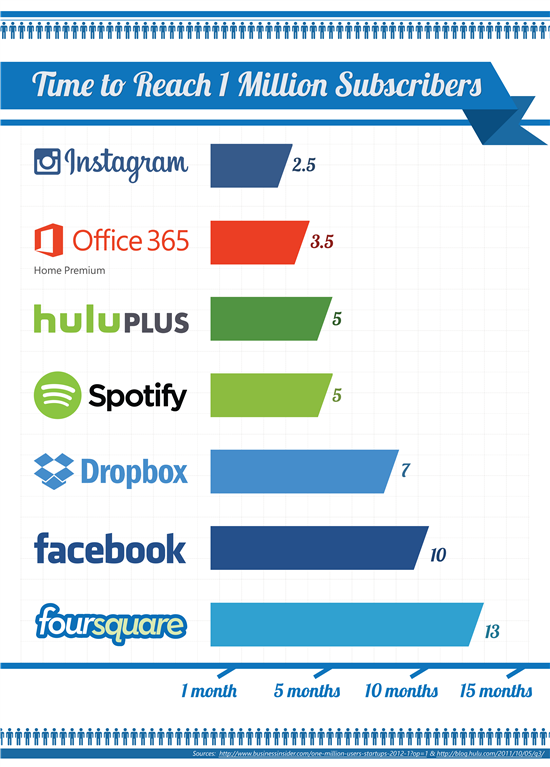
      With a subscription costing $99.99 per year, Microsoft has clearly pocketed a healthy profit with this release, but the fact that the software can be installed on up to five machines may actually mean that sales figures are perhaps not as high as they could have been.

      The sales figures were revealed through the Office blog where Microsoft compares the speed of sales to other popular services. The infographic shows that while Office 365 Home Premium took 3.5 months to obtain a million users, Spotify took 5 months and Instagram just 2.5 months.

      Have you bought into the software as a service model?

      Photo Credit: Pincasso/Shutterstock

    • Google Fiber called the potential ‘beginning of the end’ for cable companies

      Google Fiber Cable Industry Analysis
      Although the idea of Google Fiber rolling into your neighborhood and obliterating incumbent cable providers may be a pipe dream in the short term, at least one analyst thinks that Google’s fiber-to-the-home network will pose serious challenges for both the cable and telecom industries in the long run. Per MarketWatch, Bernstein analyst Carlos Kirjner has issued a new research note explaining why Google Fiber is “an attractive risk-return profile, with very limited downside and potential for material economic upside” that could disrupt the American Internet service provider landscape.

      Continue reading…

    • Google Launches Google Apps Admin Android App

      Google announced the launch of the new Google Admin app for Android today, making it easier for Google Apps administrators to control things on the go.

      “The Admin app makes it easy for admins to use their Android phone or tablet to accomplish the most common tasks—such as quickly adding or suspending users, resetting passwords, managing group memberships, and directly calling or emailing specific users,” explains Google Apps Product Manager Muzammil Esmail.

      Google Apps Admin App

      Here are the features listed in the documentation:

      • Create and manage users, reset passwords, edit profiles, upload profile photos, and suspend users
      • Manage groups, add users to groups, edit user roles, list group members
      • Contact Support for Google Apps for Business with Customer and Support PINs
      • Review account activities in the audit log, and filter events by event type or admin/date ranges

      The Admin app comes on the heels of the recently redesigned Admin Console, as well as the launch of a new Admin SDK Google made available to developers.

      The new app is available in Google Play. It requires API access to be enabled.

    • Are children who take Ritalin for ADHD at greater risk of future drug abuse?

      UCLA research has shown that that children with attention-deficit hyperactivity disorder are far more likely than other kids to develop serious substance abuse problems as adolescents and adults. But do stimulant medications used to treat ADHD contribute to the risk?
       
      UCLA psychologists have conducted the most comprehensive assessment ever on this question and have found that children with ADHD who take medications such as Ritalin and Adderall are at no greater risk of using alcohol, marijuana, nicotine or cocaine later in life than kids with ADHD who don’t take these medications.
       
      The psychologists analyzed 15 long-term studies, including data from three studies not yet published. These studies followed more than 2,500 children with ADHD from childhood into adolescence and young adulthood.
       
      “We found the children were neither more likely nor less likely to develop alcohol and substance-use disorders as a result of being treated with stimulant medication,” said Kathryn Humphreys, a doctoral candidate in UCLA’s Department of Psychology and lead author of the study. “We found no association between the use of medication such as Ritalin and future abuse of alcohol, nicotine, marijuana and cocaine.”
       
      The children assessed in the studies, who had a mean age of 8 years old when the studies began and 20 at the most recent follow-up assessment, come from a broad geographical range, including California, New York, Michigan, Pennsylvania, Massachusetts, Germany and Canada. The research is published in the May 29 issue of the journal JAMA Psychiatry, a leading psychiatry research journal published by the American Medical Association.
       
      What does this study mean for parents of children with ADHD?
       
      “For any particular child, parents should consult with the prescribing physician about potential side effects and long-term risks,” said Steve S. Lee, a UCLA associate professor of psychology and senior author of the study. “Saying that all parents need not be concerned about the use of stimulant medication for their children is an overstatement; parents should have the conversation with the physician. As with other medications, there are potential side effects, and the patient should be carefully evaluated to, for example, determine the proper dosage.”
       
      “For parents whose major concern about Ritalin and Adderall is about the future risk for substance abuse, this study may be helpful to them,” Humphreys said. “We found that on average, their child is at no more or less at risk for later substance dependence. This does not apply to every child but does apply on average. However, later substance use is usually not the only factor parents think about when they are choosing treatment for their child’s ADHD.”
       
      Ritalin is associated with certain side effects, such as suppressing appetite, disrupting sleep and changes in weight, Lee said.
       
      Lee, Humphreys and their colleagues reported in 2011 that children with ADHD are two to three times more likely than children without the disorder to develop serious substance-abuse problems in adolescence and adulthood, including the use of nicotine, alcohol, marijuana, cocaine and other drugs. This new study does not challenge that finding but finds that, on average, children who take stimulant medication for ADHD are not at additional risk for future substance abuse.
       
      “The majority of children with ADHD — at least two-thirds — show significant problems academically, in social relationships, and with anxiety and depression when you follow them into adolescence,” Lee said.
       
      As the individuals in the studies get older, researchers will be able to study the rate at which they graduate from college, get married, have children and/or get divorced and to assess how well they function, Humphreys said.
       
      ADHD occurs in approximately 5 percent to 10 percent of children in the U.S., and figures in many other industrialized countries with compulsory education are comparable, according to Lee. ADHD is about three to three-and-a-half more prevalent in boys than girls, he said.
       
      Symptoms of the disorder include being easily distracted, fidgeting, being unable to complete a single task and being easily bored. However, to receive a diagnosis of ADHD by a child psychologist or psychiatrist, a child must have at least six of nine symptoms of either hyperactivity or inattention, the child’s behavior must be causing problems in his or her life, and the symptoms must not be explainable by any medical condition or any other mental disorder.
       
      Children can be hyperactive, distracted and inattentive for a variety of reasons, Lee said, not only because of ADHD but also because some of them are abused, malnourished, depressed or have impaired vision, Lee said.
       
      Many more children meet the criteria for ADHD than are being treated for it, and many children may benefit from treatment who are not receiving it, Lee and Humphreys said.
       
      Lee’s laboratory is conducting a study of 230 children, both with and without ADHD, who were 6 to 9 years old at the beginning of the research and are now 10 to 13, to identify predictors of early and problematic alcohol use. That research is federally funded by the National Institutes of Health.
       
      As children with ADHD enter adolescence and adulthood, they typically fall into three groups of roughly equal size, Lee said: one-third will have significant problems in school and socially; one-third will have moderate impairment; and one-third will exhibit only mild impairment.
       
      Timothy Eng, a former UCLA research assistant in Lee’s laboratory, is a co-author of the current study. The current research was funded by the National Institutes of Health (grant 1R03AA020186).
       
      For information on ADHD, visit the National Institutes of Health’s ADHD page.
       
      UCLA is California’s largest university, with an enrollment of more than 40,000 undergraduate and graduate students. The UCLA College of Letters and Science and the university’s 11 professional schools feature renowned faculty and offer 337 degree programs and majors. UCLA is a national and international leader in the breadth and quality of its academic, research, health care, cultural, continuing education and athletic programs. Six alumni and six faculty have been awarded the Nobel Prize.
       
      For more news, visit the UCLA Newsroom and follow us on Twitter.

    • Texas Data Center Tax Incentives on the Horizon

      Major data center tax incentives are expected to become law in Texas, and the state’s data center operators are excited about it. The Lonestar state is already a central data center and hosting hub, but the tax breaks are designed to bring in new technology firms and capital investment. In recent years, other states have begun offering aggressive tax cuts, and the new incentives will help Texas defend its prominent position.

      The Texas Legislature has approved legislation to create a temporary sales tax exemption intended to attract major data center projects to Texas.This exemption will apply to data centers with single occupants only. It now comes down to Governor Rick Perry, who has 20 days to sign, veto, or allow the bill to become a law without his signature.

      “We are a very competitive state for large data centers in terms of our economy, geography and climate, but we haven’t been in terms of our tax code,” said Rep. Harvey Hilderbran, R-Kerrville, who authored House Bill 1223 creating the incentives.

      Data Center Providers Express Their Support

      Stream Data Centers, which has facilities in Dallas, Houston and San Antonio, and Companies like CAPSTAR, who own a large property in the Dallas market, are notably excited.

      “Large data center users consider these economic incentives as part of their total cost analysis, and Texas was being priced out of the market,” said John Patterson, who works with CAPSTAR Real Estate Advisors and has a partnership in the 3000 Skyline Dallas data center building. “These tax incentives benefit the technology firms, but they also have a huge economic impact on the state and the communities where they are located.”

      If signed, effective September 1, 2013, the sales and use tax exemption applies to  personal property that is necessary and essential to operate a qualified data center, including electricity; an electrical system; a cooling system; an emergency generator; hardware or a distributed mainframe computer or server; a data storage device; network connectivity equipment; a rack, cabinet, and raised floor system; a peripheral component or system; software; and any other equipment or system necessary to operate qualified property, including a fixture; and a component part of any qualified property.

      Senate Adds its 2 cents

      House Bill 1223 passed last Friday, and House Ways and Means Committee Chairman Harvey Hilderbran told the House he was willing to accept two important changes that the Senate made to the Bill:

      • The Senate increased the minimum capital investment required to qualify for exemption. Projects involving a capital investment of $200 million qualify for a ten year sales tax exemption. Those with $250 million investment qualify for 15 year exemption
      • The Senate defined a qualifying data center to require that the center be used by a single tenant.

      How to Qualify

      The significant thresholds are:

      • $200 million investment over the first five years following certification in infrastructure, hardware, software, electricity, etc.
      • 20 new full time jobs, which pay 120% of the existing county pay rate
      • 100,000 SF building and larger
      • Dollars spent on or after September 1st 2013.

      “This bill is significant because it isn’t location-specific,” said Todd Kercheval, a government affairs consultant who has lobbied for data center tax incentives. “These incentives are truly going to benefit enterprise companies, technology firms, and many communities all across Texas.”

      To qualify, data center owner, operator or occupants must jointly or independently meet required capital investment, create 20 full time permanent jobs that pay at least 120% of the average weekly wage of the given county, with these jobs maintained for five years.

      No investments made or jobs created prior to September 1, 2013 will count. The Comptroller of Public Accounts must pre-approveand will issue registration numbers.

      What the exemption doesn’t apply to: office equipment or supplies, maintenance or janitorial supplies or equipment, equipment or supplies used primarily in sales activities or transportation activities, property on which the purchaser has received or has a pending application for an enterprise zone refund, personal property not otherwise exempted that becomes an improvement to real property, equipment rented or leased for a year or less, or a taxable service that is performed on property exempted by the bill.

      “Data centers benefit communities by increasing real estate values in areas that are often underutilized,” Hilderbran said. “Higher real estate values mean more tax dollars for schools.”