Category: News

  • Here’s an Epic Song Full of Inane Celebrity Tweets

    Sometimes, 140 characters can be used to express something important, thought-provoking, or otherwise newsworthy. And sometimes not, as evidenced by the bulk of the musings coming from a handful of celebrities’ Twitter accounts.

    YouTuber Shane Dawson penned this epic tribute to the more inane aspects of Twitter – you know, the parts of the service that aren’t breaking news and providing insightful commentary on world events. It kind of sounds like a certain Rihanna song, and it’s pretty great. Check it out:

    If you’re looking for a less-musical but equally-awesome teardown of dumb celebrity tweets, check out Nick Offerman from Parks and Recreation reading tweets from young female celebrities.

    Keep doin what you’re doin, celebs.

  • ‘Family Table’ Author Michael Romano Talks At Google

    Michael Romano, author of Family Table, a book that takes a look behind the scenes of restaurants like Union Square Cafe, Gramercy Tavern, Maialino, Blue Smoke, and The Modern, recently gave an “At Google” talk, discussing his work.

    More recent At Google Talks here.

  • Bloody Torso Statues Arrive For Dead Island Riptide Pre-orderers

    Back in January, Deep Silver, the publisher of the Dead Island games, announced the “Zombie Bait” special edition of their upcoming Dead Island Riptide. As many collector’s editions do, the “Zombie Bait” package includes a statue. This statue however, was a de-limbed, decapitated female torso. It was, quite literally, just a pair of bloody breasts covered by a small bikini.

    The publisher later issued an apology for the statue. The carefully worded response did not state that the statues would be pulled from pre-orders, but did make it clear that they would never show up in the U.S.

    The complaints surrounding the statue subsided within days, and now Dead Island Riptide‘s launch day is finally here. Along with mediocre reviews, the game has arrived with the statue still a part of the collector’s edition.

    Video blogger AussieGamerChick received her “Zombie Bait” edition of the game today and showed it off in an unboxing video on YouTube. No doubt speaking for many horror fans, she states that the statue is the reason she pre-ordered the game.

    AussieGamerChick had defended Deep Silver and the statue back in January when complaints began:

    And here’s the launch trailer for the game, for good measure:

    (via Kotaku)

  • Rogers Expands Canadian LTE Network to 7 New Markets

    Rogers has announced the expansion of their LTE network to 7 new Canadian markets. The new infrastructure will connect new devices such as the BlackBerry Z10 and Q10 using the nimble 2600 MHz LTE connection.

    Here are the latest cities to support Rogers’ latest LTE expansion, users there will no doubt be enjoying all the things that high bandwidth mobile connection has to offer such as desktop grade Youtube videos, streaming flash based movies online and non-WiFi video conferencing.

    • Many Ottawa Regions including Kanata, Nepean, Gloucester, Stittsville and Cumberland
    • Langley, BC
    • Keswick, Ontario
    • Hamilton and Grimsby, Ontario
    • Orillia, Ontario
    • Stratford, Ontario

    Click here to check out Rogers’ Canadian coverage map.


  • Tumblr Hits Windows Phone With New App

    Tumblr announced today that it is no longer leaving its users who have Windows Phone devices out in the cold. There is now a Windows Phone Tumblr app.

    Features are as follows:

  • Find and follow the things you love
  • Share photos, gifs, video, quotes, chats, links, and text
  • Jump between your dashboard and Explore with just one swipe
  • Display the latest images from your dashboard on your lock screen and live tile
  • GIFs play as you scroll
  • So, in other words, it’s your basic Tumblr app.

    The release comes at a time (conveniently) as the company launched new mobile ads.

    The app is available in the Windows Phone store.

    Last month, Tumblr topped 100 million blogs (and over 44 billion posts).

  • SRCH2 is rethinking enterprise search for the instant age

    An Irvine, Calif.-based startup called SRCH2 launched on Tuesday with the promise of delivering better, faster and more accurate instant enterprise search results. For anyone who has come to take instant search for granted and forgotten what it is, it’s the feature search engines have that predicts your queries and the answers to them while you type. It’s a seemingly small thing that SRCH2 claims can make a big difference to the companies that use its search engine.

    The company has set its target squarely on Lucene-based search engines — claiming a 31x performance improvement over the Apache version of that technology — and claims to work as well or better than Google, too. Although it can handle internal, non-public-facing search within a company’s data sets, it seems the primary use case for SRCH2 might be online in search bars that now exist on nearly every web page. The company actually offers demos of the search engine in action on its website, including over data from popular developer-information site StackOverflow.

    Searching StackOverflow data.

    Searching StackOverflow data.

    SRCH2 was founded by Dev Bhatia and Chen Li, a University of California, Irvine, professor and former visiting research scientist at Google. The company has also raised a seed round of undisclosed value from a number of investors, including Data Collective, TenOneTen Ventures (Gil Elbaz’s new firm) and numerous data-industry experts and entrepreneurs.

    Feature image courtesy of Shutterstock user Gunnar Pippel.

    Related research and analysis from GigaOM Pro:
    Subscriber content. Sign up for a free trial.


  • The only way for big Apple bulls to be right: ‘Stop being so bullish’

    'No amount of cheerleading' will hasten Apple rebound
    Apple’s profits and revenue have seen unprecedented growth over the past few years, but covering all that ground so quickly is now doing more harm than good. The company’s stock has plummeted more than 40% over the past seven months as Wall Street continually reminds investors that Apple’s growth is slowing and rivals are gaining ground. This time last year, we couldn’t go a day without a dozen Apple bulls pounding the table and coming up with new reasons to buy Apple shares. Now, however, the biggest bulls that remain seem to be making the same case over and over again.

    Continue reading…

  • Budget smartphones to experience explosive growth and account for 46% of all smartphone shipments by 2018

    samsung-galaxy-family


    It’s no surprise that budget-level smartphones are beginning to gain the favor of consumers worldwide, but it appears there is an imminent explosion of budget-level devices in the coming years. A recent trend by research firm ABIresearch concludes that shipments of sub-$250 phones will grow from 259 million in 2013 to a whopping 788 million in 2018; conversely, mid-level (sub-$400) and high-level ($400+) smartphone shipments are expected to grow from 635 million to 925 million between 2013 and 2018. The reason? Well, it’s quite simple really— budget smartphones continue to see an impressive boom in emerging markets, such as African and Asian countries. Additionally, budget smartphones continue to act as a bridge between the few of you out there who are still on a dumbphone, allowing for more advanced features for a modest to reasonable price. Here’s senior practice director Jeff Orr sharing his thoughts:


    “As smartphone penetration moves from early adopters to mass-market and laggard consumer segments, the smartphone as a product will be less dependent on technical superiority, and more dependent on reliability and value.” 


    Still, ABIresearch is quick to point out the importance and relevance of the mid and high-level smartphones. It points out that “premium smartphones tend to carry the most advanced wireless connectivity and operators who are upgrading their network want to ensure that the handsets running on their network can deliver the best possible experience and customer satisfaction“. So in other words— budget-level devices tend to operate on 3G-esque speeds, while mid and high-level devices tend to offer items like LTE. Oh and don’t forget, people do love things like those awesome displays and nifty personal assistants that help make life easier and all.

    source: Business Week

    Come comment on this article: Budget smartphones to experience explosive growth and account for 46% of all smartphone shipments by 2018

    Visit TalkAndroid for Android news, Android guides, and much more!

  • Google Wallet Will No Longer Violate Your Privacy

    It was revealed back in February that Google Play sent your personal details to developers whenever you bought their apps on the Play store. It caused a small outcry among the Android community, and Congress even got involved. Google is now finally starting to address these concerns.

    Droid Life reports that Google will be updating the Google Wallet commerce site in the coming weeks that will remove any personally identifiable information from transactions. Before the update, all transactions would return a customer’s name, email address and other information. The new Google Wallet only returns the general location of the customer at time of purchase for tax purposes.

    So, why did it take Google this long to implement these changes? Google could have just removed the personal information and called it a day, but it seems that the company is completely rebuilding the Google Wallet commerce site to be more developer friendly as well. There’s been a number of UI changes that clean up the site.

    Here’s what the new Google Wallet commerce site looks like compared to the old, courtesy of Droid Life:

    Google Wallet Will No Longer Violate Your Privacy

    The Google Wallet fiasco was just one of many privacy challenges that Google is facing. It’s nice to see the company working quickly to address this particular problem, but it has many more to go. In fact, it only just recently settled a years-old Wi-Fi snooping case in Germany. It also has to contend with European regulators as they question Google’s new privacy policy.

  • Michael Shannon Reads the Deranged Sorority Letter [VIDEO]

    Last week Gawker published a real email from an executive board member of the Delta Gamma sorority at the University of Maryland. Now known as the ‘deranged sorority letter’, the email excoriates sorority sisters for being “boring” and “awkward” at parties and for talking “openly about post gaming at a different frat IN FRONT OF SIGMA NU BROTHERS.”

    As expected, these first world problems became the subject of internet ridicule. Now, celebrities are getting in on the action with their own renditions of the letter.

    The latest celebrity to try his hand at a dramatic reading of the letter is none other than Michael Shannon. Shannon is known for bringing a grizzled, serious presence to dramas such as HBO’s Boardwalk Empire and movies such as Bug and Take Shelter. He brings that very same gravitas to the sisters of Delta Gamma:

    Michael Shannon Reads the Insane Delta Gamma Sorority Letter from Michael Shannon

    Bonus:
    Former Attack of the Show correspondent Alison Haislip has put out her own reading of the letter, which might be even scarier than Shannon’s:

  • BitTorrent Sync goes public, brings new features along

    Back in January, I was fortunate enough to get an invitation to test the alpha version of the new BitTorrent Sync app — an opportunity that excited me, given that I had recently learned my beloved Live Mesh would go away, thanks to Microsoft’s own version of “Spring Cleaning”. This left me in the market for a replacement.

    Now BitTorrent announces that private testing is done and, while the app is still alpha, the company is ready to unleash it on the public. “We’re really excited about opening up this Alpha. The feedback has been universally positive. Those in the closed Alpha have already synced more than 200TB since we started the program on January 24”, says BiTorrent’s Christian Averill.

    With the public release comes some updated features as well. There is one-way synchronization that allows you to sync to a read-only file. This allows for your team, or family, to receive updates from you without them having the ability to edit or accidentally delete the source material.

    The new update also adds “One Time Secrets”, which is a security feature for instances when you do not want a master key and need a use-once solution. The secret code expires after 24 hours.

    Third, there is the option to exclude certain files or folders from Sync. This is handy if you, like me, want to sync your entire My Documents folder between computers, but have a file you wish to exclude for a particular reason.

    Finally, there is also the usual update inclusion of bug fixes and the promise of more stable code, advanced preferences configuration, support of Intel-based Synology devices and an improved Linux WebUI.

    The app, along with all of these updates, is now available to the public. As I stated, it is still considered alpha, and BitTorrent is promising many more updates are in the pipeline. The app is compatible with Windows Mac and Linux.

    Photo Credit: sheelamohanachandran2010/Shutterstock

  • BitTorrent opens up its Dropbox competitor to the public

    BitTorrent opened up the alpha test of its Sync app Tuesday, which offers PC-to-PC file syncing powered by P2P technology. Sync was first announced in January, and the company said this week that users have synched over 200 TB of data during three months of private beta testing.

    Sync, which is currently available for Windows, OS X and Linux, allows users to sync folders between PCs without any limits to file or folder sizes. Folders are encrypted before any transmission, and the app utilizes local network connectivity when syncing two machines within the same network.

    Sync is only one of many new apps and services BitTorrent has been testing in recent months, with others including SoShare, an app that allows users to exchange files that would be too large to email, the Facebook file sharing app Beam It Over and the live streaming service BitTorrent Live. The company has been highlighting these apps on its BitTorrent Labs site.

    Related research and analysis from GigaOM Pro:
    Subscriber content. Sign up for a free trial.


  • Pundits: Stop Sounding Ignorant About Data

    The current surge of enthusiasm around big data has produced a predictable backlash. Some of it, like Gary Marcus’s New Yorker post “Steamrolled by Big Data,” is insightful and well-reasoned (even though I have my quibbles with some of his points). This is not surprising, since he’s a neuroscientist as well as a writer, and so quite comfortable with data.

    Unfortunately, some other prominent commentators clearly aren’t. David Brooks has taken up big data in his New York Times column recently, and literary lion Leon Wieseltier posted last month in The New Republic about “What Big Data Will Never Explain.” Now, these guys are entitled to write about what whatever they like, but if they want to be taken seriously when discussing data they really should stop the kinds of elementary mistakes they’ve been making so far. Their errors of understanding and fact weaken their credibility and turn off quantitatively adept readers.

    So as a public service here’s a short list, written for non-quant-jock pundits, of things to keep in mind always when writing about data and its uses.

    Absolute Certainty is Not the Goal (Because It’s Impossible). Wieseltier writes that “The purpose of this accumulated information is to detect patterns that will enable prediction: a world with uncertainty steadily decreasing to zero, as if that is a dream and not a nightmare.” Everything in that sentence up to the colon is accurate; after it comes nonsense. When teaching introductory probability, I tell my students that a random variable (the mathematical workhorse of the data disciplines) is one where even after you know everything there is to know about it, you still don’t know everything. For example, you know a fair coin toss will come up heads 50% of the time and tails 50%; that’s it, and that’s a long, long way from zero uncertainty.

    Data geeks desperately want to make better predictions using the seas of digital information available today. They want to know how many games the Red Sox will win this season, what course of treatment will zap that particular cancer, and whether they’ll beat the dealer on the next hand. They know they’ll never know any of these things for sure, and that zero uncertainty isn’t even a meaningful goal to discuss.

    People are Not Inherently Better at Making Decisions, Predictions, Judgments, and Diagnoses. Brooks thinks that they are. He writes that “Data struggles with the social,” “Data struggles with context,” and “Data creates bigger haystacks” (apparently, when it comes to data knowing more about a topic is bad) while on the other hand “The human brain has evolved to account for this reality. People are really good at telling stories that weave together multiple causes and multiple contexts.”

    And this is exactly the problem. The stories we tell ourselves are very often wrong, and we have a host of biases and other glitches in our mental wiring that keep us from sizing up a situation correctly.

    How many of these glitches are there? I don’t think anyone knows for sure. The best catalog I’ve come across so far is Rolf Dobelli’s The Art of Thinking Clearly, which devotes a separate short chapter to each mental misfire he’s identified. The book has 99 chapters.

    The late Paul Meehl and William Grove analyzed 136 research studies directly comparing the predictions of humans, many of them ‘experts,’ against those coming exclusively from data and algorithms. Humans were clearly better in only 8 of the cases, giving them a batting average of .058. And Meehl and Grove hypothesize that those 8 human victories might have been due to the fact that the people were “provided with more data than the actuarial formula.”

    Quantification is Useful in Every Field of Inquiry. Viktor Mayer-Schönberger and Kenneth Cukier say in their new book Big Data: A Revolution That Will Transform How We Live, Work, and Think that “Datafication represents an essential enrichment in human comprehension.” Wieseltier reacts “It is this inflated claim that gives offense… The religion of information is another superstition, another distorting totalism, another counterfeit deliverance” But I don’t hear the two authors attempting to found a new religion around information; I hear them making the entirely reasonable claim that better, more precise measurement is a really valuable advance. The field of biology was transformed by Anton van Leeuwenhoek’s microscope, which for the first time gave us the ability to see, count, and otherwise measure the tiny entities that exist at a different scale than we do. This led to a reduction in superstition, not an increase.

    The great Victorian scientist Lord Kelvin laid down a general rule: “[W]hen you can measure what you are speaking about, and express it in numbers, you know something about it; but when you cannot measure it, when you cannot express it in numbers, your knowledge is of a meagre and unsatisfactory kind; it may be the beginning of knowledge, but you have scarcely in your thoughts advanced to the state of Science, whatever the matter may be.”

    Wieseltier might respond that some fields of inquiry aren’t ‘science’ and should never be, but that response would be ridiculous. Science here is simply the process of testing claims against evidence. The ones resisting this are just about guaranteed to be the ones with the flimsiest claims.

    Big Data’s Advocates Don’t Think Everything Can (and Should) be Turned Over to Computers. Brooks says that “If you asked me to describe the rising philosophy of the day, I’d say it is data-ism…; that data will help us do remarkable things — like foretell the future.” Wieseltier takes the same idea a lot further: “in the comprehensively quantified existence in which we presume to believe that eventually we will know everything, in the expanding universe of prediction in which hope and longing will come to seem obsolete and merely ignorant, we are renouncing some of the primary human experiences.”

    I’ve been talking and hanging out with a lot of data geeks over the past months and even though they’re highly ambitious people, I’ve never heard any of them express anything like those sentiments and goals. In fact, they’re very circumspect when they talk about their work. They know that the universe is a ridiculously messy and complex place and that all we can do is chip away at its mysteries with whatever tools are available, our brains always first and foremost among them.

    The geeks are excited these days because in the current era of Big Data the tools just got a whole lot better. If someone told them if their goal was to make hope and longing obsolete and merely ignorant they’d probably find a way to turn such an ignorant statement into a brilliantly nasty visual meme, post it on Reddit, and get back to work.

  • Ben Affleck: $1.50 Challenge To Raise Poverty Awareness

    Ben Affleck, who is fresh off an Oscar win for his film “Argo”, is taking the buzz surrounding his name to a good place: raising awareness about poverty and the harsh choices some have to make when it comes to every day living.

    Affleck has decided to take the Live Below The Line challenge and live on just $1.50 a day for a week in order to highlight the extremes of living at the extreme poverty line. Many celebrities have joined the cause, and Affleck will be tweeting about his experiences during the week to raise awareness and funds for The Global Poverty Project.

    “Last year we had over 15,000 people participate, and raised over $3 million,” Michael Trainer, Director of The Global Poverty Project, said in a statement. “We’re excited to leverage the support The Global Poverty Project has received from the campaign last year, and the Global Citizen Festival in Central Park.”

    New Jersey mayor Cory Booker took a similar challenge last year when he lived on only food stamps for one week to highlight how difficult it is for families who receive government funds to feed their families on what that assistance provides…especially in New Jersey, where the cost of living is high. The SNAP Challenge was initiated after a woman began a Twitter conversation with Booker regarding food stamps and whether they were really necessary.

    Affleck is reportedly due to start his challenge next week along with actress Debi Mazar, singer Josh Groban, and Sophia Bush.

  • The future of work and innovation: Robert Gordon and Erik Brynjolfsson debate at TED2013

    Robert Gordon: The death of innovation, the end of growthRobert Gordon: The death of innovation, the end of growthEconomists Robert Gordon and Erik Brynjolffson see very different things when they look at the stagnation of the U.S. economy in recent years. It’s almost as if they’re looking at an optical illusion image – one seeing a candlestick while the other sees two faces just inches apart. In today’s talks, they both outlined their thoughts.

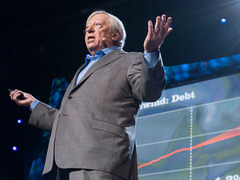
    Gordon sees the candlestick — he believes that the growth could be tapering off for good and that our best innovations may be behind us. As he points out, between 1900 and 1960, we went from traveling by a horse and buggy to taking Boeing 707s. But in the sixty years since, we haven’t learned to go any faster at a mass commercial level. What’s wrong? In his talk, he outlines four headwinds which are keeping us from continued growth at the pace of the past two centuries: demographics, education, debt and inequality.

    Erik Brynjolfsson: The key to growth? Race with the machinesErik Brynjolfsson: The key to growth? Race with the machinesMeanwhile, Brynjolfsson sees the faces. He says that the stagnation may simply be growing pains as we move from an economy based on production to one based on ideas. He also looks to the past for an example, taking us back 120 years to the Second Industrial Revolution. While all the tools were in place for mass production, it took three decades for productivity to skyrocket. The first generation of managers — who had old ideas about systems and workflows – had to age out of the system for growth to start. This is where Brynjolfsson thinks we are now. He sees another wave of innovation in our future — if humans can learn to work alongside computers and robots in more symbiotic ways.

    Click the links above to watch these two fascinating talks. And then watch this 12-minute debate between the Gordon and Brynjolfsson on what it means to work today … and what it will mean in the future.

    Do you think we are witnessing the end of innovation? Is growth over? Did either speaker here change your opinion? Explain in the comments.

  • Microsoft Store begins major online makeover

    If you live in the United States, Microsoft Store online is newly redesigned and celebrates with big savings on the Acer Aspire S7, up to $350 off. The ultra-thin Windows PC is clearly a MacBook Air competitor. The 11-inch model is now available for as little as $899. Lest memory fails me, I saw the same deal inside the physical San Diego Store on Friday night.

    The makeover marks the first of many. Microsoft plans to overhaul the online shop in all 228 markets. The new home page is more spacious, with lots more white space and prominently links to three subshops — Student, Small Business and Developer.

    Microsoft opened the online store concurrently with its retail shops, the first of which in October 2009. The store here in San Diego opened in June 2010. The company now runs more than 65 shops in Canada and the United States. So, for most potential buyers anywhere, online is the only option buying direct from Microsoft.

    Among benefits buying direct rather than retailer or reseller: No crapware, free shipping and free returns.

    Circling back to the S7, it’s a hellva bargain compared to MacBook Air. The laptops are similar size and weight. With Microsoft’s discount, the entry-level S7 and MBA have 1.7GHz Intel Core i5 processors, same amount of memory (4GB) and similar size-screens (11.6 inches); otherwise, differences are pronounced. The S7 has twice the solid-state storage (128GB versus 64GB) and higher screen resolution (1920 by 1080 versus 1366 by 768), for $100 less ($899 vs $999). Screen resolution alone is huge benefit for the Windows 8 laptop.

    Regarding the 13-inch entry-level models, Apple’s has slight processor edge — 1.8GHz versus 1.7GHz processor and same amount of memory and storage. But Microsoft’s deal puts the S7 two-hundred bucks less, $999, again with higher screen resolution (1920 by 1080 versus 1440 by 900).

  • Google gets serious about toolbar scams with new ad policy, forcing AVG to retreat

    A cryptic blog post from Google last week took aim at “bad apples” among its advertising partners, and required pre-approval for certain software offerings that wanted to use Google advertising services. It was hard at first to discern the target of the mysterious message, but now it’s pretty clear that Google fired a shot across the bow of security site AVG and others that might be tempted to trick people into installing unwanted products.

    The dispute between Google and its “bad apples” involves technical details but, fundamentally, it’s about crummy products designed to force feed ads.

    In the case of AVG, it worked like this: when people downloaded its free security software, they automatically received a “safe search” product (unless they were alert enough to uncheck a box during the download process). The unwanted product then installed itself on their browser toolbars as a default search engine. It also — and this is the critical part — served as a platform for AVG to collect money by showing ads, and proved about as easy to uninstall as resigning from the French Foreign Legion.

    Veteran tech writer Emil Protalinski was first to report AVG’s hijinks last summer, calling it the “worst foistware I’ve ever seen.” Since then, investor site Seeking Alpha warned that AVG’s aggressive tactics to get ad revenue would lead Google, which supplies ads to AVG through its AdSense program, to take action. The search giant apparently decided it could do without AVG and, in its new policy announcement, explained:

    For example, in the last 90 days, we have seen over 100,000 complaints about software that changed users’ browser settings or about toolbars that they couldn’t uninstall.  We want to avoid these kinds of bad user experiences.

    Seeking Alpha also warned that if Google jilted AVG, the site would be forced to live on Yahoo ad revenue — which would bring in less money. This prospect appears to have had its intended effect on AVG.

    The outgoing CEO of AVG, JR Smith, explained in a Monday phone interview that its “safe search” product was no longer bundled in a way that forced consumers to opt out. He added that AVG recently signed a new two-year deal with Google and said it complied with all the company’s conditions.

    “They’ll send you default letters and kick you off the network,” said Smith, adding that Google takes tough lines to promote a clean ad ecosystem.

    Google, in response to a request for comment, only repeated its policy announcement. Yahoo did not respond at all.

    Tough line or just tip of the iceberg?

    Google’s new policy aims to reign in AVG-style tactics by forcing software that uses its ad services to provide “one-click uninstall” and to go through a Google approval process. In the bigger picture, the policy appears to be part of a bigger effort by Google to clean up scammy ad practices involving toolbars.

    While toolbars have legitimate uses, they can also be a vehicle for mischief. In addition to AVG, other public companies like Babylon have acquired a reputation for malware; the latter offers a translation program but the installation process can also lead to browser hijacking. Some techniques are even more nasty.

    Certain scams typically invite users to download a program like “Find out who unfriended you on Facebook” but really serve to inject unauthorized ads. One example is Sambreel, a notorious ad outfit that forced its way onto the webpages of the New York Times and other prominent publishers last year; the hijacked ad space likely cost the Times and others millions in lost revenues. Even Google itself has been a victim through its YouTube video site.

    An executive at a major publisher forwarded new screenshots this month like the one below which shows how a “Browse to Save” toolbar device (which claims to find deals for shoppers as they search the web) has used a Sambreel product to take over YouTube’s ads:

    Sambreel on YouTubeAccording to the executive, who did not want to be named, Google is doing the right thing but faces an uphill battle. While it can whip sites like AVG into line, unlike companies, sleazy actors will simply shop around for another ad exchange to do the dirty work. He said that some exchanges — which act as trading houses for digital ad inventory — often turn a blind eye to bad advertisers so long as they bring in money. In this bigger picture, Google appears to be trying to raise the bar in the industry in order to prevent a crisis of confidence in the online ads that are its lifeblood.

    The toolbar policy comes at a critical juncture for the online display ad industry. On one hand, the industry recently suffered another black eye from a botnet scandal and may also be losing ground to the current mania for native advertising. On the other hand, Google, AOL, Facebook and others are developing a sophisticated suite of programmatic ad tools that could make the industry more efficient than ever before.

    (Image by  BMJ via Shutterstock)

    Related research and analysis from GigaOM Pro:
    Subscriber content. Sign up for a free trial.


  • Triennial Review of the National Nanotechnology Initiative

    Prepublication Now Available

    The National Nanotechnology Initiative (NNI) is a multiagency, multidisciplinary federal initiative comprising a collection of research programs and other activities funded by the participating agencies and linked by the vision of “a future in which the ability to understand and control matter at the nanoscale leads to a revolution in technology and industry that benefits society.” As first stated in the 2004 NNI strategic plan, the participating agencies intend to make progress in realizing that vision by working toward four goals. Planning, coordination, and management of the NNI are carried out by the interagency Nanoscale Science, Engineering, and Technology (NSET) Subcommittee of the National Science and Technology Council (NSTC) Committee on Technology (CoT) with support from the National Nanotechnology Coordination Office (NNCO).

    Triennial Review of the National Nanotechnology Initiative is the latest National Research Council review of the NNI, an assessment called for by the 21st Century Nanotechnology Research and Development Act of 2003. The overall objective of the review is to make recommendations to the NSET Subcommittee and the NNCO that will improve the NNI’s value for basic and applied research and for development of applications in nanotechnology that will provide economic, societal, and national security benefits to the United States. In its assessment, the committee found it important to understand in some detail—and to describe in its report—the NNI’s structure and organization; how the NNI fits within the larger federal research enterprise, as well as how it can and should be organized for management purposes; and the initiative’s various stakeholders and their roles with respect to research. Because technology transfer, one of the four NNI goals, is dependent on management and coordination, the committee chose to address the topic of technology transfer last, following its discussion of definitions of success and metrics for assessing progress toward achieving the four goals and management and coordination. Addressing its tasks in this order would, the committee hoped, better reflect the logic of its approach to review of the NNI. Triennial Review of the National Nanotechnology Initiative also provides concluding remarks in the last chapter.

    [Read the full report]

    Topics: Engineering and Technology

  • Anthony Weiner Is Back on Twitter with a New Handle

    Well what do you know – look who’s back on Twitter.

    It’s former Congressman Anthony Weiner, whose indiscretions on the social media platform led to embarrassment and his eventual political demise.

    It appears that Weiner is migrating his Twitter presence to a new handle, @anthonyweiner. His previous handle, @repweiner, tweeted out the new handle Monday evening. It was the first tweet from that account since early February. That account was silent for 17 months following the lewd photograph scandal, with Weiner breaking his silence last November by tweeting out a video in the aftermath of Hurricane Sandy.

    Here’s the final tweet from the old account:

    It makes sense that Weiner would want to start fresh, tweeting from a brand new Twitter account. Of course, there’s quite a bit of bad memories associated with the old account. Plus, Weiner is no longer a U.S. Representative, so @repweiner doesn’t make much sense anymore.

    And ‘Representative” is not the political office that Weiner is looking to be associated with. Speculations that Weiner has aspirations to dethrone Michael Bloomberg as Mayor of New York City continue to gain traction. It seems like a return to Twitter is a logical move for someone gearing up for that kind of run. Especially when the only things that you’re tweeting out are links to a 20-page document called “Keys to the City.” That document is described as “64 Ideas to Keep New York the Capital of the Middle Class.”

    The new account is less than a day old, and has already been verified by Twitter. He currently boasts nearly 8,000 followers in less than 24 hours.

  • Dzhokhar Tsarnaev Tells Authorities Tamerlan Masterminded Boston Bombing

    The remaining suspect in the Boston bombings is blaming the whole thing on the dead suspect.

    Dzhokhar Tsarnaev has been talking to authorities (or writing rather, as he can’t talk because of a gunshot wound to the throat), and says that his brother, the late Tamerlan Tsarnaev, masterminded the whole thing.

    According to a report from CNN, Tsarnaev told authorities that there is not any international terrorist group involved, and that his brother orchestrated the attack. CNN’s Jake Tapper and Matt Smith report:

    Tsarnaev has conveyed to investigators that Tamerlan’s motivation stemmed from jihadist thought and the idea that Islam is under attack, and jihadists need to fight back, the source said Monday.

    The government source cautioned that the interviews were preliminary, and that Tsarnaev’s account needs to be checked out and followed up on by investigators.

    So far, officials have not found evidence that the suspects collaborated with other people on the attacks, though Tamerlan had taken a long trip to Russia last year. The details of this trip are unclear, though he had posted and taken down a YouTube video of Islamic militant Abu Dujana, who was killed in a gun battle with Russian security forces a few months after Tamerlan’s trip.

    Dzhokhar Tsarnaev was charged on Monday with one count of using and conspiring to use a weapon of mass destruction (an improvised explosive device) against persons and property within the United States resulting in death, and one count of malicious destruction of property by means of an explosive device resulting in death. He could face, upon conviction, the death penalty or life imprisonment.

    More details about Tsarnaev’s conversations with authorities will no doubt emerge in time.