Category: News

  • Video: DC2 Datapod System Heads to Europe

    Data center manufacturer Datapod recently started deploying its first export to Sweden, delivering its Data Center 2.0 (DC2) modular data center technology. Datapod product has also been used for PNG ports and a number of global mining companies. The 1:54 video shows Datapod’s pre-fabricated modular units. “The export to Sweden is recognition that Datapod has developed a truly global data center solution that is more economical and quicker to deploy when compared to traditional bricks and mortar. The flexible, scalable and sustainable approach we take to data center manufacturing provides numerous benefits for our customers, including reduced carbon emissions, and lower CAPEX and OPEX,” said Datapod Director Adam Smith.

    For additional video, check out our DCK video archive and the Data Center Videos channel on YouTube.

  • Sponsored post: Rethinking the microserver in rack-level terms

    To get a bigger bang for the IT buck, IT managers like to optimize infrastructure for targeted applications and workloads. As I noted in a recent Intel Chip Chat, one way to do this is by creating CPUs targeted at certain types of workloads. That was the case with Centeron, the code name for the Intel® Atom™ S1200 processor family, launched in 2012.

    Centerton was the industry’s first 64-bit sub-6-watt system on a chip (SoC). This low-power processor expanded our server product line, building on the Intel® Xeon® processor family to support a new class of high-density microservers. Now we’re coming up on the launch of Avoton, the follow-on to Centeron, which will debut later this year.

    Great stuff, all the way around. But at Intel, we know that processors are only part of the optimization story. We like to look at the entire data center infrastructure to make sure we’re optimizing across the board.

    With those thoughts in mind, we are collaborating with leading cloud service providers to rethink rack designs to make them more modular and efficient. Specifically, we’re developing a reference design that uses a suite of innovative technologies in a disaggregated rack-scale architecture.

    This mix includes Intel Xeon processors and Intel Atom SoCs for servers, storage and networking; Intel® Ethernet switch silicon for distributed input/output; and Intel® Silicon Photonics Technology for high-speed interconnects.

    For a closer look at this effort, stop into the Intel IT Center.

    Raejeanne Skillern is Intel’s director of marketing for cloud computing.

  • [Deal] Grab a refurbished Nexus 10 32GB for only $380 through Woot

    Nexus_10_TA_Back

    If you’ve been itching to pick up Google and Samsung’s latest joint effort in the tablet space, Woot has you covered. They’re offering a refurbished 32GB model of the Nexus 10 for just $380, which is far less than the $499 Play Store price. It’s still about $20 cheaper than Google’s 16GB model, too. It’s not a brand new model, of course,  but that’s a great price on a fantastic tablet.

    The deal is set to run for two days, or until Woot runs out of stock, so don’t wait too long if you’ve been looking to replace your tablet.

    source: Woot

    Come comment on this article: [Deal] Grab a refurbished Nexus 10 32GB for only $380 through Woot

  • Meeker: The next ten years will be about wearable computing and personal data

    The photo wars aren’t over, but a shift is about to take place in terms of the content we upload and share to the internet, according to Kleiner Perkins’ Mary Meeker and her trademark Powerpoint slides at D11. After years of uploading each and every photo to the web, we’re about to start uploading personal data and sound files to the web in greater and greater numbers as wearable computing develops.

    Meeker’s annual attempt to present more than 100 slides in 10 minutes is a little tough on the eyes, but a few key trends emerged Wednesday at D11 (the full deck is embedded below):

    • 500 million photos are being uploaded and shared each day, doubling year over year as Snapchat turns into a real phenomenon. But photo-sharing is relatively mature compared to…
    • Video, which as Janko noted earlier today is on a tear. At the moment, video growth is being spurred by short-form video sharing like Vine and Dropcam, Meeker said.
    • Both of those content types, however, are relatively well understood compared to the next big wave: sound files and data from wearable computers. That’s because we’re at the cusp of a computing shift in which wearables take precedent over mobile.
    • Fitness and health data will be a huge percentage of that personal data, Meeker said, as more and more people realize how behavioral shifts can improve their health and how new devices can help people track those behaviors.
    • The platform change to wearables will help create that world, Meeker said. While the past ten years have been about mobile computing and the ten years before that were about the PC, the next ten years will be about wearable computers with sensors.

    Related research and analysis from GigaOM Pro:
    Subscriber content. Sign up for a free trial.

  • Amazon Greenlights First 5 Shows: Alpha House, Betas, Annebots, Creative Galaxy, Tumbleaf

    In April, Amazon debuted 14 pilots for shows that could become its first originals. Five of them made the cut: Alpha House, Betas, Annebots, Creative Galaxy, and Tumbleaf. They will begin production, and air later this year, and in early 2014.

    “We are thrilled at the enthusiastic customer response to our first original pilots,” said Roy Price, Director of Amazon Studios. “We built Amazon Studios so that customers could help decide which stories would make the very best movies and TV shows. It’s exciting to see the process in motion, doing exactly what we set out to do. The success of this first set of pilots has given us the push to try this approach with even more shows—this is just the beginning.”

    Alpha House stars John Goodman, and was written by Academy Award nominee and Pulitzer-Prize winner Garry Trudeau and produced by Elliot Webb and Jonathan Alter. It’s a comedy about “four misfit senators turned unlikely roommates”.

    Betas is a comedy set in Silicon Valley, following four friends as they try to get rich with a new mobile social networking app. It stars Ed Begley Jr., Jon Daly, Joe Dinicol, Charlie Saxton and Karan Soni, and is written by Evan Endicott and Josh Stoddard.

    The other three are kids shows. Here are the official descriptions:

    Annebots revolves around Anne, a young scientist, who creates three robot helpers to assist her scientific experiments in the back of her dad’s junkyard. This science-based series from creator J.J. Johnson aims to introduce kids to science and technology in a fun, new way.

    Creative Galaxy is an animated interactive art adventure series, designed to inspire kids’ creative thinking through crafts, story, music and dance. The series was created by Angela Santomero, creator of Blue’s Clues and the Emmy-nominated literacy series, Super Why!

    Tumbleaf was created by Drew Hodges and Kelli Bixler of Bix Pix Entertainment, the award-winning stop motion studio. The series, aimed at preschoolers, is set in a whimsical land where a small blue fox named Fig plays each day and discovers adventure, friendship and love around every bend. Children will be enriched by narratives that promote play through exploration and scientific thinking.

    Each of the shows will appear exclusively on Prime Instant Video. The pilots are currently available for streaming.

  • Verizon Galaxy S3 slated to receive large update, includes multi-window and several other features

    Verizon-Galaxy-S3

    Verizon’s Galaxy S3 was a bit behind on features and updates, but according to a newly released support document, that’s about to change. The Verizon variant is slated to receive an update to build number VRBMD3. It’s a Jelly Bean update that (finally) includes multi-window functionality. Of course, it’s not only a multi-window update, as you’ll see other features such as S Beam’s Auto Share Shot, improved hotspot reliability, carrier billing in Google Play, the Best Shot mode in the camera, and a long list of other fixes and enhancements.

    The update isn’t live yet, but since the support documents are up, it shouldn’t take too much longer. Hit the link below to check out the full changelog.

    source: Verizon

    Come comment on this article: Verizon Galaxy S3 slated to receive large update, includes multi-window and several other features

  • Sprint-SoftBank deal okayed by foreign investment watchdogs

    Sprint revealed on Wednesday that its acquisition by SoftBank had passed a key regulatory hurdle. Normally telecom mergers are the sole purview of the Federal Communications Commission and the U.S. Department of Justice, but since Japan-based SoftBank would effectively take over a U.S. company, the Committee on Foreign Investment in the U.S. also gets its say on the deal’s national security implications.

    CFIUS has given its blessing, and Sprint has entered into a national security agreement with the U.S. government. But according to a Wall Street Journal report there are plenty of strings attached. Sprint will create a national-security committee and appoint an independent security director to its board, according to the report. The deal also gives the government the unusual right to veto infrastructure deals and even ban certain vendors outright from Sprint’s network, the Journal said.

    huaweithumbThe target here is clearly Huawei, which has waged a long political battle with lawmakers and government officials over whether privately-owned Chinese networking giant presents a security risk to U.S. interests. According to the Journal, Sprint would not just be banned from working with Huawei and other Chinese equipment vendors, but it would have to rip out existing Huawei gear in its networks. That would include equipment Sprint’s affiliates installed, but most significantly it would mean a major overhaul for Clearwire if the mobile broadband operator accepts Sprint’s buyout offer on Friday.

    Huawei has built a substantial portion of Clearwire’s WiMAX network, which could cost as much as $1 billion to remove. Huawei is also building a portion of Clearwire’s new LTE network, but Clearwire CTO John Saw told FierceWireless last week that the carrier is reducing its dependence on Huawei, and the Chinese vendor accounts for only 5 percent of its LTE spend.

    Sprint is encountering problems with the multiple deals it’s juggling. Despite upping its offer to Clearwire shareholders last week, institutional investors are still opposed to the deal. That could make the Friday’s shareholder vote awfully hairy. Sprint is also forced to weigh a takeover counter offer from Dish Network. Despite those distractions, Sprint said today that it expects its deal with SoftBank will become final in July.

    For that to happen, Sprint and SoftBank still needs a thumbs up from both the FCC and Justice Department. The DOJ in January raised a red flag about security concerns, but this week’s agreement seems to address all government agencies national security questions. There are really no anti-trust issues, since Sprint isn’t being acquired by a U.S. telco, so the DOJ is likely to sign off on the deal shortly. The only thing remaining is the FCC’s public interest review.

    Related research and analysis from GigaOM Pro:
    Subscriber content. Sign up for a free trial.

  • Vice President Biden Visits Trinidad and Tobago

    Watch this video on YouTube

    After stopping in Colombia on his three-country trip to reinforce partnerships in the Americas, Vice President Biden traveled to Trinidad and Tobago, where he met with President Carmona and Prime Minister Persad-Bissessar and participated in a meeting and working lunch with a number of other Caribbean leaders.

    In that series of meetings, leaders discussed regional efforts to promote economic growth, citizen security and energy, among other issues.

    “I'm here because President Obama wanted me to have an opportunity to dialogue with all of you and because our country is deeply invested and wants to become more deeply invested in a partnership with all the nations of the Caribbean,” the Vice President explained.

    Our search for growth, jobs and affordable supplies of energy, our fight against transnational crime, and the protection of our climate and our environment — all of these issues, all of these issues have no respect for borders and they affect all of our borders. They directly affect the people of my country and each and every one of yours.

    read more

  • Google seriously considered researching teleportation

    Google Teleportation Research Project
    Google’s secretive Google X laboratory is where some of the company’s brightest minds go to work so-called “moonshot” projects such as Google Glass and self-driving cars. A new Businessweek profile on Google X makes it clear that there are limits to what the lab will put resources into researching, however. For example, Businessweek reveals that Google engineers gave serious thought to starting a research project on teleportation but ultimately decided to nix it “in part because any unique item that you would want to teleport… would have to be completely destroyed before it could be reconstituted on the other end.” But just because Google has for now given up on studying teleportation that doesn’t mean it doesn’t have other bizarre projects in the works. Among other things, Businessweek says that Google is pondering research on levitation and “inflatable robots” and wind-powered aerial drones.

  • Girlfriend Dumps Lochte on Reality Show

    Ryan Lochte gained fame last summer when he won two gold medals at the 2012 Summer Olympics in London. Since that time, Lochte has gained numerous sponsorships, appeared on TV, and even had his personality parodied by Seth MacFarlane on Saturday Night Live.

    Now Lochte has, as most minor celebrities seem to these days, his own reality show on cable. The E! network show What Would Ryan Lochte Do? premiered last month, following the Olympic athlete as he goes about his life. This week, the show found drama in Lochte’s life as the athlete’s long-time girlfriend broke up with him on the show.

    Lochte received a phone call during a dinner out with friend, which he didn’t seem happy about. He politely took his call outside the restaurant, where he attempts to get the TV show camera operator to stop filming. He apparently knew he and girlfriend Jaimee Holler were going to break up, as he turned off his microphone and walked down the street. He stated that he did not put their conversation on the show out of respect for Holler.

  • Facebook Not Acquiring Waze, Will Google?

    Rumors about Facebook trying to acquire Waze have been circulating for close to a year at this point. The rumors picked up steam earlier this month, followed by talks of a bidding war among Facebook, Google and other unspecified companies. Some have mentioned Apple as a suitor, as it has struggled with its own Maps offering.

    According to reports, it looks like Google’s competition has been reduced. AllThingsD’s Mike Isaac reports that Facebook is no longer in talks to acquire the company, indicating that talks fell apart in part due to “conflicts over whether or not the Waze team – which is predominantly based in Israel – would move over to the United States and fold itself into Facebook’s Menlo Park, Calif., headquarters, among other reasons.”

    Neither company has commented on the situation.

    Additionally, Apple CEO Tim Cook said at the D11 conference that the company did not make a bid for Waze. Technically, that doesn’t exactly mean Apple is out of the discussion, but it does clear some up some notions.

    Reports of Google’s interest in Waze haven’t exactly been confirmed, but Bloomberg reported last week that Google was in the mix. As previously mentioned, Google could be an attractive destination for a company in the mapping area, given the success of Google Maps, and the continued expansion of imagery and features. It could also prove to be a defensive move on Google’s part, keeping competitors from gaining ground against its popular Maps service.

    Google recently unveiled new Maps experiences for desktop, mobile and tablet devices.

  • Lenovo unveils dual-sim S820, a female-oriented device for the Chinese market

    lenovo-s820

    Keeping with the trend of smartphones aimed at Chinese women, Lenovo has announced the S820, a sleek red device with soft curves and a smooth velvet finish. Unlike recent offerings from Oppo (namely the MeituKiss and the Ulike 2) this device is a bit more gender neutral than the previous S720, even if Lenovo are targeting it almost exclusively at women. Hit the break for a video of the phone in action and a gallery of its gorgeous body.

    The device features a 13-megapixel rear camera, a 2-megapixel front-facing camera, and a 4.7-inch, 720p resolution IPS display. On the inside it will have a 1.2GHz quad-core MT6589 SoC with 1GB RAM and 4GB of expandable internal storage. Also included is a 2,000mAh battery and dual SIM slots (WCDMA 2100 and GSM 900/1800/1900). The device runs Android 4.2 Jellybean and is available for pre-order at the source below until June 2nd, starting at ¥1,999 (about $330).

    s820-4
    s820-3
    s820-2
    s820-1

    Click here to view the embedded video.

    Via: Engadget
    Source: Lenovo

    Come comment on this article: Lenovo unveils dual-sim S820, a female-oriented device for the Chinese market

  • Google Glass makes me want a smart watch

    I just tried Google Glass for the first time today – not for very long, just for a few minutes, but long enough to gain some first impressions beyond those of others that I’ve read. And unlike my colleague Eliza Kern, who was won over by the possibilities for voice-controlled photography, I actually came away from the experience less impressed with Glass than I previously was.

    Let’s leave aside things like weight, fit and girth – it’s very clearly a beta product and all these things will improve (they’re not too bad to start with, anyway). But there are fundamental problems with the concept, and they are “why” problems that particularly stand out when you compare the Glass concept with that of the smart watch.

    Efficiency, please

    First off, let me reiterate and flesh out a pet gripe of mine that’s highly relevant to the way I view this comparison: I think there’s way too much duplication of functionality between smartphones and tablets. I get why that is – they use the same operating systems in order to simplify developer efforts – but the result is often inefficient. Twitter, Facebook, email… there’s not much of a compelling reason to pick one mobile form factor over the other.

    If you’re going to have two communications devices, then, why not split their duties according to suitability? One option I’m considering is to get a cheap Nokia Asha phone for voice calls, SMS and WhatsApp, and to then pair it with my iPad Mini for more graphically intensive tasks: this would maximize phone battery life while giving me more screen real estate for the apps that require it.

    But what if I could push those more basic tasks across to another device that makes more out of them? What if I had the combination of a tablet and something easier to access than a phone… something wearable.

    Use cases

    motoactv_mr7_notificationsYes, I realize the battery-life-maximization element goes out the window here – and that may be a major medium-term problem for both Glass and the smart watch concept – but let’s take that out of the equation for now. For me, one of the biggest selling points of Google Glass is its ability to make it easier to see essential, bite-sized information: text messages, tweets, incoming caller identity and so on. This kind of functionality has been on smart watches for some time, though none have appealed to me until now (that might be a design thing).

    Then we have geolocation, which is probably the most important addition to the mobile canon since cellular connectivity itself. True, it is slightly easier to watch a map through a heads-up display than by glancing at a wrist-borne device, so Glass has the edge here. But that kind of use case tends to imply a device that is constantly on, making the limitations of current battery technology a major barrier for both device types.

    What’s more, the real promise of Glass for navigational purposes would lie in augmented reality – overlays, in other words. And that was perhaps my most surprising realization on trying Glass for the first time: the minute size of its screen makes it useless for the most interesting augmented reality ideas. For this form factor to really fly, it would need to utilize larger transparent screens as “lenses”, so that it could properly mediate your visual world. Again, the power usage implications are significant.

    Where Glass really does have the smart watch form factor beat is on voice – not voice commands (I’ll get back to that in a moment) but voice communications, phone-style. Glass’s audio capabilities are based on bone conduction, so only the user can really hear what’s going on. Conversations generally need to be private, both for the protection of those talking and to avoid annoying nearby people, so a voice-enabled smart watch would have to be paired with something like a Bluetooth headset – hardly ideal.

    But what about photos?

    Then we have Glass’s voice-operated camera, the factor that Eliza found compelling and something that just flat-out wouldn’t work on a watch. For me, this feature is simply not much of a draw. For a start, I usually carry a good compact system camera with me. But I also don’t like the idea of verbally telling my glasses to take a photo – it’s only slightly faster than whipping out a phone, and it also means looking like I’m talking to no-one in particular.

    And that is perhaps the biggest problem with Glass: even once its designers get past the visual tool factor, its use will still appear contextually odd. There will always be people who are fine with that, in the same way that Bluetooth headsets continue to be a thing, but it’s a hugely limiting factor when it comes to mass appeal. It may make sense when you’re driving, but most people don’t want to look like they’re talking to themselves as they walk down the street.

    I realize that all of this comes down to the user. Some people want to take photos more easily; I don’t really care much about that. I want simple information, presented to me in a way that’s an improvement over my current smartphone setup; others might find this functionality unappealing. Each to their own — there is clearly not going to be a one-size-fits-all solution in the wearables space, not in the same way that smartphones have achieved near-universal appeal. (Incidentally, if Google Glass were a fully hands-free experience, which it isn’t, it would be very useful for certain specialists, such as surgeons and mechanics.)

    There are some things that Glass, or something like it, could potentially be able to do much better than any alternative device. For me, augmented reality is at the top of that list, but Glass can’t really deliver without a monumental revamp. And that pretty much sums Glass up for me: intriguing, but I can’t see it doing what I’d want it to do anytime soon. A new generation of smart watches is a much likelier prospect in the short term and, after today’s Glass experience, that promise suddenly seems much more exciting.

    Related research and analysis from GigaOM Pro:
    Subscriber content. Sign up for a free trial.

  • Redskins Name Change Urged By Congress

    Should the Redskins change their name? Some members of Congress certainly think so.

    The Los Angeles Times reports that 10 members of Congress have sent an open letter to Redskins owner Dan Snyder asking him to change the name of the NFL team. Many view the name as offensive to Native Americans as the term “redskin” could be seen as a racial epithet.

    The letter sent to Snyder, NFL Commissioner Roger Goodell, and others says that the term “redskin” is just as offensive as other racial slurs:

    “Native Americans throughout the country consider the ‘R-word’ a racial, derogatory slur akin to the ‘N-word’ among African Americans or the ‘W-word’ among Latinos. In this day and age, it is imperative that you uphold your moral responsibility to disavow the usage of racial slurs. The usage of the “R-word” is especially harmful to Native American youth, tending to lower their sense of dignity and self-esteem. It also diminishes feelings of community worth among the Native American tribes and dampens the aspirations of their people.”

    Will the letter work? Well, it can’t hurt. Earlier this month, Washington Councilman David Grosso announced it was his intention to change the state’s NFL team name to something more respectful. His idea was the “Washington Redtails,” named after the Tuskegee Airmen.

    There are presumably countless other ideas floating around so Snyder won’t have any trouble picking a new name if he decides to change it. That being said, we’re probably not going to see a change anytime soon.

  • Radcliffe Potter’s Father? Actor Says He’d Do It

    Daniel Radcliffe, who played Harry Potter in the enormously successful film adaptations of the books, says that although he’s ruled out ever playing Harry again, he’d definitely play Harry’s father, James.

    ““No more schoolboy stuff. A cameo as Harry’s dad? That would be perfect!” he said.

    Of course, Harry famously looks just like his father, so it wouldn’t exactly be a stretch. It would also fit in with Radcliffe’s desire to move away from the role that made him famous while revisiting the characters at the same time. The 23-year old actor has made a conscious effort to distance himself from Harry, taking roles on stage–such as the controversial Broadway production of Equus which required him to be nude–and in films like “The Woman In Black” and “Kill Your Darlings”, a biopic about Allen Ginsberg.

    The young actor recently spoke about being a dad, which he hopes is in the cards for him in the near future.

    “I definitely want to have kids,” he said. “I’ve grown up around lots of people who were having kids when I knew them, because a lot of them were a lot older than me. And I saw the wonderful change in them. I see that it gives you a sense of purpose that up till now I only really get from work. I want that. I don’t know when or [with whom] but I want it. And I’d like to get started on it before my thirties. I like the idea of being a youngish parent. So I’ve got energy to play football even though they’ll be better than me by the time they’re four.”

  • Watch Tim Cook’s interview at D: All Things Digital conference

    On Tuesday, Apple CEO Tim Cook appeared for the second time at the D: All Things Digital conference. The interview, lead by perennial hosts Kara Swisher and Walt Mossberg, mostly centered around the current state and the future of the fruit company, but also briefly touched other popular topics like Android and wearable technology.

    Tim Cook, who wears a Nike+ FuelBand, says that “wearables [the category] is extremely interesting” and capable of deeply impacting people’s lives. The man, however, asserts that folks are reluctant to wear things that they don’t normally do, giving glasses as an example. For this reason, he believes that products like Google Glass don’t appeal to most users and are only attractive to “vertical markets”.

    Apple will take a more open stance towards customization, providing less restricted access to APIs but only to the point where the user experience is not negatively affected. Hinting that iOS is not poised to rival Android in this regard, Cook says: “We think that the customer pays us to make certain choices on their behalf”.

    Other noteworthy topics that Apple’s CEO discussed during his second appearance at the D: All Things Digital conference include decreasing market share, the controversy surrounding taxes and larger iPhones.

    Tim Cook refused to reveal upcoming Apple products, leaving important announcements for the WWDC (Worldwide Developers Conference) keynote in June.

  • SEOmoz Will Now Be Known As ‘Moz’

    SEOmoz has changed its name to simply, ‘Moz,’ to better reflect the growing industry of which it is a part. The company, however, isn’t only rebranding itself. It’s also launching a completely new product.

    SEOmoz now redirects to Moz.com.

    “The Problem: There isn’t a product that measures the effectiveness and impact of inbound marketing efforts,” a spokesperson for the company tells WebProNews. “Sure, Google Analytics can give you traffic data—but it doesn’t give you data for all your efforts across other channels. Moz Analytics is built to expose that data and give marketers insight into how to improve their efforts. It helps users answer a difficult question: What is the ROI of inbound marketing?”

    “The Pitch: Moz is the result of two years of product development, based on a trend that was clear to our Founder and CEO, Rand Fishkin,” the spokesperson adds. “The world of search marketing has evolved. Social media marketing matters, content matters, and SEO matters—they all contribute to the greater picture of inbound marketing, or earned marketing, as we like to call it. Moz manages and analyzes those marketing efforts on a single subscription platform.”

    “For the past decade, we’ve fought to make SEO a legitimate, respected part of a web marketer’s arsenal,” says Fishkin. “Today that battle is expanding to include content marketing, social media, community building, brand tracking, and other inbound channels. While SEO remains a key part of our product, it’s no longer transparent or authentic to say we’re purely an SEO software company.”

    The Moz Analytics platform includes SEO and link analysis features, social analytics and brand/web mention data. It will show where a brand, competitor, or industry topic is being talked about on the web, and companies can see where they’re being mentioned, but not linked to.

    “The transformation of Moz over the past year is a direct result of the feedback we’ve received from our customers and community,” says Fishkin. “We’ve taken input from thousands of marketers, and built the tools they need to understand the impact of their efforts.”

    Moz has over 25,000 customers, and boasts a community of over 300,000 online marketers. Moz Analytics is in private invite-only beta mode for the time being. They will start transitioning customers to the new software over the coming weeks.

    Fishkin discusses the change more over on the Moz Blog.

  • Formula 1 racing changes pose big data challenge

    You’d be hard pressed to find a better use case for big data number crunching than Formula 1 racing, where the cars blasting around the track are largely designed, simulated and built on computer screens. There’s a reason for that: as expensive as all that compute fire power is, it’s still cheaper than doing it all manually. Every day the real team spends testing a car out on track costs $400,000 to $450,000, said Patrick Louis, CEO of the Lotus F1 team. 

    For that reason, with its use of advanced computational flow dynamics (CFD) and CAD/CAM operations, Formula 1 racing is a demanding test case for compute and storage infrastructure.  When the real cars do hit the track, each vehicle runs 240 sensors which generate 25 megabytes of data per lap driven. That data is uploaded via satellite link to the factory — the engine data is split from the chassis data and each stream is analysed for performance and wear and tear.

    And now,  the Formula 1 racing circuit is navigating a massive mandated change — from V-8 engines with 2.4-liter displacement to more gas-efficient V-6 engines with 1.6 liter displacement. And they have to do that with no loss of speed. That means there are plenty of design challenges ahead, Louis acknowledged.

    The upcoming Lotus F-1 car will look like this -- complete with EMC, Microsoft and Symantec decals.

    The upcoming Lotus F-1 car will look like this — complete with EMC, Microsoft and Symantec decals.

    F-1 design draws on big data, big time

    As a friend (thanks Rochelle!) who is a huge F-1 fan explained to me, the race’s governing body (the FIA) lays out detailed rules about how cars can be built. It mandates, for example, that a flat plank on the underside of the carriage must be X centimeters above the ground and no car can benefit from “moveable aerodynamics.”

    Each car maker — companies including Lotus, Ferrari and McLaren – interprets those rules for its own design and spends what some estimate to be hundreds of millions developing cars for each season. Yikes. Each car — an intricate combination of 85 percent carbon fiber composites and 15 percent metal — can cost upward of $2 million.

    EMC jumps aboard Lotus F-1 bandwagon

    But while FIA rules change annually, the whole deck gets reshuffled this year in an effort to cut energy costs, Louis said. That means new engines and new transmissions. EMC put me on the phone with Louis because Lotus will be using an array of EMC gear, including Vblocks (actually bundles of EMC storage, VMware virtualization and Cisco servers) for its back-office functions that run on Microsoft Dynamics AX.

    Lotus is building  two projects running in parallel, Louis said. One is a factory where one section is dedicated to the aforementioned Microsoft Dynamics business functions and the second for all the Catia CAD/CAM design applications. The second is tasked with equipping the racing team — which obviously travels from track to track — with the same software and content.

    Louis wouldn’t detail what hardware is being displaced but it’s safe to say it’s non-EMC servers and storage. EMC’s CMO Jeremy Burton (who likes to race Mazda Miatas in his spare time) said aspects of the Lotus deal could also include EMC’s Atmos for storage and managing content; Syncplicity to sync and share files across sites; and Data Domain for backup and recovery.

    The massive computational fluid dynamics (CFD) applications that simulate how airflows will impact speed and performance, and how the hot exhaust of the car can create more downforce, are not part of this deal, Louis said.

    This is a big, high-profile multi-faceted job —  one that any tech vendor would kill to be part of. So brace yourself for a wave of promotions from EMC, Microsoft, Symantec (judging from the decals plastered on the car above) and whoever else is involved.

    Related research and analysis from GigaOM Pro:
    Subscriber content. Sign up for a free trial.

  • 2013 Toyota Tundra Limousine For Sale – Featured Truck

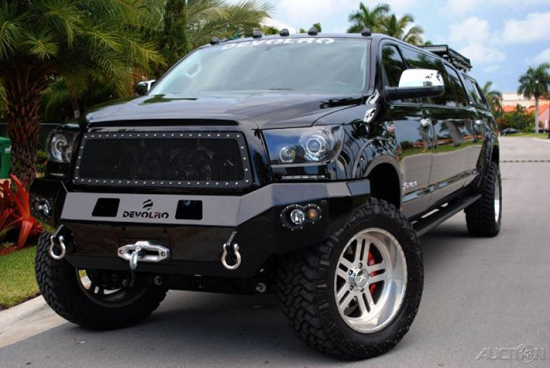
    It’s big, black and can seat six comfortably in the rear cab. You can take it off-road and on-road with ease. And it is one of the most custom Toyota Tundra’s we have ever seen. What is it? It is a fully-loaded platinum edition 2013 Toyota Tundra Limousine for sale right now on Ebay for the asking price of $229,000.

    2013 Toyota Tundra Limousine For Sale - Really!

    This Platinum edition Toyota Tundra is really one-of-a-kind!

    This Devolro Warrior “Big Boy” 5.7l V-8 limousine has just 5,987 miles, a clean title and is street legal with off-road capability. It has been custom engineered with an air-pressure controlled suspension for the length and the weight while keeping “high speed performance and off-road conditions.”

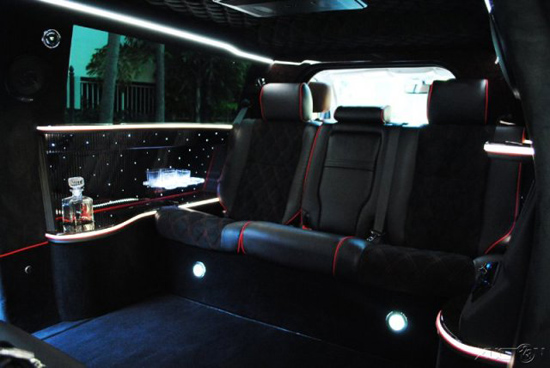
    2013 Toyota Tundra Limousine For Sale - Interior

    The interior of the truck looks like any other high-class limousine.

    The interior features hand-made Italian leather seats and trim which took over 300 hours to complete. It also has a Microsoft-based, all-in-one touch screen operating system that is controlled by the passenger (s).

    The list of engine features include:

    • Ultimate TRD upgrade package
    • TRD supercharger
    • TRDAir Intake
    • TRD Exhaust
    • 520hp
    • 550lb of torque
    • Other mechanical:
    • Upgraded alternator
    • Dual A/C Heat system
    • Heavy Duty Condenser
    2013 Toyota Tundra Limousine For Sale - Side Profile

    From the side, it is really, really long. Pretty sure turning and parking could be an issue.

    Exterior features include:

    • 70″conversion
    • Full metal Slick Top
    • Custom build suspension
    • Remote Reservoir Front Coil-over Shock System
    • Billet Aluminum Upper Control Arm System
    • 2.5″ Series Piggyback Reservoir Shocks
    • LiftRear Leaf Spring Expansion Pack
    • Custom 6.5 inch suspension lift
    • Devolro custom steel bumpers front and rear, painted
    • Front 9500 lb winch with wireless remote
    • Custom step bars
    • Custom topper with full walk in door (carpeted, additional light inside)
    • Custom roof rack
    • Custom full LED off road lightening package: includes front 50 inch LED bar and 30inch LED bar on the back, 40 inch LED bars on the side. LED Day running lights
    • Custom build 22 inch American Force forged aluminium wheels (5 pcs) wrapped in 37 inch Nitto Trail Grappler tires.
    • Offroad fender flairs painted
    • Hornblasters train horns
    • Rearview camera
    • Custom mesh grill
    • 46 US gl auxiliary fuel tank

    Interior features:

    • Custom build cabin for 6 ppl
    • Black leather with red stitching and piping,
    • Alcantera diamond inserts
    • Alcantara diamond headliner
    • Limo Touch controls
    • Sound System Upgrade
    • CD/DVD/USBUnit
    • 2×15″ Drop down TV’s
    • Wood Flooring
    • 12v outlet
    • Full interior partition
    • 2 side bars
    • White LED light panels
    • Custom floor , interior and bar lighting
    • Removable Carpet Overlay

    Go check it out on Ebay and to see a bunch more photos.

    What do you think? Would you buy it if you could?

    Related Posts:

    The post 2013 Toyota Tundra Limousine For Sale – Featured Truck appeared first on Tundra Headquarters Blog.

  • TrackMaven Receives $1.25 Mln

    TrackMaven said on Wednesday that it has received $1.25 million in funding. Among the investors that participated in the round were AOL Ventures; Roger Krakoff of Cloud Capital Partners; and Acceleprise Ventures. Based in Washington, D.C., TrackMaven is a competitive intelligence platform for marketers.

    PRESS RELEASE

    TrackMaven, the competitive intelligence platform for marketers, announced today that it has closed $1.25 million in funding from Aol Ventures and leading marketing investors. The round includes investments from:
    AOL Ventures
    Sean Glass (Former CMO of HigherOne, NYSE: ONE)
    Hemang Gadhia (Former CEO of Condaptive, Acquired by Millenial Media, NYSE: MM)
    Adam Riggs (Former President of Shutterstock, NYSE: SSTK)
    Roger Krakoff (Cloud Capital Partners)
    Tony Ayaz (Former VP of Public Sales for Splunk, NYSE: SPLK)
    Marc Solomon (CFO of JackBe)
    Acceleprise Ventures
    Andy Klingenstein
    David Cohen
    Adam Falla
    TrackMaven is the competitive intelligence platform for digital marketers. By aggregating data from paid, owned, and earned media channels, TrackMaven gives modern marketers one platform to track their competitors’ digital marketing activities in three ways: with a universal feed that displays content marketing, press mentions, social marketing on Facebook, YouTube, and Twitter, paid advertising, and other digital marketing activities in a single, filterable, real-time feed;via personalized alerts triggered by digital marketing activity of any type, from any competitor, of interest to the marketer as it happens or at the frequency of their choosing; and with competitor profiles that show how successful competitors are as compared to one another, and the user company, in every type of digital marketing activity monitored in TrackMaven, including SEO, Traffic, content marketing, social media, and more.

    Competitive intelligence is a time-intensive process for marketers with results that are traditionally quickly out of date and labor intensive. The traditional process of gathering meaningful competitive intelligence usually involves cobbling together data from lots of different sources, aggregating it by hand, and then analyzing it to get a full picture of what your competitors are doing and whether it’s effective for them. It’s really difficult to do this well the old-fashioned way. TrackMaven eliminates the manual data gathering process and shows marketers everything their competitors are doing with digital marketing and how well it’s working for them in one place. This makes it easy for marketers to see what is working in their industry and build campaigns around that, benchmark their own programs, and keep up-to-date with their industry.
    www.TrackMaven.com
    Twitter.com/TrackMavenApp
    Facebook.com/TrackMaven

    The post TrackMaven Receives $1.25 Mln appeared first on peHUB.