Category: News

  • Chrome For Business Gets Legacy Browser Support, Cloud-Based Management

    Google announced a couple of new Chrome for Business features including Legacy Browser Support and cloud-based management of Chrome for Google Apps for Business and Education customers.

    With Legacy Browser Support, businesses that have custom web apps that were built for older browsers will be able to use them with Chrome.

    “When companies use browsers that are two or more versions old, employees and developers are unable to benefit from the incredible web innovations of the past four, or even ten years,” writes Chrome for Business & Education Senior Product Manager Cyrus Mistry. “Deploying a modern browser can help IT bolster security, reduce support costs, and improve browser speed and usability for employees.”

    “With Legacy Browser Support, employees on Chrome are automatically switched to a legacy browser when they begin using an older app,” he explains. “IT managers simply define which sites should launch from Chrome into an alternate browser, and then set this Chrome policy for all employees. And while Chrome Frame helps developers build apps for older browsers, Legacy Browser Support lets IT admins of organizations embrace the modern web.”

    With the cloud-based management feature, employees will be able to access default apps, custom themes, and curated app web stores when they sign into Chrome with their work account, whether they’re on their work computer or their personal computer.

    Admins can customize over a hundred Chrome policies and preferences for employees.

  • Haystax Buys Digital Sandbox

    Haystax Technology, which is backed by Edgewater Funds, has acquired Digital Sandbox. Financial terms weren’t announced. McLean, Va.-based Digital Sandbox provides threat and risk analysis and monitoring software in the National Security and Homeland Security fields.

    PRESS RELEASE

    Haystax Technology, Inc. (Haystax), a portfolio company of the Edgewater Funds, today announced the acquisition of Digital Sandbox, Inc. Haystax provides multi-source information integration, big data analytics and visualization to address the challenges posed by exponential increases in data volume to customers in the intelligence, defense and security communities. The Digital Sandbox acquisition extends Haystax capabilities and products in public safety, law enforcement and corporate security markets.

    Digital Sandbox is a software company that has been providing threat and risk analysis and monitoring software in the National Security and Homeland Security fields since 1998. Federal, State, and Local agencies use Digital Sandbox commercial software product suites to quantify and monitor risks from natural and man-made threats, and to direct resources based on threat and risk priorities. Digital Sandbox’s suite of secure and cloud-deployable software tools provide geospatial, temporal, and real-time streaming information feeds to monitor threats and risks for field operations and special events, including four of the last five Super Bowls.
    William Van Vleet , Chief Executive Officer of Haystax, said, “The accelerating variety, volume and velocity of data available can overwhelm organizations and leaders responsible for ensuring the safety of major companies and events. We are excited to add Digital Sandbox’s technologies to provide our customers with scalable analytics to monitor hundreds of real-time news and social media feeds with mobile solutions to enable entirely new capabilities for prioritized, intelligent decision-making.”
    Digital Sandbox founders and partners, Bryan Ware and Anthony Beverina , added, “Together, as part of one company, we become a more powerful platform with access to defense and intelligence markets. We are now positioned to compete for opportunities that were, until now, beyond the capabilities of either company alone. We are very excited to join Haystax to raise the level of our service and capabilities for our customers.”
    Following the acquisition, Digital Sandbox will be known as Digital Sandbox, Inc., a Haystax Company, and will continue to be led by its president, Anthony Beverina . Bryan Ware will serve as the chief technology officer for Haystax Technology. The terms of the transaction were not released.
    About Digital Sandbox, Inc.
    Digital Sandbox provides analytic tools and information products to government agencies and large enterprises, enabling them to optimize their strategic, policy, and budgetary decisions for risk-based resource allocation. Digital Sandbox analytic risk management solutions help customers in the public safety, corporate, and homeland security fields lower their risk exposure, increase the impact of their risk management budgets, and maximize the effectiveness of their resources. Visit Digital Sandbox on the Web at www.dsbox.com.

    About Haystax Technology
    Haystax Technology, Inc. provides next generation products, systems and service solutions to sift, refine and analyze large, disparate and unstructured volumes of data to reveal undiscovered connections and enable precise, actionable intelligence for government and commercial market clients. In essence, these technologies allow users to find “the needle in the haystack” quickly and reliably. For further information about Haystax Technology, visit our website at www.haystaxtechnology.com.
    About The Edgewater Funds
    The Edgewater Funds is a Chicago-based private equity firm with $1.4 billion in committed capital. Through Edgewater Growth Capital Partners, we partner with management to help accelerate growth in their businesses. Edgewater focuses on funding high quality middle market companies where we can add substantial value through our capital, our experience and our broad network. Edgewater leverages the experiences of its Partners and Advisory Board who have distinguished themselves as successful CEOs and business leaders.

    The post Haystax Buys Digital Sandbox appeared first on peHUB.

  • eBay Seller Sues Buyer Over Negative Feedback

    An eBay seller is suing a buyer after she left a negative review on the site and refused to rescind it. The negative feedback was over an unexpected $1.44 postage charge.

    According to the complaint, Amy Nicholls purchased a microscope part from Med Express in February. As a result of that purchase, Nicholls incurred shipping costs ($12 on top of the $175 purchasing price).

    Med Express took her payment via PayPal, and shipped out the device. When it arrived to Nicholls, there was an extra $1.44 postage due.

    Nicholls, operating under the eBay moniker chimera_studios, posted on February 26th that the “Order arrived with postage due with no communication from seller beforehand. It was logged as a negative feedback on eBay.

    Med Express quickly responded, saying that “Sorry – no idea there was postage due. This has happened alot (sp) from USPS lately.”

    Over the past year, Med Express has 298 ratings, only 2 of which or considered negative. Their positive feedback percentage stands at 99.3%.

    “When notified of the problem, Med Express immediately offered to reimburse Nicholls for the postage due amount. Despite this offer, and before giving Med Express a chance to reimburse her, Nicholls on February 26, 2013, apparently as a result of the $1.44 postage due, posted negative feedback and comments for the transaction on eBay’s website and gave Med Express low ratings in the Detailed Seller Ratings section of eBay’s Feedback Forum, resulting in an unfavorable feedback profile for Med Express. In so doing, Nicholls falsely and deliberately slandered the good name and reputation of Med Express.”

    Med Express goes on to say that Nicholls caused them irreparable harm and caused them to lose customers and income.

    They seek not only an injunction to remove the negative feedback, but also damages (both punitive and reparative).

    The facts of the case do not seem to be in dispute. And in a letter to Med Express, Paul Levy of the Public Citizen Litigation Group (on behalf of Nicholls) makes it clear that the feedback about them is true.

    “In a sense, what you and your client seem to be contending is that your client’s offer to pay the $1.40 is a sufficient display of contrition that Nicholls ought to be forgiving. But the point that she made in her message to you was that the problem wasn’t the money but the hassle. she indicated that she would have been willing to pay $1.40 more in shipping up front, but that she was posting feedback because a company that ships products ought to be able to do a better job.

    That opinion might be right, or it might be wrong, but harboring it and expressing it is not a tort. And it is certainly no reason to seek damages, attorney fees, and an injunction. Consumers might well take this sort of bullying into account when they are thinking about whether to do business with Med Express,” says Levy.

    “Moreover, the relief you are seeking would be injurious to consumers. Your other potential buys have an interest in knowing the history – that, for a period of time, you were repeatedly using a shipper knowing of problems that could result in user having to pay postage due.”

    Remember the response Med Express have Nicholls? “This has happened alot (sp) from USPS lately?”

    Of course, Levy argues that’s not really the mot important part. Summarily, Ohio law and the First Amendment prevents Med Express from suing over an opinion – be it false or not.

    [via Ars Technica]

  • Japanese ISP Now Offers 2Gbps Internet, Twice The Speed Of Google Fiber

    The Internet infrastructure in the U.S. is pathetic. It’s slow, expensive and run by companies that care more about their bottom line than what their customers actually want. There is one bright spot though – Google Fiber and its record-breaking 1Gbps Internet service. Now a Japanese ISP is aiming to steal some of its thunder.

    PCWorld reports that Sony-backed ISP So-net has launched a domestic 2Gbps Internet service in Tokyo and six surrounding prefectures. The download speeds are twice as fast as Google Fiber, whereas the upload speeds are the same 1Gbps.

    Surely this super fast Internet must cost an arm and a leg, right? Not at all. So-net is only charging 4,980 yen, or $51, a month on a two-year contact. That’s even cheaper than Google Fiber’s already ridiculously cheap $70 a month just for Internet.

    Of course, there are a few reasons why Japan is able to rollout this super fast Internet and ISPs in the U.S. can’t. For one, Tokyo is closely packed in comparison to even our tightest cities making fiber rollout easy. The other, and more crucial, cause is that the Japanese government has been pushing for increased fiber proliferation in the country. Our own FCC has only just started to push for gigabit networks after years of saying 5Mbps down was good enough.

    The moral of this story is not to say that Japan has better Internet than us, even if they do. The moral here is that the U.S. still has a long ways to go with its infrastructure before it can start to compete on a global scale. Google Fiber and other gigabit initiatives are doing their best, but we won’t see true results until we start seeing true competition that scares the incumbents into actually upgrading its infrastructure.

  • IT Woes Ground American Airlines Flights

    An outage in a key reservations system has grounded all flights at American Airlines this afternoon, as the airline instituted a system-wide ground delay until 7 p.m. Eastern time. The technology problems, which left passengers and gate agents unable to manage bookings or print boarding passes, caused backups at airports in many areas of the country.

    “American’s network system is experiencing intermittent outages,” the airline said. “At this time, we are holding all flights on the ground until later this afternoon, when we will provide another update. We are working to resolve this issue as quickly as we can, and we apologize to our customers for this inconvenience … We’re currently unable to modify today’s reservations. However, when able, we’ll offer refunds or update travel at no charge.

    “The issue is with our ability to access our reservation system,” American said on Twitter, correcting an earlier tweet that attributed the downtime to problems with the Sabre reservations network. Sabre, which also serves other airlines, said “All Sabre systems are up and running; no issues here.”

    UPDATE: As of 4:30 p.m. Eastern, American said its systems outage was resolved, but impacts on operations would continue to be felt. “Our systems have been fully restored, however we expect continued flight delays and cancellations throughout the remainder of the day.” In a statement on its Facebook page, the airline offered several options for travelers with flights today.

    The airline added an unusual comment, apparently to address speculation: “It is important to note we see no evidence that today’s technical outage is related to the tragic events in Boston.”

    The outage was causing significant delays at Dallas-Forth Worth airport, a major hub for American. “At DFW, there are some aircraft on the ramps awaiting departure, as well as arrivals flights awaiting gate space,” airport spokesperson Sarah McDaniel told the Dallas News. “Aircraft have also returned to the gate and deplaned passengers.”

    The outage is the latest in a series of incidents in which problems with airline reservations systems have snarled air traffic and inconvenienced passengers. Here’s a recap:

    • United Continental had significant systems outages last August and again in November, when the problems were attributed to integration problems from the merger between United and Continental.
    • Last October customers of Alaska Airlines were stranded for hours when a cable cut on a fiber optic line severed the airlines’ connection to Sabre,preventing customers from checking in for flights and is causing delays systemwide.
    • Last July the “Leap Second Bug” caused computer problems with the Amadeus airline reservation system, triggering long lines and traveler delays at airports across Australia. More than 400 Qantas flights around Australia were delayed by at least two hours as staff switched to manual check-ins. The outage at Amadeus, one of the world’s major reservation systems, lasted about an hour but had a longer impact on air travelers and airline staff.
  • Improve Your Leadership Presence


    Muriel Maignan Wilkins, coauthor of Own the Room, breaks executive presence into three essential parts.

  • Gryphon Closes Sales of TrustHouse to Elior

    Gryphon Investors has completed the sale of TrustHouse Services Group, a Charlotte, N.C.-based contract food service provider, to Elior SCA. Financial terms weren’t announced. Gryphon invested in TrustHouse in 2008. The sale to Elicor was announced in March.

    PRESS RELEASE

    Gryphon Investors (“Gryphon”), a San Francisco-based private equity firm, and Michael J. Bailey, the CEO of TrustHouse Services Group (“TrustHouse”) announced today that they have completed the previously announced sale of Gryphon’s portfolio company TrustHouse to Elior SCA (“Elior”), a prominent provider of contract and concessions catering headquartered in Paris, France. Elior partnered with its two main shareholders and TrustHouse’s management for the acquisition. Terms of the transaction were not disclosed.
    About TrustHouse Services Group
    TrustHouse Services Group (www.trusthouseservices.com) is a leading food service provider focused on the healthcare, education and corrections sectors. TrustHouse manages over 675 client accounts across 45 states. Divisions of TrustHouse include Aladdin Food Management based in Wheeling, WV; AmeriServe Food Management headquartered in Columbia, MO; Fitz Vogt & Associates located in Walpole, NH; A’viands, LLC in Minneapolis, MN; Lindley Food Services located in New Haven, CT; and Valley Services, Inc. located in Jackson, MS. TrustHouse is headquartered in Charlotte, NC and was founded in 2008 by Mike Bailey and Gryphon Investors, a San Francisco-based premier middle-market private equity firm.

    About Gryphon Investors
    Based in San Francisco, Gryphon Investors focuses on leveraged acquisitions of, and growth investments in, middle-market companies in partnership with experienced management. Having committed more than $1 billion of discretionary equity capital, Gryphon has an extensive track record of investing $35 to $100 million of its own capital in companies with sales ranging from $50 to $250 million. Gryphon prioritizes investment opportunities where it can form proactive partnerships with owners and executives to build leading companies, utilizing Gryphon’s capital, professional resources and significant financial and operational expertise. Visit www.gryphoninvestors.com for more information.

    The post Gryphon Closes Sales of TrustHouse to Elior appeared first on peHUB.

  • Kat Von D Wedding to Have Underwater Theme [RUMOR]

    Kat Von D is engaged (again) and the reality TV star is serious this time. The tattoo artist has revealed her plans for her marriage to DJ Deadmau5, which include a very non-traditional ceremony.

    Von D told People magazine this week that her wedding will be underwater-themed and take eldritch inspiration from the stories of horror writer H.P. Lovecraft. The wedding will reportedly feature performers dressed as mermaids and the wedding dress will also match the theme, with “iridescent teals, blues and deep violet ombré gradients.”

    Vond D and Deadmau5 became engaged back in December, when Deadmau5 proposed via Twitter. The couple had only reportedly been dating for a few months before the engagement.

    This is not the first time Von D has been engaged. In addition to a four-year marriage that ended in 2007, Von D also dated and was engaged to Reality TV star Jesse James. The couple ended their on-again, off again relationship in 2011, and earlier this year James married professional drag racer Alexis DeJoria.

  • Google asks Glass developers to not blind users with advertisements [video]

    Google asks Glass developers to not blind users with advertisements
    In some ways, Google Glass sounds like a web marketer’s dream since it can conceivably project advertisements directly onto users’ eyeballs. But thankfully for all involved, Google is having none of that. Google this week released a new Glass development guidelines video that helpfully instructs developers to not “get in the way” with their applications. In the video, Google Senior Developer Advocate Timothy Jordan explains to Glass developers that “the user’s life comes first” and that “users want Glass there when they need it, but out of the way when they don’t.” As CNET notes, Google is also specifically telling developers that they may not “serve or include any advertisements” in their apps, so it seems that Glass users won’t get bombarded with ads for miracle weight-loss drugs while they’re crossing the street. A full video of Google’s Glass guidelines is posted below.

    Continue reading…

  • If You Pre-Ordered Google Glass, Here’s What To Expect Once Your Number Is Called

    puppy-glasses

    If you were one of the people who signed up last year at Google’s I/O conference to be a part of the “Glass Explorer” program, you might be getting your instructions on how to actually…purchase the thing and get it into your geeky little hands.

    In case you weren’t sure, Google Glass is real, and they’re shipping as we speak.

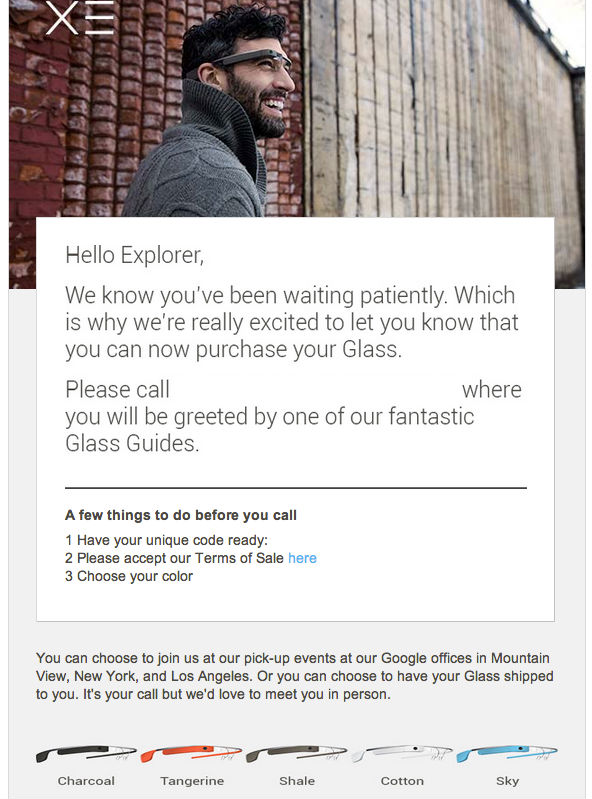
    Today, my number was called and I received the following email, which comes along with a phone number to call, a unique code and a link to a “Glass Safety Notices and Terms of Sale” that you must accept before you place your order:

    Google said in its previous email to Glass Explorers that 2,000 were pre-ordered, and I was number 933. That means that the company is filling out requests for units pretty quickly, if they’re going in order. (UPDATE: We’re told by other Glass Explorers that the fulfillment is not going in order.) Sure, some people might not follow through once they actually face dropping over $1,500 for them, but it’s safe to venture a guess that most will opt to purchase them.

    When you call the number, which I’ve blanked out from the email, you’re asked for your unique code. The process is pretty quick and you can decide on whether you’d like to pick your Glass up or have it shipped to you. Sadly, the tangerine and sky colors were already out of stock, so I opted to pick up the “shale” flavor of grey.

    I set up an appointment to pick them up in Mountain View tomorrow. I’m told that if you pick them up in person, in either Mountain View, New York or Los Angeles, you’ll meet with a member of the Glass team to have them fitted properly and then get a basic walk-through of the device and operating system. You’re also encouraged to “bring a friend.”

    The person on the phone was extremely nice, congratulating me on getting the device along the way. After all, to try these things out, and be on the cutting edge of technology, you’re dropping some serious cash.

    Since the Glass Mirror API developer guide documentation is out, along with the API itself, more developers will start creating applications on top of the Glass platform once they get their hands on them. It certainly doesn’t hurt that some of the biggests VCs in Silicon Valley are lining up to fund these projects, too. I’m personally looking forward to creating a recipe application that will let me flip through ingredients and directions, hands-free, while I cook. Amazing, huh?

    Plenty of questions remain about Google Glass, especially as to whether mainstream consumers will actually want them, how often people will actually wear them and how awkward things will be when you’re sitting across the table from someone who has a camera connected to the Internet in front of their eyeball. Having said that, Glass has gotten people excited, and you’re going to start seeing at least 2,000 more of them in the wild very soon.

  • How Page Load Speed Impacts SEO And User Experience

    Since Spring 2010 Google has used page load times as a factor in its search ranking algorithms. Google’s position is that faster-loading pages should be ranked higher because they provide a better experience for users. In Google’s own words, “Faster sites create happy users […] Like us, our users place a lot of value in speed – that’s why we’ve decided to take site speed into account in our search rankings.”

    What do we know about Google’s page speed algorithms? What can webmasters do (both for Google and for users) to speed up page load times?

    How much does page load speed impact Google rankings?

    Google representatives have stated on several occasions (for an example see this post on the Google Webmaster Central Blog) that the page speed algorithm impacts rankings for less than 1% of search queries. There have been a few reports from webmasters of page speed significantly impacting rankings :

    This data suggests that page speed doesn’t often impact rankings, but when it does the effect can be significant. One plausible interpretation (from Geoff Kenyon) is that “site speed will affect only queries where other ranking signals are very close or when the load time is exceptionally poor.” This interpretation seems to be consistent with Google’s statements and community feedback.

    Should SEOs worry about site speed? Page rankings are often based on a combination of dozens of small algorithmic factors; therefore, though page speed is a minor factor, even a small boost could be beneficial for your site. Don’t obsess over page load speeds, but it would be a good idea to dedicate a small amount of your SEO time and/or budget to speeding up your site. Page speed is also one of the factors totally within your control so its prudent to optimize this ranking factor.

    How does Google measure page load times?

    Google receives site/page load speed data from

    Google Chrome and Google Analytics are other possible sources for page load speed data.

    How fast are Google’s top 5 websites?

    According to data from Experian, nearly 20% of clicks from Google SERPs go to Facebook, YouTube, Yahoo, Wikipedia and Amazon. We used Google’s PageSpeed tool to see how well the home pages of these sites are following Google’s PageSpeed best practices:

    Pagespeed Scores

    While these figures shouldn’t be overemphasized, it is interesting to note that these top 5 websites definitely have opportunities to improve their page load speeds.

    What is an average page load speed? Google has conducted research on average page load times which can be used as a benchmark for page load times:

    Page Load Times

    How does page load speed impact user experience?

    Google implemented page speed into its algorithm because research shows that faster page load times mean happier users.

  • A Google study found that “slowing down the search results page by 100 to 400 milliseconds has a measurable impact on the number of searches per user.”
  • Shopzilla achieved a 25% increase in pageviews and a 7-12% revenue increase by speeding up its site.
  • AOL presented data showing that page load speeds can impact pageviews per visit by up to 50%.
  • A 1 second delay can decrease conversions by 7%.
  • 75% of users said that they would not return to a website that took longer than 4 seconds to load.
  • Nearly half of users expect webpages to load in 2 seconds or less.
  • Feel the need for speed? How to make your webpages pull a fast one

    Step 1: Measure.

    Your first step should be to measure your site’s page load speed. This will provide a baseline measurement from which you can work to improve. Two good tools for measuring page load speeds are Pingdom Page Load Time tool and Google Analytics Site Speed reports.

    Step 2: Upgrade your server.

    Many dynamic websites have to execute hundreds of lines of code, respond to dozens of requests, and make multiple database queries to display a single page to a single user. Hosting your website on a more powerful server can result in webpages being served faster.

    If your site is hosted on a shared hosting account, consider upgrading to a VPS or dedicated server. VPS and dedicated servers typically allow your website to have more server resources (i.e. CPU and memory) available. A VPS costs about $25 – $100 per month, depending upon the technical specifications and features you select. A dedicated server usually costs $100-$300 per month, depending upon the server’s specifications and the level of support that is included.

    Read The Differences Between VPS and Dedicated Hosting if you need help determining which is the best choice for your site.

    Step 3: Optimize your code and files.

    There are many ways to optimize your server side code, HTML/CSS/Javascript code, and images to minimize page load times. Google and Yahoo both provide excellent lists of best practices that you can implement to decrease page load time.

    Conclusion

    1. Page load speed impacts website user satisfaction, site usability and conversion rates.

    2. Google uses page load speed metrics as a minor ranking factor.

    3. Load times can be decreased by upgrading your web hosting and by implementing a list of best practices provided by Google and/or Yahoo.

    What are your favorite tools and strategies for improving page load times? How fast is your site?

  • Bethesda Teases New Game Via Vine, It’s Not Fallout 4

    Just yesterday, Bethesda Game Studios announced that it’s officially done with Skyrim. The studio is moving all of its team to full time development on its next title, and a recent teaser may point to what that game is.

    Bethesda posted the following Vine teaser on its Twitter account today:

    As you can see, there’s no explanation. Many are assuming it’s a teaser for Bethesda’s next game which many first assumed was an impending announcement for Fallout 4 or whatever Bethesda Game Studios is working on next. For Fallout fans, that’s unfortunately not the case as Bethesda’s Pete Hines put that assumption to rest:

    Of course, it’s easy to forget that Bethesda is also a publisher, and the publisher has two games on the horizon. One is codenamed Zwei, a new survival horror game from Resident Evil creator Shinji Mikami. The other is an unnamed project from MachineGames, a developer made up of ex-Starbreeze staff. Some are saying that their title is a new entry in id’s celebrated Wolfenstein series.

    The funny thing is that the Vine teaser could fit both scenarios. The record is playing Bach’s music, and Bach was German. Zwei is a German term and the creepy mood of the Vine teaser fits a horror-themed game quite well. On the other hand, Wolfenstein traditionally takes place during World War II and has the player fighting nazis in Germany.

    Bestheda hasn’t said anything else since the Vine teaser, but we’ll probably learn what the mystery game is soon enough. Besthesda generally doesn’t keep fans guessing for long so we should be seeing a proper announcement before the end of the month.

  • When We’re Hungriest for Leadership

    Just three years ago we wrote a case study for Harvard Business Review based on a terror attack in our home city of Boston. That abstract, fictional situation has now come to painful life.

    At the National Preparedness Leadership Initiative at Harvard, we study crisis leadership in many settings. We have seen graphic photos and heard compelling testimony about terror attacks around the world. Even for us, the horrific scenes of the carnage at the Boston Marathon yesterday are difficult to push out of our minds.

    In the fictional case study we wrote, there was an explosion in the subway and a business leader had to decide whether or not to let his building be used as a triage center and temporary morgue. The expert advice was unanimous: in times of crisis, civic duty trumps private interests. Yesterday, the city of Boston resoundingly agreed: we saw many people step up to selflessly help others. Whether or not they would call themselves “leaders” at all, many did offer leadership.

    It is in difficult times like these that we are hungriest for leadership, for people who can restore order, find the perpetrators, organize the aftermath, and help us find meaning and common purpose. People are wounded, whether physically or emotionally. Even those who only watched the events on television can feel the effects. Leaders, too, are affected — they’re only human. But leadership moments come unexpectedly for each of us.

    Fortunately here, it seems that careful preparation helped civic leaders improvise a swift and effective response to the unthinkable. Boston officials have used past marathons and the city’s annual Fourth of July celebration to develop, exercise, and test their preparedness plans. They had also had been at the forefront of the Tale of Our Cities program, an outgrowth of a class project at the National Preparedness Leadership Initiative that brought officials from London, Madrid, Islamabad, and Israel to share their experience with terrorist bombings. The city absorbed these lessons and modified its plans accordingly. For example, providing effective medical treatment in the aftermath of a mass casualty bombing is distinctly different from a more typical disaster such as multiple car collision. Multiple law enforcement agencies may see every patient as a possible “person of interest,” many physicians have limited experience with blast injuries, and the walking wounded can overwhelm the nearest healthcare facilities. Without careful preparation, leaders may do exactly the wrong thing while trying to do the right thing.

    Every crisis is potentially two crises: the original event and the response to the incident. When leadership remains calm and composed, they can help avoid turning the reaction to the crisis into a secondary disaster. In this case, the response was sure and swift. In Boston, effective preparation and in-the-moment leadership kept a terrible tragedy from descending into chaos that could well have resulted in more injuries, greater loss of life, and the possible destruction of evidence. Medical professionals, police, and race volunteers provided immediate aid. The professionals called upon long-rehearsed responses and were able nimbly organize bystanders and volunteers. The area was cleared quickly and efficiently.

    But leadership at a time like this is not just about the careful preparations and emergency improvisations of civic leaders and emergency responders. It’s about being the leader your followers need, no matter your position or your title.

    People will mirror your behavior: Project calm and they will be composed. Demonstrate resolve and they will be strong. Be empathetic and they will support each other…and you.

    We all go to the “emotional basement” in the face of a threat. It is an instinctual survival mechanism that serves us well when confronted with danger. However, the basement is not a place to dwell. Getting back to business as usual is a path up from the basement. Engaging in activities at which people can demonstrate basic competence helps “reset” the brain to a more productive mode.

    It can be easy to get caught up in “what if” scenarios that bedevil leaders with potential threats around every corner. This is, unfortunately, the world in which we live. Random violence is possible and increasingly probable if not precisely predictable.

    Nothing can bring back the victims or undo the injuries resulting from the violence in Boston. It is the job of leaders to help us see beyond the tragedy and pain, and heal. You must attend to collective resilience so that organizations and communities rapidly recover from tragedy. You encounter many people in any given day; take a day to slow down and connect with every single person you meet. Use their names. Ask about how the day is going. Try to meaningfully connect with each and every one of them. As Admiral Thad Allen said in the aftermath of Hurricane Katrina, collateral compassion is a good thing.

    It is your opportunity to help others realize their strength and find hope in the darkness.

  • Designer unveils $15 million iPhone 5 with 26-carat black diamond home button

    Designer unveils $15 million iPhone 5 with 26-carat black diamond home button
    We have seen luxury phones encrusted with diamonds before, and some of them are worth more than $1 million. But a British designer named Stuart Hughes is now raising the bar with an iPhone 5 that costs £10 million, or more than $15 million USD. The gimmick of this particular Apple piece is that its home button is made of a 26-carat black diamond. The marketing babble on the website is satisfyingly nutty: “Diamond is distinctive in the way it reflects light. It has a unique brilliance and also breaks the light up into spectral colours, which reflect within the stone as it is moved.” It is also pretty cool that a product description page for a £10 million device manages to misspell the word “chassis.”

    Continue reading…

  • Alison Brie Cements Internet Sweetheart Status by Imitating Popular Memes

    Not only is Alison Brie a great comedic actress (Community) and a great dramatic actress (Mad Men), but it appears that she can also do a really good Grumpy Cat.

    Watch Brie imitate more popular internet memes below, and accept the terrible fact that she’ll never be your girlfriend.

    [MadeManDotCom]

  • Coping with the Emotional Fallout After an Act of Terror

    On a map, Harvard Business Review’s offices look far from the site of yesterday’s Boston Marathon bombing, seven miles up the winding Charles River. But in a city that feels more like a town, everyone in the area — as well as in cities and countries far beyond — has been shaken up by the Patriots’ Day explosions. In our reflections, we remembered an interview conducted after the September 11 attacks that we found helpful in understanding how to cope. Diane Coutu, a longtime HBR editor, interviewed Dr. Steven E. Hyman, who served as the director of the National Institute of Mental Health (NIMH) from 1996 through 2001. Today, he directs the Stanley Center for Psychiatric Research. What follows are excerpts of their conversation from over ten years ago that have given us strength and perspective today.

    On the impact of an event like this on people who witnessed it on TV, but may not have been present:

    Most people will have at least transient trouble concentrating, and many will be irritable or depressed. Some people may feel that normal tasks are not meaningful anymore, so they may lose their motivation. These symptoms can obviously affect interactions among colleagues at work, and they can negatively affect productivity. For most individuals, these symptoms will recede with time.

    Unfortunately… the current situation is one of continuing uncertainty, and the fear of new attacks is a rational one. It’s impossible to escape this reality, but we should not panic. Like most emotions, fear is highly contagious. The infectious quality of fear and anxiety is part of our species’s warning system for shared dangers; but when anxiety becomes chronic, it is no longer adaptive. That’s why we need to develop strategies for coping.

    On some of the coping strategies that may be particularly helpful for businesses at a time like this:

    Corporate leaders must speak and act calmly, despite their own concern. They must provide honest, accurate information insofar as that is possible. Leaders should say what they know — and what they don’t know — and then relate the steps they are taking to control the situation. It is critical that managers not mix their attempts to provide information with efforts to reassure employees. Confusing the two calls into question the reliability of the information at hand.

    At the individual level, employees can take steps to improve how they cope. They should stay connected to their social networks because isolation heightens the risk for anxiety and depression. Within their social networks, both at home and at work, people should be solicitous of one another. They should offer to listen if someone needs to unload, or make a concerted effort to keep plans. At the same time, they must be wary of becoming intrusive. Some people want to tell their stories and discuss their concerns, but others do not. Pushing someone who isn’t ready to talk about his anxieties is not helpful. In fact, forcing people to face their raw emotions can retraumatize them, unless they have a safe setting and appropriate coping strategies in place. Parenthetically, this is why poorly trained stress debriefers or grief counselors can actually do harm.

    People should also take care of themselves physically. The activation of our bodies’ fight or flight response — with the accompanying release of stress hormones — may actually strengthen traumatic memories in the brain, prolonging or worsening symptoms. And so it is terribly important to get rest, even though sleeping may be difficult. Eating well and getting exercise are also important, as is avoiding excessive alcohol or caffeine. Sleeping pills may be helpful for a few days, but their use should not become long-term. An overreliance on sleeping pills may create more problems than it solves — including the risk of dependence.

    Finally, we must try to re-create a sense of control over our destinies and restore a sense of meaning to our lives… Work is a vital aspect of that: People feel healthy when they think they’re contributing to society. Indeed, finding significance in life is crucial for mental health.

    On what managers do to help employees deal effectively with feelings of depression or grief:

    While this is hard for smaller businesses, many larger businesses have invested in well-publicized employee assistance programs. These programs have been very effective in helping employees resolve personal problems that affect their job performance and their personal well-being. But the critical thing is to make sure that your EAP staff and referral network know what they’re doing. It’s great that companies are making interventions with employees — especially at a time like this — but the interventions have got to be the right ones. It should be well understood that EAP professionals are generally not physicians or clinical psychologists; their job is to offer referrals, not to make diagnoses. It’s also essential for EAPs to maintain confidentiality so that the company’s employees feel safe using them.

  • Don’t hold your breath for a Microsoft Surface Windows Phone

    There’s no need for Microsoft to build its own Windows Phone 8 devices because partners are already offering a great hardware experience. That’s according to Terry Myerson, who leads Microsoft’s Windows Phone division, and who spoke at the D: Dive into Mobile conference on Tuesday. Myerson specifically gave Nokia and HTC a shout-out as two of the hardware partners that provide compelling Windows Phone 8 handsets.

    The smartphone situation is the complete opposite of the PC and tablet markets where Microsoft surprised many with the Surface RT and Surface Pro computers it announced last June. These machines compete directly against Microsoft’s long-time licensing partners such as Dell, HP, Lenovo, and Samsung, to name a few. It also may be why some of these companies are trying to break away from from Windows. HP introduced an inexpensive Android tablet in February while Lenovo now offers a Google Chromebook for the education market, for example.

    Nokia-Lumia-900-in-BlueMyerson’s comments don’t surprise me, even though we’ve heard rumors of a Surface phone for months. I don’t see what Microsoft can offer from a hardware perspective that its Windows Phone 8 partners aren’t already offering.

    In particular, Nokia is building a wide range of superb hardware for the mobile platform; the direct result of a huge partnership with Microsoft it began in February of 2011. The flagship Nokia handsets meet nearly all, if not all, of Microsoft’s current Windows Phone 8 hardware requirements. There’s simply no reason for Microsoft to build a Surface phone at this point; it may make sense in the future if the company plans a vertical product design strategy.

    Because of that, Myerson’s comments raise a different question in my mind: If the available Windows Phone 8 hardware is already good enough to keep Microsoft from designing its own, is the software simply not resonating with enough people at this point? The operating system is intuitive and fresh, but outside of Microsoft’s own horn-tooting, very little independent data shows that Windows Phone 8 is a raging success.

    As Microsoft likes to say, however, its phone effort is a marathon, not a sprint. Perhaps later in the race the company will design and sell its own phone hardware. For now, there’s no need to wait for a Surface phone.

    Related research and analysis from GigaOM Pro:
    Subscriber content. Sign up for a free trial.


  • Google Mobile Results Get Expandable Sitelinks, ‘Quick View’ Badges

    Google announced a couple of updates to its mobile search results today. One is for expandable site links like these:

    Quick View

    “When you’re searching for information on the go, speed matters,” write software engineers Hiroshi Mizuno and Alex Fischer on Google’s Inside Search blog. “If you want to check out Rotten Tomatoes for a new movie to go see with your friends, you might not want to navigate through the Rotten Tomatoes homepage to find the list of top movies while your friends are anxiously waiting. Now, there’s a faster way to get to the Rotten Tomatoes page with just the info you need most — just look for a new quick link for “In Theaters” underneath the main Rotten Tomatoes link when you search on your mobile phone. You’ll see these expandable sitelinks appear for many sites to help you get to a specific section quickly.”

    The other new feature is the addition of “quick view” badges next to some results.

    Quick View

    Quick View

    “Say you’re new to poker or need a quick refresh on hands — just search for ‘poker hands’, and you can now click the blue badge and see a quick view of the Wikipedia page listing out the poker hands immediately,” the engineers say.

    This is considered an experimental feature, and currently just works with Wikipedia results, but Google says it will expand this in time.

  • Google Fiber Gets HBO and Cinemax

    In what is pretty big news for Google Fiber customers, future Google Fiber customers, and, most importantly, competing cable companies, Google has just patched a glaring hole in their cable offerings by adding HBO to the mix.

    “Jon Snow. Hannah Horvath. Sookie Stackhouse. If any of these names ring a bell for you, then you’re going to be very happy to hear that we’ve just added HBO to our TV lineup. Starting today, our Google Fiber TV customers will be able to add on our new HBO package to their plan for $20/month (plus tax). The plan will include HBO, HBO2, HBO Signature, HBO Family, HBO Latino, HBO Comedy, and HBO Zone,” says Product Head Larry Yang on the Google Fiber blog.

    Not only HBO, but Google Fiber is now offering Cinemax (Max, MoreMax, ActionMax, ThrillerMax, WMax, @Max, 5-StarMax, and OuterMax) for $10 a month.

    Google Fiber already offered Showtime and Starz for $10 a month, and now if you want to get all four premium channels you can do so for $40. If you were planning to get all four anyway, this saves you $10 a month on the HBO.

    In all, this means that you can get Google’s 1 Gbps internet + TV and 4 premium channels (including HBO) for $160 a month in Kansas City (and soon, Austin). Talk to plenty of cable subscribers and you’ll find that that’s not a bad deal, comparatively.

    Google hopes to start construction on Fiber in Austin in 2014, and should have their first customers up and running by the middle of that year.

  • New N. Korea Threats Issued Following Celebration

    On Monday, the citizens of North Korea celebrated the 101st birthday of Kim Il-Sung, the first leader of the country and the grandfather of its current leader, Kim Jong-un. Today, North Korea has issued more threats, continuing the rhetoric that has been sparking tensions on the Korean peninsula for weeks.

    According to a report from Reuters, the new threats are related to South Korean protests that took place during the North’s celebration. Portraits of North Korean leaders were reportedly burned during the protests, and North Korea is now demanding an apology from South Korea. According to the report, North Korea has threatened “sledge-hammer blows” if it does not receive such an apology.

    North Korea has been releasing inflammatory statements for weeks, criticizing joint U.S/South Korean military exercises near the border between the Koreas. The rhetoric has included the statements that North Korea now considers itself in a state of war and that it has rejected the Korean Armistice Agreement that ended the Korean War in 1953. The country has also cut off all communication with South Korea, including hotlines meant to stave off war. The U.S. has responded by deploying a greater military presence to the region, including F-22 stealth fighter jets.

    In other North Korea news, former NBA star Dennis Rodman has stated that he will be returning to North Korea in August to “hang and have some fun.”