Category: News

  • Klobuchar for unlocking cell phones and requiring call completion for rural Minnesota

    The Northfield News recently ran a letter from Senator Amy Klobuchar that promotes keeping rural communities connected. She begins with picturing better broadband for rural communities…

    Now, modern communications are bringing the world even closer.

    With interactive video, a patient in Lac qui Parle County can be seen by a medical specialist in Minneapolis. With e-commerce, a small business in Fergus Falls can sell its product to anyone, anywhere. With online learning, a student in Two Harbors can tune in to a class at Stanford University.

    Many companies see telecommuting as an important way to attract and retain the best, most productive workers, wherever they may be. I want to see these jobs in Lanesboro or Crookston, not China or India.

    And she into more specific actions she’s taking to keep rural Minnesota connected. Starting with unlocking cell phones…

    I believe consumers should be free to choose the phone and service that best fits their needs and budgets, and they deserve to keep and use the phones they’ve already bought.

    That’s why I’ve introduced the Wireless Consumer Choice Act. This bipartisan legislation directs the Federal Communications Commission (FCC) to take action so consumers will be able to unlock their phones when they switch carriers.

    Including a request to require call completion in all areas…

    Another problem has been around for a while, but just doesn’t seem to go away. Some long-distance providers refuse to connect calls that must go through a small rural carrier because they don’t want to pay the small charge that helps support rural phone service. …

    I’ve urged the FCC to crack down on phone carriers that do this. Just a few weeks ago the FCC reached a settlement with one offender, Level 3 Communications. The company must now comply with strict call-completion standards and pay a one million dollar fine.

    And finally reiterating a commitment to rural broadband…

    I’ve always been a strong advocate for broadband and I’ve helped secure grants from the U.S. Agriculture and Commerce departments to expand broadband access in rural Minnesota. As technology advances, I will continue working to see that our rural communities have the tools they need to stay connected.

  • AT&T rumored to launch LG Optimus G Pro on May 10th

    Optimus G Pro U.S. Release Date
    LG’s (066570) latest flagship smartphone may be heading to the U.S. as early as next month. According to Android Central, the Optimus G Pro could arrive on AT&T (T) on May 10th. The smartphone is equipped with a 5.5-inch full HD 1080p display, a 1.7GHz quad core Snapdragon 600 processor and a 13-megapixel rear camera. The Optimus G Pro also includes LTE connectivity, NFC, 32GB of internal storage, a microSD slot, 2GB of RAM, a 3,140 mAh battery and Android 4.1.2 Jelly Bean. LG previously revealed that the device sold more than half a million units in South Korea.

  • Verizon: Video accounts for 50% of mobile network traffic, and it’s only growing

    An interesting tidbit came out of Verizon CEO Lowell McAdam’s speech at the National Association of Broadcasters conference on Tuesday: Half of the traffic on Verizon’s mobile networks is now video, FierceWireless reported, and by 2017 Verizon expects that number to grow to two-thirds.

    At first glance, it would appear that Verizon just is keeping with the global average. Cisco Systems’ Visual Networking Index pegs video at 51 percent of all traffic bound for mobile devices. But Cisco is counting on all traffic to mobile smartphones and tablets whether they’re connected to cellular or Wi-Fi networks. According to Cisco’s calculations one third of “mobile” traffic never hits the cell tower, traversing Wi-Fi networks instead.

    Meanwhile McAdam is claiming that half the load on its mobile airwaves is now video, which is frankly quite a lot. McAdam had a good explanation for why: LTE. As its customers move to LTE’s faster pipe, the video experience improves – buffering and choppiness drop away – which in turn encourages more video watching. In fact, a better connection seems to naturally begets more data usage in general. Only 23 percent of Verizon’s subscribers have an LTE device, but they account for well over 50 percent of Verizon’s network traffic.

    I doubt Verizon is saddened by this development. As more customers start consuming more video they’ll have to upgrade (the ones that aren’t still clinging to their grandfathered unlimited plans, at least)  to bigger data plans to handle that load.

    But Verizon does face a perplexing problem. It’s doubtful many customers are going to start paying upwards of $100 a month for the 10 GB-plus data plans necessary to support hard-core video consumption. So while it wants to encourage its customers to consume more video, there are plenty of economic incentives convincing mobile subscribers to do the opposite.

    That’s probably why we’ve been hearing McAdam talk up new mobile video technologies like LTE-broadcast lately. By streaming content to multiple users simultaneously – either for immediate or later consumption – Verizon can deliver more video at less cost. Theoretically, at least, it can pass those sizable savings on to its customers, thus encouraging mobile video’s growth.

    Related research and analysis from GigaOM Pro:
    Subscriber content. Sign up for a free trial.


  • Advanced Animal Diagnostics Raises $6 Mln

    Advanced Animal Diagnostics said Wednesday it closed a $6 million tranche of Series B financing from Intersouth Partners, Novartis Venture Funds and private investors. Durham, N.C.-based Advanced Animal Diagnostics is developing an on-farm diagnostic test to detect subclinical mastitis in dairy cows.

    PRESS RELEASE

    Advanced Animal Diagnostics (AAD), a developer of rapid, on-farm diagnostics to improve animal health and productivity, announced today that it closed a $6 million tranche of Series B financing from Intersouth Partners, Novartis Venture Funds and private investors.
    Funds will be used to launch AAD’s Qscout™ automated on-farm lab system and Qscout™ MLD rapid on-farm test for mastitis in dairy cows. Proceeds will also develop new tests to detect disease-causing pathogens in hours instead of days required by current tests.
    “I understand how frustrating and costly it is to wait for lab results,” says Dr. Ben Shelton , owner of Rocky Creek Dairy, Rocky Creek Veterinary Service and AAD board member. “Producers need fast diagnostic information on the farm that’s cost-effective enough to use widely, and that’s what this funding will help ensure.”
    Each test on the market or in development at AAD will be processed by the Qscout™ automated reader, so producers will be able to run multiple tests on the same instrument.
    The first test marketed by AAD is the Qscout™ MLD, a new, rapid on-farm milk leukocyte differential (MLD) for faster, more accurate detection of subclinical mastitis in individual quarters. The benefits of minimizing subclinical mastitis in the fresh cow have long been documented through increased milk yield and quality and improved reproduction. A recent study showed detecting subclinical mastitis with the Qscout MLD and treating only infected cows at dry-off also has benefits. Antibiotic use was cut by 47% without an increase in infection rates 10 days after calving when compared to more costly traditional blanket antibiotic treatment. According to AAD, funds will also be used to study use of the Qscout MLD test at other times during lactation.
    For more information, call 1-855 Q2COUNT or visit www.advancedanimaldiagnostics.com/Qscout.

    About Qscout MLD
    AAD’s milk leukocyte differential (MLD) test, to be marketed as Qscout™ MLD, identifies, differentiates and provides the ratio of the three predominant leukocytes (white blood cells) in the milk of each quarter to detect the presence of subclinical mastitis, before symptoms are even visible to the producer. Performing the MLD at critical time points during the lactation cycle, such as soon after calving and at dry-off, allows for informed intervention strategies and better animal health, milk quality and economic outcomes. For more information, please visit http://www.advancedanimaldiagnostics.com/Qscout/.
    About Advanced Animal Diagnostics
    Advanced Animal Diagnostics (AAD) develops innovative on-farm diagnostics allowing livestock producers and animal health professionals to make informed interventions that improve animal health and ensure a safe, abundant, high quality supply of animal protein. The firm’s first product is a rapid, on-farm diagnostic test for faster, more accurate detection of subclinical mastitis in dairy cows. For more information, please visit www.advancedanimaldiagnostics.com.
    About Intersouth Partners
    Intersouth Partners is one of the most active and experienced early-stage venture funds in the country, having invested in almost 100 private companies over the last two decades. Founded in 1985, Intersouth Partners manages more than $780 million in seven venture capital limited partnerships, making it the largest venture capital fund in North Carolina and one of the largest in the Southeast. Based in Durham, North Carolina, Intersouth Partners seeks a broad range of seed and early-stage investment opportunities throughout the Southeast, focusing on the technology and life sciences sectors. For more information, please visit www.intersouth.com or follow the firm at @intersouth.
    About the Novartis Venture Fund
    Established in 1996, the Novartis Venture Fund currently manages over $800 million in committed capital and is invested globally in more than 60 private life sciences companies across therapeutics, vaccines, devices and diagnostics. As a financially driven corporate life science investor, the Novartis Venture Fund invests in those companies which have the potential to lead the next innovation wave in new areas that will be critical to patient care. The Novartis Venture Fund team of ten investment professionals located in Basel, Switzerland, and Cambridge, Massachusetts, brings together extensive expertise in drug development, medical devices and venture capital. www.venturefund.novartis.com

    The post Advanced Animal Diagnostics Raises $6 Mln appeared first on peHUB.

  • EMX Capital Collects $192.3 Mln with Fund, Side-By-Side Vehicle

    EMX Capital has collected US$68.2 million with its first fund. The pool, EMX Capital Partners LP, will invest along side the firm’s Mexican side-by-side vehicle which raised Ps.1,544 million pesos (roughly US$124.1 million) from pension funds in Mexico. The combined vehicles obtained US$192.3 million. EMX Capital Partners I will invest in buyout and growth equity opportunities across all sectors and target mid-size Mexican companies requiring equity capital between US$15 million to US$65 million.

    PRESS RELEASE

    EMX Capital is pleased to announce the closing of EMX Capital Partners LP with total capital commitments of U.S.$68.2 million from local and international investors. EMX Capital Partners LP will invest alongside EMX’s Mexican side-by-side vehicle, which has funding of Ps.1,544 million pesos from Mexican pension funds (approximately U.S.$124.1 million). Therefore, the combined vehicles (“EMX Capital Partners I”) have obtained U.S. $192.3 million of capital.
    EMX Capital Partners I will invest in buyout and growth equity opportunities across industry sectors. It seeks to invest in mid-size Mexican companies through equity or equity-linked securities. EMX Capital Partners I targets control investments in companies requiring equity capital of U.S.$15 million to U.S.$65 million per transaction and plans to invest over a five-year period.
    The four founders of EMX Capital and senior members of the investment team, Joaquin Avila, Rodrigo Fonseca, Miguel Valenzuela and Andres Obregon, have been working and investing together for the past seven years, initially as the investment team for Carlyle Mexico. EMX Capital seeks to obtain capital appreciation by partnering with management teams and by applying the same successful investment strategy and disciplined investment process implemented in past transactions.
    EMX Capital Partners I has made two investments to-date. First, it invested in ILSP, a leading security and logistics service provider, and then in AG Convertidora, a producer of quality flexible packaging.
    The EMX partners stated, “We are extremely pleased by investor’s interest in EMX Capital, particularly considering an often volatile fundraising environment. We see highly attractive investment opportunities in Mexico and have a strong and focused team to successfully pursue them.  The fund is off to a solid start, with two investments in thriving mid-sized companies. Each of these initial investments leverages our local network and private equity experience.”

    The post EMX Capital Collects $192.3 Mln with Fund, Side-By-Side Vehicle appeared first on peHUB.

  • Apple job posting hints at future iPhone with flexible display

    Apple Flexible Display Job Posting
    A recent job posting suggests that Apple (AAPL) is interested in incorporating new display technology in its future products. The company is looking for a display specialist to improve the overall optical performance of its devices and “lead the investigation on emerging display technologies such as high optical efficiency LCD, AMOLED and flexible display.” The employee will also be required to “analyze the trade-offs between design, process, optical performance, and implementation feasibility.” An earlier rumor suggested that Apple was interested in using a curved glass display in its iWatch device. A number of rival companies, such as Samsung (005930) and LG (066570), have been experimenting with flexible touch screens in recent years. Filings with the U.S. Patent and Trademark Office have also shown Apple’s interest in flexible display technologies over the past few years.

  • 9 documentaries that you need to see this year

    Documentaries

    By Marianna Torgovnick

    Some documentaries show us the strange, the exotic and the unfamiliar; others make us feel anew about something so everyday, we barely thought about it before. Some of my favorite TED Talks are built around great documentary films, like Deborah Scranton’s chilling “War Tapes” and Nathaniel Kahn’s moving search for “My Father, the Architect.”

    Last week, I attended the Full Frame Documentary Film Festival in Durham, North Carolina, a four-day bash featuring more than a hundred documentaries — new, classic, and invited — many of which will show theaters over the next year.

    Below, find my nine favorite films from the festival, which no documentary fan should miss.

    1. Stories We Tell (director Sarah Polley, 2012)
    An invited film that has shown at festivals in Toronto and New York, Sarah Polley’s gorgeous documentary is structured liked a mystery in which trap doors keep opening. Once an actress, the still-young Polley has directed two feature films: Away from Her, and the enigmatic Take this Waltz. Stories We Tell literally turns the camera on Polley, her family and her friends in a quest to find the truth about her mother, who died of cancer when Polley was eleven. The youngest child in her family, Polley’s questions interrogate the meaning of love, marriage, parenting, fidelity, the meaning of fatherhood, and the possibility of creative chaos. If that sounds like a lot, it is. But this beautiful and cunningly structured film is not just wonderfully crafted — it is also haunting and evocative as Polley’s family history becomes a metaphor for, well, the stories we tell and what we mean when we tell them. Part documentary, part fictional recreation of the past, this film is 100% worth seeing.

    2. Muscle Shoals (director Greg “Freddy Camalier, 2012)
    A new documentary that has the impact of a musical freight train, Muscle Shoals chronicles the men and stars behind Fame Recording Studios in the small Alabama town called Muscle Shoals. Narrated by Bono (watch his talk, “The good news on poverty”), Keith Richards, Percy Sledge, Aretha Franklin, Alicia Keys and others, the film features interviews with founder Rick Hall and his surprising back-up band, The Swampers, a group of local white teenagers. They looked, as the film says, like they worked at Walmart, but found within themselves the miraculous ability to endow singers like Franklin – not to mention bands from the Stones to Traffic — with a missing ingredient called soul. The Swampers eventually become Hall’s rivals, but the film wraps the whole story in glorious music and feel-good imagery. This Southern place exudes a special charm keyed to the rhythms of the Tennessee River and its green fields. Less known than it should be to music lovers, Muscle Shoals documents a center of the music scene that rivals Motown.

    3. Our Nixon (director Penny Lane, 2013)
    If you could have been a fly on the wall in the Nixon White House, what would you have seen? Our Nixon answers that question by culling recently available home videos made by Doug Chapin, H.R. Haldeman and John Ehrlichman, all indicted during the Watergate scandal, all forced to resign from office and all (who knew?) avid cameramen. We don’t really see a more nuanced and likeable Nixon than popular lore records, but we do see and hear him more intimately than ever before. In one tiny image, he’s slumped into an armchair, his suit enveloping him as though it’s three sizes too big, in a way that epitomizes how this hard-working — and even talented — President was consummately a man lacking charm and grace. Near the end, Haldeman, who has resigned and is facing prison, calls a lonely Nixon, who is facing impeachment. “I love you boy. I love you like a brother,” Nixon says. You realize that this band of men, deservedly under the shadow of a history they failed to understand, had friendship and bonds of love rarely seen before in public.

    4. The World According to Dick Cheney (Showtime, 2012)
    Political junkies at the film festival moved on from Our Nixon to The World According to Dick Cheney, which revisits some of the most disastrous events of the George W. Bush presidency and documents the rift between Cheney — once an unchallenged force within the White House — and the President as his popularity plummeted. Part apologia, part expose, I list it as a must-see that will be available soon both on Showtime on Demand and on Netflix.

    5. Manhunt (director Greg Barker, 2013)
    An HBO Documentary Film that will be shown in May, Manhunt is not so much the anti Zero Dark Thirty as it is an alternative version. Taking a longer historical view, it focuses on the CIA’s twenty year search for Osama Bin Laden from the time when his disturbing messages first began arriving via video to his death in May 2011. It includes statements that most Americans never heard as a way of suggesting that Bin Laden’s death, rather than a cause for celebration — as it was for crowds in front of the White House that day — has left many questions unanswered. Two of the CIA agents shown — women in roles parallel to Jessica Chastain’s in Bigelow’s film — have since left the agency and participated in the documentary because, as one said at the Q&A after the screening, “History should not be dictated from the top.” A must-see for an informed public that remembers the World Trade Center attack of 2001, the invasion of Iraq in 2003 and everything that has happened since.

    6. American Promise (directors Michèle Stephenson and Joe Brewster, 2013)
    The directors began filming their 5-year-old son, Idris, when he enrolled at the prestigious Dalton School along with his childhood friend, Seun. Both African American and from solid middle class Brooklyn families, the boys seem at first to experience bumpy rides at a mostly white school, adjusting unevenly to diversity. But the film rather quickly moves beyond race to raise questions about the parents’ frenetic belief that every quiz, every paper is a make-or-break moment in their son’s rise to a productive adult life. One boy stays at Dalton; the other goes to a self-defined all-black private school instead. As it follows both families and their sons through 13 years, the film manages not just to raise questions about the families and their choices — but also to make you really care.

    7. Cutie and the Boxer (director Zachary Heinzerling, 2012)
    Hard drinking and hard hitting Japanese artist Ushio Shinohara is turning 80 and is a reformed alcoholic as this film opens in New York, where he shares an apartment with his much-younger wife, Noriko, also an artist. Their relationship has had its ups and downs, illustrated both through home videos and shots of the couple and their adult son in their messy apartment and studio — where the rent is, it seems chronically, overdue, despite Ushio’s success. We see them negotiate with the Guggenheim and mount an exhibit of Ushio’s latest work — a stylistic breakthrough — and of Noriko’s cartoon series based on their marriage, where the character named Cutie is Noriko herself. A tribute to marriage, love and the power of personal growth within a long-term relationship, this is a handsome and well-made film that is a portrait of two artists as well as of marriage.

    8. The Record Breaker (director Brian Mc Ginn, 2012)
    At just 25 minutes, this hilarious and well-made film is less than a feature and more than a short. It wins hands-down as the funniest documentary of the year. With affection and good humor, the film chronicles the daffy and obsessive activities of Keith Furman, who renamed himself Ashrita when he began to break records in the Guiness Book to honor his guru, Sri Chinmoy. We see Ashrita catch malt balls in his mouth and then catch malt balls in his mouth while riding an elephant. We see him slice apples with a samurai sword and other hilarities, aided and abetted by a group of pals who cannot resist his child-like energy and zeal. Most of all we see him train to climb to Machu Picchu on stilts, a feat most people find challenging enough on foot. The authorities ultimately turn him back but Ashrita remains, as his father (who once disowned his son but now embraces him) says, “the happiest person I know.” Whether the malt balls or the samurai sword get you most, this film should make your day.

    9. A Will for the Woods (directors Amy Browne, Jeremy Kaplan, Tony Hale, Brian Wilson, 2013)
    Hard to see and hard to take, this documentary has the potential to affect not just individual viewers but the American way of death. Smart, articulate psychiatrist Clark Wang is dying of lymphoma and knows it when he attempts to arrange a “green burial”: no embalming, no vault-like coffin, no institutional feel or machines—just a grave in an open, protected landscape so that he can perceive his coming death and decay as part of a natural process and it can unroll that way in real time. The documentary visits “green cemeteries” in the U.S. which preserve landscapes and make the conservation of the land in perpetuity a gift of the burial. In some extremely painful sequences, we see Clark die and his wife wash his body. Then we witness burial in a simple wood coffin and a hand-filled grave topped by natural greenery in a patch of North Carolina woods that are a protected part of a more traditional cemetery run by a caring and committed woman. Small now, the movement seems destined to grow. Their elders owe the young filmmakers a debt for making this difficult but must-see documentary that will be available online at AWillfortheWoods.com if it does not find distribution. Rather than being a downer, the film won — perhaps surprisingly — the Audience Choice award.

    Marianna-TorgovnickMarianna Torgovnick is a Professor of English at Duke University and the director of the Duke in New York Program. Author of the books The War Complex and Gone Primitive, you can read much more of her work at MariannaTorgovnick.com.

  • Watch Adorable Kids Read Author and Twitter Comedian Kelly Oxford’s Tweets

    Jimmy Kimmel has a thing where he makes people on the streets read the tweets of some of his guests, you know, when the guest is particularly prolific on Twitter. He did this a few weeks ago when he had comedian Rob Delaney on the show.

    That time, it was the elderly who were made to read the oftentimes obscene tweets. This time, it’s adorable little children and the Twitter comedian is Kelly Oxford (who just published a book).

    This is predictably hilarious:

  • LinkedIn Recruiter Gets A Homepage Update

    LinkedIn has announced the launch a new home page for LinkedIn Recruiter, which introduces some new tools for hiring.

    There’s a new navigation bar with the Notifications feature, accessible via the flag icon at the top right. This will alert you to alerts you to job applies, new results for saved searches, completed hiring manager reviews and completed bulk resume uploads. There’s also a new “Smart-To-Do list” feature, which lets you to create to-do items that connect with a profile, project or job, using the ‘@’ symbol. Unchecked to-dos stay at the top of the list until they’re completed. Additionally, profile reminders you previously set will move into the Smart-To-Do list.

    The search box has been made more prominent, and it has a new drop-down that lets you access saved searches and history. Under that is the activity feed. There’s also a new feature on the right called “People You May Want to Hire.”

    Here’s what it looks like:

    LinkedIn Recruiter

    LinkedIn’s Elizabeth Burstein writes in a blog post:

    Its “look and feel” more closely resembles LinkedIn.com, which makes the user experience more intuitive and simple. As LinkedIn Talent Solutions’ Head of Product Parker Barrile noted during today’s homepage launch event, “Most recruiting products are outdated and designed for CIOs, not recruiters. Fortunately, the consumerization of the enterprise has begun to infiltrate the recruiting industry and is influencing a new generation of products. Consumerization means putting the user’s priorities first.”

    This idea motivated the Recruiter homepage redesign; we sought to build a tool that functions like a consumer app in the front, but has the power and rich feature set of an enterprise tool in the back. Let’s take a closer look.

    LinkedIn lets you take a tour of the new design here.

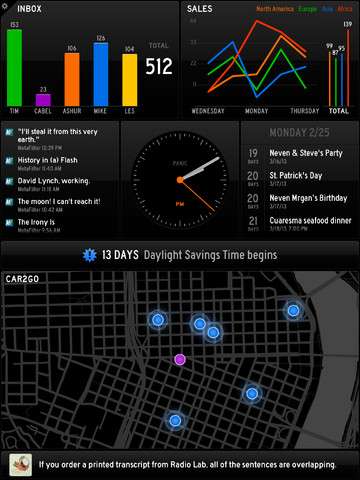
  • Status Board brings a touch of Android to iPad

    When you pick up your iPad, it’s usually with a purpose in mind. You might want to see how many new emails you have, you need to check RSS feeds, or you want to have a scan through Twitter. Each of these activities requires an individual app, and that means that you need to hunt down the relevant shortcut on the home screen. But Status Board could change all that, by displaying the data you need to see in a handy dashboard that gives you a great overview of your data.

    This is a handsome app that almost feels as though it would be more at home on an Android tablet — it could be adapted into a perfect alternative launcher — but at the moment is only available for iPad users. There is a slightly retro feel to the app, which enables you to configure a series of customizable panels to display a selection of data.

    There are a number of options available here. You may opt to have an overview of your email inbox displayed in one panel, your Twitter feed in another and your most important RSS feeds in yet another. There are also pre-designed panels that can be used to display the weather forecast, the time and your calendar.

    Other panels with a greater degree of potential customization let you show off data in tables or graphs, or you can put your HTML skills to the test and design your own panels from scratch. Whatever the type of data you have to work with, Status Board has a way to show it off in an attractive and meaningful way.

    While you can leave the app tethered to the screen of your iPad, you can also hook up your tablet to a large screen TV via HDMI or AirPlay if you want to visualize your data on a larger scale — and don’t mind making an additional in-app purchase to unlock the option.

    At a fraction under $10, this might be an app purchase you hesitate before jumping into, but Status Board is unlikely to disappoint. You can buy a copy from the App Store.

  • Ares And Killer Frost Duke It Out In Injustice: Gods Among Us

    In a few weeks, we’ll finally be able to see who wins in a match up between Superman and Batman in the Injustice: Gods Among Us Battle Arena. Before that, however, the team at NetherRealm are still announcing characters for the already packed fighter.

    Killer Frost and Ares, villains opposite of Firestorm and Wonder Woman respectively, are joining the fray. Instead of spotlighting the characters separately, the reveal trailer instead pits the villains against each other. Fans will get to the specials for each character as well with Ares’ special being especially awesome.

    The addition of Killer Frost is especially interesting as it seemingly confirms that Firestorm will be added to the game as well. Every character revealed thus far has had their opposing hero or villain added to the roster so it only makes sense.

    Injustice: Gods Among Us will launch across the Xbox 360, PS3 and Wii U on April 26.

  • Beyond App Store search: how to find the iOS apps right for you

    One of the most challenging things to do on any iOS device is find a good app. Not because there aren’t any out there. Quite the opposite: there are thousands of good apps, which can be a problem.

    With over 800,000 apps in the iOS App Store to sift through, Apple isn’t helping by cracking down on some of the better apps for discovering apps you might like. Finding what you are looking for remains a challenge.  While there is no one way to tell if an app will meet your needs or not before buying or downloading, the following will shed some light on the challenges in identifying apps you might like, and offer some advice on how to find them.

    The App Store’s search problem

    Searching for Apps

    Searching for Apps

    iOS apps are searchable by app name, company name, and keywords only in the App Store. Since most apps try to limit their names to what is viewable on the home screen (about 12 characters depending on what letters are used), company names do not necessarily represent the functionality of the app. Developers are also limited to a total of 100 characters in listing the app’s keywords; which can present a challenge for developers getting their apps discovered by customers. While the 4,000 character description may be enough to explain the functionality of the app, that description is not used in the search.

    What does not help matters much is that there are three different search interfaces. When you search for apps on your iPhone, you will not see any results for apps that only install on the iPad. This can be frustrating if you are looking for an app that works well on both the iPhone and iPad, and the developer has elected to create an app for each device, rather than a universal app for both.  The iTunes search on a Mac will initially show you results for all content matching your keywords, including songs, movies, books and podcasts.  You can filter the results to show only iPhone or iPad apps, but this gets frustrating each time you refine your search.  The iPad has the best search experience of the three as you see only apps in the search result, and you can search for both iPhone and iPad apps.

    The problem with all three is that the search results are presented in a fashion that you can only see a handful of the search results initially.  You must click, swipe, tap or scroll to see more than a few results.

    Fortunately Apple is not the only place that you can search for apps available in the App Store.  Apple has made what is called the Enterprise Partner Feed available to third parties.  It is a data feed of every piece of metadata in the iTunes Store and App Store. This enables third parties like AppShopper.comAppAdvice.com and 148apps.com to organize, display, and query all of the metadata information in the App Store.  If you have become as frustrated as I have with Apples search, try one of these instead.  Note though, you will find the search results different with each service.

    Wish lists and app lists

    Wish Lists and App Lists

    Wish Lists and App Lists

    A great resource for me has always been AppShopper’s Wish Lists. Once you open a free account with AppShopper, you have the ability to create and manage a wish list of apps that you are interested in. With this list, you can monitor apps that interest you and set up an email alert whenever the app is updated or the price drops. This is a great way to keep up to date with apps that caught your eye but you weren’t quite ready to buy because it was missing a key feature or was priced a little too high.

    AppAdvice on the other hand has a different twist to lists: rather than you coming up with a list of apps that interest you, they have created topic-based lists called AppLists.  Examples include Apps for Volunteering, a collection of apps that was put together for individuals that are interested in volunteering their time and resources in their communities.  There are also lists for Foodies, Comic Geeks, Poets and Coffee Lovers.  These AppLists are a great way of discovering apps that are more narrowly focused than Apple’s broader categories.

    From time to time, Apple will come out with a good topic list of the top apps that is very similar to AppAdvice’s AppLists. Two of my current favorites are titled Entertain your Kidsand Apps for Parents.  While topical categories from Apple are great ways to discover new apps that are closely related to one another, there is no one place to go to see all of the topic based lists of apps that Apple has put together. You will see a select and frequenlty updated number of these lists on the iTunes home page or on the features page in the App Store, but not all of them. The best way to gain access to these lists is to subscribe to Apple’s iTunes newsletter when managing your Apple ID.  Under language and contact preferences you will see a checkbox for iTunes newsletters. This is where Apple tends to announce the new lists they have pulled together.

    Do your homework

    Reviews, Rankings and Releases

    Reviews, Rankings and Releases

    Reviews, releases and rankings are the three Rs of app shopping.  One of the first things you should look at is the original release date of the app and how often it has been updated. With services like AppShopper.com, you can also see how often the developer has decided to change the price of the app as well.  Apps that are frequently updated likely point an attentive development team and can lead to a better experience overall.

    Reviews posted to the App Store can go either way.  Give less attention to reviews that complain only about the price rather than features or quality.  Just because an app costs more does not make it bad.  You may find value in an app that others may not.  If, on the other hand, you see lots of reviews claiming that the app crashes or is buggy, then you need to look back at the version history to see if the developer is paying attention and trying to resolve the issue.

    You also need to consider the total cost of ownership when buying an app, which includes in-app purchases. This is not hard to figure out as each app in the App Store will list its available in-app purchases.  Something to look for is how the in-app purchases are ranked since they are sorted by popularity: if you see high-priced items listed before lower-priced items, then you know that users of the app have found it necessary to buy those in order to use the app.

    Use Genius to replace outdated apps

    Use Genius to Replace Apps

    Use Genius to Replace Apps

    Genius is a great tool for finding new games that are similar to the games you have already purchased. But it is not a great resource for finding new apps that are completely different from the ones you already own. A good use of Genius is to locate a replacement for an app that you used to love, but has not been updated in a while or has just stopped working all together. A great example of this is when Google announced that it would be shutting down its Reader service. You can use Genius to look for alternative news apps that are not dependent on this service.

    For now, there is nothing out there better than word of mouth that can assist you in finding great apps that will enlighten your life or make you more productive.  And with Apple pulling apps from the App Store that can help make this task easier, one begins to wonder if the situation will ever improve.

    Related research and analysis from GigaOM Pro:
    Subscriber content. Sign up for a free trial.


  • Sarah Palin, Tesla CEO Trade Social Media Jabs

    Sarah Palin, the political pundit who gave up on governing the state of Alaska, this week issued yet another political rant through her Facebook page. In it, she excoriated President Obama for attempting to “pick ‘winners and losers’ in the free market.” She pointed out that Fisker Automotive, an electric car company that has “received nearly $200 million in taxpayer money” is now laying off around 80% of its U.S. workforce. From the Facebook post:

    This is really just the latest manifestation of the administration’s crony capitalism as their green energy buddies benefit from this atrocious waste of taxpayer money. Americans really need to get outraged by these wasteful ventures. As we’ve seen time and time again, We the People are always stuck subsidizing the left’s “losers.”

    Palin’s criticisms echo other conservative commentators, who have been criticizing the U.S. Department of Energy’s clean energy loan program in recent weeks. She went on to make fun of a popular recent target, electric car company Tesla Motors. She stated that Tesla’s “Obama-subsidized” vehicles brick when the battery completely discharges, costing $40,000 to repair.

    Tesla Motors announced earlier this month that it expects to finally turn a profit in the first quarter of 2013. Tesla co-founder and CEO, Elon Musk, took to Twitter to sarcastically state that he was hurt by Palin’s words, and to point out that the Tesla Model S warranty covers battery bricking:

    Musk is, of course, the type of entrepreneur that many conservatives idolize. In addition to co-founding Tesla and PayPal, Musk is on the forefront of privatizing the space industry as the founder of SpaceX. Taking advantage of a government incentive, whether it’s a tax break or (as is the case with Tesla) a loan, is simply a part of business.

  • Six ways Apple could correct its enterprise blunders

    Second in a series. Out of fairness, I follow up my long analysis “The enterprise will never embrace Apple” with some advice for the company. There’s room in the enterprise if only Apple made more effect. None of these suggestions is outside the reach of CEO Tim Cook and the core leadership.

    Perhaps Apple stays out of the enterprise game because the top brass knows that they have little expertise in the general directions that big business is heading. Their lack of desire (or capability) for true Active Directory integration, for example, is already public knowledge. When it comes to virtualization and the move to virtual desktops, Apple has no public strategy for allowing (or supporting) such an infrastructure on OS X devices, at least first party. To put it plainly, Apple’s overall game plan for cozying up to the wants of enterprise is nearly nonexistent.

    More precisely, perhaps Apple figures it shouldn’t get into a game mistakenly forgotten about years ago — for the sake of tarnishing its good name. If perfection and secrecy are the golden rules for Apple product development, then perhaps the void in the enterprise is actually a differentiator. The consumer market, on the back of iOS, treats Apple so swell that keeping out of the bare knuckle enterprise sector may be the foretold plan for the Cupertino, Calif.-based company all along.

    If you’ve spent any time researching the prospect of taking your business in an Apple direction, your frustrations are likely similar to that of what I’ve experienced and heard of from colleagues. A lack of any leverage on pricing for bulk purchases. A sub-part approach to business level support for OS X-based hardware. And headaches in every direction when it comes to fitting OS X into an existing Windows AD ecosystem. But perhaps I fret too heavily; maybe those organizations going Apple are past the usual grievances with Apple.

    But I digress. While I think Apple would take my suggestions on deaf ears, there are a few core things the company could easily do to improve its reputation in the enterprise:

    1. Get off the high horse and embrace the channel. The very reason Windows and its supporting ecosystem is so strong in big business is squarely due to the value-added offerings and sales positioning from traditional partners. I know this is against the grain for the entire sales strategy, but the company will never grow its foothold by standing behind an Apple Store and retail-only sales model.

    NOTE: I know there a sprinkling of Apple Authorized Resellers out there, but ask anyone in IT about how much of a joke the entire program is.

    2. Get the channel involved in product development and lifecycle process. Again, I highly doubt Apple would concede defeat in this realm of super-secret development, but it would give the transparency the enterprise so clearly lackd. And this lack of transparency creates the distrust between the organization and business that is core to their butting heads.

    3. Create a support structure for enterprise that actually matters. The current Apple Care offerings for business level critical support is laughing stock compared to the likes of what Lenovo, Dell, Microsoft, and HP (to name a few) offer their buyers. Apple needs to get away from the boutique shop mentality that surrounds its consumer offerings and realize that big business doesn’t have time to deal with Genius Bar concierge.

    4. Make your intentions on dropping products known with plenty of advance notice. The debacle surrounding the death of Xserve is a perfect example of Apple’s stuck up “us first” attitude. If you’re going to build a legion of followers around solid enterprise-grade products, you better have good intentions to support them with a stated lifecycle. And if that plan needs to change, be transparent — the “oh, by the way” approach to killing products only fosters enemies.

    5. Stop forcing IT to treat Apple devices as second-class citizens in the workplace. It’s squarely Apple’s fault that its own devices cannot behave nicely in the larger workplace. Apple’s hands-off approach to management of its technology needs to change, and change fast. From full Active Directory and Group Policy integration, to competing Windows features like BitLocker and DirectAccess, Apple needs to focus less on coolness and more-so on making workers’ lives easier.

    6. Realize that virtual desktops are the future, and Mac hardware can’t be the center of the Apple experience forever. From VMWare to Citrix to Microsoft, the direction of computing is heading towards VDI and virtual infrastructure as a whole. If Apple believes that a shiny Mac on every worker’s desk is the only way to get the Apple experience, then management is greatly mistaken and the company will be left behind.

    Even though I primarily support small to midsize businesses in my day-to-day consulting, my reservations with going Apple are still heavily based around similar above gripes. Keeping business IT running smoothly is more than a debate around Windows vs Mac vs Linux. It’s an overarching, unifying argument for stability, processes, and known quantities that Apple lacks in every category.

    Photo Credit: nui7711/Shutterstock

    Derrick Wlodarz is an IT Specialist that owns Park Ridge, IL (USA) based technology consulting & service company FireLogic, with over 8+ years of IT experience in the private and public sectors. He holds numerous technical credentials from Microsoft, Google, and CompTIA and specializes in consulting customers on growing hot technologies such as Office 365, Google Apps, cloud hosted VoIP, among others. Derrick is an active member of CompTIA’s Subject Matter Expert Technical Advisory Council that shapes the future of CompTIA exams across the world. You can reach him at derrick at wlodarz dot net.

  • Twitter shuts down Ribbon’s in-stream payments hours after the company launched them

    Not surprisingly, Twitter doesn’t mess around when it comes to revenue and third-party developers. But this one sure was fast.

    This morning we covered the launch of in-stream Twitter payments from Ribbon, the mobile payments company that used improvements to the Twitter Cards technology to allow for credit card payments without having to leave actual tweets. But now less than two hours later, Twitter has shut that feature down.

    Ribbon CEO Rashwan wrote in a blog post that the payment features were shut down on Wednesday right after launch:

    “At around 12:24 PM PST, with no heads up, our integration of Twitter Cards was taken down, and now Ribbon links go back to Ribbon.co without the in-stream buying experience.

    Before we released this, we made sure to validate our Twitter Card implantation (screenshot below), and all lights were green. We’ve had discussions with Twitter in the past, and are eager to find a way to work together. This is clearly something that’s good for not only Twitter, but also for Twitter users all over the world.”

    Twitter has not yet responded for a request for comment.

    The Cards technology that allows third-party developers to include more visual content like photos, videos, and product details in tweets saw a major overhaul just last week, with Twitter adding to the types of content those developers could share. Since some of the updates, including product details, seemed aimed especially at retailers, the Ribbon payments launch seemed to fit with these changes to the platform.

    However, it’s possible that Twitter is okay with an Etsy merchant posting about a product and showing what the item costs to direct people to that external page, but not necessarily with the merchant taking sales on Twitter’s platform, when Twitter isn’t getting a cut of the sale.

    The controversy again highlights the challenges companies like Twitter and Facebook face when they work with third-party developers. They need those developers creating content and bringing users to the main platform, and so they hold events like the Cards announcement to bolster support.

    But as soon as someone uses that technology to encroach on Twitter’s money-making territory? The old tensions come back, and it’s see ya.

    Related research and analysis from GigaOM Pro:
    Subscriber content. Sign up for a free trial.


  • This might be the best thing anyone can do with data

    Sometimes, when I find myself reading about new ways to serve better ads or recommendations, or to analyze who likes what on Twitter, and I find myself asking who the hell cares. That’s because, sometimes, it all seems beyond trivial. When I imagine myself in the shoes of a modern-day slave being forced to work grueling hours under grueling conditions in a developing country, or a child whose parents are pimping her out to pedophiles, I can’t seem to figure out why it matters that my Starbucks coupon is delivered at the ideal time when I’m approaching the store.

    So when I wrote on Monday about the work of the SumAll Foundation to bring the world of business and next-generation data analytics to non-profits, I was genuinely excited about what they were doing. The foundation’s first effort was around quantifying human trafficking and raising awareness of the problem. One of its next projects has to do with analyzing the online behavior of pedophiles. And the SumAll Foundation isn’t just gathering data and making infographics, but rather sharing deeper data with the relevant organizations and teaching them how to do some of this work themselves.

    I was even happier on Tuesday when I began going through my Google Reader feeds to read about two other efforts dedicated to using data fighting human trafficking and sexual exploitation. One is from Microsoft researcher and Ivy League academician danah boyd. The other is from Google.

    Tech can help when it understands human nature

    Boyd’s work isn’t so much a project as it is a framework for helping the growing number of technologists she sees working with non-profit organizations and government institutions to fight the exploitation of children. On her blog, boyd notes that technology certainly can help combat human trafficking, but that there are very human and complex factors that need to be considered before just building a system like, presumably, one would for serving targeted ads.

    “On too many occasions, I’ve watched well-intentioned technologists approach the space with a naiveté that comes from only knowing about human trafficking through media portrayals. While the portraits that receive widespread attention are important for motivating people to act, understanding the nuance and pitfalls of the space are critical for building interventions that will actually make a difference.”

    You can read the full four-page primer on her site, but here are the 10 points she addresses. She learned these lessons in part from discussions with leading scholars – some of whom Microsoft funded — researching the role that technology plays in facilitating human trafficking:

    1. Youth often do not self-identify themselves as victims.
    2. “Survival sex” is one aspect of CSEC.
    3. Previous sexual abuse, homelessness, family violence, and foster care may influence youth’s risk of exploitation.
    4. Arresting victims undermines efforts to combat CSEC.
    5. Technologies should help disrupt criminal networks.
    6. Post-identification support should be in place before identification interventions are implemented.
    7. Evaluation, assessment, and accountability are critical for any intervention.
    8. Efforts need to be evidence-based.
    9. The cleanliness of data matters.
    10. Civil liberties are important considerations.

    A global network, backed by some data heavyweights

    Then there’s Google, which awarded $3 million to three anti-trafficking organizations based in the United States, Asia and Europe in order to establish a Global Human Trafficking Hotline Network. The goal of the network, Google’s blog post explains, is to “collect data from local hotline efforts, share promising practices and create anti-trafficking strategies that build on common patterns and focus on eradication, prevention and victim protection.” This is critical: As the team at SumAll pointed out, one of the hardest things to do is facilitate effective data sharing across organizations so everyone has a clearer picture of what’s actually happening.

    Here’s how Google explains the role of data sharing:

    “Appropriate data can tell the anti-trafficking community which campaigns are most effective at reducing slavery, what sectors are undergoing global spikes in slavery, or if the reduction of slavery in one country coincides with an increase right across the border.”

    This isn’t Google’s first foray into funding anti-trafficking efforts. In 2011, the company donated $11.5 million to the cause. This time, though it’s joined by the intelligence sector’s favorite data-analysis startup, Palantir, as well as Salesforce.com, which is helping to scale the call-tracking infrastructure.

    And of course I understand that advertising and other commercial efforts are a necessary part of the economy, but watching data-analysis technology do little else but line the pockets of already rich individuals and corporations does get a bit old. However, when the money these efforts generate and the technologies they inspire help fund and fight some of the most egregious abuses on the planet — abuses that affect individuals from demographics no advertiser really cares about, and abuses that sometimes help corporations drive larger profits — the whole discussion around the importance of data starts to seem a lot more meaningful.

    Here’s Google’s three-minute video explaining the problem and how it thinks its hotline network can help:

    Feature image courtesy of Shutterstock user Karuka.

    Related research and analysis from GigaOM Pro:
    Subscriber content. Sign up for a free trial.


  • Egyptology News – 8th to 10th April

    Copied from Twitter @egyptologynews.  Nice to see a bit of sunshine today!


    Naqada II pottery vessel in the form of a fish. Ashmolean Museum.


    Brooklyn exhib: Divine Felines – Cats of Ancient Egypt. Roles of felines in mythology, kingship, everyday life. BWW  
    The remnants of Fort Babylon in Old Cairo: Often overlooked by tourists and neglected by guides. Daily News Egypt  
    Via @Amesemi
    Postcards from Rosetta: A day where the Nile meets the sea  
    Treasures of Cairo – Downtown Edition. The Palace of Prince Said Halim, grandson of Mohamed Ali Pasha. Cairo Kitchen  
    Suez Canal Authority building to become international museum to showcase the history of the Canal. Daily News Egypt  
    Criticism for Egypt’s dollar-a-night proposal for fund-raising to complete Grand Egyptian Museum. Daily News Egypt  
    1000 years of Pottery at Bubastis from Late Period til Late Antique Times. 5 wks of field work. Tell Basta Project  
    Egyptian wedding certificate key to authenticating controversial Biblical text. PhysOrg  
    Un mapa pionero busca descifrar los misterios que rodean a la necrópolis de Tebas. 20minutos.es  
    Egyptian Artifact Authenticates Controversial Biblical Text. Laboratory Equipment  
    Book review: Mireille Hadas-Lebel, Philo of Alexandria: A Thinker in the Jewish Diaspora, Brill 2012 BMCR  
    More re sunken Thonis-Heracleion, gateway to Egypt in 1st millennium BC, topic at recent conference. Science Daily  
    RIC Archaeologist Lobban and Team Discover Lost Temple. Rhode Island College  
    Sahara Went from Green to Desert in a Flash (the studies quoted are from 2012, but of ongoing interest). Live Science  
    More re 4 new 17th Dynasty Dra Abu el-Nagar burials found by Djehuty project, with photos and video. Past Horizons

  • IDC: Windows 8 has actually made PCs ‘a less attractive alternative to tablets’

    Windows 8 PC Shipments
    While Microsoft’s (MSFT) launch of Windows 8 was supposed to be the big change that the company needed to help personal computers keep pace with touch-based devices such as tablets and smartphones, new research from IDC suggests it has so far had the opposite effect. According to IDC’s latest numbers, PC shipments posted their “steepest decline ever in a single quarter” in Q1 2013, as the 76.3 million PCs shipped represented a 13.9% decline from Q1 2012. To make matters worse, IDC analyst Bob O’Donnell says that Windows 8 bears at least some of the blame for the accelerated decline in PC shipments.

    Continue reading…

  • TPH Partners Launches Principle Petroleum

    TPH Partners, the private equity arm of Tudor, Pickering, Holt & Co., has formed Principle Petroleum Partners. Dallas-based Principle is an upstream company focused on the acquisition and development of oil and gas properties in the Rockies, with a primary focus on the Big Horn Basin in Wyoming. TPH would not disclose how much it was committing to Principle. Scott Dobson, the former COO of Nimin Energy, is Principle’s president and COO while Scott Gladden is the EVP of Land and Business Development.

    PRESS RELEASE
    TPH Partners II, L.P., the middle-market energy private equity fund, is pleased to announce the formation of Principle Petroleum Partners LLC, an independent upstream company headquartered in Dallas, Texas. Principle focuses on the acquisition and development of oil and gas properties in the Rockies, with a primary focus on the Big Horn Basin in Wyoming.

    Principle is led by an experienced management team with an established track record of success in their focus area. Company President and CEO, Scott Dobson, has spent a significant portion of his career focused in the Rockies, starting at Merit Energy Company and most recently as the Chief Operating Officer at Nimin Energy Corporation, where he led the development and sale of Nimin’s Big Horn Basin assets in 2012. Mr. Dobson is joined by Scott Gladden, EVP of Land and Business Development at Principle. Mr. Gladden has 11 years of experience in the oil and gas business, including 7 years with Merit Energy Company, where he served as General Counsel and Director of the Land Department.

    “We are very happy to be in partnership with these two accomplished upstream veterans, Scott Dobson and Scott Gladden of Principle,” said George McCormick, Managing Partner of TPH Partners. “We look forward to spudding the first well this summer on Principle’s initial asset, and to adding more assets from its robust pipeline of potential transactions. These guys are strongly focused on a basin where their own experience, expertise and relationships should translate into great opportunities for attractive returns.”

    “The company is well positioned to exploit an exciting opportunity set in the Big Horn Basin and continue pursuit of additional opportunities throughout the Rockies. We believe that our partnership with TPH Partners will provide us with considerable support toward the growth of Principle,” said Scott Dobson, President and CEO of Principle. “TPH Partners’ technical expertise, relationships and market knowledge will be accretive in the execution of Principle’s business plan, and we are extremely pleased to have the opportunity to work with this team.”

    About TPH Partners II, L.P.

    TPH Partners, based in Houston, Texas, is the private equity arm of Tudor, Pickering, Holt & Co., LLC, an integrated energy investment and merchant bank. TPH Partners makes private investments in the upstream, oilfield service and midstream subsectors of the energy industry. For more information on TPH Partners, please visit www.tphpartners.com.

    About Principle Petroleum LLC

    Principle Petroleum Partners LLC is an independent upstream company based in Dallas, Texas.

    The post TPH Partners Launches Principle Petroleum appeared first on peHUB.