Category: News

  • MAD MAX RENEGADE

    Mad Max Interceptor

    For those of you petrol-heads that are unaware, there is a new Mad Max movie slated to come out in 2014. The fourth installment of the franchise entitled “Fury Road” will star Tom Hardy and Charlize Theron, and is sure to reignite the passion for one of the greatest movie cars in history. Recently though I came upon “Mad Max Renegade”, a tribute video to the franchise and one that should tide fans over until the real thing comes out. It’s well shot, fun and of course contains a replica of the original Interceptor. Check it out!

    Source: Youtube.com

  • With Ron Johnson Out, What Should J.C. Penney Do Now?

    J.C. Penney and its CEO Ron Johnson have parted ways. The news wasn’t terribly surprising as 2012 had been a challenging year: sales were down by $4.3B, the company lost close to $1B, and its stock price dropped by more than 50%. Despite Johnson’s and his supporters’ pleas of “give us more time,” Penney’s board finally succumbed and exhaled, “No mas.” In a “meet the new boss, same as the old boss” moment, Penney announced that its previous CEO, Myron E. Ullman III, is returning to the helm.

    What led to Mr. Johnson’s downfall? Two words: over ambition. First, he tried to wean customers off of coupons and sales in favor of everyday low prices. To be clear, Johnson was offering low prices, not the lowest prices, as Walmart does. This initiative failed miserably. A lesson for all businesses is when selling commodity-like products, unless customers believe you have the lowest prices all of the time, you routinely have to offer deep discounts. This pricing strategy failure could have been anticipated by testing the concept with customers as well as learning from similar attempts to ditch discounts. Both Macy’s and American Airlines previously tried to stop discounting in favor of everyday low prices, but quickly had to retreat due to poor customer reception.

    Just as important, Johnson was trying to significantly change the retailer’s merchandise offerings and hence, its customer base. And while this can be done — Millard Drexler accomplished this for J. Crew — the initiative was taking too long. As a result, old customers weren’t coming in (no coupons, changing merchandise) nor were new ones (not enough critical merchandise mass to attract target new customers). As a result, same store sales dropped by 31.7% in Q4/12.

    So now what should J.C. Penney do? It can’t revert to its past strategy because the chain was spiraling downwards before hiring Ron Johnson in late 2011. From 2007 to 2011, the chain store’s operating profit dropped from $1.9B to (-$2M). Something had — and still has — to change.

    Ron Johnson’s overall vision was spot on. One of the biggest threats to most brick and mortar stores is the simple fact that customers can buy the same (or similar) products at a cheaper price on the web. To combat this inherent price disadvantage, several brick and mortar stores are now willing to match online prices — a practice that devalues physical stores. What Johnson was trying to do is differentiate J.C. Penney in two ways: (1) Sell boutique merchandise which is not available elsewhere (thus, customers can’t buy it cheaper on the web) and (2) Provide a unique shopping experience — again, something that customers can’t get from Internet retailers. The strategy was straightforward: build a retail chain that provides customers with reasons to visit a store, instead of buying on the web. The reality that all retail chains need to realize is if they are selling products which customers can purchase cheaper online, their brick and mortar future is grim.

    Here’s what J.C. Penney should do now: stay the course on its product differentiation strategy (i.e., building 80 to 100 boutiques) but do so at an expedited speed. And don’t just go back to using sales to bring customers into stores — embrace the strategy of discounting. While Johnson was reticent to discount merchandise sold in the newly constructed boutiques (in the vein of the “no sale” policy at the Apple stores he used to oversee), I say discount these products. Big sales will effectively communicate the availability of new specialty merchandise to new target customers and provide a call to action to visit J.C. Penney.

    With Johnson’s departure, J.C. Penney bought itself another year before facing a Montgomery Ward-like bankruptcy. The 111-year-old chain is truly at a crossroads of either being transformational or fading into oblivion. Mr. Ullman’s ability to execute quickly will be the key driver of J.C. Penney’s ultimate fate.

  • The Empire acquires the rebel alliance: Mendeley users revolt against Elsevier takeover

    In a much-rumored deal announced on Tuesday, academic publisher Elsevier (please see disclosure below) is acquiring Mendeley — a widely-used open platform for collaboration and networking related to scientific research — for about $70 million. While the founders of the network maintain that they are committed to the “open access” movement, and argue that having Elsevier’s resources will allow them to expand their work and make it even more accessible, a number of high-profile users have said they aren’t convinced that Elsevier has changed its stripes, and they are taking their work elsewhere.

    One of the most prominent, Microsoft researcher danah boyd (who spells her name without capital letters), said on Twitter that the takeover was “sad,” and that she doesn’t believe Mendeley can help Elsevier repair the reputation it has developed for being against open access to research — a reputation that is based on the publisher’s support of the failed anti-piracy legislation SOPA, among other things.

    zephoria 1

    zephoria 2

    Another prominent critic of the acquisition is David Weinberger, a senior researcher at Harvard’s Berkman Center for Internet and Society and a co-director of the university’s Library Innovation Lab, which played a role in designing the new Digital Public Library of America project. Despite the assurances of executives at Mendeley that it would remain open — including its access API — Weinberger expressed scepticism that the company would be able to resist Elsevier’s attempts to make it more closed.

    https://twitter.com/dweinberger/status/321605268817469440

    https://twitter.com/dweinberger/status/321605790781825024

    https://twitter.com/dweinberger/status/321606366269681664

    Some of those who responded to the news of the acquisition seemed to see Mendeley’s acceptance of the takeover as a breach of faith, since the company had been such a vocal supporter of the open-access movement — a movement that many saw as directly opposed to the interests of companies like Elsevier. At least one observer compared it to “Haliburton buying Greenpeace,” and others made comparisons to the Empire in the Star Wars movie universe, or the Borg from Star Trek — both evil forces who eventually absorb or destroy the heroes of the story.

    Elsevier has been the target of a sustained attack from open-access advocates who organized a boycott of the company’s journals, galvanized by Fields Medal-winning mathematician Tim Gowers — arguing that its publications are too expensive and keep valuable research locked up in a virtual cartel. One commenter on a news story about the Mendeley acquisition said: “They spent their whole life as a company arguing they were the next big thing in open publishing only to sell out,” while a commenter on a thread at Hacker News about the deal said:

    “Mendeley should be ashamed, and you personally should be ashamed for perpetuating this nonsense. Within a year your company will be effectively dismantled and anyone left over who actually cares about open access can start over from scratch. I wish them luck.”

    Zeynep screenshot

    News of the acquisition re-ignited interest in the “mendelete” hashtag on Twitter, which was devoted to criticisms of the deal and the exploration of alternatives such as Zotero. One commenter said: “Was Mendeley more about its values or its services? Some of its biggest supporters have become its shrillest critics #mendelete.” If nothing else, these kinds of responses show just how much work Elsevier has ahead of it when it comes to reassuring academics and others that their commitment to openness is real. As Emily Bell at Columbia University put it:

    tweet https://twitter.com/emilybell/status/321606936061689856

    Disclosure: Reed Elsevier, the parent company of science publisher Elsevier, is an investor in GigaOmniMedia, the company that publishes GigaOM.

    Post and thumbnail images courtesy of Shutterstock / Luis Santos

    Related research and analysis from GigaOM Pro:
    Subscriber content. Sign up for a free trial.


  • Google steps up efforts to purge bad apps from Google Play

    Google Play Apps
    Google’s (GOOG) Play store doesn’t exactly have a good reputation when it comes to quality control since the company allows anyone to post their Android apps on the store without going through any sort of filtering process. However, TechCrunch reports that this may be changing since a record 60,000 were purged from the Play store in February. Although TechCrunch’s sources acknowledge that Google wasn’t responsible for removing all the purged apps, they also say that there’s no way that many apps could have been removed from the store without significant involvement from the company. Google has been working on overhauling Play to give it a cleaner, brighter look so it’s likely that Google has been doing some housekeeping in removing low-quality apps in preparation for the store’s upcoming refresh.

  • Samsung Galaxy Note 8 arrives April 11, but something’s missing

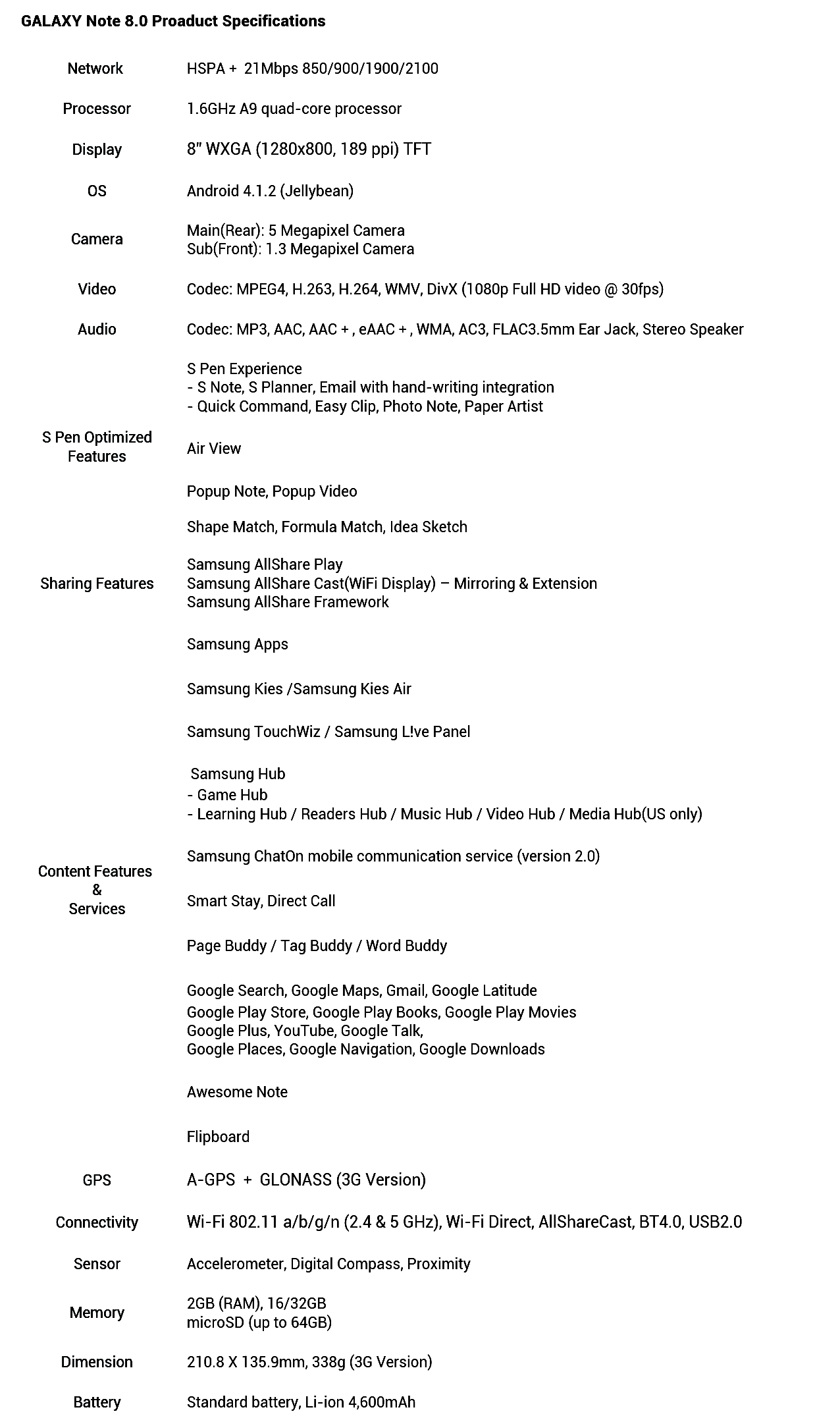
    What’s wrong with Samsung? That’s the question I asked in newsroom group chat today after seeing specs for Galaxy Note 8.0. Screen resolution diminishes the otherwise noteworthy feature list. Sorry, but 1280 by 800 is inadequate — little more than matchup to Apple’s iPad mini, which is similar size. For a company that makes such great-looking displays, lower-res is an endemic problem across Samsung’s entire tablet line.

    I really expected more from Galaxy Note 8.0, which as the same suggests has an 8-inch screen; iPad mini is 7.9. Samsung unveiled the tablet in February, and I wrote the news story. But in the rush of Mobile World Congress news didn’t consider screen resolution, in part on possibility specs would change. The electronics giant has done it before, announcing one thing but shipping something slightly different months later.

    “Back in 2010, the launch of the first Samsung Galaxy Tab with 7-inch screen opened a new chapter in the mobile industry”, JK Shin, president of the company’s mobile division, asserts. He’s wrong about that. Three years ago, the market demanded larger tablets, like 9.7-inch iPad and 10.1 inchers from other companies, including Samsung. Among the reasons smaller tablets flopped earlier on: Prices were too high and many models sold though cellular carriers that demanded costly data plans with 2-year contracts.

    “Now almost three years later, Samsung continues to evolve the sector that meets the demands of modern life”, Shin says. “Evolve” is right. The new tablet could have been so much more by bringing the stylus to “tweener” size between 5.5-inch Galaxy Note II and larger Note 10.1. The size is just about right.

    NPD DisplaySearch forecasts a dramatic shift in tablet size preferences this year. Larger is out, smaller is in. iPad dominated tablet shipments through release of the mini. But during the holidays, iPad mini sales surged. Meanwhile, 7-inch models, such as Google’s Nexus 7, wooed consumers with greater features for lesser cost.

    Display shipments foreshadow future devices. In early January, the analyst firm forecast that tablet shipments would exceed laptops this year and that the market would shift from 9.7-inch models to those between 7-7.9 inches. At the end of February, DisplaySearch backed up the forecast with real, recent numbers that revealed dramatic changes ahead.

    Between December and January, 9.7-inch panel shipments collapsed, falling to 1.3 million from 7.4 million and indicating that Apple sales largely shifted from iPad to mini. Meanwhile 7-to-7.9-inch panel shipments grew from 12 million to 14 million.

    At 8 inches, the new Galaxy Note is right at the sweet spot. “We forecast that tablet PC panels will hit 254 million in 2013, up tremendously from 160 million in 2012”, David Hsieh, DisplaySearch vice president, says. “Of this, 5-8.9-inch panels will account for 136 million and 9-10 inch for 118 million. That means smaller-size tablet PC panels — 7-8.9 inches — will surpass the larger size tablet PC panels (9-10 inches-plus)”.

    But Samsung stands still on screen resolution, while competitors go forward. “Many panel makers are developing 7-inch 1920 × 1200 or even 8.9-inch 1920 × 1200 or 2048 × 1536 panels with more than 300 ppi”, Hsieh says. These higher-res screens will come to market this year, overshadowing Galaxy Note 8.0. Think about it. When Apple bumps up iPad mini to Retina Display, how will Samsung’s tab really stand out.

    “Galaxy Note 8.0 breaths fresh life into the category as it delivers the perfect fusion of portability and everyday productivity — the result is a pioneering, pocket-sized solution that enhances and enriches our everyday lives, whether at work or play”, Shin claims.

    I can’t agree. We will see how the market receives this $399.99 iPad mini competitor. The two tablets are about the same size, with similar screen resolution. But Apple’s tablet costs about $70 less for same storage capacity. The stylus, and supporting software, is the big hardware differentiator. Software-wise, Samsung ships TouchWiz UI and stylus apps on top of Android 4.1.2, plus some business-oriented solutions.

  • Branch announces simplified version of commenting and conversation site

    Typically, an updated version of a site or product includes more bells and whistles. But Branch, the commenting and conversation site launched by former Twitter founders, announced some changes on Tuesday that will simplify, rather than further complicate, the site.

    Branch wrote in a blog post that while the company is working to improve the features surrounding commenting, users asked for a cleaner, simpler version, and the company is complying:

    “Over the last few months, we’ve spent time adding features to this simple tool: features like groups, a notification drawer, ask-to-join, and ‘branching.’ But we’ve also spent time listening, and when we did, we heard that while these features make having conversations easier and more delightful, they also make Branch more complicated. And that’s the last thing we wanted to do.

    So starting today, you’ll find a simpler http://www.branch.com.

    Just like before, you can start a branch, add people to it, and talk to each other. You can also still take your conversation and put it anywhere: embed it on a website, share it on Twitter or Facebook, or link to it in an email. What you won’t find is a complex notification system, groups architecture, ask-to-join process, or a way to “branch” individual posts. (But don’t worry! All your content is safe and sound.)”

    Branch start a comment screenshot image

    When Branch was still in private beta in July 2012, cofounder Josh Miller explained to GigaOM that he envisioned Branch evolving to become more like Google Wave, but with some key differences. He’ll be speaking at our paidContent Live conference in New York on April 17.

    “I think the promise of Google Wave is really interesting. Ultimately, it was too complicated a product,” Miller said at the time. “We’re focused on offering a very simple user experience. We’re really interested in the portability of conversations.”

    Related research and analysis from GigaOM Pro:
    Subscriber content. Sign up for a free trial.


  • Samsung Galaxy Note 8.0 coming to U.S. on April 11

    samsung_galaxy_note_8_render

    Last week the Samsung Galaxy Note 8.0 went on sale in the U.K. Fans of the Galaxy Note devices in the U.S. will be glad to know the WiFi only version of Samsung’s latest tablet will be available on Thursday, April 11th at major retailers like Amazon, Best Buy, h.h. gregg, Newegg, P.C. Richard & Son, Staples and TigerDirect.com. The Galaxy Note 8.0 will be Samsung’s first device with their Samsung WatchON software that is supposed to make it easier to channel surf both live TV and streaming video sources. The Galaxy Note 8.0 also comes with a built-in IR blaster, meaning the tablet can be used as a remote control.

    Similar to the U.K. deals, Samsung is throwing in some extras for initial buyers of the device. Pick one up for $399.99 and you can get access to 50GB of DropBox storage for 2 years, a free month of unlimited music streaming in Samsung’s Music Hub, and for a limited time buyers will receive a $25 Google Play credit when they register their device.

    Check out our hands on video of the Galaxy Note 8.0 from this year’s Mobile World Congress and the full press release after the break.

    Click here to view the embedded video.

    Samsung Brings Power and Portability to the U.S. with the Galaxy Note® 8.0 Tablet

    In stores April 11, the Galaxy Note 8.0 delivers an unparalleled tablet experience for work and play

    RIDGEFIELD PARK, N.J. – April 9, 2013 – Samsung Electronics America, Inc. today announces that the Galaxy Note 8.0 is coming to the U.S. market on April 11. Unveiled globally at Mobile World Congress in February, the Galaxy Note 8.0 will be available in stores and online at retailers including Amazon, Best Buy/Best Buy Mobile, h.h. gregg, Newegg, P.C. Richard & Son, Staples and TigerDirect.com.

    A mid-sized addition to the Galaxy Note family of products, the Galaxy Note 8.0 has the power and advanced technology to enable multi-tasking at home, at work or on the go. The Galaxy Note 8.0 is the perfect size for entertainment and productivity, with unrivaled multimedia performance in a compact format. The S Pen has evolved to improve everyday usability with Air View; and Multi Window now supports more apps to perform tasks simultaneously allowing users to do more.

    “The Galaxy Note defined an entirely new smartphone category and the Galaxy Note 10.1 tablet redefined the tablet experience for consumers,” said Travis Merrill, vice president of Samsung Electronics America, Inc. “With the Galaxy Note 8.0, we fully expect to ignite the mid-size tablet market Samsung pioneered with the first Galaxy Tab. The Galaxy Note 8.0 is small enough to fit in your pocket or purse and packs the power needed for full mobile entertainment and productivity.”

    Galaxy Note 8.0 at Play

    The Galaxy Note 8.0 will be the first product to feature Samsung WatchON, a new search and recommendation service that alleviates the chore of channel surfing and makes finding TV shows and on-demand video content faster and easier. Samsung WatchON simplifies the process of discovering new content to watch by searching across multiple content sources, such as live TV and streaming video-on-demand sources such as Samsung’s Media Hub*, to recommend movies and TV shows. It also provides complementary content including actor bios, reviews and related information.

    With the built-in IR blaster, the Galaxy Note 8.0 acts as a powerful universal remote, eliminating the need for multiple remotes to control the TV viewing experience. Users can browse for content then change the channel on the TV or cable box directly from the search window.

    For entertainment on the go, the Galaxy Note 8.0’s screen is great for everything from content viewing to reading. With its dazzling 8-inch WXGA screen, the Galaxy Note 8.0 is perfect for watching HD content, packing 1280 by 800 pixels. The Galaxy Note 8.0 also has Reading Mode, which adjusts color and brightness to an optimal level for reading. It provides the ability to customize fonts and themes so select books, magazines, documents and Web pages are easier to read. Combined with Smart Stay, which keeps the screen awake while you are reading, the Galaxy Note 8.0 is customized to ensure the best reading experience.

    Galaxy Note 8.0 at Work

    The tablet is quickly becoming a primary computing device for employees. The Galaxy Note 8.0 offers multi-tasking and productivity features, making users more efficient at everyday tasks, whether working at the office or on the go:

    • Multi Window: The Galaxy Note 8.0 offers true PC-like multitasking, so you can use two apps side-by-side. Multi-Window now supports 20 apps, including Polaris Office, Google Chrome and Facebook.
    • Air View: Conveniently preview your content without opening files or folders.  The S Pen held above the screen allows you to preview pictures in the Gallery, open menus on Web sites, and preview a message or an attachment in an email.
    • AllShare® Play: Pass content to the TV or remotely access files on your desktop computer.
    • Polaris Office: View, create, and edit Microsoft® Office Word® documents, Excel® spreadsheets and PowerPoint® presentations right on your tablet. With the Galaxy Note 8.0, you can add handwritten notes and drawings to your documents.
    • Awesome Note: A note-taking application and to do list manager, Awesome Note enables you to customize folder icons, colors, fonts and backgrounds for quick reference and visual organization.
    • Group Play: Share and collaborate on content, including documents, which allows users to work together.

    For those using tablets for work, Samsung offers improved security levels for IT managers and employees. SAFE, or Samsung for Enterprise, is the security standard to provide enterprise- and consumer-friendly devices to businesses and their employees. With SAFE, the Galaxy Note 8.0 supports the needs of IT managers while providing businesses with the functionality needed to enhance productivity.

    Powerful Performance

    The Galaxy Note 8.0 features a powerful 1.6GHz Quad Core processor and 2GB of RAM to ensure optimum performance. Wi-Fi technology with dual-channel bonding offers more efficient connectivity for faster loading of Web pages and video streaming.

    With a large, 4,600 mAh battery, the Galaxy Note 8.0 offers long battery life to work and play all day. Beyond the 16GB** of internal memory, the Note 8.0 can handle microSD cards up to 64GB, for a combined possible 80GB of storage. The 5-megapixel camera on the back can shoot 1080p video, and the 1.3-megapixel front-facing camera can handle video chats at 720p resolution.

    Preloaded with Content and Services

    Buyers will enjoy pre-loaded content and services valued at over $200, including 50GB of free Dropbox storage for 2 years***, 1 month free of unlimited music streaming in Samsung’s Music Hub, Samsung’s Smart Remote, Awesome Note, and more. For a limited time, they will also receive a $25 Google Play credit with the purchase of a Galaxy Note 8.0, when they register their device.

    The Galaxy Note 8.0 will be available in white for $399.99 MSRP. Accessories will be available beginning mid-April. These include Book Covers in white, grey, pink or green, as well as USB and HDMI adapters, and a travel charger that connect via the device’s microUSB port.


    Come comment on this article: Samsung Galaxy Note 8.0 coming to U.S. on April 11

  • AppGratis: Apple approved our iPad app a week before removing iPhone app

    Apple may have removed AppGratis, an app discovery app, from its iOS App Store, but the appmaker’s CEO has a few things to say about it. In a post published to the company’s blog on Tuesday, AppGratis CEO Simon Dawlat denied using prohibited tactics to game the App Store, but he also pointed out one of the problems with Apple’s enormous App Store: a disconnect in the app review process.

    Last weekend Apple removed AppGratis from the App Store for violating two iOS developer guidelines: 2.25 and 5.6, which prohibit, respectively, apps that exist merely to promote or market third-party apps, and apps that use push notifications for marketing or promotional purposes.

    Dawlat’s dismay at the removal stems from the fact that Apple had approved the iPad version of the app for release in the App Store just a week before the iPhone version was officially removed. In his blog post he includes a screenshot of the approval he received from Apple’s app reviewers. As he put it, “This came to us as a very strong validation of the amazing value created by our product for the whole App Store ecosystem, something we were intimately convinced of since the very beginning, and eventually had the opportunity to discuss with Apple, with a positive outcome.”

    Dawlat violated rules. That much is clear. And it’s also true that Apple allowed AppGratis and other apps like it in the store for a long while before doing anything about it. What this situation also highlights is an ongoing issue for the App Store review team: inconsistent decisions.

    It happened quite frequently when the App Store first opened. It’s not as common now, but it still happens with some high profile apps: see the hubbub over the approval of Twitter’s Vine app earlier this year despite graphic content. It appears that inconsistent enforcement of those rules — and individual app reviewers’ interpretation of them — is what caused AppGratis to get approved for an iPad app by two Apple app reviewers, only to have its iPhone app yanked back just days later in a decision by a different reviewer.

    For his part, Dawlat is putting on a brave face and saying his company “is far from finished.”

    The same could be said of Apple’s 800,000 strong App Store and its review team: there’s a lot more that needs to be done to ensure consistent rule enforcement to create the best possible experience for both app users and their developers.

    Related research and analysis from GigaOM Pro:
    Subscriber content. Sign up for a free trial.


  • Texas Fiber: Google brings gigabit internet to Austin (roundup)

    It’s official: the second city to participate in Google Fiber’s mission to bring super fast internet access at affordable prices will be Austin, Texas. Our own Austinite Stacey Higginbotham has been beside herself since the news broke last week, and as Tuesday’s official event winds down, here’s all of our coverage so far.

    Related research and analysis from GigaOM Pro:
    Subscriber content. Sign up for a free trial.


  • Featured Android App Review: MMGuardian Parental Control [Tools]

    MMGuardian_Parental_Control_Splash_Banner

    We’ve covered a few apps that help with security for children’s phones, but I wanted to tell you about another one I came across called MMGuardian Parental Control from MMGuardian.com. It seems like the age that kids are given phones is getting younger and younger as time goes on. Of course you can give them a dumbphone, but with newer shared plans, it’s not out of reach to go for a smartphone. For some kids it might be an overkill, but a smartphone can give you a lot of features like knowing your child’s whereabouts, and with apps like MMGuardian Parental Control, it gives you the peace of mind you need when you give that shiny new or used smartphone to your child.

    I think when it comes to apps such as these, a lot of parents don’t want to bother with them because they think it will be overwhelming and difficult to set up. I think that’s true for a lot of these apps, but nothing could be further from the truth regarding MMGuardian. All you really need to do is install the app on your child’s phone and activate it with your password of choice. Then it’s a matter of going through each area of the app that you want to control. Your child won’t be able to uninstall or deactivate the app without the password.

    After you install MMGuardian on your child’s phone, you will be given the opportunity to register your email address and enter the phone number of your phone as administrator. This is where you will also create the password for opening the app on your child’s phone. Administrator phones don’t need the app installed as they will be able to receive SMS text messages from the child’s phone for status updates. Later, in the settings you can add more administrator phones and/or change the password.

    The main screen consists of nine choices for setting things up:

    Lock

    This is where you are able to set an Auto SMS text response when the phone is actually locked. You will be able to schedule when the phone is locked from doing anything other than call or text an admin, and this auto SMS response will be sent to anyone who sends a message to your child during those times. Unfortunately there isn’t an option to disable it. I tried leaving it blank, but in my testing, the default message was still sent. I can see how some kids might feel embarrassed that their parents are locking their phone and don’t want to “broadcast” it. The default message is “Thanks for your message, I am not available at this moment.” It doesn’t necessarily say that their phone is locked, but those who receive that message will ask about it. Of course you can make the message whatever you want it to be, but hopefully the developers will add an option to disable it for those that wish to do so.

    Time Limits

    The Time Limits section lets you set the schedule for when you want the phone to be locked. You can set a number of different timeframes and it’s pretty versatile. You punch  in your start and end times and select which days you want. For example, if you know your child does homework every weekday between 7:00pm and 9:00pm, you can set it to lock. You can also set a schedule for just the weekends as well as one particular day of the week. You can always override any of these schedules by sending an SMS to the phone in case your child needs access for whatever reason.

    Commands

    This is a help section that lets you see all the SMS commands that you can send to your child’s phone for controls or requests when they are away from you. You can send commands that will get your child’s location, allow you to lock or unlock the phone, sound an alarm siren, turn safe driving mode on or off, request a daily report, or add a monitor command. All SMS messages need to be sent from an admin phone and any responses will go to the admin phone. Also in this section, you can send sample responses to your phone as well as demo the lock and siren functions on the child’s phone.

    App Control

    This is where you can block or allow apps that are installed on the phone. You have your choice of creating a list of blocked apps or creating a list of apps that you approve of. You can block apps full time or based on a schedule. You can also check the option to receive an SMS anytime your child installs a new app on the phone.

    Track

    The Track section lets you set a schedule in which you would like to be notified of your child’s location. It has the same kind of versatility as the lock scheduling.

    Call Block

    This is where you can block calls from either a contact or by phone number. This isn’t based on a schedule and is full time. You can also check to be notified for any calls that were actually blocked so you’re aware of them.

    Safe Driving

    For this feature, you either turn it on or off. If on, the phone will lock when it detects that your child is moving faster than 10 mph. You can also create override times when you know your child regularly rides the school bus. Additionally you can set up an auto SMS response message to those that send your child a message if the phone is locked because of this feature. You also have the power to remotely disable the safe driving mode by simply sending an SMS to the phone.

    Monitor

    This is where you can specify certain words, and you will be notified if they are contained in an SMS message sent to or from your child’s phone. You will not only be notified that the word was used, but you will also get the full text of the message.

    Settings

    This is where you can add or delete admin phones as well as turn on or off the Daily Summary Report or Uninstall Protection. If you choose to get the Daily Summary report, you will get a text message once a day telling you how many SMS messages were sent and received along with how many outbound calls, inbound calls, and missed calls took place during the last day. You will also learn how many web clicks took place. The Uninstall Protection option ensures that your child cannot uninstall the app either via the Play Store or via the built in Android apps menu if turned on

    As you can see, MMGuardian is pretty comprehensive, but at the same time pretty simple to use. About the only thing missing is some sort of safe web browser, but hopefully that will be something that is implemented in the future. Now a service such as this isn’t normally Free. MMGuardian is actually Free, but you will need a premium subscription in order to schedule tracking, schedule lock times, block or unblock apps, block calls, and monitor words. The cost is $2.99 per month or $24.99 annually. You can also opt for a one-time license for $39.99. You do get a 14 day free trial when you first install the app so you can see how amazing it is before you commit to anything. If you don’t want to purchase a subscription, you can still utilize the safe driving feature as well as send SMS commands to lock or unlock the phone, locate it, or sound the alarm siren.

    The bottomline is it’s free to try, and 14 days will give you a good idea if it’s for you. Check out my hands on video below as well as their trailer, and hit one of the download links to get started. As always, let me know what you think.

    Features

    • Locate your child’s phone via a simple text message.
    • Lock your child’s phone also via a text message.
    • Set predefined times to be informed of the location of your child’s phone.
    • Set time restrictions to limit use, eg: during school hours.
    • Prevent your child texting and driving, without killing their phone’s battery.
    • Block incoming calls and texts.
    • Monitor alarming text messages.
    • Control which applications can be used, and when.
    • Receive a daily report on your child’s phone usage.

    MMGuardian_Parental_Control_01
    MMGuardian_Parental_Control_02
    MMGuardian_Parental_Control_03
    MMGuardian_Parental_Control_04
    MMGuardian_Parental_Control_05
    MMGuardian_Parental_Control_06

    Click here to view the embedded video.

    Click here to view the embedded video.

    QR Code generator

    Play Store Download Link

    Come comment on this article: Featured Android App Review: MMGuardian Parental Control [Tools]

  • Is it Time for Mutiny?

    Perhaps you have dreamed of mutiny. Perhaps you serve under a boss whose grasp of what is important to the organization’s success and how to achieve it is so shaky that he or she should be dispatched as an incompetent. Or maybe that leader’s treatment of subordinates is so uncaring as to be abusive. If the situation is so bad that you are actually plotting the insurrection, it’s a good moment to ask: When do mutinies actually succeed?

    We actually know the answer to that question, from the people who did mutiny best: seafarers in the Age of Discovery. My colleague Ray Coye and I spent four years mining obscure primary-source accounts and journals from the era from the mid-1400s to the early 1600s to write Mutiny and Its Bounty. This was the time when seafarers like Vasco da Gama, Christopher Columbus, Ferdinand Magellan, and Henry Hudson undertook risky ventures at sea. Their venturing began in Portugal and Spain and went on for hundreds of years and with staggering volume. It’s a rarely studied era, but it holds deep lessons in human enterprise — even more, in many respects, than the study of modern industrial organizations.

    Mutinies were as common as the wind on Age of Discovery seafaring ventures. What’s more, the people participating in them often had very sophisticated conceptualizations of leadership and service. They also recorded firsthand much of what happened. Our analysis of records and diaries from their long enterprises shows that mutinies are successfully carried out when a few conditions are present:

    • Leadership is destructive. Interestingly, we find that mutinies go differently for different kinds of bad leaders. When leaders are technically weak, for example, but well-liked, members depose them via fast, tactical mutinies. The case of Henry Hudson, set adrift on today’s Hudson Bay, is a prime example. Members depose technically brilliant but not well-liked leaders with careful, strategic mutinies. Here, a mutiny against Ferdinand Magellan on the South American coast comes to mind (although apparently it wasn’t strategic enough; Magellan viciously quashed it).
    • Values have been flouted. When leader actions threaten the values that members share, an organization becomes a social powder keg. In the Age of Discovery, those shared values were centered on basic needs like the supply and quality of food, and the safety of the crew. In a modern organization, an assault on a work group’s shared values more likely threatens higher-order needs for meaning and esteem. But the mechanism is identical.
    • Ringleaders are strong. Because a mutiny requires coordinated, energized action, the role of the ringleader is essential. Credible, inspiring ringleaders are as vital to mutinies as founders are to entrepreneurial ventures.
    • The external environment is uncertain and features novel threats. Whether it’s due to weak technical expertise or low interpersonal skill (or both), bad leaders are especially prone to poor management decisions when the environment is uncertain and unprogrammed actions are necessary. At the same time, threats and opportunities to an organization are opportunities and threats (i.e., transposed) for a mutiny inside that organization. They are important to mutiny planning and execution.

    Put all this together and you have a situation where an influential member is able to make the case that the current leader can’t be trusted to deal with new threats because of their demonstrated lapse in upholding values.

    When mutiny occurs, the leader involved usually sees it as a sudden flash that is obscene. But the members involved in the action see it differently. Like an entrepreneurial team, they formulate a strategic plan for mutiny in secret, execute it tactically, and face the risks with a sense of justice and purpose. And here is the real surprise of our research: the mutinies are usually for the better. Given the connotations of the term mutiny, and the images it brings to mind, few would expect that it would have a largely ameliorative function. In our post-industrial age, mutiny is taboo. But the culture of the Age of Discovery assumed that members should depose a bad leader. It was understood that mutiny could save a venture or help it succeed.

    Ship captains recognized this and the best of them were, amazingly, able to harness the mutinous energy and put it in service of the venture. Christopher Columbus dealt with three mutinies during his most famous enterprise; he used the first mutiny to bolster commitment from members and discover land. Although there were also some infamously fierce mutinies, those cases turn out to have been the exceptions.

    Reflect for a moment on the nature of high-risk business ventures, and you might conclude that this mutinous ethos still exists. If you are familiar with entrepreneurial communities, then you know that not deposing bad leadership is hostile to the survival of a venture. Entrepreneurial founders and leaders are often removed via mutinies, and it usually happens when environmental uncertainty is most salient.

    Indeed, the current entrepreneurial age, launched in mid-twentieth century Silicon Valley, is itself the product of a mutiny. The brief history is that it all began when the team at Shockley Semiconductor rose up against its founder William Shockley. The “traitorous eight” as Shockley would call them ever after, went on to found the set of firms (including Intel and AMD) that made Palo Alto the center of technology innovation. It was a culture-defining event that embedded assumptions still present in the Valley about the value of trained specialists, delegated power, autonomy, flat and adaptable organizational structures, and questioning flawed authority.

    The similarities do not end there. Another peculiarity of the Age of Discovery is that its bold seafaring ventures were revered at a sociocultural level, much as high-impact entrepreneurial exploits are revered today. Now as then, people dream of leading such ventures, and come to do so through a remarkably analogous process.

    By contrast, the case for mutiny is very hard to make in the modern industrial organization. Here, successful performance is defined above all by efficiency. Members cannot mutiny against their leader without violating policy, disrupting operations, and usually creating a situation even uglier than bad leadership itself. Typically, even if perceptions of the inadequacy of management are widely shared and easily justified, members can’t do very much about it.

    Unlike in entrepreneurial communities, the notion of mutiny is anathema to the dominant logic of organizational life in big companies. That doesn’t mean that those working under a bad leader don’t fantasize about taking mutinous action, or indulge in more subtle forms of it. (A mutiny that is social and intellectual can still be intense.) It may mean, however, that they are putting their careers much more at risk, and that perhaps they should consider another kind of life: the authority-dashing life of the entrepreneur.

  • Compass Commissions Its First Data Center In Nashville

    Compass Datacenters has completed construction and commissioning of its first data center facility in Franklin, Tennessee, rolling out a 21,000 square foot, 1.2 megawatt stand-alone data center facility. Groundbreaking to customer handover occurred in just six months using Compass’ patent-pending “Truly Modular Architecture.”  The facility in suburban Nashville has been leased by a customer (previously identified as Windstream) that is taking possession of the data center this month.

    “Completing a stand-alone, hardened, Tier III-certified data center facility in only six months is a fraction of the time it typically takes for this kind of facility, but that is the standard timeline with Compass’ methodology,” said Chris Crosby, CEO of Compass Datacenters. “It’s not uncommon for this kind of project to take more than a year or two with traditional design and construction practices for data centers. Compass was founded to make that a thing of the past, and our very first project is a successful demonstration of the advantages of our methodology,”

    “There was 50 full days of rain in Nashville during the timeframe,” Crosby added. The company still hit its deadline. “For a greenfield build, it’s a big deal.”

    The facility in Franklin was built using Compass’ modular architecture, which makes it possible for companies to locate their data centers where they need them—at an affordable cost—rather than where their provider happens to have a facility. The centerpiece of the design is the CompassPod, which provides 10,000 square feet of column-less raised floor space supported by 1.2 MW of electrical power with 2N power distribution. The facilities delivers a PUE of 1.2 – 1.5 or lower at loads as low as 25 percent. CompassPods are contained within, and protected by, the CompassStructure, a hardened, energy-efficient, highly-secure structure for the facility’s mission critical IT systems.

    The CompassPowerCenter provides the UPS (2N) and switchgear (2N) equipment required to ensure uptime and reliability. Each facility includes a dedicated CompassSupport module that provides to meet the needs of operational staff and logistics for data center operations, including a security center, lobby, office space, loading dock, break area and restrooms.

    “In terms of momentum, this is huge,” said Crosby. “Raleigh Durham is going through level 5 commissioning next week. Once again, it’s within the six month time frame. With only six months from groundbreaking to delivery, this brings the concept of just-in-time-delivery to data center facilities, enabling customers to take delivery of their new standalone facilities on a timeline that was never before possible.”

    In short, Crosby believes the architecture has proven itself. In terms of giving the ability to expand, and time the capital, Compass’ model is attractive to customers. Compass customer Windstream, as one example, has been able to add space as they add revenue. It takes the guessing game out of the equation and allows a company to expand data center space in line with the business.

    One of the big differences Crosby sees is the hardened nature of the facilities. “The level of hardening is unique for our space and will continue to set us apart,” said Crosby. “During construction, there was a tornado that touched down basically across the street. Those folks were happy they were inside that facility at the time.”

    The company is seeing continued interest across the country. “The level of interest in the secondary markets are high. The next set of markets, Minneapolis and Columbus, also are seeing high interest,” said Crosby.“From an overall funnel perspective, we’ve been tracking 75-80MW of opportunity. We feel pretty good where things are at. We’re at the negotiation stage with a few clients.” The company’s goal is to be able to manage up to 10 projects at the same time in 2014.

    “2012 was the year of the prototype, this year was the engine – we’ll probably work another six to 10 projects this year,” said Crosby. The company says that although it has improved the level of efficiency in builds, it has a continuous improvement program in effect. Crosby gives the example of a car model undergoing tweaks from year to year to become better and better. Compass believes it has the blueprint to do things right, but will not stop looking for ways to enhance at every step of the way.

    The company’s prospects have prompted it to add Jay Forester, formerly of Digital Realty Trust, to the talent pool. “We are getting an unbelievable resource here,” said  Crosby. “It’s really an opportunity for him to take industrialization and move it to productization. Jay will lead that charge.”

    Forester was named Senior Vice President of Data Center Product Delivery, a new position at the company with responsibility for the construction and delivery of data center facilities across the United States.


  • Trump Booed Off Stage at WWE Hall of Fame Induction

    Donald Trump may have the power to fire celebrities and the money to erect buildings, but all the money in the world can’t buy respect from wrestling fans.

    This week, Trump was booed off stage while accepting his induction into the WWE Hall of Fame at Madison Square Garden. According to a report from Wrestling Online, the heckling during Trump’s speech was so bad that the business mogul cut it short and left the stage.

    The booing had reportedly started even before Trump took the stage, with WWE CEO Vince McMahon trying to calm the crowd while introducing Trump, stating that he was a “big friend” of the WWE. Trump’s son, Donald Tump, Jr. was also reportedly booed, though his daughter, Ivanka, was cheered by WWE fans.

    Trump took to Twitter after the incident, thanking McMahon and answering at a few of his detractors:

    (Image courtesy Gage Skidmore/Wikimedia Commons)

  • Sony Launches Media Storage Cloud Services

    Sony Corporation of America today announced the launch of Sony Media Cloud Services, a new subsidiary that will serve as a virtual workspace that includes media applications to store, share and manipulate content from any location in the world. The scalable cloud platform, Ci (pronounced see) will provide studios, broadcasters, filmmakers, independent producers, marketing teams and other creative individuals a “one-cloud” solution to collect, produce and archive high-value, high-definition content, allowing fast and secure collaboration on a global scale.

    “Every day, creative professionals around the world spend numerous hours and resources on non-creative tasks like moving and sharing content, figuring out how and where to store it, and getting the right assets to the right places and in the right hands,” said Naomi Climer, President, Sony Media Cloud Services. “Sony understands these complex challenges, which is why we designed Ci as a functionally rich, scalable and secure, media-focused cloud platform that can enhance and streamline traditional production workflows to make it easier to collaborate more effectively and cost-efficiently.”

    The Ci cloud platform will feature infinite scalability, pay-as-you-go pricing, and a number of browser-based applications.  Ci MediaBox will collect, organize, preview, share and archive every media type and size using studio-designed cloud storage solution suite. Ci VideoLog Enables logging of frame-accurate events to prepare content for downstream opportunities, distribution and playout automation. Ci AudioSync uses  analysis algorithms and audio pattern matching to reduce non-creative editing work time in content-preparation workflows. Ci FrameMatch analyzes media files to automatically identify differences and likenesses between two sets of video files. Ci ReviewApprove enables review, annotation and collaboration on media files across multiple locations in real time, simultaneously.

    “Built by Sony Pictures movie and television professionals, incubated by Sony’s hardware and technology, and brought to market by a global sales force who understand the needs of our industry, Ci goes beyond simply delivering innovative technology—it brings the total power of Sony into the cloud,” said Climer. “Together, we’ve built a platform with applications that not only addresses today’s media challenges, but serves as the foundation to develop innovative services to transform our industry for years to come. The possibilities are endless.”

    “The efficiency and flexibility that cloud solutions provide will radically change the way creative professionals collaborate,” said Chris Cookson, President, Sony Pictures Technologies. “Working with Sony’s Cloud Services team to further enhance Ci’s platform and applications will enable our production and distribution teams around the world to work together more efficiently, without sacrificing creativity or quality.”

    Ci is currently in beta production and will be on display at the 2013 NAB Show in the Sony booth.

  • Even without the Galaxy S4, Samsung’s Q1 market share reportedly surged

    Samsung Smartphone Market Share Q1 2013
    Samsung (005930) is gearing up for its next major smartphone launch later this month but even without a new flagship smartphone, the company’s global market share reportedly surged in the first quarter this year. RBC Capital Markets analyst Mark Sue doesn’t officially cover Samsung, but he believes that the South Korean vendor managed to dodge the typical seasonal downturn and show an increase in smartphone market share from Q4 2012 to Q1 2013. Following Samsung’s pre-announcement, Sue believes the company sold as many as 66 million smartphones last quarter — but it’s just getting started.

    Continue reading…

  • WhatsApp says no deal with Google is in the works

    whatsapp

    Yesterday we reported on rumors that Google may be looking to purchase the popular messaging app WhatsApp. According to WhatsApp business guy Neeraj Arora, sales talks with Google are not being held. Arora says there are no plans, or even discussions, at this time around Google buying WhatsApp for approximately $1 billion. Other than denying the rumors, Arora provided no other information. Next week WhatsApp CEO Jan Koum is schedule to speak at a conference in New York City. Hopefully he will be able to share some new information about the future direction and plans of the company in light of these recent rumors as well as last December’s rumored buyout by Facebook.

    source: AllThingsD

    Come comment on this article: WhatsApp says no deal with Google is in the works

  • Tearaway Could Be Just What The Vita Needs

    It’s no secret that the Vita is performing poorly in the West. The expensive handheld from Sony is a wonderful machine, but its hist cost of entry and lack of software make it an unattractive option for gamers looking for sophisticated experiences on the go.

    Sony is hoping to at least remedy the software problem in 2013 with a number of high-profile releases. One of the more interesting, and charming, games to come out of Sony’s initiative is Tearaway, a new action/adventure game from Media Molecule. PlayStation fans have come to know and love Media Molecule for its LittleBigPlanet franchise, and now its bringing a new kind of game to the Vita.

    Tearaway will be available exclusively on the PlayStation Vita on October 22. Physical copies of the game will feature reversible cover art for those want to display the female protagonist on the box.

  • Xiaomi Unveils The Mi2S And Mi2A Smartphone

    Xiaomi

    Xiaomi is a Chinese manufacturer of MIUI-powered smartphones, and has announced two new smartphones. Predecessor to the Mi2, the Mi2S has been upgraded with a better processor and camera. The Mi2A is more affordable and also features a slightly larger display. Here are the specs of both phones:

    Xiaomi Mi2S

    • 4.3-inch 1280 x 720 display
    • 1.7GHz Snapdragon 600 quad-core processor
    • Adreno 320 GPU
    • 2GB RAM
    • 16 or 32GB internal storage
    • 13 megapixel rear-facing camera
    • 2 megapixel front-facing camera
    • MIUI running on top of Android 4.1 Jelly Bean
    • 2,000 mAh battery
    • Available in five different colors

    Xiaomi Mi2A

    • 4.5-inch 1280 x 720 display
    • 1.7GHz Qualcomm Snapdragon dual-core processor
    • Adreno 320 GPU
    • 1GB RAM
    • 16GB internal storage
    • 8 megapixel rear-facing camera
    • 2 megapixel front-facing camera
    • MIUI running on top of Android 4.1 Jelly Bean
    • 2,030 mAh battery

    The Mi2S will cost $322 U.S. for the 16GB version and $371 U.S. for the 32GB version while the Mi2A will cost just $242. Xiaomi’s Mi2S will go on sale today from their website and the Mi2A will be available later this month.

    Source: Xiaomi

    Come comment on this article: Xiaomi Unveils The Mi2S And Mi2A Smartphone

  • Google Fiber Coming to Austin, Texas by Mid-2014 (Really, Officially, Definitely)

    Google, after a few days of speculation, has officially announced that Austin, Texas will join Kansas City, KS, and Kansas City, MO as the next Google Fiber-connected city.

    “Today, we’re pleased to announce with Mayor Lee Leffingwell that Austin, Texas is becoming a Google Fiber city. It’s a mecca for creativity and entrepreneurialism, with thriving artistic and tech communities, as well as the University of Texas and its new medical research hospital. We’re sure these folks will do amazing things with gigabit access, and we feel very privileged to have been welcomed to their community,” says Google in a blog post.

    Google hopes to begin construction in 2014, and will be asking neighborhoods about the service to determine the areas of the highest interest. That’s where they’ll start building first. Google hopes to get their first customers up and running by the middle of 2014.

    Google says that they are still trying to work out pricing, but they think it will be similar to what’s happening in Kansas City: $120 a month for Gigabit internet plus TV, $70 a month for just the Gigabit internet, or free internet with a $300 one-time construction fee.

    Public institutions within Austin are going to get the Google Fiber hookup for free. This includes schools, hospitals, libraries, and more – to be determined alongside the city of Austin.

    “We believe the Internet’s next chapter will be built on gigabit speeds, and we hope this new Google Fiber city will inspire communities across America to think about what ultrafast connectivity could mean for them,” says Google VP of Access Services Milo Medin.

    If you live in Austin, and want to sign up to be notified when you can sign up, check here.

  • Yandex, Russia’s ‘Homegrown Google’, Looks At Gesture-Based Interfaces To Power Apps

    Yandex gesture social TV interface

    Russian search giant Yandex has collaborated on developing an experimental gesture-based interface to explore how similar technology could be incorporated into future social apps and mobile products. The company offers digital services beyond search already, launching and expanding mapping services and translation apps, for instance, in a bid to drive growth as its domestic search share (60.5% as of Q4 2012) has not grown significantly in recent quarters. Future business growth for Yandex looks likely to depend on its ability to produce a pipeline of innovative products and services — hence its dabbling with gestures.

    Yandex Labs, the division that came up with its voice-powered social search app Wonder (an app that was quickly blocked by Facebook), has been working with Carnegie Mellon University on a research project to create a gesture-based social interface designed for an Internet-connected TV. The interface, demoed in the above video, pulls in data from Facebook, Instagram and Foursquare to display personalised content that is navigated by the TV viewer from the comfort of their armchair using a range of hand gestures.

    Here’s how Yandex describes the app on its blog:

    The application features videos, music, photos and news shared by the user’s friends on social networks in a silent ‘screen saver’ mode. As soon as the user notices something interesting on the TV screen, they can easily play, open or interact with the current media object using hand gestures. For example, they can swipe their hand horizontally to flip through featured content, push a “magnetic button” to play music or video, move hands apart to open a news story for reading and then swipe vertically to scroll through it.

    The app, which was built on a Mac OS X platform using Microsoft’s Kinect peripheral for gesture recognition, remains a prototype/research project, with no plans to make it into a commercial product. But Yandex is clearly probing the potential of gestures to power future apps.

    Asked what sort of applications it believes could be suitable for the tech, Grigory Bakunov, Director of Technologies at Yandex, said mobile apps are a key focus. “Almost any [Yandex services] that are available on mobiles now: search (to interact with search results, to switch between different search verticals, like search in pictures/video/music), probably maps apps and so forth [could incorporate a gesture-based interface],” he told TechCrunch when asked which of its applications might benefit from the research.

    Bakunov stressed these suggestions are not concrete plans as yet — just “possible” developments as it figures out how gesture interfaces can be incorporated into its suite of services in future. ”We chose social newsfeeds to test the system [demoed in the video] as it can bring different types of content on TV screen like music listened by friends, photo they shared or just status updates. Good way to check all types in one app,” he added.

    As well as researching the potential use-cases for gesture interfaces, Yandex also wanted to investigate alternatives to using Microsoft’s proprietary Kinect technology.

    “Microsoft Kinect has its own gesture system and machine learning behind it. But the problem is that if you want to use it for other, non-Microsoft products you should license it (and it costs quite a lot), plus it has been controlling by Microsoft fully. So, one of the target was to find out more opened alternative with accessible APIs, better features and more cost-effective,” said Bakunov.

    Yandex worked with Carnegie Mellon students and Professor Ian Lane to train gesture recognition and evaluate several machine learning techniques, including Neural Networks, Hidden Markov Models and Support Vector Machines — with the latter technique showing accuracy improvements of a fifth vs the other evaluated systems, according to Yandex.

    The blog adds:

    They [students] put a lot of effort in building a real training set – they collected 1,500 gesture recordings, each gesture sequenced into 90 frames, and manually labeled from 4,500 to 5,600 examples of each gesture. By limiting the number of gestures to be recognized at any given moment and taking into account the current type of content, the students were able to significantly improve the gesture recognition rate.