Category: News

  • Les Blank Dies; Documentary Filmmaker Was 77

    Documentary Filmmaker Les Blank has died at the age of 77.

    Blank’s son, Harrod, reported to the San Francisco Chronicle that his father died of bladder cancer on Sunday at his home in Berkeley, California. Harrod is also a documentary filmmaker.

    Blank directed more than 30 documentaries and documentary shorts during his 40-year career. Many of his documentaries focused on nice music and musicians, including films about blues singers, Appalachian music, Cajun music, polka, tamburitza, and Hawaiian music. Blank also took on other documentary subjects such as director Werner Herzog in the moviea Burden of Dreams and Werner Herzong Eats His Shoe. Blank’s final film was All in This Tea, which follows a California tea importer who searches for organically grown “boutique tea.”

    Though Blank had been creating movies since 1960, it was the documentary short The Blues Accordin’ to Lightnin’ Hopkins that propelled his documentary career. Blank went on to found an independent production company called Flower Films.

    (Image courtesy Petr Novák, Wikipedia)

  • Microsoft said to unveil next-gen Xbox in May

    Xbox 720 Release Date
    Microsoft (MSFT) reportedly has plans to unveil its next-generation Xbox video game console during a press conference in May. The new console was previously expected to be revealed during a special event in April but Microsoft watcher Paul Thurrott now reports that the press conference has been pushed back to May 21st. The Verge then claimed to have independently confirmed the date in a follow-up report. Preliminary details are expected at the May 21st event and then a full unveiling will reportedly follow just a few weeks later at the E3 gaming conference in June. Microsoft’s next-generation Xbox is expected to launch ahead of the holidays this year.

  • Google Posts Tech Talk About Saving Lives

    Oxford University Fellow Toby Ord recently gave a Google Tech Talk called “How Many Lives Can You Save? — Taking Charity Seriously”. Google has now made the talk available for all to watch via YouTube.

    It’s about an hour long, so set aside a bit of time before you begin your viewing.

    Here’s the abstract:

    People admire doctors and rescue workers and marvel at the possibility of saving someone’s life — something that few of us would ever achieve. And yet at the same time, we routinely hear that for a small sum of money we could save someone’s life in a developing country and this scarcely impacts our behaviour. There is an important disconnect between these two attitudes and it has serious moral implications. I will speak about the evidence which shows that we really can make a tremendous difference by giving, and then explore the moral case for giving much more than we typically do. I will then look at the great disparity in effectiveness between different charities and show how choosing *where* to give can be even more important than the decision to give in the first place.

  • More details surface regarding upcoming Samsung Galaxy Mega 5.8 and 6.3

    Samsung-Logo (2)

    Last week we found out the Samsung Galaxy Fonblet would actually be called the Galaxy Mega and it would come in both 5.8-inch and 6.3-inch varieties. What about specs? The 5.8-inch version (GT-i9153) will have a modest qHD (960 x 540) LCD display, a 1.4GHz dual-core processor, 8MP rear camera, and a 2600mAh battery. It will come in at 9.7mm thick and it will have dual-SIM capability.

    Lesser details are known about the 6.3-inch version, but what we can say is that it will also have an LCD panel, a dual-core Exynos processor, an 8MP rear camera, and a 2MP front camera. Unfortunately we don’t have the display resolution or the CPU clock speed, but they will probably be similar to the 5.8-inch version.

    It appears Samsung is trying to bring the demand for larger displays to those that are on a tighter budget. This is a good move because everyone should be able to enjoy a phone that barely fits their pocket. Word is that we will see these bad boys this summer along with some Jelly Beans.

    source: unwiredview

    Come comment on this article: More details surface regarding upcoming Samsung Galaxy Mega 5.8 and 6.3

  • Lean Green Coffee Evaluations Connected Content Articles

    If you are someone who appreciates an aromatic cup of coffee each morning just before you commence work, a great suggestion would be to roast your very own coffee beans. You will need to pick and acquire the suitable raw coffee beans which you can then roast to your very own personal preference. So what must you appear out for when you want to pick the right green coffee beans for roasting?

    An problem with shop-bought coffee is the quality of the cup that it produces. I rapidly discovered in my analysis that top quality declines quickly after roasting. Indeed, new batches of roasted espresso want to be “rested” after roasting, but following 5 days the aromatics of the espresso start declining, and following ten times there is a drop in cup top quality.

    Excellent news for slimmers is that the recent release of Nuratrim from business leaders, Sophisticated Health, who are also behind the very productive Capsiplex pill that assisted thousands to drop hundreds of surplus lbs. Nuratrim seems like leaving Capsiplex and other slimming goods in its wake, if early results are something to go by.

    ) In accordance to a research in the American Journal of Medical Nutrition, coffee consists of a lot more anti-oxidants than standard servings of grape juice, blueberries, raspberries and oranges.

    Health and fitness fads and possible excess weight-loss aids come in and out of favour with this sort of pace that it is acquiring increasingly difficult to realize specifically what it is we are being informed to put our believe in in. It was not long in the past that folks were chatting about hoodia, then there was the raspberry ketone fad and now it is the flip of the green coffee Bean extract. This post will help you comprehend the real health benefits of Eco-friendly Coffee Bean extract fairly than just the hype, the methods of using it and the possible aspect results so a conclusion can be produced over whether the solution deserves the claims or is as an alternative becoming oversold.

    If your drink espresso daily, you might not have to see your dentist as frequently. The caffeine in coffee have been analyzed, and has confirmed that it can assist stop cavities. A compound in caffeine identified as trigonelline, is what aids your tooth overcome cavities.

    Not remarkably, the other characteristics of GCE (decreasing higher blood strain and diabetic issues) have not been touted as much as the purported excess weight reduction. The possible capability of GCE to regulate the release of glucose into the bloodstream and the likelihood that it increases the threat of cardiovascular condition nevertheless want to be verified.

    Here is more info in regards to pure green coffee bean extract look into puregreencoffeebeanextractreviews.webs.com/

  • Google Said To Be In Talks To Acquire WhatsApp

    Rumors are circulating that Google is in talks to acquire WhatsApp. The root appears to be Digital Trends, which cites “an inside source” as saying the deal was started four or five weeks ago:

    While the deal started four or five weeks ago, we’ve been told that WhatsApp is “playing hardball” and jockeying for a higher acquisition price, which currently is “close to” $1 billion right now.

    A billion dollars, huh?

    Here’s the official description for WhatsApp:

    WhatsApp Messenger is a cross-platform mobile messaging app which allows you to exchange messages without having to pay for SMS. WhatsApp Messenger is available for iPhone, BlackBerry, Android, Windows Phone and Nokia and yes, those phones can all message each other! Because WhatsApp Messenger uses the same internet data plan that you use for email and web browsing, there is no cost to message and stay in touch with your friends.

    In addition to basic messaging WhatsApp users can create groups, send each other unlimited images, video and audio media messages.

    Again, this is just a rumor stemming from one unnamed source, so keep a grain of salt handy.

    Google acquisitions of 2013 so far include: Channel Intelligence, DNNresearch, and Web Application Server Talaria.

  • Google could buy WhatsApp for $1 billion

    whatsapp

    With rumors swirling that Google will come out with a new unified messaging service called Google Babel, now we’re hearing that Google might be looking to purchase the very popular messaging app, WhatsApp. This is of course a rumor, but anonymous sources close to the negotiations say that WhatsApp is playing hardball and looking for close to $1 billion. Apparently Google contacted WhatsApp back in December when Facebook was rumored to be the potential buyer.

    There’s no question that a WhatsApp acquisition could help with Google’s plans since WhatsApp is the second most popular paid app in the iTunes App Store with 18 billion messages transmitted this past New Year’s Eve. Now one has to wonder if Babel isn’t as close as we thought, and instead something we won’t see till later in the year? Not only does it take time to complete an acquisition like this, but it will also take time for the team to make an impact on Babel. Let see how this one pans out.

    source: appleinsider

    Come comment on this article: Google could buy WhatsApp for $1 billion

  • A quick look at Google Fiber pricing v. the incumbents

    The news that Google Fiber is coming to Austin, Texas has me all aflutter. But I’m the type of broadband-lovin’ fool who wants a gig for the sake of having a gig. What about those practical people out there wondering why they might sign up?

    Even if my earlier arguments about innovation don’t convince you that Google Fiber could help change the broadband landscape, then here’s a chart that could help. For the practical people out there, just check out the pricing of Google Fiber today versus the pricing of the incumbent ISPs in Austin.

    How much broadband costs in Austin.

    Service provider Cost
    Google Fiber (gigabit broadband only) $70 monthly
    Google Fiber (gigabit + TV) $120 monthly
    Google Fiber (5 Mbps) $300 install fee and $0 monthly
    AT&T U-verse (24/6 Mbps only) $55 with $200 install fee
    AT&T U-verse (24/6 + TV) $99 monthly with 1-year contract
    AT&T U-verse (6Mbps) $20 with $200 install fee
    Time Warner Cable (50/5 Mbps package) $79 monthly plus $20 install fee
    Time Warner Cable (50/5 Mbps + TV) $172 monthly with a $90 install fee
    Time Warner Lite (3/1 Mbps) $34 a month

    Comparing pricing across telecommunications services is tough, so I assembled the highest speed internet package, the TV package that offered digital cable but none of the extra premium channels and a DVR package that provided whole home DVR as Google TV does. Time Warner Cable has a box and modem fee associated with its service. Google TV doesn’t have an equipment fee but it does have a different channel line up than the incumbents.

    Looking at this, Google Fiber would be more expensive than AT&T’s services until people started using more devices and requiring more capacity. However, AT&T has a cap of 250 GB per month, and despite what the salesman told me over the phone, I’m pretty sure that I do need a 24 Mbps connection today to satisfy my family members. Still, on the eve of the Google Fiber announcement I’m tempted to switch over to AT&T while I wait for the build out.

    Related research and analysis from GigaOM Pro:
    Subscriber content. Sign up for a free trial.


  • Why You Should Take the Blame

    I was at a party in Greenwich Village in New York City. It was crowded, with about twice as many people as the space comfortably fit. There was a dog in the mix too. But it was a casual event and we all spent a lot of time in the kitchen, cooking and cleaning.

    I was at the sink washing dishes when I heard the dog yelp behind me. I turned just in time to see a woman curse at the dog as it dashed out of the kitchen. She had obviously just stepped on his foot or tail.

    “Watch out!” she shouted after the dog, then saw me looking at her and added, “He’s always in the way.”

    Really? You step on a dog and then you blame the dog? Who does that?

    Actually, a lot of us do.

    We start blaming others at an early age, usually to escape parental anger and punishment, but also to preserve our own self-esteem and self-image. Then the behavior sticks, often well into our adulthood. I — and I am sure you — see people in organizations point fingers all the time.

    Sometimes it’s at a departmental level: A struggling sales group blames a poor product, while the product people blame an ineffectual sales team or maybe lax manufacturing. Blaming a department or a product feels safer than blaming a person since it appears less personal, can pass as an attempt at organizational improvement, and might seem less defensive. But it’s counter-productive as the transparency of culpability betrays its disguises.

    A few years ago I sat at a table with the leaders of a major stock exchange. They were struggling with setting goals for the year. The CEO, to whom they all reported, was not in the room.

    I asked them what was getting in the way. “We need direction from senior leadership,” they answered in agreement.

    “Seriously?” I was stunned. “Look around,” I said, raising my voice a little, “Everyone in the organization is looking for direction from you! You are senior leadership.”

    “No,” the head of something answered with the others nodding, “The CEO isn’t here.”

    I retorted: “You’re blaming the CEO? You’re waiting for him to tell you what to do? At your level? Really?”

    An awkward silence followed. Then we got to work turning the company around.

    Blaming others is a poor strategy. Not simply because everyone can see through it. Or because it’s dishonest. Or because it destroys relationships. Or even because, while trying to preserve our self-esteem, it actually weakens it. There’s a more essential reason why blame is a bad idea: Blame prevents learning.

    If something isn’t your fault, then there’s no reason for you to do anything differently. Which means, in all probability, you’ll make the same mistake in the future. That will lead to more blame. It’s a cycle that almost always ends badly.

    Recently, a CEO I work with fired Bill*, one of his portfolio managers. He didn’t fire him for poor results. He fired him for blaming his poor investment results on everything except himself. The CEO was only looking for one thing from Bill: Awareness of the mistakes he was making. But Bill continued to deny his role in his poorly performing portfolio.

    The CEO was right to fire him. If Bill couldn’t admit to the mistakes he was making, why wouldn’t he make the same mistake tomorrow? Would you trust Bill with your money?

    Thankfully there’s a simple solution: Take the blame for anything you’re even remotely responsible for.

    This solution transforms all the negative consequences of blaming others into positive ones. It solidifies relationships, improves your credibility, makes you and others happy, reinforces transparency, improves self-esteem, increases learning, and solves problems. It’s as close as I’ve ever seen to a panacea.

    Contrary to what you may feel in the moment, taking the blame is the power move, strengthening your position, not weakening it. First of all, because once you’ve taken responsibility for something, you can do something about it, which gives you strength.

    But also because it takes courage to own your blame, and that shows strength. It immediately silences anyone who might try to blame you — what’s the point if you’ve already taken the blame? The “blame you” conversation is over. Now you can focus on solving problems.

    Being defensive makes you slippery. Taking responsibility makes you trustworthy. You might think it puts you at risk because others may see an opening and jump on you. But that’s not what usually happens.

    I was running a strategy offsite at a high technology company with a CEO and his direct reports. We were looking at some problematic numbers from the previous quarter. One by one each leader was trying to argue that he or she was not, ultimately, responsible for the issues, pointing to the other areas that contributed.

    Then Dave, the head of sales spoke up. He proceeded to list the mistakes he felt he personally made and what he wanted to do differently in the future.

    His colleagues didn’t pile on. In fact, they did the opposite. They began to say things to dilute his blame. One by one, they started taking responsibility for their role in the challenges the company was facing.

    Taking the blame serves as an example. When you take the blame, others get embarrassed about not taking the blame themselves. When they see you don’t get shot, they feel emboldened to take the risk.

    And even if they don’t, you will now be able to avoid making the mistakes you’ve made in the past, which, ultimately, is the key to your success.

    By taking the blame, Dave changed the course of that meeting and, as it turns out, the course of the company. He also got promoted.

    There is one tricky part of this. To take the blame, you need to have confidence in yourself and your capability. You need the personal strength to accept failure. You need enough self-esteem to believe you can learn from your mistakes and succeed another day. You need to accept failure as part of life and not a final sentence on who you are as a person.

    In other words, it’s OK to step on a dog. It happens. Just don’t blame the dog.

    *Names have been changed.

  • Microsoft hopes to sell its Mediaroom IPTV platform to Ericsson

    It was a rumor, but now it’s reality: Microsoft is to sell its Mediaroom IPTV business to Ericsson. The financial terms of the deal have not been disclosed.

    The deal should go through in the second half of the year, the companies said in a statement on Monday. According to a separate blog post by Yusuf Mehdi, strategy head at Microsoft’s interactive entertainment division, the sale will allow Microsoft to “commit 100 percent of its focus on consumer TV strategy with Xbox” – bear in mind that the next-generation Xbox is expected to be unveiled in the coming months.

    Mediaroom is a telco-oriented, customizable IPTV platform that should be a good fit for Ericsson, a company that already sells networking equipment and services – including IPTV equipment and services – to telcos. There are more than 40 existing Mediaroom customers, including AT&T (who brands it as U-verse) and Deutsche Telekom (Entertain). According to the statement, Ericsson will have a market share of over 25 percent if the deal goes through.

    As is customary for such sales, the deal will be subject to regulatory approval in various countries. Microsoft’s Mediaroom division employs 400 people, who are based in Mountain View, California.

    According to Ericsson SVP Per Borgklint, “future video distribution will have a similar impact on consumer behavior and consumption as mobile voice has had”, and the transferring staff that coming with the platform will give Ericsson “senior competence and some of the most talented people within the field of IPTV distribution”.

    Here’s an excerpt from Mehdi’s post:

    “We are proud of the world-class engineering and business achievements within Mediaroom. They have a rich history of driving innovation in IPTV. As early pioneers, they built the infrastructure to stream video on limited bandwidth, and today they enable multiscreen entertainment experiences for pay TV subscribers. Mediaroom has contributed to the evolution of TV and powers 22 million set-top boxes today in 11 million subscriber households.

    “With the sale of Mediaroom, Microsoft is dedicating all TV resources to Xbox in a continued mission to make it the premium entertainment service that delivers all the games and entertainment consumers want – whether on a console, phone, PC or tablet.”

    Related research and analysis from GigaOM Pro:
    Subscriber content. Sign up for a free trial.


  • Microsoft To Sell IPTV Mediaroom Division To Ericsson, Will Refocus TV Efforts On Xbox

    047a8fd8-c50e-4f01-91ad-2f34e69adc07

    Microsoft announced today via its blog that it will be selling its Mediaroom properties to Ericsson, in a deal that will see Ericsson become the dominant IPTV player in the industry with over 25 percent market share. Mediaroom operates as a pretty much separate company from Microsoft, with its own HQ in Mountain View and around 400 employees, and powers TV offerings like AT&T U-verse, as well as services from Deutsche Telekom, Telefonica and Telus. The deal clears the deck for Microsoft fo go all-in on Xbox as the focal point of its own TV efforts.

    At Ericsson, Mediaroom will continue to operate essentially as per usual, with that company investing in growing the business, while at Microsoft, the sale allows Microsoft to dedicate “all TV resources to Xbox in a continued mission to make it the premium entertainment service that delivers all the games and entertainment consumers want,” Microsoft said in its blog post. The company also intends to partners with studios, labels, networks and operators to help accomplish that mission, and says it hopes to help usher in a future where TV becomes “more simple, tailored and intelligent.”

    Microsoft built Mediaroom into the industry leader in IPTV after its introduction as Microsoft TV, which evolved into the Mediaroom platform in 2007. It’s the middleware that powers set-top boxes from a variety of manufacturers, and also has a home in the Xbox 360, which uses it to act as a set-top box for service from some IPTV operators, including AT&T and Telus.

    Mediaroom is very much a behind-the-scenes tech, however, and doesn’t carry the power or branding of Xbox. Refocusing efforts on making that the central facet of their television strategy, instead of being distracted by middleware that arguably helps competitors position their own devices at the center of a living room TV experience makes sense at this stage for Microsoft.

    This move also suggests we’ll see something exciting from Microsoft on the integrated TV front with the upcoming Xbox 360 successor, which is reportedly on track for a sneak preview towards the end of May. PlayStation may be doubling down on games and the gamer, but that means there’s even more opportunity for Microsoft to make an impression as the destination for all of a user’s entertainment needs.

  • John Cena Wins WWE Title at Wrestlemania 29

    John Cena has become the WWE Champion yet again. He won the title during this weekend’s Wrestlemania 29, where the wrestler faced off against The Rock. This is the 11th time Cena has held the WWE Championship belt.

    The main event at this year’s Wrestlemania was set when Cena won the 2013 Royal Rumble back in January, earning a shot at the title. The Rock also won the WWE Championship from CM Punk at the same event. Since then, the Rock/Cena rematch was heavily promoted by the WWE.

    The Rock and Cena also met during the main event of last year’s Wrestlemania. That match was billed as a “Once in a Lifetime” match, and saw The Rock beat Cena in a surprise victory.

    In other Wrestlemania news, WWE wrestler Jack Swagger had his Wrestlemania match against Alberto Del Rio, despite being arrested in February on DUI, speeding, and possession of marijuana charges in Gulfport, Mississippi. Del rio defeated Swagger to retain the WWE World Heavyweight Championship belt.

  • Facebook’s Paid Messages Test Continues to Expand

    It appears that Facebook’s paid messaging test has crossed the pond, as users in the U.K. are reporting that they are being given the opportunity to pay upwards of £10 to send messages to some users’ inboxes.

    “The system of paying to message non-friends in their inbox is designed to prevent spam while acknowledging that sometimes you might want to hear from people outside your immediate social circle,” said Facebook in a statement.

    This is an expansion on a months-old test that first originated in the U.S. back in December of 2012. Facebook began to test the “paid messages,” which allow users to pay a small fee to ensure that the messages they send reach the intended recipient’s inbox.

    Note it’s their inbox that we’re shooting for – not the “other” folder. That’s Facebook’s version of a spam folder, and it houses messages deemed spammy or unimportant, based on a sorting algorithm.

    The Telegraph reports that U.K. users are seeing a sliding pay scale for celebrities that quotes a message price based on their number of followers and message competition.

    “We are testing a number of price points in the UK and other countries to establish the optimal fee that signals importance. Part of that test involves charging higher amounts for public figures, based on the number of followers they have. This is still a test and these prices are not set in stone,” said Facebook.

    It’s likely that any message a random Facebook user sends to a celebrity with millions of followers or even someone that they simply don’t know and is way outside their network will be relegated to the “other” messages folder. With this test, Facebook is giving users a way to make sure that these messages reach the main inbox.

    Although it could be seen as Facebook giving people a way to pay to spam you, Facebook has always said that it’s about reducing spam.

    “Several commentators and researchers have noted that imposing a financial cost on the sender may be the most effective way to discourage unwanted messages and facilitate delivery of messages that are relevant and useful,” said Facebook when they first launched the test.

  • Chinese government reportedly orders 2 million BlackBerry Q10 smartphones

    BlackBerry Q10
    Now here’s something that would be an enormous boost for BlackBerry (BBRY) — the Chinese government has reportedly placed an order for 2 million of its upcoming BlackBerry Q10 smartphones. A poster at a Stockhouse message board has posted a supposed report from China Central Television (CCTV) claiming that the “Chinese Bureau of Economic and Cultural Development has signed an intent to purchase 2 million Blackberry Q10 handsets” that will be “distributed to the Faculties of Mobile Hacking and Cyber Warfare.” BlackBerry said in its latest earnings report that it sold around 1 million BlackBerry 10 devices in the Z10’s first quarter of availability, so a major buy from the Chinese government would represent an immediate two-fold increase in BlackBerry 10 sales, which would certainly bode well for overall BlackBerry 10 sales over the next few months.

  • Margaret Thatcher Dies, Buckingham Palace Issues Statement

    “Iron Lady” Margaret Thatcher has passed away at the age of 87. The news was announced by her daughter, Carol Thatcher, who said she died peacefully following a stroke on Monday morning.

    Buckingham Palace issued the following statement:

    “The Queen was sad to hear the news of the death of Baroness Thatcher. Her Majesty will be sending a private message of sympathy to the family.”

    Current prime minister David Cameron said:

    “It was with great sadness that l learned of Lady Thatcher’s death. We’ve lost a great leader, a great prime minister and a great Briton.”

    Thatcher was the first female prime minister of Britain, and is often associated here in the U.S. with her work with former president Ronald Reagan in the 80s.

    Here’s a small sample of the conversation in the Twitterverse:

    It goes without saying (as it would for pretty much any politician), the world was divided on Thatchers politics, and that continues to be evident scanning the Twitterverse for reactions to her death. There are plenty of much more disrespectful reactions out there that we’re not going to include here.

  • Redwood County Broadband Initiative Feasibility Study

    The Redwood Area Development Corporation (RADC) just posted their recent feasibility study.

    There are similarities in the RADC report and others we have seen – specifically residents in town have better access to broadband than residents in small communities or living on the outskirts of communities…

    While residents in Redwood Falls have access to multiple broadband providers, the residents in the smaller communities and rural areas have less access to broadband services.

    The report also shows a snapshot of services available. As the MN PUC map below indicates, there are five telephone companies in the are providing services. Mediacom, MVTV Wireless, RRCNet (fixed wireless), HughesNet (satellite), Starband (satellite) and Exede Broadband (satellite) also serve portions of Redwood County. There are also a number of cellular carriers who provide data plans in the area (Verizon, Sprint, T-Mobile, AT&T and Straight Talk).

    RADC map

    Currently 65 percent of the county subscribes to broadband, which is lower than the national average of 70 percent. Most who don’t find they don’t have an interest, which is what statewide and national surveys have also found.

    The report goes on to provide engineering and business plan scenarios for expanding broadband in the area. Here are their final conclusions…

    Conclusion

    It has been the focus of this study for Redwood County is to pursue public/private partnerships, likely with the incumbent service providers. In any scenario, it is likely that the residents of Redwood County will need to contribute, in the form of taxes, in order to make development of a county-wide broadband network attractive to potential partners. Success in grant funding would also be a factor on whether the ultimate FTTH system or an FTTN/DSL system can be built.

    Next Steps

    1) A first step should include contacting RUS to discuss the project and available RUS loans and grants.

    2) After that, meetings should be scheduled with each potential service provider partner to share the report and discuss cooperative efforts toward entering into a long term agreement.

    3) Engaging the League of Minnesota Cities or other organizations that may be useful in determining the best path to choose in organizing Redwood County legally to enter into agreements with RUS and partners.

    4) Engaging, local, state, and national politicians and their staff’s may be helpful in gaining support for any non-traditional track to implementing broadband in Redwood County.

  • Here’s why HTC is losing the smartphone game (Hint: There’s no One reason)

    Once the darling of the Android smartphone market, HTC experienced yet another quarter of missed expectations, lower revenues and meager sales. As Bloomberg notes, the company posted a first quarter net income of NT$85 million (U.S. $2.8 million); a 98 percent decrease from the year ago quarter. HTC says monthly revenue for March was NT$15.82 million; a boost of 39.69 percent from the prior month but still around half of the revenue from March 2012.

    HTC financials Q1 2013

    The company and media are starting to spin the story a bit, partially blaming the delayed new flagship HTC One handset. But let’s be honest: a few weeks’ delay for the new handset due to case and camera sensor component shortages aren’t what’s been slowly killing HTC’s momentum. The issues have been in the works for nearly two years: being beat by Samsung in the marketing department, investing in questionable technologies and not realizing that while consumers may complain about plastic phones from competitors, they’re still buying those devices.

    HTC OneTo be sure, the smartphone game is one of timing and momentum. So delays of the HTC One aren’t helping the situation. But that device alone won’t instantly turn around a company that’s been free-falling for the past 18 months. The One was introduced on Feb. 19 and due out in mid to late March. Even if the phone did launch on time, it couldn’t save a bad quarter with just two weeks of sales. The next month and quarter could be negatively impacted if delays continue, but faulting delays on the prior quarter doesn’t make sense.

    Here are the real issues for HTC’s challenges

    So what’s the deal with HTC? The company is facing the same problems it has had for several quarters. It doesn’t have the marketing budget of a Samsung, for starters. That means it relies heavily on carriers for support and that’s risky business. Then there was the $300 million investment in Beats Audio; a nice feature that a few crave but not one that’s going to sell phones to the masses. HTC later sold back half of its interest in Beats.

    Lastly, there’s the perception of how much people value well-built Android hardware. I’d argue that HTC designs and makes some of the best Android handsets. They have heft but aren’t too heavy, have few actual hardware issues and are solidly built. And there are many folks that don’t like the “plasticky” cases of competitors’ phones — I’m looking at you, Samsung.

    Air Touch on Galaxy S 4But in the overall Android market, which is quite vast, software trumps hardware. And while I don’t intend to point at one player here, it’s Samsung’s plastic phones that are pushing the envelope faster with software. When people see unique features — think multiple apps on the screen, hovering with a finger, exceptionally good note-taking with a stylus — they can overlook something such as phone case quality.

    That doesn’t mean HTC isn’t making strides in software; they are. But I’d say they’re a half-step behind Samsung’s pace and when you combine that with the other factors involved — a marketing disadvantage and brand awareness, to name a few — it’s easy to see the problem.

    The HTC One will help boost revenues for the company, of that I have no doubt. But this one phone, delayed or not, won’t save or damn the company. Much of the damage has already been done. Now it’s up to HTC to react in a way that convinces people it can turn things around in the long run. For now, it’s Samsung’s galaxy and HTC is just living in it.

    Related research and analysis from GigaOM Pro:
    Subscriber content. Sign up for a free trial.


  • Are you ready? Messenger merges with Skype

    By now you probably already know that Microsoft Messenger is going away in favor of uber-communication app Skype, which Microsoft purchased back in 2011 for a whopping $8.5 billion. The app, released back in 2003, is slowly being merged into Microsoft products. In fact, the latest iteration of Office, 365 Home Premium, comes with free Skype minutes as part of the package.

    Today is that day when Messenger officially merges with Skype. Until now, users had the option, strongly urged by Microsoft, to make this move on their own. That no longer is just an option. The company sent out a warning email back on March 21.

    As you may have heard, starting April 8th, 2013 we are bringing the great features of Messenger and Skype together, including your IM and contact list. (April 8th is the first day that you may be required to upgrade to Skype).

    We know saying goodbye can be hard, but don’t worry. Not only will all your Messenger contacts appear in Skype when you upgrade and sign-in, but you can also redeem a free welcome gift. Follow the instructions below to enjoy calls to landlines and mobiles around the world, group video calling, group screen sharing (and more) absolutely free for a month. We want to thank you for being a Messenger customer and even more, are excited to welcome you to Skype!

    Messenger has had a long run, having been around since 1999, but today the official obituary can be written. This is just one more part of the massive scaling down Microsoft is doing with its Live suite of apps, which are now known simply as Windows Essentials.

    Photo Credit: olly/Shutterstock

  • New frontiers to outpace emerging markets

    Fund managers searching for yield are increasing exposure to frontier markets (FM) as a diversification from emerging markets (EM), as the latter have been offering negative relative returns since January, according to MSCI data.

    Barings Asset Management  said on Monday it plans to launch a frontier markets fund in coming weeks, with a projected 70 percent exposure to frontier markets such as Nigeria, Saudi Arabia, the UAE, Sri Lanka and Ukraine.

    Emerging markets indices posted relative negative returns compared to developed and frontier markets in the first quarter, index compiler MSCI’s 2013 quarterly survey showed. The main emerging benchmark returned a negative 2.14 percent for the quarter, with the BRIC index also posting a loss, though a better performance of Latin American markets offered some promising signs  with a 0.48 percent increase.

    Southeast Asia posted the top returns, with double-digit figures from the MSCI Philippines Index of 17.87 percent growth and Indonesia returning 13.19 percent. That was a stark contrast to the Brazil, Russia, India, China and Korean indices, which delivered negative Q1 results.

    Weak relative performance has turned investors further afield to boost earnings with top performers Kenya, UAE and Bulgaria returning more than 20 percent. In 2012 the Kenyan benchmark rose 54 percent, the data showed.

    Frontier economies have young, growing populations and a strong base for domestic demand and labour, and according to Barings, FM countries hold around 30 percent of global oil resources. FM markets are boosted by strong foreign direct investment trends and generally low levels of government debt.

    Michael Levy, investment manager at Barings, said in a statement:

    “Over the last 20 years, the free float market capitalisation of core emerging markets (MSCI Emerging Markets) has increased 25 fold and we believe that frontier markets are now positioned where emerging markets were 20 years ago, poised to become the next big opportunity in the coming years.”

    Countries included in the MSCI FM index include Kenya, UAE, Bulgaria, Vietnam, Nigeria, Bangladesh and Slovenia. Barings research focuses on Iraq, Ghana, Qatar, Nigeria, Sri Lanka, Bangladesh, Vietnam and Kenya – all with compound annualised GDP growth rate projections above 5 percent from 2010 to 2017, according to IMF and the World Economic Outlook database.

    HSBC, however, points out that FM equity markets overall have performed less well over a four-year time period, but with three countries ( Sri Lanka, Romania and Estonia) outperforming the EM benchmark.

    HSBC analysis shows frontier markets dividend yield is set to rise to 5.5 percent in 2013, compared to 2.9 percent in emerging markets, while return on equity for FM is seen at 20.5 percent versus 13.6 percent for EM.


    “In a low interest rate world, dividend yield is likely to be an increasing focus for  investors – and this clearly plays to the strengths of FMs.”


    Frontier markets take an increasing share in global growth


  • From outsider to IBM Fellow in less than 2 years: Neil Bartlett sets a record

    Neil Bartlett set some sort of land-speed record when he was named an IBM Fellow last week.

    IBM Fellows 2013. Neil Bartlett is at far right.

    IBM Fellows 2013. Neil Bartlett is at far right.

    “I came into IBM a year and a half ago… it’s shocking that IBM would allow someone like me to become a fellow,” Bartlett said in an interview.

    There have been only 246 IBM Fellows in the 50 years since the program launched, and 85 of those are still active out of a total 442,000 IBM employees worldwide. Last week, IBM tapped 8 more, including Bartlett, who became an IBMer when Big Blue bought his company, Algorithmics, in September, 2011.

    IBM’s gonzo over analytics

    Given that IBM (like many other tech powers) has gone ga-ga over analytics, it’s not surprising that Bartlett’s speciality is risk analytics. That’s a specialty which Toronto-based Algorithmics focused on with huge financial services and insurance companies.

    As an IBM Fellow — his other title is director, development & CTO for risk analytics – Bartlett hopes to take what he and IBM have learned about evaluating risk and make it more available to smaller entities. “I’ve worked with big banking organization, large buy-side institutional investors and insurance companies. What I’m hoping to do with IBM in the mix is to do a better job servicing those guys, but also bring what we learned to a much, much larger audience,” Bartlett told me.

    Understanding risk is all about managing uncertainty, and smaller companies face risk and have uncertainty to manage too, he said.

    What can he do as an IBM Fellow that he coudld not do before? For one thing he can get access to the top.  ”I can pick up the phone and say, ‘Ginni, how about this?” Ginni is Virginia “Ginni” Rometty, CEO and chairman of IBM.

    Becoming an IBM fellow is a little bit like being named a MacArthur Fellow, although no-one at the company will talk about what, if any, monetary award might be involved.

    Money or no money, it’s a huge honor and gives the recipient a big platform and access to all of IBM’s tools — yes, even Watson, the technology known for beating human Jeopardy champs. And, like many McCarthur recipients,  Bartlett was surprised that he was tapped. “I was in London when the call came and the number had an unusual series of digits and to be honest I ignored the first two calls but picked up the third,” he said.  ”It was IBM Software GM Steve Mills with the big news.”

    Attacking the opportunity in Brazil

    IBM does expect its Fellows to pull their weight business-wise. Each becomes an ambassador for one of IBM’s targeted “growth markets”. In Bartlett’s case that growth market is Brazil — which is a little odd since Bartlett speaks some French, Italian, German, Spanish, Japanese, Thai and Russian, but not Portuguese.

    Brazil has huge potential as it emerges as a world economic power. “Algorithmics was there for a few years as a private company and there’s a lot of value we can bring to the table, especially in Brazilian banks, as the company grows and changes,” he said.

    According to Bartlett’s IBM biography, he earned a degree in computer science and electronics at the University of St. Andrews. According to the bio:

    ““I had plans of going on for my doctorate until I talked to my bank manager who told me how much it would cost me. I decided I needed to start working,” recalled the eldest son of a London car mechanic.

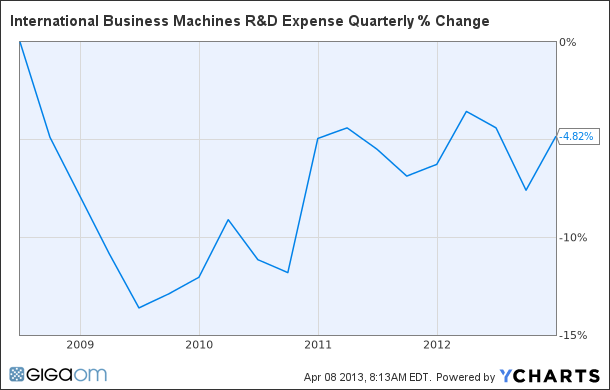
    Last year, USA Today reported that IBM was the sixth largest spender in R&D among U.S. companies — after Microsoft, Pfizer, Intel, Merck, Johnson & Johnson, according to S&P Capital IQ, spending $6.3 billion over the previous year.

    IBM R&D Expense Quarterly Chart

    IBM R&D Expense Quarterly data by YCharts

    Related research and analysis from GigaOM Pro:
    Subscriber content. Sign up for a free trial.