Category: News

  • Reuters – Cerberus Mulls Listing for German Holding

    Private equity group Cerberus is mulling listing its German retail property holdings as a real estate investment trust , in a move that could help it avoid paying corporate tax, Reuters wrote. Alternatively, the U.S.-based investor could list the buildings, which are valued at roughly 2 billion euros ($2.6 billion), as a normal real estate company, two people familiar with the transaction said on Thursday. International investors are flocking to the German property market as yields on safe assets such as German bonds vanish and as property is considered the next low-risk asset class.

    (Reuters) – Private equity group Cerberus is mulling listing its German retail property holdings as a real estate investment trust (REIT), in a move that could help it avoid paying corporate tax, two sources said.

    Alternatively, the U.S.-based investor could list the buildings, which are valued at roughly 2 billion euros ($2.6 billion), as a normal real estate company, two people familiar with the transaction said on Thursday.

    International investors are flocking to the German property market as yields on safe assets such as German bonds vanish and as property is considered the next low-risk asset class.

    A decision will be taken later this year when the preparations for the initial public offering (IPO) are gaining pace, said the sources, adding the listing may take place as early as the second half of 2013.

    Cerberus declined to comment.

    As a REIT, the group could avoid paying corporate level taxes if it distributes at least 90 percent of its taxable income to shareholders in the form of dividend payments.

    Germany has not seen REITs being launched since the listing of Prime Office REIT AG in 2011.

    Until now, Cerberus’ retail properties – comprising mainly Metro wholesale markets and Woolworth retail outlets – have not been grouped together but held in different areas of Cerberus’ company structure.

    Berlin-based Acrest Property Group, which is not owned by Cerberus, is managing the buildings, which have a combined rentable space of about 900,000 square metres.

    Cerberus has hired Bank of America Merrill Lynch, JP Morgan and Goldman Sachs to organise the listing of the German retail properties, the sources said. The banks declined to comment.

    German property has been showing a steady rise in value in the last couple of years, contrasting with the boom-and-bust of Spanish and Irish real estate markets.

    In January residential property company LEG Immobilien listed on the German Stock Exchange while peer Deutsche Annington, owned by private equity firm Terra Firma , is set to become the next listing later in the second quarter, sources have said.

    In the German real estate market, investors can expect yields of about 4.5 percent for the best housing and 6 percent in secondary locations.

    The post Reuters – Cerberus Mulls Listing for German Holding appeared first on peHUB.

  • Reuters – Fairway Grocery Chain Prices IPO

    High-end grocery store chain Fairway Market priced its initial public offering of 13.7 million Class A shares at $10 to $12 per share as it looked to raise as much as $164 million, Reuters reported. The company, which traces its origins to a fruit and vegetable stand in New York City in the 1930s, operates in Connecticut, New Jersey and New York. At the high end of the price range, the company will be valued at about $495 million. The company, majority-owned by private equity firm Sterling Investment Partners, said in August that it had confidentially filed for an IPO.

    (Reuters) – High-end grocery store chain Fairway Market priced its initial public offering of 13.7 million Class A shares at $10 to $12 per share as it looked to raise as much as $164 million.

    The company, which traces its origins to a fruit and vegetable stand in New York City in the 1930s, operates in Connecticut, New Jersey and New York.

    At the high end of the price range, the company will be valued at about $495 million.

    The company, majority-owned by private equity firm Sterling Investment Partners, said in August that it had confidentially filed for an IPO.

    While the company is offering 13.3 million share, its selling shareholders are offering the rest.

    Fairway follows in the footsteps of successful public debuts of grocery chains such as Whole Foods Market Inc and Fresh Market Inc, last year.

    The company posted a loss of $56.1 million up from a loss of $10 million from the year ago.

    Private equity-backed companies queued up to list shares as U.S. stock markets reached record highs, helping boost U.S. IPO volumes by about 65 percent in the first quarter.

    Fairway intends to list its Class A common stock on the Nasdaq under the symbol “FWM”.

    The New York-based company told the U.S. Securities and Exchange Commission that Credit Suisse, BofA Merrill Lynch, Jefferies and William Blair will underwrite its IPO.

    The post Reuters – Fairway Grocery Chain Prices IPO appeared first on peHUB.

  • Switching from Google to Microsoft, part 3 — A positive Outlook.com

    As someone who switched from Hotmail to Gmail in 2004 and then never looked back, moving to Outlook.com has been quite a weird experience (setting it up was fun in its own right). Some people hate Gmail’s interface, but if you’re used to it, using anything else seems odd.

    That said, I’ve adapted to Outlook.com pretty quickly. It feels a bit like going back in time, using an interface similar to the ones I used in the past, but it doesn’t feel dated — quite the opposite actually — and I’ve grown to really like it in the short period of time I’ve been using it as my email service.

    There are some elements I miss about Gmail. Message previews for example. When a message arrives in Gmail, I can instantly tell if it’s worth opening or not because I can see the first lines of text. Some messages just say “OK” for example and I can get everything I need from the preview.

    I’m a big Labs user, so I make good use of features like Undo Send which lets me cancel sending when I realize I’ve made a mistake — failed to attach something or missed off a CC — but equally there are some elements of Outlook.com I really appreciate.

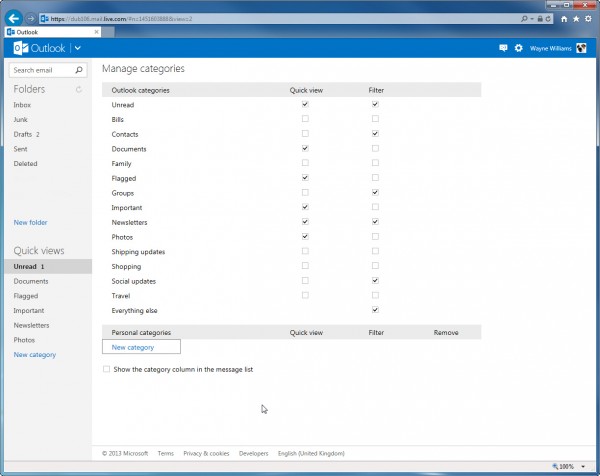
    The Quick Views in particular are really handy. I like that I can quickly view emails that have documents or photos attached, that I can see just view unread messages (as I can in Gmail) and that I can trawl through newsletters. Adding additional emails/senders to categories takes seconds via a drop down menu.

    I’ve got used to the message pane in Outlook.com. I couldn’t decide initially if I wanted to turn it on or not, but now it’s active I find it very handy. I can have the pane at the bottom or on the right — and as I have dual widescreen monitors, it makes sense to use the spare real estate and go for the latter option.

    In Gmail I can send exceptionally large files through Google Drive. Outlook.com lets me do the same using SkyDrive.

    The lack of IMAP support in Outlook.com is an annoyance, but there are ways around this and I rarely delete emails anyway (which is why my primary Gmail account is 82 percent full). Outlook.com offers unlimited space, which is great.

    Spam, Spam, Spam

    So far, so good. But now we get to the problem I have with Outlook.com, and it’s a problem I’ve had since I signed up for an account — spam. I get a lot of junk mail. In Gmail I never see it. It goes straight into my Spam folder and I never have to worry about it. Occasionally, and it’s very, very occasionally, some spam slips into my inbox, but it’s quickly dispatched and I never see it again. Sometimes, even less occasionally, real messages make it through into spam. I often miss these because Gmail is so good at filtering junk I rarely bother to look in my Spam folder.

    Despite the fact that Gmail removes any spam before forwarding on clean messages to Microsoft’s webmail service, I continue to get spam in my Outlook.com inbox that’s linked to either my Outlook.com address or the Hotmail account I had previously.

    I use the Sweep option to delete and block all future messages from the spam senders, but while this has had a huge impact on the amount of junk mail I receive, it hasn’t stopped it entirely. I know I can switch to the Exclusive junk email filter and optionally block content from unknown senders, but that all seems a bit extreme to me.

    On a related note, I went into my Junk folder after having previously just ignored it, as I do with Gmail, and found 20 or so messages — blatantly not spam — sitting there. Messages that Gmail knew were clean, but which Outlook.com had tagged as undesirable.

    It’s become clear in the couple of weeks that I’ve been using Outlook.com that I can’t trust the service to just handle spam, as I do with Gmail. I have to get much more hands on (managing safe and blocked senders myself, for example). It’s not a problem — and over time I think the issue will diminish to the point that I no longer even think about it — but at the moment it’s still slightly annoying to me.

    But I like how easy managing messages is in Outlook.com. The bar at the top makes it easy to do everything I need to with an email. I prefer the way Gmail lets me search for messages but that might be partially down to conditioning.

    On the mobile side of things, accessing Outlook.com through iOS is fine, the mobile version of the site is decent, and there’s a passable Android app too, so I’m fairly well covered. I have niggles about all of them, but I have niggles about Gmail on mobile too.

    The question I’ve asked myself a lot, and which I’ve yet to fully answer, is whether at the end of my trial period if I’m going to stick with Outlook.com or switch back to Gmail. I’ve settled into Outlook.com nicely and I don’t actually miss anything major about Gmail, with the exception of the message previews (I hadn’t realized how much I used to them to visually locate messages I was looking for until the preview lines were no longer available to me). Right now at least, I’m leaning towards making my switch to Outlook.com permanent…

    Provided I can just stop that last annoying bit of spam reaching my inbox.

    Anyone else here made the switch from Gmail to Outlook.com and what was your reason for doing so?

    Photo Credit: 3Dstock/Shutterstock

  • Microsoft releases Advance Security Bulletin for April

    Patch Tuesday is almost upon us yet again. As is its custom, Microsoft has released a monthly Advance Security Bulletin to let customers know what to expect next week. There are nine bulletins headed our way on April 9, with two of them being considered critical.

    Per standard procedures, Microsoft does not release details of the patches until the updates are actually live. This is done in an effort to prevent the bad guys from knowing the vulnerabilities and attempting to take advantage of them  between now and the update release. There is, however, nothing to protect those users who fail to install Windows updates in a timely fashion.

    This time around fixes are coming for all versions of Internet Explorer going back to IE 6 (please tell me you are not still running that). The updates will also cover Infopath 2010, Sharepoint Server 2010, Sharepoint Server 2013, Sharepoint Foundation 2010, Office Web Apps, Windows Defender, Windows operating system versions XP, 7, 8 and RT and Windows Server 2003, 2008 and 2012.

    This pretty much covers everything except Windows Home Server, so all of you can expect an update and reboot to be coming your way next week.

    Photo Credit: zimmytws/Shutterstock

  • Podcast: Facebook’s phone-y home, Tesla rides the lightning and Das Boot

    It was a busy week in the tech world, and the GigaOM Podcast is here to help you make sense of it all. Eliza Kern and Kevin Tofel invite us over to Facebook’s new “Home” on Android. Then Katie Fehrenbacher gives us a ride through Tesla’s new lease deal. And finally, Janko Roettgers opens our eyes to Rdio’s new video service, Vdio.

    (Download this episode)

    Subscribe to RSS

    iTunes

    Stitcher Radio

    SHOW NOTES:
    This episode of the GigaOM Podcast is brought to you by Squarespace – the best way create a modern and professional website, with all the features you need integrated into one platform. Every Squarespace website is mobile ready, and includes e-commerce, 24/7 customer support, and a free domain name.

    It’s no Facebook Phone: Home looks nice but could have limited impact

    Tesla to offer leasing option for Model S

    Four years in the making, Vdio finally opens up to Rdio subscribers in the US and UK

    And big thanks to the good folks at Stitcher Smart Radio for letting us use their studio.

    PREVIOUS IoT PODCASTS:
    What the internet of things can learn from Minecraft and Lemmings

    Podcast: How IBM uses chaos theory, data and the internet of things to fix traffic

    Electric Imp aims to make the Internet of Things devilishly simple

    IoT podcast: When devices can talk, will they conspire against you?

    Internet of things Podcast – Almond+’s nutty idea: Making sensor connectivity a snap

    Podcast: Why the internet of things is cool and how Mobiplug is helping make it happen

    MOBILE CALL-IN SHOW PODCASTS:
    Call in podcast: T-Mobile iPhone and the best Android keyboard

    Call in podcast: T-Mobile iPhone and the best Android keyboard

    Call-In: Galaxy S 4 predictions, Chromebook Pixel cloud storage

    Call in podcast: Galaxy S 4 predictions and Chromebook Pixel cloud storage

    PREVIOUS WEEKLY WRAP-UPS:
    Podcast: How Indie Game stayed “indie” and became a hit

    Samsung Galaxy S 4 blasts off, RIP Google Reader

    Podcast: Facebook’s feedin’; Lean In’s meanin’; and everyone’s Hadoop-in

    Related research and analysis from GigaOM Pro:
    Subscriber content. Sign up for a free trial.


  • Juniper Launches Programmable EX9200 Core Switch

    juniper-ex9204-front

    Juniper Networks (JNPR) announced new  products for enterprise campus and data center infrastructures, to take on the spikes in BYOD, mobile users and new enterprise application deployments. Its new agile, programmable network will enable network operators to respond to business changes and monitor and react responsively to how the network meets application service level agreement (SLA) requirements.

    Highly Programmable Switch

    The Juniper EX9200 Programmable Switch enables accelerated response to changing business needs, while its built-in ability to support a virtual WLAN controller. the Juniper JunosV Wireless LAN Controller, delivers reliability and flexibility across the enterprise. Built upon the Juniper One Programmable ASIC, the EX9200 prepares enterprises for emerging Software-Defined Networking (SDN) protocols, allowing for network automation and interoperability without the need for additional hardware. Its Virtual Chassis simplifies network architecture and reduces network devices and layers by to to 50 percent. Equipped with 1/10/40GbE interfaces, it is set to deliver 100GbE performance later this year.

    “A dynamic and competitive global marketplace requires organizations to be flexible and responsive,” said Bob Laliberte, senior analyst, Enterprise Strategy Group. ”As a result, the underlying IT infrastructure and the network especially needs to be able to evolve with the business. The Juniper EX9200 Ethernet switching platform delivers a level of programmability that will allow enterprises to prepare for emerging protocols and applications. This programmability will also ensure that network operators will have the flexibility to add those future services with limited need for hardware upgrades, thus providing a high degree of assurance and investment protection.”

    Tackling BYOD, Wireless and Single Pane Management

    Addressing the BYOD trend and seamless integration between wired and wireless networks, Juniper’s virtual WLAN controller is designed to run on any combination of physical appliances, on a virtual machine (VM), or directly on Juniper Networks switches (future). Juniper has made wireless controller functionality a service on the network while offering consistent, industry-leading capabilities such as controller clustering, in-service software upgrades, self-organizing adds, moves and changes, and local switching across the portfolio.

    Additionally Juniper launched its Junos Space Network Diretor, a single campus-to-data center management tool, to provide a holistic view into the enterprise network. By consolidating different management tools into a single application, the new software  accelerates application deployment time and reduces complexity and operational expenditures.

    “Juniper’s EX9200 dramatically simplifies how we provide cost-effective, reliable, high-bandwidth and high-capacity networking to our research and education participants, as well as faculty, students and staff,” said Schyler Batey, lead network engineer at Pacific Northwest GigaPOP. “The advanced programmability of the EX9200 delivers future-ready capabilities that can be easily adapted to support new requirements created by emerging applications, such as SDN and EVPN, while automation features allow us to transform network operations, reducing complexity and overhead.”

  • The one with the physical QWERTY keyboard: The new BlackBerry Q10

    The BlackBerry Q10 Smartphone

    So… you’ve been hearing all of this talk about the new BlackBerry Z10, and even though it’s designed to deliver the best touchscreen typing experience, you’re a physical keyboard enthusiast at heart. You’ve been holding out, waiting to get your hands on a shiny new BlackBerry 10 smartphone – and you know the BlackBerry Q10 is just right for you.

    You’re not alone! The anticipation is mounting around the world for this highly-anticipated smartphone, and we’re getting one step closer to getting it in your hands.

    Today, Carphone Warehouse customers in the United Kingdom will be able to pre-order the BlackBerry Q10 on O2, Orange, T-Mobile, Three, EE and TalkMobile. Plus, the handset will be available for purchase in Carphone Warehouse stores from the end of April. For those of you in other markets, we’ll have details on availability to follow soon. In the mean time head by our global availability tracker for BlackBerry 10 to see where you can pick up a BlackBerry Z10 today!

    We showed it off originally on January 30th when we officially launched the BlackBerry 10 platform. There, we showed you some of the amazing capabilities built in to BlackBerry 10, like messaging in the BlackBerry Hub, BlackBerry Balance and BlackBerry Remember. In case you need a refresher – watch this video and prepare to start drooling.

    [ YouTube link for mobile viewing ]

    Are you a BlackBerry physical keyboard fanatic? Is this the BlackBerry 10 device you’ve been waiting for – let us know in the comments below.

  • Jolla’s Sailfish OS SDK installers are now out for Windows, OS X and Linux

    Software development kit (SDK) installers for the Sailfish smartphone operating system are now out, Jolla has announced on Twitter. The SDK was previously trailed at Mobile World Congress in February.

    Jolla, which is led by ex-Nokians, has taken the abandoned MeeGo OS and wrangled it into a new, slicker version called Sailfish. The Linux-based OS will in theory be available for a number of device types, but the first commercially-available version will be on a smartphone sold through the Chinese distributor D.Phone and the Finnish carrier DNA.

    According to a separate tweet a few days ago, the timescale for that release is looking a bit fuzzy:

    One significant partnership announced at Helsinki’s Slush Festival last November will already be in trouble, namely that with ST-Ericsson – a chipmaker that is in the process of being broken up by parent companies STMicro and Ericsson.

    Sailfish will certainly find itself in choppy waters this year. There are a range of factors that threaten the iOS-Android duopoly, from Windows Phone and BlackBerry to newer players such as Firefox OS — and let’s not forget Nokia’s low-end Asha platform, which will likely compete in the same market as Sailfish and Firefox OS, and Facebook Home, whose effect on the smartphone scene is yet to be felt.

    Jolla will have a tough time establishing itself, but at least developers can really sink their teeth into its native app potential (they can also submit Android, HTML5 and Qt apps) now that they have the SDK.

    Related research and analysis from GigaOM Pro:
    Subscriber content. Sign up for a free trial.


  • Morning Advantage: What’s Known (So Far) About The Offshore Havens Leak

    It’s being billed as possibly the “largest journalism collaboration in history.” For the past 15 months, nearly 100 reporters from media outlets around the world, working in collaboration with the International Center for Investigative Journalists (ICIJ), have analyzed about 2.5 million documents detailing the identities and activities of 120,000 offshore tax havens. The effort aimed to expose the “hidden dealings of politicians, con artists, and the mega-rich in more than 170 countries.”

    Adam Weinstein at Gawker breaks down what’s been uncovered so far (names, dollar amounts, incriminating allegations), why we should care, and what we can expect to see coming to light as investigations continue. On a final note, Weinstein teases: “ICIJ’s parent, the Center for Public Integrity, lists its funders here. Will any of them pop up in the documents? Man, that would be: Awk. Ward. We’re looking into it.”

    A TALE OF TWO SUPPLY CHAINS

    White House Seeks to Change International Food Aid (The New York Times)

    The Obama administration is expected to announce a big change in the way it distributes international food aid. Instead of buying food from American farms and shipping it abroad, the administration proposes giving the money directly to relief agencies to buy food closer to where it’s needed. The proposed change would save millions, and would get food to the people who need it more quickly. But critics argue that the changes would have a devastating impact on U.S. farmers and shippers. “We are talking about hundreds of jobs lost,” says the executive director of one of the organizations lobbying against the change. But groups like Oxfam and CARE argue that the current system wastes too much food aid on shipping costs. “The current food aid program is not mission driven or about poor people,” said Gawain Kripke, director of policy and research for Oxfam. “It’s about moving product.”

    UPWARD MOBILITY

    Has a Seattle Building Discovered the Secret to Making Stairs Irresistible? (Bloomberg Businessweek)

    Despite the proven benefits of opting for the stairs over the elevator, few office buildings do anything to encourage it. Most have dimly-lit staircases hidden behind fire doors, some of which lock you out of the office entirely if you forget your keycard. Caroline Winter gives us an inside look at a building that plans to be different by design. Seattle’s $30 million carbon neutral Bullitt Center, which opens at the end of the month and is being billed as the world’s greenest commercial building, will feature what its owner calls an “irresistible staircase” — a light-filled, winding “escalier” with views of downtown Seattle and Puget Sound (check out the photo — it really is beautiful).

    NOW HEAR THIS

    A Change to This Newsletter

    Over the past year and a half, you have helped us hone our approach to Morning Advantage by providing excellent feedback on what you find useful (and what you could do without). Based on your advice, we’re announcing two changes we hope you’ll like: Morning Advantage will become “The Shortlist” (to reflect that our global audience does not all receive this newsletter in the morning) and it will appear weekly, on Fridays, instead of every weekday (to avoid cluttering your already-full inboxes). We’ll see you next week under our new name and on our new schedule — but with the same great roundup of management thinking. If the notion of a day without HBR is too much to bear (we love you, too!), please consider signing up for our new, shorter newsletter, The Daily Idea, which features a single fresh idea from the pages of HBR every weekday, summarized by Morning Advantage alumnus Kevin Evers.

    BONUS BITS

    The Real Deal

    Staying Ahead of Counterfeiters, With a Butterfly’s Help (Big Think)
    China’s Export Boom That Wasn’t (The Atlantic)
    In Honor of Mad Men’s Return, Favorite Ads from the 1960s (Ad Age)

  • Reuters – Blackstone Will Visit Dell Headquarters

    Blackstone Group will visit Dell Inc‘s headquarters on Monday to begin an in-depth analysis of the company, sources said, a strong sign the buyout firm is proceeding with an offer that could upset founder Michael Dell’s $24.4 billion buyout bid, Reuters reported. Blackstone and billionaire investor Carl Icahn separately made preliminary proposals in late March that, if finalized, could be superior to the offer on the table from Michael Dell and private equity firm Silver Lake Partners LP. The outcome of the auction would determine the future of Dell as well as Chief Executive Michael Dell, who founded the company in a dorm room in 1984 and turned it into the world’s No.3 personal computer maker.

    (Reuters) – Blackstone Group will visit Dell Inc’s headquarters on Monday to begin an in-depth analysis of the company, sources said, a strong sign the buyout firm is proceeding with an offer that could upset founder Michael Dell’s $24.4 billion buyout bid.

    Blackstone and billionaire investor Carl Icahn separately made preliminary proposals in late March that, if finalized, could be superior to the offer on the table from Michael Dell and private equity firm Silver Lake Partners LP.

    The outcome of the auction would determine the future of Dell as well as Chief Executive Michael Dell, who founded the company in a dorm room in 1984 and turned it into the world’s No.3 personal computer maker.

    In its first step toward firming up a bid, Blackstone is working closely with Michael Dell in putting together a new business plan and actively talking to him about staying on in his current role as CEO, two people familiar with the matter said.

    If Michael Dell gets on board with Blackstone’s still-developing strategy for Dell, he would be Blackstone’s preferred choice running the new company, the sources said. But the buyout firm also is putting an alternative executive plan in place.

    Blackstone has hired an executive consulting firm that has reached out to about half a dozen high profile industry executives to help evaluate Dell’s businesses and provide advice around strategy, the sources said.

    The New York-based private equity firm and its consultant are also talking to a few of the executives for potentially running Dell, while some others are being considered for board positions, the sources said.

    The executives that have been contacted by the executive reference firm include Cisco Systems Inc director Michael Capellas, former IBM Corp services head Michael Daniels, Oracle Corp President Mark Hurd and Hewlett-Packard Co’s PC boss Todd Bradley, the sources said.

    Hurd, who sources previously have said was being pursued for a CEO job, has said he is happy at Oracle. Representatives for Capellas and Daniels did not return calls seeking comment. Bradley said in an email he was not contacted for a CEO position.

    The leading external candidate for the Dell CEO job is Capellas, who has been in extensive discussions with Blackstone in recent weeks brainstorming on strategy for Dell and evaluating the industry, the sources said.

    Capellas, best known as CEO and Chairman of PC maker Compaq, that he sold to Hewlett-Packard in 2002 for $25 billion, has been spotted entering and leaving Blackstone’s Park Avenue headquarters several times over the past few weeks.

    In recent years, Capellas served as Chairman and CEO of VCE, a collaboration between EMC Corp, Cisco and VMware Inc . He still remains chairman.

    “No one knows who will ultimately sign on yet,” one of the sources said. “(Blackstone) is exploring options with those people.”

    Executives from the private equity firm and its consultants will head to the Round Rock, Texas, Dell’s headquarters on Monday, to kick off the due diligence that is expected to last about four weeks, people close to the matter said.

    “What Blackstone is trying to do is develop a smarter structure that provides more options than what Michael Dell and Silver Lake seem to be doing,” another said, adding that the firm is trying to figure out a different way for Dell going forward.

    All the sources asked not to be named because the discussions are confidential. Spokesmen for Blackstone and Silver Lake declined to comment. A spokesman for Michael Dell was not available for comment.

    STRATEGY FOR DELL

    Blackstone’s team leaders for the bid include Dell’s former head of strategy, Dave Johnson, currently a senior managing director at Blackstone. In the past, Johnson and Michael Dell have not seen eye-to-eye over a strategy that would take Dell forward, the sources said.

    Johnson is working with Chinh Chu, one of Blackstone’s most experienced partners, who has been carrying out transactions for the firm since 1990.

    Michael Dell and Silver Lake envision Dell as an integrated company, with the No. 3 PC-maker continuing to focus on a diverse offering that includes enterprise software, servers, PCs and financial services.

    Johnson’s strategy, if Blackstone acquires Dell, would be to focus the company on enterprise software and accelerate the effort to bring together all the acquisitions made in this space, a source close to Johnson said.

    In addition, under Johnson’s plan, the company would exit its finance business, the source said, adding that Johnson also wants to make the company less Texas-centric and more global to attract more talented employees.

    During Johnson’s three years at Dell, he oversaw an aggressive acquisition strategy with some 18 to 20 deals, including the 2009 purchase of Perot Systems Corp, which catapulted Dell into the technology services market alongside IBM and HP.

    But one of the sources cautioned that the due diligence process is still in the early stages, and that Blackstone is just starting to put together a business plan.

    The post Reuters – Blackstone Will Visit Dell Headquarters appeared first on peHUB.

  • With its new video calling feature can Vonage Mobile really take on Skype? [Q&A]

    On Tuesday, Vonage introduced free video calling into its mobile app for iPhone and Android, rounding out a suite which already offers features like free app-to-app calls, texts, photo and location sharing, as well as international calling.

    I chatted to Nick Lazzaro, Vonage’s SVP Product Development, Information Technology and Managing Director Mobile Services, about the new addition, the company’s plans for the future, and what he thinks is next for the mobile industry.

    BN: Tell me more about the new video capability in Vonage Mobile.

    NL: We’ve launched Vonage Mobile with video calling as part of the ongoing expansion of our mobile platform. Vonage Mobile lets users make video calls to other app users with terrific image quality and high-definition voice. Video is available now for Android and iPhone devices and allows users to make free video calls over Wi-Fi and 3G/4G. The Vonage Mobile app is a free download from Google Play and the iTunes app store, and it’s easy to register, invite friends and start making free video calls immediately. To use the feature, users simply tap the “Video” button from within the app to connect their video call to another app user. If the person being called is not available, the caller is able to send a free text message letting them know they were trying to call.

    BN: Why add video calling to Vonage Mobile now?

    NL: Our goal is to continue to make Vonage Mobile the most comprehensive communication solution for voice, messaging and now video — and improve upon the user experiences already provided by other apps. Our first order of business was to deliver free app-to-app calling and messaging and, true to Vonage’s heritage, ultra-low international long-distance calling. With this foundation, video was our most logical next goal.


    BN: What are the features of video calling with Vonage Mobile?

    NL: We’ve worked to make Vonage Mobile video calling as seamless and flexible as possible, so while making video calls on 3G/4G or Wi-Fi, users can toggle between front and back cameras, switch between voice and video mid-call, mute the line and use the app with Bluetooth.

    BN: Skype has similar offerings. What are the difference between Vonage Mobile and Skype?

    There are several significant features that differentiate Vonage Mobile. First, Vonage Mobile allows you to access your existing contacts to build a global personal free calling and texting network. Users can invite multiple contacts via SMS to join their free calling and texting community, and for each friend who downloads and registers for Vonage Mobile, users will earn $1 of credit (up to $10) as part of the app’s Referral Program. The app also mirrors your mobile phone experience — and uses your existing mobile identity — to make a phone call or send a text message. Vonage Mobile also offers international long distance calling with per-minute rates that are, on average, 30 percent less than Skype and 70 percent less than major carriers.

    BN: Vonage became well known for home phone service via VoIP. What motivated the addition of mobile, and what are the company’s plans for the future?

    NL: Our Vonage home service continues to be very popular — especially with the unlimited international long distance calling offered by our flagship Vonage World plan. But with the explosion of mobile, our customers were asking for greater mobility and we’ve delivered that through Vonage Extensions and Vonage Mobile.

    Vonage Extensions lets our subscriber customers extend their home plan for free to a second phone line, including a mobile phone. Our Vonage Extensions app for iPhone and Android enables one-touch international calling anytime, anywhere over 3G/4G or Wi-Fi. Today, 28 percent of our customers have signed up for Vonage Extensions and one out of four Vonage international long-distance calls is originated from a mobile.

    Vonage Mobile gives any Android or iOS user the opportunity to tap Vonage’s global network to make ultra-low cost international calls, plus make free app-to-app voice calls, texts and now video calls. Our plan is to continue to deliver new innovations that solve today’s consumer calling problems — whether those are mobility, convenience, cost, flexibility or network.

    BN: This would seem to transform how Vonage defines itself to consumers, right?

    NL: We’ve been defined as a telco company or a VoIP provider, but we see ourselves today as a technology company. We apply our innovations in technology and software to solving communications problems for consumers, and that’s where we believe we provide the greatest value for consumers and the business marketplace as the communications world continues to converge and compress across the globe.

    BN: With the number of OTT (Over-The-Top) apps on the market, do you believe major carriers are beginning to see a need to integrate more OTT communications apps to stay competitive?

    NL: We’ve seen an increasing innovation in communications and it’s creating a compression in the pricing and a migration of communications to the lowest-cost networks. It’s great for consumers and I think carriers are taking notice of this trend. Some are developing their own OTT apps and many may look to partner with OTT providers who can help them more quickly participate in this growing global communications trend.

    BN: It seems the mobile industry is constantly evolving and pushing for the next best thing. What do you think is next for mobile? Where do you see the industry headed?

    NL: There is a great convergence in communications as more communications networks and devices proliferate in the consumer marketplace. Simplifying this experience for consumers and helping them manage their communications and their growing social graphs is going to drive a certain amount of innovation.

    There is also a great compression in international communications pricing for voice, messaging and roaming, which is fostering the migration of communications and data traffic to the lowest cost solutions.

    Consumers will play a role by demanding solutions that have superior user experiences and are easy to access and incorporate into their everyday lives.

    Companies like Vonage will continue to develop new innovations and solutions that simplify user experiences and facilitate the migration of traffic to cost-savings channels — for our subscriber customers and any consumer looking for easy, low cost solutions to communications. We believe communication should be like email — wherever and whenever you want it — and in a way that is easy, convenient and affordable.

    Understanding these key trends and how they play in mobility and the way people interact with mobile technology will continue to drive innovation in the industry.

    Photo Credit: Bevan Goldswain/Shutterstock

  • Asthmapolis Wants To Hack The Inhaler And Help 26 Million Americans Better Track And Manage Their Asthma

    Screen shot 2013-04-05 at 2.33.11 AM

    Unless you’re reading this while using an inhaler, this fact may surprise you: According to the CDC, 26 million Americans currently have the chronic respiratory disease we know as asthma. Not only that, but the CDC tells us that the disease costs the U.S. $3,300 per person annually, and medical expenses associated with asthma have increased to about $56 billion (thanks to hospitalizations, emergency room visits and missed work), while over 10 percent of insured Americans are unable to afford their prescription medicines.

    Asthmapolis launched in 2010 to help find a solution by leveraging the advances in sensor technology (and the reduced costs of producing said sensors) and mobile data monitoring to help people manage their asthma more effectively, in turn reducing the costs both for those suffering from asthma and for the U.S. healthcare system itself. And, today, the Wisconsin-based startup has announced that it has raised $5 million in Series A financing from The Social+Capital Partnership to build out a comprehensive solution and support system for those with the chronic respiratory disease.

    Asthmapolis is one of a new generation of digital health startups attempting to hack the old software, devices and care systems that continue to prevail in today’s healthcare landscape. We recently wrote about Intersect ENT, for example, which is hacking stents (yes, stents) to help doctors more effectively treat the 31 million-plus people suffering from sinusitis.

    Meanwhile, Glooko, Omada Health and a number of other startups are bringing mobile and digital technology to those with diabetes to help them manage the condition and, in Omada’s case, hopefully even prevent it.

    Asthmapolis, on the other hand, is on a mission to hack your inhaler. The startup has designed snap-on, Bluetooth-enabled sensors that track how often people are using their inhalers (along with location and time-of-day), along with analytics and mobile apps for iOS and Android to help them visualize and understand their triggers and trends while receiving personalized feedback.

    In turn, the data collected by the solution enables doctors to identify patients who are risk or need more help controlling its symptoms. This allows them to potentially prevent attacks before they happen, saving them the cost of hospitalization or a trip to the emergency room.

    In fact, Asthmapolis’ early studies found that this access to realtime data was able to reduce the number of people with uncontrolled asthma (or those not regularly using inhalers) by 50 percent. Without realtime data and the ability to collect information on the context and situations in which people develop symptoms, doctors are groping around in the dark and waiting for attacks before they analyze context and begin treatment.

    Many startups are beginning to recognize the opportunity both to create a sustainable businesses and affect real change by positioning themselves at the intersection of growing trends like mobile devices and mobile health initiatives, personalized medicine, big data and sensors. Asthmapolis co-founder and CEO David Van Sickle thinks that the startup can sit at that intersection, while differentiating from competitors by offering both a hardware and software solution.

    Not only that, but Asthmapolis received approval from the FDA in July to market its asthma-tracking device and software solution to consumers, which puts it on a very short list. In turn, its software platform, which is available both in English and Spanish, allows users to keep a digital log on their use of medications, while receiving personalized feedback — both designed to improve their ability to successfully manage the disease.

    In the big picture, the startup also wants to help public health institutions better evaluate the efficacy of their interventions and treatments and unlock insight into how asthma works and where it originates. And that’s where Asthmapolis is monetizing: By selling its hardware and software solution to payers and health plan providers. With more effective treatment solutions, insurance providers and health plans can save between $4,000 to $6,000 in annual healthcare costs — and, naturally, that’s money in the bank.

    The company has formed a number of partnerships in the last year in this regard, which include programs with payers like Amerigroup Florida/WellPoint and providers like Wyckoff Heights Medical Center in New York and Dignity Health in California. Going forward, the startup will look to continue expanding its relationships with providers and payers, along with initiatives in retail pharmacy and the public sector.

    “Asthmapolis is in a unique position in healthcare IT,” explains Social+Capital General Partner Ted Maidenberg, “where its technology can easily integrate with existing behaviors (like using your inhaler), while adding a huge amount of data (time, location, activity) that provides a much smarter package compared to your over-the-counter inhaler.”

  • USDA caves to food industry pressures, approves three new toxic meat preservatives

    After intense lobbying by Kraft Foods Global Inc. and Kemin Food Technologies, the Food Safety and Inspection Service (FSIS), a division of the U.S. Department of Agriculture (USDA), has agreed to reverse existing regulations that prohibit the use of three toxic meat…
  • Feds raid indoor gardeners, find only tomatoes and squash plants

    How insanely out-of-control has the war on drugs become? Apparently now, if all you do is buy equipment to grow plants and vegetables indoors is reason enough to suspect you of conducting illegal drug activity. Case in point: State police and sheriff’s deputies in…
  • Extreme food allergy condition spreading among U.S. children

    Imagine having a food allergy condition so severe that you could only eat a few select foods without vomiting uncontrollably, developing extreme fatigue and becoming gravely ill. This is what young Tyler Trovato of St. James, New York, and a growing number of American…
  • Effective natural remedies to cure spring allergies

    Spring allergy is commonly used to refer to hay fever, a seasonal allergic rhinitis attack experienced by more than 35 million Americans every year as the season changes and many allergens start to blossom – during springtime. As pollens scatter and travel through air…
  • HTC One Heading to Canada on Apr 19th and Australia on Apr 23rd

    HTC One_Silver

    Recent reports from service providers in Canada and Australia revealed release dates for the HTC One are just around the corner. Canadian and Australian subscribers can expect to see the handsets in their areas on Apr 19th and 23rd respectively. Although pricing has not yet been released, buyers can expect to pay a slightly broader price range than those being charged in the US .

    We are still waiting for updated release dates for Europe, and should expect to hear announcements trickle out from that region over the next few weeks.

    Here are the announcements made by providers in Canada:

    Telus: Release on April 19th. Pricing details have not been made available at this time.  Pre-sales to begin in the coming days.

    Rogers:  Sales will start on April 19th for $149.99 with a three-year contract.  Starting today, new and existing customers can reserve or pre-order the HTC One online.

    In Australia:

    Telstra: Release on Apr 19th. Will cost $10 month (a total of $240) when paired with a $60 monthly plan on a 2-year contract. Purchasing off-contract will set customers back $768. Pre-orders prior to retail launch day will land buyers a free set of Beats Solo headphones.

    Optus: Available on Apr 23rd. Price with a 2-year contract will be a mere $3 per month (a total of $72) with $60 monthly service plans.  Pre-orders set to start April 5th.

    Vodafone: Available on Apr 23rd. Price with a 2-year contract will match competitors at $3 per month (a total of $72) with $60 monthly service plans. They are also offering up Beats Solo headphones free with pre-orders prior to launch date.

    Virgin Mobile:  Available Apr 23rd for $59/month on a 2-year contract with $3 monthly handset payment. Customers will be able to pre-order up until the retail launch date.

    Source: HTC Source

    Come comment on this article: HTC One Heading to Canada on Apr 19th and Australia on Apr 23rd

  • Couldn’t Make It To SXSW? Now You Can Learn About Google Glass And The Mirror API On YouTube

    glass-demo

    I’d wager that most of you reading this didn’t make it out to Austin for SXSW, and even fewer of you still have ever gotten some hands-on time with Google’s ambitious Glass project. On the off chance that you’ve been spending these past few weeks agonizing over all the juicy Glass tidbits you missed out on by not being there, you can rest easy — Google has posted the full video of its 50 minute Glass session on YouTube.

    The talk — titled “Building New Experiences with Glass” featured Senior Developer Advocate Timothy Jordan giving attendees (and now you) a brief rundown on what it’s actually like using Google Glass. We’ve seen these sorts of hands-on impressions in the past, but Jordan’s session managed to give attendees a clearer idea of what the Glass interface actually looks like while he’s rubbing away at the side-mounted trackpad or checking out updates from his Google+ pals.

    More importantly, Jordan’s session provided those on-site developers a glimpse at what it actually takes to build services for the head-mounted display. In it, he made multiple references to how simple the development process actually was (it’s “not complex,” as he puts it), but there’s more than enough meat here to give potential Glass developers a taste of what they’re in for. In the end though, Jordan was bullish on what Glass means for how we as users interact with our gadgetry — he didn’t go as far as saying traditional touchscreens were “emasculating” like a certain other Google employee, but he pointed out that current modes of interaction tend to separate us from the events and experiences of our lives.

    “It feels like tech is often getting in the way more than it needs to,” Jordan remarked. “And that’s what we’re addressing with Project Glass — it’s so that you can still have access to the technology you love, but it doesn’t take you out of the moment.”

    Jordan and his employers at Google may think we’ll love Glass, but the real jury has yet to weigh in. While Google is prepping Glass for a widespread consumer release at the end of this year, it has also reached out to thousands of would-be Glass Explorers about claiming their own $1,500 tester units. So far the search giant has been exceedingly careful about who has gotten to play with its vision of the future, but that’s all about to change in short order.

  • Space Studies Board Annual Report 2012

    Final Book Now Available

    The original charter of the Space Science Board was established in June 1958, 3 months before the National Aeronautics and Space Administration (NASA) opened its doors. The Space Science Board and its successor, the Space Studies Board (SSB), have provided expert external and independent scientific and programmatic advice to NASA on a continuous basis from NASA’s inception until the present. The SSB has also provided such advice to other executive branch agencies, including the National Oceanic and Atmospheric Administration (NOAA), the National Science Foundation (NSF), the U.S. Geological Survey (USGS), the Department of Defense, as well as to Congress.

    Space Studies Board Annual Report 2012 covers a message from the chair of the SSB, Charles F. Kennel. This report also explains the origins of the Space Science Board, how the Space Studies Board functions today, the SSB’s collaboration with other National Research Council units, assures the quality of the SSB reports, acknowledges the audience and sponsors, and expresses the necessity to enhance the outreach and improve dissemination of SSB reports.

    This report will be relevant to a full range of government audiences in civilian space research – including NASA, NSF, NOAA, USGS, and the Department of Energy, as well members of the SSB, policy makers, and researchers.

    [Read the full report]

    Topics: Space and Aeronautics

  • The battle begins: Anonymous takes control of North Korea’s Twitter and Flickr accounts

    Anonymous North Korea Battle
    Shortly after launching its “Operation Free Korea” initiative, notorious hacking group Anonymous has fired its first shots at North Korea. The group had demanded supreme leader Kim Jong-un resign, in addition to abandoning his nuclear ambitions and installing free democracy across the Asian country. Earlier this week, hackers belonging to Anonymous claimed to have stolen the passwords of 15,000 users from the North Korean propaganda website Uriminzokkiri. After its demands were not met, the group has begun to take down various properties belonging to Pyongyang.

    Continue reading…