
Category: News
-
HTC First preview: The first phone to feature Facebook Home
-
Here are the likely specs of AT&T’s $99 HTC First with Facebook Home pre-installed
At a press event on Thursday, Facebook introduced a custom launcher for Android called Facebook Home. The software will be pre-installed on certain handsets with the initial one being the HTC First, a device for AT&T’s LTE network that arrives in stores on April 12. As expected, it’s a mid-range handset with a price to match: $99.99 on contract.
What does that $100 and two-year commitment get you? AT&T isn’t providing many details on the handset, but says it has a 4.3-inch display, runs Android 4.1 and uses a dual-core Qualcomm Snapdragon 400 processor, which is the third most powerful of the four newest Qualcomm chips. I did a little sleuthing on HTC’s site and also found the following hardware information, which sounds about right for $99.
- 16 GB of internal storage
- 1 GB of RAM
- Internal GPS antenna + GLONASS, Digital compass
- 802.11 a/b/g/n Wi-Fi, Bluetooth 4.0, NFC
- 5 megapixel rear camera, 1.6 megapixel front camera
- Non-removable 2000 mAh battery
- 1.4 GHz processor
I still see little-to-no reason why anyone should buy this device though. For the same price, you can get a better Android phone — say Samsung’s Galaxy S III — and simply install Facebook Home if you want it. It will be interesting to see how other Facebook Home handset partners handle that scenario.

Related research and analysis from GigaOM Pro:
Subscriber content. Sign up for a free trial.- The fourth quarter of 2012 in mobile
- Takeaways from mobile’s second quarter
- Hyperlocal: opportunities for publishers and developers


-
Steve Johnson Tweet Suggests North Korea Bomb Foxboro (“If y’all do bomb 1st”)
On Wednesday, Buffalo Bills (and former Kentucky Wildcats) receiver Stevie Johnson tweeted this:
North Korea tripping hard AF right now. Chill out with that Nuke talk. #uMadBro
— STVN (@StevieJohnson13) April 3, 2013
Then this:
War is nothing to be played with. I apologize North Korea……..but if y’all do bomb 1st… Bomb Foxboro, Mass. Sincerely,#BillsMafia
— STVN (@StevieJohnson13) April 3, 2013
As you might imagine, some people (particularly Patriots fans) did not take too kindly to this, and Johnson did not follow this guy’s advice:
@steviejohnson13 delete that bro w. the quickness unless u really wanna piss A TON of people off n generate controversy.
— John Mark Brooks (@JMBrooks17) April 3, 2013
The tweet is still there.
Later, he followed up with:
i know some of yall took it too serious.. but i have Much Respect for The Pats along with Every other NFL Team. Gonna to be a Great #NFL2013
— STVN (@StevieJohnson13) April 4, 2013
Then:
PatsFans i lo…like yall also. ask any1 in my fam. ive said TheBoro is my fav place to play-bkuz you Pats fans are Live! BUT not for long..
— STVN (@StevieJohnson13) April 4, 2013
I’m sure that will be the end of it. Right?
-
2 months after DOJ settlement, retailers start discounting Macmillan ebooks
When Macmillan, the lone publisher holdout in the Department of Justice’s ebook pricing antitrust lawsuit, settled with the DOJ in February, ebook retailers were supposed to be allowed to discount Macmillan titles within three days of the settlement. It ended up taking nearly two months: Publishers Lunch noted Thursday (paywall) that retailers have finally begun discounting select Macmillan titles.
Here are a few examples of ebooks and the discounts they are receiving at various retailers. Note that Kindle, Nook and the iBookstore are matching each other’s discounts, while in most cases Kobo and Google hadn’t begun discounting as of Thursday afternoon.
Title Pub Date Ebook list price Kindle Nook iBookstore Kobo Google Killing Lincoln (O’Reilly, Dugard) 9/2011 $12.99 $9.99 $9.99 $9.99 $12.99 $12.99 The Silver Linings Playbook (Quick) 10/2012 $9.99 $7.99 $7.99 $7.99 $9.99 $9.99 A Memory of Light (Jordan, Sanderson) 4/2013 $14.99 $13.49 $13.49 $14.99 $14.99 $13.49 Ender’s Game (Card) 1st ebook ed. 4/2010 $6.99 $4.98 $5.99 $5.99 $6.99 $6.99 According to the terms of the settlement, Macmillan — like the other settling publishers — can’t restrict retailers like Amazon from setting, changing, or lowering ebook prices for two years. Though Macmillan only settled in February, its settlement gave it a back-dated head start on the two-year period, running from December 18, 2012 — the same date that Penguin agreed to settle.
Speaking of Penguin: Retailers still have not begun discounting its ebooks, Publishers Lunch notes, even though it settled nearly four months ago. Amazon still lists Penguin’s ebook prices as being set by the publisher.
Discounts on ebooks from Hachette, Simon & Schuster and HarperCollins — who settled with the DOJ back in April 2012 — have been in effect for several months. In most cases, retailers haven’t offered steep discounts on any of the settling publishers’ titles, and to my knowledge, we haven’t yet seen any of the bundling promotions or ebook giveaways that are largely allowed by the settlement.

Related research and analysis from GigaOM Pro:
Subscriber content. Sign up for a free trial.- Forecast: the evolution of the e-book market
- Connected world: the consumer technology revolution
- Controversy, courtrooms and the cloud in Q1

-
Emma Watson Photo Shoot Meets ‘Pretty Woman’
Emma Watson has denied rumors that she has been case in the role of Anastasia Steele in the upcoming Fifty Shades of Grey movie adaptation, but that doesn’t mean she’s shying away from racy roles.
This week, the star graces the cover of British GQ in a Pretty Woman-inspired dress that shows off a large portion of Watson’s bare skin. The photo portrays Watson as her character from the upcoming movie The Bling Ring. In the movie she plays Nicki, a fame-chasing, despicable character that Watson told the magazine she “hated.”
“The character is everything that I felt strongly against – she’s superficial, materialistic, vain, amoral,” said Watson. “She’s all of these things and I realised that I hated her. How do you play someone you hate? But I found it really interesting and it gave me a whole new insight into what my job, or my role as an actress, could be.”
As much skin as Watson shows in the new GQ, it turns out that the GQ photo shoot isn’t even the most racy one the actress has participated in. A new book by photographer James Houston titled Natural Beauty will soon be released, which features photos Watson posed for while topless. Though the photos don’t appear to actually show the actress’ bare breasts, Watson previewed them recently on Twitter:
My friend is supporting GlobalGreenUSA with his book Natural Beauty. It’s out now. : ) X http://t.co/zVP3rWJHWM

(Photo Courtesy GQ)
-
The HTC First Is Real, Launches April 12 Running Facebook Home

Facebook held its official event today announcing Facebook Home and revealed the HTC First, the first smartphone to run Facebook’s new UI. As mentioned previously, Facebook Home runs on top of Android and users will still have access to Google Play. The HTC First will be available exclusively on AT&T starting April 12 for $99 under a new two-year contract. Here are the official specs:
- 4.3-inch 720p display at 1280 x 720
- 1.5GHz Qualcomm Snapdragon S4 dual-core processor
- 1GB RAM
- 16GB internal storage
- 5 megapixel rear-facing camera
- 1.6 megapixel front-facing camera
- WiFi, LTE, Bluetooth 4.0
- Facebook Home UI on top of Android 4.1.2 Jelly Bean
Ahead of the HTC First release, AT&T uploaded several videos showing how to use different Facebook Home features. You can watch them below and let us know in the comments if you’re interested in buying the First.
Click here to view the embedded video.
Click here to view the embedded video.
Click here to view the embedded video.
Come comment on this article: The HTC First Is Real, Launches April 12 Running Facebook Home
Visit TalkAndroid for Android news, Android guides, and much more! -
There’s a thriving malware market, and you’re the commodity

If you listen to security companies then you may come to believe that the Internet is one big dark alley. Of course the industry has a vested interest in having you believe that you are in more or less perpetual danger. Now Dr. Web, the antivirus company, has released its monthly threat report, and the danger is almost as bad as the industry wants you to think.
The most “popular” threat during the month of March was Trojan.hosts programs: “Hosts file containing DNS server IP addresses has been compromised 186,496 times, which constitutes over 10 percent of the detected threat total”. The threat is commonly spread through malicious or compromised web sites. In early 2013 the files were being detected at a rate of over 9,500 infections per day.
The security firm also reports that the botnet known as “Win32.Rmnet.12” is growing at a rather alarming rate. “As of December 2012, the total number of infected machines was 6.5 million, and by March 27, 2013, it reached 8,593,330, an increase of two million over the first three months of 2013”, the company says. The news of this growth is bad enough, but the explantation of what it is is even worse.
The file infector Win32.Rmnet.12 can perform backdoor tasks at the command of a remote server and also steal passwords stored by popular FTP clients. That stolen information can then be used to mount network attacks or infect sites. The virus can also embed content into loaded web pages, redirect a browser to a site specified by criminals and send user information to remote hosts. Oh, and it can also self-replicate.
And then there is the malware that has been awarded the “threat of the month” medal. This, Dr. Web’s report claims, goes to Trojan.ArchiveLock.20. This little beauty can place all of your important files in password-protected WinRAR archives. Then all you have to do is pay the hacker for the privilege of getting back your own documents.
This one is also spreading according to the report: “Earlier the Trojan targeted only Russian users, but in March multiple incidents involving the program were registered in European countries such as France and Spain. In the short period from March 23 to 26, 150 Italian users whose systems were compromised by the malware contacted Doctor Web’s technical support and that number is rising”.
The company also touched on Trojan.Yontoo.1, the Mac virus we previously covered and names a new piece of Android malware that goes by the moniker of “Android.BiggBoss”.
In short, despite most platforms and users gaining better security in recent times, the attackers continue to innovate just as fast as any software maker, and sometimes much more quickly. Add that to the number of innocent users who remain clueless about much of this and you have the perfect recipe for a thriving malware market.
Photo Credit: Oxlock/Shutterstock
-
Facebook Home: Here’s A Commercial For It
Facebook has put out a new video/commercial for Facebook Home, its new Android-takeover experience. During a press event today, Facebook played a different, more humorous video with a tuba playing something vaguely sounding like this Eminem song (which is interesting given the Eminem references on Mark Zuckerberg’s alleged old Angelfire page).
Anyway, here’s the other one:
Here’s more on what Facebook actually announced, and of course that “Facebook phone”.
-
HTC First, the ‘Facebook Phone,’ Launches April 12th for $99
Today, at their big Android event, Facebook unveiled Home, the company’s new foray into Android. Rather than building a new Facebook OS of sorts, Home is a family of apps that takes over your Android device and turns it into a Facebook phone. With Home, your homescreen becomes one big, photo-oriented Facebook news feed.
So, in reality, any Android phone with Facebook Home is technically a “Facebook phone.” But that doesn’t mean that there wasn’t a true Facebook phone portion of the announcement.
As expected, the “Facebook Phone” is the HTC First. And though it’s not the first phone to come integrated with Facebook, it’s definitely the first to come this deeply integrated (with Facebook Home).
So, this is as close to a “Facebook Phone” as you’re going to get.
The HTC First will launch on April 12th exclusively on AT&T for $99.99. It will also come in four different colors: red, white, black, and light blue. The design is pretty minimal – a rounded rectangle with front and back cameras. It will sport a 4.3 -inch display and is powered by a dual-core Qualcomm Snapdragon 400 processor.
Facebook Home will also work on the HTC One X, HTC One X+, Samsung Galaxy S III and Samsung Galaxy Note II, and upcoming devices like the HTC One and Samsung Galaxy S4. Users with those devices can download Home on April 12th – the same day the HTC First hits the shelves.
Facebook says that they have already lined up partners to ship phones with Facebook Home preinstalled, including HTC, Orange, Samsung, Sony, Huawei, Qualcomm, EE, ZTE, Lenovo and Alcatel One Touch.
So, about that “Facebook Phone?” Facebook wants there to be tons of different Facebook Phones out there. And by coming up with Home, letting users of various Android phones download it, and lining up partners to ship phones preloaded with it – Facebook has done just that.
-
Poll: Facebook Home is an Android launcher; will you install it?
Facebook introduced its Facebook Home launcher on Thursday and its generally what was leaked and predicted. It essentially takes over your lock screen and your Home screen on an Android device, but it’s just a launcher like any other.
Some partners have agreed to pre-install it: Samsung, Sony, Huawei and HTC were noted. That means Facebook has to convince you that the experience is worth it for you to hit Google Play and install it once it becomes available on April 12. The simple question is: After seeing what that experience is like, will you install it?
Vote in our poll and be sure to comment if you have more to say. The Facebook Home launcher does support shortcuts for any Android app, so you can essentially use it as your only home screen. And if you’re big into Facebook, you might want to.
Of course, this is really a play for Facebook to keep you engaged with its services over those from competitors: A smart strategy from Facebook but only if people buy into it and install Facebook Home.

Related research and analysis from GigaOM Pro:
Subscriber content. Sign up for a free trial.- Analyzing the wearable computing market
- Tablets wars: Apple is from Venus, Amazon is from Mars
- The future of mobile: a segment analysis by GigaOM Pro

-
Verizon CEO says he would happily drop cell phone contracts

-
Facebook Has Strong Mobile Usage, but Is It Primary?
Today we heard the long-anticipated announcement of a Facebook phone. It’s not actually a phone, though. Instead it is a custom home screen for Android. Again, the beauty of Android’s open architecture is on display here. Companies of any stripe can, if they are so inclined, create a custom Android skin that changes the way the operating system functions in certain ways. That’s exactly what we saw from Facebook today.
Despite the anticipation of the announcement and some generally positive remarks from the live bloggers, one important question remains. Yes, people use Facebook on their mobile phone, which is a positive for the social network. But just because people use Facebook on their phones does not mean they want Facebook integrating with every facet of their smartphone experience.
In his opening pitch, CEO Mark Zuckerberg said, “Our phones are designed around apps and not people. So we want to flip that around.” While the idea of a phone designed around people sounds like a noble cause, it is not what Facebook is aiming for here. They want a phone built around Facebook, plain and simple. You can quite easily build your phone around people, especially your Android phone with its robust and customizable contacts list. Facebook would rather you view people through them.

One neat feature of the app is called Chat Heads, which allows you to message someone when you’re viewing them. “In today’s app centric world, messaging is treated just like another app,” said Zuckerberg. This is true, with even SMS acting as another app. Yet other companies that have tried to create custom skins have fallen short. Just look at HTC. We haven’t yet seen their revamped Sense UI, but the initial screenshots make it look horrible. There’s something to be said for a custom navigation experience, but no company has nailed it yet. It appears doubtful that Facebook will be the first.
Speaking of HTC, they’ll be the first company to produce a phone with Facebook Home. That phone, the HTC First, will launch later this month — probably around the same time as the HTC One. Despite the One’s probable superiority, it is almost a given that the First will sell better, given the power of Facebook’s brand. But that doesn’t guarantee consumers will like it once they have it.
As is pretty clear, I have no interest in this phone whatsoever. Consider the number of people my age (~30) who got in on the ground floor of Facebook and now only retain accounts because of others, I’m not sure that Facebook has the bright future that many in the social media industry believe. Facebook does love to tout its mobile engagement, and Facebook Home will absolutely test those claims. I don’t expect them to be particularly positive, though.
One interesting note is that Microsoft could be the big loser here. As Search Engine Land’s Danny Sullivan notes, Bing is Facebook’s desktop search provider. Yet Facebook Home is built on Android, a Google property. Zuckerberg said that you can “use whatever you want” for search, but Sullivan believes that Google will provide the default search function. That hurts Microsoft in the growing mobile search wars.
You can read more about Facebook Home at Facebook’s newsroom. Again, the Chat Heads feature actually looks cool. It’s a little disruptive, but that’s fine for messaging. The problem, at least for me, is turning my mobile experience into a Facebook-driven experience. Does anyone really want that?
For posterity’s sake, USA Today was my go-to live blog.
The post Facebook Has Strong Mobile Usage, but Is It Primary? appeared first on MobileMoo.
-
Companies that Practice "Conscious Capitalism" Perform 10x Better
If you had told me, when I was attending college during the height of the Vietnam War, and the heyday of the counterculture, that several of the most inspiring days of my life would someday be spent with a group of CEOs of large companies, I would have said you were nuts. But that’s exactly what I experienced last week, at a small gathering sponsored by an organization called Conscious Capitalism Inc. and held at the Esalen Institute in Big Sur, California.
Even today, “conscious” and “capitalism” remain unlikely bedfellows. Both are freighted words that have come to stand for fundamentally different worldviews. Capitalism is associated with individualism, personal ambition, the accumulation of wealth and power, and an identity grounded in external accomplishment. The word conscious, or more specifically consciousness, is associated with self-awareness, personal development, the greater good, and a worldview that eschews competition, hierarchy, and materialism.
The thesis of conscious capitalism — outlined in a new book of the same title by John Mackey, founder and co-CEO of Whole Foods, and his thought partner, Raj Sisodia, a business professor — is that capitalism can be a force both for economic and social good. Or as Bill George, former CEO of Medtronics, puts it in the book’s introduction: “Well run, values-centered businesses can contribute to humankind in more tangible ways than any other organization in society.”
I don’t kid myself about the unenlightened and even cruel ways capitalism has been practiced by many companies: accumulating wealth for a few while paying most employees subsistence wages; fighting regulation while blithely degrading the environment; avoiding taxes and ignoring responsibilities for the communities in which they’re based. The truth is I meet few CEOs or senior executives at large companies who seem to have a vision much beyond the next quarter’s earnings, or a sense of responsibility and commitment to their employees, customers, suppliers, and communities that equals their focus on their shareholders.
But I did last week. Even more than anything the eight CEOs I met had to say — and much of it was inspiring — I felt moved by them as people. They made no demands to be treated as “special” during the conference. We all stayed in simple quarters, with no access to cell phone service. They listened when others spoke. And they invested three days with one another for no other reason I could discern than to learn, and build a community of like-minded colleagues.
At the most basic level, consciousness simply means being conscious of more. That begins with self-awareness — the willingness to look inside, to acknowledge our limitations, uncertainties and fears, and to take responsibility for our actions. Mackey has drawn some critical attention for his libertarian views, and I found myself debating with him frequently over the three days. But I also found him to be open, real, vulnerable, and deeply committed to growing and becoming more conscious. How many leaders would be willing to say, as Mackey does: “The company was unable to grow until I was able to evolve — in other words I was holding the company back. My personal growth enabled the company also to evolve.”
I also admire leaders who put their money where their mouths are. The Container Store’s CEO Kip Tindell explained why he pays full-time sales employees a minimum of nearly $50,000 a year — approximately double the average for retail stores. Put simply, Tindell believes the best and most motivated employees, which he says the store is consistently able to attract, are three times as productive as an average worker. One of the payoffs is a turnover rate under 20 percent — a fraction of the turnover that most of his retail competitors endure.
Consciousness is also about being socially conscious — recognizing and taking responsibility for the needs of the larger community. Blake Mycoskie, who founded Tom’s Shoes at age 26, talked about the profitable business he’s built on a model of giving a pair of shoes to a child in need for each pair of shoes the company sells. Shubhro Sen, who leads people development for Tata, the huge, privately-owned Indian conglomerate, described the founding tenet of the company that endures to this day: “We earn our profits from society and they should go back into society.” Most of the company today is owned by philanthropic trusts.
I took away from these three days a very clear and inspiring message. It’s not necessary to choose up sides between consciousness and capitalism, self-interest and the broader interest, or personal development and service to others. Rather, they’re each inextricably connected, and they all serve one another.
Raj Sisodia looked at 28 companies he identified as the most conscious — “firms of endearment” as he terms them — based on characteristics such as their stated purpose, generosity of compensation, quality of customer service, investment in their communities, and impact on the environment.
The 18 publicly traded companies out of the 28 outperformed the S&P 500 index by a factor of 10.5 over the years 1996-2011. And why, in the end, should that be a surprise? Conscious companies treat their stakeholders better. As a consequence, their suppliers are happier to do business with them. Employees are more engaged, productive, and likely to stay. These companies are more welcome in their communities and their customers are more satisfied and loyal. The most conscious companies give more, and they get more in return. The inescapable conclusion: it pays to care, widely and deeply.
-
Google Compute Engine Available For Cloud Platform Gold Support Customers
Google announced today that Computer Engine is now available to Google CLoud Platform’s Gold Support customers. Product manager Navneet Joneja writes on the Google Enterprise Blog:
Google Compute Engine gives developers everywhere access to Google’s computing infrastructure. Now you can sign up online for Google Compute Engine with the purchase of Gold Support; you no longer need an invitation or a conversation with sales to get access. We’re also further reducing prices for all instance types by an average of 4%.
Starting at $400/month, Gold support gives you a direct relationship with our experienced support engineers to help you get started or troubleshoot issues across the Google Cloud Platform products.
Google also announced a 4% reduction on all Computer Engine pricing, as well as some new features.
For one, Compute Engine now has the option to boot from persistent disks mounted as the root file system, persistent disk snapshots, the ability to checkpoint and restore the contents of network resident persistent disks on demand, and the ability to attach and detach persistent disks from running instances.
There’s also a new admin console:

Additionally, there are five new instance type families with sixteen new instance types and an enhanced metadata server.
Two new zones in Europe are now supported.
-
Facebook Takes Over The Android Homescreen With Home
During a Facebook event today, the social network announced Home, a deep integration of Facebook into Android. The idea behind Home is a phone that’s built around people instead of apps.
The main feature of Home is the Cover Feed. It brings up all the latest photos from your News Feed to the homescreen of your phone. Users navigate through the photos by swiping left and right. Users can also double tap images to like them, and can comment from the homescreen as well.
Notifications get a substantial update in Home as well. All notifications will show up on the home screen as separate entries. Tapping the notification will bring up the Facebook app for further interaction. If you want to get rid of it, you can just toss it off the screen. Holding one of the notifications will lump them all together if you so wish to disregard all of them at once.

Apps will not be affected by Home as they can be easily accessed by holding the image of your face and swiping.
The final feature of Home is called Chatheads. As its name implies, it collects SMS and Facebook Messenger in one place. The interesting part is that each message shows up at the top right as a small circle containing the profile picture of your friends. These will pop up regardless of whatever app you’re in.

Facebook Home will be available on Android phones that have both the Facebook and Facebook Messenger installed. If you meet these prerequisites, the Facebook app will contain a link to the Google Play store to download Facebook Home.
Facebook Home will be updated every month, just like the Facebook mobile app. It will also come to tablets in the coming months.
Facebook Home will be initially available on the HTC One X, HTC One, Samsung Galaxy S III and the Samsung Galaxy S4 starting April 12. It will also then be available on the HTC First, a phone built with Facebook Home specifically in mind.
-
Facebook, HTC announce the HTC First

Developing…
-
Meet The HTC First, The First Android Phone To Come Preloaded With Facebook Home
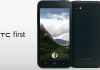
The torrent of leaks these past few days haven’t left much to the imagination, but HTC’s Peter Chou has just officially pulled back the curtain on the first phone to ship with Facebook Home — the HTC First — at Facebook’s Menlo Park headquarters.
According to HTC CEO Peter Chou the First will be the “ultimate social phone,” though he declined to dig into the device’s specs during his brief moments on-stage. The device will ship in four colors, and will support AT&T’s LTE network right out of the gate. Can’t wait for your chance to take it for a spin? The First will be available for $99 (with a 2 year contract naturally) starting on April 12, and pre-orders for the device kick off today. Those of you outside the U.S. will be able to join in the fun shortly too, as Mark Zuckerberg also noted that the phone would find its way to UK carriers Orange and EE in short order.
The mid-range First will be available in black, white, red and blue, and sports a 4.3-inch display that jibes with earlier reports. Facebook Home obviously serves to obscure the Android 4.1 Jelly Bean build that’s actually running the show, while one of Qualcomm’s dual-core Snapdragon 400 chipsets (and not the MSM8960 that was previously reported) provides the horsepower from inside that smooth, curved chassis. It’s not a bad looking phone and the internals aren’t quite as lousy as many had expected them to be, but all this begs a very important question — will anyone actually buy this phone when you can fire up Facebook Home on your (supported) Android handset for a whopping zero dollars?
I mean, c’mon — I’m a sucker for even mildly neat hardware, but so far neither HTC nor AT&T (whose CEOs both appeared on-stage to talk about how darned great the thing is) could provide a compelling reason why it’s worth buying. LTE? A handsome design? Neither of those are exactly hard to come by these days, are they? Facebook has said that the First will feature better integration for all those notifications you’re bound to get than if you had just installed the app, but at this point there’s little way of knowing how big a difference it’ll actually make. HTC knows how to make great hardware and I don’t mean to diminish that, but a lame device that’s been put together well is still a lame device.
This marks the second time that the social networking giant and the beleaguered Taiwanese OEM have collaborated on a peculiar hardware play. The first, if you’ll recall, were HTC Status (nee Chacha) and the Salsa released back in 2011– their main claim to fame was a dedicated Facebook button for quick access to your friends and feeds. Considering that neither device was exactly a runaway hit, it’s no surprise to see that Facebook and HTC have taken things in a different, more substantial direction with the One. Of course, the First is going to be the tip of the iceberg when it comes to Facebook Home devices — Zuckerberg also pointed to a Facebook Home Program which allows hardware manufacturers to build Facebook Home into their own forthcoming handsets.
-
Monster Energy – Ballistic B.J. Baldwin – #RECOIL

I think we’ve just found the man (and the video) that dethrones Ken Block. This is B.J. Baldwin, trophy truck pilot and stuntman extraordinaire. His vehicle of choice, the Monster Energy 850-horsepower trophy truck that comes equipped with 34-inches of suspension travel and a 150 mph top end. Combine that with a hot chick driving a Nissan GT-R, a helicopter and a few slow-motion cameras and you’ve just developed the recipe for internet video stardom!
Source: Youtube.com
-
What is a Modular Data Center?
This is the second article in the Data Center Knowledge Guide to Modular Data Centers series. The concept of a modular data center solution has eluded definition, if not comprehension. Through the short history of modular solutions and vendor marketing, a definition and categorization of solutions has emerged. A modular data center can be defined as more of an approach to data center design that incorporates contained units, many times in the form of prefabricated modules. The modular market started with an international standard approach in the shape of an ISO (International Standards Organization) shipping container and has evolved to a fledgling market of vendors that produce everything from containers to a variety of modular designed products and solutions for IT, power and cooling.
In some ways the shift in IT such as cloud computing has been in parallel with modular data center approaches. Modular elements for both IT and the data center exist in:

Container vs. Modular
Container:
A data center product incorporating cus¬tomized infrastructure to support power or cooling infrastructure, or racks of IT equipment. Containers are built using an ISO (International Standards Organization) intermodal shipping container.
Modular:
An approach to data center design that implies either a prefabricated data center module or a deployment method for delivering data center infrastructure in a modular, quick and flexible method.The primary confusion in terms stems from container versus modular. A data center container is a particular package that is engineered and delivered as such — in an ISO shipping container. A container is not the same thing as modular, but a container can be a part of a modular data center. A modular data center references a deployment method and engineered solution for assembling a data center out of modular components in, many times, pre-fabricated solutions that enable scalability and a rapid delivery schedule.
After the early development of containers, theories evolved and the hype cycle played out for a data center in a box. Numerous hardware vendors, independent companies and data center providers embraced the modular concept and presented their own engineered solution.
The complete Data Center Knowledge Guide to Modular Data Centers is available for download in a PDF format and brought to you by IO. Click here to download the DCK Guide to Modular Data Centers.
-
Verizon is open to the idea of a no-contract world – if consumers are
It will be an easy feat to follow T-Mobile and eliminate contract and subsidies – it’s just a question of whether consumers want them eliminated, Verizon CEO Lowell McAdam told CNET on Thursday.
Speaking to reporters at a Verizon event in New York City, McAdam said the carrier would watch T-Mobile’s new no-contract strategy closely to see how consumers respond. “I’m happy when I see something different tried,” CNET quoted McAdam as saying. “We can react quickly to consumers’ shifting needs.”

Lowell McAdam (right) with Google’s Eric Schmidt
To be honest, you wouldn’t expect McAdam to say anything different. In the past, carriers have expressed dissatisfaction with the subsidy model that dominates the U.S. mobile industry. That model dictates they sell increasingly expensive smartphones at cut-rate prices and thus take a big financial hit when they first sign up a new customer. Eventually they recoup those costs over the course of a two-year contract through higher service fees.
Most carriers have already eliminated subsidies entirely for tablets, and as McAdam points out, they would more than willing to do so for phones, if customers are amendable. That said, Verizon has done quite well for itself with the current system — it has no reason to gunk up the works unless there is some massive shift in consumer sentiment.
There’s a reason why T-Mobile was the carrier to challenge the long-established contract-and-subsidy model: it had nothing to lose. It is the smallest — by a big margin — of the four national operators, and for the last several years it has barely grown. You can call its Un-carrier strategy an act of genius or you can call it an act of desperation, but T-Mobile had to do something and had to do that something quick. McAdam only has to sit back and wait to see if it works. And he’ll likely have to wait a while since many of the customers who might be interested in what T-Mo is selling are still locked into contracts.
So what if T-Mo’s new contract-free plans prove wildly successful? Would other carriers give up on contracts completely? I seriously doubt it. Verizon, AT&T and Sprint may have their issues with the subsidy model, but they also love to the stability of long-term contracts. The last thing they want is a constantly shifting customer base, in which huge numbers of subscribers turn over each quarter. Even if the carriers didn’t have to absorb device subsidies, there are still substantial costs associated with acquiring new customers. They would much rather just lock down the ones they have.
All three carriers offer prepaid services for customers who demand or don’t qualify for postpaid services, and most carriers will sell you a postpaid plan without a contract if you pay for your device upfront. In fact, they benefit considerably if you do so because they’ll charge you the same monthly rates they do for subsidized customers – they get their cake and eat it too.
That’s where I think the other carriers will have the biggest difficulty adjusting to contract-free models. To make that model the work they’ll have to charge lower voice, SMS and data rates to those customers who eschew subsidies. If carriers are no longer recouping the cost of the device, they can’t justify the rates they charge today. Lowering rates is not something they want to do.

Related research and analysis from GigaOM Pro:
Subscriber content. Sign up for a free trial.- CES 2012: a recap and analysis
- Carrier IQ and the continued erosion of operator trust
- What to watch in mobile in 2013

