Category: News

  • One Weird Trick to Save $345 Billion

    The April 15 deadline for filing personal income tax returns in the United States is quickly approaching. According to the 2012 Taxpayer Attitude Survey, 87 percent of Americans believe that cheating on taxes is wrong. Moreover, 95 percent of those surveyed reported that their personal integrity affects their honest reporting on tax forms.

    And yet: According to a recent estimate, the gap between actual and claimed taxes due in the United States amounts to roughly $345 billion, more than half of which, the IRS estimates, is lost because people misrepresent their income and deductions. These people give in to the temptation to cheat even though they must sign a statement at the bottom of the tax form declaring that the information provided is “true, correct, and complete.”

    The survey data captures what people think — but not how they act. From research that I’ve done, the same tendency exists in other facets of our lives. When confronted with the opportunity to cheat, most people engage in behavior that violates their own ethical goals.

    Fortunately, simple interventions can help. For instance, consider a study that my colleagues and I conducted a few years ago [PDF] in collaboration with a major U.S. car insurance company. As part of the study, we sent 13,488 of the company’s customers a form that asked them to report the number of miles they had driven the prior year, as indicated on their cars’ odometers. Cheating by under-reporting mileage would come with the financial benefit of lower insurance premiums.

    On about half of the forms sent out, customers were supposed to sign to indicate their truthfulness at the bottom of the form. The other half of the forms asked the customers to sign at the top of the form. The average mileage reported by customers who signed the form at the top was more than 2,400 miles higher than that reported by customers who signed at the bottom of the form.

    Our follow-up research [PDF] demonstrated that signing at the top of the form (before reporting information that could be inflated) increased the salience of ethical standards by highlighting people’s self-identity and improving their ethicality.

    This research hints at how simply nudging people toward more ethical behavior can have important implications for organizations, which commonly bear substantial costs from dishonesty. For instance, according to a recent estimate, U.S. companies lose approximately $600 billion per year to employee theft and fraud. Most of us understand that we slip up occasionally, despite our best intentions, and that others do as well. And so it’s useful for organizations to consider some simple interventions that can help their customers and employees stick to their ethical principles.

    Organizations often use codes of ethics that employees must read and sign to indicate their intended compliance. But codes are insufficient on their own. To be effective, they need to be integrated into the organization’s culture, and their importance just be stressed and discussed. For instance, the CEO as well as senior management in an organization should make their commitment to the codes of ethics visible and clear to employees, and communicate the value they put on ethics in orientation programs, annual reports, newsletters, meetings, and training sessions.

    Organizations can also benefit more from the type of ethical nudge that would likely improve our honesty on our tax forms. Think, for instance, about the contracts we sign that explicitly stipulate the terms and agreements that different parties are expected to adhere to during a transaction or negotiation. Though we might hope that people read these documents carefully before signing, having them sign at the bottom of the form might cause them to miss important information and sign to terms they may not be able to uphold. When organizational representatives provide inaccurate numbers and sign contracts without carefully considering all the details of a business agreement, the business relationship and the company’s reputation are put in jeopardy.

    Moving the signature line to the top of a contract, along with a statement declaring the numbers reported are accurate, might cause signees be more truthful about the information they are declaring. And it may also lead them to pay more attention to the details specified in the document they are signing. The application of such simple ethical nudges could span to other contexts, such as reminding financial advisers of their fiduciary duty to their clients and doctors of their Hippocratic oaths.

    The estimated U.S. personal income tax gap of $345 billion is clearly formidable. But we may be able to narrow it over the years, one signature at a time.

  • Meet DSSD, Andy Bechtolsheim’s secret chip startup for big data

    For almost three years many of the creators of Sun’s Zettabyte File System have been slaving away in a Menlo Park, Calif. building trying to build a chip that would improve the performance and reliability of flash memory for high performance computing, newer data analytics and networking. Funded by Andy Bechtolsheim, the startup is called DSSD, and a recent hiring campaign plus the release of several patents offers some clues as to what this stealthy startup is about.

    DSSD was founded in 2010 by Jeff Bonwick and Bill Moore — both part of a select few of engineers with experience building out storage operating systems. With the backing of Bechtolsheim, a Silicon Valley rock star and co-founder of Sun Microsystems, who has backed Google and co-founded switch startup Arista, the company has some of the smartest people in the Valley working there. No one from the company wanted to comment on the story.

    My sources tell me the startup is building a new type of chip — they said it’s really a module, not a chip — that combines a small amount of processing power with a lot of densely-packed memory. The module runs a pared-down version of Linux designed for storing information on flash memory, and is aimed at big data and other workloads where reading and writing information to disk bogs down the application.

    This fits with the expertise of the team, but this is a problem that others are trying to solve as well with faster and cheaper SSDs and targeted software to to optimize the flow of bits to a database. But the proposal here appears to be about designing an operating system that takes advantage of the difference in Flash memory when compared to hard drives to boost I/O.

    For example, on old disk drives you store a group of bits in sequential order, but in reality those bits may get dropped anywhere in the drive. After regular use, when you delete a file, a tombstone marker is placed on the “deleted” file and you have to then find that tombstone and re-write just the amount of data in that space and then find more space for the rest. So the data goes everywhere.

    But the DSSD system sounds like it treats files not as a series of bits but as an object that gets a name. That name is the file’s address and it stays the same for the life of the file. The result is there’s no central index that stands between sending the data to storage and storing it, and people can write to it in parallel and not worry abut overwrites. It is both faster and can scale out.

    For more details, we can turn to the six patents that DSSD has filed. In mid-March Storage Mojo unearthed patents affiliated with the company that imply it is building a type of faster object-level storage using Flash that’s more durable. From the Storage Mojo article:

    So what are they building? They are taking a radically different approach to the problem of high-performance transaction processing storage. The use of flash is a given in TP, and the extra durability, scalability and guaranteed read latency would be very attractive in large TP applications.

    The most surprising piece is the object storage-like characteristics suggested by the patents. But handling billions of small objects at high-speed in a flat namespace would make it easy to distribute object indexes among hundreds of users, reducing file system I/O latency. The 3D RAID could eliminate the encoding overhead inherent in advanced erasure codes while providing similar robustness, enabling way-beyond-RAID6 availability.

    For those who aren’t storage or computing buffs, the problem here was well explained in a fireside chat that Bechtolsheim had with my colleague Om Malik at our Structure:Data 2011 conference. In it Bechtolsheim outlines the problem that the network causes for access to big data around the 6-minute mark and the need to build new interfaces that can take advantage of the parallelism inside flash chips compared to hard disks. If you do that, you can expand the capabilities of flash beyond just density because you can write data to it faster, meaning the network no longer gums up the works.

    Of course, when talking about using flash in more places, there’s always the question of whether this architecture will offer enough of a performance gain to justify the higher price per gigabyte of flash over a hard drive, but for that information we’ll just have to wait.

    Related research and analysis from GigaOM Pro:
    Subscriber content. Sign up for a free trial.

  • Oscar Winner Dies; Ruth Jhabvala Was 85

    Academy Award-winning screenwriter Ruth Prawer Jhabvala has died. She was 85.

    According to a report from the Associated Press, Jhabvala died in New York after battling an unnamed illness.

    Jhabvala got her start in the film industry in 1963, when she penned the screenplay adaptation for her novel The Householder. From then on, she collaborated with Merchant Ivory Productions on over 20 movies. She won best adapted screenplay Oscars for her work on both Howards End and A Room with a View.

    In addition to her success as a screenwriter, Jhabvala was also an award-winning novelist. She began writing in the 1950s, with stories about life in India. She won the 1975 Booker Prize for her novel Heat and Dust, which tells the story of a woman who travels to India and falls in love with a Nawab.

    (Image courtesy Cmacauley/Wikimedia Commons)

  • LinkedIn Tests Direct Mention Links in Status Updates

    LinkedIn is currently testing user mentions, something that other networks like Facebook, Twitter, and Google+ have had for some time and that users rely on quite heavily. Simply put, user mentions in posts let the people you’re talking about know that you’re talking about them.

    If you’re currently part of the test, you’ll see a new tip box on your status update box. It’ll say “Now you can type a name to mention a member of company.”

    LinkedIn User Mentions

    Typing a name of a person or a company prompts a drop-down menu with choices arranged with the most likely suggestions (your actual connections) at the top.

    Like Facebook, the mentions simply appear as links to the users’ profile inside the status. When someone mentions you in a post, you’ll receive a notification.

    Apart from the aforementioned ability to tip people off to your statuses, mentions give users browsing their feeds and easier way to check out other users.

    A LinkedIn spokesperson told The Next Web:

    “We are currently testing the ability for members to directly mention each other in professional conversations on LinkedIn. This test is part of our ongoing efforts to help members further engage with their networks in meaningful ways across the LinkedIn platform.”

  • Colourform (HDW theme pack) for HD Widgets officially out of Beta

    Colourform_HDW_theme_pack_Splash_Banner

    Remember the HDW: Colourform Test Pack  Beta trial that HD Widgets released in early February? Well it’s now an official app in the Play Store, so if you’re an HD Widgets user, go grab it now for 99-cents. This is an add-on theme pack, so you will need the HD Widgets app in order to use Colourform. If you’re new to HD Widgets, you might want to check it out since it’s one of the best looking widgets for showing you the time, date, and weather, along with some cool utility switches.

    With the Colourform theme pack you get:

    • 58 more widgets for phones & tablets – 2 – 1×1 / 5 – 2×1/ 36 – 4×1 / 12 – 4×2 / 1 – 6×1 / 2 – 6×2 (tablets)
    • ICS / JB style
    • tons of color settings w/ full color range
    • background opacity, tiles, & textures
    • new Quick Settings & Indicators
    • more Roboto fonts including the 4.2 hipster clock

    Check out their demo video below and hit one of the download links to get started.

    Colourform_HDW_theme_pack_01
    Colourform_HDW_theme_pack_02
    Colourform_HDW_theme_pack_03
    Colourform_HDW_theme_pack_04
    Colourform_HDW_theme_pack_05
    Colourform_HDW_theme_pack_06

    Click here to view the embedded video.

    QR Code generator

    Play Store Download Link – Colourform HDW Theme Pack

    QR Code generator

    Play Store Download Link – HD Widgets

    Come comment on this article: Colourform (HDW theme pack) for HD Widgets officially out of Beta

  • Facebook Changes Image Requirements For The New News Feed

    In early March, Facebook introduced its new News Feed to the world. The new News Feed puts much more of an emphasis on consuming content with larger pictures among other changes. Facebook has already given developers a few tips on how to get the most out of it, but now it’s starting to dole out the rules and regulations for the new News Feed.

    During its weekly Operation Developer Love update, Facebook said that it’s going to start rolling out the new News Feed to more users. In preparation, Facebook says that developers should update their images. News Feed photos must now be at least 200×200 pixels, but Facebook encourages developers stick to 600×600 pixel images for the best experience across desktop and mobile.

    So, what happens to images smaller than 200×200 pixels? Facebook says they may not show up at all. They also says that rectangular photos may be cropped automatically to fit within the new square environment of the new News Feed. As for other requirements, images can not be bigger than 4 Megapixel or 5 megabytes. Facebook will only support JPG, PNG, GIF and BMP formats in the new News Feed as well.

    In other changes, Facebook will start defaulting new apps to its “sandbox mode.” In other words, all new apps can only be accessed by admins and developers when they’re first submitted. Developers now don’t have to worry about users accidentally accessing an unfinished app.

    Keeping in line with its 90-day notice on breaking changes, Facebook has also announced the breaking changes that will go into effet on July 10:

    Social plugins will require an absolute URL in the ‘href’ parameter
    Social plugins, such as the Like Box and Like Button, will require an absolute URL in the ‘href’ parameter.

    Page ‘category’ field name change
    We are renaming the ‘category’ field to ‘category_lists’ for Pages Graph API

    Stream table will throw exception with invalid filter_key
    Query stream_filter table for a set of valid stream filters. The stream table will throw an exception if called with an invalid ‘filter_key’ option.

    Removing ‘publish_checkins’ permissions
    Publishing a Checkin object is deprecated in favor of creating an Open Graph story with a location attached. You can also create a Post with a location attached using the ‘publish_action’ permission.

    FQL Checkin table ‘page_id’ change
    We are renaming ‘page_id’ to ‘target_id’ for the Checkin table.

    Removing ‘version’ field for Groups
    We introduced ‘version’ field to indicate whether the group was created prior to launch of the current groups product in October 2010. We are removing this field as all Groups on Facebook are now the same version. This impacts both Group Graph API and Group FQL Table.

    Photos will no longer return larger sizes than the uploaded version
    ‘images’ field in photos and photo_src table will no longer return image sizes larger than the original uploaded version of the photo.

    Cannot create multiple create actions for the same Open Graph object
    We are no longer allowing multiple create actions for the same Open Graph object, as documented here.

    Deprecating ‘comments’ field from ‘stream’ FQL table
    We are deprecating the ‘comments’ field from ‘stream’ FQL table. Please select the ‘comment_info’ column to fetch the ‘can_comment’ and ‘comment_count’ fields (formerly called ‘can_post’ and ‘count’), and use the comment table directly to retrieve the list of comments.

    Removing ‘xid’, ‘reply_xid’, ‘username’ and ‘comments’ from ‘comment’ FQL table
    We are removing the fields on the FQL ‘comment’ table that were used exclusively for legacy Comments Plugins — ‘xid’, ‘reply_xid’, ‘username’ and ‘comments’. We now treat comments the same across plugins and within Facebook. Please query for comment replies left on the plugin the same way as you would for other comments.

    Removing ‘count’ from ‘comments’ Graph API connection
    We are removing the undocumented ‘count’ field on the ‘comments’ connection in the Graph API. Please request ‘{id}/comments?summary=true’ explicitly if you would like the summary field which contains the count (now called ‘total_count’)

    Mobile App Install Ads change
    We are updating the Creative Spec parameter ‘app_platform_type’ to ‘mobile_store’. The possible values for mobile_store are now “itunes”, “itunes_ipad”, and “google_play”.

    Conversion spec and tracking pixel ID changes
    We are deprecating the use of ‘tracking_pixel_id’ when specifying the desire to track a conversion pixel in an ad. You should instead specify the pixel in the newly launched tracking_specs field. We are also deprecating the use of conversion specs in bid types that are not optimized for actions (e.g. CPM, CPC, and oCPM when no bid value is placed on actions). You should instead use tracking_specs to track conversions for these bid types.

    Custom Audiences change
    We have changed the targeting spec parameter ‘excluded_user_adclusters’ to be ‘excluded_custom_audiences’. Additionally, the endpoint to create and retrieve your custom audiences is now: https://graph.facebook.com/(act_adaccountid)/customaudiences.

    Accessing link stats change
    App access tokens will be required for accessing the link_stat FQL table. App access tokens will also be required for retrieving data from Graph API endpoint for link stats, ie: http://graph.facebook.com/?id=http://example.com.

    Graph API search changes
    App access tokens will be required for all search Graph API calls except Places and Pages. Search for application will no longer be supported.

    Open Graph apps using custom actions for fitness, books, movies, and TV
    As announced in March, any apps that previously used custom actions to represent this type of sharing will need to move to common actions by July 10, 2013.

    Removing ‘page_friends_of_fans’ metric
    We are removing the metric: ‘page_friends_of_fans’ from the Insights Dashboard and the Insights API.

    Removing the ability to “Select All” or “Pre-Select” for Requests
    As part of our efforts to improve user sentiment, we have updated our platform policy so that apps may not offer a select all option or pre-select multiple recipients to receive requests. Other Request dialog functionality will remain the same.

    On a final note, 30 bugs were fixed in the last week, and 34 were accepted for further review. Check out the blog post for the full list of fixes.

  • Samsung takes another page from Apple’s playbook, plans 1,400 mini-stores with Best Buy

    Best Buy Samsung Shops
    Samsung (005930) plans to follow in Apple’s (AAPL) footsteps by opening new shops inside of Best Buy (BBY) stores nationwide. The company plans to open 500 Samsung Experience Shops inside Best Buy stores on April 8th and will expand that number to 900 in May. By early summer Samsung will have 1,400 mini-stores inside Best Buy locations nationwide. The Samsung Experience Shops, which will vary in size with the largest being around 460 square feet, will give consumers access to the company’s full lineup of products including smartphones, tablets, laptops, cameras and various accessories, all in one place. Samsung had briefly considered opening its own stores in the U.S., however the company decided to partner with Best Buy instead. Samsung’s press release follows below.

    Continue reading…

  • 2013 Chrysler 300 SRT8: Ridelust Review

    2013 Chrysler 300 SRT8

    PRO’s: Great styling, gobs of torque, impressive performance, great price.

    CON’s: Narrow 245-series tires, aging 5-speed transmission, may be a little too aggressive for some.

    FINAL THOUGHT: A modern muscle-sedan that provides tire shredding performance in a package that’s all-day comfy and wonderfully styled.

    Hurdling down Interstate 680 in Northern, CA in the new 2013 Chrysler 300 SRT8 is an exercise in restraint. On the one hand you’ve got this big American luxo-sled that’s reminiscent of the big Chrysler’s of yesteryear. And on the other you’ve got a player that has the ability to put some serious hurt on the best that Europe and Asia has to offer, something that’s not necessarily a bad thing.

    2013 Chrysler 300 SRT8

    The 300 SRT8 is about as bold and brash as the American automobile gets. It sports high style and aggressive looks, and with a naturally aspirated power-plant that has the ability to turn the back tires into liquified goop, it’s definitely a forced to be reckoned with. This is an old-school muscle sedan that’s made for driving hard and fast. It’s the crown jewel of Chrysler’s fleet and it isn’t a car that’s going to be on everyone’s playlist. Enthusiasts will make comparisons between the SRT8, BMW’s M5 and Mercedes AMG cars. But understand that this car appeals to your emotions, American’s especially, on a completely different level.

    2013 Chrysler 300 SRT8

    Where the M5 and AMG’s are technological marvels that sport terabytes of tech, the SRT8 is a pad and pencil. It’s a blunt force object in a sea of razor sharp precision, and this ladies and gentlemen is precisely why I love it.

    2013 Chrysler 300 SRT8

    Okay, down to business. Under the hood lies SRT’s 6.4-liter 392 cu.in. HEMI V8 that produces 470 hp and 470 lb.ft. of torque. It’s big mill has the ability to get this 4,365 lbs sedan to 60 mph in 4.5-seconds, blitz the quarter mile in 13-seconds and onto a top speed that lies in the mid-170′s. Some people out there are going to bitch about the aging 5-speed transmission, and rest assured that a new 8-speed auto is on the way, until then though, the 5-speed unit, while not new and fancy, still does a great job of slamming all that power down to the pavement.

    2013 Chrysler 300 SRT8

    From a ride quality perspective the 300 SRT8 comes with a new 3-mode suspension. Auto, Sport, and Track are your choices and all exhibit subtle changes. In my opinion, Auto mode was simply too soft, and Track was too harsh. This is after all a big sedan, not a Miata. Therefore go with Sport as it will provide the best combination of performance and comfort for daily use.

    2013 Chrysler 300 SRT8

    Handling wise the big Chrysler has the ability to hold its own with pretty much everything out there that’s in the same class. Remember people, you’re not race drivers (and if you are sorry), so understand that whether a comparison test shows this car leading or trailing in one area or another as compared to the competition, the odds of you being able to tell the difference are nill. Also, this is not a track car. Yes, you can venture there every now and again, but if tracking a car is your passion, then buy something else as this is not your baby.

    2013 Chrysler 300 SRT8

    One area that Chrysler has really stepped up its game is the interior. A nicely sculpted dash with monster size touch screen greet you, while fresh analog gauges tell you everything you need to know.

    2013 Chrysler 300 SRT8

    Yes, there is a function that will tell you G-forces, acceleration and breaking times, but I found this to be a bit gimmicky. Will you use it once or twice? Probably, otherwise I really didn’t see it’s appeal.

    2013 Chrysler SRT8

    It must be said though that the Garmin based navigation system, climate and audio controls are intuitive and very easy to use compared to other cars in this class. Then there are the SRT8 seats which provide the best combination of sport-support and all-day comfort that I’ve seen on a sub-60k sedan.

    2013 Chrysler SRT8

    Braking wise we’re looking at 14.2-inch rotors up front and 13.8-inch out back. Combine that with 4-piston Brembo calipers and integrated brake cooling ducts, and you’ve got a car that will haul you down to a stop in no-time flat.

    2013 Chrysler SRT8

    The 2013 Chrysler SRT8 is a great car. It’s a car that will make you grin whenever you mash the gas, giggle when you throw it into a corner, and relax on those long road trips. I’ve owned a BMW M5, driven all manner of AMG car and even owned an older SRT8, all of which have been great cars. However this car appeals to the American in me, the hot-rodder and the muscle car enthusiast, and while it’s not perfect, it does hit all the right buttons for a price that is completely reasonable.

  • Arrested Development Hits Netflix on May 26th (15 Episodes, All Markets)

    Hello, Arrested Development fans. Today we’re learning the official release date for the 4th season, which will premiere on Netflix.

    Set your calendars for May 26th at 12:01 am PT. That’s when you’ll be able to start streaming all 15 (yes, 15) new episodes of the show in the U.S., Canada, the U.K., Ireland, Latin America, Brazil, and Scandinavia.

    “We are doing something very ambitious that can only be done with Netflix as partners and on their platform. Finally my simple wish for the show is coming true: that it be broadcast every second around the clock to every television, computer or mobile device in existence,” said series creator and executive producer Mitch Hurwitz.

    Arrested Development is now widely viewed as one of the top TV comedies of all time and Mitch Hurwitz is bringing it to Netflix in a brand new way, crafted for the on-demand generation that has come to discover the show in the years since it last appeared on TV,” said Ted Sarandos, Chief Content Officer for Netflix. “The highly anticipated return of this show is sure to make history all over again.”

    History, indeed. I’m sure that there are plenty of Arrested Development fans out there that still can’t believe that it’s actually coming back with new episodes. There’s a lot of hype, so hopefully it doesn’t disappoint. Plus, this season (4) on Netflix may be all you get. A couple of months ago, we heard that Netflix is not planning on producing additional seasons of Arrested Development. Netflix CEO Reed Hastings said that it be a “one-off, non-repeatable” event.

    Still, we have 15 (hopefully) glorious episodes to look forward to. Get excited, AD fans.

  • Yandex Announces Homepage Redesign

    Russian search leader Yandex announced a redesign of its homepage today. The goal, according to the company, was to make the most relevant information more visible and more easily accessible.

    The page is less cluttered than previous versions (you can see them all here), and has less text. They’ve replaced images with blocks of text, and placed related items together. News from big media outlets, for example, are now placed with news from blogs.

    “We have moved the most popular services to a more visible position and our specialist services went to the background – for example, Yandex.Mail is now in a more prominent spot, while Yandex.Direct and Yandex.Metrica have moved down to the bottom of the page,” the company explains. “The Yandex.Maps feature has been expanded, so that users can now find the nearest pharmacy or cafe with one click, along with taxis, public transport routes and panoramas. As a result, the homepage is both simpler and more functional.”

    According to Yandex, the new page is up to 50% faster than the previous one.

    “Yandex is both a search engine and the gateway to the internet for millions of people,” said Vera Leyzerovich, head of desktop and mobile products at Yandex. “On the homepage, besides the search bar, users are accustomed to seeing information that they need every day – news, weather, exchange rates, the traffic situation. But the more data it includes, the harder it is to navigate. On the new version, we have retained the emphasis on search and kept the page informative and familiar for its users, but at the same time we have made it clear and uncluttered, so people will enjoy visiting it again and again.”

    A report came out earlier this year that Yandex had surpassed Bing in search queries.

  • Fenox Venture Capital Backs I AND C-Cruise.Co

    Fenox Venture Capital has backed I AND C-Cruise.Co Ltd., which operates a solar power web portal in Japan. Terms of the investment were not disclosed.

    PRESS RELEASE

    Fenox Venture Capital announces its first green tech investment in I AND C-Cruise.Co, Ltd. (IACC), which operates “Green Energy Navi,” the #1 solar power web portal in Japan. Fenox VC has a proven track record of helping Asian businesses achieve global expansion. With the investment from Fenox, IACC plans to launch their North American operation this June.

    Today, “Green-Energy Navi” is a marketplace that matches solar power solutions to consumers’ energy requirements. Their web portal presents consumers with user reviews and cost estimates for convenient comparison and selection of solutions from multiple vendors. Additionally, consumers are given practical information such as best practices, government subsidies and tax incentives for using solar energy.

    Fenox Venture Capital has achieved numerous successes in its investment into Japanese companies and bringing them to the global market, as a result of its deep global understanding. “IACC has great potential to expand into the United States and global market,” said Anis Uzzaman, General Partner at Fenox Venture Capital. “The company can leverage upon its proven business model in Japan and excel internationally.”

    “We were seeking a global partner for our international expansion,” said Kazuyuki Uemura, CEO of IACC. “With Fenox VC’s global connections in the United States and Europe, as well as their deep understanding of Japanese and Asian culture, they are the best partners in our endeavor.”

    Today, 300,000 Japanese households install alternative energy sources each year. As of February, IACC is the largest Japanese marketplace in this industry with more than 40,000 subscribers, and 400 manufacturers and service providers online. With a yearly revenue today exceeding USD 10 million and with a growth rate of 500% year over year, the expansion into the United States will give IACC another big boost in their upcoming financial performance.

    About Fenox Venture Capital
    Fenox Venture Capital is a global VC, headquartered in Silicon Valley and focused on providing seed, venture, and growth-stage funding to emerging technology companies in North America, Asia, and Europe. Fenox VC invests globally in the consumer Internet, retail and software sectors. Among its recent investments are Lark, DJZ, Bottlenose, Socialize, Roximity, Incident (gTar), Dream Link Entertainment (DLE) and Optilly.

    About I AND C-Cruise (IACC)
    I AND C-Cruise.Co, Ltd. (IACC) operates the web portal “Green Energy Navi” which enables consumers to find the optimal solar power installation, and make the transition to solar power solutions. IACC is committed to providing the best services to environmentally-conscious consumers. In addition to solar panels, they supply HEMS and related green tech services to consumer and other corporations.

    The post Fenox Venture Capital Backs I AND C-Cruise.Co appeared first on peHUB.

  • Summit Materials Buys Westroc

    Summit Materials has acquired Westroc Inc. an aggregates and ready-mix concrete company in Utah. Summit Materials was founded in 2009 by CEO Tom Hill and investors including Blackstone Capital Partners V L.P., and Silverhawk Capital Partners.

    PRESS RELEASE

    Summit Materials (“Summit”) is pleased to announce the acquisition of Westroc, Inc. (“Westroc”), an aggregates and ready-mix concrete company in Utah, and the purchase of certain aggregates, ready-mix concrete, asphalt and paving assets based in Wichita, Kansas from Lafarge North America, Inc. (“Lafarge, Wichita Assets”). Summit acquired mineral reserves in excess of 100 million tons through these transactions.

    Westroc, based in Pleasant Grove, Utah, operates two aggregates sites and seven ready-mix concrete plants along the Wasatch Front. The Lafarge, Wichita Assets are comprised of two aggregates operations, three ready-mix concrete plants and one asphalt plant located in metro Wichita and the broader southeast Kansas area.

    Tom Hill, CEO of Summit, commented, “We are delighted to welcome these businesses and their employees to Summit. They expand our footprint in Utah and Kansas and we look forward to continuing to provide the highest quality products and services to our many valued customers.”

    About Summit Materials
    Summit Materials was formed in 2009 to develop a leading business in the aggregates and heavy-side building materials sector through strategic acquisitions. Summit Materials was founded by its CEO Tom Hill and a group of investors that include members of its management team, Blackstone Capital Partners V L.P., and Silverhawk Capital Partners. Tom Hill is the former CEO of Oldcastle Inc., the U.S. division of CRH, Plc. To date Summit Materials has completed over 20 acquisitions, and through its three regions, East, Central, and West, it conducts operations in Kentucky, Tennessee, Virginia, Kansas, Missouri, Illinois, Iowa, Utah, Idaho, Wyoming, Colorado, Texas, Arkansas, and Oklahoma. Further information is available at www.summit-materials.com.

    About The Blackstone Group
    Blackstone BX +0.36% is one of the world’s leading investment and advisory firms. Blackstone seeks to create positive economic impact and long-term value for its investors, the companies it invests in, the companies it advises and the broader global economy. The firm accomplishes this through the commitment of its people and flexible capital. Blackstone’s alternative asset management businesses include the management of private equity funds, real estate funds, hedge fund solutions, credit-oriented funds and closed-end mutual funds. The Blackstone Group also provides various financial advisory services, including financial and strategic advisory, restructuring and reorganization advisory and fund placement services. Further information is available at www.blackstone.com.

    About Silverhawk Capital Partners
    Silverhawk is an independent investment group established in 2005 to invest in management buyouts and other private equity transactions in the Industrial, Energy/Natural Resources and Business Service sectors. The partners of Silverhawk have invested as a team and operated businesses since 1989. Further information is available at www.silverhawkcapitalpartners.com.

    The post Summit Materials Buys Westroc appeared first on peHUB.

  • WWE Lawsuit Over Owen Hart Settled

    The WWE may dominate the world of professional wrestling, but it will soon find itself paying up for using one of its former wrestlers’ images.

    According to a report from the Associated Press, the WWE has settled a lawsuit with Owen Hart’s widow, Martha. The lawsuit, which was filed in 2010, alleged that Owen Hart’s estate is owed royalties for the WWE’s use of the wrestler’s image in the years since his death. It also claimed that the WWE had violated a contract restricting the use of Hart’s image, including his name. The details of the settlement have not yet been made public.

    Owen Hart died on May 23, 1999 during a WWE (WWF at the time) pay-per-view event billed as Over the Edge. The 34-year-old wrestler was to have entered the ring by being lowered from rafters of the Kansas City, Missouri arena where the event was taking place. During the stunt, Hart’s harness malfunctioned and the wrestler fell over 70 feet to the ring below. He was taken to a nearby hospital where he was pronounced dead.

    The Hart family has already sued the WWE for negligence over Owen’s death, and received an $18 million settlement in 2000.

    (Image courtesy Mandy Coombes/Wikimedia Commons)

  • Samsung Experience Shops coming to 1400 Best Buy Stores

    Samsung_Experience_Shops_In_Best_BuyWe already reported that Samsung is planning on opening Experience Shops within Best Buy stores, but what we didn’t know was how many stores. According to a press release, the plan is for 1400 stores. You can expect to see 900 stores by early May with the remainder to follow by early summer. The emphasis will be on mobile products such as smartphones, tablets, laptops, connected cameras, and accessories.

    Best Buy is one of the more popular electronics retailers so this makes sense for Samsung. Instead of opening full-fledged stores, this is more cost effective. Samsung is planning on selling 500 million smartphones this year, and Experience Stores like these can only help them achieve their goal. Hit the break for the full press release.

    SAMSUNG JOINS FORCES WITH BEST BUY TO PROVIDE CONSUMERS A UNIQUE MOBILE SHOPPING EXPERIENCE

    Samsung Experience Shops in 1,400 Best Buy and Best Buy Mobile stores creates a destination where consumers can experience Samsung’s extensive mobile ecosystem of products and learn how they work together from dedicated Samsung experts

    Richardson, TX – April 4, 2013 – Samsung Electronics announced today a unique relationship with Best Buy, the world’s largest consumer electronics retailer, centered on retail innovation for customers to explore, purchase, activate and service the broadest portfolio of Samsung mobile products and accessories. The Samsung Experience Shop™ will be installed in more than 1,400 Best Buy and Best Buy Mobile specialty stores across the U.S. beginning this month. By early May, 900 Best Buy and Best Buy Mobile specialty stores will feature the Samsung Experience Shop, with the remainder launching by early summer.

    At the Samsung Experience Shops, consumers can experience Samsung’s full range of mobile products including smartphones, tablets, laptops, connected cameras and accessories, all in one location. The shops enable consumers to interact with and buy Samsung’s latest mobile products and experience how the devices connect together to enrich their lives.

    Select Best Buy stores will have Samsung Smart Service™, which includes dedicated Samsung Experience Consultants™ and Best Buy blue shirt sales associates to assist customers with purchasing and activating mobile products on the carrier of their choice, understanding their device and supporting them throughout the lifecycle of their product. The specially trained Samsung Experience Consultants will assist with product demonstrations, basic product services, Samsung account set up, warranty registration and post purchase support.

    “Samsung has been delivering the latest innovation across the consumer electronics category for some time,” said Dale Sohn, president of Samsung Telecommunications America. “With the Samsung Experience Shops, we are ensuring consumers get the most of that innovation by learning how to leverage their mobile devices across our ecosystem of consumer electronics. Consumers will have one place to not only explore and learn about our full portfolio of mobile products, but also the support of a Samsung expert to help with selecting and servicing them. This will truly be a unique mobile shopping experience.”

    The shops vary in size, with the largest being approximately 460 square feet. Within the larger shops, the Samsung Connected Solutions™ area creates a place for customers to see how easily Samsung devices connect and share content across multiple screens.

    “We look forward to showcasing Samsung products in the Samsung Experience Shop in all Best Buy and Best Buy Mobile locations. This is part of our Renew Blue transformation strategy – working closely with vendor partners to innovate and drive value, while also updating our stores to focus on growing and profitable categories,” said Shawn Score, head of U.S. Retail for Best Buy. “Our promise to our customers is simple: we’re committed to providing the best value, service and selection. Our partnership with Samsung on the Samsung Experience Shop is another way we’re delivering on that promise.”

    In addition to the in-store experience, a Samsung Experience Shop launches today online – www.bestbuy.com/samsungexperienceshop – featuring product shopping aisles and a full overview of the Samsung Experience Shop.

    Come comment on this article: Samsung Experience Shops coming to 1400 Best Buy Stores

  • Pritzker Group Hires David Hirsch

    The Pritzker Group has hired David Hirsch as vice president, operations. Hirsch previously served as a manager in Crowe Horwath’s transaction services practice.

    PRESS RELEASE

    The Pritzker Group today announced that it hired David J. Hirsch as vice president, operations support to provide financial and accounting services across the investment firm’s family of companies.

    Hirsch, 33, previously served as a manager in Crowe Horwath’s transaction services practice, providing buy-side and sell-side advisory services to private equity and corporate clients. A graduate of the University of Illinois, Hirsch received his CPA in 2003 and also spent five years in Deloitte & Touche’s audit and enterprise risk services group.

    The Pritzker Group, led by Tony and J.B. Pritzker, has a 10-year history of acquiring and growing middle market companies. The firm is expanding its investing activities, which remain focused on family and entrepreneur-owned companies that lead their markets.

    Other recent notable hires include Investment Partner Michael Nelson, former managing partner at Wind Point Partners, who leads The Pritzker Group’s manufactured products investment team.

    “The Pritzker Group is building out its operations team to provide support for our growing family of companies,” said Paul Carbone, managing partner of private equity. “David will be responsible not only for transaction support, but also helping our companies coordinate purchasing, implement best practices and manage audit and tax responsibilities. The operations support team has a mandate to add value to our companies by working in partnership with our management teams as they execute their growth plans.”

    About The Pritzker Group’s Middle-market Investment Team

    The Pritzker Group’s middle-market investment team acquires North American-based companies with enterprise values between $75 and $400 million, focusing on quality businesses with leading positions in the manufactured products, healthcare and services sectors. The firm’s proprietary capital base allows for broad flexibility in its investment horizon, transaction structure and approach to creating long-term value, making it an ideal partner for entrepreneur- and family-owned businesses. The Pritzker Group brings large-company credibility, relationships and expertise to the middle market and can support its companies with additional growth capital. The firm’s middle-market and venture capital teams have acquired or invested in more than 100 companies over the past decade.

    The post Pritzker Group Hires David Hirsch appeared first on peHUB.

  • Google Begins Work On Chrome’s New Rendering Engine

    WebKit has been powering Google’s Chrome Web browser since its launch in 2008. Google says that “its flexibility, performance, and thoughtful design” made it an obvious choice for Chrome when it launched, but the modern Web and modern Chrome require something different. That something different is Blink.

    Google announced that it’s developing Blink, a fork of WebKit that will become the rendering engine for Chrome and Chrome OS. Google is moving to its own rendering engine in the hopes that it can reduce the complexity found in both WebKit and Chromium projects.

    There is bound to be some concern from Web developers over Google abandoning WebKit. Google anticipated that concern, and said that Blink won’t bring a lot of change to how developers currently code for the Web. In fact, the initial work on Blink will be strictly focused on “internal architectural improvements and a simplification of the codebase.”

    Of course, the greater implication here is that Google is introducing more competition to the Web. Web developers are already having to optimize Web sites for WebKit, Trident and Gecko. Google says that Blink is only a good thing, however, as it feels “multiple rendering engines… will spur innovation and over time improve the health of the entire open Web ecosystem.”

    The philosophy held by Google seems to be shared by Mozilla as the non-profit announced a new Web rendering engine called Servo yesterday. The engine, being co-developed with Samsung, is being built with the mobile Web in mind.

    It will be interesting to see if Google’s prediction of increased competition comes true. The company says that it will work with other Web vendors to make sure Web standards are observed, and that interoperability is retained. Still, I’ve always been of the opinion that we already have too many rendering engines, but Google and Mozilla may just prove my fears unfounded as we move into this next wave of Web development.

    If you want to follow Blink development, check out Google’s project page.

  • Backupify launches additional cloud-to-cloud backup tools for Google Apps

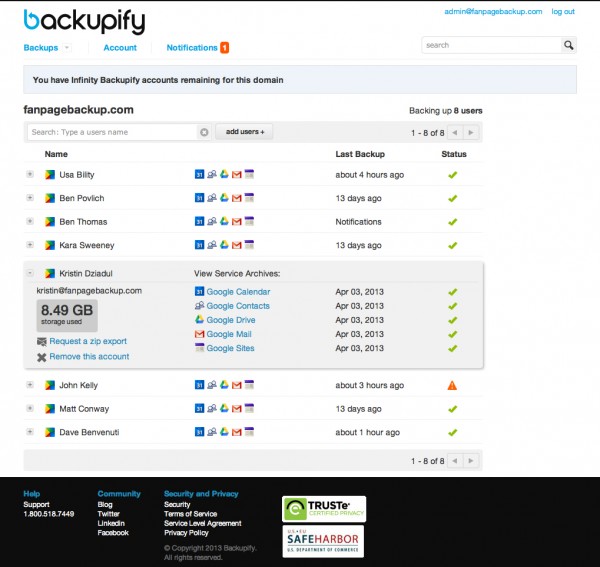
    Backupify is introducing an enhanced set of backup and recovery features designed to support its core offering for enterprise-level organizations on Google Apps. The “Spring Release for Google Apps” includes tools built to offer more efficient ways for administrators and end-users to manage their backups within larger organizations.

    The update, which builds on the Winter Release launched last December, adds the following advanced data recovery and admin controls:

    • Full Domain Export
    • Configurable Data Retention
    • Batch Import of Users
    • Restore and Export Folder Hierarchy
    • Google Sites Restore

    Backupify has also introduced unlimited storage to both its Professional and Enterprise plans.

    “Our updated Google Apps solution highlights Backupify’s focus and commitment to enterprise organizations in need of a complete backup solution that prevents loss of important business information stored on the cloud,” Rob May, CEO of Backupify explains. “Features like configurable data retention, advanced admin access control and domain export capabilities — functionality that’s critical for large companies — were all built as a result of listening to our customers’ ongoing needs”.

    Photo Credit: Andreas Weitzmann/Shutterstock

  • Cisco Strengthens Mobile Strategy With Ubiquisys Acquisition

    Cisco (CSCO) announced its intent to acquire UK-based Ubiquisys, a leading provider of intelligent 3G and long-term evolution (LTE) small-cell technologies that provide seamless connectivity across mobile networks for service providers. The $310 million acquisition strengthens its mobile strategy and business in femtocells and small cells.

    Enabling mobile users to have a faster, more consistent voice and data experience, the Ubiquisys solution delivers a signal over a shorter range. Its indoor small-cell expertise and focus on intelligent software for licensed 3G and LTE spectrum, coupled with Cisco’s mobility portfolio and Wi-Fi expertise, will enable a comprehensive small-cell solution for service providers that supports the transition to next-generation radio access networks.

    “Cisco is ‘doubling down’ on its small cell business to accelerate strong momentum and growth in the mobility market,” said Kelly Ahuja, senior vice president and general manager, Cisco Mobility Business Group. “By acquiring Ubiquisys, we are expanding on our current mobility leadership and our end-to-end product portfolio, which includes integrated, licensed and unlicensed small cell solutions that are tightly coupled with SON, backhaul, and the mobile packet core. For service providers, Ubiquisys supports cost effective coverage and capacity that delivers a differentiated customer experience.”

    Ubiquisys CTO and co-founder Will Franks spoke at the recent Mobile World Congress event about multimode LTE/WiFi/3G indoor metrocells and innovative partner applications for the Ubiquisys smart cell. Ubiquisys has partnered with Intel to develop EdgeCloud technology – an edge computing platform for smart cell applications. Intel CTO Justin Rattner discussed research about its Cloud Radio Access Network (C-RAN) at the Intel Developer Forum last fall.

    Ubiquisys employees will join the Cisco Mobility Business Group, reporting to Partho Mishra, vice president and general manager, Service Provider Small Cell Technology Group. Keeping a slightly faster pace for acquisitions compared to last year, this is Cisco’s fourth acquisition in 2013, and one of the largest European technology deals.

  • Apple Patents A Convertible MacBook Design, And Street View Navigation That Can Go Inside Buildings

    macbook-convertible

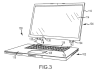
    A couple of new Apple patent applications published today (via AppleInsider) show how the company might be thinking about competing with recent innovations from other big tech companies with similar, but different designs. The first is a filing that describes a convertible MacBook design, with a touch-sensitive screen that separates from the base. The second is a method for navigating a Street View-style view of virtual maps, complete with a twist that allows it to go inside buildings, too.

    The first design for a convertible MacBook may look familiar, since it actually resembles a lot of designs available from Windows device makers, and some previous Android tablet designs. The screen detaches from the keyboard and body portion, which isn’t in itself terribly unique, but the screen in Apple’s version communicates with the brains in the base via Wi-Fi, Bluetooth and other wireless communication protocols, meaning all the serious computing work is still handled by the traditionally located GPU and CPU. The screen itself is touch-sensitive, but doesn’t act as a standalone tablet in quite the same way it does in some new Windows device designs.

    The screen also can charge wirelessly via the same kind of tech used in induction charging, drawing power from the base. What Apple describes here isn’t so much a convertible tablet, but more of a MacBook with a screen that solves the clumsy issue of how to use touch effectively on a notebook by allowing it to temporarily come off the base for more ergonomic touch-based interaction. Apple has talked about how touch doesn’t work on a traditional computer form factor in the past; this is one way around that.

    Another patent application published today could give a clue as to where Apple is headed with Maps. It describes a navigation method for a Street View-style look at the world from the perspective of someone walking the streets themselves. The difference between Apple’s patent and existing Google Street View navigation is that Apple’s is motion controlled, treating the environment as a panorama, which can be navigated based on motion detection from onboard device sensors to let a user truly experience a virtual “walk” through the streets of a city.

    There’s been little evidence to suggest Apple is deploying tech to gather its own Street View-style imagery for Apple Maps thus far, but another recent development at least makes sense given the context of this patent. Apple recently acquired indoor mapping company WiFiSlam, and this patent also describes making use of the system to map and navigated indoor environments, too, so that users could go “inside” select buildings. It was originally filed in September of 2011.

    Both these patent applications seem more like Apple hedging its bets than reflections of any immediate upcoming products, based on recent reports. But they also address issues that could become or are already competitive sore spots for the company, so there’s still a decent chance we may eventually see them make their way to shipping products.

  • Yes, you should care about Bitcoin, and here’s why

    Everybody’s talking about Bitcoin these days, which is quite remarkable given the highly technical nature of the crypto-currency. So why is it such a big deal?

    To explain why, I’m going to start with the implications of Bitcoin, then get into the technical nitty-gritty. Why that way round? Because there’s more to Bitcoin than the technical wow-factor, or indeed the crazy speculation that’s going on now. Even if Bitcoin itself fails, it’s a sign of things to come.

    All about decentralization

    Bitcoin is to state-issued currencies – often referred to as fiat money – as P2P file-sharing is to traditional broadcast media. There is no centralized source for it that can be controlled or moderated or regulated. It is difficult if not impossible to track from the outside. It is more complex to use than its better-known counterpart, but there are at least theoretical advantages to doing so.

    network

    In the case of file-sharing copyrighted content, the big advantage (apart from not paying for stuff) is the ability to ignore program scheduling or territorially-based release windows. In the case of Bitcoin — which has the added advantage of being lawful — users get to send money anywhere in the world for minimal fees, and to protect that money from the political considerations that influence central banks.

    In short, both Bitcoin and file-sharing are peer-to-peer, meaning users get to both cut out the middleman and, on an emotional level, stick it to The Man. That last factor is not trivial: Satoshi Nakamoto (the pseudonym for Bitcoin’s Keyser Söze -like initiator or initiators) seems to have had strong libertarian ideals in mind when he, she or they set the experiment in motion.

    Hang on. “Experiment”?

    Yup. People may be throwing money into Bitcoin at a scary rate (the total value of all Bitcoins passed the billion-dollar mark at the end of March, and some workers may even be opting to receive part of their salaries in Bitcoin), but it remains experimental. No one’s really sure where it will end up, because no one has really done this distributed, borderless digital currency thing for real before – yes, there are Facebook Credits and Linden dollars, but these are still centralized and controlled as such.

    However, now that the train is in motion, in a sense it doesn’t really matter if Bitcoin succeeds or fails. The original Napster failed and guess what? Unlawful file-sharing is still with us, and will remain with us for a long time. On a conceptual level, whatever happens, it’s now very difficult to see a future without Bitcoin or something like it. It may not replace fiat currencies, just as unlawful file-sharing has not killed off lawful distribution, but it may persist as a viable alternative and, by doing so, force change in the way its traditional predecessors function.

    Now’s probably a good time to look at the technical side of what we’re talking about.

    Crypto-currency

    Each Bitcoin user has a digital wallet, which can be stored on a computer or a memory stick, or in a cloud-based service, or technically even on paper. The wallet contains a list of Bitcoin addresses, which in turn contain both public and private cryptographic keys that prove the holder owns their Bitcoins and is allowed to spend them. The addresses are pseudonymous, in that there is no registry of who owns which address, so Bitcoin is great for conducting untraceable transactions.

    To receive a payment, the payee gives one of their addresses to the payer. The payer then uses that address to initiate the transaction, signing with their own private key to prove they have the funds, and the transaction then has to be certified by the network (rather than by banks, as happens with regular money).

    Mining tar sands

    Now this is where the creation of new Bitcoins also comes into play. The network is made up of computers called “miners” that are all competing with each other to solve increasingly complex computational problems. Once a miner beats the others to solving a particular problem, it gets to add the solution as a so-called “proof of work” to a block of transactions, and add that block to the “block-chain” — essentially a record of all Bitcoin transactions that have ever taken place.

    As a reward, the miner gets newly-generated Bitcoins, plus the transaction fees they have set. Apart from generating new Bitcoins, this distributed verification system also ensures that people can’t double-spend their Bitcoins.

    It is important to understand that, while fiat money is issued and controlled by governments and their laws, Bitcoin is generated and controlled by algorithm. While governments can always print more money according to their needs, there will only ever be just under 21 million Bitcoins (right now there are around 11 million), because that’s how the algorithm works.

    Every four years, the number of Bitcoins harvested with each block halves — during the first four years of Bitcoin, each block came with 50 Bitcoins, right now it’s 25, from 2017 it will be 12.5, and so on. But, even after Bitcoins cease to be produced (the current guess is that this will happen around the year 2140), miners will still want to create more blocks because of the associated transaction fees, so the network will still have the incentive to keep the economy going.

    The limit on the number of Bitcoins also makes the system inherently deflationary. As the value of Bitcoin cannot be manipulated by a central authority, as long as the Bitcoin economy continues to grow (and as people lose their Bitcoins, removing them from the system) then it follows that transactions will take place in ever-smaller fractions of a Bitcoin. However, this shouldn’t be as much of a problem as it would be with a normal currency, because Bitcoins are infinitely divisible. There is currently a limit of eight decimal places (taking us down from “bitcents” to the “satoshi”), but even smaller fractions could be enabled in the future.

    Okay, so who’s using it?

    There is some debate around whether Bitcoin is a currency or commodity. The issue there is whether people are converting fiat money into Bitcoin in order to profit off its current meteoric rise in value, or whether they intend to actually spend it.

    Golden piggy bank

    Bitcoin’s critics frequently point out how its big original user base consisted of people frequenting the Silk Road, the underground online marketplace for drugs and other illegal things. Silk Road only allows trade in Bitcoin, but in the offline world people buy a lot more drugs with dollars and euros, so frankly I fail to see the point there.

    It would certainly be a mistake to see Bitcoin’s non-Silk Road usage as widespread, but as people find out about the currency some are certainly starting to use it. You can famously use Bitcoins to buy pizza, but these days it can also be used to pay for VPN and VoIP services, music, cupcakes and, er, Linden dollars. WordPress (see disclosure) takes Bitcoin and Expensify will handle it. “Anarcho-capitalist libertarian” Jeff Berwick also wants to roll out Bitcoin ATMs.

    Does Bitcoin have rivals (apart from fiat money)?

    Yes, although none as successful. For example, there’s an interesting project called Ripple that is just getting off the ground. There have also been multiple previous attempts at creating non-digital alternative currencies, such as the Liberty Dollar, which earned its creator Bernard von NotHaus a counterfeiting conviction. Bitcoin may share the anti-statist motivation behind that wannabe currency, but it’s hard to see how it could constitute counterfeiting.

    Is it smart?

    Technically speaking, Bitcoin is very smart indeed, as it’s the first currency that removes the need for a trusted third party – usually a bank – in financial transactions.

    Business person with idea lightbulb

    That said, however, it’s crazily volatile at the moment. At the start of 2013, one Bitcoin was worth around $13. Things went nuts with the Cyprus crisis in March, and right now the price is bumping up and down around the $137 mark. It certainly looks like a bubble at this point, although the huge amount of interest Bitcoin is getting at the moment could lead to an uptick in use, which would in turn legitimize it as a viable currency. Either way, the current volatility will probably dissuade people from spending their Bitcoins right now, and make life hard for vendors setting prices in Bitcoin.

    Then, despite the supposed inviolability of the Bitcoin itself, there are multiple security issues. Before we even consider nefarious activities such as hacking, an interesting wrinkle in the Bitcoin methodology is that, if you lose your Bitcoin wallet, the money is lost forever, to everyone. If you lose your bankcard, it doesn’t wipe out the money in your account, and your bank will issue you a new one. There is no such mechanism in place here; losing Bitcoins is effectively like burning banknotes.

    Similarly, if someone steals your Bitcoin wallet by hacking into your computer, there is no heavily-insured bank to absorb the loss. You’re on your own. This happened to a user named “allinvain” back in 2011, costing him 25,000 Bitcoins. You can even get Bitcoin wallets for smartphones these days, but then you’re running a big risk if you lose your phone. As for cloud-based wallets, well, Instawallet has just suspended operations after being hacked.

    The best idea is probably to keep your Bitcoins on a device that is securely stored and not permanently connected to the internet.

    Should you get Bitcoins? I don’t know – the value against the U.S. dollar could continue to rise, or the bubble could burst. But frankly, I don’t really care. From where I’m sitting, Bitcoin is already proving its worth as a disruptor and as a test-case for how technology could divorce currency from certain external factors. If it fails, it may hurt those who bought into it big-time, but it’s not a large enough ecosystem to have wider repercussions. And if it does fail, it will have successors.

    Let’s see what happens next, because the crypto-currency genie is out of its box.

    Disclosure: Automattic, maker of WordPress.com, is backed by True Ventures, a venture capital firm that is an investor in the parent company of this blog, GigaOm. Om Malik, founder of GigaOm, is also a venture partner at True.

    Related research and analysis from GigaOM Pro:
    Subscriber content. Sign up for a free trial.