
Category: News
-
Microsoft co-founder’s multi-billion dollar venture firm eyes Silicon Valley
-
3DMark comes to Android platform, now available in Google Play Store

No matter what the platform may be, hardcore gamers are always seeking ways to tweak and improve the performance of their systems. To define that performance, a benchmarking tool is needed and one of the most popular over the years has been 3DMark. Android device owners can now access this popular application with today’s release of 3DMark for Android.
Developer Futuremark Oy indicates 3DMark will run on over 1,000 different Android devices, from smartphones to tablets. With the addition of an Android version, users can now compare benchmark scores with other Android device and Windows tablet users and eventually with owners of iOS and Windows RT devices. For Android devices, Futuremark Oy is making two versions of their Ice Storm test available to check both CPU and GPU performance. The GPU’s capabilities are tested via OpenGL ES 2.0.
3DMark is 283MB in size, so you will probably want to grab this one while on WiFi. The app is free and will run on Android versions 3.1 or higher. If you want to give it a try, use one of the download links below after a short video and some screenshots of 3DMark in action.
Click here to view the embedded video.


Come comment on this article: 3DMark comes to Android platform, now available in Google Play Store
Visit TalkAndroid for Android news, Android guides, and much more! -
Nokia told to make a ‘phablet’ or again risk being left behind

-
MetroPCS merger said to be in trouble unless T-Mobile ‘sweetens’ deal

-
Right on cue: 54.3 percent of Androids run Ice Cream Sandwich or Jelly Bean software
More than half of all Android devices tracked by Google are finally running Android 4.0 software or better. The company posted an update on Google+ as well as its dashboard that helps developers target certain device types for their apps. Based on the most recent period of tracking, 54.3 percent of Android devices hitting the Google Play store run either the Ice Cream Sandwich or Jelly Bean variants of Android software.
Google did make a slight change in how it tracks and counts such information, however. Per the company’s Google+ post:
We’ve updated the way we calculate our device dashboards to make them even more useful, and have also updated the data on screen distribution. Note that as a result of these adjustments, some slices in the pie charts have changed more than usual.
The new device dashboards are based on the devices of users who visit the Google Play Store (rather than devices that have checked-in to Google servers). As a result, the dashboards more accurately reflect the users most engaged in the Android and Google Play ecosystem—and thus most likely to download and use your apps.
This change makes sense from a developer’s standpoint: Instead of counting devices that “check in” — something that could be a simple as signing in or syncing through a Google service — devices that actually visit the Google Play store are counted. Those are the ones that developers are interested in, of course.

Since Android 4.0 was introduced in late 2011, it also makes sense for developers to be focused on writing software that supports Android 4.0 or better. I’m not saying Android 2.3 devices shouldn’t be supported any longer — they still account for 39.8 percent of all Androids — but they’re older devices that are likely to be upgraded soon through a new hardware purchase. Developers will get the most bang for buck by targeting Ice Cream Sandwich and Jelly Bean devices.
The hardware cycle refresh and momentum from handset makers to deliver Android 4.0 or better on new phones is partly why I said in October we’d hit this tipping point in four to six months. Lo and behold, six months later, that’s where we are.

Related research and analysis from GigaOM Pro:
Subscriber content. Sign up for a free trial.- Analyzing the wearable computing market
- CES 2012: a recap and analysis
- NewNet Q4: Platform mania and social commerce shakeout


-
LG finds success with the Optimus G Pro, sells half a million units in first 40 days

-
News story: Privy Council appointment: Hon Lord Bracadale
The Queen has been pleased to approve the appointment of the Hon Lord Bracadale to Her Majesty’s Most Honourable Privy Council following his appointment to the Inner House of the Court of Session.
-
News story: Press briefing – morning 2 April 2013
Welfare
Asked whether the PM thought he could live on £53 per week, the PMS said that the PM believed the benefit levels were fair. Welfare reform was ensuring work paid and unemployed people were supported back into work. Benefits were designed to support people back into work and were not for the long term. Asked whether the government was looking at changing the minimum wage level, the PMS said that the Low Pay Commission were looking at the appropriate level and that the Department for Business would respond, but that it was important the the NMW worked and supported people.
Europe
Questioned about the Balance of Competencies Review and Eurozone unemployment, the PMS said that the review had always intended to be a transparent process and the government had invited other EU member states to contribute. The government understood that some other states saw it as a domestic review. On unemployment, the PMS said that Eurozone economies have impacted UK growth and that the UK needed to stay the course as outlined by both the PM and the Chancellor.
Toll Roads
Asked whether the PM believed there should be a tolled relief road on the M4 in Newport, the PMS said that good infrastructure was vital for the UK economy, but road tolling in Wales was a devolved matter for the Welsh Assembly. The government had a policy not to toll existing roads in England. Any decisions on future schemes would be made after the spending review.
Civil Service
Asked whether the PM believed civil service terms and conditions were too soft, the PMS said that the PM thought that while the civil service do a good job there was need for reform. It was important that the civil service reduced in size and became more flexible, as well as improving project management and procurement skills. The civil service had already seen pay freezes and reforms to privilege days.
Scotland
Asked about Scotland’s independence referendum, the PMS said that the PM believed it was important for people in Scotland to lead the debate. It remained the PM’s view that Scotland and the wider UK were better off with Scotland remaining in the UK.
-
Unannounced Samsung ‘Galaxy S Tab’ tablet seemingly revealed in leaked image

-
Microsoft could push down Windows RT prices to compete with cheap Android tablets
With consumers largely ignoring Windows RT so far, Microsoft (MSFT) may be considering cutting licensing fees to make Windows RT tablets cheaper and help them compete with low-cost Android tablets. Topeka Capital analyst Brian White has released a new research note claiming that Microsoft is planning to release a cheaper version of Windows RT that could result in “a 35-40% price reduction” in Windows RT tablets going forward. News that Microsoft plans to push low-cost Windows tablets comes after the company made some changes to its Windows 8 hardware certification guidelines last week that significantly lowered the minimum resolution requirements for devices, thus potentially paving the way for OEMs to make smaller 7-inch tablets.
-
Verizon Offering Dual-Core LG Lucid 2 For Free Starting April 4

Verizon has a new mid-range device coming soon and will offer the LG Lucid 2 for free on a new two-year contract. We reported the news yesterday and instead of the Lucid 2 being available in retail stores starting April 4, customers will only be able to order online with the phone making its way to physical stores in the coming weeks. The LG Lucid 2 is actually the Optimus F5 and for an entry-level smartphone, offers very reasonable specs.
- 4.3-inch IPS display at 960 x 540 (256 ppi)
- 1.2GHz Qualcomm Snapdragon S4 dual-core processor
- 1GB RAM
- 8GB internal storage with microSD card support up to 64GB
- 5 megapixel rear-facing camera
- 1.3 megapixel front-facing camera
- Android 4.1.2 Jelly Bean
- 2,460 mAh battery
The Lucid 2 is also capable of being charged wirelessly with the wireless charging cover sold separately. For users who want to tap into their Verizon Mobile Share plan, mobile hotspot functionality is built-in as well.
Source: Verizon Wireless
Come comment on this article: Verizon Offering Dual-Core LG Lucid 2 For Free Starting April 4
Visit TalkAndroid for Android news, Android guides, and much more! -
New UCLA institute fosters unified approach to understanding and curing pediatric diseases
For more than 60 years, the faculty and staff at Mattel Children’s Hospital UCLA and the department of pediatrics at the David Geffen School of Medicine at UCLA have conducted pioneering research, delivered state-of-the-art patient care and expertly trained future pediatricians.Now, under the umbrella of the recently launched UCLA Children’s Discovery and Innovation Institute, these efforts will have an even bigger and broader impact. By bringing together pediatric physician–scientists and faculty experts from a variety of fields across the UCLA campus, the new institute will drive multidisciplinary research collaborations focused on children’s health and disease and will help speed the translation of groundbreaking pediatric research findings into clinical practice — locally, nationally and globally.“We are expanding our well-developed foundation to build a dynamic, interdisciplinary support system for our pediatric physician–scientists that fosters new avenues for innovation,” said Dr. Sherin Devaskar, physician-in-chief of Mattel Children’s Hospital UCLA and assistant vice chancellor for children’s health, who holds the Mattel Executive Endowed Chair in the UCLA Department of Pediatrics. “This new paradigm will lead to advancements that can improve the health of children faster and more efficiently.”The institute will pioneer advancements in pediatric medicine in four key research areas: the brain and behavior; nutrition and metabolism; cancer; and inflammation, infection and immunity. Efforts in each area will focus on prevention, screening and treatment, as well as providing training opportunities for the next generation of pediatricians and mentorship programs that enable younger physicians and scientists to learn from UCLA’s cadre of experts.Children are not “small adults,” pediatricians stress, and they experience illnesses and treatments differently than adults. The UCLA Children’s Discovery and Innovation Institute is in a unique position to collaborate with a wide variety of researchers across campus who have expertise not only in science and health but in the unique challenges young people face.“Interdisciplinary research as envisioned by the institute is fundamental to the discoveries that pave the way to major improvements in health,” said Dr. Eugene Washington, dean of the David Geffen School of Medicine at UCLA and vice chancellor for health sciences. “Having access to a variety of specialists and experts with different points of view can be invaluable in nurturing innovations that can ultimately benefit children around the world.”The institute will hold its inaugural fundraiser, the Kaleidoscope Ball, at the Beverly Hills Hotel on Wednesday, April 17. The sold-out event, hosted by actress Patricia Heaton, will honor philanthropists Heather and Steven Mnuchin and Cameron Cohen and musician and actor LL Cool J. Entertainment will include performances by special guests the Blue Sky Riders, Kenny Loggins, the Georgia Middleman and Gary Burr.The event will also showcase 10 custom dollhouses created by more than 20 of the most prominent, award-winning visionaries from the world of design and architecture. The dollhouses will be auctioned off, with 100 percent of the proceeds going to support the new institute.For more information on the UCLA Children’s Discovery and Innovation Institute, visit www.uclahealth.org/cdii.For more news, visit the UCLA Newsroom and follow us on Twitter. -
Who knew? Fiber is also good for a telco’s health
Fiber deployments aren’t just good for the consumers — for small to medium-sized telcos they are also good for the bottom line, resulting in an average operating savings of 20 percent. The data, which came from a Fiber to the Home Council survey issued Tuesday, also noted that the number of homes that can access fiber-to-the-home (FTTH) networks increased by 17.6 percent over a year ago to 22.7 million.
The number of households connected with FTTH now stands at 9.7 million, an increase of more than 20 percent over April 2012.

Most of the cost savings associated with FTTH deployments came from an end to costly maintenance and down time on telco networks, which one would expect if you are going from an aging DSL network to a newer network. However, offering fiber also enabled these smaller and mid-sized telcos to offer TV offerings as well as faster speeds, which enables them to compete against cable or satellite providers.

While in North America the lion’s share of fiber to the home deployments are deployed by Verizon’s massive FiOS build out and a similar (but smaller) Bell Aliant roll out in Canada, the survey notes that over 600 smaller ISPs have deployed fiber to the home in some or all of their footprints and about 100 municipalities have also built out networks. It also found that more than 640,000 North American households now get 100 Mbps service through a FTTH network, and many of those connections offer the same speeds for both uploads and downloads.
Google Fiber in Kansas City and EPB Chattanooga in Tennessee both got a shout out in the release accompanying the survey for their gigabit connections. And for those wondering why their ISP would spend the money to deploy fiber to the home, it’s clearly something customers are warming up to — there’s a 44.8 percent take rate in homes passed — a number that is on the rise.
The survey was conducted for the council by RVA LLC and involved more than 350 telecommunications providers across North America.

Related research and analysis from GigaOM Pro:
Subscriber content. Sign up for a free trial.- Netflix may suffer from limited mobility
- 12 tech leaders’ resolutions for 2012
- LTE changes everything; LTE changes nothing

-
Why I admire the OC Register, even though I disagree with almost everything they are doing
In a post earlier today, I took a look at what the new owners of the Orange County Register have been doing to try and revive the newspaper, based on a long interview I had with co-owner Eric Spitz — a list that includes the hardest of all paywalls, killing off most of the paper’s blogs, and doubling down on print as a source of revenue. Even though I disagree with their approach in almost every case, Spitz and his partner Aaron Kushner deserve some credit for putting their money (a substantial amount of it) where their mouths are.
I confess I’ve been rather fascinated with the Register ever since Spitz and his partner Aaron Kushner acquired it last year and almost immediately started implementing some fairly dramatic changes. Unlike some newspaper owners, they didn’t just start cutting costs to try and save money — the way Advance Publications has with newspapers like the Times-Picayune in New Orleans, for example (media analyst Ken Doctor has called Kushner the “anti-Advance”).
Serve your readers — everything else is secondary
Instead, Kushner and Spitz started spending money on the newspaper, pouring tens of millions of dollars into the Register newsroom — which is now a staggering 50 percent larger than it used to be — hiring reporters and editors, and launching almost a dozen new sections.

However you look at it, that’s a substantial commitment to the principle Spitz and Kushner operate on, which is that serving subscribers is the only thing that matters — not advertisers, not free readers on the web, not the “social conversation” around their content. Just readers who pay. In a sense, it’s a more extreme version of the philosophy that led Andrew Sullivan to launch a subscription-based site with no advertising (although Sullivan, who will be at our paidContent Live conference on April 17, allows for casual web reading).
As a number of media observers — including me — have pointed out, if you are going to put up a paywall, your content had better be exceptionally good. Spitz says he and Kushner are trying to boost the value they are offering to readers by putting resources into the paper (although whether enough people see that value in the same way remains to be seen).
A strong commitment to a vision
If you think of the media industry’s approach to the web as a spectrum, the Daily Mail is at one end, with a totally web-native and non-paywalled strategy: like BuzzFeed or any number of other web properties, the Mail is going to live or die based on viral content, millions of readers and digital advertising. The Orange County Register is at the complete opposite end: no free content whatsoever, a hard paywall and no interest in viral content or social media (readers can always email Register writers if they have something to say, Spitz told me).

To be clear, I think the anti-social aspects of what the Register is doing are bad — not just for the newspaper, but for society as a whole, since discussion around news events has public value, and engaging with readers has journalistic value. And I’m not sure I buy the argument that print-advertising revenue will rebound and even grow if the Register puts more money into the paper. I think the advertising industry is being disrupted just like the media industry is, and I’m not convinced the genie will go back in the bottle quite so easily.
That said, however, at least the Register isn’t trying to suck and blow at the same time, the way so many other newspapers are. Spitz and Kushner aren’t trying a little bit of this and a little bit of that, and hoping that they can be both web-native and print-focused at the same time — they are unabashedly committed to their view, and they are pouring everything they have into it, and that deserves some respect.
Post and thumbnail images courtesy of Shutterstock / Voronin76 and Flickr users 401K and George Kelly

Related research and analysis from GigaOM Pro:
Subscriber content. Sign up for a free trial.- Building a better paywall: strategies for monetizing news content
- How Media Companies Can Compete Online
- Social media in Q1: commerce and discovery dominated

-
Deep Information Sciences scores $10M for its general-purpose database
Investors continue to bet on databases that can handle large swaths and wide varieties of data. The latest proof point: Deep Information Sciences on Tuesday said it has $10 million in new Series A funding to fuel what it calls a high-performing transactional and analytic database. Funding sources include Stage 1 Ventures, Robert Davoli and angel investors.
Based in Portsmouth, N.H., Deep rejects the usual SQL, NewSQL, NoSQL, columnar, streaming and in-memory terminology, preferring the term “general-purpose database.” It handles structured and unstructured data and claims to keep latency low for writes, reads and queries. It aims to efficiently use all the cores of available processors, whether on premise or in the cloud.
One customer, Global Relief Technologies, sped up the work of updating its database with DeepDB with data from employees who log information on their tablets. A process that once took more than a day now takes 17 minutes, according to a Deep spokeswoman.
Other companies offer databases that mix transactional and analytic capability, including SAP, with its HANA database, and JustOneDB. Deep, which has two commercial customers, responds to the differentiation question by claiming DeepDB performed better in tests for many use cases. In one test, it reportedly blew through 1.72 million transactions per second, compared with 32,000 per second in MySQL using the InnoDB storage engine.
The <a href="http://gigaom.com/2013/01/08/idc-says-big-data-will-be-24b-market-in-2016-i-say-its-bigger/"willingness to spend on big data has set the stage for a large pool of database providers, and many claim they have unique products. At the end of the day, it could be that enterprises will want multiple types of databases for multiple purposes. If that’s the case, Deep will need to add customers and use cases demonstrating that DeepDB can beat existing options in the transactional market as well as the hot analytic space.

Related research and analysis from GigaOM Pro:
Subscriber content. Sign up for a free trial.- Health care and big data in 2012
- Infrastructure Q1: Cloud and big data woo enterprises
- NewNet Q4: Platform mania and social commerce shakeout

-
Windows Blue may be released this summer as Windows 8.1

-
Facebook phone images leak, likely to be called the HTC First

Well, if Facebook was trying to hide their phone before the April 4th announcement, they’ve officially failed. We’re getting our first look at the fabled device that’s going to run Facebook’s unique software courtesy of @evleaks on Twitter, and it’s apparently going to be called the HTC First. It is neither HTC’s first phone, nor Facebook’s first attempt at a phone, so I don’t completely understand the naming scheme, but I’m no marketing expert, so maybe I’m just missing something here.
Weird names aside, the First looks like a pretty slick, although generic, device. We can see a volume rocker on the side, a power button on the top, and three buttons along the bottom bezel, presumably a back, home, and menu button, in that order. The rumors say the phone will sport a 4.3 inch screen, and from this render, I’d say that looks pretty accurate. Either way, we only have a few days left before the official announcement. Anyone excited to see this phone in person?
source: evleaks
Come comment on this article: Facebook phone images leak, likely to be called the HTC First
Visit TalkAndroid for Android news, Android guides, and much more! -
9 transportation devices that could make your commute far more fun

A TED2013 attendee takes a ride on a Boosted Board. Photo: Michael Brands
When engineering grad students Sanjay Dastoor, John Ulmen and Matthew Tran met at Stanford University, they lamented the fact that there was no good way to get around campus. And so, they invented one: a longboard skateboard fashioned with an electric motor.
 Sanjay Dastoor: A skateboard, with a boostIn today’s talk, given at TED2013, the three give demo their Boosted Boards — which charge off a wall outlet, run for 1,000 kilometers on a dollar’s worth of electricity and are powerful enough to go up the famous hills of San Francisco at 10 miles per hour. They are small enough to be carried in hand and have a battery range of six miles.
“That covers half of the car trips in U.S. alone,” explains Dastoor.
It’s a fascinating concept — one that would make any skateboard-enthusiast a happy commuter. To see the boards in action, watch this high-energy talk. And below, see several more unusual vehicles that could someday greatly improve the morning commute.
 A car that folds
Mentioned in Kent Larson’s TEDx Talk “Brilliant designs to fit more people in every city,” the Hiriko is a tiny two-person vehicle that folds in order to minimize its parking footprint. Three of these small vehicles can fit into one traditional parking space — which would greatly alleviate one of the biggest hassles of car ownership. As the Hiriko website explains, these vehicles are 100% electric and maneuver by spinning — which is just really cool. An electric bike with handlebars that become a lock
Several electric bicycles are already on the market, even though they aren’t legal in every city. However, the nCycle is a particularly stylish and smart approach to the concept, which design blog Core77 brought to our attention. Designed with its battery inside a space-age frame, it’s meant to be both sturdy and lightweight. It’s handlebars morph into a lock and it has speakers in the back headlights. A motorcycle meets a unicycle
Another design created for urban commuters, the RYNO (left) is a singe-wheel scooter that looks like something a gang in a sci-fi film would ride. Expected to go into production this year, this vehicle runs on a battery that takes an hour and a half to charge, and lets riders go, go, go for about 20 miles, according to Discovery.com. This vehicle self-balances, but if you want the security of a second wheel — the BMW Halbo (right) may be the vehicle for you.A swing for the subway
A group of Washington D.C. Metro riders caused quite a stir when they posted this video of their “Metro Swing” on Vimeo in 2011. The swing attaches to the metal bars of the Metro, and allows anyone to make their own seat and — if there’s room — to channel their inner 5-year-old by swinging. Though it appears to be farce, they should consider manufacturing it. A gyroscopic wheel for one
The Yamaha Wheel Rider looks like it could be a flying saucer. Only instead of moving through the air on its flat face, it rolls along the road on its edge, a la a tire. As The New Ecologist shares, this concept vehicle was designed by Yuji Fujimura and the fin in the back contains its turn signals. An even more beautiful version of a similar idea — Sanu K R’s personal transport system, which the designer tells Gizmag drives via a joystick and stays upright thanks to gyroscopic sensors. The personal jetpack
It’s not at all a cheap option — it costs a reported $100,000. But in September of 2012, The Daily Mail told the tale of a British businessman who used a jetpack to travel 40 miles up the Thames to work. This man imported his jetpack from manufacturer JetLev. And this futuristic turn reminds us of Yves Rossy’s TED Talk, “Flying with the Jetman.”
And a Boosted Boards bonus shot: Jim Carrey tests out the board at TED2013. This shot was snapped by Tony Hawk who wrote on Instagram, “Came to #TED2013 for @amandapalmer, stayed to see Jim Carrey ride an electric skateboard (aka@boostedboards). My life is [still] weird.”

-
Nokia’s next-generation flagship Lumia 950 possibly revealed in leaked photo

-
It’s about time! Microsoft’s consumer cloud calendar gets a new Outlook
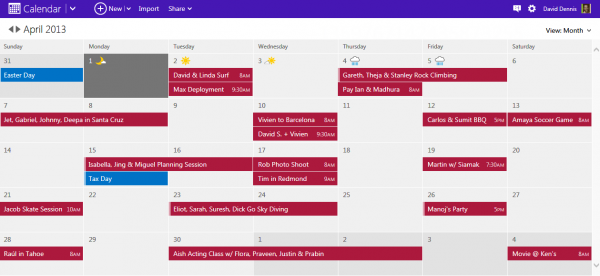
Windows Live Calendar (there’s supposed to officially be “Hotmail” in there) is dead — or soon will be. Today, Microsoft started rolling out the replacement for Outlook.com users. I’ve got the old one still, which is why the not-quite-lifeless-yet reference.
There’s some kind of aspirational, Apple-like promotion going on here. “The Outlook.com calendar has been entirely redesigned with a modern, intuitive interface that puts you in control of your schedule”, David Dennis, Microsoft’s Outlook.com Calendar principal program manager lead, beams. Yeah, baby, put me in control. Gimme the mouse clicker.
But there’s the disappointment of getting the old thing for some of us to contend with. “You can get started with any email address at Outlook.com Calendar as soon as your account is upgraded”, Dennis explains. Hey, that’s not me. You? This week, he promises everyone.
Seriously, if Dennis really wrote this whole post — not PR Borg — someone should promote him to writing all promotional copy for Office 365 and Outlook on the web. I count 29 uses of “you” and 21 of “your” in his blog post introduction. But it’s more than numbers of “you” and “your” but how they’re expressed to make, well, you feel empowered.
The subheads separating main text are great examples: “Across your modern smartphones and tablets”; “connected to what you care about”; and “you’re in control of sharing with friends and family”. The tone is clear: What the Outlook.com calendar will do for you. The best marketing convinces you that your life will be better for using product X, Y or Z.
Perhaps it will be — as long as you aren’t using an Android device. Dennis asserts that “connecting your calendar to your mobile device is easy”. But is it satisfying?
Google and Microsoft are in this scuffle over ActiveSync, which the search giant dropped. So at Google’s insistence, Microsoft agreed to adopt CalDAV, which Google then also dropped. As such, Android users wanting to sync Google and Outlook.com calendars are consigned to Hotmail Hell.
Outlook.com for Android is some popular app. Out of 5,659 reviews, 2,642 are one-star. PU. iPhone and Windows Phone users, you can stop laughing now.


