Category: News

  • Reuters – Goldman Sachs Sets Up Fund for Risky Credit Products

    Goldman Sachs Group Inc. has registered a fund that invests in risky credit products as a publicly traded business development company, a way for the bank to avoid some regulations that would otherwise limit its activity. Goldman’s Liberty Harbor Capital LLC unit will invest in middle-market companies that have weak credit ratings and are underserved by banks, according to a registration filing on Friday with the U.S. Securities and Exchange Commission. Liberty Harbor typically invests in bonds and loans that are not rated by credit ratings agencies, but would be considered less than investment-grade.

    (Reuters) – Goldman Sachs Group Inc (GS.N) has registered a fund that invests in risky credit products as a publicly traded business development company, a way for the bank to avoid some regulations that would otherwise limit its activity.

    Goldman’s Liberty Harbor Capital LLC unit will invest in middle-market companies that have weak credit ratings and are underserved by banks, according to a registration filing on Friday with the U.S. Securities and Exchange Commission.

    Liberty Harbor typically invests in bonds and loans that are not rated by credit ratings agencies, but would be considered less than investment-grade.

    Reuters first reported on Goldman’s plans for the Liberty Harbor business in January.

    Goldman does not expect Liberty Harbor to be subject to the Volcker rule, which would restrict its ability to sponsor or invest in such funds, the bank said in the filing.

    Business development companies are specifically exempt from the Volcker rule.

    Liberty Harbor also qualifies as an “emerging growth company” under the JOBS Act, which will allow it to “take advantage of…reduced reporting and other burdens” that would otherwise be applicable to a publicly traded firm.

    Liberty Harbor will mainly invest in companies with adjusted earnings of $5 million to $75 million a year, across a variety of sectors. Its investments will range in size between $5 million and $50 million, and last from three to 10 years.

    Goldman provided seed funding to the business on November 15, and since then Liberty Harbor has invested about $73 million in eight companies.

    (Reporting By Lauren Tara LaCapra; Editing by Leslie Adler)

    The post Reuters – Goldman Sachs Sets Up Fund for Risky Credit Products appeared first on peHUB.

  • Reuters – Lear Settles With Activist Investors

    Auto parts maker Lear Corp. avoided a proxy battle with investors Marcato Capital Management LLC and Oskie Capital Management LLC by agreeing to increase and quicken the pace of its share buyback program and add a board member, Reuters reported. Marcato – a $1.4 billion hedge fund run by Mick McGuire, one of activist investor William Ackman’s former partners – put pressure on Lear in February, saying it planned to nominate candidates to the company’s board.

    (Reuters) – Auto parts maker Lear Corp (LEA.N) avoided a proxy battle with investors Marcato Capital Management LLC and Oskie Capital Management LLC by agreeing to increase and quicken the pace of its share buyback program and add a board member.

    Marcato – a $1.4 billion hedge fund run by Mick McGuire, one of activist investor William Ackman’s former partners – put pressure on Lear in February, saying it planned to nominate candidates to the company’s board.

    Marcato and Oskie have withdrawn their slate and will support the company’s nominees, Lear said on Monday, after it agreed to expand the size of its board to nine from eight.

    Marcato reported a 5.2 percent stake in Lear in February, but said in March it had raised its holding to 5.9 percent.

    Activist investing has become increasingly popular in the last few months with more money being allocated to the strategy as some players, including Marcato, boast some of the strongest returns in the $2.6 trillion hedge fund industry.

    McGuire’s fund, whose other key holdings include Corrections Corp of America (CXW.N), Cincinnati Bell Inc (CBB.N), NCR Corp (NCR.N) and Ryman Hospitality Properties Inc (RHP.N), ranked among last year’s top performers with a roughly 29 percent gain.

    His low-key approach with Lear likely saved both Lear and Marcato millions of dollars by avoiding a full proxy fight – often costly and disruptive.

    BUMP IN SHARE BUYBACKS

    Lear, which repurchased $200 million of its shares in the first three months of 2013, said it would buy back the remaining $800 million in its program in the next 12 months. Lear had earlier said it would complete the program by the end of 2014.

    Lear also said it would start on a new $750 million buyback program soon after the current plan ended.

    “Over the past two years, Lear has returned more cash to shareholders through dividends and share repurchases as a percentage of our market capitalization than any of our automotive supplier peers,” Chairman Henry Wallace said in a statement.

    The company, which has a market value of more than $5 billion, had cash and equivalents of $1.40 billion as of December 31 and no short-term debt balances outstanding. It had long-term liabilities of $1.37 billion.

    “When you look at the financial impact of doing the repurchases, it will not put Lear at a compromised position,” Guggenheim Securities LLC analyst Matthew Stover said.

    Lear has the flexibility to invest in its own business as well as to pursue acquisitions, Stover said.

    Southfield, Michigan-based Lear reported a fourth-quarter profit in February that beat analysts’ expectations.

    In 2007, Lear rejected a $3 billion buyout attempt by an affiliate of billionaire investor Carl Icahn.

    Lear’s shares were up 1.1 percent at $55.48 in afternoon trading Monday on the New York Stock Exchange. They have gained 8 percent since February 8, when Marcato said it would nominate candidates to the board.

    (Additional reporting by A. Ananthalakshmi in Bangalore; Editing by Sriraj Kalluvila and Saumyadeb Chakrabarty)

    The post Reuters – Lear Settles With Activist Investors appeared first on peHUB.

  • Reuters – Billabong Says Its Still in Talks Over Buyout

    Troubled Australian surfwear firm Billabong International Ltd said on Tuesday it is still in talks with two takeover suitors and requested a trading halt in its shares ahead of a possible announcement this week. Billabong has received offers from a consortium comprised of private equity firm Altamont Capital Partners and U.S. clothing group VF Corp and another group led by Billabong’s former U.S. boss Paul Naude and private equity firm Sycamore Partners. The two competing groups had made indicative matching offers of A$1.10 a share, valuing the company at A$527 million ($549 million), but analysts expect the final bids — which were due in last week — to be around A$0.80-90. That would be slightly above Billabong’s close on Thursday of A$0.73.

    (Reuters) – Troubled Australian surfwear firm Billabong International Ltd said on Tuesday it is still in talks with two takeover suitors and requested a trading halt in its shares ahead of a possible announcement this week.

    Billabong has received offers from a consortium comprised of private equity firm Altamont Capital Partners and U.S. clothing group VF Corp and another group led by Billabong’s former U.S. boss Paul Naude and private equity firm Sycamore Partners.

    The two competing groups had made indicative matching offers of A$1.10 a share, valuing the company at A$527 million ($549 million), but analysts expect the final bids — which were due in last week — to be around A$0.80-90. That would be slightly above Billabong’s close on Thursday of A$0.73.

    The stock, which has lost around two-thirds of its value in the past year, sank to an all-time low of A$0.63 last month.

    VF Corp, which owns brands including The North Face and Vans, only wants the Billabong namesake brand and plans to give Altamont the rest of the portfolio, which includes Von Zipper and Element.

    Billabong said on Tuesday that “discussions in relation to these proposals remain incomplete.” It requested a trading halt until Thursday, or until it is ready to make an announcement if earlier.

    Since the two groups made their initial offers, Billabong has posted a first-half net loss of A$536.6 million and lowered its full-year guidance, citing difficult trading conditions in Europe and a disappointing performance from its Nixon watch brand.

    The VF Corp and Naude offers are the fourth and fifth takeover approaches for the Australian company since February 2012.

    Billabong had a tumultuous 2012, alienating investors after rejecting a A$3.30 per share bid by TPG Capital that February as too low. Subsequent offers of A$1.45 from TPG and Bain Capital were withdrawn after due diligence.

    Billabong, which sponsors current world surfing champion Joel Parkinson, has sold off key assets and replaced its chief executive in the past year as a result of profit downgrades. It raised A$225 million in a deeply discounted rights issue to cut its debt, which currently totals about A$286 million.

    The post Reuters – Billabong Says Its Still in Talks Over Buyout appeared first on peHUB.

  • UrgentRx Closes on $2.5M in New Capital

    Denver-based UrgentRx, which is developing over-the-counter flavored powder medications, recently added an additional $2.5 million in Series B funding. The funding brings the company’s total funding to date to more than $7 million. The round was led by current investors JUMP Investors and Boulevard Capital Partners. New investors include Sam Zell; David Bonderman, founder of private equity giant Texas Pacific Group; real estate magnate Herb Simon; and Academy Award-winning actress Hilary Swank.

    PRESS RELEASE
    UrgentRx®, developer of fast-acting over-the-counter flavored powder medications, today announced that the company has closed an additional $2.5 million in Series B funding, led by current investors as well as attracting new capital. The additional funding brings the company’s total funding to date to more than $7 million.

    “This additional funding will allow UrgentRx to accelerate efforts to reach consumers and support our retail partners as we expand into more and more markets.”

    The round was led by current investors JUMP Investors and Boulevard Capital Partners. New investors in the round include billionaires Sam Zell (Chicago financier and real estate developer), David Bonderman (founder of private equity giant Texas Pacific Group) and Herb Simon (real estate magnate and founder of Simon Properties), along with two-time Academy Award-winning actress Hilary Swank.

    Since closing the initial Series B financing six months ago, UrgentRx has expanded its retail presence into more than 2,500 stores nationwide, including Walgreens-owned Duane Reade, as well as several national retail chains. The company anticipates retail expansion to more than 20,000 to 25,000 locations by Q4 2013.

    After raising $3 million in mid 2012, the company reopened the round due to accelerated momentum at retail. The additional funds will be primarily used to build inventory, produce innovative point-of-sale merchandising, and fund marketing for the national launch.

    “We’ve had tremendous success working closely with Duane Reade and other retailers to create game-changing merchandising systems that take advantage of unused space, turn heads and entice consumers to reach out and grab our products,” said Jordan Eisenberg, president and founder of Denver-based UrgentRx. “This additional funding will allow UrgentRx to accelerate efforts to reach consumers and support our retail partners as we expand into more and more markets.”

    The company’s flagship product, UrgentRx Critical Care Aspirin to Go™, was designed specifically to help increase the chance of heart attack survival when taken at the first signs of heart attack symptoms. Since its introduction, UrgentRx Critical Care Aspirin to Go has been credited with helping to save the lives of more than 10 people who took the 325mg dose of UrgentRx aspirin at the first signs of heart attack. Today the company’s portfolio of products includes Critical Care Aspirin to Go, Allergy Attack Relief to Go™, Headache Relief to Go™, Heartburn Relief to Go™, Upset Stomach Relief to Go™ and Ache & Pain Relief to Go™. UrgentRx Fast Powders come in a convenient, credit-card-sized package containing a single dose of flavored powder medicine that can be taken without liquid for today’s busy, “on-the-go” consumers.

    About UrgentRx

    UrgentRx is a line of fast-acting, portable OTC medications providing right now relief for today’s busy, “on-the-go” consumer. UrgentRx Fast Powders come in an innovative, fast-acting flavored powder format available in convenient, single-dose, credit-card-sized packets for easier portability and accessibility. The flavored powders can be taken without water, providing immediate relief whenever and wherever needed. Initially developed for heart attack victims, UrgentRx currently produces medications for everyday ailments such as allergy attacks, headaches, aches and pains, heartburn, and upset stomach. Based in Denver, Colorado, UrgentRx was founded by entrepreneur Jordan Eisenberg in 2010.

    The post UrgentRx Closes on $2.5M in New Capital appeared first on peHUB.

  • Pandora gets lock screen controls for Android

    Pandora gets me through my days. As I am in an office of one person I need to create my own entertainment and the music streaming service on my Galaxy Nexus is one of my favorite options. This morning when I awoke and checked my phone I found that the app had just improved for me and every other customer.

    Today Pandora rolls out several new updates to upgrade the streaming music service — providing you are running Android 4.0, Ice Cream Sandwich, or later. That is the level of the mobile operating system you will need to get the most important of the new features, which is lock screen controls. The control is simple — just play-pause and skip buttons, along with the artist and song title that show you what is currently playing.

    If you are running an earlier version of Android, fear not, you get some of the updates as well. All versions now boast a faster boot up time, elapsed and remaining timestamps for the track progress indicator, and the usual assortment of bug fixes and minor enhancements.

    As I frequently need to quickly pause my music when life — like wife or kids — intrude, the lock screen control addition is a huge advantage for Pandora and makes the bit of money I pay on a monthly basis even more worth the small automatic withdrawal that my bank account suffers.

  • Collective Bias Inks $10.5M Series A

    Updata Partners led a $10.5 million Series A round for social shopper media startup Collective Bias. The company will use the money to expand its content management platform, as well as expand its staff.

    PRESS RELEASE

    Collective Bias®, the leader in social shopper media, announced today the completion of a Series A investment round led by Updata Partners for $10.5 million.

    “This investment round provides Collective Bias with runway to extend our four year leadership role in this new media category. We will employ these dollars to robustly enhance our Social Fabric® content management platform, enter new markets and grow our team.”

    The company concluded 2012 with its third consecutive year of triple-digit growth, along with validation from major Fortune 500 companies. This funding round represents the opportunity to accelerate key business initiatives including expansion to international markets.

    “We believe that social shopper marketing is the evolution of shopper media, and supplants tired traditional media like FSI’s, retail circulars and digital display advertising,” said John Andrews, co-founder and CEO of Collective Bias. “This investment round provides Collective Bias with runway to extend our four year leadership role in this new media category. We will employ these dollars to robustly enhance our Social Fabric® content management platform, enter new markets and grow our team.”

    With Technorati’s 2013 Digital Influence Report indicating that “consumers are turning to blogs when looking to make a purchase,” Collective Bias continues to grow on the insight of Andrews and co-founder Amy Callahan that advertisers could create greater engagement with their shoppers through the channels in which they engage today – be it Facebook, Twitter, Pinterest or a simple, pre-shop search.

    “Harnessing the power of social media to drive brand recognition, loyalty and sales are C-level priorities for consumer-focused companies, and Collective Bias has a record of delivering impressive results for its customers,” said Jon Seeber of Updata Partners. James Socas, a general partner at Updata Partners, added, “Collective Bias’ combination of shopper marketing expertise and brand and retail experience are a powerful combination in the new era of marketing, and we look forward to helping them drive even more value and growth.”

    Collective Bias operates Social Fabric®, a proprietary community of over 1,400 shopping-focused influencers, blending members’ shopping experience and product usage through engaging stories that are published online and shared with like-minded friends and followers. With an aggregate multichannel reach of more than 50 million, the Social Fabric community represents a true extension of the Collective Bias team, providing continuous, valuable feedback that has redefined the relationship between brands, retail clients and consumers.

    The financing process was facilitated by Gridley & Company, LLC, a New York-based boutique investment bank that provides financial advisory services to companies in the digital and information services industries.

    About Collective Bias

    Based in Bentonville, Arkansas, Collective Bias is a social shopper media company that weaves organic social content into engaging, real-life stories to create millions of impressions leading to increased share of voice, SEO, and ultimately sales for brands and retailers such as Tyson, Nestle and Smart & Final. The company has satellite offices in New York City, Chicago, Minneapolis, San Francisco, Toronto and London. Collective Bias was named one of America’s Most Promising Companies in 2013 by Forbes.

    Social Fabric® is a proprietary community consisting of approximately 1,400 shopping-focused influencers with an aggregate multichannel reach in excess of 50 million. All rights reserved.

    For more information, please visit Collectivebias.com or find us on Facebook and Twitter.

    About Updata Partners

    Updata Partners is a leading technology-focused growth equity firm with nearly $500 million of capital under management. Updata invests in high-growth technology-enabled services, software, and Internet companies with innovative intellectual property and market-leading solutions. Led by an investment team averaging more than 20 years of experience in the technology industry, Updata seeks investments where the combination of the firm’s financial backing and the operating expertise of its partners will accelerate growth.

    The post Collective Bias Inks $10.5M Series A appeared first on peHUB.

  • Mobility Ventures Backs Indoor Atlas

    Indoor Atlas Ltd., which is developing technology that utilizes magnetic anomalies inside buildings and smartphones in order to accurately pinpoint positions indoors., recently closed a 500,000 euro ($642,000) seed round. Mobility Ventures participated in the round. The Finland-based startup was founded in 2012 as a spin-off from the University of Oulu, Finland.

    PRESS RELEASE
    Mobility Ventures, a leading global venture capital firm in wireless, today announced an investment in a new disruptive indoor positioning and mapping technology company called Indoor Atlas Ltd. which is the world’s first company to utilize magnetic anomalies inside buildings and smartphones to accurately pinpoint positions indoors. The Finland-based startup was founded in 2012 as a spin-off from the University of Oulu, Finland.

    “In the area of indoor navigation, Indoor Atlas has developed a sustainable competitive technical advantage based on unique technology. Leveraging from this, Indoor Atlas is in a strong position to establish a leadership position in the emerging market of mobile indoor positioning and navigation”

    “Indoor positioning is the next frontier for location-based services, offering a plethora of diverse applications and the ability of providing rich contextual information about people and objects that can prove to be very valuable when combined with ‘big data’ kinds of analytics presenting enticing advertising and branding possibilities which could revolutionize retail marketing,” says Roman Kikta, Managing Partner, Mobility Ventures. “Our investment in Indoor Atlas represents our strategic commitment to identifying and investing in disruptive innovations which empower today’s digital lifestyles.”

    “With the rapidly growing location-based services market, more and more companies are interested in integrating indoor positioning and navigation capabilities into their products,” states David Sym-Smith, Partner, Mobility Ventures. “Apart from by improving the ability to analyze customer behavior and influence it with quick calls to action to increase sales, universities could allow students to chart classrooms, hospitals could streamline the movement of patients, and organizations & governments can track movement of people for convenience and safety purposes.”

    Indoor Atlas’ Founder & CEO Dr. Janne Haverinen, Ph.D., states, “Moving consumers from point A to point B can be a challenge in itself as GPS requires satellite line of sight and doesn’t work indoors. Indoor Atlas employs the smartphone’s built-in magnetic field sensor; magnetic signatures are collected inside buildings. These signatures displayed unique patterns which Indoor Atlas analyzes resulting in an indoor navigation positioning and navigation solution that radically improves navigation capabilities in environments where GPS and Wi-Fi systems are unavailable.” For more information visit: www.indooratlas.com

    “In the area of indoor navigation, Indoor Atlas has developed a sustainable competitive technical advantage based on unique technology. Leveraging from this, Indoor Atlas is in a strong position to establish a leadership position in the emerging market of mobile indoor positioning and navigation,” states Lothar Pauly, Managing Partner-Europe, Mobility Ventures.

    About Mobility Ventures

    Mobility Ventures is a leading wireless venture capital firm with a global team possessing an unparalleled combination of domain focus, technical & market expertise, global operational and venture investment experiences to identify, invest and help build industry dominating companies. Mobility Ventures focuses on companies across the wireless ecosystem and provides both investment capital and critical strategic management support needed for business and financial success.

    The post Mobility Ventures Backs Indoor Atlas appeared first on peHUB.

  • Hybrid Technology Kills Diesel Demand in U.S.

    Ram and Chevy have introduced new diesel-powered cars and trucks, yet improved gasoline and hybrid engines are hitting the market too. With improved hybrid engines, is the 2013 diesel revolution dead before it began?

    Hybrid Technology Kills Diesel Demand in U.S.

    The diesels are coming, the diesels are coming! Is the hybrid engine going to kill their demand?

    A news story in the Detroit News says that while it seems like diesel engines are seeing a rebirth (see: Ram 1500, Chevy Cruze, etc.) that hybrid engine technology will slow that demand and smother interest before it can really grow. This is due to diesel engines losing their edge over gasoline in the last several years.

    Historically, diesel engines have been known for having more torque, better fuel economy and greater resale value. There was also a time in the U.S. when diesel fuel was significantly cheaper than gasoline. Now times have changed with diesel fuel prices above gas and gasoline engines making vast improvement in terms of torque and fuel economy. Throw in the new hybrid technology that has the same MPG numbers and at a significantly less upfront cost – diesel technology has lost quite a bit of ground.

    For example, one of the comparisons that the article makes is in the new Chevy Cruze. You can buy this compact car in a hybrid or diesel variety soon. The numbers from GM show that both the hybrid and the diesel get the same MPGs while the cost difference, hybrid is $4,000 less than the diesel, creates a stark difference for the consumer.

    For the truck customer this argument is a bit different, yet there are similarities. For example, at this point it is anybody’s guess what will happen when the Ram 1500 diesel comes out.  Most diesel fans expect it to run quietly, have more torque and better fuel ratings that the gasoline engine. However, even Allen Schaeffer executive director of the nonprofit Diesel Technology Forum admits to the Detroit News:

    “There is quite a competitive landscape today, compared to what it was five or 10 years ago,” he said.

    When you talk about the increased upfront cost and the closing of the gaps between gas and diesel technology, it even gets tougher to buy a diesel.  ”The math is not a great payback,” Schaeffer said. “But when you take into account the residual, there is some added value there.”

    Schaeffer is right that diesel holds its value longer than gas engine vehicles. Is that a product of the diesel engine or the lack of diesel vehicles in the market? Probably a little of both with the lack of inventory most likely playing a larger role.

    “In spite of the resale value and fuel economy advantages, consumers in the U.S. have been slow to accept this different form of powertrain and as a result, there are not a lot of diesel vehicles to choose from,” said Eric Ibarra, KBB’s director of residual values.

    The Detroit News found that:

    Last year alone, U.S. sales of diesel vehicles rose 25 percent. But as a percentage of total industry sales, diesels made up only 2.7 percent of new-car purchases, said Edmunds.com. Hybrid vehicles — at about 3 percent of industry sales — outsold diesels in 2012.

    With the emissions standards in Europe coming close to the U.S. in 2018, the excitement to finally get the forbidden fruit is growing. Yet, European sales of diesel cars is “waning.” Is Europe done with the diesel engine as well?

    Still there are proponents of diesel engines who would like to see a diesel, electric hybrid. Now that is more likely the future of the diesel engine.

    It is going to be interesting to see which technology emerges, hybrid gasoline or straight diesel. It seems all automakers are taking different approaches and who knows at this point which one is the best one. Consumers though will finally have a chance to have their say when the Ram 1500 and the Cruze go on sale.

    What do you think? Have automakers used their power to deny U.S. consumers diesel technology for so long that once it comes, it will be outdated? Or will new diesel vehicles like the Ram 1500 or Chevy Cruze re-new interest to such a degree that a diesel re-birth will occur?

    Related Posts:

    The post Hybrid Technology Kills Diesel Demand in U.S. appeared first on Tundra Headquarters Blog.

  • With Goodreads, Amazon Fills Out an Advice Portfolio

    Amazon.com announced last week that it would purchase Goodreads, a social network for bookworms. As the “world’s largest site for readers and book recommendations,” Goodreads can help make Amazon the definitive place to go for book-related information. But does Amazon really need that help? The company is already the biggest provider of book advice, with its top-secret personalized recommendation algorithms, trusted user reviews, and inside-the-cover previews. So what makes Goodreads such an attractive acquisition?

    The answer, we believe, lies in the changing nature of advice-getting in the digital age. In recent years, many new sources of customer influence have become available thanks to technology advances, with significant new power to shape how customers think about products, services, and company reputations.

    There have always been friends and family we trust, journalists and film critics we find credible, and publications like travel guides or Consumer Reports that we know are reliable. Today, we add to that a great deal more. We have the interactivity of social networks like Facebook and Pinterest, the consensus-building opinion aggregators like Yelp and Rotten Tomatoes, the objectivity of automated recommendation engines like those of Netflix and Pandora, and the comprehensiveness of price-comparison services like Priceline and Google Shopping. Through digital media, even the “old” forms of advice are now more accessible and more potentially viral than ever before. All told, consumers can get a far greater wealth of purchasing advice from their smartphone in an instant than they can from watching ads, listening to salespeople, or even chatting with friends at a dinner party. Our recent research into the subject revealed at least ten unique sources of advice, nearly all of which have been enabled or enhanced by digital media.

    Recognizing this new influence landscape, some companies with cash to spend have started advancing a new strategy — one we call “advice consolidation.” This approach recognizes that consumers are drawn to different sources of advice for different reasons and at different times, and that the best way to keep customers engaged is to offer a diverse portfolio of guidance.

    Consider, for example, Google’s 2011 acquisition of Zagat Surveys, one of the most trusted and established names in restaurant reviews. Marissa Mayer, then Google’s VP for Local, Maps and Location Services, blogged at the time that she was “incredibly excited to bring the power of Google search and Google Maps to [Zagat’s] products and users, and to bring their innovation, trusted reputation and wealth of experience to our users.” For Google, this was the perfect advice consolidation play. The search giant not only enhanced the usefulness of its local listings, but by combining the recognized expertise of Zagat with maps, search, and user reviews, it differentiated itself from local opinion aggregators like Yelp (which, incidentally, Google also once tried to acquire).

    While Google brought recognized expertise into its portfolio, health information portal WebMD — an online service already renowned for its reliable expertise — moved to diversify and consolidate its advice portfolio in a different but related direction. The company, long known for its informative articles on symptoms, treatments, and other health-related matters, decided in 2010 to give its readers another source of advice: active communities of peers who are looking to find or share information about particular health issues. The result of this effort was WebMD Exchange, where registered users can join expert-led communities, or alternatively create their own public or private support group. Through the communities, members can share their experiences, discuss their personal challenges, and receive direct answers in close to real-time.

    Why did WebMD venture into peer communities? Because, as Nan Forte, EVP of consumer services at the time, explained, what readers sought beyond the site’s vast collection of articles was “specificity, and finding people like me. People who are starting their own [communities] are very specific: cancer patient who has heart disease and is a single mom. That becomes a community.” The personalized support and ongoing interactions on offer in the communities contrasts starkly with the longer expert articles that are the mainstay of the site. And yet, the two types of advice end up complementing each other, and WebMD has integrated links to its public communities throughout the site’s core content areas.

    This brings us back to Amazon, and the reason why the bookseller has now chosen to incorporate a social network into its broader offerings. Amazon’s recommendation engine is clearly effective at introducing customers to a diverse set of books and products; JP Mangalindan at Fortune.com argues that a lot of the company’s extraordinary growth “has to do with the way Amazon has integrated recommendations into nearly every part of the purchasing process from product discovery to checkout.” But these automated recommendations are still very different than suggestions from a trusted friend.

    Meanwhile, Amazon’s user reviews are typically helpful for customers choosing whether to make a purchase or not, and the fact that reviewers are crowd-rated lends an impression of trustworthiness and impartiality. But static reviews don’t personally respond to questions — in other words, reading the reviews page still isn’t comparable to engaging in an active conversation and building relationships with like-minded individuals.

    Goodreads therefore bridges an important gap in Amazon’s advice portfolio, and will keep customers engaged on a new front in the Amazon universe.

    The Goodreads acquisition also highlights one of the difficulties inherent in advice consolidation: convincing consumers that the different sources of advice will remain truly complementary and not complicit when united into the same business. With Amazon’s announcement, one writer took to Twitter to exclaim, “Say hello to a world in which Amazon targets you based on your Goodreads reviews. No company should have this power.”

    Can Goodreads remain an independent and active social network under Amazon? Will Zagat stay a trusted source for expert reviews under Google? Will WebMD’s Exchange continue to provide supportive communities if the site’s paying sponsors become too directly involved? Advice consolidators will have to walk a narrow line between advocating for both buyers and sellers, but that’s the price they’ll pay for keeping their customers in the fold.

  • AT&T bringing HD Voice to its LTE network this year

    AT&T HD Voice
    AT&T (T) is planning to follow in T-Mobile’s footsteps by deploying HD Voice technology over its LTE network by the end of the year. Per AllThingsD, AT&T senior VP Kris Rinne said that “HD Voice is part of our voice over LTE strategy” and that the company would have it up and running sometime in 2013. HD Voice, which T-Mobile said would be available on its recently launched LTE network, is a type of voice technology that aims to deliver clearer voice calls and eliminate most background noise by using an algorithm that significantly increases the number of voice frequencies transmitted.

  • Brazos Private Equity Backs European Wax Center

    Dallas-based private investment firm Brazos Private Equity Partners has put an undisclosed amount of money into European Wax Center, a provider of facial and body wax treatment services. Princeton Ventures, a private investment firm based in Princeton, NJ, invested alongside Brazos.

    PRESS RELEASE
    Brazos Private Equity Partners, LLC, a leading Dallas-based private investment firm, announced today an investment in European Wax Center (“EWC” or the “Company”), the leading provider of facial and body wax treatment services through its network of franchise stores. Financial terms of the transaction were not disclosed. Existing management, led by co-founders David and Josh Coba, who serve as CEO and COO, respectively, will continue to run the Company and will retain a significant equity stake in the business. Princeton Ventures, a private investment firm based in Princeton, NJ, invested alongside Brazos in this transaction.

    “The investment in EWC is an exciting opportunity for Brazos to invest in a category-leading consumer company with a strong business model and exceptional growth potential”

    Based in Hallandale, FL, EWC provides facial and body waxing services and related cosmetic and beauty products through its franchise network of more than 250 stores. EWC has become one of the fastest growing franchise concepts in the United States by developing proprietary wax and a waxing process that it believes is more comfortable and provides better results than competing hair removal service offerings.

    “The investment in EWC is an exciting opportunity for Brazos to invest in a category-leading consumer company with a strong business model and exceptional growth potential,” said Jeff Fronterhouse, Co-Chief Executive Officer and Co-Founding Partner of Brazos. “We look forward to working closely with the Coba family and other members of management to help EWC continue to execute its growth plan.”

    “I am tremendously excited about EWC’s future, and our new partnership with Brazos will be an extraordinary step in EWC’s development,” said David Coba. “My family has developed EWC into a market-leading company and we look forward to leveraging Brazos’s expertise and network of relationships as we look to further grow our business.”

    About European Wax Center

    European Wax Center, headquartered in Hallandale, Florida, is the industry leading franchisor serving the growing health & wellness and personal care consumer categories by providing facial and body wax treatment services and related products in franchised stores. With over 250 stores open across 31 states, EWC is one of the fastest growing franchise concepts in the United States.

    About Brazos Private Equity Partners, LLC

    Brazos Private Equity Partners is a Dallas-based private equity firm that manages approximately $1.4 billion of equity capital. Brazos focuses on investments in leading middle-market consumer, healthcare, commercial & industrial, and business services companies, and partners with outstanding management teams and/or families of closely-held businesses to maximize growth and shareholder value. Brazos has been one of the most active middle-market private equity investment firms, having completed in excess of 80 transactions over the past decade.

    The post Brazos Private Equity Backs European Wax Center appeared first on peHUB.

  • Reuters – Nasdaq Buys eSpeed for $750M

    Nasdaq OMX Group Inc. agreed to buy electronic Treasuries-trading platform eSpeed from BGC Partners Inc. for $750 million in cash, providing the exchange operator an entry into one of the world’s largest and most liquid cash markets, Reuters reported. The deal gives Nasdaq more exposure to fixed income markets, fitting into the company’s strategy of expanding in asset classes beyond stock trading, where volumes have been depressed for years.

    (Reuters) – Nasdaq OMX Group Inc agreed to buy electronic Treasuries-trading platform eSpeed from BGC Partners Inc for $750 million in cash, providing the exchange operator an entry into one of the world’s largest and most liquid cash markets.

    The deal gives Nasdaq more exposure to fixed income markets, fitting into the company’s strategy of expanding in asset classes beyond stock trading, where volumes have been depressed for years.

    More than $500 billion in U.S. Treasuries change hands daily.

    The acquisition helps to diversify Nasdaq’s U.S. offerings, said Christopher Allen, an analyst at Evercore Partners.

    “You always want some asset class diversification which Nasdaq really doesn’t have in the U.S., where they just have cash, equity and equity options,” he said.

    Nasdaq plans to offer customers increased access to fixed income products and a greater variety of trading instruments as a result of the acquisition, Chief Executive Robert Greifeld said on a call with analysts.

    The total consideration for the deal is up to $1.23 billion, including an earnout provision that could pay out up to $484 million in Nasdaq OMX common stock over 15 years, BGC said.

    Greifeld and Howard W. Lutnick, chairman and CEO of BGC Partners, have been in informal talks about a possible deal for the past few years, according to two sources familiar with the situation, who declined to be identified because they are not allowed to speak to the media.

    But these people said the conversations heated up late last year after IntercontinentalExchange Inc announced it was buying Nasdaq rival NYSE Euronext for $8.2 billion.

    Two spokeswomen for BGC were not immediately available to comment. Nasdaq had no comment.

    BGC was spun off from Cantor Fitzgerald in 2004.

    Nasdaq said last month it planned to create a market for trading shares of unlisted companies in a joint venture with trading platform SharesPost Inc. And it announced in December it was buying Thomson Reuters Corp’s investor relations, public relations and multimedia services units for $390 million.

    PUSHING THE ENVELOPE

    The eSpeed deal is expected to add to Nasdaq’s earnings within the first twelve months after closing – expected by mid-2013 – the exchange operator said.

    The risk for Nasdaq, however, is that it is buying eSpeed at a time when trading Treasuries might be at a cyclical low, Evercore’s Allen said.

    The U.S. Federal Reserve has been buying large amounts of Treasuries through its quantitative easing program. The result is that rates have stayed low and volatility and trading volume have been capped.

    Greifeld, however, said government intervention would eventually cease, leading to a positive impact on volume. The United States is also issuing more debt, boosting the market for Treasuries, he said.

    Most Wall Street economists do not expect the Fed to begin curtailing its asset purchases for another year. Short-term interest rates, which have been stuck near zero since December 2008, are not forecast to rise until 2015, the Fed’s latest projections show.

    Nasdaq currently offers Treasury options trading in the United States and is close to launching NLX, a Europe-based fixed-income futures trading platform to compete with Deutsche Boerse AG-owned Eurex and NYSE’s London-based Liffe.

    The deal differentiates Nasdaq in fixed income from other exchange operators, which have mainly been focused on interest rate swap clearing and swaps-like futures trading, said Will Rhode, a fixed income analyst at Tabb Group. “We really see Nasdaq pushing the envelope on different approaches to the fixed income markets,” Rhode said.

    Nasdaq plans to spend the next several weeks talking to customers and learning about what other products they want to access on an electronic trading platform, Greifeld said. “The easiest low hanging fruit is in the U.S. Treasury marketplace,” he said.

    Nasdaq expects to fund the purchase with cash on hand and long-term debt.

    Following the deal, Moody’s Investors Service said it was reviewing Nasdaq’s Baa3 bond rating for a possible downgrade.

    Deutsche Bank was Nasdaq’s financial adviser on the deal.

    Shares of Nasdaq closed down 0.9 percent at $32.01 on Monday. The deal was announced after the market closed.

    Shares of BGC were up 92 percent in after-hours trading following the deal’s announcement.

    (Reporting by Ashutosh Pandey in Bangalore, John McCrank and Jessica Toonkel in New York, and Ann Saphir in San Francisco; Editing by Sreejiraj Eluvangal and Edmund Klamann)

    The post Reuters – Nasdaq Buys eSpeed for $750M appeared first on peHUB.

  • Podcast: How Hugh Howey’s Wool became a self-published smash hit

    Hugh Howey’s self-published sci-fi thriller, Wool, has sold hundreds of thousands of copies as an ebook. Last fall, Howey signed a seven-figure, print-only deal with traditional publisher Simon & Schuster, and Fox and Ridley Scott have acquired the film rights.

    Our upcoming paidContent Live conference will highlight the changes in the book publishing business, and Howey exemplifies many of these trends. In this podcast, the second in a series featuring digital media creators who are successfully building their own independent empires, we talk to him about his success and what’s next.

    paidContent Live takes place in New York on April 17.

    (Download this episode)

    Subscribe to the Podcast RSS feed

    iTunes

    Stitcher Radio

    SELECT PREVIOUS EPISODES:
    Why the digital age needs an effective content licensing strategy

    T-Mo’s no plan, SummlYahoo and everyone’s a paparazzi

    IoT: Why the Hue internet lightbulb is a bright idea

    Call in podcast: T-Mobile iPhone and the best Android keyboard

    Podcast: How IBM uses chaos theory, data and the internet of things to fix traffic

    Podcast: How Indie Game stayed “indie” and became a hit

    Call in podcast: T-Mobile iPhone and the best Android keyboard

    Samsung Galaxy S 4 blasts off, RIP Google Reader

    Electric Imp aims to make the Internet of Things devilishly simple

    Call-In: Galaxy S 4 predictions, Chromebook Pixel cloud storage

    Podcast: Facebook’s feedin’; Lean In’s meanin’; and everyone’s Hadoop-in

    Related research and analysis from GigaOM Pro:
    Subscriber content. Sign up for a free trial.

  • Circuit Playground Is Adafruit’s Educational Series For Helping Kids Learn About Electronics

    circuit-playground

    Adafruit, the DIY electronics website and marketplace, is espousing the popular strategy of “get em’ young” with a new live action short video series broadcast on YouTube. The series, called Circuit Playground, takes an alphabetical approach to teaching kids about the basics of circuits, components and concepts that will come in handy if the tots watching have aspirations of becoming electrical engineers, or just of building their own hobby projects at home.

    The inaugural episode covers amperes, the unit of measurement for electric current flowing through a circuit. The co-hosts are Adabot, an adorable robot puppet helping keep the kids entertained, and Adafruit founder Limor Fried, providing easy-to-follow, but not patronizing explanations of the concepts involved. The intro features a number of animated characters representing circuit components, and there’s even a special guest appearance from André-Marie Ampère, after whom the ampere is named, so there’s an element of science history in the mix, too.

    At less than 5 minutes, you also won’t have to keep your kids focused too long to take in the message. And if you’re a big kid who might not be all that well versed in the basics of circuits and electronics, you’ll probably learn something, too.

  • North Castle Partners Sells gloProfessional

    North Castle Partners said Tuesday that it had completed the sale of Caleel + Hayden Holdings Inc., which does business as gloProfessional. The company is a developer and marketer of mineral-based cosmetics. Terms of the deal were not released.

    PRESS RELEASE
    North Castle Partners, a leading private equity firm focused on investments in consumer-driven companies that promote Healthy, Active and Sustainable Living, announced today that it has completed the sale of Caleel + Hayden Holdings, Inc., d.b.a gloProfessional (“gloProfessional” or “glo”). The terms of the transaction were not disclosed.

    gloProfessional is a leading developer and marketer of mineral-based cosmetics under the glominerals brand and premium skin care under the glotherapeutics brand. glo serves over 5,000 dermatologists, cosmetic surgeons, aestheticians, spas and salons (the “professional channel”) both domestically and internationally, as well as select specialty retailers. In addition, the company recently launched to the same customer base a line of hair care products under the gloessentials brand name. gloProfessional reaches its customers through a proprietary field sales force of over 65 team members, which is one of the largest in the professional channel.

    “Our investment in glo was a successful exit for North Castle and represents another strong partnership within the personal care sector,” said North Castle Managing Director Jon Canarick. “During North Castle’s ownership, glo has been transformed from a distributor with only half of its sales being generated from proprietary brands to a company that realizes virtually all revenue from its suite of glo brands. We believe the company is well positioned for further growth.”

    “We believe the way glo grew coming out of the recession illustrates the benefits our focused approach to partnering with management teams to build great companies. As the professional channel continues to pick up momentum, glo is well positioned to capitalize on that growth and achieve continued success,” said North Castle’s Managing Partner Chip Baird. “We continue to look for opportunities across the Healthy, Active and Sustainable Living markets to leverage our knowledge, network and experience in building market leaders like gloProfessional.”

    North Castle has sold gloProfessional to private equity firm Swander Pace Capital and its affiliates and the Company was advised by Wells Fargo Securities. Mark Hayden, founder and CEO and Sean Butler, President, will continue to lead the company and remain significant minority shareholders. “We are pleased that management has found strong partners in Swander Pace Capital to help lead the company through its next chapter,” added Jon Canarick.

    Mark Hayden said, “North Castle has been a great partner, and at the same time I’m excited about working with Swander Pace who brings fresh ideas and resources to the company as we continue to expand.”

    Wells Fargo Securities served as exclusive financial advisor to gloProfessional in connection with the transaction. Morrison Cohen LLP served as legal counsel to gloProfessional and Kirkland & Ellis LLP served as legal counsel to Swander Pace Capital.

    About North Castle Partners

    North Castle Partners is a leading private equity firm focused on investments in consumer-driven product and service businesses that promote Healthy, Active, and Sustainable Living. North Castle is a hands-on, value-added investor in high-growth, middle market companies in the (i) beauty & personal care, (ii) consumer health, (iii) fitness, recreation & sports, (iv) home & leisure and (v) nutrition sectors, among others. North Castle’s current portfolio includes such well-known brands as Curves International, Palladio Beauty Group, Mineral Fusion, Red Door Spas, Performance Bicycles, World Health, Octane Fitness, Ibex Outdoor Clothing, and Flatout Flatbreads. Prior portfolio company holdings include Atkins Nutritionals, Cascade Helmets, Bora-Bora Organic Foods, gloProfessional, Equinox Fitness, EAS, Enzymatic Therapy, CRC Health Group, Doctor’s Dermatologic Formula, Naked Juice Company, and Avalon Organics / Alba Botanicals. North Castle and its operating executives and advisors partner with management to bring a wide range of strategic and operational capabilities, as well as an extensive knowledge base and network to build world-class companies. North Castle is headquartered in Greenwich, CT.

    The post North Castle Partners Sells gloProfessional appeared first on peHUB.

  • NXT Capital Launches NXT Capital Equipment Finance

    Chicago’s NXT Capital has launched a new business: NXT Capital Equipment Finance, which will offer loans and leases from $2 million to $20 million to finance new and used equipment for middle-market companies. The new business will be led by Michael Gay.

    PRESS RELEASE
    NXT Capital (www.nxtcapital.com) today announced the launch of NXT Capital Equipment Finance. This new business will be led by Michael Gay, an equipment finance industry veteran.

    NXT Capital Equipment Finance offers a full range of flexible financing solutions to middle-market companies nationwide. The group will provide loans and leases from $2 million to $20 million to finance new and used equipment for companies with revenues of $50 million and above across most industries. Products include secured term loans, tax-oriented leases, finance leases, operating leases, TRAC leases and sale-leaseback transactions.

    Launching Equipment Finance is another significant step in NXT Capital’s development as a diversified commercial finance company. The new group complements NXT Capital’s existing Corporate Finance, Real Estate Finance and Venture Finance groups, extending the company’s reach to middle-market companies whose growth depends on capital-intensive assets.

    “We’re delighted to welcome Michael Gay and a talented team of equipment financing professionals to NXT Capital,” said Robert Radway, Chairman and CEO. “Equipment finance is a business we’re very familiar with and one that is a logical, attractive expansion of the NXT platform.”

    NXT Capital Equipment Finance will address an important gap in the market. “Many middle-market companies continue to suffer from a lack of access to capital to obtain essential equipment,” said Michael Gay, group head of NXT Capital Equipment Finance. “NXT Capital Equipment Finance is ideally positioned to serve these companies, providing the creative, reliable financing solutions they need.”

    NXT Capital provides structured financing solutions to middle-market and emerging growth companies, as well as real estate investors, through its Corporate Finance, Equipment Finance, Real Estate and Venture Finance groups. Based in Chicago, NXT Capital has offices in New York, Atlanta, Boston, Dallas, Newport Beach, San Francisco and Silicon Valley. See www.nxtcapital.com for more information.

    ###
    PRIVILEGED AND CONFIDENTIAL
    This e-mail message and/or any attachments thereto (the “Communication”) are intended only for the use of the individual or entity to which it is addressed and may contain information that is privileged, confidential and exempt from disclosure. If you are not the intended recipient, or believe that you have received this Communication in error, please do not disseminate, distribute, print, copy, retransmit (except as set forth in the next sentence), or otherwise use this Communication. Instead, please notify the sender of the Communication immediately by return e-mail (including the original message in your reply) and by telephone (you may call NXT Capital toll-free at 1-877-698-6111) and then delete and discard all copies of the e-mail. Thank you.

    The post NXT Capital Launches NXT Capital Equipment Finance appeared first on peHUB.

  • Credit Karma Seals $30M

    Credit Karma has raised $30 million in Series B financing. Ribbit Capital and Susquehanna Growth Equity led the investment, with participation from existing investor Felicis Ventures. The financing brings the total amount raised by Credit Karma to $33.5 million.

    PRESS RELEASE
    Credit Karma, the consumer’s financial advocate, today announced it has raised $30 million in Series B financing. Ribbit Capital, a venture capital firm focused on the financial services industry, and Susquehanna Growth Equity, a private equity affiliate of Susquehanna International Group, LLP, led the investment, with participation from existing investor Felicis Ventures.
    The financing brings the total amount raised by Credit Karma to $33.5 million. Since its Series A announcement in 2009, the company has increased revenue by more than 4,000 percent and registered an additional 10 million members, who turn to Credit Karma for free online tools that help them take charge of their financial health. Credit Karma is also available on the Android and iOS platforms.
    Credit Karma intends to use the capital to accelerate its product roadmap, including expansion into new verticals and markets. The funds will also enable the company to increase headcount, expand its infrastructure and resources, and continue to innovate through the development of new products and services.
    “The new funding will help us continue to improve our products and find innovative ways to serve consumers,” said Ken Lin, CEO and founder of Credit Karma. “We are thrilled to welcome Ribbit Capital and Susquehanna Growth Equity as investment partners and look forward to leveraging their deep industry knowledge and expertise to take Credit Karma’s growth to the next level. Importantly, all of our investment partners share our vision to become a household name for consumer advocacy and empowerment.”
    “Credit Karma has revolutionized the relationship consumers have with their credit, as evidenced by the company’s exponential growth over the past several years,” said Micky Malka, founder and General Partner of Ribbit Capital. “Credit Karma is truly a trusted consumer brand — a key element of success in personal financial
    -MORE-
    services — and we look forward to working with the team to continue to build out the platform and capitalize on the broader opportunities in this space.”
    Ribbit Capital targets disruptive, early-stage companies that leverage technology to reimagine and reinvent what financial services can be for businesses and individuals.
    “Whether a mortgage, credit card, auto loan, student loan or other financial product, the process of accessing credit is cumbersome, costly and confusing,” said Scott Feldman, Susquehanna Growth Equity director. “We spent the last seven years looking for a disruptive player in personal financial management and credit analytics that set out to bring transparency to the market, and we finally found Credit Karma. No other company offers consumers access to their personal financial condition data and assistance in finding the right credit products, at the right time and at the right cost. All of this for free! It’s a game changing business model that we think could redefine how consumers and financial institutions interact in the future.”
    With this investment, both Malka and Feldman will join Credit Karma’s Board of Directors.
    About Credit Karma
    Credit Karma provides more than 11 million members free financial peace of mind by tracking their credit and finances all in one place. Founded in 2008, Credit Karma’s goal is to help its members make the most of their credit by offering insightful saving recommendations based on unique data comparisons. It also provides financial education and access to free tools, such as the free Credit Report Card and credit card statistics, which empower consumers to take charge of their financial health. To learn more, visit creditkarma.com.
    About Ribbit Capital
    Ribbit Capital is a venture capital firm that invests globally in unique individuals and brands who are aiming to disrupt financial services. Headquartered in Palo Alto, Ribbit believes the category is profoundly under- innovated and is looking to support entrepreneurs who have already launched the businesses of the future. For more information, please visit http://ribbitcap.com/.
    About Susquehanna Growth Equity
    Susquehanna Growth Equity, LLC (SGE) is a private equity group investing in growth capital and buyout opportunities in software, information services, internet and payments. SGE’s team of dedicated investment professionals brings a unique set of experience combining venture investing with operational expertise. SGE is
    
    an affiliate of Susquehanna International Group, LLP (SIG), a leading technology empowered financial trading firm specializing in making markets and providing liquidity. For additional information, please visit www.sgep.com.
    ###

    The post Credit Karma Seals $30M appeared first on peHUB.

  • HERE Drive Beta reappears in the Nokia Collection on Windows Phone

    Late last week, HERE Drive Beta disappeared from Nokia’s exclusive app collection for Lumia smartphones, leaving many users stranded in the process. The issue affected new devices, as well as older phones which had been factory reset, with the Store returning a 805a0194 error when users tried to update from Nokia Drive or install HERE Drive Beta.

    But lo and behold, Nokia’s navigation app for Windows Phone is available to download and install from the Store once more. Users will get an updated counter in the app store tile informing them of an upgrade to HERE Drive Beta from Nokia Drive, a service which comes preinstalled on compatible Lumia devices.

    Impatient users who have yet to be informed of the update can head over to the Store, tap on Nokia Collection, scroll down to HERE Drive Beta and select the app. From there on just press the “Update” button to take advantage of the new navigation software. Or simply open this link for HERE Drive Beta on Lumia smartphones.

    Via Twitter, Nokia Care has said the following regarding the app’s availability: “Good to hear that you can see Drive+ Beta from Store, unfortunately we don’t have the info why it happened”.

    I have reached out to Microsoft and Nokia for an official statement as to what was causing the HERE Drive Beta mishap. Neither company has responded at the time of writing this article.

  • Firefox 20 arrives — adds new features and improvements

    Mozilla has released Firefox 20 FINAL for Windows, Mac and Linux, and version 20 promises to be something of a landmark new release with a number of notable new features migrating across from the beta version.

    The headline new feature has to be the long-awaited panel-based download manager, but Firefox 20 also debuts per-window Private Browsing, plus new developer features including an option to view Developer tools in a separate window to Firefox itself.

    The new download manager is represented by a dedicated down arrow button that appears to the right of the Search bar. Clicking this or initiating a new download reveals the new panel-based manager, listing all current downloads with progress bars for those not yet complete. Right-clicking reveals additional options: pause/resume, cancel, go to download page and open downloads folder.

    Clicking Show All Downloads opens the new Downloads Manager, which is integrated in the Library window alongside History, Tags and Bookmarks. The same options are displayed here as in the pop-up window, allowing users to manage downloads in the same way.
    Also new in Firefox 20 is the ability to open individual windows in Private Browsing mode via the New Private Window option on the Firefox or File menu. This allows users to mix and match public and private browsing in the same session; a first for Firefox.

    Another notable new feature allows Firefox to close hanging plugins without crashing the whole browser. Should a plugin hang, Firefox will wait 11 seconds by default before displaying a dialog box allowing the user to exit the plugin, allowing Firefox to function normally again.

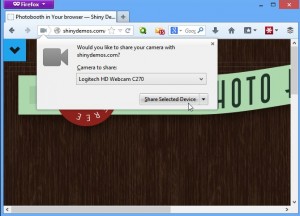
    Mozilla has also implemented the getUserMedia HTML5 control, which allows websites — with user permission — to access their camera and microphone. To see the new functionality in action, check out ShinyDemos.com’s Photo Booth.

    Developer updates
    Developers also enjoy a number of major new features in Firefox 20: the Developer menu has been reorganized to group the burgeoning number of developer tools more logically, with a Toggle Tools option added for quick access to the new, redesigned toolbar.

    Clicking this reveals the Web Console, the new default view for developers. Firefox 20 adds a new Window button that allows the tool to be viewed in its own separate window, freeing up screen real-estate for the current web page and supporting multiple displays, allowing developers to pin them to a second monitor for convenience.

    The only disappointment for developers in Firefox 20 is that the new Javascript Profiler tool for tracking the responsiveness of Javascript code is missing, stuck in beta.

    Other changes include the usual evolutionary performance improvements around common browser tasks — including page loading, downloads, and shutdown of the browser, improved HTML5 support, and the usual round of minor bug fixes and security tweaks.

    Firefox 20 FINAL is available now as a free, open-source download for Windows, Mac and Linux. Expect the Beta and Aurora channels to be updated in the next few days.

  • Morning Advantage: It’s Not Who You Know

    You might think that the best place to locate a new venture would be in an industry hub – say, Silicon Valley for a tech startup, or New York City for a publishing venture. After all, that’s where you’ll make connections, find networking opportunities, and tap into industry expertise. But, it turns out you may be better off locating your venture elsewhere. New research from Evan Rawley at the University of California at Berkeley and Philipp Meyer-Doyle of INSEAD shows that “agglomeration effects” — the benefits you get from sharing industry expertise or infrastructure — are portable, especially if you work in a service industry. And while it may seem counterintuitive to move away from an industry hub, it turns out that the benefits of staying within the hub are offset by the effects of the greater competition. Rawley explains in this Columbia Ideas at Work piece: “If you’re coming from a New York bank and starting up a new hedge fund, even if you are well connected in New York, you’re competing with people who are also well connected. There are a lot of hedge funds chasing dollars in New York, but very few in Missouri.”

    Moral of the story? You can strike out on your own. In fact, you probably should.

    CHEW ON THIS

    When Eating is an Economic Act (Bloomberg Businessweek)

    While the world produces more food than ever before, 1 in 7 people go to bed hungry every night. Many of them are farmers. Danielle Nierenberg at Bloomberg describes how we got here: “In the 1990s, the regulation controlling agriculture futures was abolished, thanks to the lobbying efforts of Goldman Sachs and others. Those futures were turned into derivatives to be bought and sold among traders, and a market in food speculations emerged, which happened to coincide with some of the biggest spikes in food prices around the world.” According to Nierenberg, the price of the world’s food has effectively doubled in the last decade and shows no signs of returning to previous levels. And this is exactly what traders want. She cautions: “The Arab Spring will look like a pep rally if the price doubles again. This kind of unrest will come back to haunt us. But that’s what the smart money is betting on.”

    BAD NEWS FOR SUPERMARKET TABLOIDS

    Beyond Showrooming: 3 Quirky Ways Smartphones Are Changing How We Shop (TIME)

    “Showrooming,” or checking out merchandise in stores while simultaneously using your phone to find a better deal, is common practice among smartphone owners. It’s one of the ways these devices have changed the retail landscape, for better or worse. But, it turns out that our phones are modifying the way we shop in more unexpected ways, too. Kit Yarrow at TIME details three: 1) We’re making fewer impulse purchases at checkout lines (turns out that our smartphones are more enticing than candy bars or Kim Kardashian’s diet secrets); 2) We’re colliding with other shoppers more often (we’re too busy texting to watch where we’re going); and 3) We’re snubbing salespeople. A study by Accenture found that 73% of shoppers with smartphones would rather consult their devices than a salesperson.

    BONUS BITS:

    Just Another Day at the Office

    The Best and Worst of the Internet’s April Fools’ Day Pranks (The Atlantic Wire)
    Google’s Greatest April Fools’ Hoax Ever (Hint: It Wasn’t a Hoax) (Time)
    April Fools’ Gadgets: You’ll Wish Some of These Were Real (CNET)