
Category: News
-
‘Phablets’ called a ‘fad’ that will eventually succumb to iPhone-sized devices
-
How HTML5 Apps Can Match a Native Experience

I was recently talking with a friend—one who’s not altogether tech-savvy—and he asked what makes BlackBerry 10 a different experience from other mobile devices. I talked about many of the new features such as BlackBerry Flow and BlackBerry Hub, and I also mentioned better navigation and the smoothness and power of the HTML5 support built into the BlackBerry 10 operating system. At that, he stopped me and asked, “I can already use a ton of apps on my smartphone. Can HTML5 make mobile apps work faster?”
What a great question! The best way I can answer this question is by example. For instance, if you’ve ever been prompted to allow a game or quiz access or post to your Facebook page, you’ve most likely just engaged a Facebook (HTML-based) app. Even signing into your Facebook or Twitter profile from another website using OpenID or OAuth engages a web app of sorts.
The HTML5 support built into BlackBerry 10 is designed to enable web apps to function faster and smoother. It’s this tight integration that allows web apps to look and feel like native apps, while leaving things like processor and memory on the device and to support native apps. So running HTML5 apps on your BlackBerry 10 device will indeed make the mobile apps run faster, while not making the native (apps) restless.
What are your thoughts on web apps and BlackBerry 10? Let us know in the comments.
For an even more basic explanation of the above, check out this post titled “Inside HTML5 and the New BlackBerry 10 Web Browser”

-
BitTorrent Sync to leave private beta
 Back in January I had the opportunity to test out BitTorrent Sync. I did not find the product to be completely ready for prime time, but I also did not find it to be terrible. I couldn’t call BitTorrent Sync ready to replace my dearly departed Live Mesh, but I saw some promise, just lacking a bit of polish around the edges.
The company steadily improved the service since those early days and now is ready to roll out a more public version of what is still considered Alpha software.
In an email sent out today, BitTorrent announces that “for those of you who are still on the wait list, keep an eye on your inbox. By mid-April we will send you a link to download the Alpha from a private server ahead of the public release”.
The SyncApp is moving forward more quickly with this latest release. The company goes on to promise “we will be opening the Alpha version of SyncApp for anyone to download by the end of April”.
For all of us dejected Live Mesh customers this has promise, but BitTorrent is not the only game in town. While Microsoft may have killed that arm of its Live suite, the company’s SyncToy app lives on and there are other oars in the water, such as SyncBack SE, which I have previously used and liked.
Still, BitTorrent has the most promise in this field and it has the technology to deliver on that promise. Over the coming weeks we will see if SyncApp can actually do exactly that, or if it is “pie in the sky”.
Photo Credit: RAJ CREATIONZS/Shutterstock
-
Michael Arrington’s Ex-Girlfriend Makes Abuse Allegations on Facebook
TechCrunch founder Michael Arrington is facing some serious allegations made in a Facebook post.
Jenn Allen, founder and CEO of RTist.com, claims in a recent post that Arrington was physically and emotionally abusive in a past relationship. She also claims that he threatened to murder her if she told anyone about the abuse.
You can read the entire post below:
Last post on someone i’m completely over. I’ve never been lonelier in my entire life. To all my friends who loved me for who I am – thank you. Power hungry people, I loved Michael Arrington for 8+ years starting when i implemented Eurekster search at the time on Techcrunch in 2006 and throughout the years i didn’t know he cheated on me multiple times, then tells people it was me immediately after he did it. It hurts when you love someone borderline and they can’t feel anything at all for you, and threaten to murder you if you told anyone about the physical abuse – all for keeping his reputation. The emotional abuse was equally bad. On a positive note, it can’t get any worse than this and I can’t get myself of this bed.
Gawker, who first spotted the post, was able to confirm that the two did in fact date at some point – specifically in 2006. Allen’s Facebook post indicates that the relationship lasted for “8+” years. There are plenty of photos of the two together back around 2006 – you can check them out on Flickr. So it doesn’t appear that the relationship is in question – but these are some pretty serious allegations for a public figure.
Obviously, this is a developing story.

[Image of Allen via Facebook]
-
Forget The Galaxy S 4: Samsung’s Eco Tree Is Where The Innovation’s At
Samsung is no stranger to eco-friendly business practices. Late last year, the company announced that it was the only mobile phone manufacturer to be granted a carbon footprint certification in the UK. Now its stepping up its duty as a good corporate citizen by making a new eco-friendly product available to all.
Samsung announced today its intentions to release the smart Eco Tree. These trees have a number of useful features that will make them an excellent addition to the planet. As Samsung points out, these new Eco Trees can filter CO2 and replace it with oxygen. Doing so requires no energy input on our parts as these Eco Trees come with natural solar panels in the form of leaves.
Of course, Eco Trees aren’t just for producing oxygen. These new devices have a number of features that make them a great addition to any location:
Group Play
You can incorporate many Eco Trees together to increase the effect of the functions described above. Group Play usually results in positive synergies such as preventing soil erosion.
SMART Share
When given the right care, Eco Trees provide S-eeds for SMART Sharing. Share your Eco Trees with friends and family. SMART Share is free of cost.
Evolution Kit
Take care of your Eco Tree! Evolution Kits are consisted of S Beams, water, fertilizers, etc. By applying these elements, you can help grow your Eco Tree. Enjoy the latest features of your Eco Tree. It’s just like upgrading to a taller, stronger, state-of-the-art Eco Tree every year!
Accessories
Various accessories, including but not limited to swings, tires, ladders, tents, tree houses are available at dealers near you. Try the latest most innovative accessories on your Eco Tree.
Special Editions
Select models are also available that provide food, entertainment and offer habitats for wild animals. Eco Tree ‘mini’ are also available for indoor application.
Samsung’s attempt at an April Fools’ Day joke is a reminder that Earth Day is right around the corner. Samsung will be celebrating the holiday on April 22 and wants everybody to know what it is doing to promote sustainability.
-
The potential success or calamity of Facebook phone

The notion of a Facebook phone has certainly lingered for a few years now — the concept reached a point of half-hearted fruition in the HTC ChaCha and Salsa in 2011, but neither really embodied the true potential of a Facebook phone. They were much more of “throw and see what sticks” devices — with the only tangible evidence of deeper Facebook integration being the Facebook button on the devices’ fronts.
Much has changed in nearly two years: Facebook’s Open Graph, the acquisition of Instagram and the introduction of Facebook Camera and Messenger applications, among others. Perhaps the most strident progression Mark Zuckerberg’s social network has made in the past two years is reaching 1 billion active users. And counting. That’s approximately one in seven people in the world, and an even larger proportion if accounting for the developed world alone.
It’s a number that CEO Zuckerberg wouldn’t have dared to dream in his Harvard dorm room almost 10 years ago, and a level of pervasiveness that I personally find astounding and perhaps even intimidating — intimidating that one corporation could occupy so much global mindshare in an industry so inherently personal. You would think that a corporation with so much social leverage would be able to make some inroads in the smartphone industry.
Collecting User Data
The question: how deep can you integrate Facebook into the smartphone experience before it becomes downright intrusive, and is portrayed obviously as an overbearing corporate ploy. This is the dangerous balancing act that Facebook has to play, to integrate deeply enough to be an inescapable aspect of our smartphones and by extension our daily lives, without integrating so much as to reveal those intentions.
For Facebook, the benefits of a phone OS developed in-house are obvious. The social network is primarily an ad business and much like Google its money-making capabilities lie almost exclusively in understanding users. The more is understood about them, the more ads can be targeted at the right people. A simple mobile app that is the depth of Facebook’s current mobile strategy on most platforms provides extremely limited scope is terms of user data aggregation — there are so many aspects of mobile usage that Facebook can’t tap into with a simple app.
If the social network built a phone to service its business motives, the device could integrate, say, Facebook places into the default mapping application and give clearer idea from where users search. The company could tap into the music and video players to ascertain the entertainment tastes of individuals. And of course Facebook could put forward a compelling case to replace SMS and calls with Facebook Messenger and free calling to other Facebook users — augmenting subscriber reliance on the Facebook ecosystem and strengthening the ‘walled garden’.
Of course not all of these approaches may be feasible, and such invasive behavior will likely come under close scrutiny from privacy watchdogs, but the potential is certainly there. As society begins to get more comfortable with sharing more information online and as the power of ubiquity continues to grow for Facebook, now is as good a time as any for the social network to pounce with an aggressive mobile strategy.
Hamsters One and All
But how well could Zuckerberg and Company sell such a device? The HTC ChaCha and Salsa failed to really make a splash, or provide any indication that a Facebook Phone can be a hit device.
Many of us are hopelessly reliant on Facebook, and we tend to know that. We know that Facebook is among the most used apps on our phone and we check it impulsively. We scroll our News Feeds rain or shine, interesting or boring and we keep doing it even when we get nothing form the behavior. There’s a natural inclination to check the social network persistently, so would a phone built around a Facebook backbone be useful? Perhaps. Is this a selling point? Doubt it.
As much as we’ve allowed Facebook to become an ingrained aspect of our lives, we’re ashamed to admit it — there’s a stigma attached to a Facebook reliance that we’d all love to, but wouldn’t ever shake. Facebook isn’t something people think of when buying a phone because we’re accustomed and satisfied with the accessibility of the social network on smartphones that we have now — through an app. A Facebook phone is the answer to a question nobody has asked, which is where the real challenge lies.
To have Facebook on our smartphones left, right and center, as the very spinal core of our smartphones will inevitably increase its accessibility, efficiency and ultimately usability, but I’d vouch that there would be significant consumer trepidation about going down this route. We don’t want to get too intimate with something that is beginning to become dangerously addictive. A Facebook Phone, that is marketed as such would lack appeal for this reason alone. Facebook does not increase a phone’s marketability, we’ve learned that. Such a device would be a flop bar for one that is so exquisitely designed and offered at a bargain basement price.
But Facebook’s “Home on Android” project mightn’t be anything like this. It might not be a “Facebook Phone” in the same way that the Kindle Fire is Amazon’s tablet — built entirely in-house with an exclusive and heavily-modified version of Android running on Amazon devices only. Such a strategy would be the anti-thesis of Facebook’s trajectory; after all, social networking is an industry which hinges entirely on pervasiveness, not exclusivity. On Thursday, Facebook will show us a modified version of Android with Facebook running through its vein in a most exquisite and beautiful manner. The company show it on a phone, of course, but not selling one. If big boy Zuckerberg unveils and intends to market a phone coupled with the Facebook-ified OS as a complete entity, then he has taken a wrong step.
Facebook has no interest in being in the hardware business, but should continue to have interest in being part of everyone else’s software — ubiquity after all, is the key.
Photo Credit: percom/Shutterstock
 Jeremy Liu is a high school student who first became obsessed with technology in the 8th grade when his father bought him an iPod touch after months of begging. At a time when iPhones and the iPod Touch were spectacularly rare, the device managed to fascinate both himself and his friends. Liu now shuns the mainstream and roots for underdogs, owning a Windows Phone, Blackberry PlayBook and Sony Walkman X. Since then technology has grown from a passion to an obsession and he now directs his energies towards writing. You can find him on Facebook, Google+ and Tumblr.
 -
Mekhi Phifer Marries Girlfriend Reshelet Barnes
E! News is reporting that ER star Mekhi Phifer has married his long-time girlfriend Reshelet Barnes.
The wedding ceremony, which took place in Beverly Hills, California on Saturday, is reported to have taken place in front of around 100 family and friends. Phifer wore a white suit for the short wedding, during which the couple held a “sand ceremony.”
Phifer has been married once before, to actress Malinda Williams in 1999. Williams is best known for her role in the movie A Thin Line Between Love and Hate. That marriage lasted until 2003, and the couple share a son, Omikaye, who participated in Phifer’s recent wedding. Phifer also has another son, born in 2007 to his girlfriend at the time.
Phifer is well-known for his roles in movies such as 8 Mile, This Christmas, and the 2004 remake of Dawn of the Dead. On television, he played the role of Dr. Gregory Pratt in the medial drama ER from 2002 until 2008, when the character is killed off in the first episode of the show’s 15th season. Most recently, Phifer has landed roles in the TV shows White Collar and Husbands, as well as the movie The Love Section.
-
Why Google Might Rank Sites With Bad Links Highly
Today’s Webmaster Help video from Google doesn’t appear to be an April Fools’ joke. It’s just Matt Cutts responding to a question like normal. The question at hand is probably something a lot of people have wondered:
I’ve seen multiple websites that appear in the #1 spot for various keywords, whose backlink profiles are pretty low quality (i.e. lower quality blog pages). Why wouldn’t Penguin have moved these sites further down in rankings?
“There’s a lot of possible reasons,” says Cutts. “One is, Penguin is geared for certain types of spam, but it’s not geared for every type of spam. For example, it doesn’t help with hacked sites. So if a site is being propelled up the rankings on the basis of illegal hacking of sites, that’s not something that Penguin attempts to tackle. There are other other algorithms that try to tackle that.”
“The simplest explanation might just be that we don’t want that to rank, but the algorithms haven’t gotten good enough yet. We need to make sure that things get better. If that’s the case, we’re happy to get spam reports or if you want to show up on a forum, or a webmaster forum, and say, ‘Hey, here’s a site that doesn’t look like it should be ranking,’ we’re happy to hear feedback like that.”
He also notes that unless you’re the site owner, you may not be getting the complete list of links for that site.
It seems fairly likely that much of the time it’s that explanation about the algorithms not being good enough. As Google has noted on plenty of occasions in the past, no algorithm is perfect, and Google tweaks them all the time.
-
Leaked screenshots show how Facebook plans to take over Android home screens

-
Pineapple Express 2 May Be An April Fools’ Joke, But This Trailer Is Real
Unfortunately, this isn’t really a trailer for Pineapple Express 2, but Seth Rogen, James Franco and the boys have reunited to promote the upcoming “This Is The End” with a Pineapple Express 2 trailer anyway:
-
HTML5 lovers rejoice: Famo.us to make its platform free for developers
Remember Famo.us, the San Francisco-based start-up that wowed us with its ultra-brisk HTML5 and javascript demo at the Disrupt conference last year? Yeah, the same one that was co-founded by Steve Newcomb, one of the technology guys behind Powerset (now part of Microsoft’s Bing) and the same person who got me excited about the possibilities of Famo.us technology in a data-rich world.
 Imagine what Famo.us can do to an Amazon.com experience or even Walmart.com? Hermes could create a new, unique shopping experience, and Warby Parker can use data and design to create a personalized virtual store. Yup, I know I am getting ahead of myself … but hell, it is better than getting excited about yet-another calender app.
Now Famo.us is all set to show off its HTML5 development platform, which at least in demos, removes any advantages of the mobile-native operating environments. The native operating systems such as Android and iOS have enjoyed an edge because they provide a smooth and satisfying experience on their platforms. Famo.us wants to do that with its platform, which is entirely HTML5 based.
Newcomb will outline many of the details of the Famo.us platform at the HTML5 Developer conference in San Francisco today. As part of the announcement, the company will announce plans to make its platform free for individual developers and give them the option to create and host many Famo.us apps on its platform. Believers in Famo.us are going to be the same people who believe and want to build HTML5 apps.
The company in turn wants to make money by charging hardware makers — the companies that make phones and televisions, for example. In addition, Famo.us will also charge enterprises that want to use its platform for services.
Famo.us had impressed me with its technology, and co-founder and CEO Newcomb laid out a compelling vision for his platform. It resonated with me mostly because the company had come up with a way to tackle what I think is a going to be a growing issue in the future: building apps for a data-rich environment. That requires a new approach that looks beyond documents and instead thinks in terms of data streams and apps. It needs web standards, as it is becoming difficult to create, deploy and maintain apps for many of these emerging (hardware) platforms. Famo.us has come up with the right approach.
According to a Forbes.com report, the company has developed a new physics engine that when combined with Famo.us’ previously announced surface rendering technology will allow developers to create apps and interfaces for data-rich environments using javascript and HTML5. Just as gaming engines enable game developers to create multifaceted worlds, Famo.us is betting that with its platform, developers can create similar data-rich applications. “Famo.us will let data itself be visually and tactilely expressive,” writes Anthony Kosner.

Related research and analysis from GigaOM Pro:
Subscriber content. Sign up for a free trial.- Social 2013: The enterprise strikes back
- Development strategies for the app-developer community
- Mobile 2012 and beyond


-
The Hidden Biases in Big Data

This looks to be the year that we reach peak big data hype. From wildly popular big data conferences to columns in major newspapers, the business and science worlds are focused on how large datasets can give insight on previously intractable challenges. The hype becomes problematic when it leads to what I call “data fundamentalism,” the notion that correlation always indicates causation, and that massive data sets and predictive analytics always reflect objective truth. Former Wired editor-in-chief Chris Anderson embraced this idea in his comment, “with enough data, the numbers speak for themselves.” But can big data really deliver on that promise? Can numbers actually speak for themselves?
Sadly, they can’t. Data and data sets are not objective; they are creations of human design. We give numbers their voice, draw inferences from them, and define their meaning through our interpretations. Hidden biases in both the collection and analysis stages present considerable risks, and are as important to the big-data equation as the numbers themselves.
For example, consider the Twitter data generated by Hurricane Sandy, more than 20 million tweets between October 27 and November 1. A fascinating study combining Sandy-related Twitter and Foursquare data produced some expected findings (grocery shopping peaks the night before the storm) and some surprising ones (nightlife picked up the day after — presumably when cabin fever strikes). But these data don’t represent the whole picture. The greatest number of tweets about Sandy came from Manhattan. This makes sense given the city’s high level of smartphone ownership and Twitter use, but it creates the illusion that Manhattan was the hub of the disaster. Very few messages originated from more severely affected locations, such as Breezy Point, Coney Island and Rockaway. As extended power blackouts drained batteries and limited cellular access, even fewer tweets came from the worst hit areas. In fact, there was much more going on outside the privileged, urban experience of Sandy that Twitter data failed to convey, especially in aggregate. We can think of this as a “signal problem”: Data are assumed to accurately reflect the social world, but there are significant gaps, with little or no signal coming from particular communities.
While massive datasets may feel very abstract, they are intricately linked to physical place and human culture. And places, like people, have their own individual character and grain. For example, Boston has a problem with potholes, patching approximately 20,000 every year. To help allocate its resources efficiently, the City of Boston released the excellent StreetBump smartphone app, which draws on accelerometer and GPS data to help passively detect potholes, instantly reporting them to the city. While certainly a clever approach, StreetBump has a signal problem. People in lower income groups in the US are less likely to have smartphones, and this is particularly true of older residents, where smartphone penetration can be as low as 16%. For cities like Boston, this means that smartphone data sets are missing inputs from significant parts of the population — often those who have the fewest resources.
Fortunately Boston’s Office of New Urban Mechanics is aware of this problem, and works with a range of academics to take into account issues of equitable access and digital divides. But as we increasingly rely on big data’s numbers to speak for themselves, we risk misunderstanding the results and in turn misallocating important public resources. This could well have been the case had public health officials relied exclusively on Google Flu Trends, which mistakenly estimated that peak flu levels reached 11% of the US public this flu season, almost double the CDC’s estimate of about 6%. While Google will not comment on the reason for the overestimation, it seems likely that it was caused by the extensive media coverage of the flu season, creating a spike in search queries. Similarly, we can imagine the substantial problems if FEMA had relied solely upon tweets about Sandy to allocate disaster relief aid.
Big data’s signal problems won’t disappear as the use of smartphones and other digital technologies increases. As the geographers Michael Crutcher and Matthew Zook noted after Hurricane Katrina, technologies are always differentially adopted, and “any divide in accessing digital technology is not a one-time event but a constantly moving target as new devices, software and cultural practices emerge.” As we move into an era in which personal devices are seen as proxies for public needs, we run the risk that already existing inequities will be further entrenched. Thus, with every big data set, we need to ask which people are excluded. Which places are less visible? What happens if you live in the shadow of big data sets?
This points to the next frontier: how to address these weaknesses in big data science. In the near term, data scientists should take a page from social scientists, who have a long history of asking where the data they’re working with comes from, what methods were used to gather and analyze it, and what cognitive biases they might bring to its interpretation (for more, see “Raw Data is an Oxymoron“). Longer term, we must ask how we can bring together big data approaches with small data studies — computational social science with traditional qualitative methods. We know that data insights can be found at multiple levels of granularity, and by combining methods such as ethnography with analytics, or conducting semi-structured interviews paired with information retrieval techniques, we can add depth to the data we collect. We get a much richer sense of the world when we ask people the why and the how not just the “how many”. This goes beyond merely conducting focus groups to confirm what you already want to see in a big data set. It means complementing data sources with rigorous qualitative research. Social science methodologies may make the challenge of understanding big data more complex, but they also bring context-awareness to our research to address serious signal problems. Then we can move from the focus on merely “big” data towards something more three-dimensional: data with depth.
-
AMMO NYC Posts Killer Results from NYC Party

AMMO NYC founder Larry Kosilla knows a thing or two about automotive detailing. You see after caring for some of the most priceless automobiles in existence over the last decade, Kosilla became so disenfranchised with the car care industry that he took matters into his own hands and created AMMO NYC, a company dedicated to creating products that cater to the toughest automotive enthusiast. To start the year off right AMMO hosted a party at Manhattan Classic Car Club. The automotive press turned out in droves to not only have some fun, but celebrate a company that finally understands what we as dedicated petrol-heads want for our vehicles.
Source: AMMONYC.com
-
Ubisoft Will Break My Heart If Far Cry 3: Blood Dragon Isn’t A Real Game
Far Cry 3 is an absolutely amazing game. I can’t really think of anything that could improve the experience beyond an injection of 80s awesomeness.
In what’s either a cruel April Fools’ joke, or the most amazing thing to ever happen in video games – Ubisoft today announced a “movie” called Far Cry 3: Blood Dragon. Here’s the amazing synopsis:
The year is 2007. It is the future. Earth has been ravaged by a nuclear war and new paths for peace must be found. A U.S. cyborg army may have found a solution: a powerful bioweapon on a distant island. A Mark IV Cyber Commando, Sergeant Rex Power Colt has been sent over to gather information and figure out what the hell is going on.
A previous report from Kotaku indicates that Far Cry 3: Blood Dragon may indeed be an expansion, an entirely new game, based on the Far Cry 3 universe. One indication we have that this may be more than a joke is that it’s been officially rated by the Australian Classification Board as R 18+ for having a “high impact sex scene.” Another sliver of hope is an achievement list for the game that features such feats as “Dragon Slayer” and “The Drug of the Nation.”
There’s still no word on whether or not this is real, but there’s hope that Ubisoft isn’t just pulling our collective legs on this one. I think I would cry if this turned out to be nothing more than a joke.
-
The GPS-Enabled DJI Phantom Quadcopter Makes The AR.Drone Look Like A Toy

Back in 2010, our own John Biggs rightly described Parrot’s AR.Drone as ” the coolest thing [he had] seen in a long, long time.” Since then, Parrot has launched the AR.Drone 2.0 and while it’s still a very cool gadget, quadcopters have come a very long way since 2010. Last month, the folks at DJI, who mostly specialize in developing unmanned aerial systems for commercial use, sent me one of their consumer-oriented and GPS-enabled DJI Phantoms to review.
Most quadcopters are aimed at hobbyists and take a good amount of assembly and at least some experience with flying remote-controlled aircraft. The Phantom, which has a list price of $849 but currently retails for about $680, comes mostly pre-assembled and is extremely easy to fly, thanks to its built-in compass and GPS module. Thanks to having GPS built-in, the drone always knows where it is in relation to you. So depending on the mode you are flying in, every input you give will always be interpreted in relation to you and not in relation to where the front of the aircraft is (here’s a video that explains how this works).
The other cool thing about the GPS mode is that the drone can hover in position even if it’s windy. It’ll just auto-correct for the wind, thanks to its built-in autopilot (you probably want to turn this mode off when you are trying to take a video, however, as the constant corrections will show up in your videos).
This autopilot also kicks in if the Phantom loses its connection with your remote control if it flies out of reach or your remote runs out of battery, the drone itself is very low on battery, or because you turn it off to see if the autopilot actually works. Once the failsafe mode kicks in, the drone will simply fly up to 60 feet, fly back to where it first took off and land. I actually tried this and it worked surprisingly well. The drone touched down just about 3 feet from where I launched it. When you spent $700 on the drone and another $300 or so on a GoPro 3 Silver, that’s a nice feature to have.
The Phantom is a clear step up from something like the AR.Drone. Its communication distance is just under 1,000 feet and a maximum horizontal speed of about 32 feet per second and a descent speed of close to 20 feet per second. That’s fast and feels even faster if you are just learning how to fly it.
These specs show that this isn’t just a toy but can actually be used for some pretty impressive aerial photography. Indeed, since the Phantom launched earlier this year, a whole ecosystem has sprung up around it that provides owners with everything from improved propellers to cases and multi-axis camera gimbals. A gimbal, by the way, isn’t a must, but if you want to take really stable videos without the so-called “jello” effect (here’s a pretty extreme example of that), both a gimbal and some well-balanced after-market rotors will surely help.
Here is a video I took with the Phantom and a GoPro 3 White over the weekend:
The Phantom’s battery lasts just under 15 minutes, so you probably want to buy at least a second one, given that the package only includes a single 2,200mAh battery and a charger.
If you decide to get one of these, by the way, make sure you read the instructions and watch this series of videos before you turn it on. The Phantom may look like a toy and is easy to fly, but this is a pretty high-end piece of technology and there are a few things you need to know and do before your first flight.
With the 2013 NAB Show just around the corner, it’s a fair bet that DJI will announce a few new products in the coming days and we’ll make sure to keep a close eye on this company.
-
Using Office in Windows 8? Microsoft wants to help
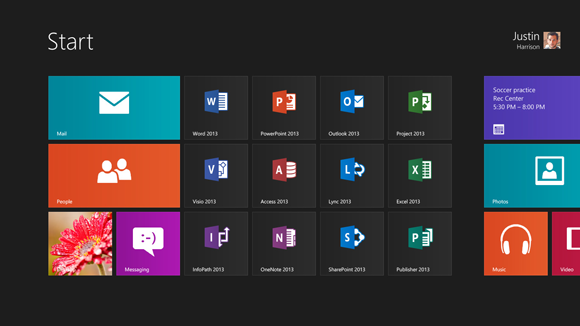
Every week Microsoft’s Office team does a webinar. That is not news, but this week the company is focusing on Office specifically within Windows 8. While perhaps many of you are not yet using the latest versions of Office and Windows, it is pretty much assured that eventually you will be — assimilation is inevitable.
With that thought in mind, Microsoft’s Doug Thomas announces that “if you are working with Windows 8-or your business will be using Windows 8 soon-check out this week’s webinar. We will go over shortcuts and quick navigation for keyboard and mouse, plus answer your questions”.
If you are expecting an in-depth look at all of this then I recommend you tune down your expectations. Oh, and you will not need to bother bringing a cup of coffee along either, because the webinar is only 15 minutes long. It does promise the basics though, such as using Windows 8 with a mouse and keyboard, the Start screen, keyboard shortcuts and a bit more.
Still, it could provide a useful foundation for those who are new to these platforms. Thomas explains how one can join in — “if you are on Windows 7 or 8, you will join via the free Lync Web App. For other computers, you may need to call in for audio: 888-320-3585, Conference ID: 84172528”. You can head over to the Office site to view other upcoming Office web events.
-
Aqua Teen Hunger Force, Robot Chicken & Co. start streaming on Netflix
ATHF fans, take notice: Netflix added a number of shows from Adult Swim and Cartoon Network to its catalog this past weekend, including the first seasons of Aqua Teen Hunger Force, Robot Chicken and the Venture Bros. Newly added titles also include Cartoon Network hits like Ben 10 and Justice League Unlimited.
The catalog additions are part of a number of deals Netflix struck in January with Warner Bros. and Turner, which will also bring TV shows like the remake of Dallas, Fringe and the Following to the service.
It further underscores how important TV has become to Netflix, where subscribers often binge on entire past seasons of their favorite shows. And Adult Swim’s edgier fare should bode well with the same crowd that will flock to Netflix once the company brings the cult classic Arrested Development back to life in May.

Related research and analysis from GigaOM Pro:
Subscriber content. Sign up for a free trial.- Controversy, courtrooms and the cloud in Q1
- How consumer media will change in 2013
- Connected consumer third-quarter 2012

-
Apple CEO apologizes to China amid fears that propaganda will hurt market share

-
eBay Deal of the Week: 1974 Dino 246 GTS

It wasn’t until the last 15 years or so that Ferrari’s 246 Dino were actually considered to be good investments. The Dino’s were always thought to be lacking in the performance department due in part to their 195 hp 6-cylinder engines. However those who were able to look past this realized that the Dino was one of the best driving cars Ferrari ever produced thanks to their low weight and superb chassis. The following example shows just 12,678 miles on the odometer and is in amazing original condition aside from a single repaint in original Bianca white. The original Daytona seats show only slight wear and mechanically, with service records from new, the car is said to be a very strong runner. Click through to check out more pics, or click below to go directly to the ad.
Source: eBayMotors.com


-
TPG’s ATD Acquires Regional Tire Distributors
 TriCan Tire Distributors Inc., the Canadian subsidiary of American Tire Distributors Inc. (ATD) has agreed to acquire Regional Tire Distributors Inc., a Burlington, Ontario-based company focused on tire supply solutions. The deal, which is expected to close at the end of April, 2013, has been valued at approximately US$62.5 million. Charlotte, North Carolina’s ATD is a portfolio investment of U.S. buyout firm TPG Capital, which bought the company in 2010 from Investcorp, Berkshire Partners and Greenbriar Equity.
PRESS RELEASE:
American Tire Distributors Holdings Inc. (“ATD”) announced today that an agreement has been reached whereby TriCan Tire Distributors Inc. (“TriCan”), its wholly owned subsidiary, entered into an agreement to purchase all outstanding shares of Regional Tire Distributors Inc. (“RTD Ontario”). ATD expects the transaction to close by the end of April 2013. The acquisition will significantly expand ATD’s presence in the Ontario and Atlantic Provinces of Canada. ATD entered the Canadian market in November 2012 by purchasing TriCan.
RTD Ontario operates five distribution centers in Ontario and four distribution centers in the Atlantic Provinces. The company has grown from two distribution centers in 2008 to its nine distribution centers today. RTD Ontario services approximately 3,100 customers and is based in Burlington, Ontario.
“RTD Ontario has built a very strong presence in the eastern provinces in which they operate,” said William “Bill” Berry, President and Chief Executive Officer of American Tire Distributors. “These nine distribution centers will complement the current TriCan operation, which has a leading market position across the Prairie Provinces and in British Columbia.”
Following the close of the acquisition, ATD will continue to run its Canadian operation as a stand-alone business unit. Mike Kustra, currently President of RTD Ontario, will assume the role of President over the combined RTD/TriCan operation. Chris Fletcher, currently President of TriCan Tire Distributors, will assume the role of Non-executive Chairman of the combined operation.
ATD and its subsidiaries plan to begin expanding their Canadian distribution centers in 2013 to support a broader product screen offering to customers. ATD and its subsidiaries also plan to add several new distribution centers across Canada by opening Greenfield locations and potentially acquiring other Canadian distributors.
About American Tire Distributors
American Tire Distributors is one of the largest independent suppliers of tires to the replacement tire market. It operates 123 distribution centers, including 15 distribution centers in Canada, serving approximately 70,000 customers across the U.S. and Canada. The company offers an unsurpassed breadth and depth of inventory, frequent delivery and value-added services to tire and automotive service customers. American Tire Distributors employs approximately 3,500 employees across its distribution center network, including approximately 200 employees in Canada.Cautionary Statement Regarding Forward-Looking Information
This press release contains forward-looking statements relating to our business and financial outlook. These forward-looking statements are not guarantees of future performance or the occurrence of future events, and are based on our current estimates, assumptions, expectations, forecasts and projections. Many factors could cause actual results to differ materially from those indicated.Contact:
American Tire Distributors
Ron Sinclair, 704-992-2000
[email protected]
or
Luquire George Andrews, Inc.
David Coburn, 704-552-6565
[email protected]Photo courtesy of Shutterstock.
The post TPG’s ATD Acquires Regional Tire Distributors appeared first on peHUB.
