Category: News

  • Apple may expand retail presence in India, but plan still doesn’t include Apple Stores

    Apple wants to sell iPhones and iPads in India, but unlike in another populous emerging market — nearby China — it does not operate branded Apple Stores in the country. As Om noted after a recent trip to India, that may be a missed opportunity for Apple to sell more products if it can’t showcase its devices, services and customer service in typical Apple fashion. On Tuesday a new report said Apple is planning to boost its retail presence in India, but not through its traditional Apple Store model.

    The Economic Times of India says it has heard from unnamed sources that Apple plans to “triple its exclusive stores to around 200 by 2015″ in the country. “Exclusive stores” are certified by Apple as official resellers of Apple products — and only Apple products. They are owned by local franchisees, not Apple. The plan is said to be a part of an “aggressive” growth strategy that will also put more Apple products on the shelves of other retailers that sell competing products too.

    iPhones and iPads are still pretty expensive for many locals, but Apple has made some moves to accomodate that. It started offering payment plans for its devices, much like it did in China.

    There were 19 million smartphones sold in India last year. But there are estimates that by 2016 that number will be 108 million, according to IDC. Samsung has basically had the run of the smartphone market in India because of the lower price of the devices, selling about a third of all smartphones in the country last quarter.

    Opening more outlets that sell iPhones is one formula to try to improve sales. But a bigger part of that equation is probably changing how local customers think of the brand. Apple’s own stores are a huge part of its success in the last decade, especially in established markets like the U.S. and Europe — and right now we’re seeing the relationship of a growing number of Apple Stores, an improving brand image and product sales momentum play out in China.

    But there’s a sticking point in India Apple right now can’t overcome: Single-brand stores can be owned by foreign companies in India, but legally they have to source 30 percent of their wares from Indian companies. Until Apple starts making devices or components in India, it looks like there won’t be any Apple Store any time soon.

    Related research and analysis from GigaOM Pro:
    Subscriber content. Sign up for a free trial.

  • YC-backed Padlet gains traction with software that lets groups create content collaboratively

    If you want to share your own content, the web offers no shortage of publishing tools, from full-on blogging platform WordPress to lightweight Tumblr to mobile micro-blogging app CheckThis. But the options aren’t as plentiful when it comes to easily creating online multimedia content with a group.

    Startup Padlet, which has been simultaneously enrolled in Y Combinator and ed tech accelerator Imagine K-12, has created software to fill that hole. It lets people quickly create an online “wall” for sharing any kind of content, from text to images to video, and allows them to collaborate on the creation of that content as well. It first launched as Wallwisher in 2008, but re-launched the product in October and changed its name to Padlet in January. The founders, who will be on stage Tuesday at Y Combinator’s Demo Day on Tuesday, say the site has seen 30 percent month-over-month growth for the last seven months and has had 300,000 users and 750,000 visitors in the last 30 days.

    While the site has been open to anyone, co-founder Pranav Piyush said a number of teachers have been using it to post class files and encourage student collaboration. “There’s no obvious answer to what a school teacher should use that’s fun and collaborative,” he said. “We’ve set out to find the easiest way to put stuff on the Web.”

    On Padlet.com, users create a “wall” with its own URL with one click. Then they can choose how public or private they want it to be and how much control they want to give others. They can add content and change the design with a drag-and-drop interface. A teacher could use it to share and collect images and video related to a history lesson or friends could use it to share memories and pictures from a recent trip. The NYC Public Advocate’s Office used Padlet to collect online tributes for the first responders to Hurricane Sandy.

    padlet - sandyOther online collaboration tools exist but they tend to provide slightly different functionality. Google Docs, for example, let people share and collaborate around documents and spreadsheets, but they tend to focus on text (you can share images and drawings but not in an integrated way). Scoot & Doodle, a new startup that recently raised funding from Pearson and others, encourages online collaboration, but via Google Hangouts and with more of a focus on real-time face-to-face communication. Dropbox is great for sharing files with a group but not really built for group content production. In education, teachers could use social platforms like Edmodo and Schoology to share content and collaborate, although those sites are intended for far more than one-off collaborative projects).

    While the basic product is free, Piyush said the company is piloting premium versions for schools and corporate clients. The startup also envisions opening up the platform to third-party developers to create a paid marketplace of add-ons for further customizing with backgrounds, themes and other tools.

    Related research and analysis from GigaOM Pro:
    Subscriber content. Sign up for a free trial.

  • Kordell Stewart Divorce Papers Filed in Atlanta

    It seems that Kordell Stewart’s official retirement from the NFL hasn’t been a boon for his love life.

    TMZ is reporting that Stewart filed for divorce from wife Porsha Stewart in Atlanta on March 22. Porsha is a cast member of the reality TV show The Real Housewives of Atlanta. The couple was married in May of 2011.

    The divorce papers reportedly state that the marriage is “irretrievably broken” and that the couple is currently separated. Kordell is also claiming no need for spousal support and that there are no marital assets to be divided between them.

    Neither Kordell or Porsha has acknowledged the divorce directly via their social media accounts, though Porsha did post this strange-in-hindsight Tweet back on March 24:

    According to the TMZ report, the issue of children was hot one for the couple, as depicted on-screen in episodes of Real Housewives. Kordell has one son, Syre, with an ex-girlfriend.

    Kordell Stewart played quarterback for NFL teams such as the Pittsburgh Steelers, Chicago Bears, and Baltimore Ravens during his decade-long career. During his 2001 season with the Steelers he led the team to the AFC Championship Game. He was named AFC Offensive Player of the Year and selected for the Pro Bowl for the accomplishment.

  • Photo Gallery: President Obama’s Middle East Trip

    In the first foreign trip of his second term, President Obama embarked on a four-day visit to Israel, the West Bank and Jordan.

    The White House Photo Office was with the President throughout his travels, and they've put together a collection of images from the Middle East trip, which include the President meeting with officials including Prime Minister Netanyahu in Israel, a dance performance in Ramallah, the West Bank and breathtaking shots from Petra, a World Heritage Site in Jordan. Check out the gallery below and visit our Middle East trip page for more information, including video.

  • Neuralstem Receives $8 Million In Debt Financing from Hercules

    Neuralstem, a Rockville, Md., company whose technology is aimed at fostering hte production of human’s neural stem cells in commercial quantities, has secured $8 million in debt financing with Hercules Technology Growth Capital to fuel the company’s capital budget through late 2014. Hercules is a specialty finance company focused on providing senior secured loans to venture capital-backed companies in technology-related markets.

    PRESS RELEASE:

    Neuralstem, Inc. (nyse mkt:CUR) announced today that it secured $8 million in debt financing with Hercules Technology Growth Capital HTGC +0.08% , to fund the company’s capital budget through late 2014.

    “This debt financing extends our cash runway well into late 2014 at a critical time in our clinical product development cycle. We have multiple NSI-566 cell therapy clinical trials planned this year, building on our successful ALS Phase I trial, including the upcoming phase II ALS in the U.S.; both chronic and acute spinal cord injury in the U.S. and South Korea, respectively; ALS in Mexico, and stroke in China, in addition to completing the NSI-189/Phase Ib trial in major depressive disorder,” said Neuralstem’s President and CEO Richard Garr. “We are pleased to have the support of leading life sciences and technology investor, Hercules.”

    “Neuralstem’s unique stem cell platform has the potential to address a serious unmet medical need in the ALS and spinal cord injury patient populations, as well as other indications. The team’s progress to date is the result of years of meticulous research and development. We are proud to be a strong financial partner,” said Chad Norman, managing director at Hercules.

    The funding of $8 million, which closed on March 22, 2013, is in the form of a secured note which is repayable in installments over 42 months following an interest-only period of nine months and up to 12 months upon funding of a second tranche. The note bears interest at a prime-based variable rate. In addition, Neuralstem issued Hercules 648,798 warrants to purchase shares of Neuralstem common stock at an exercise price of $1.08 per share. The second tranche of $2 million will be made available to the company, at the company’s option until September 30, 2013, subject to certain conditions. Further information with respect to the loan agreement with Hercules is contained in a Current Report on Form 8-K filed with the Securities and Exchange Commission.

    This press release does not constitute an offer to sell or the solicitation of an offer to buy any of the securities referenced herein in any jurisdiction to any person. The warrants and underlying shares issued in connection with the transactions have not been registered under the Securities Act of 1933, as amended, and may not be offered or sold in the United States absent registration under the Securities Act and applicable state securities laws or an applicable exemption from those registration requirements.

    TriPoint Global Equities, LLC was the placement agent for the transaction.

    About Neuralstem

    Neuralstem’s patented technology enables the ability to produce neural stem cells of the human brain and spinal cord in commercial quantities, and the ability to control the differentiation of these cells constitutively into mature, physiologically relevant human neurons and glia. Neuralstem completed an FDA-approved Phase I safety clinical trial for amyotrophic lateral sclerosis (ALS), often referred to as Lou Gehrig’s disease, in February 2013, and has submitted recommended Phase II trial protocol to the FDA. Neuralstem has been awarded orphan status designation by the FDA for its ALS cell therapy.

    In addition to ALS, the company is also targeting major central nervous system conditions with its NSI-566 cell therapy platform, including spinal cord injury, ischemic stroke and glioblastoma (brain cancer). The company received approval to commence a Phase I safety trial in chronic spinal cord injury in January 2013.

    Neuralstem also has the ability to generate stable human neural stem cell lines suitable for the systematic screening of large chemical libraries. Through this proprietary screening technology, Neuralstem has discovered and patented compounds that may stimulate the brain’s capacity to generate new neurons, possibly reversing the pathologies of some central nervous system conditions. The company is in a Phase Ib safety trial evaluating NSI-189, its first neurogenic small molecule compound, for the treatment of major depressive disorder (MDD). Additional indications could include chronic traumatic encephalopathy (CTE), Alzheimer’s disease, and post-traumatic stress disorder (PTSD).

    For more information, please visit www.neuralstem.com or connect with us on Twitter, Facebook and LinkedIn

    About Hercules Technology Growth Capital, Inc.

    Hercules Technology Growth Capital, Inc. HTGC +0.08% (“Hercules”) (www.HTGC.com) is the leading specialty finance company focused on providing senior secured loans to venture capital-backed companies in technology-related markets, including technology, biotechnology, life science and cleantech industries at all stages of development. Since inception (December 2003), Hercules has committed more than $3.4 billion to over 220 companies and is the lender of choice for entrepreneurs and venture capital firms seeking growth capital financing.

    Cautionary Statement Regarding Forward Looking Information

    This news release may contain forward-looking statements made pursuant to the “safe harbor” provisions of the Private Securities Litigation Reform Act of 1995. Investors are cautioned that such forward-looking statements in this press release regarding potential applications of Neuralstem’s technologies constitute forward-looking statements that involve risks and uncertainties, including, without limitation, risks inherent in the development and commercialization of potential products, uncertainty of clinical trial results or regulatory approvals or clearances, need for future capital, dependence upon collaborators and maintenance of our intellectual property rights. Actual results may differ materially from the results anticipated in these forward-looking statements. Additional information on potential factors that could affect our results and other risks and uncertainties are detailed from time to time in Neuralstem’s periodic reports, including the annual report on Form 10-K for the year ended December 31, 2012.

    SOURCE Neuralstem, Inc.

    The post Neuralstem Receives $8 Million In Debt Financing from Hercules appeared first on peHUB.

  • Galaxy S4 coming to T-Mobile May 1st for $99 up front

    T-Mobile Galaxy S 4
    T-Mobile is still handing out goodies to its customers and has announced that it will begin selling Samsung’s (005930) highly anticipated Galaxy S 4 smartphone starting on May 1st for just $99 up front along with subsequent payments of $20 per month over a 20-month period. The aggressive up-front pricing for high-end smartphones such as the Galaxy S 4 and the iPhone 5 is part of T-Mobile’s campaign to eliminate service contracts and brand itself as the less restrictive “un-carrier.” In addition to the Galaxy S 4, T-Mobile also said it would be selling the Galaxy Note II, the HTC (2498) One and the BlackBerry (BBRY) Z10 for $99 up front and 20 months of $20 monthly payments.

  • Marriage Equality Supporters Paint Facebook Red

    Depending on the types of friends you keep on Facebook, you may have noticed that your news feed is a little redder than normal today. Fear not, the Red Army hasn’t taken over Menlo Park. What you’re seeing is marriage equality supporters, well, showing their support.

    As you may have heard, the U.S. Supreme Court began to hear arguments in the first of two cases involving same-sex marriage today. The first one involves the constitutionality of California’s voter-approved Prop 8, which bans same-sex marriage. The other one involves the nearly two-decades old Defense of Marriage Act.

    Today, Facebook users are showing solidarity with the marriage equality cause by sharing and making a red equals sign photo their temporary profile pic.

    The photo originated with the Human Rights Campaign, who posted the image to their Facebook page. As of right now it has over 15,000 likes and over 47,000 shares.

    The red and pink equals sign is a play on the HRC’s logo, which is a yellow equals sign on a blue background.

    The photo began to spread even faster when Facebook superstar George Takei shared it with his 3.7 million+ followers.

    George Takei

    For those friends wondering, this special “red” equality symbol signifies that marriage equality really is all about love. Thanks to the Human Rights Campaign for this effort. Please consider changing your profile today in support–esp if you are a straight ally.

    Whether changing your profile pic in support of a cause is worthwhile or simply slacktivism is up for debate. But there’s no denying that the HRC’s campaign is one of the most successful campaigns of this type that we’ve seen in a while (ever since KONY 2012, really). Maybe it’s just the company I keep on Facebook. Are you seeing a lot of red in your news feed today?

  • Nigeria’s bad bank: dollar bond on the way?

    Nigeria has said it plans a sovereign dollar bond this year, only its second, but could the country’s “bad bank” beat the sovereign to it?

    Nigerian state-backed bad bank AMCON was talking to debt investors on a non-deal roadshow in London on Tuesday morning, as it looks to fill a 5 trillion naira  ($31 billion) refinancing gap. It was the second leg of the tour, after the bank visited the west and east coasts of  the United States last week.

    AMCON, which was set up in 2010 to absorb the debts of crisis-ridden banks in Nigeria,  reported a 2.37 trillion naira loss at the end of last year. But AMCON’s finance director Mofoluke Dosumu told investors this morning that the losses were not ongoing:

    It’s not an operational loss, rather the mark to market of various investments.

    The appeal of any dollar bond from AMCON for investors starved of African debt is that it would likely offer a higher coupon than Nigeria, yet the debt carries an explicit sovereign guarantee – a concern for investors burnt by situations such as the payment standstill in 2009 of state-owned Dubai World.

    Mustafa Chike-Obi, ceo of AMCON, told Reuters that the bank would probably follow up on the non-deal roadshow with a deal roadshow in the third quarter, encompassing Germany, Dubai and Singapore.

    Chike-Obi said the bank spoke to 26 investors on the U.S. leg of its roadshow.

    The interest was uniformly very, very high. You had people like Goldman Sachs, who said if we came up with a $2 billion bond, they would be interested.

    But the sovereign is still likely to be first off the blocks — it said earlier this month it would issue a $1 billion Eurobond before the end of September.

  • T-Mobile Drops The Contract In Favor Of A Simple Choice

    It’s been hinted at for a while that T-Mobile would be moving away from the traditional two-year contract business model. Now the company has fully unveiled its new plan – dubbed Simple Choice – at its UnCarrier event.

    So, what can you expect from T-Mobile’s new Simple Choice plan? It’s actually very similar to how two-year contract plans work, just minus the contract. The consumer still gets a subsidized phone while paying a monthly fee. The only difference is that the remaining cost of the phone is paid off in small payments that are added onto your monthly bill. Once the phone is paid off, the fee comes off your monthly bill.

    As for the pricing, the Simple Choice plan is very reasonable. For a single line, consumers get unlimited talk/text plus 500MB of data for $50 per month. For $10 more, consumers can upgrade to 2GB a month. At $20 more, consumers get unlimited 4G. Those on the 500MB or 2GB plans won’t have to worry about overage fees, however, as T-Mobile will only drop you down to 2G speeds if you go over.

    For those with families, T-Mobile’s Simple Choice plan charges $30 extra for a second line and $10 more for each extra line.

    Of course, a plan is only as good as the phones being offered by the carrier. T-Mobile has that covered as the company offers very attractive prices for flagship devices like the Galaxy S III and the Galaxy Note 2. The carrier also plans to offer the Galaxy S 4 and the HTC One when those become available later this one.

    On a final note, T-Mobile will finally offer the iPhone 5, iPhone 4S and iPhone 4 starting April 12. Apple’s latest flagship device will only be $99, plus $20 more a month for two years.

    T-Mobile still has a long way to go before it can take on heavyweights like Verizon and AT&T, but this move will hopefully push the U.S.-based carriers to drop contracts in favor of more consumer friendly plans like T-Mobile’s Simple Choice.

  • NBC: Robin Roberts Tweet From Ann Curry Prevented

    The drama surrounding the Today Show and Ann Curry‘s unceremonious departure from the daytime TV show simply will not die down.

    Earlier this week, New York Magazine published a long expose of the situation at the Today Show leading up to Curry’s firing and the aftermath. While Matt Lauer was courting ABC as a contract negotiation technique, Curry was fighting for her anchor position.

    After Curry’s tearful goodbye, the Today Show tanked in the ratings. The show was overtaken by Good Morning America, which was enthralling viewers with coverage of anchor Robin Robert’s battle with myelodysplastic syndrome (MDS).

    It seems that NBC executives worried about the impact Curry could have on daytime TV ratings even weeks after she left the show. The New York magazine report states that when Roberts left Good Morning America, Curry wanted to tweet her a “note of sympathy.” The idea was shot down by NBC.

    It’s unfortunate that Curry felt she needed to clear a heartfelt tweet with the public relations department at NBC. However, the incident is a rare look inside the carefully controlled battleground that TV networks call morning news programs.

  • BlackBerry World to Distribute and Promote Independent Music with Zimbalam Partnership

    BlackBerry has partnered with independent music distribution platform Zimbalam to bring fresh new music to BlackBerry World users. The Zimbalam system requires a tiny upfront fee but then gives artists 90% of the royalties.

    We’ve recently seen BlackBerry App World transition into BlackBerry World and begin offering music, movies, TV shows and rentals. The music industry has changed dramatically over the past few years with listeners demanding more than the just the top hits. Even the Billboard 200 has modernized and begun counting YouTube hits into their listening rankings.

    Zimbalam offers artists the largest network of music markets from online radio to music stores, to mobile purchases including targeted distribution. They also offer in depth sales reports and analytics as well as several ways for you to connect your fans to your music using a myriad of online services.

    Musicians, bands and artists can get started by clicking here to open a Zimbalam account.


  • $25 Raspberry Pi Model A Now Shipping In Asia, After Landing In Europe Last Month – Heading Stateside Soon

    raspberry Pi model A

    The $25 Model A Raspberry Pi has gone on sale in Asia, following its launch in Europe last month – suggesting a U.S. landing can’t be too far off for the most affordable of the Pi Foundation’s two low-cost microcomputers. One of the Foundation’s distributors, RS Components, said today it is now shipping the Model A Pi in Asia.

    Speaking to TechCrunch at the end of last month, Raspberry Pi founder, Eben Upton, said the not-for-profit organisation had completed the paperwork required to kick off global sales of the Model A, adding that it and “hope[d] to be able to enable these within the next couple of weeks”.

    The $25 Model A is the most affordable Pi in the Foundation’s microcomputing arsenal, a full ten dollars cheaper than the original Model B. To get the price down, the unit has half the RAM (256MB) of the second revision Model B, only one USB port and no Ethernet connection. It also consumes less power, making it suitable for remote battery-powered applications — although it can still support a ‘home media centre’ use-case too, according to the Foundation.

    Asked about early sales of the Model A Pi at the end of February, Upton said: “Early indications are that we’ve been selling between 5,000 and 10,000 units per week across the two distributors: so, roughly a quarter of the sales rate of Model Bs.”

    “It will be interesting to see whether these sales have displaced Model B sales, or have grown the market,” he added.

    In January, Raspberry Pi passed the one million Model B sales mark — a far cry from the founders’ original estimates of a few thousand units. The Pi was conceived as a tool to get kids learning to code – but has also proved popular with big kids who like to tinker. And with Google.

    As well as being used for powering DIY gadgets, the Pi has had plenty of software ported over to it — including classic first-person shooter Quake, block-building community game Minecraft – and for those who really want to relive the old days of computing: a DOS (PC) emulator, rpix86 (shown below running a benchmark):


  • Study shows adult Minnesotans have increased their use of smartphones for Internet access

    Some interesting stats from Connect Minnesota…

    ST. Paul, MN – New data from Connect Minnesota shows that approximately 2.1 million (51%) adults in the state use the Internet on their cell phones or subscribe to mobile wireless service for a laptop or tablet computer. The previous year’s survey showed that 39%, or 1.6 million adults in the state, used mobile Internet service; a 12 percentage point increase.

    In 2011 and 2012, Connect Minnesota conducted residential technology assessments in Minnesota to measure the growth of mobile Internet. The study shows that the reasons Minnesotans do (or do not) choose to access mobile Internet on their cell phones are multi-faceted. In addition we explored questions that have been raised nationally, such as the impact of data caps on mobile broadband adoption and usage.

    This survey was conducted in support of Connect Minnesota’s efforts to close Minnesota’s digital gap and explores the barriers to adoption, rates of broadband adoption among various demographics, and the types of activities broadband subscribers conduct online, among other findings.

    The data are available via an interactive widget on the Connect Minnesota website.

    “Connect Minnesota’s research shows that mobile broadband plays an ever-increasing role in how Minnesotans get online,” said Connect Minnesota State Program Manager Bill Hoffman. “As we look ahead, I think mobile broadband will continue to be an integral part of Minnesota’s broadband landscape.”

    Among the key findings of the residential survey are:

    • Among Minnesotans who use mobile Internet and subscribe to home broadband service, 13% say they use their home broadband service less frequently now that they have mobile Internet.
    • Minnesotans who use mobile Internet but do not subscribe to traditional home broadband service are younger, have a lower median household income, and are more likely to reside in rural areas of the state than Minnesotans with home broadband subscriptions.
    • Approximately 557,000 cell phone owners cite wanting to access the Internet while away from home as their main reason for using mobile Internet service.
    • Among Minnesota adults who subscribe to mobile Internet service, 37% say that their plan comes with “data caps,” or restrictions on how much data they can use.
    • Nearly one in three Minnesota adults who have mobile Internet plans with data caps say they had gone over their limit in the previous year. Geographically, 27% of suburban Minnesotans with an Internet cell phone plan have gone over their monthly data limit at least once in the past year. That’s a lower percentage than urban or rural residents.
    • Of the 1.4 million Minnesotans not subscribing to Internet on their cellphones, 27% say that the main reason they do not use mobile Internet service is because they do not want or need it.

    Connect Minnesota’s 2012 Residential Technology Assessment was conducted in late 2012 and includes responses from 1,201 residents. The survey was conducted as part of the State Broadband Initiative (SBI) grant program, funded by the U.S. Department of Commerce, National Telecommunications and Information Administration, and by the American Recovery and Reinvestment Act of 2009.

    For a quick comparison, I’ll remind folks of the Pew report on teens and technology I mentioned recently, they reported…

    • 78% of teens now have a cell phone, and almost half (47%) of those own smartphones. That translates into 37% of all teens who have smartphones, up from just 23% in 2011.

  • T-Mobile Lets You Put $99 Down On iPhone 5

    Not only did T-Mobile announce the availability of the iPhone 5 today, but it announced that consumers can put $99 down on the device, with monthly payments to make up the difference ($20 per month for 24 months). And that’s with no annual service contract plus unlimited talk, text and Web and 4G.

    The device will be available from Friday, April 12.

    In addition, T-Mobile is offering the iPhone 4S for $69.99 down and $20 per month for 24 months and the iPhone 4 for $14.99 down and $15 per month for 24 months.

    While the 4S and 4 will be available in select markets, the iPhone 5 will be available nationwide.

    “This is an important day for people who love their iPhone but can’t stand the pain other carriers put them through to own one,” said John Legere, president and CEO of T-Mobile USA. “We feel their pain. I’ve felt the pain. So we’re rewriting the rules of wireless to provide a radically simple, affordable iPhone 5 experience — on an extremely powerful network.”

    T-Mobile also announced today a new simplified rate plan, and eliminated the need for customers to enter into contracts.

  • T-Mobile USA gets iPhone!

    America’s fourth-largest carrier finally goes Apple, and you’ve got to wonder what that means for all the Androids on shelf. T-Mobile USA broke the long-anticipated news this morning, a day after announcing new, unlimited rate plans that ditch subsidies. iPhone comes with 4G LTE roll out in select cities and expanded HSPA+ coverage to the 1900MHz band. Subsidy-free plans, network expansion, iPhone availability and MetroPCS merger are all part of a bold “bet the company” strategy.
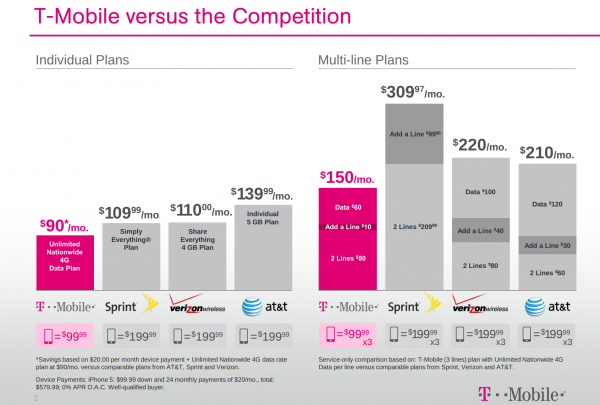
    T-Mobile will start selling iPhone 5 on April 12, for the lowest upfront-price among major carriers: $99.99. The rest is paid off in monthly payments and for full price of the handset and no contract. Rivals charge $199.99 up front with 24-month contractual commitment and hefty subsidy should customers change carriers before the term expires.

    iPhone 5 for Less

    “This is an important day for people who love their iPhone but can’t stand the pain other carriers put them through to own one”, John Legere, T-Mobile CEO, says. “We feel their pain. I’ve felt the pain. So we’re rewriting the rules of wireless to provide a radically simple, affordable iPhone 5 experience — on an extremely powerful network”.

    Ross Rubin, Reticle Research analyst, says the price “seems too good to be true”. That’s T-Mobile’s big carrot, perhaps more than the new data plans. Customers walk out the door spending upfront for iPhone 5 what competitors sell the 4S for. One C-note.

    To support iPhone and other smartphones, T-Mobile is expanding its 4G network beyond HSPA+. LTE launch cities are: Baltimore, District of Columbia, Houston, Las Vegas, Kansas City, Phoenix and San Jose. (Damnit, not San Diego). The carrier promises nationwide coverage by end of year. HSPA+ supporting iPhone 5 is available in 229 metro areas, according to T-Mobile.

    iPhone is U.S. market share leader, according to Strategy Analytics. While Android rules the world, iPhone rules the roost. T-Mobile has good reasons for coveting the iconic handset, which could unlock lots of customer upgrades while stemming some customer losses to competing carriers. That certainly was the case for Verizon, but less so Sprint. During fourth quarter, AT&T sold 10.2 million smartphones and activated 8.6 million iPhones. Surely T-Mobile would love even a small percentage of such sales success.

    Un-carrier Plans

    The above chart is T-Mobile’s comparison of its no-contract plans to options available from competitors. Does this jive with your real-world experience?

    Supporting Simple Choice plans offering unlimited text, talk and data and no contractual commitment, T-Mobile assumes label “The Un-carrier”, by placing emphasis on choice and freeing customers from forced lock-in. The new rate plans are a huge risk that, if successful, could fundamentally change how Americans buy cell phones — particularly if any of the Big Three offer something similar.

    Typically, carriers pay Apple huge amounts up front — say $649 for 16GB iPhone 5 — and sell the mobiles subsidized for much less, while locking customers into two-year contracts. Under T-Mobile’s new plan, there are no subsidies, but customers pay full price, either upfront or by monthly payments over X number of months, usually 24. There also is option for people to bring their own phones. I haven’t done a first-plush comparison but looks like the savings are more for people buying cheaper handsets with little data. For costlier smartphones and data plans, savings are iffy — or so I say after only cursory comparison, without really number crunching.

    During a press event, Legere tried to explain the new Simple Choice plans to dimwits like me. He makes a good case for greater transparency and simplicity about billing and customer costs. I have to agree — then there is the whole subsidy model, which favors Apple and a few other manufacturers reaping big margins by invisibly keeping device prices high. That $199 you pay masks the $649 the carrier dishes out.

    Broken Business Models

    Legere claims that the wireless industry is broken, and he gets no dispute from me — and judging from the live Twitter responses today — nor from many other cell phone users. But complexity and hidden costs cut different ways. T-Mobile’s iPhone 5 pricing looks like less than other carriers, but there is still monthly commitment to pay off the phone. That works out to $20 over 24 months, or about $580 when adding the initial money down.

    Reporter Brian Chen asks my question (via Twitter), too, when looking over the new plans. “Despite T-Mobile’s campaign to be a transparent ‘un-carrier’, I’m confused about the two-year device fees and the restrictions on phones. The phone can’t be unlocked until the two-year device fee is paid off. How is this different?”

    Difference is choice. Still, I’m on AT&T (for now) and the early termination fee decreases month by month during the contract period, so walking away and paying the ETF isn’t so different from leaving T-Mobile and paying off the rest owed on the phone.

    Jason Snell, Macworld editorial director, answers Chen (and indirectly me): “Different because when you’re done paying (after 2 years), your bill actually goes down. And you can BYOP and not pay fee”.

  • T-Mobile launches LTE network in 7 major markets

    T-Mobile LTE Launch
    T-Mobile fans haven’t just had to wait longer for the iPhone — they’ve had to wait longer for LTE service as well. T-Mobile on Tuesday began to rectify this, however, by officially launching its LTE network in Baltimore, Houston, Kansas City, Las Vegas, Phoenix, San Jose and Washington, D.C. The carrier says that its “advanced 4G LTE network is expected to reach 100 million Americans by midyear and 200 million by the end of 2013.” T-Mobile’s efforts to bring its LTE services throughout the United States will get an even bigger boost next month if shareholders for MetroPCS (PCS) sign off on a merger between the two carriers that will give T-Mobile significantly more LTE coverage. T-Mobile’s press release on the LTE launch is posted below.

    Continue reading…

  • What Will You Create to Make the World Awesome?

    When web designer Ben Blumenfeld was working for a major TV network, he was responsible for creating websites for mainstream shows. One day, he made a breakthrough that led to a significant uptake on a show, but the success struck Ben in a way he had not expected. His success meant more people would spend even more time watching TV, and he ultimately didn’t see that as a good thing.

    The moment proved to be an inflection point for Ben. He decided to stop thinking of his career as something separate from himself, and the values, ideals and principles that were important to him. He believed in making a positive impact in his community, and realized his day-to-day work wasn’t aligned with that. He decided it was time to pursue a path that baked his mission into his career.

    While still in that mindset, he received a phone call from Jeff Hammerbacher, the COO of a newfangled Silicon Valley startup with 8 million student users, who persuaded Ben to fly to California to meet the people working there. Later, when Ben mentioned his desire to make a positive impact in his community, the CEO assured Ben that the venture would impact the very way the human race communicated with each other, across cultures, political differences and national territories — literally bringing the world together. Ben concluded the CEO — Mark Zuckerberg — was either quite mad, or that he was a true visionary. Ben told me, “I knew Mark was going to build the company with or without me, and once I met the design team, I was just blown away. Every designer was insanely talented, both visually and technically.” And so, he decided to join in the effort.

    In time, Ben would come to lead the communication design team at Facebook as they built the company from 8 million users to almost a billion. He found the scale of every initiative to be surreal. “It was strange to design experiments that were measured in millions of people,” he told me. But, he also knew that the ability to connect so many people offered a huge opportunity to stay true to his goal of melding his career and his intention to make a positive difference in the world. Ben had an idea to work with Stanford’s Peace Innovation initiative, in connection with Stanford’s Persuasive Technology Lab, to start peace.facebook.com, which in turn sparked a conversation around the world about whether people believed we would reach peace in the next 50 years. (Incidentally, Americans are consistently far more pessimistic about this than other countries, such as Egypt, which is among the most optimistic). It was just one of the many ways that Ben decided to bake his mission into his career.

    Most recently he left Facebook and joined with Enrique Allen to cofound The Designer Fund. Enrique is also part of the founding team at 500 Startups, an early stage seed fund and accelerator in Silicon Valley. The Designer Fund invests in designer-led startups that bake positive social impact into the mission of the institution. Instead of impact being an afterthought or separate project, like some company’s apologetic foundations sometimes appear to be. (Explore some of their inspiring investments here: Neighborland, Angaza Design, Solar Mosaic and Launchpad Toys).

    I use the example of Ben to illustrate someone who’s approaching his career by design — not by default. It’s something that each and every one of us has the potential to do. When you get to a place in life where you’re questioning what the work you are doing — all the hours you’re spending — are ultimately adding up to, you need a process for evaluating what matters most to you. Here’s what I suggest:

    Step 1: Sketch Your Career. It is so easy to get consumed by the stream of activities in our careers. We get so caught up in living our lives that we don’t stop to think sufficiently about our lives. We are reacting instead of being strategic. When I find this happening, I use this simple tool to get a broader perspective. You start on the left at the beginning of your career and end on the right hand side (today). You draw a single line up if you were enjoying the experience and down if it was unfulfilling for you. Write down where you were working, what you were working on, and any other factors that shaped your experience.

    sketchyourcareer.gif

    It ends up looking something like this:

    connectthedots.gif

    Step 2: Connect the Dots. Use the sketch from Step 1 as a launch pad into being an anthropologist of your own life. Go somewhere quiet. You might think of it like a strategic offsite for your own life and career.

    Ask: When was I truly happy and why? What activity or theme do I keep coming back to? What is my gravitational pull? When was work effortless for me? What isn’t working for me? When do I seem most like myself? When was it meaningless and why? When was work meaningful and why? Don’t rush the process. Pause long enough to listen. Write the answers down as they come so you can reflect on them later.

    Step 3: Ask, “What Will I Create that Will Make the World Awesome?” That may sound like a bit of a wild question but an essential element of strategy is, to state the obvious, thinking about what we want to create in the future.

    Ask: What would I do if I could do anything? What would I do if all jobs paid the same? If I could only achieve one thing in my career, what would it be? What do I really want? Again, these are big questions. But my experience is that people spend far more time worried about their job than in creating a vision for their career and how they can uniquely contribute to the world. (If you are looking for a pep talk, this three minute video from “Kid President” does a brilliant job challenging us to figure out what we can do to make the world awesome).

    Many years ago I followed a process not at all unlike this one and, without exaggeration, it changed the course of my life. The insight I gained led me to quit law school, leave England and move to America to start down the path as a teacher and author. You’re reading this because of that choice. It remains the single most important — and strategic — career decision of my life.

    It’s a simple process. But it can help us to break down some complex questions. Like the poet Mary Oliver’s beautifully haunting question: “Tell me, what is it you plan to do with your one wild and precious life?”

  • 3D Printed Goldeneye 007 Remote Mine Is Your Nostalgia Prop of the Day

    If you’ve ever wanted to have you very own, functioning (minus the boom, of course), remote mine prop from GoldenEye 007 (the movie or the game, take your pick) – now is your chance…if you’re a 3D printer.

    This is as fine a piece of nostalgia as I’ve ever seen. Takes me way back. Sleepovers, Mountain Dew, playing the Facility map with mines only. Hostile standoffs. Man with the golden gun tiebreakers. NO JAWS, NO ODDJOB. Man, I need to start up the old N64.

    Anyway, this 3D printable remote mine beeps, lights up, and will turn any gaming room that much cooler.

    And look, you can stick it anywhere. Magnets, yo.

    Check it out in action:

    If you’re looking to make your own, head here to get started.

    [ComradeQuiche via Geekologie]

  • T-Mobile launches LTE with a bang, the iPhone 5 and no contracts

    T-Mobile’s transition to the “un-carrier” is complete. The last of the big four U.S. network carriers has an LTE service to call its very own: T-Mobile officially flipped the switch for its LTE network on Tuesday. At a press event in New York City, T-Mobile announced the first 7 cities that support the fast mobile broadband service: Baltimore, Houston, Kansas City, Las Vegas, Phoenix, San Jose, and Washington, D.C. New York City is expected to have LTE service by early summer.

    The carrier says it will deliver LTE speed to 100 million Americans by the middle of this year and 200 million by the end of 2013. LTE devices will include Apple’s iPhone 5 on April 12, plus the Galaxy S 4, BlackBerry Z10, HTC One and, after a recent software upgrade, the Samsung Galaxy Note 2. A new Sonic 2.0 Mobile Hotspot also joins the list of LTE-capable devices.

    Earlier this week, T-Mobile announced Simple Choice plans that don’t have contract terms. Instead, customers will choose from a rate plan including unlimited text, talk and various capacities of high speed mobile broadband service:

    “Customers start with one line at $50 per month for unlimited talk, text and Web with 500MB of high-speed data. Customers can add a second phone line for $30 per month, and each additional line is just $10 per month. They can also add 2 GB of high-speed data for $10 per month more per line. Unlimited 4G data is only $20 more per month per line.”

    The benefit here is that service is unbundled from the phone due to the lack of contract: Instead of sticking consumers with a phone for 24 months or more, phones can be upgraded at any point in time with no change in rates, nor any time commitments.

    Related research and analysis from GigaOM Pro:
    Subscriber content. Sign up for a free trial.

  • It’s finally here: T-Mobile iPhone 5 goes on sale April 12

    It’s official: T-Mobile has the iPhone. On Friday, April 12, the magenta-tinged operator will start selling the iPhone 5 nationwide and the iPhone 4 and 4S in select markets.

    T-Mobile now not only has the iconic device it has so long craved, but it’s offering it with compelling service pricing. Under the new plans unveiled over the weekend you can pay as little as $50 a month for unlimited voice, text and 500 MB of data, and you can use your phone as a hotspot – something most carriers charge you extra for doing on an individual data plan. For $70 a month, you can upgrade that data plan to unlimited, though hotspot usage is limited to 500 MB a month. All of these plans are available without a contract.

    But T-Mobile is demanding you make a trade-off. Its cheap rates mean it will no longer subsidize its devices, meaning customers will have to buy their iPhones up front, enroll in a financing plan, or bring an unlocked device to the network.

    The reason we’ve waited so long for the elusive T-Mobile iPhone is a combination of physics and economics. Since T-Mobile first launched its 3G mobile broadband network, it’s set itself apart from the other major carriers on the electromagnetic spectrum. Apple didn’t make an iPhone that tapped into the Advanced Wireless Services (AWS) band used by T-Mo’s HSPA+ network, and it showed no inclination of custom-designing a device for a specific carrier.

    That all changed last year when T-Mobile undertook an ambitious plan to reconfigure its networks and clear up spectrum for LTE. It began moving its HSPA+ network into the 1900 MHz PCS bands used by most U.S. carriers for 3G, and in the gaps that opened up it began deploying its LTE systems.

    Last summer, T-Mobile began inviting unlocked iPhone users to test out its network, but it hadn’t reached the point where it could support all of the new iPhone 5’s most advanced features. The missing component was LTE, which T-Mobile launched today in an iPhone-friendly band.

    Will the iPhone be T-Mobile’s savior? It’s tough to say. T-Mobile will finally have the most sought-after smartphone in its arsenal, and T-Mobile has readily admitted its lack of the device has hurt it with consumers. It will also be able to offer that device at very low pricing. But pricing and variety don’t always sway consumers. Verizon Wireless may be the most expensive carrier in the business, but its coverage and customer service have kept it on top of the heap.

    This post will be updated as we get more information.

    Related research and analysis from GigaOM Pro:
    Subscriber content. Sign up for a free trial.