Category: News

  • iPhone 5S Rumor: Launch Could Come As Early As June

    Earlier this month, a rumor suggested that we’d be seeing the iPhone 5S launch in August. Other rumors have backed the claim up, but an analyst has come forward with speculation that we could be seeing the iPhone 5S even sooner.

    In a recent investors note, Piper Jaffray analyst Gene Munster said that Apple will likely launch the iPhone 5S in late June. He also predicts that Apple will sell 4 million units before the end of the month. As for total iPhone sales, he expects those to be around 30 million by the end of the June quarter.

    Beyond his speculation of an earlier release date, Munster doesn’t really offer much in the way of new information in regards to the iPhone 5S. He regurgitates previous rumors that state the new iPhone will feature updated specs and whatever the next version of iOS brings to the table. He also suspects that Apple will incorporate NFC into the iPhone 5S.

    With all this talk about the iPhone 5S, it’s easy to forget that Apple may be launching a cheaper iPhone this year as well. A report from earlier this year suggested that the device would meld the designs of the iPod Touch and iPod Classic for a plastic chassis iPhone that would significantly reduce manufacturing costs. Munster predicts that we’ll be seeing this cheaper iPhone at some point in September, and that it will cost $250. Don’t expect it to see it in the U.S., though, as the phone is reportedly targeted exclusively at emerging markets like China and South America.

    Outside of phones, Munster drops some new speculation about the Apple TV and the rumored iWatch. He suspects that the oft-rumored Apple TV will finally be announced later this year with an iWatch announcement coming soon after.

    Like always, you should take anything analysts say with a grain of salt. They are only providing guidance to investors, and can be wrong. That being said, a June launch for the iPhone 5S would help Apple better combat the impending launch of the Galaxy S 4 and other top-tier Android handsets launching in the next few months.

    [h/t: CNET]

  • Stabbings at Target Injure Three, Including a 16-Year-Old Girl

    A trip to a local Target turned into a nightmare for Pittsburgh shoppers when a man wielding a kitchen knife began stabbing people in the store.

    According to a Pittsburgh Tribune-Review report, the man was chased into the Target and proceeded to take a 16-year-old girl hostage. It is unclear who exactly was chasing the man.

    The man reportedly entered the Target and ran to a second floor bathroom. He was then chased back downstairs, where he grabbed the girl, who was at a check-out line with her family.

    The knife-wielding man was jumped by two men while holding the girl. According to the report, he was beaten using fists and a baseball bat. Police arrived soon after and arrested the man using Tasers and pepper spray.

    The girl was stabbed in the back and arm, and is recovering at a hospital. Two others men were stabbed, one in the mouth and the other had his finger slashed.

  • Robots and rocket launchers: Kuato Studios uses gaming to teach kids the basics of coding

    Clashing robots, battle arenas set against industrial wastelands, promises of glory. At first glance, Kuato Studios’ new mobile game Hakitzu looks like any highly-produced iPad-based game a kid might play. But the company hopes it can do more than just keep kids entertained: its goal is to use sharp graphics, dramatic music and game mechanics to actually teach them how to code.

    Launched Tuesday, Hakitzu is the first game from Kuato Studios, a London- and Palo Alto-based learning startup founded last year and backed by SRI International, the company behind Siri.

    “We started to have a look at learning and education for the twenty-first century — what new techniques would we apply to learning, what technologies [could apply] to how kids are learning these days, “ said Frank Meehan, Kuato Studios’ founder and CEO, who formerly sat on the boards of SIRI and Spotify.

    At the 25-person company, he added, he essentially “mashed up” artificial intelligence scientists, educators and game developers to produce games that have all punch of an Electronic Arts game, but the educational value of teacher-created lesson.

    Hakitzu, which the company teased a bit last summer but didn’t release in its entirety until today, is meant to be the company’s showcase app, Meehan said, but future games will more deeply incorporate artificial intelligence.

    Given the growing recognition that students’ skills are lagging in computer science, Kuato Studios decided to focus its first game on teaching kids to code. As a widely-circulated video released last month by Code.org emphasized, coding is a key tool for the digital age but one not enough students have mastered. Less than two percent of students study computer programming but programming jobs are growing at double the pace of other jobs, the nonprofit says.

    Startups like Codecademy and Treehouse, as well as new startups Tynker and Hopscotch, which aim for a slightly younger audience, are similarly tackling the challenge of teaching programming to students.

    But Hakitzu aims to provide a far more gamified experience. Players assemble and customize their robots in the Chop Shop, select their arena and then play against friends or others. The goal is to hack your opponent’s lit-up “terminal” on the opposite side of the arena. Here’s where the programming comes in: to manipulate their robots (or “Code Walkers”), they have to actually code in the commands, for example:

    Move(“Forward”,3);

    FireLaser();

    Hack();

    The game targets kids aged 11 to 16, but could likely appeal to an even wider audience. In tests in schools, Meehan said the game interested boys and girls fairly evenly (although, to me, the robo- and battle-centric graphics and language seem as if they’d be more interesting to boys).

    On the engagement front, it’s easy to see how Hakitzu could capture and hold kids’ attention. But how effective is it in actually teaching them to code?  It could certainly help familiarize them with the basics of JavaScript, but typing in simple commands within the structure of a game is still a long way off from building a web site or programming an app.

    Meehan said Hakitzu’s goal isn’t to impart deep coding skills, but to jumpstart their interest in the field — and it’s happy to point them to Codecademy and other sites with comprehensive programming lessons.

    “We want them to get over the first hump of not knowing where to get started,” he said. “Further on down the track, what we want to do is push them off to other great coding companies.”

    Related research and analysis from GigaOM Pro:
    Subscriber content. Sign up for a free trial.

  • Guy Kawasaki On The Benefits Of Self-Publishing

    Guy Kawasaki, the former Apple evangelist, who is now advising Google’s Motorola group on product design, recently co-authored a book with Shawn Welch, called APE: Author, Publisher, Entrepreneur–How to Publish a Book, aimed at helping people understand the self-publishing process. Kawasaki offered WebProNews some additional thoughts on the subject, so if you’ve written a book, or are planning to, pay attention.

    According to Kawasaki, there are three main benefits to self-publishing versus traditional publishing.

    “Creative control, shorter time to market, and greater royalty per copy,” he says, noting that these benefits do, however, come with “greater responsibility for the quality of your book.”

    “There’s no such thing as a free lunch,” he adds.

    When it comes to marketing and distribution, Kawasaki notes, “First, an author has to realize that whether her publisher does these things or she does them herself, the same things have to happen. Many self-published authors don’t realize this. Then the most powerful method is to use social media such as Google+, Twitter, and Facebook to develop a fan base that you own. This applies to traditionally published authors too.”

    In 2011 the publisher of Kawasaki’s book Enchantment couldn’t fill an order for 500 ebook copies, he tells us. For that reason, he self-published his next book, What the Plus! (which we discussed with him here). He says that this experience helped him learn first hand that self-publishing is a “complex, confusing, and idiosyncratic process.”

    Though the book was self-published, it’s now available from McGraw Hill.

    “I met an editor and one thing led to another, and I pitched her on the idea,” says Kawasaki of how the publisher came to pick up the book. “The book had been out about six months by then. I learned two things from this experience: first, a good publicist can get press that simply social-media contacts cannot. Second, non-fiction books need to be available in both electronic and paper format.”

    According to Kawasaki, the ease of self-publishing means that the 99.9% of authors that publishers reject have an alternative. “It also means that the .1 percent of authors who use traditional publishing also have an alternative,” he adds. “If they can bring themselves to view this positively, it means that they can cherry pick books that are successfully self-published and turn them into even bigger sellers. That’s a huge ‘if,’ however.”

    Those self-publishing books inevitably have to figure out how much they’re going to charge for them. You don’t want to set the price too high, where nobody will buy it, but you also don’t want to short change yourself. How do you know how to price it?

    Kawasaki says, “My theory for ebooks is this: $.99 for a novice novelist, and $2.99 for an established but emerging novelist. When you’re proven, then you should go to $9.99. For non-fiction, you should start at $4.99 to ensure that people take your book seriously. Then you should go to $9.99 when you’re proven too.”

    Obviously people are reading ebooks more these days thanks to ereaders and tablets. Tablet is Kawasaki’s preferred medium for books, “by far.”

    “I’ve bought about 200 Kindle books so far,” he says. “I read five times the books I used to read before because of the convenience of Kindle books.”

    Last year, we spoke with fiction writer Joe Lansdale, who told us that paperbacks (the smaller ones, at least) will soon be gone. When we asked Kawasaki for his thoughts on this, he said, “It depends on what he means by ‘soon.’ I’d say this is probably the first genre to go because people read this kind of books in large quantities so the frictionless buying of ebooks is compelling. Also, no one can see the cover of what you’re reading on a tablet, so you don’t have to hide Fabio’s picture. Finally, it seems like this is the genre where novice writers often emerge.”

    Lansdale also said ebooks are too easy to copy, which can potentially cut into a writer’s sales.

    “My logic on DRM is that it inconveniences legitimate customers and doesn’t hinder crooks, so you shouldn’t worry about it,” says Kawasaki. “I doubt that an author can sue or copy-protect her way to success.”

    APE started off as a Kindle ebook, but is now also available in paperback.

  • White-hot BI-on-Hadoop startup Platfora now GA

    Platfora, the San Mateo, Calif.-based startup that helped spur a general rethinking of business intelligence for a big data world, is finally exiting its beta period and is generally available. It’s no wonder the company has garnered so much attention given its stated mission to make Hadoop an interactive experience and to disrupt a multi-billion-dollar data warehouse and BI market.

    Unlike legacy BI applications that generally connect to Hadoop but otherwise retain their old-school performance limitations, Platfora and its ilk have big data at their core. Platfora is built on Hadoop for scale, but the company also has its own IP around in-memory processing to improve the speed of slicing and dicing through data, and its HTML5 interface provides an easy way to navigate through lots of data points.

    Justin Borgman Hadapt Tomer Shiran MapR Technologies Ashish Thusoo Qubole Ben Werther Platfora Structure Data 2013

    Werther (far left) talking SQL on Hadoop at Structure: Data 2013 along with representatives from Qubole, MapR, Hadapt and Facebook.

    I’ve compared this general family of products — in which I’d also include ClearStory, Precog, SiSense and Birst, among others I’m sure — to Tableau, albeit slightly (sometimes significantly) rethought and then jacked up on steroids to handle big data scale and/or speed. The big difference with Platfora, though, is that it’s built on top of Hadoop and is therefore part of an even bigger movement around that open source platform and a quest to build native SQL queries into a system designed for MapReduce.

    We have been covering Platfora since its inception, from stealth mode to launch, and then a whopping $20 million VC investment in November.

    Related research and analysis from GigaOM Pro:
    Subscriber content. Sign up for a free trial.

  • How many people are actually “reading it later”? Pocket launches tool for publishers

    As web audiences increasingly shift to mobile devices and new reading platforms like Twitter and Flipboard, publishers are hungry to learn as much as possible about how consumption patterns are changing.

    Pocket, the read-it/watch-it/consume-it-later service formerly known as Read It Later, on Tuesday launched Pocket for Publishers, which aims to shed some light on that question. The free tool gives publishers a better idea of the lifespan of a story, by telling them the percentage of readers that are actually coming back to read content they’ve saved, and how long it takes them to return. Pocket is launching the tool with a handful of publishers, including GigaOM and paidContent.

    Pocket for Publishers has two parts. On the front end, publishers can install a “Save to Pocket” button on their websites, can integrate the technology into their apps, and can add a custom message to the footer of any article or video saved from their site to help promote special content, their apps, their social media accounts, or other things.

    pocket gigaom screenshotOn the back end, participating publishers access a dashboard that includes “includes top content and authors based on saves, opens and open rate, and new metrics that focus on longevity and engagement.” At left, you can see a sample of what that looks like, for Om Malik’s recent story “Google Reader lived on borrowed time: creator Chris Wetherell reflects.

    Launch partners (besides us) include The Verge, Buzzfeed, Longreads, USA Today, WordPress and The Next Web. Other publishers can sign up to request access.

    Late last year, Pocket also rolled out subscription options for publishers that charge for content. Among the publishers already using this service are the Virginia Quarterly Review, the New York Review of Books and longform journalism site Matter. The subscription options aren’t automatically included in the new Pocket for Publishers, but users can request them.

    Pocket has over 8.5 million users across the web, Mac, iOS and Android, and is also integrated into services like Flipboard and Zite. The company says that users saved content to Pocket 240 million times in 2012.

    Pocket competitors include Instapaper, a paid app with about 2 million users, and Readability. (Readability offered a payment-sharing program for publishers, but ended it last year.) Amazon, too, hopes to compete in the space with a new “Send to Kindle” button for publishers.

    Related research and analysis from GigaOM Pro:
    Subscriber content. Sign up for a free trial.

  • Stealth Innovation Is Not a Solution

    Making innovation happen inside established organizations is just darned tough work. That’s because there are deep and fundamental conflicts between innovation and day-to-day operations—and established organizations are built more for the latter than the former.

    No wonder, then, that business people tend to conceptualize innovation as a battle — usually one between an heroic innovator and a bureaucratic octopus. Indeed, the two most common questions that I get when I present on this topic are: 1) How can I find the real innovation heroes in my organization?, and 2) How can I knock down at least some of the barriers that I know that they will face?

    This is a completely natural and intuitive framing of the innovation challenge … but it is also highly toxic.

    In this idealized innovation romance, heroic individuals reign supreme. Brilliant people concoct brilliant ideas, and then they have the perseverance to make things happen no matter the obstacles. The reality, however, is quite different: Innovation is fundamentally a team sport.

    The challenge for organizations, after all, is to find a way to simultaneously tackle two distinct and often conflicting tasks—sustaining what exists and building something new. One person working underground and fighting the system is not a realistic approach. Indeed, it borders on fantasy.

    As such, I was disheartened, at first glance, to see last month’s HBR article “The Case for Stealth Innovation.” I immediately worried that in the minds of casual readers, the article would only reinforce innovation’s most poisonous myth.

    The article, on closer inspection, is realistic. Of critical importance, the article is not really about getting an innovation initiative to the finish line, it is simply about getting an idea developed to the point that it will gain the approval of senior managers.

    The authors focus on a very specific potential problem — that if you show senior managers a half-baked idea and they reject it, they may later be too uncomfortable to “flip flop” when you do have a sufficient data to prove your case. Better, then, the authors argue, to work underground until you have a more defensible proposal.

    And how to get the resources needed to gather the data, do the research, build the prototype, or formally test the idea? You beg, borrow, and steal, the authors advise. You build a coalition of the willing. You scrape by as best as you can, on whatever little slivers of free time your collaborators can contribute (after they finish their day job, of course), and on whatever pockets of free money you can find (in an efficiently run company, of course, these are very hard to come by). The authors even go so far as to suggest that stealth innovators develop a cover story, pushing into ethical grey areas in which deceiving senior managers is acceptable so long as the cause is noble.

    A clever and persuasive stealth innovator may indeed be able to cobble together sufficient resources to move an idea forward. But all of this, just to get to the point that you gain formal approval for your project? Certainly, there must be a better way.

    Two questions for senior executives:

    1. How many stealth innovators do you want running around in your company?
    2. Wouldn’t it be smarter to allocate a budget for explicitly supporting your company’s innovators in their efforts to convert half-baked ideas into more solidly researched proposals?

    The article closes: “With the right backing and some hustle and ingenuity, young breakthrough ideas can be turned into successful corporate initiatives.” Let’s be sure to recognize that a formally approved proposal is still a long, long way from a “successful corporate initiative,” and, unless the initiative is quite small and incremental, it will take much more than one stealth innovator’s hustle and ingenuity to get to the finish line.

  • Savvis Launches Online Customer Business Exchange

    Savvis, a CenturyLink (CTL) company, introduced Savvis ClientConnect, an online gateway for businesses to generate new revenue opportunities by connecting with other businesses housed in Savvis data centers. Savvis operates data centers across the United States, Europe, Canada and Asia.

    ClientConnect is designed to help customers discover interconnectivity possibilities within their industry by making it easier for them to locate, connect and share services with other businesses residing within Savvis data centers around the world. It also provides the opportunity for service providers within Savvis’ network to market themselves to other Savvis customers.

    “Whether you’re a retailer looking for e-commerce services or a trading firm looking for low latency access to financial exchanges, Savvis ClientConnect gives you visibility into the players that can help accelerate your business growth,” said Drew Leonard, vice president, colocation product management at Savvis.  ”Clients that opt in to this service can save time and money connecting with a variety of diverse businesses and carriers found within our global data center network.”

    The ClientConnect tool features an intuitive search function, client profile pages, rapid client-to-client cross-connect provisioning, visibility into interconnectivity opportunities with hundreds of Savvis colocation and managed services clients, and contact information to discuss potential business relationships.

    “In today’s competitive economy, companies must focus technology resources on the areas that drive the most business value,” said Joel Odelson, CIO, MorphoDetection. “Savvis provides the infrastructure solutions that help us reduce costs and improve service levels so that we can devote our energy to the right places. Features like Savvis ClientConnect can help companies deliver even more value by highlighting opportunities with potential partners that can fuel growth.”

  • Google’s Slow Poisoning of Google Reader Continues

    Although Google Reader is still up and running smoothly for now, Google is continuing to slowly rid the internet of any traces of its existence.

    Reader, which used to be one of the main options on Google’s omnipresent black bar menu, is nowhere to be found. Not even in the “more” tab. Google, who previously stated that they would officially kill the product on July 1st, is prepping it for the kill by making it just a little bit harder to access every day.

    Last week, we told you that Google Reader had disappeared from the black bar menu inside Gmail and Google+. If you clicked on the “more” tab while on the main Google homepage or on Image search, Google Play, Google Calendar, and all of the other Google products, Google Reader was still a clickable option.

    Today we noticed that this is no longer true. No matter what Google product you’re currently using, the black bar menu no longer shows any trace of Google Reader.

    What is simply frustrating right now is probably for the best. Any inconvenience Google can throw up in the way of you using Google Reader will likely help you out in the long run, maybe force you to go ahead and look for an alternative. But as of now, the only two ways to access Google Reader is to go directly to google.com/reader or just search “reader.”

  • The Economics of Genomic Medicine: Workshop Summary

    Prepublication Now Available

    The sequencing of the human genome and the identification of links between specific genetic variants and diseases have led to tremendous excitement over the potential of genomics to direct patient treatment toward more effective or less harmful interventions. Still, the use of whole genome sequencing challenges the traditional model of medical care where a test is ordered only when there is a clear indication for its use and a path for downstream clinical action is known. This has created a tension between experts who contend that using this information is premature and those who believe that having such information will empower health care providers and patients to make proactive decisions regarding lifestyle and treatment options.

    In addition, some stakeholders are concerned that genomic technologies will add costs to the health care system without providing commensurate benefits, and others think that health care costs could be reduced by identifying unnecessary or ineffective treatments. Economic models are frequently used to anticipate the costs and benefits of new health care technologies, policies, and regulations. Economic studies also have been used to examine much more specific issues, such as comparing the outcomes and cost effectiveness of two different drug treatments for the same condition. These kinds of analyses offer more than just predictions of future health care costs. They provide information that is valuable when implementing and using new technologies. Unfortunately, however, these economic assessments are often limited by a lack of data on which to base the examination. This particularly affects health economics, which includes many factors for which current methods are inadequate for assessing, such as personal utility, social utility, and patient preference.

    To understand better the health economic issues that may arise in the course of integrating genomic data into health care, the Roundtable on Translating Genomic-Based Research for Health hosted a workshop in Washington, DC, on July 17-18, 2012, that brought together economists, regulators, payers, biomedical researchers, patients, providers, and other stakeholders to discuss the many factors that may influence this implementation. The workshop was one of a series that the roundtable has held on this topic, but it was the first focused specifically on economic issues. The Economics of Genomic Medicine summarizes this workshop.

    [Read the full report]

    Topics: Health and Medicine

  • Samsung sues LG for allegedly ‘tarnishing its corporate image’ in refrigerator ads

    Samsung LG Lawsuit
    After reportedly dropping its earlier lawsuits against LG (066570), Samsung (005930) on Tuesday filed a brand new suit against its South Korean rival over alleged slander committed in a refrigerator ad. For those who need a refresher, Samsung and LG had been locked in a patent battle over OLED and LCD display technology, although both were said to be working toward patent peace with a settlement. LG recently reaffirmed its suit against the company and demanded compensation, and even made threats against Samsung’s new Galaxy S 4 smartphone. Unlike earlier disagreement, however, the latest lawsuit does not involve patents.

    Continue reading…

  • CamBoard Pico Demos What Kind Of Gesture Control Your Next Computer Could Have Built-In

    Screen Shot 2013-03-26 at 7.55.35 AM

    CamBoard Pico is German firm pmdtec’s next-generation gesture input reference device. We showed you before what it could potentially do to change the computer interface, and now there are a couple of new videos from the company showing how it’s working with middleware makers and what it can truly accomplish in practice in actual shipping products.

    The gesture detection in these videos is impressive, and shows a solution that’s not only small enough to be incorporated into devices like notebooks, but also works at a sufficient distance that it’s actually usable, accurately, when you’re up close and working with said devices as you would normally.

    Individual finger detection and the ability to use the CamBoard Pico tech to accomplish simple, practical things like switching between open apps. Unlike Kinect, it looks like you can use the CamBoard pico even from your standard typing position on a notebook computer, just by raising a finger while typing. That’s much, much more useful than gesture tech that requires a user to adjust themselves back from the screen, or even worse, stand up to interact with a computer, and much more likely to gain wide adoption, rather than acting as a sort of novelty.

    The second demo video, which shows pmdtec working with Metrilus middleware, demonstrates more the general gesture sort of control we’ve come to expect from Kinect and similar technologies, but again, the distance and flexibility are impressive. I’m excited to see what the forthcoming Leap Motion controller can accomplish when it ships later this year (it seems to offer similar functionality and working distance), but pmdtec’s goals and sales strategy are very different.

    It’s targeting original design manufacturers (ODMs), who in term will sell through to OEMs. That means that together with its middleware partners, pmdtec can sell these things directly to computer manufacturers, meaning when you buy a future Acer, Asus or Sony laptop, it’ll come with accurate gesture recognition tech onboard if this product catches on. With these new practical demonstrations of how that might be of use even with current operating systems and interfaces, that’s a pretty exciting prospect.

  • New Research: The State of Work for Indian Women

    The conventional narrative of India’s educated women tends to emphasize the tectonic collisions between “India Inc.,” with its expanding array of opportunities, and “Old India,” whose traditions persist in shaping — and sometimes limiting — women’s career ambitions. While there’s no minimizing this complex dynamic, a new research report to be released next week from the Center for Talent Innovation reveals surprising news: India’s women professionals are realizing their career ambitions remarkably well. In fact, they’re not just succeeding at the difficult balancing act that confronts the vast majority of working women around the world; in some critical ways, they are far ahead of their counterparts in the United States, Germany, and Japan.

    A little over one-third (36%) of the 775 college-educated women surveyed off-ramped, that is, voluntarily quit their jobs for a period of time. This is on par with the U.S., Japan, and Germany. But the amount of time they spent out of the workforce was less than a year.

    Average Length of Off-Ramping

    Many Indian women prefer to step back instead of stepping out: 73% take a scenic route, opting for part-time work, flexible work arrangements, or a position with fewer responsibilities, compared with 58% in the U.S., 49% in Germany, and 36% in Japan.

    Women all around the world face a barrage of barriers — both cultural and professional, at home and in the workplace — blocking their ability to pick up their careers where they left off. The most startling figure, however, is not that an overwhelming 91% of Indian women want to return to work but that so many succeed in on-ramping.

    Getting Back on Track is Easier for Indian Women

    That the story is so markedly different in India is due to the economic dynamo that women help power. Even though the torrid growth of the past decade cooled to 5.3% in 2012, the outlook is far healthier than in many mature markets of Europe and North America, fueling an ongoing war for talent. “The biggest limitation to growth is not market opportunities but finding the talent to maximize these opportunities,” says Sunil Nayak, CEO of Sodexo India. His concern is shared by a third of Asian executives in a recent survey (PDF), who were worried about being able to attract and retain the staff they needed. Because the Indian market is growing so fast and is still relatively new, the pipeline of experienced employees is simply not large enough, opening opportunities for on-ramping women.

    However, CTI research uncovered a troubling trend for employers: 72% of women who want to on-ramp do not want to return to the company they left. Dissatisfaction with their rate of career progression drives almost as many women out of the workforce as childcare.

    Why Women Leave

    At the same time, many women have difficulty juggling work and family obligations, and feel they receive neither support nor understanding from their employers. Although many companies offer flexible work arrangements, more than half (54%) of women professionals believe they will be penalized if they choose that option. Women who have taken a scenic route are significantly more likely (62% versus 48%) to feel stalled at work than their peers who followed a more conventional career path. Returnees to full-time schedules also feel stigmatized for having taken a leave. Suspicious that off-rampers might take time off again, coworkers are often resentful when they return, and managers marginalize them in dead-end project work.

    In short, on-ramping is easy in India. Up-ramping — regaining career momentum — is hard.

    Forward-thinking companies are aware of the rich potential offered by off-ramped women and are taking steps to facilitate their return. One approach that worked at GE India: proactively planning a woman’s on-ramping strategy before she off-ramps through an upfront discussion between the woman and her manager. Companies can also foster vital connections between off-ramping women and designated mentors, with role models who have successfully on- and up-ramped, and through informal networks of colleagues. “That way, when you come back, it’s not a strange place,” notes a female general manager at a finance multinational. “You know what’s changed, and you already understand what’s going on.”

    As India’s economic growth engines diversify from low-wage back-office administrative and technical operations to independent functions that add real value, talented women are more and more critical to a company’s ongoing success. Preparing women for the on-ramping struggles before they head out of the workforce is the first step at retaining the women a company needs for growth.

  • Ford Snapping Spark Plugs STILL Occurring – Other Trucks Next

    For years, Ford has been known for building engines with spark plugs that snap off. With several class action lawsuits related to the problem still in court, no resolution on the horizon and new metals and mixed-metals being used in building trucks, will this issue spread to other trucks due too?

    Ford Snapping Spark Plugs STILL Occurring

    This is a common sight to Ford Triton owners. Could we all be facing issues like this?

    Not aware of this issue, go ahead and type “ford spark plug class action” into Google, Bing or Yahoo. You will find several news stories and law offices dealing with class action lawsuits that have been filed over the years. The claim goes like this: Ford sold or leased F-150s, Mustangs, Explorers and other vehicles including the Triton V-8 engine with knowing that the spark plugs could snap due to engine design and/or materials. The truth is that Ford did anticipate this to some degree and actually produced a tool for dealers to address this when it happens.

    Here is the statement from one class action suit:

    “In fact, even after Ford developed a special tool and procedure to remove the defective plugs, and after a replacement spark plug was developed, Ford continued to manufacture, sell, and lease the Covered Vehicles with the defects,” the class action lawsuit continues. “As a result of Ford’s knowing and intentional conduct, Plaintiff and Class Members have been required to spend hundreds, and in many instances, thousands of dollars more than reasonably could be anticipated to replace spark plugs — something that generally costs around $150.”

    The way we understand it, the class action suits are being merged and are still in court. However, after a year of litigation (the above was filed in January, 2012), maybe they will finally settle like Toyota was forced to over the unfounded acceleration issue.

    What’s the Deal?
    The problem boils down to the mixing of different metals. To the point, “The dissimilar metals of the spark plug and the cylinder head coupled with a long service life just about welds the plug into place,” according to YouFixCars.com. “To make matters worse carbon develops on the plugs where it sticks into the combustion chamber again making it harder to remove without breaking.”

    Nowadays, most everyone is aware of the issue with the Triton V-8 engine AND they have bought the special removal tool from either Lisle or Cal Van. With this tool and a whole lot of experience, you can probably get all the spark plugs out without an issue. Note, probably not 100% for sure.

    The sad part is that it is STILL an issue. Some Ford websites say the issue started way back in the late 90′s – almost 15+ years ago. It seems rather interesting that a permanent solution hasn’t been devised.

    The real scary part for all future trucks owners is that the new weight-saving strategies of truck makers are thought to include the use new metals or combinations of existing metals. Without years of proven track records, these new metals have the potential of having unintended consequences like the Triton V-8. It does make you wonder if this problem or a new problem will impact trucks in the future. This is especially true of new vehicles that don’t require maintenance as often and with parts lasting longer. To be blunt, it will simply take a longer period of time before these issues present themselves. That could be bad news for all of us.

    Will a class action suit force Ford to address this issue? Will other trucks have issues with mixed metals? What do you think?

    Related Posts:

    The post Ford Snapping Spark Plugs STILL Occurring – Other Trucks Next appeared first on Tundra Headquarters Blog.

  • Apple buys indoor mapping company in latest bid to improve iOS Maps

    Apple WifiSLAM Acquisition
    Apple (AAPL) is still plugging away in its efforts to improve its widely panned iOS Maps application and on Monday it paid an estimated $20 million to acquire indoor mapping company WifiSLAM. The Wall Street Journal reports that WifiSLAM “has developed ways for mobile apps to detect a phone user’s location in a building using Wi-Fi signals” and “has been offering the technology to application developers for indoor mapping and new types of retail and social networking apps.” An Apple spokesperson wouldn’t tell the Journal why Apple had acquired the company and only said that it “buys smaller technology companies from time to time.”

  • Cisco, Oracle Go Shopping, Announce Acquisitions

    It’s already been a busy year for deals, and Monday saw a flurry of deal announcements in the tech sector. The action was headed by two enterprise IT titans and frequent acquirers – Cisco and Oracle.

    Cisco to acquire SolveDirect

    Cisco (CSCO) announced its intent to acquire SolveDirect, a privately held company headquartered in Vienna, Austria that provides cloud-delivered services management integration software and services. SolveDirect’s cloud-based solutions offer enterprises and service providers a flexible way to integrate with service partners, and automate sharing of processes, data, and workflows in real-time by eliminating manual practices and bottlenecks. The company specializes in ITSM (Information Technology Service Management) integration solutions. Gartner listed SolveDirect in its 2012 Cool Vendors in Cloud Services Brokerage Enablers. SolveDirect’s capabilities will enable Cisco to extend our portfolio of smart and connected IT services to our global ecosystem of customers, partners and resellers.

    Oracle buys Tekelec

    Oracle (ORCL) announced that it has entered into an agreement to acquire Tekelec, a provider of network signaling, policy control, and subscriber data management solutions for communications networks. Tekelec solutions are used by over 300 service providers in 100+ countries. Its network signaling  (Diameter and SS7), policy control and subscriber data management solutions complement Oracle Communications’ mission-critical operational support systems, service delivery platforms, and business support systems. By combining Tekelec with leading capabilities from Oracle Communications and Acme Packet*, Oracle expects to provide the most complete communications offering that will enable service providers to engage with customers, improve operations, control network resources and deploy innovative communications services.

    “As connected devices and applications become ubiquitous, intelligent network and service control technologies are required to enable service providers to efficiently deploy all-IP networks, and deliver and monetize innovative communication services,” said Bhaskar Gorti, senior vice president and general manager, Oracle Communications. “The combination of Oracle and Tekelec will provide service providers with the most complete solution to manage their businesses across customer engagement, business and network operations, service delivery and end user applications.”

    Meanwhile,  Yahoo and Apple also got out the checkbook.  Yahoo looks to enhance its mobile experience with a $30 million purchase of summarization app Summly, and Apple quietly paid around $20 million for indoor location company WifiSLAM.

  • Apple Patents Battery-Saving Multi-Touch Displays That Don’t Need To Be Active To Work

    Screen Shot 2013-03-26 at 7.25.16 AM

    Apple was granted a patent Tuesday by the USPTO (via AppleInsider) that describes a system for implementing multi-touch in a mobile device even when there the display itself isn’t actively showing any images. It’s a neat trick, and one that could help portable gadgets save battery life by not invoking the most battery-hungry element in their construction nearly as frequently.

    The patent also notes that the screen doesn’t have to be off for these no-look commands to work; a user could do things like swipe a finger in circle to change volume or tracks, for instance, even while a display is active. That adds new control options, but also makes it possible to both remove external buttons should a design benefit from that, and also make the device easier to use when in a pocket or clipped to an armband or waist during a workout.

    While the display is inactive, the patent describes that it could use gestures that mirror the button press actions on current iPod and iPhone headphone remotes. So, a single click could play/pause, a double click could skip tracks, and a long press could call up Siri, for instance.

    In terms of recognizing when touch is and is not wanted, the patent suggests implementing a special mode that would allow it to both keep the screen dark but also receive touch inputs. This might involve a way to activate a mode between a full lock and a completely on and active device, which can be selected specifically for when a user is commuting or using the device while working out, but disabled when there’s risk of accidental touch.

    It’s an interesting patent, and one which Apple has shown off as working with its previous iPod nano design, which essentially featured a square display and little else in terms of physical buttons. The trick might be making this work in such a way that it still completely eliminates any chance of accidental input – the lock screen concept is synonymous with touchscreen devices for a reason, after all.

    Not activating the screen as much as possible is the key to prolonging device battery life, though, so it’s good to see Apple looking at ways to deal with that primary limiting factor. It’s no e-ink display built into the back of a smartphone, but it’s something.

  • Try Windows Blue for yourself using VirtualBox

    Windows Blue, the next Windows release, leaked onto the internet at the weekend. It has some interesting new features and tweaks, but because it’s such an early and buggy build it wouldn’t be advisable to replace your existing OS with it. You could of course dual boot from it, but it’s just as easy to run it in a virtual environment where any crashes or issues won’t lead to you having to reboot your PC.

    For this guide I’ll use Oracle VM VirtualBox because it’s a great free program and setting up Windows Blue is incredibly straightforward with it.

    To start you’ll obviously need a copy of the leaked image file — build 9364. It’s available on all the usual torrent sites, so just do a quick search. The file you want is 2.63GB in size. There’s only a 32-bit version available, but because we’ll be running it in a virtualized environment, it will run fine on 64-bit systems.

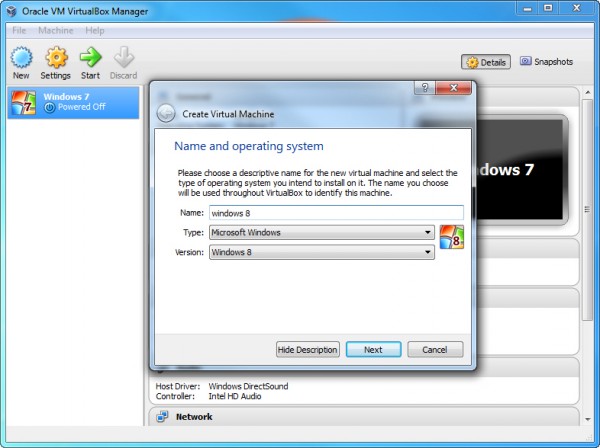
    Launch VirtualBox and click New in the Manager. In the Create Virtual Machine dialog box enter “Windows 8” as the name of the OS. VirtualBox will fill in the rest of the details for you.

    Next set the Memory Size. Accepting the recommended memory amount will likely be fine. On the next screen choose to “Create a virtual hard drive now” and click Create. Accept VDI (VirtualBox Disk Image) as the hard drive file type.

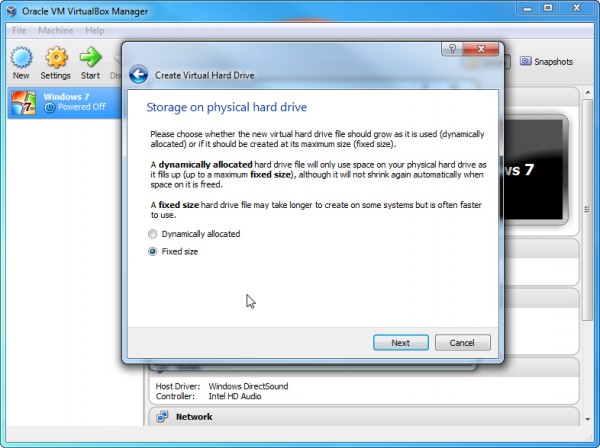
    You’ll now be asked if you want the new virtual hard drive to be dynamic (it will grow as required) or a fixed size. I always select the latter option. It takes a while to create a fixed size drive, but the operating system runs faster afterwards.

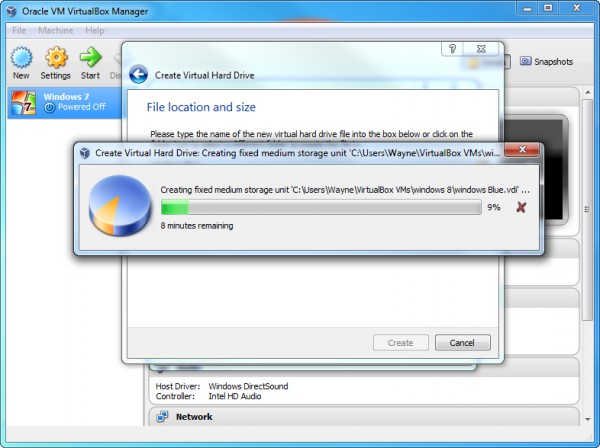
    Type in a name for the new virtual drive and choose a size for it. Again, accepting the default will likely be fine. Click Create and VirtualBox will begin building the drive. It will probably take around 10 minutes or so to do this (maybe more if like me you choose to convert some large videos at the same time).

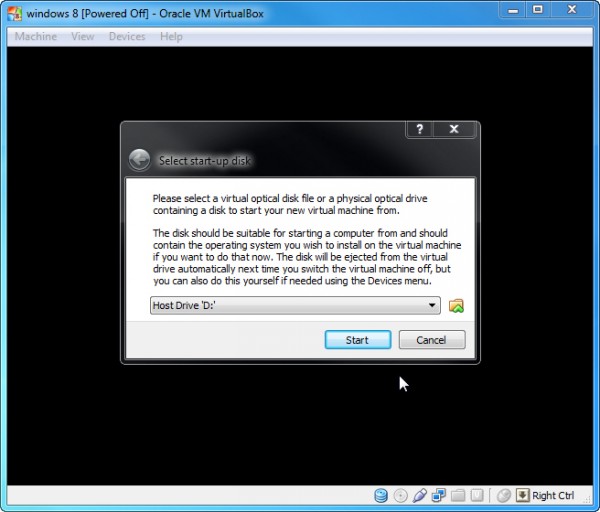
    The “Select start-up disk” window will open. If you’ve burnt the downloaded ISO file to disc you can select your drive in the drop down menu (if it’s not already selected). If you just have the file residing on your hard disk, click the folder icon and navigate to it instead.

    Once selected, click Start and Windows 8 (which is what the OS is referred to throughout) will start to load. The language screen will appear first. You’ll have to accept English (United States) as this is the only option in the leaked build. On the next screen, click the “Install now” button.

    Choose the “Custom: Install windows only (advanced)” option. It will show you the drive it’s going to be installed on. Click Next, and it will begin the installation process, rebooting when required. When that’s done, personalize the OS by picking a color and entering a PC name, and then choosing to use the express settings (which I do) or customizing things further.

    Set up a Microsoft Account if required, and then that’s it. Windows Blue will be up and running and you can begin trying it out for yourself.

  • ISO Workshop makes it easy to manage, convert and burn disc images

    Glorylogic Software has released ISO Workshop 4.0, a major update of its disc image management, conversion and burning tool. Version 4.0 broadens the tool’s ISO format support to cover six different disc types: CD, DVD, Blu-ray, Bridge, DVD video and bootable.

    The program also tweaks the existing user interface, adding new buttons to facilitate creating folders and editing files within ISO images. Other buttons have been added for loading and extracting files from ISO images.

    ISO Workshop 4.0 also comes with an updated disc-burning SDK and promises resolutions for problems opening certain image formats as well as compatibility issues with other, non-specified burning tools.

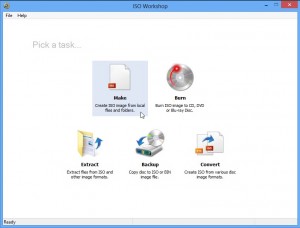
    ISO Workshop’s big selling point is its simple, unfussy interface. There are five options available — users can both create new image files from scratch and burn existing image files to disc. ISO Workshop supports all common image file formats, including ISO, BIN, NRG and MDF, and there’s an option for converting images to ISO or BIN format.

    Users can also extract individual files and folders from image files without having to burn them to disc or mount them using Windows 8’s native tool or a third-party utility such as Virtual CloneDrive. A fifth option — Backup — allows users to create image files from physical discs.

    The program promises to work with most major optical disc formats, including Blu-ray and most writable DVD formats, and claims to support all types of recordable drives. ISO Workshop 4.0 is a freeware download for PCs running Windows NT or later, including Windows 8.

    Photo Credit: AISPIX by Image Source/Shutterstock

  • Less digging and more speed: how Europe plans to get back on the broadband track

    Europe’s digital agenda chief, Neelie Kroes, may have lost all her funding for ensuring fast broadband coverage across the continent by 2020, but she’s still not giving up hope. Her latest push, unveiled on Tuesday, has two main strands: cutting some of the red tape around deploying 4G masts and antennas, and changing regulations around civil works.

    The European Commission reckons 80 percent of high-speed network deployment costs are to do with civil engineering, mostly digging up roads. For example, it may be that a road is being dug up anyway for the laying of new waterworks or electricity cables, and it would be a no-brainer to lay some fiber in there at the same time – however, in many European countries that kind of coordination is not in place, and that’s what Kroes wants to fix.

    Kroes maintains that this could take €40-60 billion ($51-77 billion) off the overall cost of deploying fiber-based broadband in Europe. She also wants rules brought in to ensure that newly-built or renovated buildings have the necessary equipment in order to receive fiber directly to the premises, and to mandate reasonably-priced open access conditions on infrastructure such as ducts and poles.

    On the mobile front, Kroes says permits for new masts and antennas should be granted or refused within six months. Her office is painting all of these changes as cuts to red tape – while this interpretation may be debatable, as some of the changes would actually involve new rules, the overall result would at least be one of more efficient bureaucracy.

    “Everyone deserves fast broadband. I want to burn the red tape that is stopping us for getting there,” Kroes said in a statement. “The European Commission wants to make it quicker and cheaper to get that broadband.”

    Kroes’s Digital Agenda office intends to see, by 2020, that everyone in Europe has access to at least 30Mbps broadband, and that half the EU is able to surf at 100Mbps or more. She recently threw €50 million in the direction of “5G” research, so that mobile can carry more of the load in meeting those goals.

    Related research and analysis from GigaOM Pro:
    Subscriber content. Sign up for a free trial.